
Procedia Computer Science 57 ( 2015 ) 1384 – 1393
1877-0509 © 2015 The Authors. Published by Elsevier B.V. This is an open access article under the CC BY-NC-ND license (http://creativecommons.org/licenses/by-nc-nd/4.0/).
Peer-review under responsibility of organizing committee of the 3rd International Conference on Recent Trends in Computing 2015 (ICRTC-2015) doi: 10.1016/j.procs.2015.07.454
ScienceDirect
3rd International Conference on Recent Trends in Computing 2015 (ICRTC-2015)
Adaptive and Optimized Emergency Vehicle Dispatching Algorithm
for Intelligent Traffic Management System
Partha Sarathi Chakraborty
a*, Arti Tiwari
a, Pranshu Raj Sinha
b aAssistant Professor, Department of Computer Science and Engineering, SRM University, Chennai, India bB.Tech. CSE Student, Department of Computer Science and Engineering, SRM University, Chennai, IndiaAbstract
Rapid development of metropolitan cities into smart cities and daily increased in number of vehicles on the roads causes increase in traffic maintenance challenges such as traffic congestion, accidents, dispatching of emergency vehicle and pollution. It will suffers people travel time, delay in response time of emergency vehicle such as ambulance, fire brigade, police etc., causes heavy loss or effects society in terms of wealth, emotions and security. The research work done in the area of Intelligent Transportation Systems and Traffic Management primarily focuses on determining effectively green light duration along with dispatching of emergency vehicle. In this research paper, we propose an algorithm which not only determines green light duration dynamically but also handles the emergency vehicle management efficiently. The objectives of the proposed algorithm are minimizing average waiting time. It always analysis the traffic situation at traffic intersection, along with continuous monitoring of emergency vehicle arrival at different lanes causes to optimize the waiting time of vehicle in lanes. It also deals with the deadlock and starvation condition, due to arrival of emergency vehicle in repeated interval of time in traffic intersection. The security level of emergency vehicle is in consideration during dispatching that assigned and verified by authorities to preserve security measures and society values. Here, the source of input on dynamic traffic condition is collected through Wireless Sensor Networks technology.
© 2015 The Authors. Published by Elsevier B.V.
Peer-review under responsibility of organizing committee of the 3rd International Conference on Recent Trends in Computing 2015 (ICRTC-2015).
Keywords: Intelligent Transportation Systems; Emergency Vehicle; Traffic lights; Wireless Sensor Networks; Traffic Management; Smart Cities;
* Corresponding author. Tel.: +91-789-564-7218
E-mail address: [email protected]
© 2015 The Authors. Published by Elsevier B.V. This is an open access article under the CC BY-NC-ND license (http://creativecommons.org/licenses/by-nc-nd/4.0/).
Peer-review under responsibility of organizing committee of the 3rd International Conference on Recent Trends in Computing 2015 (ICRTC-2015)
1.Introduction
Increase in the number of vehicle cause traffic congestion at intersection. It suffers the people time and emergency vehicle such as ambulance, fire brigade etc, are either stuck or delay to destination causes heavy loses. Therefore, need a Traffic Management System that responsible for managing traffic with emergency vehicle consideration, on the roads, efficiently.
1.1.About Traffic Management
The Traffic Management System is responsible for managing traffic on the roads, efficiently. Improvements in this system are necessary because of change in the volume of traffic with time. The increasing amount of vehicles and vehicular congestions are a cause of worry as they lead to the wastage of valuable resources like time and money. Here, the role of ITS comes into action to evacuate from such conditions and to provide a traffic management with is based on dynamic factors like number of vehicles, emergency vehicles etc.
1.2.Role of WSN
To monitor the dynamic traffic, an intelligent and novel traffic surveillance system based on Wireless Sensor Network (WSN) [4] is used. WSNs are composed of small tiny devices that work in autonomous manner to sense the surroundings. WSNs are usually composed of small, low-cost devices that communicate wirelessly and have the capabilities of processing, sensing and storing. The nodes communicate wirelessly and often self-organize after being deployed in an ad hoc fashion. It is an infrastructure comprised of sensing (measuring), computing, and communication elements that gives the user the ability to instrument, observe, and react to events and phenomena in specified environment. Currently, WSNs are beginning to be deployed at an accelerated pace. It is not unreasonable to expect that in 5-10 years that the world will be covered with wireless sensor networks with access to them via the Internet.
In this project we use WSN as a group of Incoming traffic sensor nodes (ISNs), to mainly collect and generate the traffic data like the number of vehicles, its types, vehicle ID and so on.
1.3.Need for Dynamic Traffic Signal Control
The entire project implements Dynamic Traffic Signal other than Static. The reason for this decision is to adapt the signal control to dynamic traffic flow. The number of vehicles present at the intersection varies from time to time because of which Static Traffic Control may prove to be unreliable. Moreover it has also been observed that Periodic Signal Control is unable to perform up to its potential in case of very busy intersections.
1.4.Overview of proposed real time traffic signal control algorithm
The algorithm proposed in this project dynamically controls traffic lights by collecting real time input from the Wireless Sensor Networks placed along the road. While keeping in mind the concrete objective of minimizing the average waiting time we also include a scenario involving the worst case (deadlock) condition for emergency vehicles. This algorithm offers a solution to the above mentioned problem which has not yet been addressed in any of the published research papers.
1.4.1.Steps of proposed traffic signal algorithm
The proposed algorithm contains four steps:
i. Determining the queue length (volume) of traffic.
ii. If Emergency Vehicle is present, then determine its scenario (best case or worst case). iii. Assigning green light to the most suitable phase.
2.Problem Description
Need for detailed approach towards handling prioritized vehicles (also known as emergency vehicles) like Fire Truck, Ambulance and Police Vans by taking into consideration all possible scenarios from best case to worst case.
2.1.Existing Problem
Reference paper [1] proposes a very basic approach towards handling these vehicles by simply assigning green light for the direction where the emergency vehicle is present. Reference paper [2] however does not consider emergency vehicles at all.
2.2.Proposed Technique
In our proposed algorithm we offer a solution to tackle the worst case (deadlock) condition for management of emergency vehicles. This is done as a 2 stage process:
Stage 1: The first stage categorizes Emergency Vehicles on the basis of Standard policies which may vary
from one country to another. This assigns a priority value for each type of Emergency Vehicle.
Proposed Solution for Internal Priority to Emergency Vehicles: Measuring the Level of Emergency (For Ambulances)
There is a need to assign a first degree priority to emergency vehicles, most notably; an ambulance on the basis how critical the patient is. This is needed since a person suffering from a critical illness may need to reach the hospital more quickly than a person whose condition is less severe.
We begin with certain assumptions as follows:-
I. First of all, we begin with the assumption regarding the passengers in the ambulance vehicle. a. Driver : The person who drives the ambulance
b. Patient : The patient who may/may not be critically ill.
c. Nurse : The nurse acts as knowledgeable person who can make the most
accurate judgment regarding the condition of the patient. So, it’s needed since a doctor cannot
make appropriate decision over the phone. d. Family Members (optional).
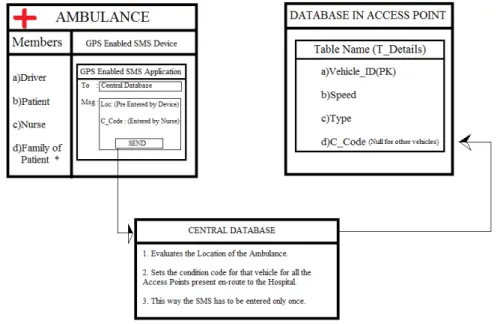
II. The nurse inside the ambulance is equipped with a standardized mobile device. This mobile device has functionalities of GPS (Global Positioning System) and Short Messaging Service (SMS).
2.2.1.How it works
a) First of all we need a set of condition code for all possible conditions the patient may suffer from.
b) These condition codes are nothing but a set of integers (starting from 0) which depicts the severity of the patient.
c) Every ambulance must have a chart depicting the condition code along with its description. For example
Condition Code Description
0 Heart Attack (critical) (Highest Priority) 1 Heart Attack (mild)
: :
N Fever (Mild) (Lowest Priority)
Where 0 depicts the most critical condition followed by 1, 2, 3… N, where N depicts the least emergency.
d) After making the necessary checkup the nurse enters the relevant condition code in the GPS Enabled SMS Device.
e) The Message body comprises of two sections
i) The Location – This contains the GPS Coordinates and is automatically entered by the device. ii) Condition Code – An integer from 0 to N which depicts the condition of the patient.
f) The message is sent to the Central Database which has information regarding each and every Access Points. The Central Database processes the GPS Coordinates and inserts the value of the condition code for
that particular vehicle across all the Access Points present en route to the hospital. In way we can have the Access Point grant the Green Light for the Emergency Vehicle with highest priority (lowest condition code).
Figure 1: Proposed Solution for Internal Priority to Emergency Vehicles
Stage 2: Considering the distance of each of the Emergency vehicle from the intersection point.
As an addition we have also included a totally abstract approach for more Optimized Emergency Vehicle Management by collaborating Code Messaging Service (CMS) and a GPS Enabled Mobile Device. Being an abstract thought, this model serves the purpose of base for possible future research.
3.Proposed Methodology
3.1.Problem Formulation and Assumptions
The selection of signal phase mode depends on the traffic flows through the intersection [1]. There are four directions marked as N (North), S (South), W (West) and E (East) leading to the road intersection and each direction has three lanes, which are turn-left (L), go- forward (F) and turn- right (R).To formulate a solution, we assume that the left- turn (L) is permitted all the time. So each passing vehicle can have a direction d of {E, S, N, W} and lane 1 of {F, R} [1].
Thus, a running vehicle can be determined by a pair of (d, l) resulting in eight paths: {WR, WF, ER, EF, NR, NF, SR, SF}. These eight paths combine in various combinations and results in twelve possible cases C, as shown in figure 3.
3.2.Assumptions
xAll the vehicles run at a constant speed and all the vehicles are in the same type.
xIt is assumed that all vehicles have a vehicle node installed.
xThe data regarding traffic volume approaching towards the intersection point from various lanes, which is required for the implementation of proposed dynamic traffic signal control algorithm, is assumed to be getting from the Wireless Sensor Network. The working of WSN is not apart of our project.
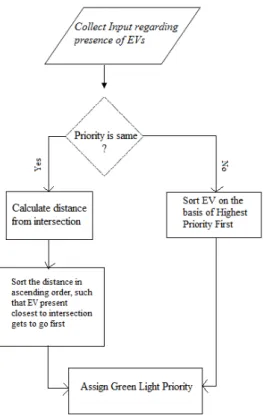
Figure 2: Flow-Chart representation of Emergency Condition
3.3.Dynamic Traffic Signal Main Procedure 3.3.1.Control Algorithm
The proposed dynamic traffic signal control algorithm contains mainly four steps: i. Determining the queue length (volume) of traffic in each lane.
ii. Check for the presence of Emergency Vehicles as well as deciding the current scenario (best or worst). Calculate the distance from intersection to the emergency vehicle.
iii. Assigning green light to the most suitable phase.
iv. Calculating how much time must be allotted to the phase decided in (iii).
3.3.2.Traffic Volume Detection
In the first step of our algorithm the queue length (Qx) for each phase is computed. This gives us a fair idea
regarding the number of vehicles or volume present in each phase. The source of input for this stage of our algorithm is WSN.
3.3.3.Check for Emergency Vehicle Presence
In the second step of the algorithm we make a check in order to ensure whether an Emergency vehicle is present at the intersection or not. An Emergency vehicle is a vehicle which has to be assigned a greater priority than other motorized vehicles. For this purpose we first need to assign a priority for different types of emergency vehicles. For example Fire Trucks can be assigned priority 0 (highest) followed by ambulance and so on. Assigning priority for the Emergency Vehicles is totally dependent on the standard policies, taking into consideration multiple parameters, and may vary from country to country.
Considering all probable scenarios, we classify the management of Emergency Vehicles on the basis of six cases:
Case 1: Only One Emergency Vehicle is Present in a Lane
In this case we simply assign green light to the lane where the Emergency Vehicle is present.
Case 2: Two Emergency Vehicles each having different Priority present in two different Lane.
In this case we simply allow the vehicle with the higher priority to pass through first, followed by the vehicle with lower priority.
Case 3: Two Emergency Vehicles each having same Priority.
This is a typical scenario since both the Emergency Vehicles have the same priority. In order to tackle such a situation we need to be fair to both these vehicles. Therefore we assign green light priority first to the Emergency Vehicle present at the shortest distance from the intersection.
Case 4: Four Emergency Vehicles (all different priorities) placed at each of the four lanes [deadlock]
Such a situation can be rightly tackled by assigning Green light to the Emergency Vehicle on the basis of Highest Priority First (HFS) Scheduling.
Case 5: Four Emergency Vehicles (all have same priorities) placed at each of the four lanes [pure deadlock]
Such a situation can be rightly tackled by assigning Green light to the Emergency Vehicle on the basis of Highest Priority First (HFS) Scheduling with first to the Emergency Vehicle present at the shortest distance from the intersection.
Case 6: Emergency Vehicles are always arriving in particular two phase only [starvation]
Such a situation can be rightly tackled by increase the green light time in repeated interval for other phases, when emergency vehicle is not present in any phase.
3.3.4.Assigning Green Light to most suitable phase
In this step, the queue length (Qx) for each phase is computed according to the dynamic information about
traffic volume of various lanes provided by Wireless Sensor Network (WSN).
3.3.5.Determination of Green Light Duration
The third step is to determine as to how much time green light should be assigned to a phase. The maximum phase time should not be more than 120 seconds. It must be reduce if repeated arrival or high arrival frequency of emergency vehicle in particular phases, to avoid the starvation condition.
3.3.6.Notation used to design proposed algorithm
To design the proposed algorithm, various notations are used. The notations depicting directions, lanes and cases are given as, D :={ North, South, East, West}, L := {Forward, Right}, C := {1, 2, 3, 4, … , 12}.
Here, D, L and C denote the set of directions, lanes and cases respectively. Expectant Phase, denoted as EI, of a vehicle is defined as the phase in which a vehicle pass the intersection.
Case 01: EI(N, F) = EI(N,R) = Ia. Case 02: EI(S, F) = EI(S, R) = Ib. Case 03: EI(E, F) = EI(E, R) = Ic. Case 04: EI(W, F) = EI(W, R) = Id. Case 05: EI(N, F) = EI(S,F)= Ie. Case 06: EI(N, R) = EI(S,R)= If. Case 07: EI(E, F) = EI(W,F)= Ig. Case 08: EI(E, R) = EI(W,R)= Ih. Case 09: EI(N, F) = EI(W,R)= Ii. Case 10: EI(S, F) = EI(E,R)= Ij. Case 11: EI(N, R) = EI(E,F)= Ik. Case 12: EI(S, R) = EI(W,F)= Il.
Lane Waiting Queue (Q(d, l)), Phase Waiting Queue (Qx), Queue passing time (TQ(d, l)), Emergency condition
(EC(d, l)), Waiting Time (WT(d, l)), Threshold waiting time (Tthreshold), Phase time (TPx), and Maximum phase time
(TPmax) are terms used.
3.3.7.The Proposed Dynamic Traffic Signal Control Algorithm Dynamic Traffic Signal Control Algorithm
//Initialization – Here parameters like Max Time and threshold time is initialized
1. Initialize Tmax := 90, Tthreshold :=120
Set Q(d, l) (d, l), where d D, l L
Q(d, l) contains the number of vehicles on the path P := {d, l} prev_dir[i] := null
//Traffic Volume Detection – Computing the queue length for each lane
2. Compute Qx := MAX(Q(d, l)) x,
where x {a, b, …, l}, d D, l L
Qx contains the maximum queue length of each of the 12 phases
//Emergency Check and Traffic Phase Selection – Here check for the presence of emergency vehicles is made so as to assign green light to the most suitable phase
3. Check emergency condition d, d D. same_set_dir_flag := 0
4. If ( a direction dc with green light priority) then goto 5 else goto 6
5. If (Emergency vehicle only in one direction dc) then Assign green light to phase Ix next such that {EI(dc, l1) = EI(dc, l2)}, l1, l2 L
dc= direction of emergency vehicle
l1, l2 = all the 2 possible lanes.
Else If (Emergency vehicle in more than one direction but of different priorities) then
Assign count := number of emergency vehicles in different direction
For k := 1 to count loop
int priority[k] := Priority of emergency vehicle for each direction
char dir[k] := direction of presence of Emergency Vehicle
Sort the array priority[] in ascending order of priority and correspondingly change the value of dir[].
For i := 1 to count loop
Assign green light to
EI(dir[i], l1) := EI(dir[i], l2) := Mx end loop;
Else If (Emergency vehicle in more than one direction but of same priorities) then
Assign count := number of emergency vehicles
For i :=1 to count loop
int arr[i] := distance from intersection of emergency vehicle for each direction using Euclidean distance formula.
char dir[i] := direction of presence of Emergency Vehicle
end loop;
Sort the array arr[] in ascending order of distance and correspondingly change the value of dir[]
For i = 1 to count loop
Assign green light to
EM(dir[i], l1) := EI(dir[i], l2) := Ix end loop;
Else If (Emergency vehicle in always arrive in same directions set dir[i] matches with prev_dir[i]) then
same_set_dir_flag := 1 dir_count:=dir_count + 1
If dir_count > 10 then phase time of green signal reduce by 15 seconds for those dir[i] in each 10 cycles or simply allow passing emergency vehicle by clear its front vehicles + 5 seconds.
If same_set_dir_flag:= 1 then prev_dir[i] = dir[i] and same_set_dir_flag := 0
6. Compute WT(d, l) (d, l), where d D, l L.
7. If a path (dc, lc) with WT(dc, lc) ≥ Tthresholdthen
Compute Qx := MAX(Q(dc, lc), Q(d, l)),
such that {EI(dc, lc) := EI(d, l) := Ix}, for every possible x, x {a, b, c, …, l}, d D, l L. Assign green light to phase Ix having maximum value of Qx computed above.
Else
Assign green light to phase Ix having maximum value of Qx computed in step 2, next.
end if; // step 7
end if; // step 4
//Determination of Green Light Duration – Calculating the duration of green light
8. Compute TQx:= T1+ (τ * (Qx– 1 ))
9. Compute TPx := MIN(TQx, TPmax)
10. Set the green light time for phase φx for time TPx.
Note: Qx as well as TQx are changed dynamically according to the traffic flow.
4.Implementation
To demonstrate the effect of the proposed algorithm, some simulations are conducted in the PC using C++ with the data of a real intersection which is reported in [10] and then analysis of average waiting time. The conditions of a real intersection considered for the evaluations are listed in table 1. In our evaluations, it is assumed that τ = 1
second, T1 = 5 seconds (for F-direction) and T1 = 7 seconds (for R- direction). Here, one phase sequence consists of twelve phases where every phase is selected dynamically. The reason behind this is that there are only twelve possible cases. Thus, a best dynamic phase sequence consists of at least twelve phases. From the figure 4(a), we see
that the average waiting time is around 34.492 seconds. Fig. 4(a) shows the maximum, the minimum as well as the average waiting time in the period of 25 phase sequences. From the figure, we see that most vehicles wait for less than 70 seconds and the average waiting time is around 35 seconds. The maximal and average waiting time changes if traffic load changes. From table 1, we know there are 6100 vehicles pass through the intersection per hour, i.e., the traffic load is 6100 v/h.
Table 1. Conditions of a Real Intersection [2]
Lanes Initial queue length Incoming vehicles (veh./hr.) Incoming vehicles (veh./sec.) Vehicles arrival rate (sec.)
EL 5 251 0.0697 14.34 EF 12 779 0.2164 4.62 ER 4 242 0.0672 14.88 WL 5 346 0.0961 10.40 WF 10 896 0.2489 4.02 WR 6 430 0.1194 8.37 SL 6 410 0.1139 8.78 SF 10 944 0.2622 3.81 SR 5 275 0.0764 13.09 NL 6 430 0.1194 8.37 NF 12 854 0.2372 4.22 NR 4 243 0.0675 14.81
5.Result
The efficiency of our solution to the existing shortcoming is expressed on the basis of theoretical and physical factors. On theoretical basis, our algorithm is a success because we have tried to provide solution to a very new problem of Emergency Deadlock condition, which opens a new dimension for further research and exploration of more complex traffic situations and development of their solutions.
On the basis of physical factors like intersection throughput factor etc. our algorithm is nearly similar to the one presented in our base research paper [1]. But due to the introduction of new concept in the algorithm, there have been some negligible effects on the time complexity.
For the above proposed algorithm, the entire time complexity relies on the sorting technique used in order to sort the distance of emergency vehicles from the intersection as well as to sort the pre-defined priority. In order to maximize the efficiency, the sorting technique considered is Merge Sort with best case, worst case and average case as O(nlogn). Therefore, the overall time complexity for the proposed algorithm is O(nlogn), it shows in figure 4(b) and After analysis all the condition of deadlock and starvation, the average waiting time is still 34.492 seconds, which is better than [1].
6.Conclusion
Wireless sensor network is offering an extremely helpful platform for traffic monitoring that can support the current technology leading to the improvement of accuracy and lifetime. In this paper, we have given an extension to the existing dynamic traffic signal control algorithm keeping in mind the sole objective of minimizing the average waiting time. We also include a scenario involving the worst case (deadlock and starvation) condition for management of emergency vehicles. This algorithm offers a solution to the above mentioned problem which has not yet been addressed in any of the published research papers. This project concludes with a concept solution for internal prioritization of ambulances which offers a wide scope for future development.
In future work, there is a scope for the proposed dynamic traffic signal control algorithm to be extended by elimination of the above made assumptions such the vehicles approaching towards the intersection from all the directions are ideal sized vehicles are assumed to be ideal sized. These assumptions can be removed by adding the detection differentiating heavy vehicles.
References
1. Anurag Goel, Ashutish Kr. Tiwari, “Dynamic Traffic Control Algorithm in Intelligent Transport System through Wireless Sensor Networks”, International Journal of Engineering and Science Research, April 2012, Volume-2, Issue-4, Article No-14, pp. 285-293, ISSN 2277-2685
2. Chen Wenjie, Chen Lifeng, Chen Zhanglong, Tu Shiliang, “A Real Time Dynamic Traffic Control using Wireless Sensor Networks”, Department of Computer Science and Engineering, Fudan University IEEE- 1530-2016/05, 2005
3. Khalil M. Yousef, Jamal N. Al - Karaki and Ali M. Shatnawi, “Intelligent Traffic Light Flow Control System Using Wireless Sensors Networks”, Journal of Information Science and Engineering 26, p. 753-768, 2010
4. Shen Ming Yu , Wang Wei, “The Research of WSN-based Vehicle Information Detection Technology”, International Conference on Electronics, Information and Communication Engineering, School of Computer and Information, Hefei University of Technology, Hefei 230009, China - 2012
5. Partha Sarathi Chakraborty, Prajeeth Nair, Pranshu Raj Sinha and Ishan Kumar Behera, “Real Time Optimized Traffic Management Algorithm”, International Journal of Computer Science & Information Technology (IJCSIT), Vol 6, No 4, August 2014, pp. 119 – 136 6. Chia-Ying Chen, Po-Yu Chen, and Wen-Tsuen Chen, "A Novel Emergency Vehicle Dispatching System", 2013 IEEE 77th Vehicular
Technology Conference (VTC Spring), 2-5 June 2013, p. 1 - 5
7. Wantanee Viriyasitavat, Ozan K. Tonguz, "Priority Management of Emergency Vehicles at Intersections Using Self-organized Traffic Control", 2012 IEEE Vehicular Technology Conference (VTC Fall), 3-6 Sept. 2012, p. 1 - 4
8. Xinping Yan, Hui Zhang, Chaozhong Wu, "Research and Development of Intelligent Transportation Systems", 2012 11th International Symposium on Distributed Computing and Applications to Business, Engineering & Science (DCABES), 19-22 Oct. 2012, p. 321 - 327 9. Ahmed S. Salama, Bahaa K. Saleh, Mohamad M. Eassa, "Intelligent Cross Road Traffic Management System", 2010 2nd International
Conference on Computer Technology and Development (ICCTD), 2-4 Nov. 2010, p. 27 – 31
10. X.F. Chen, Z.K. Shi, “A Dynamic Optimization Method for Traffic Signal Timings Based on Genetic Algorithm”. Journal of System Simulation, Vol 16 No.6, Chinese Association for System Simulation. Beijing, 2004, p.1155-1161.
![Table 1. Conditions of a Real Intersection [2]](https://thumb-us.123doks.com/thumbv2/123dok_us/1442354.2693123/9.816.63.736.227.538/table-conditions-real-intersection.webp)
