DEVELOPMENT OF INTEGRATED LEAN SIX SIGMA MODEL FOR SMALL AND MEDIUM ENTERPRISE
by
JOSHUA CHAN REN JIE
Thesis submitted in fulfillment of the requirements for the degree
of Master of Science
ii
ACKNOWLEDGEMENTS
I would first like to thank the Almighty God for giving me the grace to undertake and successfully complete this study. Without His grace, I would not have been able to overcome the struggles I faced during this challenging period of my life.
I would like to thank IR. Dr. Chin Jeng Feng, my main academic supervisor for his limitless patience and motivation. His support and guidance proved to be a driving force for me to complete this thesis. I will always remember how he used his expertise to help me write a strong thesis.
I would also like to thank Associate Professor Dr. Tan Kok Eng who is always willing to spend her time reading my countless drafts and providing constructive feedback to help me express my ideas and thoughts effectively. Without her, I would not have been able to write confidently in this thesis.
I would also like to thank Associate Professor Dr. Shahrul Kamaruddin, my ex-academic supervisor for his belief and hope in me. I am grateful for the opportunity he gave me to begin my candidature and conduct my case studies with two SME companies as a result of his research collaboration with them.
Finally, I must express my very profound gratitude to my parents, family and friends for providing me with unfailing support and continuous encouragement throughout the process of researching and writing up of the thesis. This accomplishment would not have been possible without all of you. Thank you.
iii
TABLE OF CONTENTS
Page
ACKNOWLEDGEMENTS ii
TABLE OF CONTENTS iii
LIST OF TABLES vii
LIST OF FIGURES ix
LIST OF ABBREVIATIONS xii
LIST OF SYMBOLS xiv
ABSTRAK xv
ABSTRACT xvi
CHAPTER ONE: INTRODUCTION
1.0 Overview 1 1.1 Research background 1 1.2 Problem statement 4 1.3 Research objectives 6 1.4 Scope of study 6 1.5 Thesis outline 7
CHAPTER TWO: LITERATURE REVIEW
2.0 Overview 8
2.1 Quality 8
2.2 Delivery 9
2.3 Costs 10
2.4 Management systems 11
2.4.1 Total Quality Control (TQC) 13
2.4.2 Total Quality Management (TQM) 13
2.4.3 Six Sigma 14
2.4.4 Lean Manufacturing 16
2.4.5 Business Process Reengineering (BPR) 19 2.4.6 Deming’s system of profound knowledge 20
iv
2.5 Tools and techniques 23
2.5.1 Tools of Lean Manufacturing 24
2.5.2 Tools of Six Sigma 26
2.6 Lean Six Sigma models 32
2.6.1 Non-Integrated Lean Six Sigma models 32 2.6.2 Integrated Lean Six Sigma models 34
2.7 Chapter summary 38
CHAPTER THREE: RESEARCH METHODOLOGY
3.0 Overview 39
3.1 Methodology 39
3.2 Review of management systems 40
3.3 Development of Lean Six Sigma model 41
3.4 Chapter summary 43
CHAPTER FOUR: MODEL DEVELOPMENT
4.0 Overview 44 4.1 ILSSD model 44 4.2 Stage 1: Define 48 4.2.1 Management initiative 48 4.3 Stage 2: Measure 53 4.3.1 Data acquisition 54
4.3.2 Current state map 57
4.4 Stage 3: Analyze 59
4.4.1 Cause identification 60
4.4.2 Root cause analysis 63
4.5 Stage 4: Improve 67
4.5.1 Determine solution 67
4.5.2 Implement solution 68
4.6 Stage 5: Control 69
4.6.1 Sustain improvement 69
4.6.2 Leader standard work 70
v
CHAPTER FIVE: VALIDATION OF ILSSD MODEL
5.0 Overview 72 5.1 Background of company A 72 5.2 Stage 1: Define 73 5.2.1 Management initiative 74 5.3 Stage 2: Measure 76 5.3.1 Data acquisition 76
5.3.2 Current state map 79
5.4 Stage 3: Analyze 81
5.4.1 Cause identification 81
5.4.2 Root cause analysis 88
5.5 Stage 4: Improve 90
5.5.1 Determine solution 90
5.5.2 Implement solution 92
5.6 Stage 5: Control 99
5.6.1 Sustain improvement 99
5.6.2 Leader standard work 102
5.6.3 Monitoring of results 103 5.7 Background of Company B 104 5.8 Stage 1: Define 104 5.8.1 Management initiative 104 5.9 Stage 2: Measure 106 5.9.1 Data acquisition 106
5.9.2 Current state map 110
5.10 Stage 3: Analyze 112
5.10.1 Cause identification 112
5.10.2 Root cause analysis 116
5.11 Stage 4: Improve 117
5.11.1 Determine solution 117
5.11.2 Solution verification 127
5.12 Stage 5: Control 132
vi
5.12.2 Leader standard work 134
5.13 Chapter summary 134
CHAPTER SIX: DISCUSSION
6.0 Overview 135
6.1 Notable points of ILSSD model 135
6.1.1 Conceptual perspective 135
6.1.2 Structural perspective 138
6.2 Model validation 140
6.3 Managerial implication 142
6.4 Practical benefits of model 142
6.5 Chapter summary 143
CHAPTER SEVEN: RESEARCH CONCLUSION
7.0 Overview 144 7.1 Concluding remarks 144 7.2 Research contribution 145 7.3 Future works 146 REFERENCES 147 APPENDICES
Appendix A: Design drawing of new die-cut mold system Appendix B: Process cycle time of Piercing process Appendix C: Process cycle time of Outline process Appendix D: Setup time of C-Frame machine
Appendix E: Setup time of hard tool on Li Chin machine Appendix F: Calculation of the bottleneck machine
Appendix G: Waiting time for products in Cell Bravo based on Company B’s Material Requirement Planning
vii
LIST OF TABLES
Page Table 2.1 Description of seven waste (Liker, 2004) 17 Table 2.2 Comparison between Lean Manufacturing and Six Sigma 21
Table 2.3 Benefits of Lean Six Sigma 22
Table 2.4 Most and least used Six Sigma tools 27 Table 2.5 Classification of Six Sigma tools 29 Table 2.6 Combination of tools in LSS models 36 Table 4.1 Number of IN and OUT arrows for each factor 64 Table 5.1 Capabilities of machines in printing department 77
Table 5.2 Product family matrix of labels 78
Table 5.3 Cycle time for an impression of one roller 79
Table 5.4 Time study of setup process 83
Table 5.5 Evaluation of each cause of long ink preparation time 89 Table 5.6 Evaluation of each cause of long die-cut mold installation time 90
Table 5.7 Iterations of SMED 97
Table 5.8 Internal and external setup activities 97
Table 5.9 Capabilities of all machines 108
Table 5.10 Process family matrix of panels 109 Table 5.11 Cycle time of subpanel, piercing and outline process 110 Table 5.12 Evaluation of long waiting time causes 117
Table 5.13 Product-machine matrix 119
Table 5.14 Machine cell grouping 120
Table 5.15 Capacity of each machine 121
Table 5.16 Machine capacity required for each product in one shift 123
viii
Table 5.18 Summary of the Bottleneck Analysis 128 Table 5.19 Production rate of machine cells 129
ix
LIST OF FIGURES
Page Figure 2.1 Lead time terminology in manufacturing 10 Figure 2.2 Historical timeline on origin of various management systems 12 Figure 2.3 The DMAIC methodology of Six Sigma 15 Figure 2.4 Five principles of Lean Manufacturing 18 Figure 2.5 LSS model where Six Sigma and Lean are used separately 33 Figure 2.6 LSS model where Six Sigma and Lean are applied in series 34 Figure 3.1 Methodology of the ILSSD model development 40
Figure 4.1 Overview of ILSSD 47
Figure 4.2 Using a Mission Statement as a strategic tool (Mullane, 2002) 49
Figure 4.3 Example of Team Charter 52
Figure 4.4 Example of the time study technique 54 Figure 4.5 Value Stream Mapping of the whole production 58 Figure 4.6 Pareto analysis on reasons of claim delay (Sarkar et al., 2015) 60 Figure 4.7 Causes of high butt weld repair rate (Anderson and Kovach,
2014)
62
Figure 4.8 Interrelationship of critical success factors for a business strategy (Breyfogle, 2003)
64
Figure 4.9 Interrelationship of causes of delays in utility relocation (Vilventhan and Kalidindi, 2016)
65
Figure 4.10 5 Why analysis 66
Figure 4.11 5 Why analysis on machine breakdown 66 Figure 4.12 Tree diagram to determine the solution for preventive
maintenance
67
Figure 5.1 Team Charter of Case Study 1 75
Figure 5.2 The label printing company 76
x
Figure 5.4 Setup process flow of the letter press machine 82
Figure 5.5 Pareto chart of setup process 84
Figure 5.6 Cause and effect diagram of long ink preparation time 85
Figure 5.7 Pantone guide of Pantone 473 C 86
Figure 5.8 Cause and effect diagram of long die-cut mold installation time 87 Figure 5.9 Drawer storage system of die-cut molds 87 Figure 5.10 Interrelationship diagram of causes for long ink preparation
time
88
Figure 5.11 Interrelationship diagram of causes for long die-cut mold installation time
89
Figure 5.12 Tree diagram of solutions to reduce setup time 91 Figure 5.13 Pantone guide of Pantone 3258U ink colour 92
Figure 5.14 Workstation for ink mixing 93
Figure 5.15 Result of Experiment 1 94
Figure 5.16 Result of Experiment 2 94
Figure 5.17 New rack storage system for die-cut molds 95 Figure 5.18 Trend of time taken to search for die-cut mold 96
Figure 5.19 New SOP for setup 100
Figure 5.20 Operator setup audit form 101
Figure 5.21 Leader standard work of line leader 102 Figure 5.22 Graph of total setup time from April job order 40 to May job
order 14
103
Figure 5.23 Team Charter of Case Study 2 106
Figure 5.24 Process flow of panels 107
Figure 5.25 VSM of product family L 111
xi
Figure 5.27 Current production layout of punching department 114 Figure 5.28 Utilization of all machines in punching department per day 115 Figure 5.29 Interrelationship diagram between causes of long waiting time 117 Figure 5.30 Solutions generation to reduce waiting time 118 Figure 5.31 Network diagram of combined machine cells 125
Figure 5.32 New machine cell layout 126
Figure 5.33 Waiting time per lot in current production 131
Figure 5.34 Revised production traveler 132
Figure 5.35 Visual monitoring system 133
Figure 5.36 Leader standard work of punching department 134 Figure 6.1 Integration of tools in ILSSD model 136
xii
LIST OF ABBREVIATIONS
BOM Bill of materials
BPR Business process reengineering CED Cause and effect diagram
DMAIC Define, Measure, Analyze, Improve, Control DOE Design of experiment
DPMO Defects per million of opportunities FIFO First in, first out
FMEA Failure mode and effect analysis GDP Gross domestic product
GR & R Gage repeatability and reproducibility
GT Group technology
ILSSD Integrated Lean and Six Sigma tools in DMAIC IT Information Technology
ISO International organization for standardization JIT Just in time
LSS Lean Six Sigma
MRP Material resource planning NVA Non-value added
OEM Original equipment manufacturer PCB Printed circuit board
PFA Production flow analysis QCD Quality, cost and delivery QFD Quality function deployment
xiii SD Standard deviation
SIPOC Supplier-input-process-output-customer SME Small and medium enterprise
SMED Single minute exchange die SOP Standard operating procedure SPC Statistical process control TPM Total productive maintenance TQC Total Quality Control
TQM Total Quality Management
VA Value added
VOC Voice of customer VSM Value Stream Map WIP Work in process
xiv
LIST OF SYMBOLS
C Customer demand
P Product characteristic pj Part mix fraction of part j
Q Quality
Rp Production rate
t Processing time
Tw Waiting time
WLi Workload of a station i WLn+1 Workload of part handling
xv
PEMBANGUNAN MODEL BERSEPADU LEAN SIX SIGMA UNTUK PERUSAHAAN KECIL DAN SEDERHANA
ABSTRAK
Sistem pengurusan telah dibangunkan untuk membimbing pengilang untuk penambahbaikan berterusan dalam aspek kualiti, kos dan penghantaran. Pembangunan sistem pengurusan yang terkini, Lean Six Sigma (LSS) ialah integrasi di antara Lean Manufacturing dan Six Sigma. Pelbagai model LSS telah dibangunkan dan dilaksanakan dalam pelbagai industri dengan bukti yang positif dan kukuh. Walau bagaimanapun, literatur dalam pembangunan dan pelaksanaan model LSS di Perusahaan Kecil dan Sederhana (SME) adalah terhad disebabkan oleh kekangan saiz pengurusan dan sumber. Kajian ini membangun model LSS yang bernama Model Persepaduan alat Lean dan Six Sigma dalam DMAIC (ILSSD) yang mengambil kira kekangan ini dalam pemilihan teknik dan alat untuk penambahbaikan berterusan. Model ini memperoleh matlamat pernambahbaikan berterusan daripada misi dan visi sesebuah syarikat. Model ILSSD terdiri daripada metodologi DMAIC dan mencadangkan kolaborasi penggunaan alat-alat Lean dan Six Sigma yang tidak memerlukan analisis statistik yang mendalam, misalnya, Value Stream Map (VSM), analisis Pareto, rajah sebab dan akibat, rajah perhubungan dan rajah pokok. Pelbagai teknik pengumpulan data juga diperkenalkan. Struktur model ILSSD adalah berpacuan data supaya ia memberi sistem sokongan keputusan dengan analisis yang wajar. Kegunaan ILSSD telah disahkan di sebuah syarikat SME pencetakan label dan sebuah syarikat SME semikonduktor di Pulau Pinang. Keputusan pelaksanaan adalah pengurangan masa persediaan sebanyak 18.42% di syarikat pencetakan label dan pengurangan masa tunggu sebanyak 92.8% di syarikat semikonduktor. Kajian ini telah mencapai objektifnya.
xvi
DEVELOPMENT OF INTEGRATED LEAN SIX SIGMA MODEL FOR SMALL AND MEDIUM ENTERPRISE
ABSTRACT
Management systems have been developed to guide manufacturers to continuously improve performance in the aspects of quality, cost and delivery. The latest developed management system, Lean Six Sigma (LSS) is an integration of Lean Manufacturing and Six Sigma. Various LSS models have been developed and implemented in different industries with positive and strong evidences. However, literature on developing and implementing LSS models in Small and Medium Enterprise (SME) is scant due to size-related management and resource constraints. This research develop a LSS model named Integrated Lean and Six Sigma tools in DMAIC (ILSSD) model to take into consideration these constraints in the selection of techniques and tools for continuous improvement. The model derives continuous improvement goals from a company’s mission and vision. The ILSSD model consist of DMAIC methodology and proposed collaborated usage of Lean and Six Sigma tools which is not heavy in statistical analysis namely Value Stream Map, Pareto Analysis, Cause and Effect Diagram, Interrelationship Diagram and Tree Diagram. Various data collection techniques were also introduced. The ILSSD model was structured to be data driven so that it provides a decision support system with sound analysis. The practicality of ILSSD was validated in an SME label printing company and SME semiconductor company in Penang. The results of implementation are 18.42% reduction in setup time in label printing company and 92.8% reduction in waiting time in semiconductor company. The research has achieved its objectives.
1
CHAPTER ONE INTRODUCTION
1.0 Overview
This chapter, consisting of four sections, introduces the development of a management system model based on the principles of Lean Manufacturing and Six Sigma to improve performance such as quality, cost and delivery in Small and Medium Enterprise (SME) manufacturing industries. The first section provides the background of management systems in this research field. The second section highlights contemporary issues related to management systems to support the problem statement in the present study. The third section presents the research aims and objectives and the fourth section presents the scope of study. The final section is an outline of the whole thesis.
1.1 Research background
Manufacturers recognize the need to improve performances to meet customer demands in connection to product quality, cost and delivery (QCD) (George, 2002). A quality product has to fulfil customer expectations and the requirements including serving the utility. A case in point is a car manufacturer’s duty includes the securance of its product to safely transport passengers and goods within specific load and without breakdown. In addition to timely delivery of their products, product cost should be kept at a level for reaching an acceptable gain when the product is sold. It is a common knowledge that customer expectation on product quality, cost and delivery is bound to the fundamental law of competition and evolving market.
2
Manufacturers therefore have to constantly improve to maintain competitive edges over their competitors.
For this reason, several management systems such as Total Quality Control (TQC), Total Quality Management (TQM), Deming’s system of profound knowledge, business process reengineering (BPR), Lean Manufacturing and Six Sigma have been developed and implemented (Chiarini, 2011). Of these systems, Lean Manufacturing and Six Sigma have prevailed in recent years (Tan et al., 2012). Large companies such as Toyota, Danaher Corporation, General Electric, Motorola and Honeywell have been in the forefront to implement Lean Manufacturing and Six Sigma, with significant attributable production improvements reported (Kumar et al., 2006).
Six Sigma follows a structured methodology led by improvement specialists to lessen process variation (Schroeder et al., 2008), ultimately to achieve the goal of 3.4 defects per million opportunities (Linderman et al., 2003). This results in a very well controlled and stable process which will be continuously and rigorously monitored. On the other hand, Lean Manufacturing is an all embracing management philosophy to streamline process with a human system to continuously remove wastes in the value chain (Wong et al., 2009). Lean Manufacturing relies on various tools to remove what is generally regarded as the seven Lean wastes of defects, over-processing, travelling, waiting, inventory, motion and over-production (Ohno, 1988). The direct implications are increasing flow of work-in-process (WIP) throughout the production and on-time delivery.
In many cases, implementing either Lean Manufacturing or Six Sigma is deemed inadequate to address and resolve problems and issues (Corbett, 2011). In reference to this, in 1996, General Electric (GE) CEO Jack Welch heralded Six
3
Sigma as the most important initiative taken by GE and yet, he drew concern on the consistency in product lead time (George, 2002). Implementing Lean Manufacturing and Six Sigma separately gives varied outcomes as efforts by individual systems are often disjointed.
Therefore, many recent studies have integrated both methods which is coined with a new term called Lean Six Sigma (LSS) (Salah et al., 2010; Cheng and Chang, 2012; Vinodh et al., 2014; Swarnakar and Vinodh, 2016). The integration involves Six Sigma methodology and statistical tools as well as Lean Manufacturing tools and techniques. LSS aims to increase process performances resulting in enhanced customer satisfaction and improved bottom line results (Snee, 2010). This is important not only for large companies but also small and medium enterprises (SMEs). An SME is defined by its sales turnover or number of full-time employees. According to SME Corporation Malaysia (2013), in the manufacturing sector, a Medium enterprise has a sales turnover of RM15 mil-RM50 mil or 75-200 employees while a Small enterprise has a sales turnover of RM300,000-RM15 mil or 5-75 employees. In the services and other sectors, a Medium enterprise has a sales turnover of RM3 mil-RM20 mil or 30-75 employees while a Small enterprise has a turnover of RM300, 000-RM3 mil or 5-30 employees.
From the 1900s onwards, the latest trend seems to be downsizing large firms and outsourcing business to SMEs (Lande et al., 2016). According to the statistics reported by SME Corporation Malaysia (2011), SMEs account for 97.3% of total business establishments in Malaysia for the year 2010 and since then have achieved a Gross Domestic Product (GDP) growth of 6.7% in 2015. The Department of Statistics Malaysia (2014) reported that the contribution of SMEs GDP to the country’s economy expanded to 33.1% in 2013. The reported figure confirms that the
4
SME manufacturing industry is growing in size and economic contribution. Therefore the adoption of management practices by SME is an 'important determinant of success in the global market place' (Kumar et al., 2014, p. 6482).
1.2 Problem statement
Various methods are conceived to integrate Lean Manufacturing and Six Sigma based on contextual issues faced by manufacturers (Antony et al., 2003). For example, when manufacturers are faced with an issue to identify process variables that affect a particular defect, the integration may include tools such as Design of Experiment (DOE). If manufacturers lack the expertise to use DOE, Thomas et al. (2009) simplified the DOE and integrated it into their LSS system. The integration may not necessarily include all the tools and techniques from both Lean Manufacturing and Six Sigma (Assarlind et al., 2013). Most LSS systems are inclined towards incorporating sophisticated statistical tools with little attention given to other decision making tools from Lean Manufacturing and Six Sigma. There is a need to explore a new LSS integration that combines other tools and techniques (Kumar et al., 2006).
Since SME constitutes the bulk of enterprise (Kumar, 2007) and there is growing importance of the supply chain issue together with the pressure from original equipment manufacturers (OEM) to perform, SMEs are compelled to implement management systems such as Six Sigma (Antony et al., 2005). However, the literature shows that SMEs are hesitant to implement management systems. A study conducted by Thomas and Webb (2003) concludes that only approximately 10% of SMEs in Wales have implemented some management systems. In a more recent survey reported by Kumar et al. (2014) only 36% of SMEs in Australia and
5
26% in the UK have moved beyond ISO 9000 certification to implement management systems because most SMEs consider ISO 9000 as a satisfactory final destination. Therefore, LSS in the context of SMEs should be further explored to encourage implementation as the knowledge in management systems is focused primarily on large organizations (Kumar et al., 2014).
Several reasons were cited in the literature for the reluctance of SMEs to adopt management systems. A major factor is resource constraint (Achanga et al., 2006, Chen et al., 2010; McAdam et al., 2014) which hinders the allocation of funds for external training and development of employees to adopt systems such as Lean and Six Sigma (Kumar et al., 2014). The survey of SMEs in Australia and the UK by Kumar et al. (2014) revealed the top three impeding factors to adopt management practices to be lack of resources (finance, human and time), knowledge and top management commitment. The constraint of resources is the main challenge especially for micro SMEs (Timans et al., 2016). Limited financial resources have caused companies to use in-house training and self-education, which are relatively inexpensive strategies compared to external consultation. Kumar et al. (2014) suggested that this move has led to 'conceptual confusion' (p. 6488) or lack of understanding of management practices. Therefore the development and application of any management system in SMEs should be feasible and fulfil practical requirements. A LSS model that works in the SME should capitalize on the existing capabilities of its employees, secure commitment from management and work within limited financial resources budgeted for improvement projects.
Few empirical studies have been published in the area of adopting LSS in SME (Albliwi et al., 2015, Timans et al., 2016). Sreedharan and Raju (2016) stressed that the adoption of LSS in SME is not widespread due to the reasons as mentioned.
6
One of the gaps identified by Albliwi et al. (2015) is the need of a roadmap to implement LSS and a customized LSS toolkit in the SME context.
1.3 Research objectives
This research aims to develop and implement a novel LSS model in the SME manufacturing industry with reference to two selected companies to improve their performance. As a whole, the objectives of this research are:
1. To determine suitable Lean Manufacturing and Six Sigma tools and techniques for the manufacturing SME.
2. To create a LSS model integrating the selected Lean Manufacturing and Six Sigma tools and techniques which are effective for the manufacturing SME. 3. To validate the developed LSS model in two case study companies.
1.4 Research Scope
LSS is the latest management system which integrates Six Sigma methodology, tools and techniques with Lean manufacturing tools and techniques to improve manufacturer’s quality, cost and delivery. This research is directed towards the developing a model with suitable tools and techniques in the context of implementing LSS in SMEs. The challenge is on how LSS can be practiced in the SME industry despite its constraints. The developed model in this research will aid the industry to improve in QCD and the results of implementation are used to plan improvement actions.
7 1.5 Thesis outline
This thesis is divided into seven chapters. Chapter 1 provides the contextual background to this research on LSS, the problem statement and objectives of the research. The chapter prepares readers for what this research is all about and the aims to be achieved. Chapter 2 reviews the available literature on the history of quality management systems and their principles. The chapter also covers research on LSS models as well as their tools and techniques used in these models and implementation approaches.
This is followed by Chapter 3 which discusses the methodology undertaken in this research including steps in the model development process. Chapter 4 describes the developed LSS model with information on each stage of the model and the method to be applied in the two case studies selected. Techniques for data collection and data analysis approaches are detailed out in this chapter.
Subsequently, the step by step process of validating the developed LSS model in two SME companies is described in Chapter 5. A brief background of each company is presented first to provide more information on the case studies. Then, full details and elaborations of the implementation are put forward.
Chapter 6 presents a discussion of the validation results by focussing on the notable points of the model from the conceptual and structural perspectives. Finally, Chapter 7 concludes with the contributions of the study and recommendations for future work to fill the potential gap of knowledge in this field. Articles, journals and books cited in this thesis are numbered and listed down accordingly in the reference section at the end of this thesis.
8
CHAPTER TWO LITERATURE REVIEW
2.0 Overview
This chapter reviews the literature on management systems particularly LSS to build the appropriate knowledge foundation. It begins with an introduction and definitions of three fundamental objectives or core competencies for a business organization (Liker, 2004), namely, quality, costs and delivery (QCD). Several management systems are explained next in the chapter followed by the definition and philosophy of Lean Manufacturing and Six Sigma. This includes the tools, techniques and methodologies of these two management systems. Finally LSS as the latest management system developed is explained and a number of LSS models in the recent literature are presented.
2.1 Quality
Crosby (1996) defined quality as conformance of a product to requirements while Juran and De Feo (2010) defined quality as fitness of product for its purposes. On the other hand, Feigenbaum (1991) defined quality as the total composite product characteristics of marketing, engineering, manufacture and maintenance through which the product will meet the expectations of the customer. These definitions from literature unanimously agree on quality as the product characteristic that meets customer demands. The quality of a product is determined by the customers only (Feigenbaum, 1991) and is quantified based on the ratio of product characteristic to customer demands (Besterfield, 2004) (equation 2.1),
9 𝑄 = 𝑃 𝐶 (2.1) where Q = quality P = product characteristic C = customer demands
Manufacturers strive to achieve a value of 1 for Q as indicated by equation 2.1 to meet customer demands. Since customer demands are the determinant of quality, quality may change over time and often unpredictably (Knowles, 2011), analogous to a moving target in a competitive market (Feigenbaum, 1991). Therefore, manufacturers need to continuously improve their product. In Kaushik et al. (2012), a SME manufacturing bicycle chains in India undertook a project to improve the diameter tolerance of the bicycle bush. Sigma level was significantly increased, resulting in an estimated monetary savings of Rs 0.288 million per annum.
2.2 Delivery
Delivery refers to the transportation of finished products to customers within the shortest time or at the specific required time. In this case, manufacturers have to minimize lead time and achieve on-time product delivery. Lead time of an activity is defined as the duration to complete the activity from the beginning (Engineer, 2005). In manufacturing, lead time can be distinguished as order lead time or production lead time. Their difference is illustrated in Figure 2.1.
10
Figure 2.1 Lead time terminology in manufacturing
Order lead time defines the time taken to place an order of a product until the product is received by the customer while production lead time defines the time consumed for one part to go through the entire production (Rother and Shook, 2003). Production lead time includes work-in-process (WIP) waiting time, online setup time and processing time. During the production lead time, a company is exposed to the risk of customer demand change, production disturbances such as machine breakdown and stock spoilage. Franchetti and Barnala (2013) associates 7-12 percent efficiency improvement and annual cost savings amounting to USD 65,000 in a recycling plant in Ohio when reducing production lead time.
2.3 Costs
According to George (2002), quality and delivery are equally important and both affect manufacturing costs. Costs are normally divided into direct materials cost, direct labour cost and manufacturing overhead (Groover, 2008). Direct material costs are cost of raw materials that form the product while direct labour cost is the wages of workers involved in the production. Manufacturing overhead refers to costs
Customer order receive Production start Production End Goods delivered Production Lead Time Order Lead Time
11
incurred in the manufacturing activities such as in the acquisition and maintenance of equipment and utilities. Manufacturing costs cover a wide range of expenses and are contributed by many factors including product quality and delivery time. For example, manufacturing costs increase in tandem to the number of rejected products and penalty incurred for late delivery. Such costs are termed cost of quality (COQ) and categorized as prevention cost, appraisal cost, internal failure cost and external cost (Heizer and Render, 2008). Since product cost should be kept at a level to attract customers with a marketable price, COQ should be kept at a minimum. This is depicted in a case study by Jones (2013) in a Boeing company where implementing Lean Manufacturing brought about USD24 million costs savings through projects to reduce cycle time, labour costs, and time lost due to anomalies and non-conformances.
A systematic approach is necessary to improve the manufacturer’s performance as measured by QCD (Snee, 2010). Management systems have been developed to enhance performance on a continuous basis and these systems are reviewed in the following section.
2.4 Management systems
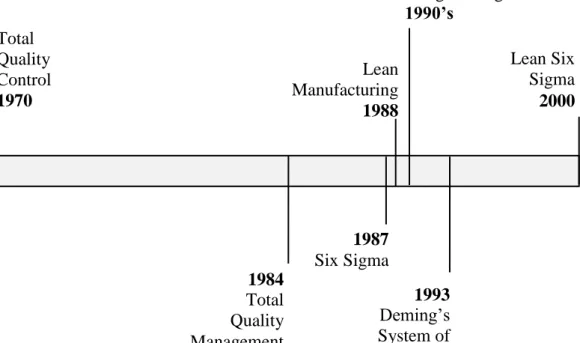
Several management systems have been developed over the years. These systems include Total Quality Control (TQC), Total Quality Management (TQM), Deming’s system of profound knowledge, Business Process Reengineering (BPR), Lean Manufacturing, Six Sigma and Lean Six Sigma. They are oriented towards process improvement and result in continuous improvement, customer satisfaction and, people and management involvement (Chiarini, 2011). The systems differ in their origins and historical paths of implementation as shown in Figure 2.2.
12
Figure 2.2 Historical timeline on origin of various management systems
TQM shifts its philosophy from TQC to manage quality rather than to control quality and then evolves into Deming’s system which stresses on the integral role of employees from different departments to play a part in improvement. Subsequently, the advancement of information technology (IT) was used to enhance management practices which led to the birth of BPR. From then on, Lean Manufacturing and Six Sigma were introduced into the various industries. The approach to integrate Lean Manufacturing and Six Sigma into a unified system has taken place since both systems are largely compatible. The integration aims to increase the scope of improvement. Extensive research was conducted on these management systems (Dahlgaard and Dahlgaard-Park, 2006, Chiarini, 2011) which are reviewed in the following subsections. Total Quality Control 1970 Lean Manufacturing 1988 1987 Six Sigma 1984 Total Quality Management Lean Six Sigma 2000 1993 Deming’s System of profound knowledge Business process reengineering 1990’s
13 2.4.1 Total Quality Control (TQC)
Considered as the oldest management system, TQC links management and procedure to manufacture products with specific quality standards (Feigenbaum, 1991). Through TQC, manufacturers aim to achieve targets such as reducing cost while improving quality, sales and profit (Chiarini, 2011). The early statistical research carried out around 1940’s formed the roots of TQC (Deming and Shewhart, 1986). Many statistical tools were used to measure, analyse and control production issues in TQC. These include the seven basic quality control tools of check sheets, Pareto, histogram, stratification, control chart, cause-and-effect diagram, and scatter diagram and management tools like design of experiment, quality function deployment, Taguchi and mistake proofing (also known as poka-yoke). Ishikawa (1985) stresses the need for a quality specialist to lead TQC due to the extensive use of statistical tools. TQC has since evolved from production quality control to a companywide quality control involving employees from all levels (Ishikawa, 1985). Employee involvement in quality management systems moves away from the slow and inflexible top-down management style which gives directives and prescribes solutions. Employee involvement gives room for innovative ideas to enhance customer satisfaction.
2.4.2 Total quality management (TQM)
TQM consists of three interdependent components which are values, techniques and tools (Hellsten and Klefsjö, 2000). It is often interpreted as a form of management philosophy based on a number of core values such as stakeholders’ involvement, teamwork, customer focus and continuous improvement of structures and processes (Mosadeghrad, 2014). TQM aims to improve and sustain product
14
quality continuously (Modgil and Sharma, 2016). The idea of quality being controlled changes to the idea of quality being managed (Martínez-Lorente et al., 1998); hence the term ‘Control’ being substituted with ‘Management’. TQM, introduced by Deming and Juran, focuses less on techniques and tools but gives more attention to the human aspect (Ehigie and Akpan, 2004). The important characteristic of TQM is management involvement and participation, management by fact and long term vision (Porter and Parker, 1993). The human aspect identifies problems and improves quality while tools are used to assist the process. Tools assisting problem solving in TQM can be divided into quantitative and non-quantitative tools (Besterfield, 2004). Examples of quantitative tools are statistical process control (SPC), Taguchi’s Quality Engineering, Failure Mode and Effect Analysis (FMEA) and Quality Function Deployment (QFD) while non-quantitative tools are International Organization for Standardization (ISO), Total Productive Maintenance (TPM) and Information Technology (IT). Deming who founded TQM also introduced Deming’s quality management system (Deming, 1993).
2.4.3 Six Sigma
Motorola developed Six Sigma in 1987 to increase the quality levels from measuring defects per thousand of opportunities to measuring defects per million of opportunities (DPMO) (Barney, 2002). The Six Sigma model assumes that if the process is centred at the target and the nearest specification limit is six standard deviations from the mean, the process will operate at 3.4 DPMO (Montgomery, 2010). The term sigma is a Greek alphabet letter used to describe variability and is applied as a statistical process technology measure in organizations (McAdam and Lafferty, 2004). Six Sigma is described as a system to reduce process variation which
15
focuses on continuous and breakthrough improvements (Andersson et al., 2006). It seeks to identify and eliminate causes of errors or defects by focussing on outputs that are critical to the customer (Snee, 1999). Six Sigma has transformed over the past 20 years and is now a flexible and adaptive business strategy applicable to many aspects of business and organizations (Siddiqui et al., 2016).
The Six Sigma approach is strongly based on facts and data while following the structured methodology called DMAIC (Define, Measure, Analyze, Improve and Control) as shown in Figure 2.3.
Figure 2.3 The DMAIC methodology of Six Sigma
Pyzdek (2003) provides a detailed description of the DMAIC methodology as presented briefly here. In the Define stage, goals of an improvement project are defined from direct communication with customers, shareholders and employees. An example of a goal is to reduce the defect level of a particular process. In the Measure stage, performance metrics are established to monitor the progress towards the goals defined in the previous stage. For example, the types of defects and their rates of
1. Define
2. Measure
3. Analyze 4. Improve
16
occurrence are measured. In the Analyze stage, the ways to eliminate the current performance to achieve the desired goal is identified. Statistical tools will be used to guide the data analysis process in this stage. The fourth stage is the Improve stage, where improvement teams will have to be creative to find new ways to improve the current system. Statistical methods are used to validate the proposed solution. In the final stage which is the Control stage, the improved system is institutionalized by modifying policies, procedures and operating instructions. Statistical tools such as control chart are used to monitor the stability of the new system. There are various tools often found to be useful within each stage of the methodology. These tools will be elaborated in Section 2.5.
Many organizations train most of their employees assigned to Six Sigma projects (Schroeder et al., 2008). In fact, Linderman et al. (2003) stressed that organizations should train all employees by using an extensive program. Training includes the application of statistical and quality tools. Schroeder et al. (2008) explained that employees who receive two weeks training are called Green Belts while employees that receive four weeks training with hands-on experience are called Black Belts. Both Green and Black Belts must complete two projects apart from the internal training (Krueger et al., 2014). Master Black Belts are those who receive extensive training beyond Black Belt and their main responsibility is to serve as instructors to provide technical assistance and mentoring (Slater, 1999).
2.4.4 Lean Manufacturing
Krafcik (1988) first used the term ‘lean’ to describe the Toyota Production System (TPS) that aims to achieve continuous flow. This is in contrast with the Ford mass production system at that time (Womack et al., 1990). Lean Manufacturing
17
considers inventory as waste, which opposes traditional manufacturing that builds inventory (Gupta and Jain, 2013). In order to be lean, manufacturers focus on making the product flow through processes without interruption (Liker, 2004) by eliminating non-value added activities referred to as wastes (Ohno, 1988). Therefore, Lean Manufacturing is defined as a system whose main objective is to eliminate waste (Shah and Ward, 2007) so that products can be produced at the lowest price and as fast as required by the customer (Bhamu and Sangwan, 2014).
There are a total of seven wastes (Ohno, 1988) identified and their descriptions are summarized in Table 2.1.
Table 2.1 Description of seven wastes (Liker, 2004)
Waste Description
Overproduction Produces extra products which do not have order and generates overstaffing, storage and transportation cost due to excess inventory.
Waiting Workers have no work resulting in merely watching and standing around for the next processing step. This may be due to stockouts, lot delays, equipment downtime and capacity bottleneck.
Unnecessary transport
Inefficient movement of WIP due to long distances.
Overprocessing Unnecessary steps and inefficient processing due to poor tools or product design.
Excess inventory Extra raw material, WIP and finished goods causing longer lead time, obsolescence, damaged goods, transportation cost, storage cost and delay. Extra inventories hide problems such as imbalance production, supplier late delivery, defects, equipment downtime and long setup time.
Unnecessary movement
Wasted motion such as walking, looking for, reaching for and stacking parts or tools.
Defects Defective parts which need repair, rework, scrap and inspection that causes wasteful handling, time and effort.
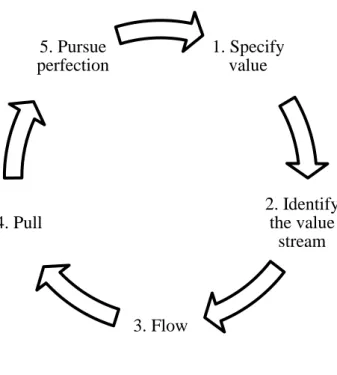
To eliminate wastes in Lean Manufacturing there are five basic principles of implementation. They are specify value, identify the value stream, flow, pull and pursue perfection (Womack and Jones, 1996) as illustrated in Figure 2.4.
18
Figure 2.4 Five principles of Lean Manufacturing
In the first principle, the manufacturer needs to specify the value which is defined by the customer. For example, the customer wants the product to be delivered in 3 days. In the second principle, all the activities to produce the products are identified and categorized according to value added activities, required non-value added activities and non-required non-value added activities. Value added activities are processes that enhance the product, for example, the cutting process of a piece of wood into the size of a pencil. Setting up the machine for the cutting process is a required non-value added activity because it does not enhance the wood but it is required so that the cutting process can take place. In the third principle, the flow of product from one process to another until completion is to be tightened. This requires rethinking work practices while ignoring job boundaries to make the product flow continuously. For example, the setup for the cutting process can be readjusted to its minimal in order to increase the production flow of the pencil. Subsequently the fourth principle allows the customer to pull value upstream in which products are being produced only when
1. Specify value 2. Identify the value stream 3. Flow 4. Pull 5. Pursue perfection
19
they are required by the customer. The final principle which is pursuing perfection requires manufacturers to continuously repeat the first four principles until perfection is achieved.
A wide range of approaches exists to eliminate waste such as value stream analysis, total productive maintenance, Kaizen, Just-in-time (JIT), pull production and engineering management accompanied by tools like value stream mapping, kanban tool cards and JIT system. Each of the approaches individually does not make the management system but together they constitute the system (Shah and Ward, 2007).
2.4.5 Business process reengineering (BPR)
Business process reengineering (BPR) became popular as a reaction towards recession in the same period of time as Deming’s system (Davenport and Short, 1990). BPR is a quality management system which requires a quick response to changes. This system focuses on the voice of customer and leads to improvement in cost, quality, service and speed in processes. BPR uses a top down approach in its implementation which raises the importance of senior management in making fast and aggressive decisions (Knights and Wilmott, 2000). Employees are empowered and the emphasis shifts from individuals to team effort (Hammer and Champy, 1993). Rinaldi et al. (2015) developed five steps for the BPR approach, namely, preparing for reengineering, analysis of As Is processes, data collection, development of simulation model and design of To Be processes. Since BPR is ‘pro-IT’, this system requires computers, software and databases to take advantage of predominantly software-based tools such as project management, brainstorming, cause-effect diagrams and problem solving. These tools involve mapping, benchmarking and IT.
20
2.4.6 Deming’s system of profound knowledge
Deming’s system of profound knowledge is summarized in William Edwards Deming’s last book The New Economics For Industry, Government, Education edited in 1993. Deming’s system consists of four interconnected components made up of the appreciation of the system, knowledge of variation, the theory of knowledge and psychology (Stephanovich, 2004). This system gives managers a special role to manage and lead a group in reducing variation. Deming (1993) did not favor the practice of management by objectives because it does not lead to improvement for the whole system and all stakeholders. This system stresses that every department in an organization should cooperate to solve problems, hence leading to a transformed new style of management system. There is no emphasis on particular tools, and each organization has the freedom to choose its tool.
2.4.7 Lean Six Sigma (LSS)
The phrase Lean Six Sigma is coined to describe the integration of two management systems (Shah et al., 2008) which are Lean Manufacturing and Six Sigma that exploits the benefits of both systems (Arnheiter and Maleyeff, 2005; Sheridan, 2000). George (2002) defined LSS as a methodology that maximizes shareholder value by achieving a significant improvement in customer satisfaction, cost, quality, process speed and invested capital. Lean Manufacturing alone cannot bring a process under statistical control while Six Sigma alone cannot dramatically improve process speed (George, 2002). LSS is a philosophy comprising of a Black Belt to adopt Six Sigma methodology where various statistical and lean tools are selected within each DMAIC phase (Hilton and Sohal, 2012).
21
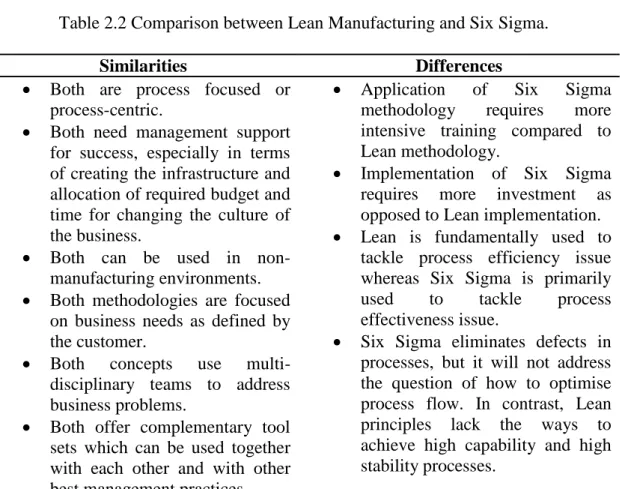
Lean Manufacturing and Six Sigma are complementary (Andersson et al., 2006). Both of these systems stem from TQM (Dahlgaard and Dahlgaard-Park, 2006) and are meant to bring changes and improvement to the organization; particularly as a cost reducing mechanism (Achanga et al., 2006). They share the same final objectives, that is to provide improvement throughout the organization and both stress the need towards continuous improvement at all levels in the organization (Pepper and Spedding, 2010). LSS combines speed introduced by Lean Manufacturing and Six Sigma’s capability of reducing process variation (Chiarini, 2011). They extend the tools and approaches evolved to achieve continuous improvement (Karthi et al., 2011). Antony (2011) compares the similarities and differences between Lean Manufacturing and Six Sigma, as shown in Table 2.2.
Table 2.2 Comparison between Lean Manufacturing and Six Sigma.
Similarities Differences
Both are process focused or process-centric.
Both need management support for success, especially in terms of creating the infrastructure and allocation of required budget and time for changing the culture of the business.
Both can be used in non-manufacturing environments. Both methodologies are focused
on business needs as defined by the customer.
Both concepts use multi-disciplinary teams to address business problems.
Both offer complementary tool sets which can be used together with each other and with other best management practices
Application of Six Sigma methodology requires more intensive training compared to Lean methodology.
Implementation of Six Sigma requires more investment as opposed to Lean implementation. Lean is fundamentally used to
tackle process efficiency issue whereas Six Sigma is primarily used to tackle process effectiveness issue.
Six Sigma eliminates defects in processes, but it will not address the question of how to optimise process flow. In contrast, Lean principles lack the ways to achieve high capability and high stability processes.
22
Assarlind et al. (2013) explained that the difference in improvement targets of both systems does not imply system incompatibility as the uniform process output could be the secondary effect of Lean Manufacturing while reduced lead time could be the secondary effect of Six Sigma. In addition, they argued that the combination of both systems is a natural way of achieving an appropriate approach which can be result enhancing. One researcher who points out the limitation of this integration is Bendell (2006) who questioned the practicality of the ‘Control’ phase in Six Sigma to control attempts of wastes elimination without real prioritization. Furthermore, Bendell (2006) added that such integration is may not be effective as either one system may ‘dominate’ the other. However, multiple researchers who advocated the LSS integration describe the benefits in Table 2.3.
Table 2.3 Benefits of Lean Six Sigma Advocates Benefits of Lean Six Sigma
Sunder (2016) increases the speed and effectiveness of any process and revenue, reduces cost and improves collaboration
Andersson et al. (2014) improves process flexibility, robustness and cost-efficiency
Nicoletti (2013), Laureani et al. (2010)
is a business strategy and methodology that increases process performances
Arumugam et al. (2012) improves process efficiency and reduces process variation in one effort
Duarte (2012) drives operational efficiency and effectiveness
Gnanaraj et al. (2010) facilitates the achievement of zero defect complemented by elimination of non-value adding activities
Snee (2010) is an effective leadership development tool
Kumar et al. (2006) increases the scope and size of improvements achieved by either concept alone
The following sections will cover common tools and techniques for Lean Manufacturing and Six Sigma.
23 2.5 Tools and techniques
When integrating the two approaches, it becomes apparent to understand the roles of various tools and techniques. Tools and techniques are practical methods, skills, means or mechanisms that can be applied to tasks and are usually used to facilitate positive change and improvement (McQuater et al., 1995). A tool is described as having a narrow focus and a clearly defined application (Antony et al., 2003, Antony, 2006). Examples of tools are process map, cause and effect analysis, affinity diagrams, run charts, relationship diagram, pareto analysis, control chart and histogram to name a few.
In contrast, a technique has a broader application and requires creativity, specific skills, training (Antony, 2006) and knowledge to tackle a particular problem (Antony et al., 2003). Some examples of techniques are statistical process control (SPC), quality function deployment (QFD), failure mode and effects analysis (FMEA) and design of experiment (DOE) among others. A technique can also be viewed as a collection of tools which are necessary for a larger scope of applications (Basu, 2009). This is clearly shown in SPC which utilizes tools such as control chart, histogram and root cause analysis within it (Antony, 2006).
Uluskan (2016) stated that there exist inconsistencies in the classification of tools and techniques. For example the supplier-input-process-output-customer (SIPOC) model is being referred to as a tool (Basu, 2009) and as a technique (Ismyrlis and Moschidis, 2013). Since a technique is a collection of tools and due to the discrepancies as shown, this research uses the term ‘tools’ to refer to both tools and techniques in the rest of thesis for simplicity purposes.
24 2.5.1 Tools of Lean Manufacturing
Lean Manufacturing tools are important because they can help to define, analyse and target sources of waste in specific ways when systematically applied (Wong et al., 2009). Numerous lean tools have been developed and those that have the most appearances in publications are value stream mapping (VSM), Kanban, Just-in-time (JIT) and 5S (Bhamu and Sangwan, 2014).
VSM is a tool that illustrates the production current state map using material and information flow symbols (Jones and Womack, 2000) to identify value added and non-value added activities beginning from the supplier’s delivery of raw material to the delivery of products to customers (Rosentrater and Balamuralikrishna, 2006). This tool measures the current ‘leanness’ level of the mapped system (Wan and Chen, 2008) and is deployed at the early stages of an improvement project. This way, manufacturers can understand the condition of the production so that improvement opportunities can be identified and action plans derived. This is exemplified in Vinodh et al. (2010) where various improvement plans such as 5S, mistake proofing and WIP reduction are developed after understanding the production leading to reduction in lead time, WIP and defects. Other positive impact such as improvement in process ratio, takt time, process inventory time, line speed and reduced manpower were also reported (Jasti and Sharma, 2014). This has led to VSM being regarded as one of the best (Braglia et al., 2006), vital (Vinodh et al., 2015) and effective tool for identification and reduction of waste (Singh et al., 2011). In certain cases, VSM is paired up with a simulation tool to analyse and compare performance measures of current and future state VSM as a verification step (Gurumurthy and Kodali, 2011).
Kanban which means sign board is the best known visual tool (Machado and Leitner, 2010). Kanban regulates the flow of WIP using signal cards in a pull