About the Unique Nature of Fusion-Enabled
Business Processes
PROMATIS software GmbH Ettlingen/Baden, Germany
Keywords
Oracle Fusion Applications, Fusion user experience, business process management, social BPM, reference models, business process model, business service model, user interaction model, business user participation, business change management
Abstract
Oracle Fusion Applications become the drivers for pioneering business processes: Fusion user experience changes the way of users performing their business tasks and the Fusion systems architecture enables seamlessly integrated business processes and master data. This white paper deals with the unique nature of Fusion-enabled business processes. And it sketches new methods and tools for the design of those business processes. Underlying concepts are derived from Social BPM and business process reference models.
Emancipation of Business Users
An analysis of strategies currently being pursued by the global players on the enterprise applications market shows that competition is defined more and more by a software’s capability to adapt to the user’s needs and requirements. The aim is to create a multimodal interaction platform supplying the user with precisely the functionalities and information needed for his or her current tasks at any time. The platform is part of an open systems architecture providing intelligent business processes by means of complex business process management technologies in which all services necessary are seamlessly integrated. The synergetic interaction of the system components ensures the adherence to preset business rules and an extensive automation of routine tasks. This resulting freedom for the business user can be used to increase the coordination of the business community, to raise the quality of service and to make better-informed business decisions.
Oracle Fusion Applications set a new standard for the work of a business user by means of a completely innovative user experience: The role-based access as well as a design of the interaction context satisfying the requirements of the respective role guarantee a faster navigation as well as an increase in process quality and the resulting outcomes. In contrast to conventional applications which tend to over-challenge the user due to their amount and variety of information and functionality, Fusion Applications offer tailor-made contents and services needed by the user to complete his or her current tasks. This includes integrated analysis functions, which are adequately available when carrying out a business
transaction. Exceptional situations are detected reliably and fast and treated according to preset rules with the help of Fusion Applications. Fusion Applications offer their user a familiar “consumer-level user experience” with their integrated collaboration and social networking features
Summing up, it can be observed that users of Fusion Applications obtain a greater freedom in their daily work, allowing for the individual organization of their work methods. However, are the business users capable of using this new freedom? Are they ready to make the most of the possibilities offered by the new Fusion Applications? And are the IT managers prepared for the business user emancipating him- or herself from „his or her“ IT? Can the IT even handle the demands of an emancipated business user? Because: emancipated users want more insight into the functional possibilities provided by the applications and the underlying middleware. Furthermore, they want to be integrated into the design of the business processes to a higher extent and most of all in an earlier stage. Whenever room for improvement is recognized, it should be translated into action consistently and quickly. After all, the emancipated user asks for easy to use self-service functions for business transactions, reporting and analyses.
An effective involvement of business users will be the most important factor in the success of information processing. Only when winning over of business users for the change succeeds can Fusion Applications live up to their claim of being promoters of process innovations.
This paper on hand will first present in detail the special features of business processes for Fusion Applications. And methods to represent the business processes with all their facets will be shown by means of graphic models. Afterwards, challenges the Applications user has to face will be identified. Using Social BPM labs, an approach to requirements engineering and change management will be presented, opening up new ways to involve business users in Fusion Applications projects. Suggestions for the integration of Social BPM labs into the Fusion Applications life cycle will top off the contribution.
Fusion-Enabled Business Processes
So, what are the special features of Fusion-enabled business processes? And how can processes be made transparent for emancipated business users?
Conceptual Components of Fusion Applications
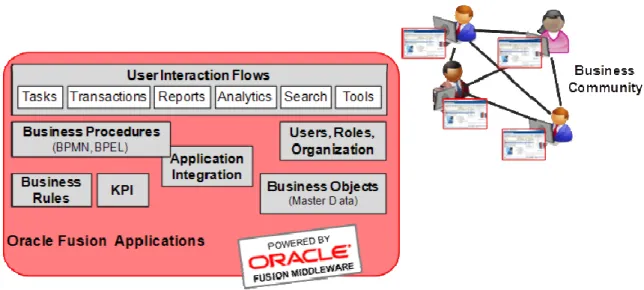
To answer these questions, it is advisable to first have a look at the conceptual structure of the Oracle Fusion Applications (see Figure 1: Conceptual components of Fusion ApplicationsFigure 1). Oracle Fusion middleware products form the basis. The business logic is realized by using the Oracle SOA Suite and the BPM Suite in the form of business procedures and business rules in connection with a role-oriented organization structure. Apart from automated processes, in which the services are supplied, human interactions are incorporated as well. The Application Integration Architecture (AIA) constitutes a core component, predefining a service-oriented integration architecture. Integrated business objects, which are realized in the Fusion data model and by dedicated master data management applications if necessary, provide for the master data management. A diversity of key performance indicators is available along the entire value chain for the enterprise performance management based on key performance indicators.
Figure 1: Conceptual components of Fusion Applications
By means of role-based WebCenter portals, users are granted access to the services. These are offered in the form of tasks, transactions, reports and analyses and are carried out as elements by user interaction flows. User interaction flows adapt to the work method of the user but should not limit the user’s individuality too much. This becomes obvious when taking the collaboration and social networking features into account. The figure does deliberately not show the single user as the target group but the collectivity of users in the form of a networked business community. And the business community is cross-company, by all means, by including external business partners or consumers (e.g. clients in e-commerce or applicants as part of the talent management).
The service-oriented architecture of Fusion Applications offers, apart from personalization, a multitude of possibilities to adapt to client- or role-specific requirements on WebCenter level. This is ensured by the Fusion Middleware products, which not only set up a modern infrastructure for Fusion Applications but also enable the realization and seamless integration of client-specific expansions. How can an efficient possibility for participation of the business users be created in such a complex architecture? How can the Fusion business processes be made transparent?
Modeling Fusion Business Processes
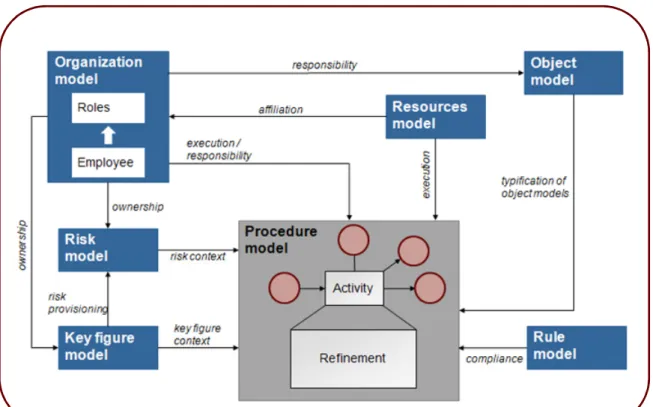
In practice, graphic models present proven means to provide transparency in business processes. However, when focusing on the participation of the business user, the models need to be well-arranged, clearly structured and easily comprehensible. And they have to allow for a drill-down into details relevant to the process. It is also important to not only consider the procedures separately but also all aspects of business processes relevant to the described conceptual components of Fusion Applications. The paper on hand exemplarily refers to the business process modeling method Horus® introduced in [1]. Figure 2 shows the structure of such a “complete” business process model that meets the requirements of the Fusion business processes.
Figure 2: More insight with business process models
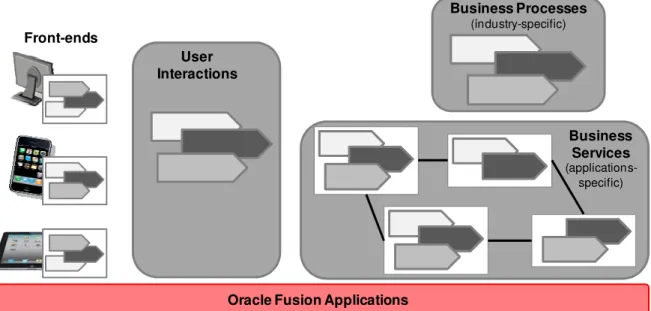
The core of the business process model is formed by the procedure model, which describes the processes on different hierarchy levels. The hierarchies are formed by refinement and coarsening. They ensure clarity, even of extensive models. In procedure models, roles are referred to in organization models, which carry out respectively are responsible for activities. Resources are either described directly in the procedure models or explicitly in the resource models. Further components of the business process model are risk and key figure models, which are also connected to the procedure model by associations. Object models are available to describe the master data and business rule model for the business rules. Corresponding associations to other sub-models are included for these sub-models. Different business process model views are included in the Horus Method (see [1]). These views take the various requirements for information of the model users into account. Figure 3 illustrates the different views and displays their relations among one another. The business process view completely abstracts the underlying enterprise applications. It focuses on sectored aspects and utilizes an industry-oriented wording for all model elements. This view is primarily used by executives and business managers. Business service models, which are orchestrated to continuous business processes, connect to the Fusion Applications processes. Business service models present the components of the Fusion Applications in a mere functional view. However, they use a wording for the model elements which enables for referencing to the Fusion Applications functionality. Different front-ends are defined for multimodal interaction platforms. They adapt to the technical possibilities of the underlying terminals. The connection between business services and the front-ends is indirect via user interaction models. The advantage is that only functional and technical aspects need to be considered.
Figure 3: Business process model views
The points discussed up to now lead to the conclusion of modeling being a quite complex procedure. However, in practice mainly reference models, models already predefined and adapted to the requirements of the project, are used. [1] describes both industry-specific business process reference models and application-specific business service models. Furthermore a specific objective should always be the basis of modeling, so that oftentimes only especially complex or models critical to success are modeled.
Practical Example: Business Service Model Procure2Pay
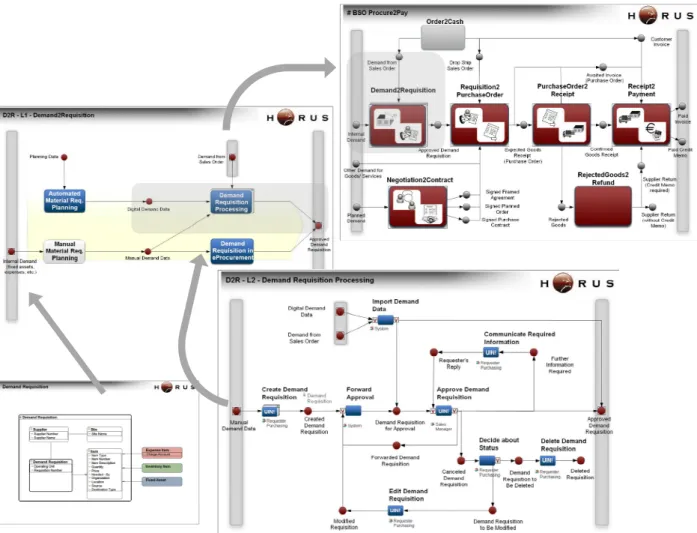
Figure 4 shows exemplarily an excerpt of an application-specific reference model for the Procure2Pay process. The connection between a more refined model and the corresponding element in the higher-level model is visualized by the rounded-off arrows. So the procedure model Demand2Requisition shows the refined activity Demand2Requisition in the Procure2Pay model. An object model for a Demand Requisition is displayed in the left side on the bottom of the figure.
Business Processes (índustry-specific) Business Services (applications-specific) Front-ends User Interactions
Figure 4: Practical example: Business service models
Business User Challenges
The paper on hand presents in detail the special features of the Oracle Fusion Applications considering the underlying business processes. But what do those features signify for the business user? How do his workplace and work methods change? Which challenges arise and how does the user overcome them? Maybe he even sees them as a threat?
In the following we will compare some of the most important challenges for the user of Fusion Applications to the marketing message of the producer:
„Fusion Makes Better Decisions Faster“
For most users, this will result in having to change their individual decision processes in order to make the most of Fusion Applications’ advantages. Additionally, the evaluation and analysis of the key figures will become part of the self-service process that might not be easy for executives.
“Navigate to What You Need Faster”
This requires the work context preset by Fusion Applications to truly cater to the needs of the user. If this is not the case, the user has to rethink his or her work method.
“Collaborate, Cooperate, Succeed”
One could suspect most business users would use the collaboration and social networking features as naturally as they do in their private environment. However, this requires trust in the partners within the community. Yet this is far less the case in the corporate environment and surprisingly even less than in much more anonymous worldwide networks (keyword: facebook).
“Complete Your Work With Ease”
Only business users who are well-prepared for the use of the innovative Fusion Applications are able to meet this requirement. The preconditions to this are suitable business change management measures carried out in advance, accompanying the introduction and critical stages of the life cycle of Fusions Applications.
In the following we offer a solution to this problem, taking into account the special features of the Fusion Applications by means of a collaborative contemplation of the business processes.
The Solution: Social BPM Lab
Social BPM labs are described in [1]. In a lab, the strong points of easily comprehensible business process modeling tools are combined with business process reference models and the collaborations in Web 2.0-based social networks. During the last months valuable experience has been gained as part of numerous lab events in different European countries with partly more than 100 participants from the fields of business, research and education (see [2]). At the moment labs in multicultural environments across all time zones and language barriers are being prepared.
The basic idea of the Social BPM lab is the collaboration among members of a business community in a Web 2.0-based social network in order to define business objectives, strategies, business processes, business rules, business objects and organizational structures together or to “just” gain a common understanding of the organization. It is important for all relevant organizational units to be represented across all hierarchy levels. All branch offices worldwide as well as strategic partners should be included into the business community. This does not necessarily imply that an actual member of each organizational unit has to be involved - it often suffices when a community member represents the interests of a whole region or of an entire business division. However, it is necessary that the respective region or business division feels properly represented by their member in the lab.
Web 2.0-Infrastructure for Social BPM
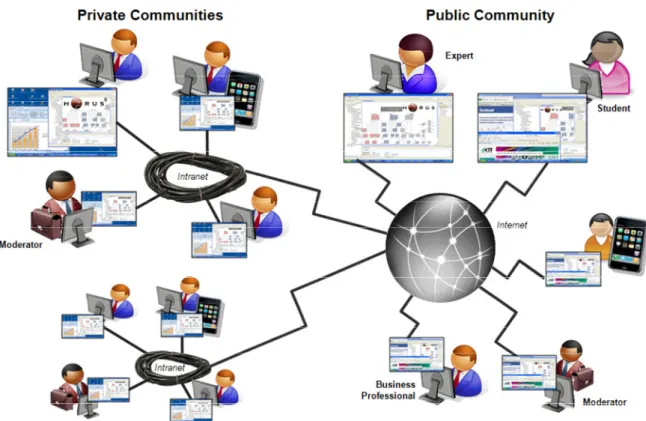
Social BPM requires a technical infrastructure in which the common interaction possibilities of Web 2.0 can be used. Most important here are wiki, forum, chat, messaging, webinars, and web conferencing. Different devices should be integrated here, in particular mobile devices right up to smart phones and pads in business sectors. Infrastructures are established in these communities, where the collaborative design or sharing of business processes takes place. Private communities are distinguished on the basis of Intranets and public communities, which are available on the Internet. Figure 5 outlines a typical Social BPM infrastructure.
In a private community, members work together in a “closed” business community. The private community includes employees in an organizational unit, an entire organization, a consortium, a virtual enterprise, and sometimes business partner employees. Permanent and temporary community members can be distinguished in a private community. Temporary members will receive access to the community only for a certain period of time or for a specific task. It is clear that a social BPM infrastructure - particularly in the context of business communities - presupposes a sophisticated access management system with identity management. A further prerequisite is one or more moderators, as compliance with the stipulated rules within the community cannot be enforced only with technical capabilities. In addition, the moderators should ensure that the business community actually achieves the objectives set within the context of collaborative work.
This is where private and public communities differ. Moderators in public communities usually have no right to drive the collaboration into a particular direction. This law behooves exclusively the community itself - under a given code of conduct within the community. For public communities, it is typical that business professionals, protagonists from research and education, as well as students are to be found. Interdisciplinary work is typical. Moreover, exactly this characteristic environment signifies the public community for business process innovation and creative ideas for solutions.
By the way, a new kind of service, which we will call “BPM Consulting on Demand,” is developing in Social BPM. This particular form of consulting is provided by experts working on the requirements within the community. Costs are involved with the expert’s services, so it must be regulated within the community, which costs the expert’s work will incur, and who is entitled to call on expert services.
Practical Example: Social Supply Chain Engineering Lab
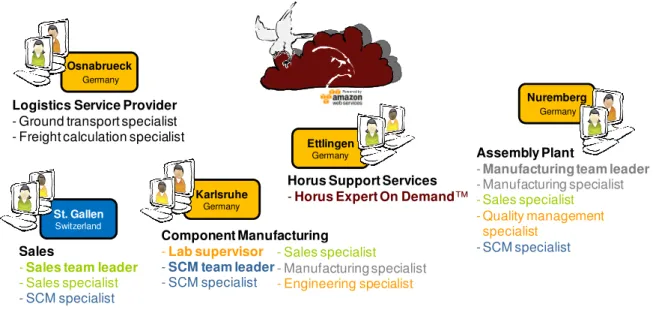
A practical example is shown by Figure 6. The structure of a lab which deals with the design of supply chain engineering processes is portrayed. The members of the business community work from different locations in Germany and Switzerland. The system environment required for the Horus Social BPM Lab is provided as a service by the Amazon Cloud. The users require only their web browser; Skype is used for telephony and chat.
Figure 6: Practical example: Social Supply Chain Engineering Lab
Different corporate functions are situated at different locations: component manufacturing in Karlsruhe, the assembly plant in Nuremberg, the sales office in St. Gallen and the external logistics service provider in Osnabrueck. A Horus Expert On Demand service in Ettlingen offers support services based on Web 2.0 for a fee. The functionality-oriented teams are divided between the locations. Each team has a responsible leader, who is integrated in a lab in one of the locations. The SCM team leader e.g. is situated in Karlsruhe. His team is constituted of experts in Karlsruhe, Nuremberg and St. Gallen. The lab supervisor in Karlsruhe is responsible for the consolidation of the results attained in the teams.
Results of a Social BPM Lab
Unfortunately, it cannot be expected that high-quality and immediately realizable business process models emerge from a Social BPM lab. However, valuable fragments of models of different qualities result owing to the business knowledge therein. If preset reference models are used in labs, the resulting models usually feature a high quality as well as a high completion rate.
The lab is suited perfectly to prevent or to solve conflicts in the wording of functional requirements. Furthermore remarkable ideas to improve processes and quite often real process innovations emerge from labs. The lab also has significant benefits when a
Pow ered by
Karlsruhe Germany Osnabrueck
Germany
Horus Support Services -Horus Expert On Demand™
Nuremberg Germany Ettlingen Germany St. Gallen Switzerland
Logistics Service Provider - Ground transport specialist - Freight calculation specialist
Sales
-Sales team leader - Sales specialist - SCM specialist Component Manufacturing -Lab supervisor -SCM team leader - SCM specialist Assembly Plant
-Manufacturing team leader
- Manufacturing specialist - Sales specialist - Quality management specialist - SCM specialist - Sales specialist - Manufacturing specialist - Engineering specialist
common and mutually agreed process understanding is to be attained or when thinking in business processes is to be trained.
When using Social BPM labs as part of the business change management it is expected that the members of the business community are prepared for the planned changes in a way that they understand the corporate objectives and the resulting business strategies. Moreover, the whole business community is actively integrated into the change process and co-designs it. Besides, practical experiences have shown that the lab fostered the quality and value orientation of the communication to no small extent and that the collaborative intensity had been strongly increased.
Full Fusion Life Cycle User Participation
A central question of this paper is how to effectively incorporate business users as part of the introduction and use of the Oracle Fusion Applications. Such a business user participation is the key to a successful business change management of Fusion Applications. Figure 7 displays the way the suggested solution of Social BPM lab takes at different phases of the applications project. The drafted phase model is to be seen as exemplary as a specific phase model is not obligatory for Social BPM.
Figure 7: Business change management with Social BPM Labs
Feasibility Study
Social BPM labs are a great help as part of project preparing activities and identifies strengths, weaknesses, opportunities and threats (SWOT) which arise from process evaluation. Furthermore, suggestions regarding process improvements and even process innovations can be expected.
Requirements Analysis
Requirements are collected, analyzed, voted on by the community and their quality assured in a requirement analysis by means of Social BPM labs.
Feasibility Study Requirements Analysis Implementation & Go Live Stabilization & Improvement Ongoing Improvement Social BPM Lab −SWOT analysis
−suggestions for improvement −process innovations
Social BPM Lab
−conflict management −full cycle testing
−reconciliation of requirements −training (key users, users)
Social BPM Lab
−process improvement & tuning −improvement potential analysis −prepare reengineering
Social BPM Lab
−full cycle testing
−process improvement & tuning −user training and coaching
Social BPM Lab
−requirements collection
−reqs analysis and quality checks −reconciliation of requirements
Implementation & Go Live
Experience shows time and again that during the implementation functional requirements have to be examined, coordinated and conflict situations must be solved if necessary. Another field of application for labs with their collaborative approach is full cycle testing as well as training of key users and end users.
Stabilization & Improvement
The stabilization of the system and thus the underlying business processes takes place after the Go Live and processes are improved. The lab can also be of use for brainstorming and coordination as well as part of tests and trainings. Besides, the lab can also simply be used to improve communication or collaboration in the business community.
Ongoing Improvement
The use of Social BPM does not stop when the Fusion Applications system is fully installed in the company. In reality, it can continue being utilized in the ongoing process improvements and in the preparation of a complete reengineering.
Conclusion
This paper has shown that Oracle Fusion Applications opens up more flexibility in work methods for the business user and provides him or her with context-rich possibilities for interaction. The great focus on process of the applications relieves the user from simple routine tasks and points out new methods to efficiently carry out business tasks. This leads to more self-confidence in business users and to emancipation from the supporting IT. In consequence they demand a say in business design decisions. A growth of business user participation may be attained by means of Social BPM labs. Only when the effective integration of the emancipated business users succeeds a successful introduction and use of Oracle Fusion Applications is possible.
References
[1] Schoenthaler, F.; Vossen, G.; Oberweis, A.; Karle, T.: Business Processes for Business Communities: Modeling Languages, Methods, Tools. Springer Heidelberg Dordrecht London New York, 2012.
[2] http://www.horus.biz/en/media-center/media-library.html [3] http://www.horus.biz/en/public-space.html