Communication-Aware Coverage Control for Robotic Sensor Networks
Yiannis Kantaros and Michael M. Zavlanos
Abstract— The purpose of this paper is to propose a control scheme to maximize area coverage and at the same time ensure reliable communication in networks of mobile robot sensors. The information that is generated at the sensors depends on the sensing capabilities of the sensors as well as on the frequency at which events occur in their vicinity, captured by appropriate probability density functions. This information is then routed to a fixed set of access points via a multi-hop network whose links model the probability that information packets are correctly decoded at their intended destinations. The proposed hybrid controller simultaneously optimizes coverage and routing of in-formation by decoupling control in the continuous and discrete domains. The robots’ motion is performed in continuous time, along the negative gradient of a cost function that combines the coverage objective and a barrier potential used to ensure satisfaction of desired communication rates. On the other hand, the communication variables are updated periodically, in discrete time, by the solution of an optimization problem, and constitute the switching signal in the continuous motion control. Simulation studies are conducted verifying the efficiency of the proposed algorithm.
I. INTRODUCTION
The area coverage problem is related to the development of a control plan that allows a group of mobile agents equipped with sensing and communication capabilities to spatially configure themselves in a way that maximizes the cumulative probability that events are detected in an area of interest. While the area coverage problem has recently received a lot of attention, ensuring that the collected rates of information can be efficiently relayed to a desired set of access points for subsequent processing is, to the best of our knowledge, still an open problem. In this paper, we provide a solution to this problem of joint coverage and communication control.
The literature related to coverage problems is quite exten-sive. In [1], the authors propose a distributed controller based on Lloyd’s algorithm for sensing a convex area. In this work, it is assumed that the sensing performance degrades as the distance from the sensor increases. The case where the robots are equipped with range-limited sensors is discussed in [2]. Distributed controllers for coverage optimization have been proposed in [3] that minimize the energy needed for sensing and data processing. Coverage optimization for anisotropic sensors, whose performance depends on both the distance from the sensor and its orientation, is studied in [4], [5], while [6]–[9] discuss coverage of non-convex areas.
The area coverage problems discussed above typically ignore the requirement that the information collected by the
This work is supported in part by the NSF awards CNS#1261828 and CNS#1302284.
Yiannis Kantaros and Michael M. Zavlanos are with the Department of Mechanical Engineering and Materials Science, Duke University, Durham, NC 27708, USA.{yiannis.kantaros,michael.zavlanos}@duke.edu
robot sensors needs to be routed to a desired set of destina-tions. Introducing this capability in the system gives a new twist to the problem on the interface with communication control and networking. Most of the existing approaches to communication control of mobile robot networks employ proximity graphs to model information exchange between robots and, therefore, consider the problem of preserving graph connectivity. Such approaches involve, for example, maximization of the algebraic connectivity of the graph [10], [11], potential fields that model loss of connectivity as an obstacle in the free space [12], and distributed hybrid approaches that decompose control of the discrete graph from continuous motion of the robots [13]. Distributed al-gorithms for graph connectivity maintenance have also been implemented in [14], [15]. A comprehensive survey of this literature can be found in [16].
A more realistic communication model between mobile robots, compared to the above graph-theoretic approaches, is presented in [17], [18] that takes into account the routing of packets as well as desired bounds on the transmitted rates. In this model, edges in the communication graph are associated with the probability that packets delivered through the corresponding links are correctly decoded by their in-tended receivers. This formulation gives rise to optimization problems to determine the desired rates and routes. Related methods for the control of wireless robot networks are proposed in [19] and [20], where the wireless channels are modeled using path loss, shadowing, and multi-path fading, or evaluated using on-line techniques, respectively.
In this paper, we consider the coverage problem with the additional requirement that the information collected by the mobile robot sensors can be efficiently routed to a set of desired access points. Each agent is responsible for sensing a region and transmitting sensor measurement information to a fixed infrastructure of base stations. The rate of transmitted information depends on the quality of sensing as a function of the sensing range as well as on the on the probability that events occur in the vicinity of the sensors, captured by an appropriate probability density function over the area of interest. The underlying communication between robots follows the model proposed in [17], [18]. Our approach to joint coverage and communication control is based on decomposing the problem in the continuous and discrete domains, so that optimal coverage is achieved via continuous gradient descent on area-based coverage potential functions that respect communication constraints, while optimal com-munication is updated periodically via the solution of appro-priate network optimization problems. In the resulting hybrid system, the communication variables constitute the switching
signal in the continuous motion controllers. We validate our approach through non-trivial computer simulations.
A related problem that considers the minimization of the aggregate information delivered directly, in one hop, from the robots to a sink node is addressed in [21]. Multi-hop communication in the context of coverage is considered in [22] and [23]. Specifically, in [22] the objective is to minimize the energy consumption in the network, so paths are sought that ensure this minimum energy objective. In [23] a joint coverage and graph connectivity framework is developed for robots that have limited, proximity-based communication ranges. These approaches differ from the one proposed here in that we consider more realistic models of wireless communication that involve routing of information over a network of varying link reliabilities, and we also ensure desired information rates that depend on the frequency with which events occur in the sensors’ vicinity.
The rest of this paper is organized as follows. Section II presents the coverage problem in the presence of communi-cation constraints. The proposed control scheme is presented in section III while its efficiency is examined in section IV through a simulation study. Conclusive remarks are provided in the last section.
II. PROBLEMFORMULATION
Assume a team of N mobile robots responsible for the sensing coverage of a convex and compact area A ⊂ R2 and for the transmission of packets of information to a fixed set ofKaccess points (APs). The positions of all nodes are stacked in the vector x= [xT1, . . . ,xiT, . . . ,xTN+K]T where
i ∈ {1, ..., N} for the robots and i ∈ {N+ 1, ..., N+K} for the APs. The motion of the robots is assumed to be governed by the following first-order differential equation:
˙
xi=ui, i= 1, . . . , N, (1)
whereui ∈R2 stands for the control input associated with thei-th robot.
To achieve area coverage, each robot is equipped with an isotropic sensor whose accuracy is captured by a radially non-decreasing function that is minimum at the sensor lo-cation. In this context, a smaller value of f means better accuracy. In particular, we choose f(xi,q) = kq−xik2.
Moreover, let φ(q) : A → R+ be an integrable density
function representing the probability that an event takes place at the point q ∈ A. Then, the coverage problem can be formulated as follows: minimize x H(x) = Z A max i=1,...,nf(xi,q)φ(q)dq. (2)
A common geometric approach to simplify the area cost functionHis via the tessellation of the area of interest into subregionsWi,i∈ {1, ..., N}according to a distance metric,
and the assignment of those regions to the robots for sensing purposes. Considering that SN
i=1Wi = A, this approach
allows us to reformulate the coverage problem (2) as: minimize x,W H(x,W) = N X i=1 Z Wi f(xi,q)φ(q)dq, (3) R1 R2 R3 AP4 AP5 T14R14 T 24 R 24 T21R 21 T31 R 31 T 13R 13 T23R23 T32R32 T35R 35 T12 R12 r1 r2 r3
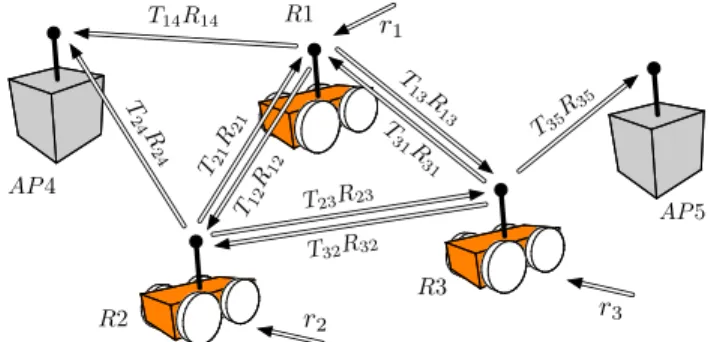
Fig. 1. Robot network consisting of two access points (APs) and three robots (Rs). Robots generate data packets at a rate 0 ≤ ri ≤ 1 and collaborate to convey this information to the APs. The position function R(xi,xj)is the reliability of the channel between robotsiandj, whereas Tij denotes the probability that robot i routes packets to robot j. The productTijR(xi,xj)is the average rate at which packets are successfully conveyed from robotito terminalj.
whereW={Wi}Ni=1 denotes the collection of regions Wi.
The problem that we address in this paper is the opti-mization of the objectiveHin (3), subject to communication constraints required to ensure desired information flows from the sensor robots to the access points (APs). In particular, let R(xi,xj)be a link reliability metric denoting the probability
that a packet transmitted by the i-th robot is correctly de-coded by thej-th node. UsingR0to denote the transmission
rate of the terminals’ radios, the effective transmission rate fromi toj is the rate R0R(xi,xj)at which information is
successfully conveyed through this link. To simplify notation we work with normalized rates by making R0 = 1. This
means that rates are measured as (dimensionless) fractions of the transmission rateR0. For simplicity, we also assume
all robots use the same transmission rateR0.
Moreover, we denote byri∈[0,1]the normalized average
rate (information units per unit of time) at which the i-th robot generates information. Recalling i-that R0 is the
transmission rate of the terminals’ radios, the effective rate at which information is generated at terminaliis:
ri(xi,Wi) =R0
Z
Wi
m(xi,q)φ(q)dq, (4)
where m ∈ [0,1] is any non-increasing function of the distancekq−xik that models the probability that an event
that occurs at a distancekq−xikfrom the sensor is correctly
captured by this sensor.1 If a constant functionmis selected
then the sensor quality is the same in the whole region
Wi and ri captures the the cumulative probability that an
event takes place in Wi. Otherwise, ri takes into account
the degradation of the sensing performance over the φ-weighted area Wi. A possible choice for the functionm is
m(xi,q) =e−kq−xik 2
.
Packets generated at the terminal i are transmitted to terminalj according to routing probabilityTij representing
1Note that the functions f and m in (2) and (4), respectively, have
essentially the same role. In fact, one could replace the functionf in (2) withmand transform the minimization problem into a maximization. We choose to keepf in the definition of (2) as this is a standard formulation in the coverage literature [24].
the probability that the i-th robot selects robot j as a destination for its transmitted packets. Upon generation or arrival from another robot, packets are assumed to be stored in a queue at each robot and they leave this queue provided they are transmitted and correctly decoded by any other nodej. Thus, the normalized rate at which packets leave the queue at the i-th node and are conveyed to the j-th node is TijR(xi,xj), since the transmission and the decoding
process are two independent events. Packets can be conveyed by thei-th robot to the APs either directly if the probability TijR(xi,xj) for j ∈ {N+ 1, . . . , N+K} is reasonably
large or through a multi-hop communication path; see Figure 1. Then, the average rate at which packets leave the i-th queue is: routi = N+K X j=1 TijR(xi,xj). (5)
Similarly, the average rate at which packets arrive at thei-th queue is: riin=ri(xi,Wi) + N X j=1 TjiR(xj,xi). (6)
Note that the APs can only receive information which explains the upper limits in the sums of equations (5) and (6). A necessary condition to ensure that the queue at node i empties infinitely often with probability one is that rin
i ≤routi . Therefore, packets are almost surely eventually
delivered to the APs as long as ri(xi,Wi)≤ N+K X j=1 TijR(xi,xj)− N X j=1 TjiR(xj,xi) (7)
for all i ∈ {1, . . . , N}. Incorporating the set of constraints (7) as well as the probability constraint PN+K
j=1 Tij ≤ 1
in the optimization problem (3) we obtain the constrained coverage problem: minimize x,T,W H(x,W) = N X i=1 Z Wi f(xi,q)φ(q)dq (8) subject to ri(xi,Wi)≤ N+K X j=1 TijR(xi,xj)− N X j=1 TjiR(xj,xi), N+K X j=1 Tij ≤1, 0≤Tij ≤1
where T ∈ RN(N+K) is the stack vector of all routing probabilitiesTij, and the constraints in (8) hold for all robots
i∈ {1, . . . , N}.
Note that (8) is an optimization problem with respect to the robot positions xi, the routing probabilities Tij, and
the partition of the area in regions Wi. In the absence of
the constraints, it is a well known result that the objective functionHin (8) is minimized if the partitionWi is chosen
to be the Voronoi partition of the space [24], defined as:
Definition 2.1 ( [25]): Voronoi diagrams generated by a set of points located at {x1, . . . ,xN} is the set V =
{V1, ...,VN} where Vi is called the Voronoi cell of node
i and contains the points that are closer to it than to any other node:
Vi ={q∈ A | kq−xik ≤ kq−xjk, ∀j6=i}.
On the other hand, in the presence of the constraints, the Voronoi regions are not necessarily feasible for (8) and, therefore, the feasible optimal partition for the constrained problem (8) is in general different from the Voronoi partition. However, if we are able to ensure feasibility of the Voronoi partition, then this partition will be optimal for (8). In our problem, this is possible by appropriately selecting the routing probabilities Tij. In fact, we replace the partition W in (8) by the Voronoi partition V, and then solve for routesTij that satisfy the constraints. This gives rise to the
following problem: minimize x,T H(x,V) = N X i=1 Z Vi f(xi,q)φ(q)dq (9) subject to ri(xi,Vi)≤ N+K X j=1 TijR(xi,xj)− N X j=1 TjiR(xj,xi), N+K X j=1 Tij ≤1, 0≤Tij ≤1
where again the constraints in (9) hold for all robots i ∈
{1, . . . , N}. Assume now that the network is initially de-ployed so that the constraints (7) are satisfied. Then, in this paper we seek a solution to the following problem:
Problem 1: Determine robot positions xi and routes {Tij}Nj=1+Ksuch that coverage is optimized and reliable
com-munication with the APs is guaranteed, as per the solution of problem (9).
III. COVERAGE ANDROUTINGCONTROL
In this section, a hybrid control scheme is proposed for solving the non-linear optimization problem (9). More specifically, for fixed values of the routing probabilities Tij, we design continuous motion controllers ui for the
robots to optimize the coverage objective in (3), while maintaining feasibility of the routing constraints (7). As the robots move, the generated rates of informationri and the
channel reliabilities Rij change, so we periodically update
the routing probabilities to account for these changes. The new routesTij are found by solving the feasibility problem
(7) for the current values ofriandRij. The routing variables
Tij constitute the switching signal in the continuous motion
controllers (1).
In particular, let {tk}∞k=0 denote a sequence of time
instances at which the routing probabilitiesTij are updated
and define the switching signal affecting the controller of robotiby
Algorithm 1 Simultaneous coverage and routing control
Require: Initial positionxi(t0)for all robots i;
1: Compute the routing probabilitiesTij(t0)by solving the
feasibility problem of constraints (7) for all i;
2: fork= 0to∞do
3: Continuously move every robot i according to the closed loop system (1)–(12) until time tk+1;
4: When t = tk+1, compute the new routing
probabil-ities Tij(tk+1)by solving the feasibility problem of
constraints (7) for all i;
5: Set k:=k+ 1;
6: end for
Then, according to the proposed scheme the motion of the robotiis governed by:
˙
xi=ui(x(t), σi(tk)), ∀t∈[tk, tk+1). (11)
To optimize coverage while ensuring feasibility of the con-straints (7) as the robots move, we choose the controller
ui(x(t), σi(tk))to be the negative gradient:
ui(x(t), σi(tk)) =−∇xiH(x(t))−∇xiCi(x(t), σi(tk))
(12) for >0a gain, where
Ci(x(t), σi(tk)) = N+K X j=1 Tij(tk)R(xi(t),xj(t)) 2 (13) − N X j=1 Tji(tk)R(xj(t),xi(t)) +ri(xi(t),Vi(t)) 2−1
is a barrier potential function that grows unbounded when the constraint (7) for robotitends to become violated. This construction ensures satisfaction of (7) for all time t ∈
[tk, tk+1) when the controller (12) is active. The integrated
hybrid system for joint coverage and routing control is described in the Algorithm 1.
Observe that the computation of the controller (12) re-quires the gradients∇xiHand∇xiri. As shown in [1], the
gradient of the functionHis given by
∇xiH= 2MVi(xi−CVi), (14) where MVi = R Viφ(q)dq and CVi = 1 MVi R Viqφ(q)dq
denote the mass and the centroid of the Voronoi cellVi with
density functionφ, respectively. To obtain the gradient ofri
we show the following result:
Proposition 3.1: Given a differentiable functionm and a density functionφ, the gradient of the functionri defined in
(4) can be expressed as follows:
∇xiri(xi,Vi) = Z Vi ∂m(q,xi) ∂xi φ(q)dq (15) + Ei X e=1 Z (qe i,1,qei,2) q−xi kxj−xik m(q,xi)φ(q)dq
whereEiis the number of edges that constitute the polygonal
boundary∂Viof the Voronoi cellViand(qei,1,qei,2)denotes
thee-th edge in this boundary with end pointsqei,1 andqei,2, i.e.,∂Vi={(q1i,1,q1i,2), . . . ,(q
Ei i,1,q
Ei i,2)}.
Proof: Applying the the Leibniz integral rule [26] to the expression forri in (4), we have:
∇xiri = ∂ ∂xi Z Vi m(q,xi)φ(q)dq (16) = Z Vi ∂m(q,xi) ∂xi φ(q)dq+ Z ∂Vi nTi ∂q ∂xi m(q,xi)φ(q)dq, whereni=kxxjj−−xxiik is the normal vector pointing outwards
of the edge of Voronoi cellVi associated with the Delaunay
neighbors iand j.2 Let (qe
i,1,qei,2)denote the e-th edge in
the boundary∂Vi. Then, the pointsqthat belong to thee-th
edge lie on the line described by the equation:
q= xi+xj
2 +aijCij(xj−xi), (17)
whereCij is the skew symmetric rotation matrix
Cij=
0 −1
1 0
so thatCij(xj−xi)is perpendicular to(xj−xi), andaij ∈
Ris a scalar.
Taking the partial derivative of (17) with respect to xi
yields:
∂q
∂xi
= 1
2I−aijCij, (18)
whereIstands for the identity matrix. Multiplying (18) from the left bynTi , we have:
nTi ∂q ∂xi =1 2n T i −aijnTiCij =1 2 (xj−xi)T kxj−xik +aij (xj−xi)T kxj−xik CTij =1 2 (xj−xi)T kxj−xik + 1 kxj−xik qT−(xi+xj) T 2 = q T −xTi kxj−xik , (19)
where in the third equality of (19), we have substituted the termaij(xj−xi)TCTij from (17).
Substituting equation (19) into (16) yields:
∇xiri = Z Vi ∂m(q,xi) ∂xi φ(q)dq + Z ∂Vi q−xi kxj−xik m(q,xi)φ(q)dq. (20)
Finally, taking into account the decomposition of the boundary of the Voronoi cell into edges ∂Vi = {(q1i,1,q1i,2), . . . ,(qEii,1,qEii,2)}, equation (20) gives (15), which completes the proof of the proposition.
2Two nodes are called Delaunay neighbors if they share an edge of their
(a) Timet= 0 (b) Timet= 1.5 (c) Timet= 3
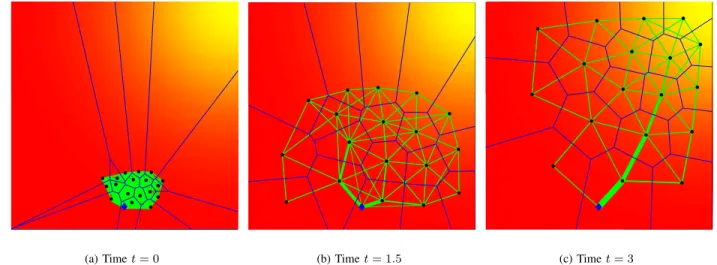
Fig. 2. Evolution of a communication network consisting ofN= 18robots (black dots) andK= 1AP (blue rhombus) during an area coverage task. Figures 2(a) through 2(c) show the evolution of the system at different time instants. Green lines represent the communication links among the nodes. Their thickness depends on the value ofTijR(xi,xj), i.e., thicker lines capture higher values. A presence of a source in the upper right corner of the area is captured by a higher density depicted in yellow.
IV. SIMULATIONSTUDIES
In this section we provide a simulation study of a mobile robot network consisting ofN = 18robots and K= 1AP. The area of interest is defined as a 2×2 square and the density function φ is assumed to be a Gaussian centered at (2,2). The function m in (4) is selected to be equal to e−kxi−qk2 and the channel reliability is modeled by the
following function: R(xi,xj) = 1 if kxijk< l P3 p=0apkxijkp ifl <kxijk ≤u 0 ifkxijk> u , wherekxijk=kxi−xjkand the constantsap,p= 0, . . . ,3
are chosen so thatR(xi,xj)is a differentiable function [17].
Figure 2 depicts the network at different instances of its evolution along with the quality of the communication links. In this simulation study, the limits l, u are selected to be equal to0.3 and0.6 units, respectively. As the diameter of the region of interest is approximately 4 times the value of u, multi-hop communication is necessary in order to cover the whole area. The rates of information transmitted over the communication links are captured by the quantities TijR(xi,xj)as described in Section II. In Figure 2, we see
that coverage is achieved, while multi-hop communication paths are established with the AP.
In Figure 3, the quantityrout−rinis plotted with respect
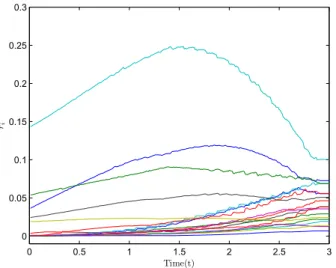
to time showing that the routing constraints (7) are satisfied through the network evolution and in Fig 4 the monotonic evolution of the coverage objective is illustrated. Moreover, in Figure 5, we show the average rate at which every robot generates information, where the higher rates correspond to robots in the upper corner in Figure 2(c), since they are close to the source.
V. CONCLUSIONS
In this paper, a first centralized approach to the simul-taneous coverage and communication control problem was
0 0.5 1 1.5 2 2.5 3 -0.05 0 0.05 0.1 0.15 0.2 0.25 0.3 0.35 0.4 0.45 Time(t) rou t − rin
Fig. 3. Graphical depiction of the differencerout−rinfor all robots of the network. 0 0.5 1 1.5 2 2.5 3 0 0.1 0.2 0.3 0.4 0.5 0.6 0.7 0.8 0.9 1 Time(t) C ov er a g e O b je ct iv e H
0 0.5 1 1.5 2 2.5 3 0 0.05 0.1 0.15 0.2 0.25 0.3 Time(t) ri
Fig. 5. Graphical representation of the average raterifor all robots of the network.
presented. The robots were responsible for sensing a convex area and for reliably relaying packets of information that depend on their sensing capabilities and a density func-tion defined over the area of interest, to a set of APs. The routing of packets was performed through a multi-hop network modeled so that its communication links represent channel reliabilities. In our approach, the coverage and the routing problem were addressed jointly, leading to a hybrid system. Particularly, the motion control was performed in the continuous time domain ensuring coverage optimization and satisfaction of the communication constraints, while communication control was implemented at discrete time instances through optimization of the routing variables that constituted the switching signal in the continuous robot motion. Simulation studies illustrated the efficacy of the proposed control scheme.
REFERENCES
[1] J. Cort´es, S. Martinez, T. Karatas, and F. Bullo, “Coverage control for mobile sensing networks,” IEEE Transactions on Robotics and
Automation, vol. 20, no. 2, pp. 243–255, 2004.
[2] J. Cort´es, S. Martinez, and F. Bullo, “Spatially-distributed coverage optimization and control with limited-range interactions,” ESAIM:
Control, Optimisation and Calculus of Variations, vol. 11, no. 4, pp.
691–719, 2005.
[3] M. Zhu and S. Mart´ınez, “Distributed coverage games for energy-aware mobile sensor networks,”SIAM Journal on Control and
Opti-mization, vol. 51, no. 1, pp. 1–27, 2013.
[4] A. Gusrialdi, T. Hatanaka, and M. Fujita, “Coverage control for mobile networks with limited-range anisotropic sensors,” in47th IEEE
Conference on Decision and Control, Cancun, Mexico, December
2008, pp. 4263–4268.
[5] B. Hexsel, N. Chakraborty, and K. Sycara, “Coverage control for mo-bile anisotropic sensor networks,” inIEEE International Conference
on Robotics and Automation, Shanghai, May 2011, pp. 2878–2885.
[6] L. Pimenta, V. Kumar, R. C. Mesquita, and G. Pereira, “Sensing and coverage for a network of heterogeneous robots,” in47th IEEE
Conference on Decision and Control, Cancun, Mexico, December
2008, pp. 3947–3952.
[7] C. Caicedo-Nuez and M. Zefran, “A coverage algorithm for a class of non-convex regions,” in 47th IEEE Conference on Decision and
Control, Cancun, Mexico, December 2008, pp. 4244–4249.
[8] A. Renzaglia, L. Doitsidis, A. Martinelli, and E. B. Kosmatopoulos, “Multi-robot three-dimensional coverage of unknown areas,” The
International Journal of Robotics Research, vol. 31, no. 6, pp. 738–
752, 2012.
[9] Y. Kantaros, M. Thanou, and A. Tzes, “Visibility-oriented coverage control of mobile robotic networks on non-convex regions,” inIEEE
International Conference on Robotics and Automation, Hong Kong,
China, June 2014, pp. 1126–1131.
[10] Y. Kim and M. Mesbahi, “On maximizing the second smallest eigen-value of a state-dependent graph laplacian,” IEEE Transactions on
Automatic Control, vol. 51, no. 1, pp. 116–120, 2006.
[11] M. C. DeGennaro and A. Jadbabaie, “Decentralized control of connec-tivity for multi-agent systems,” in45th IEEE Conference on Decision
and Control, San Diego, CA, USA, December 2006, pp. 3628–3633.
[12] M. M. Zavlanos and G. J. Pappas, “Potential fields for maintaining connectivity of mobile networks,” IEEE Transactions on Robotics,, vol. 23, no. 4, pp. 812–816, 2007.
[13] M. Zavlanos and G. Pappas, “Distributed connectivity control of mobile networks,”IEEE Transactions on Robotics, vol. 24, no. 6, pp. 1416–1428, 2008.
[14] G. Notarstefano, K. Savla, F. Bullo, and A. Jadbabaie, “Maintain-ing limited-range connectivity among second-order agents,” inIEEE
American Control Conference, Minneapolis, MN,USA, June 2006, pp.
6–pp.
[15] M. Ji and M. B. Egerstedt, “Distributed coordination control of multi-agent systems while preserving connectedness.” 2007.
[16] M. Zavlanos, M. Egerstedt, and G. Pappas, “Graph theoretic connec-tivity control of mobile robot networks,”Proc. of the IEEE, vol. 99, no. 9, pp. 1525–1540, 2011.
[17] M. M. Zavlanos, A. Ribeiro, and G. J. Pappas, “Network integrity in mobile robotic networks,”IEEE Transactions on Automatic Control, vol. 58, no. 1, pp. 3–18, 2013.
[18] ——, “Mobility & routing control in networks of robots,” in49th IEEE
Conference on Decision and Control, Atlanta, GA, USA, December
2010, pp. 7545–7550.
[19] A. Ghaffarkhah and Y. Mostofi, “Communication-aware motion plan-ning in mobile networks,”IEEE Transactions on Automatic Control,, vol. 56, no. 10, pp. 2478–2485, 2011.
[20] J. Le Ny, A. Ribeiro, and G. J. Pappas, “Adaptive communication-constrained deployment of unmanned vehicle systems,”IEEE Journal
on Selected Areas in Communications, vol. 30, no. 5, pp. 923–934,
2012.
[21] W. Jiang and M. Zefran, “Coverage control with information aggre-gation,” in52ndIEEE Conference on Decision and Control, Firenze, Italy, December 2013, pp. 5421–5426.
[22] W. Li and C. G. Cassandras, “Distributed cooperative coverage control of sensor networks,” in44th IEEE Conference on Decision and Control
and European Control Conference, Seville, Spain, December 2005, pp.
2542–2547.
[23] Y. Stergiopoulos, Y. Kantaros, and A. Tzes, “Distributed Control of Mobile Sensor Networks under RF Connectivity Constraints,”
International Journal of Distributed Sensor Networks, vol. 2012, 2012.
[24] F. Bullo, J. Cort´es, and S. Martinez,Distributed Control of Robotic
Networks. Princeton University Press, 2009.
[25] F. Aurenhammer and R. Klein,Handbook of Computational Geometry. Elsevier Publishing House, 1999, ch. 5:Voronoi Diagrams, pp. 201– 290.
[26] H. Flanders, “Differentiation under the integral sign,”American