Electronic copy available at: https://ssrn.com/abstract=3046303 1
14
Trust and Trustworthiness
Özalp Özer1 and Yanchong Zheng2
1Jindal School of Management, The University of Texas at Dallas 2Sloan School of Management, Massachusetts Institute of Technology
(To appear in The Handbook of Behavioral Operations,K. Donohue, E. Katok, S. Leider, eds., 2017, Wiley)
Abstract In this chapter, we discuss when, how, and why trust and trustworthiness arise to support cooperation within and across organizations. To do so, we first define trust and trustworthiness, discuss how they can be quantified and determine key components of trusting and trustworthy behavior. In addition, we identify building blocks of trust and trustworthiness and offer tangible insights about how to establish trusting and cooperative business/inter-organizational relationships, based on both academic research and case studies from across industries.
We all know that trust and trustworthiness matter in almost all aspects of our relationships, business or otherwise. Our friends, foes, family, colleagues, sociologists, management scientists, and even economists recognize this fact (even though some may not acknowledge it). We innately believe being trustworthy is a virtue (or, at least, are taught to think so) and have learned whether and when to trust (to the best of our abilities). And when we trust, we put ourselves in a vulnerable situation (i.e., we take a risk) based upon the expectation that the person we trusted (trustee) behaves in a positive way that is rewarding to us (as trustors). So, we make a risky “investment” of some sort and face uncertainty in the outcome (and may even regret later) when we trust. We also perhaps adjust our trusting and trustworthy behavior depending on the target of our trust, given the relevant context. For example, we may trust our significant other that he or she will return the $250 (or the car) we lend him or her (perhaps with an implicit or explicit expectation of a positive return beyond the actual loan). We probably would not ask him or her to write a contract before lending our car. However, most of us would perhaps require a marriage certificate (a binding contract that can only be annulled after a legal hearing) accepting all requirements governing a marriage before we commit “to have and to hold from this day forward, for better, for worse, for richer, for poorer, in sickness and health, until death do us part…” and ensure that we provide and receive the care and commitment in the presence of conflicting objectives that we will all face during our marriage.1
Similarly, most successful business and economic relationships are built upon a considerable degree of mutual trust and trustworthiness. As Nobel Laureate Kenneth Arrow wrote, “Virtually every commercial transaction has within itself an element of trust” (Arrow 1972). Trust has been the glue for most transactions within and across cultures as long as humans have socialized and transacted. Business owners and practitioners are not oblivious to this fact. They do not begin talking with a potential partner by first writing a complete set of contracts stipulating all
1 Note that you neither need a marriage certificate nor need to rely on trust if (the big if) your spouse’s and your objectives are
and will be perfectly aligned with absolutely no uncertainty 100% of the time during the span of your life. Similarly, in such a case, there is no need for a pre- or post-nuptial agreement.
Electronic copy available at: https://ssrn.com/abstract=3046303 2
contingencies. Researchers have also long argued that trust plays a stronger role than legal contracts in supporting cooperative relations (see, for example, the seminal work of Anthropologist Edward Hall 1959). Indeed, countries with high levels of general trust and trustworthiness deal with less friction in business transactions. Hence, business stakeholders in such countries often establish and grow successful businesses, leading to wealthier and more prosperous societies (Knack and Keefer 1997, La Porta et al. 1997, Zak and Knack 2001). A degree of mutual trust and trustworthiness is always needed to initiate most business interactions. Yet, most firms do also sign detailed contracts (and hire an army of lawyers) to foster collaboration and hedge their bets against risky investments under uncertain conditions – in other words, there are cases in which solely relying on trust and trustworthiness alone is unwise. 14.1 Are There Any Business Case Studies Where Trust and Trustworthiness Matter? Consider the classic case of Barilla, an Italian pasta maker, and Cortese, an independent Italian distributor of groceries from suppliers to retail stores (Hammond 1994). Barilla had worked with Cortese for years to distribute its products across Italy and Europe. Yet, when Barilla wanted to implement Vendor Managed Inventory (VMI), a supply chain management initiative, it faced substantial resistance, both internally from its own salespeople and also externally from Cortese. VMI required Cortese to relinquish control of its inventory to Barilla who would decide when and how much to replenish their pasta inventory at Cortese’s distribution centers. The premise was that if Barilla were to observe point of sales data and demand across different locations and distributors (which were unavailable to Cortese), then Barilla could better manage the pasta inventory. This improvement would be possible due to having greater visibility to end consumer demand, enabling better production planning, and also possibly moving inventories across different distribution centers. These changes altogether would result in fewer stock outs and higher sales for both Cortese and Barilla. However, Cortese did not trust Barilla and was reluctant to hand over its inventory decisions (control), fearing that Barilla’s objective was not fully aligned with its own. Cortese worried that Barilla would push more products than necessary, establish better relations with retailers, and eventually cut the middleman out of business and sell to retailers and consumers directly. Even Barilla’s own salespeople did not trust Barilla’s top management for fear of losing their bonuses. Eventually Barilla was able to convince Cortese through establishing trust and trustworthiness by addressing vulnerabilities and uncertainties VMI posed on its own sales force as well as on Cortese (as we will discuss in our concluding remarks). As in many other VMI initiatives, such as that adopted by Wal-Mart and Procter & Gamble, successful implementation is often built upon tremendous trust between the companies. Consider, for another example, the interaction between IBM Global Storage Technologies (GST),2 a supplier of hard disk drives, and Apple, the designer and distributor of portable electronic devices and in particular, the innovator of iPod that revolutionized both the consumer electronics industry and several others such as the music and telecommunications industries around 2001. Around the same time, IBM GST was revolutionizing the storage technology with the introduction of its Microdrives that were used in iPod minis, among other electronic devices.
2 In 2003 IBM merged its Global Storage Technologies unit with Hitachi, and they founded Hitachi GST. The company was
eventually sold to Western Digital in 2012. The story described here is based on personal communications with Apple and IBM executives who were then in charge of the partnership. Some of the issues were also leaked at the time to magazines such as The Mac Observer on May 16, 2004.
3
The Microdrive was filled with groundbreaking technologies creating low manufacturing yields and long production/assembly leadtimes due to the capital-intensive manufacturing lines. The existing Microdrive assembly and test lines in the Thailand facility were capacity constrained. Apple executives had little idea of how successful the iPods would be, but they gave annual estimates of projected demand. These anticipated orders required a 5X expansion of IBM GST’s Microdrive manufacturing capacity. The expansion implied that IBM GST needed to construct new facilities (e.g., in the Philippines) and ramp up its existing Microdrive production lines in Thailand to satisfy Apple forecasts. No commitments were given by Apple executives, apart from the words, “to become a strategic supplier requires IBM GST to prepare additional capacity, as Apple is currently doing,” according to a high-level IBM GST executive who added,
“The final result was an agreement to make the Microdrive expansion investment with no commitment on pull volumes from Apple. It was `leap of faith’ in trusting that Apple would eventually take the entire product we could produce.”
So, IBM GST expanded its supply lines to satisfy Apple’s ever-growing forecasts and made significant investments. Shortly after this effort, Apple announced a long-term relationship with Samsung to take their flash drives and use them in iPods! That is, Apple decided to drop Microdrive hard disks and used flash drives instead. The IBM executive familiar with the matter stated,
“We never shipped a single Microdrive out of the Philippines manufacturing facility [the factory that was built to satisfy Apple forecasts].” The executive concluded, “My level of trust with customers desiring our new products was still there, but my awareness of `optimism versus reality’ certainly tempered my judgment on risk taking in the future.”
Forecast manipulation (or over-optimism) and the resulting over-caution by upstream supply chain members are observed throughout industries ranging from electronics to semiconductors, medical equipment, and commercial aircrafts (Lee et al. 1997, Cohen et al. 2003, Özer and Wei 2006, Özer et al. 2011). A supplier could use a buyer’s demand forecast information to make better capacity and inventory decisions. However, when firms’ financial incentives are not well aligned (e.g., when they use a simple wholesale price contract), facing uncertain demand for its products, the buyer may report overoptimistic forecasts to ensure abundant supply. In such a scenario, if demand turns out to be low, it’s often only the supplier who bears the excess investment risk (i.e., the supplier is paid a per-unit price only after it delivers the product). Yet, the supplier, anticipating the buyer’s overoptimistic tendency, may not find the information credible (or not willing to risk excess capacity) and may discount the forecast provided by the buyer (even if the buyer were to provide truthful information). Incidentally, the Boeing Company, which works with 17,500 suppliers in more than fifty countries, states, “…it has sometimes been a job to persuade all these suppliers to invest enough to meet future demand…” Note that we emphasize “sometimes,” which suggests some other times, in other instances or perhaps with other suppliers, persuading them is not a problem. Boeing also acknowledges that an effective way to persuade suppliers is to build more trust in the supply chain (The Economist 2012). For more on the role of trust in information sharing, we refer the reader to Özer et al. (2011, 2014, 2016).
4
Despite some of these communication failures, most firms continue to share forecast information via soft orders that can be canceled at no cost. For example, firms follow initiatives such as collaborative planning, forecasting, and replenishment (CPFR) to share forecasts (Aviv 2001, Holmström et al. 2002). These initiatives do not involve complex contracts and are primarily based on nonbinding, costless, and nonverifiable communications (which are cheap talks). Some of these firms manage to effectively use cheap-talk communication to share forecast information and plan for investment decisions, whereas others fail. Similarly, some firms also voluntarily pass their decision rights (e.g., the management of their inventory) to their business partners in hope of future gains (as in VMI settings). In fact, a recent extensive analysis of supply chain projects (e.g., CPFR, EDI, RFID, and VMI projects), which examines over sixty implementations of such projects between multinational firms in various industries, confirms that the success of such projects critically depends on the degree of trust between supply chain parties (Brinkhoff et al. 2015). The research shows that across such projects, the level of trust and the requirement for trust for success vary. It also shows that the degree of trust is a stronger predictor of success than the degree of asymmetric power/dependence between the firms.
These issues are not unique to manufacturing-related industries, as service industries also face similar situations in which trust plays a key role. For example, patients frequently rely on physicians to help them choose diagnostic procedures, treatment plans, and medications. A physician may choose an aggressive treatment plan for his or her own monetary gain, even if this treatment plan may lower the patient’s overall quality of life and, thus, not in the patient’s best interests. Similarly, when planning financial investments, individual investors often rely on a financial advisor for selecting investments even when financial advisors and advisees’ incentives are not fully aligned. Most successful healthcare providers and financial advisors are promoted as trustworthy and their patients or investors trust them with their health and financial decisions. Trust and trustworthiness play a key role in all such interactions because it is impossible to envision all contingencies and write a complete set of contracts to eliminate all possible vulnerabilities a trustor and a trustee face or to account for all uncertainties throughout the relationship.
The above discussions and anecdotes show that, in some cases, trust fosters collaboration and in others, merely relying on trust may not be wise. It is therefore important to understand what is trust and when we can rely on it. This understanding will emerge from the definition of trust and trustworthiness. In what follows, we draw heavily from the discussions in our earlier research to offer some tangible insights into trust and trustworthiness. We do not intend to provide a comprehensive review of the vast literatures on trust; the references cited in this chapter are only a starting point for a curious reader wishing to explore further.
14.2 What Is Trust?
Research in trust is interdisciplinary as trust plays a significant role in all aspects of interpersonal and economic interactions. Hence, this research stream is extensive, and definitions of trust also vary. The majority of these definitions are due to psychologists or sociologists (see, for example, Rousseau et al. 1998). As management scientists and operations researchers, we prefer a tangible definition of trust that can be measured directly from observed actions and that would be useful in operationalizing trust (i.e., to understand and predict how trust impacts operational decisions). Building upon psychological definitions and our research, we propose the following definition of
5 trust:
“Trust is to behave voluntarily in a way to accept vulnerability due to uncertain behavior of another (the trustee), based upon the expectation of a positive outcome.”
This definition allows us to highlight three important concepts necessary to understand trust. The first concept is that trust is associated with “voluntary behavior.” For example, cooperative behavior alone does not mean that one party trusts the other. Behavior could be coerced (e.g., by pointing a gun). It could also be the outcome of what a legal contract might have stipulated (e.g., decision to make monthly mortgage payments as stipulated by the loan agreement). Also behavior could be the result of perfectly aligned incentives. Such behaviors cannot be attributed to trust. To speak of trust behavior, we must have a trustor whose voluntary
behavior results in accepting vulnerability. Hence, observing voluntary behavior (given the context in which that behavior occurs) we can determine whether cooperation is a result of trust. We remark that in some cases trust is an independent variable. For example, a high level of trust may cause a supplier to voluntarily make a costly capacity investment based on its buyer’s nonbinding forecast information (as in the case of IBM GST). Alternatively, trust can be the dependent variable. For example, observing that a buyer almost always provides unbiased forecasts even though doing so is not in the best interest of the buyer (e.g., when the buyer can benefit from exaggerating his or her forecast information to induce abundant supply), the supplier may be more likely to trust (voluntarily invest in capacity based on) the buyer’s forecast information.
The second concept is that a trustor faces “vulnerability” due to uncertain behavior of another. Trust requires the trustor to voluntarily put him or herself in a vulnerable situation (potentially a costly outcome) that may arise as a result of the behavior of an institution or another person (the trustee). For trust to be meaningful, the objective of the trustee should not be perfectly aligned with the best interest of the trustor. Otherwise, there is no vulnerability. For example, when we decide to invest $1,000 to an FDIC3 insured savings account, it is not because we “trust” the bank to safeguard our savings. The federal government insures the account up to $250K in case the bank goes out of business.4 Hence, the decision to deposit $1,000 in a bank does not entail accepting vulnerability due to, for example, the bank’s follow-up business decisions that may lead to bankruptcy. In this context, there is no risk or vulnerability to really speak about trust; however, if our investment exceeds $250K, then we put ourselves in a vulnerable situation (with risky and uncertain outcomes as we do not dictate or control the bank’s business decisions). We can now meaningfully speak of “trusting” the bank in safeguarding our savings over and above $250K. In this case, note that the bank’s best interest is not perfectly aligned with the depositors’, that is, the bank is not in the business to keep all our deposit in a safe. The bank’s objective is to invest the deposited money in some risky investments to maximize its shareholders’ value. This objective is not perfectly aligned with the depositor’s interest of having his or her money sit in a secure safe until it is withdrawn. For trust to be relevant, the trustor’s and trustee’s interests cannot be perfectly aligned. There needs to be some degree of uncertainty governing the trustee’s
3 Federal Deposit Insurance Corporation.
4 In this case, we are accepting vulnerability by trusting the federal government (not the bank) will insure fully any loss up to the
6
self-serving action, possibly putting the trustor in a vulnerable situation. When one trusts another entity for doing something, he or she makes a risky investment, the outcome of which is uncertain and could be negative.
As another example, recall the forecast sharing context we discussed earlier, the supplier builds capacity in the face of uncertain demand to satisfy the buyer’s need (e.g., as in IBM GST and Apple). The buyer has private forecast information about consumer demand for the product and shares its private nonbinding forecast with the supplier who makes a capacity investment decision. The buyer is also facing an uncertain market; hence, it has an incentive to provide an optimistic forecast to assure abundant supply. By trusting the buyer in providing helpful forecast information, the supplier puts itself in a vulnerable situation (as the buyer’s forecast could be exaggerated and demand for the product may turn out to be lower than what is forecasted, resulting in excess costly capacity investment). If we were to eliminate the buyer’s market uncertainty, then we would eliminate the uncertainty around the buyer’s action (e.g., if the buyer were to know the product demand perfectly, then both parties’ incentives would be perfectly aligned and the buyer would share its forecast information exactly as is with the supplier). In this case, the supplier would face no vulnerability or uncertainty. When incentives are perfectly aligned and there is no vulnerability, trust plays no role (see Özer et al. 2011 for more discussion).
The third concept is the trustor’s “expectation for a positive outcome” when accepting vulnerability. If an entity puts itself in a vulnerable situation with no expectation of positive return (or all possible outcomes are negative), then the interaction is not about trust. Consider a father jumping in front of a car to save his daughter from an imminent accident. The father’s action is not motivated by trust. The father is taking an action to save his daughter and putting himself in a severely vulnerable situation (possibly ending his life) not because he expects a positive return from the future uncertain behavior of his daughter. In this case, what motivates the father is perhaps “love” or “selflessness,” both of which are beyond the scope of this chapter. 14.3 What Is Trustworthiness?
One concept we did not highlight in the above definition of trust is the uncertain behavior of another. This concept is related to trustworthiness, which we define next. Among scholars, there is an ongoing debate regarding the way trustworthiness is defined (for more on this discussion see Colquitt et al. 2007). Most English dictionaries define trustworthiness as “worthy of confidence” or “worthy of being trusted” or variations thereof. Note first that it is easy to be “trustworthy” when trustworthy behavior almost always results in a positive return. Consider a child who gets a chocolate in exchange of telling the truth or is penalized (e.g., time out in a room with no toys) when he lies. Can we say that this child has the ingredient to be trustworthy when he tells the truth? Being trustworthy may also involve trading off short-term versus long-term benefits. For example, by exaggerating its forecast (or lying), a buyer may gain a short-long-term benefit (e.g., by manipulating the supplier to invest in large quantities of inventory). In doing so, the buyer may have to let go of the opportunity (if such an opportunity exists) of doing business with the supplier in the long-term (e.g., diminishing its ability to convince the supplier to build larger capacity in the long-term). In our opinion, what is more interesting is to observe trustworthy behavior when being trustworthy may be costly (e.g., telling the truth even when it may result in spending time in a room with no toys) or when there is no prospect for another engagement (or long-term consequences). In the absence of such long-term goals and
7
reward/penalty mechanisms, what drives trustworthiness?
We subscribe to the definition that trustworthiness is often a character trait and measures the trustee’s ability, benevolence, and integrity (Mayer et al. 1995). It is unconditional kindness generated by social norms or values that an individual adheres to (Ashraf et al. 2006). Deviating from such norms and values (e.g., not to lie) often results in psychological cost or disutility (due to, for example, deception as illustrated in behavioral experiments such as Gneezy 2005, Hurkens and Kartik 2009). Such a disutility plays a determinant role in the degree of trustworthiness. A person who incurs the highest cost/disutility for the same lie (e.g., “I did not eat the cake in the fridge… it was my sister.”) is the person who is the most trustworthy. Such traits are relatively stable compared to trust. Nevertheless, individuals’ tendency to deceive others still depends on varying institutional and environmental factors encountered (e.g., Gneezy 2005, Özer et al. 2011, Bolton et al. 2013, Özer et al. 2014). Putting together our aforementioned thoughts, our working definition of trustworthiness is:
“Trustworthiness is to behave voluntarily in a way not to take advantage of the trustor’s vulnerable position when faced with a self-serving decision that conflicts with the trustor’s objective.”
Often companies or individuals can foster trustworthiness by reducing uncertainties in their actions or taking costly actions to signal their trustworthiness. As an example of fostering trustworthiness in a business context, consider the following practices. Companies, such as Delphi, Verizon, AT&T, and Costco, explicitly encourage supplier initiatives that are above and beyond the minimum necessary business requirements. Conversely, some suppliers invest in equipment or capacity for a specific buyer even without explicit contracts promising purchase from the buyer. For example, Cosmax, a leading general beauty original design manufacturer, invested in special equipment recommended only by L’Oreal before it had a contract with L’Oreal. In another example, Kayene, an Argentinian apparel manufacturer, employed a special quality assurance team dedicated to a particular retailer prior to having any written agreement of purchase with the retailer. Relationship-specific investment even before signing any formal contracts is an effective way to signal trustworthiness, and often leads to a more collaborative business relationship (see, for example, Beer et al. 2017).
Trust and Trustworthiness are two different but related concepts. They go hand in hand – trust is influenced by uncertainties, vulnerabilities, and expectations derived from the context, while trustworthiness is relatively more stable and innate, mostly driven by social norms and values. They affect each other (i.e., knowing that one interacts with a trustworthy individual would likely reduce the vulnerability faced by the trustor). In fact, behavioral experiments and attitudinal surveys have also shown that a trusting individual is not necessarily a trustworthy one nor vice versa (see, for example, Choi et al. 2016). We also believe that neither are genetic dispositions; that is, two “different” individuals who experience exactly the same life path (with exactly the same environmental encounters and factors) would likely have similar degrees of trust and trustworthiness within the exact same situation/context they encounter. Therefore, a rigorous study of the role of trust in a business or interpersonal relationship context must also consider the role of trustworthiness in the same context (and vice versa). Next, we discuss how we can measure trust and trustworthiness.
8
14.4 How Can We Measure Trust and Trustworthiness?
At first look, trust and trustworthiness may appear unquantifiable. Note however that they affect attitudes (through perceptions) or actions or both. Hence, carefully-designed measurements of perceptions or actions could help us measure the degrees of trust and trustworthiness. For example, we can measure them using attitudinal surveys (which help us observe and quantify one’s perception of others’ trustworthiness) or through controlled experiments (which help us observe and determine possible reasons for actions).
Considering only the organizational and management literatures, trust attitudes have been studied via surveys in 129 different ways over the past 48 years (McEvily and Tortoriello 2011). In addition, there is also a healthy debate over whether attitudes lead to actions. Both of these topics are beyond the scope of the present chapter. We refer the reader to Choi et al. (2016) for a discussion on related issues and examples of how attitudinal surveys and behavioral experiments are used together to understand the role of trustworthiness perception and trust behavior in a business context involving high-level executives. Here we provide some examples of experiments to observe behavior through which one can measure trust and trustworthiness.
To accurately measure trust one needs a concrete context and a three-way interaction specifying the target of trust, that is, A trusts B in doing C. Stating that “I trust Gary” is neither quantifiable nor meaningful strictly speaking. It is at best ambiguous. Such a statement often has an implicit context and the context needs to be spelled out explicitly. In contrast, a statement, such as “I trust Gary that he will pay me back the $1,000 I lend him” could be quantifiable. How much Gary pays back could be a measure of his trustworthiness and how much money the lender is willing to lend Gary could perhaps measure the lender’s degree of trust. Note also that the context can affect the degrees of trust and trustworthiness. Perhaps it is more difficult to trust Gary when the money lent is $1M and Gary resides in a war-torn nation (e.g., Syria at the time when this article was written). Similarly, “IBM GST trusts Apple” does not make much sense by itself; however, “IBM GST trusts Apple to provide unbiased forecast” provides a three-way interaction in a concrete context, which enables us to quantify trust and trustworthiness.
14.4.1 The Investment Game
Different experiments (or games) have been used to measure trust and trustworthiness from participants’ decisions in games. One of the most well-known and extensively replicated games is the investment game (developed by Camerer and Weigelt 1988 and Berg et al. 1995). In this game, two players are both endowed with some money $E (e.g., $10). Player 1 (the investor) decides how much of his or her endowment to “invest,” say $I (e.g., $2). The experimenter (a third party) uses a multiplier M (e.g., times 3) to generate a total investment return of $M*I. Player 2 (the trustee) receives this total return and decides how much to pay back to the investor, say $R.
Standard game theoretic analysis (e.g., equilibrium based on best response that maximizes one’s own payoff) would reveal that the trustee maximizes his or her payoff by keeping the total investment return. Knowing this incentive, the investor would not invest anything. Hence both should end up leaving the experiment with the original endowment $E each. This theory predicts zero trust and trustworthiness in human behavior. However, hundreds of experiments based on the investment game and its variations show that few individuals follow this strategy. Some
9
people even invest their entire endowment of $10. The experimenter triples it to $30. The trustee pays back $20, each making $20 instead of $10.
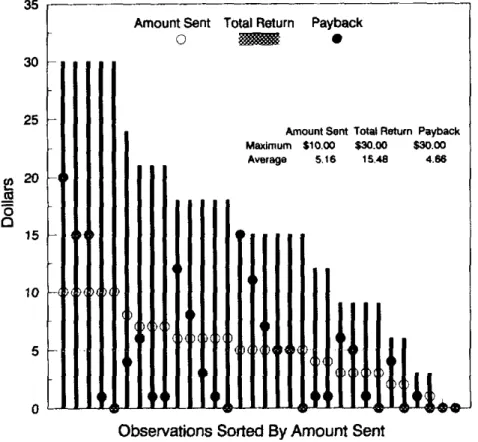
Notice that the amount invested represents a risky decision due to uncertainty in the trustee’s behavior. The amount invested can be used to measure trust, and the amount paid back can be used to measure trustworthiness. Various laboratory experiments have been conducted using the investment game.5 In general, participants in these experiments invest half of their endowment. The trustee on average pays back an amount equal to the amount invested or a little less. Figure 14.1 below presents the data collected by Berg et al. (1995). Blank circles show the amount invested by the investors; black circles show the amount paid back by the trustees; and the bars show the total return of the investment, which equals three times the amount invested. We observe that, on average, the investors invested $5.16 out of their $10 endowments, and the trustees paid back $4.66 out of the total investment return. That is, there exists a significant amount of trust in these interactions. This trust, on average, does not yield a positive return, although substantial differences (i.e., heterogeneity) across individuals is present in the data.
Figure 14.1 Experimental results in Berg et al. (1995). Source: Berg et al. (1995).
There are hundreds, if not thousands, of publications that are based on replication and variations of the investment game, which itself is a derivative of the ultimatum game.6 These
5 Camerer (2003, chapter 2) provides a review of the literature on the investment game.
6 In an ultimatum game, there are two players, a proposer and a recipient. The proposer is endowed with some money and
proposes how to split the money between the two parties. The recipient, in turn, agrees or rejects the proposal. If the proposal is accepted, then the money is split accordingly. If instead, the proposal is rejected, then both parties receive nothing. A variation of the ultimatum game is the dictator game, where the recipient no longer has a choice but must accept the proposal. Notice that in
10
variations of the investment game enable scholars to better understand the determinants of trust and the factors that play a role. For example, Ho and Weigelt (2005) use a multi-period investment game in which the two players alternate each period between the roles of investor and recipient for a total of four periods. This novel extension enables us to study both trust and trustworthy behaviors of the same individual, to analyze how much trusting behavior is motivated by future gains, and to examine how different intentions of trusting may result in different degrees of trustworthy behavior. Appendix A of this chapter discusses a few additional decision games that researchers have used to study trust.
14.4.2 The Forecast Sharing Game
The basic form of a Forecast Sharing Game involves two participants – a supplier and a retailer (or a supplier and a manufacturer, or a seller and a buyer). The supplier produces a product at a unit cost (e.g., $10) and sells to the retailer at a unit wholesale price (e.g., $12). The retailer sells the product to the market at a unit retail price (e.g., $20). The market demand for the product is expressed as D = X + Y + Z. The variable X represents the average market demand, which is a constant known to both the supplier and the retailer. The variable Y represents the retailer’s private forecast information, which is uncertain to the supplier. The supplier only knows that Y is distributed between a low and a high number with a cumulative distribution function (CDF) F(.) (e.g., Y can take an integer value between -150 and 150 equally likely). The variable Z represents the market uncertainty. Both the supplier and the retailer only know that Z is a zero-mean random variable with a CDF G(.). The game proceeds according to the following sequence. First, the retailer observes its private forecast information Y (e.g., 10 units) and submits a forecast report YR to the supplier. Second, the supplier observes YR (but not Y) and invests in capacity K. Third, the random demand D is realized, and the retailer orders D; however, the supplier can deliver only up to K. Hence, the resulting sales are equal to the minimum between K and D. Finally, both parties’ profits are realized.
Notice that the retailer does not share any overage risk due to excess capacity with the supplier but could suffer from the underage risk of failing to meet demand. In other words, if demand for the product turns out to be lower than K, only the supplier (not the retailer) incurs the excess capacity cost. Yet, if demand turns out to be higher than K, both the retailer and the supplier lose the opportunity to sell more. Therefore, the retailer has an incentive to be overoptimistic about its forecast in the report to assure ample supply. Accordingly, the supplier may not consider the report to be truthful, but instead, discounts the report when making the capacity decision (even when the retailer provides truthful forecast information). Standard game theoretic analysis (e.g., Perfect Bayesian Equilibrium that combines subgame perfection with Bayesian Nash Equilibrium) predicts that in all possible equilibria, the retailer’s report is uninformative, e.g., the retailer could report an inflated forecast. Knowing such potential, the supplier’s capacity decision K does not depend on the retailer’s report YR. Instead, the supplier relies only on its own prior forecast information (see Theorem 1 in Özer et al. 2011 for the precise analysis and results). In other words, standard theory again predicts zero trust and trustworthiness.
the second step of the investment game, the trustee essentially plays a dictator game in which the recipient (i.e., the investor) has set the dictator’s endowment.
11
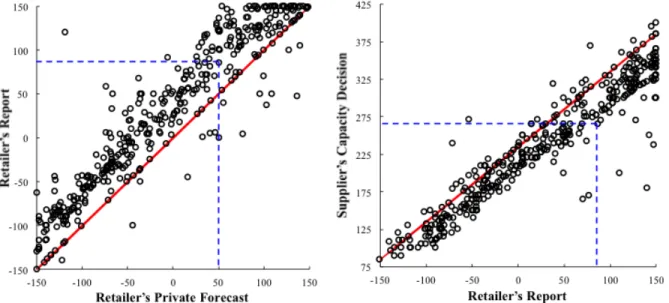
Notice that this setup is similar to the situation faced by IBM and Apple (or Boeing and its supplier). The supplier accepts vulnerability by relying on the retailer’s forecast report and makes a risky investment decision. How much the supplier relies on the retailer’s report measures the supplier’s trust level (i.e., how K depends on YR). How much the retailer deviates from its private information when reporting (e.g., |YR – Y|) measures the retailer’s trustworthiness. Figure 14.2 presents the retailers’ and suppliers’ decisions in the Forecast Sharing Game based on data collected by Özer et al. (2011). The graph on the left shows the retailers’ reports versus their private forecast information. Each circle is a data point (e.g., a retailer participant observes the private forecast information to be Y = 50 and reports YR = 90; see the blue dashed lines). The solid red line is the 45 degree line. First observe that there exists a strong positive correlation between the reports and the forecasts, indicating that the retailers’ reports convey useful information about their private forecasts. Second, most of the data points lie above the 45 degree line. That is, retailers’ indeed inflate their private forecasts to some extent, although some report exactly the information they have observed. In other words, there are varying degrees of trustworthiness. The graph on the right shows the suppliers’ capacity decisions versus the reports they receive from their retailers. Each circle is again a data point (e.g., a supplier who receives a report of YR = 90 builds capacity K = 270; see the blue dashed lines). The solid red line shows the optimal capacity decision assuming that the suppliers fully trust the retailers’ reports. Notice again that there exists a strong positive correlation between the capacity decisions and the reports. This correlation means that the suppliers in fact trust and rely on the retailers’ reports to make capacity decisions. Nevertheless, most of the capacity decisions are beneath the solid line, suggesting that the suppliers correctly “discount” the retailers’ reports when determining capacity. To summarize these observations, the data rejects the zero trust or trustworthiness predicted by standard theory. Instead, it demonstrates that a continuum of trust and trustworthiness exists between the suppliers and the retailers in forecast information sharing.
Figure 14.2 Retailers’ and suppliers’ decisions in the Forecast Sharing Game. Source: Özer et al. (2011).
12
The forecast sharing game is different from the investment game in at least three important ways. First, the investment game (and the related research) studies trust with respect to property rights; i.e., the trustor voluntarily passes property rights to the trustee in hope of future gains. The forecast sharing game, in contrast, studies the role of trust along the dimension of strategic information use, that is, the trustor’s willingness to rely on the trustee’s information claims. Second, trustor moves first in the investment game (trusting behavior is followed by trustworthy behavior). In contrast, trustee moves first in the forecast sharing game (trustworthy behavior is followed by trusting behavior). Third, the investment game can be used to measure trust in a fundamental finance context with no exogenous market uncertainty. In contrast, the forecast sharing game involves a fundamental business operations context that requires participants to make business decisions under market uncertainty beyond the control of the participants, enabling researchers to investigate various institutional and environmental factors affecting trust in business. We discuss next why such differences are important and can help scholars study various aspects of trust and trustworthiness.
14.4.3 Why Do We Use Different Games to Study Trust and Trustworthiness?
Developing structurally new games and experimental design (including replication studies related to new hypotheses) are necessary to better understand the role of trust and trustworthiness in decision-making because they are not abstract issues. Developing new experiments are necessary for at least four reasons. First, as discussed earlier, trust requires a three-way interaction involving a target of trust and a specific context, both of which affect trust and trustworthiness. Therefore, studying different contexts, different targets of trust, whether and how trust affects decisions, actions, or strategic information sharing are necessary to understand the role of trust in various business and interpersonal relationships. Second, structurally new games enable us to study how the environment (e.g., market uncertainty, institutional factors, processes used for engagement) affects trust and the resulting behavior. New games (and replications of such games) allow us to better understand the determinants of trust and the institutional and environmental factors that play a role. Third, learning in one context enlightens another. For example, understanding the role of trust and trustworthiness in the relationship between a healthcare provider and a patient may inform us about the relationship between a financial advisor and an investor (or a Ph.D. advisor and a student). Fourth, an important step toward establishing external validity of laboratory experiments is to validate (to some degree) their impact in the field. However, the need to control field conditions and to run experiments at a reasonable cost often prohibits such experiments (imagine asking Apple to raise the per unit price they pay for a hard disk drive just so that we can experiment whether such a price increase – which results in a reduction in its HDD supplier’s risk in capacity investment – affects trust and trustworthiness in that context). Therefore, like other scholars, we also stress the need to design experiments with the relevant field context and/or conduct experiments using experienced participants in addition to students (e.g., Bohm 1994, Eckel and Grossman 1996, Starmer 1999, Harrison and List 2004, 2008, Bartling et al. 2015, Choi et al. 2016).
Therefore, to study trust and trustworthiness in business, we call for developing a new wave of business-relevant experiments, which are of particular relevance to important business and management functions, for example, operations management, marketing, finance and leadership. Experiments that apply field contexts help to establish a systematic body of knowledge on when
13
trust outweighs self-interest to influence critical economic decisions. Such studies help us better understand the role of trust and trustworthiness in business and whether and how we can establish trust in business relationships. They also inform us when we can and cannot rely on trust in business.7
14.5 What Are the Building Blocks of Trust and Trustworthiness?
The extent of trusting and trustworthy behavior even for the same individual varies due to, for example, the context and the target of trust. Hence, it is important to understand when, how, and why trust and trustworthiness arise, resulting in behavior that leads to cooperation between two firms (or within the extended supply/value chain). Here, we provide a framework to organize the building blocks for trust and trustworthiness leading to cooperation between two entities (trustor and trustee). For further details, we refer the reader to Özer and Zheng (2016). In that article, we identify four building blocks in establishing trust and trustworthiness in business and interpersonal relationships:
(i) Personal values and norms (e.g., aversion to risk, inequality, betrayal); (ii) Market environment (e.g., investment risk, market uncertainty);
(iii) Business infrastructure (e.g., culture, institution, social networks); and
(iv) Business process design (e.g., process of engagement, team decision dynamics, reputation system design).
We briefly discuss each building block with a few examples.
The first building block is personal values and norms. A trustor’s personal values and norms affect his or her trust state regardless of, for example, the target of trust (e.g., who the trustee is). For example, Ashraf et al. (2006) find that one of the determinants of trust to be unconditional kindness generated by social norms or values that an individual adheres to. Recall also that trust is about accepting vulnerability (i.e., taking risk). Imagine two individuals – one enjoys making risky investments in general (e.g., skydives, plays Texas hold’em, and invests her savings mainly in start-ups) and the other makes almost sure investments (e.g., only invests in interest bearing deposit accounts and distributes his savings across multiple banks to hedge risks of bank failure). One would expect the first individual to be more likely to trust given the same exact context for the same target of trust (e.g., trusting a complete stranger to pay back the $100 – plus the interest – the trustor lends). Indeed, one of the determinants of trust was shown to be a person’s attitude toward risk (Ben-Ner and Putterman 2001, Bohnet and Zeckhauser 2004, Hong and Bohnet 2007). More specifically, trust involves accepting risk in at least three dimensions: risk of being worse off than before (risk aversion), risk of being worse off than the trustee (inequality aversion), and risk of being betrayed by the trustee (betrayal aversion).8 There is also research that determines the impact of status on trusting behavior (Buchan and Croson 2004, Gächter et al. 2004, Hong and Bohnet 2007). For example, for a “low” status group (e.g., women, blue-collar
7 Behavioral economists, such as Camerer (2003 pages 115-117), also call for a moratorium on creating more ultimatum type
game data and “shift[ing] attention toward new games and new theories.” We agree and encourage management scholars (e.g., OM, Marketing, and Finance) to leave behind these over-studied games and embrace and leverage the richness of their research contexts to bring in new insights for trust.
8 See Özer and Zheng (2016) who summarize a series of supply chain experiments that can be used to tease apart the roles of
14
workers according to the literature), trusting behavior is primarily determined by inequality aversion.9 For a “high” status group (e.g., men, white-collar workers), the primary determinant is betrayal aversion (Hong and Bohnet 2007). This research stream suggests that a woman who enjoys skydiving as a recreational activity would likely be more trusting than a man who watches birds as a hobby when the trustee is known to treat all individuals equally yet betrayed a person in the past.
The second building block of trust is the market environment (e.g., exogenous market factors defining the context) in which the trustor and trustee interact. Consider two very different market environments: a transaction (requiring trust to cooperate) between two individuals that takes place in a war zone versus in a beach resort in a Caribbean island where food, drinks, and love are abundant. The example reflects the authors’ desire to be at a beach somewhere in Little Cayman at the time when this chapter was written. Ceteris paribus, one would hope that the cool ocean breeze would have a positive impact on being trusting and trustworthy. Consider the business context that took place between IBM GST and Apple. In such engagements, we now know that product and market characteristics play a key role in trusting and trustworthy behavior. A series of experiments using the forecast sharing game have shown that investment cost (e.g., production and capacity costs) and demand uncertainty (e.g., unsystematic demand fluctuations measured by forecast errors) affect decision maker’s trusting and trustworthy behavior (Özer et al. 2011, 2014, Choi et al. 2016). These experiments were carried out with different subject pools ranging from students with limited work experience to high-level executives with an average of 17 years of work experience. The authors show that investment cost has a dominant effect on trust. In particular, when the investment cost is lower, retailer participants are more trustworthy in sharing forecast information, and supplier participants in turn trust the shared information more. This is true regardless of whether demand volatility is high or low. Conversely, when the investment cost is high, higher demand volatility does indeed lead to significantly less trusting and trustworthy behavior. Competition among retailers also reduces trusting and trustworthy behavior (Spiliotopoulou et al. 2016). Several such experiments and anecdotal observations confirm that high levels of social/market uncertainty, competition, or financial vulnerability introduced to the market environment (e.g., factors that may not be under the control of either the trustor or the trustee) discourage trust (Özer et al. 2011, 2014). One important building block of trust is therefore the market environment.
The third building block of trust is business infrastructure, e.g., the culture or network within which business organizations interact and operate. For example, today’s business operations extend across continents, and span multiple cultures across the globe before the products and services they produce reach consumers. Anecdotal evidence suggests that culture plays a distinct role in trust and hence the success of business interactions. A well-known example is the loss of eBay to a local Chinese competitor, taobao.com. eBay’s loss is often attributed to a failure to understand local consumers by eBay’s management team. In China, eBay did not allow online chats between buyers and sellers due to concerns that they might close their transactions offline to circumvent fees. In contrast, taobao.com allowed such conversations to help cultivate trust among the trading parties. Incidentally, the average propensity to trust and to be trustworthy is lower in collectivist societies (such as China, India, and Malaysia) due to a strong in-group bias; that is, collectivists exhibit high levels of trust and trustworthiness only toward their in-groups,
15
i.e., parties to whom an individual is related through kinship or long-term social ties. In contrast, collectivists tend to treat out-group members with a mix of suspicion and opportunism (Triandis et al. 1988, Fukuyama 1995, Child 1998, Yamagishi et al. 1998b, Chen et al. 2002). Conversely, individualists (such as Australia, Canada, and the U.S.) do not embrace a strong affinity for social groups and are less subject to the in-group bias. These results suggest that when there is no prospect for long-term relationships, we should expect spontaneous trust and trustworthiness to be less likely to arise in a collectivist country than in an individualistic one. Indeed, Özer et al. (2014) observe in the forecast sharing game that Chinese retailers inflate their forecasts more and Chinese suppliers invest in much less capacity; i.e., the Chinese participants are less trustworthy and less trusting than their U.S. counterparts. In sharp contrast, when the participants engage in repeated interactions (long-term relationship), Chinese and U.S. participants begin with the same levels of trust and trustworthiness. In this case, Chinese are more tolerant to minor information manipulation by Chinese retailers and maintain high levels of trust toward their supply chain partners in long-term relationships (see also Bohnet et al. 2010, 2012 for evidence of similar phenomena in countries in the Gulf of Mexico and the Middle East). Furthermore, Chinese participants in those experiments are more trusting and trustworthy when they interact with U.S. individuals than they do with Chinese. As Nobel Laureate Oliver Williamson states, “Culture, for purposes of economic organization, serves as a check on opportunism.” Curbing such opportunism likely reduces an individual’s vulnerability, leading to more trusting and trustworthy interactions.
The fourth building block of trust is business process design, e.g., reputation system design and assistance process. This building block focuses on factors that companies/individuals can change or redesign such that the business processes in question can give rise to high trust and cooperation. An immediate example of such process design is reputation/feedback mechanisms. For example, before we purchase a product from an online vendor (e.g., resellers at Amazon, eBay) or use a service (e.g., taxi, restaurant, haircut, healthcare), most of us check the vendor’s reputation/rating provided by other customers. A design of a good reputation system can reduce the buyer’s (trustor’s) vulnerability due to the uncertainty governing the actions of the seller (trustee). People are much more willing to trust a business partner who has a good track record than another who in the past often failed to deliver on its promises. Making reputation information available can screen out deceitful behavior and protect the rights of trading partners. This approach is indeed critical for the prosperity of Internet trading, where the majority of transactions occur between strangers (e.g., Resnick and Zeckhauser 2002, Resnick et al. 2006). But then what is a good reputation system? Should it be an open system in which both parties rate each other? Should it be a double-blind system in which neither party reads the other’s review before submitting his or hers? A group of researchers test such reputation system design in an eBay-like market in the laboratory (Bolton et al. 2013). They find that the open system supplemented by blinded ratings significantly outperforms the other designs in motivating trading partners both to submit more truthful feedback and to rely more on the feedback when determining whether or not to trust another party. Similar to a reputation system, a firm can impose forecast error penalties on its Sales department to encourage truthful forecast information sharing from Sales to Operations (Scheele et al. 2016). We encourage the reader, who have used Uber or a similar company as a transportation service, to examine the customer and driver review process used by Uber and decide whether and what aspects of that process create trust and trustworthiness in such two-sided markets.
16
Another example that affects trust is the design of assistance processes. In order to foster better-informed decisions, most firms (or most of us) provide assistance to, or receive assistance from, other firms (or individuals) (e.g., category captain management, VMI, financial or healthcare-related decisions, and so on). Such assistance could be in one of the following three forms: the informed party can simply share the information with the uninformed (information sharing), or advise on what action the uninformed party should take (advice provision), or request the uninformed party to delegate the decision to him (delegation). For example, in healthcare, the physician (trustee) can provide information on the treatment options available to the patient (trustor) and let him or her decide, or advise the patient on what treatment to accept, or the patient may simply delegate that decision to the physician. A group of researchers test these three forms of assistance in a laboratory and conclude that the form of assistance impacts trusting and trustworthy behavior that promotes cooperation, even when the trustee’s and trustor’s pecuniary motives are not fully aligned and remain exactly the same under all three forms of assistance (Özer et al. 2016). The authors find that information sharing leads to the highest level of trust and trustworthiness and delegation leads to the lowest. Similarly, in healthcare settings, policy makers have increasingly called for a transition from delegated decision-making by the physician to more actively involving consumers in their own healthcare decisions. Business process design can promote or suppress trust and trustworthiness.
14.6 Two Remarks on Research Methods (Optional)
In this optional section, we discuss two methodological questions commonly raised for research on trust.
14.6.1 Spontaneous (One-Shot) versus Reputation (Repeated)
One methodological issue often brought up regarding laboratory experiments to study trust is about the duration of interactions designed between participants (players), e.g., single-shot interaction versus repeated interactions (which builds reputation). One misguided criticism we often hear is that trust in business cannot be studied in a laboratory or a single interaction – and the critic often reasons that business or interpersonal relationships based on trust involve long-term and complex relationships that cannot be replicated in the lab.10 We stress that studying the single-interaction setting is fundamental to understanding trust for the following reasons.
First, it is important to control for the confounding effect of reputation that may arise in repeated-interaction settings. This idea was established in one of the earliest trust experiments conducted by Berg et al. (1995). The authors use the investment game that involves two players interacting only once. The importance of using this single-interaction setting is to “eliminate mechanisms which could sustain investment without trust; these mechanisms include reputations from repeat interactions” (Berg et al. 1995, p. 123). In responding to criticisms that this game does not capture factors such as relationships that may support or affect trust, Camerer (2003, p. 85) states, “that’s precisely the point – the game requires pure trust.” We share these opinions and thus advocate first focusing on single-interaction settings to study spontaneous trust. It is most striking to observe trust and trustworthiness to occur in single interactions, i.e.,
10 We first note that the power of controlled laboratory experiments is to create the “cleanest” possible environment to study the
behavioral factors of interest (Roth 1988, p. 974). Thus, controlled laboratory experiments are designed to isolate the behavioral factors of interest from confounding factors that may serve as alternative explanations for behavior. They are not necessarily designed to replicate practice.
17
spontaneous/pure trust and whether it exists and how it is influenced by the context of the study.
Second, recall the definition of trust. If trustor’s vulnerability from trusting the other is eliminated, one cannot speak of trust. If repeated interactions involve penalties or rewards that can eliminate any vulnerability impeding cooperation, then cooperation in such a setting may not be directly attributable to trust.
Third, a single-interaction setup is also relevant to practice because companies (particularly the global ones) constantly consider and invest in new business relationships without prior transaction history or explicit expectation for future interactions (McKnight et al. 1998). For example, how the partners’ countries of origin (e.g., China versus the U.S.) in these new relationships affect the degree to which spontaneous trust and trustworthiness occur among them has important implications for management (e.g., Özer et al. 2014). In addition, the level of spontaneous trust in the general population is a strong indicator for market and economic efficiency in a society (Knack and Keefer 1997, La Porta et al. 1997, Zak and Knack 2001).
Fourth, the “experiential view” of trust (Brehm and Rahn 1997, Hardin 2002) suggests that a person’s disposition for trust is gradually and slowly formed through life experiences and unlikely to change in a single interaction. In addition, in the absence of reputation information about the partner in interaction, trust is mainly influenced by the environment and the social norms or values that a person adheres to (e.g., Brehm and Rahn 1997, Ben-Ner and Putterman 2001). Hence, studying spontaneous trust in a single interaction allows us to understand how such social norms and business environment (e.g., high capacity investment risk, low market uncertainty) affect trust and trustworthiness.
Some business relationships most certainly have a long-term perspective. Hence, studying how trust and trustworthiness evolve in a long-term relationship and how this evolution may differ from a short-term interaction is important. This evolution can also be systematically and rigorously studied in a laboratory environment (see, for example, Croson et al. 2003, Özer et al. 2011, 2014). Yet, the first step in understanding the evolution of trust starts with understanding spontaneous trust. Only then can one build on that learning to study other issues such as repeated interactions (reputation) or culture, to provide a complete picture of the role of trust and reputation in global operations.
14.6.2 Can We Model Trust and Trustworthiness Analytically?
The answer is absolutely. The question is how best to come up with analytical models of behavior that are parsimonious and helpful in understanding and quantifying how decisions are impacted by motives such as trust. We illustrate here an example of how one can capture trust and trustworthiness in an analytical model. Özer et al. (2011) propose one of the first such models. We remark that here we intentionally simplify their model to highlight a few key observations and refer the reader to section 6 in their paper for a complete discussion. Specifically, the supplier’s trust affects his belief update about the retailer’s private forecast.11
11 Neoclassic economists and decision scientists make a strong assumption that people update information following Bayes’
Theorem or Bayes’ rule, which was primarily constructed based on the implicit thought that a single decision maker obtains information (from nature) to update his or her prior belief to obtain his or her posterior belief. By its very nature this theory implicitly assumes zero trust and trustworthiness. Several laboratory studies have shown that people are not Bayesian decision makers (e.g., Kahneman and Tversky 1982), i.e., they don’t follow Bayes’ rule in updating their beliefs. For more on this we refer the reader to Özer et al. (2011).
18
Given the retailer’s report YR, the supplier believes that the private forecast has the same distribution as α·YR + (1 – α)Y, where Y is the supplier’s prior belief about the retailer’s private forecast information. The parameter α takes a value between 0 and 1 to measure the supplier’s trust level: α = 1 implies full trust on the report, whereas α = 0 implies no trust. The retailer’s trustworthiness is driven by her disutility of deception, modeled as β·|YR – Y|. The parameter β ≥ 0 controls the retailer’s incentive to misreport her forecast. A retailer with a higher β is more trustworthy because she experiences a higher disutility when giving the same amount of forecast distortion as one with a lower β. The authors incorporate the above formulation of trust and trustworthiness into the game-theoretic model of forecast information sharing and call the resulting model the “trust-embedded model.”
To demonstrate that the trust-embedded model can effectively predict behavior in the forecast sharing game, the authors perform the following analysis. First, they show analytically that the structural properties of the predictions from the proposed model match with the observed behavior, regardless of the specific values of the behavioral parameters. For example, the trust-embedded model predicts that the retailer’s report (resp., the supplier’s capacity decision) to be increasing in her private forecast (resp., the retailer’s report), consistent with the positive correlations observed between the reports (resp., capacity decisions) and the private forecasts (resp., reports). In addition, the model also correctly predicts how the retailer’s report and the supplier’s capacity decision would be affected by the capacity cost and the level of market uncertainty, as observed in the experiment. Second, the authors estimate the behavioral parameters in the trust-embedded model (i.e., α and β) and compare the model’s goodness-of-fit with two restricted models where trust or trustworthiness is assumed to be absent (i.e., assuming
α = 0 or β = 0). They show that the full model significantly outperforms the restricted models in fitting the experimental data. Third, the authors also perform out-of-sample validation to further examine the predictive power of the model. In particular, they randomly partition the experimental data so that 2/3 of the participants are in the training set and the remaining 1/3 are in the testing set. They then estimate the model parameters given the training set, predict the decisions of participants in the testing set, and calculate the out-of-sample R2 value.
More generally, the above three steps of analysis represent good practices of developing analytical models that capture important behavioral factors. We advocate that a good behavioral model should satisfy the following properties: (i) it is parsimonious and grounded in relevant behavioral or psychological theories; (ii) it demonstrates structural properties that match observed behavior, independent of parameter values; (iii) it outperforms restricted models in fitting experimental data; and (iv) it survives out-of-sample validation.
14.7 Conclusion
Now we know what trust and trustworthiness mean, and how they can be measured. We also know some of the main building blocks that give support to trust and trustworthiness in business and interpersonal relationships, resulting in cooperation and better outcomes for all parties involved. Given our refined understanding, we conclude by revisiting the business case studies mentioned at the beginning of this article. Let us start with the classic Barilla case.
During the consideration of a VMI agreement, Barilla was facing severe external resistance from its main distributor Cortese as well as internal resistance from Barilla’s own sales force. If Cortese were to agree to VMI, it would be accepting a significant vulnerability. “VMI is
19
tantamount to allowing the proverbial fox into the hen house”.12 Such an implementation required Cortese to let go of what the company perceived as fundamental to its business model, e.g., the right to decide what products to carry, how much to stock, and when to receive them. It also required Cortese to share critical customer information (e.g., Cortese customers’ needs and demand for pasta) and risk leaking its profit margin (which would put Cortese in a disadvantage during any renegotiation of prices). If Cortese were to provide no additional value beyond what they delegated, Barilla would eventually cut the middleman out of business. So, indeed Cortese faced considerable financial vulnerability and uncertainty about the possible behavior of Barilla. What was the positive expectation upon accepting such a risk? That was also not clear to Cortese. Barilla needed to prove that both firms would benefit, e.g., by increasing their return on assets, reducing stock outs, increasing the ability to serve customers better, and earning higher profits. The absence of such potential benefits made it very difficult for Cortese to trust Barilla in executing a mutually beneficial VMI program. To resolve these issues, Barilla first implemented VMI internally, i.e., with one of Barilla-run distribution centers (responsible for a small fraction of pasta distribution). An independent external consultant/company was hired to document the resulting improvements. Barilla also allowed independent distributors to visit and audit the related processes. What Barilla essentially did was to first quantify the potential positive returns from implementing VMI, making the expectation of positive returns to be almost sure. Barilla and Cortese gradually integrated distribution centers to the VMI program, mitigating the financial vulnerability. All of these actions have resulted in reducing the barrier to trust and to be trustworthy. We encourage the reader to revisit this case (and also for the discussions to address internal resistance) with an eye toward identifying key factors affecting trust and trustworthiness in such business relationships.
We remark Barilla’s troubles were certainly not an isolated case. For example, researchers have pointed to the lack of trust as an important reason for poor performance under VMI (Blackhurst et al. 2006, Petersen et al. 2005, Claassen et al. 2008, Brinkhoff et al. 2015). In particular, the downstream firms may not delegate sufficient decision rights for the manufacturer to effectively manage the inventory. Blackhurst et al. (2006) observe, “While the companies have sought a collaborative relationship in the form of a VMI initiative, there appears to be some evidence of lack of trust…” Moreover, inter-company projects that involve the transfer of decision rights (e.g., VMI, consignment warehousing) are associated with lower trust and poorer supply chain outcomes than projects that involve only information sharing (e.g., EDI, CPFR) (Brinkhoff et al. 2015). We also now have experimental evidence supporting the conclusion that when delegation leads to a lack of trust, the retailer/downstream party may be better served if it retains control of, for example, inventory decisions, and obtains demand information or advice about replenishment decisions from the manufacturer (Özer et al. 2016). Such an approach may result in a faster path for establishing trust and cooperation in a VMI like setting.
Let us next revisit the IBM GST and Apple case. By investing in capacity and building a new facility to satisfy Apple’s soft orders/forecasts, IBM GST managers certainly put themselves and perhaps the company at a vulnerable situation in hopes for actual Apple demand and resulting profits. They decided to trust Apple in converting those soft orders to actual demand. Was that a bad decision? Not necessarily. It was perhaps well-calculated trust. At the time, IBM was a large and profitable organization with several other businesses and it was perhaps more diversified