1
Introduction
The rate of home-ownership across Europe and in many countries has increased significantly in recent decades. This is partly because most governments have promoted home-ownership as part of an asset-based welfare system with the notion that home-ownership will generate wealth for households through the accumulation of housing equity.
Changes in house prices play an important role in the generation of the housing equity and the wealth inherent in home-ownership. In general, house prices change in cycles of upward and downward trends. Each of these cycles may be driven by different sets of fundamental determinants and by the prevailing conditions in the wider economy. Over the long term, home-owners usually accumulate significant housing equity, yielding welfare benefits. However, even periods of brief house price decline can erode the value of housing equity accrued over several years. Following the 2007-08 Global Financial Crisis (GFC), for example, the severe decline in house prices caused many recent home-owners to run into negative equity. Figures from Statistics Netherlands show that following the GFC, in the Netherlands alone the total wealth in residential properties declined frome738,449 million in 2009 toe721,018 million by the end of 2012.
In effect, home-ownership involves significant financial risk, which can adversely affect the balance sheets of households. These risks require a better understanding and proper measurements. However, it is also important to first understand house price dynamics, which significantly affect the process of equity generation. A thorough understanding of house price dynamics is necessary if we are to identify innovative ways of insuring against the risks associated with home-ownership.
...
§ 1.1
Gap in the literature
...
Research has shown that home-ownership has several advantages for society and households. According to some housing researchers, home-ownership facilitates the development of a stronger society and neighbourhoods (Andrews and Sánchez,2011;
Elsinga,2003). These researchers also argue that home-owners are more likely to invest in maintenance, are more committed to the development of their
neighbourhoods and tend to be actively involved in the political process (Doling and Elsinga,2006;Doling et al.,2010). Other scholars also argue that home-ownership fosters better family connections and provides a healthier environment for child development (Toussaint and Elsinga,2007;Haurin et al.,2002).
According toElsinga and Hoekstra(2005), however, some benefits derived from home-ownership depend on the national context and on the characteristics of the household. They argue that lower-income earners in the owner-occupied sector usually cluster in poorer and deteriorating neighbourhoods, which becomes societally disadvantageous.
Elsinga and Hoekstra(2005) also argue that in certain countries, home-ownership is simply an individual preference and does not necessarily have benefits over other forms of tenure. In countries with a substantial and well-maintained social housing sector, for example, they point out that tenants are equally likely to be actively involved in their neighbourhoods. Similarly, these renters may enjoy a healthy and cohesive social environment, so this is not exclusive to home-owners.
For most households, however, home-ownership is a desirable tenure choice because it allows them the flexibility to adapt their property and yields financial benefits. The financial benefits of home-ownership, especially in the Netherlands, are inherent in the accumulation of home equity over a long period of time, partly through the preferential tax treatments available to home-owners (Boelhouwer,2002;Toussaint and Elsinga,
2007). Another financial benefit derived from home-ownership is the relative security that it provides against high and random rent increases (Zehnder,1998;Elsinga,
2008).
Furthermore, home-ownership tends to be beneficial during retirement (Haffner,
2008). Retired home-owners are likely to have paid off their mortgages and would be able to withdraw cash from their home-equity to supplement their regular pension. These attractions of home-ownership have drawn attention to the property-based welfare system, which encourages individuals to take the responsibility for their welfare needs by investing in property assets (Torgersen,1987;Toussaint and Elsinga,2009). Property-based welfare depends largely on housing equity, which is directly influenced by changes in house prices. Unfortunately, however, the characteristic volatility of house prices means that equity accumulation involves a degree of uncertainty. The chance of negative equity and sale price risk usually intensifies when house prices are more volatile, limiting the welfare benefits of home-ownership. Particularly since the substantial house price decline and uncertain prospects of home-ownership following the 2007-08 Global Financial Crisis (GFC), researchers and policy makers have been more critical about the sustainability of the asset-based welfare system (see,De Decker and Dewilde,2010;Doling and Ronald,2010;Malpass,2008;Torgersen,1987). In effect, some researchers now argue that depressed house prices could be stimulated through policy regulations once the dynamics are well understood (Blanchard et al.,
2010;Taylor,2009;Andrews,2010;Ambrose et al.,2013;Dol et al.,2010). According to one strand of literature, the spatial interactions between house prices are the most important factor to understand. The argument is that house prices are spatially interrelated and these interrelationships are pivotal in detecting the regional housing markets where intervention should be focused (Holmes and Grimes,2008;Holly et al.,
2010;Meng et al.,2014;Gong et al.,2016b). This reasoning has led to a line of research that is usually referred to in the housing literature as the house price ripple effect or diffusion (Meen,1999;Lee and Chien,2011;Holly et al.,2011).
On the other hand, a different strand of housing literature advocates using home-equity insurance to reduce the sale price risk directly (Case Jr et al.,1993;
Swindler,2012). Home-equity insurance allows home-owners to pool the sale price risk through advanced portfolio risk management and offers them a way to overcome
the constraints of negative equity (Shiller,2003;Chan,2001;Iacoviello and Ortalo-Magne,2003). Unfortunately, however, the currently proposed home-value scheme would only cover up to 50% of the sale price risks (Sommervoll and Wood,
2011). A great deal of the research into both the house price diffusion and sale price risk has been done in the UK, US and China, while the context of the Netherlands is significantly different.
This dissertation provides insight into the house price diffusion mechanisms and the sale price risk in the Netherlands. It also analyses the potential profitability of home-value insurance scheme in the Dutch market and proposes a modified scheme which could eliminate up to 70% of sale price risks. The Dutch housing market is unique in terms of its regulation and the dynamics of the mortgage market (Tu et al.,2016). This dissertation provides exclusive research into the house price diffusion mechanism and sale price risk within the Dutch context.
...
§ 1.2
Aim and research questions
...
This dissertation examines important aspects of house price diffusion and risks in the Netherlands. The aim is to better understand the diffusion mechanism and the risk of house price fluctuations, and to contribute to measuring these housing risks.
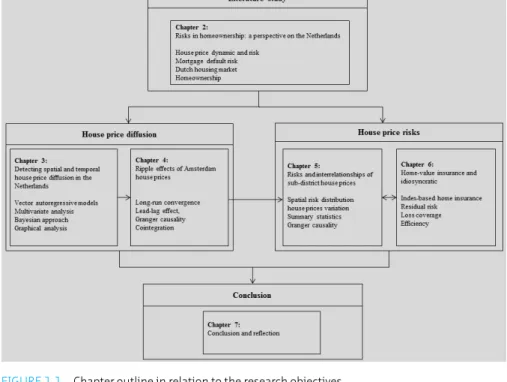
Specifically, there are three objectives: first, to understand the diffusion mechanism of house prices in the Netherlands and particularly from its capital city, Amsterdam; second, to examine the spatial distribution of house price risk; and third, to investigate the efficiency of index-based home-value insurance as a tool for mitigating house price risk in the Dutch context. The related research questions are addressed in four separate chapters. Figure1.1shows the overall structure of the dissertation and the chapters associated with these objectives.
To begin with, Chapter2provides a general perspective of the risks of home-ownership and an overview of the Dutch housing market. This provides important background information which puts into perspective the rest of the research, which rather attempts to draw conclusions with the home-owner in view and within the context of the Dutch housing market.
In Chapters3,4and5, the diffusion mechanism of house prices in the Netherlands is explored extensively. The research questions for Chapter3can be specifically formulated as:
To what extent does house price diffusion exist in the Netherlands? Which regions predominate in the house prices diffusion mechanism? How does the diffusion mechanism vary over time?
As the capital city and a major economic hub in the Netherlands, changes in the housing market in Amsterdam may have implications for other regions. Chapter4
focuses specifically on house price diffusion in Amsterdam. It addresses the research question that relates to the extent to which house price movements in Amsterdam drive house prices in other regions of the Netherlands. The diffusion mechanism within Amsterdam itself is examined in Chapter5, which relates in part to the house price interrelationships between the various districts of Amsterdam.
FIGURE 1.1 Chapter outline in relation to the research objectives
Chapter5also explores the spatial distribution of house price risk. The main research questions here relate to the degree of the variation in house price risk from the central business district (CBD) to the periphery of a city and the spatial variation of house prices over time. The research questions can be formulated as follows:
What is the pattern of house price risk and return from the CBD to peripheral areas? To what extent do house prices differ over time between regions in the CBD and peripheral areas?
Chapter6considers home-value insurance. It focuses on the question of the efficiency of the index-based home-value insurance policy for mitigating sale price risk. Index-based home-value insurance, characteristically, does not cover the entire sale price risk and residual risks may vary across sub-markets. Chapter6investigates the extent of these residual risks further in relation to various house classes in the Netherlands.
...
§ 1.3
Methodology
...
This dissertation contributes to the literature by providing comprehensive analyses of the diffusion dynamics and risks of house prices in the specific context of the
Netherlands. Its innovation, however, lies in its empirical methodological approach, which combines standard statistical analysis and more recent and complex
econometric time series models. The details of the empirical approaches for house price diffusion and risks are provided in the respective chapters and they are summarised here briefly, as follows.
§ 1.3.1 House price diffusion
...
After the discovery of house price diffusion by British scholars in the 1990s, simple empirical methodology, such as the ratio test, correlations, Granger causality and co-integration tests, have widely been adopted to confirm the existence of diffusion dynamics in house prices (seeHolmans,1990;Giussani and Hadjimatheou,1991;
Meen,1996,1999). One common drawback with these empirical methods is that they involve the assumption that house diffusion is known a priori to exist, and moves from major economic centres in large cities to peripheral regions. Most research papers also apply these methods without controlling for the common fundamentals that may possibly confound the spatial interactions between house prices.
In this dissertation, a data-driven approach is adopted which does not require the direction of house price diffusion to be known a priori. The method is based on the Bayesian graphical vector autoregressive (GB-VAR) approach recently proposed by
Ahelegbey et al.(2016a). The GB-VAR is a multivariate time series approach that combines vector autoregressive models with Bayesian graphical methods. The method is flexible and allows any necessary prior information regarding the direction of the diffusion to be incorporated into the analysis. The graphical component of the method ultimately enables the direction of the diffusion mechanism to be obtained through network statistics. The graphical method is applied in relation to the housing market for the first time in this dissertation (see Chapter3).
The diffusion pattern of house prices may be altered by a regime shift (Aue and Horváth,2013;Chien,2010). Thus the diffusion mechanisms between regions in the Netherlands are considered for different sub-periods. Methodologically, a rolling window is adopted to estimate the BG-VAR model and identify the diffusion mechanism in the sub-periods. Moreover, a structural break test is performed to formally identify regime shifts and to delineate the sub-periods for the estimation of the BG-VAR model.
The subsequent analysis (Chapter4), in which the Granger causality and co-integration methods are applied to test the diffusion pattern of house prices from the capital Amsterdam to other regions in the Netherlands, includes controls for the common house price fundamentals, which the existing literature had mainly ignored. The Granger causality analysis adopts the more versatile Toda-Yamamoto technique (Toda and Yamamoto,1995). The Toda-Yamamoto approach has the advantage that both stationary and non-stationary time series variables can be included in the empirical test. The co-integration analysis similarly adopts the autoregressive distributed lag (ARDL) bounds approach proposed byPesaran et al.(2001), which allows for both stationary and non-stationary time series variables. The ARDL bounds technique is generally more appropriate for testing co-integration between shorter time series (Narayan,2005).
§ 1.3.2 House price risk
...
Although more advanced models may be applied, the empirical method adopted in the analysis of the spatial distribution of house price risk is standard and quite
straightforward. Separate hedonic house price indexes are first created for different spatial units. Then, using these house price indexes, summary statistics, particularly the standard deviation and variants of the semi-deviation are obtained to compare the house risks across the different spatial units. In addition, the summary statistics are computed with a rolling window to discern the risk variations over time across the spatial units (Chapter5).
Further analysis of the house price risk uses the method recently proposed by
Sommervoll and Wood(2011). This approach assumes that each property has insurance cover, which pays benefits at the time of resale of the property, based on the general housing market decline depicted by a reference house price index. Since the reference house price index only captures market movements, losses incurred on a property may not be fully covered by the index-based insurance scheme.Sommervoll and Wood(2011) argue that the residual losses not covered may best be described as the idiosyncratic risks for individual properties. This approach is used to compare the idiosyncratic risks for different property types in this dissertation. Modifications of the index-based home-value insurance schemes are then proposed, which minimise the residual idiosyncratic risks (Chapter6).
§ 1.3.3 Data
...
The complete details of the data used are provided in each chapter. To summarise, the empirical analyses in this dissertation mainly use time series data. In analysing the diffusion mechanism between regions in the Netherlands and the pattern from Amsterdam (Chapter3and4), the house price index compiled by Statistics
Netherlands is used. Statistics Netherlands is the official Dutch statistics bureau, which compiles house price indexes using the sale price appraisal ratio (SPAR). The SPAR indexes combine transaction data with annually appraised values into price ratios, which are chained to correct for the appraisal bias (de Haan et al.,2009). Given the available data, the SPAR index is the most reliable index of house prices in the Netherlands, although it does not adjust for quality changes in individual properties (e.g. due to depreciation). It does adjust for changes in the quality mix, however (De Vries et al.,2009).
The empirical analyses of the house price risk and home-value insurance scheme (Chapter5and6) use individual transaction data relating to Amsterdam collected over an extended period (1995-2014). The dataset was obtained from the Dutch National Association of Property Brokers. It contains several property characteristics, and as such is appropriate for constructing hedonic price indexes. The dataset also includes details of the location of properties, enabling aggregation into various spatial units. The extended period covered by the dataset enables information to be extracted for repeated transactions, which is particularly useful for the analysis of the efficiency and loss coverage of the index-based home-value insurance scheme.
...
§ 1.4
Introduction to chapters
...
The chapters of this dissertation are journal articles, each of which addresses aspects of the research questions specified in the previous section. The chapters are therefore self-contained, four of them having been published separately in international journals and the other being currently under review.
Chapter2presents a literature study of the risks involved in home-ownership and introduces the two perspectives from which the literature studies the risks involved in home-ownership. The chapter discusses the key factors that have contributed to the increase in home-ownership over recent decades. The background to home-ownership is also presented for the Netherlands, which the analyses in the rest of the dissertation focus on. The chapter goes on to present a taxonomy of the various financial risks inherent in home-ownership identified in the literature, with a particular focus on the main risk factors for Dutch home-owners. The chapter concludes with a discussion of the two main types of financial risks faced by home-owners: the risk of mortgage default and the risk of house price changes, both of which are in turn related to several other factors.
Chapter3examines the diffusion mechanism of house prices between the twelve provinces in the Netherlands using the Bayesian graphical vector autoregression (BG-VAR) recently proposed byAhelegbey et al.(2016a). House price diffusion, also known as the ripple effect or spill-over effect, is a housing market phenomenon whereby house price shocks move from one region to other regions, with a transitory or permanent effect (Meen,1999;Holly et al.,2011;Balcilar et al.,2013). This chapter provides an introduction to the spatial diffusion mechanism between house prices and a brief overview of the methodologies used for its study. The chapter then proposes the use of graphical methods which enable a data-driven approach to identifying the main regions in which diffusion may play a role. The graphical approach is demonstrated using house price indexes for the twelve provinces of the Netherlands. The empirical results suggest evidence of spatial diffusion patterns in house prices from different regional sub-markets within distinct time periods in the Netherlands. The diffusion of house prices prior to the GFC was predominantly observed from the province of Noord-Holland.
Chapter4focuses specifically on house price diffusion from the Dutch capital Amsterdam to other regions in the Netherlands, which is referred to using the synonymous term ‘ripple effect’. Adopting the simple approach of confirming ripple effect as a lead-lag effect or a long-run convergence (Holmes and Grimes,2008;
Giussani and Hadjimatheou,1991), the Granger causality and cointegration tests are applied for the empirical analysis. To eliminate the effects of common shocks, the empirical estimation includes controls for house price fundamentals. The cumulative evidence suggests that Amsterdam house prices influence all Dutch regions, except Zeeland. In particular, the Granger test concludes that there is a lead-lag effect of house prices from Amsterdam to all regions, apart from Zeeland. The cointegration test, on the other hand, shows evidence of long-convergence between Amsterdam and six other Dutch regions: Friesland, Groningen, Limburg, Overijssel, Utrecht and Zuid-Holland.
Chapter5is concerned with the spatial distribution of risks and interrelationship of house prices within Amsterdam. It specifically explores whether house prices are exposed to more risk in the CBDs than in peripheral areas, house price variations over time in CBDs and peripheral areas, and the pattern of house price interrelationships between the various districts that make up Amsterdam. The empirical approach adopts simple indicators, which suggest that house prices grow faster but are less stable in the central business district and immediate surrounding areas than in peripheral areas. Decreasing inter-variations between house price growth in different districts over time were also observed. Furthermore, the findings indicate that a lead-lag and house price causal flow generally exists from more central districts to the more peripheral districts. Chapter6focuses on home-value insurance. Specifically, it examines the pay-out efficiency and loss coverage of the index-based home-value insurance scheme for the Dutch market (seeCase Jr et al.,1993;Shiller and Weiss,1999). The index-based home-value insurance scheme typically has low loss coverage, meaning that there are significant residual risks for home-owners.Sommervoll and Wood(2011) and
Sommervoll and de Haan(2014) have observed that the loss coverage of the index-based home-value insurance rarely exceeds 50%. Chapter6proposes a modification to the existing scheme in order to eliminate this large residual idiosyncratic property price risk for home-owners. The empirical analysis uses transaction data from Amsterdam between 1995 to 2014. The findings, based on the repeated sales and hedonic indexes, both indicate that the proposed insurance policy would have higher pay-out efficiency, better loss coverage and a greater pay-out probability than the scheme originally suggested byCase Jr et al.(1993).
All the chapters of the dissertation are thematically related. Chapters3and4relate to the house price diffusion. Chapters5and6concern house price risk and home-value insurance. Part of Chapter5also deals with house price interrelationships, which relate to diffusion (see Figure1.1).