Working Papers
324
ISSN 1518-3548Pierre-Richard Agénor and Luiz A. Pereira da Silva
Inflation Targeting and Financial Stability:
A Perspective from the Developing World
ISSN 1518-3548 CNPJ 00.038.166/0001-05 Working Paper Series Brasília n. 324 September 2013 p. 1-116
Working Paper Series
Edited by Research Department (Depep) – E-ma Editor: Benjamin Miranda Tabak – E-ma Editorial Assistant: Jane Sofia Moita – E-ma
Head of Research Department: Eduardo José Araújo Lima – E-mail: [email protected] The Banco Central do Brasil Working Papers are all evaluated in double blind referee process. Reproduction is permitted only if source is stated as follows: Working Paper n. 324.
Authorized by Carlos Hamilton Vasconcelos Araújo, Deputy Governor for Economic Policy.
General Control of Publications Banco Central do Brasil
Comun/Dipiv/Coivi
SBS – Quadra 3 – Bloco B – Edifício-Sede – 14º andar Caixa Postal 8.670
70074-900 Brasília – DF – Brazil
Phones: +55 (61) 3414-3710 and 3414-3565 Fax: +55 (61) 3414-1898
E-mail: [email protected]
The views expressed in this work are those of the authors and do not necessarily reflect those of the Banco Central or its members.
Although these Working Papers often represent preliminary work, citation of source is required when used or reproduced. As opiniões expressas neste trabalho são exclusivamente do(s) autor(es) e não refletem, necessariamente, a visão do Banco Central do Brasil.
Ainda que este artigo represente trabalho preliminar, é requerida a citação da fonte, mesmo quando reproduzido parcialmente.
Citizen Service Division Banco Central do Brasil Deati/Diate
SBS – Quadra 3 – Bloco B – Edifício-Sede – 2º subsolo 70074-900 Brasília – DF – Brazil
Toll Free: 0800 9792345 Fax: +55 (61) 3414-2553
Inflation Targeting and Financial Stability:
A Perspective from the Developing World
*Pierre-Richard Agénor
**Luiz A. Pereira da Silva
***Abstract
The Working Papers should not be reported as representing the views of the Banco Central do Brasil. The views expressed in the papers are those of the author(s) and
do not necessarily reflect those of the Banco Central do Brasil. A new version of this paper will be published as a joint IDB-CEMLA booklet in
October 2013
This paper discusses recent experiences with inflation targeting (IT), the challenges that it faces since the global financial crisis, and ways to address them. The discussion is conducted from the perspective of upper middle-income countries (MICs). As background for the analysis, the second part provides a review of financial systems in MICs (with a focus on the role of bank credit), the extent to which exposure to capital flows affect economic stability in these countries, and the link between excessive credit growth and financial crises. The third and fourth parts review the main features and evidence on the performance of IT regimes in MICs. The fifth part discusses a number of challenges that IT faces, including fiscal dominance, fear or floating, imperfect credibility, and with respect to an explicit financial stability objective assigned to monetary policy. The issue of complementarity between macroprudential regulation and monetary policy, in the context of an “integrated” IT (or IIT) regime, is taken up next. The nature of monetary policy rules in an IIT regime, and their practical implementation, is also discussed. Our analysis suggests that there are robust arguments to support the view that in an IIT regime monetary policy should react in a state contingent fashion to a credit gap measure – and possibly to the real exchange rate – to address the time-series dimension of systemic risk. However, monetary policy and macroprudential policy are largely complementary instruments. They must be calibrated jointly, in the context of macroeconomic models that account for the type of credit market imperfections observed in MICs and for the fact that macroprudential regimes may affect in substantial ways the monetary transmission mechanism.
Keywords: Inflation targeting; Monetary policy; International finance; Developing countries.
JEL Classification: E52, E58, F3
**
Hallsworth Professor of International Macroeconomics and Development Economics, University of Manchester, and Director, Centre for Growth and Business Cycle Research.
*** Deputy Governor, Central Bank of Brazil.
*
This paper dwells in part on several of our previous papers, some of them joint with Koray Alper (Central Bank of Turkey). We are grateful to him, as well as George Chouliarakis, Luiz Fernando Figueiredo, Alessandro Flamini, Carlos Kawall, Eduardo Loyo, Jonathan Ostry, Adriana Soares, Eduardo Lima, Joon Myung Woo, and participants at the BCB-IADB Seminar on Managing Capital Flows (Sao Paulo, December 14-15, 2012) for helpful discussions and comments on a previous draft. However, we bear sole responsibility for the views expressed in this paper. Financial support from the Inter-American Development Bank is gratefully acknowledged.
Executive Summary
Since the recent global financial crisis, there has been an ongoing debate on whether monetary policy should incorporate a financial stability objective. It has been therefore questioned whether monetary policy should be more proactive in response to perceived risks to financial stability and/or whether macroprudential policy should be used to mitigate financial systemic risk. Along these lines, the role of macroprudential policy and monetary policy in achieving and maintaining macroeconomic and financial stability came high on the agenda of policymakers. This debate has brought the inflation targeting (IT) regime under scrutiny since it has been the monetary regime of choice in many central banks including in middle-income countries (MICs). Therefore, in considering the role of monetary policy in addressing financial stability, the debate has evolved into evaluating the relevance and performance of the IT framework in the aftermath of the global financial crisis.
One shortcoming of IT (whether strict or flexible) is that it may neglect important information about the build-up of financial imbalances given that these developments do not materialize rapidly into consumer price pressures. By ignoring asset bubbles and other financial developments, IT could pose serious risks to economic stability. Nonetheless, several researchers have argued that IT should continue to focus on price stability but, at the same time, policy-makers could use macroprudential regulation and other policy tools to ensure financial stability. This is because it can be difficult to stabilize asset prices since the factors leading to changes in asset prices combine fundamentals and cyclical effects and can be hard to disentangle and pin down. Under such conditions, it will therefore be more prudent for central banks to focus on the implications of asset price movements for credit growth and aggregate demand, and thus inflationary pressures.
This paper provides a brief review of the financial system in middle-income countries (MICs), the domestic effects of capital flows and the link between credit and financial crises. It also discusses the features of the IT regime and highlights the challenges the framework has faced in recent years. It then goes on to discuss the role of monetary policy in achieving financial stability, in the context of a proposed "integrated" IT. The focus is mainly geared towards upper MICs, specifically the larger economies in Asia and Latin America, as well as Turkey and South Africa. We focus on these economies for two key reasons. Firstly, IT regimes in MICs face specific operational and credibility issues. Secondly, the financial systems in these economies are undergoing structural transformations which cause them to become more integrated and open to
global financial markets. Therefore, financial stability in MICs is more dependent on the financial conditions prevailing in the advanced economies.
We find that MICs can benefit from an augmented policy interest rate rule which includes a measure of the private sector credit growth gapi. This will help the central bank to contain excessively rapid credit growth, and prevent surges in asset prices. In addition, the central bank may also need to intervene in the exchange rate market to mitigate exchange rate volatility, and its adverse effects on both the real and financial sectors. It is important to note that monetary policy can be limited in itself, since it can only address the time dimension of systemic risk. In this light, monetary policy will need to be complemented with macroprudential policy.
The Financial System in Mics
In most MICs, financial markets remain underdeveloped and commercial banks are the key intermediaries in the financial system. Therefore, commercial banks are the dominant source of credit to the private sector in these economies. Bank credit has grown significantly in MICs, primarily owing to a more stable macroeconomic environment over the last decade but also to an associated process of financial inclusion. This growth has been stronger in some of the major MICs of Asia and Latin America.
In most MICs, supervisory capacity is also weak and the ability to enforce prudential regulations limited. In a weak regulatory environment banks may find it beneficial to engage in overly risky activities, which can make them more susceptible to cyclical downturns triggering high loan defaults. One exception amongst the larger economies in Latin America is Brazil, which has a strong, sophisticated, and intrusive bank supervision and a robust regulatory environment.ii Furthermore, in MICs, there is limited enforceability of contracts primarily owing to weak property rights and the inefficiency in the legal system.
Moreover, credit market imperfections are prevalent in MICs. Therefore, with limited competition among banks, many of them possess monopoly or oligopoly power - which can translate into their pricing practices. These economies also have asymmetric information problems which make it difficult to screen out good from bad credit risks. In that environment, to protect themselves, banks usually engage in collateralized lending and short-maturity loans.
Over the past two decades, more integration with world capital markets has been associated with an increase in private capital flows to MICs. Of these flows, foreign direct investment has been driven by longer-term growth prospects. On the other hand, short-term capital flows (portfolio equity flows and debt flows) - which are more volatile, respond mainly to changes in asset prices, interest rate differentials and/or shocks in general.iii In addition, the volatility of these short-term capital flows depends on domestic and international economic fundamentals, which can be magnified by domestic market distortions and the exceptional circumstances brought by the unconventional monetary policies applied by developed countries after 2008. This volatility is important to MICs because their financial systems are highly susceptible to small domestic or external disturbances.iv Hence, although well-known benefits can be derived from an increase in capital flows, sudden-stops have adverse consequences for MICs.v Finally, bank-related capital flows can be more detrimental since they can exacerbate pro-cyclicality of local credit markets.
Several researchers have tried to investigate the underlying factors that triggered the financial crisis in MICs and its relation with conditions prevailing in advanced economies. As documented in the literature, one of the contributing factors to the recent financial crisis in advanced economies might have been a long period of low interest rates together with a relaxation of prudential regulations and supervision, which encouraged excessive risk taking and caused banks to relax credit standards. This led to an increase in bank loans, especially among risky borrowers, and housing price inflation. However, in the context of MICs, there is no robust evidence to suggest that low interest rates have caused credit booms and asset price bust or financial crises. This can be because banks in MICs have maintained capital ratios above those required by international standards (see Agénor and Pereira da Silva (2010)) and/or because of a more conservative regulatory environment. Indeed, many of these economies kept using a variety of microprudential tools. Also, because of the presence of credit market imperfections in MICs, low interest rates have been associated with higher bank spreads, higher profits, and possibly less risk-taking on loans.
Besides rapid credit growth other factors, such as political turmoil, a real estate crash, a sharp decline in the terms of trade, or contagion from other economies can lead to financial crises in MICs.In addition, there are a number of other financial variables which were found to be associated with financial crises. These important variables that require policy-makers’ special attention when their growth pattern becomes excessive are the credit-to-GDP ratio, credit-to-deposit ratios (a measure of bank leverage), foreign liabilities of the private sector,
external borrowing by banks and the nonbank private sector and banks’ foreign liabilities as a fraction of domestic deposits.
Key Features of Inflation Targeting
IT can be defined as a framework containing an explicit target for future inflation and a commitment to price stability as the primary long-run goal of monetary policy. IT also requires transparency, since this framework fosters increased communication with the public about the plans and objectives of the monetary authorities; and accountability, since the central bank is also fully responsible for attaining the pre-defined inflation target. Specifically, in general, IT is characterized by a) a public announcement of medium term target for inflation; b) an explicit policy decision framework to achieve the stated objectives; and c) a high degree of transparency concerning the course of action planned by the central bank.
Credibility plays a key role in the IT regime because it can help to anchor inflationary expectations and therefore, more importantly, affects the yield curve. To build credibility, the central bank must effectively communicate its policy actions and intentions to the public. Finally, when inflation outcomes show a significant deviation from the inflation target, the central bank usually has to provide an explanation, detailing its contributory factors.
Evaluating the Inflation Targeting Regime
The performance of IT regimes in MICs can be evaluated by comparing inflation targets and inflation outcomes since the framework was implemented. Taking the case of Brazil, Chile, Colombia, Mexico and Turkey for instance in Figure 1, one can identify the episodes when positive external commodity price shocks in and/or intense capital inflows (shaded areas) have contributed to increase inflationary pressure and deviations from their respective targets. In some cases, large increases in inflation were followed by significant jumps in expected inflation. This indicates that large positive shocks to inflation can adversely affect central bank credibility. It is important to note that comparisons of this sort on an individual country basis, do not take other factors into account. Therefore, gauging the performance of the IT regime will require empirical examination of a multi-country context.
Figure 1: Brazil, Chile, Colombia, Mexico and Turkey: Deviation (p.p.) from Inflation Target
Source: Banco Central do Brasil.
Note: Shaded areas indicate periods of intense capital inflows.
In order to review the evidence of the performance of IT, two main methodological approaches have been developed. The first approach examines the macroeconomic outcomes of IT versus non-IT countries following the adoption of the regime. An assessment has revealed that IT has been successful in MICs since both expected inflation and its volatility fell, and inflation persistence declined after the regime was adopted. These results indicate that IT has led to improved credibility of monetary policy. Notably, although the regime has been criticized for its negative impact on economic growth, there does not appear to be any significant reduction in output growth rates when the regime is adopted.
The second approach to assess the performance of the IT regime has focused on central bank behavior under IT and non-IT, mainly in response to inflation and output gaps. In most cases, the methodology has involved estimating simple and augmented Taylor-type rules. The findings from the policy reaction functions indicate that IT central banks in many MICs have become more responsive to deviations in actual inflation from target. This has led to significant improvement in the prospects for macroeconomic stability.
Except for periods of severe external shocks, IT countries have been successful in meeting their targets. Therefore, MICs that use IT regimes have had lower average inflation, reduced both volatility and persistence of inflation expectations and in some cases lower exchange rate pass through - in comparison to countries that use other monetary policy regimes. It should however be
mentioned that despite its favorable outcome the IT regime has had vis-à-vis some key macroeconomic variables, the credibility of central bank policy has remained weak in most cases.
Challenges to Inflation Targeting
IT was adopted in most countries in response to the failure of other monetary policy regimes (for instance, exchange rate targeting or monetary targeting). Although, as mentioned previously, IT has been successful since MICs did achieve lower inflation rates, the framework still continues to face several challenges.
One of the challenges to the IT regime is fiscal imbalances. While in most advanced economies, the global financial crisis has caused a substantial increase in the size of public debt, in most MICs the proportion of public sector debt as a share of GDP continues to fall. This trend is expected to continue in the medium-term. Rapid economic growth, together with the successful implementation of explicit fiscal rules, were key factors responsible for reducing public debt ratios in MICs. For instance, both Brazil and Chile introduced laws which placed restrictions on fiscal expenditure. However, concerns about debt sustainability may affect the performance of these countries, and this can lead to an increase in the risk premium, due to structural and cyclical factors. For instance, as a result of the ageing population in MICs, pension expenditure is expected to increasecreating pressure on fiscal accounts. Revenue fluctuation due to commodity price shocks might also affect fiscal performance in MICs. Last, but not least, the unwinding of advanced economies’ unconventional monetary policies could produce volatility that will affect relative risk premia between advanced and developing countries
In addition to their fiscal effects, commodity price shocks also pose a challenge for the IT regime in MICs: these shocks affect prices and inflation expectations, which are two key variables the IT regime seeks to control. The policy response to terms-of-trade shocks depends on whether core inflation or headline inflation is the explicit target of the central bank. There has been much debate on which price level the IT regime should target. Those advocating the use of the headline Consumer Price Index (CPI) for the inflation target argue that core inflation measures that exclude volatile prices (like food and energy) may not be good indicators of future headline inflation. Furthermore, credibility can be enhanced when headline inflation is used since it is more familiar to the general public. On the other hand, others argue that there is no need to explicitly target headline inflation since food and energy (non-core inflation) represent a large fraction of the consumption basket and will therefore affect core inflation anyhow through their pass-through effects (see Agénor (2002) and IMF (2011)).
In that light, a different set of proponents have argued that one alternative to CPI-based targeting (whether core or headline) is to use product price targeting (PPT). Under PPT, terms-of-trade shocks are accommodated by offsetting movements in exchange rates. For instance, in the case of a deterioration (improvement) in the terms of trade, monetary policy intervention will take place in the form of an exchange rate depreciation (appreciation).vi
In any event, one of the prerequisites for IT is the absence of any commitment to target the nominal exchange rate. Therefore, under IT, an economy must have a floating exchange rate. However, IT central banks ought to be concerned with nominal exchange rate movements since this can affect inflation. Policymakers have therefore deliberately intervened, with more or less publicity, to stabilize the exchange rate. Some argue that such interventions can be seen as a fear of floating, which many MICs develop after the adoption of IT.But it has also been pointed out that besides the fear-of-floating considerations, it is optimal for IT central banks in financially vulnerable economies that are susceptible to large terms-of-trade shocks to pursue an interest rate rule that accounts for movements in the real exchange rate.
As mentioned previously, the credibility of an IT regime is important since it affects the behavior of economic agents and anchors expectations. A key challenge to IT central banks in MICs remains how to build and maintain credibility. The global financial crisis provided clearer evidence--if need be – that the financial systems of these countries are affected by the economic conditions prevailing in the advanced economies. The crisis and its aftermath revealed that some external disturbances are beyond the control of the monetary authorities in MICs– and may cause inflation to deviate from its target thus affecting the credibility of IT regimes in MICs.
Should Monetary Policy Incorporate a Financial Stability Objective?
In addition to the above mentioned but well-known challenges to IT, the global financial crisis has brought a relatively new and difficult new challenge, explicitly questioning whether the IT regime is capable of addressing financial stability issues. Naturally, in order to develop and strengthen the financial system in MICs, banks should practice prudent lending at all times; especially when economic conditions are favorable and the banking system is highly liquid. But in the light of the more complex international environment with unprecedented level of liquidity and associated capital flows that exacerbate pro-cyclicality, it has been argued that the traditional
microprudential tools are insufficient and that for example capital requirements and/or other macroprudential instruments should increase in a countercyclical manner to smooth credit cycles. In so doing, regulators can adopt a proactive approach by preventing asset price bubbles before a crisis develops. The Basel Committee on Banking Supervision (BCBS), in its own learning from the crisis in advanced economies, suggested that stronger capital requirements are needed. Their recommendation was essentially (in what was dubbed the Basel III international accord) to implement across all jurisdictions a new requirement for a capital conservation buffer and a countercyclical capital buffer. Under this new framework, capital was expected to increase in good times and to be able to absorb unexpected losses in bad times, therefore responding to credit market fluctuations in a less procyclical way.
But was that macroprudential response enough to prevent future crisis? In that context, the issue using monetary policy and macroprudential policy to address financial stability emerged and captured the attention of many academics and policymakers in recent years. Along these lines, two questions arise; 1) would adding a countercyclical component (e.g., a capital buffer) to macroprudential regulation achieve financial stability?; or 2) should monetary policy be used to achieve financial stability?
Many began arguing that monetary policy must play a more active role in addressing financial stability since macroprudential policy alone may not be sufficient.vii Whether or not this is true obviously depends on the relationship between the two policies. Put differently, it depends on whether macroprudential policy and monetary policy are complements or substitutes in achieving financial stability.
If central banks have two objectives (say macroeconomic stability and financial stability), then according to the Tinbergen's principle, they must have two separate policy instruments - the policy interest rate and a macroprudential tool. Some argue that the policy interest rate, which is traditionally used to achieve macroeconomic (price) stability, may not be successful in containing financial instability. For instance, under the IT regime, if there is a negative demand shock, the central bank will respond by lowering its policy interest rate. But at the same time, if the central bank is also interested in containing excessively rapid credit growth, then lowering interest rates in response to the demand shock could further stimulate credit growth beyond prudent levels. How long interest rates should remain low would depend on the degree of persistence of the shock. This course of action will therefore entail a trade-off between macroeconomic (price) stability and financial stability. This seems to suggest that monetary policy–using one
instrument–cannot successfully achieve both macroeconomic stability and financial stability. Therefore it builds the case for utilizing also macroprudential tools.
It is however important to note that in cases where the central bank lacks (or has low) credibility, adding a financial stability objective to monetary policy can have implications for central bank credibility. The central bank may have problems in conveying the dual nature of its objective to the public. This may trigger mixed policy signals to the market which will weaken the perceived commitment to price stability and might destabilize expectations. Therefore, a stabilization cost can be incurred if monetary policy is used in a proactive manner to achieve financial stability objectives and/or in combination with a set of macroprudential policies.
Using Sectoral and/or Macroprudential Instruments to Achieve Financial Stability
The effectiveness of sectoral instruments and macroprudential instruments in preventing financial imbalances is also an issue to consider. Under the IT regime, if the central bank increases the policy interest rate to address financial stability concerns, such as overheating of the housing market, mortgage rates are also expected to increase. But other lending rates will increase as well. Higher lending rates are likely to lead to a contraction in supply, given the importance of bank credit in financing working capital needs in MICs. Although credit growth is positively and directly related to house price inflation, using the central bank’s policy rate in this case imposes a cost to the whole economy and can lead to costly macroeconomic volatility. Put differently, the policy interest rate may be too "blunt" of an instrument to address financial stability concerns, which often have a sectoral dimension. Therefore, sectoral prudential tools, such as changes in loan-to-value ratios, debt-to-income ratios and countercyclical capital requirements on real estate lenders may be more appropriate.
In complement to sectoral tools, macroprudential tools can also be used to maintain financial stability. This requires a combination of "old" tools such as reserve requirements, liquidity or leverage ratios, loan-to value and debt to income ratios, and "new" tools such as countercyclical capital buffersviii mentioned above which are adjusted in response to excess credit growth. One can also use dynamic provisioning to slow down the pace of credit origination. All these instruments can help to mitigate excessive risk taking and strengthen the financial sector. For instance, reserve requirements were successfully used in several Latin American MICs in a countercyclical manner to smooth credit growth and manage capital flows. However, evidence on the effectiveness of the "new" tools is limited. For instance, it has been pointed out that implementing countercyclical capital buffers in MICs may face operational and institutional
challenges. This arises because in these economies supervisory capacity might be weak (as mentioned previously) and/or bank credit, albeit a dominant financing source, still a small component of firms’ funding. Finally, there is no clear consensus regarding which variables the buffers should be related to during the buildup and release phase. This important fine-tuning is still work in progress.
Can Monetary Policy be Effective in Reacting to External Shocks?
The effectiveness of monetary policy in response to external shocks (resulting from changes in external financial conditions), such as a sudden flood of private capital, is limited. Why? Traditional monetary policy intervention can at times have unintended perverse collateral effects that adversely affect economic activity (see Agénor et al. (2012)). Sudden floods have led to macroeconomic instability in MICs by creating rapid credit growth and exacerbating asset price and inflationary pressures, among other things. The textbook response consisting in increasing interest rate to restrain credit growth and reduce inflationary pressures, can be self-defeating. Why? This course of action will by design increase domestic interest rates, but obviously stimulate even greater capital inflows. In such a case, a timely and more aggressive use of macroprudential tools as a complement to a well-calibrated monetary policy response can help to manage capital flows, smooth asset price movements and reduce inflationary pressure. Furthermore, it has also been suggested that in such conditions capital flows management (CFM) measures (such as imposing taxes on capital flows) can be used on a temporary basis.ix
We therefore suggest that macroprudential policy and monetary policy should be viewed as complements in achieving financial stability. However, as stated previously, the effectiveness of the new macroprudential tools (including the BCBS recommended buffers) is still unclear. Hence, during a transition phase where more is learned about these policies and their combination, we contend that monetary policy could be used to address financial stability concerns. More importantly, we also suggest that macroprudential and traditional monetary policy tools should be closely coordinated. In this vein, we propose that MICs’ policy-makers consider a new regime, an integrated inflation targeting (IIT). IIT could be defined as a flexible IT regime in which the central bank's mandate is explicitly extended to include a financial stability objective, the policy interest rate is set to respond directly to a (well-defined) measure of excessively rapid credit expansion and monetary and macroprudential policies are calibrated jointly to achieve macroeconomic (price) and financial stability. The calibration should be conducted in
macroeconomic models that account for the fact that macroprudential regimes may alter the monetary transmission mechanism.
Designing and Implementing Integrated Inflation Targeting
This section discusses two issues associated with the design and implementation of the IIT regime. The first issue is the importance of understanding how the monetary transmission mechanism works in the IIT context. Then, we consider the formulation and implementation of an augmented Taylor rule.
Understanding the Monetary Transmission Mechanism
Under the IIT regime, since multiple instruments will be used to achieve macroeconomic and financial stability, policymakers need to ensure that they understand the interaction of macroeconomic and financial stability in the context of the transmission process of monetary and real shocks. To investigate the transmission process in this context, macroeconomic models which account for the economic environment of MICs must be used. Since in MICs commercial banks dominate the financial system, the importance of banks and bank credit must be explicitly present and reflected in policy-based models to account for their macroeconomic role in the transmission of policy and exogenous shocks. Hence, the use of macroeconomic models that account for credit market imperfections is required to examine the effectiveness of monetary and macroprudential policies and how they interact.x
Therefore, it is important for these models to capture the channels through which macroprudential regulation affects the monetary transmission mechanism. This approach is necessary and will help to avoid biased inflation forecasts.
Formulating a Credit-Augmented Interest Rate Policy Rule
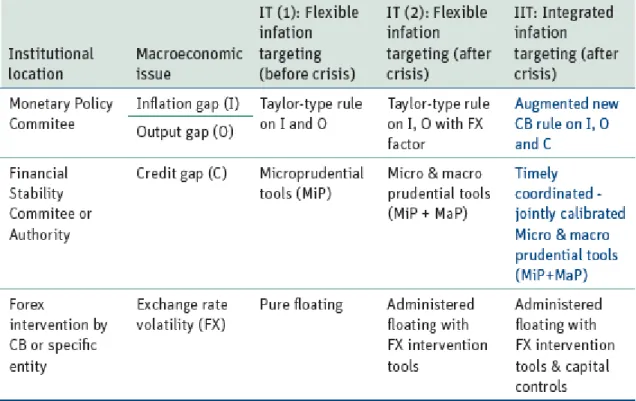
To implement IIT, an augmented Taylor rule which, in addition to reaction to the inflation gap (I), the output gap (O), also responds to (some measure of) private sector credit growth gap ((C), defined as the difference between the actual growth rate of that variable and a “reference” growth rate) will need to be explicitly formulated. Then, the optimal interest rate rule should be derived from an optimization problem involving minimizing a loss function, subject to a (reduced form) model of the economy. The loss function may also take the exchange rate volatility into account as mentioned earlier, suggesting that a real exchange rate gap can be included in the augmented rule with or without other arrangements.
Table 1: From the standard IT framework to post-crisis IT frameworks
Source: authors
Augmenting the policy interest rate rule to react to a credit gap measure can be beneficial to MICs. IT frameworks have already evolved in the post-crisis policy world, as suggested in Table 1 from a standard IT to post-crisis IT (with some degree of concern vis-à-vis exchange rate volatility and the effects of capital flows). Under this IIT framework, the central bank will be able to estimate, monitor, react and mitigate the usual accelerator mechanism that, when left unchecked, can lead to excessive rapid credit growth and inflate asset prices, which are common manifestations of financial imbalances. Since credit booms, in most cases, are well-documented leading indicators of financial crises, it is of the essence of an IIT to react with its policy interest rate rule to any unsustainable private sector credit growth gap.
There are two key pre-conditions that must be fulfilled before an IIT with an augmented inflation gap (I) - output gap (O) - credit growth (C) policy rule is implemented. The monetary authority or central bank needs to:
First, decide on the credit gap measure to be used in the rule. That requires choosing whether considering a real or a nominal credit gap, and whether using a broad measure of aggregate credit or only a component of total credit (say private sector credit).
Second, decide how the "reference" growth rate will be measured. This "reference" rate can obviously be calculated using statistical filters and/or as a trend. But given MICs process of financial deepening, the preferred way should be on the basis of an equilibrium credit-to-GDP ratio that is related to some fundamental determinants.
Finally and perhaps more importantly, the central bank will have to deal with the issue of credibility and expectations, which can both be affected by the introduction of the new policy regime. Put differently, the introduction of a modified reaction function can have implications for central bank credibility if its objectives are not communicated properly to the public and well understood. Not paying due attention to that can affect inflationary expectations. It will therefore be of the utmost importance for a central bank embarking into an IIT to clearly explain to the public, the reason(s) why there should be a more prominent focus on credit growth developments, the renewal of its commitment to macroeconomic (price) stability and the new format of its reaction function as well as its expected results.
Conclusion
In order to achieve macroeconomic and financial stability, monetary policy and macroprudential policy should be used as complements. Hence, monetary policy should use an interest rate rule which responds to deviations in inflation, output and credit, in the context of an integrated IT (IIT) framework. The IIT regime is a flexible IT regime in which the central bank has an explicit financial stability mandate and the interest rate responds to excessively rapid credit growth. Under the IIT framework, monetary and macroprudential policies are calibrated jointly to achieve macroeconomic and financial stability.
Our analysis shows that MICs can benefit from a policy interest rate rule which includes a measure of the private sector credit growth gap - which will act as an intermediate target. Also, since in these countries there is a high degree of uncertainty about real time estimates of the output gap, the credit growth gap may produce a more reliable and timely measure of excess demand. This modified reaction function can also assist monetary policy in MICs to be more proactive and address the time dimension of systemic risk.
To perform well, the IIT regime must have a strong fiscal position that maintains stable and low risk premia. Since public debt level and composition have improved in MICs, the remaining risk factor, as mentioned previously, is population ageing and pension financing needs
as well as the short-term effects of the financial crisis on MICs’ fiscal position. All of those may put considerable pressure on fiscal accounts in many MICs in the coming years. Therefore, in addition to a strong medium-term fiscal framework, reforms should be implemented to mitigate the fiscal burden associated with these liabilities and reduce concerns about public debt sustainability. Also, strong public sector accounts that are capable of countercyclical accumulation of precautionary resources may provide some fiscal space for policymakers to act counter-cyclically without losing credibility and mitigate the risks associated with large and volatile capital flows when needed. In this vein, a comprehensive framework that comprises monetary, fiscal and macroprudential policies seems to emerge as the policy framework best suited to achieve price and financial stability in MICs.
There are also several other practical operational issues.
First, there are communication and transparency requirements. Naturally, considering adopting an IIT requires a careful examination of the communication ritual and rules associated with this approach and needs to address the specific credibility issues that might be present in some MICs with consequences for inflation expectations.
Second, there is the need to develop a proper methodology for estimating credit gaps, which should be addressed to make an IIT regime operational.
Third, a decision needs to be taken on which the macroprudential tools will be used in coordination with monetary policy.
Fourth, another issue is the institutional setup that would best promote the coordination between monetary and macroprudential policies. It has been pointed out that if monetary and macroprudential policies must indeed be determined jointly, there must be very close coordination between the central bank and the macroprudential authority; they might operate under separated institutions or inside the same framework but in two distinct committees (e.g., a traditional IT’s Monetary Policy Committee, and newly created Financial Stability/Policy Committees as in the case of the Bank of England).
Fifth, there is the issue of the target horizon for price or macroeconomic stability, on the one hand, and financial stability, on the other is also important. Since in several IT-MICs, inflation targets are set on an annual basis, there is a temporal dimension which provides some flexibility to the central bank to react to anticipated changes in the process driving inflation or the nature of shocks that may affect it. However, since financial stability is a continuous target, a
critical question is whether such a dichotomy should be maintained in an IIT regime, and if not how costly would be the loss of flexibility that countries would face by moving to two continuous targets.
The final issue relates to how credibility should be measured in an IIT framework. In a standard IT regime credibility is measured based on the volatility of inflation expectations and the degree of persistence in (actual and expected) inflation over time. However, if financial stability is also an objective of the central bank, an adequate measure of credibility should involve also a measure of progress (or lack thereof) with respect to financial stability. In addition, if the financial stability objective is hierarchical as opposed to concurrent with the objective of macroeconomic stability, a proper set of weights should be developed to measure overall credibility.
These issues are not trivial but many MICs have been, implicitly or explicitly, using some form of the proposed IIT when facing the challenges posed by the post-crisis environment. This paper wishes to contribute to a more formal and organized discussion.
Notes of the Executive Summary
i Provided there is no excessive distortion brought by administered public sector growth (e.g. an imbalance
between credit growth extended by public development banks crowding-out private sector credit growth)
ii See Box 1 in the main text below for more details on Brazil's financial system regulation and supervision
including the results of its 2012 Financial Stability Assessment Program (FSAP).
iii Figure 7 in the main text below shows that equity-related flows rose sharply in Brazil in response to the
recent episodes of quantitative easing in the United States.
iv See Box 2 in the main text below for more discussions on the reasons for the volatility in capital flows and
the macroeconomic effect.
v See Agénor (2012), who provides recent evidence on the benefits and costs of capital flows and financial
openness.
vi See Box 4 in the main text below which contains more details on CPI-based targets and PPI-based targets.
vii See Agénor and Pereira da Silva (2012) for a discussion on the role of monetary policy in addressing financial
stability.
viii See Box 8 in the main text below which discusses how countercyclical capital buffers can be used to
preserve macroeconomic and financial stability after a fall in the world interest rate.
ix Further discussions on the evidence regarding the effectiveness of capital controls on the volume of capital
flows are presented in Box 6 in the main text below.
x See Box 7 in the main text below discusses the process of the monetary transmission mechanism in MICs
I. Introduction
The global financial crisis triggered by the collapse of the subprime mortgage market in the United States has led to a vigorous debate about both the nature and effectiveness of financial regulation, and whether central banks should consider more explicitly financial stability objectives in the conduct of monetary policy. Indeed, several observers have argued that central banks should consider more systematically, when setting interest rates, the potential tradeoffs that may arise between the objectives of macroeconomic stability and financial stability. A common argument to support this view is that the very achievement of price stability may be associated with an increased risk of financial instability: by inducing excessively optimistic expectations about future economic prospects, or by increasing incentives to take on more risk, low and stable rates of inflation may foster the development of asset price bubbles. Thus, price stability – defined as maintaining a low and stable rate of inflation – may not be a sufficient condition for financial stability and monetary policy must internalize potential risks to economic stability and act preemptively, rather than “mop up” after a crisis has erupted.1
Because inflation targeting (IT) has been the monetary regime of choice in a growing number of countries during the past two decades (see Figure 1), the debate on the role of monetary policy in the aftermath of the global financial crisis has naturally taken place in the broader context of the debate on the performance of these regimes. The risks that IT, even in its current flexible form, could pose if it implies that potential asset bubbles and the build-up of financial imbalances are ignored by central banks, are well described by Woodford (2012, p. 8) for instance:
“… the [global financial] crisis does justify reconsideration of at least one aspect of the inflation targeting doctrine that had developed over the previous two decades. This is the thesis that a central bank with an inflation target need not pay attention to financial developments – such as a credit-financed real estate boom – except to the extent that such developments affect the outlook for inflation (or perhaps, either for inflation or for real activity). While this thesis is not, in my view, a central, definitional aspect of an inflation targeting regime, it was undoubtedly a common view among proponents of inflation targeting prior to the crisis. It is therefore important to reconsider both the extent to which such a view is defensible, and the extent to which it is a necessary element of a coherent approach to inflation targeting. Can this previously conventional view still be maintained, after recent experience? And if not, would this require abandonment of inflation targeting as well?”
In the same vein, Mishkin (2011, p. 32) states
“Although the support for the flexible inflation targeting framework is not weakened by the lessons from the financial crisis, they do suggest, however, that the details of how flexible inflation targeting is conducted and what flexibility means need to be rethought.”
At the same time, other observers have argued that IT has by and large delivered price stability and should continue to focus on that objective, but that central banks should use prudential (especially macroprudential) regulation and other policy tools to contain financial imbalances, prevent the emergence of asset price bubbles, and ensure the stability of the financial system as a whole. The view here is that trying to stabilize asset prices per se is problematic for a number of reasons – in particular because it is almost impossible to know for sure whether a given change in asset values results from changes in underlying fundamentals,
1
The debate actually predates the global financial crisis and initially focused on the extent to which monetary policy should respond to (or “lean against”) perceived misalignments in asset prices, such as real estate and equity prices, as opposed to “cleaning up after.” In this vein, Cecchetti et al. (2000) and Kontonikas and Ioannidis (2005) found that overall economic volatility can indeed be reduced with a (mild) reaction of interest rates to asset price misalignments from fundamentals; see Wadhwani (2008) for a review. As is made clear later, our focus here will be on monetary aggregates, not asset prices.
non-fundamental factors, or both. Instead of getting into the tricky issue of deciding to what extent asset price fluctuations reflect changes in the economy’s fundamentals, central banks should focus instead on the implications of asset price movements for credit growth and aggregate demand, and thus inflationary pressures.
Figure 1
Countries Operating a Fully Fledged Inflation-Targeting Regime
(Inflation rate in percent)
Source: Hammond (2012).
Note: The figure shows the dates of formal adoption of inflation targeting for the 27 countries operating a fullfledged regime at the start of 2009, and the inflation rate at adoption.
This paper provides a broad analysis of the challenges faced by IT regimes in the post-financial crisis world, and ways to address them. In doing so we go beyond the debate on whether monetary policy should incorporate a financial stability objective, as discussed earlier, and address a host of other issues that have taken center stage in assessing the relevance and performance of IT regimes in the past few years. To conduct this analysis, and unlike other studies, we focus squarely on upper middle-income countries (MICs, for short), with a particular focus on the larger economies in Asia and Latin America, as well as Turkey and South Africa.2 Among the reasons for this choice are the facts that IT regimes in MICs face specific operational and credibility issues and that financial systems in these countries are undergoing significant structural transformations, which make them deeper and more integrated with those of advanced economies. At the same time, however, these transformations make financial stability in MICs more dependent on the financial conditions prevailing in advanced economies – especially in the aftermath of post-Lehman unconventional monetary policy actions that have led to a significant increase in global liquidity.
2
Statistically, “upper middle income countries” are defined in accordance with World Bank classifications by income groups, as given i high-income country, we include it in some of the discussions.
To preview our main policy lessons, we find that in the context of MICs, there is much merit in considering augmenting a conventional interest rate rule by adding a measure of the
private sector credit growth gap, defined as the difference between the actual growth rate of that variable and a “reference” or “equilibrium” growth rate (which, we argue, cannot be mechanically derived from the “observed trend” of credit growth). By doing so monetary policy (which can address only the time dimension of systemic risk) would help to counter accelerator mechanisms that generate excessively rapid growth in credit and asset prices, which are common manifestations of financial imbalances. Indeed, a large body of evidence has documented that excessively rapid credit growth tends to go hand-in-hand with a deterioration in lending origination standards and credit quality. In turn, the weakening of lending standards tends to increase financial fragility during a downturn. To mitigate exchange rate volatility, and adverse effects on both the real and financial sectors, the central bank may also need to react to large changes in the real exchange rate. However, because monetary policy cannot address the cross-section dimension of systemic risk, it is largely complementary to macroprudential policy. Both types of instruments must be calibrated jointly and carefully, in the context of macroeconomic models that account for the type of credit market imperfections observed in MICs and for the fact that macroprudential regimes may affect in substantial ways the monetary transmission mechanism. Finally, in countries where there is some degree of flexibility in budget outlays, a countercyclical response of fiscal policy might be an important complement to monetary policy in managing aggregate demand pressures and the adverse effects of abrupt changes in capital flows.
The remainder of the paper proceeds as follows. To set the stage for our analysis, Section 2 provides a background on financial systems in MICs, the link between capital flows and (macroeconomic and financial) volatility, and the link between credit growth and financial crises in these countries. Section 3 considers the main features of IT regimes and the fundamental trade-off between credibility and flexibility that these regimes face. We then focus in Section 4 on the evidence, with a thorough review of the recent performance of IT in MICs. Section 5 considers what we consider to be the main challenges to IT at the moment: the risk of fiscal dominance related to future fiscal liabilities; the management of terms-of-trade shocks in a volatile international environment; exchange rate volatility and “fear of floating;” building and maintaining credibility; and more recently, the focus on financial stability, which has been related to the shift (as discussed earlier) from ex post resolution of financial shocks to prevention. Section 6 then focuses on how to address the financial stability challenge in an IT regime. It discusses whether reliance on macroprudential policy and capital controls is sufficient to mitigate systemic risk or if instead monetary policy should be more proactive in response to perceived risks to financial stability (above and beyond the conventional objectives of price and output stability), and whether these tools are complements or substitutes, that is, the extent to which regulatory rules and monetary policy should be combined to ensure both macroeconomic and financial stability. We also discuss, assuming that a more proactive monetary policy is desirable, the nature of the financial indicators that it should be made responsive to. Section 7 addresses design and implementation issues associated with an “integrated” IT regime, with a particular focus on improving our understanding of the monetary transmission mechanism in MICs, and the practical formulation of a credit-augmented interest rate policy rule. The last section brings together the main policy lessons of our analysis and offers some concluding remarks.
To set the stage for our analysis, it is important to understand the financial features of MICs and their international financial environment. This section begins with a brief review of the structure of financial systems, and the experience of these countries with financial openness, capital flows, and volatility. We then discuss the link between credit growth and financial crises – an important connection to motivate our proposal for a new monetary policy rule in these countries.
2.1 Structure of Financial Systems
With some notable exceptions, financial markets in many MICs remain underdeveloped, compared to high-income countries. In most of these countries, commercial banks continue to dominate the financial system. Equity issues remain limited, despite recent progress in deepening local capital markets and changes in the ownership structure of firms. In some cases this has contributed to making the stock market highly volatile. Capital markets remain thin; local currency bond markets are still in their infant stages in many economies and do not represent significant alternatives to bank lending. According to data for 2011 published in the September 2012 issue of the IMF’s Global Financial Stability Report (Appendix, Table 1), as a share of GDP, stock market capitalization amounted to 35 percent, private debt securities for 122.8 percent, and bank assets for 223.4 percent for the Euro Area, and 103.7 percent, 138.1 percent, and 97.1 percent, respectively, for the United States. The corresponding figures for Latin America and the Caribbean were 39.6, 18.9, and 58.8 percent, and for Asia 43.3, 20.8, and 156.1 percent, respectively. Although these numbers are not specific to the major MICs in each of these two regions, they are fairly representative of their situation as well.
In part due to a more stable macroeconomic environment, in the past decade credit has grown significantly in both Asia and Latin America, both in real terms and in proportion of GDP (Figures 2, 3 and 4). Despite a sharp deceleration in the immediate aftermath of the global financial crisis, this growth has been particularly strong in some of the major MICs in both regions. In Brazil for instance, the credit-to-GDP ratio has risen from 26 percent in 2004 to more than 50 percent in 2012. This is partly a reflection of greater financial inclusion, that is, the rapid expansion of the middle class there and the demand for financial services, but also the result of improved macroeconomic fundamentals, as well as progress in legislation and reduction of information asymmetries (such as new foreclosure rules, the creation of credit bureaux, and so on). However, today credit to the private sector remains in relative terms well below the levels observed in high-income economies (Figure 4). One factor that may have hampered the expansion of credit in MICs may be that disclosure and transparency requirements on corporate firms remain inadequate.3 With poor regulation of corporate governance and weak financial accounting transparency, firms have limited incentives to consider equity issuance as an alternative source of funding – preferring instead either to rely on internal funds or to borrow from banks with which they have established close links.
Figure 2
Real Credit Growth to the Private sector, 2002-11
(In percent)
3
Source: International Monetary Fund, World Economic Outlook (April 2011).
The nature of banking operations and their degree of sophistication in many MICs have been transformed in recent years by privatization and cross-border acquisitions. However, the financial systems in most of these countries continue to lag behind developments in industrial markets. In particular, and despite some exceptions, the expansion of nonbank financial intermediaries (hedge funds, commodities funds, private equity groups, and money market funds), the shift toward the “originate and distribute” model of banking, and the development of off-balance sheet instruments, have not reached the same importance as they have in advanced economies. Indeed, apart from a few countries, nonbank financial intermediaries are not highly developed. Data compiled by Ghosh et al. (2012) for instance on the importance of shadow banking in MICs show that the sector is large only in a few countries, such as the Philippines and Thailand.4 In Brazil, the sector comprising hedge funds, pension funds, and private equity funds is also quite large (representing about 53 percent of overall deposits) and continues to grow.
4
Shadow banking comprises a set of activities, markets, contracts, and institutions that operate partially (or fully) outside the traditional commercial banking sector, and, as such, are either lightly regulated or not regulated at all (See Pozsar et al. (2010) and Institute of International Finance (2012)). In industrial countries, alternatives to conventional bank finance include invoice factoring or discounting (where a business borrows money against its invoices), asset-based financing (where money is borrowed against assets such as a plant or machinery), peer-to-peer and consumer-to-business lending (in which individuals agree to lend money to each other or to businesses through an online money exchange). New lending models also involve providing cash advances to businesses (e.g., restaurants and hotels) that derive much of their income from credit card sales. However, most of these new lending models haven’t reached a mass of borrowers that is critical enough to be considered serious alternatives to bank finance.
Figure 3
Latin America: Real Private Credit Per Capita, 2007-12
(Year-on-year percent change)
Source: International Monetary Fund, World Economic Outlook (September 2012).
Another important feature of financial systems in MICs (although not all of them) is that supervisory capacity is often weak and the ability to enforce prudential regulations limited (see Barth et al. (2004, 2008) and Rennhack (2009) for Latin America). As noted in a report by the Financial Stability Board (2011), in many MICs bank supervisors lack the ability to assess the effectiveness of banks’ risk management practices, especially the adequacy of capital in relation to the risks that they undertake. The lack of expertise in the supervisory agency is especially problematic for those countries that have approved the use of the advanced approaches in Basel II, which allow banks to rely on historical data and internal models for the determination of credit risk estimates and capital requirements. Lack of supervisory capacity affects the ability to assess other risks as well, such as market and interest rate risks. A notable exception among major MICs is Brazil, as discussed in Box 1.
Figure 4
Selected Countries: Domestic Credit to Private Sector, 2000 and 2011
(In percent of GDP)
Source: Banco Central do Brazil.
Box 1. Brazil: Financial System Regulation and Supervision
Brazil’s financial system has grown in size, strength, diversification and sophistication but has remained solid in all its essential dimensions (e.g., capital requirements, profitability, loan loss provisions and liquidity). The stress tests that have been recently conducted indicate strong resiliency to extreme shocks, including to a severe global recession. The main findings were a) the system (through its provisions and capital base) would be able to absorb the deterioration of the main macroeconomic indicators; b) for three major risks (credit, foreign exchange and interest rate), there would be no cases of insolvency, even in situations of extreme volatility; and c) the failure of any individual bank would not lead to widespread failure of other banks, indicating low direct contagion.
The system has limited exposure to external risks: low bank foreign exposure in assets and funding, conservative prudential regulation, subsidiarization approach to foreign capital banks. There is also a strong, sophisticated, and intrusive bank supervision, equipped with adequate tools for prevention and intervention. The Brazilian supervision was one of the best evaluated among G20 countries. The table below summarizes the compliance with Basel Core Principles for Supervision, compared with that of major MICs and high-income countries.
Financial regulation and supervision in Brazil is centralized at the Central Bank, which has at its disposal fairly extensive powers, based on mostly infra-legal instruments. The system is converging to international standards (IFRS, Basel 2, 2.5 and 3, IOSCO). It has a strong minimum capital ratio: 11 percent of Risk-weighted assets (well above the Basel minimum of 8 percent) with capital requirement for credit risk on trading book exposures and risk weights for residential property exposures conditioned to loan-to-value (LTV), forward-looking provisioning rules, mandatory organizational structure for management of each risk factor (credit, market and operational risks), banks’ board members personal accountability on risk management and a set of stringent limits on large exposures and on foreign currency exposures. In addition, unlike high-income countries, there is a mandatory registration of OTC derivatives.
Notes: The dates reflect the month of publication of Detailed Assessment
The document “Core Principles for effective Banking Supervision” of 2006 is available on: The revised version of this document was published in September, 2012, see
The Brazilian system of comprehensive risk-based approach supervision is organized around frequent on-site examinations, Central Bank's own rating of supervised institutions based on its own criteria (qualitative assessment of risk management and control, analysis of financial and economic indicators, identification of areas to be monitored) and contingency planning and assessment of organizational structures dedicated to risks. All credits above BRL1,000 (about USD500) need to be registered and reported to the Central Bank., which conducts specific monitoring of market and liquidity risks, using information on assets and derivatives registered in clearing houses and reconciling this information with accounting information from all financial institutions. There the Central Bank is capable of monitoring the aggregate evolution of systemic risk over time and in addition conducts a periodic application of stress tests to all financial institutions statements. See
In some cases inadequate supervision and porous regulations are the legacy of heavy public sector involvement in the banking system, which weakens enforcement incentives, and an inadequate pay structure, which makes it difficult to lure well-qualified individuals away from more lucrative private activities. As documented by the Inter-American Development Bank (2005) and Dermirguc-Kunt et al. (2008), the quality of bank supervision – as measured by the overall compliance index with the so-called Basel Core Principles for Effective Bank Supervision, which include a number of recommendations on prudential regulation and requirements – tend to be much lower for developing countries, especially those of Latin America (see Figure 5), again with the notable exception of Brazil (Box 1). In turn, a weak regulatory environment may lead to regulatory capture and create perverse incentives for banks to engage in overly risky activities. This in turn may lead to weak banking institutions, characterized by high proportions of nonperforming loans. As shown in Figure 6, while some countries (such as Brazil and Mexico) have banks that are well provisioned, others (including Chile, Indonesia, Turkey, and South Africa) are not. This makes banks in these countries highly vulnerable to a downturn, which in turn could magnify considerably the cost of adverse shocks.5
5
Vazquez et al. (2012) for instance found a significant negative relationship between non-performing loans and (lagged) GDP growth in Brazil.
Finally, in many MICs property rights are weak and the legal system is highly inefficient, thereby making contract enforcement difficult. In particular, Bankruptcy law typically provides little creditor protection and bankruptcy procedures for liquidating the assets of firms in default are rarely enforced, which results in low recovery rates for creditors.6 This in turn translates into weak intermediation, a high cost of capital, high rates of collateralized lending, and outright credit rationing – which affects disproportionately small- and medium-size firms, whose ability to pledge collateral is often weak to begin with.
2.2 Credit Market Imperfections
Credit markets in MICs are often characterized by limited competition among banks. This has led to monopolistic or oligopolistic pricing practices, market segmentation, and efficiency losses. In recent years, there has been some improvement in that regard, in large part to large-scale privatization and bank restructuring. In Latin American MICs for instance, this has helped to promote competition and generate efficiency gains in banking (see Williams (2012a).7 Nevertheless, lack of competition continues to prevail in many countries and this has important implications for the monetary transmission mechanism, as discussed later.
Asymmetric information problems in MICs tend to be more severe than in industrial countries; this makes screening out good credit risks from bad ones difficult, and fosters collateralized lending and short-maturity loans. Moreover, and despite recent trends toward privatization, governments in many countries continue to play a pervasive role in banking. While this involvement turned out to be useful in the aftermath of the global financial crisis – it made it easier in some countries to implement countercyclical credit policies – it may exacerbate moral hazard problems, by promoting connected lending and regulatory forbearance.
6
See Araujo and Funchal (2005) for the case of Latin America and Djankov et al. (2008) for a general review of debt insolvency procedures in developing countries.
7
However, whether improved competition helps or undermines financial stability remains a matter of debate, in the region and elsewhere. See for instance Degryse and Ongena (2008) for a general review of the evidence on the link between competition and bank stability and Ariss (2010) for developing countries. Indeed, increased competition in banking may actually raise the risk of financial instability. First, it may raise systemic risk, as weak banks “gamble for resurrection” by increasing the riskiness of their loan portfolios. Second, rents created by imperfect competition may induce banks to monitor better their borrowers (because there is more at stake) and to expand effort to mobilize deposits (because there are rents to be earned on them). Both the quality and level of financial intermediation can therefore be higher than under financial liberalization. This view is in line with the “financial restraint” argument discussed by Hellman et al. (1997).
Figure 5
Compliance with the Basel Core Principles for Effective Bank Supervision
(Index varies between 0 and 1)
Source: Demirguc-Kunt, Detragiache, and Tressel (2008, p. 522).
Note: The document “Core Principles for Effective Banking Supervision” published in 2006 is available at http://www.bis. org/publ/bcbs129.htm. The revised version of the document published in September 2012 is available at http://www.bis. org/publ/bcbs230.htm.
Related to the lack of financial diversification discussed earlier, bank credit plays an important role in many MICs – it serves to finance not only longer-term investment projects but also short-term working capital needs. As a result, it may have a large impact on the supply-side of the economy. Firms often borrow short term to finance their acquisition of labor inputs, raw materials, etc., prior to the sale of output. But while an increase in the cost of loans for consumption or investment (induced by a contraction in monetary policy) tends to reduce both aggregate demand and inflationary pressures, an increase in the cost of working capital loans affects output and inflation in opposite directions. This makes the transmission of monetary policy shocks to prices highly uncertain and has important implications for the performance of IT regimes, as discussed later.
Figure 6
Selected Countries: Bank provisioning and non-performing loans
(As a percentage of total loans)
Source: Bank for International Settlements, Annual Report (June 2012). a For Germany, Italy, Japan, Korea and Switzerland, 2010; for all others, 2011.
2.3 Financial Openness, Capital Flows, and Volatility
In the past two decades many MICs have continued to open their capital account, and greater integration with world capital markets has been accompanied by a substantial rise in private capital flows to these countries. The conventional distinction in terms of what drives capital flows to MICs is between “push” factors (macroeconomic and structural reforms that attract capital from abroad as a result of changes in regulation and improvements in the risk-return characteristics of assets issued by MICs) and “pull” factors (cyclical and structural factors that affect the risk-return characteristics of assets issued by advanced economies).8 While foreign direct investment has often been driven by longer-term prospects (push factors), short-term, cross-border capital flows are highly responsive to changes in relative rates of return, including movements in interest rates in advanced economies and changes in risk perception among global investors (pull factors).
Although there are substantial potential benefits associated with capital flows (especially foreign direct investment, as documented in a number of studies), the risk of volatility and abrupt reversals in short-term capital movements may represent a substantial cost. A wave of currency and banking crises during the past two decades, including most recently the global financial crisis (and the liquidity policies that were followed in its aftermath), have heightened
8
In addition to the growing trend toward integration of world capital markets and changes in policies and prospects in the recipient countries, global cyclical factors have also played an important role in explaining fluctuations in capital flows, especially short-term flows. See Agénor and Montiel (2008b, Chapter 14) for a review of the evidence on the determinants of capital flows, Forbes and Warnock (2012), Ghosh et al. (2012), Ahmed and Zlate (2013), Herrmann and Mihaljek (2013), and Okada (2013) for an analysis of the role of global and domestic factors in explaining “waves” of international capital flows over large samples, and Fratzscher (2012) for a more specific study of the importance of push and pull factors before and after the global financial crisis.