Pooling risk among countries
LSE Research Online URL for this paper:
http://eprints.lse.ac.uk/102909/
Version: Accepted Version
Article:
Callen, Mike, Imbs, Jean and Mauro, Paolo (2015) Pooling risk among countries.
Journal of International Economics, 96 (1). pp. 88-99. ISSN 0022-1996
https://doi.org/10.1016/j.jinteco.2015.01.006
[email protected]
Reuse
Items deposited in LSE Research Online are protected by copyright, with all rights
reserved unless indicated otherwise. They may be downloaded and/or printed for private study, or other acts as permitted by national copyright laws. The publisher or other rights holders may allow further reproduction and re-use of the full text version. This is
Pooling Risk Among Countries
∗
Michael Callen
†Jean Imbs
‡Paolo Mauro
§December 2014
Abstract
Suppose that international sharing risk—worldwide or with large num-bers of countries—were costly. How much risk-sharing could be gained in small sets (or “pools”) of countries? To answer this question, we com-pute the means and variances of poolwide gross domestic product growth, for all possible pools of any size drawn from a sample of 74 countries, and compare them with the means and variances of consumption growth in each country individually. From the difference, we infer potential di-versification and welfare gains. As much as two-thirds of the first best, full worldwide welfare gains can be obtained in groupings of as few as seven countries. The largest potential gains arise from pools consisting of countries in different regions and including countries with weak insti-tutions. We argue international risk-sharing fails to emerge because the largest potential gains are among countries that do not trust each other’s willingness and ability to abide by international contractual obligations.
Keywords: Risk Sharing, Diversification. JEL Classification: E21, E32, E34, F41.
∗We are grateful to two anonymous referees, and to Eric van Wincoop, Tamim Bayoumi, Mick Devereux, Michael Kremer, Raghuram Rajan, Jaume Ventura, and seminar participants at U.C. Berkeley, Cambridge U., the International Monetary Fund, U. Pompeu Fabra, the San Francisco Fed, and Tufts U. for insightful suggestions; to Nicolas Metzger, and Jos´e Romero for superb research assistance; and to Jean Salvati and especially Huigang Chen and Alin Mirastean for invaluable help in programming and computational support. Financial support from the Banque de France Chair at the Paris School of Economics is gratefully acknowledged. All errors are our own. Corresponding author: Jean Imbs - Paris School of Economics - 106 Bvd de l’Hopital - 75013 Paris, France. [email protected].
†Kennedy School of Government, Harvard University ‡Paris School of Economics (CNRS) and CEPR. §Peterson Institute for International Economics
1
Introduction
Despite major strides in lifting capital controls around the world and impressive increases in cross-border holdings of financial assets, international financial in-tegration is still far from complete: Individual countries’ consumption remains more volatile than what would result from complete risk-sharing with the rest of the world. In this paper, we conjecture that practical obstacles make inter-national risk sharing costly, and that they depend on the number and charac-teristics of potential partner countries to share risk with. Then, it can become
desirable to share risk within a well chosen subset of countries only.1 This paper
evaluates the potential gains associated with such limited risk sharing contracts. How large would such groups need to be for the gains to be sizable? And which groups would yield the largest gains?
Our main contribution consists in running a systematic search on all possi-ble groupings, or “pools” of countries, using the variance-covariance matrix of output and consumption growth rates observed in standard data for 74 coun-tries. We compare the observed volatility of consumption for each country with
the volatility of poolwide output, for each possible pool.2 Consumption data
are relevant because they reflect the insurance mechanisms that already exist in each country. Under risk sharing within the pool, consumption growth in each country equals poolwide output growth. Therefore, the comparison quan-tifies the potential for additional diversification gains—and ultimately welfare gains—that would accrue to each country from moving to complete risk-sharing within each pool considered. For any possible pool size, we identify the country groupings that minimize poolwide GDP volatility, and maximize welfare gains from international diversification.
We find that pools of fewer than ten countries can provide the bulk of the potential first best, worldwide risk sharing gains. In those well chosen groupings,
1
We do not observe worldwide risk sharing, but we do not observe sharing of GDP risk within groups of countries either. How could risk sharing be achieved in practice for a subset of countries? Various schemes have been proposed, including Robert C. Merton’s (1990, 2000) networks of bilateral swaps of GDP-linked income streams. Elements of risk sharing among groups of countries are also present, for example, in pooling arrangements for international reserves, such as the Chiang Mai initiative, the Latin American Reserve Fund (FLAR), or networks of bilateral swap arrangements (e.g., among the G7 in the 1960s-70s, among the European countries during the run up to the establishment of the Euro, and among several countries during the global financial and economic crisis that began in 2007-8). While these existing real-world arrangements do not seek to share GDP risk explicitly, they do imply some degree of sharing of macroeconomic risks among their member countries. On FLAR, see Eichengreen (2007) and www.flar.net; on the Chiang Mai initiative, see Park and Wang (2005), and http://aric.adb.org; on the earlier European experience, see Eichengreen and Wyplosz (1993). On the sharing of GDP risks more generally see Shiller (1993); and Borensztein and Mauro (2004) for a review of the literature.
2
In this regard, our approach differs from previous studies: by Obstfeld (1994) and Lewis (2000), who used consumption data only, and by Tesar (1995), who modeled explicitly the saving / investment decisions that determine production in general equilibrium. However, the paper’s results are unchanged if we use consumption data only, or production data only.
the marginal gains decline quickly for groups beyond six or seven members. Many small pools yield large risk-sharing gains. Unsurprisingly, such pools
involve relatively volatile economies.3
If the gains from international risk sharing are so significant, and could in principle be attained in relatively small groups of countries, why do such arrangements not emerge more often? One possibility is that they face partic-ularly costly obstacles. As we show in the paper, the largest potential gains are often attained by sharing risk with distant countries characterized by weak institutional quality and a history of default on international debt obligations. In that light, the observed reluctance to engage in international risk-sharing becomes less surprising: it may just stem from insufficient information about the trustworthiness of potential partners or difficulties related to international law. Then, risk sharing is especially costly precisely in those small groups of countries where they would carry maximal gains.
To explore this issue further, we report the potential gains that would result from risk-sharing arrangements if they were constrained to countries selected from a universe with certain characteristics—the same geographic region, or relatively strong institutions. In those potential country groupings, the costs associated with sharing GDP risk are presumably lower, and so a local arrange-ment is more likely to emerge. But as we show, these are also countries whose GDP risks tend to be strongly correlated, and so where the gains from risk sharing are smaller in the first place.
The rest of the paper is organized as follows. Section II provides the theo-retical background to our empirical exercise— adapted from existing work. The section also outlines how we handle the considerable combinatorial problem in-volved in manipulating a sample of 74 countries. Section III presents the general results on risk-sharing gains across subsets of countries. In Section IV, we esti-mate how much risk sharing gains are reduced when countries are constrained to share risk only with specific partners. Section V concludes.
2
Methodology
This section first outlines the theory motivating the paper’s empirics. Then it describes the algorithms used to compute the risk sharing gains, in any subset of countries, of any size, drawn from a universe of 74 countries with available consumption and output data.
3
Pallage and Robe (2003) show that the welfare cost of economic fluctuations is far larger in developing countries than in advanced economies.
2.1
Risk-Sharing, Volatility, and Welfare
The argument relies on a well known framework, based on Lewis (2000) and Obstfeld (1994). As they do, we abstract from non tradability and non separa-bility in utility, and from the possible impact of uncertainty on growth. These simplifications enable us to compute the welfare gains for risk sharing among a
large set of 74 countries.4
Following Epstein and Zin (1989), utility at timetin countryj is given by
Utj= ( Ctj 1−θ +β Et Utj+1 1−γ(1−θ)(1−γ) )1/(1−θ) (1)
where Ctj is consumption at time t in country j. The process for endowment
income at timetin countryj is
yjt =y j t−1+µj− 1 2σ 2 j+ε j t (2) where yjt = lnY j t and ε j t ∼ N 0, σj2
. 0 < β < 1 denotes the subjective
discount rate, γ > 0 is the coefficient of relative risk aversion and θ is the
inverse of the elasticity of intertemporal substitution in consumption.µjdenotes
the long run growth rate of output in country j, and σ2
j its variance around
trend growth. Equation (2) assumes permanent shocks to income, which is well known to magnify the welfare gains from diversification, for any pool size. But the assumption does not affect how quickly welfare gains increase with the number of countries sharing risk, the paper’s main question. The assumption of permanent shocks is maintained for tractability.
As in Lewis (2000), the analysis focuses on the welfare gains afforded by inter-national diversification. This assumes away alternative sources of consumption smoothing, such as self insurance and saving. It is consistent with the purpose
of evaluating the potential from international risk sharing. Following Lewis
(2000)Ctj=Y
j
t under autarky, and timet welfare in countryj is given by
Utj =C j t 1−βMj1−θ −1/(1−θ) (3) whereMj = exp µj−12γσj2
. If instead countryj enters a risk sharing
agree-ment, it will have a claim on poolwide income, ¯Yt, which we assume is distributed
log-normally, with mean ¯µand volatility ¯σ2: ¯y
t= ¯yt−1+ ¯µ−21σ¯2+ ¯εt.5 In the
pool, timetwelfare in countryj is therefore given by
¯ Utj = ¯C j t 1−βM¯1−θ −1/(1−θ) (4) 4
With non-separabilities, the literature usually considers two countries only, see Cole and Obstfeld (1991) or Coeurdacier (2009). Lewis and Liu (2014) consider up to eight countries, but have to deal with issues of existence and uniqueness.
5
Lewis (2000) shows the sum of log-linear processes can be approximated by a log-linear process.
where ¯M = exp ¯µ−12γσ¯2
, and ¯Ctj is consumption in country j at time t if
the country is part of the risk sharing pool.
How much of a claim does countryjhave on poolwide output? The only asset
available in countryjis the security that paysYtj, whose price is denoted byp
j t.
Entering the pool means acquiring the security that pays poolwide output ¯Yt,
whose price is denoted by ¯pt. Therefore, as in Lewis (2000) country j’s claim
on poolwide output at timet >0 is given by
¯ Ctj= pjt ¯ pt ¯ Yt (5)
We now introduce the possibility that a cost has to be paid by any countryj
willing to participate in the risk sharing agreement. The cost τj is paid once
and for all, at the time the agreement is contracted: it could for instance be paid outside of the pool, to a supra-national agency, whose remit is to monitor the agreement is subsequently honored, or to help provide relevant information
about the pool’s members.6 If the risk sharing agreement is contracted at time
0, this implies ¯ C0j =p j 0−τj ¯ p0 Y0¯ (6)
The cost τj affects only the level of initial consumption in country j, at the
time the pool is contracted: In particular, it does not affect the subsequent growth rates of consumption for all countries in the pool. They are all equal
to the growth in ¯Yt.7 Therefore the introduction of the cost τj does not alter
the dynamic properties of the equilibrium established in Lewis (2000), which we now discuss.
Once it is in the pool, consumption in country j obeys the following Euler
equation for allt >0:
1 =βφEt R¯ φ−1 t+1R j t+1 ¯ Ctj+1 ¯ Ctj !−θφ (7) withφ= γ−1 θ−1, ¯Rt+1= ¯ Yt+1+ ¯pt+1 ¯ pt , andR j t+1= Ytj+1+p j t+1 pjt+1 . Analogously, poolwide
consumption is governed by the following Euler equation for allt >0:
1 =βφEt R¯ φ t+1 ¯ Ctj+1 ¯ Ctj !−θφ (8) 6
See for instance Brennan and Cao (1997), or Kang and Stulz (1997). 7
Equations (5), (7) and (8) constitute a system of differential equations in the
asset prices ¯pt+1andpjt+1. Since in the pool consumption grows at the constant
rate ¯µ, Lewis (2000) shows that prices are given by
pjt =Y j t βM¯−θHj 1−βM¯−θHj (9) ¯ pt= ¯Yt βM¯1−θ 1−βM¯1−θ (10) whereHj = exp h µj+12γ¯σ2−γcov εjt,ε¯t i .
We now introduce a measure of poolwide welfare gains, W, associated with
the formation of a pool ofJ countries at time zero. Equations (3) and (4) imply
that by definition W = PJ j=1U¯ j 0 PJ j=1U j 0 −1
Since in autarkyC0j=Y0j, combining equations (3), (4) and (6) gives
W ≡W∗−T
whereW∗ is the percentage welfare gain associated with the same pool of size
J in the absence of any costτj, andT =
¯ Y0 ¯ p0(1−β ¯ M1−θ)−1/(1−θ) PJ j=1Y j 0(1−βMj1−θ) −1/(1−θ) PJ j=1τj. For
sufficiently large costsT, the welfare gainsW can be negative, so that a pool of
the corresponding sizeJ is actually not optimal. We conjecture this possibility
underlies the absence of international risk sharing pools in the data.
With asset prices defined in equations (9) and (10), it is possible to compute
a value forW∗that only depends on the parameters of the model. In particular,
we have W∗= (1−βM¯1−θ)−θ/(1−θ) ¯ M PJ j=1Y j 0 Hj 1−βM¯−θHj PJ j=1Y j 0 1−βM 1−θ j −1/(1−θ) −1
The paper’s key contribution is to computeW∗ letting J vary for all possible
subsets of countries in our sample. Our paper uses J = 74, a sample that
includes both developed and developing countries. To our knowledge, this is a
novel result. All that is needed for this purpose are calibrated values of β, γ
andθ, and estimates ofMj,Hj,Y0j and ¯M for all countriesjin any considered
pool of sizeJ.
Importantly, the paper measuresW∗, thepotential percentage welfare gains
associated with a given pool. There is no need to calibrate a value for τj, or
be optimal, and thus justifies considering risk sharing over subsets of countries
only. For legibility, the paper also presents the welfare gains W∗ as a share of
first best, worldwide gains.
In principle, overall potential gains W∗ could be positive while some
indi-vidual countries could have negative potential gains from entering the pool. In practice however, this does not seem to be a concern, as we show empirically in Section 3.4.
How could risk sharing arrangements be limited to subsets of countries? First, selective capital controls vis-`a-vis nonmembers could ensure that only the residents of countries in the pool have access to GDP indexed securities. Alter-natively, GDP swaps could be introduced along the lines proposed by Merton (1990, 2002), either as a network of bilateral swaps, or as swaps intermediated by a central entity for the pool. Each period, each country uses swap contracts to pay the others the net difference between its current output and its share in poolwide output. Participation in the network of swaps defines the pool membership.
2.2
Implementation
This paper computespotential welfare gainsW∗ for subsets of countries of any
size J. For each size J, we seek to report the grouping of specific countries
that maximizes poolwide welfare (or, alternatively, that minimizes poolwide volatility).
Proceeding incrementally, we use three approaches to computing diversifica-tion gains. First, we focus on volatility reducdiversifica-tion. We report the standard
de-viation of the growth rate for individual country consumption,σ2
j in the model,
and compare it with the variance of the growth rate in poolwide GDP, ¯σ2in the
model. We use consumption in autarky and output in the pool because autarky consumption reflects other insurance schemes that already exist in each
coun-try. This simple approach conveys most of the key economic intuition: ¯σ2 falls
quickly as J increases. Second, we compute W∗ as implied by these volatility
reductions, imposing at first that growth rates remain unchanged, i.e. µj = ¯µ,
at a level that is calibrated. This follows exactly from Obstfeld (1994). As was the case there, welfare is a monotonic transformation of volatility. Third and finally, the assumption that growth rates are the same for all countries is
relaxed, and we use historical data to estimateµj and ¯µin any pool of sizeJ.
Searching for pools of countries of any size, that yield minimal variance (or maximal welfare) is not straightforward, in light of the vast number of possible
combinations of countries. We consider the N = 74 countries in our sample
individually, then all of their possible combinations 2 countries at a time (of
which there areCN
N!
J!(N−J)!). The total number of partitions is
PN
J=1CJN = 2N −1. It quickly
reaches astronomical levels asN rises.
We implement a computational algorithm whose details are provided in a Technical Appendix available upon request. We are able to keep track of all
possible combinations for any pool size J, for a sample containing up to 31
countries, i.e. 2.1×10⁹combinations. This algorithm can handle, for example,
the universe of 26 emerging market countries—about 6.7×10⁷ combinations.
But when the universe consists of all 74 countries, the same algorithm only
allows us to analyze all combinations of pools of size J = 7 or less (C74
7 =
1.8×10⁹). SinceCN
J =CNN−J, we can also draw the inventory of all combinations
ofJ = 67 or more.
Outside of these pool sizes, we need to resort to an approximation algorithm.
WhenN = 74 for instance, the total number of groups to consider increases
to 274 = 1.9×10²², too large for existing computing power. For each group,
one needs to sum GDP for all countries in the pool, to compute an aggregate growth rate, the corresponding standard deviation, and covariances. Even if each operation took a nanosecond to complete, running an exhaustive search over all possible pools amongst 74 countries would take hundreds of centuries.
For sample sizes where exhaustive inventories are out of reach, we implement recursive searches. We first run exhaustive searches up to the maximum pool
size where it is feasible. This includes all pools of maximum sizeJ = 1, ...,7
(or J = 67, ...,74) drawn from the universe of 74 countries. For each J, we
order pools by decreasing volatility (or increasing welfare). Then, for eachJ,
we save the best pool, but also the followingS poolsthat include each country
in the sample. In other words, when drawing the inventories of groups of size
J, we collect the one group with lowest volatility, but also the next S groups
that contain country 1, the next S groups that contain country 2, and so on.
We therefore collectS×N additional pools for eachJ. We chooseS= 1,351,
so that 1,351×74≃100,000. We call these “seed” pools. We can collect seed
pools no matter the value ofJ. But forJ≤7 (orJ ≥67) we know the universe
ofall pools.
Then, for each pool sizeJ, we isolate all groups that include the members
of the optimal pool of sizeJ−1, plus one of theN−J+ 1 remaining countries.
Among these, we find the best pool of size J, as well as the best newS×N
seed pools of size J. The procedure is iterated. There is a recursive aspect to
the approach, but at each stage we consider the bestS pools for each of theN
countries: This gives plenty of opportunities for countries that are in the best
pool of sizeJ−1 to drop out at the next increment.
We have verified the reliability of this approximation in three different ways.
First, we ran exhaustive searches for all possible combinations forJ = 1, ...,7
inventories to the results of our approximation. They were always identical.
Second, we have experimented with different values forS, as low as 2, and have
found systematically the same results as withS = 1,351. Third, for each pool
size J, we have compared the results implied by the approximation to large
numbers of alternative pools, composed of countries drawn randomly. We have not found a single instance in which a pool drawn randomly was preferable to
those identified as the best through the approximation procedure.8
3
Data and Results
This section begins with a description of the data sources. We then build in-tuition through a simple, single country example, and generalize it to the main results. We describe a “global envelope” of the groupings that achieve maximal
risk-sharing gains for all sizesJ. We first focus on volatility reduction holding
growth constant, then infer welfare gains holding growth constant, and finally allow for growth rates to differ.
3.1
Data
Data on yearly real GDP and consumption are drawn from the World Bank’s World Development Indicators. They are evaluated in purchasing power
par-ity (PPP) U.S dollars, for the period 1974–2004.9 The sample consists of 25
advanced, 26 emerging market, and 23 developing economies with complete cov-erage and data of reasonable quality. The full country list is provided in the Appendix. Advanced economies are defined following the International Mone-tary Fund’s World Economic Outlook. The remaining economies are considered emerging if they are included in either the stock-market-based International Fi-nancial Corporation’s Major Index (2005), or JPMorgan’s EMBI Global Index (2005), which includes countries that issue bonds on international markets. The rest are classified as developing.
8
Combinatorial problems similar to those we are tackling are the object of a large literature in computer sciences. It revolves around the so-called “Traveling Salesman” problem, for which well-established approximated solution methods exist. To our knowledge however none can be applied to our baseline setup. For instance, Han, Ye and Zhang (2002) propose an approximation algorithm that can be applied to minimize the variance of a sum. But we minimize the variance of aweightedsum, where the weights themselves depend on the group’s membership. Imbs and Mauro (2007) use the Han, Ye and Zhang (2002) algorithm to identify risk diversification benefits for a given absolute size of the risk-sharing contract (for example, a US$1 contract). That exercise involves an unweighted average of GDP growth rates. Those conclusions are virtually identical to what we get here with recursive searches.
9
Previous studies (for example, Backus and Smith, 1993; and Ravn, 2001) have estab-lished that real exchange rate fluctuations worsen the case for international risk sharing. In-deed, GDP data at market exchange rates would imply far higher volatility—harder to hedge through international risk sharing. Using PPP-adjusted data amounts to assuming that all countries value the same consumption bundle in utility
We use these data to compute autarkic growth and volatility in consumption, and poolwide growth and volatility in GDP. The approach makes use of the variance-covariance matrix in GDP growth to infer expected gains arising from international risk sharing. A key assumption is that this matrix is relatively stable over time, which seems to be the case in the data. For instance, Doyle and Faust (2005) show that there is no evidence of significant changes in the correlation of output growth rates or other macroeconomic aggregates, despite claims that rising integration among the G-7 economies has increased cycles synchronization. And a large empirical literature has documented the cross-sectional properties of international business cycles, which appear to have highly persistent determinants, such as trade linkages or patterns of production (see
Frankel and Rose, 1998 or Baxter and Kouparitsas, 2005).10
3.2
A Simple Example
To develop intuition, we first report the results corresponding to the pools that minimize risk from the standpoint of an individual country, Chile. For each
pool sizeJ, Figure 1 plots the standard deviation of the growth rate of poolwide
GDP for the group of countries containing Chile chosen to minimize poolwide volatility. This is not a welfare measure, which explains its non-monotonicity
with respect toJ. The envelopes are displayed for various sample restrictions.
There are four cases: pools drawn from the whole sample of 73 countries; pools with other emerging markets; with other emerging markets in Latin America; or with advanced economies. To give a sense of the importance of choosing well
one’s risk-sharing partners, a fifth line also plots themaximum value of ¯σ for
all pools containing Chile, and for allJ.
Several results deserve mention. First, the lowest possible standard deviation
for poolwide GDP growth in a group that includes Chile is 0.61%, far below
4.41% for Chile itself. The minimum obtains for a group of 20 countries. Second,
a small number of carefully chosen partners is sufficient to yield the bulk of available diversification benefits. With just one well-chosen partner (France),
poolwide standard deviation falls to 1.26%. For the best pool of seven members,
the standard deviation of GDP growth reaches 0.72%, barely above the absolute
minimum. Not surprisingly, this obtains for a motley set of economies: Austria, Cameroon, Chile, New Zealand, Nicaragua, Sweden, and Syria.
As will become apparent, the finding that most diversification gains are attained in relatively small pools holds in general. In the United States for instance, despite the large size of the U.S. economy, pooling with another five or six well-chosen economies implies a near halving of US volatility. This result
10
Kalemli-Ozcan, Sorensen, and Yosha (2001) show that financial integration has an effect on the sector specialization of production, and therefore on the international correlation of business cycles. This paper abstracts from such possibility, taking as given the variance-covariance matrix of international GDP growth rates.
is reminiscent of the well-known finding in finance that a small set of stocks is sufficient to provide most of the diversification opportunities available from a market portfolio (Solnik, 1974). Marginal diversification gains quickly become
small, and even negative for J > 30. Beyond a certain pool size, hedging
opportunities are exhausted, and the pool starts including countries with high volatilities, and positive covariances. A contrario, the (upper) envelope that traces the worst possible pools of each size highlights the importance of choosing
one’s partners carefully. For smallJ, a poorly chosen pool can deliver higher
volatility than in autarky.
Various types of (economically relevant) constraints reduce maximum diver-sification benefits. For example, Figure 1 reports the extent to which potential gains decline when the universe of countries is constrained. The lowest
attain-able standard deviation is 0.61% for unconstrained pooling in Chile, but 0.87%
when Chile must pool with advanced countries only, 1.07% within the universe
of emerging markets, and 1.91% when pooling within Latin America.
Risk-sharing agreements that restrict the heterogeneity of the pool membership have substantial consequences on the potential diversification gains.
3.3
The Global Envelope
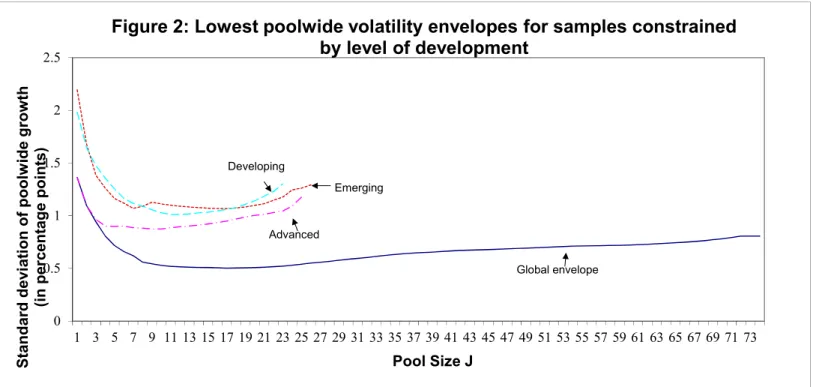
We now generalize the approach. Pools with minimum volatility are not con-strained anymore to include any given country. Figure 2 reports the envelope
of minimal output volatility for all pool sizesJ using the recursive approach
de-scribed in section 2.2. The Figure reports minimal poolwide volatilities across four different samples: pools of up to 74 countries, which traces a “global enve-lope”, and pools within developing, emerging or advanced economies. Across all four samples, the bulk of possible diversification gains is attained with relatively small pools. The global envelope implies the lowest possible poolwide volatility
is 0.50%, and it is obtained in a pool of 17 countries. But volatility is already
as low as 0.62% forJ = 7 along the global envelope. Thus, diversification gains
continue to be achieved within groups consisting of a small number of countries
in this general setup.11
The list of countries involved in minimum-volatility pools confirms that het-erogeneity is key. Interestingly, the list overlaps with that obtained for Chile, which suggests that the sample of countries providing the best hedging prop-erties within a universe of 74 economies is relatively small and robust. The variance-covariance matrix of GDP growth rates contains a few countries with systematically negative off-diagonal elements, i.e. desirable hedging properties.
11
The value reported forJ = 1 corresponds to the standard deviation of the individual GDP growth rate for the least volatile country during the sample period, namely France. Diversification gains for specific countries cannot be easily read off the figure, because the identities of countries involved in pools of different sizes change.
Figure 2 also reports minimum volatilities for three sub-samples: advanced, emerging, and developing countries. Diversification gains remain substantial within each sub-sample, but in all cases the minimum levels of poolwide volatil-ity are substantially higher than in the unconstrained sample. Advanced economies achieve smaller gains, consistent with their lower volatility and internationally correlated business cycles. All four envelopes display the same non-monotonicity
as in Figure 1, with high marginal diversification gains forJ < 10. They turn
negative forJ > 15, when countries with poor hedging properties start being
included.
Figures 1 and 2 help quantify the diversification gains that could accrue to the representative consumer living in a pool of a given size. It captures the decrease in output volatility as pool size increases. This is an input in the welfare gains from pooling risk, which we next evaluate.
3.4
Welfare Gains
This sub-section turns to computing welfareW∗. This requires calibrating the
preference parametersβ, γ and θ, and estimating Mj, Hj, Y0j and ¯M for all
countriesj in any considered pool of size J. The subjective discount rate β is
set at 0.95,θ= 2 andγ= 5. These are later subjected to robustness checks. For
each country and each pool,Mj is computed using consumption data, but ¯M,
Hj, and Y0j are computed using GDP: In autarky, consumption data are used
because they reflect existing sources of insurance, for instance inter-temporal. But in the pool, it is GDP data that must be used, because they reflect the
potential for risk sharing of a given pool of sizeJ.
Growth rates are still constrained to be equal across countries,µj= ¯µ= 3%.
With this constraint, Utj and ¯Utj are never close to zero, and welfare is well
behaved: This will no longer be the case any longer when growth rates are allowed to vary by country. This happens because, as in Lewis (2000), utility may become unbounder under certain parametrizations. Such issues are absent from our sample of 74 countries when GDP growth rates are constant, but do
appear in Section 3.5, where historical growth rates are used to calibrateµj.
Figure 3 reports the highest value ofW∗for every pool sizeJ. In the Figure,
W∗ is expressed in percentage of the first best welfare gains obtained with full
risk sharing worldwide. The results are reported once again for four different
samples. Welfare gains increase monotonically withJ, as they should, with a
maximum for J =N. Just as for volatility, the marginal increases in W∗ are
largest forJ <10. Marginal gains begin to peter out as soon asJ >7 or 8. This
holds true for the whole sample, but also across the four sub-groups of countries considered, among advanced, emerging, or developing countries. Interestingly, the gains are largest for emerging markets, and smallest for developing countries. This reflects the relative heterogeneity in business cycles in the former group.
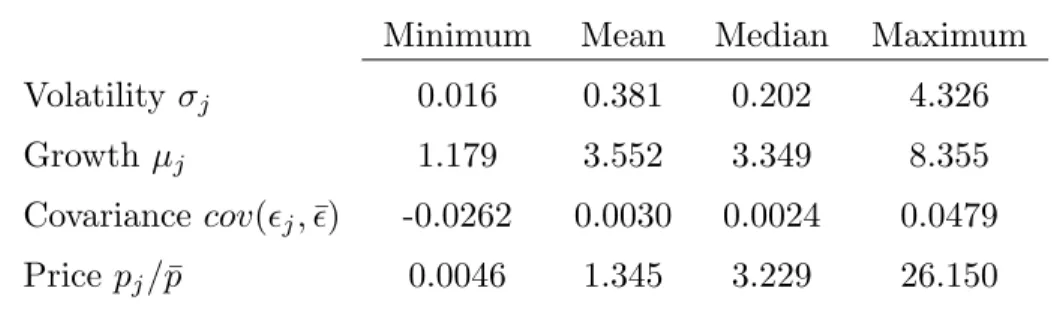
Table 1 reports summary statistics for the key variables serving as inputs to the welfare computations. The Table reports the extrema, mean and median values forσj, µj, cov
εjt,ε¯t
, andpjt / p¯t, for the universe of countries in our
dataset,J = 74. The volatility in GDP growth ranges from 0.01% to 4.32%, with
median 0.20 and mean 0.38. The distribution of country volatilities is slightly
skewed, with a few countries displaying exceptionally volatile business cycles. These are the countries for which risk insurance is particularly desirable. GDP
growth is distributed symmetrically, ranging from 1.18 to 8.35%, with mean and
median values close to each other, around 3.5%. The distribution of the
covari-ances between idiosyncratic and poolwide growth rates is heavily skewed, with
minimum−0.026 and maximum 0.048. There are very few countries with
neg-ative covariances, i.e., very few countries that represent especially good hedges
worldwide. Finally, the relative pricespjt/p¯tare heavily skewed, with a median
percentage share of 3.22, but a mean equal to 1.34%. This reflects that most
countries have very small claims to the worldwide mutual fund, while very few
have large claim, up to 26.15% for J = 74. The distribution of welfare gains is
therefore highly unequal.
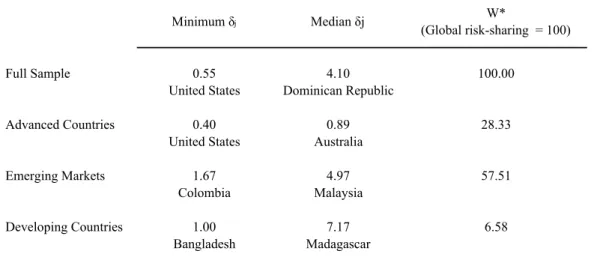
Table 2 explores the composition of W∗ for various pools. To do so, a
measure of individual countries’ welfare gains upon entry in the pool, δj, is
introduced. δj satisfies: U0j h C0j(1 +δj), µj, σ2j i =U0j ¯ C0,µ,¯ ¯σ2 . (4)
Similar to Lewis (2000) and Obstfeld (1994),δj is the percent increase in
con-sumption that would make countryj indifferent between autarky and full
risk-sharing in a pool. Table 2 calculatesδjfor all countries for four specific samples,
under the same parametrization as the one used to estimateW∗.
Table 2 reports the minimum value of δj, its median, and the value ofW∗
for four specific pools. The first pool is formed by the entire 74-country sample:
there, δj equals 1.9% of permanent poolwide consumption on average
(unre-ported). But the distribution of δj across the membership is skewed, with a
minimum for the US at 0.50%, and a median for Hong Kong at 6.21%. The
wel-fare consequences of pools are heterogeneous across their membership, reflecting the very heterogeneity of the constituent countries.
Individual country’s welfare gains decrease with per capita income, because they increase with autarkic output volatility. Among advanced economies,
me-dian δj equals 0.89%, whereas it is 4.97% in emerging markets and 7.17% in
developing countries. The distribution of δj is also less dispersed in
homoge-neous pools: for advanced countries, its minimum value is 0.40%, and its
me-dian 0.89%. Contrast this with the dispersion ofδjamong developing countries,
with a minimum of 1.00%, and a median of 7.17%. The heterogeneity in
are positive for all countries, since the minimum gains reported in Table 2 are strictly positive.
How important is carefully chosen diversification in reaping the benefits de-scribed in Figure 3? How do the optimal pools dede-scribed in the Figure differ from alternative groupings of countries, drawn randomly? In Figure 4 we report the welfare gains implied by pools drawn at random. We consider random draws
of 10,000 pools for each value of J. The Figure reports the maximum value of
W∗, normalized by the first best welfare gains, as implied by the 10,000 draws,
along with its 99th and 95th percentiles. For ease of comparability, it also
re-produces the recursive maximum reported in Figure 3. The random maximum
displays a trend increase inJ, with some convexity. As J increases, the gains
fluctuate quite considerably around the trend, reflecting the importance of a few countries in delivering the smooth welfare gains from Figure 3. But the
99thand 95th percentiles lose any similitude with the recursive measure: they
are almost linear inJ, and miss most of the convexity apparent from previous
Figures. In other words, while high values ofW∗ can be reached for low values
ofJ, this only happens in extremely rare groupings of countries. Diversification
gains do not accrue quickly between countries selected at random.
The welfare gains from risk insurance obviously depend on the calibration of preferences, and more specifically on the intertemporal elasticity of substitution. Figures 3 and 4 correspond to specific values of the rate of time preference
β= 0.95, the coefficient of risk aversionγ= 5, andθ= 2, which corresponds to
a relatively low elasticity of intertemporal substitution of 0.5. Unsurprisingly,
the welfare gains of international risk sharing depend on all parameter values: they increase in risk aversion, fall in the intertemporal elasticity, and fall in the rate of time preference. But varying these parameters has symmetric effects on the first best, worldwide welfare gains, and on the poolwide welfare gains.
Since our measures ofW∗ are always normalized, the proportional increases we
document in Figures 3 and 4 are in fact invariant to alternative calibrations of
these three important parameters.12
3.5
Pooling Growth Rates
The previous section computesW∗ holding growth rates constant. In principle,
countries with relatively high expected growth rates should be able to obtain
a higher share of poolwide consumption, with higher values forpj0. In practice
however, the challenges involved in predicting growth rates make it difficult to incorporate differences in expected growth into risk-sharing contracts. For instance, country rankings with respect to growth rates change dramatically from one decade to the next, as shown by Easterly and others (1993). To estimate expected economic growth, this section simply considers the average
12
of historical growth rates over the entire period under consideration. We also assume that individual countries’ growth rates are unaffected by risk sharing.
We estimate µj as the 1975-2004 average of GDP growth in countryj, and ¯µ
as the 1975-2004 average of poolwide GDP growth, for any pool of size J. A
possible concern might be that lower volatility in a pool may create lower mean growth. But this seems unlikely in light of the evidence that lower-volatility countries tend to have relatively high mean growth (Ramey and Ramey, 1995).
So our estimates of W∗ on the basis of historical growth rates represent if
anything a lower bound.
Figure 5 reproduces Figure 3, using historical values forµjand ¯µ. It confirms
the broad pattern of our results: Most marginal gains inW∗ accrue forJ <10.
More than 80% of maximumW∗ are reached in pools of 10 countries or fewer.
In all samples the shape of the envelopes remains the same.
An issue with using historical growth rates is the possibility of zero utility
in the definition ofUtj. We ensure this does not happen by constrainingβMj1−θ
away from 1. In particular, we drop combinations of parameters that result in 0.98 < βM1−θ
j < 1.2. With these constraints, there are no instances of
unbounded utility, or of non-positive prices for any value of covεjt,ε¯t
.This reduces the sample to a maximum of 59 countries, listed in the Appendix, where 3 advanced countries, 7 emerging markets, and 5 developing economies were dropped. There is no reason to expect the dropped countries would be precisely the ones that invalidate the convexity of the welfare function apparent in Figure 5.
It is not apparent from Figure 5, which is normalized, but when growth
rates are country-specific, the levels of W∗ shift up for all J - and so do the
gains from worldwide risk sharing. Such a systematic rise is reminiscent of Obstfeld (1994), who argued international financial integration gives access to high returns, which can have large welfare consequences. In unreported work, we
obtained poolwide weighted averages ofµj, computed for all J. We compared
them with ¯µ, once again computed for all pools. We found little difference
amongst developing countries, some improvement for advanced economies, and largest increases for emerging markets. Historical growth rates are such that it is among emerging markets that growth increases would be most pronounced
for countries participating in a pool. As a result, the increase inW∗ is largest
in this sample.
4
Pooling Risk Within Sub-Samples
The previous section establishes substantial welfare gains are accessible to small pools of countries. Yet risk sharing agreements, or GDP contingent securities, are rarely observed. The reasons for this are not clear (see Borensztein and
Mauro, 2004, for a review). Some authors have suggested that this absence may be due, for example, to difficulties in acquiring information about other countries or in enforcing international contracts, perhaps because of weak institutions.
Such difficulties are summarized byT in Section 2.1; it stands to reason that
the costs implied by such issues should depend on the size and the composition of a pool of risk-sharing countries.
To further explore these issues, we create samples determined by institutional quality or regional proximity, which is often synonymous with strong trade linkages. Goods trade creates incentives to honor international commitments
towards trade partners - often a neighbor in a given region. We computeW∗
for pools of countries that are constrained to belong to the same category, e.g. with high institutional quality.
Then existing regional agreements are considered. These include free-trade agreements, such as the European Union, the ASEAN or Mercosur. We also include pools that were built to provide some degree of cross-country insurance (but clearly fall short of complete risk sharing). We consider the Chiang-Mai Initiative and the Latin American Reserve Fund (FLAR). We illustrate the reduction in consumption volatility that would occur under complete sharing
of GDP risk in the various samples considered. Potential welfare gainsW∗ are
computed in each case, then compared with the type of welfare gains that could be attained in a pool of identical size, but whose membership would be entirely unconstrained.
4.1
Institutional Quality
We explore the effects of restricting the sample on the basis of default his-tory and scores on the measures of institutional quality that capture contract enforcement. Two definitions are considered. The first, labeled “excellent en-forceability” includes all countries that were in the top half of the distribution of the institutional quality index compiled by Kaufmann et al (2005), and that never experienced severe international repayment difficulties between 1970 and 2004. The second, “above-average institutional quality” is based on the institu-tional quality index only. In addition to advanced countries, the former sample includes four emerging markets and developing countries, whereas the latter includes eight emerging markets and three developing countries.
For each sub-sample, Table 3 reports the median value of aurtakic
consump-tion volatilityσj across the countries j in the sample. Column (2) reports the
minimum variance ¯σthat can be obtained in a pool formed by countries in the
indicated sample, for any pool size. Column (3) reports the medianδj for each
indicated sample, and column (4) reports the corresponding value forW∗. The
Column (1) confirms output volatility is higher in countries with poor
institu-tions. It is 5.24% with low enforceability vs. 2.25% with excellent enforceability,
and 5.45% with institutional quality below average vs. 3.04% if it is above
aver-age. Column (2) suggests the diversification gains from volatility reduction are larger in groups with poor institutions: a decrease of around 4 percentage points
for such groups, as against 1.5 percent for pools with good institutions. This
translates in drastically larger welfare gains for countries with poor institutions
in column (3). The last column in Table 3 reports estimates ofW∗. Countries
with institutions that ensure excellent contract enforceability can only achieve 32% of first-best worldwide risk-sharing gains. But the complementary set of countries, below excellent enforceability, can achieve more than 60% of first-best welfare gains.
The lower panel of Table 3 reports the same statistics, for pools selected on the basis of their regional proximity. We consider three economic zones: the European Union, Asian emerging countries, and Latin American emerging economies. Geographical constraints turn out to be very important for advanced
European countries. With a median volatilityσj of 1.91%, individual country’s
welfare gainsδjare well below 1%. As a result, these pools can hope to achieve at
best 10.15% of first-best welfare gains. The result presumably reflects high cycle
synchronization between rich economies in general, with little diversification to be gained.
The same is not true of emerging markets, with median volatilities σj of
3.93% in Asia and 5.14% in Latin America. Column (2) illustrates that pooled
volatility ¯σcan be reduced to just below 2%. For both groups, individual
coun-try’s median welfare gains are between 3% and 5% of permanent consumption,
and W∗doubles to around 20% of first-best welfare. In other words, pooling
risk among homogeneous European countries carries little gain. Potential gains are substantially larger in (relatively heterogeneous) emerging Asia or emerg-ing Latin America. But either still fall considerably short of what is possible within emerging markets as a whole, or within countries with poor institutions in general.
4.2
Existing Groupings
Finally, we consider the potential welfare gains that would arise if complete risk-sharing were achieved within groups of countries that already exist for other purposes. We include free-trade agreements, whose participants have long-established cooperation, as well as arrangements that involve an element of macroeconomic risk-sharing, such as the Chiang-Mai Initiative and the FLAR. At present, none of these groups explicitly seek to share GDP risk. But we consider them interesting, because their previous history of cooperation and trade and financial relations would presumably make it easier for these groups
to attain the information and mutual trust that would be required to move to
complete risk sharing.13
Table 4 reports the results for several such agreements. Row (1) reports
the median value of country-level autarkic volatility σj for each group. Row
(2) is the value of each pool’s diversified volatility, ¯σP ool, which is then
com-pared with row (3), the minimum value of ¯σ, ¯σM in, that can be achieved
in any, unconstrained pool of similar size J. Row (4) reports the value of
W∗corresponding to the volatility reduction implied by the existing pool, ¯σP ool,
assumingµj= ¯µ= 3%.
Median volatility is highest in groupings that involve emerging markets, in Asia (APEC, ASEAN, Chiang Mai), or in Latin America (FLAR), at around
4.5%. It is much smaller in Europe, at 1.19% in the EMU, or 1.91% in the
EU. Poolwide volatilities decrease substantially for the APEC, Chiang Mai,
and the FLAR, with values between 1.29 and 2.50%. In contrast, volatility
reduction is minimal in Europe. For instance, in the EMU poolwide volatility is equal to its median value across the Union, so that risk sharing would lower consumption volatility for half the membership only. This happens because of the homogeneity in these countries business cycles, and their relatively low volatility.
The values ofW∗ mirror these volatility reductions, along with the relative
sizes of each agreement. ASEAN and FLAR only involve five and seven
coun-tries, respectively. With relatively small reduction in volatility, the values ofW∗
are around five percent of the potential first-best welfare gains. EMU, EU, and
APEC deliver much larger values ofW∗, around 30 percent of first-best gains.
This reflects large values ofJ, equal to 12, 18, and 16, respectively. These
val-ues are consistent with the convexity in Figure 3. The Chiang-Mai grouping is
interesting for a different reason: there are nine participating countries, butW∗
is almost equal to 15 percent of first-best gains. This must be because of the large volatility reduction afforded by this country grouping.
To isolate the relative importance of pool size vs. volatility reduction, the
third row in Table 4 reports the potential volatility reductions that would be
possible in carefully chosen pools of identical sizes, drawn from the full sample of 74 countries. Interestingly, these alternative groupings always deliver substan-tially larger diversification gains in row (3) than in row (2), including for the EMU. Of course, these pools are constituted of countries with much more het-erogeneous business cycles than the groupings in the headings of Table 4. That such small groups of countries can deliver large diversification gains, provided the membership be chosen carefully, is the paper’s main point.
13
For free-trade agreements, on the one hand, trade linkages imply a mutual interest in each other’s economic performance and in honoring of international obligations; on the other hand, trade partners are well known to have synchronized cycles, thus reducing risk-diversification benefits (see, for example, Frankel and Rose, 1998.)
5
Conclusion
Despite a trend toward greater international financial integration, the full gains from complete international risk sharing have hitherto remained elusive. In this paper, we have shown that the bulk of these gains could effectively be reaped in carefully chosen groupings of a small number of economies, often less than ten. This makes it even harder to understand why risk sharing does not arise endogenously. We conjecture it does not because of difficulties in contracting risk sharing agreements between countries. Where such difficulties are likely to be minimal, between countries with good quality institutions, or established trade partners, we show that the potential welfare gains are minimal. In contrast, those small pools that deliver large welfare gains are constituted of economies that are often far away from each other, and include countries with weak institutions or a history of default. Thus, a possible interpretation of our empirical results is that complete risk sharing arrangements have remained elusive because the potential welfare gains may be insufficient to offset obstacles such as concerns about the difficulty of enforcing international contracts.
Advanced Economies [25] Emerging Markets [26] Developing Countries [23] Advanced Europe [18] Emerging Market Latin America [11] Emerging Market Asia [8] Excellent Enforceability [29] Above Average Institutional Quality [37]
Australia Argentina* Algeria* Austria Argentina China Australia Australia Austria Brazil Bangladesh Belgium Brazil India Austria Austria Belgium Chile Benin Denmark Chile Indonesia Belgium Belgium Canada China Bolivia Finland Colombia Korea Botswana Botswana Hong Kong SAR Colombia Botswana France Dom. Rep. Malaysia Canada Brazil Denmark* Cote d'Ivoire* Cameroon Germany Ecuador Pakistan Denmark Canada Finland Dom. Rep. Congo Rep. Greece El Salvador Philippines Finland Chile France Ecuador Costa Rica Iceland Mexico Thailand France Costa Rica Germany Egypt Gabon Ireland Peru Germany Denmark Greece El Salvador* Gambia Italy Uruguay Greece Finland Iceland Hungary Ghana Luxembourg Venezuela Hong Kong France Ireland India Guatemala Netherlands Hungary Germany Italy Indonesia Kenya Norway Iceland Greece Japan Korea Lesotho Portugal Ireland Hong Kong SAR Luxembourg Malaysia Madagascar* Spain Italy Hungary Netherlands Mexico Malawi Sweden Japan Iceland New Zealand* Morocco Nicaragua Switzerland Luxembourg Ireland Norway Pakistan Paraguay United Kingdom Malaysia Italy Portugal Peru* Rwanda* Netherlands Japan Singapore Philippines Senegal New Zealand Korea Spain South Africa Syria Norway Luxembourg
Sweden Thailand Togo* Portugal Malaysia
Switzerland* Tunisia Trin. and Tob.* Singapore Morocco United Kingdom Uruguay* SouthAfrica Netherlands United States Venezuela* Spain New Zealand
Zimbabwe* Sweden Norway
Switzerland Portugal United Kingdom Singapore United States South Africa
Spain Sweden Switzerland Thailand Trinidad and Tobago United Kingdom United States Uruguay Appendix Table 1: Country Samples
Notes: Advanced countries are defined as in the International Monetary Fund’s World Economic Outlook. The
remaining countries are emerging if they are included in either the stock-market based International Financial Corporation’s Major Index (2005) or JPMorgan’s EMBI Global Index (2005), which includes countries that issue bonds on international markets. The remaining countries are classified as developing. Above average institutional quality is according to the index of Kaufmann, Kraay, and Mastruzzi (2005). Excellent enforceability is defined as above average institutional quality and no defaults on international debt in 1970-2004 according to Detragiache and Spilimbergo (2001) and Reinhart, Rogoff and Savastano (2003). GDP data in current U.S. dollars are from the IMF’s World Economic Outlook.) GDP data at PPP are from the World Bank’s World Development Indicators. Stars denote countries that are excluded to preserve stationarity in Section 3.5.
APEC [16] ASEAN [5] CHIANG MAI [9] EMU [12] EU [18] FLAR [7] Australia Indonesia China Austria Austria Bolivia Canada Malaysia Hong Kong Belgium Belgium Colombia Chile Philippines Indonesia France Denmark CostaRica China Singapore Japan Germany Finland Ecuador Hong Kong Thailand Korea Greece France Peru Indonesia Malaysia Ireland Germany Uruguay Japan Philippines Italy Greece Venezuela Korea Singapore Luxembourg Iceland
Malaysia Thailand Netherlands Ireland
Mexico Portugal Italy
New Zealand Spain Luxembourg
Peru Switzerland Netherlands
Philippines Norway
Singapore Portugal
Thailand Spain
United States Sweden
Switzerland United Kingdom
Appendix Table 2: Additional Country Samples
References
Backus, David K., and Gregor W. Smith, 1993, “Consumption and real exchange rates in dynamic economies with non-traded goods,” Journal of Inter-national Economics, November, Vol. 35, No. 3-4, pp. 297–316.
Baxter, Marianne, and Michael A. Kouparitsas, 2005, “Determinants of busi-ness cycle comovement: a robust analysis,” Journal of Monetary Economics, January, Vol. 52, No. 1, pp. 113–157.
Borensztein, Eduardo R., and Paolo Mauro, 2004, “The Case for GDP-Indexed Bonds,” Economic Policy, April, Vol. 19, No. 38, pp. 165–216.
Brennan, Michael and H. Henry Cao, 1997,“International Portfolio Invest-ment Flows,” Journal of Finance, December, Vol. 52, No. 5, pp. 1851-1880.
Coeurdacier, Nicolas, 2009, “Do trade costs in goods market lead to home bias in equities?”, 2009, Journal of International Economics, 77, 86-100.
Cole, Harold L., and Obstfeld, Maurice, 1991, “Commodity trade and in-ternational risk sharing: How much do financial markets matter?”, Journal of Monetary Economics, August, Vol. 28, pp.3–24.
Doyle, Brian and Jon Faust, 2005, “Breaks in the Variability and Co-Movement of G-7 Economic Growth”, Review of Economics and Statistics, Vol. 87, No. 4, pp. 721-740.
Easterly, William, Michael Kremer, Lant Pritchett, and Lawrence H. Sum-mers, 1993, “Good policy or good luck? Country growth performance and temporary shocks,” Journal of Monetary Economics, Vol. 32, pp. 459–483.
Eichengreen, Barry, 2007, “Insurance Underwriter or Financial Development Fund: What Role for Reserve Pooling in Latin America?” Open Economies Review, Vol. 18, No. 1, pp. 27-52
Eichengreen, Barry, and Charles Wyplosz, 1993, “The Unstable EMS,” Brookings Papers on Economic Activity, No. 1, pp. 51–143.
Epstein, Larry and Stanley Zin, 1989, “Substitution, Risk Aversion and the Temporal Behavior of Consumption and Asset Returns: A Theoretical Frame-work”, Econometrica, Vol. 57, No. 4, pp. 937–969.
Frankel, Jeffrey A., and Andrew K. Rose, 1998, “The Endogeneity of the Optimum Currency Area Criteria,” Economic Journal, July, Vol. 108, No. 449, pp. 1009–25.
Han, Qiaoming, Yinyu Ye, and Jiawei Zhang, 2002, “An Improved Round-ing Method and Semidefinite ProgrammRound-ing Relaxation for Graph Partition,” Mathematical Programming, Vol. 92, No. 3, pp. 509–535.
Imbs, Jean and Paolo Mauro, 2007, “Pooling Risk Among Countries”, IMF Working Paper 07/132.
Kalemli-Ozcan, Sebnem, Bent Sorensen, and Oved Yosha, 2001, ”Economic integration, industrial specialization, and the asymmetry of macroeconomic fluc-tuations”, Journal of International Economics 55 (1), 107-137
Kang, Jun-Koo, and Rene Stulz, 1997, “Why is there a home bias? An analysis of foreign portfolio equity ownership in Japan,” Journal of Financial Economics, 46(1), pp. 3-28.
Kaufmann, Daniel, Aart Kraay, and Massimo Mastruzzi, 2005, “Gover-nance Matters IV: Gover“Gover-nance Indicators for 1996–2004,” The World Bank, http://www.worldbank.org/wbi/governance/govdata/.
Lewis, Karen K., 2000, “Why Do Stocks and Consumption Imply Such Dif-ferent Gains from International Risk Sharing?” Journal of International Eco-nomics, Vol. 52, pp. 1–35.
Lewis, Karen K., and Edith Liu, forthcoming, “Evaluating International Consumption Risk Sharing Gains: An Asset Return View”, Journal of Monetary Economics.
Lucas, Robert E., Jr., 1987, Models of Business Cycles (Oxford: Blackwell Publishers).
Merton, Robert C., 1990, “The Financial System and Economic Perfor-mance,” Journal of Financial Services Research, Vol. 4, No. 4, pp. 263–300.
Merton, Robert C., 2002, “Future Possibilities in Finance Theory and Fi-nance Practice.” In Mathematical FiFi-nance - Bachelier Congress 2000, edited by H. Geman, D. Madan, S. Pliska, and T. Vorst. Berlin: Springer-Verlag.
Obstfeld, Maurice, 1994, “Evaluating Risky Consumption Paths: The Role of Intertemporal Substitutability,” European Economic Review, Vol. 38, No. 7, pp. 1471–86.
Pallage, Stephane, and Michel Robe, 2003, “On the Welfare Cost of Eco-nomic Fluctuations in Developing Countries,” International EcoEco-nomic Review, Vol. 44, No. 2, pp. 677–698.
Park, Yung Chul, and Yunjong Wang, 2005, “The Chiang Mai Initiative and Beyond,” The World Economy, Vol. 28, No. 1, pp. 91–101.
Ramey, Garey, and Valerie A. Ramey, 1995, ”Cross-Country Evidence on the Link between Volatility and Growth,” American Economic Review, December, Vol. 85, No. 5, pp. 1138–51.
Ravn, Morten O., 2001, “Consumption Dynamics and Real Exchange Rate,” CEPR Discussion Papers 2940.
Shiller, Robert J., 1993, Macro Markets: Creating Institutions for Managing Society’s Largest Economic Risks (Oxford: Oxford University Press, Clarendon Series).
Solnik, Bruno, 1974, “Why Not Diversify Internationally Rather Than Do-mestically?” Financial Analysts Journal, pp. 48–54.
Tesar, Linda, 1995, ”Evaluating the Gains from International Risksharing,” Carnegie-Rochester Conference Series on Public Policy 42, pp. 95-143.
Table 1: Summary Statistics for J=74
Minimum
Mean
Median
Maximum
Volatility
σ
j0.016
0.381
0.202
4.326
Growth
µ
j1.179
3.552
3.349
8.355
Covariance
cov
(
ǫ
j,
¯
ǫ
)
-0.0262
0.0030
0.0024
0.0479
Price
p
j/
p
¯
0.0046
1.345
3.229
26.150
Notes: Summary statistics for the universe of 74 countries. cov(ǫj,¯ǫ) denotes the covariance between individual countries and poolwide growth rates. The price ratio pj/p¯is defined in equations (9) and (10). All values are in percentages. Real GDP and consumption data are from the World Bank’s World Development Indicators.
Minimum δj Median δj
W* (Global risk-sharing = 100)
Full Sample 0.55 4.10 100.00
United States Dominican Republic
Advanced Countries 0.40 0.89 28.33
United States Australia
Emerging Markets 1.67 4.97 57.51
Colombia Malaysia
Developing Countries 1.00 7.17 6.58
Bangladesh Madagascar
Table 2: Welfare Gains
Notes: Minimum, median, and total welfare gains for sub-samples indicated, assuming the same expected growth (3 percent) across countries. The results assume θ=2, γ=5, and β=0.95. Country lists are provided in the Appendix. GDP data are from the World Bank’s World Development Indicators.
(1) (2) (3) (4) Median σj individual country Minimum poolwide variance Median δj W*( % worldwide risk-sharing)
All countries (pooling with any country) 4.49 0.54 6.21 100.00
Costs of weak enforcement
Excellent enforceability countries (pooling only with excellent
enforceability countries) 2.25 0.87 1.73 32.21
Below excellent enforceability countries (pooling only with below
excellent enforceability countries) 5.24 1.30 8.77 60.89
Above average inst. countries (pooling with only above average inst.
countries) 3.04 0.82 2.65 44.67
Below average inst. countries (pooling with only below average inst.
countries) 5.45 1.50 9.96 48.64
Costs of regional constraints
European Union (pooling only with EU) 1.91 1.05 0.68 10.15
Asian emerging (pooling only with Asian emerging) 3.93 1.84 2.98 18.18
Latin American emerging (pooling only with Latin American emerging) 5.14 1.90 4.96 21.56
Table 3: Gains from Risk Pooling Among Countries
Notes: Column (1) reports the median of σj (across countries in the indicated sub-sample). Column (2) reports the median of the lowest possible standard deviation of poolwide growth (across countries in the indicated sub-sample). Column (3) reports the median δj (across countries in the indicated sub-sample) assuming growth rates fixed at 3 percent per annum. Column (4) reports W*, assuming growth fixed at three percent per annum.
Table 4. Poolwide Volatility and Welfare for Selected Groups
APEC
ASEAN
CHIANG MAI
EMU
EU
FLAR
Median
σ
j4.44
4.53
4.48
1.19
1.91
4.62
¯
σ
P ool1.29
3.47
1.40
1.19
1.09
2.50
¯
σ
M in0.68
0.86
0.79
0.66
0.65
0.71
W
∗
29.05
5.25
14.50
29.71
32.17
5.67
(worldwide = 100)
Notes: Median country volatilityσj , poolwide volatility ¯σP ool , and minimum poolwide volatility
¯
σM in that can be achieved in any, unconstrained pool with the same number of countries J. The
welfare gains W∗ use ¯σP ool. Growth is set at 3 percent, θ = 2, γ = 5, and β = 0.95. The
list of countries in each sample is in the Appendix. GDP data are from the World Bank’s World Development Indicators.
Chile drawing partners from whole sample Chile pooling with Emerging
Markets (EM)
Chile pooling with Lat. Am. EMs
Chile pooling with advanced economies Chile's worst pool
0 1 2 3 4 5 6
1
3
5
7
9 11 13 15 17 19 21 23 25 27 29 31 33 35 37 39 41 43 45 47 49 51 53 55 57 59 61 63 65 67 69 71 73
St a n d a rd de vi a ti o n of p o o lw ide g row th (i n p e rc e n ta g e p o in ts )Pool Size J
Figure 1. Benefits of diversification under various restrictions:
The case of Chile
Notes: The figure reports the standard deviation of the growth rate of aggregate (poolwide) GDP for the pool (of each size) that yields the lowest standard deviation (or the highest, in the case of the top line). Each group is constrained to contain Chile. GDP data at purchasing power parity are drawn from the World Bank’s World Development Indicators. The pool yielding the lowest (or highest) standard deviation is found by checking all possible combinations of countries for each J and
Global envelope Advanced Emerging Developing 0 0.5 1 1.5 2 2.5 1 3 5 7 9 11 13 15 17 19 21 23 25 27 29 31 33 35 37 39 41 43 45 47 49 51 53 55 57 59 61 63 65 67 69 71 73 St a n d a rd d e v ia ti o n o f p o o lw id e g ro w th (in percent a ge point s) Pool Size J
Figure 2: Lowest poolwide volatility envelopes for samples constrained
by level of development
Notes: The figure reports the standard deviation of the growth rate of poolwide GDP for the pool (of each size) that yields the lowest standard deviation for each sub-sample. The pool yielding the lowest standard deviation is found by checking all possible combinations of countries and by running the approximation procedure described in the text. GDP data are from the World Bank’s World Development Indicators.
Developing
Countries
Emerging
Markets
Advanced
Countries
Full
Sample
0 20 40 60 80 100 120 1 3 5 7 9 11 13 15 17 19 21 23 25 27 29 31 33 35 37 39 41 43 45 47 49 51 53 55 57 59 61 63 65 67 69 71 73To
ta
l
w
e
lf
a
re
g
a
in
s
(w
orl
d
w
id
e
ris
k-sha
ring
=
10
0)
Pool Size J
Figure
3:
Pooling
Gains
Notes: For each pool size, the figure reports the highest possible value for W∗ using the procedure described in the text. Welfare gains are computed assumingγ= 5, β= 0.95,θ= 2, and a constant growth rate of three percent for all countries and
Max.
from
recursive
search
procedure
Max.
from
10,000
draws
99th
pctile
from
10,000
draws
95th
pctile
from
10,000
draws
0 20 40 60 80 100 120 1 5 9 13 17 21 25 29 33 37 41 45 49 53To
ta
l
we
lf
ar
e
ga
in
s
(w
or
ldwide
ri
sk
Ͳ
sha
ring
=
10
0)
PoolSizeJFigure
4:
Random
Pools
and
Actual
Gains
Notes: For each pool size, the figure reports the highest possible value for W∗ using the procedure described in the text. In addition, the figure reports the maximum, 99th percentile, and 95th percentile obtained from 10,000 random pool draws. Welfare gains are computed using the W∗ formula given in the text assuming γ = 5, β = 0.95, θ = 2 and a constant growth rate of three percent for all countries and pools. GDP data are from the World Bank’s World
Developing
Countries
Emerging
Markets
Advanced
Countries
Full
Sample
0 20 40 60 80 100 120 1 3 5 7 9 11 13 15 17 19 21 23 25 27 29 31 33 35 37 39 41 43 45 47 49 51 53 55To
ta
l
w
e
lf
a
re
g
a
in
s
(w
o
rld
w
ide
ri
sk-sh
aring
=
10
0)
Pool Size J
Figure
5:
Pooling
Gains
(Country
Ͳ
Specific
Growth
Rates)
Notes: The figure reports the highest possible values forW∗ using the search procedure and the formula described in the text. The results assumeγ= 5,β= 0.95,θ= 2, and country-specific growth rates, given by their historical means. GDP data are from