Discovering Web Structure with Multiple
Experts in a Clustering Framework
Bora Cenk Gazen
CMU-CS-08-154
December 2008
School of Computer Science Carnegie Mellon University
Pittsburgh, PA 15213
Thesis Committee:
Jaime Carbonell, Carnegie Mellon University, Chair William Cohen, Carnegie Mellon University
John Lafferty, Carnegie Mellon University Steven Minton, Fetch Technologies
Submitted in partial fulfillment of the requirements for the degree of Doctor of Philosophy.
Keywords: Structure discovery, heterogeneous experts, hypothesis language, confi-dence scores, clustering, unsupervised data extraction, world wide web, record linkage
Abstract
The world wide web contains vast amounts of data, but only a small por-tion of it is accessible in an operapor-tional form by machines. The rest of this vast collection is behind a presentation layer that renders web pages in a human-friendly form but also hampers machine-processing of data. The task of con-verting web data into operational form is the task of data extraction. Cur-rent approaches to data extraction from the web either require human-effort to guide supervised learning algorithms or are customized to extract a narrow range of data types in specific domains. We focus on the broader problem of discovering the underlying structure of any database-generated web site. Our approach automatically discovers relational data that is hidden behind these web sites by combining experts that identify the relationship between surface structure and the underlying structure.
Our approach is to have a set ofsoftware expertsthat analyze a web site’s pages. Each of these experts is specialized to recognize a particular type of structure. These experts discover similarities between data items within the context of the particular types of structure they analyze and output their dis-coveries as hypotheses in a common hypothesis language. We find the most likely clustering of data using a probabilistic framework in which the hypothe-ses provide the evidence. From the clusters, the relational form of the data is derived.
We develop two frameworks following the principles of our approach. The first framework introduces a common hypothesis language in which heteroge-neous experts express their discoveries. The second framework extends the common language to allow experts to assign confidence scores to their hy-potheses.
We experiment in the web domain by comparing the output of our ap-proach to the data extracted by a supervised wrapper-induction system and validated manually. Our results show that our approach performs well in the data extraction task on a variety of web sites.
Our approach is applicable to other structure discovery problems as well. We demonstrate this by successfully applying our approach in the record deduplication domain.
Acknowledgments
I have been fortunate to have great teachers. Without their guidance, I would have not made it this far. I would especially like to thank Ari Requicha, who introduced me to research and academia, Craig Knoblock, who encour-aged me to pursue my academic ambitions, Jaime Carbonell, who provided me inspiration with his amazingly deep and broad knowledge and intellect, and Steve Minton, who supported me with his continuous guidance and en-couragement. Thanks to William Cohen and John Lafferty for their patient and meticulous supervision.
I also want to thank everyone at Fetch for supporting me during the last 6 years. In particular, I want to thank Evan Gamble for helping me with the thesis project and for the great discussions on science, and Greg Barish and Sofus Macskassy for sharing their PhD experiences and encouraging me to keep working on mine.
Also, many thanks to Steven Spitz. Having him to talk to has kept me sane through the many years in graduate school.
Finally, I would like to thank my parents and my wife, Pui. My dad has always reminded me that I could do better when I thought I had done my best and celebrated my success when I felt I could have done better. And Pui, without your love and support, I would have quit long time ago. Thank you for being my partner in life. We accomplished all this together.
Contents
1 Introduction 1 1.1 Overview . . . 1 1.1.1 Goal . . . 1 1.1.2 Current Approaches . . . 2 1.1.3 Challenges . . . 3 1.1.4 Contribution . . . 4 1.2 Problem Description . . . 5 1.2.1 Site extraction . . . 51.2.2 Inverse Problem - Site Generation . . . 7
1.3 Thesis Statement . . . 8
1.4 Roadmap . . . 9
2 Approach - Principles 11 2.1 Motivation . . . 11
2.2 Structure Discovery . . . 13
2.3 Tackling Structure Discovery Problems . . . 14
2.3.1 Multiple Heterogeneous Experts . . . 15
2.3.2 Combining Heterogeneous Experts . . . 16
2.3.3 Experts vs. Complex Models . . . 17
2.4 Summary . . . 18
3 CHEX: Clustering with Heterogeneous Experts 19 3.1 Overview . . . 19
3.2 Expert Framework . . . 20
3.3 Hypothesis Language . . . 22
3.4 Probabilistic Model . . . 23
3.5 Clustering . . . 26
3.6 Finding Data Clusters . . . 28
3.7 Web Experts . . . 30
3.8 Clusters to Relational form . . . 36
4 Results - CHEX 43
4.1 Evaluation Methodology . . . 43
4.1.1 Dataset . . . 43
4.1.2 Precision/Recall/F1 on Matching Clusters . . . 44
4.2 Results . . . 45
4.3 Observations . . . 52
5 CONFHEX: Clustering with Confidence Scores from Heterogeneous Experts 53 5.1 Overview . . . 53 5.2 Bayesian Network . . . 54 5.2.1 Structure . . . 54 5.2.2 Parameters . . . 56 5.2.3 Confidence Scores . . . 57 5.2.4 Belief Propagation . . . 59 5.3 Combining Experts . . . 60 5.4 Web Domain . . . 63 5.4.1 Overview . . . 63 5.4.2 Page Clustering . . . 63 5.4.3 Data Clustering . . . 65 5.5 Summary . . . 69 6 Results - CONFHEX 71 6.1 Goals . . . 71
6.2 CONFHEXon the Web Dataset . . . 71
6.2.1 Page Clustering . . . 72
6.2.2 Data Clustering . . . 72
6.3 Comparing CONFHEXto AgentBuilder . . . 78
6.4 Comparing CONFHEXto RoadRunner . . . 79
6.5 Comparing CONFHEXto CHEX . . . 81
6.6 Applications . . . 82 6.6.1 News Extraction . . . 82 7 Record Deduplication 87 7.1 Overview . . . 87 7.1.1 Citation Experts . . . 90 7.1.2 Venue experts . . . 91 7.2 Experiments . . . 91 7.2.1 Results . . . 91 7.3 Summary . . . 92 8 Related Work 93 8.1 Data Extraction from the Web . . . 93
8.1.1 Wrappers . . . 93
8.1.3 Grammar Induction . . . 96
8.1.4 Unsupervised Extraction . . . 97
8.2 Relational Model Learning. . . 98
8.2.1 Data Mining in Graphs. . . 99
8.3 Clustering . . . 100
8.3.1 Coclustering . . . 101
8.3.2 Clustering with Constraints . . . 101
8.3.3 Ensemble Clustering . . . 102
8.4 Multi-Expert Approaches . . . 103
8.4.1 GRAVA - Self-Adaptive Architecture . . . 104
8.4.2 Proverb - A Crossword Solver . . . 105
8.4.3 Poirot - Integrated Learning . . . 106
9 Conclusions and Future Work 107 9.1 Summary . . . 107
9.2 Contributions . . . 108
9.3 Future work . . . 109
9.3.1 Theoretical Framework . . . 109
9.3.2 Representation of Underlying Structure . . . 110
9.3.3 Iterative Interpretation . . . 110
9.3.4 Other Domains . . . 110
List of Figures
1.1 Extracted Data in Relational Form — The goal of our approach is to re-cover the relational structure of web data. Here information about a par-ticular book has been extracted and put into a relational table. . . 6 1.2 Relational Model of a Web Site — Two relational tables store the data
presented on this web site. Each row of the States table corresponds to a page that displays information about a particular state. Similarly, each row of the CityWeather table corresponds to a page that displays information about a particular city. . . 8
3.1 Clusters of Pages and Tokens — Pages and tokens are clustered at the same time while maintaining the constraint that tokens from two pages can be in the same token cluster only if the pages are in the same page cluster. . . 29 3.2 Alignment of Fields on a Web Page — On web pages that display tabular
data, the alignment of data items as seen on the screen usually reflects the underlying relational structure of the data. Columns of the relational table are aligned parallel to a vertical axis and rows are parallel to a horizontal axis. . . 36 3.3 Relational Structure of Data — References to values in other tables have
been replaced with the actual values. For example, the second column in the first row refers to values stored in another table. These values, [s2,s3],[s4,s5],[s6,s7], are shown as an inner table within a cell of the outer table. . . 37 3.4 Merge Steps to Compose Tables from Clusters — We merge clusters, each
of which corresponds to a column, in a bottom-up fashion to form tables. 39
4.1 Target and Extracted Clusters – To evaluate the accuracy of clustering, we compare the values in each target cluster with the values in each one of the extracted clusters. For each target cluster, we pick the extracted cluster with the highest recall score. Thus, cluster A is evaluated against cluster 1, cluster B against cluster 4 and cluster C also against cluster 4. Note that because each value is placed in exactly one extracted cluster, it is not possible to achieve recall and precision scores of 1.0 simply by generating all possible clusters of values. . . 46
5.1 Bayesian Network for Clustering — Evidence as collected by the experts enter the network at the leaf nodes and determines the probability of a pair of samples being in the same cluster. This is then used to find the most likely assignment to the root nodeC which ranges over all possible clusterings of the samples. . . 55 5.2 Sample Probability Tables — The probability table for the root node C
reflects that all clusterings are equally likely, the probability table forLab
reflects the deterministic relation between a particular clustering and the existence of a link between samplesaandb, and the probability table for E1abreflects the confidence of expertE1on the hypothesis thataandbare
in the same cluster. . . 56 5.3 Distribution of Distance Scores for an Expert — For this particular expert,
the distribution of distance scores is skewed towards small values for pairs that are in the same cluster and towards larger values for those that are in separate clusters. . . 58 5.4 Sample HTML as Displayed in a Browser — Only text nodes, such as
“Feels Like:” and “SW 14mph” are visible on screen. . . 65
6.1 Data Clustering Results — Histogram of precision, recall and F1 scores in bins of width 0.1. . . 75 6.2 Snippet from Sample Web Page — A name-value list such as the one on
this page can be represented as multiple rows in a name-value table or as a single row where the names correspond to the columns of the table. . . . 77 6.3 Levels of Effort — We compare the levels of effort required to extract
data from the web using three different approaches: AgentBuilder (a su-pervised rule induction system), RoadRunner (an unsusu-pervised wrapper induction system), and CONFHEX(an unsupervised site-extraction system) 81
7.1 Record Linkage Results — Tacking the citation deduplication problem with knowledge-rich experts gives results comparable to those obtained with a more sophisticated and computationally-expensive framework. . . 92
List of Tables
4.1 Summary of Results — We ran experiments in three domains: Journals, E-Commerce Sites, and Job-Listings. We report precision, recall and F1 scores by comparison to data in fields extracted by wrappers induced by a supervised learning system. The output of CHEXincludes these fields as well as all other data found on each site. . . 47 4.2 Extraction from E-Commerce Sites — All but one field is extracted with
high accuracy across a number of sites. . . 48 4.3 Extraction from Electronic Journals — CHEX extracts almost all fields
with 100% accuracy. . . 50 4.4 Extraction from Sites with Job Listings — On this domain, we evaluated
CHEXon a larger dataset. . . 51
6.1 Clustering Web Pages — The goal of this experiment was to show that combining multiple experts leads to better results overall than using indi-vidual experts. The scores are pairwise-F1 scores as percentages. Bold font indicates the best score of each row. In the last row, we report p-values obtained via the paired two-tail Student’s t-test. The p-value is the probability of observing the reported difference in the F1-scores with the assumption that there is no change in the performance of the system. Thus, lower p-values indicate that the results are unlikely to be coincidental. . . 73 6.2 Comparing CHEXand CONFHEX— We simulated CHEXusing a modified
version of CONFHEX to compare the two systems. CONFHEX achieves
Chapter 1
Introduction
1.1
Overview
1.1.1
Goal
The web contains vast amounts of data, estimated to be in the order of tens of billions of pages[36] or even more when the hidden web, pages that are not accessible by simple links, is included[38]. Unfortunately, machines can only use a very small portion of this large data. This is because a human-browsable web requires a thick presentation layer and this layer makes data and its rich structure obscure for machines.
Consider the problem of populating an ontology with product information. There are many web sites that sell products online and provide detailed information (pricing, specifi-cations, availability, etc.) about each product. Let’s consider the problem of extracting all the product information from a single site to populate part of an ontology. Even within a single site the product data is spread across many pages, sometimes by automated mapping from a database, whose structure we wish to recover, and sometimes by manual embed-ding.
The sub-problem of collecting pages that contain relevant data is relatively easy to solve by spidering all the pages on the site, so we will focus on the problem of extracting product information. Product information can be represented as records with fields such as product name, product description, price, and specifications. If the specifications vary over different groups of products, they may be represented as name-value pairs in a separate set of records related to the parent product record. Example specifications are weight, dimensions, input power, number of pages, etc. For each product, it might also be useful
to extract associated reviews. Like the specifications, reviews may be represented as a related set of records where these records would have fields such as reviewer email, date the review was posted, and the text of the review. Our goal is to find all such information on a given site and transform it into a form that can be as easily used as if the data was stored in a relational database.
1.1.2
Current Approaches
One approach to extracting data from the web is to use wrappers[48]. A wrapper is a func-tion that maps the text of the web page into the value of a particular field, which is normally a substring of the web page. Wrappers can be hand-written or induced by machine learn-ing algorithms. A common tool for hand-writlearn-ing wrappers is regular expressions[68]. A regular expression is a pattern that describes a collection of strings. For example, the regu-lar expression “ab*a” describes all strings that start and end with the symbol “a” and have an arbitrary number of “b”s in between. Applyinga regular expression to a string checks whether the string is within the set of strings described by the regular expression. A reg-ular expressionmatches a string if the string is within the set of strings described by the regular expression. A wrapper can be constructed from a regular expression by applying the regular expression to all substrings of a web page. The result of extraction is then a substring that matches the regular expression. To make the extraction more predictable, substrings are typically ordered from left-to-right and longest-to-shortest. As a concrete example, take the regular expression “Price: $[0-9][0-9]*.[0-9][0-9]”. This will match strings like the following: “Price: $1.79”, “Price: $24.00”, and “Price: $199.99”, but will not match “Shipping: $2.00” or “Price: N/A”. A wrapper constructed out of this regular expression will extract the first substring that contains the price information. For example, when applied to the input string “Availability: In Stock. Price: $1.79”, the wrapper will extract “Price: $1.79” as this is the longest left-most substring that matches the regular expression.
Writing regular expressions by hand is a tedious task as it is difficult to gauge whether the pattern is too specific and too general without trying it out a number of sample pages. Alternatively, machine learning techniques[46] can be used to induce regular expression-like patterns from positive and negative training samples. With machine learning, a wrap-per can be built simply by providing sufficient labeled training samples.
learning, is that they are specific to a particular site or a data field or, more commonly, to both. Thus, extracting data from a site always requires some overhead whether it is in writ-ing the wrappers by hand or providwrit-ing trainwrit-ing data to the wrapper induction algorithm. This overhead becomes especially significant when the problem involves extracting data from a large number of sites.
An entirely different approach to utilizing web data is building indices of web pages that can then be quickly searched to find the most relevant pages to a query. There are many web services, such as Google search, that provide this kind of access to web pages. These services, also called search engines, have a shallow understanding of web pages and build indices using simple models, such as abag-of-wordsmodel, where the index keeps track of the number of occurrences of individual words on each page[65]. This kind of approach provides access to all pages that are relevant to a query as long the query can be formulated within the constraints of the search engine’s model. Since a search engine has a shallow understanding of web pages, the range of queries and responses is narrow. For example, with a search engine one can find all web pages that refer to a particular product, especially if the product has a unique name or other identifier, because presumably any page that refers to the product will refer to it by its unique name. However, no simple indexing model can be sufficient when queries involve relationships between data fields on pages. For example, if the product query is extended to include only pages on which the price is below some threshold, a deeper understanding is necessary where at least the price displayed on the page is extracted and associated correctly with the product.
1.1.3
Challenges
The problem of data extraction from the web is a structure discovery problem, where the goal is to discover the structure of data from clues gathered from its representation. It is similar to other structure discovery problems such as speech recognition or vision in that the underlying structure of the data, such as text or a 3D scene, partially surfaces in its representation, such as a sound signal from a microphone or 2D image captured by a camera. On the web, the relational form of the data is obscured as its transformed into a human-browsable web site.
For example, on a given site, pages that contain the same type of information often have a similar layout on the screen. However, it is non-trivial to determine that two pages contain the same type of information only by looking at their layout. This is because
among all possible layout features only some will be related to the content of the pages and without additional structure it is impossible to choose the right ones. Similarly, on a given site, values of the same field will be formatted in the same manner, but again this structure on its own is not sufficient to reliably determine which value belongs to which field. For example, even though publishing dates are always in the form of “January 20, 2007” on a particular site, other types of dates on a page, such as the date a review is written, can easily have the same format. Thus, relying on the date format on such a site is not sufficient to correctly extract publishing date.
The challenge in web data extraction is to make clever use of heterogeneous types of structure as it surfaces in multiple forms.
1.1.4
Contribution
As we described earlier, current approaches to web data extraction focus on a shallow understanding (e.g., indexing of individual words) or have narrow scope (e.g., extraction from a particular site, extraction of person names). We focus on the broader problem of discovering the underlying structure of all data on any site. Our approach automatically discovers all relational data that is hidden behind many types of web sites by combining ex-perts that identify the relationship between surface structure and the underlying structure. Web sites that our approach is well suited for are those that are or can be generated from relational data, such as retail sites, news sites, blogs, travel sites, job listing sites, weather sites, review sites, wikis, directories and so on. Most web sites fall into this category but there are some that don’t such as web sites of an individual persons or hand-written sites with little or no structure.
We focus on the data extraction problem and not the spidering task, so we assume we are given a set of pages obtained by spidering a web site. The new approach works as follows: First, a set of software experts analyze the given set of pages. We define an expert as an algorithm that generates hypotheses about the solution to the extraction problem. Each of these experts concentrates on a particular type of structure. For example, we have experts that can induce common types of grammars for web pages, experts that analyze visual layout information, experts that can parse particular data types such as dates, experts that look for patterns in URLs, and so on. These experts discover similarities between text tokens based on the particular types of structure they analyze and output their discoveries as hypotheses in a common hypothesis language. Next, we find the most likely
clustering of the tokens using a probabilistic framework in which the hypotheses provide the evidence. Each cluster represents one particular field of the data. Thus, the clustering follows the underlying relational structure of the data closely and as a final post-processing step, we generate the relational form of the data from the most-likely clustering.
1.2
Problem Description
1.2.1
Site extraction
Given a set ofpagesfrom aweb siteand thelinksbetween the pages, the problem is to find a set ofrelational tables that best represent the data that is available on the pages. Next, we introduce some terminology and define the problem more formally.
Theweb is a collection of documents, or pages, linked to each other viahyper-links, which we will simply calllinks. A link on a document is defined by referring to theURL
of another document. URLs are identifiers for web pages. A link can be fully or partially specified. When it is partially specified, the user provides input on aweb form, which is a collection of user interface elements for selecting or typing text. The user input is then used to completely determine the link.
In addition to linking documents to one another, URLs are also useful for associating a page to its underlying data. This is done by including identifiers for the underlying data elements within the URL, e.g., as in “http://weather/current?zip=15213”. Content on web pages is annotated withHTMLwhich allows a web page developer to organize the content in a hierarchical fashion and assign formatting and semantic categories to the elements in the hierarchy. When HTML documents are parsed, they are often represented in the standardDocument Object Model, often abbreviated asDOM.
In this work, a web site is a collection of pages that provide a consistent view of a data collection1. All web pages in a web site should be reachable by spidering, which is the process of automatically navigating through a web site and collecting all its pages. Automatically navigating through a web site involves extracting links on each page and retrieving the pages pointed by these links. Doing this for fully-specified links is straight-forward. However, navigating through web forms is difficult in general because web forms need to be filled in with appropriate input before they can be spidered. In this dissertation,
1It is possible that a site contains multiple data collections. Our approach can then be applied to subsets
Hardcover </b> 432 pages Hardcover </b> 654 pages Paperback </b> 560 pages
Figure 1.1: Extracted Data in Relational Form — The goal of our approach is to recover the relational structure of web data. Here information about a particular book has been extracted and put into a relational table.
our focus is not on the spidering task, so we limit the collection of pages in a web site to those that can be spidered without navigating through web forms, although the extraction approach would be as applicable to pages that can reached via web forms as it is to pages that can be reached directly.
Typically, a web site is hosted on a particular domain, such as cs.cmu.edu or ama-zon.com, although some domains host multiple web sites and some other web sites are hosted on multiple domains. For example, it is common for internet providers to host separate web sites for their users and for large web sites to spread their pages across mul-tiple domains, e.g., domains in mulmul-tiple countries. In this work, a web site is a collection of pages that provide a consistent presentation of some data collection regardless of the domain or domains it is hosted on.
Our goal is to take a web site and turn it into a set ofrelational tables. A relational table is a set oftuples(orrecords). Each record in a table has a set of attributes and records in the same table have the same set of attributes. They can be related to other records through the use of references to the unique identifiers of other records.
Figure 1.1 shows how the tokens on a web page would be placed in a relational table. The partial view of the table displays three records, each containing the data from a single page; and four columns, each corresponding to some data field on the page.
One way to think about the site extraction problem is to consider the inverse problem of site generation: given relational data, generate a set of pages and links to present it as a web site.
1.2.2
Inverse Problem - Site Generation
As in many other structure discovery problems, site extraction has an inverse problem, namely site generation. The inverse problem has the following form in general: given structured data, present the data in a form appropriate for consumption (by humans, typ-ically). Some examples of inverse structure discovery problems are voice synthesis from text and scene-generation from 3d-models. In this section, we will briefly examine site generation.
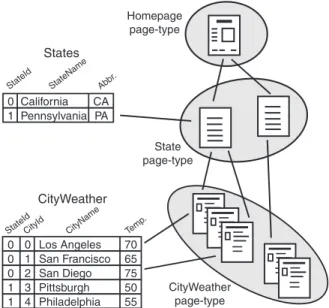
Site generation is the task of creating a web site to present data. As a concrete exam-ple, take the case of presenting weather information. We’d like to present current weather data, such as temperature, humidity, etc., for U.S. cities. A diagrammatic view of a such a site and the relation between its pages and the underlying data is shown in Figure 1.2. The weather data is best represented as a relational table “CityWeather” where the attributes are CityName, Temperature, Humidity and Wind. Generating an HTML page for a given city involves looking up the given city in CityWeather and decorating the result with ap-propriate HTML tags. We call the set of pages that are generated from individual rows of a relation table apage type.
Geographical data inherently has more structure than a flat list. Places are normally or-ganized in a hierarchical fashion, from larger regions at the top of the hierarchy to smaller ones at the bottom, with the “world” as the root of the hierarchy. As is typically done, this hierarchy can be used to organize the weather site. For example, U.S. cities can be grouped under the state in which they are in. To represent this relation, we expand the relational model as follows. The states are stored in a new table “State” with attributes StateID, StateName, and Abbrv. The city table has a new attribute StateId to link each city to its state. For example, the StateId of Pennsylvania would be stored in the rows for Pittsburgh, Philadelphia, and Harrisburg among others.
Generating HTML pages for States involves retrieving data from more than one table. The first step is to look up the given state in States and find StateID, StateName and StateAbbr. Next, the list of cities that are related to StateID are found in CityWeather. Finally, the HTML page is generated for the given state using the values found in the previous steps. The state page shows the attributes of the state and the list of cities in that state. Each city listed on a state page can also be hyper-linked to the corresponding city page. Figure 1.2 depicts the structure of the weather site and its relation to the tables in which the underlying data is stored.
California Los Angeles CityWeather States CityWeather page-type State page-type Homepage page-type San Francisco San Diego Pittsburgh Philadelphia 70 65 75 50 55 0 1 2 3 4 0 0 0 1 1 0 1 Pennsylvania CA PA
StateIdCityId CityName Temp . StateId StateName Abbr
.
Figure 1.2: Relational Model of a Web Site — Two relational tables store the data presented on this web site. Each row of the States table corresponds to a page that displays information about a particular state. Sim-ilarly, each row of the CityWeather table corresponds to a page that displays information about a particular city.
Site extraction is the inverse of site generation. Given a set of HTML pages from a web site, the problem is to discover the relational form of the data. Unfortunately, the mapping from relational data to web pages cannot be mathematically inverted in the general case because it is clearly not a one-to-one mapping.
Clearly, not all elements of the web site are in relational form. For example, parts of the HTML page are generated by a program and are not stored in relational form and there is no way to know definitively which are which ahead of time. Also, more than one model can generate the same set web site, i.e., there is not necessarily a unique solution.
1.3
Thesis Statement
The problem of data extraction from structured web sites can be solved by developing experts that encapsulate human knowledge about various types of web structure and then combining these experts while maintaining a globally consistent model of the underlying data.
The approach is applicable to web sites where some combination of surface structures represent the underlying relational structure of the data and recognizers for these surface
structures can be encoded as experts.
1.4
Roadmap
In the following chapters, we first describe the principles behind our approach. Next, we develop a basic framework for combining multiple experts, a method for evaluating it and report our results. Then, we describe a more sophisticated framework which allows proba-bilistic hypotheses. We report on our experiments with the second framework, comparing it to the first framework in the web domain. Next, we show the generality of our approach by applying it in a second domain which is different from the web domain and compare our results to another research project. Before concluding, we describe related work in several different areas of research.
Chapter 2
Approach - Principles
In this chapter, we discuss our approach of combining heterogeneous experts at a high-level. In the following chapters, we describe two concrete frameworks that follow the principles of our approach.
2.1
Motivation
To demonstrate the need for multiple experts in attacking the data extraction problem, we first try to solve it using grammar induction and demonstrate the shortcomings of relying on one particular type of structure. We pick grammar induction because it has been used for extraction from the web by other researchers (e.g., [24], [3], Page Templates in [50]) and also because it exemplifies the issues that arise from focusing on a single type of structure.
The idea behind data extraction via grammar induction is that if an appropriate gram-mar that generates a set of web pages can be found, then the symbols of the gramgram-mar can be used to label the data fields.
As an example, suppose we are extracting data from the following three pages:
p1: <h2>Los Angeles</h2><p>Temperature: 70 p2: <h2>Pittsburgh</h2><p>Temperature: 68 p3: <h1>California</h1><p>Select a City:
A grammar induction algorithm that incrementally builds a grammar from examples might first correctly induce the following grammar after observing the examples p1 and p2.
S1 -> Los Angeles | Pittsburgh S2 -> 70 | 68
This grammar already achieves the extraction goal. The data fields are identified by non-terminals S1 and S2 and the corresponding data values as “Los Angeles”, “Pitts-burgh”, “70”, and “68”. When the third page is considered, the “correct” grammar be-comes less obvious. One possible grammar is the following:
P -> T1 | T2
T1 -> <h2>S1</h2><p>Temperature: S2 S1 -> Los Angeles | Pittsburgh S2 -> 70 | 68
T2 -> <h1>California</h1><p>Select a City:
Another one is this:
P -> S1 <p> s2
S1 -> <h2>Los Angeles</h2> | <h2>Pittsburgh</h2> | <h1>California</h1> S2 -> Temperature: 70 | Temperature: 68 | Select a City:
Clearly, making the right induction decisions requires extensive use of heuristics, rang-ing from utilizrang-ing syntactic clues (e.g., not allowrang-ing HTML tags as data values or distin-guishing HTML elements h1 and h2) to understanding semantic relations (e.g., rejecting California in a rule that expands to Los Angeles and Pittsburgh or rejecting ”Select a City: ” in a rule that contains name value pairs.
Some of these heuristics can be implemented by pre-processing the input. For example, replacing names of well-known entities with their semantic classes as a pre-processing step will in general help the grammar induction algorithm. Unfortunately, some heuristics are hard to represent in this way. For example, the visual layout of a page contains useful clues about the underlying relational structure of the page in that relational tables are usually represented as lists on the page. However, it is not clear how these clues could be utilized in a grammar induction approach.
The small number of types of structure that grammar induction can use limits the types of grammars that can be practically induced. Thus, grammar induction approaches (e.g., [24], Page Templates in [50]) typically assume that the pages have been clustered according to page-type and all input comes from a single page type. This allows the grammar induction algorithm avoid having to generate “clustering” rules, such as P -> T1 | T2above. Unfortunately, correctly clustering the pages is a significant part of the site extraction problem.
A better approach to the problem of site attraction is to build a general framework that allows any number of structures to be analyzed and combined in the process of discovering the underlying structure of the data.
2.2
Structure Discovery
In this thesis, we use the termstructureto mean any type of regularity or pattern that data exhibits. There are many different languages for describing structure, some extensively studied and formalized, such as formal languages, graphs, and relations, and some ad-hoc and specific to particular problems, such as URL patterns and page layout. Our goal is to be able to combine information that is present in different types of structure to find the hidden, underlying structure of data.
In structure discovery problems, the goal is to discover the hidden structure of data from partial and potentially noisy observations. Structure discovery problems arise be-cause as structured data is transformed into observable forms, its regularity is also trans-formed. Surface structure is what remains of the underlying structure in the transformed data. Often, the surface structure appears in multiple forms because there are multiple transformations which are applied to the data and different transformations take the origi-nal regularity of data into different types of patterns.
Many AI problems can be cast as structure discovery problems. For example, com-puter vision aims to determine the hidden 3D structure of a scene from 2D observations (e.g., [42]). Some of the types of surface structure in this domain are edges, shadows, parallax effects, texture, etc. In record deduplication[79], the goal is determine sets of records that represent the same entity from the noisy attributes of the records. The hidden structure is the grouping of records and some of the common types of surface structure are acronyms and common misspellings. In protein structure prediction (e.g., [37, 52]), the goal is to find various types of structure, such as folds, from sequence data or direct physical measurements of the protein.
In structure discovery, data is assumed to have a particular type of structure. The discovery problem is then the search for a specific instance of structure within the given type of structure. For example, in our grammar induction approach above, we assume that pages are generated from a regular grammar, which is a particular type of structure. The structure discovery problem is to find the particular regular grammar that actually
generates the pages.
An important choice in solving structure discovery problems is the type of structure. Some types of structures are more general than others in that any instance of the specific structure is also an instance of the more general structure. For example, context-free gram-mars are more general than regular gramgram-mars and so any particular regular grammar is also a context-free grammar. The more general the type of structure, the more difficult structure discovery is. On the other hand, the more specific languages for describing structures may not be expressive enough to capture the underlying structure of the data.
In this work, we are mainly concerned with one particular type of structure discovery problem, namely the site extraction problem that we have introduced previously. In con-trast to some of the harder AI problems, such as natural language processing where the underlying structure of data is not only hidden but its type is an approximation of some as-yet-unknown mental structures, the underlying data in site extraction is in factstructured
in that most web sites store their data in relational databases, which are of course highly structured.
2.3
Tackling Structure Discovery Problems
One common way to attack structure discovery problems is to first pick one type of struc-ture as the underlying strucstruc-ture of data and try to find an instance of this strucstruc-ture for the given data. This is what we did earlier in the chapter when we used grammar induction to try to solve the site extraction problem.
For a given type of structure and a particular domain from which data is collected, it is usually possible to develop an algorithm, usually incorporating heuristics, to induce the particular structure of given data. For example, certain types of regular grammars can be induced by finding common substrings of samples.
The main problem with focusing on one particular type of structure is that it is difficult or impossible to pick the type of structure with the appropriate level of generality. Specific types of structures are preferable as the discovery problem is easier with more specific structures and for that structure are likely to be more accurate[78]. For example grammar induction with regular languages is easier than with context-free languages. However, the structure cannot be so specific that it is not able to represent all possible patterns in the underlying data. Unfortunately, as the type of structure is allowed be more general,
the structure discovery problem becomes more and more under-specified, as was the case in our grammar induction example, and some other heuristics of choosing an “optimal” structure is needed.
Alternatively, the specific type of structure can be extended to be more general, for example allowing certain types of context-free productions in a regular language. Unfor-tunately, such extensions require ad-hoc heuristics which require an ad-hoc patch to the heuristic induction algorithm and doing this becomes increasingly difficult as the number of extensions increases.
In this thesis, we propose a new approach to tackle structure discovery problems. In our approach, instead of picking a particular type of structure into which we fit the data, we look for many different types of specific structure in the data and then combine the information we have gained in the process in a more general structure.
An intuitive way to handle multiple types of specific structure is to develop an expert for each type of specific structure. Each expert is then responsible for finding particu-lar types of structure in the observed data and relating this structure to the more general structure.
For example, in the computer vision domain, a “boundary” expert can detect bound-aries which separate pixels that are formed by separate objects in the actual scene and relate this information into objects in 3D. Detecting boundaries requires interpreting the brightness, color and texture variations in an image (e.g., [54]). The complexity of under-standing a particular type of clue, such as boundaries, is captured by an expert.
2.3.1
Multiple Heterogeneous Experts
Building experts which deal with arbitrary types of surface structure naturally leads to a heterogeneous collection of experts. This is because as we discussed earlier, each type of structure has an associated algorithm that induces the particular structure from the data. These algorithms typically are highly-specific to the types of structures that they are work-ing on and thus heterogeneous. For example, in the site extraction domain, one expert might search for simple regular grammar patterns in data fields whereas another expert might search layout patterns on pages. These experts are heterogeneous in that not only do they use different characteristics of the data, but the patterns they find are in a sense in different languages.
structure, it introduces a new challenge: If the experts are all working independently and finding arbitrary types of patterns, then combining these patterns becomes non-trivial. For example, if the regular grammar expert above finds particular grammar rules and a set of values generated by these rules, whereas the layout expert finds DOM elements that are arranged in a column, it is not clear how these patterns can be combined so that more of the underlying structure is revealed.
To solve the problem of combining the outputs of heterogeneous experts, we introduce a common language in which each expert can express its patterns. Experts are still allowed to have heterogeneous views of the problem but output their hypotheses in a language that is globally known. In the following chapters, we experiment with two languages. The first language allows the experts to output their hypotheses in terms of primitive statements. The second language extends the first by allowing the experts to assign confidence scores to these statements.
2.3.2
Combining Heterogeneous Experts
As mentioned earlier, surface structure arises when the underlying structured data is trans-formed into observable forms. Multiple transformations take the underlying structure into multiple types of surface structure. This process clearly implies a dependence of sur-face structures on the underlying structure. The dependence between multiple sursur-face structures and the underlying structure, when combined with the independence of trans-formations, lead to an interesting and useful property: Even though from a single surface structure, many different but equally valid underlying structures can be induced, the num-ber of valid structures shrinks rapidly when multiple surface structures are taken into ac-count. In other words, maintaining consistency across multiple surface structures allows the hypotheses to be pruned to a degree that is not possible with individual experts.
This is best demonstrated with an example: Suppose on a web site, a product page mentions the price of the product and the shipping cost. A “price” expert that interprets a currency symbol followed by a decimal number will interpret both the price of the product and the shipping cost as valid prices. Assuming each product page has exactly one value for price, this expert leads to two plausible interpretations for each page: one where the product price is correctly identified and one where the shipping cost is incorrectly iden-tified as the price. Now, suppose we add a second expert that understands that the range of prices are much larger than the range of shipping costs. This expert will be able to
eliminate the second interpretation on pages where the shipping cost is relatively small to the price of the product. There is still a problem, though, because if the product price is within the same range as the shipping cost, the second expert cannot help. Next, suppose we add a third expert that understands that a single site normally lists costs in the same or-der (e.g., product price comes before shipping cost) on all product pages. The third expert will be able to eliminate the remaining incorrect interpretations by taking into account the interpretations of the second expert on pages where product price and shipping cost are more easily identified.
2.3.3
Experts vs. Complex Models
Experts encode and encapsulate domain knowledge about the relation between underlying structure of the data and its surface structure. An alternative approach to solving structure discovery problems is to use “simple” features and induce the relation between underlying and surface structures as part of the discovery process.
As a concrete example, let’s consider taking advantage of page layout in discovering the relational structure of data on a web page, while using simple features. Our goal is to learn from training data the statement that data from a relational column is typically displayed so that data elements line up on a vertical line. To represent page layout, we use as features thexandycoordinates of data elements on the screen. The induction step then is responsible for learning the concept of alignment in terms ofxandycoordinates, perhaps by searching through a space of equality constraints on coordinates. This is where model complexity arises: having simple features necessitates having a space of models where complex relations between simple features can be expressed.
Compare the approach above to the one using “experts”. If it is known that alignment on the screen is a possible indicator of underlying relational structure, it can directly be represented as a “rich” feature (perhaps, as a boolean feature among pairs of data ele-ments). This simplifies the induction step greatly because the model no longer needs to represent complex concepts that involvexandycoordinates.
In general, there is an inverse relation between rich features and complex models: Richer features require simpler models whereas complex models can utilize simpler fea-tures. The question then is whether it is better to solve a given structure discovery problem using “experts” and a simpler model or using simple features and a more complex model. In making this decision, various trade-offs need to be taken into account. In particular,
richer features by definition restrict the system to consider only the concepts that are al-ready represented by features, whereas complex models tend to be more general in the concepts that they can induce. With this in mind, we can describe a key characteristic of structure discovery problems which are suited to expert based approaches: A structure discovery problem is a good candidate for an expert based approach if the set of transfor-mations that map the underlying structure into the observed structure are well-known and each transformation can be defined independent of each other.
The web site extraction problem exhibits the characteristic above. First, the set of transformations that map the underlying structure to the surface structure are well-known (e.g., use of HTML templates to generate pages from relational tuples, use of links to con-nect pages for related tuples, laying out pages so that relational tables are displayed as tables, and so on). Second, individual transformations are independent (e.g., links are in-dependent of layout and inin-dependent of tables). Contrast this to a domain, such as protein structure discovery, where a complex model might be more suitable. In such domains, the underlying structure and the observed structure are interlinked through as-yet unknown or only partially known relations. Thus, these relations are difficult or impossible to encode as experts and approaches based on complex model are more suitable than expert based approaches.
2.4
Summary
In this chapter, we described the main principles of this thesis. In particular, we discussed structure discovery problems in general and why these problems are best attacked with a set of heterogeneous experts. In the following chapters, we describe two frameworks we build on these principles.
Chapter 3
C
HEX
: Clustering with Heterogeneous
Experts
3.1
Overview
In this chapter, we focus on developing a basic probabilistic framework in which hypothe-ses from heterogeneous experts are combined. We develop the framework for tackling a specific data extraction problem, which we call site extraction: Extract all data that is available on a given set of pages from a web site.
We start with a set of pages and the links between them, which we collect by spidering. For example, for an online bookstore, the set of pages would includelist pagesthat present lists of books grouped under various categories anddetail pagesthat contain information about individual books, such as titles, author names, ISBNs, reviews, etc.
We assume the sites we are extracting data from are generated from relational tables. This assumption is not limiting for two reasons: First, a large percentage of web sites are in fact generated from data that is stored in relational tables. This is because relational databases have become the norm for storing and querying collections of data since their introduction around 1970[15]. Second, web sites that are not generated from relational tables can sometimes be interpreted as if they are generated from relational tables.
Our goal is to find clusters of data such that each cluster corresponds to a column of one of the relational tables. On an online bookstore, we expect to find, among many others, a cluster of ISBNs, as ISBNs are commonly used to identify books.
even well-defined. Our goal is to find some relational representation such that further processing of data becomes much simpler. This is similar to the goal of clustering in general, which is to aid analysis of large amounts of data. Further processing might involve other automated processes (such as labeling columns) or human input (selecting relevant columns of data for the task at hand).
In finding the relational representation of a web site, there are three stages of pro-cessing. In the first stage, experts analyze the set of pages and links, and output a set of hypotheses about the structure of the underlying data. In the second stage, clusters of data that is marginally consistent with respect to the hypotheses is found. In the third stage, the clusters are converted to relational form.
In the following sections, we will define the expert framework, the hypotheses lan-guage, what it means for a clustering to be optimal with respect to a set of hypotheses, and our approach for searching optimal clusterings. We will also describe the experts we use in detail and our method for converting clusters to relations.
3.2
Expert Framework
In many machine learning algorithms, samples are represented by their “features”[27]. For example, in clustering points on a 2-dimensional space, each point sample has two features, its x-coordinate and y-coordinate. In a document classification problem, one way to represent documents is by turning each possible word into a binary feature such that the value of the feature is 1 when the document contains the word and 0 otherwise.
Features simplify the learning problem by reducing it to one that is on features rather than the potentially more complex samples. In particular, each feature is typically a func-tion of the sample. Given a sample, the value of a particular feature can be computed in isolation from the rest of the samples.
For the structure-induction task, the reduction to feature-space is sometimes too much of a simplification and makes the learning task too hard. In particular, some of the relations between features are lost. One way of recovering some of these lost dependencies is by post-processing the features, such as normalizing feature values or selecting important features.
As in learning algorithms, clustering can be hindered when samples are mapped into feature-space. This is especially the case because most clustering algorithms rely on the
notion of distance between samples[27] and some distance metrics in the sample-space cannot be represented as a distance metric in the feature-space. Consider clustering strings such that words that have similar spellings are clustered together (e.g., in building a spell checking application). String-edit distance would be a useful measure for this problem, but it can only be computed on pairs of strings directly and not on simpler features of the string.
Within the clustering domain, one way to improve the expressivity of features is to define features on pairs of samples rather than individual samples. This leads to pairwise-clustering (e.g., [40]) which allows metrics such as the string-edit distance to be computed as a feature as in [25].
The generalization of features from the domain of individual samples to pairs of sam-ples can be taken further and leads to the concept of experts. Whereas features are usually simple functions that map one or two samples into feature values, experts are arbitrarily complex processes, which may refer to domain knowledge, or analyze the problem glob-ally, before outputting their decisions.
Note that in defining the output of experts, we restricted the hypotheses to those that can be computed given a single element of the solution space. Clearly, the range of all possible hypotheses is much larger. As a simple example, consider an expert that generates the hypothesis that a particular problem instance has a unique solution. Such a hypothesis cannot be verified for individual elements of the solution space.
The elements of the solution space havestructurein that hypotheses can be evaluated within the context of each. Contrast this to a non-structured space where the elements are atomic. In a non-structured space, the only possible type of hypothesis is whether the element is a solution or not. The space of clusterings is an example of a structured space in that many hypothesis can be stated and tested within a given clustering, e.g., “element e1ande2 are in the same cluster”, “number of clusters is at least 3”.
An important observation is that the set of hypotheses output by an expert define a subset of the solution space where within each element of this subset all the hypotheses are true. If this subset contains more than one solution, then the expert has not been able to determine a unique solution. If the subset is empty, then the hypotheses output by the expert is inconsistent in that there are no solutions in which all the hypotheses can be satisfied.
The above observation leads to a straightforward, albeit fragile, framework for com-bining experts: The set of solutions is the intersection of all the subsets defined by the
hypothesis sets. Alternatively, the set of solutions is the subset where the hypotheses from all the experts are true.
The problem with this approach is that in practice the hypotheses from multiple experts is likely to be inconsistent even if each expert generates self-consistent sets of hypotheses. In particular, any hypothesis that is incorrect (i.e., false in solutions) will make the set of hypotheses inconsistent if the remaining hypotheses are all true only in the solution set. Thus, this type of approach is highly sensitive to any incorrect hypotheses generated by the experts and will fail to find solutions unless the experts generate only correct hypotheses.
An interesting case where an expert generates inconsistent hypotheses is when the ex-pert works on parts of a solution without considering the global consistency of the solution. For example, in the crossword domain, an expert that works on individual clues can easily generate hypotheses that when applied within the constraints of the grid are inconsistent. If one expert requires across to be either “LET” or “NET” and another expert requires 5-down to be “RAIL” or “SAIL”, clearly there are solutions in which both sets of hypotheses can be satisfied.
As an alternative and more robust approach, we define a probabilistic model of the process of hypothesis generation so that for a given element in the solution space, each hypothesis is assigned a probability. This allows us to search for solutions such that the probability of the set of hypotheses generated by the experts is maximized. Note that un-like the first framework we described where the set of hypotheses partitions the space into solutions and non-solutions, the probabilistic approach orders its elements such that all are candidate solutions, but some are more likely to have generated the observed set of hy-potheses. This is true even when the hypotheses may be inconsistent. Before we describe the probabilistic model in detail, let us first define the particular hypothesis language we will use for clustering.
3.3
Hypothesis Language
We have already restricted the scope of hypotheses by requiring each to be testable given any element of the solution space. Additionally, we desire the language to have the fol-lowing properties:
• It should be expressive enough for arbitrary experts to output their hypotheses.
effectively.
In the clustering domain, this is achievable even by allowing only one type of hypothesis: one which states that a particular pair of samples is in the same cluster. We call such a hypothesis ahint.
Using this language, experts that evaluate pairs of samples can directly output their hypotheses as hints. Such experts typically evaluate the similarity of two samples and if that similarity is above some threshold, hypothesize that the pair is in the same cluster.
More complex hypotheses are expressible, too. For example, an expert that finds clus-ters of samples outputs a hint for each pair of samples that is in the same cluster.
3.4
Probabilistic Model
Our ultimate goal is to find the most likely clustering given the set of hypotheses generated by the experts. We do this by defining a probabilistic process of hint generation.
Probabilistic approaches to document clustering are not new. The goal in document clustering in general is to find clusters of documents that are within the same topic. In the typical approach, each document is represented by a vector of word counts, normalized by one of a variety of methods, such as TF-IDF[64]. The probabilistic approaches model the distribution of these vectors. A common approach to do this is to model the distribution of words as a mixture model. In a mixture model, the word distribution is modeled as a mixture of distributions that are conditioned on particular topics. The model can be used for classification when topics and the parameters of the model are known or computed beforehand[56]. The model can also be used for clustering by applying statistical inference techniques such as EM to find locally optimal assignments to the unknown parameters from observed data[6, 39].
The main focus of document clustering research is to find probabilistic models that better fit data and to develop methods to estimate unknown parameters of these models accurately and efficiently. For example, [1] improves on the bag-of-word representation by using distributions that better model the dependence between multiple occurrences of a word within a document. In contrast to the focus of this type of research, our focus is making use of knowledge encoded within sophisticated experts and not on the probabilistic model. Thus, we use a simple probabilistic model which serves to combine the output of experts in a principled framework. We empirically assign values to the parameters of the
model and leave as future work inferring these from observed data.
To find the most likely clustering given the set of hypotheses generated by the experts, we need to compute P(C|H)where whereH is the set of hypotheses andC is the clus-tering. We follow the usual approach of using the Bayes rule to expand this probability as follows:
P(C|H) = P(H|C)P(C)
P(H)
. We assume that the prior distributionP(C)is a discrete uniform distribution, i.e.,P(C =
ci) =kfor all clusteringsciand for some constantk. Combining this assumption with the
observation that P(H) is a constant for a given set of hypotheses, finding the clustering that maximizesP(C|H)is equivalent to finding the clustering that maximizesP(H|C).
Like in naive Bayes classification, we then make an independence assumption, namely we assume that each hypothesis is independent of other hypotheses given the clustering. This leads to the following expansion:
P(H|C) = P(h1|C)P(h2|C)P(h3|C)...P(hn|C)
wherehiis inH.
The next step is to defineP(h|C)wherehis a single hypothesis, in other words a hint. We do this by defining a stochastic process of hint generation. This process has two steps:
1. Pick a cluster at random from C. The probability of picking a particular cluster is
1/NC whereNC is the number of clusters. Call the selected clusterc0.
2. Pick a pair of elements fromc0 at random. The probability of picking a particular
pair is1/NP whereNP is the number of distinct pairs inc0. Call the selected pairh.
Thus, the probability of generating h from C, P(h|C), is 1/NC ×1/NP where NC
is the total number of clusters in C and NP is the number of pairs in the cluster which
contains the pair of samples of the hypothesish.
The following table shows the probability of generating the hypothesis that the ele-ments A and B are in the same cluster for all the possible clusterings of three eleele-ments A, B, and C. Given only one hypothesis that A and B are in the same cluster, the most likely clustering based on the above process is AB,C. When the number of samples to be clustered is large, the number of clusterings is too large to be enumerated. Thus, an ap-proximate search approach is necessary. In the next section, we describe how we search for the most likely clustering using the leader-follower algorithm[27].
Clustering P(hA,B)|C) ABC 1/1×1/3 = 1/3 AB,C 1/2×1/1 = 1/2 AC,B 0 BC,A 0 A,B,C 0
The process assigns a probability of zero to hints that are inconsistent with respect to a given clustering. A hint is inconsistent with a given clustering if the pair of samples is not in the same cluster. The process described above has no way to generate such inconsistent hints. This implies that when any hint in the set of hypotheses is inconsistent with a clustering, the overall probability of the clustering is 0. Thus, when the set of hypotheses is inconsistent, i.e., there is no clustering such that all hypotheses can be satisfied, then this probabilistic model cannot pick a clustering that is “most consistent” with the hypotheses as it assigns a zero probability to all clusterings.
We extend the model by incorporating a simple model of noise. To do this, we add a new way of generating hints that is independent of the given clustering. The new way of generating hints simply picks a pair of samples uniformly from all possible pairs, and so allows all pairs to be generated as “noise” with some probability. We then extend the overall process so that it either uses the normal steps of generating hints or the steps to model noisy generation. The latter set of steps is followed with some small probability. The new process has the following steps:
1. Pick whether the hint will be generated using the noise model or the basic model as above.
2. If the hint will be generated using the noise model, pick a pair uniformly among all sample pairs. The probability of picking a particular pair is1/NP whereNP is the
number of all sample pairs. 3. Otherwise:
(a) Pick a cluster at random. The probability of picking a particular cluster is
1/NC whereNC is the number of clusters. Call the selected clusterc0.
(b) Pick a pair of elements from c0 at random. The probability of picking a
par-ticular pair is1/Nc0 whereNc0 is the number of distinct pairs inc0. Call the
In the new process, the probability of a hint given a clustering comes from two factors: a small contribution from noisy generation and a large contribution from normal gener-ation. For hints that are inconsistent with the current clustering, the factor from normal generation is zero, but there is still a non-zero contribution from noisy generation. This allows the model to assign non-zero probabilities to all clusterings even when some hy-potheses are inconsistent. The inconsistent hyhy-potheses simply reduce the probability of a clustering.
3.5
Clustering
After the hypotheses are gathered from the experts, the next step is to find the most likely clustering. The number of clusterings is at least exponentially large in the number of samples1, so a linear search through all clusterings is not possible. Instead, we use the
leader-follower algorithm, a standard clustering algorithm[27] which runs in linear time in the number of samples.
The leader-follower algorithm considers each sample in turn. The first sample is placed in a cluster of its own. Then, for each sample, the nearest existing cluster is located. If the distance to this nearest cluster is below some threshold, the sample is added to that cluster. Otherwise, the sample starts a new cluster.
Compared to some other methods such as the agglomerative clustering algorithms which run in quadratic time, the leader-follower algorithm is fast but makes decisions given very limited knowledge especially at early stages where it has seen only a few of the samples. In the approach described in this chapter, we utilize the leader-follower algo-rithm, but other approaches are certainly possible. In later chapters, we experiment with more sophisticated clustering algorithms.
The “distance” between a sample and a cluster is the change in probability of the set of hints between the current clustering and the clustering when the sample is added to the given cluster. As the leader-follower algorithm builds the clusters, the clustering is only partial, i.e., the unseen samples have not been assigned to any clusters. The probabilistic model cannot assign probabilities to hints that refer to yet unseen samples, so during the
1The number of clusterings for a sample set of sizenis given byBell numbers[63] which satisfy the
recurrenceBn+1=P n k=0 n k
Bk[53]. From the recurrence, it follows thatBn+1 > nn−1
Bn−1=nBn−1.
Thus, increasing the size of a sample set of sizen−1by 2 samples increases the number of partitions by at least a factor ofn. This means the number of partitions is at least exponential in the size of the sample set.
clustering process, we only calculate properties for hints that refer to the currently clus-tered samples. To determine the change in probability, we consider the clustering where the new sample is in a new cluster of its own and evaluate the change when the sample is added to one of the existing clusters.
distance(s, c) = P(H|Cs)−P(H|Cm)
where s is a sample, Cm is the current clustering but with s added as a new singleton
cluster,cis a cluster in current clustering, and Cm is the new clustering afters has been
merged intoc. Note that the change in probability is not a “distance” in the formal sense. Whereas distance metrics are non-negative and satisfy the triangle inequality, the change in probability can be negative and does not satisfy the triangle inequality. However, it is still able to serve as a distance measure within the context of the leader-follower algorithm, which only depends on the distance score to make local decisions. In particular, the leader-follower algorithm uses this score to choose which cluster to assign a given sample by comparing the scores for different clusters while holding the sample constant. This process makes no assumptions about the distance measure.
Adding a sample to an existing cluster affects the overall probability in two ways: First, any hints between the current sample and the samples in the cluster are assigned higher probabilities as the generation process for those hints switches from noisy (step 2) to normal (step 3). Second, the hints between samples in the cluster are assigned smaller probabilities as the number of potential sample pairs increases (step 3b).
Other standard algorithms can also be applied to the clustering problem we have de-fined. Here we chose the leader-follower algorithm for its simplicity as we focus on com-bining heterogeneous experts that share a common language. Once the clusters are estab-lished, the leader-follower algorithm is optimal in the sense that its decision is based only on the similarity of the existing clusters to the next sample. However, this also makes it sensitive to the ordering of the samples. As an example, suppose the algorithm first sees samples0 which becomes the first cluster. When it processes the next samples1, the
deci-sion to places1 into the first cluster is based only on the similarity ofs0ands1. Ifs0and
s1 are not similar, then s1 is put in a new cluster. Suppose now s0 ands1 are processed
after some clusters have been established ands0is put in clusterc0. It may well be the case
thats1is still placed inc0. This is because even thoughs0 ands1are not similar, they may
be considered similar when their neighbors inc0 are taken into account. To address this
clustering[27].
3.6
Finding Data Clusters
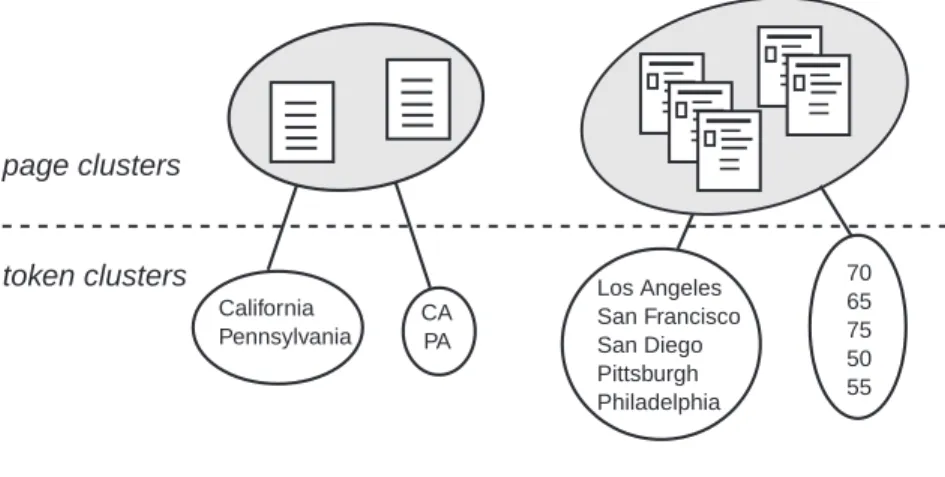
Our main goal is to cluster tokens such that each cluster corresponds to one column of a relational table. In doing this, it is also convenient to cluster the pages themselves, in order to identify page types. Thus, we have both page clusters and token clusters with the fol-lowing relation between page clusters and token clusters: Each page cluster is associated with one or more token clusters, such that the tokens of any page within the page cluster are all contained in the token clusters associated with that page cluster. More formally, we letchild(cp)be the set of token clusters associated with page clustercp such that ift is a
token on pagepandp∈cp, then there is a token clusterct∈child(cp).
For example, suppose we are working on the weather site which contains a home page listing all the states, state pages listing all the cities in that state, and weather condition pages that display the current conditions in a particular city. When we find the page clus-ters for this site, if the clustering matches our natural grouping, we would expect to end up with three clusters: one for weather condition pages, one for the state pages, and one containing just the home page. The token clusters for the weather condition page cluster might include a cluster for city names, another for low temperatures, and another for high temperatures. In Figure 3.1, two page clusters and the four token clusters that they are associated with are shown.
In the previous sections, we described the probabilistic framework in which we eval-uate the clusterings. In those sections, we assumed there was one set of samples and one set of hints. Since now we are clustering both pages and tokens we need to extend the framework. To do this we consider the sub-problems independently.