Number WP 03-9
It Takes More than a
Bubble to Become Japan
Adam S. Posen
October 2003
-Copyright © 2003 by the Institute for International Economics. All rights reserved. No part of this working paper may be reproduced or utilized in any form or by any means,
electronic or mechanical, including photocopying, recording, or by information storage or retrieval system, without permission from the Institute.
IT TAKES MORE THAN A BUBBLE
TO BECOME JAPAN
Adam S. Posen
Senior Fellow
Institute for International Economics
Abstract
Did monetary easing in the 1980s cause Japan’s bubble, as is often suggested? Drawing on both a new cross-national consideration of the monetary policy–asset price linkage and a reexamination of what actually occurred in Japan during 1985–90, I conclude that the bubble was just as likely to occur, whatever monetary policy within reason would have done. Did the bubble’s bursting cause Japan’s Great Recession?
In fact, Japan’s recession of 1990–94 was mild, and only a combination of policy mistakes turned this normal recession into extended stagnation. This is borne out by cross-national investigation suggesting that
the frequency of extended downturns following asset booms is relatively low. Comparing the post-bubble response of the US and Japanese economies, did the bubble itself impede restructuring? Given very different responses in the two economies to similar bubbles, a bubble itself is not sufficient to cause
real-side disruption. Central bankers should learn from Japan’s bubble the benefits of a more thoughtful approach to assessing potential growth and of easing rapidly in the face of asset price declines and not be
concerned with targeting asset prices or pricking bubbles per se.
Author’s note: I am extremely grateful to Samantha Davis for outstanding research assistance, and to Nobuyuki Asai, Kenneth Kuttner, Mikihiro Matsuoka, Tomoyuki Ohta, Stefano Scarpetta,
Charles Steindel, Tadao Yanase, Kazuhiko Yano, and especially Arthur Alexander, Tetsuro Sugiura, and Cameron Umetsu, for timely and thoughtful advice. Gordon de Brouwer, my discussant, and participants in the 2003 RBA Conference on Asset Prices and Monetary Policy provided helpful comments. All opinions and errors in this document are solely my own.
This research is part of my project on deflation for the Institute for International Economics. I may be reached at [email protected].
JEL codes: E31, E44, E58, G18
Japan’s extended economic stagnation since its stock market peaked on December 29, 1989, has prompted a series of investigations, recommendations, and self-examinations, both in Japan and abroad. For monetary policy, two aspects of the situation have attracted particular attention. One is the ability or inability of a central bank to successfully raise the price level and inflation expectations when the nominal interest rate is at zero and the banking system is reluctant to lend. The other is the appropriate response of a central bank to an asset price bubble: whether the central bank can or should try to “prick” such a bubble when it is expanding, and how the central bank should cope with the economic aftermath of such a bubble bursting. This paper will consider the latter set of issues as raised by the Japanese bubble.1
The topic is of more than retrospective or theoretical concern. As figure 1 plotting the time path of the Japanese Nikkei and US S&P 500 stock averages relative to peak shows, in recent years the American equity market had just about an identical boom, and so far a slightly milder bust, to that of the Japanese market—and the Japanese and American real estate markets both followed similar paths at about a two-year lag to stocks (figure 2). These are hardly the only examples. A series of applied research studies done at international financial institutions have shown that there have been a great number of asset price booms and busts, if not definitively bubbles, and these are often associated with negative economic outcomes.2 Small wonder that, in the wake of the IT and telecoms boom, many countries today are asking themselves, “Who will the next Japan be?”3
The main argument of this paper is that it takes more than a bubble to become Japan. While asset price booms and even busts are not uncommon, Japan’s Great Recession is, and it was not the bubble and its bursting that produced this outcome. That point may not be especially controversial to those well familiar with Japan’s plight. The loud concern expressed in influential parts of both the press and the official sector with regards to the implications of the US asset price boom (for example, in editorials of TheEconomist and the Financial Times), however, seems to say that the destiny of any bubble economy is an extended recession. Some Japanese politicians and pundits have seized upon the postcrash downturn in the US economy to get their own back for the years of unremitting lecturing by their American counterparts about economic policy; they
1
My take on the first set of questions, regarding monetary stimulus at the zero-bound in Japan and elsewhere, is given in Posen (2000b), Posen (2003c), and Kuttner and Posen (2001b).
2
See, inter alia, Bordo and Jeanne (2002), Borio and Lowe (2001), and IMF (2000). 3
As I point out in Posen (2003a, 2003b), this is a particularly pointed question for Germany. A plot of the German DAX index would be much the same except even steeper, and Germany shares many, though not all, aspects of Japan’s political economy.
suggest that the criticisms of Japanese policy were, if not unfounded, at least coming home to roost. All these participants in the discussion would lay the responsibility for this destiny of recession at the failure of the central banks involved to take action against the rise of bubbles.
These concerns and comments while understandable are not supported by study of the Japanese case. Monetary policy clearly was (and remains) a contributing factor to Japan’s stagnation, but it was not disregard of asset prices either on their way up or of their effects on their way down which produced this outcome. Spirited academic debates about whether central banks should directly target asset prices, either as part of an inflation-targeting framework or not, need a different case on which to hook their analyses.4 As I will argue, the Bank of Japan (BOJ) should have been able to tighten policy more quickly in the late 1980s and loosen policy more quickly in the early 1990s without any particular reference to asset price movements—and in any event, monetary policy might well have been unable to stop those movements. Negative
developments in the Japanese economy after the bubble were hardly driven by the fall in asset values, but rather by other problems in the Japanese economy (including overly tight monetary policy itself). Comparative analysis broadly of other recent cases of asset price booms, and, in more depth, of parallel developments in the United States (relative to its asset price peak), support my conclusion that a primary concern for monetary policy should be how to encourage
restructuring in the aftermath of a boom, not the boom itself.
This paper comprises five sections. First, it considers whether monetary ease in the 1980s caused Japan’s bubble, as is often suggested. I conclude that the bubble was just as likely to occur whatever monetary policy within reason would have done, drawing on both a new cross-national consideration of the monetary policy–asset price linkage and a reexamination of what actually occurred in Japan during 1985–90. Second, it asks whether the bubble’s bursting caused Japan’s Great Recession. In fact, I argue, Japan’s recession of 1990–94 was far milder than is commonly recognized and easily explicable by factors outside of the asset price decline—only a combination of policy mistakes turned this normal recession into the extended stagnation we now fear, and thereby gave time for the asset price declines to have large real effects. This is borne out by cross-national investigation suggesting the frequency of extended downturns following asset booms is relatively low.
Third, the paper compares the postbubble response of the US and Japanese economies to ask whether the bubble itself impeded restructuring. The data paint a picture of very different
4
Examples of this literature include Bernanke (2000) and Greenspan (2002) against targeting asset prices, and Blanchard (2000) and Miller, Weller, and Zhang (2002) in favor of central banks directly responding, with many essays in Hunter et al. (2003) taking one or the other side.
responses in the two economies, suggesting that the bubble itself is not a sufficient cause of real-side disruption. Fourth, it looks at whether monetary policy in Japan could have encouraged restructuring. I find some evidence in support of the view that part of the reason for the difference in adjustment between the United States and Japan is attributable to differences in monetary response. Finally, I set out what central bankers should learn from Japan’s bubble, emphasizing the benefits of a more thoughtful approach to assessing potential growth and of easing rapidly in the face of asset price declines.
DID MONETARY LAXITY IN JAPAN CAUSE THE BUBBLE?
As noted, the belief is widespread that excessive laxity of Japanese monetary policy in 1986–89 caused the bubble in Japanese equity and real estate prices.5 Bank of Japan (BOJ) officials for the last 13 years have bemoaned this fact, vowing not to repeat the mistake (e.g., Hayami 2000a and 2000b, Yamaguchi 1999). Outside observers of a more monetarist bent have largely agreed with this lesson, thanking their central bankers for being able to resist pressures for undue ease (e.g., Siebert 2000). And both academics and market pundits have chimed in as well, attributing the bubble to BOJ inaction (e.g., Jinushi et al. 2000, Nakamae 2000 and 2001). For some, the message is a reaffirmation of the importance of central bank independence, since the BOJ is thought to have succumbed to pressure from the Ministry of Finance (MOF) for ease;6 for others the lesson is that central banks should take asset prices into account when setting policy. Either way, according to this common view, the bubble arose, or at least grew large, because of excessive liquidity.
This claim that monetary policy caused Japan’s bubble, however, should not be taken for granted. We need to decide whether excessive monetary ease was a sufficient condition for the Japanese bubble (“if there is a sustained monetary ease, then a bubble occurs”), a necessary condition for the Japanese bubble (“if a bubble occurs, then there must have been prior monetary
5
In general, the academic finance literature dwells on whether bubbles actually can exist, whether any given bubble is rational, and so on. In contrast, the policy and descriptive literature on Japan in the late 1980s refers to the period as “The Bubble Economy,” and even academic treatments claiming the Japanese asset price booms were bubbles are common. For purposes of this paper, the Japanese asset price boom will be referred to as a bubble, but other countries’ experiences will be called asset price booms without
claiming to justify characterizing them as bubbles. 6
And, in this view, the MOF itself was easing due to pressure from the US government (see discussion below).
ease”), or both. The theoretical foundation for such claims turn out to be little more than ones of coincident timing—in Japan in the second-half of the 1980s, money supply was growing, velocity was declining, and no increase showed up in wholesale or consumer prices, so the
contemporaneous growth in real estate and equity prices must have been the result of this liquidity increase. Yet, this is a rather tenuous link to make. As Japan itself has demonstrated in the last few years, one can have all these conditions present (expanding money supply, declining velocity, no effect on the price level) and still see no increasing trend in asset prices. Without some forward-looking expectations on the part of investors that returns will be rising relative to base interest rates, that profits will be growing, there will be no buying of real estate or equities.
For monetary policy to be the source of a bubble, the relative price of one part of the economy (here financial and real estate assets) has to be pumped up by a blunt instrument that usually affects all prices in the economy.7 And it has to do so in such a way that the relative price shift either does not raise expectations of a countervailing shift in monetary policy in the near future (which relies on strange notions of what the imputed future income from increasing land and stock prices will generate), or is expected to only be affected by monetary policy on the upside but not on the down (which there is no reason to believe, if liquidity is the source of the relative price shift in the first place). Either way, this has to take place when we know both analytically and empirically that the relationship between a policy of low interest rates or high money growth and equity or real estate prices is actually indeterminate over time.8 Of course, one can resolve this logical tension by positing that the investors have unrealistic expectations about monetary policy. Okina and Shiratsuka (2003) and Shiratsuka (1999) do so, for example, by characterizing with some justification Japanese investors in the bubble years as believing unduly in low interest rates over a decade or longer horizon. Then, however, it is the expectations of investors, which are driving the asset price process, not the actions of monetary policy. In that case, any monetary policy short of starving the economy of credit could give rise to a boom, and a boom can arise even without excessive ease.
Before evaluating with respect to the Japanese case the merits of this claim versus the more common assumption that monetary laxity causes booms, it is worth pointing out that neither claim has been established with respect to bubbles or asset price booms in general. If this
supposed causal link between monetary laxity and the Japanese bubble is not as apparent in other
7
This point is made in Kashyap (2000) and Goodfriend (2003), among other places. 8
For example, as Hutchison (1994) points out using Japanese data, a drop in interest rates today might drive up housing prices in the short-term by making them more affordable, but in the medium-term tends to
known cases of asset price booms, then there clearly is more at work in the Japanese case than just monetary ease. To examine this question, we take a list of asset price booms in the OECD economies and match them up with a new dataset created to offer simple indicators of loose monetary conditions. Thus, the approach is pseudo-epidemiological, generating a list of cases that satisfy one, both, or neither condition at the same time. First the hypothesis, “if there is sustained monetary easing, then an asset price boom appears,” is examined, then the converse, “if a boom appears, then there was prior ease.”
The list of asset price booms is taken from Bordo and Jeanne (2002), who identify them when the three-year moving average of the growth rate in the asset price under scrutiny falls outside a confidence interval of long-run historical average growth rate plus a multiple of the average volatility of all asset price growth rates in the sample.9 Looking at 15 countries (including Japan) over 1970–2000 for industrial share prices and 1970–98 for residential property prices, they identify 18 booms in property prices and 24 in share prices (appendix table 1). For our purposes, this generates a list of booms independent of our markers of monetary ease and, in the next section, of deflation.
Identifying periods of monetary ease would appear to be much harder. As the ample monetary economics literature demonstrates, estimating the effect of monetary policy on the economy at a given moment, or assessing whether or not interest rates should be raised or lowered (given some welfare function) is contentious. It is clearly beyond the scope of this paper to generate country- and period-specific assessments of the relative looseness of monetary policy to go with the list of observed booms. For the purposes of examining the link between monetary ease and booms, however, a simple approach seems justified. In the discussion of monetary policy with respect to perceived bubbles, particularly but not just with regard to Japan, there is usually the sense that it took significant sustained ease to cause the bubble—booms do not seem to pop up frequently enough to be associated with minor mistakes of overly easy monetary policy. In particular, bubbles are usually thought to be associated with long credit booms (Borio and Lowe 2002). If either short periods of monetary ease or small degrees of ease are enough to generate or support booms on their own, that would seem to imply either that booms should be even more frequent than they are or that the link between ease and booms is indeed rather tenuous.
drive prices down because it portends a monetary tightening or slower growth. Aggregate supply factors tend to dominate monetary factors as consistent determinants of land prices.
9
The threshold is defined in their paper by 1.3 times the average standard deviation. They choose this threshold to identify the obvious booms without catching too many. See Bordo and Jeanne (2002).
So for our investigations we utilize two broadly applicable measures of monetary ease: first, whether the central bank’s real overnight or instrument interest rate is less than 1 percent for a sustained period; second, whether growth in a credit aggregate greatly exceeds the aggregate’s average growth rate for a sustained period. The second criterion uses a threshold of whether M3 (or appropriate broad money measure by country) growth, Q4/Q4, exceeds the average rate by one standard deviation of that aggregate’s growth rate.10 The idea is that for any functioning economy with real returns, a 1 percent-or-less real interest rate must be considered loose (versus any reasonable estimate of the natural rate of interest), whereas for any given country the baseline for credit growth has to be country-specific reflecting local credit markets, velocity trends, etc. A sustained period of ease is defined as two or more quarters in a row exceeding the M3 growth, or below the real overnight rate, threshold.11 Again, the idea is to create a list of periods of monetary ease of sufficient heft to be potential causes for asset price booms.
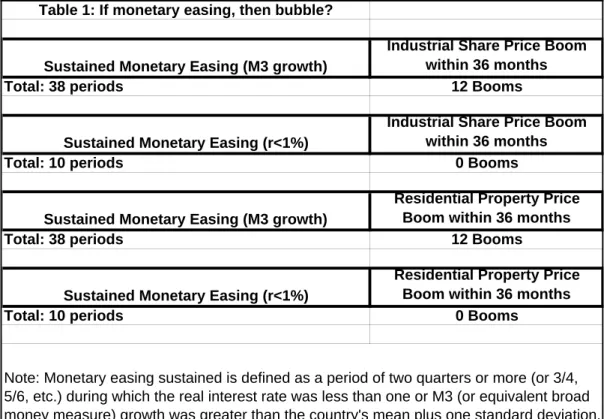
We create a list of these periods for the same 15 OECD countries over the same time-period as in the Bordo and Jeanne (2002) sample and find 38 time-periods of monetary ease by the M3 criterion and 11 periods of monetary ease by the real interest rate criterion. We see whether asset price booms occurred within 36 months of the end of one of these periods of monetary ease. The three-year time horizon is chosen both to fit with the outer limit of the usual assumed lag before the effects of monetary policy are fully felt, and with the three-year moving averages that are used to define the boom periods. If the boom begins within the period of monetary ease, that is “credited” to the ease, allowing for the possibility of forward-looking asset markets somehow seeing that monetary ease will be sustained and responding euphorically. This very large window should err on the side of associating many booms with periods of ease, even if the ease had just started, or if the ease was fading into the past.
Table 1 presents the results in response to the question, “if ease, then boom?” The results do not support the popular image of sustained monetary ease being a sufficient condition for a boom. Of 38 periods of ease identified by the M3 criterion, only 12 resulted in share price booms and 12 in property booms (the lists are not identical); of 11 periods of sustained ease by the interest rate criterion, no booms followed within 36 months. Of course, some of these periods of monetary ease were in response to contemporaneous or forecast times of slow growth or low inflation and might not be expected to generate much in the way of asset price booms during those periods.
10
Details on the data sources and the country specific monetary aggregates used, including adapting to the advent of the euro as appropriate, are given in the appendix table 1.
11
We include in our list of sustained periods those where one quarter shows tighter policy after the minimum two-in-a-row if that quarter is followed by a least one quarter back to ease, i.e., a run of
3-out-of-Yet, run-ups in asset prices often begin well ahead of actual economic recoveries and here would be counted if they began within 42 months of the monetary ease—a longer period than most recessions. In any event, the absence of any booms in response to low real interest rates would seem to put the focus on credit market conditions more narrowly, but even by that criterion, fewer than one-in-three periods of significantly above average credit expansion are followed by booms.
The idea that monetary ease alone is a sufficient condition for asset price booms might appear to be something of a straw man, though it is one that is often put forward without question in the discussions of the Japanese bubble. Perhaps this confusion is because those speaking about Japan actually subscribe to the idea of sustained monetary ease as a necessary, not a sufficient, condition for a boom to occur—if there is an asset price boom, then there must have been prior ease. In other words, on this hypothesis, while there can be periods of ease which do not result in bubbles, there are no bubbles that did not result from monetary ease. This relates closely to the idea of central banks “pricking” asset price bubbles, that interest rate increases somehow remove the loose credit conditions on which the bubble is predicated (an idea we examine in the next section).
Utilizing the same list of booms and periods of monetary ease, we consider this
possibility in table 2. We look at two possibilities—that ease must have preceded the start of the boom or that at a minimum there must have been ease during the boom.12 Neither elicits much support from the data—for property and share price booms, fewer than one-third of them were either preceded by or accompanied by sustained ease in credit growth; none of the share price booms were preceded or accompanied by sustained ease on these criteria.
The results are therefore far from supportive of monetary laxity as either a necessary or a sufficient condition for asset price booms, at least with regards to the advanced OECD economies since 1970. The direct association often drawn between the Bank of Japan’s monetary policy stance in the late 1980s and the Japanese bubble therefore bears closer scrutiny. In short, there is more to the story than just that the BOJ did not raise rates in time. The (Japanese) textbook version of the story is that international pressure upon Japan from the United States led to too much ease from the BOJ, and that ease led to the bubble.13 Japan had come out of the second oil
4 quarters or 4-out-of-5 quarters of M3 growth above threshold (r below 1 percent) is deemed as one period of sustained ease. No results depend meaningfully on this assumption, but it seems practical.
12
Excepting the last quarter, to allow for some lag between the start of interest rate increases/monetary tightening and the boom bursting. One could allow more time for tightening at the end of any boom, presumably because it takes a while for monetary tightening to have an effect on asset prices, but that would seem to contradict precisely the second version of the point being tested, that monetary ease is necessary for the bubble to continue.
13
Jinushi et al. (2000) give a good English-language summary from a Japanese perspective, while
shock, carefully closing its public deficits and managing money for price stability. At the time, protectionist pressures were mounting in the US Congress due to the large US trade deficits and the rise of the Reagan-Volcker dollar. First in the Plaza Accord of September 22, 1985, and then (after additional bilateral pressures from the US government) in the Louvre Agreement of February 20, 1987, the Japanese government agreed to stimulate domestic growth and help manage an appreciation of the yen against the dollar.
Under direction from the MOF, the BOJ began to make interest rate cuts in January 1986, starting with an overnight rate of 5 percent. By the time of the last cut three years later, the BOJ had cut its overnight rate to 1 percent. These rate cuts took place against a background of financial liberalization in the mid-1980s that had the BOJ placing greater reliance on its interest-rate instrument in implementing monetary policy and less on reserve and moral suasion measures upon banks. Meanwhile, the MOF did not wish to imperil its hard won budgetary consolidation by engaging in expansionary fiscal policy, so the burden of stimulus fell totally on the BOJ. The yen appreciated from a low of ¥240 per dollar to ¥125 per dollar, inducing the short-lived Endaka (high-yen) recession of 1985–86. The Heisei boom that we think of as the bubble years began shortly thereafter. No obvious increases in the CPI or WPI arose for the remainder of the decade, and most private sector forecasts were for continued low inflation (Ahearne et al. 2002). The ‘Black Monday’ US stock market crash of October 1987 provided another reason for the BOJ to keep interest rates low. In this version of the story, the issue is whether the BOJ could have raised interest rates some time in 1988 and in so doing have pricked the bubble.
Yet, none of this explains why there should have been a bubble in Japanese equity and real estate markets. Something had to transform the easy monetary policy into asset price
appreciation rather than either more general price pressures or sustainable growth. Again, the sole argument for blaming monetary policy seems to be one of timing. Even that, however, does not hold up well. Land prices were already rising before the Plaza Accord, let alone the full force of the BOJ’s rate cuts: one common index shows a 12.7 percent increase in FY1984 and a 28.9 percent increase in FY1985. And the run-up in stocks began even when the Endaka experience was fresh in people’s minds, but the only policy commitment of the BOJ, not by choice, was supposedly to keep the yen on an upward trend. If the decision to cut rates in 1986–89 was truly a political decision in response to US pressures on the MOF, and MOF pressures on the BOJ—as reported upon in the press and clearly grumbled about by BOJ officials—why was the BOJ’s frustrated case for tighter policy not persuasive to the bond markets? Surely, if it were clear that
perspectives, respectively. Hoshi and Kashyap (2001, ch. 7) covers the period with an emphasis on
the BOJ were violating its normal policy priorities due to obvious international pressure, the idea that such low rates would be sustainable without any effect on inflation or medium-term growth would have been discounted. The fault for the asset price increases seems to lie in the unrealistic expectations of participants in a bubble, not in Japanese monetary ease.
Let us turn the question around: should the BOJ have believed in the macroeconomics of
the Heisei-boom in the second-half of the 1980s? Or should they have been in a position to
discount this story? The debate among monetary economists over this period usually is cast as whether or not a central bank can read asset prices any better than financial markets and can assess the evaluation of equities. As the Japanese case of the late 1980s illustrates, this debate is misfocused. Whatever the state of asset prices, central banks have to assess the potential growth rate of the economy they oversee, and this macroeconomic assessment can be done largely independently of any specific relative prices in the economy (Kuttner 1994, de Brouwer 1998). For Japan in 1987–91, output was 2 percent a year above trend, and 1988 showed the highest growth rate (7 percent) seen since the mid-1970s.
Meanwhile, just looking at overall market averages, the stock and bond prices implied either 15 or more years of low interest rates or a massive drop in the risk premium (Ito and Iwaisaka 1995). Could a significant drop in the risk premium be held credible for aging Japanese savers, given well-known demographic trends and savings behavior? Alternatively, how could interest rates be expected to stay low indefinitely if the boom’s euphoria was based on a real increase in the potential rate of output—and therefore of the economy’s natural rate of interest— over the long run? As figure 3 shows with regard to Japanese labor productivity, the apparent surge in productivity in the late 1980s was something to be suspicious about. Given limited deregulation, the end of catch-up growth, and the absence of any new technological revolution, what would justify a near-doubling of productivity growth from its around 3 percent average of 1979–87?14 What precedent was there for a 2 percent jump in trend productivity anywhere except emerging markets making the great leap as Japan already had in the 1950s?15
14
Posen (2001b) explains why, using similar reasoning, one would interpret the 1990s as a period of rising
potential growth in Japan, not least because of ample deregulation (notably in financial services, energy, retail, and telecommunications) and the IT revolution, as well as changes in female labor force
participation. 15
Ueda (2003) actually goes further, suggesting that the bubble’s decline was inevitable because there was “a secular decline in the return on capital [in Japan] starting sometime in the late 1980s.” This is a view echoed by other Japanese officials who, like BOJ Policy Board member Kazuo Ueda, came to power in the mid-1990s and wished to explain if not excuse Japanese economic performance. Of course, this would suggest even more strongly that the bubble was irrational and beyond the control of the BOJ, and that the BOJ should have raised rates even earlier or more sharply in the 1980s than Bernanke and Gertler (1999) suggested it should have. Posen (2001b) and Kuttner and Posen (2001b) discuss the tendency for Japanese official estimates to understate the growth potential of Japan in hindsight.
Figure 4 underlines the reason for skepticism by comparing the investment/GDP ratio of the United States and Japan against time from stock market peak: where US investment went from 15.1 percent to 17.9 percent over the course of the bubble (up about a fifth), the Japanese investment-to-GDP ratio increased by nearly a third (from 20 percent to over 26 percent), from a higher initial level, for an economy with an already high capital-output ratio. The law of
diminishing marginal returns should not have been expected to be withdrawn.
In short, the BOJ could have decided to tighten policy in the 1980s without any reference to asset prices beyond the most general evaluation of interest rate expectations. It was not lack of explicit attention to rises in asset prices that led monetary policy astray, No expectations based on a reasonable evaluation of monetary policy could have supported these macroeconomic
assumptions embodied in the overall asset market. Kuttner and Posen (2003) establish that for any of a wide range of potential output estimates—using real-time available information and varying in method but never explicitly including asset prices—the BOJ would have normally been expected to raise rates some time in 1987–88. Of course, even if interest rates had been increased, it is not evident that alone would have ‘popped’ the bubble.
One could try to restore the link between the Japanese asset price bubble and monetary policy by asserting that a firm belief in ongoing pressure from the United States for yen
appreciation in response to the United States’s endemic trade deficits, rather than actual faith in the potential output measures implied, was what underlay the belief in monetary ease and thus the boom. Perhaps that would have been more rational than belief in the bubble per se. As Ronald McKinnon and Kenichi Ohno have shown, however, at least theoretically a long-term expectation of sustained yen appreciation will result in deflationary expectations (including of asset prices) in Japan.16 The point here though is that even if the monetary ease were held to be sustainable due to US pressure rather than false economic assumptions, that too would require false economic assumptions by the market participants, well beyond those about whatever the BOJ might do, to result in the sustained asset price rise. So there is no way to square this circle of the bubble somehow logically resting on expectations of future Japanese monetary policy. The bubble was independent of them.
We should turn instead to the obvious nonmonetary factors in the creation of the Japanese bubble. These financial developments are both well within the usual remit of a central bank’s surveillance, and logical justification for why the unrealistic expectations of bubble participants
16
were fed irrespective of monetary policy. As set out in Hoshi and Kashyap (1999), Cargill, Hutchison, and Ito (2000), and Mikitani and Posen (2000), there is a consensus view among economists on how partial financial deregulation in Japan in the 1980s led to a lending boom.17 Japan’s banks lost their best corporate customers after liberalization of securities markets allowed large firms to reduce their cost of capital by seeking direct financing. The banks’ ability to move into new lines of business was still partially constrained by regulation, and their franchise value was declining, yet they retained the same large amount of loanable funds due to deposit
insurance. The ‘Convoy’ system of financial supervision, which equated banking system stability with no closure of banks, kept overcapacity in the system, leading to low profits and
undercapitalization, increasing the desire to take risks with taxpayer insured deposits. As a result, Japanese banks made a huge shift into lending to small and medium enterprises (SMEs), increasing that share of their loan portfolios from 42 percent in 1983 to 57 percent in 1989, while their loan portfolios expanded by more than half (see figure 5). The banks nearly doubled their overall lending in selected sectors favorable to the SMEs.18 Companies hold substantial real estate in Japan, and used this as collateral of rising worth to borrow more; households also took advantage of rising home prices and declining lending standards (mortgage limits rose from 65 percent of home value on average to 100 percent on the assumption that land prices would go up).19 Two additional indicators of this lending/real estate boom arising out of the partial deregulation/ongoing deposits dynamic were the increase in Japanese banks lending directly to firms in the real estate sector, from 6 percent of total lending in 1983 to more than 12 percent in 1989, and the extreme pressure on the long-term credit banks who were most
dependent on the borrowing of major corporations (as documented in Shimizu 2000).
It is easy to draw the chain of causality from improved access to capital for both large and small business, due to rising collateral values as well as deregulation and shifts in lending standards, to rising expectations of profits and stock prices. And in Japan’s system of cross-shareholdings and banks owning significant share portfolios in borrower firms, these effects are amplified through increases in bank capital. Some belief in the rising value of land does underlie this dynamic, but once that is given, one can understand the emergence of a bubble in both stock and asset prices with no reference to monetary ease whatsoever. For comparison, remember that
17
Friedman (2000), among others, points out that this followed the exact same logic as the US savings and loan crisis, complete with accompanying real estate boom/busts.
18
See figure 21 below. Hoshi and Kashyap (1999) and Shimizu (2000) present various other measures of this boom in lending to small business.
19
Tax incentives in the inheritance system and elsewhere also encouraged older individuals to borrow against land. See Ito and Iwaisaka (1995).
the analogous dynamic seen in the US savings and loan industry took place in the early and mid-1980s, hardly a time of monetary ease.
So how did the BOJ monetary policy respond to this structural source of asset price increases? The evaluation tends to turn on whether the BOJ should have raised rates in 1988 instead of waiting until 1989, and how much they should have raised rates.20 This is often cast as a dispute over the sufficiency of inflation targeting as a guideline for monetary policymaking, without explicitly taking asset prices into account. This dispute turns on the definition of a policy rule for the inflation targeting central bank, and the information content of asset prices for inflation and output beyond factors normally considered. As I have argued here and (on an empirical basis) in Kuttner and Posen (2003), however, the proper perspective on potential output in Japan in the second half of the 1980s on its own terms would have led to rate increases in any usual forward-looking policy rule. The issue of whether assets prices should or should not explicitly enter the central bank’s target is moot (at least for Japan).21
In terms of the practice of monetary policy in the real world, inflation targeting is not about simple policy rules and what data enters them, it is about communication and
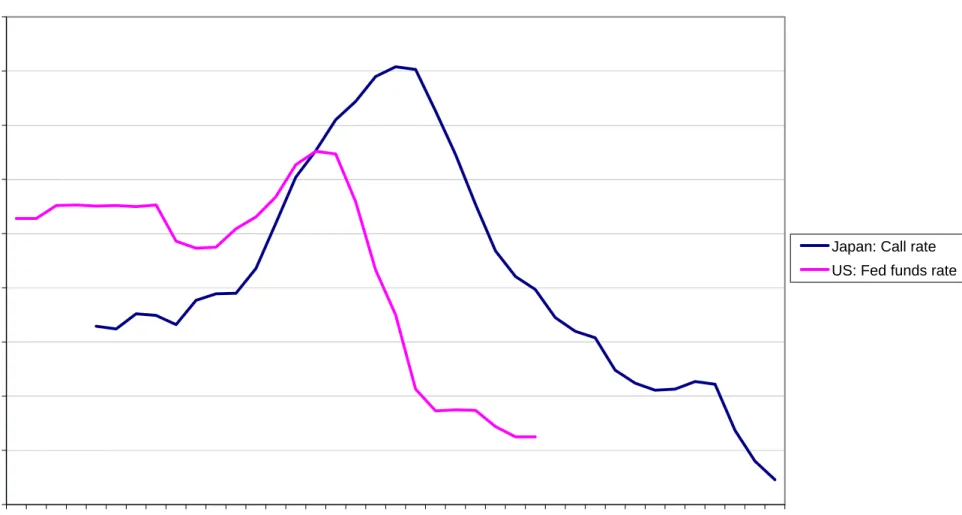
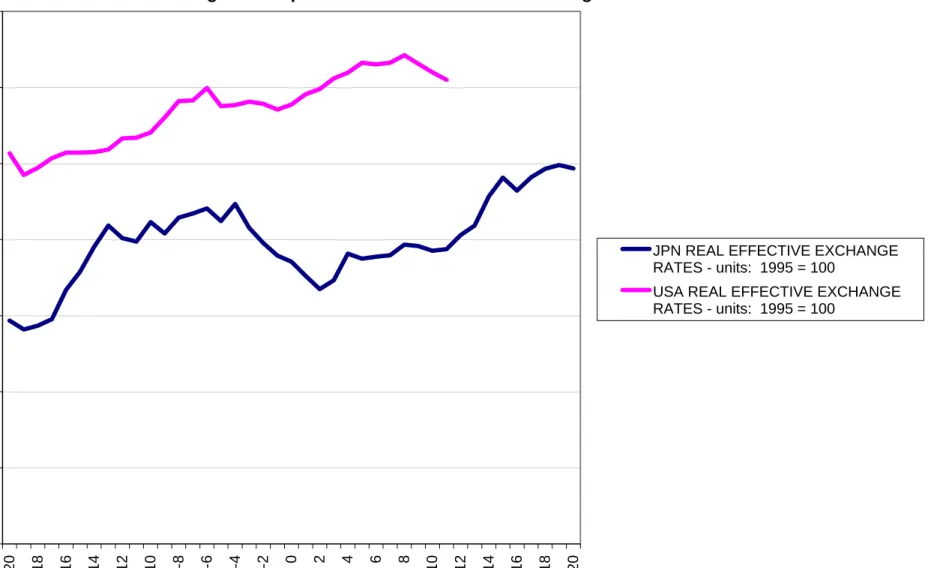
accountability.22 And it is with regard to communication and accountability that inflation targeting is indeed relevant for the behavior of the BOJ in the late 1980s, as well as for other central banks facing asset price booms. Figure 6 shows the delay, then the rapid and steep increase in the BOJ’s overnight interest rate, followed by relative slowness in cutting its overnight rate, in comparison to the Federal Reserve response (relative to their respective economies’ asset price peaks). The difference in the movements of the two economies’ real effective exchange rate (plotted in figure 7), another determinant of monetary conditions, was not enough to explain this divergence. The BOJ ultimately was slow to raise rates and then raised them high and kept them high, because around 1987 it radically increased its relative weight on inflation versus output goals and discounted the information from developments in the real economy.23
It is ironic that the BOJ began approximating an “inflation nutter,” in Mervyn King’s sense of the term, in the late 1980s, in contrast to the frequently told story about the Louvre
20
See Bernanke and Gertler (1999) versus Okina and Shiratsuka (2003). 21
Of course, there are ways to take asset price developments into account in monetary policymaking without going all the way to including it in a rule. Bordo and Jeanne (2002) and Mussa (2003) make the case for such discretionary inclusion, saying central banks need to recognize and respond to exceptional circumstances.
22
See Truman (2003), Posen (2000b) and Kuttner and Posen (2001a), and the references therein. 23
Bernanke and Gertler (1999), Jinushi et al. (2000), and Kuttner and Posen (2001a) all find in estimated BOJ reaction functions a similar shift in relative weights, a significant decline in the weight on output information, and date this break to around 1987.
Agreement and political pressures (not to mention Black Monday) causing monetary laxity. Yamaguchi (1999) indicates as much by saying that it would have been politically impossible to raise rates earlier than when the BOJ did without evidence of inflationary pressures—precisely when information from the potential growth side was offering that evidence. Had the BOJ been under an inflation-targeting regime, the sole focus on inflation would have been revealed to the public and (one hopes) reversed; conversely, had the BOJ had an inflation targeting
communications framework to draw upon, they could have conveyed to the public the inflationary pressures that were evident, even if not showing up yet in the WPI or CPI. In any event, the monetary ease in Japan in 1987–89 was not the result of the bubble not being taken into account, just as the bubble was not the result of the monetary ease.
DID THE BUBBLE CAUSE JAPAN’S DEFLATION OR STAGNATION?
Just as with monetary ease and the bubble, the idea that the bursting of Japan’s bubble caused the economy’s stagnation through at least the first half of the 1990s is widespread and often taken for granted. Some interested market participants go so far as to say that just about everything bad that has happened to the Japanese economy is due to the decline in asset prices, and that decline’s direct effect on corporate and household balance sheets (e.g., Koo 2003). Bank of Japan officials make less extreme claims but do attribute much of the ongoing difficulties in the Japanese economy to the bubble’s burst.24 And some economic researchers, notably Bayoumi (2001), give pride of place to the balance-sheet effects on the banking system as an explanation for the decline in Japanese output. The only outspoken opposition to this claim is usually from those who argue, from a real business cycle framework (e.g., Hayashi and Prescott 2000) that Japan’s economy is in a systemic decline.
This claim that the bubble’s burst caused Japan’s stagnation, like the claim about monetary ease and the bubble is overdue for reexamination. Obviously, no serious
macroeconomist who allows balance sheets, let alone credit markets and nominal rigidities, to play a meaningful role in her economic models would deny that significant declines in asset prices can have real effects. That is why macroeconomics was born as a field in response to the Great Depression. The economic effects of asset price declines are likely to be particularly felt in
24
Yamaguchi (1999) states: “In fact, much of Japan’s difficulties in the 1990s clearly has its origins in the asset market swing in the last 15 years…The damage left on the balance sheet of firms, both financial and non-financial, has been enormous.” See also Hayami (2000a).
the case when nominal debt and collateral interact with the provision of credit predominantly through a banking system (Bernanke 1983, Kiyotaki and Moore 1997). Overhangs of distressed real estate and a credit crunch for SMEs who are cut out of bank lending are certainly aspects of some of the worst recessions. For Japan, though, the issue is more empirical—when did the bubble’s burst have its effect, how large was that effect, and what other factors were going on at the time in Japan. I will argue that observers tend to conflate the post-1999 years of deflation and stagnation in Japan with the bubble of the late-1980s, leaving out the fact that a relatively normal if not mild recession and viable recovery took place in between. Japan, it turns out, is not the poster child for asset price declines causing recession, so we have to look elsewhere.
As recent research has begun to uncover, not all asset price crashes have significant negative effects on macroeconomic outcomes, despite the availability of plausible channels for transmission of the shock. Mishkin and White (2003), for example, consider 15 US stock market crashes in the last 100 years, and find that eight generated “some” or “severe” financial distress, of which only a few were followed by sharp contractions. We know that asset price busts are far more common than periods of prolonged stagnation let alone deflation like Japan has seen. If the supposed direct link between the Japanese bubble bursting and persistent subpotential growth is not as apparent in other known cases of asset price booms, then there clearly is more at work in the Japanese case than just the bubble’s impact itself.
Similarly to the previous section’s consideration of the link between ease and bubbles, we begin examining the link between bubbles and deflation by establishing a cross-national
benchmark. For the 15 OECD countries in our 1970–2000 sample, we identify periods of sustained deflation, where either the wholesale or consumer price index declined for 2 or more quarters in succession. Deflation in WPI turns out to be surprisingly common, with 73 cases in our sample (full list of cases is given in the appendix). Sustained consumer price deflation is significantly less common—only 9 cases counting Japan at the end of the 1990s—but is still more frequent than many people may realize. Following the format of tables 1 and 2, we use our list of cases of deflation and (from Bordo and Jeanne 2002) of ends of asset price booms to see whether such bubble bursts are necessary or sufficient for deflation to arise.25
25
We focus on the date asset price booms end (i.e., the peak value) rather than dating periods of actual ongoing busts (as Bordo and Jeanne 2002 do) because the point is precisely to find out whether asset price declines cause busts. Thus, in tables 3 and 4 we refer to “bursts” as the time the prices begin falling.
Table 3 reports the results for the question whether an asset price burst is sufficient to cause deflation. The sample is again split between 18 residential property and 24 industrial share price bursts, and then between CPI and WPI deflation periods. The cases of bursts are sorted into whether the onset of a sustained deflation (on a given price index) occurred within 36 months of the burst. Of the nine cases of CPI deflation, only 2 were preceded by equity bursts within 36 months prior. Notably Japan is not one of those (more than eight years between the burst and the onset of deflation), and none of the deflationary periods were preceded by property bursts. For WPI deflation, there is clearly more of a connection, but interestingly stronger on the share price (17/24 bursts followed by deflation within 36 months) than on residential property (8/18), even though Borio and Lowe (2001) and Bordo and Jeanne (2002) both find evidence that residential property bursts tend to have larger effects. Table 4 tackles the converse, whether an asset price burst is necessary to cause deflation. The procedure is reversed, first identifying the cases of CPI and WPI inflation, and then seeing how many of them had a burst (either share or property price) within 36 months prior, and gives the same picture.
How tight was the connection between Japan’s own asset price bubble burst and the performance of the Japanese economy? The first point to notice is that Japanese core CPI inflation continued to rise for 5 quarters after the stock market peak (figure 8) and did not drop sharply until mid-1992; for comparison, the US inflation rate remained quite steady for the first two-and-a-half years after the peak and then declined slightly. There must have been a lagged effect from asset prices in Japan. Looking at real GDP growth (figure 9) also depicts a Japanese economy with quite a bit of momentum: real growth was very strong in 1990 and above 3 percent even in 1991. Though below 1 percent for 1992–94, growth remained positive throughout and came back strongly in 1995–96 (growth in the United States zeroed out in the first year after the bubble burst, and the strength of the current recovery remains to be seen). In both postbubble economies, this looks like a normal mild recession that follows any monetary tightening. For Japan the underlying data bear this out. As figure 10 shows, Japanese real consumption growth actually exceeded that of the legendarily retail-minded United States in the first two years past the peak—both household and business confidence (Tankan survey measure) bottomed in 1993Q4, and stock prices grew faster than earnings in 1993 and 1994. Expectations were for a full return to growth, unimpeded by concerns over asset price declines or balance sheets. Business investment turned positive in FY1995, and private investment grew by 5.1 percent in 1996.
So 1990–94 should be seen as a normal growth recession following monetary tightening. It was perhaps a bit unusual by the standards of Japan before the oil shock, but not all that much different than the 1985–86 Endaka recession which, while shorter, actually saw the Japanese
economy contract. And, as I argued in Posen (1998), it took extensive policy mistakes—
insufficient monetary easing; contractionary fiscal policy; and forbearance of bank capital erosion and resultant misbehavior—to kill off the 1995–96 Japanese recovery. These mistakes, only the last of which has any direct relation to asset price declines, are sufficient to account for the underperformance of Japan’s economy and the onset of deflation from 1997 onwards. Even with regard to the erosion of bank capital, there were numerous regulatory and structural factors at work beyond the decline in stock and real estate prices.
The BOJ did cut its overnight interest rate nine times between July 1991 (from 6.0 percent to 5.5 percent) and September 1995 (reaching 0.5 percent) and argued at the time and thereafter that this should have been ample ease (Ueda 2000, Okina and Shiratsuka 2003). The Federal Reserve Board’s unofficial definitive study of the period (Ahearne et al. 2000) agrees that, given the data and forecasts available in real-time, the BOJ did cut as much as could have been expected—they argue that it was just that deflationary pressures from asset price declines were not taken into account sufficiently.26 Had the BOJ cut an additional 200 basis points before end of 1994, it would have been enough to keep Japan on a growth path. Yet, even taking the limitations of contemporary data into account, Ahearne et al. (2002) are too easy on the BOJ, and as a result give too much weight to the effect of asset price declines. The aforementioned shift of the BOJ to counterinflationary conservatism, and the concomitant underweighting of the output gap in decision-making, is embodied in the Taylor rule projection that Ahearne et al. (2002) use to make their case that the BOJ responses were in line with data. It is true, as Kasa and Popper (1997) establish, that market participants anticipated the severe tightening of 1989–91 and the slow loosening thereafter. This just emphasizes that the course of monetary policy reflected a consistent set of BOJ preferences, not that it was necessarily a reasonable policy response.
Kuttner and Posen (2003) find that what applied in the end of the bubble period also applies in the bubble’s aftermath: had the BOJ put a more reasonable weight on intermediate term output versus inflation goals, and therefore paid more attention to the information contained in the output gap, inputting any reasonable forward-looking measure of the output gap would have suggested more rapid interest rate cuts. This result relies solely on data available to the BOJ in real-time and does not include any information from asset price movements beyond those
26
Then BOJ Deputy Governor Yukata Yamaguchi (2002) picks up that line of argument, that the contractionary effects of insufficient monetary ease were the result of unforeseen drag from asset price deflation, but cuts would have been sufficient for normal circumstances.
embodied in the output gap. The difference with the Ahearne et al. (2002) result is in the weights. In a related exercise, Harrigan and Kuttner (2003) explicitly compare how the BOJ would have behaved if it had used the available data in a Taylor rule with “normal” Fed weights versus one with “normal” BOJ weights as in Ahearne et al. (2002). As shown in figure 11, the Fed response would have been much more aggressive (again without including any asset price or asymmetric deflation risks explicitly). In fact, the normal Fed response alone would have yielded the earlier 200 bps in cuts that Ahearne et al. (2002) estimate (using the FRB Global Model) would have been enough to offset deflationary pressures and the post-1996 recession.27
The cutting off of the mid-1990s Japanese recovery was in fact overdetermined because fiscal policy was sufficiently contractionary to have ended it on its own, absent any monetary policy mistakes, and vice versa (Posen 1998). That is part of the reason why the following recession has been so deep. From 1992 to 1995, Japanese fiscal policy was mostly stimulative, particularly in 1995, although by comparison with the United States after its bubble fiscal policy was slow to expand (figure 13). Posen (2003c) shows in a cross-national investigation that Japan was the only OECD economy whose deficit response to the business cycle declined over the 1990s, after starting out in the mid-range of responsiveness. While the infamous examples of pork barrel projects and bridges to nowhere certainly represented the nature of much of Japanese public works spending, these were not the main source of fiscal expansion. Rather, increasing social security payments for an aging society and tax cuts provided most of the bang during this period (as can be seen in figure 14, Japanese government transfers followed a smooth trend, rather than going up as an automatic stabilizer, as they did in the United States).
The yield-curve was upward sloping until 1996, consistent with a view that not only was fiscal austerity unexpected but also that recovery and inflation were expected, despite asset price declines. In April 1997 at the start of the fiscal year, however, multiple tax increases—the implementation of a suspended increase in the consumption tax from 3 to 5 percent; a rise in the income tax; the addition of copayments to the national health insurance program—hit the economy, and this took out 2.5 percent of GDP within 3 years (Kuttner and Posen 2002). From that point onwards, fiscal policy tended to be contractionary, and public investment has been declining since 1998. The recession of 1992–94, the offsetting monetary tightness, and the occasional appreciations of the yen against the dollar had little impact on the revenue-minded Japanese fiscal policymakers, and tax receipts went up significantly during the first three years after the bubble (figure 15). Since the yield-curve has flattened and nominal long-term interest
27
Similarly, Harrigan and Kuttner (2003) find that the Fed has cut rates since the US bubble burst in line with its “normal” response, given weights on output and inflation, and given real-time information—
rates have declined while the public debt has mounted, there is no reason to think that significant Ricardian offsets for fiscal expansion would have arisen had fiscal policy been tried; econometric assessments of the effectiveness of Japanese fiscal policy support this view (Kuttner and Posen 2001b). Ahearne et al. (2002) and Posen (1998) concur that had the tax hikes of 1997 been put off, the recovery of 1995–96 would have continued to gain steam. Of course, a package combining fiscal and monetary stimulus would have been best.
The third major policy mistake was forbearance of bank misbehavior and capital erosion. This was the natural if unfortunate outcome of the structural shifts in the banking system
following partial deregulation discussed above. As in the US savings and loan crisis and other instances of financial fragility around the world, Japanese bank supervisors held off closing banks in hopes that the economy’s return to growth and/or a rise in asset prices would restore bank profitability. In Japan, however, this phenomenon was taken to an extreme in duration and breadth, in part because the supervisors retained the convoy notion that banks should not be allowed to exit the market. Figure 16 juxtaposes commercial banks’ ROA with an index of the number of banks for Japan and the United States.28 In Japan, the number of banks five years after the stock market peak was 97 percent of the number at the peak, and ROA had declined to nearly zero from the already low 0.3 ratio attained during the bubble; in the United States, the number of banks was steadily declining through the boom years, and the trend continued into the postbubble period, keeping bank profitability steady (ROA six-fold or more that of Japan).
During this postbubble period in Japan (1990 to present), banks have been allowed to evergreen loans to distressed borrowers, ration out new borrowers, and exploit those lending relationships which remain viable (Hoshi and Kashyap 1999, Peek and Rosengren 2000). Japanese households went back to keeping nearly 60 percent of their savings in bank deposits (including a quarter of that amount in Postal Savings), because the convoy system and deposit insurance gave them no incentive to move their money out (see figure 17)—and that kept the banks from having to compete for loanable funds. Adherence to the Basle I Capital Accord meant that Japanese banks had to maintain sufficient Tier II capital to reach 8 percent by end of
FY1992, but the Japanese government had negotiated hard to count latent share gains on banks’ nonfinancial holdings as part of that Tier II capital (Ito and Sasaki 2002). As a result, it took until 1997 for equity prices to decline sufficiently to have an impact on the lending behavior of Japanese banks.
without reference to the extreme movements in asset prices (see figure 12).
28
There is a jump in the number of banks listed in 1988 (peak-1) for Japan due to a reclassification of certain institutions. The actual number of core commercial banks was flat and did not increase.
Had there been sufficient transparency in the Japanese banking system, with sufficient accountability to shareholders and supervisors, though, there either could have been enough Tier I capital issuance or banking sector consolidation—or even sales of long-held industrial shares—in the intervening seven years to offset the declines in Tier II capital due to cross-shareholdings. In fall 1997, however, abetted by the downturn of the economy and the fiscal tightening, financial failures shocked the Japanese public. Within a year, Hokkaido Takushoku Bank, Sanyo
Securities, Yamaichi Securities, Long Term Credit Bank, Nippon Credit Bank, and a number of minor firms failed despite government efforts to prop them up.29 At this point the effects of a bank credit crunch did add to the contraction of the Japanese economy.30
So did the asset price bubble cause Japan’s Great Recession? Even the oft-used analogy of the balance-sheet effects being the match which lit the fuse seems to exaggerate the bubble’s direct impact. The 1991–94 recession was well within normal bounds of a usual recession postmonetary tightening, nothing too arduous. Japanese monetary and fiscal policy austerity is sufficient to account for the abortion of the 1995–96 recovery, a recovery that on all forward-looking indicators (including rising stock prices) looked to be sustainable. Neglect of basic financial supervision allowed balance-sheet problems for banks to finally accumulate to where they impeded lending, after macroeconomic policy had already put the economy back into recession. If these extensive policy mistakes had not killed the 1995–96 recovery off, and if the Japanese bank supervisors had taken only 10 years after partial deregulation to engage with the structural undercapitalization of their banking sector, we would not be discussing the Japanese economy the way we do today (Posen 1998). With that proper perspective on the course of Japan’s economy after the bubble in mind, we might not now be so concerned with the impact of bubbles on major economies in general, without the Japanese example to cite.
DID THE BUBBLE IMPEDE RESTRUCTURING?
No matter what the demand shock to an economy, it is never without sectoral impact. An economy undergoing adjustment has to reallocate workers and capital from less to more rewarding uses. With well-functioning markets, distressed assets are fairly and quickly repriced and reemployed. The question here is whether a bubble burst is in and of itself sufficient to impede this process of restructuring. Given the recognition that some bubbles have significant
29
Hoshi and Kashyap (2001, ch. 8) gives a good history of this period. 30
See Bayoumi (2001), Cargill et al. (2000), Ito and Sasaki (2002), Ogawa (2003), Peek and Rosengren (2000, 2002), and Shimizu (2000) all offer evidence to this effect.
macroeconomic costs and some do not, it is possible that the difference in costliness between bubbles accords with how well the economy reallocates capital afterwards. Obviously, financial systems that are dysfunctional impede this process of reallocation. Pomerleano (2003) establishes with cross-national data that specialized human capital such as workout specialists and property appraisers also is needed. In the end, many of the factors usually cited as good for economic growth are good for restructuring, which makes sense because the ongoing process of restructuring can be seen as the Schumpeterian engine of growth. As with the previous two sections, my argument is that we should shift attention away from the bubble as a causal force in its own right and stress the response of Japanese authorities, businesses, and households.
The previous two sections addressed essentially retrospective questions: Did monetary ease cause the Japanese bubble? Did the bubble cause Japan’s recession? The restructuring issue requires something more of a counterfactual approach—tracing out the bubble’s impact on restructuring needs a benchmark against which to measure progress. Therefore, insofar as data allows, we will compare the response of the US economy (known for its arm’s length markets and corporate governance) to a given asset price bubble, with the response of the Japanese economy (known for its web of corporate and financial relationships) to an almost identical asset price bubble. Even where data limitations preclude us from making the comparison directly, it will be evident that the Japanese corporate sector responded to the bubble’s burst by resisting restructuring for a multi-year period.31
The simplest point to be made is clear in figure 19 showing the path of investment and national income in the two countries relative to peak in equity prices. In the United States, income flattened out almost immediately upon the bubble’s bursting, and investment declined—in Japan, however, investment continued to climb for two years after the bubble and so (at a slower rate) did income. The Japanese investor simply did not respond to the market signal. This could be because of the relationship banking system that encourages banks to carry clients through harder times while the securitized US system results in rapid financial cutbacks; this also could be because of evergreening and poor bank supervision in Japan. Figure 20 plots the quality spread between 10-year Japanese government and AA-class industrial bonds, which began to rise in the year after the bubble’s burst, but stayed well below prebubble levels (and at a relatively low differential compared to US spreads)—the bond market was insufficiently responsive.
A more important fact is shown in figure 21 which presents the bank loans outstanding to the sectors in the Japanese economy which were at the heart of the bubble: finance, insurance,
31
For no doubt historical and institutional reasons, the US government collects less data on the micro-level about the activities of specific firms and workers than the Japanese government does.
and real estate; services (in Japan, dominated by inefficient SMEs); and construction. Each one of these sectors saw loans outstanding to it continue to rise rather than shrink following the bubble years. In the case of construction, the trend in loan growth to the sector actually rose after the bubble.32 The United States does not break down lending data in flow of funds by sector, probably because of the lesser importance of banks in corporate finance. As Friedman (2000) notes, lending to real estate continued to rise in the United States after the savings and loan crisis, so this is not entirely atypical. Nonetheless, the expansion of lending on this scale in all these sectors is clearly an indicator of lack of adjustment of which sectors were favored by lenders. Figure 22 further reflects adverse selection in Japanese credit markets postbubble: the rate of firms going under in Japan (exiting business) actually declined starting in 1991, and stayed below prebubble levels, while the rate of new firm entry dropped markedly.
Overall, Japanese labor markets have engaged in a form adverse selection analogous to that in bank lending. As is often anecdotally observed, Japanese firms who have stayed open have generally sought to maintain employment rather than restore profitability during the 1990s, even though this came at a cost of offering few opportunities to younger workers and school leavers. Figure 23 documents that the job separation rate rose only slightly in the immediate aftermath of the bubble before declining, while over time the decline in job entry rate accelerated. Lacking US job entry/exit data for the period, we can show how employment in various industries responded as an indicator of restructuring. In figure 24 it can be seen that the same three sectors—
construction, FIRE, and services—in Japan that have continued to get funding from their banks have increased their employment;33 in the United States, the information and communications technology (ICT) sector that was the darling of the American bubble saw employment contract immediately.
In keeping with the relative extent of reallocation, labor productivity declined in Japan steadily over the years after the Nikkei peak (even discounting the artificial high of the 1988 productivity number), while US productivity has continued to grow in the three years since the S&P 500 peak, and the latest numbers released promise a continuation of the trend. As a result, real corporate profits computed from the national accounts (figure 27), not accounting profits, have rebounded from a short postbubble decline in the United States, and were generally a steady
32
This is probably in part due to the use by Japanese governments of public works construction projects as employment programs, making the loans seem to be implicitly government backed. See Posen (1998, ch. 2) and Kuttner and Posen (2001b) for discussions of the growth in construction employment.
33
Ogawa (2003) using firm-level data shows a clear link between availability of credit and employment at Japanese SMEs.
number; in Japan, corporate profits traced the boom upwards, and declined for five straight years after the peak.
Two analogous bubbles produced very different degrees of restructuring, so it is not about the bubble.34 Given that Japan does have the basic institutions, property rights, and to a large degree financial expertise necessary for a successful restructuring (or can easily import it from eager providers), why did restructuring not occur? A large measure of the blame must go to the management of the Japanese banks who not only have the usual undercapitalized lenders’ incentives to misallocate credit, but who also have been accustomed to extracting rents from corporate clients, depositors, and even government officials, and therefore have every incentive to keep current relationships going.35 Yet their lack of accountability to shareholders or public officials, and their ability to tie up so much of Japanese savings requires more to be successful. Posen (2003a,b) argues that four factors create the Japan syndrome leading to sustained deflation: undercapitalized banks with incomplete deregulation; passive savers and voters; a lack of
openness to international pressures (or exits by savers and firms); and contractionary
macroeconomic policies. The question remains open, but the role of macroeconomic policy in restructuring merits further consideration.
COULD MONETARY POLICY HAVE ENCOURAGED RESTRUCTURING?
After an asset price boom has ended, and the need for restructuring becomes apparent, the central bank has a choice to make. Inflation is unlikely to be a threat for an extended period, giving some room to focus on growth. The central bank therefore can either tighten monetary conditions in hopes of inducing faster or more complete restructuring, or it can loosen monetary conditions in hopes of easing the restructuring process. This is the old debate between liquidationists and expansionists, seen around the world during the early 1930s. Then US Treasury Secretary
Andrew Mellon was seen as the exemplar of the liquidationist view urging policies to “get the rot out;” Keynes would be the embodiment if not the creator of the expansionist alternative. In Japan, since the bubble burst, but particularly since the 1997 recession and the emergence of steady deflation, the debate has been revived, and both points of view have been heard. What are the economic and political assumptions underlying the respective positions?
34
Rosengren (2003) suggests that postbubble reaction may be more important for macroeconomic performance than prebubble preemption.
35
Among those empirical studies documenting the successful though destructive rent-seeking behavior of Japanese banks are McGuire (2002a,b), Morck et al. (2000), Peek-Rosengren (2003), Petersen-Rajan (1995), Smith (2003), van Rixtel-Hassink (2002), and Weinstein-Yafeh (1998).
The view that creative destruction requires liquidations has often been espoused by top BOJ officials. In summer 2000, in anticipation of the interest rate increase to be undertaken that August, BOJ Governor Masaru Hayami gave a series of press interviews and speeches advocating this view.36 Fundamentally, low or zero interest rates are said to impede restructuring because they allow inefficient firms to make their loan payments and remain open. Those sharing this view, such as the Japanese business pundit Tadashi Nakamae (2000, 2003b), advocate raising interest rates to increase bankruptcies and raise efficiency in the economy. Efforts by monetary policymakers to ease the pain of adjustment will likely decrease the incentive of businesses, interest groups, and government to undertake necessary restructuring (shades of the European Central Bank can be seen here). In fact, low or zero interest rates have the political effect of inviting wasteful government spending in place of reform. In all, the idea is to impose greater market discipline by making credit markets tighter.
The opposing view holds that restructuring goes best in a supportive environment, and that efforts to increase destruction of firms and jobs are often uncreative. Most of today’s mainstream macroeconomic models that include imperfect information and financial
intermediation support this view, and the existence of nominal rigidities adds to the argument for expansionist policies.37 Low or negative real interest rates aid restructuring because they improve the investment incentives of borrowers. As Bernanke and Gertler (1990) argues, the appropriate response to financial fragility is to restore the net worth of borrowers so they have something at stake in their economic activity and pursue the proper projects. Obviously, inflation and liquidity are one means by which to do this. Sorting out firms for life or bankruptcy based upon which ones happen to hit a liquidity constraint when interest rates rise is a very poor screen for investment or management quality, making monetary policy too blunt an instrument (Mussa 2003, Posen 2000a). Politically, the assumption is that governments will pander to interest groups almost inevitably, but governments with additional resources are better able to buy off entrenched interest groups into lasting change. A more buoyant economic environment may also reduce the incentive for interest groups to dig in their protections.
Looking at the one case of Japan will not settle this debate, but it does give us strong indications of where the truth lies. In fact, given that many thought the debate settled against the liquidationists by the Great Depression, only to have the old arguments resurface in the fact of Japan’s Great Recession, there may be no hope of settling it. Yet, the comparison of US and
36
See, for example, Bremmer (2000a,b,c), Hayami (2000b), Spindle (2000a,b), and Tett and Abrahams (1999), as well as the references in Posen (2003c).
37
Posen (1998, ch. 6) summarizes the relevant literature, drawing on the work of Akerlof, Bernanke, Stiglitz, and others.