Prepared by:
Lockheed Martin Federal Systems
Odetics Intelligent Transportation Systems Division
Prepared for:
Federal Highway Administration US Department of Transportation Washington, D. C. 20590
Table of Contents
1. Introduction (January 1997)_________________________________________________ 1-1
1.1 Purpose _______________________________________________________________________ 1-1 1.2 Guiding Principles ______________________________________________________________ 1-2 1.3 Document Structure and Intended Audience ________________________________________ 1-4
2. What are the Potential Implementations? (January 1997) _________________________ 2-1
2.1 Architecture Definition __________________________________________________________ 2-1 2.2 Market Packages ______________________________________________________________ 2-16 2.3 Relating Market Packages to the Architecture Definition _____________________________ 2-24 2.4 Market Package Synergy________________________________________________________ 2-30 2.5 Technology Requirements _______________________________________________________ 2-44 2.6 Standards Requirements ________________________________________________________ 2-54 2.7 Identifying Early Market Packages (January 1997)__________________________________ 2-59 2.8 Intelligent Transportation Infrastructure (January 1997) ____________________________ 2-69
3. Implementor Roles And Deployment Implications (January 1997) __________________ 3-1
3.1 The Institutional Layer __________________________________________________________ 3-1 3.2 Identifying Producers, Operators, and Consumers __________________________________ 3-11 3.3 Who Provides the Funding ______________________________________________________ 3-16 3.4 Institutional Issues Affecting Deployment _________________________________________ 3-24 3.5 Summary: Implications for the Implementation Strategy_____________________________ 3-44
4. State and Local Guidance (January 1997) ______________________________________ 4-1
4.1 Applying the Architecture in Surface Transportation Planning_________________________ 4-2 4.2 Developing a Market Package Plan ________________________________________________ 4-9 4.3 Defining a Regional Architecture _________________________________________________ 4-21 4.4 Developing a Strategic Deployment Plan___________________________________________ 4-56 4.5 Implementing the System _______________________________________________________ 4-59 4.6 Evaluating Existing Systems _____________________________________________________ 4-76
5. DOT Strategy Recommendations (January 1997) ________________________________ 5-1
5.1 Towards National Compatibility and Interoperability ________________________________ 5-1 5.2 Deployment Support ___________________________________________________________ 5-10 5.3 Strategic Investment in Research and Testing (R&T) ________________________________ 5-16
Appendix A. Detailed Market Package Definitions (September 1998) __________________A-1 Appendix B. Market Package Deployment Timing (January 1997) ____________________B-1 Appendix C. Case Studies (January 1997) ________________________________________ C-1
EXECUTIVE SUMMARY
Nationwide implementation of Intelligent Transportation System (ITS) services will result from a multitude of individual deployment decisions by public agencies and the private sector. The National ITS Architecture creates the opportunity for interoperability across these diverse ITS deployments while preserving flexibility and choice for the many implementors.
The architecture is implemented to achieve these benefits in three principal ways: (1) adaptation or development of consensus standards for transportation products based on architecture requirements, (2) development of regional architectures which interpret the national architecture and tailor it to support integrated regional ITS solutions, and (3) incremental deployment of architecture compatible systems. The Implementation Strategy defines a series of steps that encourage efficient deployment of architecture compatible systems. These include:
• Identification of basic building blocks that apply to most ITS deployments,
• Focus on near-term problems and the early deployments best suited to
addressing those problems through the Intelligent Transportation Infrastructure initiative,
• Further encourage private sector participation in ITS deployment,
• Parallel advancements in the number of ITS services offered and the degree of
system integration over time.
Each of these steps are used to inform state and regional guidance as well as specific US DOT recommendations. This summary will highlight the main findings that are more fully developed and supported in the body of the Implementation Strategy document.
Identify ITS Building Blocks. The architecture must support all user services, be
scaleable to suit the largest metropolitan areas as well as remote rural regions, and be technology independent so that current and future technologies are accommodated. This flexibility enables each implementor to use existing assets and provides a variety of evolutionary paths for maturing ITS capabilities based on individual priorities. Unfortunately, this flexibility also makes it difficult to understand precisely what pieces of the architecture are applicable and how they can best be applied in solving a particular communities current transportation problems.
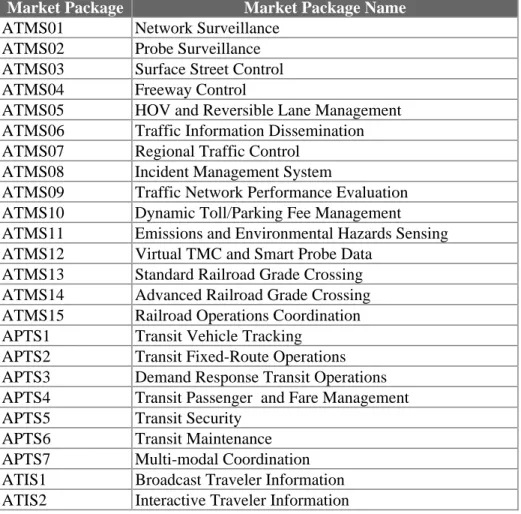
To provide visibility into the service options that will be considered by ITS implementors, a set of market packages have been defined. The market packages are tailored to fit - separately or in combination - real world transportation problems and needs. The strategy is structured around more than fifty of these packages that illustrate the range of incremental deployment options that may apply to different scenarios and time frames. The market packages address specific services that might be required by traffic managers, transit operators, travelers, and other ITS stakeholders.
Market Packages
Traffic Management Traveler Information Transit Management
• Network Surveillance • Broadcast Traveler Information • Transit Vehicle Tracking
• Probe Surveillance • Interactive Traveler Information • Transit Fixed-Route Operations
• Surface Street Control • Autonomous Route Guidance • Demand Response Transit Operations
• Freeway Control • Dynamic Route Guidance • Transit Passenger and Fare
• HOV and Reversible Lane Management
• ISP Based Route Guidance
• Integrated Transportation
Management
• Transit Security
• Traffic Information Dissemination
• Regional Traffic Control
Management/Route Guidance
• Yellow Pages and Reservation
• Transit Maintenance
• Multi-modal Coordination
• Incident Management System • Dynamic Ridesharing
• Traffic Network Performance Evaluation
• In Vehicle Signing Advanced Vehicles • Vehicle Safety Monitoring
• Dynamic Toll/Parking Fee Management
Commercial Vehicles • Fleet Administration
• Driver Safety Monitoring
• Longitudinal Safety Warning
• Emissions and Environmental Hazards Sensing
• Freight Administration
• Electronic Clearance
• Lateral Safety Warning
• Intersection Safety Warning
• Virtual TMC and Smart Probe
• Standard Railroad Grade
• Electronic Clearance Enrollment
• International Border Electronic
• Pre-Crash Restraint Deployment
• Driver Visibility Improvement Crossing Clearance • Advanced Vehicle Longitudinal
• Advanced Railroad Grade • Weigh-In-Motion Control
Crossing • Roadside CVO Safety • Advanced Vehicle Lateral Control
• Railroad Operations Coordination • On-board CVO Safety • Intersection Collision Avoidance
• CVO Fleet Maintenance • Automated Highway System
Emergency Management • HAZMAT Management
• Emergency Response ITS Planning
• Emergency Routing • ITS Planning
• Mayday Support
The market packages are tightly coupled with the architecture definition and represent the “building blocks” that can be deployed over time to efficiently achieve high-end ITS services. Several different market packages are defined for each major application area which provides a palette of services at varying cost. Market packages are also identified to segregate services which are likely to encounter technical or non-technical challenges from lower risk services. For example, driver warning and vehicle control systems are defined as separate market packages due to the increased technical and non-technical risk associated with systems which dilute the driver’s direct control of the vehicle. This approach yields market packages that may be deployed early with low risk. Many of the market packages are also incremental so that more advanced packages can be efficiently implemented based on earlier deployment of more basic packages.
Recommend Early Deployments. The market packages are inter-related and are
also influenced by the availability of basic supporting infrastructure, the evolution of technology, the emergence of industry standards, the institutional context of implementation, and market demand. Different market packages will be impacted to varying degrees by each of these factors.
or institutional change and leave room for a competitive environment on which to advance transportation technologies. Early Market Packages are the subset of market packages that appear to be early winners due to a promising combination of low risk implementation characteristics, developing public and private markets, and tangible system or user benefits. Market packages that best satisfy the above criteria include: Surface Street Control, Freeway Control, Standard Speed Railroad Grade Crossing, Dynamic Toll Management, Transit Vehicle Tracking, Transit Operations, Mayday Support, Autonomous Route Guidance, ITS Planning and Electronic Clearance.
The nine elements identified by the Intelligent Transportation Infrastructure initiative further prioritizes those early market packages that are oriented towards public infrastructure support for major metropolitan areas. This provides additional near-term focus for the strategy. Early deployments have and will continue to occur in larger metropolitan areas given their need, greater availability of resources, and the existing infrastructure to build upon.
Encourage Private Sector Participation. The Intelligent Transportation
Infrastructure initiative represents a tangible commitment to deploy key public infrastructure that should promote further deployments of ITS services. The implementation strategy described in this document proposes a shift in funding from financially strapped public agencies to private users. This shift is accomplished through emphasis on individual user fees for services and other incentives that enhance the potential for profitability and encourage capital investments by private industry. The relative emphasis within the architecture on vehicle based systems and the separation of transportation management and transportation information services are examples of choices which preserve and enhance the opportunity for private sector participation. It is forecast that several key functions will remain a public responsibility, including traffic management and emergency management services where direct user fee based operation is impractical.
Enable Service Integration and Extend Interoperability. The strategy begins
with what we have now: “Islands” of basic ITS capability that are deployed in response to local needs. Adoption of existing standards and development of new ITS standards encourages service expansion and eventual linking of these ITS islands. The implementation strategy considers the minimum level of standardization required to achieve interoperability while preserving existing investments and the potential for innovation. This balanced view emphasizes the interfaces to vehicles and other mobile elements for standardization and leaves the other regional and sub-regional interfaces to evolve towards open standards based more on local needs than top-down national priorities. The associated Standards Development Plan and Standards Requirements deliverables provide the guidance from the ITS architecture to the Standards Development Organizations (SDOs).
The National Architecture provides a general framework that must be adapted and elaborated for use in supporting an interoperable regional transportation system design. It is recommended that a regional architecture is developed as a major
output of this process which adapts the National Architecture to reflect major service, technology, and interface choices which are most appropriate for the implementing region. A series of steps are offered to assist the local implementor in applying the National Architecture in a regional setting.
Progressive Implementation of More Advanced Services. The strategy provides
a vision of how the ITS services could be provided over time for a representative set of scenarios. These forecasts document efficient deployment sequences that reflect a projected natural evolution of ITS service provision through market development and appropriate public sector decision-making. Geographic expansion will be paralleled by technology growth resulting in new capabilities, new products, and new features. For example, early deployment of basic toll collection capabilities enables future, efficient deployment of vehicle probe data collection, which in turn enhances advanced traveler information market packages and more advanced, area-wide traffic control strategies.
Integration into State and Local Planning and Programming. The strategy
emphasizes the integration of ITS architecture deployment with state and metropolitan transportation planning, programming, and maintenance decisions. Guidance is provided for: ascertaining appropriate market packages; establishing a regional ITS architecture; devising strategic ITS plans that conform with the regional architecture; identifying key interfaces and standards to be considered in deployment; and evaluating operational systems. The implementation strategy considers the regional ITS deployment process from the vantage of new systems as well as existing systems.
Recommended DOT Strategic Actions. The strategy culminates in a series of
top-level recommendations for strategic actions that are intended to facilitate ITS deployments. These actions should lower identified deployment barriers and otherwise enhance the prospects for beneficial adoption of the National ITS Architecture through efficient ITS implementations.
Facilitate National Interoperability. The strategy recommendations
complement the current US DOT “ITS Standards Development” activity which is promoting ITS standards development through five contracts with the AASHTO, IEEE, ITE, ASTM, and SAE Standards Development Organizations. Education programs and other forms of outreach are recommended to ensure active participation in, and beneficial adoption of, the standards that are developed.
Depending on interface-specific interoperability issues, standards adoption may be voluntary, encouraged through conditional funding, or regulated at the regional, state, or national level. Preliminary recommendations for the appropriate public sector role in encouraging standards adoption concentrate on those interfaces that are most critical to national interoperability. General approaches towards accommodating legacy systems while encouraging standards adoption in newer systems are addressed. The best
typically involves conversion to newer, interoperable systems over time in the course of normal system maintenance and upgrade. The range of potential conformance testing and certification programs are also briefly described. Finally, a potential approach to maintaining the national architecture products over time is suggested which maintains only the subset of the architecture products that directly support the evolving standards and implementation guidance efforts.
Policy and Guidance. First, the local implementor must be equipped with
sufficient information to make appropriate ITS architecture choices. Education and training programs which enlist regional field representatives as local champions and continuance of the on-going federal efforts to consolidate and publish ITS benefits are positive steps to this end. Improved evaluations must be performed to augment currently available information. Such evaluations should be oriented towards generating the kinds of benefits information that will be relevant and useful to implementors. For instance, benefits information that is developed should be useful in scoring potential ITS projects against the 15 planning factors identified in ISTEA (e.g., Overall social, economic, energy, and environmental effects of transportation decisions, congestion relief and prevention, consistency of planning with energy conservation measures). Each of these programs must be supported by preparation of handbook level guidance and update of existing transportation manuals, handbooks, and publications over time.
Policy recommendations augment the guidance by mitigating recognized barriers. Approaches to facilitating multi-jurisdictional agreements, applying the ITS Privacy Principles, continuing proactive procurement reform, enabling direct recovery of user fees for services, and managing public sector liability are recommended.
Strategic Investment. Funding recommendations are made for early
deployments which verify and refine integration strategies (e.g., encourage regionally integrated transportation management systems that lend credence to and/or refine the architecture framework that has been established), field operational tests which resolve major implementation choices (e.g., the role of probes versus roadside surveillance), and research and development activities that develop the tools (e.g., Improved ITS Benefits/Impact Models) and technologies (e.g., advanced vehicle sensor and control technologies) that support ITS implementations.
Achieving Efficient ITS Deployment Through Public and Private Sector Initiatives O&M Issues Liability Privacy Demonstrate Benefits Infrastructure Dependencies Technology Constraints Required Standards Interjurisdictional Issues
O&M Funding Reform Reforms, Design Constraints
Maintainable Systems Service Contracts Liability Studies
Outreach Efforts
Industry Standards New Products Systems Integrator Role
Early Deployments Core Infrastructure R&D Funding Standards Support Interjurisdictional Arrangements Market Candidate Deployment Public Agencies • Federal • State • Regional • Local Public Agencies • Federal • State • Regional • Local Private IndustryPrivate Industry Benefits Assessments Deployment
1. Introduction
1.1 Purpose
The Implementation Strategy (IS) is one of a series of deliverables documenting the National Intelligent Transportation System (ITS) Architecture developed under contract to the US DOT. The Implementation Strategy describes the architecture to potential implementors, clarifies the relationship between architecture and implementation, and recommends policies and actions that will encourage cost-effective nation-wide implementation of ITS. Through these definitions and recommendations, the Implementation Strategy provides a general vision of how an efficient deployment of systems compatible with the national architecture can take place over time. It explicitly recognizes the extreme variability in deployment that will occur in different areas of the nation at different times and provides an overall strategy that spans, and supports, these diverse deployments.
What is the Implementation Strategy trying to do?
• Describe the National Architecture and its relationship to ITS implementations to potential implementors.
• Identify potential issues that could impede the deployment of systems within the architectural framework
• Recommend policies and actions that will encourage cost-effective implementations that are compatible with the National Architecture
• Examine deployment alternatives that offer balanced approaches for public, commercial, and private investment
• Provide snapshots at various times in the future illustrating the potential time phased
deployment of ITS services.
What is the Implementation Strategy not attempting to do?
• Prescribe a specific deployment sequence or implementation. Each deployment will be
adapted to prevailing local conditions and requirements and cannot be nationally prescribed.
• Dictate ownership, financial, and operational responsibilities. The identification of public sector and private sector roles will be dependent on the needs of each community.
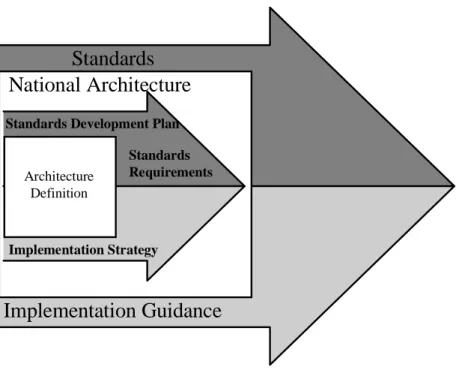
The merit of the National Architecture will only be realized through deployment of architecture-compatible systems. As presented in Figure 1.1-1, the Implementation Strategy plays a key role in bridging from the National Architecture Definition (documented in separate Logical Architecture and Physical Architecture deliverables) to real-world ITS deployments. It is intended to instruct transportation practitioners in the appropriate application of the architecture products in ITS implementations. It is anticipated that this Implementation Strategy will serve as a source for and mature into more comprehensive Implementation Guidance. Companion Standards Development Plan and Standards Requirements Documents build on the basic architecture definition in a similar fashion but are products oriented towards the Standards Development Organizations and development of standards which follow from the architecture definition.
1.2 Guiding Principles
Wide spread implementation of ITS services will result from a multitude of individual deployment decisions by public agencies and the private sector. The National Architecture preserves choice for each of these implementors by limiting its scope to include only those interfaces and functional descriptions that address key system interoperability issues. This conservative scope allows each implementor to make maximum use of existing assets and provides a variety of evolutionary paths for maturing ITS capabilities based on individual priorities.
The National Architecture was developed by a diverse group of private companies, public agencies, and technical specialists which represent a microcosm of the range of stakeholders who will ultimately influence the scope and character of future ITS deployments. The architecture has benefited from participation by public agencies at the national, state, regional, and local levels. The issues which resonate from these organizations include preservation of local autonomy, effective utilization of what has already been built or is currently under construction, and flexibility to expand as local authorities deem appropriate. Institutions are very willing to cooperate as long as their interests are preserved.
These issues were echoed by private sector members of the team with the additional recommendation that utilizing existing infrastructure enables rapid early deployment, reduces risk through utilization of known technologies and organizations, and allows more reliable cost estimation. Leveraging the existing and emerging national communications infrastructure minimizes capital investment and new communication spectrum requirements. The nature of the
Standards
Implementation Guidance
National Architecture
Architecture Definition
Standards Development Plan
Implementation Strategy Standards
Requirements
Compatible ITS
Implementations
participation in pursuing these markets were also identified by private sector participants and accommodated in this strategy.
Reaching beyond the development team in a series of regional forums, focus groups, and personal interviews with various user groups, a significant requirement to address all of the stakeholder needs becomes evident. Failing to recognize individual special needs introduces a dis-interested party; one who may not support integration with the other ITS providers and may not accept ITS recommendations. Technical specialists have provided the balancing guidance to address all of these stakeholders’ needs including transit agencies, funding institutions, and other governmental bodies.
These considerations resulted in an Implementation Strategy which is based on several key principles:
Accommodate Varied, Incremental Deployment of ITS
• This “strategy” is not a prescription for every community, or even one community. It attempts to identify the key ingredients for successful ITS deployment. The recipe for a particular community must be based on identified needs and available resources.
• The strategy supports the critical needs of public organizations to maintain and improve existing systems. Initial ITS implementations will build on these systems.
• The strategy suggests early deployment of key enabling infrastructure that is aimed at the most critical problems of the particular locale. Early implementations enhance management of the transportation network and form a basis for many of the value-added information services associated with ITS.
• Staged implementation begins with these “islands” of basic ITS capability that are deployed in response to local needs. Increased travel demand, greater traveler expectations, and evolving needs encourages service expansion and eventual linking of these ITS islands. Geographic expansion will be paralleled by technology growth resulting in new capabilities, new products, and new features.
Expedite Development of Key Standards
• ITS standards provide a unifying framework that will enhance the interoperability of these diverse, locally-responsive ITS implementations. The strategy recommends the minimum level of standardization required to achieve interoperability while preserving existing investments and the potential for innovation.
Encourage Exploitation of Market Forces
• Market forces are relied upon, wherever possible, to promote implementation of ITS services. Such markets are expected to introduce many of the early products including electronic toll collection, route guidance, and commercial vehicle operations.
• As implementation issues are addressed, market demand will spur deployment of an increasing number of ITS services as a natural progression. The strategy intervenes only where necessary to stimulate and ensure the achievement of system inter-relationships, system goals (e.g. safety), and deployment of key technical dependencies.
• The strategy recognizes the benefit to the public that can be achieved when multiple entities, public and private, enter into partnerships to provide service. Private sector participation is promoted through emphasis on individual user fees for ITS services and other incentives that enhance the potential for profitability and encourage capital investments by private industry.
1.3 Document Structure and Intended Audience
The Implementation Strategy document is intended to serve the transportation professional who is involved in ITS implementation and wants to understand the implications of the National Architecture on such implementations. This Implementation Strategy (and the remaining National Architecture documents) will be of particular interest to those that are developing, or supporting the development of, regional ITS systems. This group includes system integrators, state and local implementors who are progressing towards integrated ITS implementations, and US DOT.
The Implementation Strategy builds from the architecture definition to specific recommendations for the ITS implementor over the course of the document. The contents of each of the document sections and the supporting appendices are summarized in the following paragraphs.
Sections 2 and 3 describe the architecture and the institutional context in which ITS implementations will occur. The material in these sections is the basis for the guidance and strategic recommendations that are presented in later sections. Sections 2 and 3 provide basic background information and overall concepts that should be germane to the entire audience for the document.
Section 2. What are the Potential Implementations? This section defines the National Architecture and describes its relationship to ITS implementation and the Intelligent Transportation Infrastructure (ITI). Major technology and standards requirements that are associated with the range of potential ITS implementations are identified. Important early deployments and synergies that enable efficient incremental implementation of more advanced services are also defined.
Section 3. Implementor Roles and Deployment Implications. ITS implementation ultimately relies on a diverse set of public and private sector implementors and implementation activities. Each of these implementors, their interactions, and their roles are differentiated and discussed within the context of the Institutional Layer of the National Architecture. The extent to which the formative market for ITS services can be relied on as a principal driver for deployment is discussed. Institutional issues that arise from multi-faceted public sector and private sector participation in ITS implementation are identified and their implications for the implementation strategy are assessed.
Sections 4 and 5 form the crux of the implementation strategy. Here, guidance and recommendations are presented which are sensitive to the definitions and issues raised in the previous sections. As indicated by the titles, sections 4 and 5 are specifically targeted to the
Section 4. State and Local Guidance. This section provides preliminary implementation guidance to the local stakeholder which will be elaborated and superseded by follow-on activities to the National Architecture program.
Section 5. DOT Strategy Recommendations. Focused recommendations are then made to US DOT that are intended to facilitate beneficial, nationally compatible ITS implementations through selective standardization, policy guidance, and strategic investment.
The complementary emphasis of sections 4 and 5 provides focused material for different segments of the intended audience. However, the structure is not meant to segregate the document’s audience to individual, self-contained sections. Indeed, each of the sections is interrelated to reflect the often cooperative nature of ITS implementation. An understanding of the architecture and its implications for implementation, from the perspective of any individual stakeholder, is best achieved by reading the entire document with particular attention to the targeted section(s) of interest.
Appendix A. Detailed Market Package Definitions. The market packages that are introduced in section 2 are more fully defined. This section describes the service provided, enumerates major implementation options, and illustrates how the architecture framework supports this service for each defined market package.
Appendix B. Forecast Implementations. This appendix provides a general vision of how the market packages could be provided over time for a representative set of scenarios. These forecasts document efficient deployment sequences that reflect a projected natural evolution of ITS service provision through market development and appropriate public sector decision-making.
Appendix C. Case Studies. Several case studies were performed as part of the Implementation Strategy development effort. Case studies collected and organized data regarding ITS implementations and potential implementors through interviews and secondary research. The case studies cover a representative set of implementations, project scales, institutional settings, and geographic locations to provide a range of real requirements from actual implementors. Case study excerpts are used to illustrate the points made in sections 2 through 5. The full set of case study reports is located in Appendix C.
2. What are the Potential Implementations?
This section introduces the architecture defined by the National ITS Architecture Program and relates this definition to the range of ITS services and implementation options that will be considered by implementors. This relationship between architecture and implementation is presented using a defined set of Market Packages.
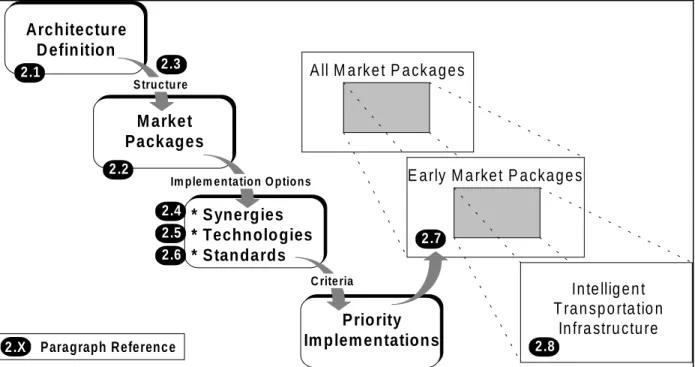
The technical implications of these implementation choices are then considered and used to identify promising early deployments. These likely candidates for early deployment are identified as Early Market Packages. Finally, the implementation choices are related to the Intelligent Transportation Infrastructure initiative. Figure 2-1 shows the general structure of the section and the relationships between each of the subparagraphs.
M arket Packages Architecture D efinition * Synergies * Technologies * Standards S tructu re
Im plem entation O ptions
2.1 2 .2 2.4 2.5 2.6 Priority Im plem entations C rite ria 2.3 A ll M a rk e t P a ck a g e s 2 .X Paragraph Reference
E a rly M a rke t P a cka g e s
In te llig e n t T ra n sp o rta tio n
In fra stru ctu re 2.8
2 .7
Figure 2-1: Section 2 Content and Sequence
2.1 Architecture Definition
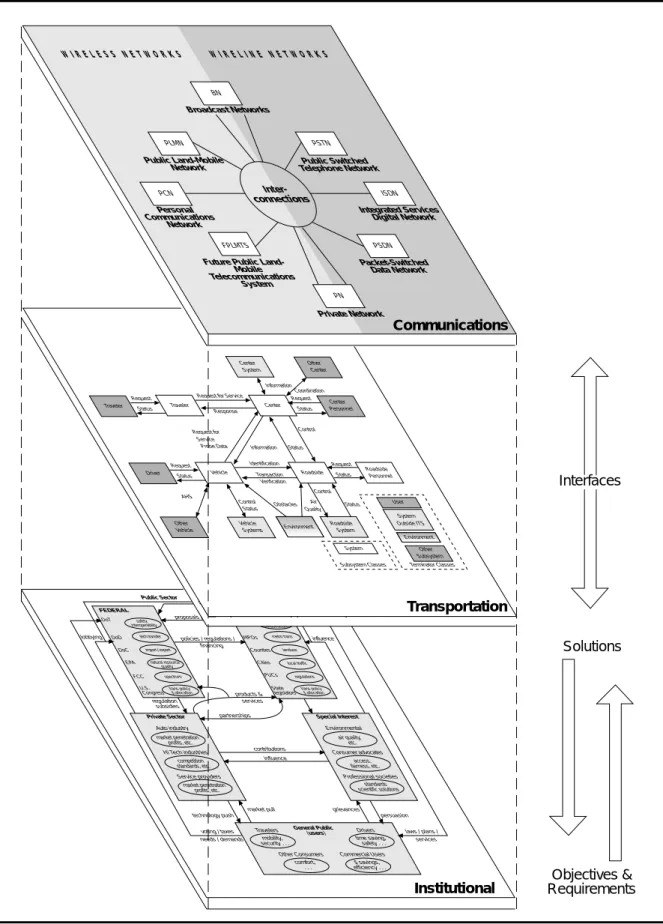
The National ITS Architecture provides a framework for designing transportation systems that implement the ITS User Services. The User Services were developed as part of the National ITS Program Planning process and were the key source requirements for the Architecture Development effort. The architecture defines the functions that must be performed, the subsystems that provide these functions, and the information that must be exchanged to support these User Services. The architecture is comprised of two technical layers, a Transportation Layer and a Communication Layer, which must operate in the context of an Institutional Layer.
FEDERAL STATE/LOCAL lobbying Public Sector Special Interest General Public (users) Travelers Drivers
Other Consumers Commercial Users
contributions influence
market pull grievances
persuasion services laws / plans / time saving, safety . . . $ savings, efficiency . . . comfort, . . . mobility, security . . . needs / demands voting / taxes technology push market penetration profits, etc. competition standards, etc. market penetration profits, etc. standards scientific solutions access, fairness, etc. air quality, etc. Private Sector Auto industry Hi Tech industries Service providers Environmental Consumer advocates Professional societies partnerships products & services policies / regulations / financing proposals / taxes influence hwy ops/mtce infrastructure metro trans landuse local traffic regulations trans policy $ allocation State DoTs MPOs Counties Cities PUCs State legislators safety interoperability tech transfer import / export natural resource quality spectrum trans policy $ allocation DoT DoD DoC EPA FCC U.S. Congress regulation subsidies
Institutional RequirementsObjectives & Solutions Interfaces Traveler Traveler Vehicle Vehicle Systems Driver Other Vehicle Center Personnel Center Roadside Personnel Other Center Roadside Roadside System Center System
Request for Service
Request for Service Probe Data Control Information Coordination Control Identification Control Status AHS Environment Obstacles Air Quality Response Status Information Transaction Verification Request Status Request Status Request Status Status Request Status System User System Outside ITS Environment Other Subsystem Terminator Classes Subsystem Classes Transportation W I R E L E S S N E T W O R K S Inter-connections PSTN PCN ISDN Broadcast Networks Public Switched Telephone Network Integrated Services Digital Network Packet-Switched Data Network Private Network Future Public
Land-Mobile Telecommunications System Personal Communications Network Communications W I R E L I N E N E T W O R K S PSDN PN FPLMTS BN PLMN Public Land-Mobile Network
The Transportation Layer includes the various transportation-related processing centers, distributed roadside equipment, vehicle equipment, and other equipment used by the traveler to access ITS services. The Transportation Layer is fully documented in the separate Physical Architecture deliverable. The Communication Layer provides for the transfer of information between the Transportation Layer elements. The technical details associated with the Communication Layer are presented in the Communications Document deliverable. The Transportation and Communication Layers together are the architecture framework that coordinates overall system operation by defining interfaces between equipment which may be deployed by different procuring and operating sectors. The Institutional Layer introduces the policies, funding incentives, working arrangements, and jurisdictional structure that support the technical layers of the architecture. The Institutional Layer is fully defined in section 3. This section provides an overview of the architecture framework by presenting the Transportation and Communication Layer definitions in more detail.
The architecture framework defines what each major transportation system element does and how they interact to provide all user services. This framework of subsystems and interfaces is specified in an implementation independent fashion to preserve maximum implementation flexibility.
The benefits of the architecture framework are the benefits of interoperability. For the private sector, interoperability and compatibility create larger markets for ITS products. For public sector and individual consumers of these products, the benefits are reduced costs and more efficient operations through economy of scale and increased competition. Coast to coast utility of ITS services and “mix and match” parts replacement are also primary benefits for the individual consumer. It is important to note that the architecture framework, by itself, will not achieve the desired national interoperability and compatibility goals. To achieve this end, the architecture framework requirements must be interpreted and developed into consensus standards by Standards Development Organizations such as ITE, SAE, and IEEE. This work is on-going.
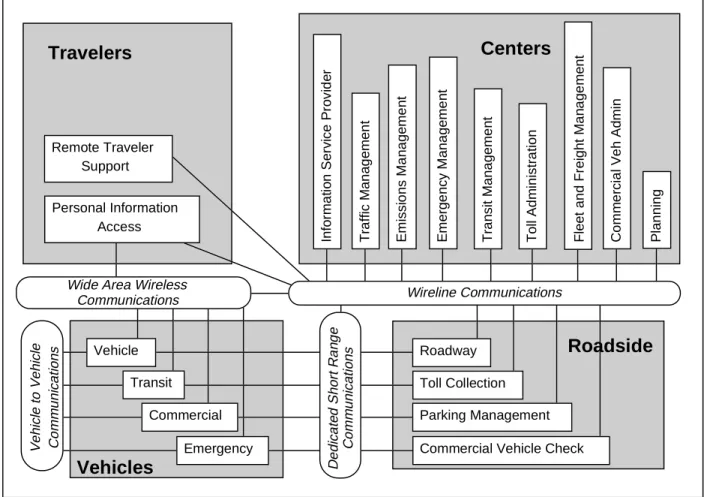
Figure 2.1-1 provides a high-level view of the architecture framework. The figure includes both the transportation and communication layers of the architecture since it depicts both the subsystems (transportation layer elements) and the major communications interconnects (communication layer elements) required to support the user services
Travelers Remote Traveler Support Vehicle Roadway Toll Collection Parking Management Commercial Vehicle Check Transit Commercial Emergency Vehicles Roadside Centers E m issi o n s Ma na geme n t T raf fi c M a na ge m e nt E m erge ncy M ana geme n t Tra n sit Ma na geme n t T o ll Ad m in istr a tion Fleet an d Fr eight Ma n a ge ment C o mm er c ial V e h A d m in In fo rm at io n S e rv ic e P ro v id e r V e hicle to V e hicle C o m m u n icat ions D e dica te d S hor t Ra n g e C o m m u n icat ions Personal Information Access
Wide Area Wireless Communications
P
lan
ning
Wireline Communications
Figure 2.1-2: ITS Architecture Subsystems and Communications
2.1.1 Transportation Layer Architecture
The Transportation Layer includes the nineteen interconnected subsystems identified in Figure 2.1-2. The selected subsystems align closely with existing jurisdictional and physical boundaries that underscore the operation and maintenance of current transportation systems. By mirroring the current transportation environment with the identified subsystems, the subsystem boundaries identify the likely candidates for interface standardization. The architecture recognizes these boundaries to minimize the impact associated with adoption of the architecture. Maximum commonality between existing transportation system boundaries and architecture boundaries serves to minimize the number of artificial boundaries which are imposed (and constrained) by the architecture.
Reference the Physical Architecture document for complete subsystem definitions. Within the Physical Architecture, each subsystem is further decomposed into one or more equipment packages. Equipment packages represent the lowest level of decomposition identified by the Physical Architecture.
As illustrated in figure 2.1-2, the subsystems may be grouped into four distinct subsystem classes that share basic functional, deployment, and institutional characteristics. These classes (Centers, Roadside, Vehicles, and Travelers) are used to group top level descriptions for each of the subsystems in this section.
Center Subsystems
The center subsystems provide management, administration, and support functions for the transportation system. The center subsystems each communicate with other centers to enable coordination between modes and across jurisdictions within a region. The center subsystems also communicate with roadside and vehicle subsystems to gather information and provide information and control that is coordinated by the center subsystems.
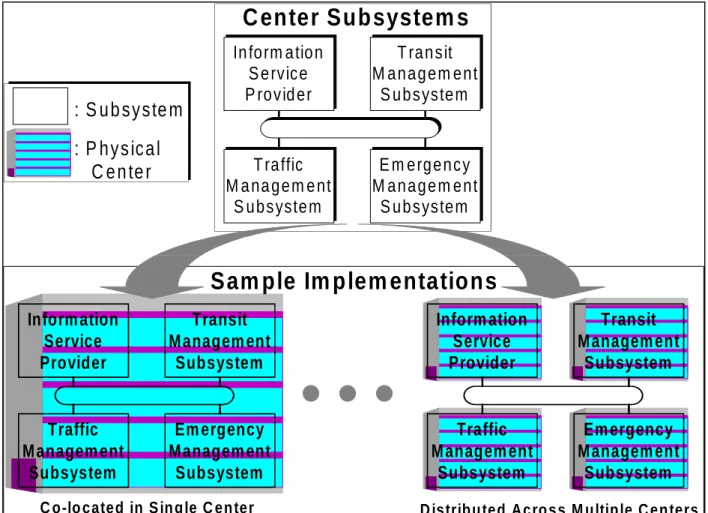
Before describing the center subsystems in detail, an important distinction must be made between the “center” subsystems and the transportation management “centers” that are familiar to most transportation professionals. In simplest terms, the center subsystems are not “brick and mortar”. Each subsystem is a cohesive set of functional definitions with required interfaces to other subsystems; subsystems are functionally defined, not physically defined. A regional implementation may include a single physical center that collocates the capabilities from several of the center subsystems. For instance, a single Transportation Management Center may include Traffic Management Subsystem, Transit Management Subsystem, Emergency Management Subsystem, and Information Service Provider subsystem capabilities. Conversely, a single subsystem may be replicated in many different physical centers in a complex metropolitan area system. For instance, the traffic management subsystem may be implemented in a traffic management center for freeway control in addition to several distinct city traffic management centers that cooperatively control the arterials. Figure 2.1-3 provides an indication of the range of ways that center subsystems may be implemented in physical centers.
Commercial Vehicle Administration Subsystem
The Commercial Vehicle Administration Subsystem will operate at one or more fixed locations within a region. This subsystem performs administrative functions supporting credentials, tax, and safety regulations. It issues credentials, collects fees and taxes, and supports enforcement of credential requirements. This subsystem communicates with the Fleet and Freight Management Subsystems associated with the motor carriers to process credentials applications and collect fuel taxes, weight/distance taxes, and other taxes and fees associated with commercial vehicle operations. The subsystem also receives applications for, and issues special Oversize/Overweight and HAZMAT permits in coordination with other cognizant authorities. The subsystem coordinates with other Commercial Vehicle Administration Subsystems (in other states/regions) to support nationwide access to credentials and safety information for administration and enforcement functions. This subsystem supports communications with Commercial Vehicle Check Subsystems operating at the roadside to enable credential checking and safety information collection. The collected safety information is processed, stored, and made available to qualified stakeholders to identify carriers and drivers that operate
C enter Subsystem s
Sam ple Im plem entations
T raffic M a na gem e nt S ubsystem E m ergency M anagem ent S ubsystem T ransit M anagem ent S ubsystem In form ation S ervice P rovid er
C o-lo cated in S in g le C en ter D istrib u ted Acro ss M u ltip le C en ters
Transit M anagem ent Subsystem Inform ation Service Provider Traffic M anagem ent Subsystem Em ergency M anagem ent Subsystem
: P h y s ic a l
C e n te r
: S u b s y s te m
Transit M anagem ent Subsystem Inform ation Service Provider Traffic M anagem ent Subsystem Em ergency M anagem ent SubsystemFigure 2.1-3: Center Subsystems May Be Implemented In Various Regional Configurations
Emergency Management Subsystem
The Emergency Management Subsystem operates in various emergency centers supporting public safety including police and fire stations, search and rescue special detachments, and HAZMAT response teams. This subsystem interfaces with other Emergency Management Subsystems to support coordinated emergency response involving multiple agencies. The subsystem creates, stores, and utilizes emergency response plans to facilitate coordinated response. It tracks and manages emergency vehicle fleets. Real-time traffic information received from the other center subsystems is used to further aid the emergency dispatcher in selecting the emergency vehicle(s) and routes that will provide the most timely response. Interface with the Traffic Management Subsystem allows strategic coordination in tailoring traffic control to support en-route emergency vehicles. Interface with the Transit Management Subsystem allows coordinated use of transit vehicles to facilitate response to major emergencies.
Emissions Management Subsystem
This subsystem operates at a fixed location and may co-reside with a Traffic Management Subsystem or may operate in its own distinct location depending on regional preferences and priorities. This subsystem provides the capabilities for air quality managers to
monitor and manage air quality. These capabilities include collecting emissions data from distributed emissions sensors within the roadway subsystem. These sensors monitor general air quality within each sector of the area and also monitor the emissions of individual vehicles on the roadway. The sector emissions measures are collected, processed, and used to identify sectors exceeding safe pollution levels. This information is provided to toll administration, traffic management, and transit management systems and used to implement strategies intended to reduce emissions in and around the problem areas. Emissions data associated with individual vehicles, supplied by the Roadway Subsystem, is also processed and monitored to identify vehicles that exceed standards. This subsystem provides any functions necessary to inform the violators and otherwise ensure timely compliance with the emissions standards.
Fleet and Freight Management Subsystem
The Fleet and Freight Management Subsystem manages fleets of commercial vehicles. The subsystem may be a large private trucking firm or a public agency with a fleet of vehicles. Smaller scale implementations oriented towards the independent owner/operator are also supported. The subsystem provides the capability for dispatchers to receive real-time routing information and access databases containing vehicle and cargo locations as well as carrier, vehicle, cargo, and driver information. It provides for the efficient purchase of electronic credentials through automated interface with clearinghouses and regulatory agencies. The Fleet and Freight Management Subsystem may operate either in a firm’s home office through dedicated facilities, or at a truck or rest stop through a public kiosk. These sites communicate with authorities via standard wireline communications. Alternatively, the functions provided by this subsystem could be implemented on a portable computer and managed from the cab of the vehicle using wide area wireless communications.
Information Service Provider Subsystem
This subsystem provides the capabilities to collect, process, store, and disseminate traveler information to subscribers and the public at large. Information provided includes basic advisories, real time traffic condition and transit schedule information, yellow pages information, ridematching information, and parking information. The subsystem also provides the capability to provide specific directions to travelers by receiving origin and destination requests from travelers, generating route plans, and returning the calculated plans to the users. Reservation services are also provided in advanced implementations. The information is provided to the traveler through the Personal Information Access Subsystem, Remote Traveler Support Subsystem, and various Vehicle Subsystems through available communications links. Both basic one-way (broadcast) and personalized two-way information provision is supported. The subsystem provides the capability for an informational infrastructure to connect providers and consumers, and gather that market information needed to assist in the planning of service improvements and in maintenance of operations.
Traffic Management Subsystem
The Traffic Management Subsystem operates within a traffic management center or other fixed location. This subsystem communicates with the Roadway Subsystem to monitor and manage traffic flow. Incidents are detected and verified and incident information is provided to the Emergency Management Subsystem, travelers (through Roadway Subsystem Highway Advisory Radio and Variable Message Signs), and to third party providers. The subsystem supports HOV lane management and coordination, road pricing, and other demand management policies that can alleviate congestion and influence mode selection. The subsystem monitors and manages maintenance work and disseminates maintenance work schedules and road closures. The subsystem also manages reversible lane facilities, and process probe vehicle information. The subsystem communicates with other Traffic Management Subsystems to coordinate traffic information and control strategies in neighboring jurisdictions. It also coordinates with rail operations to support safer and more efficient highway traffic management at highway-rail intersections. Finally, the Traffic Management Subsystem provides the capabilities to exercise control over those devices utilized for AHS traffic and vehicle control.
Toll Administration Subsystem
The Toll Administration Subsystem provides general payment administration capabilities to support electronic assessment of tolls and other transportation usage fees. This subsystem supports traveler enrollment and collection of both pre-payment and post-payment transportation fees in coordination with the existing, and evolving financial infrastructure supporting electronic payment transactions. The system sets up and administers escrow accounts to support pre-payment operations. It supports communications with the Toll Collection Subsystems (and Parking Management Subsystems and Transit Management Subsystems) to support fee collection operations. The subsystem also sets and administers the pricing structures and includes the capability to implement road pricing policies in coordination with the Traffic Management Subsystem. The electronic financial transactions in which this subsystem is an intermediary between the consumer and the financial infrastructure shall be cryptographically protected and authenticated to preserve privacy and ensure authenticity and auditability.
Transit Management Subsystem
The Transit Management Subsystem provides the capability for determining accurate ridership levels and implementing corresponding fare structures. The fare system shall support travelers using a fare medium applicable for all surface transportation services. The subsystem also provides for optimized vehicle and driver assignments, and vehicle routing for fixed and flexibly routed transit services. Interface with the Traffic Management Subsystem control shall be integrated with traffic signal prioritization. This will allow for transit schedule adjustments and automated transit vehicle maintenance management with schedule tracking. The Transit Management Subsystem also provides the capability for automated planning and scheduling of public transit operations. The subsystem shall also provide the capability to furnish travelers with real-time travel
information, continuously updated schedules, schedule adherence information, transfer options, and transit routes and fares. In addition, the capability for the monitoring of key transit locations with both video and audio systems shall be provided with automatic alerting of operators and police of potential incidents including support of traveler activated alarms.
Planning Subsystem
The Planning Subsystem accepts data from every center subsystem and uses this data to plan new deployments and new ITS operations. This data also supports policy decision making, allocation of funding, allocation of resources and other planning activities.
Roadside Subsystems
These distributed infrastructure subsystems provide the direct interface to vehicles traveling on the roadway network. Each of the roadside subsystems include functions that must be located on or near the roadway to support direct surveillance, information provision, and control plan execution. All roadside subsystems interface to one or more of the center subsystems which govern overall operation of the roadside subsystems. The roadside subsystems also generally include direct user interfaces to drivers and other travelers on the roadway network as well as short range interfaces to the Vehicle Subsystems.
Commercial Vehicle Check Subsystem
The Commercial Vehicle Check Subsystem supports automated vehicle identification at mainline speeds for credential checking, roadside safety inspections, and weigh-in-motion using two-way data exchange. These capabilities include providing warnings to the commercial vehicle drivers, their Fleet and Freight managers, and proper authorities of any safety problems that have been identified, accessing and examining historical safety data, and automatically deciding whether to allow the vehicle to pass or require it to stop with operator manual override. The Commercial Vehicle Check Subsystem also provides supplemental inspection services to current capabilities by supporting expedited brake inspections, the use of operator hand-held devices, on-board safety database access, and the enrollment of vehicles and carriers in the preclearance program.
Parking Management Subsystem
The Parking Management Subsystem provides the capability to provide parking availability and parking fee information, allow for parking payment without the use of cash with a multiple use medium, and support the detection, classification, and control of vehicles seeking parking.
Roadway Subsystem
This subsystem includes the equipment distributed on and along the roadway which monitors and controls traffic. Equipment includes highway advisory radios, variable message signs, cellular call boxes, CCTV cameras and video image processing systems
warning systems, and freeway ramp metering systems. This subsystem also provides the capability for emissions and environmental condition monitoring including weather sensors, pavement icing sensors, fog etc. HOV lane management and reversable lane management functions are also available. In advanced implementations, this subsystem supports automated vehicle safety systems by safely controlling access to and egress from an Automated Highway System through monitoring of, and communications with, AHS vehicles. Intersection collision avoidance functions are provided by determining the probability of a collision in the intersection and sending appropriate warnings and/or control actions to the approaching vehicles.
Toll Collection Subsystem
The Toll Collection Subsystem provides the capability for vehicle operators to pay tolls without stopping their vehicles using pricing structures for locally determined needs and including the capability to implement various variable road pricing policies. Transactions to each customer shall be provided a confirmation and implemented to minimize fraud by supporting vehicle identification technologies and accommodating single billing to commercial carriers.
Vehicle Subsystems
These subsystems are all vehicle-based and share many general driver information, vehicle navigation, and advanced safety systems functions. The vehicle subsystems communicate with the roadside subsystems and center subsystems for provision of information to the driver. In the following descriptions, the Vehicle Subsystem description includes general traveler information and vehicle safety functions that are also applicable to the three fleet vehicle subsystems (Commercial Vehicle Subsystem, Emergency Vehicle Subsystem, and Transit Vehicle Subsystem). The fleet vehicle subsystems all include vehicle location and two-way communications functions that support efficient fleet operations. Each of the three fleet vehicle subsystems also include functions that support their specific service area
Vehicle Subsystem
This subsystem resides in an automobile and provides the sensory, processing, storage, and communications functions necessary to support efficient, safe, and convenient travel by personal automobile. Information services provide the driver with current travel conditions and the availability of services along the route and at the destination. Both one-way and two-way communications options support a spectrum of information services from low-cost broadcast services to advanced, pay for use personalized information services. Route guidance capabilities assist in formulation of an optimal route and step by step guidance along the travel route. Advanced sensors, processors, enhanced driver interfaces, and actuators complement the driver information services so that, in addition to making informed mode and route selections, the driver travels these routes in a safer and more consistent manner. Initial collision avoidance functions provide “vigilant co-pilot” driver warning capabilities. More advanced functions assume limited control of the vehicle to maintain safe headway. Ultimately, this subsystem supports completely automated vehicle operation through advanced communications with other
vehicles in the vicinity and in coordination with supporting infrastructure subsystems. Pre-crash safety systems are deployed and emergency notification messages are issued when unavoidable collisions do occur.
Commercial Vehicle Subsystem
This subsystem resides in a commercial vehicle and provides the sensory, processing, storage, and communications functions necessary to support safe and efficient freight movement. The Commercial Vehicle Subsystem provides two-way communications between the commercial vehicle drivers, their fleet managers, and roadside officials, and provides HAZMAT response teams with timely and accurate cargo contents information after a vehicle incident. This subsystem provides the capability to collect and process vehicle, cargo, and driver safety data and status and alert the driver whenever there is a potential safety problem. Basic identification and safety status data are supplied to inspection facilities at mainline speeds. In addition, the subsystem will automatically collect and record mileage, fuel usage, and border crossings.
Emergency Vehicle Subsystem
This subsystem resides in an emergency vehicle and provides the sensory, processing, storage, and communications functions necessary to support safe and efficient emergency response. The Emergency Vehicle Subsystem includes two-way communications to support coordinated response to emergencies in accordance with an associated Emergency Management Subsystem. Emergency vehicles are equipped with automated vehicle location capability for monitoring by vehicle tracking and fleet management functions in the Emergency Management Subsystem. Using these capabilities, the appropriate emergency vehicle to respond to each emergency is determined. Route guidance capabilities within the vehicle enable safe and efficient routing to the emergency. In addition, the emergency vehicle may be equipped to support signal preemption through communications with the roadside subsystem.
Transit Vehicle Subsystem
This subsystem resides in a transit vehicle and provides the sensory, processing, storage, and communications functions necessary to support safe and efficient movement of passengers. The Transit Vehicle Subsystem collects accurate ridership levels and supports electronic fare collection. An optional traffic signal prioritization function communicates with the roadside subsystem to improve on-schedule performance. Automated vehicle location functions enhance the information available to the Transit Management Subsystem enabling more efficient operations. On-board sensors support transit vehicle maintenance. The Transit Vehicle Subsystem also furnishes travelers with real-time travel information, continuously updated schedules, transfer options, routes, and fares.
Traveler Subsystems
The traveler subsystems include the equipment that is used by the traveler to gather information and access other personal information services prior to a trip and while en-route. The class
by transportation providers and information providers. Though the equipment owned by the traveler (e.g., personal computer, personal digital assistant) is often general purpose and used for a variety of tasks, this equipment is specifically used for gaining access to traveler information within the scope of the ITS architecture. These subsystems interface to the information provider (one of the center subsystems, most commonly the Information Service Provider Subsystem) to access the traveler information. A range of service options and levels of equipment sophistication are supported.
Personal Information Access Subsystem
This subsystem accesses traveler information at home, at work, and other locations frequented by the traveler using personal fixed and portable devices over multiple types of electronic media. Radio, television, personal computers, personal digital assistants, telephones, and any other communications-capable consumer products that can be used to supply information to the traveler are all encompassed by this subsystem definition. Sophistication ranges from simple receipt of broadcast advisories to advanced interactive capabilities which enables users to receive route plans and other real-time information tailored to their individual needs. Other available capabilities include Mayday and real-time reservation services.
Remote Traveler Support Subsystem
This subsystem provides access to traveler information at transit stations, transit stops, other fixed sites along travel routes, and at major trip generation locations such as special event centers, hotels, office complexes, amusement parks, and theaters. Traveler information access points include kiosks and informational displays supporting varied levels of interaction and information access. At transit stops, simple displays provide schedule information and imminent arrival signals. This basic information may be extended to include multi-modal information including traffic conditions and transit schedules along with yellow pages information to support mode and route selection at major trip generation sites. Personalized route planning and route guidance information can also be provided based on criteria supplied by the traveler. In addition to traveler information provision, this subsystem also supports public safety monitoring using CCTV cameras or other surveillance equipment and emergency notification within public areas. Fare card maintenance, and other features which enhance traveler convenience may also be provided at the discretion of the deploying agency.
2.1.2 Communication Layer Architecture
The Communication Layer provides information transfer for the Transportation Layer subsystems. It includes all of the communications entities (e.g., wireline and wireless transmitters, receivers, satellites) and the information management and transport capabilities necessary to transfer information among the transportation entities. The application data content and the transportation application requirements are, in general, transparent to the communication architecture. The communication architecture’s view of the transportation layer is that of many distributed users, some of them mobile, which require communication services.
Due to variation in the ITS user service requirements (from a communication perspective), ITS implementations will require a range of communication services. Specifically, some ITS user services will be best served by leveraging commercial telecommunication infrastructures, others will require specialized, dedicated communication systems. The differences in these architectural choices can lead to dramatic differences in cost, deployability, and performance.
The "Communication Services" that are provided by the Communication Layer are defined according to communications governing bodies and should not be confused with the ITS user services. The communication services define the exchange of information between two points and are independent of the media and application. In essence, they are a set of information transfer capabilities provided by the Communication Layer to a user in the Transportation Layer. Figure 2.1-4 illustrates the hierarchy of communication services. A brief description of the services follows; more detailed definitions are provided in the Communications Document..
Service
Conversational Messaging Broadcast Multicast
Interactive Distribution
Communication services consist of two broad categories, interactive and distribution. Interactive services allow the user to exchange data with other users or providers in real or near real time, asking for service or information and receiving it in the time it takes to communicate or look up the information. Distribution services allow the user to send the same message to multiple other users.
Interactive services may be either conversational or messaging. Conversational implies the use of a two-way connection established before information exchange begins and terminated when the exchange is completed. Messaging, on the other hand, works more like electronic mail being exchanged between users. The messages are exchanged without establishing a dedicated path between the two sites. Each message is addressed and placed on the network for transmission, intermixed with messages from other users. The communications community labels this mode of communication a “datagram” service.
Distribution services may be either broadcast or multicast and may be used over wireline and/or wireless communication links. Broadcast messages are those sent to all users while multicast messages are sent only to a subset of users. Multicast differs from broadcast in its use of a designated address for all users and user groups. Examples of broadcast information might include current weather or road conditions, whereas multicast information might be information sent to all drivers working for a specific company. A changing group membership could be the set of users traveling between two locations or with a certain destination, for which unique information must be transmitted. The services that can be supported using circuit or packet connection mode include voice, video, image and data.
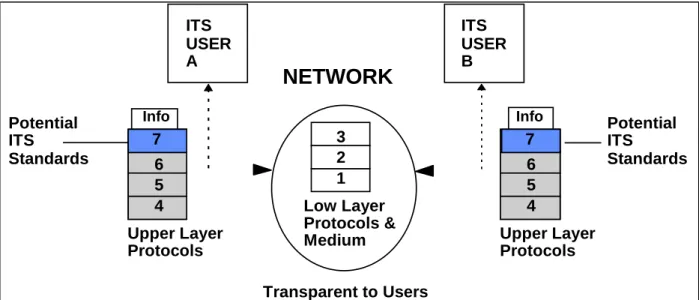
The relationship between the Communication Layer and the Transportation Layer is presented in the generic hierarchical communication model in Figure 2.1-5. The figure follows the Open Systems Interconnection model which is structured as a series of layers, each providing certain services to the layer above and capable of conversing with the corresponding layer at the other end of the link. Thus the high level layers (e.g., ITS application) are shielded from the actual implementation details of the communication services. Different networks can use layers different from the OSI model, such as the IBM SNA (Systems Network Architecture). When different protocols are used in different networks, an interworking function must provide the conversion between the protocols at the various levels.
The ITS users in the figure are the Transportation Layer subsystems which share information. The Transportation Layer user is not concerned with the specifics of the information transfer performed by the Communication Layer. In fact, the Communication Layer can be viewed as plumbing that transparently carries information between users. Communications Service requirements are assigned in the Communication Layer for each data flow that is defined in the Transportation Layer.
1 2 3 4 5 6 7 4 5 6 4 5 6 7 4 5 6 Upper Layer Protocols Upper Layer Protocols Low Layer Protocols & Medium ITS USER A
NETWORK
Info Info Potential ITS Standards Potential ITS Standards 7 7 Transparent to Users ITS USER BFigure 2.1-5 Generic Hierarchical Communication Model
In general, the communication architecture has two components: one wireless and one wireline. All Transportation Layer entities requiring information transfer are supported by one or both of these components. In most cases, the wireless component merely provides a tetherless user, usually one in a vehicle, with access to fixed (or wireline) network resources. The wireless portion is manifested in three different ways. Each of the four identified interface types (three wireless and one wireline) are defined as follows:
• Wide Area Wireless Communications defines cell-based wireless infrastructures
supporting wide-area information transfer (most data flows). The cell-based airlink, from a mobile terminal to one of a set of base stations, provides connections between mobile users or between mobile and fixed network-connected users (e.g., those connected to the telephone network). It is typified by the current cellular telephone network, the larger cells of Specialized Mobile Radio, and PCS. This interface type also includes one-way broadcast wireless communications systems used to provide basic traveler information across a wide-area. Both voice and data communications are included. FM Subcarrier is a prime example of a data capable, broadcast communications technology that would be included.
• Dedicated Short Range Communications defines the short-range airlink used for
close-proximity (less than 50-100 feet) transmissions between a mobile user and a base station, typified by transfers of vehicle identification numbers at toll booths.
• Vehicle to Vehicle Communications addresses the dedicated wireless system handling high
data rate, low probability of error, line of sight, AHS-related data flows, such as vehicle to vehicle transceiver radio systems.
• Wireline Communications addresses the information transfer between two fixed entities.
Typically, this interface will be manifested using one of the many alternative existing public or private networks that may physically include wireless (e.g. microwave) as well as wireline infrastructure.
2.2 Market Packages
The architecture definition presented in the previous section is intended to be extremely accommodating.
• It supports the complete range of ITS services from basic signal control improvements to Automated Highway Systems.
• It is scaleable so that implementations that are suitable for the nations largest population centers as well as the most remote rural areas are supported with equal aplomb.
• It is specified in a technology independent manner so that a range of current and future technologies can be supported by the framework.
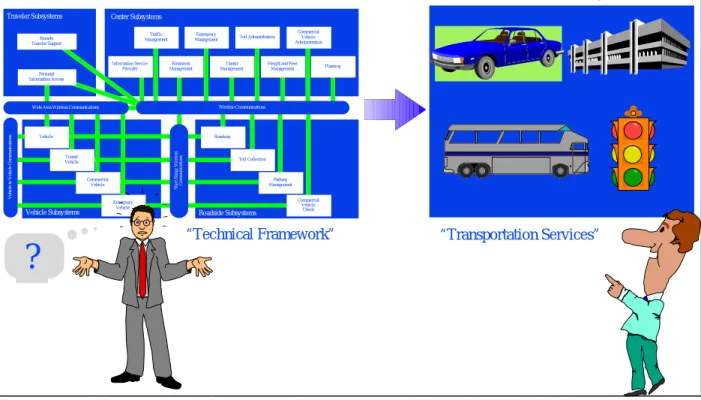
All this flexibility is necessary since the architecture must accommodate the range of possible ITS implementations from coast to coast and over a twenty year timeframe. Unfortunately, this flexibility also makes it difficult to understand precisely what pieces of the architecture are applicable and how they can best be applied in solving a particular communities current transportation problems (see figure 2.2-1).
V eh icl e t o V eh ic le C o m m u n ica ti o n s Commercial Vehicle Check
Vehicle Subsystems Roadside Subsystems
Parking Management Toll Collection Roadway Emergency Vehicle Commercial Vehicle Transit Vehicle Vehicle Remote Traveler Support
Wide Area Wireless Communications
Commercial Vehicle Administration
Freight and Fleet Management Toll Administration Emergency Management Traffic Management Transit Management Emissions Management Information Service Provider
Traveler Subsystems Center Subsystems
Personal Information Access Planning Wireline Communications S h or t Ra n g e W ir el es s C o mmu ni ca ti o n s
Architecture Market Packages
“Technical Framework” “Transportation Services”
?
Figure 2.2-1: Translating Architecture to Implementation Through Market Packages
To provide visibility into the service options that will be con