Mihály Fazekas
1, István János Tóth
2, Lawrence Peter King
3Corruption manual for beginners
“Corruption techniques” in public procurement with examples from
Hungary
Working Paper series: CRCB-WP/2013:01
Version 2.0
July 2013, Budapest, Hungary
The Corruption Research Center Budapest was created in November 2013 in response to the growing need for independent research on corruption and quality of government in Hungary. The central aim of the Center is to systematically explore the causes, characteristics, and consequences of low quality of government, corruption, and regulatory failure using an inter-disciplinary approach. In addition, the Center also aims to help citizens to hold governments accountable through the use of robust evidence. Our unique research approach combines qualitative and quantitative methods to analyse micro-level actor behaviour and generates novel hard data on the phenomena under scrutiny.
Corruption Research Center Budapest: http://www.crcb.eu/
1
University of Cambridge and Corruption Research Center Budapest, [email protected],
www.mihalyfazekas.eu
2
Hungarian Academy of Sciences and Corruption Research Center Budapest
3
1
ABSTRACT
Corruption manual for beginners: “Corruption techniques” in public
procurement with examples from Hungary
4This paper develops 30 novel quantitative indicators of grand corruption that operationalize 20 distinct techniques of corruption in the context of public procurement. Each indicator rests on a thorough qualitative understanding of rent extraction from public contracts by corrupt networks as evidenced by academic literature, interviews and media content analysis. Feasibility and usefulness of the proposed indicators are demonstrated using micro-level public procurement data from Hungary in 2009-2012. While the prime value of this broad set of indicators is the possibility of combining them into a robust composite indicator of high-level corruption, the high degree of detail also reveals that many regulatory interventions have succeeded in changing the form of corruption, but not its overall incidence.
JEL classification: D72, D73, H57,
Keywords: public procurement, grand corruption, corruption technique, corruption indicators
4
The authors would like to thank the interviewees who devoted time to sharing their insights, while special thanks goes to the colleagues at the Corruption Research Centre working on the Hungarian public procurement database (MakAB) for over three years, especially Ágnes Czibik, Kinga Csizmás, and Tamás Uhrin. Furthermore, we would like to thank the colleagues at the University of Cambridge, especially Jonathan Kennedy for their insightful comments on the earlier drafts of this paper. Some of the underlying research activities were financed by the European Union and the Hungarian Government: TAMOP 4.2.2.B and ANTICORRP (Grant agreement no: 290529).
2
Table of contents
ABSTRACT ... 1
1. Introduction ... 3
2. Principles and models of good public procurement ... 7
2.1 Principles of good public procurement ... 7
2.2 Standard model of public procurement ... 8
3. The data ... 11
4. “Technologies” of corruption ... 14
4.1 Needs assessment and definition ... 14
T1.1 Defining unnecessary need ... 14
T1.2 Defining need in a way to benefit a particular supplier ... 15
4.2 Process design ... 16
T2.1 Tinkering with the threshold and exceptional rules ... 16
T2.2 Tailoring eligibility criteria ... 21
T2.3 Abusing formal and administrative requirements ... 24
T2.4 Tailoring assessment criteria ... 26
T2.5 Using a long term complex contract ... 30
T2.6 Tinkering with the submission period ... 33
4.3 Document preparation and dissemination ... 38
T3.1 Selective information provision ... 38
T3.2 Avoiding the publication of call for tenders ... 40
T3.3 Strategically modifying the call for tenders ... 41
T3.4 Excessively pricey and hard to access documentation ... 42
T3.5 Deliberate errors in document publication ... 44
4.4 Tender evaluation and award decision ... 47
T4.1 Strategically annulling the procedure ... 47
T4.2 Repeated violations of public procurement rules ... 50
T4.3 Unfair scoring ... 51
T4.4 Abusing the unit price of contract value ... 53
4.5 Contract implementation ... 54
T5.1 Modifying the contract strategically ... 54
T5.2 Abusing an add-on contract or emergency reserve ... 58
T5.3 Performance violating the contract ... 60
4.6 Summary of corruption techniques and their indicators ... 62
5. Instead of conclusions: the use of such an inventory and some reservations ... 64
5.1 Use of such an inventory ... 64
5.2 Interpretation challenges ... 64
Bibliography ... 66
3
1. Introduction
While there have been recent advances in measuring and understanding petty or low-level corruption (e.g. Charron, Lapuente, and Rothstein 2013; Rose and Peiffer 2012), research into grand or high-level corruption5 has remained underdeveloped in the last decades. This is in large part due to the lack of data. In order to advance research as well as evidence based policy, reliable indicators are needed to gauge the structure and the magnitude of grand corruption. Data based on perceptions and formal institutional structures are plentiful, but these have not proven particularly useful in unearthing the mechanisms creating and sustaining grand corruption. The only way forward is to understand the micro-level context of grand corruption in particular fields of government activity such as public investment, law-making, or issuing permits and licenses and to develop qualitative and quantitative indicators based on a thorough understanding of the corruption process.
Below, technologies of grand corruption in public procurement are described and corresponding quantitative indicators are developed which directly or indirectly signal their use. What we call corruption techniques are techniques used by corrupt actors to make their corrupt, often illegal, acts look legal and to hide their actions from the eyes of the public. For example, making competition for a public contract look fair and open whereas the winner and the contract value were already agreed before the launch of the tendering process. Each corruption technique is described in abstract terms by outlining its characteristic elements, the actors’ reasons for resorting to it, the constraints on application, and some real-life examples as reported by the media, the courts, or our interviewees. The list of these techniques which is far from complete, can nevertheless be considered as novel scientific result in itself. However, the main rationale for their structured discussion is to provide solid theoretical and methodological ground for quantitative indicators of grand corruption. These techniques can be considered as the input side of the public procurement corruption process where the output side is the collection of rents by the ‘right’6 organisations and individuals.
We intend to define the list of indicators as comprehensively as possible because techniques can be used interchangeably and in combination making the measurement quality of overall corrupt activities ultimately dependent on the adequacy of this list.
Corruption techniques are grouped by referring to the different stages of the public procurement process (see section 2.2) in order to highlight the interdependencies between them and to emphasize the process, flow character of such corruption instead of a static understanding. It is important to keep in mind that grand corruption is institutionalized, recurrent, and mobilizes considerable collective resources so elementary techniques must be seen as parts of a larger corrupt process. Each corruption technique involves violation of principles of good public procurement in order to achieve corrupt benefits even if narrowly defined laws and regulations are not infringed upon. While there are many possible errors and deviations from good public procurement principles (European Court of Auditors 2012), what makes the below corruption techniques intertwined with grand corruption is that they
5 Grand corruption (or state capture) refers to societal actors’ institutionalized and particularistic
influence over public rule formation or policy implementation through private payments or favours.
6 Throughout this paper, the terms ‘right’, ‘desired’, or ‘wanted’ organisation refers to those
organisations who form part of corrupt networks and are deliberately benefiting from corrupt rent allocation. A prime example is a company owned by the cousin of the mayor winning procurement contracts from the municipality in question.
4
are typically used by corrupt groups to hide and legalize their actions. That is, the below listonly contains those techniques which are reportedly employed by such groups as described by the media, courts, academic literature, and interviewees in Hungary. Hence, techniques and actions which may simply result from administrative error and incompetence are not discussed in this section as they cannot be reliably linked to grand corruption.
When defining individual techniques we followed the simple rule that each of them should be able to lead to corrupt rent extraction on its own if applied skilfully. This enabled us to identify the elementary building blocks of more complex corrupt strategies whose exact composition changes over time as regulation changes. Moreover, in practice, elementary techniques are typically combined with each other and various degrees of complementarities and substitutions exist among them (e.g. once all the ‘unwanted’ bidders are excluded on administrative grounds there is no need for subjectively applying award criteria to ‘unwanted’ bidders).
The below listed techniques are explained from the viewpoint of tender issuers which, nevertheless, does not indicate that it has to be the issuer who initiates the corrupt transaction or that the issuer possesses all or most of the knowledge necessary for managing the corrupt transaction. Taking the perspective of the issuer simply acknowledges the fact that it is the issuer who, at the end of the day, has to formally manage the process of public procurement. Interviews indicated that the initiation of the corrupt exchange or de facto management may very well be done by a powerful and well-connected company or a politically supported public procurement adviser. For example, the head of public procurement department of a major construction company reported: “I wrote the full tender documentation myself which was subsequently sent out to all bidders.”.
As we look at grand corruption and state capture primarily as resulting from collusion between some public and private actors, only those techniques of corruption are discussed below which involve or require the deliberate collaboration of the issuer, even though it may well be that multiple bidders take part in the corrupt transaction (e.g. the politically connected winning bidder pays off 2-3 other companies to mimic competition). By implication, cartels and likes involving bidders only are not part of the discussion.
In order to identify as complete and reliable list of corruption techniques as possible a number of data collection methods were used in Hungary:
the small body of academic literature was screened, including secondary analysis of interviews done by other researchers,
a review of media reports of concrete corruption cases was conducted,
original interviews were carried out with public procurement practitioners who have seen corrupt transactions close up, and
some court cases relating to public procurement corruption were reviewed.
First, we reviewed the small body of directly relevant academic literature of the last 10 years looking at corruption involving public procurement in Hungary and international research papers specifically looking at public procurement corruption. This literature collected data by interviews, surveys and media reviews; in addition, a few papers made use of administrative data and court cases. As the literature is small, standard keyword searches yielded very few documents, hence our search strategy largely relied on exploring the bibliographic network
5
of key publications. The literature review combined with our own ideas spawned the initial listand definitions of corruption techniques further refined by additional data collection.
Second, the review of media reports covered all major online newspapers of Hungary such as www.index.hu, www.origo.hu, www.fn.hu, www.mno.hu, http://vg.hu, http://hetivalasz.hu,
www.nol.hu, http://hvg.hu, and www.hir24.hu which together cover the whole political spectrum from the left to the right. Many of these have a print edition too, but our review was constrained to the online material which is mostly equivalent or even more extensive than the print version. The time period of systematic analysis was between 1/1/2008 and 1/8/20127, but further articles are also included from later dates if they were brought to our attention. Due to technical issues with newspaper archives there was some random variation in the completeness of our sample, that is some months are missing from the sample. However, this doesn’t weaken the analysis as the goal is to find examples rather than establish the prevalence of certain techniques in the press. Among all the articles of these online newspapers, we initially selected those that contained any keywords associated with corruption (concrete list of keywords can be found in Appendix A). In a second step, from this large sample of articles, we identified those which discussed a corruption case in public procurement in detail (i.e. simply stating that this and this contract award was corrupt and benefited this and this individuals was not good enough for selection). In the final step, this short list of articles was checked again by the authors and were categorised according to a pre-defined initial list of corruption techniques. Based on articles describing techniques beyond our initial list, new corruption techniques were defined leading to a list covering all the articles in the sample. The results of the media review can be found in Appendix A. Third, interviews with public procurement practitioners ‘close’ to corrupt transactions were carried out to explore the underlying rationale of each corruption technique, gather specific examples (without concrete names), verify whether the techniques are typically used in corrupt transactions, and to identify additional corruption techniques. We conducted semi-structured interviews lasting for about 1-1.5 hours with 14 individuals covering all three major actor categories of public procurement (issuers, bidders, and advisors). They work in construction, healthcare, and IT services sectors taking part in projects ranging from large infrastructure projects of millions of EUR to small services contracts of few thousand EUR. In all but one case, the interviewees either referred to concrete cases they saw from ‘close’ or described the suitability of a corruption technique in general to reach corrupt goals based on their experience. Given the sensitive nature of the topic, interviewees avoided explicitly mentioning names of individuals or companies. The interview evidence formed the basis on which the final list of corruption techniques was further refined.
Finally, there have been about 600-700 convictions per year by Hungarian courts on the basis of corruption charges between 1990 and 20098 and more than 1500 Hungarian court decisions mentioning “public procurement” since 20059. While we could already obtain the
text of court decisions, it requires additional work to systematically categorize and check these cases against the below list of corruption techniques. In addition, decisions of the European Court of Justice should also be screened and analysed to cover the full spectrum
7
In the case of http://hvg.hu and http://vg.hu we only had the online content starting from 1/11/2010.
8
For annual figures and details of case identification see:
http://www.crc.uni-corvinus.hu/download/korrupcios_buncselekmenyek_1972_2009_100428.xls
9
6
of judicial review of public procurement in Hungary. We only look at the documents referring7
2. Principles and models of good public procurement
At the heart of grand corruption in public procurement lies the simple fact that public procurement legislation in the EU and Hungary in particular prescribes basic universalistic principles which must be violated in order to collect the corruption rents. As grand corruption may very well succeed in appearing legal according to the detailed regulations covering public contract award, it is the underlying general principles which define clearly what is corrupt and what is not.
Thus, below we outline the underlying principles of good public procurement and define a simple abstract model of procurement activities allowing for grouping of corruption techniques. Each of the corruption techniques and the corresponding indicator relates to a specific public procurement activity and an underlying principle whose breach implies corruption.
2.1 Principles of good public procurement
While there is a multitude of principles of good public procurement in the academic and policy literatures as well as in EU and national laws, there are considerable overlaps among them paving the way for a synthesis valid for the last 10 years (i.e. about 2002-2012) (Arrowsmith 2009, 2010 ch. 1. OECD 2007; Transparency International 2006). While many of the principles in the literature relate to actual outcomes of public procurement such as efficiency of spending, our focus exclusively lies in the process of public procurement in order to aid later discussions of corruption techniques employed during procurement procedures.
The principles relating to the process of public procurement directly derive from the ideas of public sector integrity and impartial government creating the link between the general discussions of corruption and state capacity and the domain of public procurement. Hence, good public procurement rests on three principles which mutually support each other:
Transparency,
Fair competition10, and
Accountability.
The principle of transparency means that information about public procurement should be readily available in a precise, reliable, and structured form for the public as a whole or its representatives (Kovacic et al. 2006; OECD 2007; Soreide 2002). Transparency should concern all the information pertaining to the public procurement process and outcomes such as general laws, regulations, judicial decisions, administrative rulings, procedures and policies on public procurement, statistics on procurement activities, and individual procedures and award decisions. While excess transparency may harm competition (e.g. disclosure of commercially sensitive information), transparency in Hungary is generally
10
Even though fair competition also applies to the absence of collusion among bidders, this aspect is deliberately left aside in order to concentrate attention to corruption and the private-public nexus. There is evidence that corruption and collusion tend to go together, even though they are distinct phenomena (OECD 2010a).
8
considered to be too restricted rather than too extensive (Freedom House 2012; Tóth andMárkus 2010).
The principle of fair competition means that potential bidders should have equal opportunities for participation, contract award decisions should be impartial, and that public procurement rules should be applied equally to all contractors (Arrowsmith 2009). That is, fair competition implies a level playing field for every potential and actual competitor. In general, decision making procedures should be rule-bound whereby every rule is transparently accessible to potential and actual bidders. Naturally, bidders may be treated differently if reasonable justification for such treatment is specified prior to the procedure. However, this discretion should also be exercised in an accountable manner.
The principle of accountability means that issuing authorities and their officers, public procurement advisors, and bidder companies and their employees should be held accountable for their actions according to their pre-defined duties and tasks (European Bank for Reconstruction and Development 2011; Transparency International 2006). Accountability primarily refers to 1) effective mechanisms and capacity for internal control and audit; and 2) effective mechanisms for filing complaints and challenging public procurement decisions. Accountability is also essential for ensuring fair competition. As accountability mechanisms are typically very costly both for the state and the bidding companies, balance between costs and benefits of accountability systems must be struck.
Grand corruption in public procurement, therefore, implies that some or all of these principles are systematically and recurrently breached in the conduct of procurement by some actors in order to obtain unfair benefits in competition and contracting (e.g. higher than market price). The above should make it clear that the definition of grand corruption employed here may or may not imply breaking any laws as defined by Hungarian courts and law-makers. While at the level of principles our definition and the legal definition perfectly matches, actions deemed corrupt according to our definition may seem completely lawful in light of the detailed prescriptions of public procurement and related laws. For a transaction to be deemed corrupt here, neither bribery nor coercion is a necessary condition (Jancsics and Jávor 2012; Szántó and Tóth 2008).
2.2 Standard model of public procurement
The standard model of public procurement enumerates the major actors and defines the key phases of the process in order to allow for a structured discussion of corruption techniques. Public procurement requires interaction among three major actors while there is a range of external actors intervening under some circumstances (Transparency International 2006). The three actors internal to the public procurement process are 1) issuers of tender, 2) public procurement advisors or brokers, and 3) bidder companies. There are external actors within the state such as 4) politicians who can also take on senior civil service positions; and 5) review bodies such as courts, state audit institutions, and competition agencies. The external actors outside the state are the 6) media and 7) the civil society.
The academic and policy literature identifies four major phases of the public procurement process spanning from the identification of organisational need up until the implementation
9
and conclusion of the contract (Byatt 2001; Piga 2011; Thai 2009; TransparencyInternational 2006; Várday 2005). 1. Needs assessment;
2. Process design and document preparation; 3. Tender evaluation and award decision; and 4. Contract implementation and management.
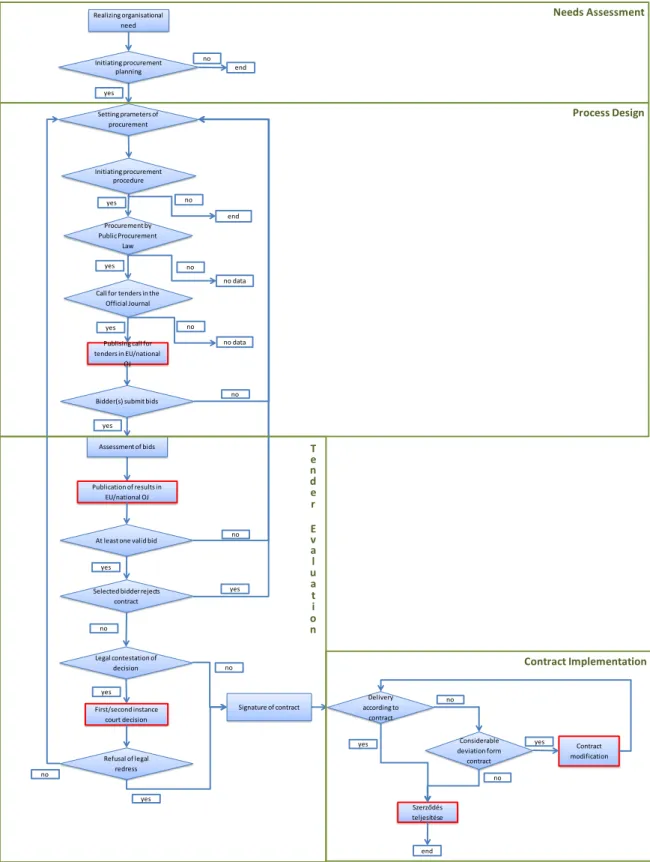
The needs assessment phase involves determining the object and quantity of the procurement task in line with the organisation’s needs. The process design and document preparation phase translates the decisions of the previous phase into the specific context of public procurement according to national laws and the organisation’s own regulations (e.g. drafting the text of call for tenders). During the tender evaluation and award decision phase the bids are assessed according to the pre-defined criteria and contract is concluded with the winning bidder. The contract implementation phase encompasses all the activities which relate to managing and monitoring the implementation of the contract and its modifications. The main decision points and steps of the public procurement process are highlighted in Figure 1 together with indications of officially available data in Hungary. The figure makes it clear that the only phase where there is no official data in the Public Procurement Bulletin is the needs assessment phase. Hence, our indicators won’t cover these, quite important, aspects of public procurement, for example corruption may arise during planning a road construction project which otherwise is lawfully executed when the road unfairly benefits some who happen to own land along the planned path (Tanzi and Davoodi 1997). While, corruption techniques can be mapped on to each step of the public procurement process (see section 4), it is suggested that they are typically used in concert to achieve the desired particularistic decision highlighting the important difference between official steps and procedures and informal decisions and power relations.
10
Figure 1. A simplified model of the public procurement process
Note: The rectangles mark those steps of the public procurement process which do not require decisions of the actor while the rhombuses mark those steps which require decisions. The red framing of some rectangles indicate that data is available from official sources in Hungary.
yes no
Setting prameters of procurement
Publising call for tenders in EU/national OJ Procurement by Public Procurement Law no data Call for tenders in the
Official Journal
yes
no data no
Bidder(s) submit bids
yes
no
At least one valid bid Publication of results in
EU/national OJ
yes
no
Selected bidder rejects contract yes no Signature of contract Legal contestation of decision yes no Delivery according to contract yes no First/second instance court decision Contract modification Refusal of legal redress yes no Szerződés teljesítése Considerable deviation form contract yes no Realizing organisational need Initiating procurement procedure Assessment of bids Initiating procurement planning end yes no end yes no end Needs Assessment Process Design T e n d e r E v a l u a t i o n Contract Implementation
11
3. The data
The database used for developing the quantitative indicators corresponding to individual corruption techniques derive from Hungarian public procurement announcements from between 2009-2012 (e.g. individual contracts, calls for tender, court rulings on the decisions) (this database is referred to as PP henceforth).The data represent a complete database of all public procurement procedures conducted under national Public Procurement Law in Hungary. As already highlighted in Figure 1, among the different steps of any public procurement procedure there is a legal obligation to publish i) call for tender in most cases, ii) contract awards in every case, iii) modification of contract in every case, iv) completion of contract in most cases (the obligation ceased as of 1/1/2012), v) results of legal proceedings in every case (e.g. court decisions regarding contract awards), and vi) errors and corrections of previous announcements in every instance. Our database contains most of the variables regularly appearing as required by law in each of these announcements such as the name and address of the winner company or the contract value.
The place of publication of these documents is the Public Procurement Bulletin which appears on a weekly basis and is accessible online11. For this publication, the Hungarian Public Procurement Authority maintains a homepage where online announcements appear and a database supporting publication. Unfortunately, the Authority was unwilling to share its data with us (and it has also been unwilling to share its data with other key public institutions such as the Hungarian Competition Authority as our interview evidence indicates). By implication, we downloaded all the announcements available online mainly in html sometimes in pdf format. Then these texts became the source of our structured database which contains variables with clear meaning and well-defined categories. As the original texts available online and most likely the underlying database of the Hungarian Public Procurement Authority contain a range of errors, inconsistencies, and omissions we applied several correction measures to arrive at a database sufficient quality for quantitative analysis (detailed account of data cleaning procedures can be found in Hungarian in Fazekas & Tóth (2012a) and in English with somewhat less detail in Fazekas & Tóth (2012b)).
A major limitation of our database is that it only contains information on public procurement cases under the Hungarian Public Procurement Law as there is no central depository of other contracts. This law defines minimum estimated contract value for its application depending on the type of announcing body and kind of products or services to be procured (for example, from 1 January 2012, classical issuers have to follow the national regulations if they procure services for more than 8 million HUF or 27 thousand EUR). Some public organisations can be rather resourceful in circumventing the law if they find it in their interest (e.g. slicing up contracts so that the parts are under the threshold, or resorting to special exemptions). This is indicated by, for example, the gap between the OECD’s estimation of public procurement in Hungary based on aggregate budget data: 20% of the GDP (2008)12 (OECD 2011) and the amount of public procurement carried out under the Public Procurement Law: 7% (2008) (Hungarian Public Procurement Authority 2009).
11
See: http://www.kozbeszerzes.hu/nid/KE (in Hungarian)
12
Having data only on larger and more heavily regulated public procurement results is anobviously biased sample of all public procurement contracts. Larger contracts are rarer events than the rest of public contracting which limits the quantitative scope of our analysis. They are also more demanding administratively not only simply due to their sheer size, but also because of stricter regulations. Most importantly, procedures carried out under the Public Procurement Law are heavily regulated in terms of transparency (e.g. format and organ of announcements) and fairness (e.g. nature of award criteria or time available for tendering). While these regulations may well be flawed in a range of ways they definitely increase the cost of corruption. Moreover, larger contracts imply larger potential benefits from corruption. Hence, our sample of all public contracts is biased towards more costly and more high stakes corruption which indicates that any analysis of such data can be indicative only of grand corruption and state capture rather than petty corruption.
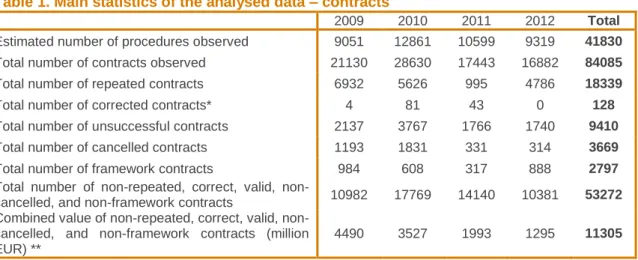
Contract award notices represent the most important part of a procedure’s life-cycle. For each procedure under the Hungarian Public Procurement Law, at least the contract award announcement has to be published. Thus, we show some elementary statistics relating to contract awards in order to provide an overview of the data. Out of the 84085 awarded contracts announced in the Hungarian Public Procurement Bulleting throughout 2009-2012 only 53272 were analysed in most calculations due to five distinctive, but sometimes overlapping reasons (Table 1):13
1. Repetitions, 2. Corrections, 3. Unsuccessfulness, 4. Cancellations, and 5. Framework contracts.
First, Hungarian announcements above the EU threshold have to be published both at the Journal of the European Union (TED) and the Hungarian Public Procurement Bulletin. However, for reasons unknown to the authors, the announcements appearing in TED also appear according to a special format in the Hungarian Public Procurement Bulletin. This leads to duplication of announcements with only slightly different information content (e.g. announcements in TED don’t contain the names of bidders who lost, whereas notices in the Hungarian Public Procurement Bulletin do). In order to avoid double counting and retain maximum possible information content we excluded all the contract award notices appearing originally in TED and reappearing at the Hungarian Public Procurement Bulleting too. Second, those announcements which were later corrected by a full, repeated announcement were also excluded from our sample for most analyses.14 More work is needed on this
13
In fact, we should extend our data with one sample referring to centralised procurement whereby issuers don’t procure on their own rather through a centralised body. Unfortunately, we don’t yet have detailed data on who bought what and how much from this central public procurement body. For the moment, we account for centralised procurement as one other issuer without knowing the details of the flows of goods and services between individual issuers and the central body. Data acquisition is in progress.
14 As many corrections don’t appear completely anew, rather a specific correction is published that
explains which parts of the original announcement were wrong and what the correct information is, we inputed the correct data to the corrected announcements. This introduces a slight bias to our sample as correct information appears to be available in our data earlier than it was in fact for the public. As this only concerns 132 contract award announcements, we consider this to be of relatively minor
13
aspect as corrections are not referenced in a standardised fashion in many cases. Third,those announcements or parts of announcements which were contract award notices, but awarded no contract were also excluded. Unsuccessfulness or invalidity are explicitly marked in the announcements; however, as there was no name of winner in a great number of announcements, it is unclear if these are actually invalid announcements or data is simply missing. As crucial information is often missing, we did not exclude these notices. Fourth, cancellations refer to those announcements which were announced as valid and correct, however, subsequently had to be withdrawn or modified due to court decisions or withdrawal of the winner. Finally, framework contracts are awarded in two stages whereby winning the contract at the first stage only implies the possibility of bidding for contracts within the framework leading to actual work and payments. Hence, contract awards referring to the first stage of framework contracts are excluded in order to avoid double counting contract values.
Table 1. Main statistics of the analysed data – contracts
2009 2010 2011 2012 Total
Estimated number of procedures observed 9051 12861 10599 9319 41830
Total number of contracts observed 21130 28630 17443 16882 84085
Total number of repeated contracts 6932 5626 995 4786 18339
Total number of corrected contracts* 4 81 43 0 128
Total number of unsuccessful contracts 2137 3767 1766 1740 9410
Total number of cancelled contracts 1193 1831 331 314 3669
Total number of framework contracts 984 608 317 888 2797
Total number of repeated, correct, valid,
non-cancelled, and non-framework contracts 10982 17769 14140 10381 53272 Combined value of repeated, correct, valid,
non-cancelled, and non-framework contracts (million EUR) **
4490 3527 1993 1295 11305
Source: PP
Notes: *=the number of corrected contracts may further increase as additional search procedures are completed; ** = a 300 HUR/EUR uniform exchange rate was applied for exchanging HUF values.
importance (there are additional corrections for other types of announcements which we still need to take into account).
14
4. “Technologies” of corruption
This section discusses each corruption technique and the corresponding indicators (note that some indicators relate to multiple techniques). Discussion follows a simple structure in each case: underlying rationale for using the technique, the principle of good public procurement breached, control mechanisms, some real-life examples, and indicators. Techniques are grouped according to the four major phases of the public procurement process (process design and document preparation are put under different headings in order to avoid any single heading containing too many techniques).
Indicators are formulated in a way that they are as closely associated with the underlying corruption technique as possible. However, there are complex non-linearities in the relationship between corruption and procurement characteristics so in many cases further refinement will be necessary through linking indicators to each other and potentially corrupt outcomes.
As the present discussion takes the viewpoint of tender issuers, the indicators primarily aim at capturing organisational behaviour (i.e. choices made by individual organisations) rather than meso- to macro level influences such as complexity of technology or investment projects of particular markets. Hence, in cases where strong market-level influences are suspected (e.g. complexity of technology is likely to impact heavily on complexity of eligibility criteria), the indicators are adjusted to reflect deviations from the market mean. While this focuses the indicator on organisational decisions, it also impedes cross-market comparisons. Thus, corruption risks emanating from the fact that an organisation operates on a particular market are downplayed even though they may be powerful contributing factors to its overall corrupt behaviour.
4.1 Needs assessment and definition
T1.1 Defining unnecessary need
Issuers of tenders can choose to procure goods and services which are in fact not necessary for them or procure them in a size and quantity excessive compared to their actual needs (Heggstad and Froystad 2011; Tanzi and Davoodi 1997; Transparency International 2006). When this benefits particular supplier(s) mis-assessment of needs can serve as a corruption technique (for a US example see Goldman et al., 2012 p. 11). By arbitrarily increasing the quantity and overall price of procured goods and services (e.g. by adding unnecessary capacities), the earned corruption fee can be increased as it tends to increase with overall contract value. Hence, this technique works well with other techniques allowing for limiting competition hence making it easy to capture rents.
In principle, there is a range of control mechanisms which are intended to make this technique difficult and costly to implement. These are the reviews of the State Audit Organisation (SAO), judicial review, and public/media scrutiny. Even though there have been instances when these presented an effective barrier, control functions are very limited in general (State Audit Organisation 2008).
15
Prime examples of this kind of technique in Hungary come from large infrastructure projects,especially highway construction such as M7 or M6 in the recent years. In the latter case, a pan-European investigation was launched in November 2012 on charges of corruption and bribery. According to media reports these highways were constructed with additional unnecessary content such as tunnels on flat surfaces, the (in)famous viaduct of Kőröshegy which turned out to be one of CEE’s largest such construct in spite of going through an only mildly hilly area. Moreover, some stories told by interviewees outline the usual approach whereby it is not the need which gets defined first, but the supply; that is, the company providing a particular service or goods and knowing about a relevant EU funding opportunity seeks an issuer to ‘join-in’ (Szántó and Tóth 2008).
This technique is one of those few for which no quantitative indicator is proposed at this stage of the research. Later on, case by case analysis could be conducted involving additional data collection in order to reveal excess procurement content for example by comparing procured values of issuers with comparable needs (e.g. capacity of photo-copy machines for municipalities of similar size).
T1.2 Defining need in a way to benefit a particular supplier
Issuers of tenders can choose to procure goods and services in a form or with capacities which are unnecessary for fulfilling their actual needs, but are advantageous for certain supplier(s) (Tanzi and Davoodi 1997; Transparency International 2006; World Bank 2007). If the issuer requires characteristics and capacities which can only be performed by a single supplier’s goods and services, fair competition can be ruled out right from the beginning. Such requirements are most easily defined on markets where products and services have a high number of very specific characteristics such as large infrastructure construction or IT infrastructure and services. This technique largely supports other means of tailoring the public procurement process to one bidder (T2.2).
This kind of corruption is difficult to detect as knowing what is actually needed by an organisation is difficult to decipher by external control bodies (i.e. problem of information asymmetry). The Hungarian SAO regularly audits individual pubic organisations and conducts more comprehensive public procurement reviews, but these concern only a selected set of organisations over longer time periods making detection rather unlikely. Moreover, the lack of long term vision for sectors or the whole country make assessment of investment needs close to impossible as there is no solid benchmark (Báger 2011). Supporting institutions such as the Hungarian National Development Agency or the European Commission’s OLAF and European Court of Auditors also conduct reviews which have the potential to detect ‘tailored’ procurement, but they are likely to be ineffective due to information asymmetries and narrow focus on financial compliance.
There is one direct quantitative indicator for this technique suggested by the literature (Bandiera, Prat, and Valletti 2009):
A) prevalence of avoiding centralised procurement.
Centralised procurement systems replace the multitude of local procurement processes with a few large purchases. Buying directly from the centralised procurement authority (in Hungary the Public Procurement and Supplies Bureau or Közbeszerzési és Ellátási Főigazgatóság) is likely to decrease corruption risks of local entities as they can no longer
16
influence contract award (Bandiera, Prat, and Valletti 2009). However, this logic is cruciallydependent on the quality, price, and flexibility of centrally procured provision. In an environment ridden with systemic corruption, centralised purchasing simply centralises corruption and state capture leading to low quality and/or high price provision (Piga 2011). Indeed, interview evidence suggests that, depending on the centralised procurement contract covering a specific market such as hospital stationery, or furniture, centralised procurement maybe more or less competitive than local procurement. If centralised procurement is more efficient than potential local procurement corrupt tender issuers are more likely to opt out of the central system and conduct procurement locally. However, if the centralised contract is less competitive than the potential local ones even non-corrupt, well-governed issuers opt out. Assuming further research can reveal the relative efficiency of centralised purchasing, the adequate indicator is the following:
PACP
it= (PPV
it- CPPV
it) / PPV
itwhere PACPit refers to the proportion of not-purchasing through centralised public
procurement within total value of contracts awarded according to the Public Procurement Law by the ith unit of observation, typically public organisation, over period t, PPVitdenotes
the total value of contracts awarded according to the Public Procurement Law by the ith unit of observation during period t, and CPPVit refers to the total purchasing through centralised
public procurement of the ith unit of observation over period t. As centralised purchasing is not available in every product and services markets only those spending items are taken into account which could be in principle obtained through centralised spending.
Unfortunately, we are still in negotiation with the Hungarian Public Procurement and Supplies Bureau for obtaining public organisation and product specific data. Consequentially, this indicator could not be calculated here.
4.2 Process design
T2.1 Tinkering with the threshold and exceptional rules
In Hungary like in any other European country, the application of the Public Procurement Law as well as the different procedural regimes is dependent on expected contract value thresholds and a range of specific exceptions (On the Coordination of Procedures for the Award of Public Works Contracts, Public Supply Contracts and Public Service Contracts
2004). Application conditions such as thresholds are crucial for corruption, first, as public procurement outside the Public Procurement Law is typically less stringently regulated in terms of transparency and open competition; second, different procedural regimes prescribe different degrees of transparency and openness (OECD 2010b). For example, the open regime requires issuers to publish a call for tenders in the Public Procurement Bulletin whereas the negotiation procedure does not. Hence, bringing procedures outside the applicability of the Public Procurement Law or into a less open and competitive procedural regime under the law provides better opportunities for hiding corrupt action (Heggstad and Froystad 2011; Kenny and Musatova 2010; OECD 2007; Transparency International 2006). Moving procedures across public procurement regimes or completely outside the remit of the Public Procurement Law can be done in three principal ways:
17
1. Slicing up contracts so that they fall out from the unwanted public procurementprocedural regime (e.g. below the national threshold) (Papanek 2009 ch. 6; Piga 2011);
2. invoking special rules of exception such as national security or extreme urgency (OECD 2007; Schultz and Soreide 2008; Soreide 2002); and
3. underestimating expected contract value (expected contract value is the basis for mandatory regime choice).
In addition, corrupt networks capable of moving contracts across public organisations can also resort to channelling money through institutions falling outside the remit of the Public Procurement Law such as the Hungarian Development Bank (Major Dezsériné 2003; Papanek 2009 ch. 6). Due to the difficulty of detecting quantitatively this latter technique no further discussion is offered.
As conducting public procurement according to different procedural regimes also has considerable costs for the issuers (i.e. some procedures are more costly than others) smaller or poorer issuers may also try to use this technique for cost saving reasons. By implication, the use of this technique as a signal of corruption should be seen in the light of issuer size and wealth.
The choice of procedural regime or the avoidance of applying the Public Procurement Law has wide-ranging impacts on other indicators and the structure of the PP database. First, contracts outside the remit of the Public Procurement Law are not recorded in the PP database. The only trace of such purchases is in public organisations’ annual budget figures from which estimates can be constructed for overall procurement (Audet 2002; European Commission 2011). Second, choice of procedural regime impacts on the availability of other corruption techniques which we discuss below: T2.6-Submission deadline and T3.2-Publication of calls for tender. While issuers’ hands are tied in terms of minimum submission deadlines and mandatory publication of calls for tender if they conduct an open procedure, they are offered more choice when using other regimes. By implication, the choice of regime type determines submission deadline and call for tenders publication to some degree in an asymmetric way. Third, the procedure choice may also support the use of other corruption techniques, especially T2.2-Tailoring eligibility criteria and T2.4-Tailoring evaluation criteria. It is possible to launch a public procurement procedure as a restricted procedure where there are two phases, the first serving the pre-screening and pre-selection of eligible bidders, and the second constituting the actual decision among the shortlisted bidders. Tailoring the eligibility and evaluation criteria to the benefit of a particular bidder is made easy by the detailed knowledge of shortlisted bidders remaining after the first phase.
Both slicing contracts and invoking special rules are regulated in the Public Procurement Law, making the application of this corruption technique difficult in principle. However, in practice, detection is difficult as the contracts are moved out of the more transparent domain and determining the actual joined-up nature of two or more contracts requires intimate knowledge of the contracts as well as the issuer (Piga 2011). As with many other techniques, external control is exercised by the SAO and supporting institutions especially the National Development Agency managing most of the EU funding coming into Hungary. Early surveys of practice confirm what our interviews underlined: external control is rare and not very effective (Major Dezsériné 2003). In the case of underestimating contract value, but still remaining under the umbrella of the Public Procurement Law, deviation between
18
estimated and actual contract value can be observed. In these cases, the PublicProcurement Arbitration Board may intervene and fine issuers. However, fines are incurred by issuers, whereas corruption fees accrue to the corrupt network making the fines a potentially weak instrument.
There are wide ranging examples of circumventing the more stringent regulations of the Public Procurement Law both from Hungary and from abroad. In Hungary, it is very telling that practitioners simply call the restricted procedure (“meghívásos eljárás” in Hungarian) the “three bidder procedure” as one public procurement adviser working in the industry for over a decade put it: “just bring two friends with whom we can agree on the exact content of their bids”. In Italy, a “culture of emergency” has evolved in public procurement leading to “a systematic search for the exceptionality” and a frequent use of “mechanisms of arbitrary choice in public contracting” (Soreide 2002 p. 18).
Due to the central position of this technique in relation to other techniques and the wide ranging ramifications of procedural regime choice to several aspects of public procurement, a large number of indicators are developed. We discuss three direct indicators:
A) proportion of non-open procedures;
B) average corruption risk score of procedures followed; and
C) frequency of actual contract value above estimated contract value. We also discuss one indirect indicator:
D) ratio of contract value according to Public Procurement Law over total procurement contract value.
The frequency of using higher corruption risk procedure types signals in a simple and straightforward way the underlying corruption technique. Corruption risks indicated by the choice of procedural regime can be measured in a variety of ways. For example, a sophisticated econometric paper looking at corruption in public procurement in Paraguay uses the proportion of exceptional procedures over all other procedures (Auriol, Flochel, and Straub 2011). In order to focus our indicator on the largest differences in corruption risks the proposed simple measure of tinkering with procedural regimes takes open procedures as a benchmark:
NOPR
it= 1 – ( OPR
it/ TNP
it)
where NOPRit refers to the proportion of non-open procedures over all procedures
concluded of the ith unit of observation such as public organisation or bidder over period t,
OPRitrefers to the number of procedures following open procedural regime of the ith unit of
observation during period t, and TNPit refers to the total number of procedures concluded by
the ith unit of observation over period t (Table 2).
It is possible to rank procedure types according to level of transparency and degree of openness of competition prescribed. Hence procedure types could be ranked according to their corruption risks. Averaging the corruption risk ranks of procedures concluded may serve as a more subtle indicator of corruption than simply looking at the prevalence non-open procedures. By implication, the following indicator is proposed:
19
ARPR
it= ( Σ
jR
j* N
itj)
/ TNP
itwhere ARPRit refers to the average corruption rank of procedures leading to contract award
by the ith unit of observation over period t (corruption rank takes a higher value for higher corruption risk procedure types), Rjrefers to the corruption rank of the jth procedure type, Nitj
denotes the number of procedures following the jth procedure type of the ith unit of observation during period t, and TNPit refers to the total number of procedures concluded by
the ith unit of observation over period t.
As Table 2 indicates these two variables tell a fairly similar story with slight differences. 2010 experienced the lowest corruption risk according to these two indicators while there is a marked upward trend since then with a particularly strong increase in 2012 which at least partially reflect changes in the Public Procurement Law.
Table 2. Mean proportion of non-open procedures and mean corruption rank of procedure types, 2009-2012
Year Mean proportion of non-open procedures
Mean corruption rank of
procedure types N 2009 0.4220 1.0635 10982 2010 0.3259 0.9267 17769 2011 0.3673 1.1959 14140 2012 0.5733 1.2376 10372 Total 0.4049 1.0869 53263 Source: PP
The underestimation of contract value can be observed simply by comparing estimated and actual contract values. While, some issuers may have indeed made an error in calculating estimated contract value, this is likely done on purpose when the ‘error’ allowed to switch procedure regime as interviewees pointed out. Hence, the suggested indicator is:
EVSPR
it= NSW
it/ TNP
itwhere EVSPRit refers to the proportion of tenders where manipulating estimated contract
value resulted in switching procedure regime within all tenders of the ith unit of observation over period t, NSWit denotes the number of tenders where manipulating estimated contract
value resulted in switching procedure regime of the ith unit of observation during period t, and TNTit refers to the total number of tenders concluded by the ith unit of observation over
period t.
While in a great number of cases, estimated contract values are missing, it is possible to explore the differences between actual and estimated contract values for over 29000 contracts throughout 2009-2012 (Figure 2). While for most contracts, actual contract value is lower or equal to estimated contract value, about 7-9% of observed contracts have a considerably higher actual than estimated contract value (we took 1 million HUF as a threshold for large enough difference). As more work is needed to precisely determine the thresholds for each observed contract, we simply took this 1 million HUF threshold as a rough indicator of potential corruption risks concerning the manipulation of estimated contract value.
20
Figure 2. The scatter plot of actual (Y axis) and estimated contract values (X axis), 2009-2012, million HUF (only contracts of less than 2 billion HUF are depicted)
Source: PP
Even though there is no contract-level detailed data on public procurement contracts outside the remit of the Public Procurement Law, it is possible to construct an estimate of total procurement for each public organisation using annual budget figures reported to the Treasury (Audet 2002; European Commission 2011). As avoiding the transparency and competition requirements set by the Public Procurement Law can be a powerful motivating factor for corrupt actors, comparing the contracted value according to the law to the total contracted value can signal the magnitude of these corrupt efforts. As contracting outside the Public Procurement Law can result from a range of non-corrupt reasons, only large gaps between the two types of contracting may actually signal this corruption technique. Nevertheless, we propose an indicator capturing the full scale of gaps leaving validation of different parts of the scale to later multivariate analysis:
NPP
it= 1 – ( PPV
it/ TPV
it)
where NPPit refers to the proportion of contract value not according to the Public
Procurement Law within the total procurement spending of the ith unit of observation, typically public organisation, over period t, PPVit denotes the total value of contracts
awarded according to the Public Procurement Law of the ith unit of observation during period
t, and TPVit refers to the total procurement spending of the ith unit of observation over period
t. As we dispose of more detailed budget figures than previous studies (Audet 2002; European Commission 2011), we calculated total procurement as the sum of material expenses and investment expenses accrued in a given period.
21
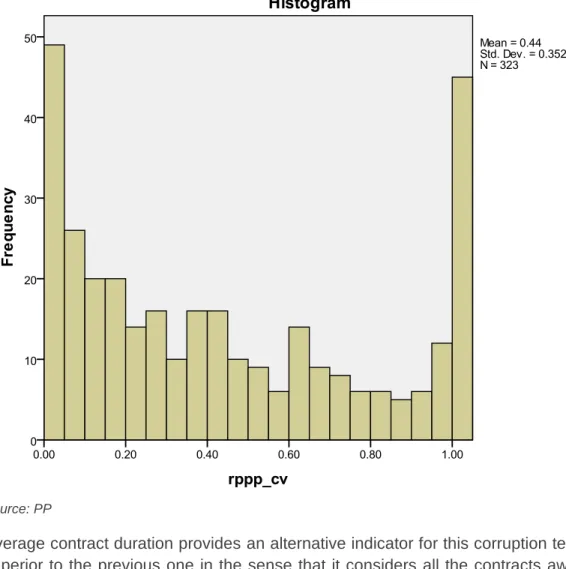
Even though, we cannot yet present the full picture of the Hungarian public administration,data on central public organisations are already highly illuminating. It appears that on average close to 80% of procurement spending takes place outside the Public Procurement Law’s remit throughout 2009-2011 (Figure 3). In addition, this proportion has increased from 75% In 2009 to 81% in 2011. This raises the concern that the analysis of PP data only looks at the “tip of the iceberg”.
Figure 3. Percentage of procurement spending not according to the Public Procurement Law, 2009-2011, N=631 issuer (the same issuer counts as multiple observations across the years)
Source: PP
While there is no specific indicator developed based on the breaks in distributions of contract values around thresholds and after changes in thresholds, it is suggested that a more detailed analysis of contract value distributions could lead to additional insights as to how issuers may game the system of procedure regimes and the corresponding thresholds.
T2.2 Tailoring eligibility criteria
Eligibility criteria define which potential bidders can bid and which bids can be considered for competition. That is, both bidders and their bids should meet a set of criteria in order to be considered for a tender. Hence, tailoring eligibility criteria to exclude most or all non-wanted bidders even though they could bid given the actual object of procurement can effectively inhibit fair competition. This is by far the most widely quoted corruption technique in the Hungarian (Báger 2011; Major Dezsériné 2003; Pálinkó, Szántó, and Tóth 2008; Papanek 2009) and international literature (Goldman, So, and Rocholl 2012; Grodeland 2005, 2010; Heggstad and Froystad 2011; Piga 2011; Soreide 2006) which was confirmed by our interviewees. Tailoring can be done by
1. defining a combination of hard criteria such as prior works or annual turnover clearly excluding some companies, or
22
2. setting vague and subjective criteria allowing issuers to exercise discretion in apartial manner.
Once, only the desired bidder remains as eligible bidder, it can submit a price considerably above market price earning a rent (OECD 2007; Transparency International 2006). Naturally, some criteria are justified as they aid sorting out capable bidders and bids; what makes them more than simple reasonable pre-screening is their excessive amount and overly restrictive nature in the light of the procured goods and services.
Consistently differentiating reasonable and excessive criteria, i.e. limiting the applicability of this technique, is difficult and requires robust case law and uniformly applied rules. In Hungary, there are several decisions of the Public Procurement Arbitration Board on this issue; however, according to interviewees, legal uncertainty is high as the very same issue could be judged differently by different judges. Nevertheless, due to potential judicial challenge, this technique may only result in limiting the list of bidders rather than eliminating all but one. In a next step, involving other techniques, the list can be shrank further.
The most intimately linked corruption technique designed to further shrink the list of eligible bidders and bids is T2.3-abusing formal and administrative requirements. Once complicated and difficult to meet set of criteria is defined, it is relatively easy for the issuer to find at least one requirement which was not appropriately documented. This provides sufficient grounds for the issuer to exclude bidders and their bids. Furthermore, corruption technique T1.2 (defining needs to benefit a particular supplier) neatly supports this corruption technique as eligibility criteria should, in principle, follow from organisational needs and the characteristics of goods and services to be procured. Biased needs estimation makes biased criteria setting more easily defensible at court.
Interviewees in Hungary frequently shared concrete examples demonstrating the abuse of the system of references (i.e. proof of prior experience). One large construction company was excluded from a tender for building a hospital on the grounds that they had no specific experience with building a lone-standing morgue even though they had built hospitals with a morgue. As lone-standing and within hospital morgues have essentially the same technical parameters this criteria was likely used to exclude unwanted bidders. The respondent knew which 3 companies had specific experience with building lone-standing morgues. Other suspicious eligibility criteria made it clear to this company that the process was ‘set-up’ right from the beginning.
Other frequently quoted examples relate to detailed financial criteria (financial information on large companies is public so it is easy to tailor criteria to the detriment of unwanted bidders). A public procurement advisor gave an example: “During a public car purchase procedure, the company was excluded because there was a condition specified requiring bidders to have higher own capital than subscribed capital. The company couldn’t meet this criterion due to an ongoing investment (subscribed capital: 125 billion HUF, own capital: 124.7 billion HUF). Instead an XY ‘phantom’ company15 won the tender.” (Papanek 2009 p. 239).
There is one direct indicator associated with this corruption technique:
15
Phantom company in ordinary Hungarian language (fantomcég) typically refers to a company created specifically for corrupt or tax evasion purposes having very little economic activity other than related to rent extraction.
23
A) length of eligibility criteria.Length and complexity of eligibility criteria both for bidders and bids provides a crude measure of the use of this technique especially when taking into consideration the size of the contract too (i.e. bigger contracts may require more lengthy and complex system of criteria for valid reasons). As looking at the use of specific ‘suspicious’ criteria was not made possible by our limited understanding and diverse nature of these ‘suspicious’ criteria16
, we propose the following crude measure:
ADLEC
it= Σ
jk( LEC
itjk- ALEC
k) / N
itwhere ADLECit denotes the average difference in the length of eligibility criteria between the
call for tenders of the ith unit of observation such as issuer over period t and the average length at the kth market over period t, LECitjk refers to length of eligibility criteria of the jth call
for tenders of ith unit of observation belonging to the kth market during period t, ALECk
denotes the average length of eligibility criteria during the whole observation period for the
kth market, and Nit refers to the number of calls for tenders of ith unit of observation during
period t. Public procurement markets are taken as reference groups recognising that more lengthy and complex criteria is justified for specific markets. Unfortunately, if a market is dominated by excessively complicated and lengthy eligibility criteria due to the large number of corrupt procedures this normalisation will lead to an underestimation of corruption risks. Length of criteria is simply measured as the number of characters used.
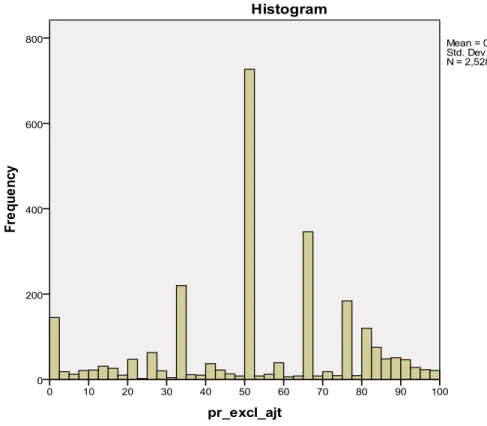
The average length of eligibility criteria in each public procurement market as defined by CPV17 main divisions varied between 4400 characters in the market of printed matter and related products (CPV division 22) to 9700 characters in the market of Services related to the oil and gas industry (CPV division 76). These differences probably reflect the variation in the complexity of these markets and potentially the differences in average contract size too. The deviation from the market average follows a somewhat skewed distribution (Figure 4). Even though the deviation from the market averages is weakly correlated with contract size (r2=0.28) indicating that contract size may play role in the complexity of criteria, a version of this indicator based on deviations from market and contract size group averages carries little extra information (the two versions are highly correlated r2=0.97).
16
More work is under way to develop better direct measure of complexity and restrictiveness as the complete text of criteria is available to us for every call for tenders. We will combine additional interview examples of frequently used ‘suspicious’ criteria and text mining methods.
17
CPV=Common Procurement Vocabulary. For more info see:
24
Figure 4. Average difference in the length of eligibility criteria between the call for tenders and its market mean, number of characters, 2009-2012
Source: PP
T2.3 Abusing formal and administrative requirements
Public procurement bids easily encompass several hundred pages of documentation especially in case of large tenders. Each bid has to comply with formal and administrative requirements such as the format of the budget or the provision of original documents from public bodies (e.g. registration at the court registry). While these requirements are desirable in general, their large number and complexity provide ample opportunities for abuse. According to our interviews as well as the international literature, it is practically always possible to find a formal or administrative error which provides grounds for excluding the bid from competition (Báger 2011; Grodeland 2005; Papanek 2009; Transparency International 2006). Hence, this corruption technique abuses minor technical errors to serve the interests of corrupt networks by allowing them to limit competition to their preferred bidders. Excluding bids on formal and administrative grounds is a legitimate activity, but it becomes cause for suspicion once it becomes excessive, inconsistently applied, and regularly leads to only one remaining bid.
In principle, the prescribed opportunity for bidders to correct such errors after submitting their bids limit the applicability of this technique. However, in Hungary, the procedure of requesting and submitting corrections is largely unregulated. This means that corrupt issuers comply with the law only formally, but not substantially: as a public procurement advisor
25
working in the construction industry for over a decade put it: “it is easy, you request onFriday 13 o’clock the original copy of any minor document bearing a public agency’s stamp on it to be submitted by Monday 10h. It all looks fine, you left three days for correction, but in fact you made it impossible.” Another surprising sign of the frequency of this technique is that one of its specific versions acquired its own expression in public procurement ‘slang’: “exhaustion technique”. According to a Public Procurement Lawyer active in a range of sectors for several years this term means that “unwanted bidders are requested to submit corrections in several turns until they finally understand that there is no point in trying, they won’t ever win the contract they bid for.”18 According to our interviews, it seems that this
technique is one of the new ‘hype’ techniques in Hungary due to the ease of its applicability (i.e. lack of regulation).
A concrete example quoted by one interviewee concerned a procurement procedure for a garden reconstruction project where the company was excluded on the grounds that its submitted budget was not complete. It was deemed incomplete because the price of grass seed was not explicitly highlighted as a separate line in the proposed budget even though it was included in the total budget for lawn installation costs. Challenging this decision at the Public Procurement Arbitration Board did not change the situation