PLS Based Financing for SMEs: Returns to IFIs
Veelaiporn Promwichit1, Shamsher Mohamad2, Taufiq Hassan3
Abstract: Profit and loss sharing (PLS) based financing without collateral and interest rate could ease the financing difficulty of small and medium enterprises (SMEs). However, this PLS based financing is not widely offered by Islamic financial institutions (IFIs). This exploratory study illustrates that PLS based financing to SMEs is viable for IFIs. Using financial information of SMEs to calculate profit sharing ratio and net income under PLS based financing context, this study determined the profit margin ratio of IFIs from extending PLS based financing to SMEs. The findings show that extending PLS based financing to hypothetical diversified portfolios of SMEs generate higher profit margin compared to conventional lending at low risk based on the Markowitz portfolio theory of diversification. Moreover, as the number of SMEs in the portfolio increases, the risk of insufficient returns from the portfolio when an enterprise suffers a loss reduces.
Keywords: Profit and loss sharing; SME financing; Islamic financing; diversification JEL Classification: G21; H25
1. Introduction
In Islam, no organization (including IFIs) or individual own any assets in this world because the ultimate ownership lies with the one and only Allah. Mankind (including IFIs) is only given the responsibility to manage assets according to the objective of the Shariah principles (Maqasid al-Shariah) (Al-Ghazali, 1937 as cited in Chapra, 1985; Ayub, 2007). Thus, for IFIs, the Shariah principles govern their operation, values and philosophy (Lee & Detta, 2007) and unlike conventional banks, their main objective goes beyond just wealth maximization. They have religious and social obligations to fulfill (Chapra, 1985; Dusuki, 2007). A survey on the stakeholders (Shariah advisors, regulators, local communities, customers, depositors, employees and managers) of Bank Islam Malaysia Berhad and Bank Muamalat Malaysia Berhad shows that they share this view of IFIs (Dusuki, 2007).
1
Lecturer, University Kebangsaan, Malaysia, Address: University Kebangsaan Malaysia, 43600 Bangi, Selangor, Malaysia, Corresponding author: [email protected].
2 Professor, PhD, INCEIF Malaysia, Address: Lorong Universiti A, 59100 Kuala Lumpur, Malaysia,
E-mail: [email protected].
3
Associate Professor, PhD, University Putra Malaysia, Address: 43400 UPM Serdang, Selangor, Malaysia, E-mail: [email protected].
Given that SMEs contribute significantly to the country but had difficulty accessing financing from collateral-based conventional financing, IFIs can promote socio-economic justice and equitable distribution of wealth by extending financing to SMEs. At the same time, social justice in Islamic banking and finance (IBF) also means that IFIs should not suffer any injustice by extending financing to SMEs. IFIs should profit from extending financing to SMEs.
There are two types of financing contracts offered by IFIs; profit-sharing contracts and sale contracts (Samad, Gardner & Cook, 2005). Profit and loss sharing (PLS) based financing could help alleviate SMEs‘ financing constraint. This financing mode will allow more SMEs access to finance their activities since the running business of the SME itself is the collateral. Unfortunately, PLS based financing contracts are less popular compared to sale contracts (Khan, 1995; CIBAFI, 2010a; CIBAFI, 2010b; KFH Research Ltd, 2010), particularly for the needy SMEs. Amongst reasons for this lack of PLS are higher risk exposure (Fabianto & Kasri, 2007), information asymmetry problems, agency problems, moral hazard problems (Dar & Presley, 2000; Samad et al., 2005; Farooq, 2007) and higher monitoring costs (Al-Harran, 1999; Maniam, Bexley & James, 2000; Sarker, 1999). As a result, IFIs have been focusing on the needs of corporations and individuals in the top third of the economy (Divanna, 2009). However, as these markets are maturing and increasingly saturated, IFIs will need to focus on other segments such as the vast and profitable SMEs market (Divanna, 2009).
This study attempts to address the lack of PLS based financing to SMEs by applying the Markowitz portfolio theory of diversification to four hypothetical portfolios. This study wish to illustrate that IFIs are not worse-off in extending PLS based financing to SMEs compared to conventional interest-based lending. IFIs perceive the application of this diversification concept as complex (Ascarya, 2009) and costly although in actual fact it is much easier and cost-effective.
2. IBF Financing Contracts: Theory and Practice
Profit-sharing contracts and sale contracts share a few notable characteristics. First, there is no interest payment. Second, funds from these contracts cannot be used to finance non-permissible (Haram) activities. Third, these contracts ensure that IFIs are only rewarded after taking some risks and responsibilities. Fourth, these contracts must be just and fair to all parties to the contract (Ayub, 2007). The main distinguishing feature between profit sharing contracts and sale contracts is the risk sharing attribute in profit sharing contracts.
In profit sharing contracts, IFIs share the risk of the funded project to share the rewards based on a predetermined ratio (profit sharing ratio) of net income from the project agreed upon at the beginning of the partnership (Ayub, 2007; Samad et
al., 2005). There are two types of profit sharing contracts; mudharabah and musyarakah (Samad et al., 2005). Mudharabah is a contract between one party who contributes capital (rabbul mal) and another party who provides skill and labour (mudarib) (Ismail, 2010). Monetary losses are borne by the rabbul mal while
mudarib loses time and effort, except when the losses occurred due to breach of trust by mudarib (Ismail, 2010). In return, both parties share expected profits at a pre-determined ratio (Ismail, 2010). On the other hand, in musyarakah, both parties to the contract contribute capital and share expected profit based on capital contribution ratio (Ismail, 2010). Both parties have the right to participate in management and bear monetary losses (Ismail, 2010).
For sale contracts, Bay‘ al Murabahah, Bay‘ Bithaman Ajil, and Al- Ijarah are the three most popular types of contracts (Samad et al., 2005). Bay‘ al Murabahah is a contract between one party (seller) who purchase goods from a supplier on behalf of the other party to the contract (buyer) and sell those goods to the buyer at a higher price than the cost price. The difference between the selling price and the cost price is the profit margin, made known at the beginning of the contract (Segrado, 2005). This short term financing facility is a source of working capital financing and trade financing (Ismail, 2010). Bay‘ Bithaman Ajil is a contract in which one party to the contract (seller) finances the purchase of assets of the other party to the contract (buyer) who wish to defer payments for the assets (Ismail, 2010). The buyer will make deferred installment payment for the asset to the seller (Ismail, 2010). The difference between this contract and Bay‘ al Murabahah contract is that this contract has a longer time period (medium and long term) thus is widely used to finance house purchases in Malaysia (Ismail, 2010). Al- Ijarah, on the other hand, is similar to a lease contract.
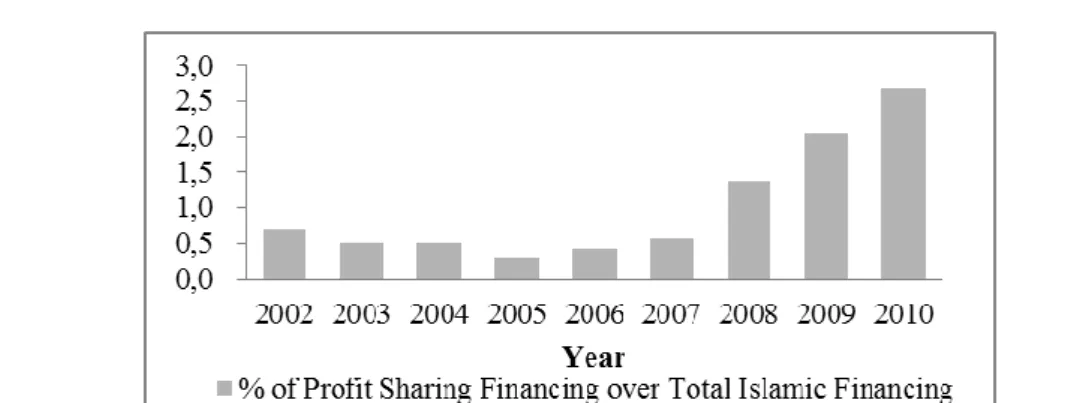
In 2009, 40.1% of total assets from IFIs worth USD 748.5 billion are financing activities (CIBAFI, 2010b). However, the majority of these financing activities (64.7%) were murabahah (CIBAFI, 2010b). In Gulf Cooperation Council (GCC) countries (i.e. Bahrain, Kuwait, Oman, Qatar, Saudi Arabia, UAE) which have the largest IFIs in the world, 57.6% of their financing activity were also murabahah financing (CIBAFI, 2010a). PLS based financing, although is the ideal financing contract, is not widely offered. Only 7.9% and 7.7% of their financing activities were mudharabah financing and musharakah financing respectively (CIBAFI, 2010a). Similar situation can be observed in Malaysia. Figure 1 below illustrates that IFIs in Malaysia did not offer much PLS based financing over the past years.
Figure 1.Percentage of PLS Based Financing over Total Islamic Financing by Malaysian Banking System from Year 2002 to 2010
Source: Bank Negara Annual Report 2002-2010
The profit sharing principle (mainly mudharabah and musyarakah financing) offered by IFIs was on a decline from 2002 till 2005 but increased from 2005 to 2010. Despite this increasing trend, the amount of PLS based financing was only 2.66% of the Islamic financing extended by Islamic banking system in 2010. Bai‘ Bithaman Ajil (at 33.73%), ijarah (at 29.80%) and murabahah (at 16.8%) were the major financing concepts offered by the banks (KFH Research Ltd, 2010). In addition, the Malaysian Islamic financing sector concentrated more on the household sector (at 60.8%) for the purchase of passenger vehicles (at 29.5%) and residential (at 17.9%) compared to SMEs, probably due to better rewards per unit of investment (Bank Negara Annual Report, 2010; KFH Research Ltd, 2010). Figure 2 highlight the amount of Islamic financing extended to SMEs and the percentage of Islamic financing over total financing extended to SMEs (both conventional and Islamic financing) by the Malaysian banking system.
Figure 2. Islamic Financing for SMEs Source: Bank Negara Annual Report 2002-2010
In Figure 2, there was an upward trend in the amount of Islamic financing extended to SMEs from Year 2002 till Year 2006. The highest amount of Islamic financing extended was RM 19.4 billion in 2009, five-fold the amount extended in Year 2002. However, this amount only represents 10.4% of the total financing (both conventional and Islamic financing) extended by the banking system to SMEs. The remaining 89.6% was conventional financing by the banking system to SMEs. Although the amount of Islamic financing extended to SMEs was increasing each year, this amount was not even a quarter of the total financing provided to SMEs. Based on Figure 1 and 2, one can conclude that PLS based financing to SMEs are negligible. This conclusion is consistent with Osman and Ali‘s (2008) findings that only 3% of the SMEs respondents utilized mudharabah financing and 4% utilized musyarakah financing.
3. Lack of PLS Based Financing: Reasons and Solutions
An important reason why PLS based financing is not popular among IFIs is the lack of qualified personnel in IBF system and Shariah principles (Al-Harran, 1999; Sarker, 1999; Maniam et al., 2000). To effectively facilitate IFIs in providing and gaining market share in PLS based financing (Maniam et al., 2000), there must be a pool of knowledgeable personnel who could appraise, monitor, evaluate and audit the proposed projects (Sarker, 1999). As a solution, IFIs can either conduct research and development activities that concentrate on project appraisal, implementation and follow-up (Khan, 1995) or establish an Islamic consultancy house that identifies feasible, profitable projects and educates entrepreneurs in project financing (Al-Harran, 1999).
Next, IFIs do not favour PLS based financing because of the risk sharing attribute (Farooq, 2007). However, Fabianto and Kasri (2007) felt that the increased risk exposure is the result of discrepancy between theory and practice. Theoretically, IFIs should have a well-diversified mixture of assets. For example, short term assets (trade financing contracts like murabahah and salam), medium term assets (like ijarah and istisna) and long term assets (like musharakah partnership) (Fabianto & Kasri, 2007). However, in practice, IFIs have more short term assets with less risk (Aggarwal & Yousef, 2000; Fabianto & Kasri, 2007). In addition, IFIs should have PLS based contracts as the basis between them and investors/depositors so that the pass through mechanism from IFIs to investors/ depositors will ensure that any losses from the asset side will also be passed to investors/depositors (Sarker, 1999; Fabianto & Kasri, 2007).
Furthermore, PLS based financing can be in a partnership or equity-financing form, both of which are not popular with IFIs and SMEs. Partnership is the least popular form of business organization compared to corporation and sole proprietorship (Farooq, 2007). A survey showed that 59% of the United States respondents
viewed partnership as bad due to conflict of interest, failure of partner to live up to expectations and shared control of management and decision making (Caggiano, 1992 as cited in Farooq, 2007). In PLS based financing, IFIs would prefer to play a larger role than just a silent equity investor but SMEs prefer to be the only party actively involved in management of the project (Farooq, 2007). Because IFIs could not play an active role, this lead to information asymmetry problems, agency problems and moral hazard (Dar & Presley, 2000; Samad et al., 2005; Farooq, 2007). Agency problem stems from the reluctance of the enterprise to report actual profit i.e. SMEs may understate profit (Sarker, 1999; Dar & Presley, 2000). If a detailed disclosure is made compulsory, the demand for PLS based financing might reduce since SMEs are usually reluctant to disclose detailed information about the operation and profitability of the business (Sarker, 1999; Samad et al., 2005). To overcome these issues, Samad et al. (2005) suggests that IFIs actively participate in selecting the Board of Directors that will look out for IFIs‘ interest and minimize agency problems. In addition, IFIs should have a concise and clear contract that states the limited liability of IFIs to the extent of not exceeding the liabilities borne by any partner who had cause the liability in violation of any predetermined condition in the contract (Farooq, 2007). The profit sharing ratio and status of business assets registered (whether under co-ownership or joint ownership) should also be included (Samad et al., 2005). In Malaysia, the contracts are comprehensive and concise because IFIs are stringent in extending PLS based financing.
Khan (1995) suggests that IFIs would not require additional monitoring if they have an efficient contract. An efficient contract could be achieved by increasing the ownership stake of the other party to the contract in order to increase the cost of the other party to the same level as the benefits reap from any non-pecuniary benefits (Khan, 1995). IFIs could also increase the ratio of profits for the other party if the project reports net income above a certain level (Khan, 1995). If IFIs prefer a lower cost of additional monitoring, they could observe the performance of another project that has similar characteristics with the project funded or through market information (Khan, 1995).
4. Methodologies
This study determined the impact of PLS based financing extended to 30 SMEs out of 645 136 SMEs in Malaysia for IFIs (in terms of profit margin) from Year 2002 to 2010. These SMEs have at least nine years of operation and debt financing from financial institutions.
4.1 Markowitz Portfolio Theory and Hypothetical Portfolios
In PLS based financing, the profit of SMEs is shared between IFIs and SMEs based on the profit sharing ratio. If the SME makes a loss, IFIs will also yield a loss (i.e. zero return) from the PLS contracts. This loss is one of the reasons why IFIs shy away from offering PLS based financing to SMEs without any guarantee or collateral. The Markowitz portfolio theory suggests portfolio diversification to reduce the variance of the portfolio without sacrificing return (Reilly and Norton, 2006). This diversification effect works best when the securities in the portfolio are negatively correlated. The variability of total return from the portfolio reduces. This Markowitz portfolio theory can also be applied to loan portfolios of SMEs. To apply the insights of this theory, four hypothetical portfolios were created consisting of different numbers (five, ten, fifteen and thirty) of SMEs. These enterprises are selected from 14 different sectors to manage unique risk associated with a particular sector. In theory, Markowitz portfolio theory of diversification will result in almost no risk or negligible risk. However, in practical, there will still be a considerable amount of risk. This research intends to show that IFIs can make sufficient return that more than compensates the risks involved from extending PLS based financing to SMEs.
4.2. Profit Margin of IFIs from PLS Based Financing to SMEs
This study calculated the profit margin ratio of IFIs to determine the profitability from each ringgit extended as PLS based financing to each portfolio. The higher the ratio is, the higher the return is to IFIs for each ringgit extended to SMEs. The PLS profit margin ratio was compared with conventional lending profit margin ratio to determine whether PLS based financing yield higher returns than conventional collateral-based lending.
For PLS based financing, the formula is as follows:
(1)
where 𝜎is the profit sharing ratio for each SME, NIPLS is the net income in PLS
context for each SME [both 𝜎 and NIPLS were calculated based on the formula
shown in Promwichit, Mohamad and Hassan (2013)] and LTD is the long term debt from financial institutions for each SME
Profit margin is calculated by dividing total returns from PLS based financing contracts of each portfolio with total amount extended to SMEs as PLS based financing contracts. Total returns from extending PLS based financing for each portfolio was calculated by summing up the individual returns from each SME in
the portfolio. The individual returns from each SME in the portfolio for the IFIs is the net income when the SME engage in PLS based financing (instead of debt financing), NIPLS distributed to IFIs based on the profit sharing ratio, 𝜎. The profit
sharing ratio and net income in PLS context for each SME were calculated based on the formula shown in Promwichit et al. (2013). The total amount of PLS based financing extended to SMEs was assumed to be the total long term debt of all SMEs in the portfolio because IFIs are merely extending financing in the form of PLS contracts in place of interest-based loans.
For conventional lending, the profit margin is as follows:
(2)
where II is the interest income (interest income is paid by SMEs to IFIs hence is reported as interest expense in the SME income statement)
5. Results and Discussions
5.1 Implementation ChallengesThis study shows that IFIs could determine returns from PLS based financing to SMEs based on profit sharing ratio. Thus, the calculation of profit sharing ratio is very important to IFIs because this ratio will determine the amount of net income redistributed between them and SMEs. The higher the ratio, the higher the portion of net income redistributed to IFIs and the lower the portion of net income redistributed to SMEs. This might provide a motive for SMEs to report a higher capital than the actual capital that the enterprise has to reduce the profit sharing ratio.
Thus, the first problem for IFIs is to determine the real amount of capital that each SME has. As shown in Promwichit et al. (2013), the profit sharing ratio is estimated by taking the sum of SMEs‘ long term borrowings divided by SMEs‘ total capital. The long term borrowings are used in the calculation because the research assumed that IFIs will offer PLS based financing in place of these debts. These figures can be determined directly from the current liabilities and non-current liabilities section of the balance sheet of the enterprise. Unlike the profit sharing ratio that is estimated from published financial information, the value of total capital of the SME cannot be determined directly from the balance sheet due to unrecorded or undeclared information on hidden liabilities or assets. Hence, the calculation requires the judgment of IFIs.
The second problem is to determine the actual cause of any losses made by SMEs. IFIs receive returns when SME reports a profit but receive no returns when SME reports a loss for the financial year. Thus, SMEs may intentionally report a loss to avoid distributing net income to IFIs or to increase its personal wealth. Hence, when an SME reports a loss for any financial year, IFIs must determine whether there is an actual loss. In the event that the enterprise purposely reports a loss, there is an automatic correction mechanism in place through the banking system and procedures. When IFIs identify that the loss is intentional, IFIs will blacklist the enterprise and this will appear in the banking system. Thus, other IFIs will be reluctant to extend financing to this enterprise when the enterprise needs financing in the future. In short run, IFIs will face a reduction in the revenue from the capital extended and incur some additional monitoring costs but in the long run, IFIs would not incur any additional monitoring cost to monitor this intentional loss. The drawbacks for SMEs to show intentional loss is being blacklisted and denied financing in the future. These drawbacks will not compensate for reporting intentional loss to avoid distributing profits to IFIs in the short run. Thus, SMEs will avoid intentional loss to avoid financing difficulty in the future.
If SME does make a loss, then IFIs must determine whether the loss was due to negligence of the SME. If the loss is due to negligence such as mismanagement, SME must be held accountable. In conventional lending, Bank Negara Malaysia has established a Small Debt Resolution Scheme (SDRS) to restructure non-performing loans for viable SMEs in an effort to reduce poor financial management of the enterprise (Alhabshi, Khalid & Bardai, 2009). Among poor financial management practices include using enterprise‘s money for personal use (Alhabshi et al., 2009). Similarly, there must be built-in mechanism for PLS based financing for effective regulatory, supervision and enforcement that protects the rights of IFIs i.e. the rights to proper disclosure and transparency and the rights to rewards after sharing risks with SMEs.
5.2. Empirical Results
PLS based financing achieve the just distribution of wealth objective through profit sharing ratio that distributes higher share of profits to the party who borne a higher liability. Currently, IFIs have determined their share of profits when they enter into the agreement, not influenced by the profitability of the SME. First, IFIs calculate the expected amount of return from the financing contract and next, they divide that predetermined amount by the total expected return of the SME to arrive at the profit sharing ratio (Sadique, 2012). In this study, four hypothetical portfolios were formed to determine the distribution of profits to IFIs that varies according to the profitability of the enterprise. Overall, PLS profit margin ratio was higher compared to collateral-based lending profit margin ratio, indicating that returns for each ringgit extended under PLS contracts were higher than collateral-based
lending. All years (except for certain years), returns from PLS contracts extended to each SME were higher than the interest income from loans to each SME. Figure 3 illustrates the profit margin ratios for all four portfolios. Out of the four portfolios, only the five SMEs portfolio consistently has higher PLS profit margin ratios compared to conventional lending profit margin ratios, indicating that returns per ringgit extended under PLS based financing was higher than returns per ringgit extended as loans for all years.
(a) Five SMEs portfolio
Figure 3. Profit margin ratio for SMEs portfolio
Unlike the five SMEs portfolio, the ten, fifteen and thirty SMEs portfolios have higher PLS profit margin ratios compared to conventional financing profit margin ratios from Year 2003 till 2010. In Year 2002, these portfolios have higher returns from each ringgit extended as loans.
(b) Ten SMEs portfolio
(c) Fifteen SMEs portfolio
(d) Thirty SMEs portfolio
Figure 3. Profit margin ratio for SMEs portfolio
In Year 2002, IFIs received lower returns from PLS contracts from a number of SMEs in the portfolio due to a low profit sharing ratio and/or reported loss in the income statement. First, IFIs have a low profit sharing ratio when an enterprise had low debt, usually in the initial few years of operation. As a result, IFIs received a lower portion of the net income under PLS based financing when the net income was redistributed between IFIs and SME1. Second, when an SME made a loss under conventional financing, the SME could have profits or losses under PLS
based financing. If the SME still suffer a loss under PLS based financing, IFIs receive zero returns. If the SME is profitable under PLS based financing, IFIs receive returns from PLS based financing, although these returns were lower than the interest income from loans extended to the SME.
In Year 2002, IFIs received lower returns from PLS contracts from two SMEs out of five SMEs in the five SMEs portfolio. However, the difference between returns from PLS contracts and interest income for the remaining three SMEs more than offset the huge difference between the returns from PLS contracts and interest income for the two less profitable SMEs in the portfolio. When five new SMEs were added to the portfolio to form the ten SMEs portfolio, IFIs received lower returns from PLS contracts compared to interest income from three out of these five new SMEs in Year 2002. Similar situations were reported for the fifteen and thirty SMEs portfolios. In the fifteen SMEs portfolio, IFIs received lower returns from PLS contracts from seven out of the fifteen SMEs in the portfolio, two of which are the new SMEs added to the portfolio. As for the thirty SMEs portfolio, IFIs received lower returns from PLS contracts from sixteen SMEs. However, higher total returns from PLS contracts compared to the total interest income from conventional financing from Year 2003 till 2010 for the ten, fifteen and thirty SMEs portfolios had more than compensated for this lower total returns for the portfolio in Year 2002.
Furthermore, increasing the number of SMEs in the portfolio reduces the impact that each SME has on the profit margin of the portfolio. To illustrate, in Year 2009, seven out of the thirty SMEs in the thirty SMEs portfolio had lower returns from PLS contracts compared to the interest income. Despite this situation, IFIs still received a higher total returns from PLS contracts compared to total interest income for the portfolio, a difference of RM8 576 971. This difference in total returns was the biggest difference across all nine years. Even when the PLS profit margin ratio decreased in certain years in the five, ten, fifteen and thirty SMEs portfolio, these ratios were still higher compared to the corresponding conventional lending profit margin ratios. For example, the PLS profit margin ratio for the five SMEs portfolio decreased from 13.42% in Year 2009 to 11.42% in Year 2010. Hence, IFIs earned about 11 cents for each ringgit extended to SMEs under PLS contracts in Year 2010. However, the corresponding conventional lending profit margin ratio in Year 2010 was only 6.51%. Thus, financial institutions earned about 6 cents from those five enterprises. The difference between the returns per ringgit from PLS contracts and returns per ringgit from conventional financing for the five SMEs portfolio in Year 2010 is about 5 cents per ringgit. This shows that increasing the number of SMEs not only increases returns from PLS contracts but also reduces the risk that IFIs will receive a lower returns from these contracts compared to loans extended to SMEs when an SME did not perform well for a
particular period. Hence, Markowitz portfolio theory does work in this alternative mode of financing for portfolios of SMEs.
6. Conclusion
In conclusion, this study illustrates that IFIs could profit from PLS based financing to SMEs without any collateral in terms of higher returns per ringgit extended. PLS based financing will help alleviate financing constraints for SMEs while creating a win-win situation for both IFIs and SMEs. As the number of SMEs in the portfolio increases, the return of each SME has less impact on the total return of the portfolio. The risk of the portfolio is reduced through diversification and IFIs would be able to operationalize the PLS contracts without losses. Besides IFIs, mutual fund managers can apply this Markowitz portfolio theory of diversification to invest in this portfolio of SMEs instead of buying shares of companies.
In addition, IFIs can provide training to their staff to increase the number of knowledgeable personnel to appraise, monitor, evaluate and audit PLS contracts (Al-Harran, 1999; Sarker, 1999; Maniam et al., 2000; Ascarya, 2009) since returns from PLS based financing extended to a diversified portfolio of SMEs will more than cover the cost of training. By improving the infrastructure, IFIs can reduce the cost of providing PLS contracts in the long run. Through training too, top management of IFIs can improve their understanding about IBF (Ascarya, 2009). However, the findings of this study are subjected to some limitations. First, the hypothetical portfolios consist of only 30 SMEs. Second, the cost of providing PLS based financing is assumed to be similar to the cost of providing debt financing. The costs of providing debt financing to SMEs include the cost of organising loan, processing loan application, appraisal, processing payment, enquiry and maintaining account (Nanda, 1999). There are also service charges and processing fees like the reimbursement of actual pocket expenses incurred by IFIs, legal fees and stamp duties (Nanda, 1999). However, in reality, IFIs might incur higher costs for PLS contracts due to higher human resource management cost, partially because of lack of knowledgeable personnel about the IBF and Shariah principles to appraise, monitor, evaluate and audit any proposed projects (Al-Harran, 1999; Maniam et al., 2000; Ascarya, 2009; Sarker, 1999).
7. References
Aggarwal, R. K., & Yousef, T. (2000). Islamic Banks and Investment Financing. Journal of Money, Credit and Banking, 32(1), 93-120.
Al-Harran, Saad. (1999). New strategic alliances between Islamic financial institutions, international university students and entrepreneurs to implement musharakah financing to meet the challenges of the 21st century. Arab Law Quarterly, 14(3), 268-281.
Alhabshi, S.M., Khalid, A. A. A. & Bardai (2009). The development of corporate credit information database and credit guarantee system. Final Draft Report. Kuala Lumpur: University Malaya. Ascarya. (2009). The lack of profit-and-loss sharing financing in Indonesia‟s Islamic banks: Revisited. Paper presented at the Tenth International Symposium on Analytic Hierarchy Process 2009. Retrieved from http://www.isahp.org/2009Proceedings/Final_Papers/5_Ascarya_ REV_FIN.pdf. Ayub, Muhammad. (2007). Understanding Islamic Finance. West Sussex, England: John Wiley & Sons.
Bank Negara Malaysia. (2010). Bank Negara Malaysia Annual Report 2002-2010. Kuala Lumpur: Bank Negara Malaysia.
Beck, T., Demirguc-Kunt, A., & Martinez Peria, M. S. (2008). Bank financing for SMEs around the world: Drivers, obstacles, business models and lending practices. [Policy Research Working Paper 4785]. Washington, D. C: The World Bank.
Chapra, M. Umer. (1985). Towards a just monetary system. Leicester, United Kingdom: The Islamic Foundation.
Dar, H.A. & Presley, J.R. (2000). Lack of profit loss sharing in Islamic banking: Management and control imbalances. International Journal of Islamic Financial Services, 2(2), 3-18.
Divanna, J. (2009). Asymmetric growth means tough decisions loom. The Banker, November 2009 Supplement, 12- 13. Retrieved from http://www.mifc.com/index.php?ch=151&pg=735&ac =395&bb=657
Dusuki, Asyraf Wajdi. (2007). The ideal of Islamic banking: A survey of stakeholders‘ perceptions. Review of Islamic Economics, 11(Special Issue), 29-52.
Farooq, Mohammad Omar. (2007). Partnership, equity- financing and Islamic finance: Whither profit-loss sharing? Review of Islamic Economics, 11 Special Issue, 67-88.
Febianto, Irawan and Kasri, Rahmatina Awaliah. (2007, July). Why do Islamic banks tend to avoid profit and loss sharing arrangements? Paper presented at the Second Islamic Conference 2007 (iECONS 2007). Retrieved from http://ssrn.com/abstract=1672127.
General Council for Islamic Banks and Financial Institution. (2010a). Islamic finance in the GCC 2010. Retrieved from General Council for Islamic Banks and Financial Institution website: http://www.cibafi.org /Images/Attaches/2010102444917685.pdf.
General Council for Islamic Banks and Financial Institution. (2010b). Islamic finance in the world 2009. Retrieved from General Council for Islamic Banks and Financial Institution website: http://www.cibafi.org/ Images/Attaches/2010102444426421.pdf.
Ismail, Abdul Ghafar. (2010). Money, Islamic banks and the real economy. Singapore: Cengage Learning Asia Pte. Ltd.
Khan, Tariqullah. (1995). Demand and supply of mark-up and PLS funds in Islamic banking: Alternative explanations. Islamic Economic Studies, 3(1), 39-78.
Kuwait Finance House Research Ltd. (2010, May 13). Islamic finance research. Kuala Lumpur, Malaysia: Author.
Lee, Mei Pheng & Detta, I.J. (2007). Islamic banking and finance law. Petaling Jaya, Malaysia: Pearson.
Maniam, B., Bexley, J. B., & James, J. F. (2000). Perception of Islamic financial system: Its obstacles in application and its market. Academy of Accounting and Financial Studies, 4(2), 22-36.
Nanda, K.C. (1999). Credit and banking: What every small entrepreneur (and banker) must know. New Delhi: Response Books.
Osman, Muhamad Rahimi & Ali, Husniyati. (2008). Exploring Muslim entrepreneurs‟ knowledge and usage of Islamic financing. Paper presented at the 2nd National Islamic Entrepreneurs Seminar, Selangor, Malaysia.
Promwichit, V., Mohamad, S. and Hassan, T. (2013). The viability of profit and loss sharing based financing for Malaysian SMEs. International Business Management, 7(1), 278-287.
Reilly, F. K. & Norton, E. A. (2006). Investments (7th ed.). Mason, Ohio: Thomson South-Western. Sadique, Muhammad Abdurrahman. (2012). Capital and profit sharing in Islamic equity financing: Issues and prospects. Kuala Lumpur: The Other Press.
Samad, Abdus, Gardner, N.D. & Cook, B. J. (2005). Islamic banking and finance in theory and practice: The experience of Malaysia and Bahrain. The American Journal of Islamic Social Sciences, 22(2), 69- 86.
Sarker, M. A. A. (1999). Islamic banking in Bangladesh: Performance, problems and prospects. International Journal of Islamic Financial Services, 1(3), 15- 36.
Segrado, C. (2005). Islamic microfinance and socially responsible investments [Case study]. Italy: University of Torino.