Research Article
With Sadness Comes Accuracy;
With Happiness, False Memory
Mood and the False Memory Effect
Justin Storbeck and Gerald L. Clore
University of Virginia
ABSTRACT—The Deese-Roediger-McDermott paradigm lures people to produce false memories. Two experiments ex-amined whether induced positive or negative moods would influence this false memory effect. The affect-as-informa-tion hypothesis predicts that, on the one hand, positive affective cues experienced as task-relevant feedback en-courage relational processing during encoding, which should enhance false memory effects. On the other hand, negative affective cues are hypothesized to encourage item-specific processing at encoding, which should dis-courage such effects. The results of Experiment 1 are consistent with these predictions: Individuals in negative moods were significantly less likely to show false memory effects than those in positive moods or those whose mood was not manipulated. Experiment 2 introduced inclusion instructions to investigate whether moods had their effects at encoding or retrieval. The results replicated the false memory finding of Experiment 1 and provide evidence that moods influence the accessibility of lures at encoding, rather than influencing monitoring at retrieval of wheth-er lures wwheth-ere actually presented.
Affect can sometimes enhance and sometimes impair perfor-mance and memory (Gray, 2001; Gray, Braver, & Raichle, 2002; Packard, Cahill, & McGaugh, 1994). For instance, although extreme emotional stress can impair memory (Packard et al., 1994; see also McIntyre, Power, Roozendaal, & McGaugh, 2003), McGaugh and his colleagues (Packard et al., 1994; McIntyre et al., 2003) have shown that moderate emotional stress improves learning how to navigate a maze using place cues. Similarly, Gray (2001) found that negative moods en-hanced performance on spatial tasks, but impaired performance
on verbal tasks. Conversely, he found that positive moods can enhance performance on verbal tasks, but impair performance on spatial tasks. These effects for positive mood are consis-tent with those of Isen and her colleagues showing that positive moods enhance creativity on verbal association tasks (Isen, 1987). The goal of the research we report here was to investigate how affective states might influence false memory effects using the highly popular Deese-Roediger-McDermott (DRM) paradigm.
FALSE MEMORY
The DRM paradigm involves the presentation of lists of words; the words on each list are highly associated with a single, non-presented word, referred to as the critical lure (Roediger & McDermott, 1995). For example, one list includesbed,pillow,
rest,awake, anddream, which should activate the nonpresented wordsleep. After participants see or hear such lists, they typi-cally show a surprising tendency to falsely recall or recognize the critical lures. Moreover, the high probability of recalling or reporting having seen such false lures is typically equal to or greater than the probability of recalling or recognizing words that actually were presented (e.g., Dodson & Schacter, 2001; Roediger & McDermott, 1995; see Roediger, Watson, Mc-Dermott, & Gallo, 2001, for a review).
Since the initial study by Roediger and McDermott (1995), several theories have been offered to account for the false memory effect (e.g., fuzzy-trace theory—Brainerd & Reyna, 1998). For example, Roediger, Watson, et al. (2001) suggested an activation-monitoring framework. They contended that two processes—a semantic activation process and a monitoring process—account for the effect. The semantic activation pro-cess begins with the encoding of a list, which can, through an automatic process of spreading activation, bring to mind list-related items, such as the nonpresented critical lure. Once the critical lure comes to mind, participants may misattribute this
Address correspondence to Justin Storbeck, 102 Gilmer Hall, P.O. Box 400400, Charlottesville, VA 22904-4400; e-mail: storbeck@ virginia.edu.
experience as due to their having heard or seen the word during encoding. This process then leads to the false memory effect. Roediger, Watson, et al. suggested that activation of critical lures does not guarantee that they will be included in recall. Even when the lures come to mind, effective monitoring can reduce (though typically not eliminate) the false memory effect. Thus, the activation-monitoring framework suggests that the probability of falsely recalling nonpresented critical lures de-pends both on the activation of lures during encoding and on monitoring processes at retrieval.
In addition to the monitoring process, the way in which a list is encoded can influence the false memory effect (Arndt & Reder, 2003; Hege & Dodson, 2004). Encoding can be accomplished in either of two ways: (a) item-specific processing or (b) relational processing (Hunt & Einstein, 1981; Hunt & McDaniel, 1993). Item-specific processing involves encoding items by their fea-tures, elements, and distinctive qualities. Relational processing involves encoding items in relation to other concepts in memory. Hunt and his colleagues (Hunt & Einstein, 1981; Hunt & McDaniel, 1993) argued that both types of processing have advantages and disadvantages for learning and remembering; however, encoding concepts in an item-specific manner may come at the expense of relational processing.
Hege and Dodson (2004) demonstrated how item-specific encoding can impoverish relational processing and reduce the probability of false recall. They found that when participants focused on distinctive aspects of items, the probability of re-calling false lures was reduced. In addition, Arndt and Reder (2003) showed that when participants engage in item-specific processing, it comes at the expense of relational processing. As a result, critical lures are less likely to be activated, and hence are less likely to be recalled. Thus, the extent to which item-spe-cific and relational processing are used should influence the occurrence of the false memory effect.
THE CURRENT STUDY
In the current research, we examined whether affective cues could serve as a trigger for item-specific or relational process-ing. The affect-as-information hypothesis (e.g., Clore et al., 2004) predicts that affective cues experienced as task-relevant feedback serve as a gate determining whether or not one engages in relational processing. Positive affective cues are believed to encourage relational processing (see also Fiedler, 2001). For example, individuals in positive moods see connections (Isen & Daubman, 1984), focus on global rather than local aspects of what they see (Gasper & Clore, 2002), and process incoming information in relation to currently accessible concepts (Stor-beck & Clore, 2004). In contrast, negative affective cues are believed to result in predominantly item-specific processing. For example, individuals in negative moods resist the influence of accessible scripts (Bless et al., 1996) and stereotypes (Bodenhausen, 1994; Isbell, 2004), focus on local rather than
global aspects of what they see (Gasper & Clore, 2002), and generally process incoming information independently of cur-rently accessible concepts (Storbeck & Clore, 2004).
If affect influences processing as predicted by the affect-as-information hypothesis, then participants in positive moods should be more likely to show the false memory effect than those in negative moods. That is, on the one hand, if positive moods encourage relational processing, then critical lures should be more likely to come to mind to people in positive moods. On the other hand, if negative moods encourage item-specific processing, then such lures should be less likely to come to mind to people in negative moods, because item-specific processing tends to occur at the expense of relational processing (Arndt & Reder, 2003; Hege & Dodson, 2004).
Experiment 1 was modeled after the paradigm used by McDermott and Watson (2001) and was designed to test whether affective states can influence the probability of recalling non-presented critical lures. The same paradigm used in Experiment 1 was used in Experiment 2, except that the instructions were changed. Experiment 2 was designed to replicate and extend Experiment 1 by examining whether affect has its influence via the activation of critical lures at encoding or through the con-tribution of monitoring processes at retrieval.
EXPERIMENT 1
Method
One hundred University of Virginia undergraduates participat-ed to fulfill a course requirement. Mood (positive, negative, or none) was manipulated between subjects. The dependent measures were veridical recall, recall of nonpresented lures, and mean recall of errors (not including critical lures).
Materials
Music was used to induce positive or negative moods. The positive-mood group listened toEine Kleine Nacht Musik by Mozart for 8 min; the negative-mood group listened toAdagietto
by Mahler for 8 min. Previous studies have shown that these musical pieces can effectively induce positive and negative mood states, respectively (e.g., Niedenthal & Setterlund, 1994). The false recall paradigm was modeled after the 250-ms condition of McDermott and Watson (2001). This condition was chosen because it maximized semantic activation and mini-mized elaborative processing during study. Thirty-six lists, each 15 words long, were shown. All words in each list were present-ed in the same serial order to all participants. The first word was the one most associated to the critical lure, the second word was the one next most associated, and so on. Words were shown for 250 ms each, with a 32-ms delay between words.
All lists were taken from McDermott and Watson (2001), ex-cept that we replaced one of the original lists (thekinglist) with either a list in whichhappywas the critical lure or one in which
list, and the other half saw thesadlist. This substitution was made to test the mood-congruent-memory hypothesis (Bower, Monteiro, & Gilligan, 1978). However, analyses showed no mood-con-gruent-memory effects, so we do not discuss this issue further.
The mood manipulation check consisted of one question embedded in an affective questionnaire administered after completion of the memory task.
Procedure
Participants received instructions and heard a cover story de-signed to disguise the purpose of the mood-induction procedure (listening to the music). The music and word-learning tasks were presented using a computer and individual headphones. After receiving the instructions, participants listened to a selection of music (positive- and negative-mood groups) or simply began the memory task (control group). The positive- and negative-mood groups began the memory task when the music ended. All groups began the task with thekinglist as a practice trial. The rest of the lists were presented in a random order. After each list, a tone signaled the start of the recall period, and after 45 s, a second tone signaled the start of the next list. This procedure was re-peated for all lists. Upon completion of the lists, participants filled out mood and personality questionnaires.
Results
Mood Manipulation Check
Participants whose mood was not effectively manipulated were removed from the analyses (10 in the positive-mood group, 6 in the negative-mood group, 0 in the control group; see Bower et al., 1978, for a similar procedure),1leaving 32 participants in the positive-mood group, 32 in the negative-mood group, and 20 in the control group. The resulting groups were reliably different in mood (positive-mood M 5 5.7, negative-moodM 5 5.1),
F(1, 62)54.8,p5.03,Z5.27.
Recall
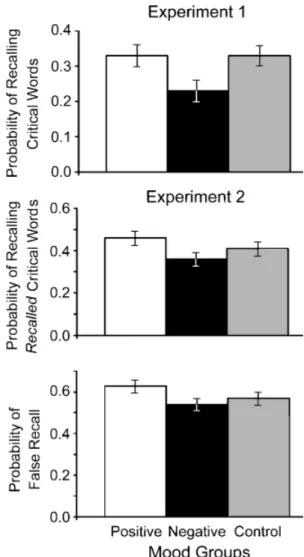
To determine whether the positive-mood group recalled a greater number of critical lures than the negative-mood group, we conducted a one-way analysis of variance on the three mood groups (positive, negative, control), with the probability of re-calling critical lures as the dependent measure (see Fig. 1, top panel). The main effect of mood was significant,F(2, 81)54.0,
p5 .02,Z 5.3. Further analysis revealed that the positive-mood group recalled more critical lures than the negative-positive-mood group,t(62)52.6,p5.01. Moreover, the control group also
recalled significantly more critical lures than the negative-mood group,t(50)52.2,p5.03.
Further analyses revealed that the positive-mood, negative-mood, and control groups did not differ in veridical recall or in mean error (critical lures not included) production (see Table 1).
Discussion
The main result from Experiment 1 was that the negative-mood group recalled significantly fewer critical lures than the posi-tive-mood and control groups. In addition, no differences were found in veridical recall or in total error production among the three groups. The primary conclusion is that negative affective cues reduce levels of false memory. We propose that this is the case because of a tendency for affective cues to influence Fig. 1.Results from Experiments 1 and 2. The top panel shows the mean probability of recalling critical words as a function of mood group in Ex-periment 1. The middle and bottom panels present the mean probability of recalling critical words as a function of mood group in Experiment 2; the middle panel shows the probability of listing critical words as having been presented (recalledcritical words), and the bottom panel shows the probability of listing critical words either as having been presented or as having come to mind (totalcritical words).
1Because a precondition for testing the hypotheses was that the compared
groups differed appropriately in mood, participants were retained for analysis only when their self-reports of mood matched the mood intended to be induced. Participants were included in the positive-mood group if their scores were above the median self-reported mood score, and participants were included in the negative-mood group if their scores were below the median self-reported mood score.
activation processes, a hypothesis that we examined further in the next experiment.
EXPERIMENT 2
This experiment was designed to replicate Experiment 1 and to investigate why negative affective cues reduce false memories. Following the logic of Hege and Dodson (2004), we introduced an inclusion instruction in order to distinguish between two possible bases for the effect: (a) reduced accessibility of the critical lure and (b) voluntarily not reporting critical lures as a result of successful memory monitoring. For each list, partici-pants were asked to recall items they had seen, but they were also asked to list any additional related words that had come to mind during the study or recall phase (the inclusion instruction; e.g., Brainerd & Reyna, 1998; Brainerd, Wright, Reyna, & Payne, 2002). Such inclusion instructions should disable the contribution of strategic monitoring processes, as there is no need to withhold reporting the critical lures that come to mind. If the reduced false memory effect in the negative-mood group of Experiment 1 was due to monitoring processes, then differences between mood groups would be expected to disappear in their responses to the inclusion instructions. But if the effect was due to differences in the accessibility of critical lures, then differ-ences between mood groups would be expected to be present in their responses to the inclusion instructions.
Method
One hundred nineteen University of Virginia undergraduates participated to fulfill a course requirement. The same design was used as in Experiment 1, with the addition of inclusion in-structions. All participants received these inin-structions. As a result, new dependent measures included inclusion lure duction (additional lures that came to mind), total lure pro-duction (lures reported as having been seen plus lures reported
as coming to mind), inclusion list recall (additional list items that came to mind), and inclusion error production (any words other than list words and critical lures that were reported as coming to mind).
Materials
The materials were the same as in Experiment 1 with the fol-lowing exceptions. We eliminated six lists to shorten the ex-periment, we presented thesadlist but not thehappylist, and we added the inclusion instructions.
Procedure
The procedure was identical to that in Experiment 1, except for the instructions for completing the DRM task. In Experiment 2, participants were instructed to write down the words that had been presented and also to write down any words that came to mind that were related to the presented items, indicating the related items by placing a check mark beside them. Participants were given 45 s to list presented and related items for each list and were informed that items could be listed in any order.
Results
Mood Manipulation Check
Participants whose mood was not effectively manipulated were removed from the analyses (12 in the positive-mood group, 17 in the negative-mood group, 0 in the control group), leaving 31 participants in the positive-mood group, 24 participants in the negative-mood group, and 35 participants in the control group. The resulting groups were reliably different in mood (positive-moodM56.0, negative-moodM54.4),F(1, 53)543.0,p5
.00,Z5.73.
Recall
The second experiment was designed to test whether the re-duction in the false memory effect for the negative-mood group TABLE 1
Results From Experiments 1 and 2
Dependent variable
Mood group
Positive Negative Control F
Experiment 1
Probability of veridical recall .40 (.05) .40 (.06) .40 (.06) <1 Mean error production 6.0 (3.8) 5.4 (3.9) 7.0 (5.3) <1
Experiment 2
Probability of veridical recall .37 (.06) .37 (.05) .36 (.05) <1 Mean error production 9.6 (13) 8.0 (8.5) 9.2 (9.5) <1 Mean inclusion list recalla 9.6 (7.5) 10.5 (10.9) 8.9 (5.7)
<1 Mean inclusion error productiona 19.4 (20) 29.9 (37) 14.6 (18) 2.3b Probability of inclusion lure productiona 0.17 (0.14) 0.20 (0.15) 0.16 (0.17) <1
Note.Standard deviations are in parentheses.
aSee Experiment 2 Method for an explanation of these variables. bp5.1.
in Experiment 1 was a result of activation differences at en-coding or of monitoring processes during retrieval. We computed two recall variables: the probability of listing lures as having been seen (recalled lures) and the total probability of listing lures either as having been seen or as coming to mind (total lures). Therefore, to test whether affect influenced activation or moni-toring processes, we compared the mean probabilities of total and recalled lures in a 2 (recall: recalled, total)3 (mood group: positive, negative, control) analysis of variance. We found a main effect for recall,F(1, 87)5110.0,p<.00,Z5.75, and a main effect for mood group,F(2, 87)54.0,p5.02,Z5.29. More important for answering the question of interest was the complete absence of an interaction between recall and mood group,F<1. That is, the effect of the inclusion instructions on the production of critical lures did not differ across the mood groups (see Table 1).
Planned comparisons showed that all mood groups had a higher probability of listing total lures (M 5 .58), which in-cluded both recalled and inclusion lures, than listing recalled lures (M5.40). Further planned comparisons found that the positive-mood group (M5.55) had a higher mean probability of recalling lures than the negative-mood group (M5.44). These results showed that compared with the negative-mood group, the positive-mood group listed more critical lures in both the re-called and the total lure sets (see Fig. 1, middle and bottom panels); this main effect, along with the lack of an interaction, indicates that we replicated the effect of mood on false memory effects found in Experiment 1. Moreover, because there was not even a tendency toward an interaction, the reduction in the false memory effect for the negative-mood group appears to be a result of reduced activation of lures during encoding.
Further analyses revealed no differences between groups in veridical recall, error production, or inclusion list recall (see Table 1).
Discussion
Experiment 2 replicated the finding from Experiment 1, which showed that mood influences the false memory effect. Compared with positive affect, negative affect reduced the tendency to show false memory effects. Experiment 2 also suggests that the effect of mood on false memory is due to differences in encoding, rather than retrieval processes. That is, when participants were given the chance to list all the lures generated during encoding, differences in the number of critical lures reported by the two mood groups remained. This result suggests that critical lures were less likely to be accessible in the negative-mood group than in the positive-mood group, rather than being more likely to be inhibited at retrieval. However, it should be noted that this conclusion comes mainly from the predicted failure of the in-teraction between recall and group. Hence, it is still possible that under some conditions mood might influence monitoring processes, as well as activation at encoding.
GENERAL DISCUSSION
The results of both experiments showed that affect influences the false memory effect. Individuals in negative moods were sig-nificantly less likely to recall critical lures than were individuals in positive moods. These results are in line with predictions of the affect-as-information approach (Clore et al., 2001), which hypothesizes that negative affective cues trigger item-specific processing. During encoding, such item-specific processing should reduce the accessibility of the semantic ‘‘gist,’’ including the accessibility of the gist-related critical lure, resulting in a corresponding reduction of the false memory effect. In contrast, individuals in happy moods are hypothesized to engage in re-lational processing, which, we predicted, should enhance the false memory effect.
In neither experiment did the positive-mood group differ from the control group in the recall of critical lures. This result may reflect the fact that establishment of a true affective neutral point is problematic. Neutral control groups routinely report quite positive affect (Diener & Diener, 1996). Indeed, imaging studies (Baker, Frith, & Dolan, 1997; George et al., 1995) find that when positive induced moods are contrasted with neutral states, pat-terns of brain activation often do not appear different. Another possibility is that the relational processing that underlies the false memory effect is the default mode for any nonnegative state. If so, then our findings primarily reflect the impact of negative affect on the false memory effect. Thus, the safest generalization may be that negative affect changes the default relational mode of processing to a more conservative, item-specific level of processing, reducing the false memory effect.
The current results are not the only ones to suggest that af-fective cues can influence the activation of semantic concepts at encoding. In another study (Storbeck & Clore, 2004), we used priming to investigate whether affect influences semantic acti-vation. We found priming in three different tasks when indi-viduals were in positive moods, but not when they were in negative moods (see Corson, 2002, for similar results). Because we used a stimulus onset asynchrony under 300 ms, our results presumably reflect automatic rather than controlled processes. If so, they also suggest that affect has its influence on activation during encoding, influencing the degree to which targets are semantically activated by primes. As in the current experiments, negative affect appeared to reduce this tendency. Roediger, Balota, and Watson (2001) suggested that priming effects rely on the same semantic activation as that involved in the false memory effect, which implies that mood should have similar effects on both.
Fuzzy-Trace Theory
The activation-monitoring framework (Roediger, Watson, et al., 2001) has difficulty accounting for the current findings. It as-sumes that critical lures are activated during encoding
regard-less of whether the false memory effect is shown or not, and that subsequent monitoring processes determine whether activated critical lures are included as recalled words. If this is correct, then people in negative and positive moods should have a similar number of critical lures come to mind. The current re-sults showed a reduction in the accessibility of critical lures in the negative-mood group. However, the results of Experiment 2 showed that this effect was not a result of monitoring processes. The activation-monitoring framework, in its current form, can-not account for this observed dissociation between true and false recall without invoking a post hoc process. In addition, because true recall was similar among the three groups across both ex-periments, differences in false recall cannot be accounted for by motivational differences among the mood groups.
Our results can, however, be accounted for by fuzzy-trace theory (e.g., Brainerd & Reyna, 1998; Brainerd et al., 2002). Fuzzy-trace theory contends that multiple representations of an event, including both verbatim and gist representations, are stored in parallel. Verbatim representations correspond to memory traces for individual items. Gist representations cor-respond to memory traces for the general semantic meanings of events (in the present case, of the lists). The parallel encoding of verbatim and gist representations allows for true and false recall to be dissociated. Fuzzy-trace theory suggests that true recall comes from verbatim representations and false recall from gist representations. Because true recall was similar for positive-and negative-mood groups, positive-and only false recall showed a dif-ference, the theory suggests that mood influenced gist rather than verbatim representations. Thus, in terms of fuzzy-trace theory, we suggest that negative moods impaired gist processing, which resulted in the recall of fewer nonpresented lures by the negative-mood group. As noted, these findings are also con-sistent with the affect-as-information approach, which suggests that negative moods lead to a reduction in relational processing.
Summary
In two experiments, we found that affect can influence the en-coding processes believed to lead to the production of false memories. In particular, negative affective cues reduced the false memory effect. We hypothesized that negative affect would trigger item-specific or referential processing during encoding, which in turn would dampen the generation of concepts asso-ciated with the studied items. Such general concepts often serve as the critical lures in the classic DRM false memory paradigm. In contrast, we predicted that individuals in nonnegative states would process the lists relationally, resulting in greater recall of the critical lures and an enhanced false memory effect. The results supported these predictions and suggest that positive affect can be expected to benefit performance on tasks requiring relational processing, but that negative affect may benefit performance on tasks requiring referential processing. In the present task, the referential processing of negative moods led to
accuracy, whereas the relational processing of positive moods led to false memories.
Acknowledgments—The authors would like to thank Charles Brainerd, Chad Dodson, and Mandy Hege for their helpful comments and insights. This article was part of the first author’s doctoral thesis. Support for this research came from National Institute of Mental Health Grant MH 50074 to Gerald L. Clore.
REFERENCES
Arndt, J., & Reder, L. (2003). The effect of distinctive visual infor-mation on false recognition.Journal of Memory and Language,48, 1–15.
Baker, S., Frith, C., & Dolan, R. (1997). The interaction between mood and cognitive function studied with PET.Psychological Medicine,
27, 565–578.
Bless, H., Clore, G.L., Schwarz, N., Golisano, V., Rabe, C., & Wolk, M. (1996). Mood and the use of scripts: Does a happy mood really lead to mindlessness?Journal of Personality and Social Psychology,
71, 665–679.
Bodenhausen, G. (1994). Emotions, arousal, and stereotypic judg-ments: A heuristic model of affect and stereotyping. In D. Mackie & D. Hamilton (Eds.),Affect, cognition, and stereotyping: Inter-active processes in group perception(pp. 13–37). San Diego, CA: Academic Press.
Bower, G., Monteiro, K., & Gilligan, S. (1978). Emotional mood as a context for learning and recall. Journal of Verbal Learning and Verbal Behavior,17, 573–585.
Brainerd, C., & Reyna, V. (1998). When things that never happened are easier to ‘‘remember’’ than things that did.Psychological Science,
9, 484–489.
Brainerd, C., Wright, R., Reyna, V., & Payne, D. (2002). Dual retrieval processes in free and associative recall.Journal of Memory and Language,46, 120–152.
Clore, G.L., Wyer, R.S., Dienes, B., Gasper, K., Gohm, C., & Isbell, L. (2001). Affective feelings as feedback: Some cognitive conse-quences. In L.L. Martin & G.L. Clore (Eds.),Theories of mood and cognition: A user’s guidebook(pp. 27–62). Mahwah, NJ: Erlbaum. Corson, Y. (2002). Effects of positive, negative, and neutral moods on associative and semantic priming.Current Psychology of Cogni-tion,21, 33–62.
Diener, E., & Diener, C. (1996). Most people are happy.Psychological Science,7, 181–185.
Dodson, C., & Schacter, D. (2001). ‘‘If I had said it I would have re-membered it’’: Reducing false memories with a distinctiveness heuristic.Psychonomic Bulletin & Review,8, 155–161.
Fiedler, K. (2001). Affective states trigger processes of assimilation and accommodation. In L.L. Martin & G.L. Clore (Eds.),Theories of mood and cognition: A user’s guidebook(pp. 86–98). Mahwah, NJ: Erlbaum.
Gasper, K., & Clore, G.L. (2002). Attending to the big picture: Mood and global versus local processing of visual information. Psycho-logical Science,13, 34–40.
George, M., Ketter, T., Parekh, P., Horwitz, B., Herscovitch, P., & Post, R. (1995). Brain activity during transient sadness and happiness in healthy women.American Journal of Psychiatry,152, 341–351. Gray, J. (2001). Emotional modulation of cognitive control: Approach-withdrawal states double-dissociate spatial from verbal two-back
task performance.Journal of Experimental Psychology: General,
130, 436–452.
Gray, J., Braver, T., & Raichle, M. (2002). Integration of emotion and cognition in the lateral prefrontal cortex.Proceedings of the Na-tional Academy of Sciences, USA,99, 4115–4120.
Hege, A.C.G., & Dodson, C.S. (2004). Why distinctive information reduces false memories: Evidence for both impoverished rela-tional-encoding and distinctiveness heuristic accounts.Journal of Experimental Psychology: Learning, Memory, and Cognition,30, 787–795.
Hunt, R., & Einstein, G. (1981). Relational and item-specific infor-mation in memory.Journal of Verbal Learning and Verbal Behavior,
20, 497–514.
Hunt, R., & McDaniel, M. (1993). The enigma of organization and distinctiveness.Journal of Memory and Language,32, 421–445. Isbell, L. (2004). Not all happy people are lazy or stupid: Evidence of systematic processing in happy moods.Journal of Experimental Social Psychology,40, 341–349.
Isen, A. (1987). Positive affect, cognitive processes, and social be-havior. In L. Berkowitz (Ed.), Advances in experimental social psychology, Vol. 20 (pp. 203–253). San Diego, CA: Academic Press.
Isen, A., & Daubman, K. (1984). The influence of affect on categori-zation.Journal of Personality and Social Psychology,47, 1206– 1217.
McDermott, K., & Watson, J. (2001). The rise and fall of false recall: The impact of presentation duration. Journal of Memory and Lan-guage,45, 160–176.
McIntyre, C., Power, A., Roozendaal, B., & McGaugh, J.L. (2003). Role of the basolateral amygdala in memory consolidation. In P.
Shin-nick-Gallagher, A. Pitkanen, A. Shekhar, & L. Cahill (Eds.),The amygdala in brain function: Basic and clinical approaches(Annals of the New York Academy of Sciences Vol. 985, pp. 273–293). New York: New York Academy of Sciences.
Niedenthal, P.M., & Setterlund, M. (1994). Emotion congruence in perception.Personality and Social Psychology Bulletin,20, 401– 411.
Packard, M., Cahill, L., & McGaugh, J. (1994). Amygdala modulation of hippocampal-dependent and caudate nucleus-dependent memory processes.Proceedings of the National Academy of Sciences, USA,
91, 8477–8481.
Roediger, H., Balota, D., & Watson, J. (2001). Spreading activation and arousal of false memories. In H. Roediger, J. Nairne, & A. Sur-prenant (Eds.), The nature of remembering: Essays in honor of Robert G. Crowder. Science conference series(pp. 95–115). Wash-ington, DC: American Psychological Association.
Roediger, H., & McDermott, K. (1995). Creating false memories: Re-membering words not presented in lists.Journal of Experimental Psychology: Learning, Memory, and Cognition,21, 803–814. Roediger, H., Watson, J., McDermott, K., & Gallo, D. (2001). Factors
that determine false recall: A multiple regression analysis. Psy-chonomic Bulletin & Review,8, 385–407.
Storbeck, J., & Clore, G.L. (2004).Turning on and off affective and categorical priming with mood. Manuscript submitted for publi-cation.
(RECEIVED8/17/04; REVISION ACCEPTED11/17/04; FINAL MATERIALS RECEIVED11/29/04)