E
FFECTS OF
I
NGESTING
P
ROTEIN IN
C
OMBINATION
W
ITH
C
ARBOHYDRATE
D
URING
E
XERCISE ON
E
NDURANCE
P
ERFORMANCE
:
A S
YSTEMATIC
R
EVIEW
W
ITH
M
ETA
-A
NALYSIS
R
EBECCAL. S
TEARNS, H
OLLYE
MMANUEL, J
EFFS. V
OLEK,
ANDD
OUGLASJ. C
ASA Human Performance Laboratory, Department of Kinesiology, University of Connecticut, Storrs, ConnecticutABSTRACT
Stearns, RL, Emmanuel, H, Volek, JS, and Casa, DJ. Effects of ingesting protein in combination with carbohydrate during exercise on endurance performance: a systematic review with
meta-analysis. J Strength Cond Res 24(8): 2192–2202,
2010—Coingestion of protein with carbohydrate has been shown to enhance muscle recovery, particularly after intense bouts of exercise. However, performance benefits of ingesting a protein–carbohydrate drink during exercise remains unclear. Therefore, we used a systematic review with meta-analysis to examine the influence of protein ingestion during exercise on subsequent endurance performance. Eleven qualifying studies were included that contained 3 time-trial and 8 time-to-exhaustion cycling protocols. Only 3 of these studies controlled for caloric content and contained an isocaloric trial. Of the 11, 4 reported significant differences between a control and protein trial; however, none of these were isocaloric studies. The 3 time-trial protocols showed no significant improvement with protein. The meta-analysis of the time-trial studies revealed
no significant overall effect (p= 0.73), whereas meta-analysis
of time-to-exhaustion studies revealed a significant effect (p= 0.008). Of the time-to-exhaustion trials, the isocaloric studies
found no significant effect (p= 0.71), whereas the
isocarbohy-drate studies revealed a significant effect (p = 0.05). The
average percent improvement with ingestion of protein was 9.0%. The isocarbohydrate studies reported an improvement of 10.5%, whereas the isocaloric studies revealed a 3.4% improvement. We conclude that compared to carbohydrate alone, coingestion of protein and carbohydrate during exercise demonstrated an ergogenic effect on endurance performance when assessed by time to exhaustion and also where supple-ments were matched for carbohydrate (isocarbohydrate). Thus,
the ergogenic effect of protein seen in isocarbohydrate studies may be because of a generic effect of adding calories (fuel) as opposed to a unique benefit of protein. Further research is warranted before a clear conclusion can be drawn.
KEY WORDS performance, protein, cycling, time trial, time to
exhaustion
INTRODUCTION
C
arbohydrate feeding during exercise has beenshown to improve prolonged endurance perfor-mance by maintaining high rates of carbohydrate oxidation and preventing hypoglycemia (12). Studies aimed at optimizing the performance effects of carbohydrate supplementation have explored feeding protocols varying in dose, source, and timing of carbohydrate intake during exercise. Historically, the focus on carbohy-drate-feeding regimens to enhance performance has occurred with little attention to protein. In the past few years, several investigations have examined the effects of adding protein to carbohydrate beverages during exercise. The most recent position statements from the American College of Sports Medicine (1) and the National Athletic Trainers Association (5) do not address the effects of rehydration beverages containing protein for use during endurance exercise. The International Society of Sport Nutrition (14) acknowledges that adding protein to a carbo-hydrate–electrolyte sport drink (3-4:1 CHO:PRO) may increase benefits of a rehydration solution.
Although protein is generally accepted to be an inefficient fuel source and contributes minimally to the overall energy demands of exercise, there are other physiologically relevant qualities of protein that may impact performance when coingested with carbohydrate during prolonged exercise (30). Protein added to carbohydrate will increase amino acid bioavailability and may increase insulin and decrease cortisol levels. These metabolic and hormonal alterations during exercise could impact glucose and fat oxidation, spare glycogen use, and inhibit protein breakdown (30).
Address correspondence to Rebecca L Stearns, [email protected]
24(8)/2192–2202
Journal of Strength and Conditioning Research
!2010 National Strength and Conditioning Association
During exercise, branch chain amino acids (BCAAs) are used for energy by skeletal muscle. This increases the ratio of free tryptophan (f-TRP) to BCAAs in the blood. Increased f-TRP to BCAA ratio facilitates increased uptake of TRP (a precursor to serotonin) in the brain. Increase in the concentration of serotonin can impair central nervous system function during prolonged exercise (9) Specifically, it mediates central fatigue, which will hinder performance. Ingesting protein can influence the ratio of f-TRP to BCAA to decrease serotonin levels and thereby delay central fatigue. Certain amino acids provided before or during exercise may also enhance exercise-related immune responses. Lastly, protein in a rehydration beverage may enhance fluid uptake by the intestines by activating supplementary active cotransporters (18), provided fluid osmolality is not increased.
Clearly, protein added to carbohydrate can alter physiologic responses during exercise that may be relevant to endurance performance. The purpose of this systematic review with meta-analysis was to conduct a preliminary examination and critically evaluate studies that assess endurance performance when protein is added to a carbohydrate–electrolyte re-hydration beverage taken during exercise.
METHODS
In January of 2010, potential studies were identified by searching Pubmed, SportDiscus, CINAHL, Scopus, Rehabil-itation, Physical Medicine (Embase database), and Cochrane Library using the following search terms in varying combi-nations: protein, amino acids, exercise, sport drink, hydration, sport, performance, running, cycling, and marathon. Articles were then screened by title and abstract and crossreferenced.
Experimental Approach to the Problem Subjects
Inclusionary Criteria. Studies were included if they had performance measures (either time to complete a set distance, time to exhaustion, or the maximal amount of work completed in a fixed amount of time) that were done in the same exercise bout as the consumption of protein, subjects ingested any form of protein during activity or immediately before the start and during activity, the effect of protein ingestion could be isolated, a crossover randomized design was used with blinding of researchers and subjects if possible. These criteria were required for inclusion to ensure the following: (a) A perfor-mance measure was taken. (b) Protein was taken immediately before and/or during exercise and not as a recovery tool between bouts of exercise. (c) The relationship between protein intake and performance could be measured. (d) Measures were taken to increase internal validity of the study (i.e., blinding of subjects and randomization of trials).
Exclusionary Criteria.Studies were excluded if (a) two bouts of exercise were performed more than 2 hours apart and protein was ingested during the recovery period from the first bout. This was to ensure that the study design did not allow enough
time for the recovery benefits of protein ingestion between bouts of exercise to occur. (b) The protocol included multiple days of protein supplementation during testing. These stand-ards were set to ensure that the consumption of protein days prior did not effect the recovery and therefore performance of subjects on testing days.
Physiotherapy Evidence Database Scale. The Physiotherapy Evidence Database (PEDro) scale (28) was used to rate each article included in the systematic review. This scale was used because of its ability to assess a study’s internal validity. The PEDro scale consists of an 11-point checklist (although a 10 indicates a perfect score) including items such as blinding of subjects and assessors, randomization of trials, and reporting measure of variability.
Although the authors performed extensive searches and thousands of articles were located, it is important to recognize that despite this search, every relevant article may not have been located. For example, the databases searched do not include theses or dissertations, MEDLINE does not include issues before 1966, and unpublished articles are not available for locating on these databases. To aid with some of these limitations, the authors also did a search on EMBASE, which indexes more than 1,000 journals that are not found in MEDLINE.
Once each article was screened by title and abstract, the remaining articles were read and further sorted according to inclusionary and exclusionary criteria. Once these steps were passed, each article was then assessed by 2 separate reviewers and given a PEDro score. Articles with scores that were either different or had different qualifying components were then analyzed by an independent third party. Any article that
received a PEDro score ,7 did not meet the criteria for
inclusion in this review. Articles with milk ingestion were included despite the inability to blind subjects, which accounts for the lower PEDro score.
Statistical Analyses
The effect of protein ingestion on performance was examined by RevMan meta-analysis software (version 5.0; The Nordic Cochrane Center, The Cochrane Collaboration, Copenhagen, Denmark). RevMan was used for the calculation of the
x2 distribution to determine heterogeneity, test for overall
effect, mean differences, weighted averages, effect estimates, and 95% confidence intervals. Continuous variables are presented as weighted mean difference and with 95%
confidence intervals. The mean and SD of the mean were
analyzed using a random-effects model for calculation of the weighted mean difference. Statistical heterogeneity was
assessed by the chi-squared test, where a pvalue#0.1 was
regarded as significant based on the software program and the analysis that was run. Interrater agreement for the PEDro scores was calculated using the Kappa computations.
RESULTS
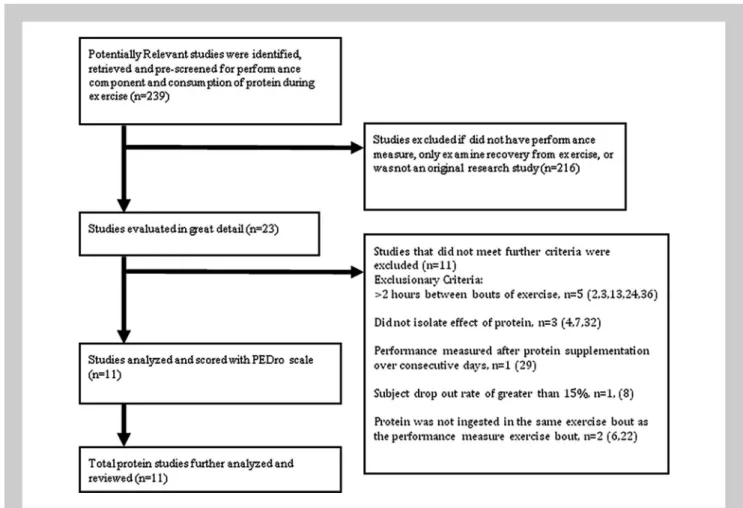
The process by which the studies were identified and selected is outlined in Figure 1. After screening the articles by title and
VOLUME 24 | NUMBER 8 | AUGUST 2010 |
2193
Journal of Strength and Conditioning Research
the TMabstract, 23 articles remained. These were then read in depth to determine appropriateness for this topic. Five studies were excluded because protein was consumed between multiple bouts of exercise and subjects were given more than 2 hours of rest. Two studies did not isolate the effect of protein with a clear control trial. The last 2 studies were excluded because of protein supplementation occurring over multiple days during the course of data collection and a subject drop out rate of greater than 15%. By removing these (2–4,6–8,13,22,24,29, 32,36) 12 articles, the remaining 11 articles used in the final analysis included studies examining protein consumption in the form of milk, gel, and protein added to a carbohydrate– electrolyte drink. These articles are summarized in Table 1.
The mean PEDro score of those included was 9.75 of 10. Studies using milk as the method of protein administration were not able to blind subjects or researchers, which affected their score. All other studies were able to achieve a 10 because of the use of a double blind and randomized crossover design. Kappa scores from all articles revealed a 1.0 agreement level on the PEDro analyses between the 2 reviewers.
Protein Supplementation
The 11 studies (11,17,20,21,23,25–27,33–35) used a placebo/ carbohydrate (control) trial for comparison with a protein
supplemented trial. All but 1 trial administered the supple-ments via a liquid solution, with the other using a gel form (26). Additionally it should be noted that none of the included studies reported any type of side effect or gastro-intestinal distress because of the ingestion of protein.
Exercise performance was assessed using a time-trial (23,27,34) or time-to-exhaustion (11,17,20,21,25,26,33,35) test with cycling as the mode of exercise. In the time-to-exhaustion studies, the majority provided supplements every 10–15 minutes (11,17,25,26,33,35), one provided supplements every 20 minutes (20) and one every 30 minutes (21). The time-to-exhaustion designs, however, allow for greater variability between studies because of the possible differences between fitness levels, which could allow for greater exercise time. In the studies that directly assessed fitness levels of the subjects, values ranged from 45 to 55 ml!kg21!min21. Other studies did not specify a minimum requirement (17,20,25,26), and no studies reported exclusion of subjects because of an elevated level of fitness. Consequently, more fit subjects were able to exercise longer and consume a greater number of boluses. The amount of protein consumed during a trial ranged from 7 to 45 g. The other 3 studies performed time trials over a set distance. This is important to note not only because of the validity of time-to-exhaustion trials as
Figure 1.Decision tree for identifying, screening and selecting studies for analyses.
2194
Journal of Strength and Conditioning Research
the TMmentioned previously, but also because of the differences in the amount of protein consumed by the more fit individuals. In time-to-exhaustion trials, these
individuals would consume
greater amounts of protein during a trial as opposed to time-trial protocols in which those subjects would finish sooner and consume less pro-tein. With the number of meth-odological differences between these studies, it was impossible to account for all of them in the analysis. We decided to divide studies based on type of per-formance test (time trial or time-to-exhaustion protocols). Time-to-exhaustion protocols were further divided into iso-caloric (carbohydrate + carbo-hydrate or carb + protein) and isocarbohydrate studies.
Meta-analysis
The meta-analysis test for
het-erogeneity was significant:x2=
20.29,p= 0.008, for the
time-to-exhaustion studies. Using a fixed-effects inverse variance analysis model, the test for overall effect was significant
(Z= 2.13,p= 0.03) indicating
a significant effect for the experimental trials. Although the test for heterogeneity was significant, the authors would like to recognize that 1 study (35) had extremely small con-fidence intervals because of identical values from both the experimental and control trials. This caused some confidence intervals not to overlap result-ing in a significant heterogene-ity value. Because the majorheterogene-ity of confidence intervals overlap (indicating homogeneity), it is still relevant to report the results of the overall effect. With the 8 studies included (2 entries were given for Valen-tine 2008 because it included both an isocaloric and an
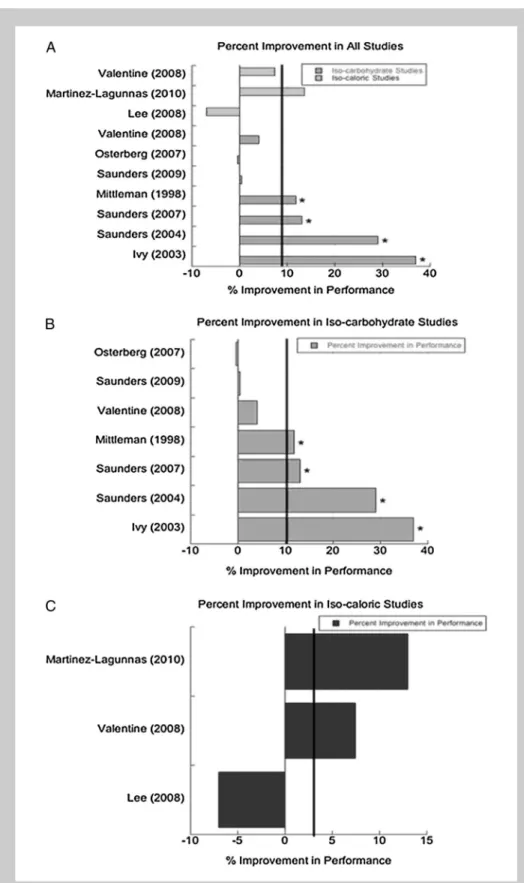
Figure 2.The effect of protein on exercise performance when ingested during or before exercise in all studies (A), isocarbohydrate studies (B), and isocaloric studies (C). Vertical line represents the mean percent improvement from all studies. A = 9%, B = 10.5%, C = 3.4%. *Significantly different from appropriate control (isocaloric or isocarbohydrate). Articles of Van Hall and Van Essen are not included because specific numbers needed to calculate percent improvement in performance were not provided.
VOLUME 24 | NUMBER 8 | AUGUST 2010 |
2195
Journal of Strength and Conditioning Research
the TMTABLE1.Article information and protocols.
Reference Men Women
Delivery mode Trials Volume and composition of control Volume and consumption of
protein solution Time of administration
Ivy et al. (11) 9 0 Solution Placebo, CHO,
CHO-PRO
200 mL 7.75% CHO 200 mL of 7.75% CHO + 1.94% PRO
At start & every 20 min Lee et al. (17)† 8 0 Solution/milk Water, CHO,
1% milk, 1% milk + CHO 1.5 ml/kg CHO (60 g/L CHO) 1.5 ml/kg Milk + CHO (33 g/L PRO + 60 g/L CHO)
At start & every 10 min Martinez-Lagunas
(20)†
7 5 Solution CHO + PRO-H,
CHO + PRO-L, CHO, Placebo
CHO: 0.7 g/kg, High PRO: 0.52 g/kg of CHO Low PRO: 0.3 g/kg of CHO
Every 20 min during exercise Mittleman et al. (21) 7 6 Solution Placebo, BCAA 5 ml/kg of 5.88 g/L of
Polydextrose
5 ml/kg of 5.88 g/L of BCAA
60 min prior to start and every 30 min there-after (including exercise) Osterberg et al. (23)‡ 13 0 Solution Placebo, CHO,
CHO-PRO
250 mL of 6% CHO 250 mL of 7.5% CHO + 1.6% PRO
Every 15 min during constant load ride
Saunders et al. (25) 15 0 Solution CHO, CHO PRO 1.8 ml/kg of 7.3% CHO
1.8 ml/kg of 7.3% CHO and 1.8% PRO
Every 15 min during exercise
Saunders et al. (26) 8 5 Gel CHO, CHO +
PRO gel
.146 g CHO/kg .146 g CHO/kg + 0.0365 g PRO/kg
Every 15 min during exercise Saunders et al. (27)‡ 13 0 Solution CHO, CHO + PRO 200 mL of 6% CHO 200 mL of 6% CHO +
1.8% PRO
Every 5 k Valentine et al. (33)† 11 0 Solution Placebo, CHO,
CHO + CHO, CHO + PRO 250 mL of 7.75% CHO + 1.94% PRO 250 mL of 6% CHO, or 9.69% CHO
Every 15 min during exercise Van Essen et al. (34)‡ 10 0 Soultion Placebo, CHO,
CHO-PRO
250 mL of 6% CHO 250 mL of 6% CHO + 2% PRO
Every 15 min during exercise
Van Hall et al. (35) 10 0 Solution Sucrose, sucrose + tryptophan, low-BCAA, high-BCAA 2 ml/kg of 6% sucrose 2 ml/kg of 6% sucrose + 6 g BCAA (low-BCAA), or 6% sucrose + 18 g BCAA (high BCAA)
Every 15 min during exercise
2196
Jo
urn
al
of
Str
en
gth
an
d
C
on
diti
on
ing
Re
sea
rch
th e TMProtein
Ingestion
During
Performance
Exercise
Reference Total protein Protocol Total exercise time
Improvement over
placebo or CHO Environmental Pedro
score r2 Ivy et al. (11) 11.64 g TTE at 85%Vo_ 2max
after 3 hours of alternating at 75%–85% cycling
3 hrs + TTE (;13–26 min) 7.2 min vs CHO (37%)*
;20"C 10 2.56
Lee et al. (17)† 38.35 g (avg) Cycling at 70%Vo_ 2 to exhaustion
;103 min both trials 7.8 min more for CHO vs milk (7%) ;20cC, 43% humidity 7 NA Martinez-Lagunas (20)† CHO-H: 26.4 g (avg)
CHO-L: 17.2 g (avg) Cycling at 55–75%Vo_ 2max for 2.5 hrs,
then 80% until fatigue
150 min + TTE (CHO: 27 min, CHO + PRO-H: 30 min, CHO + PRO-L: 28 min)
CHO-H 13% longer than CHO 21–23"C 10 0.37 Mittleman et al. (21) Femals: 9.4 g Males: 15.8 g (avg) Cycle TTE at 40% _ Vo2peak
Avg of 153 min for BCAA, Avg of 137 min for placebo
;16 min for men and women (11.8%)* ;34"C, 39% humidity 10 1.47 Osterberg et al. (23)‡
32 g PRO 120 m in constant load ergometer cycling followed by Time to complete 7 kj/kg
120 min constant load cycling + Time Trial (;38 min for both trials)
1.7 min slower vs CHO (0.45%) 23.8"C, 40% humidity 10 0.10 Saunders et al. (25) 6.5 g PRO/355 mL (avg = 17 g total) Cycling TTE at 75% _ Vo2peak
TTE (CHO: 82 min, CHO-PRO: 105.8 min) 23.8 min vs CHO (29%)* Not reported 10 0.28 Saunders et al. (26)
20 g (avg) Cycling TTE at 75%
_
Vo2peak
TTE (CHO: 102.8 min, CHO-PRO: 116.6 min) 13% longer (13.8 min)* Not reported 10 0.23 Saunders et al. (27)‡ 32 g PRO 60 km Cycling Time Trial CHO: 13564 min, PRO: 134.464.6 min 0.44 min longer vs CHO Not reported 10 0.02 Valentine et al. (33)†
40.7 g (avg) Cycling TTE at 75%
_
Vo2peak
TTE (CHO: 117 min, CHO + CHO: 121 min, CHO + PRO: 126 min)
7.4% (CHO) & 4% (CHO + CHO)
21"C 10 0.02 Van Essen et al.
(34)‡
45 g (avg) Cycling 80 km
time trial
Time Trial (CHO: 135 min, CHO-PRO: 135 min)
No difference (p= 0.92)
Not reported 10 0.00 Van Hall et al.
(35) 7 g (low BCAA) or 23 (High BCAA) Cycling TTE at 70–75% of maximum power output
TTE;122 min No difference
(no p reported)
Not reported 10 0.00
*Denotes significant difference.
†Denotes iso-calorice study.
‡Denotes time trial study.
CHO = carbohydrate; PRO = protein; BCAA = branch chain amino acids; TTE = time to exhaustion.
VOLUME 24 | NUMBER 8 | AUGUST 2010 |
2197
Jo
urn
al
of
Str
en
gt
h
an
d
C
on
diti
on
ing
Re
sea
rch
th e TM | www .nsca-jscr .o rgisocarbohydrate trail) (n = 102) the effect estimate = 5.14 (95% confidence interval = 0.42, 9.86) (see Table 2).
The meta-analysis test for heterogeneity for the time-trial
studies was not significant:x2= 0.85, p= 0.65. The test for
overall effect was not significant (Z= 0.34,p= 0.73)
indicat-ing no significant improvement in the experimental trial.
With the 3 studies included (n= 36), the effect estimate =
0.41 (95% confidence interval =21.93, 2.74) (see Table 3).
A Meta-analysis was also performed to break out the isocarbohydrate and isocaloric time-to-exhaustion studies. When the 3 isocaloric time-to-exhaustion studies were
examined, the test for heterogeneity was not significant:x2=
0.69,p= 0.71. The test for overall effect was not significant (Z=
1.32, p= 0.19), indicating no significant improvement in the
experimental trial (see Table 4). When the isocarbohydrate studies were examined, the test for heterogeneity was
significant: x2 = 20.07, p = 0.001 (see Table 5). Again the
authors attribute this to the inclusion of the Van Hall et al. study.
The test for overall effect was significant (Z= 1.96,p= 0.05)
indicating a significant improvement in the experimental trial.
Other Comparisons
Only 3 studies included female subjects (20,21,26) in which one reported differences between sexes (26), however no significant treatment by gender effect was found. Environ-mental conditions were also noted in 7 of the 11 articles, although only 1 examined the effect of protein intake in the
heat (34oC). Protein supplementation during the heat did not
result in any variation from studies performed in temperate conditions (21).
Percent Improvement in Performance
From all 11 studies, there was an average of 9.0% improve-ment in performance when consumption of protein was compared with a suitable control. Of these, 4 reported the difference to be significant at an alpha level of 0.05. Only 9 of the 11 articles were included in this average because 2 (34,35) did not report the exact differences between trials but did report that no significant difference was found. When only the isocarbohydrate studies were examined, the average percent improvement in performance is 10.5%, whereas when calories were controlled and supplements were isocaloric, the mean percent improvement was 3.4% (Figure 2C, Table 4).
Isocaloric Studies
Of all 11 studies, only 3 isolated the effect of the added calories because of protein (17,20,33). In a study conducted by Valentine, 4 trials were performed: placebo, 7.75% carbohy-drate solution, 9.69% carbohycarbohy-drate solution, and a 7.75% carbohydrate + 1.94% protein drink. The 9.69% carbohy-drate solution matched the calories in the carbohycarbohy-drate– protein drink (carbohydrate + carbohydrate vs. carbohydrate + protein). It was concluded that there was no significant improvement in cycling time to exhaustion with protein supplementation when compared with either the isocarbo-hydrate or the isocaloric drink. Because performance
T ABLE 2. Meta-analysis of time-to-exhaustion studies.* † Study or subgroup Experimental Control Weight (%) Mean difference Mean difference Mean SD Total Mean SD Total IV, Random, (95% CI) IV, Random, (95% CI) Ivy, 2003 26.9 4.5 9 19.7 4.6 9 23.3 7.20 (3.00, 11.40) Lee, 2008 102.8 32.5 8 110.6 49.2 8 1.3 2 7.80 ( 2 48.66, 33.06) Martinez-Lagunas, 2010 30.5 5.9 12 26.9 6.1 12 22.1 3.60 ( 2 1.20, 8.40) Mittleman, 1998 153.1 13.3 13 137 12.2 13 12.8 16.10 (6.29, 25.91) Saunders, 2004 106.3 45.2 15 82.3 32.6 15 2.6 24.00 ( 2 4.20, 52.20) Saunders, 2007 116.6 28.5 13 102.8 25 13 4.4 13.80 ( 2 6.81, 34.41) Valentine isocal, 2008 121.3 36.8 11 126.2 25.4 11 2.9 2 4.90 ( 2 31.32, 21.52) Valentine 2008 117.5 24.2 11 126.2 25.4 11 4.4 2 8.70 ( 2 29.43, 12.03) Van Hall, 1995 122 3 10 122 3 10 26.3 0.00 ( 2 2.63, 2.63) Total (95% CI) 102 102 100.0 5.14 (0.42, 9.86) *Heterogeneity: Tau 2 = 20.29; Chi 2 = 20.75, df = 8 ( p = 0.008); I 2 = 61%. † Test for overall effect: Z = 2.13 ( p = 0.03).
2198
Journal of Strength and Conditioning Research
the TMTABLE4.Meta-analysis of time to exhaustion: isocaloric studies.*†
Study or subgroup
Experimental Control
Weight (%)
Mean difference Mean difference
Mean SD Total Mean SD Total IV, Random, (95% CI) IV, Random, (95% CI)
Lee, 2008 102.8 32.5 8 110.6 49.2 8 1.3 27.80 (248.66, 33.06)
Martinez-Lagunas, 2008 30.5 5.9 12 26.9 6.1 12 95.5 3.60 (21.20, 8.40) Valentine isocal, 2010 121 36.8 11 126.2 25.4 11 3.2 25.20 (231.62, 21.22)
Total (95% CI) 31 31 100.0 3.17 (21.52, 7.87)
*Heterogeneity: Tau2= 0.00; Chi2= 0.69, df = 2 (p= 0.71);I2= 0%.
†Test for overall effect;Z= 1.32 (p= 0.19).
TABLE3.Meta-analysis of time-trial studies.*†
Study or subgroup
Experimental Control
Weight (%)
Mean difference Mean difference
Mean SD Total Mean SD Total IV, Random, (95% CI) IV, Random, (95% CI)
Osterberg, 2007 38.8 5.5 13 37.1 3.8 13 41.4 1.70 (21.93, 5.33)
Saunders, 2009 134.4 4.6 13 135 4 13 49.8 20.60 (23.91, 2.71)
Van Essen, 2006 135 9 10 135 9 10 8.8 0.00 (27.89, 7.89)
Total (95% CD) 36 36 100.0 0.41 (21.93, 2.74)
*Heterogeneity: Tau2= 0.00; Chi2= 0.85, df = 2 (p= 0.65);I2= 0%.
†Test for overall effect:Z= 0.34 (p= 0.73).
VOLUME 24 | NUMBER 8 | AUGUST 2010 |
2199
Jo
urn
al
of
Str
en
gt
h
an
d
C
on
diti
on
ing
Re
sea
rch
th e TM | www .nsca-jscr .o rgincreased by 7.4% when compared to the isocarbohydrate drink and only 4% when compared to the isocaloric drink, it was concluded that the improvements in performance classically seen in some of the previous studies may simply be because of caloric differences between treatments.
Lee (17) performed a study with isocaloric (carbohydrate vs. carbohydrate + protein) cycling time-to-exhaustion trials as well. During 1 trial, subjects consumed a beverage with
60 g!L21of carbohydrate and milk with additional
carbohy-drate so that it contained 33 g!L21of protein and 60 g!L21of carbohydrate. Again, no significant increase in time to exhaustion was found. In fact, exercise performance decreased by 7% when protein was ingested.
Martinez-Lagunas et al. (20) performed a study with isocaloric (carbohydrate vs. carbohydrate + high protein) cycling time-to-exhaustion trials. During trials, subjects consumed a carbohydrate only (6%), carbohydrate and high protein trial (isocaloric to the carbohydrate trial), a carbohy-drate and low protein trial and a placebo trial. Although all trials had significant improvement in time to exhaustion over placebo, the isocaloric comparison was not significantly different. The fluids provided was based on body mass, with the high protein containing 1.15% protein and 4.5% carbo-hydrate, whereas the low protein mix had 0.75% protein and 3% carbohydrate. Interestingly enough, the authors found that although none of these were significantly different in extending time-to-exhaustion performance from each other, the low calorie mix attenuated fatigue just as well as its counterparts. When calories were matched, only one-third studies found a significant improvement; however, when supplements were isocarbohydrate, 4/8 studies found signi-ficant improvements in performance. When the isocaloric studies were examined in the meta-analysis, it revealed no significant improvement with the addition of protein to the beverage (Figure 2C, Table 4).
Isocarbohydrate Studies
Of the 3 time-trial studies, none found a significant difference in performance. In sum, when all studies are combined, the additional consumption of protein during exercise resulted in
a 10.5613.9% improvement in performance. An examination
of the differences in methodology may help to further explain the variation in these results.
DISCUSSION
The primary finding in this meta-analysis of 11 studies was that coingestion of protein with carbohydrate during exercise has a benefit (9%) on performance compared to carbohydrate alone. Statistically the meta-analysis showed no significant effect of protein ingestion in the time-trial studies (of which none were isocaloric), whereas the time-to-exhaustion studies revealed a significant improvement. Although it is difficult to statistically evaluate the impact of moderating effects given the small number of studies and variability in experimental approaches, it is worth noting that the 4 studies reporting a statistically significant benefitofprotein employeda time-to-exhaustion test
T ABLE 5. Meta-analysis of time-to-exhaustion: isocarbohydrate studies.* † Study or subgroup Ex pen mental Control Weight (%) Mean difference Mean difference Mean SD Total Mean SD Total IV, Random, (95% CI) IV, Random, (95% CI) Ivy, 2003 26.9 4.5 9 19.7 4.6 9 28.8 7.20 (3.00, 11.40) Mittleman, 1998 153.1 13.3 13 137 12.2 13 19.3 16.10 (6.29, 25.91) Saunders, 2004 106.3 45.2 15 82.3 32.6 15 4.9 24.00 ( 2 4.20, 52.20) Saunders, 2007 116.6 28.5 13 102.8 25 13 8.1 13.80 ( 2 6.81, 34.41) Valentine, 2008 117.5 24.2 11 126.2 25.4 11 8.0 2 8.70 ( 2 29.43, 12.03) Van Hall, 1995 122 3 10 122 3 10 30.9 0.00 ( 2 2.63, 2.63) Total (95% CI) 71 71 100.0 6.78 ( 2 0.00, 13.56) *Heterogeneity: Tau 2 = 36.97; Chi 2 = 20.07, df = 5 ( p = 0.001); I 2 = 75%. † Test for overall effect: Z = 1.96 ( p = 0.05).
2200
Journal of Strength and Conditioning Research
the TM(11,21,25,26) whereas the 3 studies that used time trials as a performance index showed no effect of protein ingestion. Considering that time trials tend to show greater reliability than time-to-exhaustion tests (16) the lack of effect of protein on time-trial performance was unexpected (Table 3). Although highly speculative, this observation may point to a central effect of protein because time-to-exhaustion tests may be more closely linked to psychological aspects of fatigue (boredom, lack of motivation).
The addition of protein to a carbohydrate–electrolyte beverage increases the caloric content. Three studies made solutions isocaloric by supplementing the nonprotein beverage with additional carbohydrate (17,33) or replacing carbohydrate for additional protein (20) From these isocaloric studies, it appears that the increase in carbohydrate calories may explain a significant amount of the performance increases noted with the addition of protein (Figure 2C, Tables 2 and 4). The Martinez-Lagunas et al. study adds an interesting component to this analysis as the low protein trial was neither isocaloric nor isocarbohydrate but that being the case still had the same effect on time to exhaustion as trials with higher protein (and therefore equal calories) or greater carbohydrate content. When the beverages were isocarbohydrate, 4 of 6 studies showed improvements in performance (Figure 2B).
A majority of the studies used in this review used whey protein from milk sources. In all of the studies in which performance increases were noted, whey protein was the source. Three studies specified the use of BCAA and f-TRP (21,34,35) as their sources of protein. These studies found no significant differences between the 2 types of protein. Otherwise, to date, no study has directly compared the effects various types of protein on endurance exercise performance. This is an area for future research.
It is beyond the scope of this paper to critically evaluate the physiologic mechanisms by which protein added to carbo-hydrate may improve endurance performance; however, we briefly overview the limited research addressing the role of protein for endurance athletes. Although protein is generally considered to be an inefficient fuel source and contribute minimally to the overall energy demands of exercise, during ultraendurance events protein oxidation can become signif-icant. Protein ingestion during a marathon was shown to increase protein oxidation during exercise (8) and thereby potentially spare blood glucose and muscle glycogen, and contribute to an overall anticatabolic effect by preventing muscle protein breakdown (15) Prolonged exercise is associated with a profound metabolic and mechanical stress, especially the continuous pounding that occurs with each running stride. The physical tearing of membranes and the normal organized structure of muscle proteins within the cell, in combination with the biochemical stress associated with accelerated rates of metabolism, results in significant disru-ption to normal functioning of muscle. These processes contribute to delayed muscle soreness and eventually decre-ased functional capacity of muscle for several hours and days after exercise. Many studies indicate that protein helps
dampen the overall stress response. Protein added to carbo-hydrate reduced muscle damage by an average of 27% and muscle soreness by 30% in runners (19). Compared to a carbohydrate only supplement, adding protein reduced markers of muscle damage and improved muscle performance the day after exercise in cyclists (31). Performing a single bout of resistance or endurance exercise increases protein synthesis and breakdown, but the end result in the fasted state is a negative protein balance. Protein ingestion clearly pushes the balance in a highly positive direction whether it is resistance or endurance exercise (10). In trained athletes, resistance exercise stimulates synthesis of contractile proteins, which contribute to expansion of muscle size, whereas endurance exercise stimulates synthesis of other protein such as mitochondria that function in aerobic (oxidative) metabolism and contribute less to total muscle size (37). Even if protein ingestion during exercise has inconsistent effects on physical performance, there are clearly additional physiologic effects of protein that warrant serious consideration.
This study was a preliminary look at a debated question regarding the benefit of protein ingestion during a perfor-mance trial. Although this study is not able to take a clear look at the cellular mechanisms behind these findings, within the constraints of this meta-analysis we conclude that compared to carbohydrate alone, coingestion of protein and carbohy-drate during exercise resulted in an ergogenic effect on
endurance performance (;9%). In the studies examined, this
effect was limited to experiments that assessed performance by time to exhaustion as opposed to time trials. Performance benefits were greater in studies where the supplements were matched for carbohydrate (isocarbohydrate) and protein was added (10.5%) compared to studies that provided additional carbohydrate calories in the control supplement making them isocaloric (3.4%). Thus, a portion of the ergogenic effect of protein may be because of a generic effect of adding calories (fuel) as opposed to a unique benefit of protein. We would also point out that the purpose of this review was to examine exercise performance, and whereas the benefits were small, there may be other important effects of protein on metabolic processes during exercise (e.g., decreased muscle disruption, increased protein synthesis, decreased protein breakdown) that may impact recovery from exercise. More Isocaloric studies are needed to isolate the effects of protein in the absence of caloric variability. Currently, there is not enough evidence to support the theory that protein, when taken during exercise, enhances endurance performance in the absence of additional energy, but future well-controlled studies may better isolate the influence.
PRACTICALAPPLICATIONS
Based on the results of the meta-analysis, protein may be consumed by endurance athletes during exercise and will most likely not have a detrimental effect on performance. In fact, protein ingestion during exercise may have the potential to improve performance during exercise however further evidence is needed before a clear conclusion can me made as to if this
VOLUME 24 | NUMBER 8 | AUGUST 2010 |
2201
Journal of Strength and Conditioning Research
the TMeffect is because of greater calories or the protein itself. However, it is recommended that athletes ingest protein immediately postexercise for the purpose of decreased recovery time and increased performance during subsequent bouts of exercise.
REFERENCES
1. American College of Sports Medicine, Sawka, M and Burke Lea. American college of sports medicine position stand: exercise and fluid replacement.Med Sci Sports Exerc39: 377–390, 2007. 2. Betts, J, Stevenson, E, Williams, C, Sheppard, C, Grey, E, and Griffin, J.
Recovery of endurance running capacity: Effect of carbohydrate-protein mixtures.Int J Sport Nutri Exerc Metab15: 590–609, 2005. 3. Betts, J, Williams, C, Duffy, K, and Gunner, F. The influence of
carbohydrate and protein ingestion during recovery from prolonged exercise on subsequent endurance performance.J Sport Sci25: 1449– 1460, 2007.
4. Bloomstrand, E and Newsholme, E. Effect of branched-chain amino acid supplementation on the exercise-induced change in aromatic amino acid concentration in human muscle.Acta Physiol Scand146: 293–298, 1992.
5. Casa, D, Armstrong, L, Hillman, S, Montain, S, Reiff, R, Rick, B, Roberts, W, and Stone, J. National athletic trainers’ association position statement: fluid replacement for athletes.J Athlc Train35: 212–224, 2000.
6. Cermak, N, Solheim, A, Gardner, M, Tarnopolsky, M, and Gibala, M. Muscle metabolism during exercise with carbohydrate or protein-carbohydrate ingestion.Med Sci Sports Exerc41: 2158–2164, 2009. 7. Clark, H, Barker, M, and Corfe, B. Nutritional strategies of mountain
marathon competitors-an observational study.Int J Sport Nutri Exerc
Metab15: 160–172, 2005.
8. Colombani, P, Kovacs, P, Frey, P, Langhans, W, Arnold, M, and Wenk, C. Metabolic effects of a protein-supplemented carbohydrate drink in marathon runners.Int J Sports Med9: 181–201, 1999. 9. Davis, J and Bailey, S. Possible mechanisms of central nervous system
fatigue during exercise.Med Sci Sports Exerc29: 45–57, 1997. 10. Howarth, K, Moreau, N, Philips, S, and Gibala, M. Coingestion of
protein with carbohydrate during recovery from endurance exercise stimulates skeletal muscle protein synthesis in humans.J Appl Phys
106: 1394–1402, 2009.
11. Ivy, J, Res, P, Sprague, R, and Widzer, M. Effect of a carbohydrate-protein supplement on endurance performance during exercise of varying intensity.Int J Sport Nutri Exerc Metab13: 382–395, 2003. 12. Jeukendrup, A. Carbohydrate intake during exercise and
perfor-mance.Nutrition20: 669–677, 2004.
13. Karp, J, Jeanne, D, Tecklenburg, S, Mickleborough, T, Fly, A, and Stager, J. Chocolate milk as a post-exercise recovery aid.Int J Sport
Nutri Exerc Metab16: 78–91, 2006.
14. Kerksick, C, Harvey, T, Stout, J, Campbell, B, Wilborn, C, Kereider, R, Kalman, D, Ziegenfuss, T, Lopez, H, Landis, J, Ivy, J, and Antonio, J. International society of sports nutrition position stand: Nutrient timing.J Int Soc Sports Nutr5: 18, 2008.
15. Koopman, R, Pannemans, D, Juekendrup, A, Gijsen, A, Senden, J, Halliday, D, Saris, W, van Loon, L, and Wagenmakers, A. Combined ingestion of protein and carbohydrate improves protein balance during ultra-endurance exercise.Am J Physiol Endocrinol Metab287: E712–E720, 2004.
16. Laursen, P, Francis, G, Abbiss, C, Newton, M, and Nosaka, K. Reliability of time-to-exhuastion versus time-trial running tests in runners.Med Sci Sports Exerc39: 1374–1379, 2007.
17. Lee, J, Maughan, R, Shirreffs, S, and Watson, P. Effects of milk ingestion on prolonged exercise capacity in young, healthy men.
Nutrition24: 340–347, 2008.
18. Leiper, J. Intestinal water absorption-implications for the formulation of rehydration solutions.Int J Sports Med19 (Suppl 2): S129–S132, 1998.
19. Luden, N, Saunders, M, Pratt, C, Bickford, A, Todd, M, and Flohr, J. Effects of a six-day carbohydrate/protein intervention on muscle damage, soreness and performance in runners.Med Sci Sports Exerc
38: S341, 2006.
20. Martinez-Lagunas, V, Ding, Z, Bernard, J, Wang, B, and Ivy, J. Added protein maintains efficacy of a low-carbohydrate sports drink.
Strength and Cond Res24: 53–64, 2010.
21. Mittleman, K, Ricci, M, and Bailey, S. Branched-chain amino acids prolong exercise during heat stress in men and women.Med Sci
Sports Exerc30: 83–91, 1998.
22. Niles, L, T, Garfi, J, Sullivan, W, Smith, J, Leyh, B, and Headley, S. Carbohydrate-protein drink improves time to exhaustion after recovery from endurance exercise.J Exerc Physiol Online4: 45–52, 2001.
23. Osterberg, K, Zachwieja, J, and Smith, J. Carbohydrate and carbohydrate + protein for cycling time-trial performance.J Sport Sci
26: 227–233, 2008.
24. Romano-Ely, B, Todd, M, Saunders, M, and Laurent, T. Effect of an isocaloric carbohydrate-protein-antioxidant drink on cycling per-formance.Med Sci Sports Exerc38: 1608–1616, 2006.
25. Saunders, M, Kane, M, and Todd, M. Effects of a carbohydrate-protein beverage on cycling endurance and muscle damage.Med Sci
Sports Exerc36: 1233–1238, 2004.
26. Saunders, M, Luden, N, and Herrick, J. Consumption of an oral carbohydrate-protein gel improves cycling endurance and prevents postexercise muscle damage.J Strength and Cond Res21: 678–684, 2007.
27. Saunders, M, Moore, R, Kies, A, Luden, N, Pratt, C. Carbohydrate and protein hydrolysate coingestions improvement of late-exercise time-trial performance.Int J Sport Nutri Exerc Metab19: 136–149, 2009.
28. Scale P. Available at: http://www.pedro.org.au 2009. 29. Skillen, R, Testa, M, Applegate, E, Heiden, E, Fascetti, A, and
Casazza, G. Effects of an amino-acid-carbohydrate drink on exercise performance after consecutive-day exercise bouts.Int J Sport Nutri
Exerc Metab18: 473–492, 2008.
30. Spiller, G, Jensen, C, Pattison, T, Chuck, C, Whittam, J, and Scala, J. Effect of protein dose on serum glucose and insulin response to sugars.Am J Clin Nutr46: 474–480, 1987.
31. St. Laurent, T, Todd, M, Saunders, M, Valentine, R, and Flohr, J. Carbohydrate-protein beverage improves muscle damage and function versus isocarbohydrate and isocaloric carbohydrate-only beverages.Med Sci Sports Exerc38 (5): S340, 2006.
32. Thomas, K, Morris, P, and Stevenson, E. Improved endurance capacity following chocolate milk consumption compared with 2 commercially available sports drinks.Appl Physiol Nutr Metab34: 78–82, 2009.
33. Valentine, R, Saunders, M, Todd, M, and St. Laurent, T. Influence of carbohydrate-protein beverage on cycling endurance and indices of muscle disruption.Int J Sport Nutri Exerc Metab18: 363–378, 2008. 34. van Essen, M and Gibala, M. Failure of protein to improve time trial performance when added to a sports drink.Med Sci Sports Exerc38: 1476–1483, 2006.
35. van Hall, G, Raaymakers, J, Saris, W, and Wagenmakers, A. Ingestion of branched-chain amino acids and tryptophan during sustained exercise in man: Failure to affect performance.J Physiol486: 789– 794, 1995.
36. Watson, P, Love, T, Maughan, R, and Shirreffs, S. A comparison of the effects of milk and a carbohydrate-electrolyte drink on restoration of fluid balance and exercise capacity in a hot, humid environment.Eur J Appl Physiol104: 633–642, 2008.
37. Wilkinson, S, Philips, S, Atherton, P, Patel, R, Yarasheski, K, Tamopolsky, M, and Rennie, M. Differential effects of resistance and endurance exercise in the fed state on signalling molecule phosphorylation and protein synthesis in human muscle.J Physiol
586: 3701–3717, 2008.
2202