Edited by:
William Peter Cawthorn, University of Edinburgh, UK
Reviewed by:
Petra Simic, Massachusetts Institute of Technology, USA Jonathan Gooi, The University of Melbourne, Australia
*Correspondence:
Maya Styner [email protected]
Specialty section:
This article was submitted to Bone Research, a section of the journal Frontiers in Endocrinology
Received: 21 May 2016
Accepted: 04 July 2016
Published: 14 July 2016
Citation:
Pagnotti GM and Styner M (2016) Exercise Regulation of Marrow Adipose Tissue. Front. Endocrinol. 7:94. doi: 10.3389/fendo.2016.00094
exercise Regulation of Marrow
Adipose Tissue
Gabriel M. Pagnotti
1and Maya Styner
2*
1 Department of Biomedical Engineering, Stony Brook University, Stony Brook, NY, USA, 2 Department of Medicine, University
of North Carolina, Chapel Hill, NC, USA
Despite association with low bone density and skeletal fractures, marrow adipose tissue
(MAT) remains poorly understood. The marrow adipocyte originates from the
mesen-chymal stem cell (MSC) pool that also gives rise to osteoblasts, chondrocytes, and
myocytes, among other cell types. To date, the presence of MAT has been attributed
to preferential biasing of MSC into the adipocyte rather than osteoblast lineage, thus
negatively impacting bone formation. Here, we focus on understanding the physiology
of MAT in the setting of exercise, dietary interventions, and pharmacologic agents that
alter fat metabolism. The beneficial effect of exercise on musculoskeletal strength is
known: exercise induces bone formation, encourages growth of skeletally supportive
tissues, inhibits bone resorption, and alters skeletal architecture through direct and
indirect effects on a multiplicity of cells involved in skeletal adaptation. MAT is less
well studied due to the lack of reproducible quantification techniques. In recent work,
osmium-based 3D quantification shows a robust response of MAT to both dietary
and exercise intervention in that MAT is elevated in response to high-fat diet and can
be suppressed following daily exercise. Exercise-induced bone formation correlates
with suppression of MAT, such that exercise effects might be due to either calorie
expenditure from this depot or from mechanical biasing of MSC lineage away from fat
and toward bone, or a combination thereof. Following treatment with the anti-diabetes
drug rosiglitazone – a PPAR
γ
-agonist known to increase MAT and fracture risk – mice
demonstrate a fivefold higher femur MAT volume compared to the controls. In addition
to preventing MAT accumulation in control mice, exercise intervention significantly
lowers MAT accumulation in rosiglitazone-treated mice. Importantly, exercise induction
of trabecular bone volume is unhindered by rosiglitazone. Thus, despite rosiglitazone
augmentation of MAT, exercise significantly suppresses MAT volume and induces bone
formation. That exercise can both suppress MAT volume and increase bone quantity,
notwithstanding the skeletal harm induced by rosiglitazone, underscores exercise
as a powerful regulator of bone remodeling, encouraging marrow stem cells toward
the osteogenic lineage to fulfill an adaptive need for bone formation. Thus, exercise
represents an effective strategy to mitigate the deleterious effects of overeating and
iatrogenic etiologies on bone and fat.
MARROw ADiPOSe TiSSUe
Increased marrow adipose tissue (MAT) is associated with states
of impaired bone formation (
1
,
2
) and dysfunctional
hemat-opoiesis (
3
–
5
), although its physiological role remains unclear. In
humans, pathologists have noted that MAT increases in healthy
subjects with age, beginning in the distal long bones and accruing
proximally such that by age 25, approximately 70% of the
mar-row space is filled with MAT (
4
). In addition to physiologic MAT,
which accrues with aging, this fat depot – housed within bone – is
abundant in states of low bone density: osteoporosis (
6
), anorexia
nervosa (
7
), skeletal unloading (
8
,
9
), and anti-diabetes therapies
(
10
), conditions that are also associated with skeletal fractures.
Adipocytes within the marrow originate from the mesenchymal
stem cell (MSC) pool that also gives rise to osteoblasts,
chondro-cytes, and myochondro-cytes, among other cell types (
11
,
12
). Recent work
suggests that increased marrow fat can also be demonstrated in the
setting of preserved or increased bone density (high-fat feeding
or obesity) (
13
–
15
) and, thus, challenges the premise that the
rela-tionship between MAT and bone volume is reciprocal. The MAT/
bone relationship is further complicated by the identification of
a new population of Grem1
+MSC (
16
), a phenotype capable of
differentiating into osteoblasts and chondrocytes, but not
adipo-cytes: the Grem1
+population differs from the LepR
+MSC, which
do generate marrow adipocytes. Whether senile marrow invasion
with adipocytes represents a later predominance of a LepR
+MSC
population is unknown but complicates considerations as to the
physiologic and/or pathologic role of MAT.
In the case of diet-induced obesity, marrow fat also increases
compared to normal weight controls, but whether this contributes
to bone fragility is unclear (
17
). Nevertheless, if the burden of fat
across the marrow space is inevitable, then perhaps what’s more
worthy of an investigation is the quality of the MAT being
gener-ated, possibly representing a direct reflection of the health of the
surrounding bone. Importantly, the unsaturation index of MAT
increases with aging, and thus, this feature of MAT may shed
light on its physiology; nonetheless, unsaturation index of MAT
is unaffected by physical activity (
18
). While subcutaneous white
fat depots store excess energy and provide a clear evolutionary
advantage during times of scarcity (
19
), MAT’s purpose remains
indeterminate, harboring characteristics of both white and brown
fat (
20
). WAT serves as a source of adipokines and
inflamma-tory markers that have both positive (e.g., adiponectin) (
21
) and
negative (
22
) effects on metabolic and cardiovascular endpoints.
Visceral abdominal fat is a distinct depot of WAT that is
propor-tionally associated with negative metabolic and cardiovascular
morbidity (
23
), regenerates cortisol (
24
), and has been linked to
reduced bone formation (
25
,
26
). WAT substantially differs from
brown adipose tissue (BAT), as defined by a panel of proteins
that support BAT’s thermogenic role (
27
). MAT, by virtue of its
specific marrow location and its adipocyte origin from at least
LepR
+marrow MSC, is clearly demarcated from non-bone fat
depots by higher expression of bone transcription factors (
28
)
and likely represents a unique fat phenotype (
29
). Recently, MAT
was noted to produce a greater proportion of adiponectin – an
adipokine associated with improved metabolism – than WAT
(
30
), suggesting an endocrine function for MAT as distinct
depot, akin, but different from that of WAT. Moreover, deficiency
of histone deacetylase 3 (Hdac3), known to play a major role
in skeletal development and lipid metabolism, increases MAT
volume, implicating this important transcriptional regulator in
MAT development (
31
). Potentially, MAT might serve multiple
functions, reflecting those of both white and brown fat, storing
lipid in preexisting adipocytes, secreting adipokines, and
generat-ing heat. Exercise universally affects the metabolism of both WAT
(
32
) and more recently BAT (
33
,
34
); thus, exercise intervention
can be harnessed as a powerful tool to query the poorly
under-stood physiology of MAT.
MeASUReMeNT AND QUANTiFiCATiON
OF MARROw ADiPOSe TiSSUe
In order to quantify and characterize the effects of exercise
on MAT, various analytic methods were considered. Until
recently, qualitative measurements of MAT have relied on bone
histology (
35
,
36
), which is subject to site selection bias and
cannot adequately quantify the volume of fat in the marrow.
Nevertheless, histological techniques and fixation make possible
in situ
visualization of MAT, quantification of adipocyte size, and
MAT’s association with the surrounding endosteum, milieu of
cells, and secreted factors (
37
–
39
).
Recent advances in cell surface and intracellular marker
identification and single-cell microfluidic analyses have led to
greater resolution and high-throughput
ex vivo
quantification.
Flow cytometric quantification can be used to purify adipocytes
from the stromal vascular fraction of most fat depots (
40
). Early
research with such machinery cited adipocytes as too large
(50–200 mm) and fragile for cytometer-based purification, as
their cytoskeleton lacks rigidity, rendering them susceptible
to lysis; however, recent advances have been made to mitigate
this (
41
). One may distinguish discrete adipocyte
subpopula-tions from other cells by utilizing internal lipid content and
surface biomarker identification. Filtration of the marrow (pore
size
=
150
μ
m) permits adequate flowthrough for adipocytes
and smaller cellular contents. Subsequent centrifugation of the
suspension aids in isolating adipocytes. Maintaining laminar flow
and optimal temperatures when sorting has led to greater viability
and precision. However, accumulation of lipid and protein content
can adhere to the sheath tubing, thereby clogging the
instrumen-tation (
42
). High-binding affinity of protein to antibodies bound
by fluorescent probes used in FACS has made the identification
of MAT and the cells that cohabitate the marrow increasingly
specific, though these measurements provide little information
on adipocyte location within the marrow microenvironment.
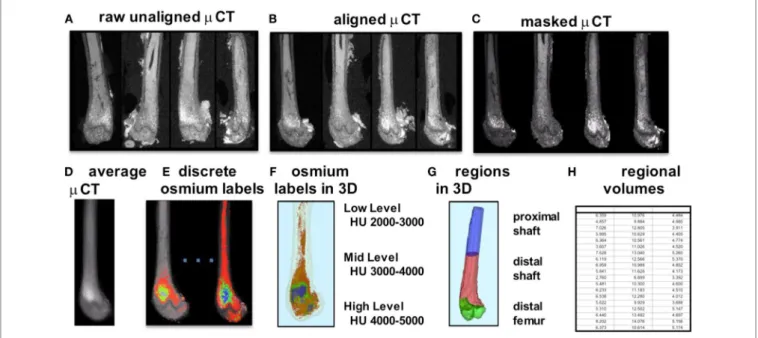
FigURe 1 | Overview of method for visualization and quantification of marrow adipose tissue (MAT). Osmium-stained femorae are visualized viaμCT. Femorae (A) are rigidly aligned (B). Bone masks (C) are averaged (D). Osmium within the bone mask is quantified as volumetric (cubic millimeter) measurements of low (red), mid (green), and high (blue) osmium-containing regions in the femur and (e) overlaid on μCT images for viewing. 3D rendering of osmium regions (F) with same coloring as (e), colors slightly offset due to transparent bone mask. In (g), the femur is subdivided into three anatomical regions of interest. (H) is a pictorial representation of a data spreadsheet containing regional osmium measurements as osmium volume normalized to bone volume (in %).
MAT in rodent bone has been recently developed, requiring
osmium staining of bones and
μ
CT imaging (
47
), followed by
image analysis of osmium-bound lipid volume (in cubic
mil-limeter) relative to bone volume (see
Figure 1
) (
13
,
48
). Briefly,
femurs stripped of connective tissue are decalcified, immersed
in osmium tetroxide, and placed in potassium dichromate
(
49
). Bones are scanned using
μ
CT imaging (resolution
10
μ
m
×
10
μ
m
×
10
μ
m). Image processing consists of rigid
image coalignment (
Figures 1B,D
, Slicer) (
50
), regional masking,
allowing consistent regional measurements and superimposed
visualizations. Additional bone masks are established in a
semi-automatic contouring of the femur. As osmium is significantly
more dense than bone [Hounsfield units (HU) ~ 700–2000],
HU thresholds are set to capture low osmium from 2000 to
3000 HU, mid osmium from 3000 to 4000 HU (
Figures 1E,F
,
green), and high osmium from 4000 to 5000 HU (
Figures 1E,F
,
blue), and quantified accordingly (cubic millimeter). The lowest
threshold is set above dense cortical bone (2000 HU) (
51
), and,
thus, the contribution of potentially mislabeled cortical bone to
the osmium volume is negligible (
51
,
52
). Following
quantifica-tion, the femur is subdivided into anatomical regions wherein
regional osmium volume is normalized to bone volume. Aligned
bone images are then averaged across all images as a reference for
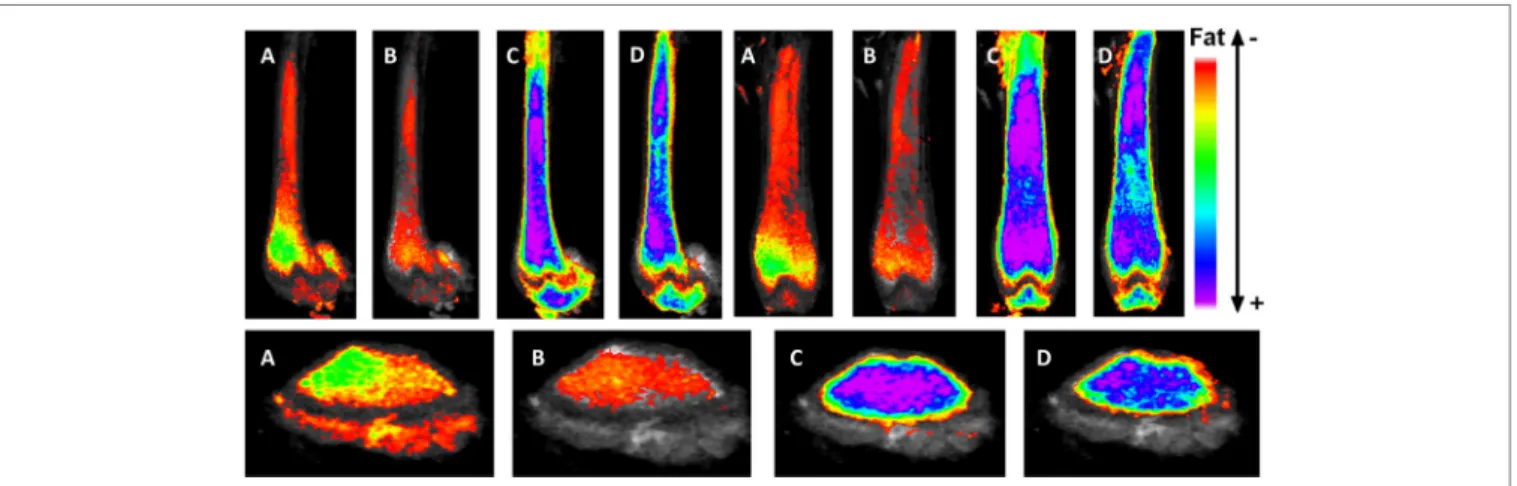
visualization. Average images are also computed for each group
to obtain color-coded visualizations of the osmium densities
to allow additional visual comparison of MAT between groups
(
Figure 2
). This technique provides reproducible
quantifica-tion and visualizaquantifica-tion of MAT, enabling the ability to quantify
changes in MAT with diet, exercise, and agents that constrain
precursor lineage allocation.
eXeRCiSe RegULATiON OF MARROw
ADiPOSe TiSSUe iN THe SeTTiNg OF
HigH-FAT FeeDiNg
Marrow adipose tissue volume has recently been demonstrated
to increase during short-term, high-fat feeding in rodents relative
to the total bone volume (
13
), rising more rapidly than calorie
induction of visceral fat depot size (
53
). A positive association
between obesity and MAT was noted in rodents (
15
) and humans
(
43
). In fact, obese individuals generally present with higher bone
density (
54
–
62
) and are unlikely to experience classical
osteo-porotic fragility fractures (
63
). Because MAT has been
associ-ated with states of low bone density and increased fracture risk
(
6
,
8
,
64
), the impact of fat in the marrow likely varies depending
on its etiology. As obesity associates with increased bone density
and lower fracture, MAT in obesity could represent a distinct fat
depot that supports skeletal anabolism.
FigURe 2 | exercise suppresses marrow adipose tissue accumulation, despite PPARγ agonist treatment. Visualization of osmium (lipid-binder) stain by μCT in sagittal (top left), coronal (top right), and axial (bottom) planes in the femur of C57BL/6 mice. Visualization is performed by superimposing and averaging the images of each femur (n = 5 per group) and colored labeling of osmium according to Hounsfield unit (HU) density. The four experimentals are as follows: control (A), rosiglitazone (B), control-exercise (C), and rosiglitazone-exercise (D).
volume and trabecular thickness are noted in tibiae of exercised
animals. Cortical bone parameters are unaltered by HFD and
exercise in this short-term study. Thus, the trabecular
compart-ment might be more receptive to both metabolic disarray and to
mechanical signals from exercise than cortical bone, especially
when challenged with elevated MAT
via
HFD.
eXeRCiSe RegULATiON OF MARROw
ADiPOSe TiSSUe iN THe SeTTiNg OF
ROSigLiTAZONe
It is accepted that elevated MAT due to PPAR
γ
-agonist treatment in
mice (
48
,
49
,
67
) and humans (
68
,
69
) is due to PPAR
γ
-induction
of adipogenesis from marrow MSC.
In vitro
, rosiglitazone (PPAR
γ
-agonist)-treated MSCs resist mechanically stimulated adipogenesis
when treated with a dynamic load (
70
).
In vivo
, it was previously
hypothesized that exercise might not overcome pathologically
induced MAT in the setting of rosiglitazone; however, interestingly,
exercise suppresses MAT even in the face of powerful adipogenic
biasing (
via
MSC) in rosiglitazone-treated mice (
48
). While
rosigli-tazone significantly elevates cortical porosity in proximal tibiae,
bone quantity is unaffected in these young mice. Exercise
associ-ates with increased trabecular bone volume fraction and trabecular
thickness in control and rosiglitazone-treated mice (
48
). This further
highlights the positive impact of exercise and mechanical signals on
healthy bone as well as bone challenged by pharmacologic agents
shown to facilitate marrow adiposity as well as cortical porosities.
eXeRCiSe AND MeCHANiCAL
RegULATiON OF BONe QUALiTY
AND QUANTiTY
exercise and Musculoskeletal Mass
Of the many health benefits attributed to exercise – improved
neu-rological endpoints (
71
,
72
), cardiovascular health (
73
), reduced
inflammation (
74
–
77
), and decreased risk for chronic disease
development, perhaps, most immediately and visually apparent
is its ability to augment musculoskeletal mass (
78
–
81
). Exercise is
known to encourage anabolic responses in musculoskeletal tissue
(i.e., bone, muscle, ligament, and tendon) (
82
) as a consequence
of successive bouts of musculoskeletal-loading. Indeed, skeletal
tissue is known to adapt to meet loading demands (
83
), altering its
bone remodeling strategy to sustain maximum loads. Prominent
and varied forces are exerted across the appendicular and axial
skeleton (
84
) through exercise: the musculoskeletal construct,
thereby, acts as a conduit for transducing muscle contractive
per-turbations at the bone surface at both low frequencies (e.g., bicep
flexion) and high frequencies (type II fast-twitch muscle). At the
cellular level, these responses are mediated by a wide spectrum
of mechanical stimuli of both high- and low-magnitude stresses,
information that is internalized by cells through cytoskeletal and
transmembrane-bound integrins linking the extracellular
envi-ronment with the genetic machinery encased within the nucleus
(
85
–
90
). Thus, these mechanical factors transcribe osteo-,
chon-dro-, or myogenic (
91
) growth factors (RunX2) while deterring
pathways conducive to adipogenesis (PPAR
γ
) (
70
,
92
–
95
). We
now know that these signals propagate across the Wnt/
β
–Catenin
transduction pathways (
96
), upregulating expression of genes
that drive osteogenic (RunX2) and chondrogenic (SOX9) growth,
while also being positioned across other complex signaling
pathways involving other signals of interest, such as MAPK, pRB,
FGFs, and TGF-
β
. The ability of mechanical stimuli to regulate
musculoskeletal mass is likely multifactorial, occurring through
repression of fat generation as well as bone resorptive pathways
(
97
), while at the same time stimulating musculoskeletal
anabo-lism. Additionally, exercise has been shown to improve resistance
to fracture, specifically through the separation of exercise into
shorter regimens (
98
).
Skeletal Unloading
absence of mechanical cues (
99
–
101
). Whereas exercise delivers
large quanta of mechanical information, as a function of disuse
(chronic bed rest, microgravity, or reduced physical activity) (
102
,
103
), regulation of musculoskeletal tissue homeostasis is
compro-mised, instead elevating conditions wherein muscle, tendon, and
ligament (and fat) undergo catalysis and rapid resorption of bone.
Together, these tissue-level responses heighten the occurrence of
osteoporotic bone and degree of fracture risk: these outcomes
are in direct response to lapses in mechanical input (
104
–
107
).
Whether chronic skeletal unloading encourages a specific MAT
phenotype remains unclear, yet, studies have definitively shown
that extended bed rest drives an increased marrow adipogenesis
(
108
). In the absence of mechanical cues, PPAR
γ
and receptor
activator of nuclear factor-Kappa-B ligand (RANKL), which
promotes osteoclast-mediated bone resorption, are both elevated,
indicating an effect that could be stemmed upon reintroduction
of mechanical stimuli.
Mechanical effect on Bone
and Fat Precursors
Both
in vitro
and
in vivo
studies have demonstrated that MSCs
and early, non-committed progenitors exhibit unquestionable
responsivity to mechanical loading (
93
,
109
). Osteocytes (
88
,
110
), osteoblasts (
111
,
112
), and pre-osteoblast MC3T3 cells (
113
)
in the marrow are other known mechanosensitive cells and
con-tribute to the complex transduction of mechanical information
driving osteogenic gene expression. While mechanical signals
can inhibit osteoclastogenesis and subsequent bone resorption
through direct effects on osteocyte and MSC expression of
RANKL, it is known that mechanical effects on bone remodeling
also involve regulation of MSC differentiation toward
osteogen-esis (
93
,
114
,
115
) facilitated by Wnt/
β
–Catenin signaling and
uncommitted precursors. This is, in part, due to the plasticity of
stem cells to differentiate specifically toward one mesenchymal
lineage over another as dictated by environmental cues, such as
exogenous mechanical stimuli (
93
), local substrate rigidity (
113
,
116
,
117
), and regional cytokine signaling gradients (
11
,
118
).
These factors drive MSC and other resident marrow cells toward
fulfilling their role in musculoskeletal homeostasis by promoting
formation of bone and other critical tissues that support skeletal
health in lieu of engaging pathways conducive to adipogenesis.
Exercise not only encourages MSC proliferation but downstream
lineages are also influenced as well: lipid droplets and adipocyte
cell diameters are reduced while driving osteogenic potential
through upregulated alkaline phosphatase activity (
119
).
In vivo
studies show decreased adipocytes and increased pre-osteoblasts
in the marrow of running rats (
38
) and climbing mice (
120
).
Rodent studies highlight increased bone formation rates
in response to exercise and mechanical signals
via
dynamic
histomorphometry (
104
), including running exercise (
121
–
124
).
These responses persist through incorporation of non-exercise
mechanical loading interventions [low-magnitude mechanical
signals (LMMS)], which have been demonstrated to increase
bone formation rates in loaded tibiae of mice (
125
,
126
). In
consideration of the phenotypic differences in lineage subtypes
across niches, the bone marrow-derived MSC has recently
been suggested to have unique, focal-specific properties (
127
).
Therefore, it is important to weigh the contribution of precursor
cells and other progenitors in the presence of mature adipocytes
or the marrow, when considering the effect mechanical stimuli
may have on their interaction with the surrounding milieu.
Low-Magnitude Mechanical Signals effect
on Bone and Marrow Adiposity
While physical activity presents an ideal strategy to introduce
exogenous low-frequency, high-magnitude mechanical cues to
musculoskeletal tissue, this approach is impractical for those
patients with compromised bone microarchitecture (i.e.,
osteo-porosis, osteopenia) (
105
,
109
,
128
–
130
) or muscle instability
(
131
–
133
), populations that could benefit the most from their
effects. Alternatively, mechanical signals delivered to the
skel-eton in the form of high-frequency, LMMS (fast-twitch muscles
controlling balance and posture) can be introduced outside of
the context of physical activity (
134
). For instance, low strain
(
<
100
μ
s) displacements contribute more toward maintaining
musculoskeletal health than higher magnitude strains and can
be delivered whole-body using platforms to oscillate in the
high-frequency domain (20–100 Hz), while maintaining a
low-magnitude (i.e., sub-gravitational) acceleration. In doing so, these
platforms partially reintroduce the spectral content of muscle
contraction (
105
,
135
), thereby exerting a beneficial quotient of
exercise without risking fracture to bone resulting from extreme
loads prevalent in exercise. Moreover, when separated into
mul-tiple administrations, the effects of both exercise and LMMS are
amplified (
95
), encouraging enhancement in the responsiveness
of MSC. Importantly, in humans, the non-pharmacologic therapy
LMMS prevent bone loss due to Crohn’s disease (
136
), in children
recovering from various cancers (
137
), and in other disabling
conditions where bone losses are apparent (
138
,
139
).
eXeRCiSe AND THe BROwNiNg OF
MARROw ADiPOSe TiSSUe
Upon initiation of exercise, there is an increase in uptake and
oxidation of lipids in skeletal muscle (
140
). When exercise
intensity increases, fuel selection shifts toward an increase in
carbohydrate and decrease in fat utilization. In contrast,
endur-ance training is associated with a shift toward an enhendur-anced
lipid utilization (
140
). BAT, initially observed in hibernating
mammals and human infants, dissipates energy in the form of
heat through non-shivering thermogenesis (
141
). Inducible
brown fat depots – beige fat – have been discovered within the
white adipose tissue of adult humans (
142
). On exposure to cold
or
β
-adrenergic stimulation, these beige/brite fat cells express
high levels of mitochondrial uncoupling protein UCP1 and fat
globules become multilocular (
143
), characteristics of the brown
fat phenotype. Irisin, a muscle-derived hormone induced by
exercise, also activates UCP1 expression and browning of white
adipose tissue (
33
): coactivator PPAR-
γ
coactivator-1
α
(PGC1-
α
)
stimulates irisin, and transgenic mice overexpressing PGC1-
α
can alter phenotype to serve functional demands. Since exercise
browns white adipose depots (
33
), it is conceivable that exercise
might result in analogous browning of MAT. Indeed, running
exercise increased UCP1 in bone mRNA (
48
). UCP1 is localized
in the mitochondrial inner membrane of mammalian BAT and
is, therefore, a specific marker for BAT (
144
). This increase in
UCP1 with exercise may indicate a brown phenotype within
MAT adipocytes; however, this requires further confirmation.
Interestingly, exercise-induced increases in UCP1 expression
may correlate with increases in irisin (
33
), although irisin’s role
in exercise physiology remains unclear (
145
). Finally, recent work
suggests that irisin may have direct effects on bone in addition to
its known effect on adipocytes, and thus irisin’s role in skeletal
health remains an area of active investigation (
146
–
148
).
CONCLUSiON
Marrow adipose tissue, housed within bone and interspersed
with hematopoietic elements, remains a poorly understood fat
depot, likely due to its anatomic location, rendering it
inacces-sible and thus challenging to quantify. Clinicians are particularly
interested in the physiology of this fat depot due to its
associa-tion with low bone density states and pharmacologic agents that
increase fracture risk. As more robust volumetric imaging and
quantification tools emerge [e.g., osmium-
μ
CT Ref. (
13
,
48
)],
precise determinations can be made regarding MAT physiology
and relationship to bone health. Interestingly, these
methodolo-gies have pointed to an increase in MAT in the setting of high-fat
feeding (
13
), without an impact on bone quantity. Additionally,
we are now able to visualize the effect of pharmacologic PPAR
γ
activation with rosiglitazone on bone and to appreciate the
significant encroachment of marrow fat (
Figure 2
) as well as to
quantify these dramatic findings. Interestingly, both regimented
exercise and LMMS serve to counter the effects of obesity and
potent pharmacologic agents on bone remodeling. Further, in
evaluating the response of MAT to mechanical stimuli, we
high-light a positive effect toward normalizing bone parameters and, in
doing so, constraining expansion of MAT across the marrow. It is
possible that exercise serves to “brown” MAT as indicated in Ref.
(
48
); however, further work is needed to establish the metabolic
purpose of MAT in the setting of exercise. It remains unclear
whether exercise-induced bone formation biases MSCs away from
adipogenesis in order to recruit osteoblasts or whether alternative
mechanisms are involved.
In vitro
, MSCs are highly responsive
to mechanical signals during differentiation; indeed, mechanical
loading slows adipogenesis (
38
,
92
,
93
,
149
–
151
). Conversely,
MSCs under microgravity conditions decrease osteogenic
dif-ferentiation in favor of fat formation, an event accompanied by
elevated nuclear expression of PPAR
γ
(
152
). Thus, in the setting
of mechanical input or exercise, bone formation is increased
and marrow fat is suppressed, highlighting a likely mechanistic
relationship between MAT and bone in the setting of mechanical
stimulation. Other pathways are likely involved in the exercise
regulation of MAT: lipogenesis, lipid uptake, skeletal anabolism,
regulation of hematopoiesis in the bone marrow, and regulation
of adipokines and cytokines. The elucidation of these pathways
and their role in MAT/bone regulation in the setting of exercise
remains an area of active investigation.
AUTHOR CONTRiBUTiONS
MS and GP wrote this review together as a team. Each author
contributed approximately 50% to the writing of this review.
FUNDiNg
Funding for this work was provided by NIAMS: AR062097 and
NIDDK: P30DK056350.
ReFeReNCeS
1. Verma S, Rajaratnam JH, Denton J, Hoyland JA, Byers RJ. Adipocytic propor-tion of bone marrow is inversely related to bone formapropor-tion in osteoporosis.
J Clin Pathol (2002) 55(9):693–8. doi:10.1136/jcp.55.9.693
2. Yeung DK, Griffith JF, Antonio GE, Lee FK, Woo J, Leung PC. Osteoporosis is associated with increased marrow fat content and decreased marrow fat unsaturation: a proton MR spectroscopy study. J Magn Reson Imaging (2005) 22(2):279–85. doi:10.1002/jmri.20367
3. Meunier P, Aaron J, Edouard C, Vignon G. Osteoporosis and the replace-ment of cell populations of the marrow by adipose tissue. A quantitative study of 84 iliac bone biopsies. Clin Orthop Relat Res (1971) 80:147–54. doi:10.1097/00003086-197110000-00021
4. Kricun ME. Red-yellow marrow conversion: its effect on the location of some solitary bone lesions. Skeletal Radiol (1985) 14(1):10–9. doi:10.1007/ BF00361188
5. Duque G. As a matter of fat: new perspectives on the understanding of age-related bone loss. IBMS Bonekey (2007) 4(4):129–40. doi:10.1138/ 20070257
6. Cohen A, Dempster DW, Stein EM, Nickolas TL, Zhou H, McMahon DJ, et al. Increased marrow adiposity in premenopausal women with idiopathic osteoporosis. J Clin Endocrinol Metab (2012) 97(8):2782–91. doi:10.1210/ jc.2012-1477
7. Fazeli PK, Horowitz MC, MacDougald OA, Scheller EL, Rodeheffer MS, Rosen CJ, et al. Marrow fat and bone – new perspectives. J Clin Endocrinol Metab (2013) 98(3):935–45. doi:10.1210/jc.2012-3634
8. Wronski TJ, Morey ER. Skeletal abnormalities in rats induced by simulated weightlessness. Metab Bone Dis Relat Res (1982) 4(1):69–75. doi:10.1016/0221-8747(82)90011-X
9. Ahdjoudj S, Lasmoles F, Holy X, Zerath E, Marie PJ. Transforming growth factor beta2 inhibits adipocyte differentiation induced by skeletal unload-ing in rat bone marrow stroma. J Bone Miner Res (2002) 17(4):668–77. doi:10.1359/jbmr.2002.17.4.668
10. Rubin MR, Manavalan JS, Agarwal S, McMahon DJ, Nino A, Fitzpatrick LA, et al. Effects of rosiglitazone vs metformin on circulating osteoclast and osteogenic precursor cells in postmenopausal women with type 2 diabetes mellitus. J Clin Endocrinol Metab (2014) 99(10):E1933–42. doi:10.1210/ jc.2013-3666
11. Pittenger MF, Mackay AM, Beck SC, Jaiswal RK, Douglas R, Mosca JD, et al. Multilineage potential of adult human mesenchymal stem cells. Science
(1999) 284(5411):143–7. doi:10.1126/science.284.5411.143
12. Muruganandan S, Roman AA, Sinal CJ. Adipocyte differentiation of bone marrow-derived mesenchymal stem cells: cross talk with the osteoblas-togenic program. Cell Mol Life Sci (2009) 66(2):236–53. doi:10.1007/ s00018-008-8429-z
13. Styner M, Thompson WR, Galior K, Uzer G, Wu X, Kadari S, et al. Bone mar-row fat accumulation accelerated by high fat diet is suppressed by exercise.
Bone (2014) 64C:39–46. doi:10.1016/j.bone.2014.03.044
15. Lecka-Czernik B, Stechschulte LA, Czernik PJ, Dowling AR. High bone mass in adult mice with diet-induced obesity results from a combination of initial increase in bone mass followed by attenuation in bone formation; implications for high bone mass and decreased bone quality in obesity. Mol Cell Endocrinol (2015) 410:35–41. doi:10.1016/j.mce.2015.01.001
16. Worthley DL, Churchill M, Compton JT, Tailor Y, Rao M, Si Y, et al. Gremlin 1 identifies a skeletal stem cell with bone, cartilage, and reticular stromal potential. Cell (2015) 160(1–2):269–84. doi:10.1016/j.cell.2014.11.042 17. Adler BJ, Kaushansky K, Rubin CT. Obesity-driven disruption of
haemato-poiesis and the bone marrow niche. Nat Rev Endocrinol (2014) 10(12):737–48. doi:10.1038/nrendo.2014.169
18. Huovinen V, Viljakainen H, Hakkarainen A, Saukkonen T, Toiviainen-Salo S, Lundbom N, et al. Bone marrow fat unsaturation in young adults is not affected by present or childhood obesity, but increases with age: a pilot study.
Metabolism (2015) 64(11):1574–81. doi:10.1016/j.metabol.2015.08.014 19. Bellisari A. Evolutionary origins of obesity. Obes Rev (2008) 9(2):165–80.
doi:10.1111/j.1467-789X.2007.00392.x
20. Krings A, Rahman S, Huang S, Lu Y, Czernik PJ, Lecka-Czernik B. Bone marrow fat has brown adipose tissue characteristics, which are attenu-ated with aging and diabetes. Bone (2012) 50(2):546–52. doi:10.1016/j. bone.2011.06.016
21. Ye R, Scherer PE. Adiponectin, driver or passenger on the road to insulin sen-sitivity? Mol Metab (2013) 2(3):133–41. doi:10.1016/j.molmet.2013.04.001 22. Tilg H, Moschen AR. Adipocytokines: mediators linking adipose tissue,
inflammation and immunity. Nat Rev Immunol (2006) 6(10):772–83. doi:10.1038/nri1937
23. Wronska A, Kmiec Z. Structural and biochemical characteristics of various white adipose tissue depots. Acta Physiol (Oxf) (2012) 205(2):194–208. doi:10.1111/j.1748-1716.2012.02409.x
24. Masuzaki H, Paterson J, Shinyama H, Morton NM, Mullins JJ, Seckl JR, et al. A transgenic model of visceral obesity and the metabolic syndrome. Science
(2001) 294(5549):2166–70. doi:10.1126/science.1066285
25. Bredella MA, Lin E, Gerweck AV, Landa MG, Thomas BJ, Torriani M, et al. Determinants of bone microarchitecture and mechanical properties in obese men. J Clin Endocrinol Metab (2012) 97(11):4115–22. doi:10.1210/ jc.2012-2246
26. Cohen A, Dempster DW, Recker RR, Lappe JM, Zhou H, Zwahlen A, et al. Abdominal fat is associated with lower bone formation and inferior bone quality in healthy premenopausal women: a transiliac bone biopsy study.
J Clin Endocrinol Metab (2013) 98(6):2562–72. doi:10.1210/jc.2013-1047 27. Wu J, Cohen P, Spiegelman BM. Adaptive thermogenesis in adipocytes:
is beige the new brown? Genes Dev (2013) 27(3):234–50. doi:10.1101/ gad.211649.112
28. Al-Nbaheen M, Vishnubalaji R, Ali D, Bouslimi A, Al-Jassir F, Megges M, et al. Human stromal (mesenchymal) stem cells from bone marrow, adipose tissue and skin exhibit differences in molecular phenotype and differenti-ation potential. Stem Cell Rev (2013) 9(1):32–43. doi:10.1007/s12015-012- 9365-8
29. Gimble JM, Zvonic S, Floyd ZE, Kassem M, Nuttall ME. Playing with bone and fat. J Cell Biochem (2006) 98(2):251–66. doi:10.1002/jcb.20777 30. Cawthorn WP, Scheller EL, Learman BS, Parlee SD, Simon BR, Mori H,
et al. Bone marrow adipose tissue is an endocrine organ that contributes to increased circulating adiponectin during caloric restriction. Cell Metab
(2014) 20(2):368–75. doi:10.1016/j.cmet.2014.06.003
31. McGee-Lawrence ME, Carpio LR, Schulze RJ, Pierce JL, McNiven MA, Farr JN, et al. Hdac3 deficiency increases marrow adiposity and induces lipid storage and glucocorticoid metabolism in osteochondroprogenitor cells.
J Bone Miner Res (2016) 31(1):116–28. doi:10.1002/jbmr.2602
32. Gollisch KS, Brandauer J, Jessen N, Toyoda T, Nayer A, Hirshman MF, et al. Effects of exercise training on subcutaneous and visceral adipose tissue in normal- and high-fat diet-fed rats. Am J Physiol Endocrinol Metab (2009) 297(2):E495–504. doi:10.1152/ajpendo.90424.2008
33. Bostrom P, Wu J, Jedrychowski MP, Korde A, Ye L, Lo JC, et al. A PGC1-alpha-dependent myokine that drives brown-fat-like development of white fat and thermogenesis. Nature (2012) 481(7382):463–8. doi:10.1038/ nature10777
34. Stanford KI, Middelbeek RJ, Goodyear LJ. Exercise effects on white adipose tissue: beiging and metabolic adaptations. Diabetes (2015) 64(7):2361–8. doi:10.2337/db15-0227
35. Bielohuby M, Matsuura M, Herbach N, Kienzle E, Slawik M, Hoeflich A, et al. Short-term exposure to low-carbohydrate, high-fat diets induces low bone mineral density and reduces bone formation in rats. J Bone Miner Res (2010) 25(2):275–84. doi:10.1359/jbmr.090813
36. Spatz JM, Ellman R, Cloutier AM, Louis L, van Vliet M, Suva LJ, et al. Sclerostin antibody inhibits skeletal deterioration due to reduced mechanical loading. J Bone Miner Res (2013) 28(4):865–74. doi:10.1002/ jbmr.1807
37. Rosen CJ, Ackert-Bicknell CL, Adamo ML, Shultz KL, Rubin J, Donahue LR, et al. Congenic mice with low serum IGF-I have increased body fat, reduced bone mineral density, and an altered osteoblast differentiation program. Bone
(2004) 35(5):1046–58. doi:10.1016/j.bone.2004.07.008
38. David V, Martin A, Lafage-Proust MH, Malaval L, Peyroche S, Jones DB, et al. Mechanical loading down-regulates peroxisome proliferator-activated receptor gamma in bone marrow stromal cells and favors osteoblastogen-esis at the expense of adipogenosteoblastogen-esis. Endocrinology (2007) 148(5):2553–62. doi:10.1210/en.2006-1704
39. Naveiras O, Nardi V, Wenzel PL, Hauschka PV, Fahey F, Daley GQ. Bone-marrow adipocytes as negative regulators of the haematopoietic microenvi-ronment. Nature (2009) 460(7252):259–63. doi:10.1038/nature08099 40. Majka SM, Miller HL, Sullivan T, Erickson PF, Kong R, Weiser-Evans M,
et al. Adipose lineage specification of bone marrow-derived myeloid cells.
Adipocyte (2012) 1(4):215–29. doi:10.4161/adip.21496
41. Majka SM, Miller HL, Helm KM, Acosta AS, Childs CR, Kong R, et al. Analysis and isolation of adipocytes by flow cytometry. Methods Enzymol
(2014) 537:281–96. doi:10.1016/B978-0-12-411619-1.00015-X
42. Bernstein RL, Hyun WC, Davis JH, Fulwyler MJ, Pershadsingh HA. Flow cytometric analysis of mature adipocytes. Cytometry (1989) 10(4):469–74. doi:10.1002/cyto.990100416
43. Bredella MA, Torriani M, Ghomi RH, Thomas BJ, Brick DJ, Gerweck AV, et al. Vertebral bone marrow fat is positively associated with visceral fat and inversely associated with IGF-1 in obese women. Obesity (Silver Spring)
(2011) 19(1):49–53. doi:10.1038/oby.2010.106
44. de Paula FJ, Dick-de-Paula I, Bornstein S, Rostama B, Le P, Lotinun S, et al. VDR haploinsufficiency impacts body composition and skeletal acquisition in a gender-specific manner. Calcif Tissue Int (2011) 89(3):179–91. doi:10.1007/ s00223-011-9505-1
45. Fazeli PK, Bredella MA, Freedman L, Thomas BJ, Breggia A, Meenaghan E, et al. Marrow fat and preadipocyte factor-1 levels decrease with recovery in women with anorexia nervosa. J Bone Miner Res (2012) 27(9):1864–71. doi:10.1002/jbmr.1640
46. Rantalainen T, Nikander R, Heinonen A, Cervinka T, Sievanen H, Daly RM. Differential effects of exercise on tibial shaft marrow density in young female athletes. J Clin Endocrinol Metab (2013) 98(5):2037–44. doi:10.1210/ jc.2012-3748
47. Scheller EL, Troiano N, Vanhoutan JN, Bouxsein MA, Fretz JA, Xi Y, et al. Use of osmium tetroxide staining with microcomputerized tomography to visualize and quantify bone marrow adipose tissue in vivo. Methods Enzymol
(2014) 537:123–39. doi:10.1016/B978-0-12-411619-1.00007-0
48. Styner M, Pagnotti GM, Galior K, Wu X, Thompson WR, Uzer G, et al. Exercise regulation of marrow fat in the setting of PPARgamma agonist treatment in female C57BL/6 mice. Endocrinology (2015) 156(8):2753–61. doi:10.1210/en.2015-1213
49. Liu L, Aronson J, Huang S, Lu Y, Czernik P, Rahman S, et al. Rosiglitazone inhibits bone regeneration and causes significant accumulation of fat at sites of new bone formation. Calcif Tissue Int (2012) 91(2):139–48. doi:10.1007/ s00223-012-9623-4
50. Fedorov A, Beichel R, Kalpathy-Cramer J, Finet J, Fillion-Robin JC, Pujol S, et al. 3D slicer as an image computing platform for the quantitative imag-ing network. Magn Reson Imaging (2012) 30(9):1323–41. doi:10.1016/j. mri.2012.05.001
51. Schreiber JJ, Anderson PA, Rosas HG, Buchholz AL, Au AG. Hounsfield units for assessing bone mineral density and strength: a tool for osteoporosis management. J Bone Joint Surg Am (2011) 93(11):1057–63. doi:10.2106/ JBJS.J.00160
53. Reid IR, Ames R, Evans MC, Sharpe S, Gamble G, France JT, et al. Determinants of total body and regional bone mineral density in normal postmenopausal women – a key role for fat mass. J Clin Endocrinol Metab
(1992) 75(1):45–51. doi:10.1210/jcem.75.1.1619030
54. Dawson-Hughes B, Shipp C, Sadowski L, Dallal G. Bone density of the radius, spine, and hip in relation to percent of ideal body weight in postmenopausal women. Calcif Tissue Int (1987) 40(6):310–4. doi:10.1007/BF02556691 55. Ribot C, Tremollieres F, Pouilles JM, Bonneu M, Germain F, Louvet JP. Obesity
and postmenopausal bone loss: the influence of obesity on vertebral density and bone turnover in postmenopausal women. Bone (1987) 8(6):327–31. doi:10.1016/8756-3282(87)90062-7
56. Liel Y, Edwards J, Shary J, Spicer KM, Gordon L, Bell NH. The effects of race and body habitus on bone mineral density of the radius, hip, and spine in premenopausal women. J Clin Endocrinol Metab (1988) 66(6):1247–50. doi:10.1210/jcem-66-6-1247
57. Kin K, Kushida K, Yamazaki K, Okamoto S, Inoue T. Bone mineral density of the spine in normal Japanese subjects using dual-energy X-ray absorp-tiometry: effect of obesity and menopausal status. Calcif Tissue Int (1991) 49(2):101–6. doi:10.1007/BF02565129
58. Harris S, Dallal GE, Dawson-Hughes B. Influence of body weight on rates of change in bone density of the spine, hip, and radius in postmenopausal women. Calcif Tissue Int (1992) 50(1):19–23. doi:10.1007/BF00297292 59. Tremollieres FA, Pouilles JM, Ribot C. Vertebral postmenopausal bone loss is
reduced in overweight women: a longitudinal study in 155 early postmeno-pausal women. J Clin Endocrinol Metab (1993) 77(3):683–6. doi:10.1210/ jcem.77.3.8370689
60. May H, Murphy S, Khaw KT. Age-associated bone loss in men and women and its relationship to weight. Age Ageing (1994) 23(3):235–40. doi:10.1093/ ageing/23.3.235
61. Khosla S, Atkinson EJ, Riggs BL, Melton LJ III. Relationship between body composition and bone mass in women. J Bone Miner Res (1996) 11(6):857–63. doi:10.1002/jbmr.5650110618
62. Evans AL, Paggiosi MA, Eastell R, Walsh JS. Bone density, microstructure and strength in obese and normal weight men and women in younger and older adulthood. J Bone Miner Res (2015) 30(5):920–8. doi:10.1002/jbmr.2407 63. De Laet C, Kanis JA, Oden A, Johanson H, Johnell O, Delmas P, et al. Body
mass index as a predictor of fracture risk: a meta-analysis. Osteoporos Int
(2005) 16(11):1330–8. doi:10.1007/s00198-005-1863-y
64. Devlin MJ. Why does starvation make bones fat? Am J Hum Biol (2011) 23(5):577–85. doi:10.1002/ajhb.21202
65. Hu FB, Willett WC, Li T, Stampfer MJ, Colditz GA, Manson JE. Adiposity as compared with physical activity in predicting mortality among women. N Engl J Med (2004) 351(26):2694–703. doi:10.1056/NEJMoa042135 66. Dalsky GP, Stocke KS, Ehsani AA, Slatopolsky E, Lee WC, Birge SJ Jr.
Weight-bearing exercise training and lumbar bone mineral content in postmenopausal women. Ann Intern Med (1988) 108(6):824–8. doi:10.7326/0003-4819-108-6-824
67. Lecka-Czernik B, Moerman EJ, Grant DF, Lehmann JM, Manolagas SC, Jilka RL. Divergent effects of selective peroxisome proliferator-activated receptor-gamma 2 ligands on adipocyte versus osteoblast differentiation.
Endocrinology (2002) 143(6):2376–84. doi:10.1210/en.143.6.2376
68. Ackert-Bicknell CL, Shockley KR, Horton LG, Lecka-Czernik B, Churchill GA, Rosen CJ. Strain-specific effects of rosiglitazone on bone mass, body composition, and serum insulin-like growth factor-I. Endocrinology (2009) 150(3):1330–40. doi:10.1210/en.2008-0936
69. Grey A, Beckley V, Doyle A, Fenwick S, Horne A, Gamble G, et al. Pioglitazone increases bone marrow fat in type 2 diabetes: results from a randomized controlled trial. Eur J Endocrinol (2012) 166(6):1087–91. doi:10.1530/ EJE-11-1075
70. Case N, Thomas J, Xie Z, Sen B, Styner M, Rowe D, et al. Mechanical input restrains PPARgamma2 expression and action to preserve mesenchymal stem cell multipotentiality. Bone (2013) 52(1):454–64. doi:10.1016/j. bone.2012.08.122
71. Taubert M, Villringer A, Lehmann N. Endurance exercise as an “endoge-nous” neuro-enhancement strategy to facilitate motor learning. Front Hum Neurosci (2015) 9:692. doi:10.3389/fnhum.2015.00692
72. Klein C, Jonas W, Iggena D, Empl L, Rivalan M, Wiedmer P, et al. Exercise prevents high-fat diet-induced impairment of flexible memory expression
in the water maze and modulates adult hippocampal neurogenesis in mice.
Neurobiol Learn Mem (2016) 131:26–35. doi:10.1016/j.nlm.2016.03.002 73. Myers J. Cardiology patient pages. Exercise and cardiovascular health.
Circulation (2003) 107(1):e2–5. doi:10.1161/01.CIR.0000048890.59383.8D 74. Bjorholt PG, Hoyeraal HM, Munthe E, Pahle J, Kogstad O, Sydnes OA, et al.
Physical activity in the treatment of inflammatory rheumatic disorders.
Scand J Soc Med Suppl (1982) 29:235–9.
75. Woods JA, Davis JM. Exercise, monocyte/macrophage func-tion, and cancer. Med Sci Sports Exerc (1994) 26(2):147–56. doi:10.1249/00005768-199402000-00004
76. You T, Arsenis NC, Disanzo BL, Lamonte MJ. Effects of exercise training on chronic inflammation in obesity: current evidence and potential mech-anisms. Sports Med (2013) 43(4):243–56. doi:10.1007/s40279-013-0023-3 77. Khoo J, Dhamodaran S, Chen DD, Yap SY, Chen RY, Tian HH.
Exercise-induced weight loss is more effective than dieting for improving adipokine profile, insulin resistance, and inflammation in obese men. Int J Sport Nutr Exerc Metab (2015) 25(6):566–75. doi:10.1123/ijsnem.2015-0025
78. Woo SL, Gomez MA, Amiel D, Ritter MA, Gelberman RH, Akeson WH. The effects of exercise on the biomechanical and biochemical properties of swine digital flexor tendons. J Biomech Eng (1981) 103(1):51–6. doi:10.1115/1.3138246
79. Turner CH, Robling AG. Mechanisms by which exercise improves bone strength. J Bone Miner Metab (2005) 23(Suppl):16–22. doi:10.1007/ BF03026318
80. Wallace IJ, Kwaczala AT, Judex S, Demes B, Carlson KJ. Physical activity engendering loads from diverse directions augments the growing skeleton.
J Musculoskelet Neuronal Interact (2013) 13(3):283–8.
81. Hinton PS, Nigh P, Thyfault J. Effectiveness of resistance training or jump-ing-exercise to increase bone mineral density in men with low bone mass: a 12-month randomized, clinical trial. Bone (2015) 79:203–12. doi:10.1016/j. bone.2015.06.008
82. Judex S, Gross TS, Zernicke RF. Strain gradients correlate with sites of exer-cise-induced bone-forming surfaces in the adult skeleton. J Bone Miner Res
(1997) 12(10):1737–45. doi:10.1359/jbmr.1997.12.10.1737
83. Frost HM. Bone “mass” and the “mechanostat”: a proposal. Anat Rec (1987) 219(1):1–9. doi:10.1002/ar.1092190104
84. Rubin C, Lanyon LE. Regulation of bone mass by mechanical strain magni-tude. Calcif Tissue Int (1985) 37:411–7. doi:10.1007/BF02553711
85. Tjandrawinata RR, Vincent VL, Hughes-Fulford M. Vibrational force alters mRNA expression in osteoblasts. FASEB J (1997) 11(6):493–7.
86. Ko KS, McCulloch CA. Intercellular mechanotransduction: cellular circuits that coordinate tissue responses to mechanical loading. Biochem Biophys Res Commun (2001) 285(5):1077–83. doi:10.1006/bbrc.2001.5177
87. Rubin J, Rubin C, Jacobs CR. Molecular pathways mediating mechanical signaling in bone. Gene (2006) 367:1–16. doi:10.1016/j.gene.2005.10.028 88. Thompson WR, Uzer G, Brobst K, Xie Z, Sen B, Yen S, et al. Osteocyte specific
responses to soluble and mechanical stimuli in a stem cell derived culture model. Sci Rep (2015) 5:11049. doi:10.1038/srep11049
89. Uzer G, Thompson WR, Sen B, Xie Z, Yen SS, Miller S, et al. Cell mecha-nosensitivity to extremely low magnitude signals is enabled by a LINCed nucleus. Stem Cells (2015) 33(6):2063–76. doi:10.1002/stem.2004
90. Uzer G, Fuchs RK, Rubin J, Thompson WR. Concise review: plasma and nuclear membranes convey mechanical information to regulate mesenchymal stem cell lineage. Stem Cells (2016) 34(6):1455–63. doi:10.1002/stem.2342 91. Murfee WL, Hammett LA, Evans C, Xie L, Squire M, Rubin C, et al.
High-frequency, low-magnitude vibrations suppress the number of blood vessels per muscle fiber in mouse soleus muscle. J Appl Physiol (1985) (2005) 98(6):2376–80. doi:10.1152/japplphysiol.01135.2004
92. Sen B, Xie Z, Case N, Ma M, Rubin C, Rubin J. Mechanical strain inhibits adi-pogenesis in mesenchymal stem cells by stimulating a durable beta-catenin signal. Endocrinology (2008) 149(12):6065–75. doi:10.1210/en.2008-0687 93. Luu YK, Capilla E, Rosen CJ, Gilsanz V, Pessin JE, Judex S, et al. Mechanical
stimulation of mesenchymal stem cell proliferation and differentiation pro-motes osteogenesis while preventing dietary-induced obesity. J Bone Miner Res (2009) 24(1):50–61. doi:10.1359/jbmr.080817
95. Sen B, Xie Z, Case N, Styner M, Rubin CT, Rubin J. Mechanical signal influence on mesenchymal stem cell fate is enhanced by incorporation of refractory periods into the loading regimen. J Biomech (2011) 44(4):593–9. doi:10.1016/j.jbiomech.2010.11.022
96. Case N, Rubin J. Beta-catenin – a supporting role in the skeleton. J Cell Biochem (2010) 110(3):545–53. doi:10.1002/jcb.22574
97. Wallace BA, Cumming RG. Systematic review of randomized trials of the effect of exercise on bone mass in pre- and postmenopausal women. Calcif Tissue Int (2000) 67(1):10–8. doi:10.1007/s00223001089
98. Warden SJ, Hurst JA, Sanders MS, Turner CH, Burr DB, Li J. Bone adaptation to a mechanical loading program significantly increases skeletal fatigue resistance. J Bone Miner Res (2005) 20(5):809–16. doi:10.1359/JBMR.041222 99. Ozcivici E, Luu YK, Adler B, Qin YX, Rubin J, Judex S, et al. Mechanical signals as anabolic agents in bone. Nat Rev Rheumatol (2010) 6(1):50–9. doi:10.1038/nrrheum.2009.239
100. Gupta S, Vijayaraghavan S, Uzer G, Judex S. Multiple exposures to unloading decrease bone’s responsivity but compound skeletal losses in C57BL/6 mice.
Am J Physiol Regul Integr Comp Physiol (2012) 303(2):R159–67. doi:10.1152/ ajpregu.00499.2011
101. Cabahug-Zuckerman P, Frikha-Benayed D, Majeska RJ, Tuthill A, Yakar S, Judex S, et al. Osteocyte apoptosis caused by hindlimb unloading is required to trigger osteocyte RANKL production and subsequent resorption of cortical and trabecular bone in mice femurs. J Bone Miner Res (2016) 31(7):1356–65. doi:10.1002/jbmr.2807
102. Globus RK, Bikle DD, Morey-Holton E. The temporal response of bone to unloading. Endocrinology (1986) 118(2):733–42. doi:10.1210/ endo-118-2-733
103. Bikle DD, Sakata T, Halloran BP. The impact of skeletal unloading on bone formation. Gravit Space Biol Bull (2003) 16(2):45–54.
104. Rubin C, Xu G, Judex S. The anabolic activity of bone tissue, suppressed by disuse, is normalized by brief exposure to extremely low-magnitude mechan-ical stimuli. FASEB J (2001) 15(12):2225–9. doi:10.1096/fj.01-0166com 105. Rubin C, Turner AS, Muller R, Mittra E, McLeod K, Lin W, et al. Quantity and
quality of trabecular bone in the femur are enhanced by a strongly anabolic, noninvasive mechanical intervention. J Bone Miner Res (2002) 17(2):349–57. doi:10.1359/jbmr.2002.17.2.349
106. Judex S, Garman R, Squire M, Busa B, Donahue LR, Rubin C. Genetically linked site-specificity of disuse osteoporosis. J Bone Miner Res (2004) 19(4):607–13. doi:10.1359/JBMR.040110
107. Squire M, Brazin A, Keng Y, Judex S. Baseline bone morphometry and cellular activity modulate the degree of bone loss in the appendicular skeleton during disuse. Bone (2008) 42(2):341–9. doi:10.1016/j.bone.2007.09.052
108. Trudel G, Payne M, Madler B, Ramachandran N, Lecompte M, Wade C, et al. Bone marrow fat accumulation after 60 days of bed rest persisted 1 year after activities were resumed along with hemopoietic stimulation: the Women International Space Simulation for Exploration study. J Appl Physiol (2009) 107(2):540–8. doi:10.1152/japplphysiol.91530.2008
109. Pagnotti GM, Adler BJ, Green DE, Chan ME, Frechette DM, Shroyer KR, et al. Low magnitude mechanical signals mitigate osteopenia without com-promising longevity in an aged murine model of spontaneous granulosa cell ovarian cancer. Bone (2012) 51(3):570–7. doi:10.1016/j.bone.2012.05.004 110. You L, Temiyasathit S, Lee P, Kim CH, Tummala P, Yao W, et al. Osteocytes
as mechanosensors in the inhibition of bone resorption due to mechanical loading. Bone (2008) 42(1):172–9. doi:10.1016/j.bone.2007.09.047 111. Tanaka SM, Li J, Duncan RL, Yokota H, Burr DB, Turner CH. Effects of broad
frequency vibration on cultured osteoblasts. J Biomech (2003) 36(1):73–80. doi:10.1016/S0021-9290(02)00245-2
112. Garman R, Rubin C, Judex S. Small oscillatory accelerations, independent of matrix deformations, increase osteoblast activity and enhance bone morphology. PLoS One (2007) 2(7):e653. doi:10.1371/journal.pone.0000653 113. Khatiwala CB, Peyton SR, Metzke M, Putnam AJ. The regulation of osteo-genesis by ECM rigidity in MC3T3-E1 cells requires MAPK activation. J Cell Physiol (2007) 211(3):661–72. doi:10.1002/jcp.20974
114. Xie L, Jacobson JM, Choi ES, Busa B, Donahue LR, Miller LM, et al. Low-level mechanical vibrations can influence bone resorption and bone formation in the growing skeleton. Bone (2006) 39(5):1059–66. doi:10.1016/j. bone.2006.05.012
115. Qiu W, Andersen TE, Bollerslev J, Mandrup S, Abdallah BM, Kassem M. Patients with high bone mass phenotype exhibit enhanced osteoblast
differentiation and inhibition of adipogenesis of human mesenchymal stem cells. J Bone Miner Res (2007) 22(11):1720–31. doi:10.1359/jbmr.070721 116. Altman GH, Horan RL, Martin I, Farhadi J, Stark PR, Volloch V, et al.
Cell differentiation by mechanical stress. FASEB J (2002) 16(2):270–2. doi:10.1096/fj.01-0656fje
117. Subramony SD, Dargis BR, Castillo M, Azeloglu EU, Tracey MS, Su A, et al. The guidance of stem cell differentiation by substrate alignment and mechanical stimulation. Biomaterials (2013) 34(8):1942–53. doi:10.1016/j. biomaterials.2012.11.012
118. Porada CD, Zanjani ED, Almeida-Porad G. Adult mesenchymal stem cells: a pluripotent population with multiple applications. Curr Stem Cell Res Ther
(2006) 1(3):365–9. doi:10.2174/157488806778226821
119. Maredziak M, Smieszek A, Chrzastek K, Basinska K, Marycz K. Physical activity increases the total number of bone-marrow-derived mesenchymal stem cells, enhances their osteogenic potential, and inhibits their adipogenic properties. Stem Cells Int (2015) 2015:379093. doi:10.1155/2015/379093 120. Menuki K, Mori T, Sakai A, Sakuma M, Okimoto N, Shimizu Y, et al. Climbing
exercise enhances osteoblast differentiation and inhibits adipogenic differen-tiation with high expression of PTH/PTHrP receptor in bone marrow cells.
Bone (2008) 43(3):613–20. doi:10.1016/j.bone.2008.04.022
121. Yeh JK, Liu CC, Aloia JF. Effects of exercise and immobilization on bone for-mation and resorption in young rats. Am J Physiol (1993) 264(2 Pt 1):E182–9. 122. Huang TH, Lin SC, Chang FL, Hsieh SS, Liu SH, Yang RS. Effects of different exercise modes on mineralization, structure, and biomechanical properties of growing bone. J Appl Physiol (1985) (2003) 95(1):300–7. doi:10.1152/ japplphysiol.01076.2002
123. Iwamoto J, Shimamura C, Takeda T, Abe H, Ichimura S, Sato Y, et al. Effects of treadmill exercise on bone mass, bone metabolism, and calciotropic hormones in young growing rats. J Bone Miner Metab (2004) 22(1):26–31. doi:10.1007/s00774-003-0443-5
124. Wallace JM, Ron MS, Kohn DH. Short-term exercise in mice increases tibial post-yield mechanical properties while two weeks of latency following exer-cise increases tissue-level strength. Calcif Tissue Int (2009) 84(4):297–304. doi:10.1007/s00223-009-9228-8
125. Judex S, Boyd S, Qin YX, Turner S, Ye K, Muller R, et al. Adaptations of trabecu-lar bone to low magnitude vibrations result in more uniform stress and strain under load. Ann Biomed Eng (2003) 31(1):12–20. doi:10.1114/1.1535414 126. Srinivasan S, Agans SC, King KA, Moy NY, Poliachik SL, Gross TS. Enabling
bone formation in the aged skeleton via rest-inserted mechanical loading.
Bone (2003) 33(6):946–55. doi:10.1016/j.bone.2003.07.009
127. Wallace IJ, Pagnotti GM, Rubin-Sigler J, Naeher M, Copes LE, Judex S, et al. Focal enhancement of the skeleton to exercise correlates with responsivity of bone marrow mesenchymal stem cells rather than peak external forces. J Exp Biol (2015) 218(Pt 19):3002–9. doi:10.1242/jeb.118729
128. Judex S, Donahue LR, Rubin C. Genetic predisposition to low bone mass is paralleled by an enhanced sensitivity to signals anabolic to the skeleton.
FASEB J (2002) 16(10):1280–2. doi:10.1096/fj.01-0913fje
129. Rubin C, Recker R, Cullen D, Ryaby J, McCabe J, McLeod K. Prevention of postmenopausal bone loss by a low-magnitude, high-frequency mechanical stimuli: a clinical trial assessing compliance, efficacy, and safety. J Bone Miner Res (2004) 19(3):343–51. doi:10.1359/JBMR.0301251
130. Wallace IJ, Rubin CT, Lieberman DE. Osteoporosis. Evol Med Public Health
(2015) 2015(1):343. doi:10.1093/emph/eov032
131. Huang RP, Rubin CT, McLeod KJ. Changes in postural muscle dynamics as a function of age. J Gerontol A Biol Sci Med Sci (1999) 54(8):B352–7. doi:10.1093/gerona/54.8.B352
132. Qin YX, Lam H, Ferreri S, Rubin C. Dynamic skeletal muscle stimulation and its potential in bone adaptation. J Musculoskelet Neuronal Interact (2010) 10(1):12–24.
133. Muir J, Judex S, Qin YX, Rubin C. Postural instability caused by extended bed rest is alleviated by brief daily exposure to low magnitude mechanical signals. Gait Posture (2011) 33(3):429–35. doi:10.1016/j.gaitpost.2010. 12.019
134. Rubin C, Judex S, Hadjiargyrou M. Skeletal adaptation to mechanical stimuli in the absence of formation or resorption of bone. J Musculoskelet Neuronal Interact (2002) 2(3):264–7.
136. Leonard MB, Shults J, Long J, Baldassano RN, Brown JK, Hommel K, et al. Effect of low-magnitude mechanical stimuli on bone density and structure in pediatric Crohn’s disease: a randomized placebo-controlled trial. J Bone Miner Res (2016) 31(6):1177–88. doi:10.1002/jbmr.2799
137. Mogil RJ, Kaste SC, Ferry RJ Jr, Hudson MM, Mulrooney DA, Howell CR, et al. Effect of low-magnitude, high-frequency mechanical stimulation on BMD among young childhood cancer survivors: a randomized clinical trial.
JAMA Oncol (2016). doi:10.1001/jamaoncol.2015.6557
138. Ward K, Alsop C, Caulton J, Rubin C, Adams J, Mughal Z. Low magnitude mechanical loading is osteogenic in children with disabling conditions.
J Bone Miner Res (2004) 19(3):360–9. doi:10.1359/JBMR.040129
139. Gilsanz V, Wren TA, Sanchez M, Dorey F, Judex S, Rubin C. Low-level, high-frequency mechanical signals enhance musculoskeletal development of young women with low BMD. J Bone Miner Res (2006) 21(9):1464–74. doi:10.1359/jbmr.060612
140. Kiens B. Skeletal muscle lipid metabolism in exercise and insulin resistance.
Physiol Rev (2006) 86(1):205–43. doi:10.1152/physrev.00023.2004 141. Cannon B, Nedergaard J. Brown adipose tissue: function and physiological
sig-nificance. Physiol Rev (2004) 84(1):277–359. doi:10.1152/physrev.00015.2003 142. Nedergaard J, Bengtsson T, Cannon B. Unexpected evidence for active
brown adipose tissue in adult humans. Am J Physiol Endocrinol Metab (2007) 293(2):E444–52. doi:10.1152/ajpendo.00691.2006
143. Wu J, Bostrom P, Sparks LM, Ye L, Choi JH, Giang AH, et al. Beige adipocytes are a distinct type of thermogenic fat cell in mouse and human. Cell (2012) 150(2):366–76. doi:10.1016/j.cell.2012.05.016
144. Nicholls DG, Bernson VS, Heaton GM. The identification of the component in the inner membrane of brown adipose tissue mitochondria responsible for regulating energy dissipation. Experientia Suppl (1978) 32:89–93. doi:10.1007/978-3-0348-5559-4_9
145. Albrecht E, Norheim F, Thiede B, Holen T, Ohashi T, Schering L, et al. Irisin – a myth rather than an exercise-inducible myokine. Sci Rep (2015) 5:8889. doi:10.1038/srep08889
146. Colaianni G, Cuscito C, Mongelli T, Pignataro P, Buccoliero C, Liu P, et al. The myokine irisin increases cortical bone mass. Proc Natl Acad Sci U S A (2015) 112(39):12157–62. doi:10.1073/pnas.1516622112
147. Colaianni G, Grano M. Role of Irisin on the bone-muscle functional unit.
Bonekey Rep (2015) 4:765. doi:10.1038/bonekey.2015.134
148. Yong Qiao X, Nie Y, Xian Ma Y, Chen Y, Cheng R, Yao Yinrg W, et al. Irisin promotes osteoblast proliferation and differentiation via activating the MAP kinase signaling pathways. Sci Rep (2016) 6:18732. doi:10.1038/ srep18732
149. Sen B, Styner M, Xie Z, Case N, Rubin CT, Rubin J. Mechanical loading regulates NFATc1 and beta-catenin signaling through a GSK3beta control node. J Biol Chem (2009) 284(50):34607–17. doi:10.1074/jbc.M109. 039453
150. Sen B, Guilluy C, Xie Z, Case N, Styner M, Thomas J, et al. Mechanically induced focal adhesion assembly amplifies anti-adipogenic pathways in mesenchymal stem cells. Stem Cells (2011) 29(11):1829–36. doi:10.1002/ stem.732
151. Styner M, Meyer MB, Galior K, Case N, Xie Z, Sen B, et al. Mechanical strain downregulates C/EBPbeta in MSC and decreases endoplasmic reticulum stress. PLoS One (2012) 7(12):e51613. doi:10.1371/journal.pone. 0051613
152. Zayzafoon M, Gathings WE, McDonald JM. Modeled microgravity inhibits osteogenic differentiation of human mesenchymal stem cells and increases adipogenesis. Endocrinology (2004) 145(5):2421–32. doi:10.1210/ en.2003-1156
Conflict of Interest Statement: The authors declare that the research was con-ducted in the absence of any commercial or financial relationships that could be construed as a potential conflict of interest.