FOR GOD AND HIS ANGELS OR MEN AT THEIR TABLES?:
THE CONTEXT AND USAGE OF PSALM-SINGING IN FRANCOPHONE CALVINISM, 1539-1565
Joshua K. Busman
A thesis submitted to the faculty of the University of North Carolina at Chapel Hill in partial fulfillment of the requirements for the degree of Master of Arts in Musicology in
the Department of Music.
Chapel Hill 2011
ABSTRACT
JOSHUA K. BUSMAN: For God and His Angels or Men at Their Tables?: The Context and Usage of Psalm-Singing in Francophone Calvinism, 1539-1565
(under the direction of John L. Nádas)
TABLE OF CONTENTS
List of Figures...iv
Introduction...1
Chapter 1. Music as Graven Image: Calvin’s Reformation of Musical Thought...4
2. Music as Rhetoric: Calvin’s Psalter and the Climate of Humanism...18
3. Music as Piety: Congregationalism and the Use of the Psalter...35
Epilogue...57
LIST OF FIGURES
1. Text and melody for Psalm 9, “De tout mon coeur t’exalteray” from La forme des prieres et chantz ecclesiastiques (1542)...26 2. Bourgeois, 4-voice setting of “De tout mon coeur t’exalteray”
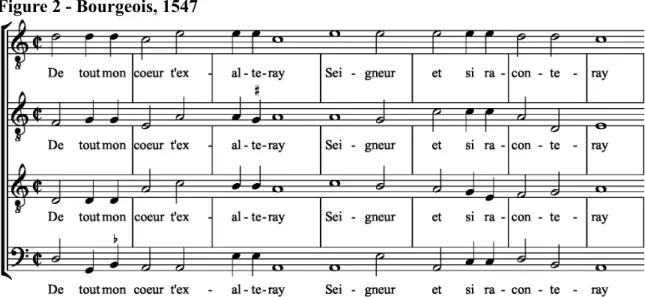
from Le Premier Livre (1547)...43 3. Jambe de Fer, 4-voice setting of “De tout mon coeur t’exalteray”
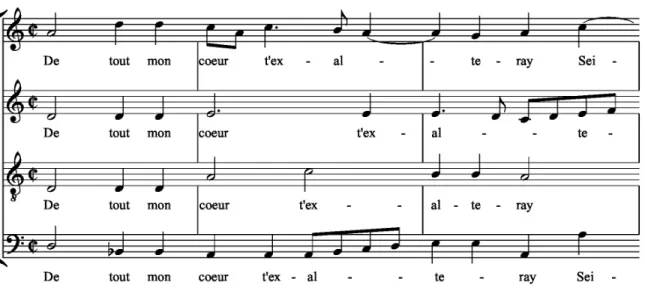
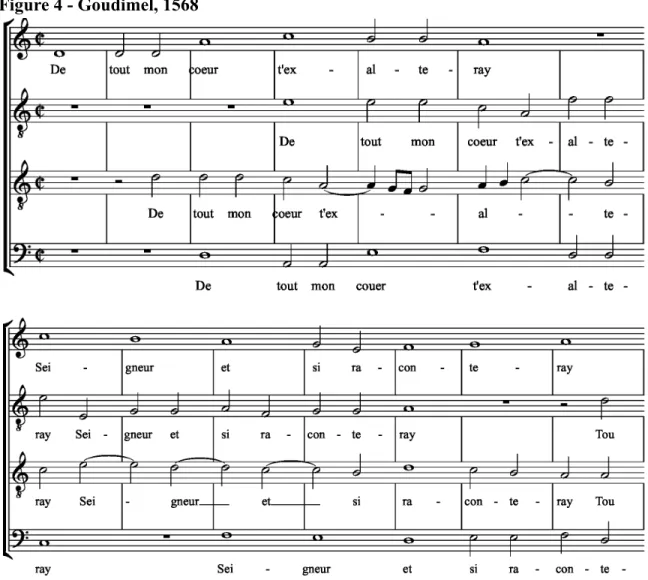
from Les Cent Cinquante Psaumes de David (1564)...44 4. Goudimel, 4-voice setting of “De tout mon coeur t’exalteray”
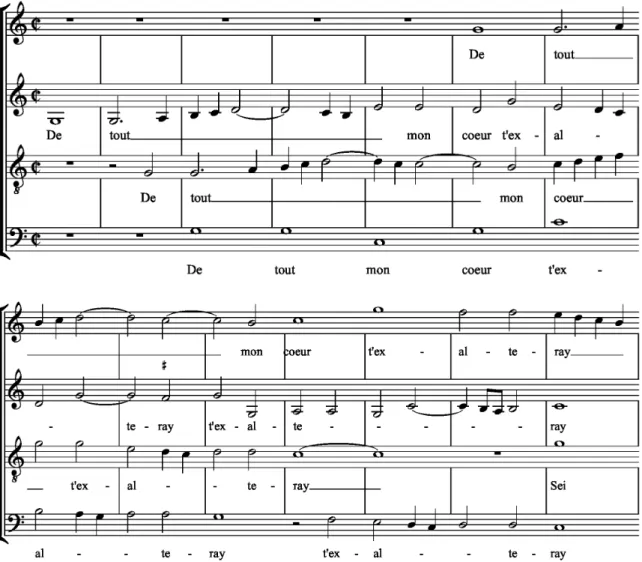
from Les Cent Cinquante Psaumes de David (1568)...45-46 5. Goudimel, motet-style setting of “De tout mon coeur t’exalteray”
Introduction
The Protestant Reformation is well-known as a catalyst of musical and liturgical innovation in both Protestant and Catholic communities across Europe. For this reason, musicologists have given the Reformation a great amount of attention, but most of these considerations have centered around the work of the German Reformation and Martin Luther. Undoubtedly, a great deal of the focus on Luther stems from musicologists’ larger interests in the Germanic tradition and the clear influence that Luther had on Johann Sebastian Bach. Less work, however, has been focused on the musical implications of the French Reformation under John Calvin. The Genevan Psalter, one of the greatest
achievements in Christian hymnody, was completed under Calvin’s close supervision during the middle decades of the sixteenth century and has shaped Protestant liturgical music for many centuries. In fact, one of the most easily recognizable hymn tunes in Western Protestantism––the “Old 100th” which is still in common use in many protestant
churches as a setting for the Doxology––was composed by Loys Bourgeois for the Genevan Psalter.
and of music.”1 Howard Mayer Brown, in an article published posthumously in 1994,
noted that Calvinist music had been unexplored by musicologists for so long because the overall aesthetic was so “crippling for musicians.”2 Admittedly, Calvinist metrical psalms
lack the bombast of Luther’s “Ein Feste Burg,” but they represent an important and influential body of musical materials, both in the history of Protestantism and in the history of French music writ large.
With this thesis, I hope to situate the creation and early usage of the Genevan psalters within a proper sixteenth century context as well as explore their reception among Calvinist communities in Switzerland and the south of France.
1 Walter E. Buszin, “Luther on Music,” The Musical Quarterly, 32 (1946): 80 and Charles Garside, Jr.,
“Calvin's Preface to the Psalter: A Re-Appraisal,” The Musical Quarterly 37 (1951): 566.
Chapter 1. Music as Graven Image: Calvin’s Reformation of Musical Thought
During Martin Luther’s nearly ten-month stay at Wartburg Castle following the Diet of Worms, the Reformation project in Wittenberg was taken up by Andreas Bodenstein von Karlstadt, a senior colleague of Luther’s at the University of Wittenberg and the man who had awarded Luther his doctorate in 1514. On Christmas Day 1521, Karlstadt performed the first “reformed” mass, and in keeping with the tenets of the Reformation, he did not elevate the Eucharistic elements, he spoke the words of institution in German instead of Latin, he rejected confession as a prerequisite, and he let the communicants take both bread and wine on their own.3 It was just a few days after this historic mass that
Wittenberg was beset by the arrival of the so-called “Zwickau Prophets,” a trio of radical Reformers who had been recently exiled from Zwickau, a fellow Reformation stronghold in the Electorate of Saxony.4 The Zwickau Prophets prompted Karlstadt to attempt more
radical reforms and in January 1522, he convened the city council in Wittenberg.
Karlstadt implored the council to pass an ordinance which would require the removal of all images and icons from city churches. Karlstadt argued that while the images which adorned the church walls were certainly placed “out of love,” they quickly became objects of veneration themselves, rather than serving their intended purpose as vehicles
3 Robin A. Leaver. Luther's Liturgical Music: Principles and Implications. (Grand Rapids: William B.
Eerdmans, 2007), 36.
4 Ronald J. Sider. Andreas Bodenstein von Karlstadt: Development of His Thought, 1517-1525. (Leiden:
for the adoration of God.5 On January 24th, 1522, the Wittenberg city council accepted
Karlstadt’s proposal and just three days later, his arguments were published in a pamphlet entitled, On the Removal of Images. Despite the disorderly and sometimes violent
reaction that Karlstadt’s verbal invective provoked from his parishioners in Wittenberg, his published argument in the pamphlet is essentially a legalistic one rooted in the Decalogue.6 The first commandment, which commands “Thou shalt have no other gods
before me” and provides explicit warning against the fashioning of “graven images,” forms the backbone of Karlstadt’s three-part argument. Karlstadt’s commitment to this scriptural mandate is strong enough that he even commends local Jewish congregations for their consistent prohibition of images within their temples, a dangerous endorsement to make in the notoriously anti-Semitic environment of the Reformation.7
When Luther finally returned to Wittenberg in March of 1522, he gave a sermon explicitly opposing the positions of Karlstadt, saying “What is forbidden here is the adoration and not the making of images…one can have or make images, but one should not adore them.”8 For Luther, the danger of “graven images” was in their ability to be
misconstrued as the personal idolatries of cultic practice, rather than somehow inherent within the images themselves. In his defense, Luther also quoted the first commandment, but offered a different interpretation. For Luther, the prohibition of “graven images” was intended to reinforce the more important command to worship only the one, true God. 5 Joseph Leo Koerner. The Reformation of the Image. (Chicago: The University of Chicago Press, 2004),
94.
6 Sider, 166-67.
7 Sergiusz Michalski, The Reformation and the Visual Arts: The Protestant Image Question in Western and Eastern Europe. (London: Routledge, 1993), 45.
Ultimately Luther’s interpretation prevailed and within a month of his arrival in
Wittenberg, images began returning to city churches. But Karlstadt and Luther’s debate over the first commandment continued as the two men traded rebuttals in both sermons and pamphlets throughout the 1520s and 1530s. Their conversations placed the
Decalogue front and center and provided both the impetus and the justification for some of the deepest divides between Reformers in the first twenty years of the Reformation.
In the Judeo-Christian tradition, the Ten Commandments, or Decalogue, are generally sourced from Exodus 20:1-17.9 Within the seventeen verses which comprise the
Decalogue in Exodus, there are no less than twelve distinct statements that might be numbered as commandments. Unfortunately the text does not provide divisions or numberings, though it does suggest in numerous places that the Law of God consists of specifically ten commandments.10 Many church fathers extolled this fluidity, commenting
on the way in which this allowed the Decalogue to contain and subsume all other laws. St. Augustine remarked on the wonder he experienced when considering how “the other commandments, which seem to be innumerable, may be reduced to this small number of ten.”11 But, despite its proponents, ambiguity within the text has obviously led to
discrepancies in how the passage is parsed out and how the commandments are numbered. Regardless of their numbering, however, the commandments are typically
9 Though the commandments also appear in Deuteronomy 5:6-21, the two texts are nearly identical in form
and content except for the lack of narrative frame in the Deuteronomy text. Since the Exodus text is more frequently referenced in the writings of the Reformers, it will be the case study for this investigation.
10 The expression “Ten Commandments” is used three times in the Old Testament, in Exodus 34:28,
Deuteronomy 4:13 and Deuteronomy 10:4.
11 Augustine. Sermons on the New Testament (148–183). trans. Edmund Hill. (New Rochelle, NY: New
gathered into two “tables” which indicate their orientation. Commandments from the first table are said to regulate the relationship between God and man, while commandments from the second table regulate those between men. The primary dispute among the Reformers arises from varying interpretations of the first six verses of the Exodus text which reads:
(1) And God spake all these words, saying, (2) I am the LORD thy God, which have brought thee out of the land of Egypt, out of the house of bondage. (3) Thou shalt have no other gods before me. (4) Thou shalt not make unto thee any graven image, or any likeness of any thing that is in heaven above, or that is in the earth beneath, or that is in the water under the earth. (5) Thou shalt not bow down thyself to them, nor serve them: for I the LORD thy God am a jealous God, visiting the iniquity of the fathers upon the children unto the third and fourth generation of them that hate me; (6) And shewing mercy unto thousands of them that love me, and keep my commandments.12
Roman Catholic interpretation, going back to St. Augustine in the fifth century, maintains that all six of these verses are part of a single commandment.13 In his Small
Catechism of 1529, Luther interprets these six verses in the same way, reducing them to the statement, “You shall have no other gods before me.”14 Luther’s explanation of the
commandment is equally concise, stating that it instructed believers to “fear, love, and trust God above anything else.” In his challenge to Luther’s interpretation, Karlstadt felt that the second half of the commandment was being ignored and that the implications of this marginalized portion of the text involved a radical simplification of corporate
12 Exodus 20:1-6, King James Version; I have selected the KJV here because it maintains the language of
“graven image” which is so essential to the theological discussion of the Reformers and closest to Luther’s rendering of “Bildnis” in the 1545 edition of his translation of the text.
13 John Stapleton. “The Ten Commandments” in The Catholic Encyclopedia. Vol. 4. (New York: Robert
Appleton Company, 1908), 153-154.
14 Martin Luther. “The Small Catechism” in Martin Luther's Basic Theological Writings, ed. Timothy F.
worship and a staunch rejection of the Roman Catholic practices of iconography. Thus he concluded that all images within the church should be destroyed because they violated the first commandment’s prohibition of “graven images.” Though the opinions of Karlstadt did not prevail in Wittenberg, they did attract the attention of a young Zürich minister named Huldrych Zwingli.
Zwingli discussed the idolatry of “graven images” at length in many of his works, but none of his discussions are so extensive as that of A Brief Christian Introduction, published in 1523. Using the insights of Karlstadt and others, Zwingli strongly condemned the use of images within the context of Christian worship, declaring that
We should be taught only by the Word of God; but the indolent priests, who should have been teaching us without respite, have painted doctrines on the walls, and we, poor, simple ones have been robbed of teaching thereby, and have fallen back upon images and have worshiped them.15
Here Zwingli articulates the core of Karlstadt’s insight and demands that the walls of the church be wiped clean. But Zwingli takes the idea one step further; he goes on to declare that “one’s god is the one from whom he seeks help,” and thus the forbiddance of “other gods” does not simply include the reliance upon icons or the cultic figures they
represented (as it had for Karlstadt), but “rather all means of recourse, invisible or visible, which man may employ in times of trouble, anxiety, fear, or despair…any idea, any movement of thought, which is directed not instinctively and immediately toward God.”16
Zwingli’s hardline stance won support from other reformers, despite Luther’s protests. Among those were Zwingli’s Swiss colleagues Martin Bucer and Johannes
15 Charles Garside, Jr. Zwingli and the Arts. (New Haven: Yale University Press, 1966), 147.
Oecolampadius, both of whom would help to perpetuate this viewpoint through their influence on the most important Reformer of the next generation, John Calvin.
Calvin’s radical interpretive change to the Decalogue was introduced in one of the first publications Calvin made after his conversion to Protestantism, the 1536 edition of his Institutes of the Christian Religion. Whereas Karlstadt and Zwingli had been fighting for the thorough interpretation of a single commandment, Calvin divided the
commandment in two, explaining that “Thou shalt have no other gods before me” and “Thou shalt not make unto thee any graven image” stand as two separate and equally important ideas. This “alternative interpretation” of the Decalogue can be found in the writings of the second-century Christian theologian, Origen, who was cited frequently in Calvin’s work. Calvin discusses the process of dividing of the Decalogue, saying:
Beyond the common form accepted almost everywhere, I include four commandments under the first table. Not without reason, nor even for a light one, has this been done. For certain authorities divide them
differently, erasing the Second Commandment from the number, as related by us, one to which the Lord undoubtedly gave a distinct place as a
commandment. Yet they absurdly tear in two the Tenth Commandment, on not coveting the possessions of one’s neighbor, which is one single
commandment. Besides, one can understand this manner of division was unknown in a purer age from the fact that Origen incontrovertibly set forth this division of ours. Admittedly, the other was found in Augustine’s time, but was not approved by all. Surely it pleased Augustine for a very
insufficient reason, namely that in the number “three” (if the first table consists of three commandments) the mystery of the Trinity shines forth more clearly…I do not doubt it was by the devil’s fraud that this
commandment, whereby idolatry is so expressly forbidden, gradually slipped away from men’s minds.17
17 John Calvin. Institutes of the Christian Religion, 1536 Edition, trans. Ford Lewis Battles. (Grand Rapids:
Calvin’s rhetorical strategies in this particular passage are very interesting and indicative of larger trends within his output. Particularly of note are his use and disuse of the church fathers, Augustine and Origen. Rather than utilizing a language of “reformation” as Luther did, Calvin uses a language of “restoration,” in which the aim is less political or theological than metaphysical. Calvin’s evocation of Origen and his comment that this perspective comes from a “purer age” is not a praise of Origen’s exegetical skills, but rather is meant to reinforce the sense of self-evidence that should accompany his exegesis. Calvin observes that even Origen––who was frequently maligned and condemned as a heretic by the Synod of Constantinople for his less-than-orthodox stances––recognized the obviously correct division of the Decalogue more than a millennia ago.
In application, Calvin clearly believed the purpose of this second commandment was to condemn idolatry as well as place emphasis on a transcendent God who cannot be subjected to representation or comprehensibility by the senses. The idea of “graven images” quickly became a rallying cry for both Calvinists and Zwinglians in their battle to effectively regulate the use of the arts in worship. Though the debate over the role of “graven images” was centered around the issue of iconography, the same attitudes were applied to the role of sensuous experience in worship writ large. Music, like the visual arts, fell into the category of adiaphora, a concept used to indicate things which exist outside of moral law– that is, actions which are neither morally mandated nor morally forbidden. The anti-iconographic arguments drawn from reinterpretations of the
with a consistently Scriptural language with which to demand it. Raymond Mentzer has commented that the actions of the reformation went beyond simply asserting a new set of aesthetic criteria, instead enacting a “redefinition and reconfiguration of sacred space.”18
Clearly, Luther, Karlstadt, Zwingli and Calvin all saw the role of music in worship as a central question of their respective Reformation perspectives and in each case, an engagement with the first commandment is central to their interpretive projects.
For Luther, the regulative power of the first commandment was not in its ability to dictate which practices could and could not be used in worship, but rather in its ability to remind congregants to whom worship should be directed. Music itself is morally neutral and only gains moral status from its object of adoration. Luther advocated the teaching of spiritual songs, especially to youth, in hopes that it help “to wean them away from love ballads and carnal songs and to teach them something of value in their place.”19 Luther
strongly critiqued those who used the first commandment as a means to condemn the arts, saying, “Nor am I of the opinion that the gospel should destroy and blight all the arts, as some of the pseudo-religious claim. But I would like to see all the arts, especially music, used in the service of Him who gave and made them.”20 This quotation also highlights
another aspect of Luther’s endorsement of music, namely that it could not be properly condemned under the label of “graven images.” By definition, a “graven image” is a man-made creation that is designed to approximate God’s glory. Luther’s belief was that
18 Raymond A. Mentzer, Jr. “The Reformed Churches of France and the Visual Arts,” in Seeing Beyond the Word: Visual Arts and the Calvinist Tradition, ed. Paul Corby Finney. (Grand Rapids: William B. Eerdmans Publishing, 1999), 201.
19 Carl Schalk, Luther on Music. (St. Louis: Concordia Publishing House, 1988), 33.
music a “costly treasure given to mankind by God,” which prevents its inclusion in this category. Luther was quite adamant on this point, once commenting that “a person who gives this some thought and yet does not regard music as a marvelous creation of God, must be a clodhopper indeed and does not deserve to be called a human being.”21
Karlstadt claimed that music, like other iconic representations in worship,
distracted the participants from the true worship of God alone. A performance of the high order which God clearly deserved would require the congregant to be first a musician and only secondarily a proper worshipper. Though he called for the radical simplification of musical practice, he did not follow his own advice, and less than a year after committing his radical thoughts to paper in A Disputation on Gregorian Chant, Karlstadt drew up a new liturgy for Wittenberg which retained nearly all of the traditional musical forms, Latin texts and the use of a choir. Despite his hypocritical actions, Karlstadt’s writings continued to inspire Zwingli, who began drafting his own liturgy for the church in Zürich after reading Karlstadt’s work.
For Zwingli, the regulating power of the first commandment is far-reaching and absolute. Because his interpretation of the first commandment had led him to condemn “any movement of thought” that was not immediately directed at God, any endeavor outside of prayer was subject to substantial scrutiny, and the practices of worship and prayer became nearly indistinguishable. The practice of music in the church is external and ceremonial, creating a culture in which spiritual deeds were done to be seen by the world. “True worship must be private and individual,” Zwingli commands, “We sing the
praise and glory of God not with our voices…but with our hearts.”22 Under Zwingli, the
liturgy in Zürich was stripped not only of icons and music, but of everything outside of the sacraments and the scriptures. Pious citizens stripped the churches bare of statues, pictures, stained glass, candles, bones and other relics, while Zwingli himself oversaw the dismantling of pipe organs and the whitewashing of walls. But Zwingli’s ideas regarding music are not simply asceticism that comes with the rejection of iconography, they are also the fullest realization of the Reformation doctrine of sola scriptura. Unlike Karlstadt’s critique, which arose to combat abuses of the musical system within local churches, Zwingli’s critique is born out of rigorous Biblical exegesis. Music––choral or instrumental, no matter how religiously inspired, artistically beautiful, or superlatively performed––must be prohibited from worship because Scripture, more specifically the first commandment, has made its existence impossible.
Calvin’s engagement with the first (and later second) commandment(s) resulted in a new theological paradigm which Calvin called “the regulative principle of worship.” The regulative principle states that scripture is used to completely and authoritatively regulate and prescribe the means and objectives of worship. In the wording of the Westminster Confession,
The acceptable way of worshipping the true God is instituted by himself, and so limited by his own revealed will, that he may not be worshiped according to the imaginations and devices of men, or the suggestions of Satan, under any visible representation, or any other way not prescribed in the Holy Scripture.23
22 Garside, Zwingli and the Arts, 44.
As demonstrated in the first six verses of Exodus 17 considered above, God has the power to determine how he is to be worshipped and to punish or reward his followers according to their fidelity to His ideals. While Lutheran and Roman Catholic liturgists would certainly agree that worship practices ought to be scriptural in the sense of not contradicting the Bible, Calvin insists on a much stricter standard by which anything not explicitly commanded by God in scripture is forbidden. Calvin clearly shared Zwingli’s convictions that the rites and ceremonies of corporate worship can easily transform into the forbidden “graven images” of the first commandment and he followed Zwingli’s lead in demanding a close circumscription of worship practice.
It is important to note that many of the Reformer’s positions, especially those of both Calvin and Zwingli, found grounding in the anti-Semitic climate of the Reformation. Calvin’s anti-Semitic rhetoric and its connection to the reform of worship is apparent in one of his homilies on 1 Samuel.
In Popery there was a ridiculous and unsuitable imitation of the Jews. While they adorned their Temples and valued themselves as having made the worship of God more splendid and inviting, they employed organs, and many other such ludicrous things, by which the Word and worship of God are exceedingly profaned, the people being much more attached to those rites than to the understanding of the divine Word.24
By drawing on the common stereotype of Jews as decadent, Calvin demonstrates how the Jews provide the misguided example upon which the corruption of Roman Catholic worship is based. In the writings of Zwingli, he frequently uses the Jews as a straw man in order to establish the validity of his positions regarding worship.25 Much of this
24 John Calvin. Homiliae in Primum Librum Samuelis. (Grand Rapids: Christian Classics Ethereal Library,
1999), 259.
rhetoric is rooted in the idea of the “new covenant” enacted by Jesus, which displaced the Mosaic Law of the Jews. This is how the writings of Zwingli, and early writings of Calvin, deal with the issue of biblical precedents for music in worship. While the Old Testament scriptures may show pious Jews engaging in musical worship involving instruments, this is not appropriate for the “new covenant” which governs Christians.
While Calvin’s new second commandment certainly provided him the impetus for liturgical reform, it was not, by itself, sufficient for the task of dealing with music.
Calvin’s early writings would seem to suggest that Calvin is reticent about the use of music altogether. In the first edition of his Institutes of the Christian Religion from 1536, Calvin allows the possibility of singing the psalms in corporate worship, but is very clear to restrict them to prayerful reflection, saying “it is fully evident that unless voice and song, if interposed in prayer, spring from deep feeling of heart, neither has any value or profit in the least with God.”26 Even within the context of prayer, Calvin seems eager to
eliminate song whenever possible, observing that “the tongue is not even necessary for private prayer” and that “sometimes the best prayers are silent ones.”27
It seems that Calvin’s views on music began to change when he began working more closely with the specific congregations in Geneva and Strasbourg. In the Articles on the Organization of the Church and its Worship at Geneva, presented to the Geneva city council in 1537, Calvin argues that the psalms are not simply tolerated, but should be required for corporate worship, declaring that
26 Calvin. Institutes of the Christian Religion, 1536 Edition, 74.
it is a thing very expedient for the edification of the Church, to sing some psalms in the form of public devotions by which one may pray to God, or to sing his praise so that the hearts of all be roused an incited to make like prayers and render like praises and thanks to God.28
His acceptance of music continued to broaden and strengthen during his time spent in Strasbourg (1538–41) with Martin Bucer, and it was in Strasbourg that Calvin first
attempted to compile a psalter for use in worship, Aulcuns Pseaumes et Cantiques mys en chant (”Some Psalms and Hymns to be sung”), which was published in Strasbourg in 1539. For his revised copy of the Institutes which appeared at the end of his time in Strasbourg, Calvin adapted his language regarding song and prayer in accordance with his new attitudes towards music, inserting the sentence “However, we do not say that words or songs are not good, but we value them very highly provided they follow from the affection of the heart and serve that feeling.”29 Much of this attitude was engendered
by the fundamentally different approach that the Strasbourg reformers brought to liturgical matters. While others sought to adapt or conform existing models to the theological standards of the Reformation, those in Strasbourg, led by Martin Bucer, believed that “the Roman Mass was so corrupt that it could not be revised or re-formed, and therefore new vernacular liturgical forms, drawn up according to the sola scriptura principle were required to replace the Latin Mass.”30 By all accounts, Strasbourg was a
hotbed of liturgical development, with local printing presses bringing out forty-four
28 John Calvin. “Articles on the Organization of the Church and its Worship at Geneva” in Calvin: Theological Treatises, ed. J.K.S. Reid. (Louisville, KY: Westminster John Knox Press, 2000), 48.
29 John Calvin. Institutes of the Christian Religion: 1541 French Edition, trans. Elsie Anne McKee. (Grand
Rapids: William B. Eerdmans Publishing, 2009), 476.
30 Robin Leaver. “The Reformation and Music” in European Music, 1520-1640, ed. James Haar.
different vernacular liturgies and congregational song collections between 1524 and 1561.31 The influence of Martin Bucer’s liturgical outline, centering on the rites of
confession and absolution, Biblical exegesis, and congregational singing, as well as his increasing preference for metrical psalm singing can be seen on Calvin’s later liturgical developments. It is largely thanks to the influence of Bucer and others in Strasbourg that Calvin seems to have supported psalm singing as an integral part of both corporate worship and religious education upon his return to Geneva in 1541.
But despite Calvin’s softening views towards music, his earlier anti-iconographic stance towards the visual arts was never relinquished. Because of the deeply imbedded connections between the anti-iconographic arguments rooted in the new second
commandment and the regulation of music in the liturgy, Calvin had to find a way to differentiate the visual arts from music in order to restrict his earlier arguments in such a way that music could be considered a productive part of Christian worship again.
Christopher Joby, in his book Calvinism and the Arts: A Re-Assessment identifies four central ideas within Calvin’s work which help to justify music’s inclusion, and visual art’s exclusion, from Calvinist worship.32 Firstly, music is more ephemeral than the visual
arts, providing an appropriate analogue to the invisible, immaterial God to whom worship is directed. Material objects, which would include visual arts (and later musical
instruments), are detrimental because of their ability to distract or detract from this invisible focus. This desire for ephemerality in worship is central to the second argument
31 William Young, “Music Printing in Sixteenth-Century Strasbourg,” Renaissance Quarterly 24 (1971):
486-501.
in favor of music, namely that it is a temporal art that does not persist outside of
performance. As soon as one is done with a performance of music, it persists only in the hearts and minds of the parishioners, which are presumably directed towards God. Visual artworks, however, persist with a fixity which may inspire idolatry. Thirdly, music, or at least music as Calvin employs it, gains superiority because of its ability to contain Biblical texts. For Calvin the humanist, texts were central to the conveyance of truth and music was intimately related to language through its inclusion in the trivium of the humanist educational system, which I will discuss in more detail below.33 Finally, Calvin
asserts that the act of music-making is always a communal activity, as opposed to painting which is often the expression of an individual. The communal effect of music-making is amplified when one is singing the Psalms because of the frequent use of first-person plural perspective. Even when the Psalms rely on individual, pietistic language, they provide a communal articulation of individual experiences, reminding parishioners that they do not journey alone.
In the summer of 1541, Calvin returned to Geneva, the city that had expelled him less than three years prior. Calvin’s exile in Strasbourg was a formational time, with Calvin drawing on the theological and liturgical influence of fellow Reformer Martin Bucer, as well as cultivating a relationship with famed poet Clément Marot, who would eventually contribute the majority of the translations and versifications for Calvin’s metrical Psalter. Upon arrival, Calvin quickly went to work, convincing the city council to pass his “Ordonnances ecclésiastiques” (”Ecclesiastical Ordinances”) in November
33 The beginning of Chapter 2 will provide a lengthy description of Calvin’s educational background and
1541.34 With the new ordinances in place and the city council squarely behind him,
Calvin set to work on revising his Strasbourg service book (Aulcuns Pseaumes et Cantiques mys en chant), which would form the core of the first Genevan Psalter, published the next year.
34 Alister E. McGrath. A Life of John Calvin: A Study in the Shaping of Western Culture. (Oxford:
Chapter 2. Music as Rhetoric: Calvin’s Psalter and the Climate of Humanism
With any consideration of Calvin’s relationship to the psalter, or even to music in general, it is imperative to keep in mind the humanistic perspective that ultimately guided
Calvin’s aesthetics. Calvin was educated as a lawyer during a time of great turmoil and controversy in the educational system. This was a time when the new scholarship of humanism made its appeal to the intelligent young men of France, and when humanist ideas were frequently the subject of discussion and debate. More than likely, Calvin was required to have a basic education in music as a part of his training at the University of Paris, but there is no evidence that he ever took particular interest in music or
competently played a musical instrument.35 His engagement with music, then, would
have been conditioned by his humanistic education, specifically with his rootedness in the trivium of grammar, logic, and rhetoric.
Calvin’s education began in the provincial Northern French town of Noyon, where his father Gerard served as legal and financial council to the local church, which was still monolithically Roman Catholic when Calvin was born in 1509. Gerard used his connections to the Bishopric in Noyon to secure jobs for his sons, with Calvin’s elder brother Charles becoming a priest and John Calvin receiving a benefice from the church when he was only eleven. Additional connections between the Calvins and the de Hangest family, local nobles who controlled the Bishopric of Noyon, ensured Calvin
35 Robert M. Copeland, introduction to Le droit chemin de musique by Loys Bourgeois (Ottawa: Institute of
continued his education, and by the age of fourteen, Calvin had matriculated at the University of Paris.36 Little else about Calvin’s early life is known, though Calvin
biographers have spilled much ink on the subject. In the insightful and comprehensive Calvin biography by theologian Alister McGrath, he spends nearly 7 pages recounting the wildly different accounts of Calvin’s early life proposed by other biographers.37 Much of
these accounts are based on speculation or evidence of dubious provenance, and thus McGrath closes this section by establishing that there are only three facts that can be firmly asserted regarding Calvin’s early educational career.
1. Calvin was taught Latin grammar by Mathurin Cordier [who later taught in Geneva under the direction of Calvin].
2. He was then formally affiliated with the Collège de Montaigu [one of the constituent colleges of the Faculty of Arts of the University of Paris].
3. He studied arts, probably with a view to studying theology subsequent to successful graduation.
Upon graduation from the University of Paris (possibly between 1526-28), Calvin went on to study civil law under Pierre de l’Estoile in the city of Orléans. The academic environment in Orléans was markedly different than that of Paris, most notably in the richly humanistic tradition that was established when the law faculty was reformed in 1512. The traditional study of civil law was generally shaped by a two-fold approach. First, one would study the foundational texts of Emperor Justinian the Great, a sixth century Byzantine ruler whose Corpus Juris Civilis formed the basis of nearly all
36 W. Robert Godfrey. John Calvin: Pilgrim and Pastor. (Wheaton, IL: Crossway Books, 2009), 25.
37 Alister E. McGrath. A life of John Calvin: A Study in the Shaping of Western Culture (Oxford: Basil
contemporary practice of law. Secondly, and perhaps more importantly, one would study extensively the nearly endless glosses and commentaries provided to the texts by
medieval scholars such as Accursius and Bartholus.38 The contemporary trend of legal
humanism, spearheaded in France by the legal scholar Guillaume Budé, demanded a return to the original Roman texts and held the overwhelming focus on secondary sources in disdain. It was within this intellectual climate that Calvin lived and worked until his graduation from the University of Orléans in 1531.
Upon graduation, Calvin moved back to Paris and attempted to establish himself as a humanist scholar, publishing a poorly received and financially disastrous
commentary on Seneca’s De clementia at his own expense in April 1532.39 It was during
these tumultuous years in Paris however that Calvin began to apply the high regard for primary sources instilled in him by his humanistic legal studies to the study of Biblical texts and early Christian writers. As mentioned in the previous chapter, Calvin insisted that scholars of the Bible go back to the original Hebrew and Greek texts, citing the works of the post-Nicean Church Fathers and medieval commentators only when
absolutely necessary. These views put him squarely in line with a growing contingent of Lutheran sympathizers in Paris.40 Calvin recounts his “conversion” to Protestantism in his
preface to his commentary on the Psalms, published in 1557. In the preface, which serves as a mini-autobiography for Calvin, he says of his experience,
38 Ibid, 51-59.
39 Ibid, 60.
Thus it came to pass, that I was withdrawn from the study of philosophy, and was put to the study of law. To this pursuit I endeavored faithfully to apply myself in obedience to the will of my father; but God, by the secret guidance of his providence, at length gave a different direction to my course. And first, since I was too obstinately devoted to the superstitions of Popery to be easily extricated from so profound an abyss of mire, God by a sudden conversion subdued and brought my mind to a teachable frame, which was more hardened in such matters than might have been expected from one at my early period of life. Having thus received some taste and knowledge of true godliness I was immediately inflamed with so intense a desire to make progress therein, that although I did not altogether leave off other studies, I yet pursued them with less ardor.41
Though the exact details of Calvin’s “conversion” are not known, it is clear that it was complete by 1534, when he suddenly resigned his longstanding chaplaincy in La Gésine and decided to leave France for the more Protestant and humanist-friendly city of Basel, Switzerland. It is also clear that Calvin’s conversion experience was conditioned by a question of authority. Namely, who had more authority within the life of a Christian: the Church or the Bible? Since Calvin believed that Scripture was necessarily at the center of the Christian life (as discussed in Chapter 1) and his humanist beliefs in primary sources reinforced his need to ravenously study the Bible through his life, he broke with the Roman Catholic church and began his life as a Reformer.
This thumbnail sketch of Calvin’s early biography intentionally highlights two aspects of Calvin’s ideology that are essential for my consideration of the Genevan Psalter and its role in the Calvinist project: the centrality of humanist ideals in Calvin’s academic life and the role that textual commitments played in his initial conversion to Protestantism. As demonstrated in the severity of attitude towards music in the early
41 Jean Calvin, preface to Commentary on the Book of Psalms, trans. James Anderson (Grand Rapids:
theological works, Calvin was skeptical of anything outside of the Biblical text soon after his conversion because of the strength of his commitment to faithful exegesis. Music, the use of which could not be straightforwardly exegeted from the New Testament, was a threat to a holistically Biblical conception of the Christian life.42 When Calvin finally did
allow for the use of music in a worship service, it was tempered by his humanistic education, which led him to engage with “musical poetics” as a subset of the humanist trivium rather than the more scientific conception of music which was traditionally situated as the fourth component of the medieval quadrivium.
In his 1981 dissertation “Music and Humanism in the Early Renaissance,” Roy Ellefsen comments on the strained relationship between the two educational traditions and how music fit into the newly emerging humanist mindset.
The medieval liberal arts was always a shotgun marriage of two irreconcilable traditions…Because of its importance to philosophers, medieval educators held those four sciences called the quadrivium to be superior to the trivium which preserved a pale vestige of the classical rhetorical tradition. Speaking of the trivium, the Venerable Bede wrote that “equipped with these arms we should approach the study of philosophy” by which he meant the quadrivium. The studia humanitatis represented a complete reversal of Bede’s priorities: philosophy was dethroned and poetry (the trivium) was crowned. The humanists preserved the
quadrivium but demoted it to the less important role formerly held by the trivium. The historical connection between music and natural philosophy guaranteed its place among the newly inferior arts.43
While music certainly did occupy a diminished position in the thought of many humanist thinkers, others continued to engage it seriously, but now as a subset of the trivium,
42 While there was certainly a precedent for the use of music in the Old Testament, this was tempered by the
mistrust of Jewish practice that accompanied the anti-Semitic climate of the Reformation.
43 Roy Martin Ellefsen, “Music and Humanism in the Early Renaissance: Their Relationship and Its Roots
seeing music primarily as rhetorical. Gary Tomlinson has noted the ways in which musical study in the Renaissance was “suspended between two categories of knowledge: the mathematical arts of the quadrivium, in which music had found its intellectual niche since late antiquity and to which it sill looked for its theoretical and rational foundation, and the speaking arts of poetry and rhetoric.”44 Because of his humanist training, Calvin
was more inclined to engage with music from the trivium, seeing rhythms and intervallic content of the music, not as mathematics or divinely inspired art, but rather as a vehicle for text. In all of his writings dealing with music, Calvin consistently identifies the two inseparable aspects of text and melody as the constituent elements of “music” as such. This view, rooted in a humanist exposition of ancient thought, is most evident in Calvin’s “Epistle to the Reader” from the beginning of the 1542 psalter, titled La forme des prieres et chantz ecclesiastiques.
Now in speaking of music I understand two parts, namely, the letter, or subject and matter, and the song, or melody. It is true that, as Saint Paul says, every evil word corrupts good manners, but when it has the melody with it, it pierces the heart much more strongly and enters within; as wine is poured into the cask with a funnel, so venom and corruption are distilled to the very depths of the heart by melody.45
This quotation makes clear that, while music certainly “has great force and vigor to move and inflame the hearts of men”46 as Calvin notes earlier in the letter, it is the text which
holds the true content of the song. The melody is simply a potent vehicle for conveying it.
44 Gary Tomlinson. “Renaissance Humanism and Music” in European Music, 1520-1640, ed. James Haar
(Woodbridge, UK: The Boydell Press, 2006), 8.
45 John Calvin. “Epistle to the Reader” in Source Readings in Music History, ed. Leo Treitler (New York:
W. W. Norton & Company, 1998), 366.
This view of music as rhetoric is strongly evident in a variety of attitudes that surround the production and consumption of the Genevan Psalters.
The close connection between the psalters and the humanist educational program is conditioned by and dependent upon a view of music as primarily rhetorical. Calvin’s humanistic agenda did not consist simply of an application of his educational ideals, but also a propagation of them by using the church as a venue for humanistic education. The rise in adult literacy during the period and the new Reformation focus on the “priesthood of the believer” led to vast increases in the number of lay-persons engaging with the Biblical text. Alistair McGrath notes the particular fervor with which many copies of Biblical texts, in French, Latin and Greek, were consumed and collected by members of the French bourgeoise and the important role that the French translations of the psalms played in this new widespread consumption of the Christian scriptures.47 Of particular
importance are the French New Testament (1523) and French Psalter (1524) prepared by Jacques Lefèvre d’Etaples, whom Philip Edgcumbe Hughes has called “Calvin's
forerunner in France.”48 As established earlier in the “epistle” which prefaces the 1542
psalter, Calvin regarded the music as being definitely subordinate to the sacred text, which had to be heard and understood above all else. This humanistic notion is most clearly articulated by Pontus de Tyard in his Solitaire Second ou Prose de la Musique published in Lyon in 1555. “The intention of music seems to be to give such a melody to the text, that all hearing it will feel themselves moved, and let themselves be drawn to the
47 McGrath, 4
48 Philip Edgcumbe Hughes. Lefévre: Pioneer of Ecclesiastical Reform in France (Grand Rapids: William
affection of the poet.”49 Both Calvin and Tyard agree that the text should dominate, in
order that its full meaning may be conveyed to the listener. The music must primarily aid in the accomplishment of this process. By learning to sing the psalms, the new believer could learn moral behavior by following the example set by the psalmist (presumably King David) as well as praising God in one’s own language with words that He Himself had inspired.50 Additionally, because the Psalms were be sung rather than simply recited,
the texts were retained much more easily among the congregations, allowing the faithful to “remember and understand what they sang, which in turn allowed them to sing from the heart.”51
Furthermore, the musical materials themselves were directly correlated to the syntactical structures of the psalm versifications. Frank Dobbins observes that the
musical aims of Calvin’s theology “were realized by setting strophic verse syllabically in regular semibreves and minims, with simple, conjunct melodies devoid of word-painting or melismas.”52 The short and long syllables of Marot and Bèze’s French versifications of
the psalms that were used in the Psalter were set to music using a rhythmic vocabulary of only semi-breves and minims, which directly correlated to the length of the syllable they set. Many scholars have criticized Calvinist music for this rigid correlation, noting the ways in which it restricts the musical motion, making for austere and somewhat flat musical products. As noted in the introduction, Howard Mayer Brown famously quipped
49 Qtd in Charles Garside, Jr. “Calvin’s Preface to the Psalter: A Re-Appraisal,” The Musical Quarterly 37
(1951): 576.
50 Joby, 53.
51 Ibid, 54.
that the simplicity of Calvinist music presented problems for musicologists because the aesthetic viewpoint was “so crippling for musicians.”53 These melodies, though
admittedly bland from a musical perspective, form an almost exact musical response to the syntactical structure of the poetic texts. This can be clearly seen in the 1542 text and melody for the first strophe of Psalm 9, which can be found below in Figure 1.
Figure 1 - Psalm 9 “De tout mon coeur t’exalteray,” First Strophe
French versification by Clément Marot English translation + – – + + – – +
De tout mon coeur t’exalteray, + + + – – + + + Seigneur, et si raconteray + – – + + – – + + Toutes tes oeuvres nompareilles – + + – – – – + + Qui sont dignes de grans merveilles.
With all my heart I shall exalt thee, Lord, and thus shall retell,
All thine unparalleled works
Which are worthy of great marvels.
+represents a stressed or long syllable – represents an unstressed or short syllable
+represents a stressed or long syllable – represents an unstressed or short syllable
A more thorough consideration of Psalm 9 will form the basis of discussion in the next chapter, but a basic consideration of the relationship between music and text is
instrumental to understanding the ways in which music functioned as rhetoric within Calvinist communities.
The text, which is provided with a scansion and translation in Figure 1, was translated and versified by Clément Marot, a Genevan poet and friend of Calvin. Along with Théodore de Bèze, Marot was responsible for translating and versifying all of the 150 psalms that comprise the Genevan psalters. As can be quickly discerned from a glance at the text and melody, the rhythms of the music and poetry are exactly correlated, with each long syllable set with a semi-breve (here a half note) and each short syllable on a minim (here a quarter note). Formally, the melody and text are also correlated, with each poetic phrase cadencing on the confinalis before returning to the finalis at the end of the strophe. This close connection between the musical and textual materials in the psalter in indicative of the close relationship between music and rhetoric in Calvin’s thought.
Not only is the use of the trivium as a way to engage music essential to understanding Calvin’s aesthetic positions, it also highlights several interesting differences between the approaches of Calvin and fellow Reformer, Martin Luther. Luther, an Augustinian monk, was educated into the climate of ecclesial Scholasticism while Calvin, more than 25 years his junior, was trained in a new tradition of legal humanism. Robin Leaver has noted the ways in which Martin Luther almost
overemphasizes music as the most important member of the quadrivium. According to Leaver, “Luther went far beyond his predecessors by insisting that in matters concerning expressions of theology––the praise and glory of God––music takes precedence over the other disciplines of the quadrivium.”54 Luther himself notes in his 1538 preface to Georg
Rhau's Symphoniae Iucundae, saying “thus it was not without reason that the fathers and prophets wanted nothing else to be associated as closely with the Word of God as
music.”55 Even when Calvin made statements similar to Luther, once remarking that
music was “either the first, or one of the principal in order to occupy us in that spiritual joy which He recommends to us so much,” Charles Garside reminds us that “this statement is not the extravagant enthusiasm of a musician praising his beloved art, as Luther did so often, but the carefully reasoned and dispassionate statement of a man who was primarily a lawyer, theologian, and philosopher.”56 Much of the difference between
the two men and their respective approaches to music is ultimately reducible to this conflict between the two education paradigms of the time.
Calvin’s grounding in the humanist tradition had several additional effects on the singing of psalms in the Genevan church. Emphasis on primary sources led to Calvin’s desire to recapture the uses of liturgical song that he saw discussed in the Acts of the Apostles and the Pauline Epistles and it is this impetus which shapes many of the defining characteristics of Genevan music-making. Because Calvinist music was
premised so heavily upon these common commitments, Jeffrey VanderWilt has remarked that the music tended to be fairly homogenous, even across national, ethnic and linguistic barriers.
It is easy to enumerate the characteristics of the Genevan psalms. They were monophonic. The texts were set in metrical strophes…In all languages the psalms were sung unaccompanied…nonetheless,
instrumental accompaniment was almost always permitted in homes and
55 Martin Luther, “Preface to Georg Rhau’s Symphoniae Iucundae,” in Liturgy and Hymns, ed. Ulrich S.
Leupold (Philadelphia: Fortress Press, 1965), 323–4.
schools. The psalms were irregular but rhythmic. They were composed in half notes and quarter notes. They were strong accented according to the meters of the texts. The tunes rarely exceed an octave in range and were eminently singable. For the Genevan psalter every tune was newly
composed. There are few identifiable contrafacta. Thus the characteristics of the stilus calvinisticus.57
While this summary is no doubt an oversimplification and acknowledged by VanderWilt as such, it does highlight several of the most significant features of Calvinist music-making in the sixteenth century.
One significant feature that VanderWilt notes is the Calvinist commitment to monophony and to unaccompanied congregational singing. Calvinist values of simplicity and austerity informed this aesthetic preference as did the commitment to
congregationalism. By eliminating the professional choir and musicians and having all members sing in unison, new music needed to be limited in range, eminently singable and rhythmically simple. With these changes, the act of worship was seen to be more faithful to Biblical precedents, but it also became a way for congregations to perform a new egalitarian approach to ecclesial organization on a regular basis. Pierre Pidoux has noted the ways that “this sung psalm is not an ad libitum element but an essential part of the service. Were it not there, the element of praise and of adoration would be absent in the service; and the whole assembly would be lowered to the simple role of an audience.”58
This division between “audience” and “performer” is precisely the division that the congregationalist trends of which Calvinism was a part hoped to dismantle, with “unison,
57 Jeffrey VanderWilt. “John Calvin’s Theology of Liturgical Song,” Christian Scholar’s Review 25 (1995):
74.
unaccompanied congregational singing in the vernacular thus [becoming] the only form of service music” and “priestly singing at the altar was abolished.”59
As mentioned above, many of the features of Calvinist music are a result of this newfound congregationalism of the Reformation. Prior to the Reformation, it was believed that the church was necessarily an instrument in the confession, absolution and ultimately salvation of individual persons. Luther challenged this perspective with what Alistair McGrath has called “Luther's discovery of the righteousness of God” and the establishment of the doctrine of the “priesthood of all believers,” first enumerated by Luther in the early 1520s.60 It was this congregationalist focus within Protestant theology
and the freedom which it engendered that led to the explosion of personal pietism across the European continent and it is this same personal pietism which is responsible for so many of the distinctive features of Calvinist music.
The fidelity to source texts that drove a reclamation of Biblical practices also led to a focus on Biblical texts as the textual component of congregational singing. While Calvinist psalters are obviously known for their inclusion of metrical Psalms, most Psalters also include metrical translations of other Biblical texts, including the Song of Simeon, the Ten Commandments and the Lord’s Prayer. The explicit focus on Biblical texts is obviously a result of the ways in which Calvin regarded the music as being subordinate to the sacred text, which had to be heard and understood above all else. Further evidence of this focus can be found in the ways that the texts were actually 59 Walter Blankenburg, “Church Music in Reformed Europe,” in Protestant Church Music, ed. Friedrich
Blume et al (London: Victor Gollancz, 1975), 517.
60 For a historical exploration of the idea of “the priesthood of all believers” in Luther’s thought, see:
deployed within the liturgy. Unlike Lutheran services, where the clergy selected music to coincide with the sermon topic, Calvinists in Geneva used the psalter in a tightly
circumscribed schedule which allowed for the singing of the full cycle of 150 psalms twice a year (a cycle lasted 25 weeks).61 The emphasis was thus on the utilization of and
familiarity with the entire corpus of psalms rather than on the preferential use of particular favorites of the clergy or congregation. Use was dictated by the value of the text––which was equal since all were biblical texts––rather than its musical or thematic appropriateness.
Despite its seemingly decreased role, Calvin regarded the musical materials as an important component of the way in which these texts were “distilled to the very depths of the heart by melody.”62 Beyond the musical restrictions designed to ensure intelligibility
(straightforwardly metrical settings, monophony, congregational singing) there were a host of musical parameters that were dictated by Calvinist attitudes towards music itself. In addition to his identification and distinction of two elements of song (text and
melody), it was incredibly important for Calvin to make a clear distinction between the music used for worship and music made for other purposes. In his preface to the psalter he states,
It must always be looked to that the song be not light and frivolous but have weight and majesty, as Saint Augustine says, and there is likewise a great different between the music one makes to entertain men at table and in their homes, and the psalms which are sung in the Church in the
presence of God and his angels.63
61 Ibid.
62 Calvin, “Epistle to the Reader,” 366.
Walter Blankenberg notes the importance of the principle of convenable au sujet (”proper to the subject”) that was often evoked in the discussions surrounding the psalters.64 This
phrase was taken from the final sentence of Calvin’s preface which again implores that melodies used for the psalters “be moderated in the way that we have adopted in order that it may have the weight and majesty proper to the subject, and even to be proper for singing in the Church” (italics mine).65 VanderWilt cites the lack of identifiable
contrafacta in the Genevan psalters as evidence of this sharp divide between musical aesthetics. Though the lack of contrafacta has been disputed by other sources, even Blankenberg, who argues strongly for the prevalence of pre-existing tunes within the Calvinist tradition, concedes that
The fact that most of the Geneva psalm tunes have their origin in various existing models did not, however, prevent the various melodists from following an editorial concept completely unified in its basic principles and obviously guided by Calvin himself. They developed an entirely original melody type, different from melody types of other Reform regions…It is to that element that they mainly owe their extraordinary effectiveness and widespread acceptance.66
But Calvin’s statement from the psalter preface is not interesting primarily for its tight circumscription of “liturgical” music or even its stress on the importance of
differentiating this music from other forms of non-liturgical music, which has been frequently noted by commentators on Calvin. More interesting is how this seems to allow for the existence of a sphere of extra-liturgical music-making that is different but not in
64 Blankenburg, 517.
65 Calvin, “Epistle to the Reader,” 367.
conflict with the liturgical one. It is important here to distinguish the usage of “liturgical” and “non-liturgical” from the more frequently implemented “sacred” and “secular.” With his statement, Calvin is not suggesting that there is a sphere of music-making which could somehow evade theological regulation. Calvin’s theological worldview is too holistic to allow this. What he is suggesting, however, is that music implemented within the church community and that used for personal piety in the privacy of ones home, might be regulated by the scriptures differently. Interestingly, in his 2002 study
Worldview: The History of a Concept, David K. Naugle observes that Calvin “understood the Scriptures and his reflection upon them to constitute a comprehensive view of things” and suggests that his theology represents one of the first attempts at what the nineteenth century would call a Weltanschauung.67 Naugle suggests that the development of a
Christian worldview “which flows from the theological wellsprings of the reformer from Geneva, John Calvin” is one of the most significant developments in the history of the church.68 An exploration of the ways the people negotiated this liturgical/non-liturgical
divide will feature prominently in the next chapter.
Calvin’s critics have long decried the ways that his strict limitation on liturgical music created an “anti-musical climate” in the Calvinist movements in France and the Netherlands, but as musicians took the Genevan psalters and pressed them into service in localized worship contexts, they made changes, adaptations and sometimes exceptions to Calvin’s theology. But one must also consider the ways in which Calvin’s theology itself changed as a result of this process of development in local and trans-local contexts of
67 David K. Naugle. Worldview: The History of a Concept. (Grand Rapids: William. B. Eerdmans, 2002), 5.
performance.69 During the last twenty-five years of his life, Calvin’s theologies of music
were being shaped by the emerging trends developing in local churches and by examining the ways in which people used the psalters, one can come to a fuller understanding of the climate that produced them.
69 The work of Charles Garside has been instrumental as both a serious engagement and rebuttal of many of
Chapter 3. Music as Piety: Congregationalism and the Use of the Psalter
Upon his return to Geneva in 1541, work on the psalter began in earnest, with close collaboration between Calvin, poet Clément Marot, and composer Guillaume Franc. While the 1539 Strasbourg service book Alcuns Pseaumes et Cantiques mys en chant had split the translation duties fairly evenly between Calvin and Marot––Calvin with nine texts and Marot with thirteen––the 1542 psalter contains thirty-two texts by Marot, displacing all but two of the texts translated by Calvin. By 1543, a new book (now lost) containing fifty psalms was published, this time with all of the texts provided by Marot.70
While the textual sources are surprisingly easy to determine, mostly due to Calvin’s personal involvement on this end of the process, the origin of the melodies are surprisingly difficult to uncover. The Strasbourg service book seems to have largely consisted of pre-existing melodies by German composers working in Strasbourg in addition to a few that are sometimes attributed to Marot.71 Of the nineteen melodies
found in the Strasbourg book, only one (the famous tune of Matthias Greiter’s Es sind doch selig alle) survived in the first Genevan psalter of 1542.72 Over the subsequent two
decades and in spite of the sudden death of Marot in 1544, a team of writers and composers worked to complete the psalter, which culminated in the publication of the first setting of all 150 psalms in 1562. Genevan publisher Antoine Vincent coordinated
70 Blankenburg, 519.
71 Ibid.
fifteen different printers to have the 1562 edition simultaneously brought out in Geneva, Paris, Lyons and several other locations.73 A subsequently “revised edition” of the
complete psalter was printed in 1565, just a year after Calvin’s death. In this short three-year span, the complete psalter was printed no less than 63 different times by printers throughout the Francophone world.74 In fact, a great number of psalters were also being
printed in Dutch, thanks in part to the spread of Calvinist aesthetics and theology.75 This
period of just over two decades, from the publication of the first Genevan psalter until the publication of the revised edition following Calvin’s death, not only saw the development of the “official psalter” but also the creation of a huge number of derivative works which interfaced with the psalter in a variety of ways.
This chapter will explore the ways in which different composers interacted with the psalter by examining a host of variants on Marot’s versification of Psalm 9, De tout mon coeur t'exalteray. Though not in the original Strasbourg service book, De tout mon coeur t'exalteray was included in the first Genevan psalter of 1542 and quickly became one of the most frequently cited texts (and melodies) within Calvinist circles. The words to verse eleven of the psalm––”Chantez au Seigneur qui habite en Sion, & annoncez ses faits entre les peuples.”76 (”Sing the praises of the Lord, who is enthroned in Zion, and
73 Ibid, 518.
74 Ibid.
75 For a full exploration of how Calvinism impacted the aesthetic climate of the Netherlands, see: Phyllis
Mack Crew. Calvinist Preaching and Iconoclasm in the Netherlands 1544 -1569. (Cambridge: Cambridge University Press, 1978).
76 Interestingly, while this text is always attributed as Psalm 9:11 and it is a faithful rendering of the
announce his works among the nations.”)––became a sort of rallying cry for the
Calvinists, appearing on the title pages of many publications, including the Geneva and Lyon editions of the first complete psalter in 1562.77 While this text was certainly
appropriate because of its evocation of singing as a means of announcing the work of God, it also carries resonance because of its traditional interpretation as a celebration of David’s victory over the Philistine giant, Goliath. As a preface to Psalm 9 in each edition of the psalter, the writers include a short introduction which states. “This is a song of triumph, in which David gives thanks to God for certain battle he won by the death of his main enemy (some argue that it was Goliath). After this, [the Psalmist] magnifies the justice of God, who avenges His people in the right time and place.”78 With the
Reformation still in its infancy and the counter-Reformation in full swing, this Old Testament story would have been a potent metaphor for Protestants, reminding them that God had traditionally used the small and powerless to obtain victory, even against seemingly insurmountable odds. The melody of De tout mon coeur t'exalteray is also noteworthy because of its remarkable stability within the tradition. It is one of only 12 melodies present in every edition of the Genevan psalter produced between 1542 and 1565. The stability and wide distribution of this particular psalm makes it a perfect candidate for such a comparative study. Many psalm settings within the Calvinist tradition are ignored because of their simplistic musical language or seeming lack of connection to the theology that Calvin exposed in his writings. But an examination of
77 Pierre Pidoux. Le Psautier huguenot du XVIe siècle. Volume 2, (Bâle: Bärenreiter, 1962), 132.
78 “C'est un chant triomphal, par lequel David rend graces à Dieu de certaine bataille qu'il gagna, en
Calvinist musical interactions with this single text will form a profitable example of the ways in which practicing musicians and worshiping congregations dealt with Calvin’s theological aesthetics. I will posit that not only do their interactions with the psalters constitute a body of uniquely Calvinist practices, but also that in reifying these principles through weekly performance, local congregations might have helped to shape Calvin’s aesthetics in its later forms.
Because the singing of psalms was such a potent way to “funnel” a text to the very depths of the heart, Calvin and his colleagues in Geneva placed a strong emphasis on musical pedagogy, encouraging congregants to learn how to read music and even the basics of music theory in order to properly sing from the psalter, both during the service and for personal piety. At the forefront of this pedagogical movement were two
composers, Guillaume Franc and Loys Bourgeois, who together are responsible for a large majority of the tunes contained in the Genevan psalters. Both men served as cantor and maistre des enfants at Saint-Pierre Cathedral in Geneva––the seat of Calvin’s
pastorate––with Franc holding the job from Calvin’s return in 1541 until Bourgeois took over around 1545 and served until his subsequent dismissal in early 1553.79 The
“Ordonnances ecclésiastiques” (“Ecclesiastical Ordinances”) which the Geneva city council passed upon Calvin’s return in November 1541 gives some insight into the role of the maistre des enfants within the Genevan church structure as well as insight into the role of musical pedagogy within the larger Calvinist project. On the role of musical pedagogy, the “Ordonnances ecclésiastiques” clearly state that