THE CRITICAL AND ARTISTIC RECEPTION OF BEETHOVEN’S STRING QUARTET IN C♯ MINOR, OP. 131
Megan Ross
A dissertation submitted to the faculty at the University of North Carolina at Chapel Hill in partial fulfillment of the requirements for the degree of Doctor of Philosophy in the Department
of Music in the College of Arts and Sciences.
Chapel Hill 2019
Approved by: Mark Evan Bonds Tim Carter
©2019 Megan Ross
ABSTRACT
Megan Ross: The Critical and Artistic Reception of Beethoven’s String Quartet in C♯-Minor, Op. 131
(Under the direction of Mark Evan Bonds)
Long viewed as the unfortunate products of a deaf composer, Ludwig van Beethoven’s “late” works are now widely regarded as the pinnacle of his oeuvre. While the reception of this music is often studied from the perspective of multiple works, my dissertation offers a different
perspective by examining in detail the critical and artistic reception of a single late work, the String Quartet in C♯ minor, Op. 131. Critics have generally agreed that the string quartets best exemplify the composer’s late style, and that of these, Op. 131 stands out as the paradigmatic late quartet. I argue that this is because Op. 131 exhibits the greatest concentration of features typically associated with the late style. It is formally unconventional, with seven movements of grotesquely different proportions, to be played continuously, without a pause, as if to insist on the unity of the whole. It conspicuously avoids a sonata-form movement until its finale, opening instead with an extended fugue; the sonata-form finale, in turn, quotes from the fugue, again reinforcing the notion of formal wholeness. These features have consistently challenged commentators to search for coherence in this work. Questions of coherence are central to the reception of the late works, and nowhere more so than in the case of Op. 131.
ACKNOWLEDGEMENTS
I am truly grateful for all of the support of my advisor, Mark Evan Bonds. Thank you, Evan, for your patience, encouragement, advice on becoming a better writer, and generous and timely feedback on all of my work. My entire committee also deserves recognition for their support and helpful feedback on this project including Tim Carter, Annegret Fauser, Aaron Harcus, and Mark Katz. Past advisors Jessica Waldoff and Lewis Lockwood also provided helped along the way as well.
I would like to extend thanks to the staff of the libraries I utilized while writing this dissertation, particularly Carrie Monette, Diane Steinhaus, and Philip Vandermeer (UNC-Chapel Hill), Holly Mockovak (Boston University), Patricia Stroh (Ira F. Brilliant Center for Beethoven Studies at San Jose State University), and those at the Harvard Loeb Music library.
I received insightful advice on this dissertation was provided by many colleagues,
TABLE OF CONTENTS
LIST OF ABBREVIATIONS………..x
LIST OF IMAGES………xii
LIST OF MUSIC EXAMPLES………...……….xiii
LIST OF TABLES………xvi
INTRODUCTION: THE PARADIGMATIC LATE QUARTET………..….1
CHAPTER 1: THE SEARCH FOR COHERENCE: AN OVERVIEW………....19
CHAPTER 2: INTERNAL COHERENCE: ANALYTICAL INTERPRETATIONS…………..46
The Finished Work………....48
Cyclic Form………...47
Continuity Between Movements …….………..59
Novel Harmonies………..….64
The Fugue………..70
Traditional Forms………..….76
Musical Memories……….………...….81
Sketches……….84
Cyclic Form………...………84
Continuity Between Movements………..………..91
The Fugue………..97
CHAPTER 3: EXTERNAL COHERENCE: BIOGRAPHICAL INTERPRETATIONS……...100
The Narrative of Struggle………....114
CHAPTER 4: RESONANCES: THE AFTERLIFE OF OP. 131………...….128
Cyclic Form………...129
The Fugue Opening………..146
The Narrative of Struggle………....155
CONCLUSION………....169
LIST OF ABBREVIATIONS 19CM 19th-Century Music
AmZ Allgemeine musikalische Zeitung
BAmZ Berliner Allgemeine musikalische Zeitung
BEK5 Lenz, Wilhelm von. Beethoven: Eine Kunst-Studie, vol. 5. Hamburg: Hoffmann & Campe, 1860.
BGQ Seyfried, Ignaz von. “L. van Beethoven: Grand Quatuor, in ut-dièze mineur, (cis-moll).” Cäcilia 9, no. 36 (1828), 241–43.
BML Lockwood, Lewis. Beethoven: The Music and the Life. New York: W. W. Norton, 2003.
BS Riemann, Hugo. Beethoven’s Streichquartette. Berlin: Schlesigner’sche Buch- und Musik-Handlung, 1910.
BSA Helm, Theodore. Beethovens Streichquartette: Versuch einer technischen Analyse. Leipzig: E. W. Fritzsch, 1885.
BPM Adorno, Theodor W. Beethoven. The Philosophy of Music: Fragments and Texts. Edited by Rolf Tiedemann. Translated by Edmund Jephcott. Stanford: Stanford University Press, 1998; Originally published as Adorno, Theodor W. Beethoven: Philosophie der Musik. Frankfurt: Suhrkamp Verlag, 1933.
BSD Sullivan, J. W. N. Beethoven: His Spiritual Development. London: Jonathan Cape, 1927.
CRBC Wallace, Robin. The Critical Reception of Beethoven’s Compositions by His German Contemporaries, Op.126 to WoO 140. Boston: Center for Beethoven Research Boston University, 2018,
http://www.bu.edu/beethovencenter/files/2018/08/crit_recep_beethoven_op73_to _85.pdf.
GQ1 Rochlitz, Friedrich. “Grand Quatuor…par Louis van Beethoven. Oeuvr. 131.”
Allgemeine musikalische Zeitung 30, no. 30 (July 23, 1828), 485–95.
GQ2 Rochlitz, Friedrich. “Grand Quatuor…par Louis van Beethoven. Oeuvr. 131.”
Allgemeine musikalische Zeitung 30, no. 31 (July 30, 1828), 501–9. JAMS Journal of the American Musicological Society
Letters 8, no. 2 (April 1, 1927), 131–55.
TBQ Kerman, Joseph. The Beethoven Quartets. New York: W. W. Norton, 1966. W70 Wagner, Richard. Richard Wagner’s Beethoven 1870. Translated by Roger Allen.
LIST OF IMAGES
Image 3.1: Rembrandt’s Night Watch (1642)………..103
Image 3.2: Rembrandt’s Tobias Healing His Father (1836)………...104
Image 3.3: Rembrandt’s Philosopher in Meditation (1632)………106
Image 3.4: Jean-Auguste-Dominique Ingres’ The Apotheosis of Homer (1827)……….108
LIST OF MUSIC EXAMPLES
Music Example 1.1: Op. 131 Fugue Theme, Movement 1, Violin 1, mm. 1–4 ………...37
Music Example 1.2: Op. 131 Fugue Theme, Movement 7, mm. 21–25………....37
Music Example 2.1a–e: Fétis’s Examples of the Opening Fugal Motif in Op. 131………..50
2.1a: Movement 1, Violin 1, mm. 1–5………...50
2.1b: Movement 2, Violin 1, mm. 1–4………...50
2.1c: Movement 4, mm. 1–8……….……….50
2.1d: Movement 5: Violin 1, mm. 1–8………...51
2.1e: Movement 7: Violin 1, mm. 2–5………...51
Music Example 2.2: Augmented Fugue Theme, Op. 131, Movement 7, Violin 1, mm. 94–96…51 Music Example 2.3a–b: Recurrences of the Fugue Theme in Op. 131 According to Lenz……..52
2.3a: Movement 7, Violins 1 & 2, mm. 30–31………...…52
2.3b: Movement 7, Violins 1 & 2, mm. 34–35………...………...52
Music Examples 2.4a–b: Fugue Theme in the Finale According to Riemann………..54
2.4a: Movement 5, Violin 1, mm. 68–72………..….54
2.4b: Movement 5, Violin 1, mm. 110–18……….54
2.4c: Movement 5, Violin 1, mm. 307-10………..54
2.4d: Movement 7, Violin 1, mm. 5–13………...………..54
2.4e: Movement 7, Violin 1, mm. 289–92………...…………..54
Music Example 2.5: Second Fugue Subject of the Grosse Fuge, Violin 1, mm. 30–32…...……58
Music Example 2.6: Op. 132, Movement 1, Violin 1, mm. 3–4………59
Music Examples 2.7a–e: “False” Harmonic Progressions in Op. 131 According to Fétis………66
2.7b: Movement 1, Violin 1 and Cello, mm. 19–20: Parallel Fifths………..………66
2.7c: Movement 1, Violins 1 and 2, mm. 57–59: Unresolved Dissonance…..…………..67
2.7d: Movement 1, mm. 104–107: Unresolved Dissonance ……….67
2.7e: Movement 4, variation 4, mm. 1–2: A Major Over E Major………....67
Music Example 2.8: “Joseph est bien marié” (La Clé du caveau, 1811)……….………..…82
Music Example 2.9a–b: Op. 131 and “Joseph est bien marié”………...…81
2.9a: Op. 131, Movement 6, Violin 1, mm. 6–10………..……81
2.9b: “Joseph est bien marié,” mm. 1–5………81
Music Example 2.10: Breslaur’s Link Between Kol Nidre and Op. 131………..…….83
Music Example 2.11a–g: Hirschbach and Schindler: First Transcriptions of Op. 131 Sketches..85
2.11a: Idea No. 1………....85
2.11b: Idea No. 2………....85
2.11c: Idea No. 3………....85
2.11d: Idea No. 4………....85
2.11e: Idea No. 5………....86
2.11f: Idea No. 6………....86
2.11g: Idea No. 7………....86
Music Example 2.12a–l: Nottebohm’s Transcriptions of Op. 131, Movement 4, mm. 274–77 (Artaria 210)………..……….92
2.12a: Idea No. 1………92
2.11b: Idea No. 2………92
2.11c: Idea No. 3………92
2.11d: Idea No. 4………93
2.11f: Idea No. 6………93
2.11g: Idea No. 7………94
2.11h: Idea No. 8………94
2.11i: Idea No. 9……….94
2.11j: Idea No. 10………...95
2.11k: Idea No. 11………..95
2.11l: Idea No. 12………...95
Music Example 4.1: Felix Mendelssohn, Frage Melody………130
Music Example 4.2: Frage Motif in Op. 13, Movement 1, Violin 1, mm. 1–15……….130
Music Example 4.3: Frage Motif in Op. 13, Movement 4, Violin 1, mm. 391–93………...…..130
Music Example 4.4: Second Theme of Op. 13, Movement 1, Violin 1, mm. 26–28…………..132
Music Example 4.5: Op. 13, Movement 1, mm. 20–23……….…………..132
Music Example 4.6: Adaptation of Marston’s Example 8………..……….135
Musical Example 4.7: Robert Schumann’s String Quartet Op. 41, No. 1, mm. 1–7…………...136
Music Example 4.8: Op. 131 Fugue Theme, Violin 1 & 2, mm. 1–6………..147
Music Example 4.9: Hector Berlioz, L’Enfance du Christ, “L’Arrivée a Saïs,” mm. 4–12……147
Music Example 4.10: Hector Berlioz, L’Enfance du Christ, “L’Arrivée a Saïs,” mm. 99–106..147
Music Example 4.11: Op. 131, First Movement, mm. 115–21………...148
Music Example 4.12: Absolute Jest, mm. 619–25………...154
LIST OF TABLES
INTRODUCTION
THE PARADIGMATIC LATE QUARTET
What is Ludwig van Beethoven’s “late” style and what makes it so perpetually compelling? Long viewed as the unfortunate products of a composer who could no longer hear, most critics now regard them as the pinnacle of his oeuvre. From the last decade of the composer’s life down to the present, writers have wrestled with these questions in many ways and have typically presented their hypotheses through the lens of either all the late works (however defined) or a few specific compositions. Study of late-style reception through these broader approaches are significant to contemporary understandings of the composer’s late works in general. Looking at the reception of a single work, however, offers the opportunity to study a fixed object, allowing for a more detailed investigation of factors across the entire span of late Beethoven reception.
adapted classical models to fit the oddities in this work. In other words, they aimed to normalize this highly original quartet. Others used external evidence, that is, the composer’s biographical circumstances of deafness, to explain how and why the quartet exhibited so many unusual features. Whether deafness was used as a way to show how the music was flawed or visionary, it offered critics a way to unify the whole under the assumption that it was an autobiographical composition. Artists who creatively responded to this quartet often were inspired by aspects of this work’s coherence, thus furthering an understanding of this work as “logical.”
Deeming a work of art coherent is a highly subjective matter. Coherence, logic, and unity are often used interchangeably in analytical discourse. As Leonard Meyer observed,
unity is not an objective trait like frequency or intensity, nor specifiable
relationship like an authentic cadence or a crescendo. Rather, it is a psychological effect—an impression of propriety, integrity, and completeness—that depends not only on the stimuli perceived, but on cultural beliefs and attitudes ingrained in listeners as standards of cognitive/conceptual satisfaction.1
In other words, assessments of coherence are products of a historical and cultural context, and often reveal more about the commentator than the music itself.
But why coherence? Broadly, humans tend to seek coherence because it brings comfort and guidance. Beginning with Aaron Antonovsky in 1979, the field of psychology has
investigated the concept of “sense of coherence” that is, “the extent to which one has a pervasive, enduring through dynamic, feeling of confidence that one’s environment is predictable and that things will work out as well as can reasonably be expected.”2 It is largely believed that having a strong sense of coherence equates with lower anxiety levels. Thus, the search for coherence in Op. 131 likely is a response to a psychological desire among commentators to impart a “sense of
1 Leonard B. Meyer, Style and Music: Theory History, Ideology (Philadelphia: University of Pennsylvania Press,
1989), 326.
coherence” in yet another facet of their lives—music analysis.
The seemingly obsessive pursuit to promote this quartet as coherent suggests an underlying desire to redeem Beethoven’s otherwise unwieldy music from the humbling
possibility that it might in fact be the work of a composer laid low by the disability of deafness, a variety of illnesses, and advancing age. The ideal of “genius” was also at stake here. The fact that Beethoven was a male genius, and that his music was often characterized as masculine, was a myth perpetuated over the course of this quartet’s reception history, and provided a basis for why a search for coherence was paramount to this work’s reception.3 This gendered reception history is compounded in the case of Op. 131 by the presence of both the fantasy and the string quartet as historically masculine gendered genres.
The search for coherence is certainly not limited to Op. 131. It is central to the reception of the late works in general. Works from the period from about 1817–1827, including the String Quartets Opp. 127, 132, 130, 133, 131, and 135, the Missa solemnis, the “Diabelli”
Variations, the Bagatelles, Op. 126, nos. 1–6, the Piano Sonatas Opp. 101, 106, 109, 110, 111, the Cello Sonatas Op. 102, and the Ninth Symphony, defied the musical conventions of their time in many different ways. Critics identified the main characteristics of these works as follows: extreme contrasts and juxtapositions of character, style, meter and tempo; heightened emphasis on continuity between phrases or movements; new use of variation technique with extreme transformations of the main theme; new sonorities and harmonies; use of traditional styles ranging from sixteenth-century chorale settings to sonata form; expansion of imitation and fugue, with the later in new positions; reconsiderations of multi-movement form with
3 For a longer discussion of how gender played a role in the reception of Beethoven and his music See K. M. Knittel,
movements to be performed without pause as well as an expansion of the number of movements in general; and newly conceived plans for unity across the work with thematic, harmonic, and rhythmic integration.4 These features led to their perception as strangely paradoxical, that is, exhibiting unity and disunity simultaneously.5
Despite these difficulties these works pose, early critics agreed that the late works were worth analyzing for the simple reason that they were Beethoven’s. As one contemporary critic noted of Op. 126: “Bagatelles? Yes, indeed! But bagatelles by the master Beethoven.”6 For some, even the most earnest efforts did not result in an understanding of these works musically. An anonymous critic of Op. 130 explained that at “first glance,” the music of this quartet, and specifically its fugal finale, was “incomprehensible, like Chinese,” an invitation to “Babylonian confusion.”7 Others were struck by the mixture of genres utilized by Beethoven over the course of any given work, such as A. B. Marx (1795–1868), who in 1826 tried to make sense of the instrumental and vocal aspects of the Ninth Symphony as “something other than a vocal composition…[a] double construction.”8 Others found more concrete pieces of evidence to
4 This summary of late-style characteristics is typical of that found in textbooks of music history; see, for example, J.
Peter Burkholder, Donald Jay Grout, and Claude V. Palisca, A History of Western Music, 8th ed. (New York: W. W.
Norton, 2010), 586–91.
5 While there are many contemporary examples of scholarship focused on the topic of unity and disunity in the study
of late Beethoven, see in particular Joseph Kerman, “Dissociation and Integration,” in TBQ, 303–49; David L. Brodbeck and John Platoff, “Dissociation and Integration: The First Movement of Beethoven’s Opus 130,” 19CM 7, no. 2 (Autumn 1983), 149–62; and James Parsons, “‘Pour the Sweet Milk of Concord into Hell’: Theories of Unity and Disunity in Late Beethoven,” Music Analysis 18, no. 1 (Mar. 1999), 127–42.
6 Anon., “Kurze Anzeige,” AmZ 28, no. 3 (January 18, 1826), 47–48: “Bagatellen? Nun ja! Aber Bagatellen vom
Meister Beethoven.” Translation in CRBC, 12.
7 Anon., “Nachrichten,” AmZ 28, no. 19 (May 10, 1826), 310–11: “unverständlich, wie Chinesisch”; “die
babylonische Verwirrung.”
8 A. B. Marx, “Recensionen,” BAmZ 3, no. 47 (November 22, 1826), 374–75: “Schon hiernach müssen wir also
justify the works as coherent, such as Wilhelm von Lenz (1809–1883), who identified the return of the opening material in the finale of Op. 101.9 Scholars went beyond the finished work to find coherence in the sketches, looking for another layer of evidence that might explain the unusual nature of this quartet. Gustav Nottebohm (1817–1882), for example, studied the sketches for the Adagio movement in Op. 127 as a way to show how Beethoven methodically considered ways to make this work intelligible.10 By the mid-nineteenth century, the designation of “late style” helped to organize and contain these diverse features as a basis for internal coherence.11 Critics in the twentieth and twenty-first century continued to uphold theories of internal coherence, now arguing that the particular type of logic these works exhibited rendered them as having a higher degree of greatness.12
The search for coherence in the late works was also directly linked to a growing knowledge of Beethoven’s biography. From the start, authors pointed to Beethoven’s unusual biographical circumstances, namely his debilitating health and deafness, as a way to make sense of the strange musical features they heard in the music.13 In fact, K. M. Knittel argued that the division of the composer’s oeuvre into three periods hinged on the desire of critics to “make sense of a musical-biographical situation that they could not comprehend.” Instead of dismissing
9Wilhelm von Lenz, Beethoven et ses trois styles (St. Petersburg, 1852), 243.
10Gustav Nottebohm, “Skizzen zum zweiten Satz des Quartetts Op.127,” in Beethoveniana (Leipzig:
Rieter-Biedermann, 1872), 210–20.
11 For an overview of the development of the construct of Beethoven’s “late style” see K. M. Knittel, “Imitation,
Individuality, and Illness: Behind Beethoven’s Three Styles,” Beethoven Forum 4 (1995), 17–36.
12For a broad overview of theories of coherence in late Beethoven studies in the twentieth and twenty-first century
see “A Modernist Epilogue,” in Stephen Rumph, Beethoven after Napoleon: Political Romanticism in the Late Works(Berkeley: University of California Press, 2004), 222–46.
13 Knittel provides a handful of sources as evidence for knowledge of Beethoven’s deafness during and after his
the works outright, they “instead chose to segregate the music that they found unacceptable” and “agreed that the oddness of the music was related in some way to Beethoven’s pitiable
circumstances.”14 Whether or not critics used biographical evidence as a way to shun or admire these works, it offered what seemed to them a reasonable explanation for what they heard.
Critics proposed a spectrum of autobiographical interpretations of the late works in the nineteenth century. Alexander Oulibicheff (1794–1858) used the composer’s deafness as a way to dismiss them as the products of a madman, labelling them the “negation of music itself.”15 Others acknowledged Beethoven’s efforts but did not understand the music of this period. Joseph Fröhlich, for example, asserted that the many “telling harshnesses” of the Missa solemnis were due to “Beethoven’s deficiency in hearing.”16 Critics also supported these works on the basis that they offered an intimate view into Beethoven’s personal struggles. Some suggested that deafness actually worked to the composer’s advantage, including Ludwig Rellstab (1799–1860), who argued that although Beethoven’s deafness had led to isolation, works such as Op. 127 could lead listeners to a “paradise” from which the composer himself has been excluded.17 Even in recent years, authors have continued to search for external coherence in these late works because they remain interested in perceiving these works through the prism of biography.18
While the search for coherence (both internally and externally) was most pronounced in
14 Knittel, “Imitation, Individuality, and Illness,” 34.
15 Alexander Oulibicheff, Beethoven: Ses critiques et ses glossateurs (Leipzig and Paris: Brockhaus, 1857), 270:
“c’est la négation de la musique même.” For more on Oulibicheff’s reception of Beethoven’s late style see Knittel, K. M. “Divining the Enigmas of the Sphinx: Alexander Oulibicheff as a Critic of Beethoven’s Late Style,” The Beethoven Newsletter 8 (1993), 34–37.
16 Joseph Fröhlich, “Zweite Recension,” Cäcilia 9 (1828), 22–45: “bedeutende Härten vorfinden; was vermuthlich
Beethovens Mangel an Gehör zuzuschreiben ist.”
17 Ludwig Rellstab, “Ueber Beethovens neuestes Quartett,” BAmZ 2, no. 21 (May 25, 1825), 165: “Paradies.”
18 For example, we might consider Robin Wallace’s recent monograph on Beethoven’s deafness, Hearing
the reception of Beethoven’s late-period works, it was not unique to them. Critics prior to 1816 attempted to provide a convincing understanding of works they deemed especially complex musically. Robin Wallace has found that in cases where musical coherence in a Beethoven work may be elusive, critics tried “to appeal to the eyes to explain it…either by evoking extramusical imagery or by describing how the music looked on paper, appealing to the listener to ‘see for yourself.’”19 Theorists today continue to concentrate their efforts on finding coherence in tonal music. Kofi Agawu reasons, that failure to do so is “tantamount to listing ingredients without indicating how they are to be mixed.”20
Op. 131 as the Paradigmatic Late Quartet
Of all the late works, the late quartets were deemed distinctive because Beethoven concentrated his efforts on writing almost exclusively for this genre in the final years of his life. And of these quartets, Op. 131 was soon considered by far the most unusual of the late quartets, and therefore the paradigmatic of the composer’s late style.
Op. 131 offers a fuller range of late-style features than any other late quartet. It is formally unconventional, with seven movements of grotesquely different proportions, to be played continuously, without a pause, as if to insist on the unity of the whole. It conspicuously avoids a sonata-form movement until its finale, opening instead with an extended fugue; the sonata-form finale, in turn, quotes from the fugue, again reinforcing the notion of formal wholeness. Beethoven also includes a variation forth movement, and composes new tonal sonorities across this work set in the unusual key of C♯ minor. Early commentary on internal
19 Wallace, Hearing Beethoven, 205.
20 Kofi Agawu, Playing with Signs: A Semiotic Interpretation of Classical Music (Princeton: Princeton University
coherence in Op. 131 is particularly revealing because the first critics of this quartet had the unprecedented opportunity to have a score in hand prior to hearing the work performed: the first edition was published in June 1827, and the work received its public premiere in March 1828.21 It is also revealing because at this point in time, after Beethoven’s death, critics were especially eager to find a way to organize the final works by the composer in general, and Op. 131 offered them an unparalleled opportunity to do so.
With so many unusual features, this quartet helped to establish the late-style construct. François-Joseph Fétis’s (1784–1871) examination of Op. 131, for example, shaped his
conclusions about the composer’s late style in general. His initial list of characteristics of this style that appeared in the opening of his review for Op. 131—namely fantasy, thematic
repetition, and harmonic errors— re-appeared in his “Beethoven” entry in the 1837 Biographie universalle.22 Lenz similarly undertook an analysis of Op. 131 in his monumental publications that helped to codify the composer’s late style: Beethoven et ses trois styles (1852) and its revised German version, Beethoven: Eine Kunststudie (1855–1860). Lenz considered this work “perhaps the greatest member of the five last quartets, and thus the greatest quartet in the collective literature...[the] apotheosis of the genre of the last quartets!”23 Like Fétis, Lenz showed how this quartet embodied all the features he noted more broadly in the composer’s late works such as the “the spirit” of Beethoven, more equal voice distribution, an increase in the traditional number of four movements for the quartet genre, changes in the inner-movement
21 For a more complete timeline of events see “Table 3” in John M. Gingerich, “Ignaz Schuppanzigh and
Beethoven’s Late Quartet,” The Musical Quarterly 93 (2010), 482.
22 See François-Joseph Fétis, “Beethoven (Louis van),” in Biographie universelle des musiciens (Brussels: Meline,
Cans et Compagnie, 1837), 2:111.
23 BEK5, 254, 263–64: “Die Apotheose der Gattung Quartett-Finale!”; “vielleicht das großartigste Glied der
economy, and the unity of style despite striking differences in all the movements.24 He often relied on the appearance of these features in Op. 131 as a measure of those same features in other late quartets, such as when he compared the inner-movement economy heard in the Op. 127 variation movement to that of Op. 131, recitative style of first two movements of Op. 132 to the entirety of Op. 131, and the repeat of opening material in the second part of the Op. 135 Vivace to that of the Op. 131 Presto. Because of its unusual key and harmonies, the Quartet in C♯ minor was also the only late quartet to appear in Lenz’s earlier identification of late style features in his book on the composer’s three styles.25
With so many enigmatic and often contrasting features, characterized by one recent scholar as a “bizarre collection of seven heterogeneous movements,” critics sought internal coherence in Op. 131 from the start.26 Beethoven’s direction to perform the work without breaks between movements made the question of coherence all the more compelling. The individual movements, in effect, are not allowed to stand alone, and the work presents itself all the more forcefully as a complete and single whole, not as a set of successive individual movements that together constitute a whole. And although it contains abrupt movement transitions, many critics found opportunities to point out harmonic and thematic connections across the movements, especially through explanations of cyclic form (see Chapter 1). Moreover, amid the vast sea of fantasy and new sonorities, the work as a whole was perceived to possess such readily
recognizable features throughout such as a fugue in the opening movement, variation form in the fourth movement, and sonata form in the finale. And once the sketches for this quartet became
24 For Lenz’s complete description of Beethoven’s late-style features, see BEK5, 213–14, 232, 238, 266.
25 See Lenz, Trois styles, 1:74.
26 This is James Webster’s perception of nineteenth century views on Op. 131. See his “The Concept of Beethoven’s
available beginning in the mid-nineteenth century, they offered scholars the opportunity to investigate how the elements they perceived to be coherent in this quartet were arrived at in the first place. In total, there are over 200 leaves of score sketches, pocket sketchbooks, and nearly complete drafts of the entire quartet at each stage in the compositional process.27
Op. 131 also offered critics a wide range of possibilities for biographical interpretations. Without textual clues to explain any verbal “meaning,” such as those found in the mottoes associated with the finale of Op. 135, or the inscription of “Hymn of Thanksgiving” for the slow movement of Op. 132, critics of Op. 131 found this work especially “deep,” that is, with a surface suggesting more to be discovered underneath.28 The tonic key of C♯ minor was also a vital element in understanding this work autobiographically, given that at the time of its publication it was associated with the characteristics of intimacy, seriousness, and despair.29 Critics crafted biographical readings of this quartet based on their perception of it as fantasy-filled music that exposed the Beethovenian narrative of struggle reverting to the archetype of struggle-to-triumph. The continuous performance of the quartet’s movements compelled critics to offer similarly uninterrupted narratives that could be aligned with the entire quartet, as
opposed to individual movements. Given the status of Op. 131 as a late work, it also became the most prominent piece cited in biographical readings aiming to expose Beethoven’s experience as a deaf composer, through analogies of isolation. Focusing on readings of Op. 131 as an
27 Douglas Johnson, Alan Tyson and Robert Winter, The Beethoven Sketchbooks: History, Reconstruction, Inventory
(Berkeley: University of California Press, 1985), 482.
28 This aesthetic value of depth was highly valued in German music criticism of the nineteenth century. For more on
the origins of musical depth and Beethoven criticism see Holly Watkins, Metaphors of Depth in German Musical Thought: From E.T.A. Hoffmann to Arnold Schoenberg (Cambridge: Cambridge University Press, 2011), 1–50.
29 For more on key characteristics in the early nineteenth century see Rita Steblin, A History of Key Characteristics
in the Eighteenth and Early Nineteenth Centuries, 2nd ed. (Rochester: University of Rochester Press, 2002), 117,
autobiographical work is revealing in that it exposes the longstanding misperception of Richard Wagner’s (1813–1883) “Beethoven” essay of 1870 as the pivotal moment when critics began to positively receive the late works, specifically the late quartets, using Beethoven’s biography.30
Beethoven himself also supposedly called Op. 131 the greatest of his late quartets. Anecdotal evidence for this comes from Lenz, who in 1860 published violinist Karl Holz’s (1798–1858) recollection of the conversation he had with Beethoven when the composer made this pronouncement.31 Holz told Lenz that when he asked the composer if Op. 130 was his greatest of the three quartets (Op.127, 130, and 132), he answered wittily “Each [quartet] in its way. Art demands of us that we shall not stand still. You will find a new manner of voice treatment (part writing) and thank God there is less lack of fancy than ever before.”32 Holz then told Lenz, “Later [Beethoven] declared his best the C♯ minor one.”33 Whether Beethoven actually made such a statement is less important than the repeated assertion that he did.34 When Beethoven’s publisher Schott questioned the work in general, the composer apparently retorted ironically by writing on the cover of the publisher’s score, “Zusammen gestohlen aus Verschiedenem, diesem und Jenem” (“Put together from stolen odds and ends”). Lenz was the first to use this quote in his account of Holz’s anecdotal knowledge regarding
30 Among others see K. M. Knittel, “From Chaos to History: The Reception of Beethoven’s Late Quartets,” PhD
dissertation, Princeton University, 1992; and Knittel, “Wagner, Deafness, and the Reception of Beethoven’s Late Style.”
31 See BEK5, 217.
32 Ibid. Translation in Elliot Forbes, rev. and ed., Thayer’s Life of Beethoven (Princeton: Princeton University Press,
1967), 982.
33 Ibid., 217: “Später erklärte er doch für srein größtes, das Cis Moll-Quartett.” See also Wilhelm von Lenz, Letter to
Karl Holz from Vienna, August 3, 1857 (Beethoven-Haus Bonn, BH 188).
34 J. W. Sullivan, Alexander Wheelock Thayer, and Lewis Lockwood, for example, all cite this statement. See BSD,
Beethoven’s own ideas about this quartet as a mix of different musical elements.35 Given the originality of this work, critics have remained interested in the meaning of this contradictory statement over the course of this quartet’s reception.
Given the prominence of late-style features in Op. 131 and Beethoven’s alleged
acknowledgment of it as his greatest late quartet, it is not surprising that this work would have the most impressive afterlife of all his quartets. For nearly two centuries, artists have been particularly motivated to model aspects of their own work on this quartet’s cyclic form, opening fugue, and associated narrative of struggle. Op. 131, and the works it has influenced, bear with it the legacy of the composer’s late style.
Methodology
By focusing on a single work, I am able to synthesize a broader spectrum of interpretations of Beethoven’s late style from more time periods, places, and methodological frameworks than is typical in studies on the reception history of these works. This dissertation is centered around the one overriding issue in the critical and artistic reception of Op. 131—the search for coherence. Critics sought logic in this quartet through analysis of the music and the composer’s biographical circumstances, and artists sought coherence through the creation of new works inspired by this quartet.
By shaping my reception history around discussions of prominent late-style issues, my study bears the influence of other topic-centered approaches to Beethoven reception, notably
35 See BEK5, 264. For a defense of this phrase in terms of the music itself see Pierre Fortassier, “Sur l’épigraphe du
Hans Heinrich Eggebrecht’s Zur Geschichte der Beethoven-Rezeption: Beethoven 1970.36 Eggebrecht claimed that we do not and indeed cannot understand Beethoven’s music unfiltered, but rather only through the lens of the reception of his works. He organized his study around “Rezeptionskonstanten” (“constants of reception”).37 These include categories such as “Erlebenmusik” (“music-as-experience”) and “Leidensnotwendigkeit” (“necessity of
suffering”).38 As Scott Burnham has noted, many of these constants suggest “the feeling that Beethoven’s music somehow encodes real-life experiences.”39
My use of constants is similar to Eggebrecht’s in that I, too, organize the reception of Op. 131 around issues that have existed from the start and continued down to the present. Moreover, many of Eggebrecht’s constants are similar to those I found for this quartet, such as
“biographischer Gehalt der Musik” (“biographical content of the music”) and “Überwinden,” the “overcoming” aspects of Beethoven’s biographical circumstances. My approach is different in that I apply these constants to a single work. Moreover, I expand the scope of my topics to include those that fall under not only biographical interpretations, but also those from analyses, sketch studies, and cases of influence.
By focusing on all of these various explanations of coherence through the paradigmatic late quartet, my reception differs from other scholarship that examines late-Beethoven reception from a single perspective. For example, Ivan Mahaim (1897–1965) examined the nineteenth-century reception of the late quartets primarily through the prism of performance. He organized
36 Hans Heinrich Eggebrecht, Zur Geschichte der Beethoven-Rezeption: Beethoven 1970 (Mainz: Akademie der
Wissenschaften und der Literatur, 1972).
37 Ibid., 17.
38 Ibid.
their reception into two periods: “prophets” (1825–1850) and “apostles” (1851–1875), showing how the increasing number of performances during the latter period helped to promote the international reputation of these works. He examined the unique aspects of various quartet ensembles, their travel, influences, and particular obstacles in performing these works not only in Germany, but throughout Europe, the French provinces, and the United States.40 Similarly, John Gingerich’s research focuses on early performances of the late quartets, highlighting their premieres in Vienna as part of Ignaz Schuppanzigh’s concert series from 1825 to 1828. Gingerich’s research shows that with this series, a new type of listening experience emerged which helped listeners to appreciate the late quartets.41 Both of these studies helped me to observe larger trends in late quartet programming during the nineteenth century, including the fact that Op. 131 was the most frequently performed late quartet with a total of 255 known public performances by 1875. This data provides further evidence for the rise of this quartet to
paradigmatic status by the mid-nineteenth century.
My study is also different from those that focus on late Beethoven reception from
technical, political, intellectual, and cultural contexts. Martin Cooper, for example, examines the context of the personal and political circumstances surrounding Beethoven’s last decade of life. Specifically, he emphasizes decisive events in the composer’s private life, such as his
deteriorating health, deafness, and lawsuit for custody over his nephew.42 Maynard Solomon likewise focuses on Beethoven’s psychology and considers the connections between his broader intellectual curiosity and final compositions. Ultimately, Solomon suggests that as Beethoven
40 See Ivan Mahaim, Beethoven Naissance et renaissance des derniers quatuors (Paris: Desclée De Brouwer,
1964).
41 See Gingerich, “Ignaz Schuppanzigh and Beethoven’s Late Quartet,” 451.
began to expand his ideas on topics such as Romanticism and Freemasonry in 1810, his
compositional ideas and imagination also grew.43 Similarly, Stephen Rumph uses the composer’s own ideas about politics to suggest that the works reflect less liberal values than critics believed, beginning with Theodor Adorno (1903–1969) in the 1950s, and that they in fact reinforce the composer’s belief in contemporary conservative ideals.44 By way of contrast, Michael Spitzer reaffirms Beethoven’s Classicism by using Adorno’s writings to suggest that these works as a whole can be understood as responses to the Enlightenment.45 In his study of the so-called
“Galitzin” quartets (Opp. 127, 132, 130), Daniel Chua similarly relies on Adorno’s philosophy to offer new analyses of these works. He suggests that they serve as a compelling case study for understanding the “process of increasing disintegration” heard in these quartets, whereas Opp. 131 and 135 are a “different subject…[often] (mis)taken as the reintegration of Beethoven’s language.”46
The only work of Beethoven’s late period whose reception has received such focused attention is the Ninth Symphony. Esteban Buch, Andreas Eichhorn, and David Levy have all written monographs on the reception of the Ninth, using the symphony as a starting point for understanding larger cultural issues across an extended span of time.47 However, this work is an exceptional composition in many respects, and one that is often regarded as atypical of the late
43 See Maynard Solomon, Late Beethoven (Berkeley: University of California Press, 2003), 2, 10.
44 See Rumph, Beethoven after Napoleon.
45 See Michael Spitzer, Music as Philosophy: Adorno and Beethoven’s Late Style (Bloomington: Indiana
University Press, 2006).
46 Daniel Chua, The “Galitzin” Quartets of Beethoven: Opp. 127, 132, 130 (Princeton: Princeton University
Press, 1995), 3–4.
47 See Esteban Buch, Beethoven’s Ninth: A Political History, trans. Richard Miller (Chicago: University of Chicago
style. In some quarters, it is not even regarded as a late-style work. Adorno, for example claimed that the Ninth Symphony “falls outside the late style altogether, turning retrospectively towards the classical, symphonic Beethoven, without the edges and fissures of the last string quartets.”48
At the broadest level, my approach is based on Rezeptionsästhetik in German literary scholarship, which developed the idea of bringing awareness to how society shapes the reception of literature. For Hans Robert Jauss, writing in the 1970s, the reception of a literary work had to take into account an understanding of the changing “horizon” of readers’ expectations.49 From there, Jauss drew upon the concept of the “question and answer” to understand the aesthetic criteria for how a text was read by critics.50 I apply these principles by taking into consideration the multiple factors impacting Op. 131 reception at various times, such as the knowledge critics had of the composer’s deafness.
Organization
The four chapters of this dissertation trace the critical and artistic reception of Op. 131. Chapter 1 begins with an overview of the sources that make up this quartet’s reception. From these
interpretations, I identify coherence as the central issue in the reception history of this quartet. This chapter also defines key terms and theories of coherence related to this quartet’s story.
In Chapter 2, I show how from the start of its reception history Op. 131 was recognized
48 BPM, 144.
49 Jauss’s idea of “horizons” or “the range of vision that includes everything that can be seen from a
particular vantage point,” comes from his teacher Hans-Georg Gadamer. See Hans-Georg Gadamer, Truth and Method, trans. G. Barden and J. Cumming (London: Sheed and Ward, 1979), 269. See also Hans Robert Jauss, “Literary History as a Challenge to Literary Theory,” in Toward an Aesthetic of Reception
(Minneapolis: University of Minnesota Press, 1982), 28.
50 This “question and answer” concept comes from R. G. Collingwood; see Jauss, “Literary History as a
as the most unusual of the late quartets and thus paradoxically the paradigm of the composer’s late-period music. The search for this work’s internal coherence guided critics in their
development of the “late style” construct, which allowed them to organize the oddities of these final works. Critics have consistently found ways to analyze the music of Op. 131 from the finished score and sketches to explain its internal coherence. The features most prominently discussed are cyclic form, continuity between movements, novel harmonies, the fugue opening, traditional forms, and musical memories. In light of this chronology, I question the usefulness of continuing to study late works like Op. 131 through this restricting construct.
In Chapter 3, I examine biographical responses to Op. 131 as part of the search for external coherence. My study of these explanations debunks the perceived novelty of Wagner’s 1870 essay. Similar to the reception of the internal search for coherence in this quartet, the search for external coherence reveals that from the earliest reviews to the most recent ones, critics remained glued to the same types of explanations. In this case, the two most prominent theories are analogies of isolation and narratives of struggle. In light of this history, I suggest that disability studies offer scholars a fruitful path forward in our understandings of the connection between Op. 131 and Beethoven’s deafness.
CHAPTER 1
THE SEARCH FOR COHERENCE: AN OVERVIEW
“Whereas the Fifth Symphony hammers at its four-note motto in ways that any child can perceive,” music critic Alex Ross observed in 2014, “Opus 131 requires a lifetime of
contemplation.”51 And even then, a lifetime does not seem to be enough, for after nearly two centuries of examination critics continue to search for coherence in this work.
Critics have offered a broad range of explanations for the quartet’s coherence through analytical, biographical, and artistic responses. Some have gravitated toward internal—that is, purely musical—evidence to justify this quartet’s coherence, with special attention to the work’s cyclic form, continuity between movements, its use of fugue, novel harmonies, traditional forms, and musical memories (see Chapter 2). In covering Op. 131’s reception through a chronological investigation of these musical concepts, my study offers by extension a new perspective on the broader histories of these theories over time. External evidence has provided critics with the ability to promote theories of coherence through biographical readings that emphasize analogies of isolation and narratives of struggle (see Chapter 3). Subsequent artists who were inspired by Op. 131 often drew upon some of the same issues: the quartet’s cyclic form, its fugal opening movement, and narratives of struggle (see Chapter 4). Each of these explanations is defined below in context, with relevant examples accompanied by descriptions of related terms.
51 Alex Ross, “Deus Ex Musica: Beethoven Transformed Music—But Has Veneration of Him Stifled His
Table 1.1 provides an annotated catalogue of all the sources I discuss in this dissertation that are part of Op. 131’s critical and artistic reception. In comparison to how these sources are examined in the following chapters organized around different explanations of coherence, here they appear together in a single chronological list according to their date of publication. Readers may refer to this table throughout the dissertation if they wish to see the broader context for any given theory of coherence.
Table 1.1: The Sources of Op. 131 Reception Year Annotated Citation
1828 Rochlitz, Friedrich. “Grand Quatuor…par Louis van Beethoven. Oeuvr. 131.”
AmZ 30, nos. 30 (July 23, 1828), 485–95; and 31 (July 30, 1828), 501–09. Promotes an understanding of the quartet as unified and deep, created from an advantageous point of view similar to that of Jean Jacques Rousseau when he was isolated on the island of St. Pierre, Switzerland. He also incorporates the perspective of the violinist of the
Schuppanzigh Quartet, Karl Holz, as a way to show how learning to perform this quartet was its own narrative of struggle mirrored on that of Beethoven’s experience of composing it.
1828 Seyfried, Ignaz von. “L. van Beethoven: Grand Quatuor, in ut-dièze mineur, (cis-moll).” Cäcilia 9, no. 36 (1828), 241–43.
Understands Op. 131 as representative of the late works, and
champions its conventional formal aspects and harmonic connections between movements through printed musical examples. He also
compares Beethoven’s isolation through deafness to that of Rembrandt Harmenszoon van Rijn in his later years.
1829 Berlioz, Hector. “Biographie étrangère: Beethoven (Suite en fin.)” Le Correspondant (October 6, 1829), 57–58.
Explains that in order to understand this quartet, and the late works in general, listeners must first understand Beethoven. In an effort to help his readers, Berlioz compares the composer’s isolation to that of Shakespeare’s character of Hamlet.
1830 Fétis, François-Joseph. “Les derniers quatuors de Beethoven (oeuvre 131e).” Revue musicale 7, nos. 9 (April 3, 1830), 279–86; and 11 (April 17, 1830), 345–51.
harmonically. He is the first to note the return of the fugue theme in the finale using music examples. Fétis also notes a link between
Beethoven’s theme for the sixth movement and an old French song. 1830 Anon. [François-Joseph Fétis?]. “Question Théoretique: A M. Fétis, Rédacteur
de la Revue musicale.” Revue musicale 7, no. 10 (April 9, 1830), 327–31. The anonymous reader of the journal, likely Fétis himself, questions Beethoven’s use of parallel fifths in the opening of Op. 131, and how this progression was not conventional yet part of Beethoven’s quartet. The larger argument Fétis advances is the promotion of better music education.
1837 Anon. [John Ella?]. “Musical: Quartett Concerts.” Morning Post (March 10, 1837), 4.
Confirms that the debate over the merit of the late works is over in Germany and France, and London is next to follow. Suggests that one of the reasons to admire Op. 131 is that it is full of eccentricity.
1839 Hirschbach, Hermann. “Ueber Beethoven’s letzte Streichquartette: Zur Einleitung.” Neue Zeitschrift für Musik 11, no. 4 (July 12, 1839), 13–14.
Regards Op. 131 as one of the easiest late quartets to understand. He links the fantasy-like attributes of this quartet to moments in the composer’s life, paying special attention to the variation movement. His analysis also links the fugue to Bach.
1844 Hirschbach, Hermann, and Anton Schindler. “Aus Beethoven’s Skizzenbüchern.” Musikalish-kritisches Repertorium aller neuen Erscheinungen im Gebiete der Tonkunst 1 (January 1844), 1–5.
Earliest transcriptions and analysis of Op. 131 centered on the main theme for the finale that highlighted Beethoven’s struggle to arrive at the proper opening for this movement. These transcriptions later appeared with further interpretation in the third edition of Schindler’s biography on the composer in 1860.
1853 Blanchard, Henri. “Auditions musicales de la semaine.” La Revue et Gazette musicale de Paris 20, no. 3 (January 16, 1853), 17–18.
After years of studying the late quartets, in 1853 with Op. 131, Blanchard finally has come to positively understand the composer’s late works as a fusion of classical and romantic styles. His analysis emphasizes the opening fugue as the lens through which listeners can understand the entire work as exhibiting “good style.”
1855–60 Lenz, Wilhelm von. Beethoven: Eine Kunststudie. 5 vols. Hamburg: Hoffmann & Campe, 1860.
knowledge that Beethoven also thought of this quartet as his greatest. He interprets this quartet as coherent based on its continuity, or its “recitative form.” He identifies other features of this quartet including its cyclic integration, harmonic layout, and traditional forms within. Also, he compares Beethoven’s isolation to that of playwright Honoré de Balzac’s character, Desplein in his short story “La Messe de Athée” (1836).
1859 Anon [Lowell Mason?]. “Beethoven’s C Sharp Minor Quartet, Op. 131.” New York Musical Review and Gazette 10, no. 11 (May 28, 1859), 163.
This report, following the New York premiere of Op. 131, offers hope for American audiences in gaining an understanding of this work as a clear, beautiful, and connected whole, as German and French audiences have in recent years. It also contains an autobiographical reading of the quartet outlining Beethoven’s emotional journey from sadness to joy. 1860 Schindler, Anton. Biographie von Ludwig van Beethoven. 3rd ed. Münster:
Aschendorff, 1860.
Using Beethoven’s sketches for the finale of this quartet, he uncovers the composer’s intensive efforts to bring about a valuable piece of music.
1862 Anon. [J. S Dwight?]. “Concert Record: Mendelssohn Quintette Club.” Dwight’s Journal of Music 22, no. 13 (December 2, 1862), 310–11.
This review, following the Boston premiere of this quartet, confirms a general acceptance of this work as compelling, logical, and
autobiographical.
1863 Marx, A. B., Ludwig van Beethoven: Leben und Schaffen. 2 vols. 2nd ed. Berlin: Otto Janke, 1863.
Contains a reading of this quartet as autobiographical outlining
Beethoven’s emotional journey as a deaf composer from despair in the opening to triumph in the finale.
1869 Wagner, Richard. “Ueber Das Dirigiren.” Neue Zeitschrift fur Musik 65, no. 49 (December 3, 1969), 417–19.
Wagner highlights how performers need to take better care in executing a unified performance of Op. 131, especially in relation to their
transition between the first two movements.
1870 Nottebohm, Gustav. “Arbeiten zum Quartett in Cis-moll.” AmZ 4 (January 26, 1870), 26–28; Reprinted as “Arbeiten zum Quartett in Cis-moll.” In
twelve transcriptions of sketches for the end of the seventh variation that lead into the fifth movement Presto.
1870 Wagner, Richard. Beethoven. Leipzig: Fritzsch, 1870; Wagner, Richard. Richard Wagner’s Beethoven 1870. Translated by Roger Allen. Woodbridge: The Boydell Press, 2014.
Biographical reading of Op. 131 that unveils a musically unified quartet following the course of a day in the life of Beethoven. Compares the composer’s deafness to that of Tiresias, the blind mythological prophet of Apollo, to explain how Beethoven’s isolation worked to his
advantage by allowing him to focus on his inner sound world. 1872 Nottebohm, Gustav. “Sechs Skizzenhefte aus den Jahren 1825 u. 1826.” In
Zweite Beethoveniana, 1–13. Leipzig: Verlag von J. Rieter-Biedermann, 1872. Using transcriptions, shows how Beethoven took time crafting the correct themes for the opening fugue, second movement, fourth variations, and finale. Claims that Beethoven did not use a French theme, as Fétis hypothesized, for the main theme of the sixth movement.
1877 Nohl, Ludwig. Beethovens Leben. 3 vols. Leipzig, Ernst Julius Günther, 1877. Using Schindler’s transcriptions for the finale of Op. 131, Nohl asserts that this material took up three times the amount of the finished score, thus revealing that Beethoven worked tirelessly to create a valuable piece of music.
1885 Helm, Theodor. Beethovens Streichquartette: Versuch einer technischen Analyse. Leipzig: E. W. Fritzsch, 1885.
Provides an analysis of this quartet largely based on Wagner’s 1870 essay. He understands this work as having five main movements, unified through cyclic form. The author also points to a handful of moments of inner- and intra- movement coherence.
1898 Breslaur, Emil. Sind originale Synagogen- und Volksmelodien bei den Juden geschichtlich nachweisbar? Leipzig: Breitkopf und Härtel, 1898.
Suggests that Beethoven’s sixth-movement theme was modelled on the melody of the Jewish prayer Kol Nidre.
1905 Berlioz, Hector. “Lettres des Années romantiques.” La Revue de Paris 6 (December 15, 1905), 691–94; Berlioz, Hector. Letter to his sister Nanci, March 24, 1829. In Berlioz: Selected Letters, 53–54. Edited by Hugh Macdonald. Translated by Roger Nichols. London: Faber and Faber, 1995.
1913 Mendelssohn, Felix. Letter of 22 April 1828 to Adolf Linbald. In Bref till Adolf Fredrik Linblad från Mendelssohn, Dohrn, Almqvist, Atterbom, Geijer, Fredrika Bremer, C. W. Böttiger och andra, 20. Edited by Lotte Dahlgren. Stockholm: Albert Bonnier, 1913.
Mendelssohn claims that he was influenced by the cyclic integration of Op. 131 in his String Quartet, Op. 13.
1920 Prohaska, Carl. “Beethovens Cis-Moll-Quartett, eine Formstudie.” Der Merker 11 (1920), 269–72.
Argues that Op. 131 was a model of the dialectical forces of freedom and regularity.
1925 Marliave, Joseph de. Les Quatuors de Beethoven. Edited by Jean Escara. Paris: Librarie Félix Alcan, 1925; Translated by Hilda Andrews as Beethoven’s World. Preface by Gabriel Fauré and Introduction by Jean Escarra. Oxford: Oxford University Press, 1928; Reprinted as Beethoven’s Quartets. New York: Dover Publications, 1961.
Claims that Op. 131 is unified through cyclic integration.
1925 Mies, Paul. Die Bedeutung der Skizzen Beethovens zur Erkenntnis seines Stiles. Leipzig: Breitkopf & Härtel, 1925.
Relying primarily on Nottebohm’s transcriptions of Beethoven’s
sketches for the end of the variation movement of Op. 131, Mies argues that Beethoven’s concept of the work was unified from early on.
1927 Sullivan, J. W. N. Beethoven: His Spiritual Development. London: Jonathan Cape, 1927.
Provides a biographical reading of Op. 131 as representative of the composer’s entire career. According to Sullivan, this quartet was the epitome of Beethoven’s spiritual development.
1927 Tovey, Donald Francis. “Some Aspects of Beethoven’s Art Forms.” Music and Letters 8, no. 2 (April 1, 1927), 131–55.
Argues that Op. 131 is both highly abnormal in form but also contains several conventional aspects of form, some linked to Bach.
1928 Rolland, Romain. Beethoven: Les grandes époques créatrices. 7 vols. Paris: Sablier, 1928–49.
Extensively detailed biographical reading of Op. 131, with emphasis on the opening fugue, a work that mirrors the style of Bach.
1929 Riemann, Hugo. “Breslaur, Emil.” In his Musik Lexikon, 227–28. Edited by Alfred Einstein. Berlin: Max Hesses Verlag, 1929.
theme across the entire quartet, moments of intra-movement coherency, and a coherent harmonic layout.
1933 Adorno, Theodor W. Beethoven: Philosophie der Musik. Frankfurt: Suhrkamp Verlag, 1933; Adorno, Theodor W. Beethoven. The Philosophy of Music: Fragments and Texts. Edited by Rolf Tiedemann. Translated by Edmund Jephcott. Stanford: Stanford University Press, 1998.
Argues that Op. 131, especially its finale, exhibits “none of the
tendencies of dissociation and alienation” typical in the composer’s late style, and thus it is in need of re-evaluation as a “late” work. Also, he is the first critic to suggest that Bach’s fugue in C♯ minor may have been a model for Beethoven while composing Op. 131’s opening fugue. 1933 d’ Indy, Vincent. Cours de composition musicale, deuxième livre, second
partie. Paris: Durand, 1933.
Hears Op. 131 in six main movements, and understands it as unified based on cyclic integration.
1941 Tovey, Donald Francis. A Musician Talks. 2 vols. Oxford: Oxford University Press, 1941.
Confirms his previous argument from 1927 that Beethoven composed Op. 131 strictly and also freely.
1951 Réti, Rudolph. The Thematic Process in Music. New York: The Macmillan Company, 1951.
Shows how Op. 131’s thematic integration of the fugue theme occurs in the second, fifth, and seventh movements through the process of
“interversion.”
1956 Joachim Hecker, “Untersuchungen an den Skizzen zum Streichquartett Cis-Moll Op. 131 von Beethoven,” PhD dissertation, University of Freiburg, 1956.
The first major study of sketches for all of Op. 131 centered on the production of transcriptions with little interpretation.
1956 Nettl, Paul. “Jews.” In Beethoven Encyclopedia, 103–4. New York: Philosophical Library, 1956; Reprinted with some changes in Beethoven Handbook, 104. New York: Friedrich Ungar, 1967; Westport: Greenwood Press, 1975.
Suggests a link between the sixth-movement theme of Op. 131 and Kol Nidre.
Ludwig Nohl reports that one of Schubert’s last requests before he died was to hear Op. 131. He recalls Holz’s recollection that upon hearing this quartet, Schubert was struck by the emotional content of the work, and wondered what there was left to write in music after it.
1966 Kerman, Joseph. The Beethoven Quartets. New York: W. W. Norton, 1966. Provides an analysis of Op. 131 that supports this quartet as the most deeply unified work in Beethoven’s oeuvre based on its harmonic layout, thematic integration, and continuity with movements to be performed without breaks. In this respect, Op. 131 stands at the very opposite end of the spectrum from Op. 130.
1967 Draeger, Hans Heinz. “A Quantitative Analysis of Music as Exemplified by Beethoven’s Sketches for his Opus 131.” In Festschrift für Walter Wiora zum 30. Dezember 1966, 25–36. Edited by Ludwig Finscher und
Christoph-Hellmut Mahling. Kassel: Bärenreiter, 1967.
Using Jack Watson’s idea of quantitative musicological research, Draeger provides an interpretation of Nottebohm’s transcriptions of the variation movement showing how Beethoven’s plans for this quartet exhibit his interest in creating a coherent work.
1968 Stravinsky, Igor. Review of The Beethoven Quartets, by Joseph Kerman. The New York Review of Books 11, no. 5 (September 26, 1968), 3–4.
Claims that along with Op. 127, Op. 131 was the most integrated string quartet by Beethoven. It seems likely, though it cannot be documented, that Robert Craft, the composer’s associate, would have played a role in writing this review.
1970 Kropfinger, Klaus. “Wagners Tristan und Beethovens Streichquartett Op. 130: Funktion und Strukturen des Prinzips der Einleitungswiederholung.” In Das Drama Richard Wagners als musikalisches Kunstwerk, 259–76. Edited by Carl Dahlhaus. Regensburg: Gustav Bosse Verlag, 1970.
Argues that the contrasting character between the first and second movements of Op. 131 influenced Wagner in his composition of the transition from the Prelude of his opera Tristan und Isolde (1859) to Act I.
1975 Kolodin, Irving. The Interior Beethoven: A Biography of the Music. New York. A. A. Knopf, 1975.
Recognizes this quartet as a supreme example of the composer’s late style and maintains that this work’s intricacies are linked to the
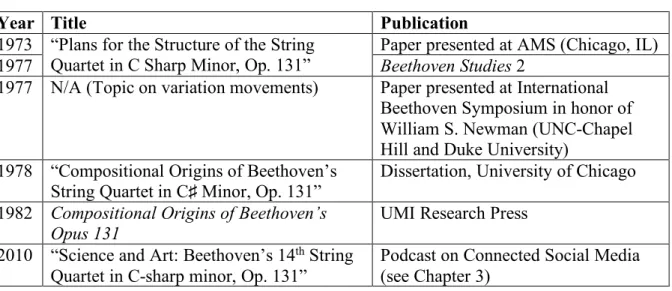
1977 Winter, Robert. “Plans for the Structure of the String Quartet in C Sharp Minor, Op. 131.” In Beethoven Studies 2, 106–37. Edited by Alan Tyson. Oxford: Oxford University Press, 1977.
Analysis of the movement plans for Op. 131 that reveal the composer’s underlying interest in creating a unified work.
1978–79 Drabkin, William. “Beethoven’s Sketches and the Thematic Process.” Proceedings of the Royal Musical Association 105 (1978–1979), 25–36.
Using Winter’s transcriptions of Beethoven’s movement plans, Drabkin argues for the underlying unity of this quartet.
1978–81 Platen, Emil. “Eine Frühfassung zum ersten Satz des Streichquartetts Op. 131 von Beethoven.” Beethoven-Jahrbuch 10 (1978–1981), 277–304.
An investigation of Artaria 212, a manuscript containing transcriptions of the opening fugue by copyist Wenzel Rampl. Platen shows how Beethoven’s early ideas for this movement highlight the composer’s concern for coherence.
1978–82 Winter, Robert. “Compositional Origins of Beethoven’s String Quartet in C♯
Minor, Op. 131,” PhD Dissertation, University of Chicago, 1978;
Compositional Origins of Beethoven’s Opus 131. Ann Arbor: UMI Research, 1982.
Shows how the composer developed this quartet as a unified whole. Fundamental to his argument are Beethoven’s sketch materials pertaining to overarching movement plans, the end of the variation movement, and the opening of the finale. Suggests that Beethoven was inspired to use cyclic form in Op. 131 from his earlier song cycle, “An die ferne Geliebte” (1816).
1979 Kirkendale, Warren. Fugue and Fugato in Rococo and Classical Chamber Music. Translated by Kirkendale and Margaret Bent. Durham: Duke University Press, 1979.
Shows how Op. 131’s fugue is both conventional and innovative in its form and features.
1980 Glauert, Amanda. “The Double Perspective in Beethoven’s Opus 131.” 19CM 4, no. 2 (1980), 113–20.
Glauert, the first woman to publish an analysis on Op. 131, suggests that this quartet has a “double perspective,” exhibiting features of both classical and revolutionary styles.
Woolf acknowledges the influence of the continuous and cyclic form of Op. 131 in drafting the final scene of her novel The Waves (1931) and implements use of the later feature in the final version.
1981 Zaekner, Karl A. “String Quartets in Prose.” Canadian Review of Comparative Literature 8, no. 4 (December 1981), 512–13.
Includes the observation that Op. 131’s opening fugue exists in Reinhard Baumgart’s 1966 novel Hausmusik. Ein deutsches Familienalbum.
1983 Kerman, Joseph, and Alan Tyson. The New Grove Beethoven. New York: W.W. Norton, 1983.
Suggests that Op. 131 is the most integrated late work, and the epitome of the composer’s efforts.
1983 Levin, Gerald. “The Musical Style of ‘The Waves.’” The Journal of Narrative Technique 13, 3 (Fall 1983), 164–71.
Through an analysis of Beethoven’s late quartets featuring Op. 131, alongside J. W. N. Sullivan’s interpretation of these works from 1927, Levin suggests that these quartets influenced Virginia Woolf’s design of her novel The Waves.
1984 Plantinga, Leon. Romantic Music. New York: W. W. Norton, 1984.
Argues that Op. 131’s outer movements are diametrically opposing forces, yet they echo each other thematically.
1985 Cooper, Martin. Beethoven, the Last Decade 1817–1827. Oxford: Oxford University Press, 1985.
Believes that with the late works, Beethoven utilized his inward ear in much the same way that William Wordsworth used his inward turned eye. Cooper defends Op. 131 specifically by comparing Beethoven’s deafness to that of poet John Milton’s blindness; both disabled men produced canonical works.
1986 Crotty, John Edward. “Design and Harmonic Organization in Beethoven’s String Quartet, Opus 131.” PhD dissertation, University of Rochester, 1986.
Claims that Op. 131 was the most integrated multi-movement work in Beethoven’s oeuvre. Applies Schenkerian analysis to relevant sketch material in an effort to prove his point.
1986 Kropfinger, Klaus. “Von der Werkstatt zur Aufführung: Was bedeuten
Beethovens Skizzen für die Werkinterpretation?” In Festschrift Arno Forchert zum 60. Geburstag am 29. Dezember 1985, 169–74. Edited by Gerhard
Builds upon Winter’s research on the sketches for Op. 131, promotes an understanding of it as cyclic, and offers insights regarding how to perform it.
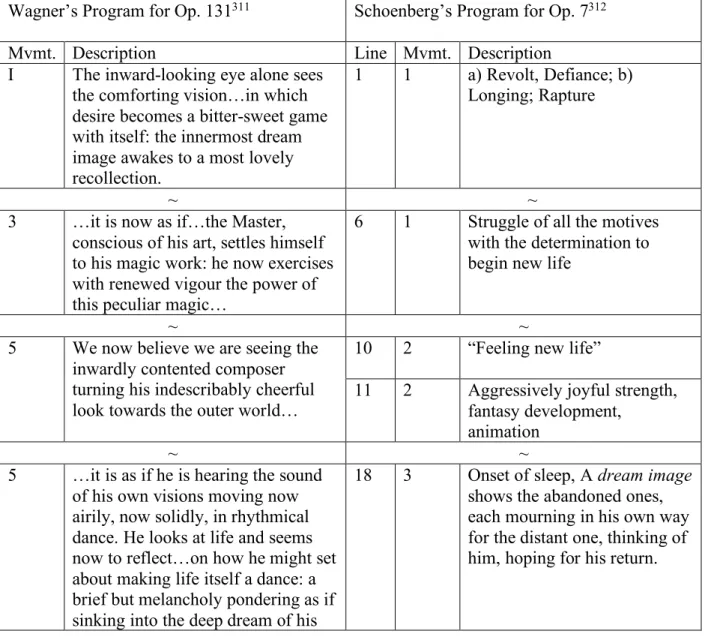
1988 Frisch, Walter. “Thematic Form and the Genesis of Schoenberg’s D-Minor Quartet, Opus 7.” JAMS 41, no. 2 (Summer 1988), 289–314.
Using Winter’s research on the sketches, Frisch compares Beethoven’s creative process in finding large-scale design in Op. 131 to that of Schoenberg’s in composing Op. 7.
1988 Ormesher, Richard. “Beethoven’s Instrumental Fugal Style: An Investigation of Tonal and Thematic Characteristics in the Late-Period Fugues.” PhD dissertation, University of Sheffield, 1988.
Explains how Op. 131’s fugue is exceptional in many ways, and serves as the natural sequel to Op. 133.
1990 Barry, Barbara R. “Teleology and Structural Determinants in Beethoven’s C♯
Minor Quartet, Op. 131.” College Music Symposium 30, no. 2 (Fall 1990), 57– 73.
Through analysis and interpretation of Winter’s sketch studies for Op. 131, Barry claims that this quartet was unified through the Gestalt, or idea, of this quartet being the dialectical push and pull of coherence and disjunction.
1990–91 Hughes, Ted. Capriccio. Searsmont: The Gehenna Press, 1990; Later published as “Opus 131.” The New Yorker (November 30, 1992), 132.
Writes a poem about struggle in love, “Opus 131,” likely based on the narrative of struggle associated with this work.
1991 Marston, Nicholas. “Schumann’s Monument to Beethoven.” 19CM 14, no. 3 (Spring 1991), 247–64.
Argues that Schumann’s composition of his song cycle Dichterlibe (1840) was a monument to Beethoven because it was heavily influenced by the form and harmonic content of Op. 131.
1991 Webster, James. “Integration of the Cycle.” In Haydn’s “Farewell” Symphony and the Idea of Classical Style: Through-Composed and Cyclic Integration in His Instrumental Music, 174–224. Cambridge: Cambridge University Press, 1991.
Asserts that Op. 131 is a representative example of a Beethovenian work with an end-oriented finale.
1993 Imeson, Sylvia M. “‘The time gives it proofe’: Paradoxes in the Late Music of Beethoven.” PhD dissertation, University of Victoria, 1993.