International consensus guidelines for endoscopic papillary
large-balloon dilation
Tae Hyeon Kim, MD,1Jin Hong Kim, MD,2Dong Wan Seo, MD,3Dong Ki Lee, MD,4 Nageshwar D. Reddy, MD,5Rungsun Rerknimitr, MD,6Thawee Ratanachu-Ek, MD,7
Christopher J. L. Khor, MD,8Takao Itoi, MD,9Ichiro Yasuda, MD,10Hiroyuki Isayama, MD,11 James Y. W. Lau, MD,12Hsiu-Po Wang, MD,13Hoi-Hung Chan, MD,14Bing Hu, MD,15
Richard A. Kozarek, MD,16Todd H. Baron, MD17
Iksan, Suwon, Seoul, Republic of Korea; Hyderabad, India; Bangkok, Thailand; Singapore; Tokyo, Kawasaki, Japan; Hong Kong, China; Taipei, Kaohsiung, Taiwan; Shanghai, People’s Republic of China; Seattle, Washington; Chapel Hill, North Carolina, USA
Common bile duct stones are frequently diagnosed throughout the world. Endoscopic sphincterotomy (EST) has been used for the removal of bile duct stones for the past 40 years. The purpose of EST is to provide an opening to allow bile duct stone extraction. However, adverse events such as bleeding, perforation, pancreatitis, and cholangitis occur in 5% to 10% of patients who undergo EST.1-4 Addi-tionally, endoscopic mechanical lithotripsy (EML) may be required as an adjunctive procedure in patients with large bile duct stones to facilitate clearance.5-9Endoscopic papil-lary balloon dilation (EPBD) wasfirst proposed as an alter-native to EST in 1982.10 Because the extent of orifice dilation with EPBD is limited to a diameter of 10 mm, it is less successful than EST in removing bile duct stones.11,12 Endoscopic papillary large balloon dilation (EPLBD) combined with EST was introduced in 2003 to facilitate the removal of large or difficult bile duct stones,13 and the size of the large-diameter balloons used was 12 to 20 mm. Since then, EPLBD with limited or large EST has become rapidly and widely adopted, mainly in Asia. As an alternative method, EPLBD without a preceding EST was introduced as a simplified technique in 2009.14 Several studies have reported that this technique is safe and effective in patients with large bile duct stones without an increased risk of severe pancreatitis or bile duct perforation. Nevertheless, it is difficult to precisely analyze the outcomes of EPLBD because the techniques and definitions are used differently among studies. To date, there is no published consensus of guidelines on the techniques and indications for EPLBD. The consensus
guidelines in this report will help provide a framework to improve the outcome of EPLBD.
METHOD FOR PREPARING THE GUIDELINES
The literature on EPLBD was initially reviewed by searching titles and abstracts with the search terms“large balloon,” “balloon dilation,” “sphincteroplasty,”and“ endo-scopic papillary large balloon dilation” in MEDLINE, the Cochrane Library, and Embase. After reviewing the corre-sponding abstracts of the retrieved articles, the full text of the articles relevant to this review were downloaded. Additional articles were then searched by reviewing the ref-erences of these articles.
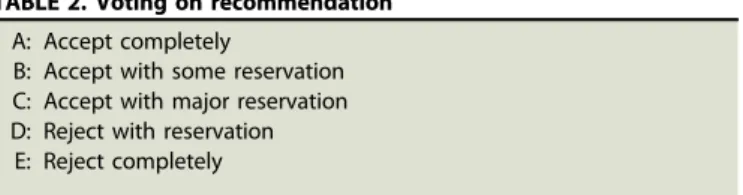
Before the consensus meeting, the Korean co-authors created first draft statements. The statements for EPLBD were divided into the following topics: definition, indica-tion, technique, outcomes, adverse events, and specific cases such as periampullary diverticulum, surgically altered anatomy, and previous EST. These topics were determined according to their perceived clinical importance. These statements were provided by e-mail to the consensus group panel. A face-to-face meeting of the consensus group was held on February 14, 2014, in Seoul, Republic of Korea, to review and discuss the evidence for all state-ments. All statements were revised and finally agreed on at the concluding plenary session. Thereafter, the evidence level and recommendation grade were rated using the ev-idence leveling system of Scottish Intercollegiate Guide-lines Network Grading Review Group (Table 1),15 and the voting system used was a 5-point Likert scale (Table 2). The first vote was conducted in this meeting, and the second voting was conducted electronically by e-mail. Consensus was considered to be achieved when 80% or more of voting members indicated “accept completely” or “accept with some reservation.” A statement was refused when 80% or more of voting members “reject completely” or “reject with some reservation” (Table 2). Commentaries on statements Abbreviations: CI, confidence interval; EML, endoscopic mechanical
lithotripsy; EPBD, endoscopic papillary balloon dilation; EPLBD, endoscopic papillary large-balloon dilation; EST, endoscopic sphincter-otomy; OR, odds ratio; PAD, periampullary diverticulum.
DISCLOSURE:All authors disclosed no financial relationships relevant to this article.
Copyrightª2016 by the American Society for Gastrointestinal Endoscopy 0016-5107/$36.00
were written by T.H. Kim and J.H. Kim and all co-authors were involved in thefinal editing of the commentaries.
In this report, wefirst discuss the definition, indication, and technique of EPLBD with or without EST. We then focus on the best indications, followed by a discussion of safe techniques and outcomes of EPLBD. Each section of this report includes the key recommendations related to the section topic followed by a summary of the supporting evidence (Table 3).
1. DEFINITION
1.1. EPLBD is used to dilate the biliary ori
fi
ce
with a large-diameter balloon (
≥
12 mm) and
can be performed with or without EST.
EPBD involves dilation of the biliary sphincter with a small-diameter balloon (10 mm) and is usually performed without EST. When large bile duct stones are extracted by using EPBD, a great number of EMLs is needed because of the small biliary opening created after EPBD. EPLBD is an extension of EPBD, which is used to create a larger biliary opening with a large diameter balloon (12 mm). The in-tended purpose of EPLBD is to simplify removing large or difficult bile duct stones without additional adverse events of EST alone or EPBD alone. EST has been generally rec-ommended before EPLBD because it was believed to be associated with a decreased risk of postprocedure pancre-atitis.16,17 EPLBD was initially performed when the stan-dard balloon and basket extraction techniques failed after large EST, but recently it has been performed after limited EST or sometimes without EST to minimize the risk of adverse events of large EST, even before attempting trials of the standard extraction techniques. A recent systematic review of EPLBD concluded that EPLBD with EST has similar outcomes in terms of stone clearance and the
advantage of a lower risk of overall adverse events and pancreatitis compared with EST alone.18 As an alternative method, Jeong et al14 reported that avoiding EST during EPLBD can simplify the procedure and that this technique is safe and effective for managing large bile duct stones without increasing the risk of pancreatitis. Although the initial success rate of EPLBD without EST was significantly lower than that of EPLBD with EST, there were no significant differences in the overall success rates in the systematic review.18 However, only a few reports regarding EPLBD without EST have been published. Accordingly, large-scale prospective, multi-center studies would be ideal to verify the effectiveness of EPLBD without EST.
2. INDICATION
2.1. In the removal of large or dif
fi
cult bile duct
stones, EPLBD can be used as an alternative to
EML.
Evidence level: 1D Recommendation level: B
Level of agreement: A, 70.6%; B, 29.4%; C, 0%; D, 0%; E, 0%
Bile duct stones may be difficult to remove endoscopi-cally by using standard balloon and basket extraction
TABLE 1. Definitions of categories for evidence levels and recommendation grades used in these guidelines15
Evidence level
:
1þþ: High-quality meta-analyses; systematic reviews of randomized, controlled trials; or randomized, controlled trials with a very low risk of bias 1þ: Well-conducted meta-analyses; systematic reviews of randomized, controlled trials; or randomized, controlled trials with a low risk of bias 1: Meta-analyses, systematic reviews, or randomized, controlled trials with a high risk of bias
2þþ: High-quality systematic reviews of case-control or cohort studies; high-quality case-control studies or cohort studies with a very low risk of confounding, bias, or chance and a high probability that the relationship is causal
2þ: Well-conducted case-control or cohort studies with a low risk of confounding, bias, or chance and a moderate probability that the relationship is causal
2: Case-control or cohort studies with a high risk of confounding, bias, or chance and a significant risk that the relationship is not causal 3: Nonanalytic studies (eg, case reports, case series)
4: Expert opinion
Recommendation grade
:
A: At least 1 meta-analysis, systematic review, or randomized, controlled trial rated as 1þþand directly applicable to the target population or a systematic review of randomized, controlled trials or a body of evidence consisting principally of studies rated 1þdirectly applicable to the target population and demonstrating overall consistency of results
B: A body of evidence including studies rated 2þþdirectly applicable to the target population and demonstrating overall consistency of results or extrapolated evidence from studies rated 1þþor 1þ
C: A body of evidence including studies rated 1or 2þdirectly applicable to the target population and demonstrating overall consistency of results or extrapolated evidence from studies rated 2þþ
D: Evidence level 2, 3, or 4 or extrapolated evidence from studies rated 2þ
TABLE 2. Voting on recommendation
A: Accept completely
B: Accept with some reservation C: Accept with major reservation D: Reject with reservation
techniques after mainly large EST in the setting of large stones (>15 mm), multiple stones, barrel-shaped stones, and tapering or tortuosity of the distal common bile duct.19,20 In such situations, additional endoscopic proce-dures, mainly EML, are usually required.5-9 However, EML is a time-consuming procedure, raising problems such as impaction and fracture of the Dormia basket, and increases the risk of adverse events ranging from 6% to 13%.9,21-24 The frequency of the use of EML when performing EST or EPBD is related to various factors such as the diameter of the dilating balloon, a discrepancy in the size between the stone and ampullary orifice or distal bile duct, and the shape of the stone and bile duct. EPLBD combined with EST or without a preceding EST can be used as the alternative to EML after EST for the removal of large or difficult bile duct stones, reducing the need for EML because it allows a larger biliary orifice to be achieved than full-incision EST or EPBD. A number of case series; retrospective cohort studies; randomized, controlled trials; and meta-analyses supported the fact that EPLBD was a safe and useful alternative technique to EML without causing any additional risk of severe adverse events when removing large or difficult bile duct stones.16,20,25-36
2.2. EPLBD
can
be
used
as
the
initial
method when large bile duct stones have
been identi
fi
ed on endoscopic retrograde
cholangiography or cross-sectional imaging.
Evidence level: 1D Recommendation level: B
Level of agreement: A, 70.6%; B, 23.5%; C, 5.9%; D, 0%; E, 0%
In early trials of EPLBD, a supplementary EPLBD was per-formed when the standard balloon and basket extraction technique failed after large EST.13,37However, preemptive EPLBD has recently been performed after limited EST or sometimes without EST in patients with large bile duct stones that are suspected to be difficult to remove by using standard extraction techniques even after large EST, because EPLBD after large EST may increase the risk of adverse events such as bleeding and perforation. Abdominal CT with coronal reconstruction and MRCP can be used to measure the num-ber and size of bile duct stones and to determine the shape of the bile duct. Accordingly, this allows endoscopists to decide on the method to use for bile duct stone removal even before endoscopic retrograde cholangiography is
TABLE 3. Summary statements of EPLBD
1. De
fi
nition
:
1.1. EPLBD is used to dilate the biliary orifice with a large-diameter balloon (12 mm) and can be performed with or without EST.
2. Indication
:
2.1. In the removal of large or difficult bile duct stones, EPLBD can be used as an alternative to EML (evidence level: 1þ, recommendation level: B). 2.2. EPLBD can be used as the initial method when large bile duct stones have been identified on endoscopic retrograde cholangiography or
cross-sectional imaging (evidence level: 1þ, recommendation level: B).
2.3. When conventional stone removal after EST fails, EPLBD can be considered (evidence level: 1þ, recommendation level: B).
2.4. In patients with obvious distal bile duct strictures or a nondilated bile duct, EPBLD is not recommended because of the increased risk of perforation (evidence level: 2þ, recommendation level: C).
2.5. EPLBD without EST is preferred over EPLBD with EST in patients with coagulopathy (evidence level: 4, recommendation level: D).
3. Techniques
:
3.1. The maximal diameter of the balloon should not exceed the diameter of the distal bile duct (evidence level: 3, recommendation grade: D). 3.2. The balloon should be inflated slowly in gradual steps (evidence level: 3, recommendation grade: D).
3.3. The usual duration of balloon dilation is approximately 30 to 60 seconds after disappearance of the waist (evidence level: 1, recommendation grade: C).
4. Outcomes
:
4.1. The initial and overall success rates of EPLBD with EST are comparable to those of EST alone (evidence level: 1þ, recommendation grade: A). 4.2. Overall success rates of EPLBD with and without EST for bile duct stone clearance are comparable (evidence level: 2þþ, recommendation
grade: B).
4.3. EPLBD with EST can reduce the need for EML (evidence level: 1þ, recommendation grade: B).
5. Speci
fi
c cases
:
5.1. The presence of a periampullary diverticulum may not increase the risk of adverse events in patients who undergo EPLBD (evidence level: 2þþ, recommendation grade: B).
5.2. In patients with surgically altered anatomy, EPLBD may be an effective and safe procedure to remove bile duct stones (evidence level: 3, recommendation grade: D).
5.3. In patients with a previous EST, EPLBD without repeated EST may be effective and safe for the removal of recurrent stones (evidence level: 2, recommendation grade: D).
6. Adverse events
:
6.1. The rate of overall adverse events for EPLBD with EST is lower than that for EST alone in patients with large or difficult stones (evidence level: 1 , recommendation grade: C).
6.2. EPLBD may not increase the risk of pancreatitis (evidence level: 1þ, recommendation grade: B).
6.3. EPLBD with large EST may increase the risk of bleeding (evidence level: 2þþ, recommendation grade: C).
6.4. EPLBD with EST has a perforation rate similar to that of EST. A distal CBD stricture is a major risk factor for perforation (evidence level: 1þ, recommendation grade: B).
performed. All recent studies that were conducted to compare the clinical outcomes of EPLBD with limited EST with EST alone as an initial stone extraction technique in pa-tients with large bile duct stones, constituting 2 retrospective cohort studies25,26and 5 randomized, controlled trials,27-30,35 showed similar or even better initial and overall success rates of stone clearance and rates of adverse events. In addition, 2 retrospective case series reported that initial EPLBD without a preceding EST could be safely and effectively used as an alternative stone extraction technique to EST alone in pa-tients with large bile duct stones.14,38Therefore, if large or difficult bile duct stones are seen on endoscopic retrograde cholangiography or cross-sectional imaging, initial EPLBD before attempting trials of the standard extraction techniques can be performed after limited EST or sometimes without EST to facilitate effective stone removal, minimizing the risk of adverse events of large EST.
2.3. When conventional stone removal after
EST fails, EPLBD can be considered.
Evidence level: 1D Recommendation level: B
Level of agreement: A, 88.2%; B, 11.8%; C, 0%; D, 0%; E, 0%
In 2003, Ersoz et al13were thefirst to report successfully performing EPLBD as an alternative technique to EML as a means of removing difficult or large bile duct stones in patients in whom standard extraction techniques after large EST failed. Thereafter, a number of case series supported the finding that supplementary EPLBD after mainly large EST was a feasible and useful technique in similar situations.37,39-43 However, several severe to fatal adverse events (1 case of fatal pancreatitis,42 2 cases of severe bleeding,39,401 case of fatal bleeding,43and 1 case of severe perforation40) have been described in published reports. One well-conducted randomized, controlled trial reported that full-incision EST followed by EPLBD was equally as effec-tive as full-incision EST followed by EML for the removal of large bile duct stones, but associated with fewer adverse events (4.4% vs 20%,P Z.049).29However, further large-scale randomized, controlled trials are needed to verify the effectiveness of supplementary EPLBD in patients in whom standard extraction techniques after mainly large EST failed.
2.4. In patients with obvious distal bile duct
strictures or a nondilated bile duct, EPLBD is
not recommended because of the increased
risk of perforation.
Evidence level: 2D Recommendation level: C
Level of agreement: A, 64.7%; B, 35.3%; C, 0%; D, 0%; E, 0%
In a well-conducted case-control multicenter study for the analysis of adverse events in 946 patients who underwent EPLBD, a distal bile duct stricture was found to be the inde-pendent risk factor for perforation (odds ratio [OR] 17.083;
95% confidence interval [CI], 3.936–74.132;P<.001), which was known as the most serious adverse event of EPLBD.17In this study, perforation-related deaths occurred only in 3 pa-tients with a distal bile duct stricture, and suspected causative factors of perforation in these patients were overinflation of the balloon in all 3 patients as well as full-incision EST in 2.17 Therefore, EPBLD is not recommended in patients with obvious distal bile duct strictures or a nondilated bile duct because of the increased risk of perforation due to excessive dilation of the bile duct with a balloon.17,18Obvious strictures of the distal bile duct can be detected easily on chol-angiography, whereas obscure strictures may not. The speed and degree of balloon inflation should be carefully controlled to avoid adverse events in view of such obscure strictures of the distal bile duct.44 If there is a suspicion of distal bile duct strictures during ERCP, especially in patients with a tapered distal bile duct, use of the pulling method of a large inflated retrieval balloon through the suspected site is recommended to confirm a suspected existence.18
2.5. EPLBD without EST is preferred over
EPLBD with EST in patients with coagulopathy.
Evidence level: 4
Recommendation level: D
Level of agreement: A, 58.8%; B, 35.3%; C, 5.9%; D, 0%; E, 0%
3. TECHNIQUES
3.1. The maximum diameter of the balloon
should not exceed the diameter of the distal
bile duct.
Evidence level: 3
Recommendation grade: D
Level of agreement: A, 70.6%; B, 29.4%; C, 0%; D, 0%; E, 0%
Major procedure-related risk factors that seem to be related to adverse events during EPLBD include the extent of EST, the diameter of the balloon, and the method of balloon inflation. The size of the bile duct stones and the diameter of the distal bile duct are crucial factors when se-lecting the diameter of the balloon. Although the balloon diameter for EPLBD ranges from 12 mm to 20 mm, a balloon with a diameter of 15 mm or less is frequently used to pre-vent serious adverse epre-vents, even if the bile duct stones are larger than 15 mm in diameter. Therefore, the diameter of the distal bile duct may be regarded as a more important factor when selecting the balloon rather than the size of bile duct stones because excessive balloon dilation beyond the diameter of the distal bile duct may increase the risk of perfo-ration. A large-scale retrospective, multicenter EPLBD study of 946 patients with large bile duct stones (>10 mm) noted that the diameter of the inflated balloon used was larger than that of the distal bile duct in 2 of 3 patients with fatal perforation.17 Although further studies are still needed, the maximal inflated diameter of the balloon should not exceed the diameter of the distal bile duct to prevent the risk of perforation due to overinflation of the balloon.
3.2. The balloon should be in
fl
ated slowly in
gradual steps.
Evidence level: 3
Recommendation grade: D
Level of agreement: A, 58.8%; B, 41.2%; C, 0%; D, 0%; E, 0%
During EPLBD, the rapid and forcible inflation of the balloon across a tight distal bile duct stricture can lead to perforation and bleeding. Obvious bile duct strictures are easily visible on cholangiography, whereas obscure bile duct strictures are sometimes difficult to diagnosed. In a multi-center retrospective EPLBD study of 946 patients, the central waist of the balloon did not disappear during EPLBD in 2 of 3 patients who experienced bile duct perforation that resulted in death, whereas it could not be identified in the third patient because of rapid forcible inflation of the balloon during EPLBD.17Therefore, if the central waist of the balloon does not disappear, obscure strictures of the distal bile duct stricture should be strongly considered and further balloon inflation must be ceased at any step to avoid perforation.17 The balloon should always be inflated slowly and gradually, starting from a smaller diameter than the intended maximal target, to recognize obscure bile duct strictures with attention paid to the balloon shape underfluoroscopy.44
3.3. The usual duration of balloon dilation
is approximately 30 to 60 seconds after
disappearance of the waist.
Evidence level: 1L
Recommendation grade: C
Level of agreement: A, 41.2%; B, 41.2%; C, 5.9%; D, 5.9%; E, 5.9%
The duration of balloon dilation in 24 studies of EPLBD with EST, which were included in the systematic review, var-ied from 10 seconds to 180 seconds; the duration of every study was<60 seconds with the exception of 3 studies.18 One randomized, controlled trial reported that a 30-second duration of balloon dilation was not different from a 60-second duration with regard to adverse events, including pancreatitis, bleeding, and perforation in EPLBD with EST.42 One randomized, controlled study on the duration of balloon dilation by using a small-diameter balloon reported that 5-minute EPBD improved the efficacy of stone extraction and reduced the risk of pancreatitis compared with conventional 1-minute EPBD.50 When studies were stratified by different durations of balloon dilation in a meta-analysis of EPLBD studies by Feng et al,31 the rates of bile duct stone clearance were not significantly different between EPLBD and EST alone, despite EPLBD being performed with either short duration (<1 minute) (OR 2.77; 95% CI, 0.80–9.61; P Z .11) or long duration (1 minute) (OR 0.56; 95% CI, 0.18–1.78; PZ .33). In a large-scale retrospective case series of 247 patients who un-derwent EPLBD without EST for the treatment of large bile duct stones (>10 mm), there were only 3 adverse events (1.2%) comprising 2 cases of mild pancreatitis (0.8%) and 1 case of mild cholangitis (0.4%), after inflating a large balloon up to the mean diameter of 13.2 mm (range 11-20 mm) over a mean duration of 4.7 minutes (range 2-6 mi-nutes).51 Therefore, a longer duration of balloon dilation does not seem to be related to an increased risk of adverse events, even in patients who undergo EPLBD without EST. However, further studies are warranted to determine the optimal duration of balloon dilation during EPLBD.
4. OUTCOMES
4.1. The initial and overall success rates of
EPLBD with EST are comparable to those
of EST alone.
Evidence level: 1D(systemic review and prospec-tive studies, meta-analysis)
Recommendation grade: A
Level of agreement: A, 47.1%; B, 47.1%; C, 5.9%; D, 0%; E, 0%
success rate in EPLBD with EST was similar to that of EST alone in 1 retrospective cohort study,20 in 4 of the 6 randomized, controlled trials27-30; and in all 5 meta-ana-lyses16,31-33,36; whereas it was significantly higher in EPLBD with EST than that in EST alone in another 2 retrospective cohort studies by Kim et al25 and Rosa et al26 and the remaining 2 randomized, controlled trials by Li at al34 and Jun et al.35The overall success rate of EPLBD with EST in the previously mentioned systematic review18 was comparable to that of EST alone (96.5% vs 95.3%, P Z .141) in a previous meta-analysis.11The overall success rate of EPLBD with EST was similar to that of EST alone in 2 of 3 retrospective cohort studies20,25; in all 6 randomized, controlled trials27-30,34,35and in all 5 meta-analyses,16,31-33,36 whereas it was significantly higher in EPLBD with EST than in EST alone in the remaining retrospective cohort study by Rosa et al.26 Based on these results, the initial and overall success rates of EPLBD with EST are comparable to, or somewhat better than, those of EST alone.
4.2. Overall success rates of EPLBD with and
without EST for bile duct stone clearance are
comparable.
Evidence level: 2DD Recommendation grade: B
Level of agreement: A, 70.6%; B, 29.4%; C, 0%; D, 0%; E, 0%
After EPLBD with EST was introduced in 2003, EPLBD without EST was formally incorporated as a simplified alter-native technique in 2009.14 There are not enough comparison studies to investigate the clinical outcomes between EPLBD with and without EST in patients with large bile duct stones. A retrospective cohort study that compared stone clearance between EPLBD without and with EST showed similar outcomes in overall successful stone removal (96.8% vs 95.7%; P Z .738) and complete stone removal without EML (80.6% vs 73.9%;PZ.360).38 In the systematic review of 32 EPLBD studies, the initial success rate of EPLBD without EST was significantly lower than that of EPLBD with EST (76.2% vs 84.0%;P<.001).18 This was most likely due to the opening of the orifice retracting almost immediately to its original size, which is commonly seen with EPBD alone. However, there was no significant difference in the overall success rate between the 2 procedures (97.2% vs 96.5%;PZ.432).18Therefore, it can be concluded that the overall success rates of EPLBD with and without EST are comparable.
4.3. EPLBD with EST can reduce the need for
EML.
Evidence level: 1D
Recommendation grade: B
Level of agreement: A, 76.5%; B, 23.5%; C, 0%; D, 0%; E, 0%
EML is usually required as an adjunctive procedure of EST to facilitate complete clearance of large bile duct
stones.5-9 However, EML has proven to be a time-consuming and a challenging technique,21,22 and EML-related adverse events such as basket impaction and bile duct injury can occur. EPLBD can be used as the main alternative to EST followed by EML for the removal of large or difficult bile duct stones. The widened ampul-lary orifice made by EPLBD facilitates easier extraction of relatively large bile duct stones and may reduce the need for EML. However, the frequency of EML use with EPLBD might be related to various factors such as the diameter of the dilating balloon used, a discrepancy in the size be-tween the stone and the ampullary orifice or the distal bile duct, and the shape of the stone and the bile duct.
There are some conflicting results concerning the need for EML for the removal of large or difficult bile duct stones in several studies comparing EPLBD with EST and EST alone. In 2 of 3 retrospective cohort studies20,26and 3 of 5 randomized, controlled trials,30,34,35 EPLBD with EST showed a reduced need for EML over EST alone. However, in the remaining 3 studies,25,27,28 the need for EML was similar that for EST alone. One retrospective study in these 3 studies reported a reduced need for EML in EPLBD with EST, when confined to patients with large CBD stones (15 mm).25 In 4 meta-analyses,16,31-33 it was evident that EPLBD with EST reduced the need for EML compared with EST alone, although one of them, a meta-analysis by Yang and Hu16 reported no significant difference between the 2 groups when conducting a sensitivity analysis by including only high-quality full-text studies, which was 4 of the total 6 studies of this meta-analysis. Based on these results, there is speculation that EPLBD with EST can reduce the need for EML in patients with large bile duct stones.
5. SPECIFIC CASES
5.1.
The
presence
of
a
periampullary
diverticulum may not increase the risk of
adverse events in patients who undergo EPLBD.
Evidence level: 2DD Recommendation: B
Level of agreement: A, 76.5%; B, 23.5%; C, 0%; D, 0%; E, 0%
events in both, after EPLBD with limited EST or EPLBD alone.54-56 When comparing each subtype of PAD with the controls or between subtypes of PAD in these studies, the rates of adverse events were not significantly different,54,56 whereas the frequency of pancreatitis was significantly higher in PAD type A than controls (14.3% vs 3.0%, P Z .047) in 1 study.55 In addition, several studies, including a well-conducted case-control, multi-center study for the analysis of adverse events in 946 pa-tients who underwent EPLBD, reported that the presence of PAD did not significantly increase the risk of adverse events such as pancreatitis, bleeding, and perforation af-ter EPLBD, even with large EST.17,54-56 Nevertheless, EPLBD without EST is generally considered to avoid serious adverse events such as perforation and bleeding in patients with PAD. Randomized, controlled trials for comparing outcomes of patients with and without PAD warrant further investigative studies, especially based on the type of PAD.
5.2. In patients with surgically altered anatomy,
EPLBD may be an effective and safe procedure
to remove bile duct stones.
Evidence level: 3 Recommendation: D
Level of agreement: A, 88.2%; B, 5.9%; C, 5.9%; D, 0%; E, 0%
It is well known that EST is usually difficult and may require special techniques or devices in patients with sur-gically altered anatomy. Despite the development of spe-cific sphincterotomes, EST in patients who have undergone Billroth II gastrectomy is more difficult than in patients with unaltered anatomy because the papilla now has to be approached from an inverted anatomic structure. In such a situation, balloon dilation may be particularly suitable instead of EST. Six case series of EPLBD with limited EST, mainly using a needle-knife or a rotatable papillotome in patients with a surgically altered anatomy such as Billroth II surgery and Roux-en-Y anasto-mosis, reported relatively high rates of complete stone clearance (96.7%–100%)57-62 compared with 81.3% to 100% in other studies using adjusted EST techniques to suit the surgically altered anatomy.63-65 In all of these EPLBD studies in patients with a surgically altered anat-omy, only mild pancreatitis and mild to moderate bleeding were noted without any perforation or serious adverse events. Jang et al66 reported complete CBD stone removal after EPLBD without EST in all Billroth II gastrectomy patients with large or difficult CBD stones without any serious adverse events. However, to date, there are still no randomized, controlled trials of EPLBD and EST alone in Billroth II gastrectomy patients. Nonetheless, EPLBD is still regarded as an effective and safe procedure and is commonly used to remove bile duct stones in patients with surgically altered anatomy.
5.3. In patients with previous EST, EPLBD
without repeated EST may be effective and
safe for the removal of recurrent stones.
Evidence level: 2L Recommendation: D
Level of agreement: A, 82.4%; B, 11.8%; C, 5.9%; D, 0%; E, 0%
In recurrent bile duct stones, extended incision of a pre-vious EST site is sometimes required to remove large and difficult stones. However, it can increase the risk of adverse events such as bleeding and perforation.1,4,6In such cases, EPLBD can be safely and effectively used to widen the ampullary orifice without performing a repeat EST. There have been 3 case series and 1 retrospective cohort study of EPLBD in patients who underwent previous EST.67-70 In the 3 case series involving 146 patients, complete stone removal was achieved in all patients with 1 case of mild pancreatitis being the only procedure-related adverse event.67,68,70 In a retrospective cohort study of EPLBD without repeated EST and standard balloon and basket extraction techniques in patients with a history of EST and large bile duct stones (>10 mm), the total procedure time was significantly shorter and the frequency of EML use was significantly lower in EPLBD without repeated EST than when performing standard extraction techniques, whereas the rates of complete stone clearance and the procedure-related adverse events were similar in both.69 Therefore, in patients with previous EST, EPLBD without repeated EST may be effective and safe for the removal of recurrent stones.
6. ADVERSE EVENTS
6.1. The rate of overall adverse events for
EPLBD with EST is lower than that for EST
alone in patients with large or dif
fi
cult stones.
Evidence level: 1L
Recommendation grade: C
Level of agreement: A, 41.2%; B, 41.2%; C, 17.6%; D, 0%; E, 0%
large-scale multicenter case-control study that investigated 946 patients, a subgroup analysis showed that stones larger than 16 mm, cirrhosis, and full-length EST were indepen-dently associated with an increase in overall adverse events.17
6.2. EPLBD may not increase the risk of
pancreatitis.
Evidence level: 1D
Recommendation grade: B
Level of agreement: A, 70.6%; B, 11.8%; C, 11.8%; D, 5.9%; E, 0%
Two meta-analyses of EPBD by using small-diameter bal-loons (<10 mm) showed a significantly higher rate of pancreatitis than EST (8.6% vs 4.3%,P Z.0005 and 7.4% vs 4.3%,PZ.05).11,71Based on this evidence, many con-cerns have been raised about pancreatitis after balloon dila-tion with increasing balloon size. However, Youn et al72 reported that EPLBD with a large balloon of more than 15 mm with EST is safe with a very low rate of severe pancreatitis. In the systematic review of EPLBD studies using large-diameter balloons (12-20 mm), pancreatitis occurred in 2.4% (61/2511) of patients who underwent EPLBD with EST; almost all cases of pancreatitis were of mild to moderate severity (98.4%) with the exception of 1 fatal case of severe pancreatitis.18 Furthermore, this systematic review reported that only mild to moderate pancreatitis after EPLBD without EST occurred in 3.9% of 413 patients.18 In the comparison of adverse events between results of a previous meta-analysis by Weinberg et al11 of EST alone and those of this systematic review in EPLBD with EST, the rate of pancreatitis in patients who underwent EPLBD with EST was significantly lower than that in patients who underwent EST alone (4.3% vs 2.4%, P Z .006).18 In all 6 randomized, controlled trials27-30,34,35 and all 5 meta-analyses16,31-33,36 that were conducted to compare the clinical outcomes of EPLBD with EST and of EST alone, the rate of pancreatitis showed no statistical difference between them. Furthermore, the systematic review of 3 studies reported that only mild to moderate pancreatitis after EPLBD without EST occurred in 3.9% of 413 patients.18 Based on these results, acute pancreatitis associated with EPLBD with or even without EST may occur at a lower incidence rate and is less severe than that associated with EPBD alone and may occur with a similar incidence to that associated with EST alone. Therefore, there is no doubt that the mechanism of pancreatitis differs between EPLBD and EPBD, although it still remains unclear.
Interestingly, in a multicenter study, balloons larger than 14 mm in diameter were independently associated with a lower risk of pancreatitis, suggesting that only sim-ple stretching of the ampullary orifice or direct blockage of the pancreatic orifice by compression of large-diameter balloons is not a major mechanism for pancreatitis after EPLBD.17 A possible mechanism of the reduced
pancreatitis rate for EPLBD with EST is that the radial force exerted by the dilating balloon shifts along the cutting direction made during EST toward the bile duct and away from the pancreatic orifice, resulting in less periampullary injury around the pancreatic duct.16,17 How-ever, EST may have a limited role in preventing pancreatitis in EPLBD because patients undergoing EPLBD without EST did not have an increased risk of pancreatitis.18 Therefore, the other hypothesis about the mechanism of pancreatitis after EPLBD was suggested: the manipulation frequency of the Dormia basket and retrieval balloon catheter in EPLBD both with and without EST can be reduced due to a sufficiently widened ampullary orifice, resulting in less periampullary trauma or edema and a lower risk of pancreatitis. On the contrary, the risk of injury to the ampullary orifice in EPBD by using small-diameter balloons may be increased because instruments for stone removal are passed through an inadequately widened ampullary orifice.
6.3. EPLBD with large EST may increase the risk
of bleeding.
Evidence level: 2DD Recommendation grade: C
Level of agreement: A, 76.5%; B, 11.8%; C, 5.9%; D, 5.9%; E, 0%
extraction techniques with large EST when the stone is seen to be too large on cholangiography or cross-sectional imaging.
6.4. EPLBD with EST has a rate of perforation
similar to that of EST alone. A distal bile duct
stricture is a major risk factor for perforation.
Evidence level: 1D
Recommendation grade: B
Level of agreement: A, 82.4%; B, 11.8%; C, 5.9%; D, 0%; E, 0%
The most serious adverse event of EPLBD with EST is bile duct perforation. In the systematic review of EPLBD studies, the rates of perforation were 0.6% (range 0%–2.8%) for EPLBD with EST.18 Six problematic perforations after EPLBD with EST were reported: 2 duodenal perforations that were successfully managed with surgery, 1 cystic duct perforation managed with percutaneous drainage, and 3 fatal perforations from either septic shock or cardiogenic shock. In all 6 randomized, controlled trials27-30,34,35 conducted to compare the clinical outcomes between EPLBD with EST and EST alone, the rate of perforation was similar. Among 4 meta-analyses of the clinical outcomes between EPLBD with EST and EST alone, 2 meta-analyses by Feng et al31 and Jin et al32 showed no significant difference between them; a meta-analysis by Yang and Hu16 found a lower perforation rate only in EPLBD with EST, but no significant difference between them when excluding 2 low-quality abstracts of all 6 studies; the last meta-analysis by Madhoun et al33 showed no estimable results between them, but no significant difference when excluding guidewire-related perforations. The extent of ampullary incision may not be a major cause of perfora-tion because there was no difference in the perforaperfora-tion rate between EPLBD with large EST and EPLBD with limited EST (0.4% vs 0.5%,PZ1.00) in the systematic re-view,18 but it is well known that the diameter of the balloon is the most important major factor in ensuring the success of EPLBD and minimizing adverse events.74 The wider the ampullary orifice is dilated with the balloon, the more easily removal of the stone can be achieved. However, choosing an inappropriately oversized balloon increases the risk of perforation. Also, the large-scale multicenter case-control EPLBD study of 946 patients showed that a distal bile duct stricture was noted in 7 of a total of 9 perforations, consisting of 3 per-forations of moderate severity and all 4 perper-forations of se-vere severity and was an independent predictor of perforation (OR 17.08,P <.001).17
ACKNOWLEDGMENTS
Other members who greatly contributed to our work during the consensus meeting and manuscript preparation
are Sang Hyub Lee, Department of Internal Medicine, Seoul National University Hospital, Seoul National Univer-sity College of Medicine, Seoul, Republic of Korea; Park Joo Kyoung, Department of Internal Medicine, Seoul Na-tional University Hospital, Seoul NaNa-tional University Col-lege of Medicine, Seoul, Republic of Korea; Dong Uk Kim, Department of Internal Medicine, Pusan National University Hospital, Pusan National University School of Medicine, Pusan, Republic of Korea; and Seok Jeong, Digestive Disease Center, Department of Internal Medi-cine, Inha University School of MediMedi-cine, Incheon, Repub-lic of Korea.
REFERENCES
1.Cotton PB, Lehman G, Vennes J, et al. Endoscopic sphincterotomy complications and their management: an attempt at consensus. Gas-trointest Endosc 1991;37:383-93.
2.Sherman S, Ruffolo TA, Hawes RH, et al. Complications of endoscopic sphincterotomy. A prospective series with emphasis on the increased risk associated with sphincter of Oddi dysfunction and nondilated bile ducts. Gastroenterology 1991;101:1068-75.
3.Boender J, Nix GA, de Ridder MA, et al. Endoscopic papillotomy for common bile duct stones: factors influencing the complication rate. Endoscopy 1994;26:209-16.
4.Leung JW, Chan FK, Sung JJ, et al. Endoscopic sphincterotomy-induced hemorrhage: a study of risk factors and the role of epinephrine injec-tion. Gastrointest Endosc 1995;42:550-4.
5.Bergman JJ, Rauws EA, Fockens P, et al. Randomised trial of endo-scopic balloon dilation versus endoendo-scopic sphincterotomy for removal of bileduct stones. Lancet 1997;349:1124-9.
6.Freeman ML, Nelson DB, Sherman S, et al. Complications of endo-scopic biliary sphincterotomy. N Engl J Med 1996;335:909-18. 7.Higuchi T, Kon Y. Endoscopic mechanical lithotripsy for the treatment
of common bile duct stone. Experience with the improved double sheath basket catheter. Endoscopy 1987;19:216-7.
8.Moriai T, Hasegawa T, Fuzita M, et al. Successful removal of massive intragastric gallstones by endoscopic electrohydraulic lithotripsy and mechanical lithotripsy. Am J Gastroenterol 1991;86:627-9.
9.Hintze RE, Adler A, Veltzke W. Outcome of mechanical lithotripsy of bile duct stones in an unselected series of 704 patients. Hepatogas-troenterology 1996;43:473-6.
10.Staritz M, Ewe K, Meyer zum Buschenfelde KH. Endoscopic papillary dilatation: an alternative to papillotomy? (author’s transl). Dtsch Med Wochenschr 1982;107:895-7.
11.Weinberg BM, Shindy W, Lo S. Endoscopic balloon sphincter dilation (sphincteroplasty) versus sphincterotomy for common bile duct stones. Cochrane Database Syst Rev 2006:CD004890.
12.Zhao HC, He L, Zhou DC, et al. Meta-analysis comparison of endoscopic papillary balloon dilatation and endoscopic sphincteropapillotomy. World J Gastroenterol 2013;19:3883-91.
13.Ersoz G, Tekesin O, Ozutemiz AO, et al. Biliary sphincterotomy plus dila-tion with a large balloon for bile duct stones that are difficult to extract. Gastrointest Endosc 2003;57:156-9.
14.Jeong S, Ki SH, Lee DH, et al. Endoscopic large-balloon sphinctero-plasty without preceding sphincterotomy for the removal of large bile duct stones: a preliminary study. Gastrointest Endosc 2009;70: 915-22.
15.Harbour R, Miller J. A new system for grading recommendations in evidence based guidelines. BMJ 2001;323:334-6.
17.Park SJ, Kim JH, Hwang JC, et al. Factors predictive of adverse events following endoscopic papillary large balloon dilation: results from a multicenter series. Dig Dis Sci 2012;58:1100-9.
18.Kim JH, Yang MJ, Hwang JC, et al. Endoscopic papillary large balloon dilation for the removal of bile duct stones. World J Gastroenterol 2013;19:8580-94.
19.Kim HJ, Choi HS, Park JH, et al. Factors influencing the technical diffi-culty of endoscopic clearance of bile duct stones. Gastrointest Endosc 2007;66:1154-60.
20.Itoi T, Itokawa F, Sofuni A, et al. Endoscopic sphincterotomy combined with large balloon dilation can reduce the procedure time and fluoros-copy time for removal of large bile duct stones. Am J Gastroenterol 2009;104:560-5.
21.Leung JW, Tu R. Mechanical lithotripsy for large bile duct stones. Gas-trointest Endosc 2004;59:688-90.
22.Shaw MJ, Mackie RD, Moore JP, et al. Results of a multicenter trial using a mechanical lithotripter for the treatment of large bile duct stones. Am J Gastroenterol 1993;88:730-3.
23.Garg PK, Tandon RK, Ahuja V, et al. Predictors of unsuccessful mechan-ical lithotripsy and endoscopic clearance of large bile duct stones. Gas-trointest Endosc 2004;59:601-5.
24.Chang WH, Chu CH, Wang TE, et al. Outcome of simple use of mechan-ical lithotripsy of difficult common bile duct stones. World J Gastroen-terol 2005;11:593-6.
25.Kim TH, Oh HJ, Lee JY, et al. Can a small endoscopic sphincter-otomy plus a large-balloon dilation reduce the use of mechanical lithotripsy in patients with large bile duct stones? Surg Endosc 2011;25:3330-7.
26.Rosa B, Moutinho Ribeiro P, et al. Endoscopic papillary balloon dilation after sphincterotomy for difficult choledocholithiasis: a case-controlled study. World J Gastrointest Endosc 2013;5:211-8.
27.Heo JH, Kang DH, Jung HJ, et al. Endoscopic sphincterotomy plus large-balloon dilation versus endoscopic sphincterotomy for removal of bile-duct stones. Gastrointest Endosc 2007;66:720-6; quiz 68, 71.
28.Kim HG, Cheon YK, Cho YD, et al. Small sphincterotomy combined with endoscopic papillary large balloon dilation versus sphincterotomy. World J Gastroenterol 2009;15:4298-304.
29.Stefanidis G, Viazis N, Pleskow D, et al. Large balloon dilation vs. me-chanical lithotripsy for the management of large bile duct stones: a prospective randomized study. Am J Gastroenterol 2011;106:278-85. 30.Teoh AY, Cheung FK, Hu B, et al. Randomized trial of endoscopic
sphincterotomy with balloon dilation versus endoscopic sphincteroto-my alone for removal of bile duct stones. Gastroenterology 2013;144: 341-5.e1.
31.Feng Y, Zhu H, Chen X, et al. Comparison of endoscopic papillary large balloon dilation and endoscopic sphincterotomy for retrieval of chole-docholithiasis: a meta-analysis of randomized controlled trials. J Gastroenterol 2012;47:655-63.
32.Jin PP, Cheng JF, Liu D, et al. Endoscopic papillary large balloon dila-tion vs endoscopic sphincterotomy for retrieval of common bile duct stones: a meta-analysis. World J Gastroenterol 2014;20:5548-56. 33.Madhoun MF, Wani S, Hong S, et al. Endoscopic papillary large balloon
dilation reduces the need for mechanical lithotripsy in patients with large bile duct stones: a systematic review and meta-analysis. Diagn Ther Endosc 2014;2014:309618.
34.Li G, Pang Q, Zhang X, et al. Dilation-assisted stone extraction: an alter-native method for removal of common bile duct stones. Dig Dis Sci 2014;59:857-64.
35.Jun Bo Q, Li Hua X, Tian Min C, et al. Small endoscopic sphincterotomy plus large-balloon dilation for removal of large common bile duct stones during ERCP. Pak J Med Sci 2013;29:907-12.
36.Liu Y, Su P, Lin Y, et al. Endoscopic sphincterotomy plus balloon dila-tion versus endoscopic sphincterotomy for choledocholithiasis: a meta-analysis. J Gastroenterol Hepatol 2013;28:937-45.
37.Maydeo A, Bhandari S. Balloon sphincteroplasty for removing difficult bile duct stones. Endoscopy 2007;39:958-61.
38.Hwang JC, Kim JH, Lim SG, et al. Endoscopic large-balloon dilation alone versus endoscopic sphincterotomy plus large-balloon dilation for the treatment of large bile duct stones. BMC Gastroenterol 2013;13:15.
39.Misra SP, Dwivedi M. Large-diameter balloon dilation after endoscopic sphincterotomy for removal of difficult bile duct stones. Endoscopy 2008;40:209-13.
40.Attasaranya S, Cheon YK, Vittal H, et al. Large-diameter biliary orifice balloon dilation to aid in endoscopic bile duct stone removal: a multi-center series. Gastrointest Endosc 2008;67:1046-52.
41.Poincloux L, Rouquette O, Privat J, et al. Large-balloon dilation of the sphincter of Oddi after sphincterotomy or infundibulotomy to extract large calculi or multiple common bile duct stones without using me-chanical lithotripsy. Scand J Gastroenterol 2012;48:246-51.
42.Paspatis GA, Konstantinidis K, Tribonias G, et al. Sixty- versus thirty-second papillary balloon dilation after sphincterotomy for the treat-ment of large bile duct stones: a randomized controlled trial. Dig Liver Dis 2013;45:301-4.
43.Ghazanfar S, Qureshi S, Leghari A, et al. Endoscopic balloon sphincter-oplasty as an adjunct to endoscopic sphincterotomy in removing large and difficult bile duct stones. J Pak Med Assoc 2010;60:1039-42. 44.Lee DK, Han JW. Endoscopic papillary large balloon dilation: guidelines
for pursuing zero mortality. Clin Endosc 2012;45:299-304.
45.Huibregtse K. Biliary sphincter balloon dilation; who, when and how? Can J Gastroenterol 1999;13:499-500.
46.Park DH, Kim MH, Lee SK, et al. Endoscopic sphincterotomy vs. endo-scopic papillary balloon dilation for choledocholithiasis in patients with liver cirrhosis and coagulopathy. Gastrointest Endosc 2004;60: 180-5.
47.Fujita N, Maguchi H, Komatsu Y, et al. Endoscopic sphincterotomy and endoscopic papillary balloon dilatation for bile duct stones: a prospec-tive randomized controlled multicenter trial. Gastrointest Endosc 2003;57:151-5.
48.Disario JA, Freeman ML, Bjorkman DJ, et al. Endoscopic balloon dila-tion compared with sphincterotomy for extracdila-tion of bile duct stones. Gastroenterology 2004;127:1291-9.
49.Watanabe H, Yoneda M, Tominaga K, et al. Comparison between endo-scopic papillary balloon dilatation and endoendo-scopic sphincterotomy for the treatment of common bile duct stones. J Gastroenterol 2007;42: 56-62.
50.Liao WC, Lee CT, Chang CY, et al. Randomized trial of 1-minute versus 5-minute endoscopic balloon dilation for extraction of bile duct stones. Gastrointest Endosc 2010;72:1154-62.
51.Chan HH, Lai KH, Lin CK, et al. Endoscopic papillary large balloon dila-tion alone without sphincterotomy for the treatment of large common bile duct stones. BMC Gastroenterol 2011;11:69.
52.Shemesh E, Klein E, Czerniak A, et al. Endoscopic sphincterotomy in pa-tients with gallbladder in situ: the influence of periampullary duodenal diverticula. Surgery 1990;107:163-6.
53.Zoepf T, Zoepf DS, Arnold JC, et al. The relationship between juxtapa-pillary duodenal diverticula and disorders of the biliopancreatic sys-tem: analysis of 350 patients. Gastrointest Endosc 2001;54:56-61. 54.Kim KH, Kim TN. Endoscopic papillary large balloon dilation in patients
with periampullary diverticula. World J Gastroenterol 2013;19:7168-76. 55.Kim HW, Kang DH, Choi CW, et al. Limited endoscopic sphincterotomy plus large balloon dilation for choledocholithiasis with periampullary diverticula. World J Gastroenterol 2010;16:4335-40.
56.Lee JW, Kim JH, Kim YS, et al. The effect of periampullary diverticulum on the outcome of bile duct stone treatment with endoscopic papillary large balloon dilation. Korean J Gastroenterol 2011;58:201-7. 57.Itoi T, Ishii K, Itokawa F, et al. Large balloon papillary dilation for
removal of bile duct stones in patients who have undergone a Billroth II gastrectomy. Dig Endosc 2010;22(Suppl 1):S98-102.
59.Kim TN, Lee SH. Endoscopic papillary large balloon dilation combined with guidewire-assisted precut papillotomy for the treatment of chol-edocholithiasis in patients with Billroth II gastrectomy. Gut Liver 2011;5:200-3.
60.Choi CW, Choi JS, Kang DH, et al. Endoscopic papillary large balloon dilation in Billroth II gastrectomy patients with bile duct stones. J Gastroenterol Hepatol 2011;27:256-60.
61.Kim KH, Kim TN. Endoscopic papillary large balloon dilation for the retrieval of bile duct stones after prior Billroth II gastrectomy. Saudi J Gastroenterol 2014;20:128-33.
62.Itoi T, Ishii K, Sofuni A, et al. Large balloon dilatation following endo-scopic sphincterotomy using a balloon enteroscope for the bile duct stone extractions in patients with Roux-en-Y anastomosis. Dig Liver Dis 2011;43:237-41.
63.van Buuren HR, Boender J, Nix GA, et al. Needle-knife sphincterotomy guided by a biliary endoprosthesis in Billroth II gastrectomy patients. Endoscopy 1995;27:229-32.
64.Bergman JJ, van Berkel AM, Bruno MJ, et al. A randomized trial of endoscopic balloon dilation and endoscopic sphincterotomy for removal of bile duct stones in patients with a prior Billroth II gastrec-tomy. Gastrointest Endosc 2001;53:19-26.
65.Siegel JH, Cohen SA, Kasmin FE, et al. Stent-guided sphincterotomy. Gastrointest Endosc 1994;40:567-72.
66.Jang HW, Lee KJ, Jung MJ, et al. Endoscopic papillary large balloon dilatation alone is safe and effective for the treatment of difficult chol-edocholithiasis in cases of Billroth II gastrectomy: a single center expe-rience. Dig Dis Sci 2013;58:1737-43.
67.Yoon HG, Moon JH, Choi HJ, et al. Endoscopic papillary large balloon dilation for the management of recurrent difficult bile duct stones af-ter previous endoscopic sphincaf-terotomy. Dig Endosc 2014;26:259-63. 68.Kim KO, Kim TN, Lee SH. Endoscopic papillary large balloon dilation
for the treatment of recurrent bile duct stones in patients with prior sphincterotomy. J Gastroenterol 2010;45:1283-8.
69.Harada R, Maguchi H, Takahashi K, et al. Large balloon dilation for the treatment of recurrent bile duct stones prevents short-term recurrence in patients with previous endoscopic sphincterotomy. J Hepatobiliary Pancreat Sci 2013;20:498-503.
70.Kurita A, Maguchi H, Takahashi K, et al. Large balloon dilation for the treatment of recurrent bile duct stones in patients with previous endo-scopic sphincterotomy: preliminary results. Scand J Gastroenterol 2010;45:1242-7.
71.Baron TH, Harewood GC. Endoscopic balloon dilation of the biliary sphincter compared to endoscopic biliary sphincterotomy for removal of common bile duct stones during ERCP: a metaanalysis of random-ized, controlled trials. Am J Gastroenterol 2004;99:1455-60.
72.Youn YH, Lim HC, Jahng JH, et al. The increase in balloon size to over 15 mm does not affect the development of pancreatitis after endo-scopic papillary large balloon dilatation for bile duct stone removal. Dig Dis Sci 2011;56:1572-7.
73.Attam R, Freeman ML. Endoscopic papillary large balloon dilation for large common bile duct stones. J Hepatobiliary Pancreat Surg 2009;16:618-23.
74.Oh MJ, Kim TN. Prospective comparative study of endoscopic papillary large balloon dilation and endoscopic sphincterotomy for removal of large bile duct stones in patients above 45 years of age. Scand J Gas-troenterol 2012;47:1071-7.
Received March 12, 2015. Accepted June 11, 2015.
Current affiliations: Department of Gastroenterology, Wonkwang Univer-sity Hospital, Wonkwang UniverUniver-sity School of Medicine, Iksan (1), Depart-ment of Gastroenterology, Ajou University Hospital, Ajou University School of Medicine, Suwon (2), Department of Gastroenterology, Asan Medical Center, University of Ulsan College of Medicine, Seoul (3), Division of Gastroenterology, Department of Internal Medicine, Gangnam Severance Hospital, Yonsei University College of Medicine, Seoul (4), Republic of Korea, Department of Medical Gastroenterology, Asian Institute of Gastroenterology, Hyderabad, India (5), Department of Medicine, Faculty of Medicine, Chulalongkorn University (6), Department of Surgery, Rajavi-thi Hospital (7), Bangkok, Thailand, Department of Gastroenterology and Hepatology, National University Health System, Tan Tock Seng Hospital, Singapore (8), Department of Gastroenterology and Hepatology, Tokyo Medical University, Tokyo (9), Department of Gastroenterology, Teikyo Uni-versity Mizonokuchi Hospital, Kawasaki (10), Department of Gastroenter-ology, Graduate School of Medicine, The University of Tokyo, Tokyo (11), Japan, Department of Surgery, Endoscopic Center, Prince of Wales Hospi-tal, The Chinese University of Hong Kong, Hong Kong, China (12), Endo-scopic Division, National Taiwan University Hospital, National Taiwan University, Taipei (13), Division of Gastroenterology, Department of Inter-nal Medicine, Kaohsiung Veterans General Hospital, Kaohsiung (14), Taiwan, Department of Endoscopy, Eastern Hepatobiliary Hospital, Second Military Medical University, Shanghai, People’s Republic of China (15), Digestive Disease Institute, Virginia Mason Medical Center, Seattle, Wash-ington (16), Division of Gastroenterology and Hepatology, University of North Carolina, Chapel Hill, North Carolina (17), USA.