T
HEL
IBERALP
ARADOXK. Elizabeth Coggins
A dissertation submitted to the faculty of the University of North Carolina at Chapel Hill in partial fulfillment of the requirements for the degree of Doctor of Philosophy in the Department of Political Science.
Chapel Hill 2013
Approved by:
James Stimson
Pamela Conover
Frank Baumgartner
Kevin McGuire
ABSTRACT
K. ELIZABETH COGGINS: The Liberal Paradox. (Under the direction of James Stimson)
How can liberal policy programs remain widely supported and liberal politicians
con-tinue to win elections when the liberal identity itself is out-favored by the conservative
identity at a margin of nearly two-to-one? This dissertation attempts to provide novel
in-sight to explain this central paradox of American politics. I begin by building a theory
of ideological identification formation at the micro level, drawing from recent findings in
psychology, and also considering the powerful agency of the environment in which
individ-uals form attachments. In the second empirical chapter, I return the 1960s, using content
analysis to recount the most dramatic shift in ideological identification in history. This
endeavor uncovers the birth of the core symbolic meaning of “liberal” that still lives on
to-day, and highlights the central role of the media in shaping individuals’ affects for liberals.
Likewise, on the heels of theses new connotations, liberal elites abandoned the label as a
definition for themselves and their policies, despite clear ideological connections. Finally,
in the third empirical chapter, I trace the media’s presentation of “liberal” to the mass
pub-lic as a function of moral symbols and rhetoric. My findings suggest that the liberal label,
once vacant of meaning, gained substantial substance in the 1960s, and that bundle of
im-ages, groups, and characteristics have become evermore central to the label. Furthermore,
I demonstrate that the moral language with which elites and the media color the liberal
identity has been typically less appealing to self-identified liberals and those predisposed
to identify as liberals. These findings offer new insight for understanding the persistence
ACKNOWLEDGMENTS
It is self-evident that dissertations do not write themselves. It is far less acknowledged,
however, that they are rarely the product ofone person’s thinking. This dissertation is no
exception. It begins and ends with Jim Stimson, simply the finest advisor and mentor in the
practice. Our relationship began on my first day at Carolina, and I expect it will continue
for the rest of our lives.
On that first day during our chance meeting, Jim proposed to me a research project that
he had in mind, a project that eventually became the centerpiece of my own research. And
nearly five years later, we are still working together. Jim is the epitome of what political
scientists, and scholars in general, aspire to be. Like his students before me, I begin my
career with the singular goal of one day being compared to my mentor and friend, Jim
Stimson. That would be the ultimate accomplishment.
Along the way in writing this dissertation, Jim suggested I ask for the advice of someone
he admired, and someone I would come to adore: Pam Conover. She lit a new spark in my
research and also, in my work ethic. Indeed, she is a spark herself, and I am deeply in her
debt. Pam took me on as her own student and has spent many, many hours working with
me and providing feedback that has not only contributed to the quality of my work, but also
to my understanding of what it means to be a scholar. I could not be more grateful to Pam,
and I feel lucky to be a part of her circle.
My debts do not end here, of course. Frank Baumgartner afforded me an incredible
opportunity as the graduate assistant on an NSF project that has produced truly enjoyable
collaboration, a few European conferences, and a deep level of respect for him. Frank
has a unique ability to very quickly see the bigger picture of any project and help his
him has been a real highlight in my graduate career. I am indebted to Kevin McGuire for
his thoughtful feedback along the way. His judicial politics class has shaped the way I’ve
thought about many issues more central to my research, especially theoretically. Kevin’s
knack for intuitive explanation (and, of course, quick wit) set him apart among the very
best of teachers. And finally, in my first year at Carolina, I had the great fortune of meeting
John Aldrich, who I am grateful has been open to working with me from the other side of
Tobacco Road. His involvement has made me a better writer and thinker.
On a more personal level, my debts are threefold. First, my dear Alice. She has seen this
project evolve from day one, and has miraculously remained positive and excited about it
day-in and day-out. This is an exceptional contribution, for it has given me the daily ability
to sit back down at my desk and write another paragraph. I’m proud of what we have built
together.
Second, there is the obvious truth that I would never have made it to Carolina without
Jim Elsey, my stepfather. When I was ten years old, before he asked my mother to marry
him, we made a pact to be a team. No one has been a more consistent supporter of my
academic endeavors—or just of me—than Jim. He educated me. And he demanded only
that I choose the path that most enthralled me. I hope I have made him proud.
And finally, for my mother and best friend, there are hardly worthy words. Our unique
relationship is a constant source of laughter and stability for me. Yet, our bond is so
ethe-real. Suffice it to say that she is at once elegant and tenacious: a remarkable woman who is
TABLE OF CONTENTS
1 INTRODUCTION . . . 1
2 ORIGINS & MAINTENANCE OF IDEOLOGICAL IDENTITIES . . . 5
3 THE REFRAMING AND REMAKING OF THE LIBERAL IDENTITY . . . 38
4 ON THE LONGITUDINAL PRESENTATION OF “LIBERAL” . . . 76
5 CONCLUDING THOUGHTS . . . 98
LIST OF TABLES
2.1 Mean Feeling Thermometer Scores . . . 24
2.2 Correlations of Feeling Thermometer Ratings of Liberals and Conservatives . 26 2.3 Correlations by Level of Education. . . 27
2.4 Mean Feeling Thermometer Scores for Liberals and Conservatives . . . 28
2.5 Adjusted Mean Feeling Thermometer Scores for Liberals and Conservatives . 28 2.6 Correlations Between Thermometers for Liberals & Other Groups . . . 30
2.7 Deviations from Mean Feeling Thermometer Scores . . . 33
2.8 Groups in Society Item List . . . 35
2.9 Traits & Characteristics Item List . . . 36
3.1 Meaningful Responses to Liberals & Conservatives Thermometers . . . 47
3.2 Average Thermometer Scores for Liberals & Conservatives . . . 47
LIST OF FIGURES
2.1 Model of Identity Formation . . . 18
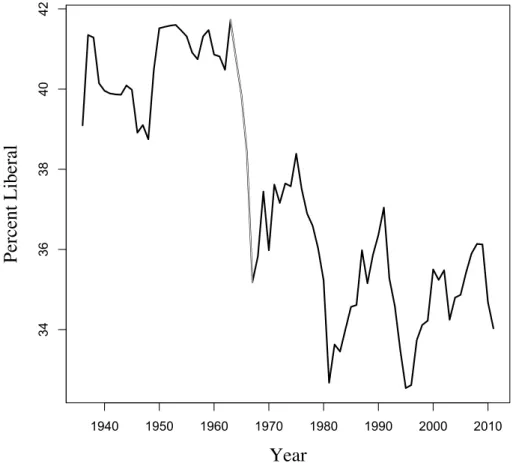
3.1 Longitudinal Series of Ideological Self-Identification . . . 44
3.2 Zoomed Look at Ideological Self-Identification Series . . . 45
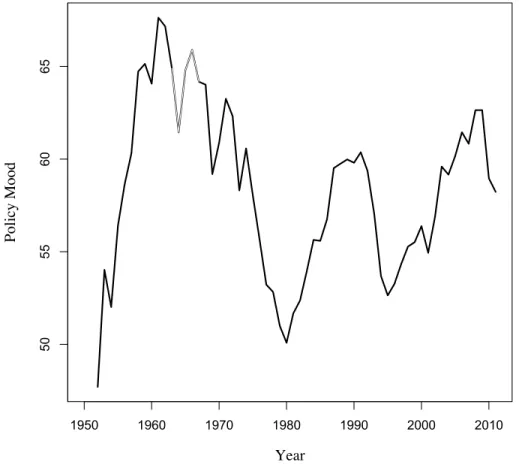
3.3 Policy Mood in the U.S. 1952-2012, Gray Portion Highlighting 1965-1967 . 52 3.4 Riot Frequency in U.S. Cities . . . 56
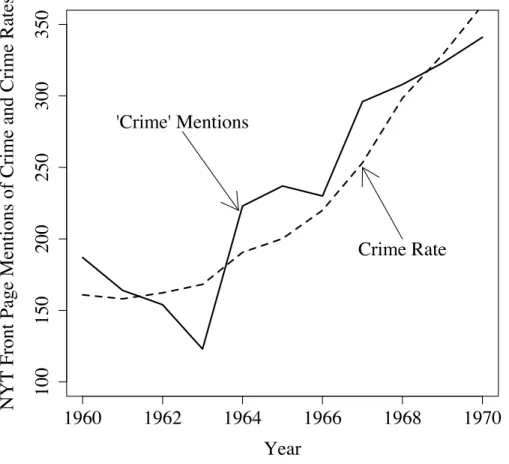
3.5 Crime Rate &The New York TimesCoverage of Crime . . . 60
3.6 “Crime” as Most Important Problem . . . 61
3.7 Crime & Liberal inThe New York Times. . . 63
3.8 The New York TimesCoverage & Self-Identification Series . . . 65
3.9 “Liberal” & The Courts . . . 67
3.10 “Liberal” & The Warren Court . . . 68
3.11 The Growth of Negative Associations between “Liberal” and “Crime” . . . 69
3.12 Newsweekon “Crime” . . . 71
3.13 Correlation of “Liberals” with Other Groups . . . 73
4.1 “Don’t Knows” & Liberal Thermometers . . . 78
4.2 “Don’t Knows” & Liberal Identification Together . . . 79
4.3 Identity Formation Model . . . 88
4.4 Moral Foundations Rhetoric inThe Times. . . 91
4.5 Net of Moral Foundations Rhetoric inThe Times . . . 93
4.6 Use of Liberal-Appealing Language inThe Times& Liberal Identification . . 94
1 INTRODUCTION
“Liberal,” in the 21stCentury America is an unpopular term. It has been unpopular for
decades. Liberal candidates diligently avoid the label. And their opponents diligently tag
them with it. To be called as a liberal, everyone understands, is to be called out as one.
This dissertation endeavors to understand why. If liberalism itself—the set of public
policies and proposals for policies—were equally unpopular, the story would be easy. But
ordinary Americans are consistent and insistent supporters of liberalism as policy.1
So-cial Security, Medicare, unemployment insurance, regulation of the workplace, progressive
income taxes, minimum wages, and a litany of other welfare state programs which have
made life better for ordinary working people all enjoy massive support. Mostly they go
unchallenged because conservative opponents understand that they are off limits. Since the
symbol is unpopular while its substance is revered, it is obvious that the two have become
divorced, that “liberal” as symbol has come to mean something different from its policy
achievements.
To make sense of that divorce, I believe it is necessary to understand how particular
symbols rise or fall as associations with ideological labels in the public mind. This
pro-cess begins at the individual level, specifically individual-level ideological identification
development—how images, experiences, and symbols get tied to terms like “liberal” and
“conservative”—shaping the meaning that individuals bring to them. This conception
illu-minates the long-lasting impact that historical events can have on ideological identification.
A detailed theoretical account of the process by which individuals fill a political symbol
1The term “liberalism” is used to describe the policies that liberals themselves have traditionally ascribed
with meaning is offered in the first empirical chapter. It brings together a diverse set of
ideas offered by political scientists (Conover and Feldman 1981), psychologists (Jost and
Sulloway 2003), and moral psychologists (Graham, Haidt and Nosek 2009). In particular, I
suggest that identities are manifestations of citizens’ inherent psychological predispositions
and the environments they encounter. Personality and moral sensibilities drive individuals
to be attracted to certain symbols, and their affects for the symbols of “liberal” and
“con-servative” inform their ideological attachments. The environment, however, determines the
salience—the availability and accessibility—of symbols for citizens to evaluate.
Central to the findings of the first empirical chapter is that the symbols of liberal, at
least in the modern era, are symbols of change (consistent with the findings of Conover and
Feldman (1981) and Zschirnt (2011)), most notably those linked with marginalized groups
in society. For many Americans, “liberal” is unpopular in part because of the company it
keeps.
But the theory of ideological identification formation also suggests that the
environ-ment in which these identities are forged plays a critical role. That is, predispositions do
not work alone in ideological identification formation. Environmental forces such as the
media, political elites, and political rhetoric heavily influence these attachments because
they dictate what symbols are available and how they get framed for public consumption.
Framing—how individuals organize and perceive symbols—plays a central role in
deter-mining ideological identifications.
This final component, framing, lends a crucial piece: it helps explain how and why
changes in ideological identification may occur, especially swift and dramatic ones. Thus,
framing is a critical piece of my theoretical framework: it links the micro level story of
ideological identification formation to the macro level story of ideological identification
change. Without this link, two disparate stories exist: in one, we can explain how identities
level changes and develop logical, yet employ time-sensitive explanations for such change.
But, weaving in the story of framing creates an avenue for pulling the stories together,
employing individual level theory to understand how and why macro level changes occur.
In the second empirical chapter, I return to the 1960s, using a newly developed
ide-ological identification series (Ellis and Stimson 2012) to pinpoint the most critical shift
in ideological identification in U.S. history. Content analysis ofThe New York Timesand
Newsweek provides compelling evidence that the media’s presentation of the race riots,
and crime and race more generally, became inextricably linked to the liberal identity—a
message that the public received loud and clear. This racialization is strongly supported
by ANES correlational analyses. At the same time, liberal elites ceased to identify with
the label or characterize their policies as “liberal.” More broadly, the message of the
sec-ond chapter is that media’s framing of the liberal label left an indelible mark on the liberal
identity.
Lastly, in the final empirical chapter, I consider a more complete series of ideological
identification, linking the 1960s with modern times. I collect every front page story ofThe
New York Timesfrom 1960-2000 that mentions “liberal,” and analyze the overtime
presen-tation of the liberal label to the American people. By tracing the use of moral foundations
rhetoric and symbols alongside “liberal”—the first analysis to consider the overtime
sig-nificance of moral foundations—I discover that the packaging of the liberal label is rarely
appealing to liberals themselves. In fact, in onlyone yearfor the entire 40 year series does
“appealing” rhetoric surrounding liberal supersede less appealing language. This finding is
pivotal to understanding the persistent unpopularity of “liberal” in name.
Taken together, the chief contributions of this dissertation are this: (1) a novel
structur-ing of existstructur-ing pieces for a more complete framework for ideological identification
race, marginalized groups, and change, (3) an explanation for the largest shift in
ideologi-cal identification in history, (4) a demonstration that the symbols of “liberal” were largely
born in the 1960s, (5) affirmation of the capacity of the media in shaping what symbols
are salient in the minds of citizens, and finally (6) that the framing of those symbols is a
2 ON THE ORIGINS AND MAINTENANCE OF IDEOLOGICAL IDENTIFICATIONS AT THE MICRO LEVEL
This project is motivated by a simple observation: the modern-day dearth of liberal
identifiers in the United States. In 2012, more than a dozen polling agencies,
includ-ing well-respected institutions like Gallup,The New York Times/CBS, American National
Election Studies, NBC/Associated Press, and Pew Research Center found that conservative
identifiers outweigh liberal identifiers nearly two to one.1 The puzzle, thus, is
straight-forward: why, given the popularity of many liberal policies, is the conservative identity
nearly twice as popular as the liberal identity? In this chapter, I lay the foundation for
un-derstanding this puzzle, beginning by developing a theory of the derivation of ideological
identifications at the individual level. These identities, I suggest, are borne from
psycholog-ical characteristics inherent among individuals and environmental factors that individuals
encounter in their lifetimes. This individual level theory sets the stage for explaining macro
level changes in ideological identification, the central focus of the second empirical chapter,
which hones in on the 1960s when ideological identification experienced its largest shift in
history. In the final chapter, I merge the 1960s with present day by tracing elite rhetoric
and media coverage, demonstrating the detrimental presentation of the liberal label to the
American public.
Building a Theory of Ideological Identification Change
This chapter builds an individual level theory of ideological identification development,
and in turn, a theory of how and why these identities may change among individuals. To do
so, I rely on the work of others—political psychologists, moral psychologists, and political
scientists. The result is a piecing together of the central components from these literatures,
along with my own theoretical offerings, that produces a comprehensive understanding of
the origins and maintenance of ideological identifications. These primary components—the
origins—are critical to developing a theory of how and why identities can and do change.
In their seminal study of ideological identification, Conover and Feldman (1981) brought
evidence to bear on the then growing suspicion that ideological labels had sparse cognitive
meaning to individuals (Converse 1964; Erikson, Luttbeg and Tedin 1980; Levitin and
Miller 1979). That is, evidence suggests that the source of ideological identifications was
rarely issue-based or even policy-oriented. Conover and Feldman look to schema theory,
arguing that ideological identifications are borne from evaluations of the labels “liberal”
and “conservative” such that individuals’ identities are associated with positive evaluations
of his or her chosen label. Schemata can be thought of as cognitive structures, bundles of
images and symbols that individuals link to concepts or groups based on past experiences
(e.g., Fiske and Linville 1980). These frameworks help individuals organize their thinking
about groups and concepts.
Furthermore, Conover and Feldman suggest—and find ample evidence to support—
that the dynamics underlying the formation of liberal and conservative ideological
self-identifications differ significantly from one another. In other words, liberals identify as
liberals for different reasons than conservatives identify as conservatives. The key to this
finding lies in the “critical referents,” the cognitive and symbolic sources of ideological
self-identification that guide individuals in their choices. Different referents are pivotal
in determining positive evaluations of liberals and conservatives. Imagine, for example,
a self-identifying liberal, who has a strong affinity for the symbol of equality, which he
or she associates with the liberal label. This affinity for the symbol, coupled with its link
to “liberal” generates a positive evaluation of liberals. A conservative, on the other hand,
the liberal label). He or she may simply place himself or herself into the category of
conservative because of an affinity for the symbol of patriotism, which he or she associates
with conservatives.
To be clear, there are three moving parts of Conover and Feldman’s theory. First is
ideological identification itself. These identifications are informed by evaluations of
ideo-logical labels. And these evaluations, moving part number two, mediate almost all of the
impact which issues and symbols, moving part number three, have on identifications.
Conover and Feldman consider the unique contributions of two types of sources to
ide-ological identification: cognitive, or issue-based sources, and symbolic sources. Cognitive
sources are captured by considering respondents’ views on a myriad of economic, racial,
and social issues, including health insurance, guaranteed jobs, busing school desegregation,
marijuana use, the ERA, and sex roles. To consider symbolic sources, Conover and
Feld-man evaluate numerous feeling thermometers, collapsing them into six symbolic meaning
scales, including Status Quo, Radical Left, Capitalism, Reformist Left, Disadvantaged, and
Social Control.
Recalling that cognitive and symbolic sources influence ideological identification via
evaluations of the terms “liberal” and “conservative”, Conover and Feldman find that
sym-bolic factors were the clear front-runner in contribution, heavily outweighing the impact
of cognitive sources. Positive attitudes toward liberals are a function of positive affect for
the Radical and Reformist Left, while positive evaluations of conservatives are a function
primarily of positive affect toward the symbol of Capitalism.
Furthermore, in an analysis of open-ended survey items asking respondents what the
terms “liberal” and “conservative” mean, self-identified liberals and conservatives varied
widely in their emphases. Namely, liberals stuck to a broad message of change, including
recent social issues (e.g., abortion, ERA) and equality. Conservatives displayed a clear
“liberals and conservatives view the political world not from different sides of the same
coin, but...from the perspective of entirely different currencies” (Conover and Feldman
1981, 624).
In his update to Conover and Feldman, Zschirnt (2011) largely confirms the key
compo-nents of their theory and findings, specifically that symbolic sources dominate evaluations
of ideological terms. He likewise follows up on a prediction made by Conover and
Feld-man, who found that the impact of liberal evaluations outweighed the impact of
conserva-tive evaluations in predicting ideological identification in general. They suggested that this
result was potentially time-sensitive—conservatives may identify as such partly due to a
negative reaction to liberals and the symbols of liberalism in the New Deal Era. Liberals,
on the other hand, did not seem to derive their ideological identifications from a distaste for
conservatives. Conover and Feldman suggested that with the ensuing shifting of the bases,
this phenomenon may likewise shift directions. Their words were prescient, as Zschirnt
demonstrates exactly this: ideological identification in the modern era is increasingly
in-formed by evaluations of conservatives. The growing hostility toward conservatism and its
associated symbols of big business, Christian fundamentalists, and the military has become
an ever important source of liberal self-identifications in the more modern era.
Both studies present compelling evidence that the dominant symbols of the political
agenda play a significant role in informing the ideological identifications of citizens. While
neither study directly takes on the tangential, but related, question of the origins of the
symbols themselves, both make multiple allusions to elite rhetoric shaping the symbolic
meaning of ideological labels for Americans. As such, both studies take as fact the
agenda-setting power of the elites, and further, the media as the channel by which citizens absorb
elite rhetoric. What elites say, and importantly, how they frame their words, is a core
component of news in the American media (McCombs and Shaw 1972; Iyengar and Kinder
media and the elite rhetoric that drives its coverage. The larger, more central message is that
prominence, power, and the agenda of that power matters when it comes to understanding
macro level ideological identification.
The story of ideological identification in the United States is one of constancy and
change. Both consistency and change are linked to symbolic substance: this message
emerges clearly from the findings of Conover and Feldman (1981) and Zschirnt (2011)
who offer compelling evidence to support the notion that when the defining symbols of
ideological groups change, so too do citizens’ evaluations of these groups. Salience, then,
matters for understanding ideological identifications, especiallychanges in those
identifi-cations at both the micro and macro level. At the micro level, the critical referents that
individuals use to inform their identities shift along with the changing tide of the political
environment.2 And those shifts are observable at the macro level when changes in salience
are dramatic enough to move a large constituency of individuals.
How individuals feel about the groups, values, and symbols they associate with the
labels liberal and conservative dictates the identity they choose. Ultimately, to identify
with an ideological label, one must feel connected to the related group. And, of crucial
importance in this formation of affinities and aversions, I am suggesting, is the political
environment in which these attachments are forged. The extent to which elites are able
to garner power and control the agenda can have a significant impact on what symbols
matter to individuals, and thus, what referents they consider when forming their ideological
identifications.
Putting together these two elements together—how ideological identities are formed
and the importance of symbol salience and agenda control—leads to an important message:
most simply, ideological identifications can change. And they may do so when individuals
2In a related example, Green, Palmquist and Schickler (2002) found that party identification is best
alter their critical referents either on their own (e.g., personal, individual level events) or by
the force of the political environment (e.g., cultural wars, elite rhetoric, media coverage).
Salience of symbols is largely dictated by political elites, and citizens come to understand
those symbols by way of the media.
The Psychology of Ideological Identification
Environment is not the only agency that influences individuals’ attachment to an
ideo-logical label. Psychoideo-logical forces—those stable, dispositional factors unique to individuals—
influence attitudes, too, and play a decisive role in determining ideological identities. The
field of psychology has long acknowledged the hefty contribution of “motivational
dif-ferences” in explaining variation in ideological identifications among citizens (Jost and
Sulloway 2003; Jost 2006; Jost and Gosling 2008). Where political science has
consid-ered psychological factors like citizen involvement, sophistication, and political expertise,
psychology has factored in the predispositions of citizens, repeatedly concluding that
ideo-logical differences among citizens have psychoideo-logical roots. Ideoideo-logical identifications are
adopted, at least in part, because they satisfy psychological needs, and thus, have a strong
motivational basis.
Probably the most compelling finding in those endeavors has been the much-supported
conclusion that the structure of liberalism and conservatism rests on two main aspects: (1)
advocating versus resisting change and (2) rejecting versus accepting inequality (Jost and
Sulloway 2003). Change, in its very nature, involves at least some sense of uncertainty,
but individuals view this uncertainty in different fashions. Some experience threat and
anxiety in the face of uncertainty, and, as such, are resistant to change. These
individu-als typically demonstrate a dispositional need for order and structure, preferring stability
and accepting hierarchy, which in turn, makes them more accepting of inequality (Jost,
et al. 2007). Others, however, are far less sensitive to uncertainty, and, as such, tend to
social-psychological orientations concerning uncertainty and threat (Jost, et al. 2007). In
particular, conservatives, on average, possess a situational and dispositional need to manage
uncertainty and threat, which motivates their tendency to resist change and accept
inequal-ity (Jost and Sulloway 2003). The psychology of the conservative identifier compels him
or her to find the status quo particularly appealing, which, by definition, preserves the
fa-miliar and rejects the uncertain. Liberals, on the other hand, are not similarly motivated,
and thus are more open to change and less accepting of inequality. Indeed, the hallmark of
the liberal label is one of change (Conover and Feldman 1981).
Jost and Sulloway (2003) suggest that situational factors also influence the experience
and expression of conservative identification. That is, powerful environmental forces that
heighten psychological needs to reduce uncertainty and threat can drive up conservative
identification among citizens. It need not be solely an individual-difference variable—
citizens can be moved by the force of an event. Social movements advocating change, for
example, or a marked rise in crime would be particularly unsettling to conservatives (or
those individuals with inherent inclinations to resist change and accept inequality) because
uncertainty and potential threat are introduced. Thus, conservative identification in the
population as a whole can be increased by the introduction of threatening circumstances
or instability in the political system—or, critically, even by the pretense of such
condi-tions (Jost and Sulloway 2003). This is a powerful message, one that complements the
earlier theory that symbol salience, elite rhetoric, and media coverage contributes
signif-icantly to understanding shifts in ideological identification in the U.S. It means, in brief,
that the influence of elites and the media, and how these actors frame events, should not be
overlooked.
What this also helps uncover is that there is perhaps a slight variation to the theme of
conservative identifiers. Dispositional factors, the stable psyches of individuals, and
avoidance and threat reduction, should affect ideological preferences at the macro level.
Simply who we are matters a great deal in predicting ideological identifications, but, so too
does the changing environment to which we are exposed. In a larger sense, when threat
and uncertainty are heightened, either by an event, movement, or rhetoric, the appeal of the
conservative label increases considerably.
Social Identity Theory
It is useful to take a step back to understand in a deeper sense what ideological identities
mean to citizens psychologically. Social identity theory recognizes that all individuals are
members of numerous social groups—and that these memberships contribute to the image,
positive or negative, we have of ourselves (Tajfel 1974). Our social identities, how we think
of ourselves, come from these group memberships—whether they be national, religious,
racial, political, or of another type—and they create and define our place in society (Tajfel
and Turner 2004). Inherent in Tajfel’s concept of a social identity are two basic aspects: that
people perceive themselves to belong to a group and that the membership(s) have emotional
significance. Understood in this framework, social identities have certain consequences. In
particular, individuals tend to sustain those identities which contribute positively to their
self-concept, serving to maintain or boost self-esteem. Positive social identity is largely
created by favorable comparisons between the in-group to which the individual belongs
and some relevant out-groups (Tajfel and Turner 2004). Absent a positive contribution,
individuals will seek exit, unless leaving the group is deemed impossible for “objective”
reasons or exit “conflicts with important values which are themselves a part of his [or her]
acceptable social identity” (Tajfel 1974, p. 69).
Objectively, a black citizen cannot abandon membership with the group “black.”
Simi-larly, but related more to the value tie, a devout Catholic may find it impossible to renounce
his or her strong religious ties even in the wake of embarrassing sexual abuse accusations
may have blackened the contribution this group membership made to the individual’s social
identity—and the conflict of values remains—the association with Catholicism is powerful
enough to prevent exit.
In such conditions, these immovable individuals have a couple of options. They may
engage in social creativity, reinterpreting the group’s image or comparing one’s group on
alternative or irrelevant dimensions to boost one’s image (Jost and Burgess 2000). The
devout Catholic may ignore the legal problems of the church altogether, instead choosing
to focus on the good the church does for the needy. Entrenched members may also simply
“own” the new characteristics assigned to them, attempting to reframe the values associated
with the characteristics (Tajfel 1974), such as with the classic example of “black is
beauti-ful” where the salient dimension of skin color remains, but the prevailing value system is
rejected and reversed (Tajfel and Turner 2004).
But when exit is facile, individuals are free to engage in social mobility, the
move-ment from one social group to a higher status group that more positively contributes to
the individual’s self-concept. Such shifts occur regularly when ties to groups are looser
and sufficient social flexibility exists. Such shifts likewise weaken the cohesiveness of the
abandoned group, lowering morale, and often setting in motion a degenerative path for the
subordinate group (Tajfel and Turner 2004).
A conflict of values within a group can likewise often be intense enough to destroy
the positive contributions it makes to some of its members’ social identities (Tajfel 1974).
Confronted with a new issue or relevant problem, social groups often disagree on the proper
approach, such as was the case of the leading pro-gay groups during the Amendment One
debate and vote in North Carolina 2012.3 While many supporters advocated attacking the
amendment head-on, with a message of “love is love” by promoting long-standing gay
3Amendment One proposed to amend the North Carolina Constitution to say, among other things, that
relationships and families (and thus, sending the message that an amendment that prohibits
civil unions and gay marriage is unjust), the major organizers of the pro-gay movement in
North Carolina effectively “closeted” gay citizens, instead focusing on the amendment’s
potential to harm children and jeopardize victims of domestic violence. The incongruous
views on strategy are known to have caused serious discord among the various pro-gay
group members (Kreiss and Meadows 2013). Advocates’ ties to the pro-gay identity were
also likely weakened by the alienation they experienced.
Often in situations where values become more evident, able members will seek
mem-bership in the opposing group whose values, they now realize, are more in line with their
own. While a switch from a pro-gay group to an anti-gay group is far-fetched, the
ex-ample does make clear that often citizens identify with groups that evolve, or approach
issues in ways the citizen was not expecting. Situational circumstances can highlight these
values and shifts, and thus, have the ability to alter individual group memberships, and
consequently identities, perhaps on a large scale if the circumstances are widely known or
observed. We shall observe such a situation in the case of liberal identification in the next
chapter.
In particular, Huddy (2001) suggests that rhetoric—the words and actions of political
leaders—can manipulate political identities, even those sorts of identities that are
consid-ered quite stable over time (e.g., partisan identity). Evaluating what she considers critical
factors that give group memberships meaning to individuals, Huddy places considerable
importance on group “prototypes,” or the types of members that exemplify group
mem-bership and give the group meaning (Huddy 2001, p. 144). For example, if shaven head
braless disruptive women protestors represent the contemporary feminist, it would not be
surprising to find that white working-class males in the South distance themselves from a
feminist group membership. But, if NRA-supporting, Nascar-loving, white southern males
working-class males in the South are eager to identify as conservative. And, as Huddy
notes, “the news media are an especially good place to begin the search for the
character-istics of prototypes that exemplify social and political groups, given the narrow range of
people who appear in the news” (Huddy 2001, p. 144).
Social identity theory, then, provides important insight into why ideological identities
may change—and may need to change from the individual’s perspective. When citizens
identify with an ideological group, they give it psychological significance—it becomes
who they think they are. It is positively charged. But, what happens when the environment
changes, bringing out intragroup value conflicts? Or, when the classic prototype of liberals
or conservatives shifts? And finally, what happens when liberals discover that their group
has become stigmatized?
The short answer is that instability ensues. The longer answers will take center stage in
the next chapter. The psychological and historical components of the story of ideological
identification in the U.S. are coming together.
Moral Foundations
A final component to the psychological forces of ideological identification is that of
moral foundations, those guiding principles to which individuals refer back to when
eval-uating groups and symbols. These foundations work like “taste receptors” in the moral
sense, contributing to the ways individuals interpret the actions and agents they encounter
in their everyday lives (Haidt, Graham and Joseph 2009). In his compelling work, detailed
in his bookThe Righteous Mind, Haidt (2012) demonstrates that the moral foundations of
liberals and conservatives are fundamentally different. Of the five foundations outlined—
harm/care, fairness/reciprocity, in-group/loyalty, authority/respect and purity/sanctity—Haidt
and Graham (2007) find that liberals show greater endorsement and use of the harm/care
and fairness/reciprocity foundations, those that emphasize rights and welfare of
plate to their decision-making processes, drawing from all five moral foundations, but
espe-cially from the last three: in-group/loyalty, authority/respect and purity/sanctity, those that
emphasize group-binding loyalty, duty, self-control, and wholesomeness (Graham, Haidt
and Nosek 2009).
But, moral foundations should not be considered simply another set of personality
vari-ables that correlate with political preferences like ideological identification. Rather, these
foundations are the under layer, an explanatory framework of why such preferences
ex-ist. They can be thought of as “characteristic adaptations” (McAdams 1995), or mid-level
personality traits that encompass the goals and values individuals hold that guide
deci-sions and preferences. Characteristic adaptations are casually subsequent to actual core
personality traits, but are informed by both personality and contextual factors like the
envi-ronment. Political attitudes and behaviors, for example, are characteristic adaptations: they
are products of both core personality traits and life experiences (McCrae and Costa 1996).
Importantly, while many characteristic adaptations are relatively stable over individuals’
lifetimes, events, experiences, and changing contexts may cause these cause these attitudes
to shift (Gerber, Huber, Doherty, Dowling and Ha 2010).
In one of their original studies, Haidt and Joseph (2007) asked respondents to rate the
relevance of 15 concerns related to their moral judgments, all 15 corresponding to one of the
five moral foundations. Beginning with the stem, “When you decide whether something is
right or wrong, to what extent are the following considerations relevant to your thinking?”,
respondents were then offered the 15 considerations, such as “Whether or not someone was
harmed (harm/care); whether or not someone acted fairly (fairness/reciprocity); whether or
not someone betrayed his or her group (ingroup/loyalty); whether or not the people
in-volved were of the same rank (authority/respect); whether or not someone did something
disgusting (purity/sanctity).” Liberals rated the first two foundations—harm and care and
relevant) in their decision-making processes, while conservatives rated all five between 4
and 5 on this same scale.4 In general, these results demonstrate that the morality of
con-servatives is built upon all five foundations, and thus, that concon-servatives tend to “moralize”
more types of behavior than do liberals—whose morality is built firmly, indeed mostly,
upon foundations of harm and fairness.
Liberals and conservatives, then, are weighing different values when they evaluate
groups, policies, behaviors, and symbols. In a larger sense, these findings help explain
why it is so difficult for liberals and conservatives to understand each other—because they
base their arguments and evaluations on different combinations of the five moral
founda-tions.
All Together Now
Putting these pieces together, moral foundations (Haidt 2012), symbolic importance and
the evaluative process (Conover and Feldman 1981), motivated social cognition (Jost and
Sulloway 2003), and social identity theory (Tajfel 1974; Tajfel and Turner 2004), suggests
a new theoretical framework for thinking about ideological identification formation, and
importantly, how and why those identities may change. Figure 2.1 maps out the causal
process I have described thus far. Dispositions (personality and moral foundations), along
with environmental forces influence the manner in which individuals perceive symbols and
issues. These perceptions influence evaluative process—in the present case, of “liberal”
and “conservative,” and these evaluations help determine ideological identifications.
This new framework merges micro and macro-level thinking. Individuals’ evaluations
of symbols and images in the political world are motivated by their inherent moral
foun-dations. An individual’s social identity and moral foundations shepherd the way he or she
evaluates the changing symbols and images in the political world, and thus his or her group
attachments.
dispositions
evaluations
ideological
identification
symbols
& issues
environmental
forces
Each of these theories hint at one other critical component: the environment, the context
in which citizens form and maintain attachments. The evaluative process for symbols and
groups (Conover and Feldman 1981) is premised on the importance of context: citizens
can only evaluate the stimuli to which they are exposed, and exposure is largely
depen-dent upon outside sources like news media and elite rhetoric. Especially important in this
environment calculation is the way in which these symbols and groups are framed by
vari-ous sources. Social identities carry significant psychological importance (Tajfel 1974), and
thus, individuals strive to maintain positively charged identifications. When groups shift in
meaning, by the force of political events or media framing, these attachments may dissolve
or change, making it difficult for individuals to maintain positive identities. Likewise, the
environment affects motivated social cognition. Psychological needs, such as managing
uncertainty and threat, vary among citizens (Jost and Sulloway 2003), and may also vary
situationally as powerful events and fluctuating environments can heighten them. Finally,
the moral foundations framework suggests that the context of exposure to stimuli can
in-fluence evaluations of those stimuli if certain dimensions are specifically (or purposefully)
primed. Applied to the political environment, the moral foundations theory suggests that
when fairness and harm are primed or salient in the political arena, the appeal of the
lib-eral label increases. True conservative identifiers are not as affected by this shift in focus
because all five moral foundations appeal to them. However, when the tone shifts back,
and one of the other three dimensions (mostly irrelevant to liberals) is primed or salient,
the conservative identity becomes more appealing. In these times, only true liberals “stay
put.” This asymmetry in the political world, the waxing and waning of value emphasis,
is a key contributor to changing ideological identifications. Thus, I suggest that shifts in
ideological identification—large scale or modest—occur partly as a function of oscillating
These implications lend new theoretical and predictive leverage. We can be more
the-oretically driven when explaining what steers evaluations of liberals and conservatives,
and what drives ideological identifications. Likewise, we can provide clearer predictions
of how individuals, and thus, the larger public, will respond to changing saliency in the
political world. Social identity theory, moral foundations, and the shifting evaluations of
symbols in a fluctuating environment together elucidate the process by which ideological
identifications are formed, and most importantly, the process by which macro level shifts—
whether they be small movements or large-scale changes—are generated. Thinking about
these micro-level theories alongside the macro level force of framing links the micro and
macro stories of ideological identification. This thinking is applied in the next chapters first
to understand the most dramatic shift in ideological identification to date, the sharp decline
in liberal identification from 1965-1967, and then to evaluate overtime shifts for the entire
time series of ideological identification in the U.S context.
What Do We Know?
It is worthwhile at this point to shift gears and turn to the actual data which show what
we know empirically about ideological identification in the U.S. today. While social
psy-chology (e.g., Jost and Sulloway 2003; Tajfel 1974) and moral psypsy-chology (e.g., Haidt and
Graham 2007) supplied the building blocks in my construction of a more comprehensive
theory of ideological identification formation and change, they are not the centerpieces of
my empirical research.
Instead, my empirical investigation focuses on the symbols and images tied to the labels
of liberal and conservative, which has been done most recently by Zschrirnt (2011). As
such, my task here mostly one fine tuning and reinterpretation. But it is an important task,
for it sets the stage for what is missing, what more we need to know to develop a clearer
image of ideological identification in the U.S. in the modern context. With the guidance of
new questions.
The baseline questions are simple: who supports liberals? What symbols do identifiers
and supporters link to the liberal label? This investigation will be enlightening, but limited
in its approach. It will leave us curious. It will beg for straightforward survey items that
directly link ideological identities to non-political symbols and psychological factors. In
particular, it will not satisfy the questions that the theory of ideological identity formation
presented above would suggest.
Future research should seek to make these connections between a larger array of
sym-bols and groups to ideological identities, looking closely at symbolic and psychological
meanings of identities. I attempt to satisfy this curiosity with newly author-designed
sur-vey items currently being tested in the field. In particular, these new items directly link
ideological identification to psychological forces and an extended list of societal groups
and images (see Tables 2.9 and 2.8 in the conclusion).
The proceeding analyses represent a modern-day snapshot of the contours of
ideolog-ical identification, though they lack a direct connection to environmental forces, a key
component to the theory of ideological identification. In the second empirical chapter, I
evaluate the influence of such environmental factors, by taking into consideration a portion
of the full time series.
To motivate the analysis to follow, I begin with an observation: conservatives outweigh
liberals nearly two to one in the modern day. The most recent Associated Press poll asking
citizens to place themselves on the ideological scale reports 40% of citizens choose
conser-vative, while just 21% select liberal.5 As such, the analysis will focus heavily on liberals
and what citizens believe about liberals as a group.
Feeling Thermometer Analysis
Probably the most exploited method for analyzing ideological identification has been
feeling thermometers. These survey items ask respondents to rate various groups and
fig-ures on a scale from 0—100: the higher the number the warmer they feel, with the typical
reading suggesting that scores under 50 are “cool,” scores of 50 are neutral, and scores
above 50 are “warm.” In a nutshell, it allows us to observe citizens’ affects for policies,
groups, and members of the political world. However, such analyses are limited to
avail-able survey items, which are typically politically charged, restricting their utility. The
terms “liberal” and “conservative” mean much than politics to ordinary people (Conover
and Feldman 1981). Indeed, they are richer in context. Nonetheless, feeling thermometers
are a widely available and useful source for organizing an initial read on the ideological
map of identification in the U.S.
Like most survey tools, feeling thermometers are not perfect measures. In particular,
they are subject to positivity bias—the proclivity of respondents to respond favorably to
a wide range of political figures and groups (Miller and Gurin 1978; Sniderman and
Tan-nenbaum 1982; Knight 1984). As a result, all feeling thermometer responses should be
viewed as relative, each rating relative to the mean score of the individual. For example,
an individual giving one group a rating of 55 while giving most other groups a rating in
the 70s is registering “cool” on the former, even though a typical reading of 55 would be
slightly “warm.” Individuals use the feeling thermometer scales differently, and to properly
utilize feeling thermometers, this reality must be heeded.
Given the lack of perfect validity and reliability, Green and Krasno (1988) and Wilcox,
Sigelman and Cook (1989) have warned against the use of feeling thermometers without
controlling for random and non-random errors inherent in measurement response.
Weis-berg (1980) found that warmness toward Democrats was statistically unrelated to coolness
for liberals was unrelated to a warm affect for conservatives—both unexpected findings. A
central characteristic of partisanship and ideological identification is affective attachment
toward one’s “home” group, or in-group, coupled with a distaste for one’s home team
op-ponent, or out-group. Likewise, research suggests that even though individuals may not
understand the content of ideological “talk”, they can still hold strong beliefs about
lib-erals and conservatives as social groups (e.g., Levitin and Miller 1979). So, why do these
analyses not find evidence of bipolarity in evaluations of liberals and conservatives, and
Re-publicans and Democrats? According to Green, taken together, these findings suggest an
uneducated and indifferent public, perhaps largely conforming to Converse’s (1964) early
findings and lending credence to Kinder and Sears’s (1985) characterization of the mass
public as “innocent of ideology.”
In her analysis of positivity bias in feeling thermometer ratings for Republicans and
Democrats and liberals and conservatives, Knight (1984) created a mean feeling
thermome-ter score for each individual in the sample. The average of those means is the sample mean
which represents the overall average feeling thermometer score given in the survey. She
then subtracted each individual’s mean feeling thermometer score from his or her score
for each of the four groups of interest (Knight studied feeling thermometers for
Republi-cans, Democrats, Conservatives, and Democrats), creating an “adjusted score.” Averaging
across all respondents in the four categories resulted in “adjusted mean” feeling
thermome-ter scores for each group.6
Fortunately, by following Knight (1984), checking for positivity bias is straightforward:
generate a mean feeling thermometer score for each respondent and observe the mean of
the sample. If the mean is higher than 50, positivity bias exists in the sample.7
6Knight used these four adjusted scores for a different purpose than stated here, however. Specifically, she
correlated the means to test the unidimensionality of Liberal and Conservative and Republican and Democrat.
7Controlling for positivity bias in this way assumes that the feeling thermometers whose mean is the basis
for correction are representative of all the groups that might have been posed. While I cannot be certain about
In Table 2.1, “Feeling Thermometer Average” represents the mean of all respondents’
average group-based feeling thermometer scores in the 2008 American National Election
Study.8 The sample average of 61.17 is well above the traditional middle-marker of 50,
indicating positivity bias in this sample of responses to feeling thermometers. The first row
represents the mean for the sample of respondents who provided answers to all 25
group-based feeling thermometer prompts presented by the ANES. The second row shows the
mean for all respondents in the sample, regardless of how many feeling thermometer
ques-tions actually answered. Both hover around 61, clearly well above a neutral 50, indicating
positivity bias no matter how the data are analyzed.
Table 2.1: Mean Feeling Thermometer Scores for Full Sample and Partial Sample (Re-spondents Answering all 25 Feeling Thermometer Prompts)
N Responses Mean s.d. Min/Max
Feeling Thermometer Average 1615 25 61.17 10.89 29.84/93.16
Felling Thermometer Average 2312 varies 61.04 11.63 7.67/97
Two central points underscore this analysis: first, like most other studies with feeling
thermometers, this sample is biased by respondent’s tendency toward positivity when asked
to rate other groups and individuals; second, any averages considered in analysis should be
considered alongside its “corrected” mean.
We can answer how different these means are by observing, for each individual, how
much each feeling thermometer score deviates from the average feeling thermometer scores.
This adjustment to the biased mean will return the “true” feeling thermometer scores. In all
further analyses, these adjustments will be made, often highlighting significant differences
within groups that are imperceptible without consideration for positivity bias.
8Excluded are the person-specific feeling thermometers, e.g., Hilary Clinton, Republican Party
Having confirmed the presence of positivity bias (see Table 2.1) and controlled for it
using the method suggested by Knight (1984), I turn in earnest to analytics.
The Dimensionality of the Liberal-Conservative Continuum
A central underlying theme runs through the theoretical framework I suggest for
un-derstanding liberal and conservative identity. While liberals and conservatives often find it
impossible to understand the other’s position, this is not necessarily because they disagree
on the same points of a political issue. Instead, it is largely because they talk past each
other, beyond each other (Haidt and Graham 2007). On gay marriage, for example, liberals
tend to understand the issue as one of fairness—two members of the same sex who love
each other and are committed should be able to marry. Conservatives, however, see the
is-sue as one of respect for authority and sanctity—long-standing institutions should be given
the benefit of the doubt, and gay marriage would challenge an ancient and well-functioning
institution.
This understanding of liberals and conservatives suggests that perfect
unidimensional-ity of the liberal-conservative continuum is unlikely. It also lends credence to what Conover
and Feldman (1981) found so many years ago: liberals identify as liberals for wholly
dif-ferent reasons than conservatives identify as conservatives. It likewise speaks to the
under-pinnings of Haidt’s moral foundations argument: quite simply, that the foundations differ
between liberals and conservatives. An ideological identity is rarely chosen as a rebuttal
to the “opposing” group. The motivations behind the two identifications are simply not the
same.
But let us put the test to the public: are “liberal” and “conservative” the poles of the
singular concept of ideological identification in the minds of Americans? Knight’s analysis
is nearly 30 years old, and the political atmosphere of the U.S. has become decidedly more
polarized over the years. What effect has the changed political environment had on citizens’
I replicate Knight’s analysis here with data from the 2008 ANES, showing both results
without the positivity bias control and with the control. Because Knight demonstrates
variations by political knowledge, I also include correlations by level of education.9 If
individuals view liberal and conservative as the opposite ends of one concept, ideology, we
shall find highly negative correlations between the feeling thermometer scores for liberal
and conservative.
Table 2.2: Correlations of Feeling Thermometer Ratings of Liberals and Conservatives, With and Without Control for Positivity Bias
Liberals with Conservatives
No Control -.085
Controlling for Positivity Bias -.379
The positivity bias control makes a significant difference in the correlation between
liberal and conservative feeling thermometers, pushing the correlation from an
unimpres-sive r= -.085 to a more healthy r= -.379. While stronger, it is only moderate evidence
that Americans view liberal and conservative as the poles of a unidimensional construct.
Given the prominence of these ideological terms in political talk and everyday rhetoric, a
stronger relationship was reasonably expected. Polarization, by any measure, has grown
considerably over the years. In a series of exhaustive analyses, Poole has demonstrated
that polarization in the House and Senate is presently at the highest level since the end of
reconstruction.10 Yet, these signals, as measured by affects for liberals and conservatives,
evidently do not permeate public thought.
It may also be that some Americans, perhaps the highly educated, do view ideology
this way. Knight used the “level of conceptualization” groups suggested by Campbell et al.
9Knight replicated the Campbell, Converse, Miller and Stokes (1960) “level of conceptualization” of four
tiers of respondents based on responses to open-ended questions: Ideologues, Group Benefit, Nature of the Times, No Issue Content. I use level of education as stand-in for this analysis.
(1960) to demonstrate that those with the most political knowledge were more likely to see
liberal and conservative as opposites. I use education as a stand-in for her more intricate
measure, and find similar, but less compelling results. As the level of education increases,
so does the correlation, suggesting that among those Americans with the most education,
many view ideology as lying on a single dimension.
Table 2.3: Correlations of Feeling Thermometer Ratings of Liberals and Conservatives by Level of Education, Controlling for Positivity Bias
Pearson’sr N
Grade School or less -.146 59
High School -.223 808
Some College, no degree -.417 633
College or advanced degree -.556 443
Nonetheless, the general lack of compelling evidence for unidimensionality suggests
that ideological terms are simply not opposites for most citizens. Liberal is not the
op-posite of conservative. Instead, each group has distinct symbolic meaning to individuals.
Understanding these distinctions, I believe, is critical to explaining the heavy advantage
that conservative identification enjoys among Americans. This premise guides the
inter-pretation of proceeding analyses and those surveys presently in the field.
Affects for Liberals & Conservatives
Moving forward, I present a straightforward feeling thermometer rating: how
respon-dents in the 2008 American National Election Study (ANES) “feel” about liberals and
conservatives.
The results of this calculation in Table 2.4 seems to indicate that respondents feel warm,
on average, toward both liberals and conservatives, as both ratings register above the
rec-ognized neutral point of 50. There is likewise a healthy range of affect for both groups as
re-Table 2.4: Mean Feeling Thermometer Scores for Liberals and Conservatives
N Mean s.d. Min/Max
Feeling Thermometer for Liberals 1615 56.8 21.1 0/100
Feeling Thermometer for Conservatives 1615 59.9 19.7 0/100
Difference of Means 3.1
t=4.08,p<.001
a mostly unsurprising finding given that the conservative identification is more popular than
the liberal identity. But does the public feel warm toward either group comparatively—that
is, when we consider how warm they felt on average toward all groups? The feeling
ther-mometer sample average ofµ=61.17 indicates that respondents actually feel cooler toward
bothliberals and conservatives than they do toward other groups.
Given that positivity bias plays an important role in feeling thermometers, we can go
a few more steps to observe the unbiased results of affects for liberals and conservatives.
Using the adjusted means created in the prior section, a deviation score representing the
difference between the average feeling thermometer score and the score for liberals (and
conservatives) is generated. These deviations are then subtracted from the average feeling
thermometer scores for liberals and conservatives, giving an unbiased look at how
respon-dentsfeelabout these groups. Adjusted, unbiased means are presented in Table 2.5.
Table 2.5: Adjusted Mean Feeling Thermometer Scores for Liberals and Conservatives
N Mean Deviation Adjusted Mean
Feeling Thermometer for Liberals 1615 56.8 -4.3 52.5
Feeling Thermometer for Conservatives 1615 59.6 -1.5 58.1
t=3.75,p<.001
What was significant in the preceding analysis of unadjusted feeling thermometers for
liberals and conservatives is further underlined by the adjusted analysis in Table 2.5. The
statistically so (t = 3.75), with liberals dropping even farther away from the mean
ther-mometer score (µ=61.17), plainly out of the good graces of the American people.
In the next section, I shift to a decidedly more “liberal” focus. Given the popularity
of the conservative label, the analytical conundrum, as I see it, is explaining the dearth of
liberal identifiers. And, the first step to understanding that puzzle is coming to terms with
what liberal means to the American public. As such, I replicate the procedure of many
former scholars to set the stage, determining the main correlates of liberalism: what groups
are also supported among those who currently support liberals? Critically, however, I also
evaluate how do these correlations change when positivity bias is considered.
Correlational Analysis Between Feeling Thermometer Ratings
While many scholars have studied ideological identification by exploiting feeling
ther-mometers (e.g., Conover and Feldman 1981; Jacoby 2006; Ellis and Stimson 2012), few
have considered the effects of positivity bias in correlational analyses. Such a bias is
partic-ularly important when it comes to studying ideological identification. Taken together, the
findings in Tables 2.1 and 2.5 demonstrate not only the presence of positivity bias, but also
that citizens’ affects for ideological groups are significantly lower than for other groups.
This merits a closer look at correlational analyses.
Using data from the 2008 ANES, Table 2.6 reports the correlations between
feel-ing thermometers liberals’ unadjusted feelfeel-ing thermometers and the adjusted feelfeel-ing
ther-mometers.
A predictable handful of correlates of liberal register above a robustr>.30 in the second
column (unadjustedr). Three racial minority groups, blacks, Hispanics, and Asians, are
as-sociated with support for liberals, as is support for illegal aliens. Other arguably
marginal-ized groups—environmentalists, gays and lesbians, feminists, and people on welfare—also
associate strongly with affect for liberals. Unsurprisingly, those with warm affects for the
Table 2.6: Correlations Between Feeling Thermometer Scores for Liberal and Feeling Thermometers for Various Other Groups and Correlations Between Variations from the Mean
Liberals with... Pearson’sr Adjustedr
Religious Groups
Jews .27 -.08
Catholics .22 -.16
Christian Fundamentalists .05 -.29
Racial & Regional, & Demographic Groups
Illegal Aliens .32 .07
Blacks .35 -.03
Asians .32 -.04
Chicanos/Hispanics .32 -.06
Whites .24 -.14
Southerners .14 -.22
Economic Groups
Big Business .12 -.19
Labor Unions .44 -.21
Sociodemographic Groups
People on Welfare .31 .03
Middle Class .24 -.09
Poor .26 -.11
Marginalized Groups
Gays & Lesbians .37 .21
Feminists .46 .23
Environmentalists .47 .25
Governmental Groups
Congress .38 .08
Democratic Party .45 .31
Federal Government .28 -.04
Both Major Parties .18 -.08
Military .01 -.25
Republican Party -.25 -.35
Yet, many of these connections fall apart when moving to the next column, the
Ad-justed r, which correlates adjusted affect for liberals with the average movement away
from the mean feeling thermometer reading for each group. Where once there was an
as-sociation between support for liberals and support for racial minority groups, for example,
the connection vanishes when positivity bias is considered. Positive affect for labor unions
also flips when considering how respondents placed themselves on the feeling
thermome-ter baromethermome-ter compared to all other groups. Support for the Democratic Party, feminists,
environmentalists, and gays and lesbians remains intact—all is not lost.
It is a slight overstatement to say that support found in the first set of correlations
vanishes when we consider the adjusted estimates. It is more accurate to say that the
association, or symbiosis, between the two groups declines relative to other associations.
A different way of translating the deviation measures is to consider them a read on the “real
support” a respondent has for that group, based on the average level of support he or she is
willing to give. In particular, those who support liberals also support blacks, but when we
control for positivity bias, that association breaks down. Finally, hypothesis tests confirm
that thePearson’s ris significantly different from theAdjusted rin each case at thep<.001
level.
The only mathematical truth needed to signal correlation is movement in the same
di-rection. When positivity bias is considered in respondent’s feeling thermometer scores, the
typical areas of correlations between warmth for liberals and warmth for other groups often
changes. Liberal’s common correlates no longer move with it.
Equally important in determining the correlates of affect for liberals are those symbols
and groupsnotassociated with positive affect for liberals. Chief among these associations
is the Republican Party, whose strong negative correlation with liberals only strengthens
predictably does not associate with affect for liberals, and neither does the military—
switching from no real association to a strongerr=-.25 when positivity bias is considered.
The apparent affection for Congress and the Federal Government felt by liberal supporters
falls by the wayside. Finally, a new group, Christian Fundamentalists, emerge on the scene
as particularly unpopular among those with strong affect for liberals.
Those holding a warm affect for liberals hold little regard and cool affects for a handful
of prized groups in American politics, including the military, Christian Fundamentalists,
and southerners. On the other hand, liberal’s supporters have positive regard for some
traditionally underrepresented or marginalized subsets of Americans: environmentalists,
feminists, and gays and lesbians in particular. The portrait of the liberal identity now has
its broad strokes.
Variations by Affect for Liberals
Another stroke in building the portrait of the liberal label is understanding how citizens
feel about liberals in comparison to how they feel about conservatives. Earlier evidence
(Table 2.4) demonstrated that, taken as a whole, respondents in the 2008 ANES felt warmer
toward conservatives than liberals. Dividing the sample by affect for liberals gives a closer
look at understanding this difference.
Using feeling thermometer scores for liberals, I generate a categorical variable that
breaks respondents into three distinct groups: those rating liberals below his or her own
average feeling thermometer score, Low Affect, those rating liberals at the neutral point
of 50, Neutral Affect,11 and finally those who rate liberals above his or her own feeling
thermometer average, High Affect. Then, I utilize the deviation measure created earlier
to gain new insight. As a reminder, this measure represents by how much and in what
direction the respondent’s feeling thermometer score for Group X varies from his or her
11The ANES instructs respondents to rate a group at 50 degrees if the respondent does not feel