HOME IN A NEW PLACE:
MAKING LAOS IN MORGANTON, NORTH CAROLINA
Kathryn Anne Clune
A thesis submitted to the faculty of the University of North Carolina at Chapel Hill in partial fulfillment of the requirements for the degree of Master of Arts in the Department
of American Studies (Folklore).
Chapel Hill 2015
Approved by: Bernard L. Herman Marcie Cohen Ferris
ii
iii ABSTRACT
Kathryn Anne Clune:
Home in a New Place: Making Laos in Morganton, North Carolina (Under the direction of Bernard L. Herman)
This thesis explores, through the world of one family, how Lao-Americans have crafted their home in a small southern community. By chronicling their experiences in Morganton, North Carolina, I tell a larger story about emergent global landscapes across the South.
The extended Phapphayboun family is an anchor for the Lao-American community in Morganton. With three generations now united, the family asserts their Lao heritage every day. This project explores three realms essential to the Phapphayboun’s identity: their home and holiday traditions; the family restaurant; and the local temple they helped establish. Across each of this family’s worlds, traditional foodways knit together the threads of their
iv
“It is the sense of place going with us still that is the ball of golden thread to carry us there and back and, in every sense of the word, to bring us home.”
—Eudora Welty, “Place in Fiction,” 1957
“When you live your life, it is like going to a rice paddy. Your focus is on the rice, but along the way you may pick up a cricket or see a snail. You take what you can along the way:
life is not tunnel vision.”
v
For Toon Phapphayboun, whose generosity in both story and hospitality made this project possible.
vi
ACKNOWLEDGEMENTS
The success of this project depended on unwavering help from my family, mentors, and of course, the Phapphaybouns, who welcomed me into their home again and again, eventually giving me a key. From our first meeting, Toon offered wise reflection on her experiences and her country. She also took me to Asian Fusion Kitchen, her sister Dara’s restaurant, which has felt like home ever since. Each time I left Morganton to return to Chapel Hill, heavy bags were pressed into my hands, full of leftovers and sweet sticky rice wrapped in banana leaves. Dara and Danil are always the most gracious hosts at Asian Fusion Kitchen, as Mee and her husband Noh are at their home. Meemee never lets her guests want for anything and always dishes out portions too generous for my own good. I thank Khamsi for his eagerness in welcoming me to Wat Lao Sayaphoum and Noubath for showing me what real Lao cooking in North Carolina tastes like. Airsikhay was patient and forgiving with me as I made my first video.
My committee members and mentors at UNC-Chapel Hill gave me the courage to take this project on and see it through. Bernie Herman was the first to convince me it had to be done, and I am grateful for that push. Marcie Cohen Ferris was my most faithful
cheerleader and encouraged me to take video and as many photographs as possible—even lending me her camera in the early days. Together, Marcie and Bernie helped me form a new understanding of the cultural importance of food and dramatically shaped my writing.
vii
this fieldwork rests upon. Glenn Hinson encouraged me to make my first trips to High Point, Hickory, and Morganton, and affirmed my decision to keep going back, however nervous I was about telling this story. Amanda Millay Hughes at the Ackland Art Museum gave me valuable personal and professional advice, trusted in my abilities, and contracted me for special projects—for which I am very grateful.
I have had other helpful mentors, though they are less likely to call themselves by that label. Mattiebelle Gittinger, the longtime research associate for Southeast Asian textiles at The Textile Museum in Washington, D.C. was rode her bicycle across Indonesia and documented the art and people she met as early as the 1960s. It is women like her, looking past the center of what academia typically celebrates, who inspired my path. Ajan
Chansamone, the Lao language teacher at the US Embassy in Vientiane, was so helpful in answering my questions: I often went to her with a photo of something that caught my eye and left with a deeper understanding of Laos. Betty Belanus, my supervisor and friend at the Smithsonian’s Center for Folklife and Cultural Heritage, helped me discover the shape of my
career. Whitney Brown, a constant voice of encouragement, introduced me to the Folklore Program and has forged countless connections and new friendships for me in the Triangle and D.C. One of those dear friends is Emily Wallace, who shared work dates and weekend getaways—sometimes one in the same—throughout these two years. Emily and Sandra Davidson, my classmate and MA twin, saw me at my best and my worst during these two years, and with them, I could laugh through it all.
viii
decisions which led me to pursue this MA. I am so grateful I could spend eleven weeks in Vientiane with them during the course of this project. It is a time-out-of-time I will always remember. My sisters Margaret and Sarah and their families were there to offer
ix
TABLE OF CONTENTS
LIST OF INTERVIEWEES………..………xi
LIST OF FIGURES………xiii
INTRODUCTION………...………..1
CHAPTER 1: FROM VIENTIANE TO MORGANTON……….………6
Laos: A Brief History……….6
The Phapphayboun’s Journey to America………..….12
CHAPTER 2: AT HOME IN NORTH CAROLINA………..18
Morganton: Context and Change……….20
Family Home as Foundation………24
CHAPTER 3: SHARING THE FLAVORS OF HOME……….40
Laos is its Food………42
Food and the Phapphayboun Family………51
Asian Fusion Kitchen: Sharing the Taste of Home……….56
x
CHAPTER 4: FOOD AND FAITH CARRY A WORLD………...69
Wat Lao Sayaphoum………72
Feeding the Spirit: Food and Religion in Laos………74
Belief Made Visible at Wat Lao Sayaphoum………..76
CONCLUSION………..……..82
AFTERWORD………...……..84
xi
LIST OF INTERVIEWEES
Chansamone Inlavongsa (in person)………..……….Vientiane, Laos, July 17, 2014
Venerable Jhiteeyanao (in person)………...…Morganton, NC, September 21, 2014
Barbara Lau (in person)………...…..Durham, NC, November 17, 2014
Nancie McDermott (in person)………...…Raleigh, NC, April 18, 2014
April McGreger (over email) ……….………..…...…...March 22, 2015
Toon Phapphayboun (in person)……….Morganton NC, March 10 and April 12, 2014 ………...………...……...Vientiane, Laos, July 28, 2014
………..……...(over the phone) March 22, 2015
Daraphone Phrakousonh (in person)………...Morganton NC, March 10, 2014
Danil Phrakousonh (in person)………...…Morganton, NC, September 20, 2014
Pam Roths (in person)………..……….Morganton, NC, April 11, 2014
Khamsi Bounkhong Siluangkhot (in person, with translation by Toon Phapphayboun)
………..……Morganton, NC, May 11 and September 21, 2014
Noubath Siluangkhot (in person, with translation by Toon Phapphayboun)
………..………...….Morganton NC, March 10 and May 11, 2014
xii
xiii
LIST OF FIGURES
Figure 1.1 Phapphayboun family tree………..xvi
Figure 1.2 Map of Laos and Southeast Asia………...xvii
Figure 1.3 The Phapphaybouns in Morganton, NC………...xviii
Figure 1.4 Countryside of Laos from the air………...9
Figure 1.5 Political cartoon showing President Nixon and a military officer by Doug Marlette, courtesy of the Library of Congress……….…11
Figure 1.6 Hmong story cloth showing the escape from Laos………..15
Figure 2.1 Postcard showing Union Street, Morganton, NC, ca. 1930……….19
Figure 2.2 Present-day downtown Morganton………..………19
Figure 2.3 Champasak Province, Laos………..22
Figure 2.4 Blue Ridge Mountains, Morganton, NC………..22
Figure 2.5 Clay Street family home………..…25
Figure 2.6 Deerfield Street family home……….……..25
Figure 2.7 Family photos in homes (view 1)………..………...…28
Figure 2.8 Family photos in homes (view 2)………..………...…28
Figure 2.9 Outdoor kitchen at Clay Street family home (view 1).………...30
xiv
Figure 2.11 Deerfield Street kitchen (view 1)……….………...….30
Figure 2.12 Deerfield Street kitchen (view 2)………30
Figure 2.13 A street in Baan Sikai, Vientiane, Laos………...33
Figure 2.14 Meal in Baan Sikai, Vientiane, Laos………...33
Figures 2.15 Map of households in the Lao Family Association of Morganton, Morganton, NC (view 1)………..35
Figures 2.16 Map of households in the Lao Family Association of Morganton, Morganton, NC (view 2)………..35
Figure 2.17 The extended family at the 2014 Têt celebration. Photo courtesy of Toon Phapphayboun………..37
Figure 2.18 Meemee and her sons at the 2015 Têt celebration………...37
Figure 2.19 Meemee serving khao poun at the November 2014 celebration for Thanksgiving and her son’s birthday. ……….……37
Figure 2.20 Khamsi watching one of his home videos at the 2015 Têt celebration……...37
Figure 3.1 Lao Lanxang Asian Grocery and Asian Fusion Kitchen……….41
Figure 3.2 Tak baht in Vientiane, Laos……….41
Figure 3.3 Fisherwomen along the Mekong in Vientiane, Laos………..41
Figure 3.4 Sticky rice drying in the sun, Luang Prabang, Laos………41
Figure 3.5 Seaweed drying in the sun, Luang Prabang, Laos. Photo by James Roche….41 Figure 3.6 Produce display in a Luang Prabang market………46
xv
Figure 3.8 A family dinner in Laos………...49
Figure 3.9 Leaves used in Lao cooking……….………49
Figure 3.10 Noubath in her outdoor kitchen………...53
Figure 3.11 Dara in the kitchen of Asian Fusion Kitchen………...53
Figure 3.12 Interior shot of Asia Fusion Kitchen………62
Figure 3.13 A Lao meal at Asian Fusion Kitchen………...62
Figure 4.1 Wat Lao Sayaphoum’s entrance, seen from the road……….………….71
Figure 4.2 Exterior of Wat Lao Sayaphoum……….71
Figure 4.3 An offering made of sticky rice and banana leaves……….75
Figure 4.4 Spirit house in Laos with sticky rice………75
Figure 4.5 Food arranged on trays for a temple offering in Vientiane, Laos………75
Figure 4.6 Food offered to spirits at Wat Lao Sayaphoum………...75
Figure 4.7 Khamsi bringing lunch to the monks at Wat Lao Sayaphoum…………...….77
Figure 4.8 Monks eating lunch at the Morganton temple……….77
Figure 4.9 The altar at Wat Lao Sayaphoum………...………..79
Figure 4.10 The altar at the Phapphayboun’s temple in Baan Sikai, Vientiane, Laos…....79
xvi
xvii
Figure 1.2 Laos and Southeast Asia. Map adapted from Donald K. Swearer, The Buddhist World of Southeast Asia. Albany: State University of New York Press, 1995.
xviii
1
INTRODUCTION
Food is the sensory landscape of Laos. In the city streets of Vientiane, smoke rises from grilling fish, chicken, and pork. Over charcoal, lower to the ground, soft, short bananas are turned to evenly brown. The fruit vendor rings his bell as he bicycles down the street. There is no explanatory sign or text: the gleaming fruits declare themselves on their own terms. Red and spiny rambutan, green raw mango (paired with spiced salt), and pale, chewy yellow corn gleam from behind the glass. Mobile vendors dart in and out of traffic, which slows as drivers judge the pineapples for sale on the back of a parked truck. The markets (talats) overwhelm you with a kaleidoscope of produce. Maneuvering through the heavily laden tarps, tables, and bargaining shoppers is a feat. Herbs and bitter greens lie beside parts of plants you never thought to eat: the leaves of squash and galangal flowers. Vientiane embraces a bend in the Mekong River, and even here, in the country’s largest city, men and
women fish in its waters. You see them heading home at dusk with shining silver fish in plastic crates. Venture just beyond the urban center and the landscape opens into lush rice paddies. Green papayas hang on drooping branches just steps from the kitchen and the mortar and pestle that will pound flavor into their flesh.
2
Eleven years later, she had assisted the rest of her family in leaving Laos for the United States. After living in California and Connecticut, the Phapphaybouns almost entirely reunited in Morganton, North Carolina, in 2003. The small city is located in the foothills of the Blue Ridge Mountains. Today, Toon, her parents Khamsi Bounkhong and Noubath Siluangkhot, her sister Daraphone (Dara) Phrakousonh and her family and her brother Noh and his family live in two houses a few miles apart (see figure 1.1 for a family tree). Their daily togetherness is a triumph over history and circumstance, and the family joyously asserts their Lao heritage.
Upon moving to Morganton, the Phapphaybouns embarked on remaking Laos in the mountain South. Their world is split across three primary realms: family homes; Asian Fusion Kitchen restaurant and the adjacent grocery run by Dara; and Wat Lao Sayaphoum, the Buddhist temple the family helped found, now situated in a double-wide trailer and carport in the surrounding hills (figure 1.3). Across each of these worlds, traditional
foodways knit together the different threads of the Phapphayboun’s identity for personal and public display while granting the family a foundational strength. It is the taste of Laos, played out in papaya salad and chilies, which enables the Phapphaybouns to exercise their heritage among one another, the local Lao community, and other Morgantonians.
3
Phapphaybouns in their ancestral home and took copious notes in the many markets, temples, and restaurants I explored. My interviews with the family, their friends, my language teacher at the US Embassy, and others are supported by countless conversations with Toon. She translated my questions to Lao and assisted with my interviews with her parents and a visiting monk at the Morganton temple. As a result of my growing friendship with the Phapphaybouns, and with deep thanks for their support of this project, this thesis is an intimate portrait of their lives in Morganton.
It is a timely exploration of how individuals like the Phapphaybouns are helping to transform the South by integrating global influences into the region. Most of the scholarship on immigrants from Laos in America deals with the Hmong, not Buddhist, Lao.1 Literature on Lao immigrants in North Carolina is extremely limited, yet increasingly important given that Asian-Americans are one of the fastest-growing populations in the state. In 2000, the census recorded that North Carolina’s Asian population was 1.4 percent of the entire state.2
By 2010, the figure rose to 2.6 percent.3 This thesis is in conversation with folklorist Barbara Lau’s foundational work, which provides a parallel examination of the Cambodian
1 Anne Fadiman, The Spirit Catches You and You Fall Down (New York: The Noonday Press, 1997); Sami Scripter and Seng Yang.Cooking from the Heart: The Hmong Kitchen in America (Minneapolis: University of Minnesota Press, 2009); Sucheng Chan, ed., Hmong Means Free: Life in Laos and America (Philadelphia: Temple University Press, 1994); Cathleen Jo Faruque, Migration of Hmong to the Midwestern United States
(Lanham, Maryland: University Press of America, 2002); Sue Murphy Mote, Hmong and American: Stories of Transition to a Strange Land (Jefferson, North Carolina: McFarland & Co., 2004).
2"Race, North Carolina, 2000," United States Census Bureau, prepared by Social Explorer, accessed April 12,
2015. http://www.socialexplorer.com/tables/C2000/R10932136?ReportId=R10932136
3
4
population in Greensboro, North Carolina, through the lens of a large temple (2000).4 In its analysis of how immigrants negotiate remaking home in a new context, this thesis relates to a much broader body of literature. Two new collections of essays address the growing diversity in the South, demonstrating the increasing interest in the subject: The Larder: Food Studies Methods from the American South (2013) and Asian Americans in Dixie: Race and Migration
in the South (2013).5 By chronicling the Phapphayboun’s journey to the United States and their lives in Morganton, I add their voices to this growing scholarship.
To begin, Chapter One provides an essential overview of the political and social issues in Laos that motivated Toon to escape her country at the age of fourteen. I provide background on the family’s journey to Morganton to emphasize the triumph their daily
togetherness represents. Chapter Two moves the reader inside the two family homes, which serve as a foundation for the Phapphaybouns. Their houses reflect their cultural heritage and family values, and include kitchens large enough to support the many festive gatherings they host each year. Chapter Three provides an overview of the food of Laos, and then invites the reader into Asian Fusion Kitchen, where Dara pulls from her private world of family cooking and Lao cuisine to gracefully articulate of her identity for the wider public. Finally, the temple Wat Lao Sayaphoum is introduced in Chapter Four. Here, amidst the intricate altar display and golden Buddhas, the connection between cooking and sharing traditional foods and the Lao worldview grows evident. The overlap between these three realms demonstrates that, for the Phapphaybouns and Lao-Americans across the country, the heat and bright
4
Lau, Barbara. "The Temple Provides the Way: Cambodian Identity and Festival in Greensboro, North Carolina." Master's thesis, University of North Carolina-Chapel Hill, 2000.
5
Edge, John T., Elizabeth Engelhardt and Ted Ownby, eds. The Larder: Food Studies Methods from the American South. Athens and London: University of Georgia Press, 2013.
5
6
CHAPTER 1: FROM VIENTIANE TO MORGANTON
“Laos has a spirit of survival. It is a beautiful country.” —Toon Phapphayboun, March 10, 2014
Laos: A Brief History
Before visiting Laos, I spent several weekends in Morganton learning about the country from the Phapphaybouns. Their stories, together with my meals at Asian Fusion Kitchen, helped bring the distant nation to life. We talked excitedly about my upcoming trip, Toon telling me, “You’ll see once you get there.” Her parents encouraged me to “Drink Beer Lao like water!” I checked out books on Lao history and culture and thumbed through my
own glossy, color-photograph coffee table volume in anticipation. Still, nothing could prepare me as my plane from Bangkok lowered into Vientiane. It was an overcast day and fertile flatlands stretched from the riverbank towards distant mountains. No skyscrapers defined the skyline—fields and trees ran up against the city. Gray concrete buildings were punctuated by bright red and gold tiered temple roofs. Red dirt roads, so close to airport tarmac in a capital city, surprised me. This lack of development, in comparison with neighboring nations, symbolizes the complicated modern history and political sea changes behind the Phapphayboun’s decision to leave their home country for the United States.
7
northwest, Thailand and Cambodia to the south, and Vietnam to the east and southeast, Laos is a relatively small country (roughly the size of Great Britain). Its population today is under seven million—tiny in comparison with the sixty-eight million people living in neighboring Thailand.6 Laos is a nation defined in the nineteenth century at the hands of external powers. Bernard Fall, one of the earliest historians to write on the Vietnam War, claims Laos was “neither a geographical nor an ethnic or social entity, but merely a political convenience.”7
Before the French took the country as a colony in 1893, Thailand threatened to control the native, centuries-old Kingdom of Lan Xang (Kingdom of a Million Elephants and the White Parasol) that ruled a fracturing region from the north. The royal seat, Luang Prabang, was also the center of Lao Buddhism. As the French mapped boundaries of this new nation, they encircled nearly fifty different ethnic groups, who spoke variations of five different linguistic families.8 Among these peoples, there was no sense of belonging to the same home. The new French borders followed the Mekong in southwest Laos and excluded Isan, a region in North Thailand, despite the fact that the population was ethnically Lao and nearly culturally
identical to its neighbors just across the river. Grant Evans, one of the few western historians of Laos, explains: “Even for the French, Laos was, at that time, more a cartographic reality than a social or historical one.”9
6 "East and Southeast Asia: Laos," Central Intelligence Agency, The World Factbook, accessed April 12, 2015, https://www.cia.gov/library/publications/the-world-factbook/geos/la.html.
"East and Southeast Asia: Thailand," Central Intelligence Agency, The World Factbook, accessed April 12, 2015, https://www.cia.gov/library/publications/the-world-factbook/geos/th.html.
7 Bernard B. Fall, Anatomy of a Crisis: The Laotian Crisis 1960-1961 (Garden City, New York: Doubleday & Company, Inc., 1969), 23.
8 Grant Evans, ed., Laos: Culture and Society, (Chang Mai: Silkworm Books, 1999), 26. Fall, Anatomy of a Crisis, 24.
8
While the concept of a single nation was introduced to Laos by outside powers in the modern era, a nationalistic spirit grew increasingly important in the twentieth century. Following World War II, the colonial hold on Laos was weakened and the French left permanently in 1953. The Royal Lao Government (RLG) was formed under the old royal family in Luang Prabang and new statesmen in Vientiane. Yet the RLG’s hold over its people was still tenuous. In the simplest of terms, Laos defines itself by three ethnic and geographic divisions: the highlands or mountains, which are largely Hmong; the foothills, which are home to a more diverse set of peoples, many of them also animist; and the lowlands, where the Lao Loum live.10 This is the majority ethnic group of Laos, and the country’s
practitioners of its national religion, Theravada Buddhism. While the Lao Loum were optimistic at the notion of independence under the RLG, Laos was soon engulfed by the turmoil in Southeast Asia. Its national identity was tentative and its economy was
underdeveloped: the French relied on opium as the largest export, a crop the West was now unwilling to legally trade. As the conflict in Vietnam worsened, President Eisenhower began covert interventions in Laos that would last into the Johnson Administration. By 1955, the United States provided training to the Royal Lao Army and in 1957, the US gave more aid money to Laos than any other nation.11 After Kennedy took the reins from Eisenhower, he addressed the country in 1961, saying, “Laos is far away from America, but the world is small. The security of all Southeast Asia will be endangered if Laos loses its neutral
10
“In pre-war Laos, the various ethnic groups were as stratified as a pousse-café glass.” Fadiman, The Spirit Catches You, 120.
11
Fadiman, The Spirit Catches You, 125.
9
10
independence.”12
Kennedy referred to the threat posed by the rising communist party Neo Lao Hak Xat, more commonly known as the Pathet Lao (or Lao State).
In support of the Royal Lao Government, the CIA covertly enlisted willing locals in what became known as America’s “Secret War.” Fighters were largely Hmong, an ethnic minority living in the highlands who sought independence from any government—including the Pathet Lao. At its peak, this army (the Hmong Armeé Clandestine) numbered 30,000, led by the fierce General Vang Pao.13 By paying the Hmong to fight an American war, the United States adhered to the 1962 amendments to the Geneva Accords on paper. Meanwhile, the US dropped more than two million tons of bombs on Laos, “an average of one bombing sortie every eight minutes for nine years.”14
Much of this artillery targeted the Ho Chi Minh trail, which ran through southeastern Laos. Despite US attempts, in May 1975 the Pathet Lao took over Vientiane. Seven months later, the party overthrew Laos’s ancient monarchy and the nation was renamed the Lao People’s Democratic Republic (LPDR). America’s
intervention failed, and today national and international teams continue to remove tons of unexploded ordinances from Laos’s countryside.
Following the Pathet Lao takeover the “bamboo curtain” descended and LPDR
embraced policy that isolated the country from the rest of the world.15 Restrictions were put in place, including a ban on western dress and all trade that was not state-sponsored. As a result, this new government grew increasingly unpopular. Between 1975 and 1985, ten
12 Warner, Shooting at the Moon, 48.
13 Fadiman, The Spirit Catches You, 130.
14
Ibid., 131.
11
Figure 1.5 Political cartoons from the 1960s and 70s occasionally featured Laos, but the country was typically left out of public discourse in the US.
12
percent of Laos’s citizens left the country as refugees.16 The intellectual and middle to upper classes of lowland Laos joined tens of thousands of Hmong (who now faced retaliation) in making dangerous journeys across mountains and rivers in search of a new home. The Hmong General Vang Pao was among those who left, arriving first to farm outside of Missoula, Montana, in 1975 before settling in Santa Ana, California.17 With the war in Laos never publicized in the United States, the nation’s newest citizens slowly rebuilt their lives and families while bearing the burden and memory of their country’s untold history.
The Phapphayboun’s Journey to America
The Phapphayboun family history is tightly woven into this larger narrative of civil war, US intervention, and escape. Their story begins in their hometown, Vientiane, in the 1970s and fragments, running in parallel narratives until 2003, when nearly the entire family reunited in Morganton, North Carolina. Reflecting on her mother’s experience, Toon says, “My mom [Noubath] is like a chameleon. She can be the lady of high society, or she can plant rice right next to you and it wouldn’t make her feel small. She adapts.”18
Born in Laos in 1946, Noubath married La Phapphayboun when she was seventeen. La was later elected Mayor of Tha Deua, a town roughly twenty miles further south along the Mekong from Vientiane.19 Faithful to the RLG, La was swept into the in-fighting that ravaged Laos in the 1970s. Bounsang Khamkeo, who worked for the Ministry of Foreign Affairs leading up to and following the Pathet Lao takeover, described the political scene as a “systematic brainwashing of the Laotian population by methods that included political indoctrination,
16 Martin Stuart-Fox, Laos: Politics, Economics, and Society (London: Frances Pinter Publishers, 1986), 53. 17 Warner, Shooting at the Moon, 382.
13
peer pressure, lies, threats, rewards for compliance, manipulation by fear and guilt, and physical abuse.”20
Toon’s father fell victim to this instability, and was assassinated while campaigning for a local gubernatorial seat in 1974. While the blame was placed on the increasingly powerful communists, Toon explained those responsible were “actually people from his own side [motivated by] jealousy.”21
Noubath was left a single mother to four children: Khattana, Toon, Dara, and Noh. She made a good living selling homemade food and running a small shop with the help of her daughters. However, as conditions in her home neighborhood Ban Sikai and Vientiane
worsened, friends and their children fled for Thailand. Only the Mekong River stood between Laos and the possibility of amnesty and freedom. Then teenagers, Khattana and Dara enjoyed their social life at school too much to think of leaving. But when a close friend with political connections offered to take Noubath’s children to Thailand by posing as their mother, Toon jumped at the opportunity. In her words, “I left Laos with no idea of where I wanted to be . . . But I said, ‘You got to send me . . .’ I told my Mom, ‘Just send me. I’ll just deal with
whatever.’” Fourteen years old, Toon left Laos on May 30, 1980.
Like others who made the same dangerous journey, Toon’s escape left an indelible mark on her. She arrived in the United States after eight months—a relatively short journey compared to many.
We had ten people and two canoes. We started in the early morning, but didn’t cross until . . . the next day. In between we were hiding from the officials so we didn’t get arrested. We were so thirsty, when we crossed a sugarcane field we broke the sugarcane and chewed it to get some juice and water in our body. . . .We walked on
20
Bounsang Khamkeo, I Little Slave: A Prison Memoir from Communist Laos (Spokane and Cheney, Washington: Eastern Washington University Press, 2006), 15.
14
mud along the rice paddies. All that horror stuff you read in books, I went through that. My canoe had a little boy in it and there was a hole. So I jumped down—I was a good swimmer—and started paddling and pushed the canoe to shore, kicking in my jeans. . . . That’s how I got to Thailand.22
Thousands of Lao men, women, and children left during the 1970s and early 1980s.
Airsikhay (Air) Ammalathithada, Toon’s sister-in-law, also left Ban Sikai with little idea of what lay before her: “I didn’t have any money, not even a dollar or a penny. I didn’t think
about that when I crossed . . . I was young, I just followed with the folk. Everybody said, ‘Let’s go, Let’s go!”23
Air jumped into the Mekong and swam across the river in darkness. “I almost died in the middle of the river because my leg cramped. I told my friend, ‘I cannot swim anymore, I’m going to sink in the water right now!’ He told me, ‘Hang on to this.’ One bamboo stick, that’s how I made it across the Mekong River.”24
The Phapphayboun household intimately felt the threat posed by the new government. In 1981, Noubath fell in love with a young doctor, Khamsi Bounkhong Siluangkhot. When they met, Khamsi was newly freed from a Pathet Lao run “re-education camp.” Nearly 20,000 of the country’s best and brightest were sent to these notorious labor camps.25
A former RLG army doctor, Khamsi experienced hard physical labor throughout his six years in prison. As with Noubath, Khamsi’s resilience served him well as he moved from army doctor to prisoner to head doctor at Laos’s largest hospital before travelling to America, where as a newly arrived US immigrant, he became a machine operator.
22 Toon Phapphayboun, interview by Kathryn A. Clune, Vientiane, Laos, July 28, 2014.
23 Airsikhay Ammalathithada, interview by Kathryn A. Clune, Morganton, NC, September 21, 2014.
24
Airsikhay Ammalathithada, interview by Kathryn A. Clune, Morganton, NC, May 7 2014.
15
Figure 1.6 This is a story cloth, a type of narrative embroidery made by the Hmong. The style has its origins in the regufee camps. This particular example, in the collection of the Museum of International Folk Art in Santa Fe, New Mexico, depicts Vientiane. The city’s French name, “Vieng Chan,” is spelled out, and the monuments Patuxay and That Luang are pictured. Hmong are shown escaping across the Mekong to Thailand in canoes or by swimming. This is how Toon and Air left Laos.
16
For those who escaped Laos, most awaited news of their fate in a refugee camp in Thailand. Toon and Air spent time in Camp Nong Khai, directly across the river from Tha Deau, where Toon’s father had earlier campaigned. Judy Ranthala, wife of a USAID employee, visited Nong Khai in 1976. There to see former friends from Vientiane, she described rough conditions where the barracks were “divided into fifty rooms, and a family was assigned one room of less than ninety square feet.”26 While some families lived in these camps for years, Toon stayed only four months. She moved to the Philippines for another few months before finally arriving in Los Angeles on January 13, 1981.
As the first Phapphayboun to live in the US, Toon helped each member of her family make the journey to America. Khattana, her oldest sister, was the second to leave Laos in 1986, encouraged by Noubath. “My Mom realized I needed somebody. . .the moment I picked up my sister at the airport I felt great,” Toon remembers.27
While she pursued her education—first a high school diploma, then a BA in English from UC Santa Cruz and a MA in English from Cal State—she also learned about immigration law. In 1989, her brother Noh and Noubath came for her college graduation, and only Noubath returned to Laos. In 1990, Dara came on a student visa and moved in with Toon and Noh. Finally in 1991, with an application using her student P.O. address, Toon successfully filed for a green card for her mother. Khamsi also entered the country legally and the two settled in Bridgeport,
Connecticut, where they stayed until moving to Morganton in 2003. Eleven years after stepping into a canoe to cross the Mekong River, Toon’s family was finally in the United
26 Rantala, Laos Caught in the Web, 183.
17
States. After describing this journey, Toon shook her head in amazement, saying, “If you didn’t know me, it’s a fiction, isn’t it?”28
18
CHAPTER 2: AT HOME IN NORTH CAROLINA
“If you can plant your roots well, nothing can shake you.”—Toon Phapphayboun, April 12, 2014
When I ask the Phapphaybouns and their relatives why they chose to settle in Morganton, a small city surrounded by hilly countryside, they always provide the same answer: It is a little bit like Laos. The two distant places—one in Asia, one in North Carolina—share a similar mountain foothills landscape, a tie viscerally felt by the Lao families. When Daniel Phrakousonh, Toon’s brother-in-law, visited Morganton before moving there he thought, “It looks like Laos! A lot of trees, a lot of mountains. Plus at that
time, I was considering the cost of living. . . .When I came down here it was quiet [and] there was a lot of time for family and outdoor activities.”29
Air Ammalathithada also embraced the town’s peace and quiet and recognizes that it was a good place to raise her son.30
Morganton has a population of roughly 17,000 and is sixty miles northeast of Asheville.31 As you exit I-40, fast food and chain restaurants give way to a small historic downtown. This central shopping district is contained on a grid of narrow streets lined with tidy two-story brick buildings. As in most small cities across America, a few storefronts stand empty. Still, Morganton’s historic downtown feels like the heart of the community. The lawn of the
29 Danil Phrakousonh, interview by Kathryn A. Clune, Morganton, NC, September 20, 2014.
30 Airsikhay Ammalathithada, September 21, 2014.
31
19
Figure 2.1 "Union Street, Morganton, N.C." c. 1930. in Durwood Barbour Collection of North Carolina Postcards (P077), North Carolina Collection Photographic Archives, Wilson Library, UNC-Chapel Hill
20
original cream-colored courthouse, built in the 1830s and crowned with an ornamented cupola, is the site of city festivals and holiday light displays. As you continue north, nineteenth-century mansions stand as worn but dignified testaments to the city’s affluent past. The landscape quickly opens into hilly rural suburbs. The surrounding mountains—like those in Laos—hang heavy and blue on the horizon, closer now than they were from the interstate. Roadside signs reinforce their presence—Smokey the Bear offers a fire safety rating and advertisements for rock climbing and camping compete with signs for local churches.
In this corner of the South, in the foothills of the Blue Ridge Mountains, the Phapphaybouns have successfully created a highly personal version of Laos. Reunited and living across two homes, the family has adapted this place to reflect their identity and support cultural traditions from everyday cooking to sacred gatherings. By choosing to make
Morganton their home, the Phapphaybouns are actively shaping an evolving South.
Morganton: Context and Change
Until the 1980s, the South was not a destination for immigrants. Historian Tom Hanchett notes that industry in the region was small enough to initially draw its workforce from local white and black populations.32 Morganton, the oldest settlement in western North Carolina, is a bit of an anomaly. Commissioned as the seat of Burke Country in 1784,
Morganton first prospered as a railroad stop before lumber operations, furniture factories, and textile mills were established. The success of these industries required immigrant labor earlier than other parts of the South. Labor historian Leon Fink notes that French-speaking
21
Waldensians from Italy settled in and around Morganton at the turn of the twentieth century. The region’s most recent wave of immigrants—indigenous Maya from Guatemala—began
arriving in the 1980s. Between these two movements, Hmong refugees from Laos came to the region in increasing numbers. The first families arrived in 1976 with the support of Marion’s Garden Creek Baptist Church.33
By 1980, 800 Hmong families lived in Morganton.34
Many of the Southeast Asians who moved to North Carolina after the 1980s came from other regions of the US, making a “second migration.” Displaced by the conflict in Vietnam and its repercussions, refugees were initially resettled in the United States with the help of federally-funded programs and local sponsoring agencies such as churches. In 1982, the government shifted the responsibility for refugee support from the federal to the state level. As a result, California and Minnesota enacted more generous policies than many other states, drawing large influxes of immigrants in the following years.35 However, rising costs of living and increased crime pushed many immigrant families to move elsewhere.
Morganton was a natural choice. Industry was sustained by the construction of Interstate 40 in 1960-61, connecting the region with the state’s urban centers and the rest of the country.36 A shoe company, fish hatchery, knitting mill, a poultry processer, and machine parts factories came in the following decades, and by the mid-nineties, nearly half of the county’s labor
33 Carole Diane Breakstone, "'I Come Back, Will Remember: Tales of a Hmong Community Leader in Morganton, North Carolina" (master's thesis, University of North Carolina-Chapel Hill, 1990), 26.
34
Jo Woestendiek, “Hmong refugees adjust well to life in N.C. mountains: Family conquers culture clash, starts making living,” The News & Observer, November 28, 1991, B9.
35
Lau, “The Temple Provides the Way,” 48.
22
Figure 2.3 Mountains and rice paddies make up much of the countryside in Laos. Champasak Province, Laos. Photo by Kathryn A. Clune.
23
force worked in manufacturing.37 Even for new immigrants with little knowledge of English, jobs were easy to come by. Kathleen Quinby, program director for the Favorable Alternative Site Project of Lutheran Family Services in Greensboro, remembers one job developer who placed Cambodian immigrants in manufacturing positions “by the six pack” in the late 1980s.38 Barbara Lau, who has studied and collaborated with the Cambodian population in Greensboro, explains the area’s appeal: “The land was cheap, it looked sort of like home, it wasn’t too cold, and you could go fishing.”39
For all of these reasons, and because Dara Phapphayboun and her new husband Danil were ready to try something new, the couple moved from Bridgeport, Connecticut, to
Morganton in 1994—the first in the family to do so.40 Dara and Danil worked at the Valdese Weavers textile factory, starting with little more than a mattress on the floor of their rental apartment. After their daughter April was born—the first Phapphayboun born in the United States—the rest of the family considered joining them in North Carolina. Toon moved to Morganton from Los Angeles in 1997, followed by her brother Noh and his wife Meemee. Air, Meemee’s sister, came in 1997 after leaving Los Angeles for Charlotte. Khamsi and
Noubath Siluangkhot left Bridgeport, Connecticut for North Carolina in 2003. Khattana, the eldest Phapphayboun daughter, is the only sibling living out of state and, according to Dara, she is “dying” to join everyone in Morganton.41
At last Noubath, who “came to America to
37
Fink, The Maya of Morganton, 8.
38 Lau, “The Temple Provides the Way,” 53.
39
Barbara Lau, interview by Kathryn A. Clune, Durham, NC, November 17, 2014.
40 Danil is brother to Daniel Phrakousonh. Without knowing it, the two brothers chose the same American name to go by upon arriving in the US years apart.
24
create her Laos,” as Toon says, could enjoy having three of her four children and their families together. 42 For a family separated for over two decades, their daily togetherness is a joyous triumph over tragedy.
Family Home as Foundation
The white February sky hangs low and threatens snow as I hurry from my car to the front door. Taking off my boots, I add them to the growing pile of shoes before stepping inside. I pass underneath the miniature fish net baskets that hang above the threshold for good fortune. Dara, Danil, their two children, and Khamsi and Noubath share this house, and today Noubath is hosting Têt, a celebration of the New Year in Vietnam. This year’s
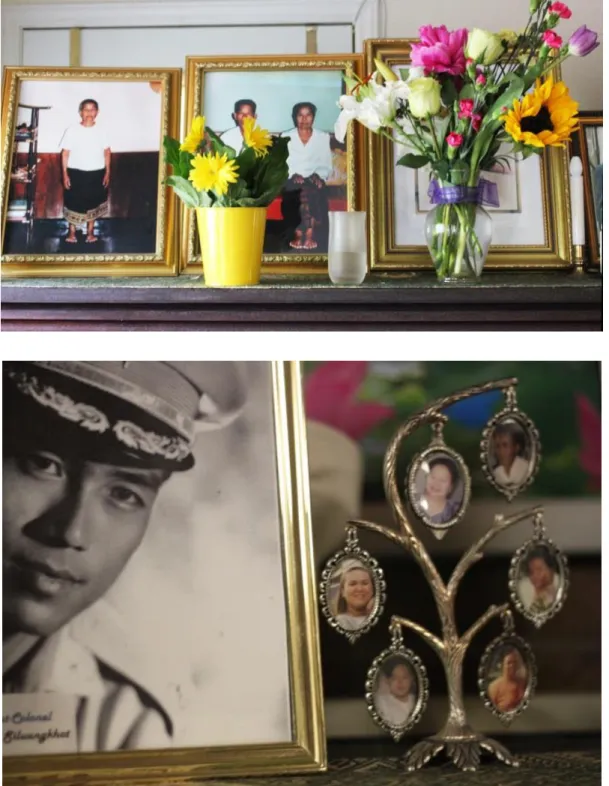
gathering is smaller than last year; the living room is dark and quiet, except for Noh’s two boys glued to video games on their phones. Dark leather couches line the walls, and to the left of the door is a glass and wood display case that holds ornamented silver bowls used for temple offerings—the oh for men and the taller kahn for women. Towards the front of the room, bathed in the warm glow from the kitchen, family photographs are arranged across the piano, mantle, and television cabinet. The picture frames glint in the low light, revealing giddy first grade portraits and solemn photos of relatives in traditional dress in Laos. On this special day, bright yellow flowers are positioned between the photographs, offered to the memory of family. As I step into the kitchen—the heart of the home—Noubath and Khamsi hug me warmly in welcome. While waiting for the party to begin, the family watches Khamsi’s old home videos, which jump between Laos, Morganton and Connecticut, and
weddings and funerals. Noubath and Meemee move between the indoor kitchen, the dining table, and an elaborate kitchen on the porch, straightening dishes as they make room for the
25
Figure 2.5 The Clay Street house, where Dara’s family and Noubath and Khamsi live. Photo by Kathryn A.
Clune.
Figure 2.6 Noh’s family and Toon live on Deerfield Street. Both homes are adapted to reflect of family
26
grocery store cake Noh just brought inside. There is little space: a barbequed pig dressed for the occasion—purple chrysanthemums in its ears—is at the center of the table. Roast duck, chicken, and fried fish are placed by its side. Smaller plates of sour pork, pickled daikon, sesame-mung-bean balls, candied fruits, as well as tea, Beer Lao and a bottle of wine from Lake James, North Carolina, are arranged around the table’s perimeter. More photos hang on the paneled walls of the kitchen and its adjacent room. Underneath a black and white studio portrait of the Phrakousonhs in Lao formal dress is April’s cheerleading portrait for
Morganton’s Walter R. Johnson Middle School Yellow Jackets. Surrounded by family and
friends, those present and those remembered, Noubath signals it is time for the meal to begin.
While the table is fuller and more elaborate at Têt, little else changes for everyday meals in the Phapphayboun homes. The family is divided into two households that are four miles apart, tucked into the suburbs of Morganton. Dara’s family shares their home with her parents, and Toon lives with her brother Noh, Meemee, and their two boys. Social time is split between these two houses, which Toon calls “Clay” and “Deerfield” after their
27
together. Nine people. A bunch of big houses [around here] only have two people. Not my house—everybody is there. I really like it.”43
Homes like those of the Phapphaybouns are foundations for both intimate and more public personal expression, which material culture scholars have analyzed as evocative “texts.” Countering claims of the diminished role of the handmade in today’s world,
folklorists and anthropologists look to the process of personal collecting and alteration that occurs in homes as a vibrant expression of creativity. Folklorist and cultural theorist Barbara Kirschenblatt-Gimblett argues that “people save, collect, and arrange their possessions in ways that are profoundly meaningful,” and in so doing, undertake a review of their life that empowers them to craft their own narrative of identity and becoming.44 In The Stars of Ballymenone, Henry Glassie visits Ellen Cutler in her whitewashed thatched-roof home in Northern Ireland. Cutler, a “house-proud” woman, takes care of her dresser of blue and white
china.45 Among its carefully arranged shelves, Glassie sees a life: “Her platters and plates were her family and friends, her memories . . . her ornaments were bits of beauty that made memories and connections,” forming “a halo of identity, memory, [and] social connection.”46
Glassie argues the house, remodeled and filled with objects, is an exhibit of will and creativity. As he explains in his seminal work Material Culture: “It is not the food bought, but the food processed and made into a meal—it is not the shirt bought off the rack that is you, but the shirt as a component in a composition of attire that informs on you. Whole
43 Daraphone Phrakousonh, March 10, 2014.
44
Barbara Kirschenblatt-Gimblett, “Objects of Memory: Material Culture as Life Review,” in Folk Groups and Folklore Genres: A Reader, ed. Elliot Oring (Logan, Utah: Utah State University Press, 1986), 330.
45
Henry Glassie, The Stars of Ballymenone (Bloomington and Indianapolis: Indiana University Press, 2006), 197.
28
Figure 2.7 Mementos of Laos and family photos are spread throughout both homes. On important occasions such as Têt, the Phapphaybouns place flowers between the frames in honor of their ancestors. Photo by Kathryn A. Clune.
29
meals, sets of clothing in action . . . and collections of commodities assembled into domestic settings—these are the key creations in the material culture of industrial civilization. They are our mirrors; we see ourselves in them. They are our lenses; others read us through them.”47
“Reading” the Phapphayboun homes in this manner—as collections that reveal
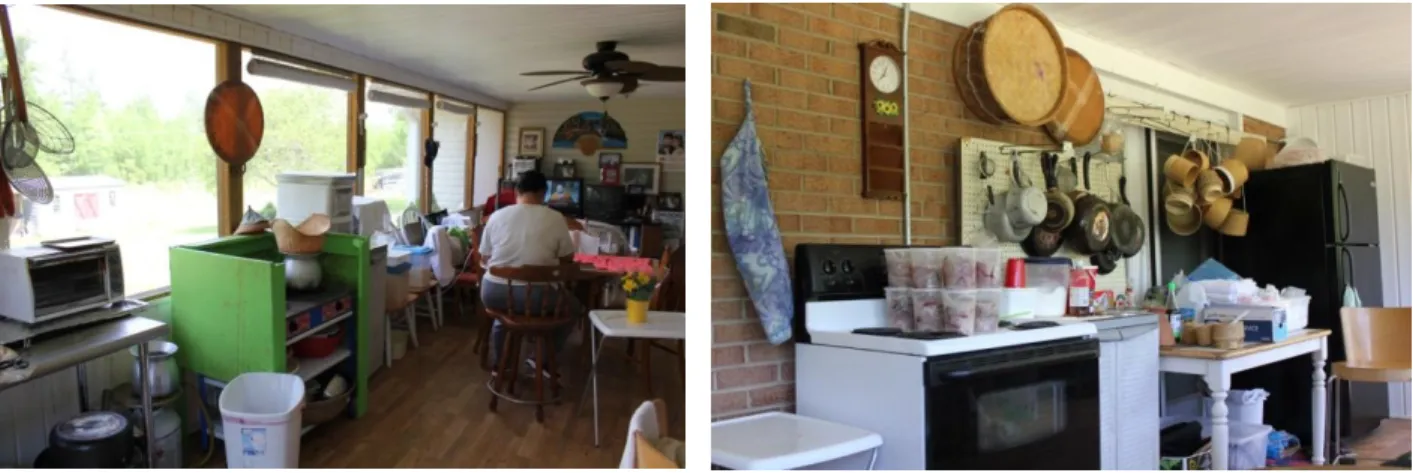
identity, memory, and values—it is evident how these spaces are designed to support family and social gatherings. Food brings the family together, thus the kitchen is the center of both houses. In Laos the kitchen (heuan khua), cooking, and eating define family (kuap khua) life: the terms for each even share a word.48 Noubath transformed the porch of the Clay Street house into a semi-outdoor kitchen. In winter, the screen windows are covered with plastic to keep the heat in, but in summer, warm breezes flow freely through the space. “This is my house,” says Noubath, as she peeled a fragrant lime on a May morning.49
In these four words Noubathdemonstrates the importance of this space that suits her needs so well. With two stoves, a sink, a refrigerator, two work tables, improvised counters, and two shelving units, there is still barely enough room to contain her cooking. Two tennis balls protect Noubath from the sharp corners of an eye-level shelf. A pah kao, a low straw platform and portable table, hangs on the wall above a row of twenty or so pots and pans, ordered by size. Thip kao, or sticky rice baskets, dangle in unwieldy bunches from the wall near the refrigerator
alongside sieves, steamers, spatulas, graters, and whisks. In the summer, the kitchen extends out into the yard, where Noubath dries sticky rice in the North Carolina sunshine
47 Henry Glassie, Material Culture (Bloomington: Indiana University Press, 1999), 84.
48
Monica Janowski and Fiona Kerlogue, eds., Kinship and Food in Southeast Asia (Copenhagen: Nias Press, 2007), 230.
30
Figures 2.9–2.10 Noubath has transformed her porch into a customized Lao kitchen. Photos by Kathryn A. Clune.
31
Meemee’s kitchen at Deerfield Street house is less elaborate, but just as central to
family life. Meemee loves decorations; each time I visit she has added another item to her collection. As Glassie noted during his time in Ballymenone, “the kitchen was everyone’s. Irish icons among the ornaments brought them together.”50
Such is the case at Meemee’s home. There are touches of Laos throughout the kitchen—some obvious, like wooden carvings and sparkling textiles with elephants and tropical flora, and some less public, like the homemade padaek (fermented fish sauce) she keeps under the sink. A Keurig coffee maker shares counter space with a metal and bamboo sticky rice steamer. A woven bamboo basket, with the national monument That Luang and “Lao” in bold letters, hangs above the
microwave with its American flag sticker and a growling bulldog promoting 92.1 FM. Family photos cover the counter and the refrigerator. Meemee alters the space with each changing season. In November, two small ornamented Christmas trees stood on her counter. During my February visit, the trees were replaced by gold Buddha statues found at TJ Maxx, a nearby homewares discount store. The kitchen extends outside, where Noh installed a grill, stove, and a small roof with a light on the porch. Here Meemee uses larger pots to cook curries and broths for noodles and Noh grills, rain or shine.
In crafting their Morganton homes in this manner, the Phapphaybouns purposefully integrate the home life and social connection they experienced in Laos. Vientiane is a city of just 810,000 and is divided into roughly 500 neighborhoods (or baan, which translates to village).51 Each baan is centered on a temple and this tight-knit community is managed by an
50 Glassie, The Stars of Ballymenone, 202.
51
Chansamone Inlavongsa, July 17, 2014.
32
elected leader who hears grievances and periodically gathers with other baan leaders across the city. While it is the nation’s capital, in many ways Vientiane is a series of small towns.
The streets of Baan Sikai, the Phapphayboun’s neighborhood, quickly turn to alleys and dirt roads off of the main thoroughfare. Houses are so close it is easy to spend an afternoon between neighbor’s living rooms and kitchens, visiting and eating. Laos’s love of food and company are encapsulated in sayings about the country. In Laos, you are always either preparing for a party, having a party, or cleaning up after a party. Tourist shirts are sold with “LDPR” spelled out as “Laos: Please Don’t Rush.” Edgar Buell, an American volunteer in
Vientiane in the 1970s, observed that “everyone seemed caught in a languid tropical daydream, as though the national sport was waiting in the shade.” 52 Past the bustle of
downtown, the same could be said of the city today. In open cafes, riverbank restaurants, and in private homes across the city, relaxed meals and social gatherings define life in Vientiane.
In Laos, it is common to sit, visit, and linger for so long after a meal that, as Toon says, “lunch turns into dinner and we eat again.”53
When I visited Toon and her family in Ban Sikai, we did just that. Without our leaving the table, our small personal plates were swapped out for clean ones, more entrees came from the kitchen, less full serving dishes were combined, and beer glasses filled for another round of socializing. Long, convivial meals like this were the center of the day, often combined with a walk around the
neighborhood. We stopped to sit and catch up with an aunt, a friend, or perhaps Meemee’s brother, who once snuck out of work, saying he had to pick up an ingredient, just to visit with
52 Warner, Shooting at the Moon, 3.
33
Figure 2.13 A street in Baan Sikai, Vientiane, Laos, where houses are close to one another and nearly everyone knows each other. Photo by Kathryn A. Clune.
34
us. While I could not understand much of the conversation, hospitality needs no translation. We were always offered something at each stop, if nothing more than a bottle of water.
In Morganton, and across western North Carolina, families are divided by larger distances, and the impromptu visiting they knew in Laos is not possible. Khamsi and
Noubath help manage the Lao Family Association of Morganton, a social-aid membership of roughly thirty families, or eighty people.54 This association is modelled after the baan in Laos and is loosely affiliated with the Morganton temple. As the maps indicate (figures 2.15 and 2.16), membership is dispersed as far as High Point. In this context, drawing together the community becomes more difficult, yet more meaningful. Toon commented on the different attitudes towards time and coming together in Morganton and in Laos while she was in Vientiane. “If you and I want to get together [in America] it’s got to be a weekend. . . .Here, if someone says, ‘Let’s get together!’ They mean tonight. And if it’s a Friday night, great,
and if not, they still get together.”55 In the context of an undeveloped economy in which having a fulltime job is rare, Laos can prioritize social gatherings.
To make up for the distance between families in North Carolina, the Phapphaybouns make their homes the sites of annual celebrations. Their kitchens are specially designed for preparing the feasts associated with each gathering. Every year, Noubath and her children organize the Têt holiday, which she celebrates in honor of her Vietnamese father, who was killed as a young man. Noubath has hosted Têt since 1978, when, after she began suffering from headaches, a traditional healer explained that the cause for her pain was “someone from
54Khamsi Bounkhong Siluangkhot, interview by Kathryn A. Clune, Morganton, NC, September 21, 2014.
35
36
your past . . . asking for an offering.”56
In coming together for this occasion—the largest family gathering of the year—the Phapphaybouns pay respect to Noubath’s father and their ancestors. If Noubath cannot host this event, “there is a little tie in her heart.”57
She has adopted this New Year holiday for her own purposes. In her words, the day is about “all the family living together, eating together.”58
Toon elaborates: “It is about the love and compassion for her children. [It is about] getting them together to let them know this
tradition, respect for the family, the love, the bond, and keeping it in the younger generation so hopefully they’ll continue.”59
Preparing for the holiday requires much organization, determining in advance which daughter will pick up the pig and other barbequed meats.
Before the family fills their plates, Noubath directs a New Year’s blessing. I joined them this past February. We took three sticks of incense and lit them from a candle on the table. Thinking about my own family, I followed Khamsi and Toon outdoors to place my burning incense together with theirs in the front lawn. The ground was soon studded, blue smoke coiling and dissipating into the white winter sky. Meemee and Noh lit a fire in an iron ring as their sons took intricately folded gold paper and made a wish before tossing the delicate wreaths into the flames. Inside, Khmasi’s home videos continued to play. The parties, toddlers, and meals viewed on the screen reinforce family memories for the Phapphaybouns, uniting their past with the present.
56
Noubath Siluangkhot, March 10, 2014.
57 Ibid.
58 Ibid.
37
Figure 2.17 The extended family at the 2014 Têt gathering (front row, left to right: Dara, Meemee, Khattana, Noubath, Aunt Norm, Air, and Toon). Photo courtesy of Toon Phapphayboun.
Figure 2.18 Meemee with her sons Keeneau and Raayeau throw folded paper into a fire as they make wishes for the new year. Photo by Kathryn A. Clune.
Figure 2.19 Meemee spoons out kaopoon from her kitchen counter at the November 2014 celebration for Raayeau’s birthday and Thanksgiving. Photo by Kathryn A. Clune.
38
Têt holds strong personal significance for the family, but they also invite nearby friends and relatives to join in the celebration. When I attended in 2014, food was laid out on an eight-foot table in the living room and nearly thirty people were gathered in Clay Street house. Similarly at Deerfield Street house, Meemee combined her younger son Rayeau’s birthday
with Thanksgiving in 2014 and scheduled it on a Saturday so friends and family could come. Those that traveled great distances were invited to spend the night. These important annual celebrations both reinforce family for the Phapphaybouns and reduce the distance among members of the dispersed Lao community in western North Carolina.
The customized cooking spaces, the decorations from Laos, and the many family photos in their homes are powerful physical representations of what the Phapphaybouns value. These houses support a sense of rootedness, a connection to their homeland, and make possible the many social gatherings that define Lao life. Folklorist Debra Lattanzi Shutika examines the complicated way Mexican families, who have moved to the United States for work balance their concept of home between Kennett Square, Pennsylvania, and their hometown. Many of these families retain their homes in Mexico (though they now stand empty), a phenomenon referred to as the casa vacía.60 Their family photographs and
mementos are on display in empty rooms, memorializing an implicit dream to return. For the Phapphaybouns, there is no dream to return. Laos is the dream: a home suspended in time, another climate and a world away, a place incapable of supporting hopes for their children. Laos defines the Phapphaybouns, but they can only visit, and decades separate each return. Sitting in her father’s home in Ban Sikai in the cool dark air, Toon remarked, “I missed Laos
60
Debra Lattanzi Shutika,“La Casa Vacia: Meanings and Memories in Abandoned Immigrant Houses” in
39
the day I landed in Laos.”61
In this she acknowledges the impossibility of staying, and the ever-present, bittersweet connection to her country. This visceral connection is constant as the Phapphaybouns weave Laos into their daily lives in Morganton. As Shutika says, home is “a landscape that provides the setting for the expression and development of the self.”62
This strong foundation enables the Phapphaybouns to share this world beyond the walls of the Clay and Deerfield Street houses.
61 Toon Phapphayboun, July 28, 2014.
40
CHAPTER 3: SHARING THE FLAVORS OF HOME “When life gives you green papayas, make papaya salad.” —Toon Phapphayboun (July 28, 2014)
Sunlight streamed into Asian Fusion Kitchen, brightening the yellow walls and
casting shadows about the carefully arranged décor. Garlic and the sweet smell of lemongrass filled the small dining area, situated around a bubbling indoor fountain. The metallic bustle of pots and pans passed through silk elephant curtains covering the kitchen’s threshold. I sat in the back at the family table and chatted with Toon. We had met for the first time in Hickory, North Carolina, only a couple of hours earlier. Before we parted ways, she insisted on bringing me to her sister’s new restaurant in nearby Morganton for dinner. As we ate a simple (off-menu) chicken and basil stir-fry with sticky rice, I could feel the sisters’ palpable pride in their food and the restaurant. Asian Fusion Kitchen is the accomplishment of Dara. The family celebrated its second successful year this past February 2015 and business is thriving. Dara is the only chef, by her choice. She works twelve-hour days six days a week, but in her words: “To cook for me is not work. It’s something I enjoy.”63 Soon after she moved to Morganton with her husband in 1994, Dara quit her job at Valdese Weavers so she could attend nursing school. Following this, Dara worked at a retirement home. After having her first daughter, and with her husband still working long shifts at Valdese, Dara dreamed of the freedom of running her own business. She explained, “I said one of these days I am going
41
42
to [start] a business and try to bring everyone together.”64 In 2010, she opened the Lao Lanxang grocery store, named for Laos’s ancient monarchy. The prepared foods she sold
with her mother on Thursday nights grew so popular she could imagine a successful
restaurant. In 2013, Dara rented two adjacent storefronts on West Fleming Drive and opened the second iteration of Lao Lanxang next to her new restaurant, Asian Fusion Kitchen.
Tucked into a plain strip mall roughly two miles south of downtown Morganton, these two spaces are a direct connection to the culinary and cultural worlds of Laos. At Asian Fusion Kitchen, Dara expresses her cultural identity while gently inviting others to learn about Laos. This is a powerful introduction in a place where the Lao community is small and Laos is largely unknown by locals. Dara explains, her restaurant “bring[s] something out to show everybody where I come from, who I am, and why I do what I do because I wanted to introduce everyone to Laos. Because everybody says ‘Hey, you Chinese.’ Laos never exists! That’s why I said I’m going to open a restaurant or grocery store one day and I’m going to tell them I’m not Chinese, I am Lao.”65
Through the food and conviviality Dara and her family share with each customer, Asian Fusion Kitchen vividly conjures Laos in full color and full flavor and supports the Phapphayboun family’s and the wider Lao community’s cultural identity.
Laos is its Food
Food is at the heart of daily life in Laos. It is intimately tied to the landscape, has several unmistakable dishes and flavors, and a distinct ethos. On early neighborhood walks in Vientiane, I see steam wafting from sticky rice in the morning light. Women sit on low
64
Daraphone Phrakousonh, March 10, 2014.
43
bamboo stools waiting for tak baht, the morning ritual of giving monks their daily meal.66 Each dawn, wrapped in dark orange robes, young men walk single-file cradling alms bowls in their hands. As they pass each group of morning worshippers, the line stops, turns to face away from the street, and chants in thanks. While the warmth of the sun is still gentle, fishermen and women wade into the Mekong using longboats and intricate homemade bamboo nets. Fresh river fish is sold across Vientiane, skewered and grilled, wrapped in banana leaves and steamed, or cooked at waterside tables in hot pots. Kitchens in Laos are typically outdoors, and in many homes are open to passersby. As the day heats up, women move their vegetables and cutting blocks into the breezy shade, transforming neighborhood streets into ad-hoc prep areas. On sunny days, the sidewalk becomes auxiliary counter space. Chilies are set to dry in low-walled baskets and bamboo nets lean on fences holding drying patties of sticky rice. More enterprising home cooks season their dishes with herbs grown in improvised raised beds. Papaya trees grow just as well in Vientiane as in the country, and only the smallest of the green fruits hang unpicked near the trunk. I have seen stalky greens used in soups and stir fries planted on city balconies.
The roadside farm stands and markets of Laos overwhelm the senses with their
abundance of fresh vegetables, fruits, and meats. With the Mekong River running through the entire western length of the country, and with plentiful smaller waterways, fish is the main source of protein.67 It is prepared in a thousand variations, from pickled to steamed with herbs and spices, to stews, salads, and salty jerkies. While rice is the most common crop in
66Tak baht is the more widely used term for this ritual, but sai baht is more accurate. Chansamone Inlavongsa, interview by Kathryn A. Clune, Vientiane, Laos, July 17, 2014.
44
45
Laos, farmers truck in seasonal cucumbers, pineapple, or pumpkins, and arrange them in towering piles. In the morning market in Luang Prabang, elaborate displays of produce are next to women with simple arrangements of foods they foraged, caught, and cooked. Markets are overwhelmingly run and visited by women, who navigate the narrow walkways to inspect foods, checking for freshness and bargaining for the best price. There is dark seaweed, eels, leaves fragrant and foreign—leaves of the forest without English names. Under the market canopies, it is a sea of green with flashes of silver (fish), red (chilies), purple (eggplant), and the occasional burst of orange from a vendor selling temple offerings studded with bright chrysanthemums. The market is local by necessity, and seasonal specialties are coveted. In spring in Luang Prabang there are round, earthy dumpling-like mushrooms, dark jumping toads, and a foraged ant nest that rests on a banana leaf. There is an art to these market displays. Quilts of colorful vegetables and fruits are laid out on the ground, and jerky and home-cooked rice snacks hang from above, bundled together with bamboo ties.
Lao cuisine reflects this natural abundance and is prepared with ingenuity and a mastery of flavor. Xaixana Champanakone, who has recently published a Lao cookbook, connects the Lao attitude toward food with the spirit of the country: “The cooking of food, like everything else in Laos, reflects the easy and immediate reliance on nature as guide and provider.”68
Lao cooking shares characteristics with other Southeast Asian foodways. As Nancie McDermott, who was a Peace Corps volunteer in north Thailand and is an expert on Thai cuisine, explains, “the flavors and the cultures in the Mekong delta all blend together.”69 Jeffrey Alford and Naomi Duguid, who have travelled and eaten their way across Southeast Asia since the 1970s, capture the central characteristic of the region’s cuisine. In every dish,
68 Xaixana Champanakone, Lao Cooking and the Essence of Life (BookBaby, 2014), 92.
46