ENGENDERING INEQUALITY:
MASCULINITY AND RACIAL EXCLUSION IN CUBA, 1895-1902
Bonnie A. Lucero
A dissertation submitted to the faculty of the University of North Carolina at Chapel Hill in partial fulfillment of the requirements for the degree of Doctor of Philosophy in the Department of History.
Chapel Hill 2013
Approved by:
iii
ABSTRACT
BONNIE A. LUCERO: Engendering Inequality: Masculinity and Racial Exclusion in Cuba, 1895-1902
(Under the direction of Dr. Louis A. Pérez, Jr.)
This dissertation explains the rise of a culture of racial silence in a time of heightening racial exclusion in Cuba at the turn of the twentieth century. Employing a case study of Cienfuegos, a port city on the south-central coast of the island, I examine gendered articulations of inequality among Cuban separatists between the outbreak of the war of independence in 1895 and the inauguration of the Cuban republic in 1902. I argue that Cuban struggles for political power in the wake of the American military
intervention (1898) and military occupation (1899-1902) fundamentally transformed separatist visions of citizenship, increasingly restricting its boundaries along racial lines.
Separatists expressed racial exclusion in terms of masculinity. During the first years of the war, a discourse of racial brotherhood afforded inclusion to all men
iv
became increasingly contingent upon collaboration with American military authorities. Failure to cooperate with Americans supposedly equated with supporting black rule in Cuba. Collaboration with the Americans, however, meant preserving racial order and sacrificing the revolutionary promise of social justice.
Manliness provided a strategy by which political elites could preserve the discourse of racial brotherhood which afforded them political legitimacy among their fellow separatists. Simultaneously, they were able to justify the racial exclusion that earned them the esteem of American military authorities. Poor and working-class black men and women appropriated this gendered language to protest social inequality,
v
DEDICATION
vi
ACKNOWLEDGEMENTS
Working in Cuba can be an incredibly rewarding experience, but it is never easy. This dissertation arises from four years of collaboration and struggle, cooperation and obstruction, realization and frustration. It is built upon more than seven years of discovering how to live and work there, each breakthrough serving as further proof of how much more there is to learn. The highs and the lows of working in Cuba have only solidified my love of the island, its people and the treasures of its history.
I am forever indebted to my wonderful adviser, Dr. Louis A. Pérez, Jr., for his invaluable feedback on my work, his patience with my persisting imperfections, and his unending support for my professional development. He has always been supportive of my aspirations and his advice and admonitions have always been well-founded. He so
generously shared his connections with scholars in both the United States and Cuba, from Rebecca Scott to Pepe Vega Suñol to Eduardo Torres-Cuevas. Professor Pérez was instrumental in helping me establish connections with Orlando García Martínez in Cienfuegos, without whom research in that city would have been impossible.
In his infinite wisdom and encyclopedic knowledge of local history, Orlando has oriented me in the rich history of Cienfuegos, guided me in my research and allowed me into the local scholarly community. He helped me gain access to the invaluable
vii
cienfueguera. His daughter, Anabel García García has been and continues to be a friend and a colleague. Together we spent numerous afternoons browsing documents and confronting the usual archival obstacles and weekends sharing, debating, and discussing ideas and research trajectories and others cogiendo brisa on the Malecón. Ileana, Yoany, Pocho, Dianelis, and the whole García clan provided a necessary social network. Aníbal Barreño generously shared his historic maps and images which form the base of many of the city maps in this dissertation and his beautiful family.
I must also thank the staff at the Santa Catedral de Cienfuegos, especially Jesús and Susana Teresa García Roldán, who allowed me access to the baptismal, marriage and death registries kept by the church. I am grateful to the Bishop of Cienfuegos for granting me permission to view the parochial records. Marilú, Carla, Adrián, Mayíto, and el Mostro provided hospitality during my first trip to Cienfuegos, while Estrella was the eccentric landlord with whom I spend several summers.
In Havana, the staff of the Archivo Nacional de Cuba, especially Julio, Silvio and Orleana provided access to important collections. Brian Sardiñas and the rest of the crew dealt with my numerous requests for materials and brought me so many large dusty boxes of documents.
The staff at the Cuban Heritage Collection at the University of Miami provided generous support for my research and writing. Esperanza B. de Varona, Lesbia O.
Varona, Annie Sansone, and many others were instrumental in identifying collections and provided a network of support for my research. Rosa Monzón went above and beyond her duties to provide access to the materials I needed. Over the three years we worked
viii
wonderful family, especially Milja. My time at the Cuban Heritage Collection was more than just a rich space for scholarship and exchange. It was an opportunity to become part of the CHC family. The Massachusetts Historical Society also generously funded my research. The wonderful staff, especially Conrad Wright and Kate Viens, welcomed me into a vibrant scholarly community, out of which many ideas and friendships emerged, including Nicole George.
The Department of History provided financial support and a vibrant intellectual community and a supportive environment for growth. I especially appreciate the amazing set of faculty who have shared their time and ideas with me and supported my research and teaching. My committee provided valuable feedback on my ideas and gave me considerable food for thought in future projects. The constant positive reinforcement and help from Dr. Joseph Glathaar, Dr. Lindsay, Dr. Jerma Jackson, Dr. Heather Williams among others has made my time at UNC incredibly enriching and memorable. The Institute for the Study of the Americas at the University of North Carolina at Chapel Hill has also provided funding for my research, without which my numerous trips to Cuba and other archives across the United States would not have been possible. These two
communities, as well as the scholars of TAAHC, the Afro-Latin America Working Group, the Anthropology Department, especially Dr. Anna Agbe-Davies, and Teresa Chapa at Davis Library have made my time at UNC fruitful and enjoyable.
ix
away from Richmond, California. Sarah has been my trusty dissertating partner since we met in NARA II one summer.
Finally, my mother, who has believed in me even when my own confidence was shaken, provided the needed strength to get through the difficult moments.
For all these people and the many more who I have undoubtedly forgotten, I thank you for your support.
x
TABLE OF CONTENTS
IMAGES ... xiv
MAPS ... xvi
TABLES ... xvii
ABBREVIATIONS ... xviii
INTRODUCTION ... 1
Microhistory and the Microcosm of Cienfuegos... 12
Masculinity and the Measures of Citizenship ... 17
A Note on Sources... 25
Chapter Outlines ... 28
CHAPTER 1: Cowardly Spaniards, Heroic Cubans: Race and the Politics of Masculinity during the War of 1895... 32
Just Another Black Rebellion ... 34
Resonance of Spanish Propaganda ... 40
Cowardly and Effeminate Spaniards ... 57
Dueling in Defense of Women: Chivalry and Insurgent Honor... 67
Masculine Honor and Female Sexual Virtue ... 74
Conclusions ... 83
CHAPTER 2: Insurgent Masculinities: The Invasion, Black Officers, and Regionalism... 85
xi
Race and Regionalism in Visions of Patriotism ... 96
Race, Masculinity and the Limits of Political Legitimacy: The Case of Quintín Bandera ... 105
Concubines, Mambisas, and the Allure of Cuba Libre ... 126
Demographics and Divisions within the Cuban Army... 132
Conclusions ... 139
CHAPTER 3: From War Heroes to Bandits: Criminalization and Emasculation of Veterans in Post-war Cuba ... 143
Rural Destitution and the Roots of Crime in the Countryside ... 147
Beyond Banditry: Violent Crime and Political Rivalry ... 158
Crime in Rural Cienfuegos through American Eyes ... 166
Emasculation and Disbandment of the Cuban Army ... 180
Conclusions: Crime as an Argument for Political Exclusion ... 188
CHAPTER 4: Annexation or Black Republic: Radical Patriots, Autonomists and Annexationists in the Struggle for Political Power... 191
Antagonism among Allies ... 194
Americans defend Spanish Authority ... 201
“Bricks Without Straw”: The Menace of a Cuba for Cubans ... 209
Not All White Veterans are Equal: Searching for “the better class of men” ... 216
The Specter of Black Rule and the Limits of Cuba Libre ... 226
Unrestricted Manhood Suffrage in the Elections of June 1901 ... 241
Conclusions: Cuban Independence as Black Rule ... 245
CHAPTER 5: The Color of Disorder: Black Veterans, Law Enforcement, and the Ordered City ... 248
xii
Who’s Disorderly Now?: Debating Responsibility for the Riot ... 259
Agents of Order or Criminal Conspirators?: American views of the Police ... 266
“El cuento del foky, foky”: Black veterans confront American sexual privilege ... 273
Public Disorder and the American Civilizing Mission ... 280
Race and Incompetence in the Municipal Police Force ... 284
Turning the Tables on Civilization: Conflict and Discourses of Savagery ... 292
Conclusions ... 296
CHAPTER 6: Subjugating Black Urban Authority: White Rule, Police Brutality, and the Demise of Racial Brotherhood ... 298
“The Trumpet of Cuban Dignity”: Political Criticism in the Radical Press ... 300
Making the Police Respectable: Whiteness, Fear, and Legitimacy ... 305
From Defenders of the People to Murderers: The Assassination of Dionisio Gil ... 309
Public Responses to Police Brutality ... 315
A Failed Revolution ... 322
Anti-Racism as Patriotism: The Commemoration of Gil ... 324
Policing Political Power after the Assassination of Gil ... 329
Conclusions ... 339
CHAPTER 7: Towards a New Racial Geography: Rape, Riots and the Regulation of Vice ... 342
“Racha de Salvajada”: Rape, Racial Protest and Questioning Civilization ... 343
“Get your hands off my woman”: Drunken Americans and the Dancehall Riot of 1900 ... 347
Regulating Cuban-American Gender Relations: Prostitution and Venereal Disease ... 352
xiii
Taking Back the Transvaal: Vice as Strategy ... 382
Terror in the Transvaal: The Chiquito disturbance of 1901 ... 384
Conclusions: Conflict, Continuity and Change ... 391
CHAPTER 8: “In this matter of Dignity”: Black Labor, Collective Action, and the Urban Order ... 395
The Race-Labor Hierarchy and Post-War Expectations ... 397
A Black Union in a White City ... 410
The Strike of April 1899 ... 422
The Dock Workers Strike of February 1900 ... 426
“The incarnate enemy of Cuba” and Union Breaking ... 438
Conclusions: The Demise of the Union and the Consolidation of “Urban Order” ... 452
EPILOGUE: Under the Veil of Racial Brotherhood: Consequences and Lessons from American Rule ... 455
BIBLIOGRAPHY ... 469
Archives and Manuscripts…………...……….469
Newspapers and Periodicals………...……….469
xiv
IMAGES
Image 1: Artist rendering of Cubans burned alive by Spanish in Olayita Massacre ... 64
Image 2: Artist Rendering of the Battle of Mal Tiempo ... 79
Image 3: Spanish Blockhouse, Cienfuegos ... 88
Image 4: “One of Quintín Bandera’s ... 107
Image 5: “Quintín Bandera ………….. ... 109
Image 6: “Sometime in the future” ... 128
Image 7: “The Cuban Melodrama” ... 128
Image 8:“The Duty of the Hour” ... 129
Image 9: Sketch of Madame González, a Mambisa ... 130
Image 10: “Looking Forward” ... 167
Image 11: Higinio Esquerra ... 176
Image 12: “Good Government vs. Revolution” ... 227
Image 13: “Save me from my friends” ... 228
Image 14: Quintín Bandera ... 231
Image 15: “Here you are”--Caricature of American views of Cuban Independence ... 236
Image 16: Captain of the Port (where stevedores protested) circa 1899. ... 251
Image 17: Monument to Dionisio Gil, Cienfuegos ... 325
Image 18: Number of prostitutes classified by race among Cuban cities, circa 1902 .... 356
Image 19: Caricature of Boer War from La Discusión ... 371
xv
Image 21: Southward view of Steamer at the Muelle Real (Royal Wharf)
circa 1900. ... 409
Image 22: Northward view of wharf and warehouses, circa 1900 ... 409
Image 23: Miscellaneous photographs of Stevedores, 1904-1921 ... 415
xvi
MAPS
Map 1: Island of Cuba, 1898... 12
Map 2: Fortified Zone of Cienfuegos ... 89
Map 3: Events Leading to Assassination of Dionisio Gil, December 1899. ... 312
Map 4: Relocation of the red light district, 1900 ... 370
Map 5: Un-urbanized spaces of Cienfuegos, mid-19th century ... 372
Map 6: Urbanization of the Transvaal, circa 1902 ... 383
xvii
TABLES
Table 1: Populations Statistics by Race (per 100), for selected
geographic zones, 1899 ... 14
Table 2: Rations Issued to Destitute in Cienfuegos, January-June 1899 ... 148
Table 3: Crimes of Prisoners in Cienfuegos Jail, May 1899 ... 156
Table 4: Proportion of Blacks and Whites before and after the War ... 173
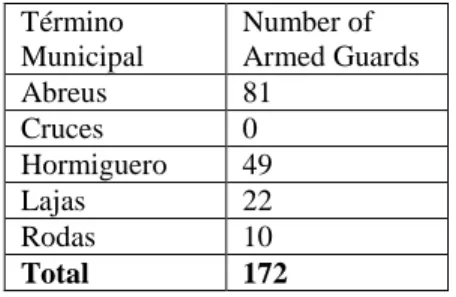
Table 5: Private Armed Guards in Cienfuegos, June 1899 ... 178
Table 6: Armed Private Guards in Cienfuegos, June, 1900 ... 179
Table 7: Selected Crimes Committed by American Officers and Soldiers: 1899-1900, Department of Matanzas & Santa Clara ... 267
Table 8: Pay Schedules for Municipal Police of Santa Clara Province, Cienfuegos Jurisdiction ... 272
xviii
ABBREVIATIONS
AHNE Archivo Histórico Nacional de España, Madrid, Spain AMHT Archivo Municipal Histórico de Trinidad, Trinidad, Cuba ANC Archivo Nacional de Cuba, Havana, Cuba
APHC Archivo Provincial Histórico de Cienfuegos, Cienfuegos, Cuba BNJM Biblioteca Nacional José Martí, Havana, Cuba
CHC Cuban Heritage Collection, University of Miami LOC Library of Congress, Washington, D.C.
MHS Massachusetts Historical Society, Boston, MA MSU Mississippi State University Library
INTRODUCTION
“I notice negroes come into the plaza now, which was never allowed before,” wrote, Edwin F. Atkins, an American planter in Cienfuegos in January 1899.1 In this statement, he identified a crucial change in the way men and women of African descent inhabited the urban space in this central Cuban port city. This shift came at a pivotal juncture in Cuban history and race relations. Cubans had recently emerged from the war of independence against Spain (1895-1898) and entered the first year of the American military occupation (1899-1902). The anti-colonial insurrection transformed racial attitudes and challenged the very foundations of the colonial social hierarchy with a revolutionary discourse of racial brotherhood. Insurgents reportedly claimed there was no such thing at the black man or the white man, only the Cuban. The military ascension of black men to high-ranking positions in the Cuban Army seemed to corroborate the centrality of social revolution to Cuba Libre.2
After the war, challenges to the racial order were particularly evident among Cuban veterans. Insurgents apparently showed little regard for racial etiquette, as black and white men gathered, consorted, and organized together, united by the bonds of military service. Atkins described the crowd gathered to greet revered insurgent chief Máximo Gómez on his visit to Cienfuegos in February 1899: “all the insurgents of the
1
Edwin F. Atkins, Sixty Years in Cuba (Cambridge: Riverside Press, 1926), 297.
2
neighborhood came to the station to meet him, some four hundred and fifty, and only some half a dozen white men.”3
The Cuban army, which Gómez had commanded, became the ultimate symbol of the troubling racial opening occurring in the late nineteenth century, particularly the war. Atkins even disdained the behavior of white insurgents, who shamelessly presented their black lovers in public. “One dignified officer was seen marching with a negress on his arm (so the boys said) and everything was mixed.”4
The cross-racial alliance so loudly touted by the insurgents during the war, transformed the way black men and women occupied the urban space of Cienfuegos and how veterans of all colors interacted with one another. This worried some men with vested interests in preserving the racial status quo.
The racial anxieties emerging after the war provided a convenient pretext for realizing a historic American aspiration: the annexation of Cuba. After thirty years of armed anti-colonial struggle against Spain, Cuban separatists gained only conditional freedom as American military rule replaced Spanish colonialism. Americans had intervened on behalf of the Cubans, many believing the Cuban cause equally noble and righteous as the American Revolution. Yet, once in Cuba, American sentiments toward the Cuban separatists quickly changed. Imperialists and advocates of annexation pointed to several factors contributing to Cuban unfitness for self-government including the longstanding Spanish tyranny, the widespread economic devastation, and especially the unfavorable racial composition of the Cuban population. These factors, they claimed, certainly implied a need for benevolent American tutelage.
3 Atkins, Sixty Years in Cuba, 300.
3
The length and outcome of the period of American rule were both uncertain. Instead of attempting to mold Cubans into American citizens, the American military occupation attempted to create a society in which Cuban political elites willingly favored American economic interests. In April 1899, General James H. Wilson, Commanding General of Matanzas and Santa Clara Provinces, wrote that the Cubans “should
necessarily go through a period of tutelage, the length of which will depend altogether on
their own behavior during the occupation of the island by the United States forces.”5 Wilson underlined what became the core policy of the American military occupation: the political future of Cuba depended on the cooperation of the Cuban political elites with the commercial goals of Americans.
Guaranteeing American interests in Cuba involved two main projects. First, Cuban political elites were charged with ensuring a stable workforce for American business. Sugar planters especially relied heavily on a cheap and obedient labor force, historically guaranteed by slavery and preserved to a large degree with the
post-emancipation racial order, at which the revolution had chipped away. Second, political stability was required to ensure consistent international trade. However, stability often entailed collaboration with American military officials and favoring wealthy (especially American) capitalists, rather than simply fostering a peaceful and democratic political realm. Both these goals relied on the preservation of the racial order. In public, Cuban political elites remained silent on issues of race. At the same time, they enacted policies aimed at preserving a racial order that placed men and women of African descent distinctly at the bottom of the social hierarchy.
4
This dissertation examines the paradoxical coexistence of racial silence with increasing racial exclusion in Cuban society at the turn of the twentieth century. To address this question, this study focuses on the political struggles of Cuban separatists and the personal experiences of poor and working-class black men and women during the war and the transition to sovereignty (1895-1902). The emphasis on the everyday
personal experiences and interactions required a reduction in the scale of analysis to the local level. Therefore, the primary methodological approach used here is a case study of a medium-sized port city called Cienfuegos, located on the south coast of central Cuba.6
I argue that the negotiations among various groups of separatists and American military officials resulted in a transformation of the agenda of the Cuba Libre from concern about social justice to struggle for political power in the emerging republic. The American military intervention in Cuba in 1898 fundamentally altered the course of the separatist movement by favoring socially-conservative veterans whose political
legitimacy hinged on repression of blacks. Race-based social and political mobilization came to represent more than a mere threat to the social order; they emerged as the single greatest threat to Cuban self-government.
6
This study finds methodological inspiration in microhistory and everyday life history. Both of these approaches to history imply the reduction of the scale of analysis, and a close analysis of human agency. Louis A. Pérez, Jr., argues that the increasing North American presence in Cuba over the course of the nineteenth century “served as a powerful force for change” and these cultural influences “were accepted as commonplace and thus became part of everyday life.” Louis A. Pérez, Jr., On Becoming Cuban: Identity, Nationality, and Culture (Chapel Hill: University of North Carolina Press, 2008), 27; Brad S. Gregory, “Is Small Beautiful? Microhistory and the History of Everyday Life,” History and Theory 38:1 (1999), 101; Dorthee Wierling, “The History of Everyday Life and Gender Relations: On Historical and
Historiographical Relationships,” in The History of Everyday Life: Reconstructing Historical Experiences and Ways of Life, ed. Alf Lüdtke (Princeton: Princeton University Press, 1995), 157; Paul Steege, Andrew Stuart Bergerson, Maureen Healy, and Pamela E. Swett, “The History of Everyday Life: A Second
Chapter,” The Journal of Modern History 80:2 (2008), 376; Lutz Niethammer, “Zeroing in on Change: In
5
This project builds on nearly a century of scholarship on the American military occupation of Cuba and a growing body of literature on race, racism, and the struggle for equality. Both Cuban and American research on the American occupation has been defined by prevailing political currents in U.S.-Cuban relations at least since the advent of the Platt Amendment in 1901. Much of the scholarship in Cuba has approached the American intervention with a nationalist agenda, protesting the role of American
imperialism in Cuba.7 To commemorate the fiftieth anniversary of the inauguration of the Cuban republic, prominent nationalist historians like Emilio Roig de Leuchsenring and Ramiro Guerra y Sánchez published lengthy studies of the American occupation, characterized by a strongly critical tone against the intervention, its American
representatives, and the Platt Amendment, which the Cubans had successfully abrogated in 1934.8 With the triumph of the 1959 revolution, scholarly accounts of the occupation continued in a similar nationalist vein, though usually emphasizing the role of class conflict and imperialism in shaping developments in Cuba.9 Post-1959 accounts tended to validate the Cuban revolution by protesting the injustices of American rule.
After 1959, American accounts of the military occupation have attempted to explain how the Cuban Revolution emerged in a society the Americans had supposedly
7 Robert Freeman Smith, “Twentieth-Century Cuban Historiography,” The Hispanic American Historical
Review 44:1 (1964), 48-50. Also see David Healy, “One War from Two Sides: The Cuban Assessment of U.S.-Cuban Relations,” Cercles 5 (2002), 31-38.
8
Ramiro Guerra y Sánchez, José M. Pérez Cabrera, Juan J. Remos and Emeterio S. Santovenia, Historia de
la nación cubana. Tomo VII: cambio de soberanía. Desde 1868 hasta 1902 (Havana: Editorial Historia de
la nación cubana, S.A. 1952), 73-104; Emilio Roig de Leuchsenring, La Lucha Cubana por la República,
contra la Anexión y la Enmienda Platt (Havana: Oficina del Historiador de la Ciudad de La Habana, Colección Histórica Cubana Americana, 1952), 41.
6
cured of its revolutionary tendencies. Scholars like James H. Hitchman and David Healy argued that the premature departure of American troops from Cuba in 1902 left Cubans inadequately prepared for self-government, which ultimately resulted in the success of the rebellious caudillo, Fidel Castro.10 Philip S. Foner, as a marked contrast, was much more sympathetic to the Cuban perspective, articulating a cogent critique of the
occupation of Cuba as a founding moment for American empire.11
While previous accounts tended to emphasize the homogeneity of Cuban and American “nations,” the scholarship of the 1980s began to uncover political
fragmentation among Cubans during the occupation. A groundbreaking study in 1983 by Louis A. Pérez, Jr. transformed the field by employing both Cuban and American
archival sources to study the political developments between 1878 and 1902. By
emphasizing the interplay among different groups of Cubans, Pérez opened the door to a new generation of historians concerned with the social and cultural developments during the military occupation.12 Cuban historian Marial Iglesias Utset built upon this foundation with a seminal study of the material culture of Cuban nationalism during the
occupation.13
10
James H. Hitchman, Leonard Wood and Cuban Independence, 1898-1902 (The Hague: Martinus Nijhoff,
1971), 212; David Healy, TheUnited States in Cuba, 1898-1902. Generals, Politicians and the Search for Policy (Madison: The University of Wisconsin Press, 1963), 214.
11 Philip S. Foner, The Spanish-Cuban-American War and the Birth of American imperialism, 1895-1902,
2vol. (New York: Monthly Review Press, 1972), 672.
12
Louis A. Pérez, Jr., Cuba Between Empires, 1878-1902 (Pittsburgh: University of Pittsburgh Press, 1983). Also see his works exploring the cultural connections between Cuba and the United States, an
important aspect of which emerged out of the American military occupation. Pérez, On Becoming Cuban;
Louis A. Pérez, Jr., Cuba and the United States: Ties of Singular Intimacy (Athens: University of Georgia Press, 2003).
13 Marial Iglesias Utset, Las metáforas del cambio en la vida cotidiana: Cuba, 1898-1902 (Havana:
Ediciones Unión, 2003). Also see Raquel Vinat de la Mata, Las cubanas en la posguerra (1898-1902):
7
Strikingly absent from the scholarship of the American military occupation were studies centering the experiences of men and women of African descent. Studies of race abound for other time periods. Most scholars have addressed the struggle for racial equality either before or after the American military occupation. The early work of Rebecca Scott elucidated the process of gradual emancipation and struggles over the meaning of freedom in late-nineteenth century Cuba.14 More recently, she explored Atlantic definitions of freedom by juxtaposing the post-emancipation societies of central Cuba and Louisiana. Although this study does encompass the period of American rule, the longer durée approach centers on questions of post-emancipation freedom in rural Cuba, rather than access to citizenship among urban dwellers. In her study of the racial politics of the Cuban anticolonial struggle, Ada Ferrer argued that the Cuban revolution ultimately failed to overturn racism in Cuba, despite the persistence and entrenchment of racial brotherhood as a national patriotic discourse.15
The work of Scott and Ferrer demonstrated that black Cubans waged a protracted struggle for freedom and citizenship under Spanish rule. Although they did not gain full equality, they established a framework for protest and a legacy of struggle, gradually expanding their autonomy and rights. This trajectory laid an important foundation for the goals and strategies of Cuban separatists. They attempted to appeal to men of African descent by offering the fulfillment of their aspirations for equality within the Cuban army. Furthermore, it shaped the expectations of men of African descent during their service to Cuba Libre, empowering them to reclaim the promises of equality. The
14
Rebecca J. Scott, Slave Emancipation in Cuba: The Transition to Free Labor, 1860-1899 (Pittsburgh: University of Pittsburgh Press, 1986).
8
experience of war under the discourse of racial brotherhood led many men to believe that the trajectory of increasing inclusion and social justice would continue after the war.
It did not. In contrast to the gradual expansion of rights for black Cubans in the late colonial period, stark racial inequality defined the early Cuban republic. Alejandro de la Fuente argued that the failure of the government to take direct action against racism contributed directly to the persistence of racial inequalities, especially in the sectors of education, labor and access to power in the twentieth century.16 Melina Pappademos corroborated the prevailing narrative of thwarted aspirations and narrowing citizenship in the early republic in her account of black political activism.17 These studies emphasized the failure to dismantle the structures of racism despite the persistence of the discourse of racial brotherhood, which supposedly attested that racism did not exist.
The limitations of black mobilization were even reinforced by political
fragmentation and socio-economic stratification among people of African descent since the military occupation. Frank Guridy explored the ways black Cubans and African Americans appropriated the transnational connections of empire to forge diasporic networks after the American military intervention.18 Even in his agency-driven narrative, the limitations of an implicitly racialized Cuban nationality become evident in the
persistent emphasis on the culture of black respectability that led black elites to reject the Africanist cultural practices of the black masses.
16
Alejandro de la Fuente, A Nation for All: Race, Inequality, and Politics in Twentieth-Century Cuba
(Chapel Hill: University of North Carolina Press, 2001).
17 Melina Pappademos, Black Political Activism and the Cuban Republic (Chapel Hill: University of North Carolina Press, 2011).
18
Frank Andre Guridy, Forging Diaspora: Afro-Cubans and African Americans in a World of Empire and
9
When considering the colonial scholarship and the republican scholarship together, a clear paradox emerges. A trajectory of expansion in rights for people of African descent in the late colonial period was transformed into a violent rejection of black inclusion and a frustration of aspirations for racial equality in the early republic, which continues to a degree today. Few studies have addressed this apparent
contradiction. One of the closest approximations to a study of race during the American occupation was a 1983 conference paper by Cathy Duke. Therein, she argued that “American racial ideas and practices were imbibed and institutionalized” during the occupation, leaving behind “a legacy of racism unlike anything that had come before.”19 This interpretation draws upon a history of scholarship arguing that American race relations were fundamentally distinct from and more virulently racist than Iberian race relations.20
Few would disagree that Duke afforded Americans an exaggerated role in determining the Cuban racial climate. However, it is also difficult to deny that the American military occupation influenced the meanings of race in post-war Cuba to a degree. More recent studies have challenged the idea that the inculcation of American
19
Cathy Duke, “The Idea of Race: The Cultural Impact of the American Intervention in Cuba, 1898-1912,” in Politics, Society and Culture in the Caribbean, ed. Blanca E. Silvestrini (San Juan: University of Puerto Rico, 1983), 1.
20 Magnus Mörner emphasized the dual influence of social and racial factors in determining status in colonial Latin America, thus giving way to the concept of “social race,” acknowledging that Latin
American practices of race transcended phenotype as a marker of difference and hinged as well upon social aspects such as occupation, wealth and social networks. Carl Degler asserted the significance of the divide between mulattoes and blacks in Brazil, identifying greater social mobility among lighter-skinned
Afro-descendants as the Mulatto Escape Hatch. Magnus Mörner, Race Mixture in the History of Latin America
(Boston: Little Brown, 1967); Patricia Seed, “The Social Dimensions of Race: Mexico City, 1753,”
Hispanic American Historical Review 62:4 (1982): 569-606; Carl N. Degler, Neither Black Nor White: Slavery and Race Relations in Brazil and the United States (New York: Macmillan, 1971). Affording intermediary social status to mixed-race offspring was “ideologically repugnant” to white Anglo
10
racial values produced ipso facto black disenfranchisement in Cuba. In her 1995 monograph, Our Rightful Share, Aline Helg contended that “Cuba’s racial system was not a product of U.S. influence.”21
Helg addressed the first military occupation in two chapters discussing the “making of the new order,” and the “frustration” of black hopes for equality and political power in the Cuban republic, both narratives that span the period from 1899-1906.22 This declensionist narrative of black political power in the early republic has defined recent scholarship on race in early republican Cuba.
Other historians have emphasized the role of military organization during the war in the formation of early-republican networks of political patronage.23 Orlando García Martínez and Michael Zeuske both juxtapose the prevalence of wartime discourse of racial brotherhood with the post-war disenfranchisement of men of African descent. According to Zeuske, most of leadership of the Cuban army concurred in the “ideals of Martí” until 1898. However, “under the impact of the Spanish-Cuban-American war and the first year of the occupation, the ideas of the high officials, many of who were white, shifted toward more opportunistic ends, making use of the positions of power obtained before.”24
The transformative moment was the American intervention, not because it brought American racism to Cuban soil, but rather because it set in motion a process of
21 Aline Helg, Our Rightful Share: The Afro-Cuban Struggle for Equality, 1886-1912 (Chapel Hill: University of North Carolina Press, 1995), 3.
22 Ibid., 91-140.
23
Fernando Martínez Heredia, Rebecca J. Scott, and Orlando F. García Martínez, eds., Espacios, silencios y los sentidos de la libertad: Cuba entre 1878 y 1912 (Havana: Ediciones Unión, Unión de Escritores y Artistas de Cuba, 2001).
11
transformation within the Cuban army. García identified a pivotal shift in the social composition of the Cuban army when wealthy sectors joined en masse following the announcement of American intervention. He charted the development of “two armies” within the military branch of Cuba Libre, one that fought for patriotic ideals, and the other group that joined for political power.25 Both García and Zeuske showed the
marginal role of black veterans through surveys of political appointments during the first decade of the republic.26 These studies suggest that the revolution failed to transform the lives of black Cubans.
This dissertation brings together studies of the American occupations and accounts of race to explain the coexistence of racial brotherhood with increasing racial exclusion in Cuba at the turn of the twentieth century. I build on these fields of study in two main ways. First, by examining the developments that informed the political shift Zeuske and others identified, this study shows how the political context of the American intervention and military occupation helped socially-conservative ideas to overtake the revolutionary agenda of social justice. Second, this study focuses on the consequences of the transformation of the goals of Cuban separatists for poor and working-class black Cubans, especially considering how they experienced and responded to these changes. While the electoral politics and policies of the ruling elite provide a framework for understanding the shift in visions of Cuba Libre, the protagonists of this study are not
25 Orlando García Martínez, “La Brigada de Cienfuegos: un análisis social de su formación,” in Espacios,
silencios y los sentidos de la libertad. Cuba entre 1878 y 1912, eds. Fernando Martínez Heredia, Rebecca J. Scott y Orlando F. García Martínez (Havana: Ediciones Unión, 2001).
26
12
political elites, but rather men and women whose exclusion from the political realm made their every private move a political act. In the words of feminist Carol Hanisch, “the personal is political.”27
Microhistory and the Microcosm of Cienfuegos
A microhistory of Cienfuegos can help cast light on broader national
developments because the city and its hinterland reflect broader patterns island-wide. While smaller than Havana, Cienfuegos was nonetheless one of the most populous, prosperous, and well-connected Cuban cities because of its rich sugar economy and profound integration into Atlantic networks of trade and cultural exchange. Cienfuegos was a key port city for the Trans-Atlantic slave trade in the nineteenth century, and its expanding wealth and fertile lands attracted investment from all over the world, but most notably from American capitalists. Cienfuegos emerged as a product of the very forces that defined Cuban society in the nineteenth century: slavery and gradual emancipation, sugar plantation economy, American investment, and anti-colonial struggle.
Map 1: Island of Cuba, 189828
27 Carol Hanisch, “The Personal Is Political,” Notes From the Second Year: Women's Liberation, 1970.
28
Severo Gómez Núñez, La guerra hispano-americana: El bloqueo y la defensa de las costas con
13
The demographics of Cienfuegos closely resemble national patterns. In 1899, the population of Cienfuegos district was 59,128, and the population of the city proper was 30,038. In the district of Cienfuegos, nearly half of the employed people earned their livelihoods from agriculture. In the city, the most common sectors of employment
14
Admittedly, Cienfuegos is not without its own particularities. For example, the province of Santa Clara was one of the only regions to increase its populations between the census of 1887 and that of 1899. Moreover, the black population of that province increased by approximately 10 percent. For most other parts of the island, population decreases were far more common. Yet, the post-war demographic transformation of Santa Clara province does highlight a national redistribution of the population that may have resulted from the centrality of the province in the war of independence. Despite these differences, the demographic proportions of Santa Clara province and Cienfuegos district more specifically tend to reflect national trends, and can therefore provide a counterpoint to the Havana-centric nature of most studies of the island.
Table 1: Populations Statistics by Race (per 100), for selected geographic zones, 189929
Native White
Foreign White
Negro Mixed Chinese
Havana City 49.0 22.4 12.2 15.2 1.2
Cienfuegos City 52.4 11.6 10.2 24.6 1.1
Cienfuegos District
54.5 10.8 12.6 20.1 2.0
Cuba 57.9 9.0 14.9 17.2 .9
Santa Clara Province
60.3 8.4 13.6 16.3 1.4
In Cuban historiography, Havana has often stood in for Cuba, even though the history of the island has been intensely regionalized. Nationalism has been a powerful
15
force in Latin American historiography.30 This concept relies on a unified national community, the nation, frequently represented by the capital city as the pinnacle of civilization and culture. Nowhere is this more apparent than in Cuba, where the bustling metropolis of Havana has loomed large over the rest of the provinces. The overwhelming emphasis on the nation, however politically convenient, tends to obscure the diverse historical experiences emerging from the peculiar socio-political conditions of each unique locality.
Sub-national history offers a way to challenge the conflation of capital city and nation. Two approaches in particular, regional history and microhistory, provide a framework for a critical re-assessment of the role of place in historical narratives and the role of scale in historical research. Regional history is based on the idea that “region” is a hypothesis, rather than a given natural category.31 In microhistory, this critical
perspective expands beyond place to encompass the object of analysis. Although microhistory often takes the form of a local, regional or provincial case study, it also permits transcending place and tracing one individual, family or commodity through time and space.32 By reducing the scale of analysis, sub-national history can help reveal the
30 See Nikita Harwich Vallenilla, “La historia patria,” in Modernidad e independencias: ensayos sobre las
revoluciones hispánicas, ed. François-Xavier Guerra (Madrid: Editorial MAPFRE, 1992); Ferrer, Insurgent Cuba; Iglesias Utset, Las metáforas del cambio; Tomás Fernández Robaina, El negro en Cuba, 1902-1958: apuntes para la historia de la lucha contra la discriminación racial (Havana: Editorial de Ciencias Sociales, 1994); Eduardo Torres-Cuevas, En busca de la cubanidad (Havana: Editorial de Ciencias Sociales, 2006).
31
Daniel Campi, “Historia regional. ¿Por qué?” in Lugares para la historia: espacio, historia regional, e historia local en los estudios contemporáneos, eds. Sandra Fernández and Gabriela Dalla Corte (Rosario: UNR Editora, 2001), 87-89.
32 Rebecca J. Scott, Freedom Papers: An Atlantic odyssey in the Age of Emancipation (Cambridge: Harvard University Press, 2012); Marie Eileen Francois, A Culture of Everyday Credit: Housekeeping,
Pawnbroking, and Governance in Mexico City, 1750-1920 (Lincoln: University of Nebraska Press, 2006);
Karen B. Graubart, With Our Labor and Sweat: Indigenous Women and the Formation of Colonial Society
16
multitude of chronological and spatial variation, while moving beyond the ideologically-constructed naturalness of the nation-state.
Cienfuegos is an ideal case study for approaching the problem of race in Cuba, because it is in many ways a microcosm of Cuban society at the turn of the twentieth century. A center of both Spanish loyalty and the early incursion of American capital, the regional economy was based on sugar and, consequently, on slavery. While its port opened the city to the world of Atlantic commerce, it is still small enough to make personal and micro-level analysis feasible in a way that it would not be in a place like Havana. The manageable size of Cienfuegos allowed me to get acquainted with many of the individuals, families and networks defining the black life in the city. In addition, the locality is endowed with a rich provincial archive and its transnational history has helped preserve the local history in the written record in numerous Spanish, American and Caribbean archives. The wealth of archival materials on the city and municipality of Cienfuegos has contributed to a burgeoning body of historical scholarship on the region, especially on the history of slavery, emancipation and black participation in the wars of independence.33
Ethnicity, and the Urban Economy in Colonial Potosí (Durham: Duke University Press, 2005); María Elena Díaz, The Virgin, the King, and the Royal Slaves of El Cobre: Negotiating Freedom in Colonial Cuba, 1670-1780 (Stanford: Stanford University Press, 2000). Herman L. Bennett, Africans in Colonial Mexico: Absolutism, Christianity, and Afro-Creole Consciousness, 1570-1640 (Bloomington: Indiana University Press, 2003); Alejandro de la Fuente, Havana and the Atlantic in the Sixteenth Century (Chapel Hill: University of North Carolina Press, 2008), 164.
33 Martínez Heredia, et. al., Espacios, silencios y los sentidos de la libertad; Rebecca J. Scott, “Race, Labor,
and Citizenship in Cuba: A View from the Sugar District of Cienfuegos, 1886-1909,” The Hispanic
American Historical Review 78:4 (1998), 687-728; Rebecca J. Scott and Michael Zeuske, “Property in Writing, Property on the Ground: Pigs, Horses, Land, and Citizenship in the Aftermath of Slavery, Cuba,
1880-1909,” Comparative Studies in Society and History 44:4 (2002), 669-699; Michael Zeuske, “The
17
I search for an explanation to the historiographical paradox of expanding rights in the colonial period and heightened exclusion in the Republic in the intensely local
interactions and struggles of three main groups of people: poor and working-class men and women of African descent, white Cuban patriot-politicians, and American military officials. I argue that these three groups envisioned and sought to create fundamentally different societies after the war. One of the most significant divergences in their visions of Cuba Libre was the role of race in determining access to political power and
republican resources. In their zeal to secure power from the hands of both their Spanish and American enemies, white Cuban patriots subordinated the ideal of racial brotherhood in practice and to quell fears that they would threaten the interests of wealthy plantation owners. Simultaneously, they upheld it as a patriotic discourse that ensured their
continued patriotic legitimacy among their fellow separatists. Political elites devised new ways to explain racial exclusion, among which was a language of masculinity.
Masculinity and the Measures of Citizenship
Citizenship in Cuba, like in other Latin American republics, was a masculine realm at the turn of the twentieth century. The implicit gendering of discourses and practices of citizenship has not escaped the attention of historians in recent years, though historians have typically paid less attention to the links between masculinity and
Approaches to the Atlantic World,” in Gender and Slave Emancipation in the Atlantic World, eds. Pamela Scully and Diana Paton (Durham: Duke University Press, 2005), 181-198; Michael Zeuske, “The Cimarrón in the archives: A re-reading of Miguel Barnet's biography of Esteban Montejo,” New West Indian Guide/ Nieuwe West-Indische Gids 71:3/4 (1997), 265-279; García Martínez, “Caciques, elites, clientelas, y los
problemas raciales…”; Orlando García Martínez, Esclavitud y colonización en Cienfuegos, 1819-1879
18
citizenship than to the feminine exclusion from it.34 Fewer scholars have explored the relationship between masculinity and citizenship in the specific contexts of Latin America. “We need studies that concentrate on men and masculinities, on men as engendered and engendering beings in Latin America,” wrote Matthew C. Gutmann.35
This project attempts to contribute to this nascent body of scholarship by employing a gendered analysis to explore the intersections of race, masculinity and class in their specific social and cultural context in Cienfuegos at the turn of the twentieth century.
Citizenship is about defining the boundaries of inclusion and exclusion in a particular political community.36 This idea typically refers to the rights, responsibilities, privileges and duties of belonging to a particular nation-state. In this project, citizenship can be operationalized most effectively by equating it to access to political power, whether the right to vote or the ability to hold office. The first boundary of citizenship was gender. In Cuba, like in many emerging Latin American republics, one of the most important criteria necessary to become a citizen was being a man.37 Indeed, the idea of Cuban citizenship was born in the manigua, the almost exclusively male and intensely
34
Mary G. Dietz, “Citizenship with a Feminist Face: The Problem with Maternal Thinking,” in Feminism:
The Public and the Private, ed. Joan Landes (Oxford: Oxford University Press, 1998), 45-64; Joan B.
Landes, “The Public and the Private Sphere: A Feminist Reconsideration,” in Feminism, 135-164; Anna
Clark, “The Rhetoric of Masculine Citizenship: Concepts and Representations in Modern Western Culture,” in Representing Masculinity: Male Citizenship in Modern Western Culture, eds. Stefan Dudink, Karen Hagemann, and Anna Clark (New York: New York University Press, 2007), 3–24; Ruth Lister,
Citizenship: Feminist Perspectives (New York: New York University Press, 2003).
35 Matthew C. Gutmann, ed., Changing Men and Masculinities in Latin America (Durham: Duke University
Press, 2003), 1.
36 As James Holston and Arjun Appadurai note, the historical emergence of the idea of citizenship proved to be “revolutionary and democratic, even as it has also been conservative and exclusionary.” James Holston and Arjun Appadurai, “Cities and Citizenship,” Public Culture 8 (1996): 187.
37
Nancy P. Appelbaum, Anne S. MacPherson, and Karin Alejandra, “Introduction: Racial Nations,” in
19
multi-racial domain of the separatist military camps.38 Cuban ciudadanos, as the
separatists often called themselves, fostered unity among the soldiers by constructing an inclusive Liberal citizenship that extended belonging to men regardless of race, class, or place of origin. The discourse of racial brotherhood became a rhetorical device to unify men across race and class under the political banner of Cuba Libre.39 Service to the
Patria, in the form of joining the anti-colonial insurrection became a demonstration of two diverging, almost contradictory forms of masculinity: the violence of military combat and the gentility of self-abnegation.40
The purpose of focusing on the evolving and diverging meanings of masculinity is to elucidate the ways race, as an unspoken category of difference, operated in the daily lives Cienfuegos residents, even when racial categories were rare in the language Cubans used to talk about inequality. I distinguish between the physicality of being a “man”— masculinity—and the moral and normative aspects employed in constructing and differentiating between “good” men and men who fail to achieve the ideal—manliness. This distinction emerges from acknowledging that gender, its physicality, the discourses about it, and its outward display and embodiment are socially constructed.41 Masculinity, articulated during the early year of the war as appeals to a common manliness, masked
38 The conception of Cuban nation emerged much before the outbreak of the wars of Independence. Josef
Opatrný, Antecedentes históricos de la formación de la nación cubana (Prague: Universidad Carolina, 1986).
39 Ferrer, Insurgent Cuba, 7.
40 John Charles Chasteen, “Fighting Words: The Discourse of Insurgency in Latin American History,”
Latin American Research Review 28:3 (1993), 103.
41
20
racial and class differences by deploying a seemingly more “natural” social ordering based on gender and honor. While it seemed to provide a theoretical basis for inclusion of all Cuban men, this form of inclusive masculinity actually encapsulated the inequalities of race and class.
Hegemonic masculinity, the idea that there is certain way of being a man against which all men are measured, can explain the increasingly exclusive and hierarchical nature of Cuban citizenship during the transition from colony to republic.42 In this study, “masculinity” is used to refer to a system of thinking about how to be a man, usually encompassing the most basic physical definition of “man.” “Manliness,” on the other hand, is used to denote the realization or perceived fulfillment of the highest conception of what it meant to be a man as defined by the particular notion of hegemonic masculinity at that moment. This distinction can help explain how some “men” could be ineligible to enjoy the rights of citizenship supposedly available to all “men.”
Constantly evolving in definition and deployment, dominant ideas of masculinity came to define inclusion, status and belonging within the emerging conception of Cuban citizenship. As visions and practices of masculinity changed, so too did the boundaries of citizenship. During the war, access to citizenship supposedly rested upon upholding an idealized patriotic masculinity, the highest virtues of manliness. The ideal Cuban man was “respectable,” “honorable,” values that implied a host of other qualities including chivalry, self-restraint, and self-abnegation, especially among middle-class men. More
42 For an overview of the origins definitions, and critiques of the concept of hegemonic masculinity see, R.
W. Connell and James W. Messerschmidt, “Hegemonic Masculinity: Rethinking the Concept,” Gender and
Society 19:6 (2005): 829-859; John Tosh, “Hegemonic, Masculinity and the History of Gender,” in Stefan
Dudink, Josh Tosh and Karen Hagemann eds., Masculinities in Politics and War: Gendering Modern
21
virile forms of manliness most closely associated with the working class, however, became increasingly prominent in performances of masculinity amidst military conflict. The idea of valor, bravery, and military prowess accompanied the potentially more dangerous tendencies toward violence, sexual aggression, and even lawlessness.
These competing ways of being a man had no explicit racial implications. In practice, however, the lines of inclusion and exclusion closely resembled racial lines, and the qualities of patriotic masculinity seemed to be applied more severely to people of African descent. Indeed, the virile working-class masculinity seemed to be acceptable only when enacted by whites. They were considered far too threatening if deployed by a black man. The association of blackness with hypermasculinity, a way of being a man that was so manly as to be threatening, in the very moment of political uncertainty would endure through the war and into the occupation. It provided the pretext for the campaign to exclude blacks from the rights of being a man, namely political power, because of the perceived threat to racial order and sexual morality.
22
For the purposes of this study, it is possible to identify two main turning points in which definitions of masculinity shifted. The first transitional moment occurred between late 1897 and 1898, when participation in the insurgent army began to have direct political implications. Before late 1897, military service supposedly provided a common bond of brotherhood regardless of race or class. This relative equalization was sustainable because few immediate benefits were expected for individuals who served. This changed when a series of military defeats turned into a succession of military victories, bringing the Cuban army closer to what they viewed as an eminent victory over the Spanish. With the American military intervention the rank and file of the Cuban army swelled as men of diverse political tendencies sought to secure access to the political fruits of the separatist toil.
23
the standard by which all others would be judged. Although the Liberal ideal of national inclusion persisted, sectors of the population considered undesirable, in one way or another, were excluded from the rights of citizenship. There was a marked difference between being called a citizen and being able to exercise the rights that it supposedly afforded.43
The second watershed for local conceptions of masculinity occurred around 1900, when access to and preservation of political power for civil authorities began to depend on cooperation and collaboration with the American military authorities. Service to the war and even belonging to prestigious local families were necessary, but no longer sufficient to demonstrate “fitness” for political power. In the political arena, masculinity among local ruling elites became increasingly defined as the ability to preserve order, which implied cooperation with American military authorities and repression of poor and working-class blacks. Ironically, the claims of white socially-conservative veterans to power rested upon the support of and submission to American military authorities. These veterans served as middlemen between an ever-more-narrowly defined Cuban citizenry and the American military, thereby defining the masculinity of the political elite in terms of their relationship to Americans.
Under the occupation, political beliefs, especially attitudes toward Americans and policies toward wealthy property owners became increasingly significant in determining access to the rights and privileges of citizenship. Consequently, under American rule,
43 Doris Sommer, “Irresistible Romance” in Doris Sommer, Foundational Fictions: The National
Romances of Latin America (Berkeley: University of California Press, 1991), 1-30; Harwich Vallenilla, “La historia patria”; Fernando Unzueta, “Scenes of Reading: Imagining Nations/Romancing History in Spanish
America,” in Castro Klarén and John C. Chasteen, Reading and Writing the Nation in Nineteenth-Century
24
hegemonic masculinity became associated not only with whiteness, but also with social conservatism and pro-American attitudes. The central point of negotiation between Cuban ruling elites and American military officials became not whether or not Cuban citizenship would be narrowly defined, but rather how to articulate exclusion. While Americans resorted to race as a measure of masculinity,44 Cuban civil authorities observed the discourse of racial brotherhood by articulating racial exclusion in terms of masculinity. In other words, the defect was not the racism of society, but rather the faltering masculinity of the individual.
The supposedly hegemonic masculinities operating in each of the three periods (1895-1897, 1897-1900, 1900-1902) did not preclude the development of dissenting visions of how to be a man. This project focuses most intensely upon the
“counterhegemonic” masculinities that emerged during the military occupation. While political elites subscribed to and embodied shifting definitions of manliness to
consolidate political power, poor and working-class men and women of African descent contested their political exclusion with two main strategies. First, they articulated a different vision of what it meant to be a man, one that often employed the discourse of racial brotherhood as its foundation. This was most common in the earlier years of the occupation. Second, they appropriated “hegemonic” visions of masculinity and
transformed them into discourses that suited their needs and supported their causes. This became one of the dominant strategies for men and women of African descent to protest racial exclusion in a context in which explicit reference to race was deemed unpatriotic and dangerous.
25
A Note on Sources
This study employs archival documents from over one dozen archives and
libraries in Cuba, from Havana to Cienfuegos, and in the United States, from Mississippi to Massachusetts. The bulk of the materials informing this study come from four places: Cienfuegos, Havana, Washington, D.C., and Boston. In the absence of a solid collection of local newspapers from the time period under study, I relied on city council meeting minutes in the provincial historical archive of Cienfuegos (APHC) to identify key debates, political shifts, and social issues. Several important collections in the provincial archive allowed me to “meet” some of the men and women who would become the protagonists of this narrative. The personal papers of local female patriot Rita Suárez del Villar, especially the correspondence with key insurgent leaders of Cienfuegos helped me reconstruct the networks of power and patronage forming during the war, and even the ways these relationships persisted under American rule.
The provincial archive also contained a variety of textual sources created by or referring to men and women of African descent. The records of several black recreational associations, religious societies and clubs provided a rare opportunity to access the voices and daily experiences of local black elites and, at times, those of poor and working-class people of African descent. I was able to trace the lineages and generational trajectories of numerous black families by examining property transactions, loan agreements, and
26
provided a glimpse into the struggles of working-class men under American rule. The meeting minutes and books of members illuminated the ways in which unionized black stevedores negotiated the increasing state suppression of organized labor. By reading elite-produced sources against the grain and juxtaposing them with documents produced by black men and women, I crafted a narrative that privileges the voices of the latter.
I focused my research on specific individuals related to Cienfuegos to navigate the heavily Havana-centric collections of the National Archives of Cuba (ANC). I explored the regional dimensions of the war through the personal letters and war diaries of insurgent leaders and soldiers operating in the central provinces, contained in the Personal Collection of Máximo Gómez. As well, I leafed through thousands of pages of personal correspondence concerning black leaders in Cienfuegos and occasionally a rare newspaper, newsletter, leaflet, manifesto, or pamphlet contained in the Acquisitions Collections, the Donations and Remissions, and the Papers of the Secretariat of
Government. One of the most valuable resources was a collection of letters by Nicolás Valverde, a tailor, journalist and local black leader in Cienfuegos, including one issue of a publication dedicated to local race issues that he edited during the American
occupation. By first getting acquainted with the local personalities, activists and political leaders in Cienfuegos in the provincial and parochial archives was essential for finding relevant local materials.
27
of organized labor to the regulation of prostitution, to countless reports of assassinations, crime and banditry. Within the military government of Cuba records were the letters individual men and women, including widows, black veterans, Spaniards, and indigent farmers, who wrote to American military officials about the social conditions, poverty, and political anxieties of post-war Cuba. In addition, I used court martial records to uncover some of the violent conflicts between Cubans and Americans that were endemic in American-occupied Cuba. Another important resource in the United States National Archives was the records of the Spanish Treaty Claims, a bureaucratic organ created after the 1898 Treaty of Paris to administer the suits for reparations of American businessmen who suffered damages during the war of independence. The diverse array of documents and interviews conglomerated in this collection sometimes featured the voices of black veterans in depositions, and they proved invaluable for reconstructing life during the war.
The Atkins Family Papers housed at the Massachusetts Historical Society were another pillar of this research. Edwin F. Atkins, a Boston merchant who owned the largest sugar plantation in Cuba, kept meticulous records about his sugar business, the political conditions of the island, the attitudes and behaviors of laborers, and his own commentary about the society more generally during and after the war. The abundant personal correspondence between Atkins and key military officials in Cuba as well as important political figures in the United States government reveal the perspective of one American businessman, who wielded a strong influence over military officials in
28
Emilio Terry, Elias Ponvert, the owners of Constancia Sugar Company, among others) usually had strong ties to the United States, including prolonged periods of residence, education, and often citizenship. I refer to this group as wealthy property owners.
With these diverse primary sources, this study situates the local case study of Cienfuegos within a broader geographical and theoretical context. Employing the transnational scales of empire and Diaspora, this study illuminates national questions of citizenship within the local context of urban Cienfuegos during the transitions from Spanish colonialism to American empire to Cuban republic. Because this project privileges the continuing and evolving dialogue between the local, the national and
transnational, it broaches the problem of scale defining studies of colonialism and empire.
Chapter Outlines
This study is structured into two main parts. The first part provides a survey of the war and post-war political context. In chapter 1, I argue that Cuban insurgents employed a discourse of masculinity in response to racially divisive Spanish propaganda, aiming to unifying black and white Cubans under the umbrella of patriotic masculinity. In chapter 2, I show how this unity slowly began to disintegrate amidst military setbacks. Insurgent chiefs in central Cuba responded to critiques of their military inadequacies by targeting black Cuban officers, promoting racial hierarchy within the army. Although Cuban remained united as they approached victory, post-war images of the insurgents as black served to exacerbate existing tensions, and foment American reservations about
29
These chapters corroborate the conventional wisdom of black political exclusion, but advance two further arguments. First, American rule did not create racial
discrimination in Cuba; rather, the racial thinking and anxieties of the post-emancipation, post-Reconstruction United States found resonance among certain segments of the Cuban population, namely, those with interests in the plantation economy. Second, although some veterans may have shifted their ideals to gain access to the political benefits of the occupying government, many veterans remained steadfast in their opposition to the occupation. Therefore, rather than an overall transformation of values among veterans, the American occupation contributed toward a conservative shift in Cuban politics, as American military officials supported the candidacy of conservative political hopefuls.
While some historians have stubbornly persisted in their search for black political participation in the midst of explicit and pervasive marginalization, this study instead seeks to access the experiences and struggles of poor and working-class blacks outside the realm of formal politics. The second half of the dissertation examines dissenting visions of masculinity articulated by poor and working-class blacks and black veterans by studying the ways poor and working-class black urbanites experienced this political shift under American rule.
30
intervened against unruly Americans, military officials condemned them as allies of black criminals and unfit for self-government. These two incidents consolidated the
unacceptability of explicit white political alliances with blacks. Access to political power hinged not only on the rejection of black political power, but the active suppression of black urban authority.
The remaining three chapters show a shift in the policies of civil authorities, from protecting local residents to suppressing them. Chapter 6 charts the rise in police brutality against poor and working-class blacks, beginning with the murder of black General Dionisio Gil. In this chapter, condemnations and commemorations of his death unveil dissenting voices against a hegemonic masculinity bent on violently excluding men of African descent. Chapter 7 examines the physical marginalization of urban black populations through the relocation of the tolerance zone from the city center to the outskirts of the city. The petitions of marginalized residents for improvements in their neighborhood based on paterfamilial honor suggest a gradual appropriation of hegemonic discourses of masculinity. Chapter 8 follows the rise of collective action as a source of power for working-class blacks, and the disintegration of the union under civil and
military repression. An examination of the claims made by unionized stevedores reveals a unique deployment of discourses of respectability, formerly limited to white middle-class articulations of masculinity. Together these chapters center poor and working-class blacks in local history.