DOES REPRESENTATION REALLY MATTER?
BLACK UNDERGRADUATE WOMEN’S STORIES OF IDENTITY, ACADEMIC ACHIEVEMENT, AND (DIS)CONNECTIONS WITH BLACK FEMALE
CHARACTERS IN POPULAR CULTURE
Torri Allyce Staton
A dissertation submitted to the faculty at the University of North Carolina at Chapel Hill in partial fulfillment of the requirements for the degree of Doctor of Philosophy in the
School of Education (Cultural Studies and Literacies).
Approved by: Sherick Hughes Eileen Parsons Charles Price Charlene Regester Xue L. Rong
ABSTRACT
Torri Allyce Staton: Does Representation Really Matter? Black Undergraduate Women’s Stories of Identity, Academic Achievement, and (Dis)Connections with Black
Female Characters in Popular Culture (Under the direction of Dr. Sherick Hughes)
Black consumers watch and stream television at a higher percentage than any other demographic. Research has shown that presence of Black teachers, administrators, and school officials has positively influenced Black students’ academic success.
Research on how Black students understand and connect to portrayals of Blackness is needed in order to best understand the influence that presence and representation in popular culture has on Black students, their identities, and their academic achievement.
There have been statements presented predominantly on social media that representation matters – implying that it is important for adolescents to see
representations of themselves in popular culture – including on television and film screens. This study aims to understand the types of academic and racial affirmation do Black female students describe when revisiting K-12 school – related academic
experiences. This study also aims to analyze what experiences of Black characters in television and film intersect with the academic experiences described by Black female undergraduates as affirming their racial and academic identities.
goal of this study was for participants to tell their own stories of academic identity, popular culture, and how both of those identities have been affirmed in school
environments, in the community, and in the home. This study also sought to understand how the Black female characters in television shows and films these women watched affirmed and influenced them.
To my Mom, Dad in heaven, Ashley, and Nick.
To every Black woman who has educated and/or schooled me.
To every Black girl and/or woman that I have or will ever educate and/or school.
ACKNOWLEDGEMENTS
I consider it an impossible feat to thank everyone who has contributed to my physical,
mental, and spiritual well being throughout this process. If I have omitted you – please,
as wise Black folks say, charge it to my head and not my heart.
First and foremost, I would like to thank my Lord and Savior Jesus Christ. Romans 8:28 says “And we know that all things work together for the good of those who love Him and are called according to His purpose.” No weapon formed against me has prospered. I thank God for peace, strength, and unparalleled love throughout this process. It is my hope that all of the things I am blessed to accomplish in this life gives God glory, for God is the solid rock on which I stand.
because of your guidance and style! To Dr. Parsons–thank you for everything you have done. Your advice and guidance has truly been priceless. Your feedback has changed the type of scholar I am–for that I am grateful. Thank you for shining your Black girl magic onto me–it made this experience that much more special. Dr. Regester–thank you for being you for the past eleven years. The most authentic and enriching conversations I have had about my scholarship have been with you. You taught me everything I know about film–learning from you has been an honor! You have changed the lives of so many students besides my own and you are royalty on UNC’s campus–know that! I would not be here without you, Dr. Regester.
To the spaces at UNC–Chapel Hill who have supported me – I thank you so much. To the High School Journal – thank you for challenging me and making me a better writer. To the Office of Undergraduate Retention – thank you for your
encouragement, care, and space to write. It has been a joy working with such wonderful people. To Gregg at the Stone Center Library – thank you for the amazing food and wonderful love! Last but definitely not least, to the Institute of African American Research– thank you! Amatullah, Karla, Gregg, and Angela–you all have loved on me since I returned to UNC as a graduate student and your nurturing has meant so much to me. Thank you for the love, guidance, and laughs!
invaluable. It is my honor to serve all mankind alongside you all as my sisters. It is an honor to be a part of this wonderful sisterhood.
To all of my fellow doctoral students who have been writing buddies, mentors and friends – thank you for your love, encouragement, mentorship, and guidance. Danny– thank you for your great conversations and for being a safe space. I appreciate you and your friendship. Beth – thank you for your encouragement and conversations. We are doing it WEE–even if we have no idea what that is ☺! To my fellow UNC SOE Black
graduate students, current and former, with whom we have become a community–thank you! Alecia, Candice, Jerry, Jay, Olivia, Amber, Cortland, Brittany, and so many others– you all uplifting me in this process has been invaluable. I’m proud to walk beside you as BLACKademics. Ronda, girl! Thank you for all of our conversations and your belief in me! Thank you for letting me vent to you and validating me. It means so much to me to be able to call you my homegirl. Black girl magic! Fabiola – Thank you for your encouragement and conversations! Thank you for your love, nurturing, and honesty–it has meant so much to me. Sarah–thank you for your amazing friendship. All of the conversations, encouragement, work that we’ve done together, and love and guidance you’ve given me has meant so much to me – it is truly priceless to me, and I cherish it. Ronda, Favi, Beth, and Sarah–you all took me in, nurtured me, and showed me the ropes when I first started graduate school–and I am so thankful for your friendship. I have so much love for you all.
cry, scream, complain, laugh, and everything else–I thank you all. I could not have done this without your support. To my family–I thank you all. All of my cousins, aunts, uncles, and everyone else–thank you for your love and encouragement. Uncle Charles and Aunt Bev–thank you for always reaching out to me and encouraging me in the Lord. Charity and Renee–thank you both for your love and support. To my non-blood family– Aunt Joanne, Renee and the Best family, Mrs. Shirley and the McCall family–blood couldn't make us stronger. Thank you all for being my family.
To my core – Nick, Ashley, Dad, and Mom. Ashley and Nick–thank you for being the best siblings ever… kind of (lol). You all encourage me, listen to me (even when I get on your nerves), and you both are always being in my corner. Y’all are my first best friends–and I’m so thankful for both of you. To my Mom–thank you for the sacrifice of raising me and for giving your all to Ashley, Nick, and me. You have been my hero throughout my life and there is no greater blessing than the blessing of being your daughter. It is an honor to be your legacy. To my Dad in heaven–thank you for the sacrifice of raising me and all of your love and encouragement. Even though you aren’t physically here–I still talk to you, and I’d like to think you hear me. Keep interceding for me – I need it. I will see you again. Dad, Mom, Ashley and Nick – I hope I make you all proud in everything I do. Thank you for your truly unconditional love.
TABLE OF CONTENTS
LIST OF TABLES ... xv
PROLOGUE: MOVIES AND DOLLS AND IDENTITIES, OH MY! ... 1
CHAPTER 1: INTRODUCTION ... 5
STATEMENT OF THE PROBLEM ... 5
Background of the Problem – The Creation of Race ... 6
Historical Foundations of Black Education ... 7
IMAGES AND REPRESENTATION ... 11
CONNECTING RACE, IMAGES, AND REPRESENTATION ... 14
PROPOSED RESEARCH QUESTIONS AND GOALS OF THE STUDY ... 16
THEORETICAL FOUNDATION ... 18
Critical Race Theory ... 19
Racial Identity, Academic Identity, and Affirmation ... 19
Representation of Black People in Film and Television ... 20
PURPOSE ... 21
POSITIONALITY ... 22
Blackness and Womanhood ... 23
Film and Media Indulgence as a Family Value ... 23
STUDY ASSUMPTIONS AND LIMITATIONS ... 25
DEFINITION OF TERMS ... 27
CONCLUSION OF CHAPTER 1 ... 29
CHAPTER 2: LITERATURE REVIEW ... 30
RELEVANT LITERATURE: BLACK STUDENTS ... 30
Academic Achievement of Black Students... 30
Affirmation and Racial Pride ... 31
Racial Identity, Academic Identity, & Academic Achievement ... 33
RELEVANT LITERATURE AND TEXT: BLACK PEOPLE IN FILM AND TELEVISION ... 35
Representation as Oppression: Caricatures of Blackness ... 35
Essentialism, Caricatures, and “Negative” Images ... 37
FILMS AND TELEVISION PORTRAYAL AS COUNTERSTORYTELLING ... 39
PORTRAYALS OF BLACK STUDENTS, BLACK EDUCATORS, AND POWERFUL BLACK FIGURES IN POPULAR CULTURE: A FILM AND TELEVISION TIMELINE ... 40
Pre-1950’s Depictions of Black Students ... 41
Black Students Coming of Age in the 1960s and 1970s ... 42
Black Schools and Black Pride: The 1980s and 1990s ... 45
Teaching Black Students: White and Black Educators... 49
Funny Schools: Comedic Portrayals of Educators in School Settings. ... 52
The Last Twenty Years of Black Students in Film and Television ... 53
Reality Television ... 56
Black Women Empowerment in Film and Television ... 57
CHAPTER 3: METHODOLOGY ... 59
RESEARCH DESIGN ... 59
Life Narrative Methodology ... 59
Researcher Subjectivity ... 60
Design of Study... 61
Participants ... 62
DATA COLLECTION ... 66
QUALITATIVE DATA ANALYSIS ... 67
LIMITATIONS ... 69
CONCLUSION OF CHAPTER 3 ... 71
CHAPTER 4: THE STORIES OF BLACK WOMEN ... 72
JOAN ... 72
NAKIA ... 78
RAVEN ... 84
MAYA ... 91
GINA ... 99
ANGELA ... 106
PENNY ... 112
LISA ... 119
CHAPTER 5: WHAT DO THESE STORIES TELL US? ... 125
INTRODUCTION ... 125
School Affirmation ... 126
Family and Community Academic Affirmation ... 127
Racial Identity Affirmation ... 128
The Impact of the Representation of Black Women in Film and Television ... 129
SEEKING COUNTERSTORIES – THE REALITY OF RESONATION OF IDENTITY IN POPULAR CULTURE ... 133
Young Black Girls on TV ... 135
Reality TV and Documentary Films ... 136
Black Films, Black Actresses, and Critique... 138
Social Media ... 140
Blackening of Race-less Animated Characters ... 141
CONCLUSION TO CHAPTER 5 ... 145
CHAPTER 6: MOVING FORWARD ... 147
INTRODUCTION ... 147
DISCUSSION ... 147
What forms of academic and racial affirmation do Black female students describe when revisiting their K-12 school – related experiences? ... 147
What experiences of Black characters in television and film intersect with the academic experiences described by Black female undergraduates as affirming their racial and academic identities? ... 148
Contributions to the Education Field ... 151
FUTURE QUALITATIVE RESEARCH ON THIS TOPIC ... 152
For Filmmakers, Black Actresses, and other facilitators of Popular Culture ... 154
For Educators and Policymakers ... 155
For Parents, Grandparents, and Guardians ... 156
For Black women students ... 157
FINAL THOUGHTS ... 157
APPENDIX A ... 158
APPENDIX B ... 159
LIST OF TABLES
PROLOGUE: MOVIESANDDOLLSANDIDENTITIES,OHMY! I grew up in a family that loved to watch film and television. My Mom is an actress and my Dad was a self-professed entertainer, so to my older sister, my younger brother, and myself, the love of film and television was, as the old saying goes, “in our blood.” My siblings and I grew up in the ‘90s: An age of fine Black television and film. We could see Black people in film or on television and, very often, we could see people interacting in a family that was very similar to ours. We could watch family–friendly television shows on Nickelodeon like “Gullah Gullah Island”, “Kenan and Kel”, or “Moesha”– which depicted Black families that dealt with a wealth of different cultural experiences, particularly those of adolescent Black people.
In my case, Black television and films were not as much sanctuary as they were an expansion of this world of Blackness, humor, and excellence. We could gaze into the experiences of our parents and into our own futures by watching television shows like “Martin,” “Living Single,” or “A Different World”– depicting young, Black, professional adults navigating their own unique cultural experiences. We could even (with parental supervision) watch films like “School Daze” (1988), “Waiting to Exhale” (1995), and “Soul Food” (1997) depicting Black men, Black women, and their personal and
professional experiences, challenges, and values. This family time allowed us to bond as a family while watching and reflecting on humorous dialogue, complex social issues, and multiple representations of Black people and Black families. It was great quality time that provided mentorship and love for our family and friends. I loved seeing Black people on my television screen.
with Barbies in the commercial were also White. I was a Black girl and all of the Barbies I owned were Black. It didn’t make sense to me.
Frustrated after watching one of these commercials, I asked my mother why all of the Barbies and children in the commercials were White. While I do not remember what she said – I do remember the look on her face. It was the look of someone who was about to explain a hardship over which they had no control. It was the look of someone who was about to explain disappointment to an innocent party. It was the look of a mother who had to explain a more personal aspect of racism to her child. I do remember that she tried to explain to me that some people thought the White Barbie was prettier, better, and more marketable than the Black Barbie. Therefore, people were more likely to show the White Barbie in the commercial because more people would then buy the White Barbie. Racism was not a new concept to me, as my parents had previously explained to me that as a Black girl, people would not always be nice or fair to me. It was the first time, however, that I felt personally affected by racism. It was the first time that I realized that it was not just that people would not be nice or fair to me, but that people had the power to make me feel less valuable as a person because of something over which I had no control – my racial identity grouping – who I am.
CHAPTER1: INTRODUCTION
Statement of the Problem
needed in order to focus on the influence that representations of Blackness in popular culture have on Black students’ perceptions of their own identities. If Black presence in the classroom can influence achievement, images in popular culture can shape ideology, and lack of Black presence in the classroom can affect self-image, it can be assumed presence and representation in popular culture has influence as well.
Background of the Problem – The Creation of Race
Race, by definition, is a socially constructed way of identifying people by physical and cultural characteristics (Sensoy & DiAngelo, 2012). Matias (2016) also acknowledges that race identification moves beyond physical characteristics and cultural characteristics, but also includes a state of being which includes levels of privilege, access, and ethnic and emotional connections to certain historical events in the United States (US). Contemporary forms of race trace back to the first permanent English colony settled in Virginia in 1607. Writings of the times referred to the Native Americans who inhabited this land as “savages” (Malin, 2008). Soon after, the first Africans were kidnapped by Europeans from their homelands and brought to these English colonies as indentured servants (Allen, 2012), bringing a new group of people to the land. A series of events over the next century ensured that people who were of African and Native American blood were branded with inferiority.
Africans and Native Americans of this time were more likely to receive harsher punishments for similar crimes than Dutchmen and Scotsmen (Allen, 2012). Also, large numbers of Native Americans were massacred by White people in the Pequot war (Cave, 1996) and Africans were entrapped by White people in American chattel slavery
by their country of origin, Virginia enacted laws that if men who were from Europe had children with women who were from Africa, that their children would take on the classification of their mother – ensuring that enslaved people who had children would have children born into bondage (Franklin & Higginbotham, 2011). The response to Bacon’s Rebellion (1676), in which indentured servants and enslaved Africans rebelled against the ruling class in the colony, perpetuated a lack of racial unity amongst poor colony members, ensuring they would no longer unite and rise up against the ruling class. By 1691, “White men” were defined as men with no African or Native American blood with the exception of descendants of John Rolfe and Pocahontas, who were classified as White. White indentured servants were given land, money, and other tools once their servitude was completed, while descendants of African people who were slaves were bound to bondage (Allen, 2012). The line between who was “White” and who was “Black” continued to be elongated through the inception of what became the United States of America, a civil war, reconstruction, and separation of created races of people in public areas (Franklin & Higginbotham, 2011).
Historical Foundations of Black Education
slaves to learn mathematics as well (Williams, 2005). In some states, offending people slaves who broke this law were often punished physically with lashes or whippings, when they taught someone to read and write. In North Carolina, according to the General Assembly Act passed in 1831, White people who taught slaves how to read and write could be punished with fines. Although the legal reasons why people who were slaves were not allowed to read and write were obtuse and tended to vary greatly, the existence of laws against slaves knowing how to read and write symbolized the general consensus among lawmakers that even without a moral purpose, enslaved people should not learn how to read and write.
Following emancipation, education was highly valued by former slaves for many reasons (Tyack & Lowe, 1986). There were economic reasons – newly freed people did not want to miss economic opportunities because they were cheated out of money due to the inability to read and write. There were religious reasons – newly freed people had the desire to read and study the Holy Bible. There was also a desire to achieve the full benefits of American citizenship and humanity - one of those rights being the ability to read and write. With the ability to read and write comes knowledge – knowledge to learn, understand, and effectively navigate the systems that had previously excluded them. There was hope that knowledge would lead to work and positions of power – possibly politics, leadership in the community, and advancement of the Black
advancement of the Black race (Tyack & Lowe, 1986). Segregation of schools, however, kept Black people from achieving the educational endeavors that they longed for.
The Brown v. Board of Education of Topeka, Kansas decision was a Supreme Court case that involved four separate class action lawsuits filed by the National Association for the Advancement of Colored People (NAACP) on behalf of Black schoolchildren in Kansas, South Carolina, Virginia, and Delaware (Brown v. Board of Education, 1954). With segregation being a legal practice, many school districts in the United States still practiced segregation on the basis of race, relegating children of color to meager school facilities, school supplies, and transportation measures in comparison to their White counterparts (Garbus, 2015).
This was, to many, a violation of the Equal Protection clause of the Fourteenth Amendment (Brown v. Board of Education, 1954). The Brown case lasted over a year and a half, as NAACP lawyers argued and reargued in front of the Supreme Court on behalf of Black children in the United States (Garbus, 2015). One of the most
the arguments were related to social psychology, attempting to prove the damage done to the psyche of Black children therefore making separation in education unequal.
The Supreme Court decided unanimously that segregation on the basis of race in schools was unconstitutional, ultimately calling for the desegregation of public schooling in the United States (Brown v. Board of Education, 1954). Although this decision
indicated victory for people of color who had been subjected to menial conditions in school, it was also an indication of the complex nature of building a school system not built on the presumed genetic inferiority of a race of people. Rebuilding the school system based on equality seemed more complicated to execute than to plan. One of the main issues with execution was the overwhelming opposition to the desegregation of schools from all races of students (Long Road to Brown, 2006). While White people saw desegregation as a threat to the purity of their race and their perceived superiority, people of color were concerned about the treatment of students of color both by White students and White educators (Long Road to Brown, 2006). Many schools for people of color had established their own cultures, their own values, and their own forms of school pride. Black schools were led by Black educators, many of whom were also leaders in their communities. Desegregation of schools was a threat to the influence that these leaders had over Black students.
One year later in April of 1955, Brown v. Board of Education of Topeka, Kansas II sought to find solutions as to how the newly desegregated school system would come
The courts that heard the original desegregation cases and denied them causing them to be sent to the Supreme Court, were now charged with carrying out the desegregation efforts that many did not support. Chief Justice Earl Warren urged local governments to get into compliance with desegregation principles promptly and “with all deliberate speed” (Brown v. Board of Education II, 1955).
Images and Representation
Representation, as a concept, has meant different things throughout the history of the United States. Many grade – school aged children have memorized the phrase “No Taxation without Representation” in history classes. This phrase described the decree of American colonists in protest of the British government because they were being taxed on goods by the British government without having a representative present in the British government to speak to the specific issues they faced in order to receive proper assistance (McClanahan, 2009). Representation by way of presence in the government, what I’ll call presence representation, was so valued, the colonists revolted against the British government in what would be known as the American Revolution.
Presence representation has been shown to influence success and achievement. Black people can experience presence representation in the everyday facets in their lives – including in classrooms and school settings. The presence representation of Black teachers, administrators, and other educational figures in educational environments has proven to have significant influence on Black students. The idea of presence in
own race show significant positive effects, especially in their elementary school grades (Egalite et al, 2015). These effects were especially significant for Black and White low – performing students when paired with a teacher of their race. Black teachers, even without the research, seem to be fully aware of this phenomenon. Black teachers have been shown to have higher expectations to be fulfilled among Black students
(Gershenson et al, 2004). Black students with a Black teacher are less likely to
experience exclusionary discipline in elementary school classes (Lindsay et al, 2017). Black teachers and professors have also been shown to put in extra labor to mentor students of color, even when they are not being paid for it (Griffin, 2012). If it is
important to have presence of Black people in the classroom for Black student success, it can be assumed that presence and adequate representation in popular culture, which is regularly consumed by Black audiences, can have an influence on success among Black students.
including your own ideology. You, therefore, need to connect with representations of your body to have ownership over your body.
First, images and portrayals need to be present in order to have a medium to assess representation. That ability to connect with the salient identities of the people that represent and are maintained by consumers can be a predictor of the level of economic support that people will contribute to it. Popular culture, or pop culture for short, includes the aspects of culture that are generally consumed and broadcast to the general
population. Popular culture can encompass film, music, television, games, social media, and many other forms of mass media that are for the purpose of consumption of the masses. American audiences both produce and consume various mediums of popular culture; this study will focus on film and television.
Representation, however, cannot just be restricted to mere presence or visibility in popular culture mediums. In this paper, I am defining three different levels of
representation. Adequate representation in popular culture includes presence of values, culture, and distinct identifying factors of a group of people being represented on screen. Failure to present those facets in perspective as well as the presence of individuals of varying identities will be referred to as lack of representation. Stereotypical
Connecting Race, Images, and Representation Popular culture has used the myth of Black inferiority as a source of entertainment for White audiences. Patricia Hill Collins explored images and
representation, stating that images and representation are tools “designed to make racism, sexism, poverty, and other forms of social injustice appear to be natural, normal, and inevitable parts of everyday life” (2000, p. 69). The first images of Black people in stage plays were not actually Black actors, but White actors in blackface. Blackface
encompassed painting skin Black, painting lips and eyes other colors to accentuate them and exaggerate facial features – as to perpetuate the stereotype that Black people have large lips and eyes, and they would often speak and behave in a manner that perpetuated the genetic and intellectual inferiority of Black people in America (Ferris, 2012). The first Black character to appear on film was a White man in Blackface – dressed up like a stereotypical character by the name of “Uncle Tom” (Bogle, 2001). Since then, Black characters began to appear more often in benevolent, subservient, and stereotypical roles. Eventually, Black actors did actually begin to play these characters – some, like actor Bert Williams, still having to perform in Blackface to exaggerate their facial features. The roles, however, still were stereotypical representations and presented on screen Black people as an inferior race in comparison to their White colleagues.
popular culture, is present (Bogle 2001, Ferris, 2012). Black Americans have, however, struggled for adequate representation in popular culture and media both in front of the camera and behind the scenes.
Proposed Research Questions and Goals of the Study
While research has shown that teenagers spend a significantly higher amount of time-consuming television and film, there are no studies on how it influences their
academic identities. There has been a statement presented predominantly on social media that representation matters – meaning that it is important for adolescents to see adequate representations of themselves in popular culture – including on television and film screens. For example, the Twitter hashtag #OscarsSoWhite became a movement in response to the lack of representation of people of color in feature films that are often recognized by the Academy of Motion Picture Arts and Sciences (Academy), which rewards the prestigious Academy Award or “Oscar” for the top performances of the year (Staton, 2018). This movement has highlighted the struggle for visible and adequate representation in popular culture and media both in front and behind the camera for people of color.
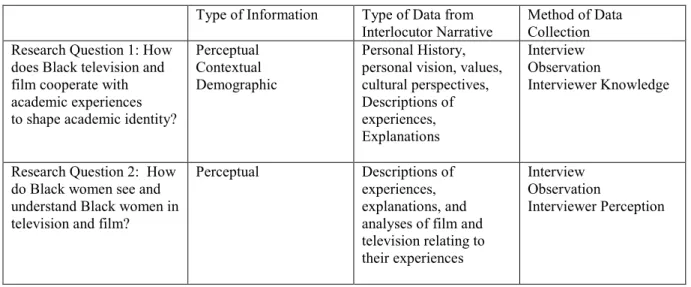
I also seek to understand how popular culture – specifically film and television, cooperate with and influence the racial identity development and academic identities of college aged Black women. This study specifically seeks to understand how the
characters in the films and television shows that they regularly watch influence the
perceptions of Blackness and academic achievement, among other identities these women possess. I hope to achieve this through interviews with Black women from a
southeastern historically White institution and a southeastern historically Black institution. There are two central research questions:
2. What experiences of Black characters in television and film intersect with the academic experiences described by Black female undergraduates as affirming their racial and academic identities?
All data for this study will be collected using life narrative analysis. The interviews consist of open – ended questions in which the interlocutor can reflect on personal experiences and give a first – person account of their own lives. The data presented not only includes what was spoken in the interviews, but it also contains my interpretations of my interlocutors’ body language, emotional reactions, and previous knowledge about the interlocutors during the period of data collection.
Using these methods, I hope to offer clarity in the personal identities and connections that these interlocutors have to Black female characters in the film and television shows that they watch. Additionally, I hope to gain understanding into the ways in which the interlocutors express their academic identities and how that relates to the characters with whom they identify. In doing so, this study seeks to understand how representation in film and media can, indirectly, affect the racial and academic identities of Black women college students. The purpose is to connect the concept of
Theoretical Foundation
All of us are exposed to popular culture, images, and representation, while we are also socialized through wider culture and popular culture. Representation and images conveyed in popular culture influence our expectations for interacting with people. Further, these can be manipulated as a strategy to spread myths connected to identities (Sensoy & DiAngelo, 2012). The use of pop culture to perpetuate the myth of biological Black inferiority is one of the many forms of racism. The Sensoy and DiAngelo (2012) define racism in Canada and the United States as:
White racial cultural prejudice and discrimination, supported by institutional power and authority, used to the advantage of Whites and the disadvantage of people of Color. Racism encompasses economic, political, social, and institutional actions and beliefs that perpetuate an unequal distribution of privileges, resources, and power between Whites and people of Color. (p. 187)
racial identity (1971). This study also relies on Nasir’s theory of racialized identities, in which academic identity is racialized as it is developed (2012).
Critical Race Theory
The ideology of Critical Race Theory (CRT) is that racism is woven into the fabric of our nation – as racism is not a facet of history but an ever-present issue that is constantly a part of the lives of American citizens (Bell, 1980). Critical Race Theory uses race and racism as the analytic center, while also incorporating identities that might intersect, such as gender, class, and sexuality. Critical race theorists embrace that racism is endemic to American life (Bell, 1980) and works to eliminate racial oppression and end all forms of oppression (Matsuda, Lawrence, Delgado, & Crenshaw, 1993).
CRT’s tenet of counterstorytelling acknowledges that White people have historically told many stories of race and racism – including in pop culture (Delgado and Stefancic, 1993). People of color telling their own stories serves as a counterstory – a way for people of color to not only have their own voices but also to combat the narratives that have, in many cases, associated people of color with negative characteristics (Delgado and Stefancic, 1993).
Racial Identity, Academic Identity, and Affirmation
Fordham and Ogbu’s (1986) research explored the influence that race and
ideology that one develops an academic identity to assist in construction of the narratives about schooling and education presented in this study. Black women, however, still experience stressful situations in their careers and academic pursuits (Norris & Mitchell, 2013, Diggins et al, 2015). I use Cohen, et al (2009)’s study on the positive effects if self-affirmation on academic achievement to show the effects of affirmation. The effects of affirmation will be imperative as I frame external affirmation in this research study. I also cite Chavous et al (2003) and Rivas-Drake et al (2014), studies that show that racial pride and positive racial views can have a significant effect on academic achievement. I use these racial affirmation studies to frame an understanding of how affirmation can influence academic achievement in Black students.
Representation of Black People in Film and Television
Cultivation theory (Gerbner, 1967) laid the groundwork for the effects that film and television can have on the ideals, assumptions, and beliefs of the audiences who regularly engage with this type of media. Black representation in popular culture has been a topic of observation and debate since the inception of the film industry (Bogle, 2001). Representation in popular culture and media is a reflection of the environment, values, and manifestations in the society in which the popular culture and media
representation take place (Storey, 2010). Identifying the ways in which Black American people have played the roles of teachers, students, and administrator, specifically in film and television, offer an alternate perspective on the struggle of Black Americans to receive education.
understanding of Black representation in popular culture. Historically, caricatures of Blackness prominently portrayed in films indirectly harmed the Black community with stereotypical representations; they also served a political agenda to keep Black
Americans in a state of inferiority, Bogle (2001) alleged. These caricatures persisted, even as more Black actors and filmmakers gained notoriety in American society. These caricatures in school environments, however, often acted as a political statement about the education of Black people in the United States.
Purpose
The main goal of this research is to improve the quality of life and education for Black women. Educators and policymakers would greatly benefit from this research – as there could be practices and policies put in place that might improve academic
achievement and educational outcomes for Black women students. Educators can, using this research and other forms culturally relevant pedagogy (Ladson-Billings, 1995) implement better teaching, advising, and helping skills with Black women students. Policymakers can head start the implementation of these practices in educational settings.
representations and the stories told of Black women. More Black filmmakers and producers could also lead to a greater variety of types of stories told about the experiences of Black women in America.
Lastly, parents of Black female children would greatly benefit from this research. Parents are often burdened with teaching their children how to navigate through
American society not only as a young person, but also as a young Black person. “The Talk”, as it is often referred to in popular culture, involves handling bullying for often race - related features, developing appropriate responses during interactions with often – White authority figures and law enforcement, and also coping with common racial microaggressions that they are likely to experience as a result of being a Black person in American society.
Positionality
As a Black woman, I connect to this research in a very personal manner. My idols, my inspirations on screen, and my personal mentors are all Black women. This research is very personal for me because I am, in a way, seeking validation that
representation in film and television matters to others as it does to me. As I listen to the stories of the interlocutors in this research, I plan to immediately compare and contrast them to my story. There are different identities that I have that will connect to the stories of my interlocutors. I am also aware that I view all of these stories from the perspective of a Critical Race Theorist. My definitions of racism, White supremacy, and the
Blackness and Womanhood
My childhood experiences, college experiences, and professional experiences have made me aware of the intersection of my race and my gender. Black women have historically experienced oppression at the hands of men, but also at the hands of Black men. Black women have been historically excluded from social movements including the Black Liberation Movement, the Black Power Movement, and most recently the Black Lives Matter Movement (Macias, 2015). We, in turn, try to uplift members of our race knowing that there is a separate set of issues that we experience at the hands of Black men. In the same vein – Black women also have historically experienced oppression at the hands of White women. When women achieved suffrage rights, for example, those rights were only granted to White women – not Black women. As I encounter the world as a Black woman, it is impossible for me to separate the two identities, as I will always be separated from my Blackness because of my womanhood and I will always be separated from my womanhood because I am Black. Understanding the ways in which these two identities intersect to create a new identity (Crenshaw, 2016) oppressed in two different forms connects me to my interlocutors.
Film and Media Indulgence as a Family Value
like racism, colorism, and police brutality. We also related to the characters. My sister and I would tell our mother that she reminded us of “Lisa”, the matriarchal character on the show “Sister, Sister”. We would remark about how my brother, the youngest sibling in my family, looked just like the character “Miles” on the show “Moesha”. We
commented on how my father was the “cool dad”, unlike the portrayals of Black fathers that we saw in film and television. We related to these representations rather than just watching them. We looked for ourselves in these representations. I really seek to understand if my participants saw film and television in the same way.
As I tell the stories of my participants, it is important to acknowledge that I am also a participant. I use my own experiences and perspectives to make sense of the stories of other people. As some may believe this limits my perspective, I contend that it gives me a perspective in which I can connect to my participants beyond the interviewer and interlocutor connection as a member of the within - group (Collins, 1991). I can connect with my participants as women, as Black people, and as someone who wants to be seen and represented adequately.
Racial Philosophy
CRT is a foundational ideology for my interpretations of identity development among Black people and how representation in film and television has been used to perpetuate Black inferiority, as well as how stories told by Black people about Black people can counter the images dominantly portrayed.
realistically, the US is still a very racist society. Not only is the US still racist, but also racism will persist in the US because racism is deeply rooted in the foundation of the US. I believe this theory – as a Black American person. According to Bell, Black people should be as persistent as possible and continue the fight for a truly equal society – even if it is unattainable. While Bell was very realistic in his assessment – many would call him a pessimist. Critiques of him (Powell, 1991) have accused him of stating that the future of the US is hopeless. While he did not intend to seem hopeless in his approach, he wanted to give an honest assessment about the racial state of the US. If Bell was hopeless, he would not have contended that Black people continue in their persistence for equal rights. That persistence has been the reason that, while a struggle has ensued, Black people have gained the right to formal education. The struggle, as Bell described, still continues. This study operates under a racial realism frame – racism is still ever present in American society and it cannot and will not be eradicated but the struggle must persist.
Study Assumptions and Limitations
I asked participants to recall information from school experiences. Some memories may not be as vibrant to them as they recall experiences. I understand that in asking participants to recall events from years before, they may not be as clear. Lastly, I am only interviewing participants who are enrolled at a four – year University. This could skew my cases, as many of my participants could have a certain academic
background. I am limited in the number of life narrative interviews that I can complete. For the purpose of this study, I completed sixteen interviews with eight interlocutors. Ten interviews can provide a wealth of different life experiences, but are not
Definition of Terms
• Academically Rigorous Courses – Honors, Academic Placement (AP), IB (International Baccalaureate), or Dual Credit (College Credit) Courses which are available and taken in high school.
• Anti-Blackness – Discrimination, prejudice against, or disdain for Black people and or features associated with being Black.
• Black – a collective descriptor representing anyone with African descent regardless of national origin.
• Black American – Black people in America that are descendants of people who were enslaved and/or relegated to segregation during Jim Crow.
• Caricature – a picture, description, or imitation of a person or thing in which certain striking characteristics are exaggerated in order to create a comic or grotesque effect. • Color-blind racism – collective expressions of White racial dominance and racial
discrimination that is subtle, apparently nonracial, and institutionalized (Bonilla-Silva, 1997).
• Colorism – A process that privileges light-skinned people of color over dark skinned people in areas such as income, education, housing, and the marriage market (Hunter, 2007)
• Counterstory – a story used as a tool for exposing racial privilege while “voicing” the experiences not often told by people of color (Allen & White-Smith, 2014).
• Cultural Appropriation – the unacknowledged or inappropriate adoption of the customs, practices, ideas, etc. of one people or society by members of another and typically more dominant people or society.
• Media – a means of mass communication, i.e. television, newspapers, and magazines, that influences people’s opinions, thoughts, beliefs, and actions. Media takes a variety of forms – films, television, art, books, news, and social media.
• Minority/Minorities – a collective descriptor representing anyone non-White regardless of national origin.
• Popular Culture – culture based on the tastes of ordinary people rather than an educated elite.
• Race – a divisive social construct, created by Whites during colonial expansion, as a means of assigning themselves rights and power while using themselves as the model for humanity (Racial Equity Institute, 2016).
• Racial Identity – the racial background a person most identifies with.
• Racial Realism – a term created by Dr. Derrick Bell that describes “the permanence of the subordinate status for Black Americans, and by extension the persistence of White supremacy, in establishing law and other social policy”
• Social media – technology that can facilitate the sharing of ideas and other forms of expression. Social Media includes social networks like Facebook, Twitter, Snapchat, Instagram, Linked.In, and other networking websites.
• White – a collective descriptor representing anyone with European descent regardless of national origin.
• Whiteness – historical and social construction of being White in America; social status, privilege, and power associated with being White.
• White Savior or White Messiah – a collective descriptor representing a White person who acts as a savior, liberator, or rescuer of Blacks from desolate circumstances. • White Privilege – unearned benefits given to White people (McIntosh, 1988;
Strmic-Pawl, 2014) granting access to power.
• White Supremacy – systematic and systemic ways in which those that are considered White benefit from the racial social order of society and, as a result, how this social order oppresses people of color (Strmic-Pawl, 2014).
Conclusion of Chapter 1
Representation is a concept and human practice that American society values – as appropriate representation can reflect an identity adequately and present positive
characteristics about an identity. Representation is also cause for concern – when scrutinized it gives us a more intimate understanding of identity, power, privilege, and oppression. While we know from previous research how representation in the classroom can affect academic achievement, this study seeks a deeper understanding of how
CHAPTER2: LITERATUREREVIEW
The objective of this study is to understand how Black female characters in television shows and films resonate with and influence young Black women. This study will focus on the participants’ past K-12 experiences with race and academics. In this chapter, I describe some research studies that have focused on academic achievement and academic identity as it relates to achievement of Black students from kindergarten to high school graduation.
In addition to research on identity development and academic achievement of Black students, I will give a brief analysis of some of the major caricatures that have represented Black women in film historically. I will use the fourth tenet of Critical Race Theory, counterstorytelling, and describe how films and television shows produced by Black minds can act as counterstories to a dominant ideology of caricatures that have represented Black people. Lastly, I will give a comprehensive list and brief analysis of films and television shows that have included portrayals of Black students to show the representation of Black students that currently exists in popular culture and media.
Relevant Literature: Black Students Academic Achievement of Black Students
applied to students of color, particularly Black students. Race and personal
demographics influence educational attainment. Students from low income backgrounds attend schools that “receive fewer resources, face greater difficulties attracting qualified teachers, face many more challenges in addressing student’s needs, and receive less support from parents” (Lee and Burkam, 2002, Sun and Sonnenschein, 2017). Black kindergarteners are already scoring lower on tests than both White and Asian
kindergarteners (Sun and Sonnenschein, 2017) – contributing to the dominant language in education that there is an “achievement gap” amongst Black students and their White and Asian counterparts. In an article that examines the trend of the achievement gap between African American and White students, Flores (2007) points out the failure of theorists to find its remedy and instead uses the concept of an opportunity gap to hold school systems more accountable for the achievement differences between these racial groups.
Not all theory on Black education and achievement is based on low performance. Some of these burdens could theoretically be lifted if educators actively practice
culturally relevant pedagogy, engaging in describes practical application to educating that includes facing implicit biases that show in educational practices. (Ladson – Billings, 1995).
Affirmation and Racial Pride
functioned similarly to John Henryism, a phenomenon in which Black people who worked hard to overcome adversity were more likely to experience high levels of stress and hypertension and thus decreased performance. Sellers et al (2006) found that adolescents with experiences of racial discrimination were likely to have lower levels of psychological functioning and psychological well being.
In an attempt to decrease stereotype threat, Cohen et al (2009) designed a research study that included self-affirmation. Self-affirmation included reflecting on important personal values as a writing assignment (Cohen et al, 2009). This study added a positive element to the psychological strategies Black students could use to overcome stereotype threat. Affirmation not only improved grade point averages and aided assignment into advanced placement courses, but affirmation maintained those increases over time due to perceptions of self – adequacy in Black students (Cohen et al, 2009). These
psychological methods have also been shown to be effective for women who are experiencing psychological threat to their academic achievement (Cook et al, 2012)
Similarly, Black children who have a certain level of racial and ethnic pride have been shown to excel academically, mentally, and physically relating to their health. Chavous et al’s (2003) study found Black adolescents’ beliefs and attitudes about themselves and their race had a significant effect on their educational attainment and social development. Strong group pride and positive beliefs about how society viewed Black people were among the factors that led to positive belief in themselves
pride was positively correlated with better academic performance, more academic engagement, expectations of academic success, and less risky behavior.
Black women as a demographic are not strangers to stress. Black college aged women experience a significant amount of stressors from academic, social, and
environmental pressures due in part to marginalization in various environments (Norris & Mitchell, 2013, Diggins et al, 2015). This is not an issue that is specific to Black female college students. Black actresses have also struggled to manage the pressures of the American film industry (Regester, 2010). Black actresses have struggled to manage the pressure with playing a caricature from both the Black and non-Black communities, they have struggles with the demands of racism in society and Jim Crow, and they have struggled with maintaining Hollywood personas and their own personal lives. It is important to highlight the struggles of actresses who represent Black women in popular culture in order to examine their representations and how they affect the participants of this study – with regards to how they identify with that character and how it affects their own ideas about academic achievement.
Racial Identity, Academic Identity, & Academic Achievement
It is important to acknowledge that academic achievement is often connected to an academic identity. That academic identity is developed through academic experiences and is also racialized due to the involvement of racialized experiences. Fordham and Ogbu (1986) describe a phenomenon described as “the burden of acting White” for high achieving Black students – indicating that Black student achievement is influenced both by external and internal factors. Black students who are high achievers are often
identity. This drives this ideal that Blackness and high academic achievement are identities that are in opposition to each other. Black students therefore have to either align closer to their Blackness and distance themselves from achievement, be race-less and have achievement, or align close to achievement and distance themselves from Blackness. According to Fordham and Ogbu, Black children’s attempts to cope with this burden and their own perceptions of limited opportunity cause Black children to have academic learning and performance issues in American schools. The implications of the Fordham and Ogbu (1986) study regarding the burden of “acting White” indicate that academic identity is racialized.
Nasir (2012) studied academic identity and how racialization of academic identity occurs in its development. This study was based on racialized learning in school
environments and racialized learning in non-school environments. Among the previously discussed research that highlights the lack of achievement and lack of opportunity of Black students due to a variety of issues. Nasir aimed to point out challenges created and maintained by this categorization of Black students resulting from educator and practical ideas presented by previous research.
There was a spectrum of racial identities that Nasir identified in the Black students she studied, ranging from a “thug” identity to a “social conscious and school oriented” one, but there was no in between. While students were more likely to identify with the socially conscious identity that connected them to knowledge of their history and a Black community, the thug identity was still present.
Racial identity was connected to an academic identity that the Black student developed in a variety of settings. Nasir (2012) analyzes how Black students are aware of how certain racial identity groups, like Black people, are connected to poor performance in school and lack of interest in school. The students’ racial identity development was connected to their academic identities through their feelings and understandings of schooling. She mentions that the idea that Black students are underperformers can, however, be
connected to the stereotype of Black students not being academically smart – which is perpetuated in film and television in a variety of ways as well as perpetuated in research (Nasir, 2012).
I assert that academic identity, as a concept, not only highlights the ways in which racial identity and societal racialization can complicate the development of identities, but it also gives Black students a certain amount agency in their own academic likeness. An implication of Fordham and Ogbu’s (1986) and Nasir’s (2012) studies is that while students may not have a choice in societal influence on perceptions of them, lack of resources, and psychological effects, Black students do have a choice in how they can perform academic identity. These studies implicate that Black students believe that performance of their academic identity can connect them closer to Blackness or to academic achievement, even if those are opposing identities.
Relevant Literature and Text: Black People in Film and Television Representation as Oppression: Caricatures of Blackness
characters using computer generated imagery (CGI) that can be considered to represent people of color, such as the alien race in the film “Avatar”. According to Donald Bogle (2001), there are five major caricatures of Black film and movie characters. These caricatures have also evolved over the last century along with progression of American societal norms. According to Bogle, all of these caricatures had one intention: To reinforce the idea of Black inferiority. Although these caricatures as a whole were not explicitly harmful, they reinforced harmful stereotypes about Black people. In this paper, I will focus on the caricatures present of Black women – since that is the common
identity of my interlocutors.
The tragic mulatto caricature could be somewhat of a darling for their likable nature and sympathetic backstory. Tragic mulattos, usually women, struggled with both Blackness and Whiteness – often having White blood in their lineage or being so light in complexion that they could pass for White. Like their names, they often had tragic life stories. Whether they were the daughter of a slave master and a slave woman who grew up alongside her White half siblings, or whether they were light enough to pass as White but didn’t want to abandon or upset their family members – tragic mulatto characters were characters that audiences liked and sympathized with because their Blackness would forever be an obstacle that they would need to overcome.
While tragic mulattos can be likable and have sympathetic storylines, tragic mulattos can also have “jezebel” characteristics. A jezebel is sexual by nature –
caricature is the character of Peola in Imitation of Life (1934), a film based off of Fannie Hurst’s novel of the same name. Peola, a woman light enough to pass as White, struggles with attempting to achieve true happiness by living life as a White woman and making her Black mother proud, a woman who loves her dearly. In the 1959 adaptation of “Imitation of Life” Sarah-Jane, the tragic mulatto character, is given more jezebel characteristics.
The mammy caricature is a popular caricature among audiences – with portrayals in recent films. The mammy caricature could be humorous like the coon – but is
independent, cantankerous, and a woman (Bogle, 2001). Mammy caricatures are usually extremely obese, bossy, and cunning. Mammy caricatures that are mouthier evolved in later films to be sapphires – the archetypal angry Black woman (Ferris, 2012). Sapphires are rude, loud, stubborn, and overbearing. While their pointed personality traits are often directed at Black men, anyone who opposes a sapphire can be targeted. They are bitter – and they want the rest of the world to be unhappy. In contrast, aunt jemima-like mammy caricatures could also be more docile – having more complicit characteristics and a jolly, nurturing nature (Bogle, 2001). They were more polite than the typical mammy
caricatures. They are usually in positions of servitude. Hattie McDaniel was the first Black person to win an Academy Award for her portrayal of a character aptly named Mammy in “Gone With the Wind” (1939), a distinctive mammy caricature (Regester, 2010).
Essentialism, Caricatures, and “Negative” Images
Spike Lee Discourse” criticized this notion that certain Black filmmakers, like Lee, should be lauded for their exclusion of Bogle’s historical caricatures of Blackness and for their “realism” in their representation of Black characters culture, particularly to White audiences. Essentialism, as Lubiano describes it, assumes that there are characteristics that are essential to membership in a group. She says “realism used uncritically as a mode for African-American art implies that our lives can be captured by the presentation of enough documentary evidence or by insistence on another truth”, implying that there is no singular representation of Black people that is “unacceptable” or “acceptable” – as stories of Black people vary greatly (Lubiano, 1991).
According to this scholarship – it is dangerous to present this narrative of
Blackness and Black life in order to “intervene in the dominant culture’s construction of African Americanness” (Lubiano, 1991). Similarly, Raquel Gates (2018) describes how images of Black people in popular culture can often evoke discussions of Blackness and Black life that “acceptable” or “respectable” images do not. Using the concept of images of Blackness in popular culture being “negative", “negativity” is used as a framework to
discuss politics and social norms present in studies of Blackness and Black life. While there are differences in scholarship on whether these caricatures indirectly
harmed the Black community by misrepresenting them or presenting them in stereotypical manners, they also served a White political agenda to keep Black
Films and Television Portrayal as Counterstorytelling
Edward S. Herman’s propaganda model suggests that the wealthy elite control the mainstream media, which only exists to serve the interests of the elite (Goss, 2013). In Herman’s analysis, the mainstream media is a text that is manipulated and molded by the wealthy elite. While the leaders and facilitators of American popular culture, including film and television, have been White people (Osborne, 1989), the consumers of this popular culture are not. The stories presented in television and films are often told by White people and encouraged by White consumers. These stories told then “generate from a legacy of racial privilege, which racial privilege seems ‘natural’” – expressing White privilege through the explicit and implicit messages about the dominance of the White race to the screen (Delgado & Stefancic, 1993). By watching films, television, and other indicators of American popular culture, Black people that are consumers often buying into and telling White stories (Solorzano & Yosso, 2002). Black actors, directors, and consumers offering their ideas about the experiences and issues with being a Black student in America can, however, challenge that ideology that is prominent in other films. This, however, is a rare occurrence in the television and film industries.
Williams (2004) states that people outside of the dominant culture have used their stories, parables, satire, parodies, and other forms of storytelling to provide another perspective of society. Delgado (2000) argued that counterstories are a valuable medium to engage in cultural critique. While Delgado applied this ideology to legal studies, I am applying this ideology to popular culture – as telling stories that counter a dominant narrative will not only influence cultural critique, but critique of what we know to be American societal norms.
Portrayals of Black Students, Black Educators, and Powerful Black Figures in Popular Culture: A Film and Television1 Timeline
As Black students start to develop their own racial identities and their own academic identities, it is important to understand how the portrayals of Black people in television and on film have historically been presented. These films and television shows will act as texts that guide us through historical and current representation of Black students, Black educators, and Black people with advanced degrees in popular culture. Although not as dominant as the caricatures that Bogle and Ferris have presented to us, Black people have been portrayed as people who have pursued education. In this context, educated will indicate that they are students, educators, or have a degree of some type. Black students have been portrayed at every level of education. Even though some roles
were somewhat small, the depiction does have an influence – as they are Black students who are portrayed as students attempting to get an education. This, meaning other Black students in film, is an identity that current Black students can identify with.
Pre-1950’s Depictions of Black Students
American youth films are typically centered on the stories of adolescent, middle – class, White students. Education is situated within those stories – for entertainment purposes – education is usually a pathway to partying, drug use, and sexual activity (Speed, 2001). Black students in film, however, have not been as frequent. While there are a significant number of “token” Black students in White films, rarely are their stories developed on screen. Portrayal of Black students was very rare pre-1950 and usually very brief. In Imitation of Life (1934), Peola is shown being exposed as passing for White in an in – class scene. Peola, who is in a class completely of White people, leaves the classroom hurriedly and embarrassed as her mother, a Black woman, brings her materials for her to get home in the cold, rainy day. In this instance, however, Peola is not developed as a Black person in school as much as she is developed as a young woman who is struggling with her race.
This film presents very polished Black students who compete with White students who attend prestigious institutions like Harvard.
The film “Separate But Equal” – while it premiered in 1991, tells the story of the Brown v. Board of Education case in the 1950’s. Depictions of Black students in scenes are focused on pre-Brown schooling – the main visuals were of a school in South
Carolina in 1950. Black students were subjected to extremely subpar environments in schools – old buildings, few resources, and no transportation to and from school. Young children are shown walking alone across dangerous train tracks. There are many students of many different ages in one classroom – and the class sizes are large with one lone teacher. Circumstances are described in which a student walks five miles to and from school every day. White schools, however, are shown in refurbished buildings with nice décor. They have transportation by school buses to and from school as well. These conditions are what prompted them to sue the school board – who refused to give the Black school one bus, citing money issues. It is implied in this film that Black students are not characteristically inferior, but they do not receive equal accommodations, which inhibits them from certain educational opportunities, like college. While the film does not focus on schooling but more so on the trial, the final decision is not shown to be a decision that actually desegregated schools, as it is superimposed at the end of the film that while Thurgood Marshall later found success by joining the US Supreme Court, schools were not desegregated or improved in a speedy manner.
Black Students Coming of Age in the 1960s and 1970s
struggling with the racism that he has experienced all of his life as someone who has grown up in a middle class, White environment. Spence is very intelligent and interested in Black studies – he even challenges a White teacher who speaks dismissively of the education of Black slaves. He is suspended for these actions – and when chastised by his parents for refusing to accept and adjust to the blatant racism of his school – he leaves home. He does find, however, that his intellect is not able to help him survive the “real world” on his own, after he is rejected many times.
Portrayals of Black students in the late 1960’s and 1970’s allowed for more character development and more of a personal feel to Black students in America. Films that featured Black students, however, also featured extreme poverty. Black sitcoms of the time all depicted families who were subjected to poverty due to lack of education or access to it. While there were occasional situations that the young characters in the sitcoms would experience in school, the sole focus was not the fact that they were Black students in schools. There were films at that time, however, that depicted Black students. In 1975, two films, “Cooley High” and “Cornbread, Earl, and Me” both depicted school aged children in their daily lives.
Preach, however, was academically gifted in poetry and literature, showing promise as a writer. The poverty they experienced was a source of comedy, but it was also a place with dangerous criminal activity. While Preach and Cochise were innocent in their intentions, the presence of bad people, who were also students at their high school, put them in danger. Cochise is violently murdered at the conclusion of the film.
“Cornbread, Earl, and Me” tells a similar story. Cornbread is a promising athlete, with a talent in basketball that has given him many college scholarship offers – which he plans to take. Many believe he is good enough for professional basketball – which will allow him to get his family out of their current environment. While there are no scenes of Cornbread in class – he is shown to be a model citizen and student. He is friendly, he is involved in his community, he mentors neighborhood boys, and he avoids the criminal activity in his neighborhood. Much like “Cooley High”, the area was an extremely poverty filled area with a high crime rate. This film also incorporated police brutality and intimidation, which was a barrier that all of the members of this community, both
students and adults, had to overcome. Cornbread is killed by police officers that mistake him for a criminal in the area. In both of these films, the criminal activity in the