FUNCTION AND DYSFUNCTION OF THE PREFRONTAL CORTEX: EFFECTS OF DISTRACTION ON ACTIVE MAINTENANCE IN HEALTHY CONTROLS AND
INDIVIDUALS WITH SCHIZOPHRENIA
Sarah J. Hart
A dissertation submitted to the faculty of the University of North Carolina at Chapel Hill in partial fulfillment of the requirements for the degree of Doctor of Philosophy in the Department of Psychology.
Chapel Hill 2007
Approved by Aysenil Belger, Ph.D. Kelly Giovanello, Ph.D.
ABSTRACT
SARAH J. HART: Function and Dysfunction of the Prefrontal Cortex: Effects of Distraction on Active Maintenance in Healthy Controls and Individuals with
Schizophrenia
(Under the direction of Aysenil Belger, Ph.D.)
The prefrontal cortex (PFC) is thought to be critical for the active maintenance of goal-related information in the face of distraction. Previous studies have demonstrated that schizophrenia is associated with changes in the function of the PFC, and is
characterized by difficulties in the active maintenance of information in working memory and in the ability to resist distraction. Two functional neuroimaging experiments were conducted with healthy control participants that examined the effects of distracter demand on working memory by manipulating both voluntary attention to distracters (“executive”) and involuntary capture of attention by emotional distracters. Two additional behavioral experiments were conducted to assess how processing of these types of distracters would be affected in individuals with schizophrenia. It was expected that specific prefrontal subregions would be differentially recruited under conditions of increased distracter demand, and that the group with schizophrenia would be
disproportionately affected by executive, but not emotional distraction. The results largely supported the hypotheses, and indicated that the ventrolateral PFC was
DEDICATION
ACKNOWLEDGEMENTS
TABLE OF CONTENTS
LIST OF TABLES………...x
LIST OF FIGURES………....xi
Chapter I. INTRODUCTION………1
Prefrontal Cortex Function in Active Maintenance……….5
Working Memory……….5
Effects of Perceptual Interference………6
Effects of Proactive Interference……….8
Effects of Attention Allocation………9
Effects of Emotional Interference………..11
Rule Maintenance………..14
Effects of Switching………...16
Effects of Emotional Interference………..18
Prefrontal Cortex Dysfunction in Schizophrenia………...19
Working Memory………...20
Effects of Distraction……….22
Effects of Switching………...29
Effects of Emotional Interference………..31
Remaining Questions……….33
II. EXPERIMENT 1………...38
Method………...……38
Participants……….38
Imaging Task……….38
Image Acquisition………..40
Analyses……….41
Imaging Data………..41
Preprocessing……….41
Voxel-Based Analyses………...41
Region of Interest (ROI) Analyses………42
Behavioral Data……….42
Results………43
Behavioral Performance……….43
Imaging Data………..44
Effects of Executive Distraction………44
Laterality Effects………46
Brain-Behavior Correlations………..46
Discussion………..48
III. EXPERIMENT 2……….57
Participants……….57
Imaging Task……….57
Image Acquisition………..59
Analyses……….59
Imaging Data………..60
Voxel-Based and ROI Analyses………60
Behavioral Data……….60
Results………60
Behavioral Performance……….60
Imaging Data………..61
Effects of Emotional Distraction………...61
Laterality Effects………63
Brain-Behavior Correlations………..64
Effects of Switching………...64
Interactions between Emotion and Switching………64
Discussion………..65
IV. EXPERIMENT 3……….74
Method………...74
Participants……….74
Behavioral Task……….75
Analyses……….76
Results………77
Within-Group Performance: Patients……….79
Between-Group Comparisons………80
Correlational Analyses………...83
Discussion………..83
V. EXPERIMENT 4………..89
Method………...89
Participants……….89
Behavioral Task……….89
Analyses……….90
Results………91
Within-Group Performance: Controls………91
Within-Group Performance: Patients……….91
Between-Group Comparisons………92
Correlational Analyses………...94
Discussion………..94
VI. GENERAL DISCUSSION………101
LIST OF TABLES
Table
1. Foci of Maximum Activation for the Control and
One-Back Tasks……….107 2. Foci of Maximum Activation (One-Back Greater than
Control)………..108 3. Foci of Maximum Activation (Control Greater than
One-Back)………..109 4. Foci of Maximum Activation (Emotional Greater than
Neutral)………..110 5. Foci of Maximum Activation (Neutral Greater than
Emotional)………..111 6. Foci of Maximum Activation (Rule Switching Greater
than Rule Maintaining)………..112 7. Foci of Maximum Activation (Emotional Rule Switching
LIST OF FIGURES Figure
1. Schematic of Dorsal Executive and Ventral Affective
Circuitry……….114
2. Schematic of Executive Distraction Task Design………..115
3. Accuracy on Working Memory and Distraction Tasks……….116
4. Ventrolateral PFC Activation in Executive Distraction……….117
5. Dorsolateral PFC Activation in Executive Distraction………..118
6. Schematic of Emotional Rule Task Design………...119
7. Accuracy during Rule Maintenance Task………..120
8. Ventrolateral PFC Activation in Emotional Distraction………121
9. Amygdala-Hippocampal Complex Activation in Emotional Distraction………122
10. Dorsolateral PFC Activation in Emotional Distraction……….123
11. Anterior Cingulate Activation in Emotional Distraction………...124
12. System Interactions during Emotional Distraction………125
13. Control Group Accuracy during Low Memory Load………126
14. Control Group Accuracy during High Memory Load………...127
15. Accuracy in Group with Schizophrenia……….128
16. Group Differences on Working Memory………...129
17. Group Differences on Distracter Task………...130
18. Trade-Offs in Performance (Control – One-Back)………131
21. Group Differences in Accuracy during Emotional
CHAPTER I INTRODUCTION
The prefrontal cortex (PFC) is critical for supporting cognitive control processes that allow for the guidance of behavior according to a goal. Performance of goal-directed behavior requires not only the ability to retain the relevant goal in mind, but also the ability to ignore information that is irrelevant to the primary task at hand. The prefrontal cortex is thought to be important for supporting multiple cognitive processes, such as working memory (WM) (Goldman-Rakic, 1987), selective attention (Banich et al., 2000; Milham, Banich, & Barad, 2003), and inhibition (Fuster, 1980). All of these cognitive processes are thought to rely to some degree on the same prefrontal mechanism, that is, the active maintenance of task-relevant information in the face of interference (Desimone & Duncan, 1995; Kastner, Pinsk, De Weerd, Desimone, & Ungerleider, 1999).
currently relevant task goals to be maintained, while simultaneously preventing task-irrelevant information from interfering with the task at hand.
The activity of prefrontal neurons during active maintenance is characterized by sustained high rates of firing during delayed-response tasks, where information must be held in working memory across a delay period (Chafee & Goldman-Rakic, 1998; Curtis & D'Esposito, 2003; Ranganath, Cohen, Dam, & D'Esposito, 2004). Functional
neuroimaging studies in humans have similarly found sustained high levels of prefrontal activation during working memory performance (Cohen et al., 1997; Courtney,
Ungerleider, Keil, & Haxby, 1997; Jha & McCarthy, 2000). Findings from lesion studies have provided complementary evidence supporting the role of the prefrontal cortex in maintenance, as loss of these neurons leads to impaired performance on delayed-response tasks (Curtis & D'Esposito, 2004; Funahashi, Bruce, & Goldman-Rakic, 1993; Mishkin, 1957).
While this sustained activation may reflect processes of keeping information in mind, it may also reflect another crucial function of the PFC, which is keeping
therefore, largely affected by impaired ability to suppress the effects of task-irrelevant information on information maintained in working memory.
In line with findings that the PFC is important for suppressing interference, neuroimaging studies using task-irrelevant distracters during WM paradigms have found that activation in the PFC is capable of surviving distraction, as opposed to more
posterior sensory regions, where sustained activity is disrupted (Constantinidis & Steinmetz, 1996; Miller, Erickson, & Desimone, 1996). Prefrontal sustained activation has also been found to further increase as a function of distraction when compared to maintenance conditions without distraction, suggesting that the PFC may play an active role in protecting memories from interference (Sawaguchi & Yamane, 1999). These findings have therefore supported a role for the PFC in not only active maintenance, but also in the ability to simultaneously protect active memories against distraction (Sakai, Rowe, & Passingham, 2002).
The primary mechanism in the prefrontal cortex that coordinates these processes works by sending bias signals that modulate the activity of more posterior neural
pathways. These signals have been found to be critically involved in “top-down” processes of cognitive control, or the ability to guide one’s behavior according to a goal (Miller & Cohen, 2001). This mechanism is thought to be particularly important in conditions where the mappings between stimuli and responses are relatively weak
goal’s internal representation and to adjust behavior accordingly (Braver, Barch, & Cohen, 1999).
Miller and Cohen (2001) have argued that these bias signals guide the activity of neural pathways that establish the proper mappings between stimuli, internal states, and responses. While different pathways compete with one another through mutual inhibitory interactions, the pathways that are selected by the PFC reach higher levels of activation (Desimone & Duncan, 1995). Sensory regions processing attended features are biased towards more activation (Giesbrecht & Mangun, 2002; Hopfinger, Buonocore, & Mangun, 2000; Mangun, Buonocore, Girelli, & Jha, 1998), while other regions processing unattended features are suppressed as a consequence of those bias signals (Desimone & Duncan, 1995). These mechanisms have been illustrated, for example, by neuroimaging and electrophysiological studies showing that increasing the amount of attention allocated to a primary task (i.e., bias signal strength) attenuates the neural response to task-irrelevant stimuli (Yucel, Petty, McCarthy, & Belger, 2005a, 2005b). The biasing signals can also be sustained over time, allowing for the active maintenance of attended, task-relevant representations until the goal is achieved.
The following introduction will present a review of the literature that addresses the role of prefrontal mechanisms in normal processes of active maintenance,
tasks. Furthermore, this review will address how these mechanisms have been found to be altered in schizophrenia, as evidenced by behavioral and neurophysiological findings.
Prefrontal Cortex Function in Active Maintenance Working Memory
Working memory is the ability to actively maintain and manipulate information over a short period of time (Baddeley, 1986). Top-down attentional control is thought to play an important role during active maintenance, underlying the ability to keep selected task-relevant goal representations continuously active over time (Awh, Jonides, & Reuter-Lorenz, 1998; Awh et al., 1999; Barnes, Nelson, & Reuter-Lorenz, 2001; Corbetta, Kincade, & Shulman, 2002). Indeed, recent theories have begun to
conceptualize working memory as the recruitment of brain systems through attention, as opposed to the operation of specialized systems like the phonological loop, visuospatial sketch pad and central executive in Baddeley’s (1986) multiple component model (Postle, 2006). Postle (2006) suggests that rather than reflecting active maintenance of
specialized sensory inputs, prefrontal neurons instead support the ability to flexibly adapt behavior according to information that is currently relevant to the task goal (Duncan & Miller, 2002; Fuster, 2002).
A recent study by Lebedev, Messinger, Kralik, and Wise (2004) directly
remembered locations. The smallest subset of recorded neurons responded to remembered locations only. The authors concluded that delay-period activity in prefrontal neurons is primarily accounted for by attentional selection processes, as opposed to memory functions per se. While the findings show that the PFC does support WM functions, they suggest that the delay-period activity in the PFC supports multiple additional cognitive functions, including the guidance of behavior according to currently relevant goals.
The PFC is able to continuously maintain sensory representations for as long as they are relevant to the current task, which usually spans across many other irrelevant, interfering events (Miller & Cohen, 2001). Many studies have therefore examined the effects of different types of task-irrelevant distraction on active maintenance processes. Given the evidence that attention is a primary mechanism supporting active maintenance in the face of concurrent distraction, it is not surprising that diversion of attentional resources to task-irrelevant stimuli impairs active maintenance processes. The following sections will review and compare the effects of several different types of distraction on active maintenance processes.
Effects of Perceptual Interference
probe stimulus was part of the original memory array. Interference can then be
manipulated within trials by presenting distracters during the delay period that are either congruent or incongruent with the domain of the maintained information (e.g., during a face working memory task, presenting pictures of congruent faces and incongruent houses as distracters). According to the attentional rehearsal hypothesis, which posits that attention is the mechanism underlying active maintenance, processing of congruent distracters will be facilitated because the brain areas representing them are already biased due to concurrent active maintenance processes. Under these conditions, prefrontal selection mechanisms should be invoked to prevent distracters from interfering with the primary working memory task (Jha, Fabian, & Aguirre, 2004; Thompson-Schill,
D'Esposito, Aguirre, & Farah, 1997).
One theory of prefrontal organization posits that this ability to inhibit interference from irrelevant stimuli is represented in more ventral PFC subregions, while more dorsal regions support maintenance processes (Luria & Homskaya, 1970). Alternatively, more recent theories have supported a more general role for ventral prefrontal regions in selecting between competing responses, rather than inhibiting irrelevant information per se (Sakai et al., 2002; Tippett, Gendall, Farah, & Thompson-Schill, 2004). In terms of Miller and Cohen’s (2001) model, this differing response competition may be reflected through variations in PFC biasing signals that can account for different activation between prefrontal subregions.
To address the role of prefrontal subregions in WM maintenance and interference resolution, Jha et al. (2004) used a face working memory task to test whether the
predicting that delay-period activity in this region would be greater during congruent than incongruent distraction (pictures of faces and shoes, respectively). The results indicated that both dorsal and ventral prefrontal regions showed sustained delay-period activation during the working memory task, but only the ventral PFC was modulated by the congruency of the distracters, with greater activity for the congruent face distracters. In addition, the fusiform face area showed enhanced activation during congruent faces compared to incongruent shoes. These congruency effects were only present during correct trials, suggesting that the interaction between prefrontal selection mechanisms and posterior sensory regions plays an important role in preventing interference during WM.
In contrast to the vlPFC, the dorsolateral PFC (dlPFC) did not respond differently according to distraction, although it showed greater delay-period activation for correct than incorrect trials, suggesting an important role in active maintenance. Jha et al. (2004) suggest that under conditions of difficult, congruent distraction, the selection failures of the vlPFC lead to maintenance failures within the dlPFC, with concomitant decreases in delay-period activation. While these interacting neural mechanisms are still a matter of debate, the results of the study indicate that dorsal and ventral prefrontal subregions may play differential roles in maintenance and interference resolution.
Effects of Proactive Interference
correct response would be to identify the item as a non-match to S1, but interference results from the item being presented previously in the experiment. This type of interference typically leads to slower reaction times and poorer accuracy on recent-negative probe trials compared to other trial types (Goggin & Wickens, 1971; Jha et al., 2004; May, Hasher, & Kane, 1999).
Like studies of perceptual interference, neuroimaging studies of proactive interference have also found increased involvement of the ventrolateral PFC during greater distraction. Several studies have found that the vlPFC is more active on recent-negative probe trials than other trials (Bunge et al., 2001; D'Esposito, Postle, Jonides, & Smith, 1999; Jha et al., 2004; Jonides, Smith, Marshuetz, Koeppe, & Reuter-Lorenz, 1998). It has been proposed that the vlPFC engages similar selection processes when a probe item is familiar, so that the item must be further evaluated as to whether it is task-relevant or irtask-relevant (Thompson-Schill, 2003; Tippett et al., 2004). Ventrolateral PFC activation has indeed been found to increase when it is uncertain whether the item is relevant or irrelevant and the need for selection is high (Kan & Thompson-Schill, 2004; Nelson, Reuter-Lorenz, Sylvester, Jonides, & Smith, 2003; Thompson-Schill et al., 2002). Like studies of perceptual distraction, these findings are consistent with an important role of the vlPFC in representational selection processes that help to resolve interference (Desimone & Duncan, 1995; Jha et al., 2004).
Effects of Attention Allocation
the degree of control allocated to a task according to the current goal is an important adaptive function of the PFC. For example, it is important to pay closer attention to the road when driving on a rainy night than during a sunny day (Miller & Cohen, 2001). In the previously described distracter tasks, the primary goal of the task is to maintain information in working memory while allocating as little attention as possible to
distracters, as they are irrelevant to the primary task. However, these types of distracters often require some attention to be allocated to them (for example, when pressing a button in response), thus diverting some resources away from the primary working memory task. One question that has remained unanswered is the effect of active allocation of some attentional resources to secondary distracter stimuli, while the bulk of attentional resources are focused on the primary working memory task. Given that attentional mechanisms play an important role in prefrontal active maintenance processes, the active diversion of resources to a secondary task would be expected to similarly impair active maintenance and recruit selection mechanisms to deal with increased competition.
prefrontal regions generally predicted working memory performance. Furthermore, under conditions of distraction, the correlation between activation in prefrontal and posterior sensory regions was found to predict working memory performance. Consistent with findings from perceptual interference paradigms (Jha et al., 2004), these results suggest an important role for interacting prefrontal and posterior sensory regions in protecting active memories from interference, suggesting similar recruitment of prefrontal biasing mechanisms during both active and passive types of distraction.
While the study by Sakai et al. (2002) employed distracters that were actively attended during the delay, it differs notably from the current study (Experiment 1) in that the distracters completely disrupted the ability for active maintenance to occur. The processes underlying executive distraction during simultaneous active maintenance processes have remained unexplored. Furthermore, the study by Sakai et al. (2002) did not distinguish activation patterns between prefrontal subregions. Experiment 1 in this study aimed to directly assess the effects of executive distraction in separate dorsal and ventral prefrontal regions by manipulating the degree to which distracters must be attended, without completely disrupting active maintenance.
Effects of Emotional Interference
emotionally neutral distracters as a modulation of distracter demand during working memory maintenance.
Studies of stress effects, which cause a physiological response and have been conceptualized as an emotional state (Lazarus, 1999), have been found to impair
executive ability and prefrontal function. For example, Hartley and Adams (1974) found that presenting loud noise stressors impairs the abilities for selective attention and
inhibition during performance of the Stroop task, which requires processing of task-relevant information over competing irtask-relevant information. Arnsten and Goldman-Rakic (1998) found similar effects in monkeys, where noise stress impaired spatial working memory performance. The authors suggested that emotional stress takes the PFC “off-line”, allowing behavior to be regulated by more habitual responses.
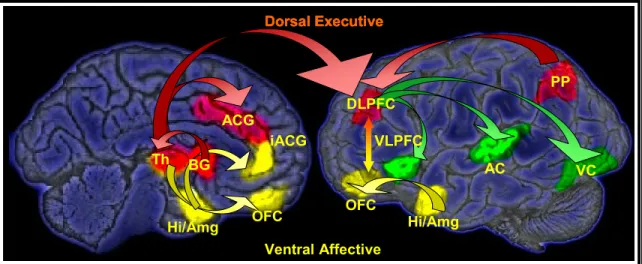
The mechanisms underlying these emotional interference effects have been proposed to rely on an interaction between dorsal and ventral brain systems that differentially support executive and emotional processing (Drevets & Raichle, 1998; Mayberg, 1997; Phillips, Drevets, Rauch, & Lane, 2003). The dorsal executive control system (DECS) includes the dorsolateral PFC and parietal cortex and is critically involved in active maintenance of goal-relevant information. The ventral affective processing system (VAPS) includes the ventrolateral PFC (vlPFC), medial PFC,
orbitofrontal PFC, and the amygdala (Davidson & Irwin, 1999; Zald, 2003) (Figure 1). It has been suggested that interactions between these dorsal and ventral systems can
& Cummings, 1994), conflict monitoring (C. S. Carter et al., 1998), and evaluating emotional information (Bush, Luu, & Posner, 2000; Vogt, Berger, & Derbyshire, 2003). The vlPFC, in addition, has been proposed to be a site of integration between emotional and executive processes, as it has been found to be activated during both behavioral inhibition (Aron, Robbins, & Poldrack, 2004) and emotional interference (Wang et al., 2005; Yamasaki, LaBar, & McCarthy, 2002).
A study by Dolcos and McCarthy (2006) demonstrated the effects of emotional distraction during working memory maintenance on activation in the DECS and VAPS. Using a delayed-response working memory task for faces, they presented emotional and neutral scenes during the delay period. The results indicated that the emotional
distracters elicited activity in the VAPS, including the amygdala and ventrolateral PFC. Simultaneously, the emotional distracters led to deactivation in the DECS, including the dorsolateral PFC and parietal cortex. These changes in activation were also associated with greater behavioral impairment due to emotional distraction compared to equally complex neutral distracters. The study demonstrated that the interactions between these dorsal and ventral systems could explain the detrimental emotional interference effect on active maintenance processes.
A specific region in the VAPS, the orbitofrontal cortex (OFC), has frequently been associated with processing social and affective stimuli (O'Doherty, Kringelbach, Rolls, Hornak, & Andrews, 2001; Price, 1999). The OFC receives extensive projections from the amygdala, and has been found to be critical in aspects of reward processing and emotional evaluation and decision making (Bechara, Damasio, & Damasio, 2000;
that this region may have a more important role in resolving competition rather than being specialized for emotional information per se, because emotional stimuli are more likely to strongly compete for attention by eliciting reflexive reactions. The orbitofrontal PFC may play an important role in dealing with increased competition, which is reflected under conditions where emotional stimuli lead to greater competition for the focus of attention. While specific prefrontal regions do receive input from areas that process emotion, the increased response competition may account for a significant amount of the activation observed in these regions.
As the role of the PFC in emotional distraction during working memory has only just begun to be examined, the exact mechanisms by which emotional information
impairs active maintenance have yet to be delineated. Because emotional stimuli provide a particularly salient form of distraction, they can provide a useful way to manipulate distracter difficulty and to examine how the dorsal and ventral systems interact.
Experiment 2 in the current study aimed to expand upon the current findings by assessing how emotional distraction affected the recruitment of prefrontal regions during active maintenance of task goals and rules.
Rule Maintenance
of the current task rules. Impairment to these prefrontal mechanisms is associated with difficulty in adapting behavior according to the currently relevant task rule, leading to perseverative behavior.
Evidence from several neuropsychological studies has supported the critical role that prefrontal mechanisms play in rule maintenance and flexible adaptation of behavior. For example, prefrontal damage is associated with perseveration on the Wisconsin card sort task (WCST), which requires participants to sort cards according to a rule that varies periodically (Dias, Robbins, & Roberts, 1997; Milner, 1963). Because no single
stimulus-response mapping can be used, behavior must be flexibly adapted when the task goals change. Top-down signals are required to favor the currently task-relevant
response (i.e., to sort according to the new rule), which is in competition with the irrelevant but prepotent response (i.e., to sort according to the previously used rule).
Several studies using neuroimaging techniques have found prefrontal activation during abstract rule maintenance in humans. In these studies, participants are typically trained on an arbitrary set of stimulus-response associations before scanning. Neural activity is then recorded while participants hold the currently task-relevant rule in mind in order to guide subsequent responses. Manipulations of demand on rule retrieval and maintenance (e.g., complex versus simple rules) have consistently found greater
involvement of the ventrolateral PFC (Brass & von Cramon, 2004; Bunge, Kahn, Wallis, Miller, & Wagner, 2003; Crone, Wendelken, Donohue, & Bunge, 2006). However, the roles of prefrontal subregions in rule maintenance under conditions of interference, such as during task switching, remain controversial.
Effects of Switching
Task switching is considered to be a component of rule implementation, and requires retrieval of the currently relevant task set while ignoring the previously relevant set (Bunge, 2004; Sakai & Passingham, 2006; Swainson et al., 2003). Behavioral studies have consistently found that switching to rules that have two response meanings (i.e., where the response depends on the current rule) is more difficult than switching to rules with single response meanings (Crone et al., 2006; Monsell, 2003). These findings suggest that performance decrements resulting from task switching do not result only from retrieving a new rule, but also result from the need to override the previously relevant rule. Indeed, several neuroimaging studies have demonstrated activation in the same lateral prefrontal regions during both task switching and inhibition (e.g., in
While both the vlPFC and dlPFC have been implicated in the ability to flexibly switch behaviors when the task rules change (Shafritz, Kartheiser, & Belger, 2005; Yeung, Nystrom, Aronson, & Cohen, 2006), Crone et al. (2006) found that lateral prefrontal areas may be more important for rule maintenance, while medial prefrontal regions may contribute more to the ability to override the old rule.
Swainson et al. (2003) specifically examined the extent to which a common neural mechanism supports task switching and behavioral inhibition processes using a modified go / no-go paradigm. The task design isolated the processes of inhibiting a motor response and switching between task sets by having subjects switch between two tasks, including a “go” task requiring an immediate response and a “wait” task requiring the response to be withheld until stimulus offset. Within a mixed block of trials, switch and non-switch trial types could be isolated, along with “go” and “wait” trials. The results indicated that lateral prefrontal activation elicited by response inhibition was found only on switch trials, but not non-switch trials. Activation elicited by task
switching was, similarly, only apparent on “wait” trials requiring inhibition. The results indicate therefore that lateral prefrontal activation depended on interacting processes of inhibition and task switching. The results are consistent with previous findings
suggesting that a common prefrontal inhibitory mechanism may underlie both task switching and behavioral inhibition abilities (Konishi et al., 1999).
While several studies have examined inhibitory control during task switching using these types of designs, the effects of task-irrelevant perceptual information
whether the inhibitory mechanisms required for switching are the same as those involved in the ability to ignore irrelevant perceptual inputs. Experiment 2 in the current study addressed the effects of task-irrelevant perceptual information presented during rule use in the form of emotional pictures, in order to examine effects of distracter demand across the period of time that a rule was being maintained.
Effects of Emotional Interference
As described in the working memory section above, distracters with emotional content provide a particularly salient form of interference that allows for the manipulation of distracter difficulty. Few studies have specifically investigated emotional effects on rule maintenance or switching, although several animal studies have examined the interactions between emotion (in the form of associated rewards) and shifting of
animal studies have dissociated the roles of prefrontal subregions in emotional and executive processing, the effects of emotional information as a perceptual distracter during rule maintenance and switching have remained unexplored. This manipulation was tested in Experiment 2 in the current study.
The final two experiments (3 and 4) in this set of studies addressed distraction effects on active maintenance in individuals with schizophrenia. Like Experiments 1 and 2, these studies addressed the effects of voluntary attention allocation and involuntary diversion of attention on active maintenance processes. The following section will review the effects of schizophrenia on prefrontal mechanisms and the associated changes in active maintenance processes and interference resolution.
Prefrontal Cortex Dysfunction in Schizophrenia
Schizophrenia is a severe and chronic mental illness characterized by behavioral deficits in a multitude of cognitive domains, including working memory, attention, and various executive functions (Braver et al., 1999; Perlstein, Carter, Noll, & Cohen, 2001). A predominant theory of cognitive impairment in schizophrenia posits that these
neurophysiological measurements, including in individuals in the prodromal stage of schizophrenia (Morey et al., 2005; van der Stelt, Lieberman, & Belger, 2005).
Impairments in the ability to selectively attend to relevant stimuli in schizophrenia have been well-documented in the literature, as shown by impaired performance on Stroop tasks, where attention must be allocated to one aspect of a stimulus (the ink color of a printed word) while a prepotent response (reading the word) must be inhibited (Abramczyk, Jordan, & Hegel, 1983; Barch, Carter, & Cohen, 2004; Schooler, Neumann, Caplan, & Roberts, 1997). Individuals with schizophrenia also show impairments on continuous performance tasks like the AX-CPT, where the currently relevant context or goal1must be attended to and used to govern a response to a target (Cohen, Barch, Carter, & Servan-Schreiber, 1999; Cornblatt, Lenzenweger, & Erlenmeyer-Kimling, 1989; Nuechterlein & Dawson, 1984). Furthermore, schizophrenia is frequently associated with difficulties on behavioral inhibition tasks that require the suppression of a prepotent response, as shown by impairments on go / no-go tasks (Kiehl, Smith, Hare, & Liddle, 2000; Weisbrod, Kiefer, Marzinzik, & Spitzer, 2000). Impairment to prefrontal
mechanisms can therefore influence performance on a multitude of cognitive tasks that require selective attention and inhibition. In addition, individuals with schizophrenia are particularly impaired on tasks that require the active maintenance of selective attention over time, as in working memory.
Working Memory
Consistent with the proposed prefrontal dysfunction in schizophrenia, behavioral studies have demonstrated significant impairments in working memory performance, with difficulty in actively maintaining information in the face of distraction (C. Carter et al., 1996; Park & Holzman, 1992). It has been suggested that WM deficits may be a core feature of schizophrenia, underlying many of the disorder’s deficits and symptoms (Manoach, 2003). As a result of impairment in the ability to actively keep task-relevant information in mind while resisting interference, individuals with schizophrenia generally have difficulty with goal-directed behavior, leading to behaviors that are guided by stimuli rather than context (MacDonald et al., 2005; Manoach, 2003). This impairment in contextual, goal-directed processing in schizophrenia has been proposed to explain the behavioral difficulties on many different types of working memory tasks that require active maintenance and manipulation of information (Barch, 2006).
evidence suggests that working memory deficits in schizophrenia should be considered in terms of network dysfunction, rather than focused exclusively on dlPFC hypoactivation.
While many studies using a variety of paradigms have found evidence of hypofrontality in schizophrenia, several studies have also found equal activation or hyperactivation of prefrontal regions during working memory tasks (Callicott et al., 2000; Honey, Bullmore, & Sharma, 2002). A review by Manoach (2003) addressed these seemingly discrepant findings by examining methodological issues between studies. The review suggests that task difficulty may be an important factor mediating whether
prefrontal regions show hyper- or hypoactivation in schizophrenia. Manoach suggests that due to reduced WM capacity in schizophrenia, prefrontal activation as a function of load is shifted so that the dlPFC activates maximally at a lower load relative to controls. Hypofrontality may therefore be largely a result of testing WM loads that exceed the capacity of the individuals with schizophrenia, but not the controls. Findings of hypo- and hyperactivation in the PFC during working memory in schizophrenia may therefore both be informative markers of dysfunction.
Effects of Distraction
between task-relevant and irrelevant information, increasing the influence of distracting input. Abnormalities in dopamine signaling are thought to dysregulate the ability to gate information in working memory, leading to susceptibility to interference (Braver et al., 1999). Indeed, several studies have found that modulating dopamine levels can improve working memory performance in schizophrenia (Daniel, Berman, & Weinberger, 1989; Daniel et al., 1991).
It has been suggested that a reduction in the amount of available processing resources in schizophrenia leads to impairments on both active maintenance and the ability to resist distraction. The ability to perform and coordinate multiple tasks simultaneously relies on a finite pool of attentional resources that must be allocated according to task demands. The allocation of attentional resources is thought to occur following the detection of conflict, and involves interactions between the PFC and anterior cingulate cortex (Botvinick, Nystrom, Fissell, Carter, & Cohen, 1999; C. S. Carter et al., 2000). Individuals with schizophrenia have been found to perform poorly across domains under conditions with high processing demands, suggesting that they reach the limit of resources at lower processing loads than controls, an idea which is also consistent with their working memory deficits (Granholm, Asarnow, & Marder, 1996; Nuechterlein & Dawson, 1984; Silver & Feldman, 2005).
However, it has remained a matter of debate whether individuals with
visual search task simultaneously with a secondary reaction time task requiring a button press in response to an auditory tone, which was either cued by a warning (high demand) or was unwarned (low demand). Allocation of resources was assessed by examining resource tradeoff, that is, the improvement in performance on one task when performance on the other decreases, between the high and low demand tasks in the dual-task condition. The results indicated that that the group with schizophrenia was more impaired on the dual-task condition than controls, suggesting a reduction in the amount of processing resources, but analyses of resource tradeoff indicated that both groups allocated resources similarly. The authors noted, however, that resources may still be allocated improperly when task-irrelevant stimuli are present. Furthermore, it is possible that when competing tasks engage active maintenance processes, rather than only selective attention, the overloading of prefrontal mechanisms would lead to greater distractibility.
Fleming et al. (1995) addressed the effects of task-irrelevant distracters on active maintenance in schizophrenia using a delayed-response paradigm with an “executive” type of distraction, where varying degrees of attention needed to be allocated to a secondary task. The study manipulated distracter demand during a verbal working
memory task by comparing the effects of finger-tapping, counting forwards, and counting backwards from 100 by threes during active maintenance. As the combination of
working memory requirements and need to resist distraction necessitates the
schizophrenia was disproportionately impaired by greater distracter demand relative to controls. Even distracters that required relatively little attentional resources, like forward counting, resulted in significant disruption to the primary working memory task,
supporting the possibility that overloading prefrontal mechanisms leads to greater distractibility.
The study by Fleming et al. (1995) was limited in that it did not directly measure the degree of attention allocated to the distracter tasks (for example, by measuring speed or accuracy when counting backwards). Furthermore, the study averaged only 5 trials to assess the effect of each distracter condition. Experiment 3 in the current study aimed to improve upon the design of Fleming et al. (1995) by measuring behavioral responses at both WM retrieval and during the secondary distracter task itself, and included 24 trials per condition. Furthermore, it was able to control for perceptual and motor requirements across the distracter conditions in order to better isolate the effects of attentional
allocation. This allowed for the examination of whether increased attention allocation to distracters could account for impaired working memory performance in schizophrenia. Attention-Emotion Interactions
While Experiment 3 assessed the effects of distracter demand in schizophrenia by degree of attention allocated, Experiment 4 manipulated it according to emotional
schizophrenia is characterized by proportionately greater distractibility to emotional stimuli.
Schizophrenia is characterized by changes in social and emotional processing, which have been linked to impaired prefrontal function (Andreasen et al., 1992). The negative symptoms of schizophrenia are associated with abnormalities in affect and motivation, including emotional blunting, apathy, lack of spontaneity, social withdrawal, and anhedonia (Andreasen et al., 1992; C. Carter et al., 1996). It has been furthermore suggested that positive symptoms, such as hallucinations and delusions, may directly reflect the interplay between executive and emotional processes (Freeman, Garety, Kuipers, Fowler, & Bebbington, 2002).
These executive-emotional interactions have been found to be abnormal in schizophrenia in several types of cognitive paradigms, and have been associated with abnormal attentional biases for affective information (Waters, Badcock, & Maybery, 2006). It has been argued that affective information provides context for directing behavior and directs attention toward relevant stimuli, a process which relies on the PFC (Park, Gibson, & McMichael, 2006). Emotional and motivational processes are therefore necessary for goal-directed behavior to occur. Impaired affective processing may
therefore impair the abilities for active attention and working memory, or conversely, WM deficits may disrupt socio-affective functioning. It is also possible that the deficits in schizophrenia may generally reflect impaired goal-directed behavior, whether it is guided by cognitive, affective or social information (Park et al., 2006).
and speech affect (Edwards, Jackson, & Pattison, 2002; Gooding & Tallent, 2002; Martin, Baudouin, Tiberghien, & Franck, 2005; Schneider et al., 2006). In particular, individuals with schizophrenia have been found to have deficits in recognizing fearful facial expressions, which has been linked to dysfunctional activation in the amygdala (a region in the VAPS) (Edwards, Pattison, Jackson, & Wales, 2001; Evangeli & Broks, 2000). Several studies have also found that schizophrenia is associated with memory biases for negative information (Calev & Edelist, 1993; Corcoran & Frith, 2003), however, other findings have instead indicated better memory for positive stimuli (Neumann, Blairy, Lecompte, & Philippot, 2006).
Other studies have found that a greater degree of emotional interference impairs selective attention and inhibitory processes in schizotypy, or individuals with a
predisposition for developing schizophrenia. These individuals have been found to show increased behavioral interference to threat-related words on an emotional Stroop task, which requires selective attention to the task-relevant ink color while ignoring the emotional meaning of the word (Epstein, Stern, & Silbersweig, 1999). Mohanty et al. (2005) similarly used fMRI to examine the neural underpinnings of the emotional Stroop task in schizotypy. Their results indicated abnormal dlPFC activation patterns, which the authors interpreted as reflecting impaired ability for active maintenance of attentional set in the presence of emotional distraction. The group with schizotypy also showed
abnormal activity in ventral limbic areas (i.e., part of the VAPS) such as the nucleus accumbens, hippocampus and amygdala.
is clear that further research is needed to elucidate the neural mechanisms of executive-emotional interactions in schizophrenia. It may be that the social aspects of the
emotional stimuli may play an important role in determining attentional bias. For example, it is possible that pictures of negative emotional social interactions or facial expressions may be attended less as a result of specific impairments in social cognitive processing and amygdala dysfunction. In contrast, stimuli that consist of negative emotional words may lead to greater attentional bias in schizophrenia, as suggested by studies using the emotional Stroop paradigm (Epstein et al., 1999). Experiment 4 in the current study assessed the effects of social-emotional distracters on active maintenance. Due to the social nature of these stimuli, it was hypothesized that while distracting pictures would impair active maintenance in general, negative emotional pictures would be processed less in individuals with schizophrenia than in healthy controls, leading to relatively less interference.
Rule Maintenance
For example, Posada and Franck (2002) found that individuals with schizophrenia had proportionally longer reaction times than controls when performing a task requiring rule use, compared to a task that required simple discrimination. A more recent study by the same group examined neural activity during the same rule use task using
event-related potentials (ERPs) (Posada, Zalla, Vianin, Georgieff, & Franck, 2005). The results indicated that while controls showed a frontal negativity wave that was modulated by rule use, the ERPs in the group with schizophrenia were not modulated by the rule use task. The results suggest that impaired ability to acquire and actively maintain rules in schizophrenia may be associated with impaired prefrontal function.
Effects of Switching
The Wisconsin card sort task has been used in many studies of schizophrenia in order to assess the ability for rule use and task switching. Individuals with schizophrenia show similar perseverative deficits on the WCST as patients with prefrontal lesions, in that they continually sort the cards according to the same rule despite negative feedback (Everett, Lavoie, Gagnon, & Gosselin, 2001; Goldberg et al., 1988). Functional
neuroimaging studies have found that during WCST performance, individuals with schizophrenia show reductions in prefrontal activation relative to controls, particularly in the dlPFC (Meyer-Lindenberg et al., 2002; Riehemann et al., 2001; Volz et al., 1997).
performance on prosaccades, where participants looked at a target, and 3) anti-saccades, where participants looked in the opposite direction of a target. Prosaccade and anti-saccade trials were presented in a random sequence so that individual trials could be preceded by the same task or the other task (i.e., switched). The results indicated that individuals with schizophrenia were impaired on both WCST and anti-saccade performance, but showed normal task switching ability, suggesting that the WCST impairments in schizophrenia primarily reflect impairment in attentional functions.
However, findings of intact task switching in schizophrenia seem to be at odds with findings of prefrontal impairment. If a major function of the PFC is the flexible guidance of behavior in the face of interference, it would be expected that prefrontal impairment would affect task switching abilities in addition to attention and working memory. It has been suggested that the requirement to actively maintain context may explain the discrepancies between task switching studies (Birkett, Brindley, Norman, Harrison, & Baddeley, 2005; Meiran, Levine, & Henik, 2000). When the ability to keep contextual information in mind confers an advantage in task switching such as in the WCST, individuals with schizophrenia are disproportionately impaired relative to controls. The anti-saccade task by Manoach et al. (2002), however, provided contextual cues so that the task switching condition would have no greater demands on ability to maintain context than the control condition. Task switching impairments in
An additional potential explanation for the discrepancy between task switching studies could be the degree to which previously relevant rules must be inhibited on switch trials. If individuals with schizophrenia have particular difficulty in inhibiting irrelevant information, it would be expected that tasks with little interference might lead to
performance comparable to controls. According to Bunge (2004), rules that are univalent or bivalent have differing requirements for inhibitory control due to differing amounts of response competition. For example, a univalent rule would require a single response for different stimuli (e.g., press the left button for houses, and press the right button for trees). Bivalent rules require responses dependent on the current rule (e.g., if preceded by triangle, press left for houses and right for trees, but if preceded by circle, press right for houses and left for trees) (Crone et al., 2006). Indeed, the study by Manoach (2002) examined the effects of univalent rule switching in schizophrenia, which may not have required significant inhibition of previously relevant rules, in addition to having reduced requirements for working memory and contextual updating.
Experiment 4 in the current study assessed the effects of interference on rule use in schizophrenia while taking into account the methodological considerations discussed above. The experiment assessed processes underlying active maintenance of task rules where the currently relevant context needed to be utilized in order to respond correctly. It also used a bivalent rule design, therefore requiring significant inhibitory processing during switch trials. This design allowed the assessment of interference effects on active maintenance and updating of contextual information in schizophrenia, rather than on isolated switching processes.
The effects of emotional interference on rule maintenance and switching in
schizophrenia have remained relatively unexplored in the literature. Although it has been found that individuals with schizophrenia show abnormal attentional biases to negative emotional stimuli, it is unclear whether these biases interfere with rule maintenance or switching. One particular task that was developed in order to assess emotional effects on interference is the Affective Shifting Task (AST), which independently assesses selective attention for emotional valence information and task switching abilities (Murphy et al., 1999). In the AST, participants respond to emotional target words of one type (positive or negative) while inhibiting responses to words of the opposite emotional valence. Shifting is addressed by periodically varying the rule for responding to the target, that is, whether the goal is to respond to positive or negative words. Participants must therefore shift attention to a new, relevant emotional target, while ignoring the irrelevant emotional words.
Waters et al. (2006) applied this paradigm to a study of executive and emotional processing in individuals with schizophrenia. Contrary to previous findings, the results did not indicate that the group with schizophrenia overall had a greater attentional bias to negative than positive words. However, when the group with schizophrenia was divided into subgroups with high and low depression scores, those with high levels of depression did show a significant attentional bias to the negative words. The findings also indicated that the group with schizophrenia, as a whole, had impaired interference control as
evidenced by overall slowing of reaction times on the task, but was not disproportionately impaired on switch trials compared to non-switch trials. These findings of intact
memory and context updating as well as the univalent rule design, as discussed above. The results also highlight the importance of assessing specific symptoms in studies of schizophrenia in terms of their contribution to measurements on executive control tasks.
Remaining Questions
In summary, the current literature indicates that several questions remain to be answered regarding the effects of voluntary attention allocation and involuntary diversion of attention to task-irrelevant stimuli during concurrent active maintenance processes. While the mechanisms of the PFC in active maintenance have been characterized in the normal brain, it is unknown how the mechanisms respond, particularly within specific subregions, to these variations in distracter demand. The majority of studies examining distraction effects have typically examined effects of task-irrelevant sensory distracters that cause interference by overlapping with the working memory task’s domain (e.g., face distracters during a face working memory task). It is unknown whether distracters that interfere by diverting attentional resources recruit similar prefrontal regions that are involved in suppressing sensory interference. Manipulating distracter difficulty through attention requirements should help to elucidate which prefrontal regions primarily support active maintenance compared to those more involved in coping with attentional resource demands from competing stimuli.
attention toward irrelevant thoughts or stimuli. However, few studies have assessed the effects of simultaneous active maintenance and attention allocation to competing distracters in schizophrenia. It might be expected that greater attentional demand from distracters would lead to proportionately greater active maintenance impairments in schizophrenia. However, it is also possible that if attentional resource allocation processes are intact in schizophrenia despite reductions in the amount of resources (Granholm et al., 1996), individuals with schizophrenia may show similar trade offs in performance to controls, with similar effects of distracter load on the working memory task despite an overall decrease in performance.
The following four experiments aimed at addressing these questions by
under conditions of increased distracter demand, and that these mechanisms would be disproportionately impaired in schizophrenia, leading to greater impairments in active maintenance.
The specific aim of Experiment 1 was to assess the effects of “executive” distraction on normal prefrontal working memory processes using functional magnetic resonance imaging (fMRI). In this experiment, degree of distraction was manipulated according to the amount of attention that needed to be actively allocated to each distracter stimulus that appeared during the maintenance phase of a delayed-response spatial
working memory task. Given that attentional mechanisms play an important role in prefrontal active maintenance processes, the diversion of more resources to a secondary task was expected to impair active maintenance due to reduced available resources for working memory (Posner & Rossman, 1965). Furthermore, it was expected that selection mechanisms would be recruited in order to deal with the increased competition. Given the postulated role of the ventrolateral PFC in inhibition and selection among competing responses, it was expected that this region would be recruited to a greater degree under conditions of greater “executive” distraction. The dorsolateral PFC, in contrast, was expected to be primarily recruited during the active maintenance requirements of the primary working memory task.
The specific aim of Experiment 2 was to assess the effects of attention-capturing distraction on active maintenance of rule information. While Experiment 1 manipulated voluntary attention allocation to distracters, Experiment 2 manipulated degree of
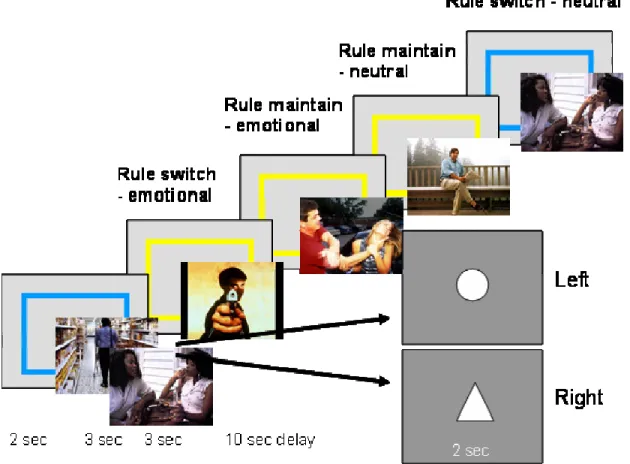
divert attentional resources away from the primary active maintenance task (Dolcos & McCarthy, 2006). The primary task required the active maintenance of rule information across a delay period in order to guide a subsequent behavioral response. It was expected that through the interactions of dorsal and ventral prefrontal regions, emotional
distraction would impair the ability to actively maintain the currently relevant rule, and would lead to further impairment when behavior needed to be flexibly switched after the rules changed. Furthermore, it was hypothesized that activation of more ventral
prefrontal regions in response to emotional distraction would be associated with decreased dorsolateral PFC activation, with concomitant impairment on active maintenance abilities.
The primary aim of Experiment 3 was to assess the effects of executive
attention-demanding distracters during simultaneous working memory performance (Fleming, Goldberg, Gold, & Weinberger, 1995).
CHAPTER II EXPERIMENT 1
Experiment 1 used fMRI to assess the effects of “executive” distraction on active maintenance processes using a spatial working memory task in healthy controls. The degree of distracter demand was manipulated according to the amount of attention that needed to be actively allocated to competing stimuli that appeared during maintenance. Method
Participants
Fifteen healthy volunteers were recruited for the functional neuroimaging task. Participants were recruited through the database at the Duke-UNC Brain Imaging and Analysis Center and from advertisements on the campus of the University of North Carolina at Chapel Hill. Eligible participants included both males and females between the ages of 18 and 35. Exclusion criteria included presence of a neurological, psychiatric, or substance abuse disorder, presence of metal in the body, and pregnancy. The sample of participants had a mean age of 23.33 years (range 18-30 years).
Imaging Task
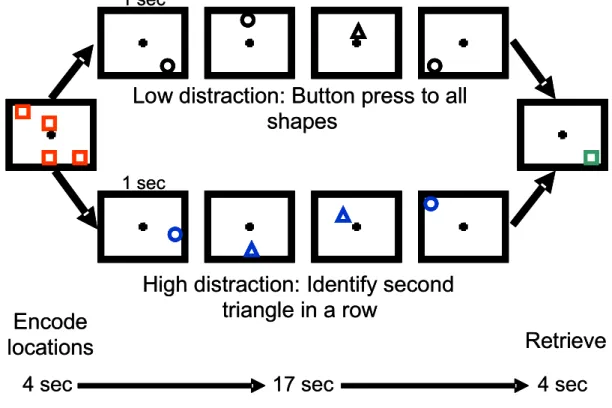
During the S1 phase, participants encoded the spatial locations of four red squares that each appeared randomly (for 1 second) in one of 12 possible locations. A delay period of 17 seconds ensued, during which 9 distracter shapes were presented in randomly chosen locations. During the S2 phase, a green probe square appeared (for 4 seconds), and participants were asked to respond by button press as to whether its location matched one of the 4 previously presented red squares (Figure 2). Participants pressed a “target” button when the location matched, and pressed a “non-target” button when it did not match. Intertrial intervals of 17 seconds were presented displaying a central crosshair. The advantage of this design was that activity related to each temporal phase of the working memory task could be isolated because the hemodynamic response would return to baseline levels if no sustained activity occurred (Hart, Davenport, Hooper, & Belger, 2006; Jha et al., 2004). Sustained activity related to active maintenance and distracter resolution was therefore able to be assessed without contamination from encoding effects.
was preceded by another triangle and pressing another button for all other distracters. The high distraction condition required the same sensory and motor requirements as the low distraction condition, but differed only in the amount of attention that needed to be allocated to the shapes in order to discriminate the repeated triangles.
The task was designed so that the low and high distraction conditions were grouped together in a series of runs, to prevent confusion on the task instructions. In half of the participants, the low distraction condition was presented in the first 3 runs,
followed by the high distraction conditions in the last 3 runs. The other half of the group was presented with the conditions in the opposite order. Additionally, all locations in the low and high distraction conditions were equated by presenting mirror images of the same spatial patterns between conditions. This ensured that the primary working
memory task did not differ in difficulty between conditions, in order to isolate the effects of distracter demand. There were 24 trials presented per condition (where one trial includes S1, the delay period, and S2), with 8 trials presented per run and a total of 6 functional runs.
Image Acquisition
T1 images using a spoiled gradient-recalled acquisition (SPGR) pulse sequence (TR: 22 msec; TE: 3 msec; FOV: 24 cm; image matrix: 256 x 256; Flip Angle: 20; voxel size: 1 x 1 x 2.5 mm; 54 axial slices).
Analyses
Imaging Data
Preprocessing
Image preprocessing was performed with automated scripts using SPM software (Wellcome Department of Cognitive Neurology, UK). Standard quality assurance
assessments provided information on temporal signal-to-noise measurements, and epochs with detected artifacts were eliminated from further analysis. Functional images were adjusted for interleaved slice acquisition and corrected for head motion, and were co-registered with the anatomical images. The realigned scans were then normalized to the Montreal Neurologic Institute Template.
Voxel-Based Analyses
Epochs synchronized to the onsets of each trial were excised containing 4 images preceding and 29 images following the onset of the encoding period, to cover the
encoding, delay, and probe periods of each trial. Epochs for the low distraction and high distraction trials were separated and averaged. Using custom Matlab-based scripts, the average BOLD-intensity signal values were converted to percent signal change relative to the prestimulus baseline. Voxel-based statistical analyses were performed with a
Additionally, second level group-average activation maps were generated along with random effects analyses to create between-condition contrast maps. This allowed for the examination of which regions significantly activated during low and high distraction, and which regions activated differentially according to the degree of distraction present during the working memory task.
Region of Interest (ROI) Analyses
Finally, the percent signal change during each condition was characterized within specific, hypothesis-based brain regions of interest. The BOLD response was specifically examined within functionally activated clusters in the dorsolateral PFC (dlPFC),
ventrolateral PFC (vlPFC), anterior cingulate gyrus (ACG), and intraparietal sulcus (IPS), regions which have been found to be specifically recruited during executive function and spatial working memory processing (Belger et al., 1998). After the ROIs were selected according to group-average activation clusters, intensity changes that were time-locked to stimulus events were interrogated within each ROI in each individual subject. The average hemodynamic responses were measured in each region, so that the amplitudes of percent signal change at S1, S2, and the delay period could be compared across
conditions for each ROI and subject. A series of ANOVAs were then conducted to test differences in activation as a function of stimulus condition.
Behavioral Data
repeated measures ANOVAs. This allowed for the examination of whether distracter demand significantly impaired performance on the working memory task, and whether performance on the distracter task itself differed according to the low or high distraction demands. Further exploratory analyses correlated the behavioral measurements with the percent signal change data in order to assess whether the activation patterns were related to working memory performance.
Results
Behavioral Performance
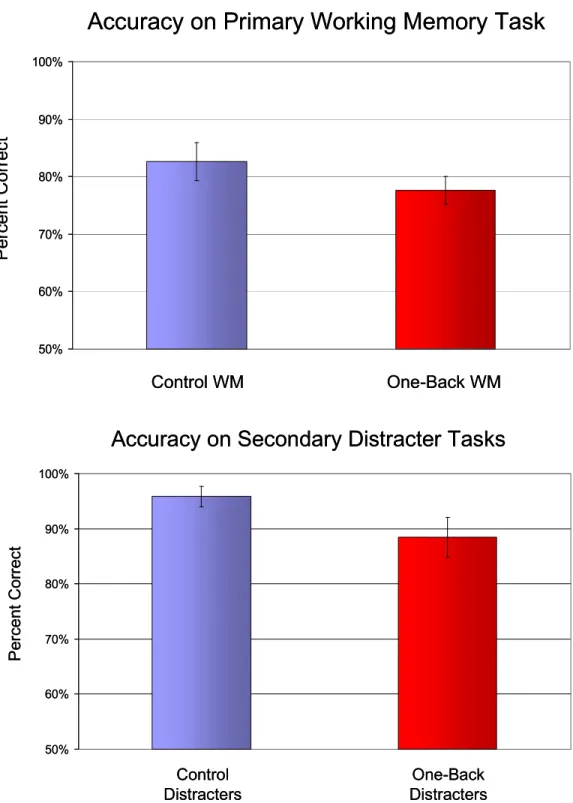
Behavioral measures of accuracy and reaction time were examined to test the hypothesis that the diversion of more resources to a secondary task would impair active maintenance due to reduced available resources for working memory. However, contrary to the hypothesis, a repeated-measures ANOVA on accuracy during the working memory task showed no significant differences between the control and one-back conditions (F(1,14)=2.39, p=.144) (Figure 3A). Participants performed at 82.64% accuracy (SD=.13) during the control condition, and at 77.64% (SD=.09) during the one-back condition. Reaction times at working memory retrieval, similarly, did not differ between conditions (F(1,14)=1.94, p=.185). Average RTs were 1337.34 msec (SD=417.58) for the control condition and 1448.84 msec (SD=443.33) for the one-back condition. These results indicated that active maintenance processes were not significantly differentially disrupted by the distracter manipulation.
significantly impaired for the one-back relative to control condition (F(1,14)=5.48, p=.035) (Figure 3B). Participants correctly pressed a button for 95.86% of control distracters (SD=.07) and for 88.42% of one-back targets (SD=.14). These results suggest that while active maintenance processes were not significantly disrupted, fewer resources were available for allocation to the more difficult distraction task. Additionally, no significant interactions were found between working memory and distracter performance for the two conditions (F(1,14)=.39, p=.543). That is, working memory performance on each condition was not differentially affected by distracter performance.
Imaging Data
Effects of Executive Distraction
Activation patterns were assessed to test the hypothesis that the ventrolateral PFC would be recruited to a greater degree under conditions of “executive” distraction (i.e., the one-back condition). Furthermore, activation patterns in the dorsolateral PFC were examined to test the hypothesis that it is primarily recruited during active maintenance in working memory. The voxel-wise group average analyses indicated that both distraction tasks activated similar regions in a network of prefrontal (middle frontal gyrus), parietal, and subcortical regions (Table 1). Random effects difference maps were calculated for trials where the working memory probes were correctly identified (i.e., active
distraction, clusters of voxels in regions such as the ventrolateral PFC (inferior frontal gyrus), dorsolateral PFC (middle frontal gyrus), cingulate gyrus, and inferior parietal lobule were more active during the one-back than the control condition (Table 2). During the control condition, areas that were more active relative to the one-back task included clusters within the anterior and posterior cingulate and the parietal lobule (Table 3).
To probe the activity within regions of interest, repeated-measures ANOVAs were performed on selected time points during the delay period to assess the percent signal change during each condition. These analyses were carried out on time points within 16-18 seconds after the beginning of each correct trial, and provided a sampling of activity near the end of the working memory delay and distraction period. In the vlPFC, the results showed a pattern consistent with its proposed role in resolving interference, where delay-period activity was significantly sustained above baseline during the one-back (F(1,14)=9.22, p=.009), but not the control (F(1,14)=2.09, p=.17) conditions (Figure 4). The dlPFC, in contrast, showed a pattern consistent with a role in active maintenance, where activity was significantly sustained above baseline for both the control
(F(1,14)=4.86, p=.045) and one-back (F(1,14)=28.37, p=.0001) conditions (Figure 5). Repeated-measures ANOVAs indicated a trend towards a significant effect of distracter demand (F(1,14)=3.78, p=.072), suggesting potential roles in both active maintenance and interference resolution for the dlPFC.
demand (F(1,14)=1.82, p=.199). Similarly, the IPS did not show a differential effect of distracter demand (F(1,14)=1, p=.334), and showed significantly sustained delay-period activity for both the control (F(1,14)=6.96, p=.019) and one-back (F(1,14)=13.75, p=.002) conditions. These patterns suggest that these regions are sensitive to active maintenance requirements, but are not differentially recruited under conditions of executive distracter demand.
Laterality Effects
In order to assess whether the hemispheres differed in their response to executive distraction, interactions between hemisphere and distracter type were assessed in each ROI. Only the vlPFC showed a trend towards a significant interaction between
hemisphere and distraction (F(1,14)=3.99, p=.066), where the left vlPFC showed greater sustained activity during one-back condition. No other significant laterality differences were found.
Brain-Behavior Correlations
To assess whether activity in the regions of interest predicted working memory performance, correlations were performed between the delay-period activation and subsequent WM performance. In addition, activity in each ROI was correlated with performance on the secondary distracter task performance. Activity in the vlPFC was significantly correlated with accuracy at retrieval on the one-back (r=-.56, p=.029), but not with the control condition. That is, during difficult distraction, better performers had less sustained delay-period activity. Activity in the vlPFC was also found to be