AN EXAMINATION OF COMMUNITY AND CONSUMER TOBACCO AND FOOD RETAIL ENVIRONMENTS
Heather D’Angelo
A dissertation submitted to the faculty at the University of North Carolina at Chapel Hill in partial fulfillment of the requirements for the degree of Doctor of Philosophy in the Department of Health Behavior in the Gillings School of Global Public Health.
Chapel Hill 2015
Approved by: Kurt Ribisl Alice Ammerman Penny Gordon-Larsen Laura Linnan
ABSTRACT
Heather D’Angelo: An Examination of Community and Consumer Tobacco and Food Retail Environments
(Under the direction of Kurt M. Ribisl)
Community and consumer tobacco and food environments may contribute to
neighborhoods that either support or limit health promoting choices. Tobacco use and dietary intake behaviors consolidate early in life and track over time; yet tobacco and food environments are often studied independently. The three studies in this dissertation examine the intersection of tobacco and food environments at the community and consumer levels. Studies One and Two examine the availability of tobacco outlets and fast food restaurants surrounding public schools (n=18,379) in a national sample of 97 counties within 40 states. Study One used spatial point pattern analysis to examine whether tobacco outlets and fast food restaurants cluster around schools. Significant clustering of tobacco outlets occurred as close as 200 m from all schools. Significant clustering of fast food restaurants occurred as close as 200 m from schools in cities and suburbs, and within 600 m of schools in rural areas. Study Two used generalized linear mixed models to examine whether tobacco outlet and fast food restaurant availability within an 800 m radial buffer of schools was associated with student socioeconomic status and
1.01, 1.05). Study Three examined the consumer tobacco and food environment within rural, small food stores and used the Diffusion of Innovation (DOI) to investigate retailer (n=55) perceptions of the availability, display and promotion of tobacco products and healthy foods. Retailers with greater perceived relative advantage were more willing to sell and display more healthy foods and beverages, but DOI constructs were not associated with willingness to reduce tobacco products and marketing. The three studies in this dissertation have implications for using land use planning, zoning and licensing ordinances to improve the retail tobacco and food
ACKNOWLEDGEMENTS
Many people contributed to the successful completion of this dissertation. Many thanks to all of my committee members for ensuring that I go forward with all the tools I need on the path to becoming an independent public health researcher. First, I would like to thank my advisor, Dr. Kurt Ribisl, for providing continued support and encouragement to pursue cross-disciplinary research throughout my doctoral career, and for supporting my research to combine tobacco control and obesity prevention efforts at the point-of-sale. Dr. Laura Linnan, for your encouragement and advice on applying organizational theory to my research; Dr. Leslie Lytle for your invaluable perspective on research into the food environment and youth health; Dr. Alice Ammerman, for linking my research with local healthy food access advocates and inspiring me to pursue research with real world implications for improving healthy food access; and Dr. Penny Gordon-Larsen, for your insight into the complexities of measurement in neighborhood level studies, and keeping me grounded in understanding what my research can do, and what it cannot.
I would like to thank my mom and dad, for your support and encouragement through my seemingly endless pursuit of higher education. Thanks for giving me my first microscope and chemistry set and setting me on the path of science at an early age. It stuck!
TABLE OF CONTENTS
LIST OF TABLES ... xi
LIST OF FIGURES ... xii
CHAPTER 1. INTRODUCTION ...1
Problem Statement ... 1
Significance of the Proposed Research ... 4
Studies One and Two ... 4
Study Three ... 5
CHAPTER 2. LITERATURE REVIEW ...7
Obesity and Tobacco Use Among Youth ... 7
Adolescent Health Behavior Adoption and Consolidation ... 8
Community Food and Tobacco Environments ... 9
Associations with Youth Health Outcomes ... 9
Fast Food Restaurant and Tobacco Outlets Availability Near Schools ... 12
Consumer Food and Tobacco Environments ... 14
Healthy Food Availability in the U.S. ... 14
Retailer and Customer Perspectives on Healthy Food Availability ... 17
CHAPTER 3. THEORETICAL FRAMEWORK AND CONCEPTUAL MODELS ...20
Health Inequalities and Place Frameworks ... 20
Hypotheses for Studies One and Two ... 24
Hypotheses for Study Three... 27
CHAPTER 4. STUDY ONE: SPATIAL CLUSTERING OF TOBACCO OUTLETS AND FAST FOOD RESTAURANTS AROUND PUBLIC SCHOOLS ...29
Introduction ... 29
Methods... 31
Schools and Study Area ... 31
Fast Food Restaurants and Tobacco Outlets ... 33
Analyses ... 33
Results ... 35
Discussion ... 39
Strengths and Limitations ... 41
Implications for Practice and Research... 42
Conclusion ... 43
CHAPTER 5. STUDY TWO: IS THE AVAILABILITY OF FAST FOOD RESTAURANTS AND TOBACCO OUTLETS NEAR SCHOOLS ASSOCIATED WITH SCHOOL SOCIODEMOGRAPHIC CHARACTERISTICS? ...44
Introduction ... 44
Methods... 46
Study Area and Schools ... 46
Fast Food Restaurants and Tobacco Outlets ... 47
Measures ... 48
Analysis... 49
Results ... 50
Descriptive Statistics ... 50
Regression Analyses ... 52
Sensitivity Analyses ... 53
Discussion ... 55
Strengths and Limitations ... 58
Conclusion ... 60
CHAPTER 6. STUDY THREE: USING THE DIFFUSION OF INNOVATIONS TO EXAMINE RURAL SMALL FOOD STORE RETAILERS’ PERCPETIONS OF IMPLEMENTING HEALTHY STORE STRATEGIES ...61
Introduction ... 61
Conceptual Framework ... 62
Definition of the Innovation... 62
Innovation-Decision Process ... 63
Methods... 65
Study Setting and Participant Recruitment ... 65
Measures ... 66
Analyses ... 70
Results ... 72
Retailer and Organizational Characteristics ... 72
Retailer Willingness to Implement Healthy Store Strategies ... 74
Association of Diffusion of Innovation Perceived Attributes with Retailer Willingness ... 75
Healthy Store Strategy Implementation ... 76
Discussion ... 81
Implications for Research and Practice ... 83
CHAPTER 7. CONCLUSION & SYNTHESIS ...87
Summary of Dissertation Activities ... 87
Synthesis of Significant Findings ... 91
Strengths and Limitations ... 95
Implications for Research, Practice and Policy ... 98
APPENDIX 4.1. LIST OF COUNTIES: STUDIES ONE AND TWO ...101
APPENDIX 4.2. OUTLET INCLUSION CRITERIA ...104
APPENDIX 4.3. DEFINTION OF SCHOOL URBAN CENTRIC LOCALE ...107
APPENDIX 5.1. DEMOGRAPHIC CHARACTERISTICS OF STUDY AREA ...109
APPENDIX 5.2. CONSTRUCTS, MEASURES AND DEFINITIONS ...110
APPENDIX 5.4. MODELS USING 400 M BUFFERS AROUND SCHOOLS ...113
APPENDIX 5.5. SENSITIVITY ANALYSES ...115
APPENDIX 5.6. SCHOOLS WITH COMPLETE DEMOGRAPHIC DATA ...118
APPENDIX 5.7. ADDITIONAL ANALYSES FOR STUDY TWO ...120
APPENDIX 6.1. INFORMED CONSENT AND DATA COLLECTION INSTRUMENT ...122
APPENDIX 6.2. STRATEGY IMPLEMENTATION SCORING ...149
APPENDIX 6.3. PERCEIVED ATTRIBUTE SCALE CREATION ...153
APPENDIX 6.4. ADDITIONAL TABLE STUDY THREE ...157
LIST OF TABLES
Table 4.1. Distance between Public Schools (n=18,379) and Fast Food
Restaurants and Tobacco Outlets, by Urban Locale, 2011 ...36 Table 4.2. Ratio of Observed to Expected K Function for Outlets
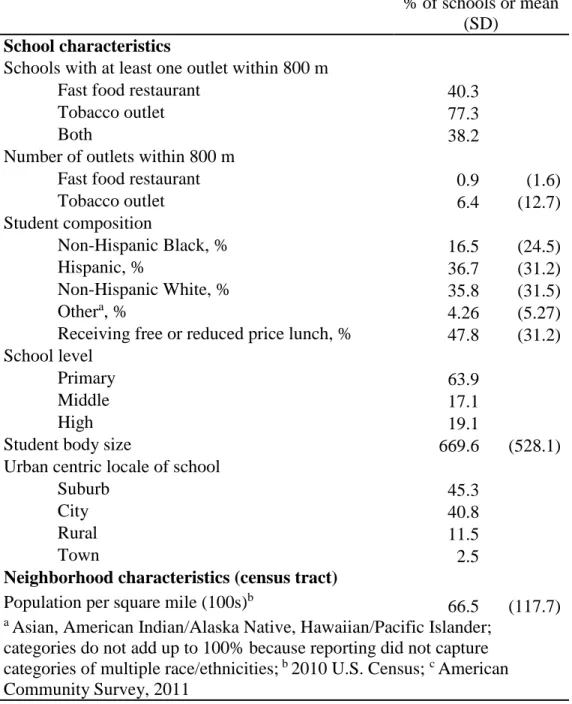
Relative to Schools, 2011 ...38 Table 5.1. Characteristics of Schools and Study Area in 97 Counties in
the Contiguous United States, 2011 ...50 Table 5.2. Incidence Rate Ratios, Odds Ratios and 95% CI for the Availability
of Fast Food Restaurants, Tobacco Outlets and Both Within 800 m Radius of Public Schools in 97 Counties in the
Contiguous the U.S. (N=18,379) ...54 Table 6.1. Constructs and Measures for Study Three ...67 Table 6.2. Retailer and Store Characteristics, Eastern North Carolina, 2014;
n=55 retailers; n=54 store audits ...73 Table 6.3. Retailer Willingness to Implement Healthy Store Strategies,
Eastern North Carolina, 2014 ...76 Table 6.4. Correlates of Retailer Willingness to Implement a Healthy Food
Strategy, Eastern North Carolina, 2014, n=52 ...77 Table 6.5. Correlates of Store Healthy Food Products and Marketing Score,
Eastern North Carolina, 2014 ...79 Table 6.6. Correlates of Tobacco Products and Marketing Score in Small
LIST OF FIGURES
Figure 3.1. Conceptual model for Studies One and Two: Examining the influence of school neighborhood characteristics on
adolescent health ...24 Figure 3.2. Conceptual model for Study Three: Using the diffusion of
innovations framework for predicting retailer healthy
store strategy adoption ...27 Figure 4.1. U.S. Counties (N= 97) randomly selected to create the study area.
Shaded counties are those that were selected. ...32 Figure 4.2. Spatial clustering of chain fast food restaurants and tobacco outlets near
schools by urban locale in 97 U.S. counties, 2011 ...37 Figure 4.3. Differences in observed and expected K function for tobacco outlets
and fast food restaurants by distance from schools ...38 Figure 5.1. Average number of fast food restaurants and tobacco outlets,
and percentage of schools with both a fast food restaurant and tobacco outlet within 800 m of schools by quartile of student
demographics. ...52 Figure 6.1. Store and retailer recruitment ...72 Figure 6.2. Percentage of stores (n=54) with displays, ads and price promotions
CHAPTER 1. INTRODUCTION
Problem Statement
Obesity and tobacco use are risk factors for cardiovascular disease and many forms of cancer, and disparities in both exist by socioeconomic status, race/ethnicity, and geography.1, 2 Rates of obesity are higher among Hispanic Black and Hispanic youth compared with non-Hispanic White youth,3 and rates of current smoking are higher among those living at or below the poverty level than among those living above the poverty level.4 In terms of geography, obesity rates are higher, and the prevalence of current smoking is greater among adults living in rural compared with urban counties, particularly in the rural Southern United States (U.S.).5, 6
In 2007-2008, 33% of children and 41% of adolescents consumed fast food in the prior 24-hours,7 and Black and Hispanic children are more likely to consume fast food and sugar
sweetened beverages compared with White children.8 Dietary habits and obesity developed in childhood or adolescence may track into adulthood,9, 10 and unhealthy behaviors, such as
smoking and poor dietary intake, appear to covary,7consolidate early11 and track together over time.9, 12 In a meta-analysis of 51 nutritional studies, compared with non-smokers, smokers had poorer diets, including higher total energy intake and lower intakes of fiber, vitamin C, iron, calcium, and beta carotene.13 Adolescents who smoke tend to have poorer diets9 and consume more fast food11 compared with non-smokers. Therefore, intervening early to prevent the
In separate lines of research, the availability of retail tobacco and food outlets have been associated with obesity14 and smoking15, and may contribute to a neighborhood that either
supports or limits health promoting choices. Tobacco and food environments are often studied independently, yet they occur together, not in isolation, within neighborhoods. In nutrition environment research, Glanz et al.16 distinguish between the community environment, the type and location of food outlets and restaurants, and the consumer environment, the availability, price, promotion, and placement of foods within food outlets and restaurants. Community and consumer distinctions have also been applied to retail tobacco environments.17 At the community level, the availability of tobacco outlets has been associated with youth smoking initiation,18 and the availability of fast food restaurants has been associated with higher youth Body Mass Index (BMI).19 At the consumer level, exposure to tobacco marketing at the point-of-sale (POS) has been associated with youth smoking initiation and undermines quit attempts among adults,20
while healthy food availability within retail food stores has been associated with consuming more healthy foods.21, 22
Examining tobacco and food retail environments together provides an opportunity to examine how environmental factors may influence both dietary intake and tobacco use. The studies in this dissertation examine the intersection of tobacco and food retail environments at the community and consumer levels to assess dimensions of the built environment that may be related to health disparities observed by race/ethnicity, income, or geography.
regulated by licensing or zoning ordinances.23 Study One uses spatial analysis to examine
whether FFR and TO cluster around schools in a national sample of counties selected as part of a larger study, Advancing Science and Policy in the Retail Environment (ASPiRE, Grant Number: U01 CA154281). Study Two examines whether FFR and TO availability near schools is
associated with school demographic characteristics, including student socioeconomic status and race/ethnicity.
Study Three investigates the consumer tobacco and food retail environment in small food stores in rural North Carolina through a cross-sectional retailer questionnaire and in-store
observation. Small food stores, such as convenience stores, are an important venue for both improving healthy food availability and reducing access to tobacco products, particularly among youth. Convenience stores also present a more readily changed environment compared with a fast food restaurant that often have fixed menus and are operated as chains or franchises without local ownership. Using the Diffusions of Innovations (DOI) framework, retailers’ perceived attributes of implementing strategies to increase the availability, display, and promotion of healthy foods and reduce the availability, display and promotion of tobacco products were assessed, and linked to the actual products, displays and promotions within stores. The research questions for each study are:
Study One: Do fast food and tobacco outlets cluster around public schools in a sample of 97 counties in the contiguous U.S.?
Study Three: Are the perceived attributes of implementing a healthy store strategy associated with retailer willingness to a) increase the availability, display, and promotion of healthy foods and beverages and b) reduce the availability, display, and promotion of tobacco products and in turn, is retailer willingness to implement a healthy store strategy associated with actual
implementation, or the observed in-store availability, promotion and display of a) healthy foods and beverages and b) tobacco products.
Significance of the Proposed Research
Studies One and Two
The proposed studies will contribute to a broader understanding of the community retail environment surrounding public schools in the U.S. by examining access to both fast food and tobacco outlets. Given the disproportionate rates of obesity, cardiovascular disease, and some cancers observed among racial and ethnic minority populations,24, 25 understanding access to unhealthy foods and tobacco products and marketing can help to understand “upstream” determinants of population health.26 These studies will contribute to a greater understanding of the distribution of fast food restaurants and tobacco outlets by utilizing a national dataset to explore whether there is spatial clustering of outlets around schools. No studies to our knowledge have examined the spatial clustering of fast food and tobacco outlets near schools. Of the studies that have assessed fast food restaurants near schools, only two have been on a national scale27, 28
and neither of these examined spatial clustering. No studies examining the availability of tobacco outlets near schools have been on a national scale and only one study (in New York City)
There is growing interest in policies and programs that address multiple health behaviors that contribute to the burden of chronic disease.30 Examining the availability of fast food and
tobacco outlets near schools is important to inform policies that could improve children’s health. Adolescence is a critical period of development when health behaviors adopted may be sustained over time.12 Studies have found that adolescents frequently shop at tobacco outlets such as convenience stores31, 32 and eat at fast food restaurants,33 which has been associated with youth smoking initiation and consuming more calories, fat, sodium, and sugar-sweetened beverages, respectively.34, 35 Through zoning or licensing restrictions, communities could limit the number of fast food or tobacco outlets, or create buffer zones around schools and other youth focused areas (e.g. playgrounds) where no fast food or tobacco outlets could zoning23. Making health promoting changes at the policy level through land use policies would allow for sustained environmental change that could improve the health behaviors of children and track into adulthood to improve the health of future generations of children and families.
Study Three
Healthy stores interventions and programs have mostly taken place in urban food deserts in cities including Baltimore, Philadelphia, New York, and Minneapolis.36, 37 Yet, many people
in rural areas also may not have easy access to large supermarkets;38, 39 therefore small food stores play an important role in providing staple foods between supermarket trips. This study will add to our understanding of the unique challenges that rural food retailers may face in order to stock healthy foods in their stores. This can inform future retailer interventions and the
development of local licensing ordinances to not only improve healthy food access, but also minimize exposure to tobacco products and marketing at the point-of-sale. Previous research has shown that many retailers do not stock healthy food because they believe that their customers will not buy it.40 Yet, customers cannot buy what is not available, making it difficult to
CHAPTER 2. LITERATURE REVIEW
Obesity and Tobacco Use Among Youth
Obesity and tobacco use are risk factors for cardiovascular disease and many forms of cancer, and disparities in both of these risk factors exist by socioeconomic status and
race/ethnicity.1, 2 Rates of obesity are highest among non-Hispanic Black (“Black”) and Hispanic youth compared with non-Hispanic White (“White”) youth.3 In 2007-2008, over a third of children and 40% of adolescents consumed fast food in the previous day.34 Black and Hispanic youth are also more likely to consume fast food and sugar sweetened beverages compared with White youth,8 and consuming fast food has been associated with increased intake of total energy, fat, sodium, and sugar-sweetened beverages among youth.34, 35
Rates of current tobacco use are highest among White high school students; however, in 2012 current tobacco use among middle school students was higher for Hispanic students (10.5%) compared with White students (5.1%), and cigar use was highest among Black high school students compared with both White and Hispanic students.41 Rates of smoking initiation are highest among lower income youth of all race/ethnicities.42, 43 Given that about 90% of adult smokers initiate smoking by age 18,44 early intervention among vulnerable populations is critical. Similarly, dietary habits and obesity developed in adolescence may track into adulthood,9, 10 and unhealthy behaviors, such as smoking and poor dietary intake, appear to covary,7consolidate
Adolescent Health Behavior Adoption and Consolidation
Adolescence is a critical period of development when youth tend to take more risks and make poor decisions.45 There is evidence that adolescents may consolidate multiple health risk behaviors. Students in the U.S. who use alcohol and drugs are more likely to use tobacco products.46, 47 Among a sample of 145 high school students in St. Paul/Minneapolis, smoking cigarettes was positively associated with soda consumption, eating high fat foods and patronizing fast food restaurants.48 A larger study of middle and high school students (n=4756) in the same city found that adolescents who smoked consumed fast food more frequently, and consumed more soda and fewer servings of fruits and vegetables per day compared with non-smokers.11 In
Virginia, a study of middle and high school students (n=10,635) found that smokers consumed vegetables and milk/dairy products less frequently compared with non-smokers.49
Behaviors developed in adolescence may also track into adulthood. A study of adolescents (6th through 12th grade) followed over 7 years found that not only did students consolidate smoking, physical inactivity, and poor food choice behaviors early on,9 but also that
independently, they point towards a mechanism by which adolescents might adopt multiple unhealthy behaviors.
Community Food and Tobacco Environments
Associations with Youth Health Outcomes
Health disparities observed among racial/ethnic minority and low income populations have driven research into assessing inequalities in neighborhood access to health promoting resources as possible explanations.50 The availability supermarkets, convenience stores, parks and playgrounds, has been associated with obesity14, smoking15 and physical activity,51
respectively. While features of the community environment are often studied independently, they occur together, not in isolation, within neighborhoods. Smiley et al52 found that the densities of supermarkets/produce stores, retail areas, and recreational facilities were correlated with each other, and that African American neighborhoods tended to have multiple low resource
densities.52 This review will identify studies that have examined the availability of fast food and
tobacco outlets in association with youth health outcomes and make the case that examining both food and tobacco outlets together is necessary to gain a more robust understanding of the overall environmental influences on health.
Living near fast food restaurants has been associated with higher BMI,53 consuming more fast food54, 55 and fewer healthy foods53, 55, 56 among adolescents. In a study of neighborhood food
reduced the risk of overweight or obesity by nearly 80%.58 However, another study found that BMI among New York City high school students was inversely associated with the availability of fast food restaurants (and, as a placebo test, banks) in the census tract where students homes were located, after controlling for individual and neighborhood level characteristics.59 The discrepant finding of this study may be due to the unique retail mix in New York City neighborhoods and the use of a census tract to define the neighborhood. The next section describes studies that have examined fast food and tobacco outlet availability in school neighborhoods in association with youth health behaviors and outcomes.
Alviola et al. examined FFR availability near schools and found that the presence of a FFR within 1 mile of a school was associated with a 1.23% increase in BMI among students, after accounting for school proximity to a highway interstate.60 Using a sample of over 3 million ninth grade students, Currie found that aFFR within 0.1 miles of a school was associated with an increased obesity incidence of 5.2%.61 Davis and Carpenter found that among a sample of over 500,000 middle and high school students, having a FFR near their schools was associated with consuming fewer fruits and vegetables, more soda, and increased the odds of being overweight or obese by 6 and 7%, respectively.62 Powell et al. found that greater convenience store
TO availability within school neighborhoods has been associated with adolescents ever smoking,66, 67 smoking susceptibility,68 school smoking prevalence,69, 70 and students purchasing
their own cigarettes.70 Over 75% of adolescents in the U.S. have reported exposure to tobacco marketing in retail stores.71 Convenience stores are frequented by children on the way to and from school, particularly in low income urban areas.31 A study of convenience stores
surrounding schools in Minneapolis found that 87% of stores had exterior tobacco advertising and stores carried few healthy foods.72 Exposure to tobacco outlets and in turn, tobacco
marketing at the point-of-sale has been associated with youth smoking in both cross sectional and longitudinal studies. Over 60% of a sample of middle school students in California (n=2125) visited tobacco outlets once a week or more frequently, which was associated with a 50% greater odds of ever smoking.32 A longitudinal study in California found that students who shopped at stores selling tobacco products two or more times a week had 2.58 times the odds of smoking initiation compared to students who shopped less than once a week. 73 In contrast, one study found no association between TO availability and adolescent smoking outcomes after controlling for multiple individual risk factors, including peer smoking status.74
The availability of FFR and TO near adolescents’ homes and schools is an important contextual factor to consider when examining correlates with adolescent dietary intake and smoking. Although there are some mixed results, the evidence suggests that a higher availability of FFR near schools influence adolescent dietary intake and BMI, and a higher availability of TO near schools is associated with smoking initiation. The next section examines differences in the availability of FFR and TO near schools by neighborhood or student socio-demographic
Fast Food Restaurant and Tobacco Outlets Availability Near Schools
Several studies describe FFR availability surrounding schools. Of these, six were located in the U.S., two in Canada and one in New Zealand. Three used spatial analysis methods to examine whether FFR cluster near schools located in urban areas. 75-77 Using spatial analysis
allows for the determination of whether the likelihood is greater for an outlet to be clustered within a certain distance surrounding a school than would be expected if outlet location was unrelated to school location. The majority of studies used 400 and 800 m buffers surrounding schools to account for 5 and 10 minute walking distances. Studies also varied on whether they used road network or straight line (Euclidean) buffers, depending on the data available.
Among the studies using spatial analysis, all found that FFR were significantly clustered around schools. In Chicago, Austin and colleagues found 3 to 4 times as many FFR located within 1.5 km of schools than would be expected if FFR location were not related to school location.76 FFR were found to cluster near schools in high and moderate commercialization zones and near schools in high income (median household income of block group >$ 43,700) but not lower income neighborhoods.76 In New York City, more FFR were clustered around public elementary and high schools with a higher percentage of black students and around schools in block groups with a higher percentage of black residents.75 However, public high schools in higher income neighborhoods had greater FFR clustering compared to lower income
neighborhoods.75 In New Zealand, schools located in the most socioeconomically deprived
neighborhoods had 3 times the number of FFR within 400 m of the school.77
Studies that did not use spatial analysis to account for clustering near schools have used ANOVA to examine differences in FFR density and median household income, logistic
surrounding schools, or negative binomial regression to model the outcome of the count of FFR within school buffers. Two studies examined FFR near all U.S. public middle and high
schools.27, 28 Zenk and Powell27 found that schools in the lowest income neighborhoods had more FFR and convenience stores nearby, but schools in neighborhoods with a higher proportion of Black residents had fewer FFR and convenience stores nearby, controlling for school size, urbanicity and population density. Sturm28 examined the presence of FFR, convenience stores, snack stores and liquor stores surrounding schools in the U.S. and found that schools with a higher percentage of Hispanic students and schools with more low income students were more likely to have a FFR within 400m. There was no association between FFR presence near a school and the proportion of Black students.28 In Montreal, the odds of a FFR being located within 750 m of a low income compared to a high income school was over 30 times greater (OR 30.9, 95% CI 19.6, 48.9), after controlling for commercial density.78 Another study of public schools in
New York City broadened the definition of “unhealthy food sources” to include chain and local FFR, pizzerias, convenience stores, and bodegas near schools.79 Schools with higher proportions of low-income and Hispanic students had the greatest exposure to all unhealthy food sources. After controlling for population density, subway stops, and proportion of commercially zoned area, the association remained only for bodegas.
nearly 80% of retailers were within 1000 ft. of schools.80 Another study using spatial analysis found significant clustering of TO near schools in New York City, and TO availability was positively associated with population density, commercial zoning, and the percentage of residents receiving public health insurance coverage.29 However, there was no significant association of TO availability with neighborhood racial/ethnic composition. In Ontario, Canada, about 65% of tobacco outlets were located within 500 m of a schools, with more outlets near schools in lower income neighborhoods.81 In California, schools with a higher density of tobacco
retailers in the school neighborhood had higher proportions of Hispanic students and students receiving free or reduced price lunch.15
The available studies examining FFR and TO near schools have found significant clustering around schools in the urban areas studied. The literature on neighborhood disparities in FFR and TO located within walking distance of schools is not conclusive, but points towards higher FFR and TO availability near lower income schools and schools with higher proportion of Hispanic and/or Black/African American students, although this finding is not consistent across studies. By comparison, few studies have examined tobacco outlets near schools in association with school demographic characteristics.
Consumer Food and Tobacco Environments
Healthy Food Availability in the U.S.
compared to black neighborhoods in four U.S. states.85 A national study found fewer supermarkets and more convenience stores in low income neighborhoods, regardless of neighborhood ethnicity, and overall, predominantly Black and predominantly Hispanic neighborhoods had fewer supermarkets compared to White neighborhoods.86
There are also differences in healthy food availability by geography. In urban areas, predominantly Black high poverty areas had fewer supermarkets and convenience stores but more grocery stores while Hispanic high poverty areas had fewer supermarkets, but more convenience and grocery stores, compared to White, low poverty neighborhoods. In rural areas, both predominantly Black and Hispanic high poverty areas had more convenience and grocery stores compared to White low poverty areas, however Hispanic high poverty areas had fewer supermarkets.86 Sharkey et al. examined food access disparities in rural colonias in Hidalgo County, Texas and found high access to convenience stores, and, in highly deprived areas, lower access to supermarkets, supercenters, and grocery stores.87 However, in another study of six rural Texas counties, higher neighborhood deprivation was associated with increased supermarket access.88 In the rural Mississippi Delta, low-income residents have to travel more than 30 miles
to reach a large supermarket, and therefore rely on smaller food stores with a more limited selection of foods.89
In addition to disparities in the types of stores available (e.g. supermarkets), there are also neighborhood disparities in the types of foods (e.g. fresh produce) available.90, 91 These
disparities in access have been associated with poorer dietary intake and increased obesity risk,22,
92, 93 both important cardiovascular disease and cancer risk factors. In a study set in six rural
that fresh produce is not readily available in rural convenience stores.95 In a rural South Carolina county, 74% of all food stores were convenience stores, however only between 4% and 29% of convenience stores sold healthier options such as low-fat/nonfat milk, apples, high-fiber bread and eggs; moreover, healthy items in convenience stores tended to cost more compared to supermarkets.39
In addition to offering few healthy foods, convenience stores also tend to sell and prominently display and promote tobacco products. In 2002, 85% of convenience stores and 92% of gas station/convenience stores in the U.S. sold tobacco products.96 In a national study of retail tobacco marketing, convenience stores (without gas stations) averaged 28 tobacco
marketing materials per store, and 73% displayed tobacco product promotions.97 Smaller studies
have found similar results. In downtown Albany, New York, 84% of food stores sold tobacco products and 66% displayed tobacco ads,98 and 97% of a sample of convenience stores around
urban schools in Minnesota displayed tobacco ads.72 In three communities within Nashville, Tennessee, 90% of convenience/small grocery stores sold tobacco products while only 30% sold any fruit and 17% sold any vegetables.99 However, convenience stores in the U.S. generate
nearly twice as much sales from food compared with tobacco products,100 and declines in cigarette consumption101 may contribute to tobacco products becoming a less profitable product
category.
Retailer and Customer Perspectives on Healthy Food Availability
Despite well documented disparities in healthy food access, little research has been done to understand the determinants of healthy food availability within rural small food stores. Small food stores are typically independently owned and the retailer has full control over the product mix, store layout, and marketing and advertising within the store. Retailers of small food stores may not stock healthier foods and beverages because they do not perceive customer demand for healthy foods.40, 102, 103 Yet evidence from both cross-sectional and intervention studies suggest that if healthy foods were available in small food stores, customers would purchase them. In cross-sectional studies, living in a neighborhood with more shelf-space devoted to fresh
vegetables was associated with consuming more servings of fresh vegetables104 and shopping at a small food store with more fruits and vegetables available was associated with significantly increased odds of purchasing both fruits (12%) and vegetables (15%).105
Small food store interventions have resulted in significant increases in both sales and purchasing frequency of promoted foods.37 A systematic review of small food store intervention
trials shows promising results, with all 16 interventions resulting in increased availability of healthy foods, increased sales of healthy foods in all interventions that tracked sales data (n=5), and increased purchasing frequency of promoted foods in nine out of the ten interventions that measured it.37 Although a majority of stores were corner stores where tobacco products are heavily marketed, only one store owner in the Good Neighbors Program in San Francisco voluntarily removed tobacco advertising, and no other interventions mentioned tobacco as a focus.
profitability influenced their decision to stock healthy foods.103 Andreyeva et al. interviewed 68 non-supermarket food retailers in five of the most populous towns in Connecticut and found that 83% were interested in selling healthier items in their stores.40 Retailers perceived that customer demand for healthy items was lower than for unhealthy items, and the primary barrier to stocking healthy foods was perceived customer dislike of the item. However, more than half of retailers surveyed stated that they sold healthy foods in their stores, and believed that their customers would have healthier diets if they stocked healthier foods in the stores. Although retailers perceived low customer demand for healthy foods, residents expressed their desire to be able to purchase healthy foods in their neighborhood corner stores.
Ayala et al.106 and Gittelsohn et al.107 used a mixed method approach to interview small
food retailers in eight major U.S. cities after changes in the WIC food package (e.g. fruits, vegetables, whole grain bread were added to package). Retailers stated that stocking decisions were most highly influenced by customer requests and profitability of the food item, followed by refrigerator/freezer availability. Qualitative interviews revealed that retailers stock foods
primarily on the basis of customer demand, and weight regular customers’ preferences highly.107
Perceived retailer benefits of stocking the new WIC package food items included increases in sales, customers, and improved store atmosphere. Retailers also stated that customers liked the convenience and availability of healthy foods. Challenges or barriers included keeping up with the supply and stocking of perishable foods.
Jilcott-Pitts et al. interviewed corner store retailers and customers in rural food deserts and urban non-food deserts in Eastern North Carolina as part of the formative research for a healthy stores intervention.108 Through qualitative interviews, retailers stated they would stock
products that sold best were alcohol and cigarettes. Among food items, snack products (e.g. chips, candy) sold best. Other barriers to stocking more healthful foods included space,
refrigeration, and shelf life. Rural customers shopped more frequently at corner stores compared to urban customers, and more often stated that they do not eat more fruits and vegetables because the stores they shop at do not stock them. Most customers were willing to purchase fresh fruits (92%) and vegetables (79%) at the corner store.
CHAPTER 3. THEORETICAL FRAMEWORK AND CONCEPTUAL MODELS This chapter describes the theories and frameworks that have informed each dissertation study. Studies One and Two were informed by several frameworks that posit that there are underlying historical, social and economic determinants that contribute health outcomes and are inherently linked to place. Study Three was informed by the Diffusion of Innovations, a
theoretical framework for identifying the determinants of the decision to implement an innovation.
Health Inequalities and Place Frameworks
Bernard and colleagues present a framework linking health disparities by place to inequalities in the “distribution of resources”109 within and between neighborhoods.
Neighborhood resources can be divided into physical and social domains. The built environment falls within the physical domain, and resources can be positive, such as parks, or negative, such as liquor stores, graffiti, and abandoned vehicles. Bernard and colleagues propose that there are rules that govern how neighborhood environments influence health. Within the physical domain, proximity to resources is the predominant rule; that is, living near positive or negative resources affects health. Yet it is not only access or proximity to resources that influences health, but the interplay between the physical and social domains that determine the effect the environment will have on health.
within their neighborhoods. The shaping of the neighborhood physical environment is based on the economic context of the area, part of the social domain. Historical and political factors, including retail redlining and racial residential segregation, drive the economic context of an area, which in turn determines the types of businesses and services that locate within particular neighborhoods.110, 111 For example, large chain supermarkets in the U.S. with less expensive food prices112 are more likely to be located in higher income, non-minority neighborhoods.84
However, in other countries, with different historical, political, and economic contexts, the opposite has been found.113, 114
Similar to the Bernard framework, the Schulz and Northridge framework is based on the hypothesis that there are fundamental causes of health inequities stemming from historical, social, political and economic factors at the societal, or macro, level that then translate into inequalities in the distribution of wealth and in educational, employment and political
opportunities.111, 115, 116 It is both the macro-social factors and the resulting inequality of resource distribution that influence zoning and land use laws, and residents’ proximity to neighborhood resources, such as retail stores and public parks. In turn, proximity to resources, whether health promoting (or detracting), influences health behaviors and health outcomes. Rossen and Pollack adapt the Schulz and Northridge framework by adding zoning and land use as part of the
community’s political context.117 They suggest that zoning be used as a tool to address health
disparities, for example, by distributing health promoting resources more equitably across neighborhoods, or limiting exposure to tobacco outlets near schools or playgrounds.
segregation.118 Racial residential segregation has been associated with inequalities in income, educational and employment opportunities, and housing quality,119 all critical factors for
maintaining a healthy lifestyle.
According to Kwate, racial residential segregation influences fast food density through four pathways. First, it creates neighborhoods with concentrated minority populations and concentrated poverty, and fast food chains target minority and low-income customers through low prices and targeted marketing campaigns.118, 120, 121 The same can be said for the tobacco
industry. According to industry documents, minority and low-income neighborhoods have historically been targeted for menthol marketing,122, 123 and cigarette pack prices are cheaper in lower income, minority neighborhoods.124, 125 Next, residential segregation shapes the economic
context of a neighborhood, and allows fast food restaurants to draw from a pool of low-wage workers. Third, residential segregation influences physical infrastructure through zoning regulations that determine the siting of fast food restaurants and, finally, social processes determine whether the community has the political clout to keep out businesses that may negatively impact residents’ health. Higher income neighborhoods or towns may have the economic and political strength to reject new fast food restaurants development, while lower income neighborhoods may be eager for the increased employment opportunities. For example, the town of Concord, MA, a wealthy Boston suburb, bans all fast food restaurants,126 and a study examining fast food land use planning proposals between 2001 and 2013 found that among the 77 communities that proposed a ban or restriction on fast food restaurants, the 77% were predominantly White and 66% had average household incomes greater than the U.S. average.127
work force,128 and may represent undesirable types of businesses in higher income communities. The tobacco and fast food industries both target low income, minority, and youth populations with promotions and advertising.129-132 Older children and teens attending middle and high schools may also be more likely to be targeted by both the fast food and tobacco outlets, particularly convenience stores, due to their greater autonomy and purchasing power.133
Figure 3.1. Conceptual model for Studies One and Two: Examining the influence of school neighborhood characteristics on adolescent health.
Hypotheses for Studies One and Two
The following hypotheses will be tested:
H1: Fast food restaurants and tobacco outlets will cluster around public schools in a sample of 97 counties in the contiguous U.S.
H2: There will be more fast food restaurants and more tobacco outlets near schools with higher proportions of students receiving free or reduced price lunch, Hispanic students and non-Hispanic Black students.
Conceptual Model for Study Three
Most healthy stores interventions have used Social Cognitive Theory and the Social Ecological Framework to inform intervention development, primarily because they focus on explaining and changing consumer behavior by changing the store environment.37 This study
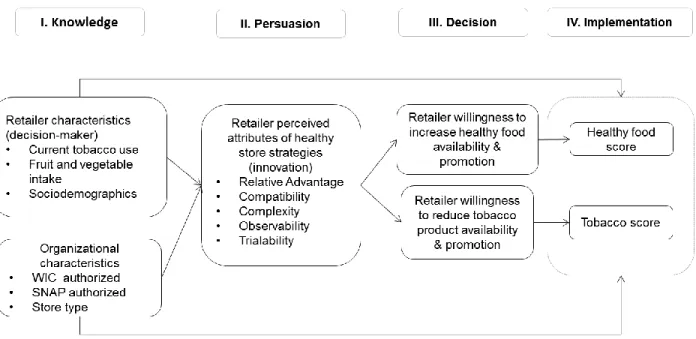
focused on retailer behavior using the Diffusion of Innovations (DOI)137 to explain a retailer’s implementation of strategies to increase healthy food availability and reduce the display and marketing of tobacco products (i.e. the innovation) (Figure 3.2).
According to Rogers, there is an innovation-decision process that explains the adoption of innovations.137 The first stage is knowledge of the innovation, and is influenced by decision-maker (retailer) and organizational (store) characteristics. The organizational characteristics explored in this study include WIC and SNAP authorization status, as these programs might make it easier for retailers to stock healthier foods, and previous research has shown differences in both healthy food availability138 and in point-of-sale tobacco marketing98, 139 by WIC/SNAP authorization status. Knowledge is followed by persuasion, when the retailer forms a favorable or unfavorable attitude towards the innovation. The persuasion stage is characterized by the perceived attributes of the innovation (i.e. relative advantage, compatibility,complexity,
observability, and trialability, described below). The next stage is the decision to either adopt or reject the innovation, and is operationalized in this study as retailer willingness to adopt a healthy store strategy. Finally, the implementation of the innovation is when the retailer puts their
decision into action and is operationalized as the availability, promotion, and display of healthy foods and tobacco products in the store.
innovation (perceived attributes) that influence whether they will adopt it. The first is relative advantage, and is operationalized as whether retailers perceive that adopting a strategy to increase healthy food availability or reduce tobacco products and marketing is an improvement over what they currently stock, display and promote in their stores. Attributes of relative advantage that are relevant in this context are primarily economic advantages such as sales, profitability, demand, and gaining a competitive edge over other stores. Compatibility refers to how well the innovation is perceived as fitting in with the retailer’s current business practices, the business image, the physical layout of the store, and the available products from suppliers in the retailer’s network. Complexity refers to how difficult the retailer perceives the innovation to be, and will be assessed relative to training staff, maintaining products, and the extra work or planning required to adopt the innovation. Trialability is the ability of the retailer to easily try out the innovation and is operationalized as whether retailers can change the store product mix or layout easily, and easily switch back to the original product mix or display configuration. Observability is whether the results of the innovation are visible to customers.
Combined, the perceived attributes influence the decision stage, operationalized as retailer willingness140 to adopt specific strategies to transition to a healthy store by increasing healthy food availability, display, and promotion and reducing tobacco product availability, display, and promotion. Measuring willingness rather than intention may result in more meaningful responses given that retailers may not have ever considered some strategies (e.g. discontinuing the sale of tobacco products). Willingness to adopt a strategy was assessed as part of a “suppose” situation141 where the retailer would receive some assistance through a program
implementation of the innovation, operationalized as the observed in-store healthy food and tobacco product availability, display, and promotion.
Figure 3.2. Conceptual model for Study Three: Using the diffusion of innovations framework for predicting retailer healthy store strategy adoption.
Hypotheses for Study Three
The following hypotheses will be tested:
H1: Retailers who perceive greater relative advantage, compatibility, observability, trialability, and lower complexity for stocking healthy foods/limiting tobacco products, will have greater willingness to implement a strategy to increase the availability, display and promotion of healthy foods and beverages (“healthy food strategy”) and reduce the availability, display and promotion of tobacco products (“tobacco product strategy”), and in turn,
H2b: Retailer willingness to implement a tobacco product strategy will be negatively associated with tobacco product strategy implementation score, or the in-store availability, display, and promotion of tobacco products.
CHAPTER 4. STUDY ONE: SPATIAL CLUSTERING OF TOBACCO OUTLETS AND FAST FOOD RESTAURANTS AROUND PUBLIC SCHOOLS
Introduction
Examining the retail tobacco and food environment surrounding schools provides an opportunity to assess built environmental factors that might influence both dietary intake and tobacco use among youth. In 2012, 6.7% of middle school and 23.3% of high school students currently used any tobacco products41 and in 2007-2008, 33% of children and 41% of
adolescents consumed fast food in the prior 24-hours.7 Evidence suggests that these behaviors co-occur, and track over time among youth.12 Adolescents who smoke tend to have poorer diets9 and consume more fast food11 compared to non-smokers. Consuming fast food has been
associated with poor diet quality, including increased intake of total energy, fat, sodium, and sugar-sweetened beverages among both children and adolescents.34
incidence,61 and increased odds of obesity62 among youth. However, others have reported null findings between fast food restaurant proximity to schools and adolescent diet 64 and weight.65
School proximity to retail tobacco and food outlets is a problem, because it provides both easier access to products and exposure to ads and marketing on the storefront and at the point-of-sale. Both tobacco and fast food companies target youth with advertising129, 130, 142 and offer special products that have youth appeal, like kid’s meals with toys134 or flavored little cigars.143
Over 75% of adolescents in the U.S. have reported exposure to tobacco marketing in retail stores,71 and a longitudinal study of non-smoking youth at baseline found that students who shopped at stores selling tobacco products two or more times a week had 2.58 times greater odds of smoking initiation compared to students who shopped less than twice a month.73 Children and
teens are exposed to between 2.4 and 4.1 fast food ads per day on television,.144 and exposure to food advertising increases preference for advertised food items.145 The clustering of fast food and
retail tobacco outlets around schools could therefore provide environmental cues and shape social norms around consuming fast food and using tobacco products.
The bivariate K function tests whether the spatial patterning of outlets relative to schools is no different than what would be expected if the outlets were distributed randomly, or if there is spatial dependence (clustering) between outlets and schools.149 The bivariate K function has been used to determine clustering of fast food restaurants and food outlets near schools75-77, 150 and the clustering of fast food restaurants near supermarkets.151 U.S. studies using a measure of spatial clustering found that fast food restaurants clustered within 500 m of public schools in New York City,75 and in Chicago there were up to 7 times more fast food restaurants within 1.5 km of
schools than would be expected if restaurant location was unrelated to school location.76 No studies have measured the spatial clustering of tobacco outlets relative to schools using a
bivariate K function, or used a national sample of U.S. counties to measure the spatial clustering of either type of outlet relative to schools. The following research question was addressed: Are there more (a) fast food restaurants and (b) tobacco outlets around public schools in a sample of 97 U.S. counties than would be expected if fast food restaurant/tobacco outlet location was not associated with school location?
Methods
Schools and Study Area
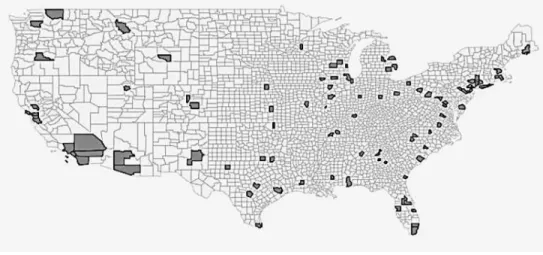
As part of a larger study aimed at creating a national sampling frame of tobacco outlets, a random sample of counties within the contiguous U.S. was selected using a probability
proportionate to size (PPS) method152 proportionate to county population size with minimal replacement. The resulting 97 counties within 40 states represent 25.7% of the U.S.
Figure 4.1. U.S. counties (N= 97) randomly selected to create the study area. Shaded counties are those that were selected.
School geographic coordinates, address, school level and urban centric locale were obtained for 2010-2011 from the National Center for Education Statistics (NCES)
Elementary/Secondary Information System (ELSi).154 School urban centric locale is based on the school's physical address (or mailing address if physical address was unavailable) and is a
measure of a school's location relative to areas an urban core, classified as located in cities, suburbs, towns, or rural areas (see Appendix 4.3). Because of the small number of schools in towns (n=453), we combined schools in suburbs and towns.
There were 18,457 public primary, middle and high schools in the study area; 71
Fast Food Restaurants and Tobacco Outlets
Business name, address, latitude, and longitude were obtained from commercial business lists for both outlet types. We purchased data from Dun & Bradstreet (D&B) using SIC codes for fast food and pizza chain restaurants (58120307, fast-food restaurant, chain; 58120601, pizzeria, chain), consistent with similar studies.155 Food outlet validation studies have found commercial sources to have at least moderate sensitivity.156 Over 40 kinds of establishments sell tobacco products in the U.S..96, 100 We narrowed our search to establishment types likely to sell tobacco products157 using NAICS codes and searched both D&B and ReferenceUSA
(445110,supermarkets and other grocery (except convenience) stores; 445120, convenience stores; 453991,tobacco stores; 447110; gasoline stations with convenience stores; 452910, warehouse clubs and supercenters; 451212, news dealers and newsstands; 445310, beer, wine, and liquor stores; 446110, pharmacies and drug stores;452112, discount department stores; 447190, other gasoline stations). Outlets without a valid street address were excluded, as were chains known to not sell tobacco were excluded (e.g. Target, Trader Joe’s).Among pharmacies, we retained the top 50 chains and retained Wal-Mart as the only likely tobacco retailer in the discount department store category. The final list included 16,909 chain fast food and chain pizza restaurants (“fast food restaurant”) and 89,245 tobacco outlets.
Analyses
QGIS 2.2.0 was used to create point shapefiles for schools and outlets using the NAD 83 Conus Albers projection. A polygon layer was created for the counties in the study area using Tiger Line shapefiles of county boundaries from the U.S. Census, 2010. Shapefiles for points and polygons were imported into R (version 3.1.1) using the spatstat package.158 The polygon
located and provided edges to the study area. Descriptive statistics on the distance between schools to the nearest fast food and tobacco outlet were calculated using R, and differences in distances analyzed using t-tests.
The bivariate K function was used to determine whether and where spatial clustering of fast food restaurants and tobacco outlets (“outlets”) occurs around schools. A vector of distances (r) at which to estimate the K function was constructed between 0 and 2 kilometers (km) in 10 meter (m) increments in order to capture a range of travel distances around schools. Because outlets were not distributed equally across the study area, and the location of outlets and schools may be affected by local zoning regulations, an inhomogeneous bivariate K function accounted for localized variations in the density of both schools and fast food restaurants and tobacco outlets across the study area, similar to previous work.75 An edge correction was applied using Ripley’s isotropic correction159 because outlets located outside the study area (county
boundaries) would not be counted, even if they were within a distance r of the school. This could lead to biased estimates of the bivariate K-function, which is dependent on values of r.160 The formula for the inhomogeneous bivariate K-function including the edge correction gives:
K̂ij (r)=( λ̂ix λ̂jy A)-1 Σx Σy w(ix , jy ) I (dix, jy < r)
where x is school location and y is fast food or tobacco outlet (“outlet”) location. The bivariate K function is the ratio of the total number outlets, j, located within a distance r of a randomly chosen school, i, and normalized by the local densities of schools and outlets (λ̂ix , λ̂jy) in the
of study area by adjusting for the portion of each school centered circle of radius r that is included in the study area.
Because of the large size of the dataset, schools were subset by the NCES designated school urban centric locale (“locale”) into city, suburb/town, or rural. Using the spatstat package, we generated observed and expected (theoretical) bivariate K functions for each distance, r. The expected bivariate K function is based on the null hypothesis of complete spatial randomness (CSR) of outlets relative to schools. Running multiple simulations creates an envelope with lower and upper critical boundaries, and clustering occurs when the observed bivariate K function exceeds the upper critical boundary at a particular distance. Ratios of observed to expected bivariate K functions were calculated to examine the magnitude of clustering at 400 and 800 m from schools, common walking distances for children.161 Figures showing the
observed and expected K functions with upper and lower critical boundaries within 2 km and the difference between observed and expected K functions within 800 m were created separately for fast food and tobacco outlets within each locale.
Results
Table 4.1. Distance between Public Schools (n=18,379) and Fast Food Restaurants and Tobacco Outlets, by Urban Locale, 2011
Distance from school to nearest outlet (km)
Tobacco outlet Fast food restaurant
School urban locale
Mean SD Median Range Mean SD Median Range
City
(n=7,501) 0.45* 0.40 0.35 0-5.0 0.88 0.59 0.77 0.01-6.11 Suburb/
Town
(n=8770) 0.62* 0.58 0.48 0-12.2 1.39 2.02 0.98 0.01-65.1 Rural
(n=2,108) 1.78* 3.14 1.02 0-78.1 6.85 10.4 3.29
0.03-102.1
*Significantly different from the mean distance between school and nearest fast food
restaurant, p=.000
Both tobacco outlets and fast food restaurants were significantly clustered around schools although the distances at which clustering occurred varied by school locale (Figure 4.2). To show differences in the magnitude clustering by distance from school on a smaller scale, the difference in observed to expected bivariate K functions within 800 m of schools is presented in Figure 4.3. Clustering of tobacco outlets begins at about 200 m from all schools and increases with
increasing distance from schools. Similarly, clustering of fast food restaurants begins at approximately 200 m from city and suburban schools, but begins at around 600 m from rural schools.
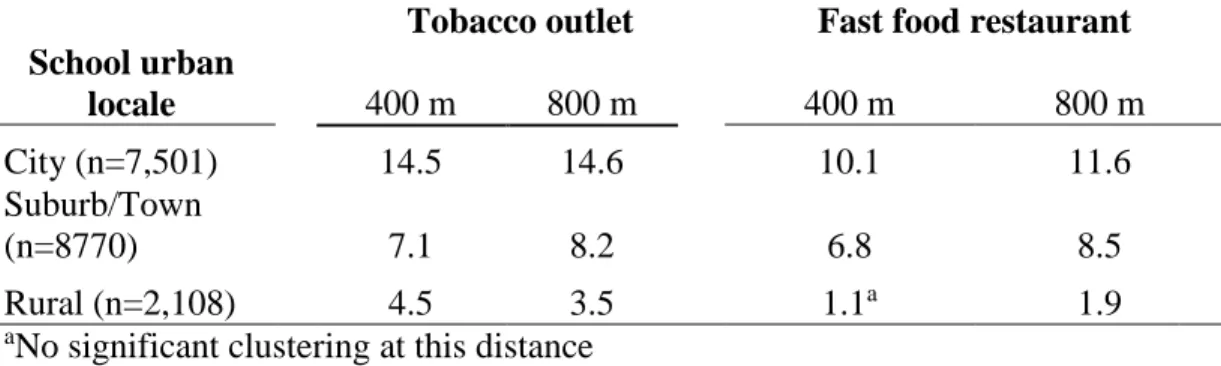
were observed for fast food where the ratio was 11.6 times more around schools in cities, 8.5 times more in suburbs, and 1.9 times more in rural areas than would be expected if fast food restaurant location was unrelated to school location.
Figure 4.3. Difference in observed and expected K functions (Kobs-Kexp) for tobacco outlets and fast food restaurants by distance from schools.
Table 4.2. Ratio of Observed to Expected K Function for Outlets Relative to Schools, 2011
Tobacco outlet Fast food restaurant
School urban
locale 400 m 800 m 400 m 800 m
City (n=7,501) 14.5 14.6 10.1 11.6
Suburb/Town
(n=8770) 7.1 8.2 6.8 8.5
Rural (n=2,108) 4.5 3.5 1.1a 1.9
Discussion
Both tobacco outlets and fast food restaurants were significantly clustered around schools in diverse geographic areas in this sample of U.S. counties. There were more of both outlet types than expected around all schools at distances as close as 600 m, or under a 10 minute walk; and in cities and suburbs, clustering occurred as close as 200 m from schools. We found a greater degree of clustering of tobacco outlets compared with fast food, and that tobacco outlets are located closer to schools, on average. The sheer number of tobacco outlets compared with fast food restaurants may account for these differences: there were over 5 tobacco outlets for every fast food restaurant in the study area, likely because there are multiple types of retail outlets that sell tobacco, whereas fast food was more narrowly defined. Some tobacco outlets are also places where kids can access unhealthy foods and beverages (e.g. convenience stores, pharmacies), and it is likely that about half of the tobacco outlets in our sample were convenience or
gas/convenience stores.96 These findings suggest that children and adolescents in the U.S. are exposed to a greater number of both tobacco outlets and fast food restaurants in school neighborhoods than what would be expected if outlet location was not associated with school location.
Our study area covered a more diverse geographic area which may account for differences. Frick et al. also found that proximity and density were associated, with a shorter distance between a school and a tobacco outlet being associated with greater tobacco outlet density within school neighborhoods,29 similar to our findings of a greater magnitude of clustering in cities and suburbs where the distance between a school and the nearest tobacco outlet or fast food restaurant was shorter.
Previous studies using spatial analyses to examine fast food restaurants around schools have found similar results. In both Chicago and New York City, researchers used the bivariate K function and found that fast food restaurants clustered around schools, although the magnitude of clustering in both those locations was lower than found around city schools in this study.75, 76 In
New Zealand, both fast food and convenience stores clustered around schools, with a greater ratio of observed to expected K function near schools located in areas with greater population density.77 In contrast, national chain fast food restaurants in Scotland did not cluster around schools within distances up to 1.5 km, although there was evidence of spatial clustering of other food outlet types.150 Although no studies have examined tobacco outlet clustering near schools
using a bivariate K function, there was significant spatial autocorrelation of tobacco outlets in neighborhoods around schools in New York City.29 In other words, tobacco outlets clustered
relative to each other in school neighborhoods, but clustering relative to schools was not measured.
predefined study area. The inhomogeneous K function we used accounted for the varying density of outlets across the study area, but the inclusion of cities of different sizes likely yielded an overall lower average outlet density for schools in cities compared with outlet density within a single large city. Large cities may have a greater overall concentration of outlets, yielding smaller observed K functions, and lower ratios of observed to expected K functions than observed in a more diverse study area.
Strengths and Limitations
This is the first study using a large sample of U.S. counties to examine the spatial clustering of both tobacco outlets and fast food restaurants near public schools. We have shown that both tobacco outlets and fast food restaurants are clustered relative to schools within easy walking distances for children in diverse geographic locations. We cannot establish causation with youth tobacco use or dietary intake. However, identifying whether and within what distance tobacco outlets and fast food restaurants cluster around schools can inform zoning and licensing policies that can impact the built environment in school neighborhoods.
Our study area included 97 counties with small, medium, and large cities, along with suburbs and rural areas, and this geographically diverse study area allowed us to compare the relative magnitude of clustering around schools in different locales while using an
inhomogeneous bivariate K function allowed us to account for the varying outlet density observed around schools across the study area. We did not account for commercial land use or population density beyond stratifying by school locale. However, clustering of fast food near schools was similar in New York City with and without accounting for commercially zoned land.75 Further, even if population density or commercial land use accounted for clustering, students attending schools in densely populated areas would still be exposed to the same outlets on their way to and from school each day. In addition, we did not examine if clustering differed by type of school (elementary, middle and high school) and further research may examine potential differences in access to tobacco and fast food by type of school.
Implications for Practice and Research
Examining whether tobacco outlets and fast food restaurants cluster around schools could inform licensing and zoning ordinances that impact the location of retail tobacco outlets and fast food restaurants. Zoning and licensing ordinances can help localities create healthier
neighborhoods around schools by restricting the types of businesses or the types of products sold near schools.23, 162, 163 Santa Clara County in California and the City of New Orleans have
implemented bans on tobacco outlets near schools.164 Chicago banned the sale of flavored
or sale of specific products within 500 ft. or even 1000 ft. of schools are likely to be conservative policies.
Conclusion
CHAPTER 5. STUDY TWO: IS THE AVAILABILITY OF FAST FOOD RESTAURANTS AND TOBACCO OUTLETS NEAR SCHOOLS ASSOCIATED WITH SCHOOL
SOCIODEMOGRAPHIC CHARACTERISTICS?
Introduction
Obesity and tobacco use are risk factors for cardiovascular disease and many forms of cancer, and disparities in both of these risk factors exist by socioeconomic status and
race/ethnicity.1, 2 Rates of obesity are highest among non-Hispanic Black (“Black”) and Hispanic youth compared with non-Hispanic White (“White”) youth.3 Black and Hispanic youth are also more likely to consume fast food and sugar sweetened beverages compared with White youth,8
and consuming fast food has been associated with increased intake of total energy, fat, sodium, and sugar-sweetened beverages among both children and adolescents.34, 35
Rates of current tobacco use are highest among White high school students; however, in 2012 current tobacco use among middle school students was higher for Hispanic students (10.5%) compared with White students (5.1%), and cigar use was highest among Black high school students compared with both White and Hispanic students. Rates of smoking initiation are highest among lower income youth of all race/ethnicities.42, 43 Given that about 90% of adult smokers initiate smoking before age 18,44 early intervention among vulnerable populations is critical. Unhealthy behaviors, such as smoking and poor dietary intake, appear to co-vary,9 consolidate early11 and track together over time.9, 11, 12