Made in Italy, by Chinese: how Chinese migration changed the apparel production
networks in Prato
Tu Lan
A dissertation submitted to the faculty at the University of North Carolina at Chapel Hill in partial fulfillment of the requirements for the degree of Doctor of Philosophy in the Department of Geography in
the Graduate School.
Chapel Hill 2014
Approved by:
John Pickles
Altha Cravey
Lawrence Grossberg
Scott Kirsch
ii ©2014 Tu Lan
iii
Abstract
Tu Lan: Made in Italy, by Chinese: how Chinese migration changed the apparel production networks in Prato
(Under the direction of John Pickles)
As a prototype of the Italian industrial districts (IDs), Prato has become a unique case in Italy and hosts
the second largest Chinese community in Italy. In the past two decades, a Chinese apparel industry in
Prato, known as the pronto moda, developed from a few stitching workshops into a full-fledged
production network, including designing, manufacturing, and wholesale. Exclusive ethnic enclave and
widespread irregular labor have triggered social tensions between Chinese immigrants and the local
society. This dissertation investigates the formation of this immigrant’s industry, the expansion of its
global production networks, and its interactions with the local institutions. In conversation with the
literature of industrial district and global value chains, it argues that the apparel value chains created by
Chinese immigrants in Prato have been a historically contingent consequence of regional economy and
national institutional contexts. There are three main findings in the dissertation. First, the emergence of
the Chinese pronto moda is a unique response to the rise of fast fashion and regionalization of apparel
production in Europe. In particular, it targets to low-end fast fashion and fills the specific niche market
between the European fashion brands and Made-in-China garments. Second, the social tensions in Prato
have to be understood in terms of its conjuncture. Power asymmetry within Chinese pronto moda has
resulted in a specific spatial pattern of “subcontracting the visibility”, which in turn triggers conflicts
between Chinese and Italian communities. Finally, to integrate and regularize the Chinese apparel
industry requires a transformation of the existing institutional framework in Prato, and the future of Prato
iv
attempts to dislodge two major myths in the literature of industrial district and Chinese migration. On the
one hand, Prato has been never an endogenous entity, and the recent Chinese influx is one of the many
exogenous forces that shaped and are still shaping the Pratese economy. On the other hand, neither a
passive sufferer nor a government conspiracy, the Chinese migration to Prato has actively responded to
v
TABLE OF CONTENTS
LIST OF TABLES………..………viii
LIST OF FIGURES………..ix
LIST OF ABBREVIATIONS………...xi
CHAPTER 1: INTRODUCTION………..……1
Section 1.1: Chinese Migration to Italy………..……..2
Section 1.2: Industrial Districts and the Made-in-Italy products………..………3
Section 1.3: The case of Prato……….………..7
Section 1.4: Main analytical questions………...………16
Section 1.5: Fieldwork and data sources………...…………..19
Section 1.6: Chapter outlines………..…………20
References………...24
CHAPTER 2: INDUSTRIAL DISTRICTS AND GLOBAL VALUE CHAINS……….…….…..28
Section 2.1: Industrial Districts……….……….…….…31
vi
Section 2.3: Confluence of the two traditions……….………46
Section 2.4: Conjuncture and conjunctural analysis……….………..50
References………...53
CHAPTER 3: WHEN WENZHOU MEETS PRATO……….………59
Section 3.1: Two myths about Chinese migration……….……….………60
Section 3.2: Prato: an industrial district as an adaptive system……….….73
Section 3.3: Lead firms vs. subcontractors……….78
Section 3.4: Government and social institutions……….……81
References………...87
CHAPTER 4: PRODUCTION TEAMS OF THE PRONTO MODA……….……….92
Section 4.1: The origin of the pronto moda………95
Section 4.2: Structure of the Chinese pronto moda………97
Section 4.3: Competitive advantage of the production teams……….…..104
References……….117
CHAPTER 5: TRADE NETWORKS ACROSS EUROPE………...120
Section 5.1: Competitiveness outside Prato………..………121
Section 5.2: Upstream – textile sourcing………...………...127
vii
References……….138
CHAPTER 6: POWER ASYMMETRY AND SPATIAL CONFLICTS OF THE PRONTO MODA……….……...…139
Section 6.1: Subcontracting the visibility……….143
Section 6.2: Spatial heritage and Chinese reinvention………....…..152
Section 6.3: Problematization of the space………...………163
Section 6.4: Dragon parade as spatial demarcation………..172
References……….175
CHAPTER 7: ECONOMIC COOPERATION AND THE ROLE OF THE LOCAL GOVERNMENT……….………...178
Section 7.1: The limitation of the business associations……….……….……….181
Section 7.2: Firm-level cooperation……….……….185
Section 7.3: CREAF and its problems……….…….187
Section 7.4: Toward a cohesive, transnational investment community………....195
Section 7.5: Economic cooperation and integration………...…..199
References……….202
CHAPTER 8: CONCLUSION………..……….204
viii
LIST OF TABLES
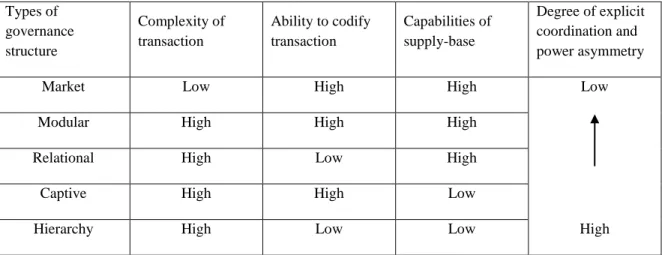
Table 2.1: Types of governance structure………...…….41
Table 2.2: Stages of upgrading in the textile and apparel industry……….……….42
Table 3.1: Businesses headed by top 10 immigrant groups in Italy in 2011……….……..………66
Table 4.1: Internal structure of the Chinese pronto moda……….104
ix
LIST OF FIGURES
Figure 1.1: Industrial districts officially endorsed by the Italian government………...5
Figure 1.2: Map of Prato………..………..9
Figure 1.3: Number of Chinese immigrants by province………..10
Figure 1.4: Percentage of Chinese immigrants by province………11
Figure 1.5: Number of textile and apparel firms in the ID of Prato, 2000-2012………...12
Figure 1.6: Prato’s export in value (thousand Euro), 2002-2011……….…………12
Figure 1.7: Ethnic shares of the textile and apparel industries in Prato………..13
Figure 1.8: Number of Chinese individual firms in the top 8 provinces in 2010………..14
Figure 2.1: Historical succession of the textile and apparel industry……….……..43
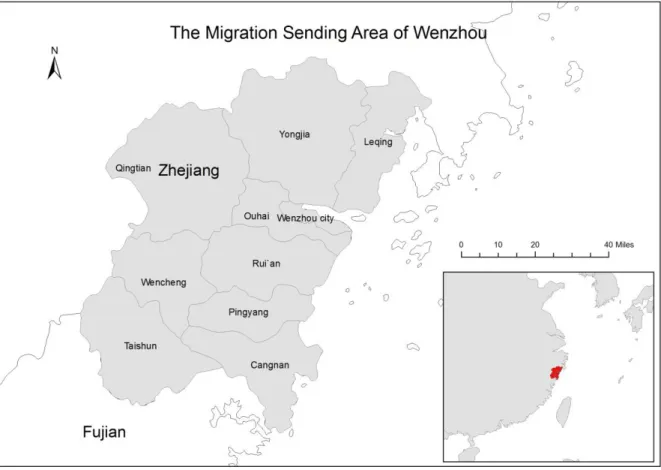
Figure 3.1: Wenzhou in China……….…62
Figure 3.2: Number of Chinese nationals in Italy by year………..66
Figure 3.3: Migration routes (undocumented) from China to Italy in the 2000s……….71
Figure 3.4: Number of establishments in the textile industry in Prato, 1991-2001……….…80
Figure 4.1: Production teams in the Chinese pronto moda………104
Figure 4.2: Predominant role of manufacturing sectors in Prato………..……….110
Figure 5.1: Textile imports by Prato and Italy………...…130
x
Figure 5.3: Maps of the major markets for the pronto moda……….…135
Figure 6.1: Comparison between the (a) Pratese textile industry and (b) Chinese pronto moda………...…..150
Figure 6.2: Bird view of Macrolotto 0 and 1……….155
Figure 6.3: Outside a final firm in Macrolotto 1………157
Figure 6.4: Exhibit room of a final firm……….158
Figure 6.5: A former textile mill now hosting stitching workshops in Macrolotto 0………....159
Figure 6.6:Factory-houses in Macrolotto 0………..….160
Figure 6.7: Ground floor of a factory-house………..161
Figure 6.8: Dorm room on the attic of a factory-house……….162
Figure 6.9: Conception of the fabbrica abitata………..168
xi
LIST OF ABBREVIATIONS
ID Industrial District
GVC Global Value Chain
GPN Global Production Network
OEM Original Equipment Manufacturer
ODM Original Design Manufacturer
OBM Original Brand Manufacturer
1
Chapter 1: Introduction
On January 1, 2011, 274,417 Chinese nationals lived in Italy. They were and still are the fourth largest
foreign immigrant group in the country and the largest group from Asia (ISTAT 2012). Compared with
other immigrant groups, the Chinese community has been involved in entrepreneurial activities in very
specific and relatively large-scale ways. In particular, Chinese immigrants in Italy concentrate in the
traditionally Made-in-Italy sectors such as apparel and leather goods, and in specific industrial districts in
the northern and central part of the country (Barberis 2009, 9–10). In this dissertation, I focus on the
Chinese apparel industry in the most important of these industrial districts, Prato, Tuscany. Prato has been
globally renowned for its textile production since the 1930s, but in the past two decades, the Chinese
apparel industry in Prato has developed from a few stitching workshops into a nearly full-fledged network
including manufacturing, designing and wholesaling. Mainly serving the lower cost market, the
magnitude of this industry has been widely reported as a threat to the reputation of high-value
Made-in-Italy textile and apparel (Donadio 2010).
What makes it possible for the cluster of small and medium-sized apparel companies headed by Chinese
immigrants to emerge in the middle of an Italian industrial district? Why do these companies bring
Chinese workers overseas instead of producing and sourcing in China? What makes this cluster different
from other regional economies that rely on migrant workers? I argue that on the one hand, the changing
institutional contexts and socioeconomic circumstances of varying scales have been important in shaping
the structure of the Chinese production network in Prato, while on the other hand, Chinese migrants have
been responding to markets and social pressures in their own ways. Working through theories of
industrial districts and global value chains, this dissertation analyzes the position of the Chinese apparel
2 1.1. Chinese migration to Italy
As early as the 1910s, people from the districts of Wenzhou and Qingtian in Zhejiang province arrived in
Europe as the street peddlers and war recruits for the labor shortage during and after WWI (Live 1998, 98;
Li 2002, 106). The number of Chinese in Italy remained small until China’s reform in 1979 and the
subsequent relaxation of the emigration policies (Li 2002, chap. 5). Following the Sino-Italian treaty in
1985 and a series of amnesties in 1990, 1995, 1998, 2002 and 2012, Italy became the most popular
destination in Europe for the Chinese (Carchedi and Ferri 1998; Ceccagno and Rastrelli 2008). As a result
of these regulations, many Chinese also came illegally from China and other European countries hoping
for the next amnesty (Ceccagno 2003). The recent arrival of Fujianese and Northeasterners to a certain
degree diversifies the Chinese population in Italy, although it is believed that immigrants from Zhejiang
still dominate the Chinese population in Italy (Pieke et al. 2004, 118). Part of the Chapter 3 is devoted to
this history and contemporary situation of Chinese migration to Italy.
The Chinese immigrants in Italy show a strong propensity toward entrepreneurship. At the national level,
although Chinese immigrants are only 4% of the total foreign population, in 2010 the number of
companies registered by Chinese businessmen and women reached 53,000 or 8.5% of the total foreigner
headed companies (Camera di commercio di Torino 2011, 119). Unlike their Western European and
North American counterparts, many of Chinese immigrants in Italy work in consumer goods
manufacturing sectors that were traditionally recognized as “Made in Italy” products. Data in 2004 shows
that there were 18,554 businesses in Italy run by the Chinese (PRC nationals), of which 6,236 were in the
textile and clothing sector and 7,735 were in the wholesale and retail sector, most of which were also
related to the textile and clothing industry (Ceccagno 2007). Similar to what happens in Italy’s
mainstream economy, 69.5% of Chinese firms were those with only one person or imprese individuali
(Camera di commercio di Torino 2011, 119). Although these workshops originally ran as the
3
supply higher-end fashion brands such as Armani or Gucci, or to directly supply lower-end fast fashion
market (Ceccagno 2003).
This occupational pattern results in a unique demographic and economic geography. Unlike other major
immigrant groups, the Chinese have moved primarily to the industrial districts of Central and Northern
Italy. The top four regions with the largest numbers of Chinese population are Lombardy, Tuscany,
Veneto and Emilia-Romagna (ISTAT 2012). In particular, Prato, Tuscany has been identified as the
manufacturing center of the Chinese apparel industry, while Milan and Rome are the wholesale centers
for importing and selling finished goods (Cologna 2005; Lucchini 2008). Partly because of language
barriers and the closure of the community to non-Chinese speaking scholars, research of the Chinese in
Italy and their specific effects on manufacturing in Italian IDs remains very limited (Barberis 2009).
1.2. Industrial Districts and the Made-in-Italy products
The concept of industrial district (ID) was originally defined by Alfred Marshall (1890) based on three
mechanisms: scale economies, external economies and a sufficient pool of skilled labor (discussed in
Chapter 2). This Marshallian concept was later developed by a number of Italian scholars and became one
of the doctrines for regional studies (Becattini 1978; Brusco 1982). In an ID, the majority of firms are
small and medium-sized enterprises (SMEs) which cooperate usually in one sector and in auxiliary
industries and services, and these firms form a communal network with common business conventions
(Becattini et al. 2003). During the golden age of Italian industrialization between the 1950s and 1970s,
IDs concentrating in the northern and middle part of the country played a significant role in the national
economy, as they exported (1/4 of the total) more than the heavy industries in Piedmont and Lombardy
which mostly served domestic market (Becattini 2001, 40; Dunford and Greco 2006). Their products
were mainly light consumer goods such as textile, apparel, leather and furniture which build the
4
Italian congress to pass a law in 1991 which officially authorized the ID as one of the most important
instruments in the state’s economic policies (Becattini 2001, 125; Lazerson and Lorenzoni 1999, 239).
Although I give a detailed analysis of Italian IDs in Chapters 2 and 3, it is worthwhile to mention a
number of its most distinct characteristics here. First, compared with vertically integrated factories of
their northern neighbors, IDs in Emilia-Romagna and Tuscany are constituted by small and medium-sized
companies each of which specializes in a specific phase of production. Second, nearly all of the IDs are
located in the 2nd or 3rd tier towns, or “urbanized countryside” (Sforzi 2003, 36) such as in my case Prato
instead of metropolitan areas such as Turin and Milan. Third, IDs are extremely adaptive to new market
conditions because of their mechanisms for innovation, arm-length transaction, and exchange of
“contextual” or “uncodifiable” knowledge between SMEs (Becattini 2001, 12). Finally, strong tradition in
organizing political and social institutions has been viewed as one of the major factors for the relatively
harmonious relationship between labor and capital in the IDs, and therefore protected the districts from
the violent turmoil of class struggles common in the northern part of the country. Despite the tremendous
changes of the global market and local society between the 1950s and now, IDs maintain their unique and
consistent socioeconomic identity (Becattini, Bellandi, and De Propris 2010). Scholars, in particular
Italian scholars, believe that the continuity of local business and institutions has successfully mitigated the
discontinuations imposed by external forces: “I believe – though I cannot prove it – that Prato’s ‘social
kernel’ has not merely allowed the modern world to surge through it but has tried to experience it on its
own terms, pushing and pulling it this way and that to make it fit in, as far as it could, with its own
potential and its own values” (Becattini 2001, 197). The social kernel of Prato comprises not only the
culture of entrepreneurship and knowledge sharing, but also a number of social and governmental
institutions. Therefore, the development of the Pratese ID was seen as being mostly propelled by its own
5
Fig. 1.1: Industrial districts officially endorsed by the Italian government
However, in spite of the positive readings given to the successful IDs, many IDs have some inherent
deficiencies and therefore have been suffering a prolonged recession since the 1990s. On the one hand,
the low fertility rate and the occupational preference of the younger generation have caused a shortage of
labor in the IDs (Becattini et al. 2003). On the other hand, the competitiveness of Made-in-Italy products
has been hurt for a number of reasons including shifting market tastes, restructuring of the retail network,
competition from emerging Asian economies and the appreciation effects caused by the currency change
from Lira to the Euro (Becattini et al. 2003; Dunford and Greco 2006). Evidence shows that the economic
unevenness among Italian regions has rapidly increased in the past 10 years with advantaged regions in
6
becoming more disadvantaged (Dunford and Greco 2006, chap. 4). I discuss the transformations of Italian
IDs in Chapter 2, and those specific to Prato in Chapter 3.
As Belussi and others argue, there have been many evolutionary paths that the IDs follow, and different
origins and different genealogies often result in very different responses to the economic crisis (Belussi
and Sedita 2009; Camuffo and Grandinetti 2011; Belussi and Sedita 2012). First, evidence shows that a
substantial increase of the size of firms is occurring in some of the IDs (Dunford and Greco 2006; Dei
Ottati 2009b). Facing competition pressures from emerging economies, some Italian SMEs have started
vertically integrating themselves in order, on the one hand, to capture more value added in the commodity
chain, and on the other hand, to concentrate capital for foreign investments and innovation (Rabellotti,
Carabelli, and Hirsch 2009). With the increasing size of the firms, whether or not many of the districts
qualify as an “Industrial District” as defined by law remains a question. Second, quality upgrading and
product shifts are happening throughout the IDs. As mentioned earlier, the IDs are always export-oriented.
In 1996, the share of manufacturing exports from IDs accounted for 46% of the Italian national total
(ISTAT 2002). Many argue that since the majority of these exports are low-price, low-skilled products,
the competitiveness of IDs is doomed to lose to the emerging economies in Asia (Dunford 2006).
However, Rabellotti et al. (2009) argue that since the 1990s, many Italian IDs have undergone a
substantial upgrading. In particular in the textile industry, many IDs have either upgraded to produce
branded luxury products or shifted to produce machineries for consumer goods. Therefore, even though,
by definition, these IDs remain in their traditional sectors, they are not actually competing with emerging
economies. Third, outsourcing has been used by many IDs as a way to reduce costs. Since the late 1990s,
many Italian firms began to move assembly lines to Eastern Europe (in particular Romania) and North
Africa (in particular Tunisia), but still kept the key components i.e. the innovation department and a
substantial production capacity in Italy (Corò and Volpe 2006). This trend is officially encouraged by the
Italian and EU governments as Outward Processing Trade (OPT) (Smith 2003). However, parallel to OPT,
7
ethnic firms. Many believe that the emergence of Chinese firms helps the IDs to keep its competitiveness
(Ceccagno 2009), while others argue that these firms sustain the low-skilled jobs and therefore counteract
the preferable upgrading (Dei Ottati 2009a). Some argue that the emergence of Chinese Italian firms only
temporarily slows down the pace of upgrading without changing either the internal structure or external
market of the IDs, and so when the accumulation of these firms reaches a certain level, upgrading will
resume (Rabellotti, Carabelli, and Hirsch 2009).
All these trends are intertwined to various degrees among IDs. In many cases, one trend is conditioned by
another. For example, in the textile industry, outsourcing to Eastern Europe is usually accompanied by the
vertical integration of the firm, because the FDI requires a hoard of capital which is usually impossible for
smaller firms (Rabellotti, Carabelli, and Hirsch 2009). Moreover, as many have argued, each individual
ID has its distinct composition of strategies and responds to globalization differently (Dunford and Greco
2006; Belussi and Sedita 2009). That is, the success of one industry in one ID can by no means be applied
to another industry in another ID. Globalization never diminishes the local; it simply transforms the ways
in which the locale is connected to the global (Harvey 1991; Agnew 2002). As shown in the later chapters,
global value chains and transnational migration have never erased the distinctiveness of the production
network in the Pratese ID. Instead, these “global” forces innovatively rearticulated production networks in
Prato. The emergence of Chinese firms in fact is part of this bigger picture of transitions in the Italian
economy. If we see them as the response to the differential transitions in different IDs, from a
functionalist point of view, they must have very specific impacts in different IDs—that is, the firms in
Milan should be very different from those in Prato. In that sense, any research on Chinese businesses in
Italy ought to be locally specific and should not be overly generalized.
1.3. The case of Prato
8
fright triggered by crises and the fears of unfair competition at home.” (Pieraccini 2010, xi) My translation.
The beginning of Silvia Pieraccini’s L’assedio cinese (The Chinese Siege) partially explains the stimulus
for my research. Prato is less than 20 km to the northwest of Florence.1 Historically a production and
trade center for woolen fabrics in the Medieval Age (Origo 1957), Prato is now one of the most
industrialized towns in the region of Tuscany. The province of Prato is one of the newest and smallest
provinces in Italy (The Province of Prato 2012; Agnew 2002, chap. 9). It became independent from the
province of Florence in 1992 as part of the national political reform towards local autonomy. On January
1, 2011, there were 249,775 residents in the province, of which 188,011 lived in the city (comune) of
Prato (ISTAT 2012). Despite its relatively small population, Prato is among the most popular Italian
destinations for immigrants. By the end of 2010, 33,874 foreign nationals lived in the province,
accounting for 13.6% of the total population. In particular, in 2010, the Prato Province hosted the
country’s second largest community of Chinese immigrants, a population of 24,626, behind only Milan
(31,385) but ahead of Florence (20,650) and Rome (15,970) (ISTAT 2012).2 In terms of the ratio between
immigrant and local populations, the city of Prato had the highest percentage of Chinese immigrants
among all the Italian cities, 9.9% of the total population, far ahead of Ascoli Pecino of Marche (2.6%) and
Florence (2.0%), which follow in the list. Apart from those who held resident permits, there are also a
significant number of undocumented workers in Prato. Since many of the migrants do not hold residence
permits, estimates for the Chinese population in the city of Prato goes as high as 28,000 (Smyth and
French 2009, 4).
1 Prato is the name both for the province and the city which hosts the provincial seat. Since the data used in this
dissertation comes from both the city (municipal) and provincial institutions, I have carefully specified the level of the statistics in each of the cases.
2 According to the manual book provided by ISTAT, these numbers only count the number of immigrants who held
9 Fig. 1.2: Map of Prato
12
Fig. 1.5: Number of textile and apparel firms in the ID of Prato, 2000-2012
Sources: Author’s illustration with data from the Prato Chamber of Commerce and UIP. Note: The 2000
and 2001 numbers are estimated based on numbers of active firms in respective sectors; the 2012 number
is predicted in the 2nd quarter of the year.
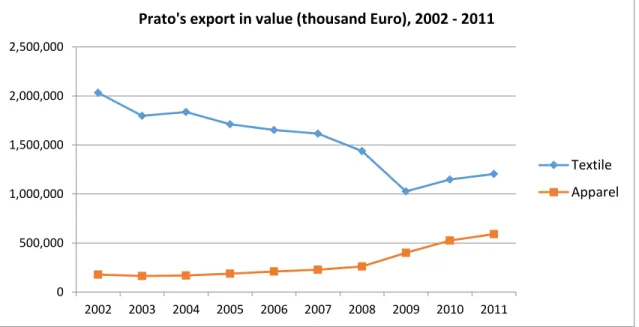
Fig. 1.6: Prato’s export in value (thousand Euro), 2002-2011 0
1,000 2,000 3,000 4,000 5,000 6,000 7,000
2000 2001 2002 2003 2004 2005 2006 2007 2008 2009 2010 2011 2012 Number of textile and apparel firms in the ID of Prato, 2000 - 2012
Textile
Apparel
0 500,000 1,000,000 1,500,000 2,000,000 2,500,000
2002 2003 2004 2005 2006 2007 2008 2009 2010 2011 Prato's export in value (thousand Euro), 2002 - 2011
Textile
13
Source: Author’s illustration with data from the Prato Chamber of Commerce.
Fig. 1.7: Ethnic shares of the textile and apparel industries in Prato
Source: Author’s illustration with data from the Prato Chamber of Commerce.
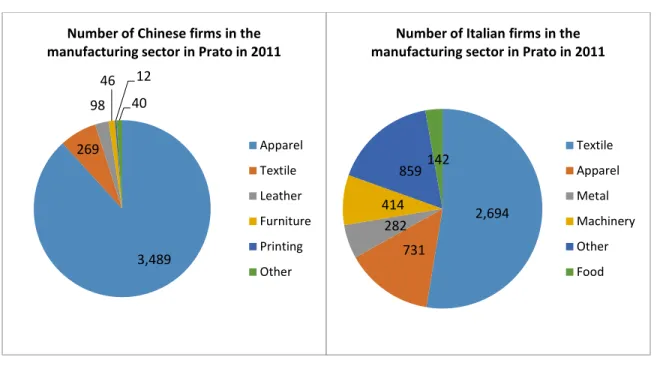
The Chinese apparel industry in Prato is characterized by the large portion of small firms, the
predominance of manufacturing and sheer number of establishments. What makes the issue more
interesting is that Prato has the biggest number of Chinese individual firms among all the provinces: 11.5%
of total Chinese individual firms in Italy are in Prato Province (Camera di commercio di Torino 2011,
123), among which 81% or 3,249 were apparel manufacturers (UIP 2012). This percentage also made
Prato the primary manufacturing center for Chinese apparel in Italy. 3,489
269 98
46 12 40
Number of Chinese firms in the manufacturing sector in Prato in 2011
Apparel
Textile
Leather
Furniture
Printing
Other
2,694
731 282 414
859142
Number of Italian firms in the manufacturing sector in Prato in 2011
Textile
Apparel
Metal
Machinery
Other
14
Fig. 1.8: Number of Chinese individual firms in the top 8 provinces in 2010
Source: Author’s illustration with data from the Turin Chamber of Commerce (2011, 125).
The emergence of this Chinese apparel industry is closely related to the trajectory of the local textile
industry in three aspects. First, as the apparel industry grew, the traditional textile industry in Prato
suffered a prolonged downsizing and verticalization during the same period. Having been the production
center for woolen fabrics since the WWII, since the 1980s, the Pratese textile industry has been facing a
series of difficulties. Rising labor cost, the phasing-out of the Multi Fiber Agreement (MFA) and the
continuous decline of market demand for woolen fabrics are among the most important factors (Becattini
et al. 2003; Dei Ottati 1996; Dei Ottati 2009b).
Data provided by the Unione Industriale Pratese (UIP, Association of Pratese Industrialists, local branch
of Confindustria)and theItalian census bureau, ISTAT(Dei Ottati 2009b, 1882) give a clear picture of
this shift from textile to apparel, and why local Italians are not very contented with the shift. First,
between 1991 and 2011, the number of textile firms in Prato plummeted from 9,411 to 2,979, while the
number of apparel firms soared from 1,219 to 4,388. The closures also resulted in high unemployment 0
500 1000 1500 2000 2500 3000 3500 4000 4500
Prato Milan Florence Rome Naples Turin Padua Reggio Emilia
Number of Chinese imprese individuali in the top 8 provinces in the 3rd quarter of 2010
Other
Personal service
Hotel and food
Construction
Trade
15
rates in Prato. According to a report by Istituto Tagliacarne (2012), between 2007 and 2012, the
unemployment rate in Prato rose from 5.1% to 9.3%. In particular, the rate of youth unemployment
(between 15 and 24) rose 2 percentage points every year, reaching 31% in December, 2011 (Pignalosa,
Dorato, and Martone 2012, 7). Second, although the production volume of the apparel industry has been
large, the value of apparel products remains much lower than the textile industry. In 2010, the annual
turnover of the textile and apparel industry was 4,528.5 million euro, in which 3,004.6 million or 66%
was produced by the textile industry (UIP 2012). In terms of export values, in 2011, Prato’s textile export
(1.2 million euro) was still two times bigger than the apparel export (0.6 million euro). This contrast
implies the huge gap between the qualities of textile and apparel produced in Prato. While Italian textile
firms were suppliers for high fashion brands, Chinese apparel companies mainly produced for low end
markets. Therefore, it becomes natural for people to worry whether or not the Made-in-Prato apparel is
impairing the reputation of Made-in-Italy in general and the prestige of the Pratese ID in specific. Finally,
because the local apparel industry is dominated by Chinese companies, some have argued that the
Chinese apparel industry in Prato has been an independent ID within the ID, and for that reason, has been
making use of the local resources without paying back to the local society (Dei Ottati 2009a). Data
provided by the UIP show that until the 3rd quarter of 2011, among all the 4,072 apparel firms, only 882
firms or less than 1/4 were registered by Italian nationals. Although to what extent the Chinese apparel
industry is benefiting the local economy remains a question (I discuss this question in Chapters 6 and 7),
the ethnicization of the apparel industry has caused widespread local hostilities.
Since 2000, socioeconomic changes redrew the political image of Prato. In the past years, problems of
immigration became one of major discursive instruments for the right wing parties to address social issues
(Zincone 2006). In particular, as evident in many of the recent Italian publications (Oriani and Stagliano
2008; Pieraccini 2010), the case of Prato has been widely reported as a Chinese triumph over the local
economy, inflicting fears in the Italian society. The recent coverage of Chinese in Prato by the New York
16
threatening the world (Donadio 2010). In 2009, by manipulating anti-immigration sentiments, the right
wing coalition including Popolo della Libertà and Lega Nord won the municipal election for the first time
in Prato’s postwar history (Fazzino 2010). As one of its electoral promises, the new municipal
government imposed stricter regulations on the Chinese community by introducing army patrols in the
downtown area, restraining the hours of Chinese businesses, and launching more frequent police
investigations targeting Chinese firms, all of which were highly visible in local newspapers.3 The Italian
debt crisis beginning in 2009 further exacerbated the tensions between the Chinese and local communities
and made the future of Chinese firms unpredictable.
1.4. Main analytical questions
This dissertation is structured into three main analytical questions:
(1) How did the development of Prato and the institutional contexts both in Italy and China prepare the
conditions for the Chinese apparel industry in Prato?
At the heart of my question is a local debate about whether or not the Chinese apparel industry halted the
upgrading of the ID by introducing low-road competition based on undocumented workers. On the one
hand, scholars such as Dei Ottati (2009a) and Toccafondi (2009) are concerned with the tensions between
Chinese firms and local society, and argue that without institutional intervention, the lower value apparel
produced by Chinese firms would banish the higher value textile companies and eventually impair the
overall reputation of Made-in-Italy products. On the other hand, scholars such as Ceccagno (2007) argue
that Chinese apparel firms have actually been supporting the Italian production network, since many of
Chinese firms were subcontractors of Italian firms until recently. Notwithstanding the disagreement, most
of these scholars admit that the particular timing of the arrival of Chinese immigrants has been important
3 For instance, within the single week between February 25, 2012 and March 2, 2012, there were 18 police raids
17
for their success. Therefore, I want to investigate the entry point of the Chinese companies and elucidate
the historical contexts that made the entry happen. My research shows that the entry of Chinese apparel
firms was by and large contingent upon a number of historical events. In addition to changes of the
institutional contexts in both sending and receiving countries, the development trajectory of Prato has
prepared in important ways a niche for the Chinese apparel industry.
Focusing on this debate, the dissertation seeks to de-essentialize the dominant story portraying the
Prato ID as an endogenous system. Instead, I shall show that the entry of Chinese firms must be viewed
as one of the latest phenomena along the array of global and national forces that have changed the ID
since its origin. At the same time, I want to de-essentialize the dominant story of Chinese migration
which so far has been seen either as a cultural exception or as a strategic conspiracy of the Chinese
government (Skeldon 2007). In contrast to these stereotypes, the history of the Chinese apparel industry
in Prato has been full of contingencies and subject to a variety of economic, social and political factors.
For this reason, my research attempts to contextualize it and presents it in its peculiar historical
conjuncture.
(2) How do Chinese apparel manufacturers and traders in Prato participate in the local and global value
chains that have been transforming the ID over the past two decades?
Chinese companies in Prato are, at the same time, both local and global. As local companies in the ID,
they are dependent on local infrastructure, existing business model and local supplies of industrial inputs.
Moreover, the Italian and European markets have been one of the main reasons for them to relocate here.
On the other hand, as immigrants’ companies, they participate in the global value chains in particular
ways. Being largely excluded from the mainstream value chains controlled by lead firms, these Chinese
companies have established their own distribution networks throughout Europe. For working class
consumers in many European countries, these value chains have been important supplements to those of
18
value chains. On the one hand, regulations at national and local levels left significant vestiges in the
Chinese apparel value chains. As immigrants’ companies, Chinese in Prato faced a number of barriers
including immigration laws and local business regulations. On the other hand, Chinese immigrants
responded to these regulations in their own ways. Based on their specific cultural and social norms, they
invent different ways to circumvent or co-opt the unfavorable regulations. More importantly, such
interaction between institutions and immigrants does not always produce favorable results for the
immigrants. Benefitting from the transformation of the Prato ID, the Chinese companies and workers are
also victims of the transformation, as evident in the widespread irregular labor and under-standard
working conditions (see Chapter 6). To sum up, I want to argue a more dialectical relationship between
Chinese firms and local society, and problematize the simplified story of the Chinese triumph in Prato.
(3) What roles have local and national governments played in shaping the structure of the Chinese
production network and coping with the tensions between Chinese and local societies?
Throughout the history of Chinese migration to Prato and the evolution of the Chinese apparel industry,
local and national governments were important in at least three ways. First, the institutional contexts
defined the condition of possibilities for immigrants’ businesses; the choices of industries, location,
partners and the ways of contracting are shaped by laws and regulations. In particular, I see the economic
behaviors of firms not only determined by economic factors but also connected to a variety of social and
political forces. Through the perspective of conjunctural analysis (Hall and Massey 2010; Grossberg
2010, chap. 3), I want to present the complexity of relations and tensions between groups of people in
Prato. Second, among others, I study a particular dimension of the tensions between Chinese and Italian
communities: the contest between different ways of managing space. While the Chinese firms and
workers tend to diffuse working and living spaces, the Italian authority tries to enforce a clear boundary
between the two. This contest has become the center of the struggles between Chinese immigrants and
local society in Prato. Finally, as many recent research shows, the traditional leadership in Prato is no
19
transnational nature of the Chinese apparel industry, the cooperation between local Italian and Chinese
firms necessarily goes beyond the border of the ID. Therefore, I argue that Prato requires a new form of
development in which a transnational community of private and public agencies should pay a more
important role.
Responding to these questions, I engage with a number of theories in economic geography and related
disciplines. First, the literature of Post-Fordist regional development in general and the debate about the
“Third Italy” model of industrialization in specific are important for me to rethink the concept of
industrial district (ID) with Chinese migration. Second, the literature of Global Value Chains (GVC)
provides a set of theoretical and methodological tools for me to study the firms and inter-firm relations in
the Chinese apparel industry. Recent elaborations by economic geographers expand the new scope for
studying the broader social impacts of industrialization. Both ID and GVC literatures offer a variety of
frameworks to study the transnational trade and entrepreneurship. By interrogating the boundaries of
these studies and with the help of the critical tradition in economic geography, I attempt to propose a new
model of regional development incorporating transnational migration.
1.5. Fieldwork and data sources
The dissertation is based on over 70 interviews with 60 subjects between 2011 and 2013. The dates were
split between China and Italy. In Italy, I spent 5 and half months in total, with 1 month in Turin and
Milan, 4 months in Prato, and about 2 weeks in Rome and Naples. Compared with the continuous stay in
Italy, the part of the fieldwork in China comprised short visits to the hometowns where the majority of
Chinese immigrants come from; 20 days in total were spent in Wenzhou City and its neighboring
Qingtian County. A number of half-day visits were spent in Lianjiang where many Fujianese immigrants
in Italy come from. I also made several visits to Xingtang and Nanhai of Guangdong Province to find (in
vain however) some of the factories in which Chinese Italian entrepreneurs invested. The subjects of my
20
Additionally, it was my surprise to find a number of Italian and Chinese scholars and social activists who
had been working to tackle the tensions between Chinese immigrants and local communities. The
interviews with them, although few, broadened my understanding of those seemingly “economic”
tensions that mass media and politicians were highlighting. To protect my subjects, all the names in this
dissertation have been replaced by aliases.
Data were collected from a variety of Chinese and Italian institutions and publications during the same
period. Reports and books of chorography (as Difangzhi in Chinese referring to an old tradition of
writing local geographies and histories) were acquired from local governments in Wenzhou, Qingtian,
Wencheng, Florence and Prato. Trade and industrial statistics were mostly obtained from the Unione
Industriale Pratese and Prato Chamber of Commerce, in particular the latter. On their website, Prato
Chamber of Commerce provided yearly import and export data between Prato and other countries
(http://www.po.camcom.it/servizi/datistud/index.php). Estimates of immigrant population have been
disputed in Italy, since a couple of institutions are reporting different numbers at the same time. In the
dissertation, I rely extensively on the data published by the national census bureau of Italy, the ISTAT.
Compared to other data sources such as the one offered by the Catholic Church (Caritas), the data from
ISTAT are usually conservative and collected through statistically robust methods.4
1.6. Chapter outlines
The dissertation is structured into 7 chapters. In this introductory Chapter 1, I have laid out the scope of
the problematic and the analytical frameworks for my research. I also briefly review the fieldwork and
methodology that this research relies on.
Chapter 2 generally engages with 2 bodies of literature that are most important to my dissertation. The
literature of industrial districts emerged upon the crisis of Fordism in the 1970s and has generated a series
4 Technical insights of different data sources were offered by Dr. Luisa Salaris at the University of Cagliari and Dr.
21
of international debates on models of regional development in general, and the case of the Third Italy in
specific. They provide necessary background knowledge and a theoretical framework to study Italian IDs,
such as Prato. The second body of literature I engage with is the global value chains. Instead of reiterating
the history of this literature, I focus on a number of useful methodological tools offered by it and show
how these tools can be applied to my case. Beyond these two bodies of literature, I also borrow the
concepts of conjuncture and conjunctural analysis from British Cultural Studies.
Chapter 3 has two general purposes. First, it gives a brief overview of the history of Chinese migration to
Italy. It describes the flow of workers and owners mainly from the southern part of Zhejiang Province
since the early 1900s. It then shows how the establishment of the Chinese community as a permanent
aspect of the Pratese industrial district and in Italy more generally was an outcome of a series of historical
contingencies. Many of the contemporary characteristics of the Chinese Italian community were shaped
by a specific sequence of Italian and Chinese national policies. By so doing, I want to contextualize the
Chinese migration to Prato and help to de-essentialize the stereotype of Chinese migration either as
cultural exception in which mechanism such as guanxi dominate or as a government conspiracy. Second,
based on secondary researches, the chapter also reviews the postwar history of Prato ID. I want to show
that the concept of industrial district should not be fetishized as an endogenic process in which only local
forces play dominant roles. There have been a handful of historical moments at which Prato could have
followed different paths of development. By so doing, I want to de-essentialize the concept of ID and
argue that the emergence of the Chinese apparel industry in Prato, alongside the return of vertically
integrated producers and the polarization between small and big firms, was a unique outcome of the
ongoing transformations in Italian IDs.
Chapter 4 is devoted to the internal structure of the Chinese apparel industry. I make two investigations in
the chapter. First, I introduce the production network of Chinese apparel firms in Prato commonly known
as pronto moda. Although many would presume that the Chinese apparel companies emerged at the cost
22
the transformation that local firms have pioneered. Chinese firms inherited the existing governance
structure of the Italian pronto moda but introduced new functions that boost productivity and flexibility.
Second, I analyze the competitive advantage of the Chinese pronto moda and attempt to shed lights on the
dark side of these production teams. In particular, the Chinese pronto moda, compared to its Italian
precedent, has been more unequal in terms of governance structure and the consequent power asymmetry.
This inequality defined the competitiveness of Chinese firms, but at the same time also engendered
profound social problems.
Chapter 5 continues the analysis of the competitiveness of the pronto moda, but from the perspective of
its trade networks outside of Prato. It argues that another part of its competitive advantage also relies on a
horizontally integrated wholesale network of Chinese migrant traders living across Europe. On the one
hand, these traders follow a business model that concerns fashion designs, faster replenishment, and smart
inventory control. In this sense, they are very similar to what major European fashion brands, such as
Zara, have been doing. On the other hand, different from major European brands, this Chinese trade
network is less capitalized and targets a niche market with cheaper price and lower quality. In this sense,
they fit the niche market between major European brands and Made-in-China garments.
The 6th chapter focuses on the tensions between Chinese firms and local Italian authority on the ways in
which productive and living space is managed in pronto moda. In particular, drawing upon the
conjunctural analysis from British cultural studies, I study the conjunctural spatial logics behind the
apparel production networks in Prato. While the Italian authority carefully defines the spatial boundary
between factories and houses, the Chinese stitching workshops tend to ignore the regulation for economic
and social reasons. Because of the power asymmetry between final firms (firms that organize the
production team and specialize in design and output phases) and stitching workshops (firms that
specialize in the stitching phase alone), final firms are able to subcontract not only the least profitable
phase but also the more precarious forms of work to stitching workshops. Such power symmetry has
23
depend on flexible labor are deemed too risky to be seen even though it might have little to do with
illicitness, other phases of production such as exhibit of final products are intentionally to be public. This
is the reason why stitching workshops are forced to hide themselves from the local society. I show that
the hiddenness of the Chinese workshops contributes to the misunderstanding between Chinese and
Italian communities, which culminated in the annual dragon parades of the Chinese New Year.
The central question of the Chapter 7 is how the local institutions in Prato respond to the tensions and
why some of the ongoing efforts made by Italian local government failed. In this chapter, I discuss how
local business associations and local governments tried to cooperate and regularize the Chinese pronto
moda. I point to the main obstacles of cooperation between Chinese firms and local authority, and suggest
a possible way to overcome the obstacles. In particular, I focus on the ongoing project, called CREAF
(Centro di Ricerche e Alta Formazione, Center for Research and Higher Education) between the region of
Tuscany and the province of Zhejiang which attempts to collaboratively solve the problems of Chinese
apparel firms in Prato. As part of a bigger project called the Programma MAE-Regioni-cina which
convenes Italian regions to seek economic opportunities in China, this program attempted to create a joint
research center in Prato with both inputs from Tuscany and Zhejiang where the majority of Chinese
immigrants came from. I argue that the current stagnation of the project may be due to its top-down
process initiated by the regional and provincial governments. Without the support from local firms and
the transnational investment promotion community (Sellar and Lan 2013), the project is bound to face
numerous problems.
24 References
Agnew, John A. 2002. Place and Politics in Modern Italy. 1st ed. Chicago: University Of Chicago Press.
Bailey, David, Marco Bellandi, Annalisa Caloffi, and Lisa De Propris. 2010. “Place-Renewing
Leadership: Trajectories of Change for Mature Manufacturing Regions in Europe.” Policy Studies 31 (4): 457–74. doi:10.1080/01442871003723408.
Barberis, Eduardo. 2009. “The Chinese Diaspora in Italy: An Economic Sociology Approach to Transcend the Ethnic Enclave.” Paper presented in American Association of Chinese Studies 2009 Conference, Rollins College, Winter Park, FL.
Becattini, Giacomo. 1978. “The Economic Development of Tuscany: An Interpretation.” Economic Notes, 2–3.
———. 2001. The Caterpillar and the Butterfly. Florence: Felice Le Monnier.
Becattini, Giacomo, Marco Bellandi, and Lisa De Propris. 2010. “Critical Nodes and Contemporary Reflections on Industrial Districts.” Regional Responses and Global Shifts: Actors, Institutions and Organizations–p 3. Accessed on July 7, 2013.
http://citeseerx.ist.psu.edu/viewdoc/download?doi=10.1.1.169.7925&rep=rep1&type=pdf.
Becattini, Giacomo, Marco Bellandi, Gabi Dei Ottati, and Fabio Sforzi, ed. 2003. From Industrial Districts to Local Development: An Itinerary of Research. illustrated edition. Edward Elgar Publishing.
Belussi, Fiorenza, and Silvia R. Sedita. 2012. “Industrial Districts as Open Learning Systems: Combining Emergent and Deliberate Knowledge Structures.” Regional Studies 46 (2): 165–84.
doi:10.1080/00343404.2010.497133.
Belussi, Fiorenza, and Silvia Rita Sedita. 2009. “Life Cycle vs. Multiple Path Dependency in Industrial Districts.” European Planning Studies 17 (4): 505–28. doi:10.1080/09654310802682065.
Brusco, Sebastiano. 1982. “The Emilian Model: Productive Decentralisation and Social Integration.” Cambridge Journal of Economics 6 (2): 167.
Camera di commercio di Torino. 2011. Diventare Laoban: Lavoro Autonomo, Percorsi Imprenditoriali e Progetti Migratori dei Cinesi in Italia e a Torino. Turin: Camera di commercio industria
artigianato e agricoltura di Torino.
Camuffo, Arnaldo, and Roberto Grandinetti. 2011. “Italian Industrial Districts as Cognitive Systems: Are They Still Reproducible?” Entrepreneurship & Regional Development 23 (9/10): 815–52. doi:10.1080/08985626.2011.577815.
Carchedi, Francesco, and Marica Ferri. 1998. “The Chinese Presence in Italy: Dimensions and Structural Characteristics.” In The Chinese in Europe, edited by Gregor Benton and Frank Pieke, 261–77. London: Macmillan Press.
25
———. 2007. “The Chinese in Italy at a Crossroads: The Economic Crisis.” In Beyond Chinatown: New Chinese Migration and the Global Expansion of China, edited by Mette Thunø, 115–36. Manoa, HI: University of Hawaii Press.
———. 2009. “Chinese Migrants as Apparel Manufacturers in an Era of Perishable Global Fashion: New Fashion Scenarios in Prato.” In Living Outside the Walls: The Chinese in Prato, edited by
Graeme Johanson Russell Smyth and Rebecca French, 42-74. Newcastle upon Tyne: Cambridge Scholars Publishing.
Ceccagno, Antonella, and Renzo Rastrelli. 2008. Ombre Cinesi? : Dinamiche Migratorie Della Diaspora Cinese in Italia. 1a ed. Roma: Carocci editore.
Cologna, Daniele. 2005. “Chinese Immigrant Entrepreneurs in Italy: Strengths and Weaknesses of an Ethnic Enclave Economy.” In Asian Migrants and European Labour Markets: Patterns and Processes, 1st ed., 262–84. Routledge.
Corò, Giancarlo, and Mario Volpe. 2006. “Local Production Systems in Global Value Chains: The Case of Italian Industrial Districts.” In Global Value Chains Workshop on Industrial Upgrading, Offshore Production, and Labor. Durham, NC: Social Science Research Institute, Duke University, November, 9–10.
Dei Ottati, Gabi. 1996. “Economic Changes in the District of Prato in the 1980s: Towards a More Conscious and Organized Industrial District.” European Planning Studies 4 (1): 35–52. doi:10.1080/09654319608720328.
———. 2009a. “Italian Industrial Districts and the Dual Chinese Challenge.” In Living Outside the Walls: The Chinese in Prato, edited by Graeme Smyth and Rebecca French, 26-41. Newcastle upon Tyne: Cambridge Scholars Publishing.
———. 2009b. “An Industrial District Facing the Challenges of Globalization: Prato Today.” European Planning Studies 17 (12): 1817–35. doi:10.1080/09654310903322322.
Donadio, Rachel. 2010. “Chinese Remake the ‘Made in Italy’ Fashion Label.” The New York Times. September 12. Accessed on Nov 17, 2012.
http://www.nytimes.com/2010/09/13/world/europe/13prato.html?pagewanted=all&_r=0.
Dunford, Michael. 2006. “Industrial Districts, Magic Circles, and the Restructuring of the Italian Textiles and Clothing Chain.” Economic Geography 82 (1): 27–59.
Dunford, Michael, and Lidia Greco. 2006. After the Three Italies: Wealth, Inequality and Industrial Change. Malden, MA: Wiley-Blackwell.
Fazzino, Elysa. 2010. “I Cinesi Di Prato Che Lavorano Giorno E Notte Ormai Dettano Legge Sul Marchio Made in Italy.” Il Sole 24 ORE. September 13. Accessed on Nov 22, 2012.
http://www.ilsole24ore.com/art/notizie/2010-09-13/cinesi-prato-lavorano-giorno-135451.shtml.
26
Hall, Stuart, and Doreen Massey. 2010. “Interpreting the Crisis.” Soundings 44 (1): 57–71.
Harvey, David. 1991. The Condition of Postmodernity: An Enquiry into the Origins of Cultural Change. Malden, MA: Wiley-Blackwell.
ISTAT. 2002. “Le Esportazioni Dei Sistemi Locali Del Lavoro”. Collana Argomenti 22. Roma: Istituto Nazione di Statistica.
———. 2012. “Mappe, Popolazione, Statistiche Demografiche dell’ISTAT.” Accessed on Nov 7, 2012. http://demo.istat.it/.
Lazerson, Mark H., and Gianni Lorenzoni. 1999. “The Firms That Feed Industrial Districts: A Return to the Italian Source.” Industrial and Corperate Change 8 (2): 235–66.
Li, Minghuan. 2002. A History of Chinese Immigrants in Europe 欧洲华侨华人史. Beijing: Chinese Overseas Publishing House.
Live, Yu-Sion. 1998. “The Chinese Community in France: Immigration, Economic Activity, Cultural Organization and Representations.” In The Chinese in Europe, edited by Gregor Benton and Frank Pieke, 96-124. London: Macmillan Press.
Lucchini, Giulio. 2008. “Luoghi di Residenza e di Lavoro della Comunità Cinese a Roma.” In Il Vicino Cinese: la Comunità Cinese a Roma, edited by Valentina Pedone, 27–44. Rome: Nuove Edizioni Romane.
Marshall, Alfred. 1890. Principles of Economics. 8th Edition. Nabu Press.
Oriani, Raffaele, and Riccardo Stagliano. 2008. I Cinesi Non Muoiono Mai: Lavorano, Guadagnano, Cambiano l’Italia e per Queso Ci Fanno Paura (The Chinese Never Die: They work, Make Money, Change Italy and For This Reason They Make Us Fear). Translated by Jinghong Deng to Chinese. Beijing: Social Sciences Academic Press.
Origo, Iris. 1957. The Merchant of Prato, Francesco di Marco Datini. London: J. Cape.
Pieke, Frank, Pál Nyíri, Mette Thunø, and Antonella Ceccagno. 2004. Transnational Chinese: Fujianese Migrants in Europe. 1st ed. Stanford: Stanford University Press.
Pieraccini, Silvia. 2010. L’assedio Cinese. 2nd ed. Milan: Gruppo 24 Ore.
Pignalosa, Daria, Lorenzo Dorato, and Corrado Martone. 2012. “Nota sull’Economia della Provincia di Prato”. Rome: Istituto G. Tagliacarne.
Rabellotti, Roberta, Anna Carabelli, and Giovanna Hirsch. 2009. “Italian Industrial Districts on the Move: Where Are They Going?” European Planning Studies 17 (1): 19–41.
doi:10.1080/09654310802513914.
27
Sforzi, Fabio. 2003. “The ‘Tuscan Model’ and Recent Trends.” In From Industrial Districts to Local Development, edited by Giacomo Becattini, Marco Bellandi, Gabi Dei Ottati, and Fabio Sforzi, 29–61. Cheltenham, UK: Edward Elgar.
Skeldon, R. 2007. “The Chinese Overseas: The End of Exceptionalism?” In Beyond Chinatown: New Chinese Migration and the Global Expansion of China, edited by Mette Thunø, 35–48. Manoa, HI: University of Hawaii Press.
Smith, Adrian. 2003. “Power Relations, Industrial Clusters, and Regional Transformations: Pan-European Integration and Outward Processing in the Slovak Clothing Industry.” Economic Geography 79 (1): 17–40.
Smyth, Graeme Johanson Russell, and Rebecca French, ed. 2009. Living Outside the Walls: The Chinese in Prato. New edition. Newcastle upon Tyne: Cambridge Scholars Publishing.
The Province of Prato. 2012. “Storia Della Provincia Di Prato.” Provincia Di Prato. Accessed on November 19, 2012.
http://www.provincia.prato.it/w2d3/internet/cache/provprato/internet2/index.html?fldid=61.
Toccafondi, Daniela. 2009. “Prato’s Textile Industry and Chinese Ethnic Businesses.” In Living Outside the Walls: The Chinese in Prato, edited by Graeme Smyth and Rebecca French, 75–95.
Newcastle upon Tyne: Cambridge Scholars Publishing.
UIP. 2012. “Le Confezioni a Prato”. Prato: Unione Industriale Pratese.
28
Chapter 2: Industrial districts and global value chains
“Think of the tools in a tool-box: there is a hammer, pliers, a saw, a screw-driver, a ruler, a glue-pot, glue, nails and screw. – The functions of words are as diverse as the functions of these objects” (Wittgenstein 1953, 11).
I engage with in general two traditions in economic geography and related disciplines. First, as the
prototype of Italian “industrial districts” (IDs), Prato has been at the center of many debates in regional
studies and economic geography. The original concept of industrial district was defined by Alfred
Marshall (1890) based on the textile industry of Lancashire. After the 1970s, when capitalism fell into
another crisis, the concept of distretti industriali in the regions of Tuscany and Emilia-Romagna was
reintroduced by Italian scholars and then received strong resonance in the Anglophone academia as an
alternative to the Fordist model of mass production. Being used as the primary model by leading scholars
such as Becattini and Sforzi, the development path of Prato’s textile industry has been thoroughly
analyzed and treated as an ID of IDs (Becattini 2001; Becattini et al. 2003). In this literature, Prato has
been described as a cultural and social entity which fosters widespread entrepreneurship and communal
trusts between interest groups. The recent emergence of Chinese apparel industry in Prato has raised
important challenges to the development of Prato ID in specific and the theoretical viability of IDs in
general. What are the relations between the Chinese apparel industry and the local textile industry? To
what extent are Prato’s internal forces still dominating the local economy? What can be learned by other
Italian IDs in the Prato case? To respond to these questions, one has to understand the conception of
industrial districts, in particular the genealogy of its Italian version since the 1970s.
Second, based on an analysis of the world system of capitalism, the concept of global value chains (GVCs)
has been recognized as one of the handiest theoretical tools for understanding the firm-level involvement
29
tradition of GVCs is concerned with the external linkages of local production systems, and argues that it
is these value chains organized by multinational corporations that boost the process of industrialization in
less developed countries/regions (Humphrey and Schmitz 2002). In Prato as well as in many of the
Italian IDs, this theory has very concrete meanings. Theoretically, the production and retail networks of
IDs, with a myriad of small and medium-sized enterprises (SMEs), are fundamentally different from the
GVCs organized by multinationals. However, because of the transformation of global markets and
competitive pressures imposed by newly industrialized countries (NICs), IDs are no longer able to export
the traditional Made-in-Italy products in the ways they did before the 1990s. In the lower end market, IDs
lost market share to NICs because of rising labor cost in Italy, while in the higher end market, IDs faced
difficulties competing with multinationals which invested heavily in research and design (R&D). The
substantial decline of many of the Made-in-Italy goods has spurred people to rethink the model of IDs and
its inherent limits in reducing cost and funding R&D (Corò and Volpe 2006; Chiarvesio, Di Maria, and
Micelli 2010). Can SMEs in Prato compete with the multinationals that have taken advantage of chasing
the lowest cost in the developing world? How can Italian SMEs make use of the GVCs rather than being
excluded from them?
For Italian scholars, the Prato case has a special meaning. Facing pressures from GVCs, Italian scholars
have been debating on the future of Italian IDs (Belussi and Sedita 2009; Rabellotti, Carabelli, and Hirsch
2009; Becattini, Bellandi, and De Propris 2010). At the center of this debate is the question whether or
not the Italian IDs are still a viable development model. Many Italian scholars believe that IDs in fact
have diverse origins and obtain very different competitive advantages (cf. Belussi and Sedita 2009).
Therefore, at least some of the IDs are still or have the potentials to be competitive in global markets.
However, what happened in Prato poses a difficult challenge to this debate, because if the Chinese pronto
moda continues to thrive while the Italian textile in Prato continues to decline, to what extent we can say
this is a “successful” transformation of an “Italian” ID, and more importantly, to what extent we can still
30
Italian IDs, or at least not at the same scale, I argue that the Chinese pronto moda is one of the many
possibilities that can happen and in fact has already happened around the world.5
Influx of immigrant companies and workers has been nothing new in the history of capitalism. During the
heyday of the Italian industrialization in the 1950s and 60s, it was the migrants from southern Italy who
came to Prato and finally became entrepreneurs in one generation (see Chapter 3). Similar story has also
been observed when Turkish entrepreneurs and workers migrated to the bordering industrial districts in
Bulgaria (Begg et al. 2005). What is really unique in Prato is the scale of the pronto moda and the ways
in which it represents the characteristics of probably a new phase of globalization. As Henderson et al.
(2011; 2013) have argued, with the rising Chinese economy, the world may begin to see a new phase of
globalization with distinct characteristics of Chinese capital and labor. In Chapters 6, 7 and 8, I show that
this “globalization with Chinese characteristics” (Henderson, Appelbaum, and Ho 2013) is indeed
impacting not only the production networks in Prato but also redefining the business networks across
Europe and between Europe and China.
For Chinese apparel firms in Prato, the concept of GVCs has a different but no less important meaning.
Similar to its Italian counterpart, the Chinese production network is also organized by SMEs. However,
interestingly, similar to fast fashion chains such as ZARA, Chinese firms have been able to occupy niche
markets in Italy and other parts of Europe. If we take account of the competition from low-value clothing
imported by their colleagues from China, their success in Prato is even more impressive. How do
Chinese apparel firms from manufacturers to wholesalers organize their value chains? What are the
differences between their chains and the mainstream ones organized by Italian ID firms? What are their
competitive advantages against peer producers in Europe and in China? The literature of GVCs offers a
theoretical framework in which value chains of the Chinese apparel can be fitted, and provides a
methodological tool-box to analyze these questions in systematic ways.
5 Carpi in the region of Emilia-Romagna has also hosted a cluster of Chinese apparel firms. However, most of those
31
Beyond these two traditions, I also borrow a number of conceptual tools from cultural theories. One of the
most important tools in my dissertation is the conception of conjuncture and conjunctural analysis.
Developed by British cultural studies, it offers a theoretical angle to look into the complicated relations of
economic, social and political forces in Prato. In this chapter, I do not intend to give the entire genealogy
of either the British cultural studies or the concept of conjuncture. Instead, I elucidate my particular
engagements with the concept in the case of Prato.
2.1. Industrial Districts
The golden age of post-WWII capitalism was dominated by the model of mass production in vertically
integrated corporations. This model was named after Henry Ford’s Detroit auto plants as Fordism and
prevailed across the developed countries until the 1960s, when a series of crises hit the shores (Harvey
1991, 142–150). Stagnant rates of profit and accumulation, soaring rates of unemployment, and
competitions from emerging newly industrialized countries (NICs) eventually led to serious social unrests
in Western Europe and the United States. The end of Bretton Woods system in 1971 and the oil embargo
after the Yom Kippur War in 1973 aggravated the situation and severely affected the foundation of
capitalist accumulation in the western economies. Facing economic and social crises, academics began to
rethink the dominant discourse of development and industrialization.
A number of theories emerged from different parts of the developed world and responded to the crisis
from the perspective of their own contexts. While the Anglophone academy was interested in the
paradigm shift of the capitalist regime of accumulation from Fordism to Post-Fordism, the Italian
academy was more concerned with the fact that provincial economies in Emilia-Romagna and Tuscany
maintained strong growth in contrast to the large plants in Piedmont and Lombardy (Sellar 2007, 24). As
Sellar nicely summarizes, although these two trends were developed separately for different purposes,
they intensively interacted and later on converged into a reappraisal of models for regional development.