Cross-sectional survey of Good
Samaritan behaviour by physicians
in North Carolina
William M Garneau,1,2Dean M Harris,2Anthony J Viera1,2
To cite:Garneau WM, Harris DM, Viera AJ. Cross-sectional survey of Good Samaritan behaviour by physicians in North Carolina. BMJ Open2016;6:e010720. doi:10.1136/bmjopen-2015-010720
▸ Prepublication history and additional material is available. To view please visit the journal (http://dx.doi.org/ 10.1136/bmjopen-2015-010720).
Received 30 November 2015 Revised 9 February 2016 Accepted 10 February 2016
1University of North Carolina School of Medicine, Chapel Hill, North Carolina, USA 2University of North Carolina Gillings School of Global Public Health, Chapel Hill, North Carolina, USA
Correspondence to William Garneau; [email protected]
ABSTRACT
Objective:To assess the responses of physicians to providing emergency medical assistance outside of routine clinical care. We assessed the percentage who reported previous Good Samaritan behaviour, their responses to hypothetical situations, their comfort providing specific interventions and the most likely reason they would not intervene.
Setting:Physicians residing in North Carolina. Participants:Convenience sample of 1000 licensed physicians.
Intervention:Mailed survey.
Design:Cross-sectional study conducted May 2015 to September 2015.
Main outcome and measures:Willingness of physicians to act as Good Samaritans as determined by the last opportunity to intervene in an out-of-office emergency.
Results:The adjusted response rate was 26.1% (253/ 970 delivered). 4 out of 5 physicians reported previous opportunities to act as Good Samaritans.
Approximately, 93% reported acting as a Good Samaritan during their last opportunity. There were no differences in this outcome between sexes, practice setting, specialty type or experience level. Doctors with greater perceived knowledge of Good Samaritan law were more likely to have intervened during a recent opportunity ( p=0.02). The most commonly cited reason for potentially not intervening was that another health provider had taken charge.
Conclusions:We found the frequency of Good Samaritan behaviour among physicians to be much higher than reported in previous studies. Greater helping behaviour was exhibited by those who expressed more familiarity with Good Samaritan law. These findings suggest that physicians may respond to legal protections.
INTRODUCTION
A Good Samaritan is commonly defined as an individual who intervenes to assist another without a previous responsibility and without compensation. The frequency of Good Samaritan acts is unknown;1 however, there have been studies of the incidence of
these events on airplanes.2 3Studies of Good Samaritan behaviour have concluded that nearly three-quarters of physicians encounter an opportunity to intervene outside of routine clinical care in their career.4 5 However, the willingness of physicians to intervene varies in the literature.4–8
In order to increase the likelihood of inter-vention, individual states in the USA have passed laws to immunise healthcare providers from claims of negligence under such cir-cumstances.9There has been limited study of the effect of these laws. In the 1960s, the American Medical Association (AMA) found that physicians in states that had passed Good Samaritan laws were no more likely to render assistance to a stranger in need.8 Despite the lack of research demonstrating an effect of legal protection, all 50 states in the USA have Good Samaritan laws.9 Laws differ in the specific nature of their protec-tions: the definition of the site of the emer-gency, the type of provider who receives protection, and the standard for negligence all vary by state.1Three states (Rhode Island, Vermont, Minnesota) require citizens to assist in emergencies.1 North Carolina (NC) law (NC General Statutes §90–21.14) states that a healthcare provider who intervenes in an emergency will not be liable for negli-gence when acting in good faith and without expecting compensation.10 According to a paper from 2008, there is no history of a
Strengths and limitations of this study
▪ Sample drawn from all physicians licensed to practice in state of North Carolina.
▪ Examines physician responses to out-of-office emergencies across specialties, degree of experi-ence as physician, age and personal beliefs. ▪ A minority of physicians (26.1%) responded to
the survey and these responses may reflect selection bias.
plaintiff winning a case against a doctor who sought Good Samaritan protection for emergency medical treat-ment in the USA.9 Additionally, the federal Aviation Medical Assistance Act provides protection to physicians who provide assistance on all airplanes registered in the USA.11 12
A large scale study of the attitudes and behaviour of American physicians from different specialties has not been performed since the 1960s.8Physicians may differ in their willingness to provide care. This may be due to training: for instance, a psychiatrist may not feel as com-fortable performing chest compressions as a critical care specialist. The setting of the emergency may also affect physician willingness to intervene. A physician who encounters a car accident on a deserted road might behave differently than a doctor who passes an urban car accident. Similarly, the characteristics of the injuries may affect the response. More physicians might feel comfortable treating simple dehydration than decom-pressing a tension pneumothorax at 10 000 feet.
The primary goal of the NC Good Samaritan Study was to determine the willingness of physicians to render assist-ance outside of routine clinical care. Routine clinical care in this context refers to a pre-established patient– provider relationship taking place in a formal healthcare venue subject to typical standards of professional respon-sibility, documentation and billing. Secondary goals included estimating the incidence of Good Samaritan events in the career of physicians, establishing the factors that contribute to physician willingness to intervene and assessing the level of comfort of physicians with different interventions with respect to differences in training and knowledge of Good Samaritan laws. Gaining more under-standing of the characteristics of Good Samaritan behav-iour can inform policy and thereby increase the frequency that physicians assist in emergencies.
METHODS
Survey development
An initial version of the survey was developed by members of the study team (WG, AV) and piloted with physicians and medical students. Survey questions were refined based on feedback. The survey covered demo-graphic information, respondent’s moral attitudes and legal knowledge, previous experience with Good Samaritan events, comfort with various forms of inter-ventions, as well as responses to hypothetical scenarios (see online supplementary appendix A). The scenarios were chosen in order to vary the number of bystanders, the nature of the injury, and the relationship between the victim and the respondent. The Office of Human Research Ethics of the University of North Carolina at Chapel Hill deemed this study exempt from review.
Sample and survey procedures
Our target population was licensed physicians in NC. We obtained a full database of physicians from the North
Carolina Medical Board. A random sample of 1000 phy-sicians from this list were selected to receive the survey. Only physicians with a primary address in NC were included. Surveys were mailed to physicians and a follow-up postcard was delivered approximately 1 week later. The identity of individual respondents was unknown to the study team. Responses were entered into a database by members of the study team. Invalid and missing responses were omitted from analysis.
Analysis
Statistical analysis was conducted using Stata, V.14 (StataCorp, College Station, Texas, USA). p Values are reported where applicable. Physicians in the sample were assigned to a specialty based on their primary prac-tice as listed by the North Carolina Medical Board. The assignment of groups for primary care, medical specialty and others are listed elsewhere (see online supplementary appendix B). We compared the report of acting as a Good Samaritan at most recent opportunity across variables including sex, medical specialty, previous Good Samaritan experience, training in emergency life support, practice setting and beliefs regarding Good Samaritan behaviour and tested for significance usingχ2 and analysis of variance. For analysis, response categories of agree and strongly agree were combined as agree, and disagreement categories were likewise combined. In determining the years elapsed since training for the sample, we used an average length of training of 4 years after completion of medical school.
RESULTS
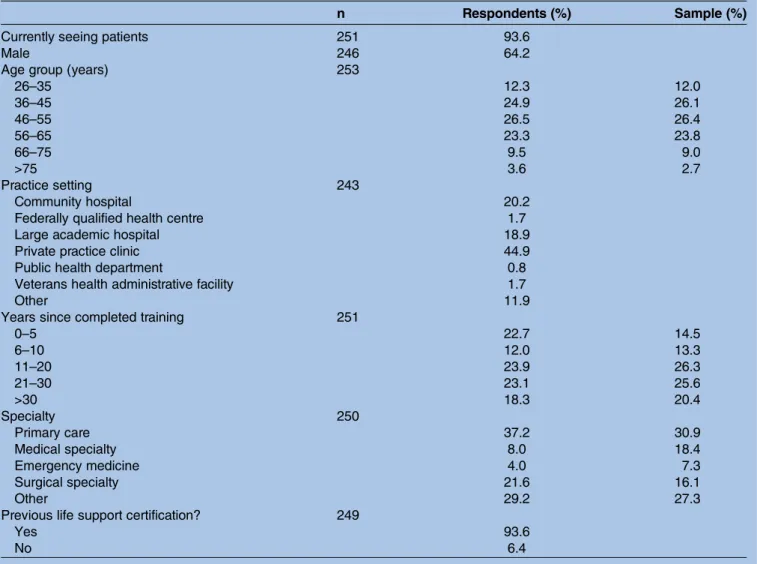
Of the 1000 mailed surveys, 30 were returned as not deliverable. A total of 253 surveys were returned (26.1%). Respondents were predominantly male, primary care providers and in private practice (table 1). Physicians who responded were similar to the sample population in years of experience and age. Almost all physicians had some form of life support certification (93.6%).
law and those without perceived knowledge of the law (98.0% vs 89.9%, p=0.02).
A higher number of physicians would definitely help a friend or neighbour compared with a stranger (table 5). The scenario in which the greatest number of physicians would definitely assist was a man collapsed on a plane (90.4%), while the fewest doctors would definitely assist a man placed on stretcher by emergency responders (2.8%). Only 39.6% of physicians stated they would def-initely stop to assist at the site of a traffic accident.
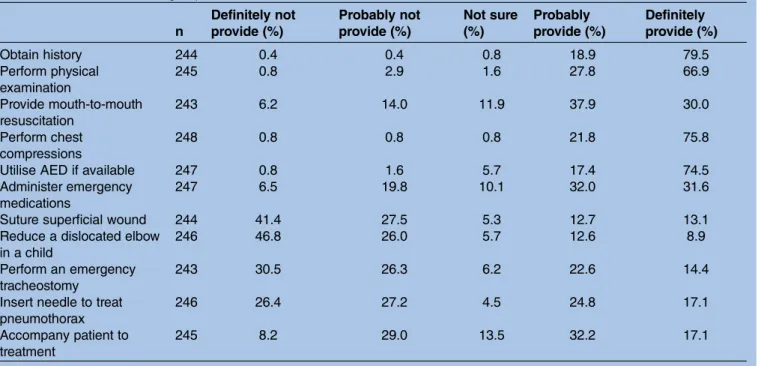
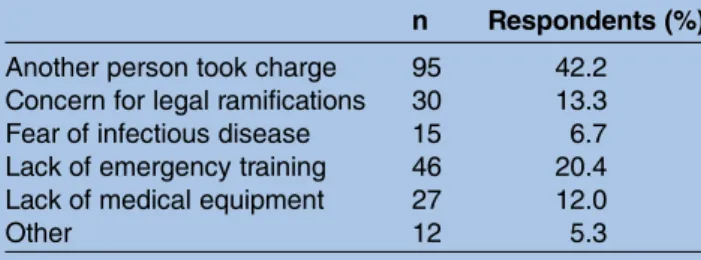
In sharing the level of care that they would be com-fortable providing, 79.5% of physicians would definitely take a history (table 6). A similar majority would defi n-itely perform chest compressions and use an automated external defibrillator (AED) if available; however, less than one-third would definitely provide mouth-to-mouth resuscitation or use emergency medications. There was marked reluctance to reduce a dislocated elbow in a child, with only 8.9% of physicians stating they would definitely provide this care. Likewise, a minority of doctors would perform more invasive procedures like performing a tracheostomy (14.4%). The most com-monly cited answer for not intervening was that another
person was in control (42.2%;table 7). The second most commonly cited reason was a lack of emergency training (20.4%). Concern for legal liability was the third most common reason, cited by 13.3% of respondents.
DISCUSSION
The NC Good Samaritan Study found that a majority of physicians encounter opportunities to provide emer-gency medical assistance outside routine clinical care. Research by DiMaggio et al5 and Williams4 found that nearly three-quarters of physicians have had prior oppor-tunity to act as a Good Samaritan which agrees with our
findings. This consistency across countries suggests that out-of-office emergencies are not uncommon in the life of a physician. Our study found that over 90% of physi-cians responded to the last Good Samaritan emergency encountered, a similar result to the Sheffield Good Samaritan Survey in the UK which found that doctors had acted in all but 1 of 329 previous experiences.4This result reveals an encouraging level of physician assist-ance; however, it likely reflects measurement bias as it depends on self-report.
Table 1 Characteristics of respondents and sample (n=253)
n Respondents (%) Sample (%)
Currently seeing patients 251 93.6
Male 246 64.2
Age group (years) 253
26–35 12.3 12.0
36–45 24.9 26.1
46–55 26.5 26.4
56–65 23.3 23.8
66–75 9.5 9.0
>75 3.6 2.7
Practice setting 243
Community hospital 20.2
Federally qualified health centre 1.7
Large academic hospital 18.9
Private practice clinic 44.9
Public health department 0.8
Veterans health administrative facility 1.7
Other 11.9
Years since completed training 251
0–5 22.7 14.5
6–10 12.0 13.3
11–20 23.9 26.3
21–30 23.1 25.6
>30 18.3 20.4
Specialty 250
Primary care 37.2 30.9
Medical specialty 8.0 18.4
Emergency medicine 4.0 7.3
Surgical specialty 21.6 16.1
Other 29.2 27.3
Previous life support certification? 249
Yes 93.6
Multiple studies have examined the hypothetical response of physicians to a traffic accident. The NC Good Samaritan Study found that 7 in 10 NC physicians would likely stop to render assistance at the scene, a higher response rate than the 1964 AMA study in which 57.4% of NC physicians would intervene.8 These results are more in line with the findings of Gray et al6 who found that over 90% of doctors in Ontario would inter-vene. However, the percentage who stated they would definitely respond (39.6%) is slightly lower than the 44% rate reported by Grosset al7in a study of New York physicians.
There were no differences in the response to a recent emergency between sexes which agrees with previous
findings.4 7 The rate of Good Samaritan interventions during the most recent opportunity did not differ between specialty types in contrast to previous research
which found that general practitioners were more likely to intervene compared with hospitalists.4 It should be noted that the categories of doctors in this study were broad, for example, anaesthesiologists and psychiatrists are both categorised in the ‘other’ category. A more detailed comparison of individual specialties may reveal differences in behaviour.
Experience as a physician has generally not previously been associated with differences in Good Samaritan behaviour;4however, Gross et al7 found attending physi-cians were less likely to intervene at the scene of a hypo-thetical car accident. This is the first study to find that older physicians are as likely to have previously acted as a Good Samaritan at the last opportunity.
The vast majority of physicians responding to this survey reported confidence in their emergency skills; however, this may be skewed by the population complet-ing the survey. Previous research, such as a 1992 study of family practitioners in Canada, demonstrated a lower level of confidence in emergency care skills.13Only 50% of physicians stated that they were knowledgeable about Good Samaritan law in NC which highlights the import-ance of education regarding the legal protection of phy-sicians. This finding is consistent with previous studies that have found low levels of physician knowledge of the law.4 6 7 Reassuringly, almost 90% of doctors believed it was a moral obligation to intervene, which accords with the AMA Code of Medical Ethics and is consistent with
findings reported by Williams.4 14Only 2% strongly dis-agreed with the concept of a moral obligation to provide assistance.
The rate of physician intervention varied with knowl-edge of Good Samaritan laws. Thisfinding is in contrast to the 1964 AMA study which indicated that physicians in states with protections for Good Samaritans were no more likely to respond to an emergency.8 Two previous studies have found that knowledge of the law and inter-ventionism were not positively associated.4 7 However, both of these studies used the doctors’ responses to hypothetical scenarios instead of past self-reported behaviour. In the current study, physicians were asked about their perceived knowledge of the law, whereas in previous studies, doctors’knowledge of Good Samaritan laws was directly assessed. The finding in this study sug-gests that laws, or more precisely, doctors’ perceived knowledge of laws, can affect behaviour.
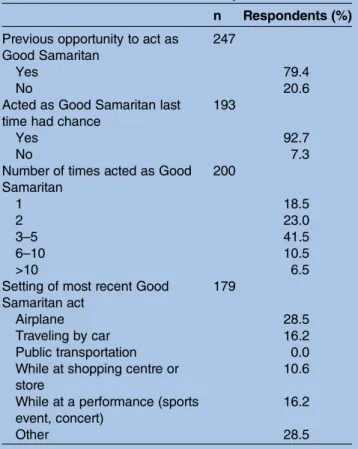
Table 2 Previous Good Samaritan experience
n Respondents (%)
Previous opportunity to act as Good Samaritan
247
Yes 79.4
No 20.6
Acted as Good Samaritan last time had chance
193
Yes 92.7
No 7.3
Number of times acted as Good Samaritan
200
1 18.5
2 23.0
3–5 41.5
6–10 10.5
>10 6.5
Setting of most recent Good Samaritan act
179
Airplane 28.5
Traveling by car 16.2
Public transportation 0.0 While at shopping centre or
store
10.6
While at a performance (sports event, concert)
16.2
Other 28.5
Table 3 Knowledge and beliefs about Good Samaritan behaviour
n
Strongly disagree (%)
Disagree (%)
Not sure (%)
Agree (%)
Strongly agree (%)
Confident in ability to provide emergency care
249 2.4 14.9 2.8 51.4 28.5
Knowledgeable about Good Samaritan law 250 4.4 34.0 10.8 41.6 9.2 Believe physician is morally obligated to
intervene
The scenario that would prompt the most persons to definitely intervene was aboard an airplane; however, this was the only scenario in which it was explicitly stated that the respondent was the only doctor, which may have contributed urgency. Over 90% of doctors in the present study would definitely assist a passenger on an airplane which is a rate far higher than physicians sur-veyed by Gross et al7 who found only 54% would defi n-itely respond; however, the nature of the request was not specified which may explain the discrepancy. Thesefi nd-ings are reassuring as emergencies on airplanes were also the most common specific site of Good Samaritan acts, a finding that agrees with previous research.5 Medical emergencies occur on approximately 1 in 600
flights and doctors are present in nearly 50% of these
flights,3 which helps account for this finding in the
current study. It is also likely that these events are more memorable and may be recalled readily by physicians.
Unsurprisingly, the least number of doctors would def-initely respond to the scenario in which emergency assist-ance had already arrived. This conforms tofindings from DiMaggioet al5who found lower volunteerism in settings in which physicians perceived other potential sources of medical care. The overall message is that physicians will intervene when they feel their assistance is more urgently needed. However, in the present study, an unexpectedly large number of physicians would intervene to help a woman who was collapsed on a busy city street. A prior study posed a similar scenario in which a physician encounters a man presumably passed out from intoxica-tion on a dangerously cold morning. However, only 2% reported that they would definitely help.7 Both studies
Table 4 Characteristics of physicians who acted as GS at last opportunity
n Acted as GS (%) p Value
Currently seeing patients 192
Yes 92.7 0.954
No 92.3
Sex 188
Male 95.0 0.184
Female 89.9
Specialty 192
Primary care 96.0 0.2541
Medical specialty 81.3
Emergency medicine 100.0
Surgical specialty 90.0
Other 92.5
Age group (years) 193
≤45 97.0 0.103
>45 90.6
Years in practice 191
≤10 96.7 0.141
>10 90.8
Advanced life support training 189
Yes 92.7 0.826
No 90.9
Practice setting 185
Community hospital 97.2 0.7483
Federally qualified health centre 100.0
Large academic hospital 93.6
Private practice clinic 89.5
Public health department 100.0
Veterans health administrative facility 100.0
Other 95.5
Confidence in providing emergency care 183
Yes 92.8 0.641
No 90.3
Knowledgeable about GS laws in NC 169
Yes 98.0 0.020
No 89.9
Believe physicians have moral obligation to provide GS care 187
Yes 94.2 0.212
No 85.7
defined intervention as potentially including mouth-to-mouth resuscitation. This discrepancy may reflect the high level of Good Samaritan behaviour that was observed generally among respondents in NC as well as greater reluctance to provide medical services to stran-gers among urban physicians in New York City.
Physicians were willing to provide a range of services which conforms to previous research.5 However, slightly less than one-third of respondents would definitely provide mouth-to-mouth resuscitation. This is a finding
that agrees with the cardiopulmonary resuscitation litera-ture, in which rates of providing mouth-to-mouth resus-citation vary from 70% to 80% for babies or children to 20–30% for possibly homosexual men or patients who suffered a trauma.15 Interestingly, very few doctors were willing to reduce a dislocated elbow in a child or suture a superficial wound. A possible explanation for this
finding is that a dislocated elbow or superficial wound may not be immediately life-threatening and may be more appropriate to defer to the clinical setting.
Table 6 Level of care willing to provide
n
Definitely not provide (%)
Probably not provide (%)
Not sure (%)
Probably provide (%)
Definitely provide (%)
Obtain history 244 0.4 0.4 0.8 18.9 79.5
Perform physical examination
245 0.8 2.9 1.6 27.8 66.9
Provide mouth-to-mouth resuscitation
243 6.2 14.0 11.9 37.9 30.0
Perform chest compressions
248 0.8 0.8 0.8 21.8 75.8
Utilise AED if available 247 0.8 1.6 5.7 17.4 74.5
Administer emergency medications
247 6.5 19.8 10.1 32.0 31.6
Suture superficial wound 244 41.4 27.5 5.3 12.7 13.1
Reduce a dislocated elbow in a child
246 46.8 26.0 5.7 12.6 8.9
Perform an emergency tracheostomy
243 30.5 26.3 6.2 22.6 14.4
Insert needle to treat pneumothorax
246 26.4 27.2 4.5 24.8 17.1
Accompany patient to treatment
245 8.2 29.0 13.5 32.2 17.1
Table 5 Hypothetical scenarios
N
Definitely not intervene (%)
Probably not
intervene (%) Not sure (%)
Probably intervene (%)
Definitely intervene (%)
Female friend collapses at mall 250 0.0 0.4 0.0 12.0 87.6
Female neighbour collapses at the mall
250 0.0 0.4 0.0 13.2 86.4
Female stranger collapses at mall 252 0.0 2.4 0.8 20.2 76.6
Man suffers spinal injury at baseball game
248 1.2 8.9 2.4 24.6 62.9
Woman in anaphylactic shock at baseball game
251 0.0 0.4 1.2 16.3 82.1
Man suffering heart attack at baseball game
250 0.0 0.4 0.8 22.8 76.0
Female baby choking at baseball game
252 0.8 0.4 0.8 13.9 84.1
Man collapses on flight 250 0.0 0.4 0.4 8.8 90.4
Woman collapsed on city street 250 0.0 3.6 1.6 33.2 61.6
Man collapses on public bus 252 0.0 0.8 0.0 19.4 79.8
Victims of traffic accident 250 1.6 19.2 6.8 32.8 39.6
Man placed on stretcher by EMS 252 37.3 53.2 0.4 6.4 2.8
Over 40% of physicians stated that they would not intervene because someone else was in charge, which is a similarfinding to previous research.4Interestingly, fear of legal liability was only cited by 13.3% of doctors, which has previously been found to be a more import-ant factor in physician judgement.6
Importance
There have been limited studies of the views and experi-ences of American physicians with Good Samaritan situa-tions. The present study also belongs to the broader category of research on the effectiveness of laws on phys-ician behaviour. For instance, laws governing medical liability may encourage doctors to practice defensive medicine; however, it has not been shown that injuries are reduced by these laws.16 Our study found that perceived familiarity with the law lead to greater intervention; however, we did not assess whether physician intervention improved outcomes. The medical literature is mixed regarding the effect of laws on patient outcomes.17 18 Another caveat to this finding is that doctors were only assessed on their perceived knowledge of the law. This
finding does suggest that efforts to provide doctors with education on Good Samaritan law may be an important way to increase this behaviour. In contrast, greater confi -dence in emergency skills was not associated with greater intervention rates. This research demonstrates that oppor-tunities to act as a Good Samaritan are not uncommon and that physicians are willing to respond. Our study found that physicians who feel well informed with Good Samaritan protections are more likely to intervene. These
findings may be used in crafting policy and lead to improvements in the training of physicians.
Limitations
While our study is one of the largest and most up-to-date studies of Good Samaritan behaviour in the USA, we acknowledge several limitations. The response rate to our survey was 26.1%. While the distribution of age and training do not suggest that the respondents were significantly different than the sample, there was a lower participation rate of medical specialists and higher rates among primary care physicians. The sam-pling was performed in order to gather a random selec-tion of NC physicians; however, the findings from individual specialists may over-represent or under-represent the views of certain specialties. For instance,
the respondents included a smaller percentage of emer-gency medicine physicians than our initial sample, which may bias the results towards the null as these doctors would be expected to react readily to Good Samaritan scenarios.
Those who responded may be more likely to have acted as a Good Samaritan previously. One implication of this possible selection bias is that our finding that physicians with greater knowledge of the law were more likely to have acted as a Good Samaritan is likely biased towards the null; thus, the true relationship may be stronger if the respondents had included more physicians with less Good Samaritan experience. In contrast to other studies, the NC Good Samaritan Study relied on respondents’ appraisal of their knowledge of local law and did not test their understanding as in other studies. Lastly, this survey did not ask respondents to disclose previous lawsuits which may contribute to physician behaviour.
Further study
Future directions of study include the effect of legal knowl-edge on physician behaviour compared between states using the same survey instrument. A larger study could provide more definitive conclusions regarding the way that policy can be designed to maximise physician humanitar-ianism as well as help illustrate differences between special-ties. Lastly, as the ability of physicians to effectively intervene is dependent on their training, developing further studies to delineate if recent training in life support improves willingness to intervene would highlight how physicians could better serve as Good Samaritans.
Acknowledgements The authors would like to acknowledge the assistance of several individuals. Lara Handler, MSLS, provided assistance with the literature search. Leeah Robinson assisted with data entry. The aforementioned are affiliated with the University of North Carolina.
Contributors WMG prepared the manuscript, conceived study, provided design of study, managed acquisition of data and provided analysis. DMH provided editorial support. AJV obtained funding, assisted with design of study, provided administrative support, provided editorial support and supervised project.
Funding This work was supported by funds from the endowed Charles B Wilkerson, MD’06 Distinguished Professorship of Family Medicine. Open access publication supported by the Medical Alumni Association of the UNC School of Medicine.
Competing interests None declared.
Provenance and peer review Not commissioned; externally peer reviewed.
Data sharing statement No additional data are available.
Open Access This is an Open Access article distributed in accordance with the Creative Commons Attribution Non Commercial (CC BY-NC 4.0) license, which permits others to distribute, remix, adapt, build upon this work non-commercially, and license their derivative works on different terms, provided the original work is properly cited and the use is non-commercial. See: http:// creativecommons.org/licenses/by-nc/4.0/
REFERENCES
1. Stewart PH, Agin WS, Douglas SP. What does the law say to Good Samaritans? A review of Good Samaritan statutes in 50 states and on US airlines.Chest2013;143:1774–83.
Table 7 Primary reason for not intervening
n Respondents (%)
Another person took charge 95 42.2 Concern for legal ramifications 30 13.3 Fear of infectious disease 15 6.7 Lack of emergency training 46 20.4 Lack of medical equipment 27 12.0
2. Cummins RO, Schubach JA. Frequency and types of medical emergencies among commercial air travelers.JAMA 1989;261:1295–9.
3. Peterson DC, Martin-Gill C, Guyette FX,et al. Outcomes of medical emergencies on commercial airline flights.N Engl J Med
2013;368:2075–83.
4. Williams K. Doctors as Good Samaritans: some empirical evidence concerning emergency medical treatment in Britain.J Law Soc 2003;30:258–82.
5. DiMaggio LA, Rubino SE, Lee RV. Good Samaritans or reticent bystanders?J Travel Med1994;1:143–6.
6. Gray R, Sharpe G. Doctors, Samaritans and the accident victim.
Osgoode Hall LJ1973;11:1–29.
7. Gross CP, Reisman AB, Schwartz MD. The physician as ambivalent Samaritan.J Gen Intern Med1998;13:491–4.
8. Sanders GB. First results: 1963 professional-liability survey.JAMA 1964;189:859–66.
9. Dachs RJ, Elias JM. What you need to know when called upon to be a Good Samaritan.Fam Pract Manag
2008;15:37–40.
10. First aid or emergency treatment; liability limitation, N.C. Gen. Stat. §90–21.14 (2014).
11. Aviation Medical Assistance Act of 1998, Pub. L. No. 105–170, §5 (1998).
12. Shepherd B, Macpherson D, Edwards CM. In-flight emergencies: playing the Good Samaritan.J R Soc Med2006;99:628–31. 13. O’Connor HM, Davidson JR. Emergency medicine skills: Are primary
care physicians adequately prepared?Can Fam Physician
1992;38:1789–93.
14. American Medical Association. AMA Code of Medical Ethics; Principles of Medical Ethics. Revised June 2001. http://www. ama-assn.org/ama/pub/physician-resources/medical-ethics/ code-medical-ethics/principles-medical-ethics.page. Retrieved: 28 December 2015.
15. Brenner BE, Van DC, Lazar EJ,et al. Determinants of physician reluctance to perform mouth-to-mouth resuscitation.J Clin Epidemiol 2000;53:1054–61.
16. Mello MM, Chandra A, Gawande AA,et al. National costs of the medical liability system.Health Aff (Millwood)2010;29:1569–77. 17. Madden JM, Soumerai SB, Lieu TA,et al. Effects of a law against
early postpartum discharge on newborn follow-up, adverse events, and HMO expenditures.N Engl J Med2002;347:2031–8. 18. Needleman J, Buerhaus P, Pankratz VS,et al. Nurse staffing and