Program Self-Study Document
Industrial Engineering Option
2009-2010 Visit
Submitted by
California State University East Bay
to the
Engineering Accreditation Commission
Accreditation Board for Engineering
and Technology, Inc.
Engineering Accreditation Commission
Accreditation Board for Engineering and Technology, Inc. 111 Market Place, Suite 1050
Baltimore, Maryland 21202-4012 Phone 410-347-7700 FAX 410-625-2238 email: [email protected] WWW: http://www.abet.org/ Participating Bodies
American Academy of Environmental Engineers American Congress on Surveying and Mapping American Institute of Aeronautics and Astronautics
American Institute of Chemical Engineers American Nuclear Society
American Society of Agricultural Engineers American Society of Civil Engineers American Society for Engineering Education
American Society of Heating, Refrigerating, and Air-Conditioning Engineers, Inc. The American Society of Mechanical Engineers
The Institute of Electrical and Electronics Engineers, Inc. Institute of Industrial Engineers, Inc.
ISA - The International Society for Measurement and Control The Minerals, Metals, and Materials Society
National Council of Examiners for Engineering and Surveying National Institute of Ceramic Engineers
National Society of Professional Engineers Society of Automotive Engineers Society of Manufacturing Engineers
Society for Mining, Metallurgy, and Exploration, Inc. Society of Naval Architects and Marine Engineers
Society of Petroleum Engineers Affiliate Bodies
American Consulting Engineers Council
American Institute of Mining, Metallurgical, and Petroleum Engineers American Society of Safety Engineers
Materials Research Society Society of Plastics Engineers
Table of Contents
A. Background Information... 5
A.1Degree Title 5 A.2Program Mode 5 A.3Actions to Correct Previous Shortcoming 5 A.4Contact Information 6 B. Accreditation Summary ... 7
B.0.3 Department Mission ... 8
B.0.4 Preparation for 2009 Visit ... 8
B.1Students 11 B.1.1 Evaluation Process ... 11
B.1.2 Advising Process ... 13
B.1.3 Monitoring Process ... 21
B.1.4 Policies for Accepting Transfer Students/Credits ... 21
B.1.5 Process to Ensure All Students Meet Program Requirements ... 22
B.1.6 Incoming Student Quality ... 23
B.1.7 Assessment results with respect to criterion 1 ... 24
B.2Program Educational Objectives 25 B.2.1 Objectives and Publication Information ... 25
B.2.2 Program Constituencies ... 26
B.2.3 Process to Determine and Evaluate Objectives ... 27
B.2.4 Involvement of Constituencies ... 29
B.2.5 Description of the PEOs Assessment Process ... 31
B.2.6 Educational Objectives Assessment Process and Tools ... 31
B.2.7 Results of Program Educational Objectives Achievement Evaluation ... 36
B.2.8 Closing the Assessment Loop on PEOs ... 49
B.3Program Outcomes and Assessment 49 B.3.1 Program Outcomes ... 50
B.3.2 Relation of Outcomes to Program Objectives ... 54
B.3.3 Program Input to Achieve Outcomes ... 55
B.3.4 Assessment Process (including measures and tools used) ... 59
B.3.5 Assessment Results Used to Develop/Improve Program ... 68
B.3.6 Assessment Results Summary ... 68
B.3.7 General Education Assessment ... 74
B.3.8 Assessment Results Mapped to Criterion Outcomes 3(a) through 3(k) ... 79
B.3.9 Materials Available for Review during Site Visit ... 87
B.4Continous Improvement 89 B.4.1 Improvements to the Assessment Process and Tools ... 89
B.4.2 Improvements to the Curriculum ... 89
B.4.3 Improvements to the Facilities ... 94
B.5Professional Component 97 B.5.1 Design Experience ... 97
B.5.2 Capstone Design Experience ... 98
B.5.3 Coverage of Mathematics and Basic Sciences ... 99
2008 Industrial Engineering Option Self-Study 3
B.5.5 General Education Content ... 102
B.6Faculty 104 B.6.1 Faculty Size and How Competencies Cover Curricular Areas ... 104
B.6.2 Student-Faculty Interaction ... 106
B.6.3 Student Advising and Counseling ... 106
B.6.4 University Service Activities ... 106
B.6.5 Professional Development ... 107
B.6.6 Interaction with Practitioners and Employers ... 107
B.6.7 Adequacy of the size of the faculty ... 107
B.7Facilities 108 B.7. 1 Classrooms ... 108
B.7.2 Laboratories ... 108
B.7.3 Equipment and Tools ... 109
B.7.4 Computing and Information Infrastructure ... 111
B.7.5 Laboratory Development Plan ... 111
B.7.6 Opportunities for Using Modern Engineering Tools ... 112
B.8Institutional Support and Financial Resources 112 B.8.1 Budget Process ... 112
B.8.2 Institutional/Financial/Leadership Support ... 113
B.8.3 Retention and Recruitment of Faculty ... 114
B.8.4 Planning and Funding of Faculty Development ... 114
B.8.5 Planning and Funding of Facilities Development ... 114
B.8.6 Support Services ... 114
B.9Program Criteria 115 B.9.1 Curriculum ... 115
B.9.2 Faculty... 117
B.10Copies of Survey Forms/ Industrial Advisory Board Meeting Minutes. 118 Appendix I - Additional Program Information... 152
Table 1-a. Basic-Level Curriculum (Current) 153 Table 1-a. Basic-Level Curriculum ( valid to spring 2008) 156 Table 2. Course and Section Size Summary 158 Table 3. Faculty Workload Summary 159 Table 4. Faculty Analysis 160 Table 5. Support Expenditures 162 Appendix II Course Syllabi... 163
Appendix III Faculty Vita ... 238
Appendix IV Institutional Profile ... 262
I. Background Information Relative to the Institution 263 1. General Information ... 263
2. Type of Control ... 263
3. Regional or Institutional Accreditation ... 263
4. Faculty and Students ... 263
5. Mission ... 264
6. Institutional Support Units ... 265
7. Computing, Communication and Media Support ... 266
1. Engineering Educational Unit ... 268
2. Programs Offered and Degrees Granted ... 270
3. Information Regarding Administrators ... 270
4. Supporting Academic Departments ... 273
5. Engineering Finances ... 273
6. Engineering Personnel and Policies ... 274
8. Definition of Credit Unit ... 277
9. Admission and Graduation Requirements, Basic Programs ... 277
10. Non-academic Support Units ... 280
2008 Industrial Engineering Option Self-Study 5
Industrial Engineering Option Self-Study Report
A. Background Information
A.1 Degree Title
The degree title in Industrial Engineering (IE) is Bachelor of Science in Engineering, Industrial Engineering Option
A.2 Program Mode
The Industrial Engineering Program is a day-mode program. Some classes are taught in late afternoon and early evening to accommodate students who work in local businesses. All course sections are identical irrespective of when and where they are taught.
A.3 Actions to Correct Previous Shortcoming
The ABET review team on their visit on October of 2003 cited one weakness in the program. We submitted an interim report in 2005 to ABET that successfully removed the cited Weakness. The following is the summary of the 2005 interim report.
A.3.1Program Weakness
“1. Criterion 2. Program Educational Objectives Criterion 2(d) requires a system of ongoing evaluation that demonstrates achievement of program objectives. The program has performed some evaluation of achievement of objectives. Evaluation results have been used to improve the effectiveness of the program. The program self-study cited alumni surveys as one instrument in this evaluation, but the first survey was scheduled for fall 2003. This is understandable in a new program, but at the same time the system of ongoing evaluation could be strengthened by this information. Further, there has been little opportunity to observe trends in the evaluation, regardless of instrument. The program has had little opportunity to gather information about professional accomplishments of graduates, or to gain confidence in the system of evaluation through analysis of repeated trials. In expanding the evaluation of objectives to include alumni and employers, the program is encouraged to also consider objective measures of performance, such as student placement, professional advancement of graduates, entry into graduate education, and professional licensure.
Actions Taken
We submitted our interim report in 2005 where we detailed actions taken to remove the weakness. Following the report we received confirmation from ABET that the weakness has been removed. Summary of actions is as follows:
Since the ABET visit (October 2003), we have had the opportunity to administer the following assessment tools to collect data for continuous evaluation of achievement of our program outcomes and objectives. Some of these tools are used to assess outcomes and others are for assessment of program objectives.
exit survey/interview with graduating seniors faculty self assessment of courses
Tools to assess program educational objectives and outcomes (Criteria 2 and 3) Alumni survey
employers survey
Profile of our alumni and their current positions and professional achievements.
We have used the collected data and considered program changes to assure the achievement of program outcomes and objectives. We have also used the data to evaluate the appropriateness of our program educational objectives. These processes have been repeated since 2003 as indicated in our assessment plan to assure the program quality.
A.4 Contact Information
Dr. Saeid Motavalli Professor and Chair
Department of Engineering, CSUEB 25800 Carlos Bee Boulevard
Hayward, CA 94542-3085 Tel: 510-885-4481
2008 Industrial Engineering Option Self-Study 7
B.
Accreditation Summary
California State University East Bay (CSUEB) is a comprehensive Category II Master’s institution. City of Hayward is the location of the main campus. CSUEB’s Concord Campus is located in central Contra Costa County and mostly offers upper division and graduate instruction. Engineering courses are all offered out of the Hayward Campus. The current enrollment figures for the University is about 10,500 undergraduate, 2,400 graduate students and 600 faculty members. The University is part of the California State University system which, consists of 23 campuses located throughout the state and is the largest university system in the country. The ten buildings of the Hayward Hills campus, on 342 acres, contain over 150 classrooms and teaching laboratories, over 177 specialized instructional rooms, numerous student oriented computer labs and a library, which contains a collection of over one million items accessible through HAYSTAC, its on-line catalog. CSUEB is organized into four colleges: Letters, Arts, and Social Sciences; Business and Economics; Education and Allied Studies; and Science. The University offers bachelor’s degrees in 45 fields, minors in 66 fields, and master’s degrees in 31 (in addition to Special Majors).
The Department of Engineering is part of the College of Science. The Department offers two engineering options, Industrial Engineering and Computer Engineering. The Computer Engineering option is a joint program with Computer Science Department. The Department offers Bachelor’s degree programs with options in Industrial Engineering and Computer Engineering. We also offer Master’s degree programs in Engineering Management and Construction Management. The graduate programs are joint programs with the College of Business and Economics. The Bachelor’s degree in Industrial Engineering is accredited by EAC/ABET.
B.0.1 University’s Mission
University’s mission is: “To provide an academically rich, multicultural learning experience that prepares all its students to realize their goals, pursue meaningful lifework, and to be socially responsible contributors to their communities, locally and globally.”
University’s values statement is: “The University values learning in an academic environment that is inclusive and student-oriented. We value engagement in the Civic, Cultural and Economic life of the communities we serve locally, regionally, and globally. We value critical and creative thinking, effective communication, ethical decision making, and multi-cultural competence. We value the open exchange of ideas and viewpoints.
The University’s mission statement can be viewed using the following link;
http://www.csueastbay.edu/about/president/mission.html
B.0.2 College of Science Mission Statement
The College of Science, by fostering an environment where students, faculty and staff work collaboratively to expand knowledge in the disciplines of science and mathematics, seeks to provide both majors and non-majors with a science foundation that is appropriate to their career goals and with knowledge and skills that will allow them to function as responsible and
contributing members of society. B.0.3 Department Mission
The Industrial Engineering Department at California State University, East Bay provides a quality engineering education that prepares its graduates for employment related to their major and to have an aptitude for continued learning. The program provides students with technical and problem solving capabilities, an understanding of real-world business often through practical work experience, and excellent teamwork and communications skills. It promotes a high rate of student success in completing the program in a reasonable length of time and enables the transfer students to take no longer than native students in completing the upper division portion. Students graduate from the program with a high degree of satisfaction about their education. Faculty maintain a high level of currency in the discipline through a strong program of professional development and interaction with the Industrial Advisory Board.
B.0.4 Preparation for 2009 Visit
Preparation for the 2008–09 cycle ABET visit began immediately after the last visit in Fall 2003 and has been a continuing effort. We have been regularly collecting assessment data, analyzing them, discussing the results and making improvements to the program resulting from the
assessment process. The Department has a well established plan for assessment, evaluation and continuous program improvement. Also, we have a periodic process of evaluating our program educational objectives to assess their validity and appropriateness. ABET criteria serves as our guide in all our assessment, evaluation and program improvement.
We have engaged in specific activities to assure our preparedness for the 2009 visit. These include the following:
• Faculty attended the faculty training workshop offered by ABET at the ASEE conference June 2008.
• We are planning to conduct a Mock review of our program in Winter of 2009 using an experienced ABET program reviewer.
• The Department Industrial Advisory Board (IAB) is heavily involved in program assessment and activities related to ABET.
• The Department Curriculum Committee that consists of all faculty members is actively involved in the preparation for the visit.
• The College has provided us with faculty release time for a faculty to help the department chair develop and organize supporting material required for ABET visit.
B.0.4.1 Curriculum Committee
The Curriculum Committee is in charge of program curriculum revision, assessment, evaluation, and objectives/outcomes revisions. The committee is currently comprised of the following individuals:
• Dr. Saeid Motavalli(Chair)
2008 Industrial Engineering Option Self-Study 9
• Dr. David Bowen
• Dr. Farnaz Ganjeizadeh
The committee charges are as follows:
• To initiate curriculum revision.
• To initiate course revision.
• To assure course integrity.
• To provide feedback to course coordinators for corrective action.
• To propose development/revision of ABET/Institutional assessment criteria/procedures.
• To coordinate ABET/institutional assessment activities.
• To assist in preparing ABET documents.
• To assist in preparing institutional assessment reporting/documentation.
• To coordinate assessment feedback and implementation of corrective action.
B.0.4.2 Common Definitions of Terms
We will use the following definitions in the development of our program educational objectives, outcomes and other terms related to accreditation.
Program (Educational) Objectives (PEOs)
“Program objectives are statements that describe the expected accomplishments of graduates in the first few years after graduation.”
Program objectives can be of two types: (a) what all graduates will do, and (b) what some
graduates will do. Program objectives should be written to be used as descriptors of the program and should be such that upon reading them, prospective students and employers will have a clear idea of the program. Objectives should do the following:
• Address external constituencies.
• Be sufficiently detailed.
• Be consistent with the mission of the institution.
• Be consistent with ABET/EAC criteria
• Differentiate various programs within the same institution.
• Differentiate one program from similar programs in other institutions.
Program Outcomes
“Program outcomes are statements that describe what students are expected to know and are able to do by the time of graduation. The program outcomes must embrace the (a) through (k) requirements of ABET/EAC Criterion 3.”
Program outcomes are essentially the knowledge and skill-set that graduating students will have obtained.
Program Constituents
“Constituents are stakeholders.”
Program constituents are those who would be directly impacted if the program focus is changed drastically or if the program is discontinued.
The following groups are referred to throughout this report. They are briefly described below for a common understanding of who they are and what roles they play in the development,
evaluation, and assessment of program objectives, program outcomes and curriculum.
Curriculum Committee (CC)
This is a departmental committee of faculty that is charged to develop, implement, evaluate, and make recommendations about objectives outcomes and curriculum. CC allows faculty
involvement in these processes.
Industry Advisory Board (IAB)
This advisory body comprised of industry representatives is charged to advise and make recommendations concerning the development, evaluation and revision of program objectives and curricular matters. IAB allows alumni, employers, student representatives and industry involvement in these processes.
2008 Industrial Engineering Option Self-Study 11
B.1 Students
This section describes how students are evaluated, advised, and monitored in a manner consistent with program objectives, as required by EAC Criterion 1.
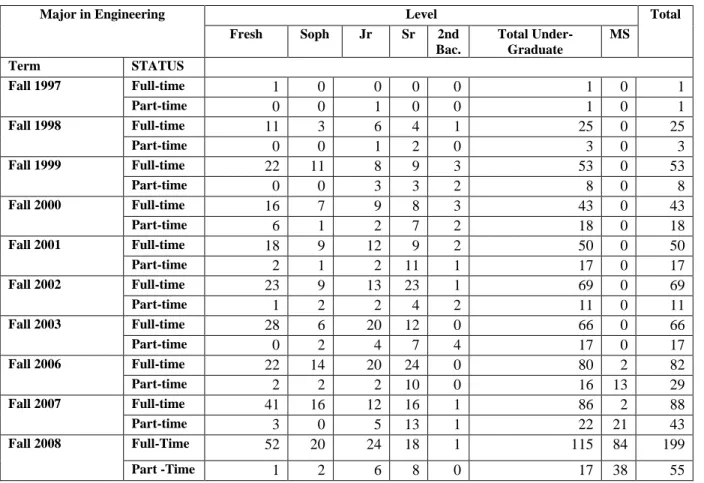
Undergraduate enrollment in Industrial Engineering has had a trend upwards. In Fall of 2007 we had an enrollment of 108 and since then we have witnessed an increase expecting to have larger enrollment in Fall 2008. These numbers are students that declared Engineering as their major.
Table B.1.1. IE Program Enrollment History
Major in Engineering Level Total
Fresh Soph Jr Sr 2nd Bac. Total Under- Graduate MS Term STATUS Fall 1997 Full-time 1 0 0 0 0 1 0 1 Part-time 0 0 1 0 0 1 0 1 Fall 1998 Full-time 11 3 6 4 1 25 0 25 Part-time 0 0 1 2 0 3 0 3 Fall 1999 Full-time 22 11 8 9 3 53 0 53 Part-time 0 0 3 3 2 8 0 8 Fall 2000 Full-time 16 7 9 8 3 43 0 43 Part-time 6 1 2 7 2 18 0 18 Fall 2001 Full-time 18 9 12 9 2 50 0 50 Part-time 2 1 2 11 1 17 0 17 Fall 2002 Full-time 23 9 13 23 1 69 0 69 Part-time 1 2 2 4 2 11 0 11 Fall 2003 Full-time 28 6 20 12 0 66 0 66 Part-time 0 2 4 7 4 17 0 17 Fall 2006 Full-time 22 14 20 24 0 80 2 82 Part-time 2 2 2 10 0 16 13 29 Fall 2007 Full-time 41 16 12 16 1 86 2 88 Part-time 3 0 5 13 1 22 21 43 Fall 2008 Full-Time 52 20 24 18 1 115 84 199 Part -Time 1 2 6 8 0 17 38 55 B.1.1 Evaluation Process
The primary academic evaluation mechanism is course grades from instructors. At California State University East Bay, the following letters may appear in a transcript: A, A-, B+,B, B- , C+ C, C-, D+, D, F, W, Au, CR, NC, SP, WU, I and RD. Detailed description of these letter grades can be found in the CSU East bay on-line catalog, http://www.csueastbay.edu/ecat/. Following is a brief explanation of these grades:
A Excellent. Grading (quality) points earned= 4.0/credit hour A- Excellent. Grading (quality) points earned= 3.7/credit hour B+ Good. Grading (quality) points earned= 3.3/credit hour
B Good. Grading (quality) points earned= 3.0/credit hour B- Good. Grading (quality) points earned= 2.7/credit hour C+ Satisfactory. Grading (quality) points earned= 2.3/credit hour. C Satisfactory. Grading (quality) points earned= 2.0/credit hour. C- Satisfactory. Grading (quality) points earned= 1.7/credit hour. D+ Poor. Grading (quality) points earned= 1.3/credit hour.
D Poor. Grading (quality) points earned= 1/credit hour. F Failing. No points.
CR Credit. No points. NC No Credit. No points. Administrative grading symbols
SP Satisfactory Progress. No points I Incomplete (authorized). No points WU Withdraw Unauthorized. No points RD Report delayed. No points
W Withdrawal. No points AU Audit. No points
Grade point average (GPA) is computed by dividing the total number of quality hours (units attempted), whether or not they were passed (but excluding "CR/NC" courses and those in which administrative grades were assigned except for the "U"), into the number of quality (grade) points earned. A 2.00 (C) average in all college/university courses, all Cal State East Bay courses, and all major courses is required for a baccalaureate degree (excluding "CR," "NC," "W," and "AU" grades). All courses required by a major, including those in other departments, must be included in the calculation of the major GPA.
The number of quality points earned may affect academic standing on a quarterly basis. If the total number of Higher Education quality points does not equal at least twice the number of Higher Education quality hours, or the number of Cal State East Bay quality points does not equal at least twice the number of Cal State East Bay quality hours, the student will be placed on probation (GPA will be below 2.00). If the student falls short of a 2.0 grade point average, then he/she is said to have a quality (grade) point deficiency. The quality point deficiency is computed as follows:
Number of quality points deficient = 2 x (number of quality hours) – (quality points earned for those units)
If the student has a quality point deficiency either in his/her entire undergraduate record or in his/her Cal State East Bay record, he/she is placed on Academic Probation.
Administrative Academic Probation
A student can also be placed on Administrative Academic Probation if (a) he/she withdraws or is administratively dis-enrolled from all courses for two consecutive quarters, or any three quarters;
2008 Industrial Engineering Option Self-Study 13 (b) he/she repeatedly fails to make progress toward a degree while enrolled, e.g., earn 23 "NC" units; (c) he/she fails to comply with a routine academic requirement or regulation, e.g., fail to take the Writing Skills Test; or (d) he/she earn only grades of "F," "NC," and/or "U" for two consecutive quarters, or any three quarters.
Academic Disqualification
A student can be academically disqualified if his/her quality point deficiency is so great that it is unlikely he/she can make it up in the remaining time before he/she completes other degree requirements. Only when astudent can provide compelling evidence that he/she will be able to complete a university degree will reinstatement be considered.
While on academic probation, a student will be academicallydisqualified if:
With fewer than 90 earned hours of college work completed, he/she falls 32 or more quality points below a 2.0 GPA on either Higher Education quality hours or Cal State East Bay quality hours.
With 90 to 134 earned hours of college work completed, he/she falls 23 or more quality points below a 2.0 GPA on either Higher Education quality hours or Cal State East Bay quality hours. With 135 or more earned hours of college work completed, he/she falls 18 or more quality points below a 2.0 GPA on either Higher Education quality hours or Cal State East Bay quality hours. Administrative Disqualification
If a student becomes subject to Academic Probation while on Administrative Academic Probation or a student is placed twice on Administrative Academic Probation for the same reason, that student will be administratively disqualified.
"CR" and "NC" grades and units are not included in GPA calculation.
"SP" and "I" grades and units are not included in GPA calculation. A "SP" or "I" grade becomes an "F" if he/she does not complete the coursework in the specified time frame. The "F" will be included in his/her GPA calculation in the quarter in which the "SP" or "I" changes.
"WU" grades are regarded the same as "F's" in his/her GPA calculation. "RD" grades and units are not included in his/her GPA.
"W" grades and units are not included in his/her GPA.
B.1.2 Advising Process
Each student in the Department of Engineering has an assigned faculty member as his/her academic advisor. Upon entering the program, each student is assigned this advisor considering department faculty members’ advising load. This assignment continues throughout the student’s program, thus providing continuity in the relationship between the student and advisor. The student is free to change advisors by simply notifying the departmental secretary so that records can be updated to indicate the new assignment. Before each quarter’s pre-registration period, each student is reminded, by e-mail, of advising schedules. Every new faculty is mentored by
the department chair on undergraduate advising procedures. Also, at the beginning of each academic year, the advising process is reviewed at a faculty meeting.
To assist the faculty advisor and students, the University has a comprehensive electronic student advising system as part of its Computer Management System (CMS). The faculty advisor can view student records through the faculty link at:
https://my.csueastbay.edu/psp/paebprd/EMPLOYEE/EMPL/h/?tab=PAPP_GUEST
Students also have access to their records through this system. The system updates student’s records as they go through their education. It also includes updates of any transfer courses both G.E. and major courses that have been accepted by the Department. This system is also used by the University to ensure that every student have completed all their program requirements before graduation.
In addition to the computerized system, the department keeps student records that include:
• Graduation check sheet
• Student’s transcript for courses taken at other institutions
• Record of all transfer courses accepted
• Comments by the faculty advisor/chair where needed for exceptions.
At registration (or pre-registration) each quarter, the student meets with his/her advisor. During this consultation, the student and the advisor have the student's file, the advising sheet, the program requirements, prerequisite structure and the CMS system available. The incoming freshman or transfer students go through an orientation program and a campus tour. During orientation the students meet with a representative of the University Advisement Center (UAC), which is responsible for advising students for their general education requirements. They also meet with their engineering advisor to discuss the engineering courses to take and also to evaluate engineering transfer credits. For each transfer student the department and the student both receive a copy of the transfer evaluation for general education from the UAC office. Engineering students are not able to register for engineering courses until they submit their advising sheet to the department to receive permission numbers.
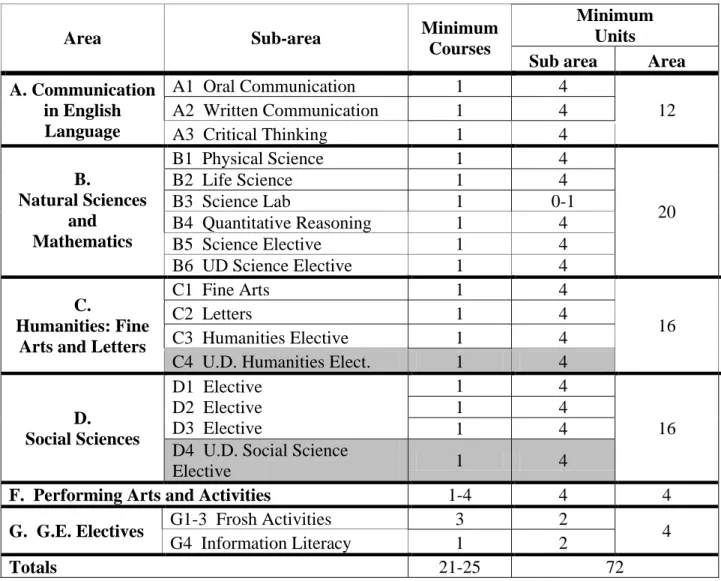
The requirements for the degree are divided into two parts, general education requirements and major requirements. A total of 72-quarter units of coursework are required to meet the general education-breadth requirements. Also two courses in U.S. history (or successful completion of a challenge exam) and an English course (ENGL 1002) are required in addition to the 72 hours. Some of the engineering required courses have been approved by the university to meet general education requirements. Engineering students are using, CHEM1101, ENGR 1011 (2008), ENGR 2060, ENGR 3140, ENGR 3190, ECON 2301, PSYC 1000 and Math 1304 which are program required courses, for general education credit . Table B1.2.1 depicts the general education requirements.
Through the use of a computer-generated degree audit and other material in the file, the advisor ensures that the student is obtaining appropriate credit in engineering design, mathematics, basic science, and humanities and social sciences. In addition, before a student enrolls in the first senior design course (ENGR 4610 Senior Design), the faculty advisor checks to ensure that the
2008 Industrial Engineering Option Self-Study 15 student has completed the necessary prerequisites for this course.
Also, the department chair performs a graduation check of all seniors in the quarter prior to the expected graduation. A student cannot graduate unless he/she has submitted through the department a completed major graduation check sheet to the university the quarter prior to expected graduation. There is also a parallel system through the CMS where the same check is conducted for general education requirements. The general education evaluation in most part is performed by the University’s Student Advisement Center.
Table B.1.2.1 General Education Requirements
Area Sub-area Minimum
Courses
Minimum Units
Sub area Area
A. Communication in English Language A1 Oral Communication 1 4 12 A2 Written Communication 1 4 A3 Critical Thinking 1 4 B. Natural Sciences and Mathematics B1 Physical Science 1 4 20 B2 Life Science 1 4 B3 Science Lab 1 0-1 B4 Quantitative Reasoning 1 4 B5 Science Elective 1 4 B6 UD Science Elective 1 4 C. Humanities: Fine Arts and Letters
C1 Fine Arts 1 4
16
C2 Letters 1 4
C3 Humanities Elective 1 4
C4 U.D. Humanities Elect. 1 4
D. Social Sciences D1 Elective D2 Elective D3 Elective 1 4 16 1 4 1 4
D4 U.D. Social Science
Elective 1 4
F. Performing Arts and Activities 1-4 4 4
G. G.E. Electives G1-3 Frosh Activities 3 2 4
G4 Information Literacy 1 2
Totals 21-25 72
Interviews conducted with our graduating seniors and comments added to our graduating student survey forms have consistently mentioned advising and mentoring as examples of program strengths. The faculty are extremely accommodating in allocating time to ensure that every engineering student receives sufficient advising.
B.1.2.1 Substitutions
Substitutions to the requirements may be made only upon the recommendation of advisor and with the approval of the appropriate individual or committee, as explained below. In general, substitutions are made only under those circumstances which will assure that the student's
educational experience is equivalent to that which would be obtained with the approved program curriculum. The following policies apply to substitutions:
2008 Industrial Engineering Option Self-Study 17 Exceptions to these must be approved of the University Advisement Center and entered into the CMS database.
Lower division courses.
The student’s advisor, department chair and in the case of the support courses, the department that offers the course must approve the substitution.
Upper division courses.
The substitution for these courses are done by the advisor and the department chair based on course syllabus, school catalog information and review of the course material by the advisor and the faculty teaching, similar course at CSUEB.
If for some compelling reason a student is unable to schedule a required course, a number of possibilities are considered. One of these is to examine whether a course in another department or a nearby accredited institution would provide the student an equivalent exposure to topics in the required course. If no such course can be found, an attempt is made to find a faculty member who would be willing to supervise the student in an individual studies course with equivalent material to the required course. In nearly all cases the advisor (working with the department chair) and the student arrive at a mutually agreeable solution. The approval is documented in the student file.
B.1.2.2 Advising Resources
In order to minimize errors and ensure consistency, the department has developed the advising form, containing the prerequisite structure on the back, the major check sheet, and a sample four-year plan of study that are depicted in Figures B.1.2.1, B.1.2.2 and B.1.2.3 respectively. The forms are distributed to faculty advisors and to the student. Copies of these documents are available on the Department web page at: http://www.sci.csueastbay.edu/engineering/ . Students must submit a completed, signed major graduation check sheet to the Office of Enrollment Management the quarter before graduation. In addition, The University Advisement Center (UAC) provides academic advisement, campus information, referral service, and general education evaluation services to aid students in their transition to Cal State East Bay. The primary focus of the UAC is to help undeclared majors set realistic, attainable educational goals and identify pertinent academic major/minor study programs. Undeclared students meet
individually with an academic advisor to assess their interests and choose appropriate fields of study. UAC also provides new and continuing students with advising on general education and other non-major graduation requirements. Individual assistance is provided to all undeclared majors experiencing academic difficulties. The web site for UAC is at:
California State University, East Bay Hayward Hills Campus Department of Engineering
BS Engineering Advising Form – IE Option
Student Name: Local Phone Number:
Email Address: Net ID:
Advisor:
Classification: Freshman Sophomore Junior Senior
COURSES YOU ARE CURRENTLY
ENROLLED IN: QUARTER:
Dept & Course Number
Title
PLANNED ENROLLMENT FOR NEXT
QUARTER: QUARTER:
Dept Issued Permission
Number
Dept & Course
Number Section Title Units
List All Co/Prereq. Are All Coreq/ Prereq. Met? Y N Total Units Overload? Y N Notes:
Student Signature Date
Advisor Signature Date
Figure B.1.2.1 Student Advising Form
2008 Industrial Engineering Option Self-Study 19 Figure B.1.2.2 Major Graduation Check Sheet for Industrial Engineering
CSUEB Bachelor of Science - Engineering, Industrial Engineering Option Catalog: 2007-2008 Expected Date of Graduation: Name:
REQUIREMENTS UNITS GRADE TERM & YEAR
CHEM 1601 (or 1605)
Basic Chemistry (4) CS 1160 Intro to Computer Sci &
Programming (4) ECON 2301 Principles of
Microeconomics (4) ENGR 1010 Introduction to
Engineering (2) ENGR 1420 Engineering Graphics
(2)
ENGR 2010 Electric Circuit Theory (3)
ENGR 2060 Material Science (4) ENGR 2070 Fundamentals of
Manufacturing (2) MATH 1304 Calculus I (4) MATH 1305 Calculus II (4) MATH 2304 Calculus III (4) PHYS 1001 Physics I (5) PHYS 1002 Physics II (5) PHYS 1003 Physics III (5) PSYC 1005 (or
1000, 1001, 2004, or 2009)
General Psychology (5) ENGR 3020 Work Design &
Measurement (4) ENGR 3140 Engineering Economy
(4)
ENGR 3190 Human Factors Engineering (4) ENGR 3841 Operations Research I
(4)
ENGR 4100 Production Planning & Control (4) ENGR 4200 System Simulation (4) ENGR 4280 Design & Mgmt of
Human Work Sys (4) ENGR 4300 Quality Engineering (4) ENGR 4400 Manufacturing Systems
Engineering (4) ENGR 4430 Facilities Planning &
Design (4) ENGR 4440 Computer Integrated
Manufacturing (4) ENGR 4610 Senior Design I (3) ENGR 4620 Senior Design II (3) MATH 3331 Differential Equations
(4)
PHYS/ENGR 3101Statics & Dynamics (4) STAT/ENGR 3601 Statistics & Probability
for Sci & Engr I (4) STAT/ENGR 3602 Statistics & Probability
for Sci & Engr II (4) STAT/ENGR 4603 Operations Research II
(4)
8 units from the following: CIS/ENGR 3281; ENGR 3090, 3898, 4090, 4180, 4330, 4900, 4990; MATH/ENGR 4841; MGMT/ENGR 3110, 3600; PHYS/ENGR 3280 or other 3000 and 4000 level courses with Department approval.
SUBSTITUTION WHERE COMPLETED IF NOT TAKEN AT CSUH
Net ID:
ELECTIVES:
Freshman Year (49 units)
Fall Quarter(17 units) Winter Quarter(15.5 units) Spring Quarter(16.5 units)
General Education A1 COMM 1004 (4) B1/3 CHEM 1601 (4) B4 MATH 1304. Calc I (4) G1 GS 1011 (1) G4 LIBY 1210 or 1551 (2) General Education A2 ENGL 1001 (4)
B5 ENGR 2060 , Engineering Materials(4)
F1 ART/DANC/ KPE/MUS Activity (1)
G2 GS 1021 (.5) General Education A3 Critical Thinking (4) B2 PSYC 1000 (5) F2 ART/DANC/ KPE/MUS Activity (1) G3 GS 1031 (.5) Major
ENGR 1010, Intro to Engr. (2)
Major
ENGR 1420, Engineering Graphics (2) MATH 1305, Calc II (4)
Major
ENGR 2070, Manuf. Proc. (2) MATH 2304, Calc III (4)
Sophomore Year (51 units)
Fall Quarter(17 units) Winter Quarter(17 units) Spring Quarter(17 units)
General Education C1 Fine Arts (4)
D1 ECON 2301(4
Gen Educ/2nd Comp D2 Social Science (4) 2nd Comp ENGL 1002 (4) General Education C2 Letters (4) D3 Social Science (4) Major
ENGR 3020, Work Measurement (4) PHYS 1001 (5) Major MATH 3331 (4) PHYS 1002 (5) Major CS 1160 (4) PHYS 1003 (5)
Junior Year (49 units)
Fall Quarter(16 units) Winter Quarter(17 units) Spring Quarter(16 units)
GE/Other
D4 ENGR/ECON 3140, Engr. Econ. (4)
F3 ART/DANC/ KPE/MUS Activity (1)
GE/Other
C3 Humanities (4)
F4 ARTDANC/ KPE/MUS Activity (1)
GE/Other B6 ENGR 3190, Human Fc. (4) C4 Upper Division Humanities (4) Major ENGR 2010, Circuits (3) ENGR 3601, Stat I (4) ENGR 3841, OR I (4) Major ENGR 3101, Statics (4) ENGR 3602, Stat II (4) ENGR 4100, Prod. Planning (4)
Major
ENGR 4300, Quality (4) ENGR 4400, Systems Mod. (4)
Senior Year (49 units)
Fall Quarter(16 units) Winter Quarter(18 units) Spring Quarter(15 units)
Gen Educ/Code Code U.S. History/ Government (4)
Gen Educ/Code Code U.S. History/ Government (4)
Major
ENGR 4200, Simulation (4) ENGR 4280, Human Work Sys. (4) MATH/SCIENCE
Elective (4)
Major
ENGR 4350, Reliability (3) ENGR 4430, Facil. Planning (4) ENGR 4610, Senior Dsgn. I (3) ENGR Elective (4)
Major
ENGR 4440, CIM Systems (4)
ENGR 4603, OR II (4) ENGR 4620, Sen. Dsgn II (3) ENGR Elective (4)
Figure B.1.2.3 B.S. in Engineering, Industrial Engineering Option Roadmap for Students with no Remediation 2007-2008 Catalog
2008 Industrial Engineering Option Self-Study 21 B.1.3 Monitoring Process
During pre-registration and registration, the student’s faculty advisor checks the student’s schedule. This check is performed to ensure that the student is following the prescribed
curriculum. At the time of advising the faculty advisor has access to the student file that includes the record of any transfer courses or exceptions granted, and to the CMS database. Students often meet informally with the Department Chair or their advisor throughout the year to review their files and assess their progress.
As mentioned above, the Department Chair checks each student’s records the quarter preceding the graduation date. A meeting is scheduled with the student to discuss which courses and requirements must be taken by the student before graduation. The graduation check sheet, completed by the Department, is signed by both the chair and the student and is included in the student’s file. It is then submitted to the Office of Enrollment Management for a final check. This check sheet is used to confirm that at graduation, all program requirements have been completed.
B.1.4 Policies for Accepting Transfer Students/Credits
Students desiring to transfer into the Engineering Department are evaluated according to CSU East Bay and the Department of Engineering transfer credit policies and practices. A student qualifies for admission as a transfer student if he/she has a grade point average of 2.0 (C) or better in all transferable units attempted (2.4 for non-residents), is in good standing at the last college or university attended, and meets any of the following standards:
Lower division transfer
1. The student meets the freshman admission requirements (grade point and subject requirements) in effect for the term to which he/she is applying (see "What are the minimum admission requirements for freshmen?")
Or,
2. The student was eligible for admission as a freshman at the time of high school
graduation (except for the subject requirements), has been in continuous attendance at an accredited college since high school graduation, and has made up the missing subjects. Upper division transfer
Upper division transfer is possible if:
1. The student has a grade point average of at least 2.0 ("C" or better) in all transferable units attempted;
2. The student is in good standing at the last college or university attended, has completed at least 30 quarter units of college coursework with a grade of "C" or better in each course. The CSU East Bay Admissions Office first evaluates the student’s record. The admissions office with the help of Student Advisement Center does the determination of general education transfer courses. A form indicating the deficiencies in general education is placed in the CMS that is available to the faculty and the student.
evaluate the courses in the student’s major. For example the physics courses taken elsewhere are evaluated by the Physics Department but the actual credit will be given to the student by the Engineering Department. The Engineering Department Chair with the help of the Engineering faculty teaching the equivalent of the transferring course determines the appropriateness of a transfer credit. Special attention is given to the accreditation status of the university that courses are transferred from. The documentation regarding any transfer is kept in the student file for later use.
Department uses catalog information, course syllabus, and textbook to determine the equivalency of a course. Careful attention is given to prerequisite structure of the offering institution and to an interview with the student. Lower division courses taken in California community colleges are transferred based on the articulation agreement between California universities and community colleges. These agreements are accessible through the www.assist.org website. No more than 131 quarter units can be transferred.
B.1.5 Process to Ensure All Students Meet Program Requirements
The Department of Engineering Major Check Sheet is used as a guide to make sure a student has satisfied all the requirements for graduation. A copy of this check sheet is kept in each student’s academic records folder. Also the Department has developed a sample four-year program of courses and an advising sheet, which lists the prerequisite structure. The University’s CMS system contains the student records of all courses taken and what remains to be done. The faculty advisors have access to this system for advising. The academic advisor uses the student file when advising. Also through the CMS, the advisor has access to an electronic copy of the student course work and transfer courses. The students are informed repeatedly during the quarter to see their advisors for approval of their course schedule for the following quarter. Table B.1.5.1 summarizes all forms of records/guides available for ensuring that students meet all program requirements.
Students are encouraged to be advised by their designated advisor. The Department requires students to submit a signed copy of their advising form before issuing permission numbers to enroll in engineering courses. This ensures that all engineering students complete the advising process before registration. Also, instructors check compliance with course pre- and co-requisites at the beginning of their classes and recommend to the students that do not have the prerequisite to drop the course. The Department Chair performs a degree check in the final year of each student. Finally the office of Enrollment Management performs an independent check to assure that the students are satisfying all program requirements.
2008 Industrial Engineering Option Self-Study 23 Table B.1.5.1 Available Records/Guides to Ensure that Students Meet Requirements.
B.1.6 Incoming Student Quality
The requirements for admission to the Engineering program are the same as the requirements for the CSU East Bay in general. Upon admission, the students are required to take Entry-Level Mathematics (ELM) and English Placement Test (EPT). These tests are given to assess if students are prepared for college level Mathematics and English courses. If not, they have to register for remedial courses. Students seeking admission as freshmen are required to submit their ACT or SAT scores. An eligibility index based on the combination of the high school grade point average and scores on either the American College Test (ACT) or the SAT (Math and Critical Reading sections only) is calculated. Grade point averages (GPA) are based on grades earned in courses taken during the final three years of high school. Included in the calculation of the GPA are grades earned in all college preparatory "a-g" subject requirements and bonus points for approved honors courses (excluding physical education and military science). Up to eight quarters of honors courses taken in the last three years of high school (including up to two approved courses taken in the tenth grade) can be accepted. Each unit of "A" in an honors course will receive a total of 5 points; "B," 4 points; and "C," 3 points. Up to two 11th grade IB, AP or honors courses with 11th or 12th grade course content taken in 10th grade may also receive bonus points.
Score requirements are specified in the on-line catalog at www.csueastbay.edu . Table 1.6.1 represents the ACT scores of incoming students over a four year period.
Record Type Content Location Can be Accessed by
Electronic CMS and Transcripts University
Computer System Faculty Department chair Paper (Academic Records File) Transfer Credit Transcript Advisor Comments Major Check Sheet
Engineering Department
Faculty
Administrative Assistant
Electronic Major Check Sheet Advising Form
Prerequisite Structure Sample Four Year Program of study Department Web page Students Faculty Administrative Assistant
Paper Major Check Sheet
Advising Form, Prerequisite List, and Suggested List of Technical Electives Faculty Offices Department Office Faculty Faculty, Students
Table B.1.6.1 Incoming CSU East Bay Average SAT/ACT Scores and GPA
All terms of the
Academic/College Year Avg. ACT Avg. SAT HS GPA CY97-98 23 891 3.09 CY98-99 19 925 3.1 CY99-00 19 918 3.11 CY00-01 18 936 3.15 CY01-02 19 936 3.15 CY02-03 18 939 3.18 CY03-04 19 941 3.16 CY04-05 19 940 3.11 CY05-06 19 943 3.12 CY06-07 19 906 3.05 CY07-08 19 916 3.03 CY08-09 18 965 3.20
B.1.7 Assessment results with respect to criterion 1
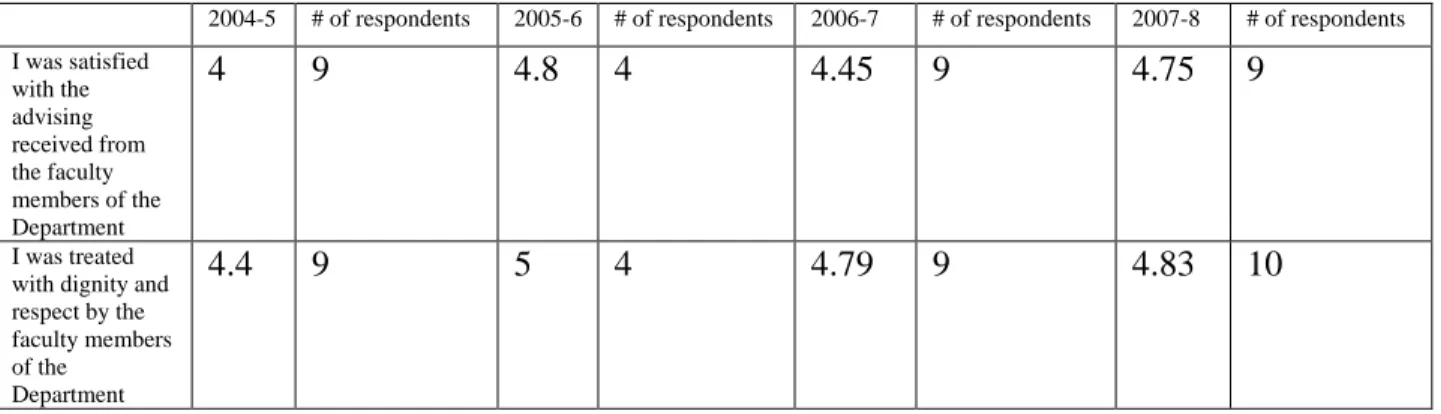
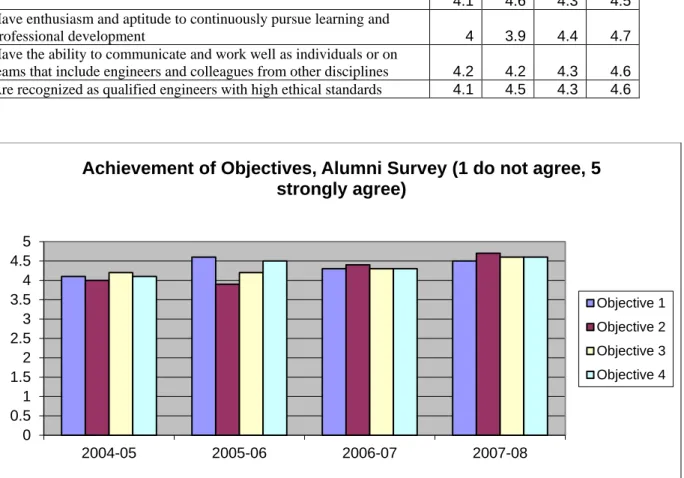
Some questions in the alumni survey forms relate to students’ educational experience at CSUEB. The following data demonstrates a high degree of satisfaction with regard to advising and their educational experience. Also students overwhelmingly mention that they are very satisfied with the level of advising they receive.
Table B.1.7.1, Response to questions in part II of alumni survey (Rate of answer between 1 to 5 with 1 meaning not at all and 5 meaning very much)
2004-5 # of respondents 2005-6 # of respondents 2006-7 # of respondents 2007-8 # of respondents I was satisfied with the advising received from the faculty members of the Department 4 9 4.8 4 4.45 9 4.75 9 I was treated with dignity and respect by the faculty members of the
Department
2008 Industrial Engineering Option Self-Study 25
B.2 Program Educational Objectives
This section of the self-study report provides a detailed discussion of Program Educational Objectives (PEOs), the process by which these objectives have been determined and evaluated, how the program ensures that these objectives are achieved, and the system of ongoing
evaluation that leads to continuous improvement of the program, as required by EAC Criterion 2. B.2.1 Objectives and Publication Information
The initial draft of program objectives was culled from IIE/CIEADH meeting discussions and publications; faculty, student, and employer perceptions of the essence of industrial engineering; faculty and employer expectations for the program’s graduates; and consideration of the
Department’s responsibility toward fulfilling CSU East Bay’s mission. In developing these objectives, the faculty have been guided by ABET’s explanation of the term. One explanation of the term suggests that program objectives are “statements that describe the expected
accomplishments of graduates in the first few years after graduation (our emphasis with italics).” Building upon this, the faculty decided that program objectives should be written to be used as descriptors of the program and provide prospective students and employers a clear idea of the program. The faculty’s understanding of the characteristics of program objectives, as explained in various ABET publications and presentations, has lead them to believe that program
objectives should do the following:
• Address external constituencies.
• Be sufficiently detailed.
• Be consistent with the mission of the institution.
• Be consistent with EAC/ABET criteria.
• Differentiate various programs within the same institution.
• Differentiate one program from similar programs in other institutions.
Based on these understandings, the faculty prepared an initial draft of program objectives and distributed them to Industry Advisory Board members in meetings that we had student
representative from the IIE Student Chapter (2002). With feedback from these groups as received in advisory board meetings, the faculty revised the objectives.
The Program Educational Objectives have gone through a few iterations of assess/evaluate cycles without any substantial change. The last review of PEO’s was conducted at our June 2008 IAB meeting. The changes were mostly editorial. The members of the IAB, the faculty, employers and student representatives agreed that the changes are necessary to strengthen our PEO’s. Specifically they indicated that our graduates should be able to work effectively as individuals as well as on teams. It is expected that these will remain fairly constant, with modifications made only as necessitated by the reality expressed in the results of the evaluation of the program’s effectiveness in achieving these objectives.
its constituencies are:
The Department of Engineering provides a quality engineering education that produce graduates who:
1. Successfully apply their learned skills throughout their professional pursuits
2. Have enthusiasm and aptitude to continuously pursue learning and professional development
3. Have the ability to communicate and work well as individuals or on teams that include engineers and colleagues from other disciplines
4. Are recognized as qualified engineers with high ethical standards
Except minor changes adapted in June 2008, these objectives have remained unchanged since adoption in 2002. These objectives are published in the online catalog at:
http://www.csueastbay.edu/ecat/current/index.html and in program informational brochures
published by the department, and on the program webpage:
http://www.sci.csueastbay.edu/engineering/programobjective.html
Copies of the informational brochure will be made available at the time of the site visit. Table B.2.1.1 shows a mapping of program objectives with the institutional mission statements. B.2.2 Program Constituencies
One of the first steps in establishing an evaluation/improvement process is to define the constituencies whose interests are paramount to the success and well-being of the program. Faculty of the Department, after extensive discussion, identified the following constituencies.
• Industrial Engineering Program alumni,
• Prospective employers of program graduates, and
• Faculty.
2008 Industrial Engineering Option Self-Study 27 Table B.2.1.1. Mapping of Program Objectives with Institutional Mission Statements Objectives → Mission ↓ Graduates who successfully applying learned skills in their professional pursuits Graduates who have an enthusiasm and aptitude to continuously pursue learning and professional development Graduates who can communicate effectively and work well as individual and on teams Graduates who are recognized as qualified engineers with high ethical standards University: To provide an academically rich, multicultural learning experience that prepares all its students to realize their goals, pursue meaningful lifework, and to be socially responsible contributors to their
communities, locally and globally.”
The University values learning in an academic environment that is inclusive and student-oriented. We value engagement in the Civic, Cultural and Economic life of the
communities we serve locally, regionally, and globally. We value critical and creative thinking, effective
communication, ethical decision making, and multi-cultural competence. We value the open exchange of ideas and
viewpoints.
B.2.3 Process to Determine and Evaluate Objectives
Program assessment of whether objectives are being achieved is performed to ensure that the following occurs:
• Objectives are realistic/appropriate and meet ABET guidelines.
• Any change in University mission is reflected in program objectives.
• Constituencies have input in the process.
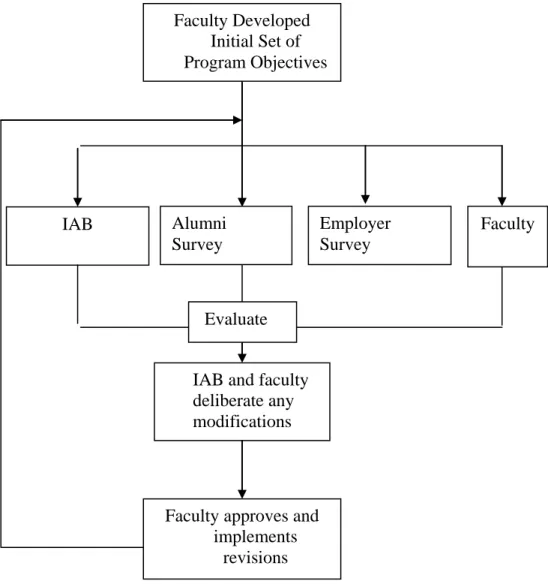
The current process for determining and evaluating program objectives is shown in Figure B.2.3.1. Many of our Industry Advisory Board (IAB) members are either employers of our graduates or are alumni of our program. Also, selected members of IIE student chapter attend the IAB meetings as student representatives. This evaluation process (steps 2 through 4) is formally repeated on a schedule as described below:
Figure B2.3.1 Program Objectives Development-Evaluation Process.
• The IAB meets each fall and spring quarter. Periodically, ABET assessment/evaluation reports are presented (minutes of meetings are in the appendix). As needed, IAB formally approves any change in the program educational objectives or reaffirms to
Faculty Developed Initial Set of Program Objectives
IAB Alumni
Survey
IAB and faculty deliberate any modifications
Faculty approves and implements revisions Employer Survey Faculty Evaluate
2008 Industrial Engineering Option Self-Study 29 continue with the current PEOs.
• Each alternate year, alumni survey forms are mailed by the Department to more recent graduates of the program. We have reproduced electronic copies of alumni and employer surveys that are posted on our website and can be completed and submitted
electronically. To encourage alumni and employers to complete and return surveys we contact them either by phone or e-mail and make special requests and provide them with a small token of appreciation for completing their surveys.
• Every other year, the employer survey form is mailed to supervisors of our more recent alumni. We have had low response rate from the employers. We have initiated new procedures to increase the response rate. We are asking our alumni to directly send a request to their supervisors to complete the survey. Also the Department Chair contacts local employers and conducts in person or phone interviews with as many as possible. B.2.4 Involvement of Constituencies
The five identified program constituents have been, are, and will remain, involved in the process of program objectives development, evaluation, assessment, and revision. The process for obtaining inputs from the constituencies for formulation and revision of the program educational objectives consisted of the following: faculty meetings, Industry Advisory Board meetings, Alumni Surveys and Employer Surveys.
B.2.4.1 IAB, Alumni and Employers
The Industrial Engineering Industry Advisory Board (IAB) consists of mid- to upper-level executives from major industrial and service organizations in the Bay Area. A number of IAB members are graduates of our IE program. Also student representatives participate in the IAB meetings. The IAB meets formally twice a year (in Fall and Spring quarters) to deliberate on issues directly affecting the program and its curricula. Program graduates and their employers are represented in the same process in three ways: IAB meetings, Alumni Survey, and Employer Survey. The alumni and employer surveys have recently been revised to provide direct feedback about each program objective and outcomes (copies provided in the appendices). Table B.2.4.1 lists the current membership of the IAB.
Table B.2.4.1. Industry Advisory Board Members
Engineering Department
2008 Industrial Advisory Board Members
First Name Last Name Company
Bruno Alvarez (Alumni) CISCO
Stephanie Ceguerra-Buquis (Alumni) Leap Frog Company
Neal Ely Las Positas College
Peter Hladun (Alumni) Artisan Confections
Giselle Icabalzeta (Alumni) Peterson Power
Marc Komrosky ISE Unlimited
Aris Krimetz Wente Vineyards
Karen Maxwell NUMMI
Rajan Mutialu (Alumni) OSHA
Mark Oty UPS
Ethan Plotkin GD California
John Sabinorio UPS
Mehria Saffi (Alumni) UPS
Adam Tran (Alumni) Lockeed Martin
Jeff Wold (Alumni) Air Liquide
B.2.4.2 Faculty
Faculty members are directly involved on a day-to-day basis with all aspects of curriculum development and delivery. They are also active participants in our advisory board meetings where program appropriateness and assessment of program educational objectives is conducted. Every other year in one of our faculty meetings we discuss the need for any modifications to our educational objectives based on evaluation of assessment data. If any change is warranted we discuss the matter in our next IAB meeting.
2008 Industrial Engineering Option Self-Study 31 B.2.5 Description of the PEOs Assessment Process
Since 2003, we have been continuously involved in assessment of educational objectives and outcomes. We have made some minor refinements into the assessment process since then. The process as it stands is that each fall the Department chair summarizes the assessment data from the previous year. The faculty then evaluates the data and if needed suggests program
modification or occasionally the need to update the PEOs. The evaluation of the assessment data will then be presented at the next IAB meeting, where through extensive deliberations between faculty and IAB members, any modifications to program or PEOs are approved. The Department then implements the curriculum modifications.
B.2.6 Educational Objectives Assessment Process and Tools
The primary inputs for ensuring that Program Educational Objectives (PEOs) will be achieved are the curriculum and the faculty. The curriculum has been designed with adequate emphasis on general education, communications, mathematics, science, engineering fundamentals, required technical courses, and technical elective courses. The technical courses provide the foundation of discipline knowledge for graduates to be prepared for employment, to pursue life-long learning, and to be successful in their professional pursuits. In addition, various courses emphasize oral and written communication, design through solving open-ended problems, and teamwork. Many students participate in the cooperative education (co-op) or internship
programs in local industries, giving them valuable engineering experience. In addition, students are strongly encouraged to be active in professional societies and participate in the student chapter of IIE. Faculty members, through their teaching and scholarly activities, directly impact the preparation of program graduates to meet the educational objectives. All faculty members have terminal degrees in their areas of specialization and many have other professional
certifications and licenses. The primary assessment tools for assessing program objectives are the Alumni Survey, Employer Survey, Profile of Alumni and IAB meetings. Our IAB includes a number of members that are alumni or employers’ of our graduates.
Table B.2.6.1 Mapping Assessment tools to Educational Objectives Objective → Tool ↓ Successfully apply their learned skills throughout their professional pursuits Have enthusiasm and aptitude to continuously pursue learning and professional development
Have the ability to communicate and work well as individuals oron teams that include engineers and colleagues from other disciplines
Are recognized as qualified engineers with high ethical standards Alumni Survey Employer Survey IAB Meetings Profile of Alumni
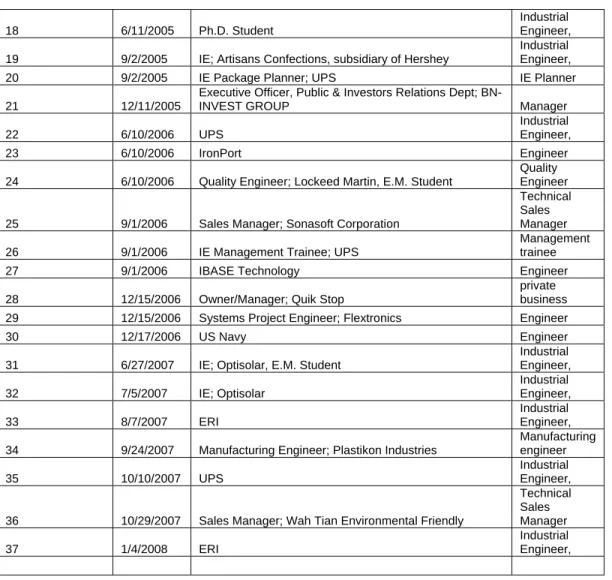
The direct method for evaluating whether the objectives of the program are being achieved is to obtain the employment history of program alumni to find out the extent to which the program prepared them to be successful in their chosen careers. This information has been obtained indirectly, through the Alumni Survey, direct contact with the alumni, alumni reconnect meetings and the Employer Survey, on a continuing basis.
Alumni Survey
In our most recent IAB meeting (June 2008) we discussed the analysis of survey data and discussed our program educational objectives and the appropriateness of our assessment tools. As a result of these discussions, although our current Alumni Survey asks about achieving program objectives, we modified the question such that it now has the question for each objective separately.
To assess achievement of educational objectives through Alumni Survey in addition to the analysis of the response to the specific question about achievement of PEOs, we developed the following relationship table between the PEO’s and other questions in the survey.
Table B. 6.2.2 Mapping Alumni Survey questions to program educational objectives. Objective →
Survey Question ↓
Successfully apply their learned skills throughout their professional pursuits Have enthusiasm and aptitude to continuously pursue learning and professional development
Have the ability to communicate and work well as individuals oron teams that include engineers and colleagues from other disciplines Are recognized as qualified engineers with high ethical standards
How long have you held an engineering position:
√ √
Educational degrees received or expected:
√ √
Have you taken the
fundamentals of engineering
2008 Industrial Engineering Option Self-Study 33
exam?
How well did your education prepare you for the test?
√ Indicate the professional
societies you are a member of:
√ √
Do you think you have achieved the objectives set out by the engineering program at CSU East Bay
√ √ √ √
Use of knowledge in math and basic science
√ √
Use of knowledge in engineering science
√ Model and design system and
components
√ Communicate effectively in both
written and oral formats
√ √
Communicate ideas and results in drawing and graphics expressions
√ √
Integrate knowledge and information for engineering problem solving √ √ Work effectively in international/global environment √ Apply engineering
professionalism and ethical standards appropriately
√ Obtain needed knowledge and
self learn
√ Build teams and facilitate team
processes √ Be aware of socio-economic environment in which engineering is practiced √ √
Use appropriate computer hardware and software
√ Collect and analyze data
properly
√
We then analyzed the survey data and developed averages for questions with rating responses and summery statistics for others to demonstrate the degree our alumni believe that our program has achieved its educational objectives. The analysis is provided in section B.2.7.
Employer Survey
As a result of our recent discussions (June 2008) in our IAB meeting and faculty consensus, we modified the Employer Survey form to include direct questions on achievement of each program objective. Our previous survey included several questions that provided the information needed to assess the degree of achievement of our educational objectives. To acquire quantitative data
from the survey responses, we developed the following table linking responses to survey
questions to achievement of the program educational objectives. The revised and current survey forms are included in the appendix.
Table B.2.6.3. Mapping employer survey questions to program educational objectives
We then analyzed the survey data and developed averages for questions with rating responses and summery statistics for others to demonstrate the degree the employers believe that our program has achieved its educational objectives. The analysis is provided in section B.2.7. Results of this analysis are processed by the faculty and then presented to the IAB who are then involved in evaluation of the outcomes and objectives and program improvements to ensure the achievement of the educational objectives.
Objective → Survey Question ↓ Successfully apply their learned skills throughout their professional pursuits Have enthusiasm and aptitude to continuously pursue learning and professional development
Have the ability to communicate and work well as individuals or on teams that include engineers and colleagues from other disciplines Are recognized as qualified engineers with high ethical standards
Use of math and basic science in engineering design √ Design and conduct scientific experiments √ √ Analyze and interpret data √ Modeling and design of systems, components and processes √ √ Understand professional ethics √ Work in multi-disciplinary teams √ Communicate effectively √ Recognize the need
for engaging life-long learning √ Overall assessment of CS East Bay engineering graduates √ √ √ √
Does it appear that CSU East Bay graduates are well prepared for the job?