THE EFC FORMULA, 2015–2016
What is the EFC?
The Expected Family Contribution (EFC) is a number that determines students’ eligibility
for federal student aid. The EFC formulas use the financial information students provide on
their Free Application for Federal Student Aid (FAFSA) to calculate the EFC. Financial aid
administrators (FAAs) subtract the EFC from students’ cost of attendance (COA) to determine
their need for the following federal student financial assistance offered by the U.S. Department of
Education (the Department):
• Federal Pell Grants,
•
Subsidized Stafford Loans through the William D. Ford Federal Direct Loan Program,
• Federal Supplemental Educational Opportunity Grants (FSEOG),
• Federal Perkins Loans, and
• Federal Work-Study (FWS).
The Teacher Education Assistance for College and Higher Education Grant (TEACH Grant) is a
non-need-based federal program, for which a student must also use the FAFSA to apply.
The methodology for determining the EFC is found in Part F of Title IV of the Higher Education
Act of 1965, as amended (HEA). Updated tables used in the computation of the EFC for the
2015–2016 Award Year were published in the
Federal Register
on May 30, 2014
(
ifap.ed.gov/fregisters/FR053014.html
) (79 FR 31103).
What is the source of data used in EFC calculations?
All data used to calculate a student’s EFC comes from the information the student provides on
the FAFSA. A student may submit a FAFSA:
• by using FAFSA on the Web,
•
by filing an application electronically through a school, or
• by mailing a FAFSA to the Central Processing System (CPS).
Students who applied for federal student aid in the previous award year may be eligible to
reapply using a renewal FAFSA online. Applying for federal aid is free, but to be considered for
non-federal aid (such as institutional aid), students may have to fill out additional forms, which
might have a fee.
We encourage applicants to complete the FAFSA electronically because there are edits that
reduce applicant errors and customize the questions presented based on answers to prior
questions. The electronic version also contains additional instructions and help features and
allows the Department to send results to the students and schools more quickly.
Who processes the application, and how are students
notified of their EFC?
The CPS receives the student’s application data, either electronically or on the paper application,
and uses it to calculate an EFC. After the FAFSA has been processed, the CPS sends the student
an output document containing information about his or her application results. This document,
which can be paper or electronic, is called a Student Aid Report (SAR). The SAR lists all the
information from the application and indicates whether the application was complete and signed.
If the application is complete and signed and there are no data conflicts, the SAR also includes
the student’s EFC. Students are instructed to carefully check the accuracy of the information
on the SAR. All schools listed on the student’s FAFSA receive application information and
processing results in an electronic file called an Institutional Student Information Record (ISIR).
Which EFC Formula Worksheet should be used?
There are three regular formulas and a simplified version of each:
• Formula A for dependent students,
• Formula B for independent students
without
dependents other than a spouse, and
• Formula C for independent student
with
dependents other than a spouse.
Instructions for applicants who are eligible for the automatic zero EFC calculation are included
in each worksheet. See page 5 for more information on which students qualify for an automatic
zero EFC.
Formula A Worksheet ...pages 9–12
Simplified Formula A Worksheet
...pages 13–16
Tables A1 through A7 (use with Formula A Worksheet) ...pages 17–20
Formula B Worksheet ...pages 21–22
Simplified Formula B Worksheet
...pages 23–24
Tables B1 through B4 (use with Formula B Worksheet) ...pages 25–27
Formula C Worksheet ...pages 29–30
Simplified Formula C Worksheet
...pages 31–32
Tables C1 through C6 (use with Formula C Worksheet) ...pages 33–35
Note: Do not complete the shaded areas in the simplified worksheets;
asset information is not required in the simplified formulas.
The EFC Formula, 2015
–
2016 3What is the definition of an independent student?
Because the EFC formula for a dependent student uses parental data and the two formulas for
independent students do not, the first step in calculating a student’s EFC is to determine his or
her dependency status. For the 2015–2016 Award Year, a student is automatically determined to
be independent for federal student aid if he or she meets one or more of the following criteria:
• The student was born before January 1, 1992.
•
The student is married or separated (but not divorced) as of the date of the application.
• At the beginning of the 2015–2016 school year, the student will be enrolled in a master’s or
doctoral degree program (such as MA, MBA, MD, JD, PhD, EdD, or graduate certificate,
etc.).
•
The student is currently serving on active duty in the U.S. Armed Forces or is a National
Guard or Reserves enlistee called into federal active duty for purposes other than training.
•
The student is a veteran of the U.S. Armed Forces (see the definition in the box on page 4).
•
The student has or will have one or more children who receive more than half of their support
from him or her between July 1, 2015 and June 30, 2016.
•
The student has dependent(s) (other than children or spouse) who live with him or her and
who receive more than half of their support from the student, now and through June 30, 2016.
• At any time since the student turned age 13, both of the student’s parents were deceased, or
the student was in foster care or was a dependent or ward of the court.
• As determined by a court in the student’s state of legal residence, the student is now, or was
upon reaching the age of majority, an emancipated minor (released from control by his or her
parent or guardian).
• As determined by a court in the student’s state of legal residence, the student is now, or was
upon reaching the age of majority, in legal guardianship.
• On or after July 1, 2014, the student was determined by a high school or school district
homeless liaison to be an unaccompanied youth who was homeless or was self-supporting
and at risk of being homeless.
• On or after July 1, 2014, the student was determined by the director of an emergency shelter
or transitional housing program funded by the U.S. Department of Housing and Urban
Development to be an unaccompanied youth who was homeless or was self-supporting and at
risk of being homeless.
• At any time on or after July 1, 2014, the student was determined by a director of a runaway
or homeless youth basic center or transitional living program to be an unaccompanied youth
who was homeless or was self-supporting and at risk of being homeless.
•
The student was determined by the college financial aid administrator to be an
unaccompanied youth who is homeless or is self-supporting and at risk of being homeless.
For students who do not meet any of the above criteria but who have documented unusual
circumstances, an FAA can override their dependency status from dependent to independent. For
information about dependency overrides, see the Application and Verification Guide, which is
TERMS USED IN THE DEFINITION OF AN INDEPENDENT STUDENT
LEGAL DEPENDENT.
Any children of the student who receive more than half
of their support from the student (children do not have to live with the student),
including a biological or adopted child. Also, any persons, other than a spouse, who
live with the student and receive more than half of their support from the student now
and will continue to receive more than half of their support from the student through
June 30, 2016.
VETERAN.
A student who: (1) has engaged in active service in the U.S. Armed
Forces (Army, Navy, Air Force, Marines, or Coast Guard), or has been a member of
the National Guard or Reserves who was called to active duty for purposes other than
training, or was a cadet or midshipman at one of the service academies, or attended
a U.S. military academy preparatory school, and (2) was released under a condition
other than dishonorable. A veteran is also a student who does not meet this definition
now but will by June 30, 2016.
Which students qualify for the simplified EFC formulas?
The following criteria determine which students have their EFCs calculated by a simplified
formula. Assets are not considered in the simplified EFC formulas.
For the 2015–2016 Award Year, a
dependent
student qualifies for the simplified EFC formula if
both (1) below and (2) on the next page are true:
(1) Anyone included in the
parents’
household size (as defined on the FAFSA) received
benefits during 2013 or 2014 from any of the designated means-tested federal benefit
programs: the Supplemental Security Income (SSI) Program, the Supplemental Nutrition
Assistance Program (SNAP), the Free and Reduced Price School Lunch Program,
the Temporary Assistance for Needy Families (TANF) Program
1, and the Special
Supplemental Nutrition Program for Women, Infants, and Children (WIC);
OR
the student’s
parents
:
•
filed or were eligible to file a 2014 IRS Form 1040A or 1040EZ
2,
•
filed a 2014 IRS Form 1040 but were not required to do so
3, or
•
were not required to file any income tax return;
OR
The EFC Formula, 2015
–
2016 5AND
(2) The 2014 income of the student’s
parents
is $49,999 or less.
•
For tax filers, use the parents’ adjusted gross income from the tax return to determine
if income is $49,999 or less.
•
For non-tax filers, use the income shown on the 2014 W-2 forms
of both parents (plus
any other earnings from work not included on the W-2s) to determine if income is
$49,999 or less.
For the 2015–2016 Award Year, an
independent
student qualifies for the simplified EFC formula
if both (1) and (2) below are true:
(1) Anyone included in the
student’s
household size (as defined on the FAFSA) received
benefits during 2013 or 2014 from any of the designated means-tested federal benefit
programs: the SSI Program, SNAP, the Free and Reduced Price School Lunch Program,
the TANF Program
4, and WIC;
OR
the student and student’s spouse (if the student is married)
both
•
filed or were eligible to file a 2014 IRS Form 1040A or 1040EZ
5,
•
filed a 2014 IRS Form 1040 but were not required to do so
6, or
•
were not required to file any income tax return;
OR
the student (or the student’s spouse, if any) is a dislocated worker.
AND
(2) The student’s (and spouse’s) 2014 income is $49,999 or less.
•
For tax filers, use the student’s (and spouse’s) adjusted gross income from the tax
return to determine if income is $49,999 or less.
•
For non-tax filers, use the income shown on the student’s (and spouse’s) 2014 W-2
forms (plus any other earnings from work not included on the W-2s) to determine if
income is $49,999 or less.
Which students qualify for an automatic zero EFC
calculation?
Certain students are automatically eligible for a zero EFC. The requirements for receiving an
automatic zero EFC are the same as those for the simplified EFC calculation except for these
differences:
• The income threshold for the parents of dependent students and for independent students and
their spouses is $24,000 or less (for an automatic zero EFC) instead of $49,999 or less (for
the simplified EFC calculation), and
•
For independent students, those without dependents other than a spouse cannot receive an
automatic zero EFC.
4 See note 1 on page 4. 5 See note 2 on page 4. 6 See note 3 on page 4.Note:
The income threshold for an automatic zero EFC has not changed from $24,000 for the
2015–2016 Award Year.
For the 2015–2016 Award Year, a
dependent
student
automatically qualifies for a zero EFC if
both (1) and (2) are true.
(1) Anyone included in the
parents’
household size (as defined on the FAFSA) received
benefits during 2013 or 2014 from any of the designated means-tested federal benefit
programs: the SSI Program, SNAP, the Free and Reduced Price School Lunch Program,
the TANF Program
7, and WIC;
OR
the student’s
parents
:
•
filed or were eligible to file a 2014 IRS Form 1040A or 1040EZ
8,
•
filed a 2014 IRS Form 1040 but were not required to do so
9, or
•
were not required to file any income tax return;
OR
the student’s
parent
is a dislocated worker.
AND
(2) The 2014 income of the student’s
parents
is $24,000 or less.
•
For tax filers, use the parents’ adjusted gross income from the tax return to
determine if income is $24,000 or less.
•
For non-tax filers, use the income shown on the 2014 W-2 forms
of both parents
(plus any other earnings from work not included on the W-2s) to determine if income
is $24,000 or less.
An
independent student with dependents other than a spouse
automatically qualifies for a
zero EFC if
both (1) below and (2) on the next page are true:
(1) Anyone included in the
student’s
household size (as defined on the FAFSA) received
benefits during 2013 or 2014 from any of the designated means-tested federal benefit
programs: the SSI Program, SNAP, the Free and Reduced Price School Lunch
Program, the TANF Program
10, and WIC;
OR
the student and student’s spouse (if the student is married)
both
•
filed or were eligible to file a 2014 IRS Form 1040A or 1040EZ
11,
•
filed a 2014 IRS Form 1040 but were not required to do so
12, or
•
were not required to file any income tax return;
OR
The EFC Formula, 2015
–
2016 7AND
(2) The student’s (and spouse’s) 2014 income is $24,000 or less.
• F
or tax filers, use the student’s (and spouse’s) adjusted gross income from the tax
return to determine if income is $24,000 or less.
•
For non-tax filers, use the income shown on the student’s (and spouse’s) 2014 W-2
forms (plus any other earnings from work not included on the W-2s) to determine if
income is $24,000 or less.
Note:
An
independent student without dependents other than a spouse
is not eligible for an
automatic zero EFC.
Why might a calculation of an EFC using these worksheets
differ from the EFC reported on a student’s SAR?
When it appears that an applicant has reported inconsistent data, the CPS may make certain
assumptions to resolve the inconsistency. These assumed values, which are reported on the
student’s SAR, are used to calculate the student’s EFC. Therefore, in some cases, the EFC
produced by these worksheets may differ from the EFC produced by the CPS if the assumed
values are not used.
In addition, to help reconcile EFC Formula Worksheet calculations with those of the CPS, all
calculations should be carried to three decimal places and then rounded to the nearest whole
numbers. Round upward for results of .500 to .999, round downward for results of .001 to .499.
Rounding should be performed so that the intermediate value that is the result of each step does
not have any decimal digits.
WORKSHEETS AND TABLES
Dependent Students
Formula A Worksheet ...pages 9–12
Simplified Formula A Worksheet
...pages 13–16
Tables A1 through A7...pages 17–20
Independent Students Without Dependents Other than a Spouse
Formula B Worksheet...pages 21–22
Simplified Formula B Worksheet
...pages 23–24
Tables B1 through B4...pages 25–27
Independent Students With Dependents Other than a Spouse
Formula C Worksheet...pages 29–30
Simplified Formula C Worksheet
...pages 31–32
Tables C1 through C6...pages 33–35
Note: Do not
complete the shaded areas in the simplified worksheets; asset information is
not required in the simplified formulas.
continued on the next page
2015–2016 EFC FORMULA
A
: DEPENDENT STUDENT
16. Cash, savings & checking (FAFSA/SAR #90)
17. Net worth of investments** (FAFSA/SAR #91)
If negative, enter zero. 18. Net worth of business and/or investment farm
(FAFSA/SAR #92) If negative, enter zero.
19. Adjusted net worth of business/farm
(Calculate using Table A4.) + 20. Net worth (sum of lines 16, 17, and 19) = 21. Education savings and asset
protection allowance (Table A5) − 22. Discretionary net worth
(line 20 minus line 21) =
23. Asset conversion rate × .12 24. CONTRIBUTION FROM ASSETS
If negative, enter zero. =
**Do not include the family’s home.
***To calculate the parents’ contribution for other than nine-month
enrollment, see page 11.
PARENTS’ CONTRIBUTION FROM ASSETS
PARENTS’ CONTRIBUTION
AVAILABLE INCOME (AI) (from line 15) CONTRIBUTION FROM ASSETS (from line 24) + 25. Adjusted Available Income (AAI)
May be a negative number. = 26. Total parents’ contribution from AAI
(Calculate using Table A6.) If negative, enter zero.
27. Number in college in 2015–2016
(Exclude parents) (FAFSA/SAR #74) ÷
28. PARENTS’ CONTRIBUTION (standard contribution for nine-month enrollment)***
If negative, enter zero. =
AVAILABLE INCOME
Total income (from line 7)
Total allowances (from line 14) −
15. AVAILABLE INCOME (AI)
May be a negative number. =
REGULAR WORKSHEET Page 1
*STOP HERE if the following are true: Line 3 is $24,000 or less and
• The parents are eligible to file a 2014 IRS Form 1040A or 1040EZ (they are not required to file a 2014 Form 1040) or they are not required to file
any income tax return or
• Anyone included in the parents’ household size (as defined on the FAFSA) received benefits during 2013 or 2014 from any of the designated means- tested federal benefit programs or
• Either of the parents is a dislocated worker.
If these circumstances are true, the Expected Family Contribution is
automatically zero.
8. 2014 U.S. income tax paid (FAFSA/SAR #86) (tax filers only) If negative, enter zero.
9. State and other tax allowance
(Table A1) If negative, enter zero. +
10. Parent 1 (father/mother/stepparent) Social Security tax allowance (Table A2) + 11. Parent 2 (father/mother/stepparent) Social Security tax allowance (Table A2) + 12. Income protection allowance (Table A3) + 13. Employment expense allowance:
• Two working parents (Parents’ Marital Status is “married” or “unmarried and both parents living together”): 35% of the lesser of the earned
incomes, or $4,000, whichever is less • One-parent families: 35% of earned income,
or $4,000, whichever is less
• Two-parent families, one working
parent: enter zero +
14. TOTAL ALLOWANCES =
ALLOWANCES AGAINST PARENTS’ INCOME PARENTS’ INCOME IN 2014
1. Parents’ Adjusted Gross Income (FAFSA/SAR #85)
If negative, enter zero.
2. a. Parent 1 (father/mother/stepparent) income
earned from work (FAFSA/SAR #88) __________ 2. b. Parent 2 (father/mother/stepparent) income
earned from work (FAFSA/SAR #89) + __________
Total parents’ income earned from work = 3. Parents’ Taxable Income
(If tax filers, enter the amount from line 1 above. If non-tax filers, enter the amount from line 2.)*
4. Total untaxed income and benefits:
(Total of FAFSA/SAR #94a. through 94i.) + 5. Taxable and untaxed income
(sum of line 3 and line 4) = 6. Total additional financial information
(Total of FAFSA/SAR #93a. through 93f.) −
7. TOTAL INCOME
(line 5 minus line 6) May be a negative number. =
A
REGULARWORKSHEET Page 2
STUDENT’S INCOME IN 2014
29. Adjusted Gross Income (FAFSA/SAR #36)
If negative, enter zero.
30. Income earned from work (FAFSA/SAR #39)
31. Taxable Income
(If tax filer, enter the amount from line 29 above. If non-tax filer, enter the amount from line 30.)
32. Total untaxed income and benefits
(Total of FAFSA/SAR #45a. through 45j.) + 33. Taxable and untaxed income
(sum of line 31 and line 32) = 34. Total additional financial information
(Total of FAFSA/SAR #44a. through 44f.) −
35. TOTAL INCOME
(line 33 minus line 34) = May be a negative number.
ALLOWANCES AGAINST STUDENT INCOME
36. 2014 U.S. income tax paid (FAFSA/SAR #37) (tax filers only) If negative, enter zero.
37. State and other tax allowance
(Table A7) If negative, enter zero. +
38. Social Security tax allowance (Table A2) +
39. Income protection allowance + 6,310 40. Allowance for parents’ negative Adjusted
Available Income (If line 25 is negative, enter line 25 as a positive number in line 40. If line 25 is zero or positive, enter zero in line 40.) +
41. TOTAL ALLOWANCES =
Total income (from line 35)
Total allowances (from line 41) −
42. Available income (AI) =
43. Assessment of AI × .50 44. STUDENT’S CONTRIBUTION FROM AI =
If negative, enter zero.
STUDENT’S CONTRIBUTION FROM INCOME
STUDENT’S CONTRIBUTION FROM ASSETS
45. Cash, savings & checking (FAFSA/SAR #41)
46. Net worth of investments* (FAFSA/SAR #42)
If negative, enter zero. + 47. Net worth of business and/or investment farm
(FAFSA/SAR #43)
If negative, enter zero. + 48. Net worth (sum of lines 45 through 47) = 49. Assessment rate × .20
50. STUDENT’S CONTRIBUTION FROM ASSETS =
EXPECTED FAMILY CONTRIBUTION
PARENTS’ CONTRIBUTION
(from line 28)
STUDENT’S CONTRIBUTION FROM AI
(from line 44) + STUDENT’S CONTRIBUTION FROM ASSETS
(from line 50) + 51. EXPECTED FAMILY CONTRIBUTION (standard contribution for nine-month
enrollment)**If negative, enter zero. = *Do not include the student’s home.
**To calculate the EFC for other than nine-month enrollment,
Note: Use this additional page to prorate the EFC only if the student will be enrolled for other than nine months and only to determine the student’s need for Campus-Based aid or a Federal Direct Subsidized Loan. Do not use this page to prorate the EFC for a Federal Pell Grant or TEACH Grant. The EFC for the Federal Pell Grant Program is the nine-month EFC used in conjunction with the cost of attendance to determine a Federal Pell Grant award from the Payment or Disbursement Schedule.
REGULAR WORKSHEET
Page 3
A
Calculation of Parents’ Contribution for a Student Enrolled LESS than Nine Months
A1. Parents’ contribution
(standard contribution for nine-month enrollment, from line 28)
A2. Divide by 9 ÷ 9
A3. Parents’ contribution per month =
A4. Multiply by number of months of enrollment × A5. Parents’ contribution for LESS than nine-month enrollment =
Calculation of Parents’ Contribution for a Student Enrolled MORE than Nine Months
B1. Parents’ Adjusted Available Income (AAI) (from line 25—may be a negative number)
B2. Difference between the income protection allowance for a
family of four and a family of five, with one in college + 4,860
B3. Alternate parents’ AAI for more than nine-month enrollment (line B1 + line B2) =
B4. Total parents’ contribution from alternate AAI (calculate using Table A6)
B5. Number in college (FAFSA/SAR #74) ÷
B6. Alternate parents’ contribution for student (line B4 divided by line B5) =
B7. Standard parents’ contribution for the student for nine-month enrollment (from line 28) − B8. Difference (line B6 minus line B7) =
B9. Divide line B8 by 12 months ÷ 12
B10. Parents’ contribution per month =
B11. Number of months student will be enrolled that exceed 9 ×
B12. Adjustment to parents’ contribution
for months that exceed nine (multiply line B10 by line B11) =
B13. Standard parents’ contribution
for nine-month enrollment (from line 28) + B14. Parents’ contribution for MORE than nine-month enrollment =
Calculation of Student’s Contribution from Available Income (AI) for a Student Enrolled LESS than Nine Months*
C1. Student’s contribution from AI
(standard contribution for nine-month enrollment, from line 44)
C2. Divide by 9 ÷ 9
C3. Student’s contribution from AI per month =
C4. Multiply by number of months of enrollment × C5. Student’s contribution from AI for LESS than nine-month enrollment =
*For students enrolled more than nine months, the standard contribution from AI is used (the amount from line 44).
REGULAR WORKSHEET
Page 4
A
Calculation of Total Expected Family Contribution for Periods of Enrollment Other than Nine Months Parents’ Contribution—use ONE appropriate amount from previous page:
• Enter amount from line A5 for enrollment periods less than nine months OR
• Enter amount from line B14 for enrollment periods greater than nine months
Student’s Contribution from Available Income—use ONE appropriate amount from previous page:
• Enter amount from line C5 for enrollment periods less than nine months OR +
• Enter amount from line 44 for enrollment periods greater than nine months Student’s Contribution from Assets
• Enter amount from line 50 + Expected Family Contribution for periods of enrollment other than nine months =
2015–2016 EFC FORMULA
A
: DEPENDENT STUDENT
CONTRIBUTION FROM ASSETS (from line 24) +
1
PARENTS’ CONTRIBUTION FROM ASSETS 16. Cash, savings & checking (FAFSA/SAR #90)
17. Net worth of investments** (FAFSA/SAR #91)
If negative, enter zero. 18. Net worth of business and/or investment farm
(FAFSA/SAR #92) If negative, enter zero.
19. Adjusted net worth of business/farm
(Calculate using Table A4.) + 20. Net worth (sum of lines 16, 17, and 19) = 21. Education savings and asset
protection allowance (Table A5) − 22. Discretionary net worth
(line 20 minus line 21) = 23. Asset conversion rate × .12 24. CONTRIBUTION FROM ASSETS
If negative, enter zero. =
A
SIMPLIFIEDWORKSHEET Page 1 PARENTS’ INCOME IN 2014
1. Parents’ Adjusted Gross Income (FAFSA/SAR #85)
If negative, enter zero.
2. a. Parent 1 (father/mother/stepparent) income
earned from work (FAFSA/SAR #88) __________ 2. b. Parent 2 (father/mother/stepparent) income
earned from work (FAFSA/SAR #89) + __________
Total parents’ income earned from work = 3. Parents’ Taxable Income
(If tax filers, enter the amount from line 1 above. If non-tax filers, enter the amount from line 2.)*
4. Total untaxed income and benefits
(sum total of FAFSA/SAR #94a. through 94i.) + 5. Taxable and untaxed income
(sum of line 3 and line 4) = 6. Total additional financial information
(sum total of FAFSA/SAR #93a. through 93f.)
− 7. TOTAL INCOME
(line 5 minus line 6) May be a negative number. =
ALLOWANCES AGAINST PARENTS’ INCOME
8. 2014 U.S. income tax paid (FAFSA/SAR #86) (tax filers only) If negative, enter zero.
9. State and other tax allowance
(Table A1) If negative, enter zero. +
10. Parent 1 (father/mother/stepparent) Social Security tax allowance (Table A2) + 11. Parent 2 (father/mother/stepparent) Social Security tax allowance (Table A2) + 12. Income protection allowance (Table A3) + 13. Employment expense allowance:
• Two working parents (Parents’ Marital Status is “married” or “unmarried and both parents living together”): 35% of the lesser of the earned
incomes, or $4,000, whichever is less • One-parent families: 35% of earned income,
or $4,000, whichever is less
• Two-parent families, one working
parent: enter zero +
14. TOTAL ALLOWANCES =
*STOP HERE if the following are true: Line 3 is $24,000 or less and
• The parents are eligible to file a 2014 IRS Form 1040A or 1040EZ (they are not required to file a 2014 Form 1040) or they are not required to file
any income tax return or
• Anyone included in the parents’ household size (as defined on the FAFSA) received benefits during 2013 or 2014 from any of the designated means-tested federal benefit programs or
• Either of the parents is a dislocated worker.
If these circumstances are true, the Expected Family Contribution is
automatically zero.
AVAILABLE INCOME
TOTAL INCOME (from line 7)
TOTAL ALLOWANCES (from line 14) −
15. AVAILABLE INCOME (AI)
May be a negative number. =
PARENTS’ CONTRIBUTION
AVAILABLE INCOME (AI) (from line 15)
= 25. Adjusted Available Income (AAI)
May be a negative number.
26. Total parents’ contribution from AAI
(Calculate using Table A6.) If negative, enter zero.
27. Number in college in 2015–2016
(Exclude parents) (FAFSA/SAR #74) ÷
28. PARENTS’ CONTRIBUTION (standard contribution for nine-month enrollment)***
If negative, enter zero. = **Do not include the family’s home.
***To calculate the parents’ contribution for other than nine-month
enrollment, see page 15.
Note: Do not
complete the shaded areas; asset
information is not required in the simplified
formula.
STUDENT’S CONTRIBUTION FROM ASSETS (from line 50) + .20
A
SIMPLIFIED WORKSHEET Page 2 STUDENT’S INCOME IN 201429. Adjusted Gross Income (FAFSA/SAR #36)
If negative, enter zero.
30. Income earned from work (FAFSA/SAR #39)
31. Taxable Income
(If tax filer, enter the amount from line 29 above. If non-tax filer, enter the amount from line 30.)
32. Total untaxed income and benefits
(Total of FAFSA/SAR #45a. through 45j.) + 33. Taxable and untaxed income
(sum of line 31 and line 32) = 34. Total additional financial information
(Total of FAFSA/SAR #44a. through 44f.)
−
35. TOTAL INCOME
(line 33 minus line 34)
May be a negative number. =
ALLOWANCES AGAINST STUDENT INCOME
36. 2014 U.S. income tax paid (FAFSA/SAR #37) (tax filers only) If negative, enter zero.
37. State and other tax allowance
(Table A7) If negative, enter zero. +
38. Social Security tax allowance (Table A2) +
39. Income protection allowance + 6,310 40. Allowance for parents’ negative Adjusted
Available Income (If line 25 is negative, enter line 25 as a positive number in line 40. If line 25 is zero or positive, enter zero in line 40.) +
41. TOTAL ALLOWANCES =
STUDENT’S CONTRIBUTION FROM INCOME
Total income (from line 35)
Total allowances (from line 41) −
42. Available income (AI) =
43. Assessment of AI × .50 44. STUDENT’S CONTRIBUTION FROM AI
If negative, enter zero. =
STUDENT’S CONTRIBUTION FROM ASSETS
45. Cash, savings & checking (FAFSA/SAR #41)
46. Net worth of investments* (FAFSA/SAR #42)
If negative, enter zero. + 47. Net worth of business and/or investment farm
(FAFSA/SAR #43)
If negative, enter zero. + 48. Net worth (sum of lines 45 through 47) = 49. Assessment rate × 50. STUDENT’S CONTRIBUTION FROM ASSETS =
EXPECTED FAMILY CONTRIBUTION
PARENTS’ CONTRIBUTION
(from line 28)
+ STUDENT’S CONTRIBUTION FROM AI
(from line 44)
= 51. EXPECTED FAMILY CONTRIBUTION
standard contribution for nine month
enrollment. If negative, enter zero.**
*Do not include the student’s home.
**To calculate the EFC for other than nine-month enrollment, see the next page.
Note: Do not
complete the shaded areas;
asset information is not required in the
simplified formula.
Note: Use this additional page to prorate the EFC only if the student will be enrolled for other than nine months and only to determine the student’s need for Campus-Based aid or a Federal Direct Subsidized Loan. Do not use this page to prorate the EFC for a Federal Pell Grant or TEACH Grant. The EFC for the Federal Pell Grant Program is the nine-month EFC used in conjunction with the cost of attendance to determine a Federal Pell Grant award from the Payment or Disbursement Schedule.
A
SIMPLIFIEDWORKSHEET Page 3
Calculation of Parents’ Contribution for a Student Enrolled LESS than Nine Months
A1. Parents’ contribution
(standard contribution for nine-month enrollment, from line 28)
A2. Divide by 9 ÷ 9
A3. Parents’ contribution per month =
A4. Multiply by number of months of enrollment × A5. Parents’ contribution for LESS than nine-month enrollment = Calculation of Parents’ Contribution for a Student Enrolled MORE than Nine Months
B1. Parents’ Adjusted Available Income (AAI) (from line 25—may be a negative number)
B2. Difference between the income protection allowance for a
family of four and a family of five, with one in college + 4,860
B3. Alternate parents’ AAI for more than nine-month enrollment (line B1 + line B2) =
B4. Total parents’ contribution from alternate AAI (calculate using Table A6)
B5. Number in college (FAFSA/SAR #74) ÷
B6. Alternate parents’ contribution for student (line B4 divided by line B5) =
B7. Standard parents’ contribution for the student for nine-month enrollment (from line 28) − B8. Difference (line B6 minus line B7) =
B9. Divide line B8 by 12 months ÷ 12
B10. Parents’ contribution per month =
B11. Number of months student will be enrolled that exceed 9 ×
B12. Adjustment to parents’ contribution
for months that exceed nine (multiply line B10 by line B11) =
B13. Standard parents’ contribution
for nine-month enrollment (from line 28) + B14. Parents’ contribution for MORE than nine-month enrollment =
Calculation of Student’s Contribution from Available Income (AI) for a Student Enrolled LESS than Nine Months*
C1. Student’s contribution from AI
(standard contribution for nine-month enrollment, from line 44)
C2. Divide by 9 ÷ 9
C3. Student’s contribution from AI per month =
C4. Multiply by number of months of enrollment × C5. Student’s contribution from AI for LESS than nine-month enrollment =
*For students enrolled more than nine months, the standard contribution from AI is used (the amount from line 44).
SIMPLIFIED WORKSHEET
Page 4
A
Parents’ Contribution—use ONE appropriate amount from previous page:
• Enter amount from line A5 for enrollment periods less than nine months OR
• Enter amount from line B14 for enrollment periods greather than nine months
Student’s Contribution from Available Income—use ONE appropriate amount from previous page:
• Enter amount from line C5 for enrollment periods less than nine months OR +
• Enter amount from line 44 for enrollment periods greater than nine months Expected Family Contribution for periods of enrollment other than nine months =
Table A1: State and Other Tax Allowance
for EFC Formula A Worksheet (parents only)
STATE PERCENT OF TOTAL INCOME
$0–$14,999 $15,000 or more Alabama ...3% ...2% Alaska ...2% ...1% American Samoa ...2% ...1% Arizona ...4% ...3% Arkansas ...4% ...3% California ...8% ...7%
Canada and Canadian Provinces ...2% ...1% Colorado ...4% ...3% Connecticut ...8% ...7% Delaware ...5% ...4% District of Columbia ...7% ...6% Federated States of Micronesia ...2% ...1% Florida ...3% ...2% Georgia...5% ...4% Guam ...2% ...1% Hawaii ...4% ...3% Idaho ...5% ...4% Illinois ...6% ...5% Indiana ...4% ...3% Iowa ...5% ...4% Kansas ...5% ...4% Kentucky ...5% ...4% Louisiana ...3% ...2% Maine ...6% ...5% Marshall Islands ...2% ...1% Maryland ...8% ...7% Massachusetts ...7% ...6% Mexico ...2% ...1% Michigan ...5% ...4% Minnesota ...6% ...5% Mississippi ...3% ...2%
STATE PERCENT OF TOTAL INCOME $0–$14,999 $15,000 or more Missouri ...5% ...4% Montana ...5% ...4% Nebraska ...5% ...4% Nevada ...3% ...2% New Hampshire ...5% ...4% New Jersey ...9% ...8% New Mexico ...3% ...2% New York ...9% ...8% North Carolina ...6% ...5% North Dakota ...2% ...1% Northern Mariana Islands ...2% ...1% Ohio ...5% ...4% Oklahoma ...3% ...2% Oregon ...7% ...6% Palau ...2% ...1% Pennsylvania ...5% ...4% Puerto Rico ...2% ...1% Rhode Island ...7% ...6% South Carolina ...5% ...4% South Dakota ...2% ...1% Tennessee ...2% ...1% Texas ...3% ...2% Utah ...5% ...4% Vermont ...6% ...5% Virgin Islands ...2% ...1% Virginia ...6% ...5% Washington ...3% ...2% West Virginia ...3% ...2% Wisconsin ...7% ...6% Wyoming ...2% ...1% Blank or Invalid State ...2% ...1% OTHER ...2% ...1% Multiply Parents’ Total Income (EFC Formula A Worksheet, line 7) by the appropriate rate from the table above to get the “State and Other Tax Allowance” (EFC Formula A Worksheet, line 9). Use the parents’ State of Legal Residence(FAFSA/SAR #70). If this item is blank or invalid, use the student’s State of Legal Residence (FAFSA/SAR #18). If both items are blank or invalid, use the State in the Student’s Mailing Address (FAFSA/
Table A2: Social Security Tax
Calculate separately the Social Security tax of father, mother, and student.
Income Earned from Work
*
Social Security Tax$0 – $117,000 7.65% of income
$117,001 or greater $8,950.50 + 1.45% of amount over $117,000
*Parent 1 (father/mother/stepparent) 2014 income earned from work is FAFSA/SAR #88. Parent 2 (father/mother/stepparent) 2014 income earned from work is FAFSA/SAR #89. Student’s 2014 income earned from work is FAFSA/SAR #39.
Social Security tax will never be less than zero.
Table A3: Income Protection Allowance
Number in parents’ household, including
student
(FAFSA/SAR #73)
Number of college students in household (FAFSA/SAR #74)
1 2 3 4 5 2 . . . $17,580 $14,570 ——— ——— ——— 3 . . . 21,890 18,900 $15,890 ——— ——— 4 . . . 27,040 24,030 21,040 $18,030 ——— 5 . . . 31,900 28,890 25,900 22,890 $19,900 6 . . . 37,310 34,310 31,310 28,310 25,320
Note: For each additional family member, add $4,210.
For each additional college student (except parents), subtract $2,990.
Table A4: Business/Farm Net Worth Adjustment
for EFC Formula A Worksheet (parents only)
If the net worth of a Then the adjusted business or farm is— net worth is—
Table A5: Parents’ Education Savings and
Asset Protection Allowance
for EFC Formula A Worksheet (parents only)
Age of older parent as of 12/31/2015* Age of older parent as of 12/31/2015* Allowance if there are two parents**
Allowance if there is only one parent
*Determine the age of the older parent listed in FAFSA/SAR #64 and #68 as of 12/31/2015. If no parent date of birth is provided, use age 45.
Allowance if there are two parents**
**Use the two parent allowance when the Parents’ Marital Status listed in FAFSA/SAR #59 is “married or remarried” or “unmarried and both parents living together.”
Allowance if there is only one parent 25 or less $0 $0 26... 1,700 500 27... 3,300 900 28... 5,000 1,400 29... 6,700 1,800 30... 8,400 2,300 31... 10,000 2,700 32... 11,700 3,200 33... 13,400 3,600 34... 15,100 4,100 35... 16,700 4,500 36... 18,400 5,000 37... 20,100 5,400 38... 21,800 5,900 39... 23,400 6,300 40... 25,100 6,800 41... 25,600 6,900 42... 26,200 7,100 43... 26,900 7,200 44... 27,500 7,400 45... $28,200 $7,500 46... 28,800 7,700 47... 29,500 7,900 48... 30,300 8,100 49... 31,100 8,300 50... 31,800 8,500 51... 32,700 8,700 52... 33,500 8,900 53... 34,400 9,100 54... 35,400 9,300 55... 36,300 9,500 56... 37,300 9,800 57... 38,300 10,000 58... 39,400 10,200 59... 40,500 10,500 60... 41,700 10,800 61... 42,900 11,000 62... 44,100 11,300 63... 45,400 11,600 64... 46,700 11,900 65 or over .. 48,100 12,300
Table A6: Parents’ Contribution from AAI
If parents’ AAI is—
Less than -$3,409 -$3,409 to $15,700 $15,701 to $19,700 $19,701 to $23,700 $23,701 to $27,700 $27,701 to $31,700 $31,701 or more
The parents' contribution from AAI is—
-$750 22% of AAI $3,454 + 25% of AAI over $15,700 $4,454 + 29% of AAI over $19,700 $5,614 + 34% of AAI over $23,700 $6,974 + 40% of AAI over $27,700 $8,574 + 47% of AAI over $31,700
Table A7: State and Other Tax Allowance
for EFC Formula A Worksheet (student only)
Alabama ...2% Alaska ...0% American Samoa ...2% Arizona ...2% Arkansas ...3% California ...5%
Canada and Canadian Provinces ...2% Colorado ...3% Connecticut ...5% Delaware ...3% District of Columbia ...5% Federated States of Micronesia ...2% Florida ...1% Georgia...3% Guam ...2% Hawaii ...4% Idaho ...3% Illinois ...3% Indiana ...3% Iowa ...3% Kansas ...3% Kentucky ...4% Louisiana ...2% Maine ...4% Marshall Islands ...2% Maryland ...5% Massachusetts ...4% Mexico ...2% Michigan ...3% Minnesota ...4% Mississippi ...2% Missouri ...3% Montana ...3% Nebraska ...3% Nevada ...1% New Hampshire ...1% New Jersey ...4% New Mexico ...2% New York ...6% North Carolina ...4% North Dakota ...1%
Northern Mariana Islands ...2%
Ohio ...4% Oklahoma ...2% Oregon ...5% Palau ...2% Pennsylvania ...3% Puerto Rico ...2% Rhode Island ...4% South Carolina ...3% South Dakota ...1% Tennessee ...1% Texas ...1% Utah ...3% Vermont ...3% Virgin Islands ...2% Virginia ...4% Washington ...1% West Virginia ...3% Wisconsin ...4% Wyoming ...1%
Blank or Invalid State ...2%
OTHER ...2% Multiply the student’s total income (EFC Formula A Worksheet, line 35) by the appropriate rate from the table above to get the “state and other tax allowance” (EFC Formula A Worksheet, line
TOTAL INCOME (from line 7)
TOTAL ALLOWANCES (from line 14) −
15. AVAILABLE INCOME (AI) =
16. Assessment rate × .50
17. CONTRIBUTION FROM AI =
May be a negative number.
CONTRIBUTION FROM AVAILABLE INCOME
2015–2016 EFC FORMULA
B
: INDEPENDENT STUDENT
Without Dependent(s) Other than a Spouse
REGULAR WORKSHEETB
Page 1*Do not include the student’s home.
**To calculate the EFC for less than nine-month enrollment, see the next page. If the student is enrolled for more than nine months, use the nine-month EFC (line 29 above).
EXPECTED FAMILY CONTRIBUTION
CONTRIBUTION FROM AI (from line 17) May be a negative number.
CONTRIBUTION FROM ASSETS (from line 26) + 27. Contribution from AI and assets = 28. Number in college in 2015–2016
(FAFSA/SAR #96) ÷ 29. EXPECTED FAMILY CONTRIBUTION for
nine month enrollment. If negative, enter zero.** = 18. Cash, savings & checking (FAFSA/SAR #41)
19. Net worth of investments* (FAFSA/SAR #42) If negative, enter zero.
20. Net worth of business and/or investment farm
(FAFSA/SAR #43) If negative, enter zero.
21. Adjusted net worth of business/farm
(Calculate using Table B3.) + 22. Net worth (sum of lines 18, 19, and 21) = 23. Asset protection allowance (Table B4) −
24. Discretionary net worth (line 22 minus line 23) =
25. Asset conversion rate × .20 26. CONTRIBUTION FROM ASSETS
If negative, enter zero.
STUDENT’S/SPOUSE’S CONTRIBUTION FROM ASSETS STUDENT/SPOUSE INCOME IN 2014
1. Student’s and spouse’s Adjusted Gross Income
(FAFSA/SAR #36) If negative, enter zero.
2. a. Student’s income earned from work
(FAFSA/SAR #39) __________
2. b. Spouse’s income earned from work
(FAFSA/SAR #40) + __________
Total student/spouse income earned from work = 3. Student/spouse Taxable Income
(If tax filers, enter the amount from line 1 above. If non-tax filers, enter the amount from line 2.)
4. Total untaxed income and benefits
(sum total of FAFSA/SAR #45a. through 45j.) + 5. Taxable and untaxed income
(sum of line 3 and line 4) = 6. Total additional financial information
(sum total of FAFSA/SAR #44a. through 44f.) −
7. TOTAL INCOME
(line 5 minus line 6) May be a negative number. =
ALLOWANCES AGAINST STUDENT/SPOUSE INCOME
8.2014 U.S. income tax paid (FAFSA/SAR #37) (tax filers only) If negative, enter zero.
9. State and other tax allowance
(Table B1) If negative, enter zero. + 10.Student’s Social Security tax (Table B2) + 11.Spouse’s Social Security tax (Table B2) + 12.Income protection allowance:
• $9,810 for single, separated or divorced/widowed student;
• $9,810 formarried student if spouse is enrolled at least 1/2 time;
• $15,720 for married student if spouse is not enrolled at least 1/2 time. + 13.Employment expense allowance:
• If student is not married or is separated,
the allowance is zero.
• If student is married but only one person is working (the student or spouse), the
allowance is zero.
• If student is married and both student and
spouse are working, the allowance is
35% of the lesser of the earned incomes,
or $4,000, whichever is less. +
REGULAR WORKSHEET
Page 2
B
Note: Use this additional page to prorate the EFC only if the student will be enrolled for other than nine months and only to determine the student’s need for Campus-Based aid or a Federal Direct Subsidized Loan. Do not use this page to prorate the EFC for a Federal Pell Grant or TEACH Grant. The EFC for the Federal Pell Grant Program is the nine-month EFC used in conjunction with the cost of attendance to determine a Federal Pell Grant award from the Payment or Disbursement Schedule.
Calculation of Expected Family Contribution for a Student Enrolled for Less than Nine Months
Expected Family Contribution
(standard contribution for nine-month enrollment, from line 29)
Divide by 9 ÷ 9
Expected Family Contribution per month =
Multiply by number of months of enrollment × Expected Family Contribution for less than nine-month enrollment* =
*Substitute the student’s EFC for less than nine-month enrollment in place of the EFC for the standard nine-month enrollment (EFC
2015–2016 EFC FORMULA
B
: INDEPENDENT STUDENT
Without Dependent(s) Other than a Spouse
18. Cash, savings & checking (FAFSA/SAR #41)
19. Net worth of investments* (FAFSA/SAR #42)
If negative, enter zero. 20. Net worth of business and/or investment farm
(FAFSA/SAR #43) If negative, enter zero.
21. Adjusted net worth of business/farm
(Calculate using Table B3.) + 22. Net worth (sum of lines 18, 19, and 21) = 23. Asset protection allowance (Table B4) −
24. Discretionary net worth (line 22 minus line 23) =
25. Asset conversion rate × .20 26. CONTRIBUTION FROM ASSETS
If negative, enter zero.
STUDENT’S/SPOUSE’S CONTRIBUTION FROM ASSETS
Note: Do not
complete the shaded areas;
asset information is not required in the
simplified formula.
CONTRIBUTION FROM ASSETS (from line 26) +
27. Contribution from AI and assets
*Do not include the student’s home.
SIMPLIFIED WORKSHEET
Page 1
B
STUDENT/SPOUSE INCOME IN 2014
1. Student’s and spouse’s Adjusted Gross Income
(FAFSA/SAR #36) If negative, enter zero.
2. a. Student’s income earned from work
(FAFSA/SAR #39) __________ 2. b. Spouse’s income earned from work
(FAFSA/SAR #40) + __________
Total student/spouse income earned from work = 3. Student/spouse Taxable Income
(If tax filers, enter the amount from line 1 above. If non-tax filers, enter the amount from line 2.)
4. Total untaxed income and benefits
(sum total of FAFSA/SAR #45a. through 45j.) + 5. Taxable and untaxed income
(sum of line 3 and line 4) = 6. Total additional financial information
(sum total of FAFSA/SAR #44a. through 44f.)
−
7. TOTAL INCOME
(line 5 minus line 6) May be a negative number. =
ALLOWANCES AGAINST STUDENT/SPOUSE INCOME
8. 2014 U.S. income tax paid (FAFSA/SAR #37) (tax filers only) If negative, enter zero.
9. State and other tax allowance
(Table B1) If negative, enter zero. +
10. Student’s Social Security tax (Table B2) + 11. Spouse’s Social Security tax (Table B2) + 12. Income protection allowance:
• $9,810 for single, separated or divorced/widowed student;
• $9,810 formarried student if spouse is enrolled at least 1/2 time;
• $15,720 for married student if only the student is enrolled at least 1/2 time. + 13. Employment expense allowance:
• If student is not married or is separated,
the allowance is zero.
• If student is married but only one person is working (the student or spouse), the
allowance is zero.
• If student is married and both student and spouse are working, the allowance is 35% of the lesser of the earned incomes, or
$4,000, whichever is less. +
14. TOTAL ALLOWANCES =
CONTRIBUTION FROM AVAILABLE INCOME
TOTAL INCOME (from line 7)
TOTAL ALLOWANCES (from line 14) −
15. AVAILABLE INCOME (AI) =
16. Assessment rate × .50 17. CONTRIBUTION FROM AI
May be a negative number. =
EXPECTED FAMILY CONTRIBUTION
CONTRIBUTION FROM AI (from line 17) May be a negative number.
= 28. Number in college in 2015–2016
(FAFSA/SAR #96) ÷ 29. EXPECTED FAMILY CONTRIBUTION for
nine-month enrollment. If negative, enter zero.** =
**To calculate the EFC for less than nine-month enrollment, see the next page. If the student is enrolled for more than nine months, use the nine-month EFC (line 29 above).
SIMPLIFIED WORKSHEET
Page 2
B
Note: Use this additional page to prorate the EFC only if the student will be enrolled for other than nine months and only to determine the student’s need for Campus-Based aid or a Federal Direct Subsidized Loan. Do not use this page to prorate the EFC for a Federal Pell Grant or TEACH Grant. The EFC for the Federal Pell Grant Program is the nine-month EFC used in conjunction with the cost of attendance to determine a Federal Pell Grant award from the Payment or Disbursement Schedule.
Calculation of Expected Family Contribution for a Student Enrolled for Less than Nine Months
Expected Family Contribution
(standard contribution for nine-month enrollment, from line 29)
Divide by 9 ÷ 9
Expected Family Contribution per month =
Multiply by number of months of enrollment × Expected Family Contribution for less than nine-month enrollment* =
*Substitute the student’s EFC for less than nine-month enrollment in place of the EFC for the standard nine-month enrollment
Table B1: State and Other Tax Allowance
Alabama ...2% Alaska ...0% American Samoa ...2% Arizona ...2% Arkansas ...3% California ...5%Canada and Canadian Provinces ...2% Colorado ...3% Connecticut ...5% Delaware ...3% District of Columbia ...5% Federated States of Micronesia ...2% Florida ...1% Georgia...3% Guam ...2% Hawaii ...4% Idaho ...3% Illinois ...3% Indiana ...3% Iowa ...3% Kansas ...3% Kentucky ...4% Louisiana ...2% Maine ...4% Marshall Islands ...2% Maryland ...5% Massachusetts ...4% Mexico ...2% Michigan ...3% Minnesota ...4% Mississippi ...2% Missouri ...3% Montana ...3% Nebraska ...3% Nevada ...1% New Hampshire ...1% New Jersey ...4% New Mexico ...2% New York ...6% North Carolina ...4% North Dakota ...1%
Northern Mariana Islands ...2%
Ohio ...4% Oklahoma ...2% Oregon ...5% Palau ...2% Pennsylvania ...3% Puerto Rico ...2% Rhode Island ...4% South Carolina ...3% South Dakota ...1% Tennessee ...1% Texas ...1% Utah ...3% Vermont ...3% Virgin Islands ...2% Virginia ...4% Washington ...1% West Virginia ...3% Wisconsin ...4% Wyoming ...1%
Blank or Invalid State ...2%
OTHER ...2% Multiply the total income of student and spouse (EFC Formula B Worksheet, line 7) by
the appropriate rate from the table above to get the “state and other tax allowance” (EFC Formula B Worksheet, line 9). Use the student’s State of Legal Residence (FAFSA/SAR #18) reported on the FAFSA. If this item is blank or invalid, use the State in the Student’s Mailing Address (FAFSA/SAR #6). If both items are blank or invalid, use rate for blank or invalid state above.
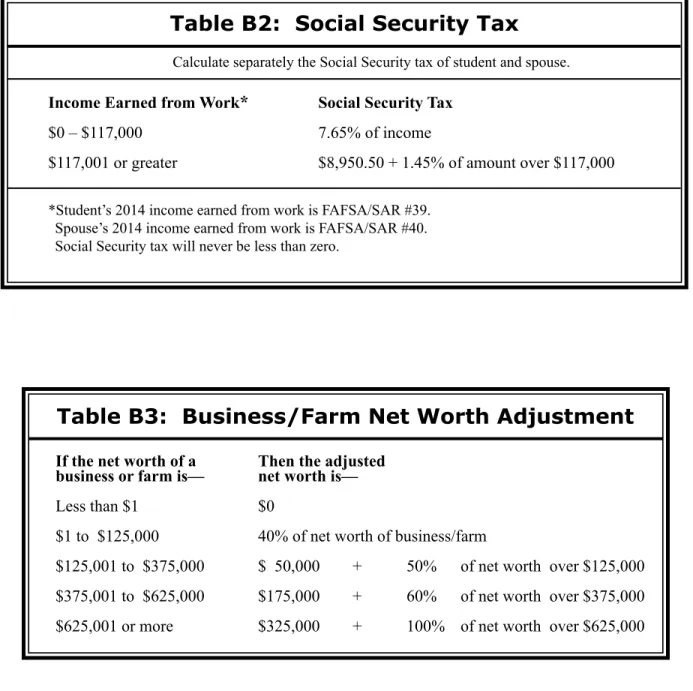
Table B2: Social Security Tax
Calculate separately the Social Security tax of student and spouse.
Income Earned from Work
*
Social Security Tax$0 – $117,000 7.65% of income
$117,001 or greater $8,950.50 + 1.45% of amount over $117,000
*Student’s 2014 income earned from work is FAFSA/SAR #39. Spouse’s 2014 income earned from work is FAFSA/SAR #40.
Social Security tax will never be less than zero.
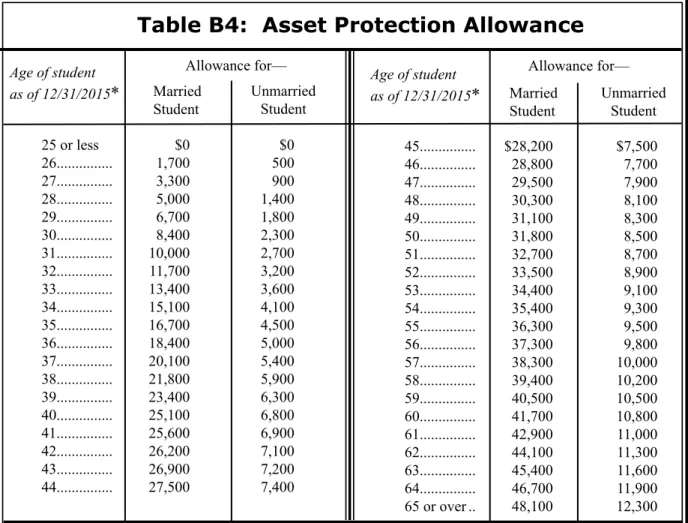
Table B3: Business/Farm Net Worth Adjustment
If the net worth of a Then the adjusted business or farm is— net worth is—
Less than $1 $0
$1 to $125,000 40% of net worth of business/farm
$125,001 to $375,000 $ 50,000 + 50% of net worth over $125,000
$375,001 to $625,000 $175,000 + 60% of net worth over $375,000
Table B4: Asset Protection Allowance
Age of student as of 12/31/2015*
*Determine student’s age as of 12/31/2015 from student’s date of birth (FAFSA/SAR #9) Allowance for—
Married
Student Unmarried Student
Age of student
as of 12/31/2015* Married
Student Unmarried Student Allowance for— 25 or less $0 $0 26... 1,700 500 27... 3,300 900 28... 5,000 1,400 29... 6,700 1,800 30... 8,400 2,300 31... 10,000 2,700 32... 11,700 3,200 33... 13,400 3,600 34... 15,100 4,100 35... 16,700 4,500 36... 18,400 5,000 37... 20,100 5,400 38... 21,800 5,900 39... 23,400 6,300 40... 25,100 6,800 41... 25,600 6,900 42... 26,200 7,100 43... 26,900 7,200 44... 27,500 7,400 45... $28,200 $7,500 46... 28,800 7,700 47... 29,500 7,900 48... 30,300 8,100 49... 31,100 8,300 50... 31,800 8,500 51... 32,700 8,700 52... 33,500 8,900 53... 34,400 9,100 54... 35,400 9,300 55... 36,300 9,500 56... 37,300 9,800 57... 38,300 10,000 58... 39,400 10,200 59... 40,500 10,500 60... 41,700 10,800 61... 42,900 11,000 62... 44,100 11,300 63... 45,400 11,600 64... 46,700 11,900 65 or over .. 48,100 12,300
2015–2016 EFC FORMULA
C
: INDEPENDENT STUDENT
With Dependent(s) Other than a Spouse
REGULAR WORKSHEETPage 1
C
A
STUDENT/SPOUSE INCOME IN 2014
1. Student’s and spouse’s Adjusted Gross Income
(FAFSA/SAR #36) If negative, enter zero.
2. a. Student’s income earned from work
(FAFSA/SAR #39) __________ 2. b. Spouse’s income earned from work
(FAFSA/SAR #40) + __________
Total student/spouse income earned from work = 3. Student/spouse Taxable Income
(If tax filers, enter the amount from line 1 above. If non-tax filers, enter the amount from line 2.)
4. Total untaxed income and benefits
(sum total of FAFSA/SAR #45a. through 45j.) + 5. Taxable and untaxed income
(sum of line 3 and line 4) = 6. Total additional financial information
(sum total of FAFSA/SAR #44a. through 44f.)
−
7. TOTAL INCOME
(line 5 minus line 6) May be a negative number. =
ALLOWANCES AGAINST STUDENT/SPOUSE INCOME
8. 2014 U.S. income tax paid (FAFSA/SAR #37) (tax filers only) If negative, enter zero.
9. State and other tax allowance
(Table C1) If negative, enter zero. + 10. Student’s Social Security tax (Table C2) + 11. Spouse’s Social Security tax (Table C2) + 12. Income protection allowance (Table C3) + 13. Employment expense allowance:
• Student and spouse both working: 35% of the lesser of the earned incomes, or $4,000,
whichever is less
• One-parent families: 35% of earned income,
or $4,000, whichever is less
• Student or spouse working (not both): zero +
14. TOTAL ALLOWANCES =
*STOP HERE if the following are true: Line 3 is $24,000 or less and
• The student (and the student’s spouse, if any) are eligible to file a 2014 IRS Form 1040A or 1040EZ (they are not required to file a 2014 Form 1040) or they are not required to file any income tax return or
• Anyone included in the student’s household size (as defined on the FAFSA) received benefits during 2013 or 2014 from any of the designated means-tested federal benefit programs or
• The student (or the student’s spouse, if any) is a dislocated worker. If these circumstances are true, the Expected Family Contribution is
automatically zero.
AVAILABLE INCOME
TOTAL INCOME (from line 7)
TOTAL ALLOWANCES (from line 14) −
15. AVAILABLE INCOME (AI)
May be a negative number. =
STUDENT’S/SPOUSE’S CONTRIBUTION FROM ASSETS
16. Cash, savings & checking (FAFSA/SAR #41)
17. Net worth of investments** (FAFSA/SAR #42) If negative, enter zero.
18. Net worth of business and/or investment farm
(FAFSA/SAR #43) If negative, enter zero.
19. Adjusted net worth of business/farm
(Calculate using Table C4.) + 20. Net worth (sum of lines 16, 17, and 19) = 21. Asset protection allowance (Table C5) − 22. Discretionary net worth (line 20 minus line 21) = 23. Asset conversion rate × .07 24. CONTRIBUTION FROM ASSETS
If negative, enter zero.
EXPECTED FAMILY CONTRIBUTION
AVAILABLE INCOME (AI) (from line 15)
CONTRIBUTION FROM ASSETS (from line 24) + 25. Adjusted Available Income (AAI)
May be a negative number. = 26. Total contribution from AAI
(Calculate using Table C6.) If negative, enter zero.
27. Number in college in 2015–2016
(FAFSA/SAR #96) ÷ 28. EXPECTED FAMILY CONTRIBUTION for
nine month enrollment. If negative, enter zero.***
**Do not include the student’s home.
***To calculate the EFC for less than nine-month enrollment, see the next page. If the student is enrolled for more than nine months, use the nine-month EFC (line 28 above).
C
REGULARWORKSHEET Page 2
Note: Use this additional page to prorate the EFC only if the student will be enrolled for other than nine months and only to determine the student’s need for Campus-Based aid or a Federal Direct Subsidized Loan. Do not use this page to prorate the EFC for a Federal Pell Grant or TEACH Grant. The EFC for the Federal Pell Grant Program is the nine-month EFC used in conjunction with the cost of attendance to determine a Federal Pell Grant award from the Payment or Disbursement Schedule.
Calculation of Expected Family Contribution for a Student Enrolled for Less than Nine Months
Expected Family Contribution
(standard contribution for nine-month enrollment, from line 28)
Divide by 9 ÷ 9
Expected Family Contribution per month =
Multiply by number of months of enrollment × Expected Family Contribution for less than nine-month enrollment* =
*Substitute the student’s EFC for less than nine-month enrollment in place of the EFC for the standard nine-month enrollment