Weaving a Web Development Curriculum
Wayne A Haga and Janos T Fustos
Metropolitan State College, Denver, CO, USA
[email protected] [email protected]
Abstract
Faculty in the Computer Information Systems department at the authors’ institution is in the process of developing a new Computer Information Systems degree with several areas of emphasis. One of the pro-posed areas of emphasis will be to prepare students for a career as a web developer. As part of the cur-riculum development process, the authors collected data regarding the current demand for web developers, the education level requested, salaries, and the specific skills employers are demanding. The research process included reading and recording the education level, experience, and specific skills employers are requesting for hundreds of jobs that have been posted on the Internet within the last few months. Addi-tionally, data was gathered from other sources including courses and programs offered at other institutions of higher education. Using this data, a model curriculum for a degree leading to a career in the field of web development is proposed.
Keywords: education, model, curriculum, web developer, job requirement
The Web Developer
The Role of a Web Developer
Different organizations define the role and the position of the web developer quite differently. Unfortu-nately, there is no Department of Labor (DOL) definition for this occupation that might clarify the very colorful palette.
Mozzila.org defines the web developers as “people who write web pages” (Mozilla, 2002). The online Web Developer’s Journal defines the web developer as “a person who not only designs web sites, but also understands the web as a medium, and is able to translate that understanding into site design.” The World Organization of Webmasters specifies the Web developers in its certification program as professionals who “… are proficient at creating web site structure and interactivity. They use database tools and custom applications to prepare the site for dynamic presentation of content to the visitor.” In several cases the job descriptions might also be mixed with the tasks and the responsibilities of a web administrator/webmaster and/or a web designer.
Job Demand for Web Developers
The U.S. Department of Labor in the Issues in Labor Statistics newsletter (December 06, 2001) listed the Webmasters, the Web designers and Web developers among the new and emerging occupations. (See Fig-ure 1.) They also stated “Within the Internet occupa-tions, more new occupations were related to such
Material published as part of these proceedings, either on-line or in print, is copyrighted by Informing Science. Permission to make digital or paper copy of part or all of these works for personal or classroom use is granted without fee provided that the copies are not made or distributed for profit or commercial advantage AND that copies 1) bear this notice in full and 2) give the full citation on the first page. It is permissible to abstract these works so long as
Web site development tasks than to either site administration or support.”
The authors searched for job advertisement in online Web job/career search engines. For the keywords we used: web & developer (Boolean AND connection), the scope was the whole country, and the time frame the last 30 days/4 weeks.
The results are presented in Table 1.
Table 1: Number of Online Advertisements for Web developers
Site # of Advertisements dice.com 3661 monster.com 952 careerpath.com 598 recruitersonline.com 239 headhunter.com 589 jobsearchengine.com 500 hotjobs.com 487 jobsearch.org 857
Figure 1: Functional Specialties in Web-Related Jobs
Salaries for Web Developers
The Bureau of Labor Statistics does not have a separate category for Web/Internet related jobs. The clos-est white-collar professional and technical areas are the computer systems analysts and scientists, and the operations/systems researchers and analysts. The reported salaries for these computer related non-research occupations are between $26.26 and $34.08 (hourly mean), and $54,630 and $70,890 (annual mean) (U.S. BLS, 2001). Many companies just state that they offer competitive salaries (whatever that means), or state that the salary will be based on experience and skills that the candidate offers.
Of 351 job position announcements examined for this study, only 63 listed salary levels or ranges. For positions with ranges, the average of the salary range was recorded. The salary range for all positions was from $10,400 to $250,000 with the average being $70,674. The median salary offered was $64,000 and the 25th and 75th percentiles $52,000 and $80,000, respectively.
Formal Education Requirements for a Web Developer
Of 351 job position announcements examined for this study, the majority (255) listed no specific formal educational requirements. Forty-eight listed only a high school degree as the minimum education required for the position. Five required at least an associate (2-year) degree. Forty positions required at least a bachelors degree (preferably in Computer Science, Computer Information Systems, or Management In-formation Systems). Only three required an advanced Masters degree. It was apparent from the job de-scriptions that employers were more interested in the Web Development skills the applicant possessed, rather than how the person had obtained those skills.
What Does It Take to Become a Successful Web Developer?
The following categories of requisite knowledge and skills are necessary for a Web developer: Knowledge:
• Computers and networking including different platforms and protocols.
• Communications and media - knowledge of electronic media production, communication, and dis-semination techniques and methods.
• Telecommunications - knowledge of transmission, broadcasting, switching, control, and operation of telecommunications systems.
Skills:
• Programming - writing server side and client side application programs for various purposes by us-ing different programmus-ing languages.
• Web page design and development – create static and dynamic web pages with text and graphical content in different developing environments by using authoring tools.
• Visual design of Web pages with graphical and multimedia applications.
• Integration database functions in the Web services, and the extension of Web functionality. • Adding security services to the Web servers, perform administration tasks in site configuration,
management, and maintenance.
What Do Employers Want?
A search for jobs with “Web Developer” in the job title was performed at America’s Job Bank
(http://www.jobsearch.org). This site allows you to search for jobs listed at all 50 of the state government job service organizations. An initial search resulted in 857 matches. Many of these turned out to be du-plicate listings. It was decided that examining between 300 and 400 jobs descriptions (after eliminating duplicates) would be adequate to get a representative sample. All jobs were listed with the agencies during the months of February and March of 2002. After elimination of obvious duplicate job listings, 351 posi-tions were included in this study.
Job descriptions/requirements for the 351 jobs were examined. Forty (11%) of the positions listed either no requirements or only a list of generic skills such as:
• experience as a web developer • strong technical skills
• strong problem solving skills • strong writing skills
• strong communication skills • project management skills • teamwork skills
• leadership
• troubleshooting skills
Of the remaining 311 positions, the technical skills required/requested were noted and tallied. Since the purpose of this study was to help develop a curriculum in web page development with the skills that in-dustry wanted, skills requested were recorded regardless of whether the skill was required or preferred. One hundred and sixty of the positions specified the number of years experience required for the posi-tions. The average number years of experience requested ranged from 1 to 10 years, with the average be-ing 3.8 years.
Initially, 75 positions were examined, and a complete list of skills required/preferred was noted. Skills were then categorized. Skills were next broken into the 15 following categories:
1. Markup language (HTML, UML, DHTML)
2. Web authoring tools (Flash, FrontPage, Photoshop)
3. Client side scripting (Javascript, VBscript, XSL, XSLT, CSS, generic request for scripting skills) 4. Client side scripting products (Dreamweaver, Generator, WebLogic)
5. Server side scripting (ASP, JSP/EJB, Perl, servlets/EJB, generic) 6. Server side scripting products (Cold Fusion, ISAPI, NSAPI)
7. Programming languages (Active X, C/C++, CICS/COBOL, Java, J++, Visual Basic, generic) 8. Programming products ( Jbuilder, Interdeveloper, Visual Studio, Visual Age)
10.Database products (Oracle/PL/SQL), DB2, Informix, MS Access, PowerBuilder, Sysbase, MS Transaction Server)
11.Operating systems (Unix, Linux, Windows, Solaris, Mac OS, OS400)
12.Methodology (COM/DCOM, OOP/OOD, RAD/JAD, SDLC, Database/E-R model-ing/normalization)
13.General server experience (Apache, IIS, Websphere, MS Commerce) 14.General networking skills
15.General e-commerce skills
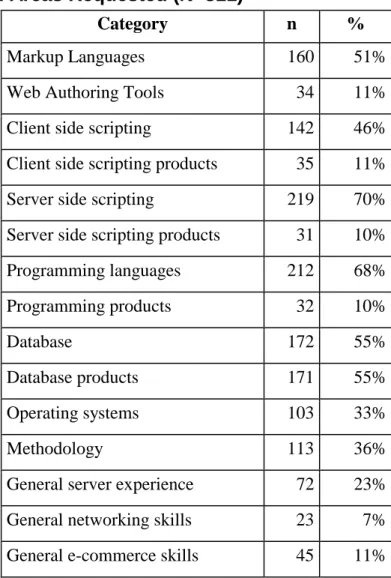
Table 2 summarizes the number and percentage for each category where at least one of the skills was re-quested and/or required. The most rere-quested skills were server side scripting (70%), programming lan-guages (68%), database (55%), database products (55%), markup lanlan-guages (51%), and client side script-ing (46%).
Table 2. Skill Areas Requested (N=311)
Category n %
Markup Languages 160 51%
Web Authoring Tools 34 11%
Client side scripting 142 46%
Client side scripting products 35 11%
Server side scripting 219 70%
Server side scripting products 31 10%
Programming languages 212 68% Programming products 32 10% Database 172 55% Database products 171 55% Operating systems 103 33% Methodology 113 36%
General server experience 72 23%
General networking skills 23 7%
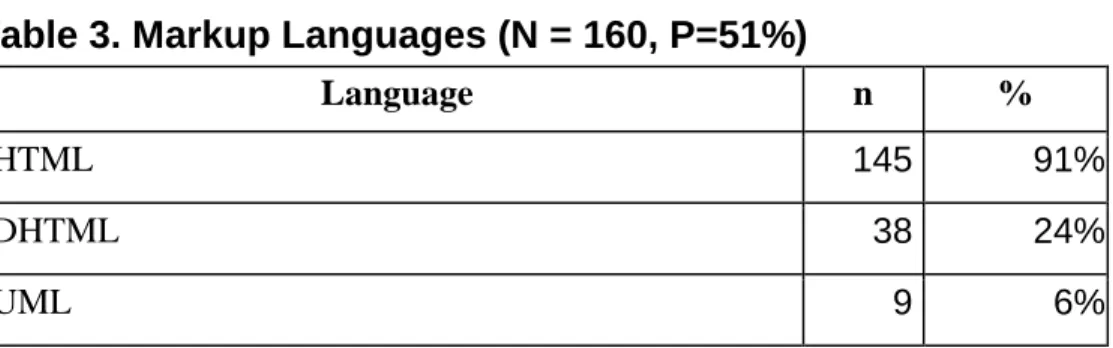
One hundred and sixty (51%) of the positions requested experience with one or more markup languages. Table 3 summarizes the specific skills requested. Experience with HTML was by far the most requested skill (91%). Additionally, many of the position announcements implied a requirement of understanding HTML (i.e. a request was made for JavaScript but not HTML; without a knowledge of HTML it would not be possible to embed JavaScript code into an HTML document).
Thirty-four (11%) of the positions requested experience with one or more basic web authoring software products. Table 4 summarizes the specific skills requested. Note that only 11% of the positions requested experience with a Web Authoring tool. The author’s interpretation is that employers want hard coding experience and they will train employees to use the specific product tools. The most requested tool for positions requesting a Web authoring tool was Photoshop (65%).
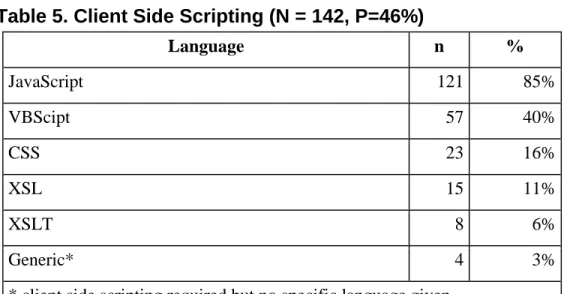
One hundred and forty-two (46%) of the positions requested experience with one or more client side scripting languages. Table 5 summarizes the specific skills requested. JavaScript was the most requested skill (85%), followed by VBScript (40%).
Table 3. Markup Languages (N = 160, P=51%)
Language n %
HTML 145 91%
DHTML 38 24%
UML 9 6%
Table 4. Web Authoring Tools (N = 34, P=11%)
Product n %
Photoshop 22 65%
Flash 15 44%
Only thirty-five (11%) of the positions requested experience with one or more client side scripting prod-ucts. Again, the authors believe the employers are more interested in employees entering the position with solid programming skills rather than experience with scripting products. WebLogic (77%) was the most requested skill. Table 6 summarizes the specific skills requested.
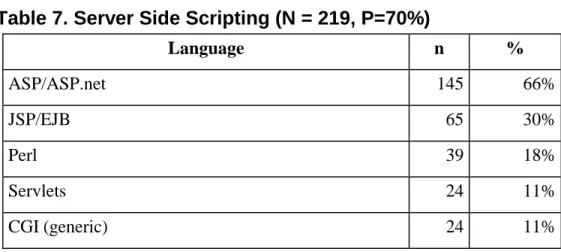
Two hundred and nineteen (70%) of the positions requested experience with one or more server side scripting languages. Experience with Active Server Pages was the most requested skill (66%), followed by JSP/EJB (30%). Table 7 summarizes the specific skills requested.
Table 5. Client Side Scripting (N = 142, P=46%)
Language n % JavaScript 121 85% VBScipt 57 40% CSS 23 16% XSL 15 11% XSLT 8 6% Generic* 4 3%
* client side scripting required but no specific language given.
Table 6. Client Side Scripting Products (N = 35, 11%)
Product n %
WebLogic 27 77%
DreamWeaver 8 23%
Thirty-one (10%) of the positions requested experience with one or more server side scripting products. Table 8 summarizes the specific skills requested. Cold Fusion (71%) was the most requested product.
Two hundred and twelve (68%) of the positions listed one ore more programming languages. Table 9 shows the specific languages requested. Java (63%) was the most requested language, followed by Visual Basic (50%) and C/C++ (22%).
Table 7. Server Side Scripting (N = 219, P=70%)
Language n % ASP/ASP.net 145 66% JSP/EJB 65 30% Perl 39 18% Servlets 24 11% CGI (generic) 24 11%
Table 8. Server Side Scripting Products (N = 31, P=10%)
Product n %
Cold Fusion 22 71%
InterDeveloper 12 39%
ISAPI 4 13%
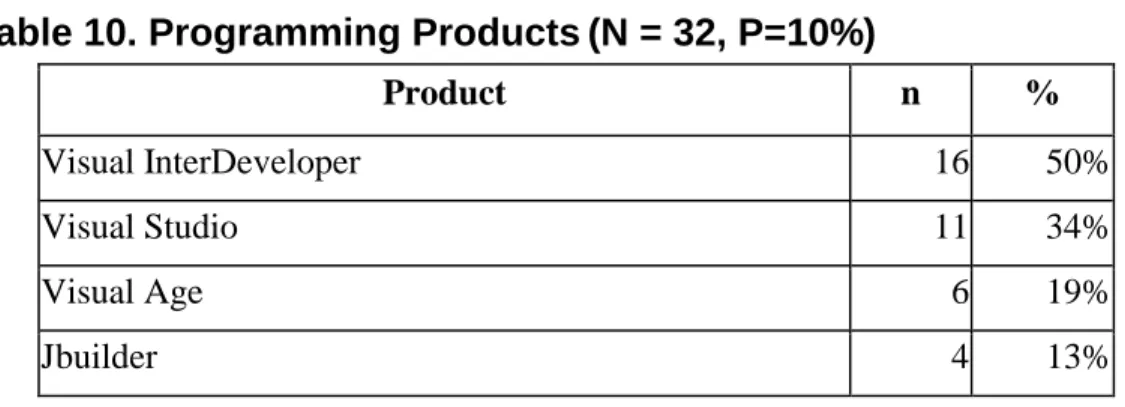
Thirty-two (10%) of the positions listed a programming product/development tool. Table 10 summarizes the programming language products required/requested. Visual InterDeveloper (50%) was the most re-quested skill.
One hundred and seventy-two (55%) of the positions requested one or more database skills. XML (56%) and SQL (44%) were the most requested skills. Table 11 summarizes the specific skills requested.
Table 9. Programming Languages (N = 212, P=68%)
Language n % Java 133 63% Visual Basic 107 50% C/C++ 47 22% Active X 9 4% COBOL 1 0% Table 11. Database (N = 172, P=55%) Language n % XML 96 56% SQL 75 44% Generic 34 20% ODBC 8 5%
Table 10. Programming Products(N = 32, P=10%)
Product n %
Visual InterDeveloper 16 50%
Visual Studio 11 34%
Visual Age 6 19%
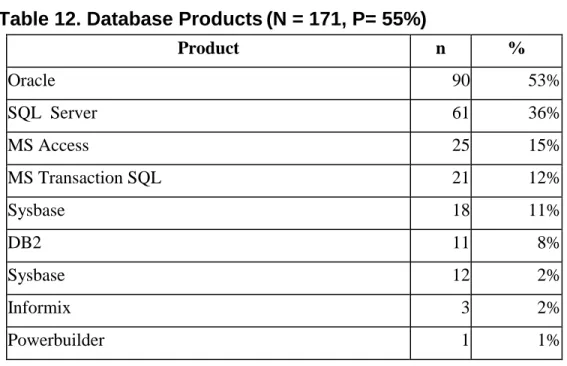
One hundred and seventy-one (55%) of the positions listed a specific database product. Oracle (53%) was the most requested skill, followed by SQL Server (36%). Table 12 summarizes the database products re-quired/requested.
One hundred and three (33%) of the positions requested experience with one or more operating systems. Experience with Windows was required by 63 of employers, followed by 49% requiring UNIX. Table 13 summarizes the operating systems requested.
Table 12. Database Products(N = 171, P= 55%)
Product n % Oracle 90 53% SQL Server 61 36% MS Access 25 15% MS Transaction SQL 21 12% Sysbase 18 11% DB2 11 8% Sysbase 12 2% Informix 3 2% Powerbuilder 1 1%
Table 13. Operating Systems (N = 103, P=33%)
Operating system n % Windows 65 63% UNIX 50 49% Sun Solaris 10 10% Linux 10 10% OS400 6 6% Mac OS 1 1%
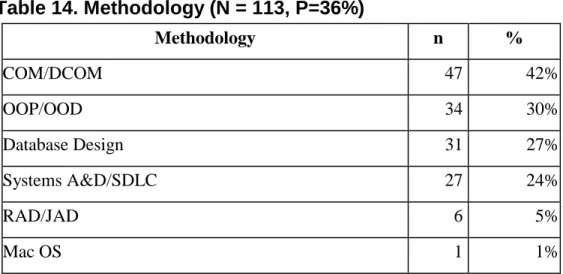
One hundred and thirteen (36%) of the positions requested experience with one or more methodologies. Table 14 summarizes the operating systems requested.
Seventy-two (23%) of the positions requested experience with one or more servers. Table 15 summarizes the server program knowledge requests.
General networking skills were requested for 23 (7%) of the positions. E-commerce experience was re-quested in 45 (11%) of the positions.
Existing Programs
The higher education system realized the importance of the Web related jobs and positions. Universities and colleges started to develop their degree and certification programs to support students and the indus-try. Programs are available at MS level (e.g. Golden Gate University, CA), but most are BS degrees in the Applied Science field (e.g. Lewis-Clark State College, ID; North Seattle Community College, WA; West Valley College, CA). The programs are based on 35-50 credit units.
Table 14. Methodology (N = 113, P=36%) Methodology n % COM/DCOM 47 42% OOP/OOD 34 30% Database Design 31 27% Systems A&D/SDLC 27 24% RAD/JAD 6 5% Mac OS 1 1% Table 15. Servers (N=72, P=23%) Server n % IIS 41 57% WebSphere 19 26% Apache 10 14% MS Commerce 7 10%
Several professional organizations offer different certifications on the Web field. The Computer Training Schools have CIW certifications (covering development, design, administration, security, networking, and e-commerce). The Web area is part of the MCSE certification series. Novell supports the use of their Web services with related programs. The Web is part of the CompTIA I-Net+ examination. Several universities and colleges offer certifications in the Web field including Java programming, HTML/Web page devel-opment, Web site management. The World Organization of Webmasters teamed up with colleges and businesses, who teach courses in various areas to offer Web related certifications. Almost 100 organiza-tions in the US and Canada teach the WOW courses with the support of corporate partners. They use Prentice Hall books in their program.
A Proposed Model Curriculum
A Model for a Certificate Web Page Development
The analysis of the job advertisements suggested that a proposed program should include at a minimum courses from the following areas: communications basics, HTML/Web page design, Web programming, database applications, visual design, and site administration. Certainly each area can be covered several different ways and at different levels. Communication might include the whole networking area, Web pages can be extended with DHTML features, combined with Cascading Style Sheets and scripting with Javascript and/or VBScript. Database applications might include the integration of the Web platform with various database systems, allowing also information exchange across applications and platforms, applica-tion of data integraapplica-tion, manipulaapplica-tion and transformaapplica-tion by using XML/XSL tools. The Web programs can be developed for the user side in Java, VB, for the server side in Perl, C, Java, and ASP. The business requirements include transaction processing, payment handling, dynamic content delivery, and integration of additional application services. Visual design is beyond the general IS education, and involves artistic work, interface design, psychology, and the study of human and consumer behavior. The site administra-tion background shall make sure that the services are up running, they are configured properly, they are an integral part of the organization’s information services, and they handle the load and the requests of the users.
Keeping these areas and requirements in mind we proposed a Web Development certification program that includes courses from the mentioned areas, and gives the students a broad overview of the involved techniques and technologies.
The certificate program is designed to prepare students for web development positions, help with career changes, and give a broader view of Web technology. Current market conditions and the growing demand for information technology professionals require IS specialists with the experience and skill sets needed to design, create Web sites, and operate Web services. They have to manage Internet services, deal with de-sign, operation and security issues, support their users, and fulfill system administrative tasks. This certifi-cate will prepare a student to design and develop web pages, to use JavaScript to generate dynamic Web content, to understand and use Web programming solutions, to integrate Web solutions into the organiza-tion’s information system, and to design and perform Web site administration tasks.
The certificate will prepare a student to design and develop web pages, to use appropriate scripting lan-guage to generate dynamic Web content, to integrate Web solutions into the organization’s information system, and to design and perform Web site administration tasks.
CIS3xxx Web Page Development (HTML, CSS, Javascript, DHTML)... 3 CIS3xxx Database Management Systems (terminology, design, theory, SQL)... 3
CIS3xxx Business Application Development w/ Visual Basic or
CIS3xxx Business Application and Web Applet Design w/ Java... 3
CIS3xxx Telecommunication Systems ... 3
CIS4xxx Web Site Administration ... 3
There are two prerequisite courses (CIS 2xxx – Computer Applications for Business and CIS 2xxx – Business Problem Solving: A Structured Programming Approach) that give the general business comput-ing and problem solvcomput-ing background to the program.
A Model for a 4 year degree in Computer Information Systems, with an
Emphasis Area in Web Development.
The degree will prepare a student to design and develop web sites, to use appropriate programming lan-guages to generate dynamic Web content, to integrate Web solutions into the organization’s information system, and to design and perform network and Web site administration tasks. The degree is intended to give students a solid background of conceptual knowledge in Web page design and development, client-side and server-client-side programming, general networking, database design and application development, multimedia programming, and service administration that will allow them to keep pace in a fast-changing and dynamic field. Upon completion of the degree the student will be prepared for careers that involve website design, service and application development, and site maintenance, as well as more business-oriented careers such as business project managers. The degree is applicable for students in most of the Web related fields. Graduates from this degree can expect to find jobs with companies, system providers, consulting firms or individuals. CIS2xxx Computer Applications for Business (basics of business computing) .... 3CIS2xxx Business Problem Solving (general problem solving techniques) ... 3
CIS3xxx Operating Systems (Windows, UNIX, Linux) ... 3
CIS3xxx Web Page Development (HTML, CSS, Javascript, DHTML) ... 3
CIS3xxx Database Management Systems (terminology, design, theory, SQL) ... 3
CIS3xxx Application Development w/ Visual Basic ... 3
CIS3xxx Application and Web Applet Design w/ Java... 3
CIS3xxx Programming in Perl and/or C/C++ ... 3
CIS3xxx Multimedia Information Systems (creating multimedia components) .... 3
CIS3xxx Telecommunication Systems (networking basics) ... 3
CIS4xxx Advanced Data Base Systems (database application development)... 3
CIS4xxx Network Installation and Administration (intranet administration) ... 3
CIS4xxx Web Site Administration (configuring and running Web services) ... 3
CIS4xxx Advanced Server Side Programming (servlets, ASP, JSP) ... 3
CIS4xxx Internship ... 3
CIS4xxx Systems Analysis and Design... 3
Summary And Conclusion
differ. It also seems to have a close relationship to the level of the recent Web applications in the com-pany’s information systems. The broad spectrum, the very different job descriptions and advertisements suggest that those businesses who just started their Web development might be satisfied with less skills and knowledge, and those who have already established a solid Web presence might have higher expecta-tions, and require more experience and higher, more complex skills. But the fact is that technical special-ists, content designers, and also managers need a broad vision of the Web, the applicable tools, and the involved areas. They all need to understand the vital pieces of the Web services, be familiar with the proc-esses, and make the right decisions regarding the technologies, infrastructure, and development. Higher Education can support businesses by offering regular courses and creating certification and degree pro-grams that fulfill industry needs.
References
Mozilla.org (2002) “Web Developer Documentation” (January 17, 2002) Accessed March 10, 2002 at
http://www.mozilla.org/docs/web-developer/indexd.html
U.S. Bureau of Labor Statistic (2001) “Occupational Employment Statistics”, 2000 National Occupational Employment and Wage Estimates, Computer and Mathematical Occupations (Nov. 15, 2001) Accessed March 10, 2002 at
http://www.bls.gov/oes/2000/oes_15Co.htm
U.S. Department of Labor (2001)” New and emerging occupations”(December, 2001) Accessed March 10, 2002 at
http://www.bls.gov/opub/ils/pdf/opbils45.pdf
Web Developer’s Journal. http://www.webdevelopersjournal.com
Other Resources
Government:
Occupational Employment Statistics. Bureau of Labor Statistics. Occupational. Employment Statistics. Internet: http://stats.bls.gov/
Organizations:
America's Career InfoNet. Employability Profile. Internet: www. acinet.org Association for Computer Machinery (ACM). Internet: www.info.acm.org
Computer Jobs & Technical Employment in the US & Canada. Internet: www.computerwork.com HTML Writers Guild. Internet: www.hwg.org
IEEE Computer Society. Internet: www.computer.org
Institute for the Certification of Computer Professionals. Internet: www.iccp.org Institute of Electrical and Electronics Engineers. Internet: www.ieee.org International Webmasters Association. Internet: www.iwanet.org Internet Society. Internet: www.isoc.org
World Organization of Webmasters. Internet: www.joinwow.org
Biography
Wayne A. Haga, Ph.D, in Applied Statistics from the University of Northern Colorado, MS in Computer Science from North Dakota State University. Areas of research interest include project management,
evaluation of online courses, and curriculum issues. Dr. Haga primarily teaches courses in database de-sign and development courses, as well as programming languages.
János T. Füstös, dr. univ., MS Chem. Eng., both from the University of Veszprém, (Hungary). Major re-search area includes the comparative study of information systems in managerial decisions at international level. Dr. Füstös primarily teaches courses in Web page development and Web site administration.