1
Revised: 7/21/2014Welcome to
Scottsdale Unified School District
HIGH SCHOOLS
This booklet allows us to introduce you to the high school curriculum in the Scottsdale Unified School District. We offer a
comprehensive program as outlined by the various courses described in this District-wide booklet and online at
www.susd.org
. Thank you for your interest, and welcome to Scottsdale Unified School District.
Vision
A community that engages, educates and empowers all to excel.
Mission Statement
To deliver a world-class education promoting the highest level of academic achievement, creativity and personal growth
that will inspire greatness in today’s students and tomorrow’s leaders.
Values
Excellence
We strive for unsurpassed achievement, challenging students to reach their personal best.
Collaboration
We work together and partner with our community, united by a shared responsibility to
educate our students.
Leadership
We seek to inspire and engage, recognizing that we are developing tomorrow’s leaders
today.
Character
We aspire to instill integrity, respect and responsibility in all that we do.
Creativity
We pursue innovation and exploration in our curriculum and our classrooms.
Strategic Goals
Communication and Community Partnerships
To improve public awareness and foster relationships that result
in strong support, community/business partnerships,
volunteerism and community pride.
Optimal Class Sizes and Personalized Learning
To establish optimal class sizes and differentiated learning
opportunities resulting in a more personalized learning
environment.
Teacher Quality and Professional Development
To recruit and retain highly effective teachers and invest in their
professional development.
Technology Improvements and Integration
To enhance the use of technology that develops student
readiness to compete in a global economy.
High Standards and Accountability
To establish high standards through increased academic rigor and
relevance which instill a passion for lifelong learning.
School Safety and Student Support
To cultivate a safe, structured, and supportive learning
environment which enables students to grow and achieve.
2
Revised: 7/21/2014Education Center
Telephone: 480-484-6100
3811 North 44th Street FAX: 480-484-6287
Phoenix, Arizona 85018-5420 Web site: www.susd.org
Welcome to the Scottsdale Unified School District (SUSD), where our 31 schools offer an outstanding education for your
child and a wide range of programs to meet the needs of all learners from Pre-Kindergarten through 12th grade. We are
very proud that the District has received Arizona’s highest rating – A – for two consecutive years, and 17 of our schools
also received an A rating. With the support of our Governing Board, staff, students and the greater community, we have
become innovators in public education and have demonstrated why
We Do It Better!
In all of our classrooms, students engage in curriculum designed to help them reach their academic potential and
prepare them for a successful and rewarding future. SUSD’s success rests on the shoulders of our highly-qualified
teachers, our dedicated administrators, and our caring support staff. Your student’s success results from the
collaboration between home and school. We look forward to working with you to ensure the best possible education for
your child.
SUSD provides something for everyone! As you look through this High School Planning Guide, you will note that in
addition to the courses that fulfill graduation requirements, there are additional specialized programs and electives
designed to create a well-rounded experience for every student. We offer eLearning, International Baccalaureate
Program, Advanced Placement, Honors classes, Career and Technical Education, Fine Arts, Athletics, Special Education
and much more. Whether students are interested in art or aviation, construction or culinary arts, music or marketing,
there are class offerings that provide a solid knowledge base for students who are college bound or plan to enter the
workforce directly after high school.
I invite you to visit our website at www.susd.org to find out more about our District. We know that you have choices for
your child’s education, and we are very glad that you chose SUSD.
Very truly yours,
Dr. David J. Peterson
3
Revised: 7/21/2014Table of Contents
Page
Education and Career Action Plan (ECAP) ... 4
Student Planner ... 5
Record Keeping Guidelines and College Admissions ... 6
SUSD eLearning ... 15
AVID ... 17
Career and Technical Education (CTE) ... 18
Communications and Media Technologies ... 20
Design and Merchandising ... 22
Finance ... 22
Health Science ... 23
Hospitality and Tourism ... 23
Human Services ... 24
Information Technology ... 24
Marketing, Management and Entrepreneurship ... 25
Science, Technology, Engineering and Mathematics ... 25
English ... 27
English Immersion Studies Program ... 31
Fine Arts ... 33 Dance ... 34 Music ... 35 Theatre ... 39 Visual Arts ... 40 Inter-Departmental ... 44 International Baccalaureate ... 49 IB Pre-Diploma ... 50 Group 1- Language A ... 51 Group 2- Language B ... 51
Group 3- Individuals and Society ... 52
Group 4- Experimental Sciences ... 53
Group 5- Mathematics ... 54
Group 6- The Arts ... 55
Core Components ... 56 Mathematics ... 57 Physical Education ... 62 Science ... 64 Social Studies ... 68 Special Education ... 71 World Language ... 73 Fee Schedule ... 77
East Valley Institute of Technology (EVIT) ... 79
Index ... 86
4
Revised: 7/21/2014Education and Career Action Plan (ECAP)
Planning a Four-Year Program
An ECAP (Education and Career Action Plan) reflects a student’s current plan of coursework, career aspirations, and extended learning opportunities in order to develop the student’s individual academic and career goals. A student’s plan helps to personalize education and enables the student to maximize the opportunities available upon high school graduation. The ECAP will incorporate the traditional four-year high school plan. All counseling departments will offer incoming freshman a formal Freshman Transition Program that will allow parents and students an opportunity to begin the ECAP process. There is an annual $5.00 administrative fee for the ECAP that is assessed during registration. Students currently enrolled will continue to work with their counselor to update and track the progress of the Four-Year Plan.
Who is Involved in the ECAP Process?
Students, parents, and school personnel (i.e. counselors, teachers, administration, or career center staff) can work together to help guide the student in his/her choices for career and educational experiences. When students, parents and the school staff plan together, each student receives needed support to meet his/her Education and Career Action Planning (ECAP) goals.
Arizona Education and Career Action Plan (ECAP – State Board Rule # R7-2-302.05)
An Arizona Education and Career Action Plan shall, at minimum, allow students to enter, track and update the followinginformation:
ACADEMIC • Plan coursework
• Meet high school requirements and plan for postsecondary requirements • Document postsecondary education goals
• Review academic progress to include needed interventions or advisements • Record academic achievement or awards
• Monitor State of Arizona test requirement: all students must pass Reading, Writing, and Mathematics in order to graduate
CAREER
• Identify postsecondary career plans, options, interests or skills • Explore career opportunities
• Explore needed educational requirements to meet the career option
POSTSECONDARY
• Explore admissions requirements • Complete necessary applications • Create a financial assistance plan
EXTRACURRICULAR
Documentation for participation in: • Clubs or organizations
• Athletics
• Recreational activities • Fine arts opportunities
• Community service or volunteer activities • Work experiences, internships, job shadow, etc. • Leadership opportunities
5
Revised: 7/21/2014Student Planner
C o m p e t e n c y S U S D C r e d i t R e q u i r e m e n t s A r i z o n a U n i v e r s i t y C r e d i t R e q u i r e m e n t s Ad d i t i o n a l I n f o r m a t io n
En g li sh 4 4 The District’s and Arizona’s graduation requirement in English is four credits.
M ath 4 4
Math credits must include Algebra I, Geometry, Algebra II (or course equivalent to Algebra II) and one other course that includes significant math content. The State Board of Education
established that, beginning with the graduating class of 2013, students must complete four credits of mathematics including: a.) two credits containing course content in preparation for proficiency on the high school Arizona state test, b.) one credit covering Algebra II or course content equivalent to Algebra II, and c.) one credit of significant mathematics as determined by district governing boards. See http://www.ade.az.gov for more information.
Sc ien c e 3 3 State of Arizona university admission requires at least three years of laboratory science.
Soc ia l
Stu d ie s 3 2
All students must take the following courses in order to meet the SUSD Social Science graduation requirement:
a. World History/World Geography (2 semesters) b. American and Arizona History (2 semesters, Junior year) c. American and Arizona Government (1 semester, Senior year) d. Economics/Free Enterprise (1 semester, Senior year) Wor ld
Lan gu a g e 0 2
Two years of the same language is required for Arizona state universities (for example: French I and French II).
Fin e
Ar t s/C T E 1 1
Arizona state universities require 1 credit of Fine Arts from the following areas: music, art, theater or dance.
E lec ti ve s 6 0
Elective credits may be from all curricular areas.
A maximum of 1 credit may be earned in the course of Teacher Assistant. A maximum of 2 elective credits may be earned in the course of Independent Study.
Ph ys ic al
Ed u c at ion 1 0
The District graduation requirement is one credit in either Introductory Physical Education or Physical Education Opportunity Program for Exceptional Learners.
See International Baccalaureate (IB) counselor for IB requirement. O n l i n e
B e g i n n i n g 2 0 1 8 g r a d u a t i n g c l a s s
.5 0 SUSD requirement effective for all students entering ninth grade in 2014-15 school year. Among the 22 credits required, .5 must be completed through an online or blended modality.
Tota l 22
A student may be awarded a diploma from any SUSD high school if he/she has continuously enrolled in a minimum of four (4) credit bearing courses the final semester before graduation on a Scottsdale High School campus his/her senior year.
While completion of the requirements for high school graduation will allow admittance to a community college, it does not ensure entrance into all colleges and/or trade schools, etc. Anyone planning to pursue higher education should determine the entrance requirements of the school he/she plans to attend, optimally by the end of the sophomore year for scheduling and planning purposes. College admission requirements are subject to change.
Arizona Instrument to Measure the Standards (AIMS) Requirement:
Per state statute (A.R.S § 15-701.01) and State Board of Education Rule (R7-7-302), students graduating after January 1, 2006 must meet the standard on the reading, writing, and mathematics portions of AIMS in order to graduate from high school or receive a diploma. Beginning in the spring of their sophomore year, all students will have the opportunity to take the AIMS tests once per semester. This test is due to change in format and name by 2014/15. The test is referred to as the Arizona State Test in the High School Planning Guide. For more information, please refer to the Arizona Department of Education's Web page at
www.ade.az.gov.
Supporting Student Learning
As of the 2011-2012 school year, 8th grade students taking Algebra I and/or any World Language Level I course may elect to receive SUSD high school credit for these courses. This allows students to start high school with 1.0 credit for each of these courses toward their SUSD high school diploma. For detailed information about the timeline, please see “Letter to 8th Grade Parents” in the SUSD Digital Backpack, available on the SUSD website. Please note: accepting Algebra and/or Spanish I grade(s) taken in middle school for high school credit may have an effect on the student’s academic GPA. Please consult with the guidance department for more information.
Effective for all SUSD students entering the ninth grade in the 2014-2015 school year, students will be required to complete one virtual online or blended learning course experience (.5 minimum credit requirement) prior to graduation as a District graduation requirement. Exceptions through Individualized Education Plans (IEP’s) will be allowed. For additional information regarding the eLearning policy, please review the eLearning manual available online at http://elearning.susd.org.
On June 19, 2012, the SUSD
Governing Board voted to
approve a new policy regarding a current minimum GPA of 2.0 for all middle and high school
students, effective August
2012. This policy includes
interventions and support
systems available to ensure student success. The SUSD Code of Conduct explains how this policy impacts high school and middle school students’ participation in extracurricular activities. Please see the Code of Conduct available on the
SUSD website for more
6
Revised: 7/21/2014Record Keeping Guidelines and College Admissions
Admission to Community Colleges
Admission to a community college in Arizona may be granted to any person who meets at least one of the following criteria:
Is a graduate of a high school which is accredited by a regional accrediting association as defined by the United States Office of Education or approved by a State Department of Education or other appropriate state educational agency
Has a high school certificate of equivalency
Is 18 years of age or older and demonstrates evidence of potential success in the community Is a transfer student in good standing from another college or university
Students are encouraged to check the specific post-secondary school websites for the latest information.
Admission to Out-of-State Colleges and Universities
Out-of-state schools may have additional entrance requirements that differ considerably. It is suggested that students send for school catalog (if not available in the Guidance Office or Career Center) or go to college websites to see specific requirements.
Admission to State Universities
Students seeking admission to Arizona State University (ASU), the University of Arizona (U of A), or Northern Arizona University (NAU) are required to present evidence of the following graduation criteria. Admission will be based on the grade-point average of the following 16-unit Board of Regents requirements, and not on the entire curriculum:
English - 4 years/units (grammar, composition, literary analysis)
Mathematics - 4 years/units (Algebra I, Geometry, Algebra II, any advanced math course for which Algebra II is a prerequisite)
Laboratory Science - 3 years/units (Chemistry, Physics, Earth Science, Biology, Environmental Biology; one year each in at least three of the four areas, or a laboratory-based integrated science)
Social Studies - 2 years/units (at least one course in American History and one year of an additional social studies field) World Language - 2 years/units of the same world
language; a third year is recommended
Fine Arts - 1 year/unit in any combination of two semesters of fine arts courses (visual and performing arts) NOTE: Additional courses are needed for graduation.
While the ACT or SAT examinations are not required for admission to all the state universities, they may be required for certain programs and/or scholarships.
Advanced Placement, Honors and International Baccalaureate Courses
The Advanced Placement program affords students the opportunity to complete college-level courses in high school. Participating colleges grant credit and/or appropriate placement based on the scores that students achieve on AP examinations. Students who complete an Advanced Placement course are expected to take the appropriate Advanced Placement examination at their own expense.
The International Baccalaureate (IB) program is an enriched and accelerated program challenging students to develop and refine their critical thinking skills. Junior and Senior Courses within this program have weighted grades. See International Baccalaureate section for more information. Course names followed by H, AP, or IB are Honors courses. All honors courses receive weighted grades and comply with the following Scottsdale Schools guidelines for honors classes:
A. Provide a foundation for success in AP and/or IB classes and consistently align with AP and/or IB content B. Consistently align with college coursework
C. Cover more breadth and depth in each subject area, thus requiring additional effort and perseverance on the part of the student; summer reading or other outside activity is often an expectation
D. Consistently require thinking at the highest levels of Bloom’s Taxonomy (application, analysis, synthesis, and evaluation)
E. Require students to demonstrate higher levels of reading comprehension, analytical writing, oral communication, and test-taking skills across disciplines
F. Require prior mastery of all prerequisite skills
Appeal of Grade
An appeal for a grade change must be made within one semester of the completion of that course for which the grade was given. Student and parent appeals must be made at the site level, to the teacher of record for that course. Only the teacher of record for the class may change a grade.
7
Revised: 7/21/2014Athletic Eligibility
In order to participate on an athletic team, a student must take a minimum number of classes to be in compliance with Arizona Interscholastic Association and State policies. Five credit bearing classes are needed for athletic eligibility the first seven semesters of high school. Graduating seniors who are only second semester athletes need four credits for eligibility.
A Scottsdale Online (SOL) student must maintain eligibility standards in at least two courses and remain on schedule to pass the courses for each of the 6 week blocks that constitute the athletic season.
Please check with a site guidance counselor or Athletic Director for specific requirements.
On June 19, 2012, the SUSD Governing Board voted to approve a new policy regarding a current minimum GPA of 2.0 for all middle and high school students, effective August, 2012. This policy includes interventions and support systems available to ensure student success. The SUSD Code of Conduct explains how this policy impacts high school and middle school students’ participation in extracurricular activities. Please see the Code of Conduct available on the SUSD website for more information.
Audit
Students may audit courses for the following reasons: 1) Attendance audit- due to excessive absences and/or tardies
2) Late enrollment audit- due to student enrollment after the start of the semester without prior course enrollment of an equivalent course Notice: Students are placed on audit if they have missed ten or more days of class. However, students who are placed on audit may earn credit in a course if it is determined that the student has met the requirements of the course. Students entering a course without prior enrollment after the first day of the second or fourth quarters will not earn credit due to the amount of instruction that has been missed in the course. Students who are placed on audit and are not eligible to earn credit will be encouraged to enroll in SUSD eLearning courses, subject to availability, to allow students an opportunity to earn credits. The site guidance counselors may provide other credit recovery options.
Charter Schools
Students entering a Scottsdale Unified School District (SUSD) high school after attending a charter school must provide an official transcript in order to receive credit toward graduation. Credits from accredited charter schools will be reviewed and transferred to the SUSD transcript. Credits from non-accredited schools will not carry the same academic status on the SUSD transcript. Should a student enter without a transcript, a site administrator or guidance counselor has the discretion to offer credit by exam.
Collaborative Enrollment Programs
Concurrent Enrollment / High School Students
Concurrent enrollment programs offer high school students the opportunity to study at a college campus and to earn both secondary and postsecondary credits. Concurrent enrollment is permitted for SUSD students who have surpassed the highest level of a course available on a high school campus and are deficient in credits in that curricular area for graduation.
The following District guidelines must be met:
A. The institution in which the course is taught must be accredited.
B. Hours spent in the college classroom must correspond with the hours normally spent in the high school classroom for the equivalent course. The course must carry 3 or more hours of college credit to generate a .5 credit at the high school. College courses may not be combined to receive the .5 credit.
C. A qualified student may receive credit toward graduation for courses taken at the college level if the course is equal to, or above, the academic demands of the similar high school course.
D. The student shall be limited to taking one course per semester at the college level for high school credit except when approved by a site administrator.
E. Prior to course registration for the college course, students must complete an SUSD concurrent enrollment form and secure approval from a site administrator to receive high school credit for the college course. SUSD High School credit will not be issued for classes taken before permission is approved.
F. Students enrolled for college or university credit are responsible for payment of the appropriate college tuition.
G. The student shall have an official college transcript submitted to the high school verifying successful completion of the course and receipt of credit.
H. Courses cannot conflict with high school hours.
High school students who register for concurrent enrollment will be expected to meet college-level requirements for attendance, participation and performance. Students will be responsible for fulfilling all course expectations. Some concurrent enrollment programs within the colleges may require student and sometimes parent participation in an orientation at the beginning of each semester. Individual high schools may also require students and parents to sign a concurrent enrollment agreement as part of the permission process. Students participating in these programs will be enrolled in college courses with college classmates.
8
Revised: 7/21/2014Dual Enrollment / High School Students
Dual enrollment offers students the opportunity to take high school courses on their high school campuses and receive both secondary and postsecondary credit. Through dual enrollment, students can take specified college-level courses at the high school during regular school hours. Dual enrollment courses are taught by SUSD teachers who are certified to teach in those areas and who also hold community college certification. The courses must meet the District's minutes-per-class standard.
SUSD partners with Scottsdale Community College to offer a variety of dual enrolled courses. Dual enrollment is not offered for all courses and is dependent on the qualifications of high school teachers and course approval by the community college. Students should check with their counselor to see which courses are available for dual enrollment at their site.
Students receive .5 high school credits per semester for each period enrolled in the dual enrolled course. College credits received may vary from 1-12 credits per high school course(s) completed. Students should contact specific high school teachers for dual enrollment information, including the number of college credits available and tuition costs.
All concurrent enrollment guidelines will apply, with one exception. Students enrolled in honors high school courses will receive weighted grades on the high school transcript and non-honors grades on the college transcript. Community college credits earned in Arizona may transfer to the Arizona public universities. Students are responsible for verifying whether their dual enrollment credits will transfer to in-state or out-of-state colleges and universities.
Fees
All of the courses taken as “dual enrollment” involve a fee for college credit. Students enrolled for college or university credits are responsible for payment of the appropriate college tuition. Textbook fees may apply to dual enrollment courses.
The Dual Enrollment Process
Once teacher and course are approved for dual enrollment credit, the high school communicates the dual enrollment option to students. Select courses require students to pass a placement test, which is administered by the community college. Additionally, Scottsdale Community College may have criteria or pre-requisites in place for enrollment in specific SCC courses. Specific processes and guidelines include:
The high school teacher provides the dual enrollment registration, tuition and testing information to students.
Students register and submit tuition payment directly to the community college or submit payment to their high school (see instructor). High school instructors collect students’ registration forms and submit to college or students submit registration directly to the college (see
instructor for details).
High school instructors verify class rosters provided by the college after the 45th day from the start of the course.
The college sends a final roster at the end of the course. High school instructors submit grades to the college on the rosters provided.
Joint Enrollment / Middle School Students
Students may enroll at more than one school in SUSD with the approval of the principals of both schools.
Beginning 2011-12, 8th grade students can receive high school credit for courses taught by a high school certified teacher who uses the District’s high
school curriculum. If the course is an Honors course, they will receive an Honors weighted grade. Students enrolled in Algebra I or World Language I courses can elect to receive high school credit at the end of the year. If a student elects to receive high school credit, this credit will be used for high school course placement as well as be applied to the high school transcript for the purposes of computing the grade point average.
In unique circumstances, 8th grade students may earn high school credit in a math course by enrolling in both middle school and high school. The
students may travel to the high school and take a course on the high school campus. Students will receive two sets of report cards, two grade records, and two grade point averages. These students will be concurrently enrolled at the participating high school in the District’s student information system.
Correspondence Courses
Credits earned through fee based correspondence courses to meet graduation requirements shall be taken from an accredited institution as defined in R7-2-601. Credits earned thereby shall be limited to four (4), and only one credit may be earned in each of the following subject areas:
a. English b. Social Studies c. Mathematics d. Science
Correspondence exams must be proctored by approved personnel, which may include home school staff. Students must receive prior approval from an administrator or his or her designee to receive credit for any correspondence course. Correspondence class grades must be submitted to the registrar by May 10th in order for them to be included in the spring semester grade point average and/or class rank. Students are encouraged to
check the www.ncaaclearinghouse.netsite to ensure specific correspondence courses are accepted.
Course Availability
District high schools provide those courses required for a student to graduate. Courses offered in the High School Planning Guide are subject to minimum course enrollment. Therefore, courses which do not have sufficient enrollment may not be offered throughout the four year plan in a traditional setting. Site guidance counselors can provide additional options such as SUSD eLearning or summer school. Courses will be offered at all high schools unless noted in course listing within the Guide. Please note that additional courses may be added to the High School Planning Guide after annual review of the Guide.
9
Revised: 7/21/2014Course Load Credits
All students in high school, except graduating seniors, are required to enroll in six (6) campus classes per semester, two of which may be in an on-campus lab. Graduating seniors will be required to be continuously enrolled in a minimum of four (4) on-on-campus credit bearing courses each semester of their senior year. (Seniors may take one or two additional courses either on campus or online.)
SUSD sophomore and junior students enrolled in East Valley Institute of Technology (EVIT) must take a minimum of three (3) classes on their home campus, and SUSD senior students may take one or more classes on their own campus.
One unit of credit is granted for work completed in a subject meeting one (1) period daily for the academic year. One-half unit of credit is granted for work completed in a subject meeting one (1) period daily for one semester.
Once graduation requirements have been met in any department, additional courses taken will be recorded as electives. Exceptions to course loads must be approved by the site administrator or guidance counselor.
Course Load Requests
High school students are limited to registering for six classes per semester. Students desiring to take more than six classes per semester must have the approval of the administration to do so. This will include correspondence courses, SUSD eLearning, dual enrollment classes and community service projects.
Students enrolling in more than six classes per semester will be assessed tuition of $185.00 per course, for each class above six, per semester. Students enrolled in Marching Band, state test remediation courses and/or Government/Econ classes for IB may exceed six classes per semester. A tuition waiver will apply to the seventh credit and no more.
Students attempting to earn credits at sites other than the campus from which they intend to graduate must exert care and caution. Acceptance of transfer credits from sources outside of the Scottsdale Unified School District is not automatic. Please seek the advice of a site guidance counselor. Through careful planning, disappointments and confusion can be avoided.
Course Selection/ Changes/ Withdrawal
Course Selection
Course selection materials will be distributed to all students in the spring. Students will be able to select and enroll in classes through their counseling departments and/or online processes. For students new to the school, the registration process begins when the forms and supporting paperwork have been completed. The student will then meet with a site counselor for course selection and to develop a program for the coming year.
Course Changes
Student initiated requests for course changes must be received prior to the 10th day of the course. Requests for course changes are evaluated and
approved on the following conditions:
Senior student requiring a course to fulfill a graduation requirement Course was completed in summer school
Student failed to meet prerequisite
Requested course is not available due to insufficient enrollment or schedule conflict Staffing adjustment initiated by school
Requests for course changes are dependent upon open seats in the classroom.
Course Withdrawal
Students who withdraw from a course after the first quarter mid-grade of each semester will receive a WP (athletically eligible) or WF (athletically ineligible). Credit recovery courses (online CR courses) cannot be taken to replace a WP or WF on a transcript. WP and WF do not impact the student’s grade point average.
Students who withdraw from a course after quarter 1 and quarter 3 will receive a mark of F on their transcript, regardless of the current grade in the course. This policy may be waived by administration where emergencies or legitimate education plans exist.
Credit Deadline
It is the student’s responsibility to present official verification of courses taken at institutions outside of his/her high school before the completion of arrangements for graduation exercises. This deadline is a minimum of fourteen (14) calendar days prior to the scheduled date of the graduation ceremony.
10
Revised: 7/21/2014District Assessment Program (Benchmark/DAP)
The District Assessment Program (benchmarks) measure a student’s progress on the Arizona State Standards. At the high school level, Reading benchmarks are administered to all freshman and sophomore students; Writing benchmarks are administered to freshman and sophomore students; Math benchmarks are administered to students in Algebra I and Geometry. Junior and Senior students who have yet to pass the Arizona State test will also take benchmark assessments. These tests help teachers and students determine which of the essential standards have been mastered and which still require mastery. These tests also help teachers and administrators predict how a student might perform on the Arizona State tests required for graduation purposes.
District Grading Scale
The following grading scale is used in all courses, both non-weighted and weighted, and at all levels to report grades: A = 100-90
B = less than 90 - 80 C = less than 80 - 70 D = less than 70 - 60
F = below 60
Electronic Transcript Reporting
Students use a secure, Web based interface to order official copies of their transcripts to be sent to selected scholarship funds and any accredited college in the country. Colleges receive transcripts in the format they desire (electronic or mailed). The students will be assessed a $5 processing fee per official transcript through www.parchment.com and for official transcripts requested directly at the school site. Fee waivers are available for qualifying students.
Fees
Fees may be charged for some courses. See the Fee Schedule section located in the back of the planning guide.
Foreign Exchange Students
To ensure successful experiences for our foreign exchange students, SUSD will accept foreign exchange students whose mastery of the English language is sufficient to permit successful participation in the instructional programs at the appropriate level. Foreign exchange students will only be granted a “Certificate of Attendance.”
For more information, please refer to the policies for SUSD foreign exchange students, located on the SUSD Centralized Enrollment page.
Grade Placement/Cohort
A student’s grade placement and cohort/graduation year are established when the student enters the ninth grade for the first time at any school. The cohort/graduation year is calculated by adding four years to the year in which the student entered 9th grade (i.e., student entered the 9th grade in 2009; the cohort year for this student would be 2013). Once set, the cohort year may not be changed. For tracking purposes, students will be promoted at the end of each school year regardless of credits earned; students may be retained in their senior year (12th grade) if graduation requirements have not been met.
Grade Point Averages
The following scale is for computing grade point averages (GPAs):
Weighted classes are identified as Honors, International Baccalaureate and Advanced Placement. GPAs are computed by totaling the grade points earned and dividing by the number of classes taken. Academic and overall GPAs are computed.
Students transferring into SUSD who have been in honors courses will be granted weighted credit only if SUSD offers the identical course and it is so designated on the transcript.
If a student’s record includes courses that are marked in non-traditional fashion, for example, on a Pass/Fail or Credit/No Credit basis, the computation of grade point average will be based upon those courses with traditional marks only. Students who move within SUSD may retain a weighted grade for any completed course in the District program of studies.
Academic Grade Point Average – This computation includes all grades earned in English, Math, Science, Social Studies, and World Language. Overall Grade Point Average – This computation includes all courses for which alpha grades are received.
Non-Weighted Classes Weighted Classes: Honors, IB, AP
A = 4 A = 5
B = 3 B = 4
C = 2 C = 3
D = 1 D = 1
11
Revised: 7/21/2014Graduation
Entrance age requirements: Per J-0600 ©JEB, students between the ages of sixteen (16) and twenty-one (21) years shall be admitted to high school except that a student who, prior to seeking enrollment in the Scottsdale Unified School District, has met the graduation requirements established by the State Board of Education, or other recognized authority, shall be refused admission.
While completion of the requirements for high school graduation will allow admittance to a community college, it does not ensure entrance into all colleges and/or trade schools, etc. Anyone planning to pursue higher education should determine the entrance requirements of the school he/she plans to enter. This should be done by the end of the sophomore year for scheduling and planning purposes. Admission requirements are subject to change.
Early Graduation
Students who meet graduation requirements at the end of the sixth or seventh semester are eligible to graduate and will receive their diploma at the end of the school year. These students may participate in the graduation ceremony at that time. Students planning to graduate at the end of their sixth semester must inform site guidance counselors and administration before the start of the sixth semester to assure inclusion in graduation programs.
Graduation Residency Requirement
A student may be awarded a diploma from any SUSD high school if he/she is continuously enrolled in four credit bearing classes the final semester on a Scottsdale high school campus his/her senior year. Students are not eligible for an SUSD diploma if they have received a diploma from another high school.
Homebound
Definition: “Homebound” or “Hospitalized” refers to students who are capable of profiting from academic instruction but are unable to attend school due to illness, disease, accident or other health conditions. Students eligible for these services have been examined by a competent medical doctor and are certified by that doctor as being unable to attend regular classes for a period of not less than three school months or who are capable of profiting from academic instruction but are unable to attend school regularly due to chronic or acute health problem. Homebound students have been examined by a competent medical doctor and are certified by that doctor as being unable to attend regular classes for intermittent periods of time totaling three school months during a school year. The medical certification will state the general medical condition, such as illness, disease or chronic health condition that is the reason that the pupil is unable to attend school. “Homebound” or” Hospitalized” includes a student who is unable to attend school for a period of less than three months due to a pregnancy if a competent medical doctor, after an examination, certifies that the student is unable to attend regular classes due to risk to the pregnancy or to the student's health. ARS 15-901(B) (14).
Eligibility for Homebound services includes the completion of an application including, but not limited to, treating physician’s signature that certifies that it is his/her opinion that this student will not be able to attend school in accordance with the definitions above (ARS 15-901(B)(13). The patient, if eligible, will be able to receive academic instruction in the home or hospital setting while services are necessary.
For information regarding Homebound, please call the SUSD homebound office: (480) 484-5037.
Home Schooling
The Scottsdale School Unified District does not automatically award credit for students entering high school from home schooling. Students who enter from home schooling must provide information regarding the accreditation of the home schooling and verification of registration from the County Superintendent’s office before credit is granted.
Home School Course Credit Transfer Criteria
The school counselor, in collaboration with the school registrar will determine the following: 1. Parents used an accredited high school curriculum and provided the name
2. Curriculum was utilized 3. List of courses taken is provided
4. Standardized assessments have been provided by the home school service 5. Grades were awarded
6. A transcript was issued by the accredited high school
Based on the criteria above, credit could be awarded for courses taken through the home school service. (Upon review, “Pass” or “No Credit” will be indicated on the transcript.)
For placement purposes, ARS 15-745 determines, “A child who enrolls in a kindergarten program or grades one through twelve after receiving credit in a homeschool program shall be tested pursuant to this article to determine the appropriate grade level for the educational placement of the child.” A home school student must request testing by examination for core classes within 10 days of enrollment in Scottsdale Unified School District. Upon the school’s receipt of the request for testing, the school will contact the student within 20 school days to arrange for examination. The student’s testing must be completed within 10 days after contact by the student’s home school. SUSD is not responsible for providing curriculum or testing preparation materials for the requested course(s) for the student. Course descriptions are available to students through the SUSD High School Planning Guide. Arizona state standards are followed in all core curriculum areas. All tests will be administered and taken only once. There will be no retakes. If the student passes with a grade of at least 60%, a mark of “Pass” will be issued on the transcript.
12
Revised: 7/21/2014Homework/Coursework
Homework completion contributes to the development of self-discipline, responsibility, and lifelong learning. It is the expectation that Scottsdale Unified School District staff assign challenging and meaningful homework assignments to reinforce academic standards. Homework will be assigned at the discretion of the teacher to support learning outcomes.
Homework assignments may include: Preparation for new learning
Practice to reinforce classroom instruction
Extension of new skills to foster critical and creative thinking Time for test and project preparation
Time: Actual time required to complete assignments will vary with each student’s study habits, academic skills and selected course load. When absent, the student has the responsibility to acquire and complete all missed work, which may include handouts, reading and assignments. Students are encouraged to consult the SUSD Grading Guidelines and the SUSD Code of Conduct to learn more about expectations and policies for homework.
Incomplete Grades
If a student receives a grade of “Incomplete” (I), the student must make up the work within four (4) weeks of the following nine-week grading period. An “Incomplete” grade remaining after the four-week grading period will be changed to an “F.”
Independent Study
In rare circumstances, students taking Independent Study courses, offered outside the traditional program of studies, should have those experiences so designated, preceded by the title of the course. Credits shall be awarded on the basis of the Carnegie Unit Criteria. A certificated Scottsdale teacher must sponsor the course work. Independent Study may be taken for two (2) credits toward graduation. Principal approval must be obtained in advance for independent study.
NCAA Eligibility
All high school athletes who plan to enroll and compete as college freshmen in a Division I or II institution must complete the NCAA Initial Eligibility Clearinghouse Release form at the end of their Junior year. Students should check with his/her guidance counselor for specific information. Students are encouraged to check the ncaaclearinghouse.net site. An official transcript and standardized test scores (SAT/ACT) must be sent to the Clearinghouse.
Students who plan to enlist in a branch of the armed forces should contact their local recruiter to verify acceptance of courses.
Non-Accredited Courses
SUSD does not accept credits from non-accredited schools; thus, those credits are not reflected on a student’s transcript.
Open Enrollment
Please refer to the District's Open Enrollment Policy available on line at www.susd.org.
Pass / Fail
Courses that are listed for Pass/Fail are noted in the course description.
Permanent Record Information
The student’s permanent record (transcript) will include the following: Academic record
State of Arizona test requirements Class ranking
13
Revised: 7/21/2014Rank in Class
In determining rank in class, all students in a cohort will be included.
For college admission purposes only, rank in class is computed and posted on the permanent record at the end of the sixth (6th) semester based on the Academic GPA.
For college admission purposes only, rank in class is computed again, by request, at the end of the seventh (7th) semester based on the Academic GPA. The Academic GPA includes all grades earned in English, Math, Science, Social Studies and World Languages.
All ranks shall be reported as number rank in class with graduating class size.
The rank entered on a student’s transcript will be available to students and parents/guardians upon request.
Rank in class information should be released only 1) to appropriate school personnel; 2) at the request or with consent of the student and/or parent/guardian; or 3) in response to formal legal processes.
The methods used to compute grade point average and rank in class shall be reported to students, parents/guardians and any authorized transcript recipient.
Students transferring into SUSD who have been in honors courses will be granted a weighted credit only if SUSD offers the identical course and the course is designated on the student’s transcript.
Correspondence class grades must be submitted to the registrar by May 10th to be included in the spring semester grade point average
and/or class rank.
Religious Education
One credit of religious education will be accepted toward graduation if the course has been taken in an accredited high school in which diplomas are granted.
Repeating Courses for Grade Enhancement
A course may be repeated for remediation of an “F” or to better a poor grade. A student who fails a required course must repeat it until it is passed successfully. The credit for that course resides with the better grade, and only the better grade is computed into the GPA. The repeated course remains on the transcript as an “R.”
ELearning (eL) classes can count for grade replacement (repeat tags). Credit recovery courses will not be eligible for grade replacement (repeat tag) on a failed class.
Honors courses differ from non-Honors courses to the extent that one cannot replace the other. If a student has obtained credit in two courses in the same subject, one in non-Honors and one with an Honors grade weight, the student will receive credit for both courses, and both grades will be computed into the grade point average. The course taken first will be used to satisfy graduation credit (e.g., Biology I and Biology I H would not count as two lab sciences). In most cases, the second course would count as an elective course when subject area credits have been met.
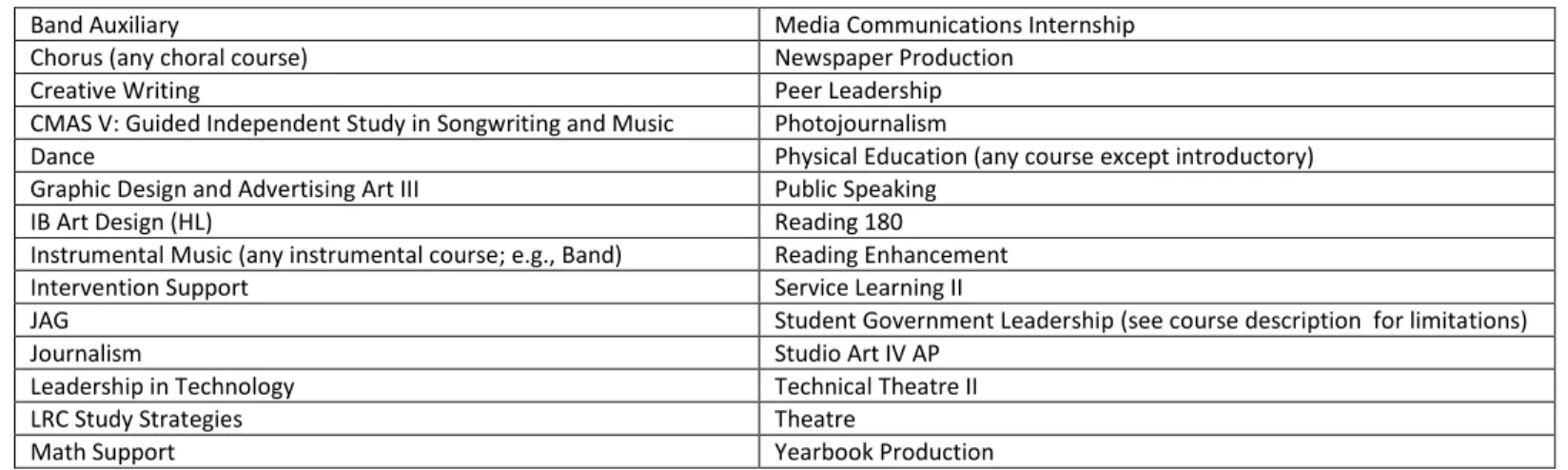
Repeating Courses for Credit
The following courses may be taken up to four times toward the graduation requirement if the course taken is the highest level offered. Level one courses may be repeated with supporting Special Education documentation.
Band Auxiliary Media Communications Internship
Chorus (any choral course) Newspaper Production
Creative Writing Peer Leadership
CMAS V: Guided Independent Study in Songwriting and Music Photojournalism
Dance Physical Education (any course except introductory)
Graphic Design and Advertising Art III Public Speaking
IB Art Design (HL) Reading 180
Instrumental Music (any instrumental course; e.g., Band) Reading Enhancement
Intervention Support Service Learning II
JAG Student Government Leadership (see course description for limitations)
Journalism Studio Art IV AP
Leadership in Technology Technical Theatre II
LRC Study Strategies Theatre
14
Revised: 7/21/2014SUSD Summer School
Scottsdale Unified School District offers a variety of courses during summer school, both online and in a traditional classroom setting.
Traditional Classroom Setting:
The fee for summer school credit is $185 per semester course (.5 credit). In the traditional classroom setting, courses typically offered in the fall during the school year are offered in June as a 3-week session, with students in attendance for 5 hours per day (science has extended hours for lab time). Spring courses are offered in the July summer school traditional classroom setting. Community Education oversees all summer school programming for high school students. Please visit www.susdcommunityed.orgfor more information.
Online Classroom Setting:
The fee for summer school credit is $185 per semester course (.5 credit). Online courses offer flexibility to students and do not require attendance on specific days and times. Attendance will be required for final exams in online courses and in some lab science courses. Specific details will be available on the Community Education website. Please refer to the Community Education Web site for schedules and class offerings at
www.susdcommunityed.org.
IMPORTANT:
Course selection is the responsibility of the student. No matter what type of summer school course is desired, (online or traditional setting), Community Education cannot advise or be held responsible for students who take the wrong course in Summer School. Four-year plans and graduation requirements should be discussed with a site guidance counselor and parent/guardian PRIOR to registration and enrollment in a summer course. Please visit the Community Education website for instructions on how to register and pay for Summer School courses.
Textbooks
As per ARS §15-723-5, “Governing Boards shall furnish free required textbooks and related printed subject matter materials in the high schools.” The textbooks must be returned at the end of a course, or the student must pay the replacement cost. Textbook fees may apply for Dual Enrollment courses.
Transfer Credits from Outside Summer School/Night School Programs
Credits may be accepted from accredited traditional (not online) summer and evening high schools. Site guidance counselors can provide additional information.
Transfer Students
Fractional course credit of less than .50 (one semester) will receive no credit. Fractional course credit of .66 or greater, transferred from other high schools, shall be evaluated and adjusted to the nearest half-credit. Three trimesters, two semesters, or the equivalent hourly course time will transfer as 1.0 credit to SUSD. The adjustment will always be made with the student’s best interest in mind. Upon presenting a transcript, students will be registered in the grade level indicated by the record in accordance with their cohort/graduation year.
Students entering with a record indicated by a Credit/No Credit format will show Pass/Fail on the Scottsdale transcript. Students entering with letter grades will receive those letter grades on the Scottsdale transcript. Credits and/or grades will be accepted as they appear on the student’s transcript. Numbers identifying courses that correspond to courses taken in a previous school will be used when possible. Transfer numbers for the various departments will be used when course descriptions do not match the course in our system.
To determine credits accepted by SUSD, international transfer students must provide the grades, number of hours per week and descriptions of the courses taken at previous schools. A translated transcript is preferred.
For courses taken outside of SUSD, credit will be given only as an elective credit if SUSD does not offer the course in either the class room, virtual learning lab, blended learning, eLearning, or SOL and it is identified by the student’s guidance counselor as a graduation requirement. However, if SUSD offers either the core or elective class, SUSD students are expected to take SUSD courses via one of the learning delivery methods mentioned above.
15
Revised: 7/21/2014SUSD e-Learning
Introduction
In order to better serve our students with a myriad of course offerings, Scottsdale Unified School District (SUSD) extends several valuable learning methods of delivery led by highly qualified teachers to guide rigorous, relevant instruction for our 21st Century learners. Our flourishing SUSD
eLearning programs have many benefits for our students:
Highly qualified, trained online SUSD teachers
College approved, award-winning online curriculum from Florida Virtual Schools (FLVS) matched with an extensive catalog of online course offerings : http://elearning.susd.org
Student-centered learning delivery options that meet the needs of various student populations, from high achieving students seeking more challenging courses via Advanced Placement College Board offerings to students struggling in the traditional classroom
Continued exceptional service from student’s home school counseling department and school administration
Individualized learning that enables students to learn at their own pace
Flexibility in time and place of learning
Online teacher’s capacity to create a personalized learning experience for each student
Parent and student orientation sessions
State-of-the-art learning management system (LMS)
SUSD technology support
Course Type
There are three different types of online courses offered in SUSD. It is important to understand what these course types are and how they are intended to be utilized.
eLearning Courses (eL) ELearning courses are available to all students currently enrolled in a traditional brick-and-mortar school in SUSD. ELearning courses are the online equivalent of a course that is offered in the traditional classroom. Not all classroom-based courses are available online and not all online courses are available in a traditional classroom setting (see course descriptions for more information). ELearning courses are eligible to be taken as repeat courses for grade and credit replacement. For example, if a student received a ‘C’ in 3110 English 1 and took 3110eL at a later time and received an ‘A’, the new grade of ‘A’ would be factored into the student’s GPA and the ‘C’ would not be a factor in the GPA calculation. The final exam in eL is proctored in a lab and must be taken in person. All students must pass with a minimum of 60% of their final exam in order to receive credit for the course. Two attempts at passing the final exam is the maximum allowed for any student in an eLearning course.
Credit Recovery Courses (CR) Credit Recovery courses are used to demonstrate mastery of a subject area at a minimal level. Students who take CR courses will take a pretest at the beginning of the course. The results will determine which modules (or sections) of the course the student must complete in order to have met the minimal standards for that particular course. Credit Recovery courses are only available to be taken by a student who has previously failed that same course. CR courses DO NOT count for grade replacement (repeat tags) on transcripts. CR courses are taken to replace the lost credit from the previous course, only. For example, if a student failed 4410 Algebra I with an ‘F’, that student could take 4410CR in the future and upon successful completion would be given the .5 credit that was lost when he/she failed 4410 the first time. The ‘F’ will remain as part of this student’s GPA and the grade for the CR course will not factor into the student’s GPA, but the .5 credit would be recovered and would count towards graduation. The final posttest in CR is proctored in a lab and must be taken in person. All students must pass their final posttest to receive credit for the course. Two attempts at passing the final posttest is the maximum allowed for any student in a credit recovery course.
Scottsdale Online Learning (SOL) SOL offers the same courses as eLearning. They are only available to be taken through Scottsdale Online Learning, which is SUSD’s Virtual High School. Students must be enrolled in SOL to take a course listed in the SOL catalog. For more information, please visit http://scottsdaleonlinelearning.org .
Course Selection
Course selection materials are distributed to students in the spring. Students will select and enroll in eLearning classes through their counseling department. For students new to the school, the registration process begins when the forms and supporting paperwork are complete. The student will then meet with a counselor for course selection and to develop a program for the coming year.
eLearning Assessments
Online courses utilize both formative and summative assessments. Formative assessments are known as discussion-based assessments (DBAs). DBAs are scheduled by teachers and their students on a regular basis after each learning module to check for student understanding. Via a scheduled appointment, online teachers utilize predetermined questions based on the learning objective to dialog one-on-one with each of their students to verify student learning. Teachers have the opportunity to modify and adjust instruction to meet the needs of individual learners so concepts can be learned. For summative assessments, final exams are utilized at the end of each course. All final exams are proctored on site to maintain academic integrity. A passing grade on the final exam of at least 60% must be achieved in order to receive credit. ELearning classes have one final exam, and credit recovery classes have two “posttests” that must both be proctored in the lab. The final may be taken a second time if it is failed on the first attempt. Two attempts is the maximum amount allowed to any student before an ‘F’ is recorded.
16
eLearning Curriculum
SUSD online learning programs are a Web-based curriculum in academic and elective content areas for students in grades 9-12. The curriculum is aligned with State and District standards as well as Arizona College and Career Ready Standards. The courses are taught by highly qualified Scottsdale teachers. SUSD eLearning is a form of education that focuses on independent study and individualized instruction for students. Students submit coursework and communicate with teachers online via Gradpoint, the Learning Management System (LMS). All final exams are proctored on site to maintain academic integrity. See course descriptions to select and enroll in courses.
eLearning Labs at School Sites
Each high school has at least one designated brick-and-mortar eLearning lab. The school site will work together with the Assistant Principal for Educational Services to determine availability of the lab. Seniors have an option to take the online classes at their homes or other off-campus locations if they are enrolled in at least four (4) brick-and-mortar classes at their home school site and have parental permission. In general, freshman, sophomore and junior students will remain on campus the entire school day.
Inactivity
Communication to parent/guardian should be made after 5 days of no activity. The online teacher will work very closely with the student, who will respond accordingly. Students may be dropped after 10 days of inactivity. The teacher will make contact once the student has reached 10 days of inactivity.
In cases of inactivity, eLearning will work closely with school administration to assure that every attempt has been made to communicate with the student and parent before any drop is made and to determine whether there is a valid reason for the inactivity, including, but not limited to, a qualified disability under Section 504 or the IDEA, a homelessness issue under McKinney Vento or other valid reason. If intervention attempts have failed and student continues inactivity, he/she will be dropped from his/her online class and returned to the brick-and-mortar setting by the counselor in collaboration with the school administration.
Length of eLearning Courses
Typically, courses take 12-18 weeks for most students to complete, although students are allowed to accelerate at their own pace. Students should commit to working at least 120 hours per regular online course and 75 hours for credit recovery courses to complete one-half credit.
NCAA Eligibility
All high school athletes who plan to enroll and compete as college freshmen in a Division I or II institution must complete the NCAA Initial Eligibility Clearinghouse Release form at the end of their Junior year. Students should check with their guidance counselor for specific information. Students are encouraged to check the ncaaclearinghouse.net site. An official transcript and standardized test scores (SAT/ACT) must be sent to the clearinghouse.
*Note: NCAA does not recognize eLearning as credit recovery. Students and/or parents should contact NCAA for specific information. .
HOW TO READ THE COURSE DESCRIPTIONS
COURSE TITLE (IB Only: SL = 1 Year Course HL = 2 Year Course) COURSE ID#
Where Course is Taught
Grade Level Course Length Credit Satisfies District Graduation Requirement
Satisfies AZ 4+ University Entrance Requirement A=Arcadia Ch=Chaparral Co= Coronado D=Desert Mt. S= Saguaro eL=eLearning All = All Brick/Mortar Schools
17
AVID
(Advancement via Individual Determination)
AVID, Advancement via Individual Determination, is a college readiness system that is designed to increase school wide learning and performance. The AVID system increases student learning and utilizes research-based methods of effective instruction to support student success and decrease the opportunity gap. AVID is a college preparatory elective course for students in grades 9 through 12 and is open to applicants who will be selected based on specific criteria and an interview. Once selected, students remain as a cohort group until graduation. The trained AVID teacher serves as the students’ advocate and provides social and academic support.
The purpose of AVID is to provide students with skills to help them succeed academically. The AVID elective is academically focused, encourages students to enroll in rigorous coursework and has an enduring academic and social support network. The course is designed to follow a weekly structure that includes teacher led academic instruction and tutorial support from teachers and college students. Writing, Inquiry, Collaboration, Organization and Reading, combined with the use of higher order thinking skills, help students learn content specific curriculum. Study skills, note taking (Cornell note-taking model), and college/career exploration are examples of the areas explored by AVID which help to prepare students for more rigorous academic courses. Small group tutorials, facilitated by trained tutors, take place twice weekly in small groups. In addition, guest speakers and college visits are an integral component of AVID.
While AVID serves all students, the system focuses on students in the academic middle who have the desire to go to college and demonstrate the willingness to work hard. This course is open to applicants who are identified based on specific criteria and should meet ONE of the following criteria: (1) student has 2.0-3.5 GPA, (2) student has been identified as having potential for more rigorous courses, but has not been able to achieve success, (3) student is “under-represented” in the college arena, (4) student is considered first in their family to either attend and/or graduate college, or (5) student comes from a single parent family and/or is considered financially disadvantaged. Exceptions are determined on a case by case basis. Contact the school’s AVID Site Coordinator or your counselor if interested in applying.
AVID (Advancement via Individual Determination)
3056-3057 (Sr) 3054-3055 (J) 3052-3053 (So) 3050-3051 (F)
A, Co, S F, So, J, Sr 2 sem 1.0 Y N
The purpose of this course is to provide students with skills to help them succeed in rigorous college preparatory classes. AVID is an elective course for grade 9 through 12 with grade-specific curriculum. AVID has a strong academic focus, requires students to enroll in rigorous coursework, and has an enduring academic and social support network. Tutoring takes place in the AVID class at least two times weekly. Study skills, note-taking (Cornell note-taking model), test taking/preparation skills (SAT/ACT) and college/career exploration are examples of the areas covered by AVID. The trained AVID teacher serves as the student’s advocate and provides social and academic support.
This course is open to applicants who will be selected based on specific criteria and an interview. Once selected, students remain as a cohort group until graduation. Contact your AVID counselor if interested in applying for this elective class.
18
Career and Technical Education (CTE)
CTE and Career Clusters
Career and Technical Education (CTE) has a long and rich history in the United States. Today’s CTE has evolved from a limited number of vocational programs available at the turn of the 20th century into a broad system that encompasses a variety of challenging fields in diverse subject areas which are constantly evolving due to the changing global economy.
Today’s CTE provides students:
academic subject matter taught with relevance to the real world.
employability skills, from job-related skills to workplace ethics.
career pathways that link secondary and postsecondary education.
education for additional training and degrees, especially related to workplace training, skills upgrades and career advancement.
Technological advances and global competition have transformed the nature of work. The careers of the future will require a highly skilled, educated, and flexible workforce. Tomorrow's leaders must be prepared to continually update their knowledge and skills. To prepare today's students for the new global economy, SUSD CTE courses provide students with opportunities to engage in learning activities that teach academic and 21st Century
Skills standards taught through relevant project based learning tasks using current industry standard technology.
Students may enroll in CTE courses at their home campus, other SUSD campuses, or at the East Valley Institute of Technology (EVIT). Below is a list of the nine career clusters offered at SUSD through CTE programs.
Communications Media Technologies Film and Video
Graphic /Web Design/Advertising Art Music and Audio Production (CMAS,Tech Theatre)
Health Science Health Care Assistant/ Nursing
Sports Medicine and Rehabilitation
Information Technology Gaming Software Development Computer Repair
Design and Merchandising Interior Design
Hospitality and Tourism Hospitality Management Culinary Arts
Marketing Professional Sales and Marketing Sports and Entertainment Marketing Finance
Financial Services (Business 101/102)
Human Services Early Childhood Education
Science, Technology, Engineering and Mathematics (STEM)
Biotechnology Engineering
CTE COURSE DESCRIPTIONS
FEES:
· All of the courses taken as “dual enrollment” involve a fee for college credit.
· Career and Technical Education (CTE) dual enrolled students will have a fee for college credit and textbooks. CAREER AND TECHNICAL EDUCATION (CTE) FEES
6930-6943 CMAS I, II,III, IV, V $30 per year 9174-9179 Health Care Assistant (Nursing Services)
$100 per year
7822-7823 Culinary I $25/semester
7824-7825 Culinary II $25/semester 9490-9491 Hospitality/Tourism Mgmt. I $15 per year 9274-9279 Engineering Design I/Drafting $10 per year 7846-7847 Interior Design/Merchandising I $15 per year 9266-9299 Engineering Design II $10 per year 6900-6901 Technical Theatre I $20 per year 9240-9245 Graphic Design/Advertising Art I $35 per year 6902-6903 Technical Theatre II $20 per year 9250-9255 Graphic Design/Advertising Art II $35 per year