Copyright © 2014 Oracle and/or its affiliates. All rights reserved. |
Common
Anti
‐
Patterns
for
Optimizing
Big
Data
Oracle
Databases
Vlado
Barun
Real
World
Performance
Team
March
19
th
,
2015
Copyright © 2015, Oracle and/or its affiliates. All rights reserved. |
Safe
Harbor
Statement
The following is intended to outline our general product direction. It is intended for
information purposes only, and may not be incorporated into any contract. It is not a
commitment to deliver any material, code, or functionality, and should not be relied upon
in making purchasing decisions. The development, release, and timing of any features or
functionality described for Oracle’s products remains at the sole discretion of Oracle.
Copyright © 2015, Oracle and/or its affiliates. All rights reserved. |
Agenda
Is
this
session
for
YOU?
About
the
Real
World
Performance
Team
Your
mission,
should
you
choose
to
accept
it
…
Use
of
Weapons
Solution
(or
How
to
use
a
Model
S
P85D
to
pickup
groceries)
3
takeaways
for
achieving
Extreme
Performance
1
2
3
4
5
4
Copyright © 2015, Oracle and/or its affiliates. All rights reserved. |
Agenda
Is
this
session
for
YOU?
About
the
Real
World
Performance
Team
Your
mission,
should
you
choose
to
accept
it
…
Use
of
Weapons
Solution
(or
How
to
use
a
Model
S
P85D
to
pickup
groceries)
3
takeaways
for
achieving
Extreme
Performance
1
2
3
4
5
5
Copyright © 2015, Oracle and/or its affiliates. All rights reserved. |
Anti
‐
Patterns
An
anti
‐
pattern
(or
antipattern)
is
a
common
response
to
a
recurring
problem
that
is
usually
ineffective
and
risks
being
highly
counterproductive.
Copyright © 2015, Oracle and/or its affiliates. All rights reserved. |
•
Design/Develop/Operate
Decision
support
systems
(i.e.
Data
Warehouse/Mart,
Big
Data,…)
•
Require
orders
of
magnitude
(10x,
100x,
1000x)
improvements
•
Prefer
an
Interactive
Session
•
Reproduce
in
your
own
environment
Is
this
session
for
YOU?
•
Expect
flashy,
cool
looking
slides
•
Interested
only
in
OLTP
•
Need
just
a
few
%
point
improvements
(i.e.
20%)
Copyright © 2015, Oracle and/or its affiliates. All rights reserved. |
Agenda
Is
this
session
for
YOU?
About
the
Real
World
Performance
Team
Your
mission,
should
you
choose
to
accept
it
…
Use
of
Weapons
Solution
(or
How
to
use
a
Model
S
P85D
to
pickup
groceries)
3
takeaways
for
achieving
Extreme
Performance
1
2
3
4
5
8
Copyright © 2015, Oracle and/or its affiliates. All rights reserved. |
Real
‐
World
Performance
•
Part
of
the
Database
Development
Organization
•
Global
Team
located
in
USA,
Europe,
Asia
•
300+
combined
years
of
Oracle
database
experience
•
Innovate
to
achieve
exceptional
Database
Performance
•
Our
methods:
•
Use
the
product
as
it
was
designed
to
be
used
•
Numerical
and
logical
debugging
techniques
•
Educate
others
about
the
best
performance
methods
and
techniques
•
Avoid
and
eliminate
“tuning”
by
hacking/guessing/luck
Copyright © 2014, Oracle and/or its affiliates. All rights reserved. |
One
Day
Real
‐
World
Performance
Road
Show
Copyright © 2015, Oracle and/or its affiliates. All rights reserved. |
Real
‐
World
Performance
Tour
in
Association
with
IOUG
•
Europe 2015
–
Feb 13th Norway
–
Mar 17th Slovenia/Croatia
–
Mar 19th Great Britain
–
Mar 23rd Denmark
–
Mar 25th Austria
–
Mar 27th Turkey
•
USA—TBD
•
ASIA
–
May 20th Beijing
–
May 22th Shangai
•
South America—TBD
4/7/2015Copyright © 2015, Oracle and/or its affiliates. All rights reserved. |
Real
‐
World
Performance
•
Real
‐
World
Performance
Engineers
discussing
and
demonstrating
performance
issues,
root
causes
and
when
to
apply
the
correct
techniques
–
The Optimizer
–
Core DB Performance
–
Extreme OLTP
–
Extreme DW
•
http://www.oracle.com/goto/oll/rwp
4/7/2015
Copyright © 2014, Oracle and/or its affiliates. All rights reserved. |
Real
‐
World
Performance
Training
Copyright © 2014, Oracle and/or its affiliates. All rights reserved. |
Real
‐
World
Performance
Classroom
Training
•
4
Day
Class
of
Intensive
Performance
Training
–
Topics: The Optimizer, Core DB Performance, Extreme OLTP and DW
–
Classroom, Demos, Hands On, Test and Quizzes
–
Training given by Real‐World Performance Engineers
–
Designed for Architects, Developers and DBAs
–
4 months training in 4 days
•
Contact
RWP
or
your
local
Oracle
team
to
apply
4/7/2015
Copyright © 2015, Oracle and/or its affiliates. All rights reserved. |
Agenda
Is
this
session
for
YOU?
About
the
Real
World
Performance
Team
Your
mission,
should
you
choose
to
accept
it
…
Use
of
Weapons
Solution
(or
How
to
use
a
Model
S
P85D
to
pickup
groceries)
3
takeaways
for
achieving
Extreme
Performance
1
2
3
4
5
15
Copyright © 2015, Oracle and/or its affiliates. All rights reserved. |
Your
mission,
should
you
choose
to
accept
it
…
•
Current
environment
does
not
meet
SLAs
•
Business
expects
data
volume
to
increase
drastically
in
the
future
•
Legacy
application
and
DB
migrated
to
new
powerful
hardware
but
performance/scalability
goals
have
not
been
reached
•
Business
expects
1000x
better
performance
for
a
mission
‐
critical
BI
process
Copyright © 2015, Oracle and/or its affiliates. All rights reserved. |
BI
process
details
•
Identifies
the
most
valuable
customers
for
each
month
•
Currently
the
process
takes
about
26
minutes
•
Implemented
in
Java,
data
in
Oracle
12.1.0.2
on
Exadata x3
‐
8
Copyright © 2015, Oracle and/or its affiliates. All rights reserved. |
ERD
1,500,000 rows
Copyright © 2015, Oracle and/or its affiliates. All rights reserved. |
Agenda
Is
this
session
for
YOU?
About
the
Real
World
Performance
Team
Your
mission,
should
you
choose
to
accept
it
…
Use
of
Weapons
Solution
(or
How
to
use
a
Model
S
P85D
to
pickup
groceries)
3
takeaways
for
achieving
Extreme
Performance
1
2
3
4
5
19
Copyright © 2015, Oracle and/or its affiliates. All rights reserved. |
Use
of
Weapons
Set
‐
based
processing
Dynamic
Sampling
Attribute
Clustering
SQL
Profiles
Instance
parameters
Hash
Clusters
PL/SQL
Native
compilation
In
‐
Memory
Column
Store
Which
tool(s)
to
choose
???
In
‐
Memory
Column
Store
Copyright © 2015, Oracle and/or its affiliates. All rights reserved. |
Agenda
Is
this
session
for
YOU?
About
the
Real
World
Performance
Team
Your
mission,
should
you
choose
to
accept
it
…
Use
of
Weapons
Solution
(or
How
to
use
a
Model
S
P85D
to
pickup
groceries)
3
takeaways
for
achieving
Extreme
Performance
1
2
3
4
5
21
Copyright © 2015, Oracle and/or its affiliates. All rights reserved. |
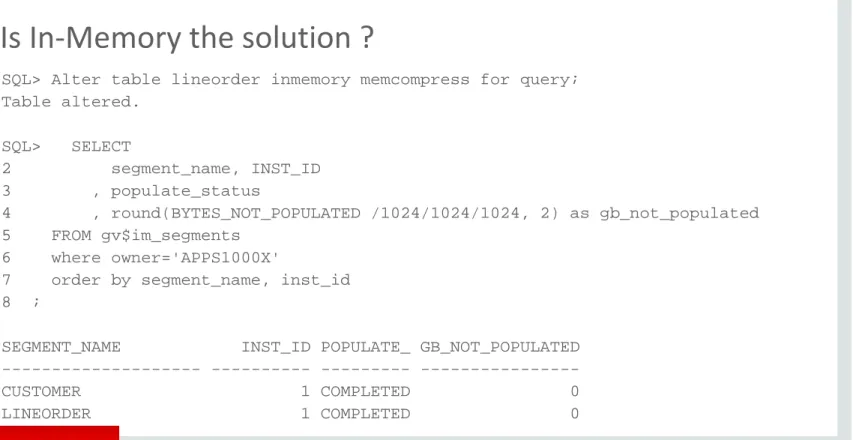
Is
In
‐
Memory
the
solution
?
SQL> Alter table lineorder inmemory memcompress for query;
Table altered.
SQL> SELECT
2 segment_name, INST_ID
3 , populate_status
4 , round(BYTES_NOT_POPULATED /1024/1024/1024, 2) as gb_not_populated
5 FROM gv$im_segments
6 where owner='APPS1000X'
7 order by segment_name, inst_id
8 ;
SEGMENT_NAME INST_ID POPULATE_ GB_NOT_POPULATED
---- --- ---
---CUSTOMER 1 COMPLETED 0
LINEORDER 1 COMPLETED 0
Copyright © 2015, Oracle and/or its affiliates. All rights reserved. |
Use
of
Weapons
– trial
#2
Set
‐
based
processing
Dynamic
Sampling
Attribute
Clustering
SQL
Profiles
Instance
parameters
Hash
Clusters
PL/SQL
Native
compilation
Storage
Indexes
In
‐
Memory
Column
Store
Which
tool(s)
to
try
next???
Copyright © 2015, Oracle and/or its affiliates. All rights reserved. |
Anti
‐
Pattern
#1
‐
Trial
and
Error
approach
•
Time
consuming
•
Relies
on
luck
•
Limits
understanding
of
the
root
cause
of
a
performance
bottleneck
Copyright © 2015, Oracle and/or its affiliates. All rights reserved. |
Look
before
you
leap
The
universal
experience
of
programmers
who
have
been
using
measurement
tools
has
been
that
their
intuitive
guesses
fail.
Copyright © 2015, Oracle and/or its affiliates. All rights reserved. |
Copyright © 2015, Oracle and/or its affiliates. All rights reserved. |
Look
before
you
Leap
•
Notice
elapsed
time
>>
db
time
•
Notice
db
cpu >>
sql execution
elapsed
time
•
Notice
sum
of
all
sql times
<<
db
cpu
Copyright © 2015, Oracle and/or its affiliates. All rights reserved. |
Where
is
the
missing
time?!
•
java
process
OS
stats
$ time java demo
4.608u 2.780s 26:08.47 0.4%
•
If
50%
time
is
not
spend
in
the
App
nor
in
the
database,
where
is
it?
•
What
is
between
the
App
and
the
DB?
Copyright © 2015, Oracle and/or its affiliates. All rights reserved. |
Anti
‐
Pattern
#2
– Stay
inside
your
Comfort
Zone
•
Don’t
choose
your
tool
solely
based
on
what
you
are
comfortable
with,
or
what
is
currently
in
vogue,
…
•
Choose
the
tool
that
can
achieve
the
goal
•
When
processing
large
amounts
of
data,
move
the
processing
close
to
the
Copyright © 2015, Oracle and/or its affiliates. All rights reserved. |
Eliminate
the
bottleneck
– network
round
‐
trips
One way to eliminate network round‐trips is to move the data processing logic into the
database, i.e. using PL/SQL.
Copyright © 2015, Oracle and/or its affiliates. All rights reserved. |
Eliminate
the
bottleneck
‐
network
round
‐
trips
SQL>create or replace procedure find_high_value_customers as
2 revenue_total cust_agg.revenue_total%type;
3 begin
4
5 execute immediate 'truncate table cust_agg';
6
7 for c in (select c_custkey, c_name
from customer)
8 loop
9 revenue_total := 0;
10
11 for lo in ( select lo_revenue
12 from lineorder
13 where lo_orderdate between date'1996-12-01' and date'1996-12-31'
14 and lo_custkey = c.c_custkey)
15 loop
16 revenue_total := revenue_total + lo.lo_revenue;
17 end loop;
18
19 insert into cust_agg (custkey, revenue_total) values (c.c_custkey,revenue_total);
20 end loop;
21
22 delete cust_agg where revenue_total < 200000000;
23 commit;
24
25 end;
26 /
Procedure created.
Copyright © 2015, Oracle and/or its affiliates. All rights reserved. |
Copyright © 2015, Oracle and/or its affiliates. All rights reserved. |
Why
did
the
performance
improve?
•
AWR
–
elapsed
time
≈
db
time
–
db
cpu
≈
sql execution
elapsed
time
–
sum
of
all
sql times
≈
db
cpu
–
Pl/sql time
≈
21%
of
baseline
+
≈
70%
of
missing
time
(network
round
trips)
–
SQL*Net
roundtrips
to/from
client
reduced
from
about
3,300,000
to
287
–
Network
traffic
reduced
from
514
MB
to
0.3MB
(330KB)
–
Not
about
Java
vs PL/SQL,
or
App
vs DB
–
Use
the
tool
that
can
achieve
the
goal
Copyright © 2015, Oracle and/or its affiliates. All rights reserved. |
Copyright © 2015, Oracle and/or its affiliates. All rights reserved. |
Anti
‐
Pattern
#3
– Throw
Hardware
at
it
•
Use
Faster
CPUs?
–
Intel® Xeon® E7‐8870 (2.40 GHz)
–
384 GFLOPs
•
More
CPUs
Theory
Practice
Cor
e
Coun
t
Throughput
Copyright © 2015, Oracle and/or its affiliates. All rights reserved. |
Identify
the
bottleneck
•
What is the alternative?
Copyright © 2015, Oracle and/or its affiliates. All rights reserved. |
Anti
‐
Pattern
#4
– Looking
only
at
the
tree…
•
Miss
the
forest
for
the
trees
•
Row
‐
by
‐
row
processing
=
Slow
‐
by
‐
slow
processing
•
How
to
use
a
Tesla
Model
S
P85D
to
pickup
groceries
•
Applying
OLTP
specific
algorithms
to
Big
Data
Systems
Copyright © 2015, Oracle and/or its affiliates. All rights reserved. |
Eliminate
the
bottleneck
– row
‐
by
‐
row
processing
•
Replace row‐by‐row with set‐based processing
•
Just tell the database what data you want, not how to get to it !
select lo_custkey, sum(lo_revenue)
from lineorder a
where lo_orderdate between date'1996-12-01' and date'1996-12-31'
group by lo_custkey
having sum(lo_revenue) >= 200000000
;
Copyright © 2015, Oracle and/or its affiliates. All rights reserved. |
Copyright © 2015, Oracle and/or its affiliates. All rights reserved. |
Results
Comparison
(Elapsed
seconds)
1561
343
8
2
1
1
0
200
400
600
800
1000
1200
1400
1600
1800
Row‐by‐row
(outside of DB)
Row‐by‐row
(in DB)
Set Based
Set Based
(w/Part.)
Set Based
(w/Part. & IMC)
Set Based
(w/IO & Exadata)
405x
781x
1561x
1561x
195x
No
use
of
DB
Options,
just
plain
Features
(free)
No
use
of
extra
Exadata features,
no
PX,
etc.
No
IO
!!
Is
Disk
faster
then
Memory
?!
80x
more
data
to
process,
all
from
Disk,
Copyright © 2015, Oracle and/or its affiliates. All rights reserved. |
Copyright © 2015, Oracle and/or its affiliates. All rights reserved. |
Use
of
Weapons
Set
‐
based
processing
Dynamic
Sampling
Attribute
Clustering
SQL
Profiles
Instance
parameters
Hash
Clusters
PL/SQL
Native
compilation
Storage
Indexes
In
‐
Memory
Column
Store
Copyright © 2015, Oracle and/or its affiliates. All rights reserved. |
Performance
Acceleration
Performance
Foundation
Convergence
of
Techniques
and
Technology
Real
World
Performance
Partitioning
Statistics
Optimizer
Environment
Application
Algorithms
Data
Types
Constraints
Schema
Design
Exadata
Database In‐
Memory
Bloom Filters
Parallel Execution
Clustering
In‐Memory
Aggregation
Star
Transformation
Compression
Copyright © 2015, Oracle and/or its affiliates. All rights reserved. |
Where
is
the
biggest
bang
for
the
buck
(ROI)?
1561
343
8
2
1
1
0
200
400
600
800
1000
1200
1400
1600
1800
Row‐by‐row
(outside of DB)
Row‐by‐row
(in DB)
Set Based
Set Based
(w/Part.)
Set Based
(w/Part. & IMC)
Set Based
(w/IO & Exadata)
445x
781x
1561x
1561x
195x
Copyright © 2015, Oracle and/or its affiliates. All rights reserved. |
Agenda
Is
this
session
for
YOU?
About
the
Real
World
Performance
Team
Your
mission,
should
you
choose
to
accept
it
…
Use
of
Weapons
Solution
(or
How
to
use
a
Model
S
P85D
to
pickup
groceries)
3
takeaways
for
achieving
Extreme
Performance
1
2
3
4
5
45
Copyright © 2015, Oracle and/or its affiliates. All rights reserved. |
1.
Look
before
you
leap
It
is
a
capital
mistake
to
theorize
before
one
has
data.
Insensibly
one
begins
to
twist
facts
to
suit
theories,
instead
of
theories
to
suit
facts.
―
Sherlock
Holmes,
“The
Adventures
of
Sherlock
Holmes”
Copyright © 2015, Oracle and/or its affiliates. All rights reserved. | 4/7/2015
The
truth
is
out
there*
•
EM
•
EM
Express
Performance
Hub
•
AWR
•
ADDM
•
ASH
•
SQL
Monitor
•
SQL
Trace
•
SQL
Compiler
Trace
•
SQL
Test
Case
Builder
•
SQLTXPLAN
•
SQLD360
Copyright © 2015, Oracle and/or its affiliates. All rights reserved. |
The database is not being used as it
was designed to be used
4/7/2015
The application architecture/code
design is suboptimal
There is a suboptimal algorithm in
the database
Copyright © 2015, Oracle and/or its affiliates. All rights reserved. | Oracle Confidential – Internal/Restricted/Highly Restricted 49
Convergence
of
Techniques
and
Technology
3.
Extreme
Performance
is
multi
‐
faceted
Constraints
Data Types
Statistics
Optimizer Env.
Partitioning
Schema design
Parallel query
Bloom Filters
Clustering
Exadata
In‐Memory
Access method
App Algorithm
Copyright © 2015, Oracle and/or its affiliates. All rights reserved. |
Recent
Results
1000X
Projects
Baseline:
~ 4.3 Hours
Code Changes:
4.3 Hours
Correct Usage:
29 secs
Bug Fixes:
11.5 secs
Final:
11.5 secs
Speed up:
1346x
Baseline:
~ 2.4 Days
Code Changes:
27 Mins
Correct Usage: 7.5 Mins
Bug Fixes: 3 Mins 27 Secs
Final:
3 Mins 27 Secs
Speed up:
1002x
Baseline:
4.06 hours
Code Changes:
3.65 Secs
Correct Usage:
3.65 Secs
Bug Fixes:
3.65 Secs
Final:
3.65 Secs
Speed up:
4007x
Copyright © 2015, Oracle and/or its affiliates. All rights reserved. |