Comparison of Texas Prescriptive Authority Law for APRNs
Before and After November 1, 2013
Lynda Woolbert, MSN, RN, CPNP-PC, FAANP
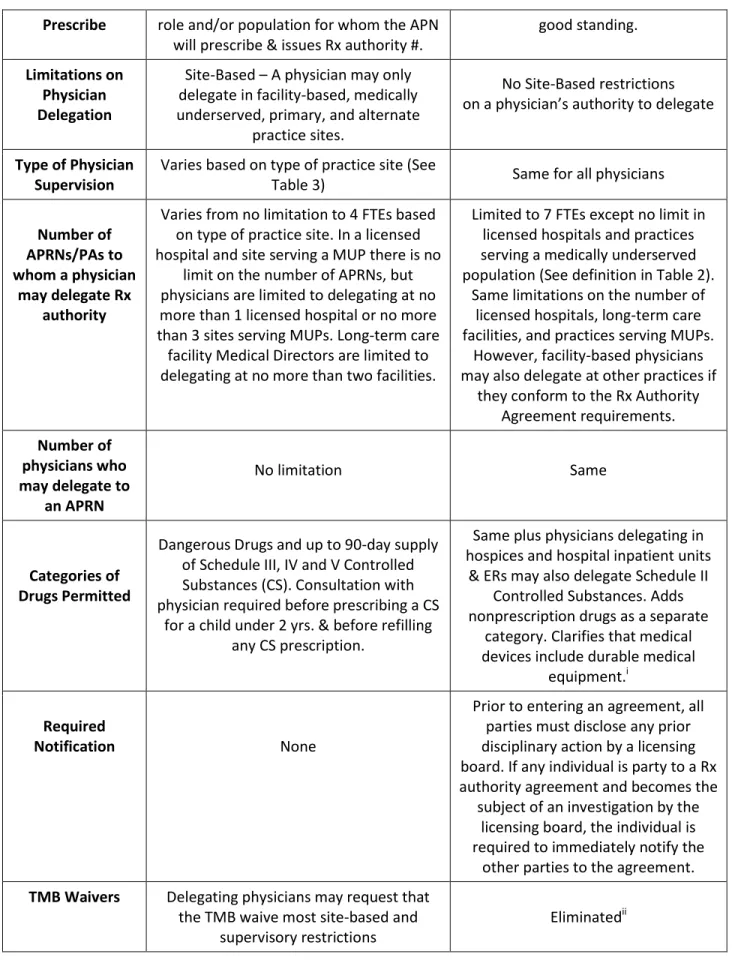
SB 406 is the new prescriptive authority law governing delegation of prescriptive authority to Advanced Practice Registered Nurses (APRNs) and Physician Assistants in Texas. The law goes into effect on November 1, 2013. Before November 1, 2013, physicians who delegate prescriptive authority and APRNs who have delegated prescriptive authority must practice under the current site-based restrictions. Table 1 outlines the general differences between current law and delegated prescriptive authority as it will exist under the provisions in S.B. 406. Table 2 outlines the differences in the definitions for practice sites, and Table 3 outlines differences in physician supervision and quality assurance requirements. Table 4 notes the elements that must be included in the written documents required for delegated prescriptive authority before and after November 1st.
Abbreviations
BON – Texas Board of Nursing MUP – Medically Underserved Population CS – Controlled Substance QAI – Quality Assurance and Improvement DO – Doctor of Osteopathy RN – Registered Nurse
MD – Doctor of Medicine Rx – Prescriptive TMB – Texas Medical Board
TABLE 1: General Differences in Prescriptive Authority Law before and after Implementing SB 406
Before November 1, 2013
November 1, 2013 and After
Umbrella Term Advanced Practice Nurse (APN) Advanced Practice Registered Nurse(APRN) Regulatory
Agency for APRNs
BON authorizes RNs to practice as a NP, CNS, CRNA or CNM and issues prescriptive
authority numbers
BON licenses RNs to practice as a NP, CNS, CRNA or CNM and issues prescriptive authority numbers
Type of Prescriptive
Authority
Delegated – A physician must complete the TMB online Prescriptive Delegation Registration form before APN may “carry
out or sign a prescription drug order.”
Delegated – A physician must complete the TMB online Prescriptive
Delegation Registration form before APRN may “prescribe or order a drug
or device.” (Except for physicians delegating to CRNAs ordering drugs
and devices necessary to deliver anesthesia and related services.) Written
Document Required
Protocol
Prescriptive Authority Agreement (except in facility-based practices, or
CRNAs functioning under §157.058, Medical Practice Act. See Table 4) Physicians who
may Delegate Rx Authority
MD or DO with an unrestricted Texas Medical License
Same
Eligibility Requirements for
APRNs to
Based on meeting eligibility requirements in BON Rule 222.2, BON approves APN’s
Rx authority application for each APRN
Same plus statutory requirements for the APRN to be licensed in Texas in
Rx Law 2013_L. Woolbert Page 2 Prescribe role and/or population for whom the APN
will prescribe & issues Rx authority #.
good standing. Limitations on
Physician Delegation
Site-Based – A physician may only delegate in facility-based, medically underserved, primary, and alternate
practice sites.
No Site-Based restrictions on a physician’s authority to delegate
Type of Physician Supervision
Varies based on type of practice site (See
Table 3) Same for all physicians Number of
APRNs/PAs to whom a physician
may delegate Rx authority
Varies from no limitation to 4 FTEs based on type of practice site. In a licensed hospital and site serving a MUP there is no
limit on the number of APRNs, but physicians are limited to delegating at no more than 1 licensed hospital or no more than 3 sites serving MUPs. Long-term care
facility Medical Directors are limited to delegating at no more than two facilities.
Limited to 7 FTEs except no limit in licensed hospitals and practices serving a medically underserved population (See definition in Table 2).
Same limitations on the number of licensed hospitals, long-term care facilities, and practices serving MUPs.
However, facility-based physicians may also delegate at other practices if
they conform to the Rx Authority Agreement requirements. Number of
physicians who may delegate to
an APRN
No limitation Same
Categories of Drugs Permitted
Dangerous Drugs and up to 90-day supply of Schedule III, IV and V Controlled Substances (CS). Consultation with physician required before prescribing a CS
for a child under 2 yrs. & before refilling any CS prescription.
Same plus physicians delegating in hospices and hospital inpatient units
& ERs may also delegate Schedule II Controlled Substances. Adds nonprescription drugs as a separate
category. Clarifies that medical devices include durable medical
equipment.i Required
Notification None
Prior to entering an agreement, all parties must disclose any prior disciplinary action by a licensing board. If any individual is party to a Rx authority agreement and becomes the
subject of an investigation by the licensing board, the individual is required to immediately notify the
other parties to the agreement. TMB Waivers Delegating physicians may request that
the TMB waive most site-based and supervisory restrictions
Rx Law 2013_L. Woolbert Page 3
TABLE 2: Differences in Practice Site Definitions
Type of Site
Before November 1, 2013
November 1, 2013 and After
Site Serving a Medically Underserved
Population
Includes practices located in federally or state designated medically underserved areas (MUAs) and Health Professional Shortage Areas (HPSAs), Rural Health Clinics,
Federally Qualified Health Centers, public health & family planning clinics under contract with the state, and a site the Department of Health designates as serving a disproportionate number of clients eligible
for publically funded health care programs.
Changes the term to “Practice Serving a Medically Underserved
Population.” Adds county, state, or federal correctional facilities. Eliminates practices in MUAs unless they were designated as a
site serving a medically underserved population prior to
March 1, 2013.iii
Facility-Based (FB)
Licensed hospital where the delegating physician is the medical director, Chief of
Medical Staff, Chair of the Credentialing Committee, Department Chair, or a physician who consents to the request of
the Medical Director or Chief of Staff; or a long-term care facility where the physician
is the Medical Director
Same except a hospital FB practice
excludes free-standing clinics,
centers & practices. Physicians delegating in those facility-owned settings delegate to no more than
7 APRN/PA FTEs. Clarifies that one or more of the
following may delegate Rx authority in hospitals: Medical Director, Chief of Medical Staff, Credentialing Committee Chair, Department Chair, or physicians who consent to the request of the
Medical Director or Chief of Staff.
Primary Practice
Patients with whom the physician has or will establish a physician-patient relationship,
and includes any of the following: 1. practice location at which the physician spends the majority of his/her time; 2. a licensed hospital, long-term care facility or adult care center where both the
physician and APRN practice; 3. a public school-based clinic;
4. the residence of an established patient; 5. any location where the physician is physically present with the APRN; or 6. if the APRN practices on site with the physician more than 50% of the time, a clinic for established patients, a voluntary charity clinic, or a voluntary clinic during a declared disaster.
Eliminated
(APRNs in these practice sites may prescribe but it is based on having
a Prescriptive Authority Agreement (PAA), not on practicing in a particular site.)
Alternate Practice
A practice offering services similar to those provided at the delegating physician’s primary site & located within 75 miles of the
physician’s residence or practice.
Eliminated (APRNs in these sites may prescribe based on having a PAA.)
Rx Law 2013_L. Woolbert Page 4 TABLE 3: Differences in Physician Supervision and Quality Assurance Requirements
Type of Site Before November 1, 2013 November 1, 2013 and After Physician
Supervision Requirements applying to all practice sites
Supervision must conform to what a reasonable, prudent physician would find consistent with sound medical judgment; May vary based upon the APRN’s education
and experience; and
Must be continuous, but the physician’s constant physical presence is not required.
TMB Rules not yet proposed, but language is likely to be similar.
Facility-Based Same as above and in accordance with medical staff bylaws, policies or guidelines.
Same as above and in accordance with medical staff bylaws, policies
or guidelines. Site Serving a
Medically Underserved
Population
Physician on-site once every 10 business days the APN or PA is on-site. Maintain a log of patients discussed during
daily status reports and a summary of physician activities while on-site.
Standardizes physician supervision and quality assurance requirements in all other practices. Physician Supervision: Same as above
Quality Assurance:
1) Chart review – Number of charts determined by physician & APRN. 2) Document monthly meetings between APRN and physician to discuss patient care improvement, patient treatment, changes in patient care plans & patient referrals.
3) Frequency of meetings – For APRNs who have exercised Rx authority in 5 of the last 7 years, face-to-face once a month for 1 year, then face-to-face once every 3 months with monthly meetings between by electronic means. For APRNs with less Rx experience, monthly face-to-face meetings for 3 years, then face-to-face once every 3 months with electronic monthly meetings between. 4) Location of face-to-face meetings determined by APRN & physician.
Primary Practice
Same as for all sites.
If APN and physician are not in the same site as least 50% of the time, maintain a log of patients discussed during daily status reports, and a summary of physician activities while on-site.
Alternate Practice
Physician on site with the APN at least 10% of the hours of operation the PA or APN is
acting with Rx authority. Available through telecommunication. Physician randomly reviews 10% of charts. Maintain a log of patients discussed during
daily status reports and a summary of physician activities while on-site.
Rx Law 2013_L. Woolbert Page 5 TABLE 4: Requirements for Documents to Delegate Prescriptive Authority
Before November 1, 2013
November 1, 2013 and After
Document Name Protocol, physician’s orders,standing medical orders, standing delegation orders
Prescriptive Authority Agreement (PAA) In a facility-based practice, may use PAA or delegation is under a physician’s order, standing medical order, or standing
delegation order or other order or protocol in accordance with facility medical staff bylaws & policies.
Elements of Written Document Required by Statute or Rule.
1) Medical acts physician delegates 2) Categories of dangerous drugs and CSs the APN may or may not prescribe
4) Limitations on dosage units and refills
5) Limitations on generic substitution
6) Instructions to patient for follow-up
1) Name, address and all professional license numbers of parties to agreement
2) Nature of practice, practice locations, or practice settings
3) Types or categories of drugs or devices the APRN may or may not prescribe 4) General plan for consultation & referral 5) Plan to address patient emergencies 6) General process for communicating information between the APRN & physician 7) May designate alternate physicians assuming QAI & supervisory duties on a temporary basis (not mandatory)
8) Describe a prescriptive authority QAI plan, specifying methods to document plan implementation. At a minimum the QAI plan must include a chart review (number of charts determined by physician & APRN) and nature & frequency of the meetings
required in statute (see Table 3). Document
Retention
TMB Rule required physician to retain documents forever.
Physician and APRN must retain
documentation for 2 years from the date the agreement is terminated.
Document Review Review annually, sign and date Same
i
The definition of “dangerous drug” in Texas law includes prescription drugs that are not controlled substances and medical devices. Therefore, APRNs with prescriptive authority have always been able to prescribe medical devices. However, there was confusion regarding the authority of APRNs to order durable medical equipment. Therefore, SB 406 includes the term “device” and defines it to include “durable medical equipment.”
ii
The provision permitting physicians to request waivers for most site-based and supervisory requirements was repealed because most site-based requirements were repealed.
iii
The “medically underserved” designation was retained in SB 406 in order to continue not limiting the number of APRNs to whom one physician could delegate prescriptive authority in these sites. Even though the definition no longer includes practices located in MUAs, all practices that were designated as a site serving a medically underserved population prior to March 1, 2013, will continue to have no physician to APRN ratio for purposes of delegating prescriptive authority in those sites.