Developing a Novel and Facile Method for DNA Isolation from Passive Drool
and Oral Swab Samples
Caroline Peckels
Eric A. Hodges, PhD, FNP-BC
University of North Carolina- Chapel Hill
Abstract
In 2011, the National Institute of Nursing Research (NINR) held a meeting to develop a five year
strategic plan for advancing nursing research in order to help current and future health care
needs. At its core, the NINR’s purpose is to improve the health of individuals, families, and
communities by funding research projects that focus on new health care initiatives. One novel
and noninvasive way of studying genomic contributions to different health conditions is through
the use of saliva. In addition to secretions and proteins, saliva also contains essential biomarkers,
steroid hormones, antibodies, enzymes, and genetic material that allow researchers to explore
deeper into different diseases and conditions. Surprisingly, these salivary sample biomarkers
have not been significantly explored until the early 2000s. Due to its minimal invasiveness and
ease of use, salivary samples have the potential to be used in vastly different disciplines such as
psychology, nursing, medicine, dentistry, and neuroscience. Because of its tremendous potential
impact on global diseases and chronic conditions, future research is needed on developing a
reproducible method for DNA extraction from whole cell salivary samples. The purpose of this
study was twofold: 1) to develop an economical and facile method for extracting DNA from
passive drool samples and 2) to develop an economical and facile method for extracting DNA
from SalivaBio swabs. By developing these methods, the Biobehavioral research lab will be able
to be cost-effective in doing DNA extraction/isolation “in house” and will be able to utilize
Developing a Novel and Facile Method for DNA Isolation from Passive Drool
and Oral Swab Samples
In 2011, the National Institute of Nursing Research (NINR) held a meeting to develop a
five year strategic plan for advancing nursing research in order to help current and future health
care needs. At its core, the NINR’s purpose is to improve the health of individuals, families, and
communities by funding research projects that focus on new health care initiatives. This new
strategic plan stressed the importance of researching the interplay between biology, behavior,
and the environment on the health of an individual (Grady, 2011). Specifically, the report states
“NINR will also maintain its focus on basic research, seeking to improve knowledge of
underlying biological systems including the genetic and genomic contributions to symptoms
(such as pain) and to health conditions (such as obesity) (Grady, 2011, p.7).” One novel and
noninvasive way of studying genomic contributions to different health conditions is through the
use of saliva.
Saliva/oral fluid is a mixture of different fluids and chemicals from glands within the oral
cavity and can vary in PH from 4-8 (Beltzer et al., 2010). Saliva contains bronchial and nasal
secretions, blood and serum, as well as possible bacteria and drug chemicals. It also contains
essential biomarkers, steroid hormones, antibodies, enzymes, and genetic material that allow
researchers to explore deeper into different diseases and conditions. Surprisingly, these salivary
sample biomarkers were not significantly explored until the early 2000s (Hanrahan, McCarthy,
Kleiber, Lutgendorf, & Tsalikian, 2006). Previously, invasive blood samples were used to
analyze the biological systems; however, this method required a trained laboratory technician
and increased the pain and discomfort of the research participant (Granger, Johnson, Szanton,
With new technological advances, there has been a shift to focus on using salivary
samples in research studies. There are numerous benefits to using salivary samples for biological
analysis. Specifically, saliva is minimally invasive (not painful to the participant), safe (because
needles are not needed to extract the saliva), easy to use (participants can collect the samples
themselves), and less expensive than blood draws (because a certified technician is not needed to
collect the sample) (Looi et al., 2012). Due to its minimal invasiveness and ease of use, salivary
samples have the potential to be used in vastly different disciplines such as psychology, nursing,
medicine, dentistry, sports medicine, and neuroscience. Thus far, saliva has been used for
studying oral cancer, viral hepatitis, different parasitic infections, as well as cardiovascular
disease (Granger et al., 2012).
In nursing, research using salivary samples has focused on specific chemicals found in
the saliva such as cortisol, melatonin, alpha-amylase, and immunoglobulin A (Nemoda et al.,
2011). Further studies have focused on using salivary samples for easy and quick drug and virus
screenings (Looi et al., 2012). Research into saliva samples can be broken down into five main
areas: 1) systemic body processes, 2) local oral biology 3) medications and environmental
exposures 4) antibodies, and 5) genetic factors (Granger et al., 2012). The first four areas have
been extensively studied and companies such as Salimetrics, Inc. have developed to handle the
increasing demand for salivary sample analysis.
Although demands have increased for analysis of different biomarkers and chemicals
present in saliva, there is little research that has focused on analyzing the DNA in saliva samples
(Nemoda et al., 2011; Viltrop, Krjutškov, Palta, & Metspalu, 2010). While a method of DNA
collection has been created using Oragene (DNA Genotek, Ottawa, Ontario, Canada) tubes, this
analysis using salivary samples is an exciting new area of research that could have tremendous
impact on the healthcare field. Specifically, salivary DNA could be used for establishing DNA
biobanks and genomic-wide association studies where large populations of people could be
studied for various genetic mutations and diseases (Rylander-Rudqvist, Hakansson, Tybring, &
Wolk, 2006). Previous studies like this have been used for breast cancer susceptibility variants
(Ellingjord-Dale et al., 2014) as well as multiple sclerosis (Bahlo et al., 2010). Further, salivary
DNA could also be used for identifying variants of genes that are associated with
normal/abnormal drug metabolism as well as large-scale genetic epidemiological studies (Koni
et al., 2011; Nemoda et al., 2011). Studies that have used whole cell saliva for DNA extraction
and analysis have done so using an Oragene self-collection device. This device contains DNA
and antibacterial preserving chemicals (Rylander-Rudqvist et al., 2006).
In the Biobehavioral Research Lab at UNC Chapel Hill, salivary samples have been
collected using SalivaBio’s (Salimetrics, State College, PA) passive drool and oral swab
methods. These two methods do not have any chemicals or preservatives in them because it
could affect biomarker testing. The samples collected were used for cortisol analysis and other
chemical biomarkers; however, researchers now have expressed interest in the potential to use
these samples for genetic analyses. Because these samples were not preserved with chemicals to
help protect the integrity of the DNA, it is unknown as to whether these samples will be viable to
use for future research.
As of February 2016, only one article published has addressed using previously used
salivary samples for genetic analysis (Nemoda et al., 2011). From this article, it was concluded
that unpreserved DNA can be successfully extracted from passive drool and oral swab samples
diseases and chronic conditions, future research is needed on developing a reproducible method
for DNA extraction from whole cell salivary samples.
The purpose of this article is twofold: 1) to develop an economical and facile method for
extracting DNA from passive drool samples and 2) to develop an economical and facile method
for extracting DNA from SalivaBio swabs. By developing these methods, the Biobehavioral
research lab will be able to be cost-effective in doing DNA extraction/isolation “in house” and
may be able to utilize previously collected existing samples for future analysis.
Methods
I. Sample Collection
Passive Drool and SalivaBio Oral Swab samples were collected using the procedures
described in “Saliva Collection and Handling Advice” 3rd
edition protocol manual (Salimetrics &
SalivaBio, 2011). The samples were then stored long term in -80ºF freezers until ready to be
used. Twenty passive drool samples and twenty salivary swab samples were obtained from five
different subjects and the DNA was extracted using the steps listed below.
II. DNA Extraction and Purification
A modified Purelink DNA isolation kit (Invitrogen, Grand Island, NY) was used for
DNA extraction. The salivary sample was thawed at room temperature and then centrifuged at
2,000x gravity (g) for 12 minutes. After centrifugation, the supernatant was removed except for
200µL of it. The supernatant is the liquid on top after centrifugation. It contains cell debris and
unwanted material. The pellet, which is the solid mass at the bottom of the tube after
centrifugation, was resuspended in this remaining supernatant. The pellet contained the DNA of
interest. After resuspension, 50µL of sample was added to a microcentrifuge tube with 20µL
thoroughly and incubated at room temperature for 2 minutes. Subsequently, 200µL of
Lysis/Binding buffer was added and the tube was incubated for 10minutes at 55ºC. After heating,
200µL of 100% ethanol was added to the lysate mixture.
The lysate from above was transferred into a spin column and centrifuged at 10,000g for
1 minute at room temperature. The collection tube was discarded, the spin column was placed
into a new collection tube, and 500µL Wash Buffer 1 was added to the sample. The column was
centrifuged at 10,000g for 1 minute at room temperature. The collection tube was discarded, the
spin column was placed into a new collection tube and 500µL Wash Buffer 2 was added to the
sample. The column was centrifuged at 20,000g for 3minutes at room temperature. The column
was then placed into a sterile 1.5mL collection tube and 50µL of Elution buffer was added to the
column. The tube was incubated at 1min room temperature and then spun down at 20,000g for 1
minute. A detailed protocol description can be found in Appendix B of this article.1
III. DNA Quantification
DNA was quantified by measuring the absorbance of the sample at wavelengths 260nm
and 280nm using the NanoVue Spectrophotometer (GE Healthcare Life Sciences, Marlborough,
MA). Nucleic Acids in the DNA absorb at 260nm. The purity of the sample can be assessed by
comparing the 260nm to 280nm ratio, with a ratio above 1.8 indicating a pure sample.
Results and Discussion
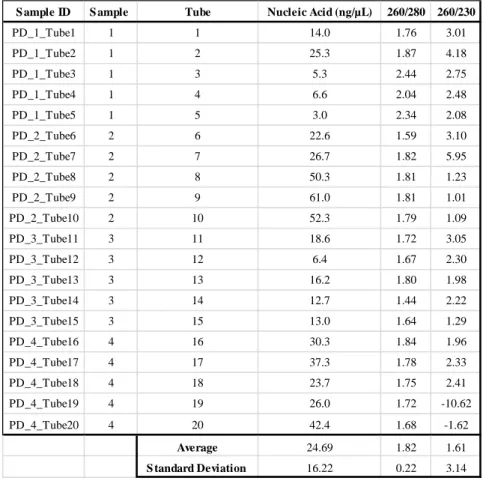
Twenty passive drool samples from five different subjects were analyzed and the results
are listed in Table 1 in Appendix A. The average concentration for the passive drool samples was
1
24.69ng/µL with a standard deviation of 16.22. The average 260/280 ratio was 1.82 with a
standard deviation of 0.22. The 260/230 ratio was 1.61 with a standard deviation of 3.14.
The twenty oral swab samples five different subjects were also analyzed and the results
are listed in Table 2 in Appendix A. The average concentration for the oral swabs was
17.05ng/µL with a standard deviation of 8.23. The average 260/280 ratio was 1.69 with a
standard deviation of 0.16. The 260/230 ratio was 2.32 with a standard deviation of 1.94.
In order to do subsequent PCR reactions, at least 15 ng/µL of extracted salivary DNA is
required (Nemoda et al., 2011). The concentration varies greatly depending on the subject and
the adherence to the data collection protocol listed in the previous section. Based on the data
obtained from the passive drool and oral swab samples, there was an average concentration
greater than 15 ng/µL in both sample methods.
Two ways to assess the purity of the DNA sample isolated are to compare the absorbance
at 260nm to the absorbances at 280 and 230 (Nemoda et al., 2011). Nucleic acids absorb at
260nm. Proteins absorb at 280nm and salts/ carbohydrates absorb at 230nm. In order to assess
the purity, the 260/280 ratio and 260/230 ratios need to be calculated. A pure sample should have
a 260/280 above 1.8 and a 260/230 above 1.5. For the passive drool samples, the 260/280 was
1.82 ±0.22 and the 260/230 was 1.61 ±3.14. For the oral swab samples, the 260/280 was 1.69
±0.16 and the 260/230 was 2.32 ±1.94. These results are shown in Table 3 in Appendix A. Using
this data, it can be concluded that on average the passive drool and oral swab DNA samples
extracted were pure.
Conclusion and Future Work
The purpose of this study was twofold: 1) to develop a method for extracting DNA from
The results from this experiment showed that DNA can be successfully isolated from passive
drool and Oral Swabs with a good concentration and a high degree of purity. Future studies need
to be conducted to determine the cost per tube extraction. Further, PCR needs to be conducted on
the extracted salivary DNA samples to obtain the desired sequences for future research. Through
doing PCR and the subsequent steps of DNA purification, these salivary DNA strands can then
be used for future epidemiologic studies.
As technology advances, epigenetic researchers are looking for easier and less invasive
methods for studying DNA. One way of obtaining DNA in a non-invasive way is through
collecting salivary samples and isolating the DNA from those samples. Isolated DNA can be
sequenced and collected to form a large DNA bank for epidemiological studies. These studies
can have profound implications on healthcare such as discovering genetic mutations that increase
the risk of a certain type of cancer or how someone’s genetic makeup can increase their risk of
References
Bahlo, M., Stankovich, J., Danoy, P., Hickey, P. F., Taylor, B. V., Browning, S. R., . . . Rubio, J.
P. (2010). Saliva-derived DNA performs well in large-scale, high-density single-nucleotide
polymorphism microarray studies. Cancer Epidemiology, Biomarkers & Prevention : A
Publication of the American Association for Cancer Research, Cosponsored by the
American Society of Preventive Oncology, 19(3), 794-798.
doi:10.1158/1055-9965.EPI-09-0812 [doi]
Beltzer, E. K., Fortunato, C. K., Guaderrama, M. M., Peckins, M. K., Garramone, B. M., &
Granger, D. A. (2010). Salivary flow and alpha-amylase: Collection technique, duration,
and oral fluid type. Physiology & Behavior, 101(2), 289-296.
Ellingjord-Dale, M., Grotmol, T., Lee, E., Van Den Berg, D. J., Hofvind, S., Couto, E., . . .
Ursin, G. (2014). Breast cancer susceptibility variants and mammographic density
phenotypes in norwegian postmenopausal women. Cancer Epidemiology, Biomarkers &
Prevention : A Publication of the American Association for Cancer Research, Cosponsored
by the American Society of Preventive Oncology, 23(9), 1752-1763.
doi:10.1158/1055-9965.EPI-13-1212 [doi]
Grady, P. A. (2011). Bringing science to life: NINR strategic plan. ().
Granger, D. A., Johnson, S. B., Szanton, S. L., Out, D., & Schumann, L. L. (2012). Incorporating
salivary biomarkers into nursing research: An overview and review of best practices.
Hanrahan, K., McCarthy, A. M., Kleiber, C., Lutgendorf, S., & Tsalikian, E. (2006). Strategies
for salivary cortisol collection and analysis in research with children. Applied Nursing
Research, 19(2), 95-101.
Koni, A. C., Scott, R. A., Wang, G., Bailey, M. E., Peplies, J., Bammann, K., & Pitsiladis, Y.
(2011). DNA yield and quality of saliva samples and suitability for large-scale
epidemiological studies in children. International Journal of Obesity, 35, S113-S118.
Looi, M. L., Zakaria, H., Osman, J., & Jamal, R. (2012). Quantity and quality assessment of
DNA extracted from saliva and blood. Clinical Laboratory, 58(3-4), 307-312.
Nemoda, Z., Horvat-Gordon, M., Fortunato, C. K., Beltzer, E. K., Scholl, J. L., & Granger, D. A.
(2011). Assessing genetic polymorphisms using DNA extracted from cells present in saliva
samples. BMC Medical Research Methodology, 11, 170-2288-11-170.
doi:10.1186/1471-2288-11-170 [doi]
Rylander-Rudqvist, T., Hakansson, N., Tybring, G., & Wolk, A. (2006). Quality and quantity of
saliva DNA obtained from the self-administrated oragene method--a pilot study on the
cohort of swedish men. Cancer Epidemiology, Biomarkers & Prevention : A Publication of
the American Association for Cancer Research, Cosponsored by the American Society of
Preventive Oncology, 15(9), 1742-1745. doi:15/9/1742 [pii]
Salimetrics, L., & SalivaBio, L. (2011). Saliva collection and handling advice. Available Oat
Viltrop, T., Krjutškov, K., Palta, P., & Metspalu, A. (2010). Comparison of DNA extraction
methods for multiplex polymerase chain reaction. Analytical Biochemistry, 398(2), 260-262.
Appendix A
Table 1. Passive Drool Samples.
S ample ID S ample Tube Nucleic Acid (ng/µL) 260/280 260/230
PD_1_Tube1 1 1 14.0 1.76 3.01
PD_1_Tube2 1 2 25.3 1.87 4.18
PD_1_Tube3 1 3 5.3 2.44 2.75
PD_1_Tube4 1 4 6.6 2.04 2.48
PD_1_Tube5 1 5 3.0 2.34 2.08
PD_2_Tube6 2 6 22.6 1.59 3.10
PD_2_Tube7 2 7 26.7 1.82 5.95
PD_2_Tube8 2 8 50.3 1.81 1.23
PD_2_Tube9 2 9 61.0 1.81 1.01
PD_2_Tube10 2 10 52.3 1.79 1.09
PD_3_Tube11 3 11 18.6 1.72 3.05
PD_3_Tube12 3 12 6.4 1.67 2.30
PD_3_Tube13 3 13 16.2 1.80 1.98
PD_3_Tube14 3 14 12.7 1.44 2.22
PD_3_Tube15 3 15 13.0 1.64 1.29
PD_4_Tube16 4 16 30.3 1.84 1.96
PD_4_Tube17 4 17 37.3 1.78 2.33
PD_4_Tube18 4 18 23.7 1.75 2.41
PD_4_Tube19 4 19 26.0 1.72 -10.62
PD_4_Tube20 4 20 42.4 1.68 -1.62
Average 24.69 1.82 1.61
Table 2. Oral Swab Samples
Table 3. Passive Drool and Oral Swab Purity
S ample ID S ample Tube Nucleic Acid (ng/µL) 260/280 260/230
Swab_1_Tube1 1 1 23.5 1.90 4.39
Swab_1_Tube2 1 2 26.1 1.93 3.45
Swab_1_Tube3 1 3 22.2 1.78 2.65
Swab_1_Tube4 1 4 15.2 1.91 6.90
Swab_1_Tube5 1 5 14.9 2.02 7.66
Swab_2_Tube6 2 6 24.9 1.60 1.18
Swab_2_Tube7 2 7 16.8 1.62 1.42
Swab_2_Tube8 2 8 24.5 1.79 2.63
Swab_2_Tube9 2 9 13.5 1.61 1.05
Swab_2_Tube10 2 10 11.8 1.72 3.55
Swab_3_Tube11 3 11 4.7 1.50 1.25
Swab_3_Tube12 3 12 6.0 1.43 0.66
Swab_3_Tube13 3 13 15.4 1.51 0.89
Swab_3_Tube14 3 14 16.3 1.49 0.83
Swab_3_Tube15 3 15 8.4 1.62 1.08
Swab_4_Tube16 4 16 17.5 1.71 1.60
Swab_4_Tube17 4 17 10.5 1.59 1.25
Swab_4_Tube18 4 18 41.8 1.79 1.79
Swab_4_Tube19 4 19 15.1 1.67 0.84
Swab_4_Tube20 4 20 11.9 1.63 1.23
Average 17.05 1.69 2.32
S tandard Deviation 8.23 0.16 1.94
260/280 260/230
Appendix B
Passive Drool Salivary DNA Extraction Protocol
Mammalian Cells Lysate Protocol
1. Set a water bath or heat block at 55°C
2. Add 20µL if Proteinase K and 180µL of Purelink™ Genomic Digestion Buffer to a sterile microcentrifuge tube
3. Thaw salivary sample at Room Temperature (24°C)
4. Pipette up and down sample once thawed and centrifuge at 2,000 x g for 12minutes. 5. Remove all but ~200µL of the supernatant, leaving the pellet intact. Note: some samples
may not have 200µL total volume in the tube, if that is the case, just resuspend
6. Resuspend the pellet in the 200µL by pipetting up and down the sample for 15seconds 7. Transfer 50µL of pellet suspension to the tube containing Proteinase K and Genomic
Digestion Buffer from Step 2. Pipette up and down to mix thoroughly.
8. Add 20µL RNase A to the sample. Pipette up and down and then incubate at room temperature for 2 minutes, Centrifuge briefly to spin down any lysate from the tube cap 9. Add 200µL PureLink™ Genomic Lysis/ Binding Buffer, pipette up and down to mix
and then pipette up and down to obtain a homogenous solution 10.Incubate at 55°C for 10minutes to promote protein digestion 11.Centrifuge briefly to collect any lysate from the tube caps
12.Add 200µL 96-100% ethanol to the lysate. Mix well by pipetting up and down. 13.Proceed to Purification Protocol
Purification Protocol
1. Remove a Purelink™ Spin Column in a Collection Tube from the package
2. Add the lysate (690µL) prepared with PureLink™ Genomic Lysis/Binging Buffer and ethanol to the spin column. Centrifuge the column at 10,000g for 1 minute at room temperature
3. Discard the collection tube and place the spin column into a clean PureLink™ Collection Tube supplied with the kit
4. Add 500µL Wash Buffer 1 prepared with ethanol to the column 5. Centrifuge column at 10,000 x g for 1 minute at room temperature
6. Discard the collection tube and place the spin column into a clean PureLink™ collection tube supplied with the kit
7. Add 500µL Wash Buffer 2 prepared with ethanol to the column
8. Centrifuge the column at the maximum speed (20,000xg) for 3minutes at room temperature. Discard the collection tube
9. Place the spin column in a sterile 1.5mL microcentrifuge tube 10.Add 50µL of PureLink™ Genomic Elution Buffer to the column
11.Incubate at room temperature for 1 minute. Centrifuge the column at maximum speed (20,000xg) for 1 minute at room temperature.
12.The tube now contains purified genomic DNA. Label the tube and either store tube at -20°F for later use or continue on with the next step.
1. Take the 1.5mL microcentrifuge tube now with the purified genomic DNA over to the nanodrop. Pipette sample up and down to mix thoroughly.
2. Click on the Nanodrop 2000 software to open up the nanodrop. Make sure to remove the Kimwipe in between the pedestal before starting the software.
3. Click on the Nucleic Acid Group
4. Load 2µL of elution buffer from the Purelink™ kit to the pedestal and click blank 5. Wipe off the pedestal with a clean Kimwipe
6. Add 2µL of sample to the pedestal and hit Measure.
Appendix C
SalivaBio Oral Swab Salivary DNA Extraction Protocol
Lysis Buffer 2016 Preparation
Chemicals Final Concentration per 500mL
1M Tris pH 8.0 10mM 5mL
5M NaCl 100mM 10mL
0.5M EDTA pH 8.0 10mM 10mL
10% SDS 0.5% 25mL
dH2O bring to 500mL (approx 450mL)
Proteinase K Concentration:
*Add 20µL of a 20mg/mL stock per 1mL of lysis buffer
DNA Isolation Lysis Buffer 2016 1. Thaw sample
2. Add 500µL of Lysis Buffer 2016 containing Proteinase K (20µL) to each swab 3. Incubate at 56°C for 1 hour
4. Centrifuge swabs at 2300g for 10minutes
5. Remove supernatant and leave only 200µL of supernatant and the pellet undisturbed 6. Resuspend the pellet in 200µL of supernatant by vortexting for 5 seconds.
7. Continue on with the Purelink™ lysis protocol.
Mammalian Cells Lysate Protocol from Purelink™ 14.Set a water bath or heat block at 55°C
15.Add 20µL if Proteinase K and 180µL of Purelink™ Genomic Digestion Buffer to a sterile microcentrifuge tube
16.Transfer 200µL of pellet suspension from the section above to the tube containing Proteinase K and Genomic Digestion Buffer from Step 2. Pipette up and down to mix thoroughly.
17.Add 20µL RNase A to the sample. Pipette up and down and then incubate at room temperature for 2 minutes, Centrifuge briefly to spin down any lysate from the tube cap 18.Add 200µL PureLink™ Genomic Lysis/ Binding Buffer, pipette up and down to mix
and then pipette up and down to obtain a homogenous solution 19.Incubate at 55°C for 10minutes to promote protein digestion 20.Centrifuge briefly to collect any lysate from the tube caps
Purification Protocol
13.Remove a Purelink™ Spin Column in a Collection Tube from the package
14.Add the lysate (690µL) prepared with PureLink™ Genomic Lysis/Binging Buffer and ethanol to the spin column. Centrifuge the column at 10,000g for 1 minute at room temperature
15.Discard the collection tube and place the spin column into a clean PureLink™ Collection Tube supplied with the kit
16.Add 500µL Wash Buffer 1 prepared with ethanol to the column 17.Centrifuge column at 10,000 x g for 1 minute at room temperature
18.Discard the collection tube and place the spin column into a clean PureLink™ collection tube supplied with the kit
19.Add 500µL Wash Buffer 2 prepared with ethanol to the column
20.Centrifuge the column at the maximum speed (20,000xg) for 3minutes at room temperature. Discard the collection tube
21.Place the spin column in a sterile 1.5mL microcentrifuge tube 22.Add 50µL of PureLink™ Genomic Elution Buffer to the column
23.Incubate at room temperature for 1 minute. Centrifuge the column at maximum speed (20,000xg) for 1 minute at room temperature.
24.The tube now contains purified genomic DNA. Label the tube and either store tube at -20°F for later use or continue on with the next step.
NanoDrop for DNA Concentration
9. Take the 1.5mL microcentrifuge tube now with the purified genomic DNA over to the nanodrop. Pipette sample up and down to mix.
10.Click on the Nanodrop 2000 software to open up the nanodrop. Make sure to remove the Kimwipe in between the pedestal before starting the software.
11.Click on the Nucleic Acid Group
12.Load 2µL of elution buffer from the Purelink™ kit to the pedestal and click blank 13.Wipe off the pedestal with a clean Kimwipe
14.Add 2µL of sample to the pedestal and hit Measure.