Brian Young. Impact of User-Generated Metadata on Circulation Rates in Academic Libraries. A Master’s Paper for the M.S. in L.S degree. April, 2012. 25 pages. Advisor: Robert Losee
This study examines the overlap of user-generated tags from LibraryThing and subject headings from a library catalog for the most circulated monographs in history and political science at Duke University from 2007-2011. By examining the overlap, implications are found that suggests the presence of user-generated metadata can have impacts on circulation rates in academic libraries.
Headings:
Subject headings Metadata
Subject cataloging
IMPACT OF USER-GENERATED METADATA ON CIRCULATION RATES IN ACADEMIC LIBRARIES
by B. Young
A Master’s paper submitted to the faculty of the School of Information and Library Science of the University of North Carolina at Chapel Hill
in partial fulfillment of the requirements for the degree of Master of Science in
Library Science.
Chapel Hill, North Carolina April 2012
Approved by
Table of Contents
Introduction ... 2
Literature Review... 4
Methodology ... 12
Data and Analysis ... 15
Implications... 19
Introduction
To loosely borrow from Walter Ong, libraries may be considered the storehouses of cultural knowledge as stored in various forms of media. The librarian’s role is to mediate, whether directly through research services or indirectly through technical services, the user’s discovery of these resources. Librarians and library users, alike, often
use the catalog as the tool for locating both known-items and unknown-items, such as those required for investigating a particular topic. Users, though, often declaim the catalog as being difficult to use, and subsequently, librarians often conduct instruction sessions intended to, in part, introduce and demonstrate how to navigate the intricacies of the catalog. Digital tools and other technological developments can be leveraged to improve the usability of the catalog from the non-librarian’s perspective.
Library catalogs, especially subject heading access to items in the catalogs,
depend on controlled vocabularies, from which catalogers assign descriptors to resources. Controlled vocabularies refer to a defined list that “introduces a measure of control over the terms used” (Foskett, 1996, p. 113). Catalogers depend on the Library of Congress
Uncontrolled vocabularies, unlike controlled vocabularies, are not formalized and are based more on natural language. Tagging systems, such as those found at
LibraryThing and Delicious, are examples of uncontrolled vocabularies where users have organically-created classifications. These classifications depend on tags: user-generated annotations assigned to the resources found on the sites (books and websites,
respectively, for LibraryThing and Delicious). The subject tags, as opposed to more personal tags such as own or read later, for books at LibraryThing provide libraries the opportunity to compare how professionally-generated subject headings from LSCH compare to the user-generated terms.
Online catalogs remain the gateway to library resources. Hence, searchers’ ability
to navigate the catalog to find a resource should have a direct impact on the circulation on that resource. Other researchers have discussed the impact of enriching MARC records, and this study proposes to continue that research by looking at one potential source for uncontrolled keywords to populate the 653 MARC field. Specifically, this study proposes that non-fiction monographs whose MARC records include at least two user-generated subject tags have higher circulation rates at academic libraries than non-fiction
Literature Review
Online library catalogs are tools through which users locate monographs and other materials. To provide results to search queries, catalogs compare the user’s search terms
against the available indexed information. Known-item search queries, such as searching by author or title, are typically straightforward for users as they are, generally, factual information with only derivations of names to complicate searching. Most queries, though, result in a more active process occurring between the searchers and the
information system. These active searches can require several iterative steps consisting of the searcher querying and re-querying based on the results (Foskett, p. 25, 1996). Though Foskett wrote about searching well before the implementation of modern-day catalogs, the idea may even be more pertinent today due to the keyword searching process often used by library catalog users.
This constraint can result in unsuccessful searches because, as Borgman notes, non-expert users face the difficult challenge of creating search queries to match terms
available in the catalog’s vocabulary (Borgman 1996). Belkin, Oddy, and Brooks (1982)
question the possibility for searchers to match their query to the indexed versions of the resources. This anomalous state of knowledge requires users to be able to construct a query in such a way that is readable by the information system, rather than the system being able to facilitate the search process. Further, Bates (1986) demonstrated that it is psychologically difficult for individuals to ascribe the same meaning to commons words and to describe straightforward operations in the same manner. Additionally, some entries require scope notes to distinguish nuances between two headings, such as
alcoholism and drunkenness (Foskett, p.341, 1996). If disambiguation is required in order to appropriately catalog, then it should be expected that novice users will have difficulty formulating queries to return desired results. Hence, searchers, particularly new library users, such as undergraduates, can have difficulty navigating the vocabulary and
searching via keywords.
as Larson (1991) showed in his study on search behavior, which demonstrated users’
tendency for keyword searching over subject searching.
Larson also reported that Hildreth (1987) and Hunter (1991) found that subject searching was more often than not unsuccessful, as searches resulted in non-zero hits only 37% and 37.9% of the time. Lancaster et. al. (1991) further shows the lack of recall provided by subject headings. Recently, libraries have begun introducing new catalog interfaces, commonly called next-generation catalogs or discovery platforms, which are intended, in part, to mimic online search behavior. Part of this trend is the introduction of additional elements to the MARC record that enables successful keyword searching.
Next-generations catalogs, such as those powered by Endeca’s Information Access Platform, are one potential way to overcome the controlled vocabulary dilemma. In addition to introducing commonly found search features (relevance ranking, stemming, etc.), these catalogs facilitate access to subject headings through facets (Antelman 2006). Svenonius discussed the potential role of browsing, via facets, as a method for improving search recall when conducting subject searches (1983). Facet-based searching offers users the opportunity to refine their initial search based on pre-defined categories, including subject headings and subdivisions (Kornegay, p. ix, 2009). Post-coordinated searching, such as faceted browsing, does not require the user to have prior knowledge of the underlying structure. Marchionini (1995) and others have extolled the virtues of browsing as an effective technique for finding items. Fagan (2010) offers an extensive review of the faceted browsing literature, and in it, notes Hearst’s (2006) conclusions that facets are a “proven technique for supporting exploration and discovery.” Additionally,
positive feedback from users during usability studies. Fagan, though, concludes that “user
studies about faceted browsing revealed empirical evidence that faceted browsing improves user performance, “[y]et this evidence does not necessarily point directly to
user success in faceted library catalogs, which have much more complex databases than those used in the experimental studies” (Fagan 2010).
The literature reveals that catalogs have traditionally been difficult to use and that the underlying controlled vocabulary should not be considered entry-level (Foskett, p. 25, 1996). While an active, iterative process is likely to yield successful results, introductory users, today, are accustomed to more friendly interfaces and their expectations do not match the capabilities of catalogs. Harping (2010), in her book on controlled vocabularies for cultural heritage institutions, refers to the expected difficulties of end users who are not specialists in using controlled vocabularies and may be unable to identify the appropriate term (i.e., which synonym is used). Facets, though, introduce an easier method for exploring the library’s resources, yet they still rely on the user’s initial query
for recalling a corpus of records to be browsed. This expanded emphasis on recall and attention to user search behavior, has led some libraries to enhance their MARC records with additional metadata in order to improve the usability of the catalog.
monographs being used by 45%. Similarly, Tosaka and Weng (2010) found that enhanced records (presence of tables of content and/or summaries) for titles published between 1990 and 2004 were used between 30.7% and 45.5% more often than
monographs without enhanced records. Moreover, Markey and Calhoun (1987)
demonstrated that tables of content and summaries added roughly fifteen unique index terms per bibliographic record. While studies have concluded that enriching catalog records can increase the number of access points and circulation rates for monographs, little research has been conducted regarding the addition of user-generated metadata and the impacts it may have on collection usage.
Enhancing MARC records should be seen as complementary to traditional subject searching. Librarians can, and should, still emphasize the importance of subject heading facets during library instruction and reference consultation sessions as these are an invaluable tool for refining searches and eliminating unneeded items. Researchers, however, consistently present keyword and subject searching as a dichotomy. Mann (2005), for example, extols the virtues of subject searching for its ability to aggregate similar items and increase precision, while dismissing keyword searching as being untenable for dedicated researchers. Gross and Taylor (2005) demonstrate the need for subject terms to return search results during keyword searches. Others, such as Shirky (2005), posit that controlled vocabularies are unneeded now that libraries have online catalogs and that controlled vocabularies may even lead to users missing relevant sources. Moreover, Lakoff (1990) discusses the importance of tags being able to capture how non-specialists view items, rather than trained catalogers. These collective
(good, long) and personal indicators (to be read). The lack of conclusive evidence and myriad opinions among experienced information professionals demonstrates the need for further investigation into the potential benefits of adding and/or linking to additional metadata in the form of uncontrolled terms.
The fundamental differences between controlled and uncontrolled vocabularies are implied by the name of each. Controlled vocabularies depend on consensus as to the appropriate term for a particular concept. Taylor (2004) recognizes the fact that rarely do true synonyms exist; however, individuals often interchange words for concepts that are related and/or similar. As Haykin (p.7, 1951) notes, “a subject catalog must bring together under one heading all the books which deal principally or exclusively with the subject, whatever he terms applied to it by the authors of the books and whatever the varying terms applied to it at different times.” Controlled vocabularies, therefore, enable
searchers to feel confident that all resources related to a given concept are grouped under one heading. Moreover, controlled vocabularies enable disambiguation of polysomic words and consistent handling of degrees of specificity (Golder and Huberman 2006). Disambiguation is often performed by the addition of parenthetical statements (Taylor 2004). Researchers have also discussed the merits of controlled vocabularies, in relation to uncontrolled vocabularies, of being able to provide guidelines for appropriate usage of plurality and specificity (Rolla, 2009, Mathes, 2004, Guy and Tonkin, 2006). The
accustomed to the vocabulary, this allows ready access to materials cataloged under these headings.
Uncontrolled vocabularies embrace less formal approaches to subject searching by creating systems geared more towards keyword searching. User predilection to this form of searching warrants investigation into supplementing subject headings with other terms. Haykin (p.7 1951) notes that the fundamental purpose of catalogs is to facilitate access, which supersedes “conformity to a chosen logical pattern.” Tagging systems, such
as those found on websites like LibraryThing, Delicious, and Connotea, embrace uncontrolled vocabularies, depending on user-generated lists that organically form a vocabulary. As already discussed, relying on user-generated terms should increase the likelihood that a user’s query will find an indexed term as these descriptors tend to
represent the ways users themselves describe the resources. Foskett (p. 112, 1996), while discussing the need for consistency, even notes the difficulty for indexers to categorize resources consistently due to contextual (background, frame of reference, etc.)
differences. Hence, it should not be surprising that users may find it difficult to query an interface with a term that will lead to the correct subject heading used by a controlled vocabulary. Lancaster (p. 23, 1977) discusses the advantages inherent by enabling users to search using the language in which they communicate. Ultimately, libraries must consider whether the benefit of additional descriptors, resulting in an increase in recall, warrants inclusion at the risk of potentially losing precision or increasing the need for modifying online catalog features to allow for these additional descriptors.
that can provide access to concepts not covered by the subject headings assigned to the record. Emphasizing the need for user-generated metadata and subject headings to be used in conjunction with each other, Rolla also found that 55.6% of the bibliographic records contained access points to concepts not covered by user tags. Several studies conclude that users more often tag items broader than librarians classify with LCSH (Munk and Mork, 2007, Golder and Huberman, 2006).
This conclusion has direct impact on catalog searching because it indicates differences in how general users and library catalogers view items. For twentieth and twenty-first century English-language literary works, DeZelar-Tiedman (2011) concluded that while more popular works from this genre had rich collections of usable tags that could supplement the resource’s subject headings, lesser-known works lacked tags of
Methodology
This study will focus on non-fiction monographs contained in Duke University Library’s collection and, for the purposes of this study, non-fiction monographs will be
defined as those books that lack the subject heading term fiction in LCSH, as displayed in Duke University’s OPAC. Similar to Tosaka and Yeng’s (2010) study, I will be focusing
on monographs from two distinct portions of the LCSH vocabulary. The monographs will be limited to history (call numbers DEF) and political science (call number P=J)
classifications due to the heavier reliance on monographs by researchers in these areas than others, such as science and engineering.
From these call numbers, I selected the 125 most circulated titles within each call number, resulting in a data set of 250 titles. Circulation rankings were based on statistics extracted from Duke’s local ALEPH ILS for the five years between January 1, 2007 and
December 31, 2011 for bibliographic records in the aforementioned classification ranges. Further, checkouts will not include renewals or interlibrary loan fulfillments because this study is only interested in checkouts that may be directly influenced by the online
catalog.
extracting the information found under the Tags section. Additionally, this study will only focus on subject tags—those tags that describe the aboutness of the resource. More specifically, subject tags will not include personal descriptions (i.e., read, to be read, etc.) or terms that describe the resource itself and not its content, such as title, publisher, or author. Mainly, this is to ensure that when resources are documented as overlapping, it is due to terms related to subject access, and no other access points, like title and author, which are more useful when conducting known-item searches.
Related to the idea of aboutness, comparisons will be made between top-level subject headings and LibraryThing tags. Limiting to only top-level subject headings, such as only looking at civil rights for the subject heading civil rights -- history, reflects the search process of academic library searchers who are less likely to use broad terms such as general subject areas when first conducting a search. Moreover, this study counts partial matches, such as a tag politics compared to subject heading world politics, because a keyword search would return the record. However, the reversal, world politics as the tag, does not count as the keyword search for world politics would not return the record.
Once the list of subject tags for each monograph is compiled, they will be compared to the MARC records for their respective monograph. Only specific words contained in both the compiled tag list and designated MARC records will be
States), and singular/plural forms (library vs. libraries or horse vs. horses). From these comparisons, each monograph can then be categorized as either containing or failing to contain two or more user-assigned subject tags. For each resource, the number of overlapping terms will also be documented in addition to denoting a simple yes/no.
Data and Analysis
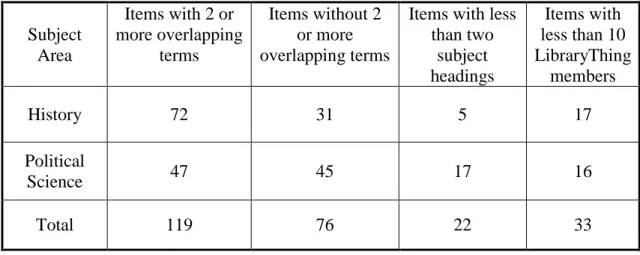
Before performing any analysis, some records were excluded in order to present an accurate depiction of how overlaps between subject headings and tags can impact circulation. Monographs with either fewer than two subject headings or less than ten LibraryThing “owners” were excluded from the study. The former were excluded due to,
by default, failing to meet the assigned criteria and the latter were excluded due to the lack of tags with which to compare to subject headings.
Subject Area
Items with 2 or more overlapping
terms
Items without 2 or more overlapping terms
Items with less than two
subject headings
Items with less than 10 LibraryThing
members
History 72 31 5 17
Political
Science 47 45 17 16
Total 119 76 22 33
Table 1: Breakdown of data
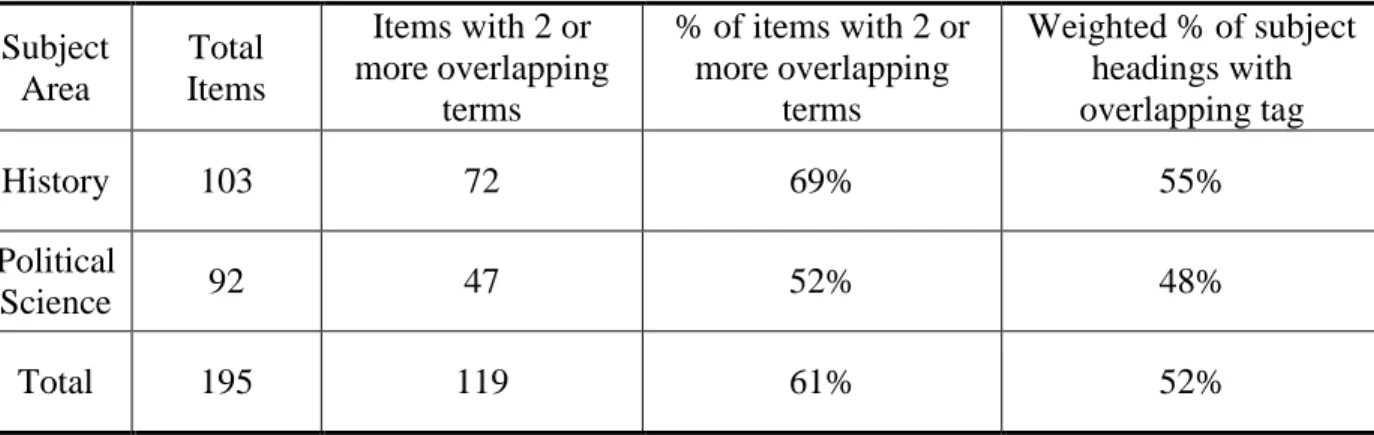
much closer when looking at the weighted percentage, which shows that only 14% more of the total user-generated tags for history monographs are also used as subject headings.
Subject Area
Total Items
Items with 2 or more overlapping
terms
% of items with 2 or more overlapping
terms
Weighted % of subject headings with overlapping tag
History 103 72 69% 55%
Political
Science 92 47 52% 48%
Total 195 119 61% 52%
Table 2: Summary Table for items with 2 or more overlapping terms
As political science monographs only have 4% fewer (3.43 vs. 3.68) unique, top-level subject headings assigned than history monographs, it seems unlikely that this is the cause of this difference. One other potential explanation is the popularity, in the context of LibraryThing, for history monographs as compared to political science monographs. The median number of users who have added history monographs from this study to their LibraryThing account is 64% greater (146.5 vs. 89) than the number who have added political science monographs. While further study would be needed to fully ascertain the difference, it is important to consider how the number of users tagging items can
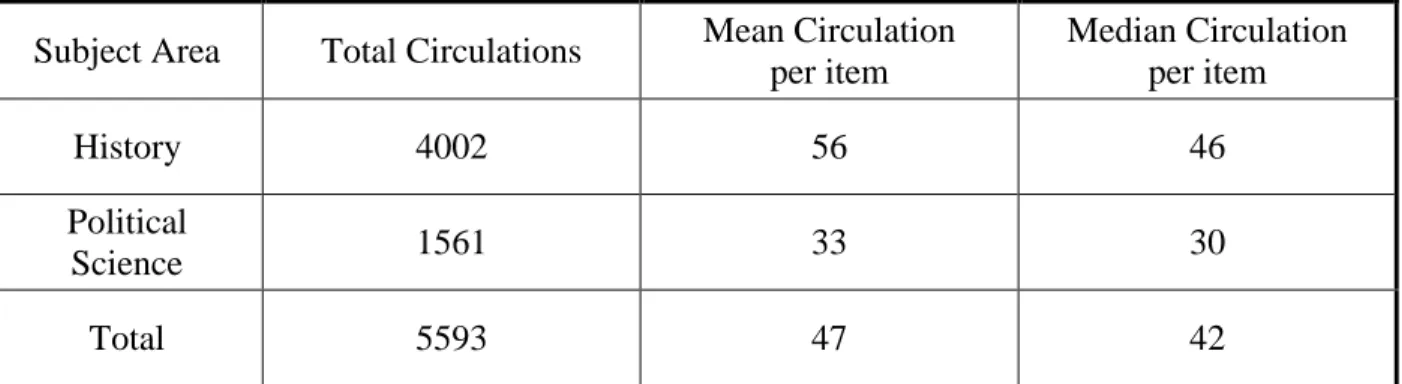
To further examine the potential impact of user-generated tags, the mean and median circulations for monographs that have and do not have at least two user-generated subject tags were calculated. The mean and median circulations for monographs in this study were approximately 23.6% and 23.5%, respectively, higher for those monographs that had two or more user-generated terms. Looking specifically at each subject area, the overall trend is still valid except for median circulations for history, which are only slightly higher for those monographs with two or more user-generated tags.
Subject Area Total Circulations Mean Circulation per item
Median Circulation per item
History 4002 56 46
Political
Science 1561 33 30
Total 5593 47 42
Table 3: Circulation rates for items with 2 or more user-generated subject terms
Subject Area Total Circulations Mean Circulation per item
Median Circulation per item
History 1591 51 45
Political Science 1293 29 27
Total 2884 38 34
Table 4: Circulation rates for items with less than 2 user-generated subject terms
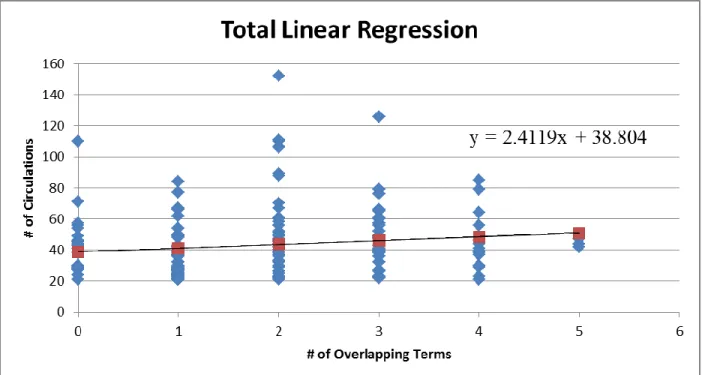
heading. Given the average circulation rate of 43 items during this same time frame, each additional tag can potentially increase circulation approximately 6%.
Figure 1: Total Linear Regression
Along with the previous discussion of median and mean circulation rates, the data presented in this study, while not demonstrating a causal relationship between the
presence of user-generated tags as subject headings and circulation rates, does
Implications
This study has examined the thirty most-attributed tags from LibraryThing and compared them to the subject headings assigned to the most circulated monographs from an academic library during a five-year period. Noticeable differences in the circulation statistics between the two groups (≥2 tags and <2 tags), while not generalizable, suggests
that the inclusion of uncontrolled vocabularies in library bibliographic records may have a positive impact on circulation. In the past, libraries restricted the number of assigned terms due to physical limitations of the card catalog, but with today’s electronic catalogs,
libraries should investigate the potential benefits that providing additional terms
accessible through keyword searching can provide. Faceted catalogs, which diminish the need for precise searching, and increasing number of e-books, where collocation of items on shelves is non-existent, contribute to the need for closer analysis of user search
behavior and investigation into how to better support keyword access to resource discovery.
history monographs. While this may be related more to the discipline than to how the items are cataloged, it still warrants further investigation.
The study as presented is but one way in which to investigate the value of adding user-generated tags. The collected data highlight other opportunities such as the differences between the vocabulary of everyday users and catalogers. For example, within the political science monographs, thirty-six different monographs were tagged political
philosophy, which currently is not an available subject heading, although it can be
constructed in a manner that would appear in search results by qualifying political
science with philosophy. This, however, was only done on three of the thirty-six titles.
Additionally, some phrases, such as State, The or full spellings, such as United States, are unused by LibraryThing users. In the former case, expectations may be that researchers would use the term, but freshmen who are unaccustomed to advanced research would be unlikely to use this term. It is more likely that individuals would use the full name for the U.S., but as the collected data demonstrates, we, as librarians, should still consider supporting discovery for alternate forms, especially those with demonstrated high-frequency of usage.
References
Antelman, K., Lynema, E., & Pace, A. (2006). Toward a 21st century library catalog.
Information Technology and Libraries, 25 (3), 128-139.
Bates, M. (1986). Subject access in online catalogs: A design model. Journal of the
American Society for Information Science, 37(6), 357-376.
Belkin, N., Oddy, R., & Brooks, H. (1982). ASK for information retrieval: Part I: Background and theory. Journal of Documentation (38)2, 61-71.
Borgman, C. (1996). Why are online catalogs still hard to use?. Journal of the American
Society for Information Science, 47(7), 493-503.
Dezerlar-Tiedman, C. (2011). Exploring user-contributed metadata’s potential to enhance access to literary works: Social tagging in academic library catalogs. Library
Resources & Technical Services 55(4), 221-233.
Fagan, J. (2010). Usability studies of faceted browsing. Information Technology and
Libraries, 29(2), 58- 66.
Foskett, A.C. (1996). The subject approach to information. London: Library Association Publishing.
Golder, S.A. and Huberman, B.A. (2006). Usage patterns of collaborative tagging systems. Journal of Information Science, 32(2), 198-208.
Gross, T & Taylor, A. (2005). "What have we got to lose? The effect of controlled vocabulary on keyword searching results. College & research libraries, 66(3), 212-230.
Guy, M. and Tonkin, E. (2006), Folksonomies: Tidying up tags?. D-Lib Magazine, 12(1). Retrieved from http://www.dlib.org/dlib/january06/guy/01guy.html.
Hearst, M. (2006). Clustering versus faceted categories for information exploration.
Communications of the ACM, 49(4), 59-61.
Hildreth, C. R. (1997). The use and understanding of keyword searching in a university online catalog. Information Technology and Libraries, 16(2), 52-63.
Hunter, R. (1991). Success and failures of patrons searching the online catalog at a large academic library: a transaction-log analysis. Research Quarterly, 30(3), 395-402. Kornegay, R., Buchanan H., & Morgan H. (2009). Magic search: Getting the best results
from your catalog and beyond. Chicago: American Library Association.
Lancaster, F. (1977). Vocabulary control in information retrieval systems. In Voigt, M. & Harris, M. (Eds.), Advances in librarianship: Volume 7 (1-40). New York:
Academic Press.
Lancaster, F., Connell, T., Bishop, N., & McCowan, S. (1991). Identifying barriers to effective subject access in library catalogs. Library Resources and Technical
Services, 35(4), 377-391.
Larson, R. R. (1991). The decline of subject searching - long-term trends and patterns of index use in an online catalog. Journal of the American Society for Information
Science, 42(3), 197-215.
LibraryThing. Retrieved from http://www.librarything.com/about
Mann, T. (2005). Will Google’s keyword searching eliminate the need for LC cataloging and classification?. Library of Congress Professional Guild. Retrieved from http://www.guild2910.org/searching.htm
Marchionini, G. (1997). Information seeking in electronic environments. Cambridge: Cambridge University Press.
Markey, K., & Calhoun, K. (1987). Unique words contributed by MARC records with summary and/or contents notes. Proceedings of the 50th Annual Meeting of the
American Society for Information Science, 153-162.
Mathes, A. (2004). Folksonomies: Cooperative classification and communication through shared metadata. Retrieved from http://adammathes.com/academic/computer-mediated-communication/folksonomies.pdf
Morris, R. C. (2001). Online tables of contents for books: Effect on usage. Bulletin of the
Medical Library Association, 89(1), 29-36.
Rolla, P. (2009). User tags versus subject headings. Library Resources and Technical
Services, 53(3), 174-184.
Sadeh, T. (2007). Time for a change: New approaches for a new generation of library users. New Library World 108(7), 307-316.
Shirky, Clay (2005). Ontology is overrated: Categories, links, and tags. Retrieved from http://shirky.com/writings/ontology_overrated.html.
Svenonius, E. (1983). Use of classification for online retrieval. Library Resources &
Technical Services, 27(1), 76-80.
Walsh, L. (2012). The faceted catalog as a tool for searching monographic series: Usability study of lens. Cataloging & Classification Quarterly 50(1), 43-59. Tosaka, Y., & Weng, C. (2010). Re-examining content-enriched access: its effect on
usage and discovery. College & Research Libraries, 72(5), 412-427.
Yu and Young (2004). The impact of web search engines on subject searching in OPAC.