Robert C. Speck. The Effect of Peer-to-Peer File Sharing On Independent Record Labels. A Master’s paper for the M.S. in I.S. degree. April 2004. 50 pages. Advisor: Bradley Hemminger
This study describes a web-based questionnaire survey of the effects of peer-to-peer file sharing on independent record labels in the United States and Canada. The owners and managers of such labels were contacted via email and asked to participate anonymously in the survey. The survey encouraged them to describe their labels, estimate the financial impact file sharing has had on their labels, and share their opinions of file sharing.
A total of 883 label owners and managers were contacted. Ninety-seven responded. The data was evaluated qualitatively and quantitatively. The survey results indicate that approximately two-thirds of the respondents favored file sharing and reported that it either benefited or at least did not harm their businesses. However, a consistent proportion of the respondents either opposed file sharing or had no opinion of it at all. Finally, most of those respondents who included comments with the survey expressed opposition to file sharing.
Headings:
World Wide Web Internet Music File Sharing
THE EFFECT OF PEER-TO-PEER FILE SHARING ON INDEPENDENT RECORD LABELS
by Robert C. Speck
A Master’s paper submitted to the faculty of the School of Information and Library Science of the University of North Carolina at Chapel Hill
in partial fulfillment of the requirements for the degree of Master of Science in
Information Science.
Chapel Hill, North Carolina April 2004
Approved by
Table of Contents
Chapter 1: Introduction………1
Chapter 2: Background and Literature Review……….4
2.1 Definitions……….………4
2.2 What is at Stake………...………..5
2.3 The Recording Industry Association of America (RIAA)…...……….………8
2.4 The Reaction to the RIAA………...…..9
2.5 The Purpose of This Study………….………...13
2.6 Recent Studies and articles on the Effects of File Sharing……….………….14
Chapter 3: Methodology………..16
3.1 Participants………..16
3.2 The Questionnaire………...17
3.3 Data Analysis………..21
Chapter 4: Findings ………...……….22
4.1 Breakdown of Participants………..22
4.2 Answers to Survey Questions.………24
4.3 Statistical Analyses..………...31
4.4 Participant Comments……….32
Chapter 5: Discussion...……….36
5.1 Primary Considerations….………..36
List of Tables
Table 1: Number of Full-Time Staff Members Employed by Participants..………..22 Table 2: Annual Full-Length Releases Released by Participants………..…………..23 Table 3: Annual CD and Record Sales for Participants’ Labels……….23 Table 4: Number of Active Bands on Label Rosters………...………….24 Table 5: How Long Participants’ Labels Have Been in Business…………..………..24 Table 6: Participants Belief That File Sharing… ………..……..……….25 Table 7: Do Participants Support or Oppose RIAA Litigation Against File
Sharers?……….……….26 Table 8: Participants Belief That File Sharing of Music Released by Their Labels
Results in… ……….…………..27 Table 9: Participants Belief That File Sharing of Music Released by Their Labels
Results in… (Part 2)……….…………..28 Table 10: Participants Who Answered “Yes” to the Question: “Do you think that
internet file sharing of songs released by your label has increased…”….29 Table 11: Participants Belief That File Sharing of Music Produced by Their Labels
List of Figures
Chapter 1: Introduction
Does file sharing of copyrighted music over the internet with various peer-to-peer file sharing services decrease profits for small or independent record labels in the United States and Canada? The Recording Industry Association of America (RIAA) makes it very clear that, as far as larger labels are concerned, this is the case. Studies by Edison Media Research and Peter Hart Research provide evidence to support this claim. According to Edison Media Research, the number of people between sixteen and forty who are downloading rather than buying music increased by 38% from 2001 to 2002. (National Record Buyers Survey II, 2002). As a result, the RIAA is doing everything in its power to curtail file sharing in order to protect “the livelihoods of artists, musicians, songwriters, retailers, and everyone in the music industry,” according to RIAA president Cary Sherman. (Prestwood, 2003). But is this really everyone? Are there others in the music industry not represented by the RIAA that might have a different perspective on file sharing? Is it possible that the effects of file sharing are not as clear cut as the RIAA would want us to believe?
RIAA much-needed ammunition to enforce its claim that file sharing is indeed piracy. The Bill provides music copyright owners a “safe harbor” while performing otherwise illegal actions to protect their property. Most importantly, these actions include
“disabling, interfering with, blocking, diverting, or otherwise impairing the unauthorized distribution, display, performance, or reproduction of his or her copyrighted work on a publicly accessible peer-to-peer file trading network…” (Berman Bill, Sec.1a).
As a result, an ethical quandary arises. How far can copyright owners go to protect their music? Can 20th century concepts of intellectual property and ownership still apply to the internet? Is it fair to prevent through litigation and law enforcement the seemingly innocuous practice of sharing music in one’s own home? Clearly, if file sharing is proven to be as damaging as the RIAA says it is, then the answers to these last two questions will be “yes.” It is the purpose of this paper to help determine if this is the case by giving a voice to individuals in the music industry who might not ordinarily have a voice on this issue.
This paper describes a study that surveyed small and independent label owners and managers in the United States and Canada. Participants were asked to describe their labels, estimate the financial impact file sharing has had on their labels, and explain their personal opinions of file sharing. It is hoped that this project will help determine if file sharing has had the same negative effect on small and independent labels as the RIAA claims it has had on major labels.
Chapter 2: Background and Literature Review
2.1 Definitions
File Sharing: The public sharing of computer data across a network via a file server in which any number of people can access, view, copy, or modify the same files. Unless otherwise noted, the computer data referred to when mentioning “file sharing” in this paper will be copyrighted music stored on digital audio files such as mp3 files.
Peer-to-Peer Network: An internet network with no dedicated servers that allows users with the same networking software to share and request computer files. In such a network, users can act as both client and server simultaneously. (Schollmeier, 2002). Popular examples of peer-to-peer networking software include Napster, Grokster, Kazaa, Soul Seek, Gnutella, and Morpheus. Again, unless otherwise noted in this paper,
computer files that are shared across peer-to-peer networks will refer to copyrighted music stored on audio files.
Record Label: A company specializing in the manufacturing, distribution, and promotion of recorded music and other kinds of recordings and merchandise. Recording media include compact discs, LPs, DVDs, and cassettes.
Independent Label: A record label that “is not affiliated in any way with a major label, and uses independent distributors to get their releases into stores.” (Knab, 2003). In most cases, such labels are very small (under five employees), but in some cases
independent labels can be fairly large and well known. Dischord, Saddle Creek, and Kill Rock Stars are three examples of larger, more famous independent labels.
2.2 What Is At Stake
One of the goals for future libraries is to, in sense, do away with libraries. This is not to say that soon big state-funded buildings with books and librarians and public PCs will become obsolete. This is to say, however, that there will be some libraries, digital ones specifically, that will not require the accouterments of libraries as we know them now. They will instead exist as information on servers across the world. This is already happening, of course. User-run, open source digital libraries exist in which contributors upload software, computer code, files, and other digital information for others to
download. Further, contributors have the ability to catalog and index these files in order to facilitate use. (Jones, 2001). This kind of apparatus appeals to those of us who believe that the democratic, free-exchange of information is a goal worth pursuing.
A wrinkle in this schema is that there is a difference between borrowing and publishing. Because digital files can be so easily copied, people who access information from popular file sharing services aren’t “borrowing” anything. Instead, they are
depends upon the publishing, distribution, promotion, and sale of media commodities. This will also cause artists, musicians, and writers to be concerned since their livelihood also depends in part upon selling such commodities that people can now acquire for free.
Is this a trend that should be stopped? It seems that the progress of technology is coming to odds with common notions of intellectual property and property rights. But to put a stop to file sharing is tantamount to stopping progress. If one of the aims of
technological progress is to enable people to do what they already can do, but more easily, cheaply, and quickly, then file sharing is indeed technological progress. Further, file sharing, as it is commonly performed on the internet, does not encourage users to hack into music industry databases and literally steal audio files. There is no breaking and entering, no malicious removing of precious commodities. This technology we’ve
developed simply takes well-known processes, namely, the publishing and distribution of music, and makes them less expensive, faster, and easier to perform by several orders of magnitude. Indeed, there is a school of thought that insists record labels give in to the inevitable and simply not fight the irresistible tide of technology. Proponents of this idea would have record labels limit the production of CDs and other tangible music products, and instead deal almost entirely with digital media. (Ian, 2002).
The opposite end of the spectrum consists of those who believe that file sharing, along with other forms of piracy, infringe upon the profits made in the music industry. Without a significant profit motive, so the argument goes, there will ultimately be no music industry at all. Potential entrepreneurs will be less likely to open record stores, recording studios, distributorships, and record labels, while the stores, studios,
workers. (RIAA: Anti-Piracy). Most importantly, without reasonable prospects of financial reward, musicians and songwriters will be more reluctant to make the life-altering and financially risky decision of trying to make a living as a recording artist.
What makes the dilemmas surrounding the file sharing issue so interesting is that three honest and noble human impulses have come at loggerheads, and we have not yet come to a consensus about what to do about it. These three impulses are the desire to make business in a capitalist society, the desire to create and enjoy music, and the desire to advance the current state of technology.
Imagine an automobile on a road. The automobile represents our technology since the advent of recorded sound: always moving forward. The road represents the shaky marriage between capitalism and art. Capitalists realize that there is money to be made selling art (in this case, music) to the public. On the other hand, artists (musicians and songwriters) realize that through this agreement, they can find an audience and can receive rewards for their work. The road is not always a smooth one, of course. Many record labels have gone out of business for promoting unpopular music, while many artists have failed to earn a living making music that is ultimately unpopular. Up till now, however, there has only been one road.
The advent of file sharing has given us a new technology that presents us with a fork in this road, a choice between two mutually exclusive options: on one extreme, following the capitalist impulse to make business, and on the other, following the artistic impulse to create. If we agree to outlaw file sharing, we are placing our capitalist
sharing, then we will essentially be placing man’s artistic impulses over his business ones because file sharing greatly reduces the business aspect of making music.
At this moment, the only compromise in sight is internet mp3 subscription
services such as Emusic (http://www.emusic.com/pitch.html) and the iTunes Music Store (http://www.apple.com/itunes/store). The former charges a monthly service fee for unlimited downloads whereas the latter charges by the song. In both cases, songs are bought and paid for, and the copyright owners are compensated. However, this method is still very new. It is too soon to tell if it will prove as popular or as satisfying as
downloading music for free or purchasing music in stores. In the meantime, the RIAA continues to file suit against file sharers and file sharers continue to share music files. 2.3 The Recording Industry Association of America (RIAA)
According to the RIAA website, the RIAA is “the trade group that represents the U.S. recording industry. Its mission is to foster a business and legal climate that supports and promotes our members' creative and financial vitality.” (RIAA: About Us). RIAA members consist of record companies, distributors, and other companies affiliated with the entertainment industry. Included in its list of members are not only major labels such as Geffen, Sony Music, and Columbia Records, but smaller and less famous ones such as Maya Records, Leni Stern Recordings, and 1500 Records. The RIAA states that its members “create, manufacture and/or distribute approximately 90% of all legitimate sound recordings produced and sold in the United States.” (RIAA: Distributed Labels of Reporting Companies).
3,000 subpoena requests to internet service providers to reveal the names, addresses, and phone numbers of subscribers suspected of file sharing across peer-to-peer networks. (Mark, 2004). Further, these subpoenas were filed before any formal copyright infringement charges had been made. (Mark, DC.internet.com, 2003). This was done largely on an interpretation of the Digital Millennium Copyright Act of 1998. (Borland and McCullagh, 2003). Great controversy has arisen as a result, both in the courtroom and out. In December 2003, the U.S. Court of Appeals for the District of Columbia ruled in Recording Industry Association of America, Inc. v. Verizon Internet Services, Inc. that the RIAA may not lawfully subpoena names of suspected peer-to-peer file traders from their Internet service providers. This motion reversed the January 2003 RIAA v. Verizon ruling by a District Court that enabled the RIAA to subpoena internet service providers for information on suspected file sharers such as names and addresses. (Gross, 2003).
Of course, the RIAA vowed to continue its efforts against file sharing. On January 21st, 2004, it filed “John Doe” lawsuits against 532 file sharers. On February 17th, it filed 531 more. Since the RIAA can no longer subpoena the names of suspected file sharers from their Internet Service Providers, it has resorted to acquiring suspects’ identities through their Internet Protocol addresses before filing suit. (Roberts, 2004). "The process by which we obtain the identity of defendants has changed," RIAA president Cary Sherman said, "but the enforcement program has not." (Mark, 2004).
2.4 The Reaction to the RIAA
those who routinely share files. Since many of these people are internet savvy to begin with, it makes sense that much anti-RIAA literature appears on the internet.
Websites such as www.boycott-riaa.com, www.downhillbattle.org,
www.riaawatch.org, www.eff.org continually condemn the RIAA and its actions. Boycott-riaa.com as well as www.thinkgeek.com sell anti-RIAA merchandise such as baseball caps, T-shirts, and coffee mugs. There is an anti-RIAA petition on
www.petitiononline.com. The electronic Frontier Foundation also has an anti-RIAA petition on its website, urging legislators to stop the “madness” of RIAA litigation.
In perhaps the most brazen move against the RIAA, Downhill Battle, a self-described “music-activism” project initiated an online protest of the RIAA on February 24th, 2004 called “Grey Tuesday.” This protest entailed the posting for free download on nearly 170 websites an “album” by DJ Danger Mouse. This record is titled The Grey Album since it is an unauthorized remix of both Jay-Z's Black Album and the Beatles White Album. EMI, which owns the rights to the Beatles’ 1968 White Album, sent cease and desist letters to all websites that offered the record for free download, demanding that they take the record off their sites. These demands were largely ignored and for a day at least, people downloaded The Grey Album for free. According to Downhill Battle, over 100,000 copies of The Grey Album were downloaded on February 24th. (Walker, 2004).
Further, by representing the major labels in its efforts, the RIAA is shielding the major labels from much negative publicity. (Downhill Battle, 2003).
Perhaps the most striking aspect of all the anti-RIAA literature appearing on the internet is the absolute certainty with which people support file sharing and condemn the RIAA and its actions. File sharing represents freedom and is therefore good, whereas the RIAA, the major labels, and its supporters represent the squelching of that freedom and are therefore bad. If these websites are to be believed, a class struggle that is part Marx and part MTV will inevitably ensue. The language sometimes encourages legal means of making changes and sometimes encourages outright subversion. Below are several quotes from anti-RIAA websites that demonstrate this certainty:
Example 1:
Boycott-RIAA was founded because we love music. More and more the RIAA and the major labels have attempted to lock up our culture and heritage through extensive lobbying, outrageous campaign donations, misleading our political leaders, and lying to the public, while misrepresenting the facts. . . . It is our intention to make the public, and our leaders aware of the implications and long term consequences to our culture of bowing to every demand the recording industry presents to our congress. It is our intent to continue to unspin the spin and to represent the consumer and independent artists positions on the battlefield that copyright has become.” (Boycott-RIAA, 2003).
Example 2:
The corporate record industry is on the brink, and we can push them over the cliff. After decades of screwing musicians, buying off radio, and overcharging for CDs, the “big 5” record companies are sliding towards bankruptcy. They won’t go without a fight – the major labels are clinging to their monopoly as hard as they can, and now they’ve even started suing fans. But if we bring together musicians, activists, DJs, and everyone who cares about music, we can put an end to this corrupt system in less than 2 years, and we can build a new one in its place. (Downhill Battle, 2003).
Example 3:
than working to create a rational, legal means by which its customers can take advantage of file-sharing technology and pay a fair price for the music they love, it has chosen to sue people like Brianna LaHara, a 12 year-old girl living in New York City public housing.
Brianna, and hundreds of other music fans like her, are being forced to pay thousands of dollars they do not have to settle RIAA-member lawsuits -- supporting a business model that is anything but rational. This crusade is generating thousands of subpoenas and hundreds of lawsuits, but not a single penny for the artists that the RIAA claims to protect. (Electronic Frontiers Foundation, 2003).
Despite this resistance, the actions of the RIAA seem to be bearing fruit according to a January 2004 study entitled “The Impact of Recording Industry Suits Against Music File Swappers” by the Pew Internet Project and Comscore Media Metrix. According to this six-page study, the percentage of Americans file sharing on the internet has been almost halved since RIAA litigation began in September 2003. The study also notes sharp declines in usage of the Kazaa Media Desktop Application shortly after the RIAA
announced it was preparing to sue file sharers in June 2003 and shortly after it filed its first wave of lawsuits that following September. This was a nationwide phone survey which contacted 1,358 Internet users. (Rainie, Madden, Hess, Mudd, 2004). Of course, this survey was quickly criticized as being tainted since it required people to report illegal activity to strangers over the phone. (Morphy, 2004).
2.5 The Purpose of This Study
labels? Perhaps file sharing actually increases profits for those acts and those record labels that would call themselves independent?
To help answer these questions, this study has polled independent record label owners and managers across the United States and Canada and asked them about the effects of file sharing on their businesses. They were also polled for their opinions on file sharing in general. The answers to these questions will help us more accurately assess whether file sharing does indeed threaten to take much of the profit motive out of the music industry. If this is the case, then perhaps the actions of the RIAA are justified after all? Either way, it is intent of this study to help us decide which way to go in this fork in the road.
2.6 Recent Studies and articles on the Effects of File Sharing
Ian, Janis. “The Internet Debacle”, Performing Songwriter Magazine, May 2002
Ian, Janis. “Fallout – a Follow-up to ‘The Internet Debacle’”, www.janisian.com, August 1, 2002
These two articles are thoughtful essays on the effects of file sharing done by Windham Hill and former Atlantic Records recording artist Janis Ian. She argues against the claim the file sharing harms musicians and songwriters. One of her central arguments is that file sharing helps the music industry because it gives further exposure to artists and increases demand for back-catalogue recordings from people who are more inclined to buy and collect CDs than build a collection entirely through file sharing. She offers increased sales of her work and increased attendance to her shows as evidence.
This article attempts to refute the claim that the recording industry is losing money as a result of file sharing. This is done by adding weight to the claim that the recording industry has been losing money in the last few years as a result of a stagnating economy, not because of file sharing. This claim is supported by economic and
demographic data from 1999 to 2002 such as revenue of fortune 500 companies, total music units sold, and U.S. inflation statistics.
“The National Record Buyers Survey,” Edison Media Research.
http://www.edisonresearch.com/Record2summary.htm, 2001 “The National Record Buyers Survey II,” Edison Media Research.
http://www.edisonresearch.com/Record2summary.htm, 2002
In these comprehensive studies, nearly a thousand people aged twelve and over were interviewed over the telephone about their attitudes and behavior with regards to file sharing. The study finds that, thanks to file sharing, the recording industry is in danger of losing customers. In one part of the study, researchers divided subjects into four groups: “Drop-outs” (those who download and do not purchase music), “Non-consumers” (those who neither download nor purchase music), “Neo-“Non-consumers” (those who download and purchase music), and “Traditionals” (those who purchase and do not download music). The researchers learned that from the first study to the second, the number of drop-outs grew 38% and the number of neo-consumers shrank by 8% – the two largest changes in the four groups.
Olsen, Eric. “Interview with Cary Sherman, President of the RIAA”
In this interview, RIAA president Cary Sherman takes on pointed questions from music-savvy bloggers, giving the RIAA’s perspective on issue of piracy and file sharing. This interview is useful also because it links to various sources and a message board.
Rainie, Lee & Madden, Mary & Hess, Dan & Mudd, Graham. The Impact of Recording Industry Suits Against Music File Swappers, www.pewinternet.org, January 2004.
Chapter 3: Methodology
3.1 Participants
This study’s web survey targets independent label owners and managers in the United States and Canada. Of course, such participants would have the strongest understanding of the effects of file sharing on their businesses. Canadian labels were included because of the large number of independent labels in Canada. Further, it is likely that Canada’s proximity to the United States causes greater market and audience sharing between the nations since Canadian bands will likely tour in the United States and vice versa. Therefore, the aspects of file sharing that would benefit or harm American independent labels would likely benefit or harm Canadian labels for the same reasons.
Several sources from which we selected worthwhile participants were used. The most important source was www.allrecordlabels.com, which is a database of more than 13,000 record labels. The database includes basic information on each label and posts links to each label’s website (if the label has one). The site also indexes its records by genre, music format, and location, allowing users to browse. American and Canadian labels that fell under the “indie” genre were selected.
Another source was www.indiepages.com. This site contains links to the web sites of approximately 350 independent labels, many of which were also contained in
allrecordlabels.com.
Records (www.mordam.com) and Southern Records (www.southern.com). The website for each of these distributors contains links to many independent labels.
Finally, record labels from Insound (www.insound.com), an online record store that carries music produced almost exclusively by independent labels, were selected.
Information on 883 independent labels was amassed in a Microsoft Access XP database. Individual emails were sent to each label. These emails briefly described the survey, linked to it, and invited the label owner or manager to participate in it. Letter versions of the email were sent via snail mail to labels that lacked valid email addresses. In all cases, the emails and letters were not personalized and were addressed to “record label owner or manager.”
Below is the consent form that participants first saw when participating in this study:
3.2 The Questionnaire
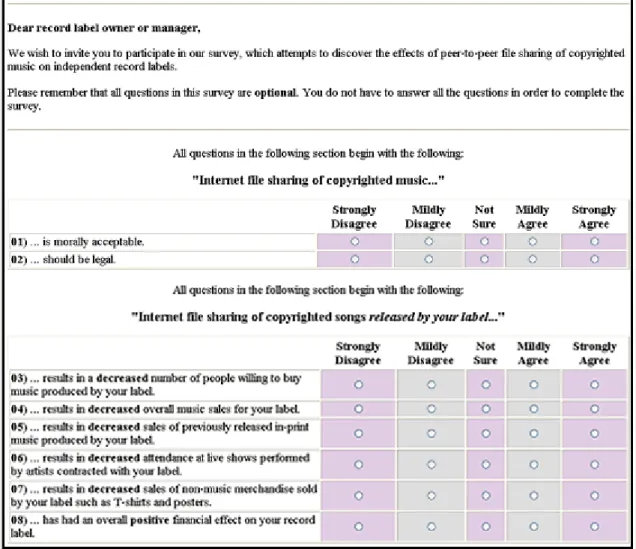
Below are screenshots of the web-based questionnaire used in the study.
The third part mostly asks label owners to describe their labels. Label owners are asked for the number of people they employ, the number of active bands on their rosters, the number of CDs/albums/tapes their companies release and sell every year, as well as how long their companies have been in business. This information will be used to determine if there is any correlation between size of a label and the effects file sharing has on it. Included in the third part is a question on whether the label owners approve of the litigation initiated by the RIAA. Answers to this question will be compared to answers in the first part regarding the label owner’s general feelings on file sharing. The third part ends by asking label owners if there have been any specific positive effects of file sharing on their businesses. This is in contrast to the second part of the survey in which label owners are asked if file sharing has had specific negative effects on the companies.
The fourth part was anticipated to only apply to some label owners. Since file sharing entails unauthorized downloading of copyrighted music, it might be interesting to learn the percentage of independent labels that allow the authorized downloading of their copyrighted music. Further, there are some file sharing services that charge a subscription fee and pay royalties on music downloads. It would be interesting to know the percentage of independent labels that work with such services. Data from this section can reveal how far along we are with compromise measures between allowing file sharing and banning it altogether.
publicize their opinions on this issue, all questions were optional and all data in this survey was entered anonymously.
3.3 Data Analysis
Chapter 4: Findings
The results from this study are provided in three forms:
1) Frequency charts and bar graphs, which provide raw data on each question in the survey.
2) Correlation matrices, which include bar graphs and mean calculations of participants grouped by various characteristics.
3) Direct comments from participants. 4.1 Breakdown of Participants
883 label owners and managers were contacted and ninety-seven, or 10.98%, participated in the survey. Below are the six criteria used to differentiate responding labels into groups and their concomitant data or frequency charts.
1) Whether the labels are considered “independent:” Ninety-five participants (or 97.9%) responded that they considered their labels to be independent. The two that did not respond in the affirmative did not answer the question at all. No participant responded that their label was not independent.
Table 1: Number of Full-Time Staff Members Employed by Participants
3) The number of annual full-length releases released by the label: Participants were asked to choose from four ranges: 1-5, 6-10, 11-20, and over 20.
Table 2: Annual Full-Length Releases Released by Participants
4) Annual CD and record sales: Participants were asked to choose from five ranges: 1-15 000, 1-15 001-30 000, 30 001-50 000, 50 001-100 000, and over 100 000.
5) The number of active bands on label rosters: Participants were asked to choose from four ranges: 1-5, 6-10, 11-15, and over 15.
Table 4: Number of Active Bands on Label Rosters
6) How long the labels have been in business: Participants were asked to choose from four ranges: 0-2, 3-5, 6-10, and over 10.
It is clearly evident that data from Table 1 to Table 4 are skewed heavily in favor of the tiny rather than the merely small independent label. Thus, full breakdowns
according to all criteria except the number of years in business (Table 5) would not be useful. A full breakdown was performed according to label age due to its fairly even
distribution. Finally, because nearly 98% of the participants admitted to being independent label owners, this statistic was not used in this study.
4.2 Answers to Survey Questions
The following tables show the responses of participants to the remaining questions on the survey.
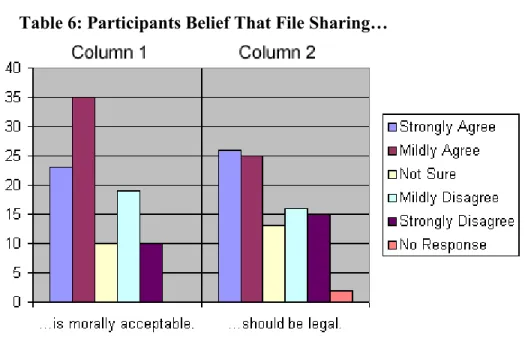
Table 6: Participants Belief That File Sharing…
case, a majority in favor of the ethics and legality of file sharing was observed, but not an overwhelming one. 0 10 20 30 40 50 60 Strongly Oppose Mildly Oppose No Opinion Mildly Support Strongly Support
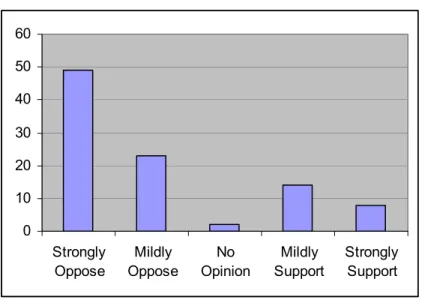
Table 7: Do Participants Support or Oppose RIAA Litiga Against File Sharers?
tion
Table 8: Participants Belief That File Sharing of Music Released by Their Labels Results in…
When prompted to respond to statements that address the financial impact of file sharing on their labels’ music sales, the participants returned to the kind of support for file sharing seen in Table 6. 57.8% of the participants denied that file sharing reduced overall music sales. A similar 55.7% answered the same way regarding
Table 9: Participants Belief That File Sharing of Music Released by Their Labels Results in…
All similarity to previous data evaporates with Table 9 in which participants contemplate how file sharing affects attendance at shows and merchandise sales. In both cases, the participants overwhelming indicated that file sharing decreases neither. Further, not one single participant strongly agreed with the idea that file sharing
decreases attendance at shows and merchandise sales (which often do go hand-in-hand). And this is with a solid 32% of participants who believe that file sharing should not be legal. Given that only 13.3% in Table 9 Column 1 did not disagree that file sharing reduced show attendance and that only 24.8% in Column 2 felt the same way about merchandise sales, there is a strong indication that a substantial portion of those opposed to making file sharing legal deny that file sharing reduces show attendance and
Table 10: Participants Who Answered “Yes” to the Question: “Do you think that Internet file sharing of songs released by your label has increased…”
Table 10 includes questions that were the inverse of many earlier questions: instead of being asked to assert or deny any negative effects of file sharing, participants were asked to agree or disagree with particular positive effects of file sharing.
Predictably, only 38.1% of the participants responded “yes” in the third column. This matches the tepid support for file sharing shown in Table 8 in which 32% of the
participants strongly disagreed with the notion that file sharing reduces music sales and 42.2% either were not sure or agreed. Also predictably, strong majorities in columns 1, 4, and 5 demonstrate that file sharing (as indicated in Table 9 Column 1) increases
attendance at shows, which perhaps causes or is the result of increased interest in particular bands and labels. It is interesting however that while 86.6% of respondents disagreed with the idea that file sharing reduces attendance at shows (Table 9, Column 1), only 66% of the respondents in Table 10 stated positively that file sharing indeed
disagreed with the notion in Table 9 Column 1 that file sharing reduces show attendance. It seems that those who mildly disagreed with this notion in Table 9 Column 1 (17.5%) are unaccounted for in Table 10.
What is most interesting in Table 10, of course, is that the certainty regarding file sharing not reducing merchandise sales from Table 9 is almost completely repudiated. Only 38.1% of the respondents in Table 10 Column 2 stated that file sharing increases merchandise sales as opposed to a whopping 75.3% in Table 9 Column 2 that disagreed with the notion that file sharing reduced merchandise sales. Further, 59.8% of the respondents in Table 9 Column 2 strongly disagreed with this notion. Thus, the result from Table 10 Column 2 is inconsistent with the result from Table 9 Column 2.
Table 11: Participants Belief That File Sharing of Music Produced by Their Labels Has Had a Positive Financial Effect on Their Labels
all along, that a sizable portion of independent record label owners have yet to fully make up their minds regarding file sharing.
4.3 Statistical Analyses
These statistics were not quite as useful as had been hoped. In the majority of cases, the participants in this study represented labels that had less than three full-time employees, released less than six full-length records annually, sold less than 15,000 records annually, and had less than six active bands on their rosters. As a result, a full correlation between, say, attitudes on the legality of file sharing with the number of full-time employees would mean little since only one participant claimed to have six to ten full-time employees and only two claimed to have more than ten.
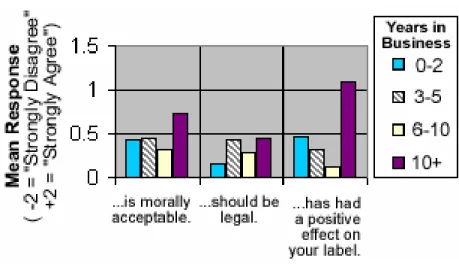
The best distribution was seen in Table 5, which broke the participants down by the number of years their labels have been in business. As a result, a complete correlation was calculated between this statistic and numerous other items on the survey. The results are shown in the two tables below:
Table 13: Participants Responses to Other Survey Items (by Years in Business)
One recurring pattern is that those participants who have run their labels for more than ten years tend to support file sharing the most. This is evident in all cases but two, and in these two cases (Table 13, Columns 4 and 5), although the 10+ group asserted the least support for file sharing, its averages were still very close to the groups that asserted the most support (-1.45 to -1.72 in Column 4 and -1.30 to -1.50 in Column 5).
4.4 Participant Comments
Example 1:
The major 5 record labels (soon to be 3) are my natural enemies. It is in my biggest plans to take as much market share away from them as possible even if the money does not enter my pockets. Power to the people.
Example 2:
People who listen to indie music tend to be people who like having a real copy of a release, and often discover new bands (whose CDs or merchandise they then buy) through file-sharing. Often these people are also involved in the music scene. Example 3:
I personally think that file sharing is not the cause for the drop of sales which is mostly related to big established record labels. The increase in price and reduced quality of the music being released are the main factors for drop of sales.
Example 4:
Although file sharing is probably responsible for some loss of sales to larger labels, I feel that it is a mixed blessing to smaller labels and unsigned artists, as it greatly increases our exposure. For all intents and purposes, it's a new form of radio (BMI and ASCAP rarely if ever distribute airplay royalties to artists heard only on college and public radio). The fact that many smaller labels are suffering dramatically reduced sales now in comparison to a few years ago can be attributed to…factors besides file sharing, for example: marketplace
saturation/diversification (thinner and thinner slices of pie); aging fan bases (most people collect records intensely for a few years around and immediately after college, tapering off as they become immersed in careers, marriage, etc.); failure to convert younger fans into rabid collectors (I've been told that the current teen generation in Japan blows most of its disposable income on text messaging...). Example 5:
It is part of our culture to share that which we enjoy. Anything that gets people more interested in certain bands is a good thing. However, file sharing is NOT acceptable when an artist expressly states they do not wish people to share their music.
Example 6:
File sharing has without question contributed to the death of my label. My sales have fallen from 2,000 to less than 50 in the space of 2 years. I now have no distro in Europe.
Example 8:
File sharing is destroying the industry. Artists will always be able to make their revenue from touring and merchandise, however labels’ only revenue generator (CD sales) is decreasing every year. Eventually there will be no labels...
Example 9:
Chapter 5: Discussion
5.1 Primary Considerations
One point of this study was to determine the financial impact of file sharing on independent record labels. Another was to place this reported impact within the context of the political and ethical debate currently being held regarding the future of file sharing and the music industry. On one extreme, there are the RIAA and the major labels it represents, all of whom equate file sharing with stealing. On the other are the music activists who believe in complete digital freedom and are outraged by the litigation initiated by the RIAA. It would be safe to conclude from this study that independent record label owners and managers tend to fall in the middle of this spectrum, but closer to the music activism extreme. While the respondents generally did not share the popular pro-file sharing fervor so easily found on the internet, they were not gung-ho about eliminating it, either. Over seventy percent of the respondents said they opposed the anti-file sharing litigation of the RIAA (Table 7) but only slightly over half said that anti-file sharing should be legal (Table 6, Column 2). Nearly 80% felt that file sharing increased interest in their bands (Table 10, Column 4), but when asked if file sharing has had a positive effect on their businesses, less than half agreed and nearly 30% were not sure (Table 11).
have been in business longer. On a scale of -2 to 2, with -2 signifying “strongly disagree” and 2 signifying “strongly agree,” the overall average response to the question of whether file sharing has a had a positive effect on label businesses was .385. Without the input from label owners that have been in business for over ten years (which amounts to 11.3% of the participants), this number drops to approximately .29. Using the same range, the overall average response to the question of whether file sharing is morally acceptable was close to .44. Without label owners who have been in business longer than ten years, this number drops to approximately .39. This certainly suggests that the most experienced independent label owners are the ones who are also the most consistently pro-file sharing. Of course, there is the caveat that with only eleven respondents, this “most experienced” group of participants is also the smallest group in its category (Table 5).
A second conclusion that might be drawn from this data is that file sharing positively affects attendance at shows. This makes sense since it is likely that file sharers who are exposed to a performer on the internet and download his or her songs for free may then attend shows they would not have ordinarily attended. (Ian, 2002). This conclusion is clearly supported by the data. Both columns in Table 9 as well as Table 10 Column 1 present strong to overwhelming majorities of independent label owners who attest to the positive impact of file sharing in this regard.
without merit. These studies essentially show that file sharing removes potential customers from the marketplace and thus plays a part in reducing sales of recorded music. Certainly the major labels would agree with this claim. This study shows that one in four independent record label owners would also tend to agree.
In the end, however, we must respect the fact that not only do the majority of independent record label owners support file sharing but that more claim it has had a positive impact on their businesses than not. Further, over 70% of independent record label owners oppose the RIAA litigation and almost no one attested that file sharing reduces attendance at shows. Beyond saying that file sharing affects major and independent labels differently, this suggests that there is a cultural divide between the two. This also makes sense, especially considering that close to 98% of this study’s participants classify themselves as “independent” and that the very definition of an independent label is that which “is not affiliated in any way with a major label.” (Knab, 2003).
Perhaps one way to help answer the question of why this gulf exists can be found in Table 1. 77% of this study’s respondents have 1-2 full-time employees and an
getting the music out to people. It is possible that the major labels and some independent ones tend to lean to the former extreme while the majority of independent labels lean towards the latter. This would perhaps explain how independent record label owners can be relatively uncertain regarding the effects of file sharing on sales (Table 8 and Table 10 Columns 2 and 3) and yet find file sharing morally acceptable by an strong majority (Table 6 Column 1).
Perhaps another way to explain this difference is to look at the quality of the music. This is highly subjective of course, but, as the respondent in Example 3 above explains, perhaps major label music is more susceptible to file sharing since its quality is not very high? Perhaps people see major label music as inferior and would rather
download one or two songs than purchase an entire CD of songs they are afraid they will not enjoy?
Regardless, the concern over file sharing expressed by the major labels and the RIAA seem, for the most part, not echoed by independent record label owners. This strongly indicates not only the aforementioned culture gap with regards to perspectives on money and music but also that the financial pressures that affect the major record labels might not be the same pressures that affect independent record labels.
5.2 Secondary Considerations
If file sharing is ever permitted, the data in this study indicates that the importance of live performances for professional songwriters and musicians may increase. As of yet, downloading hardly takes the place of experiencing an actual live performances. Further, free downloading can increase a band’s exposure, if anything. Therefore, live
negatively impacted by file sharing. Janis Ian attests to this very point in her “Internet Debacle” article:
One other major point: in the hysteria of the moment, everyone is forgetting the main way an artist becomes successful - exposure. Without exposure, no one comes to shows, no one buys CDs, no one enables you to earn a living doing what you love. Again, from personal experience: in 37 years as a recording artist, I've created 25+ albums for major labels, and I've never once received a royalty check that didn't show I owed them money. So I make the bulk of my living from live touring, playing for 80-1500 people a night, doing my own show. I spend hours each week doing press, writing articles, making sure my website tour information is up to date. Why? Because all of that gives me exposure to an audience that might not come otherwise. So when someone writes and tells me they came to my show because they'd downloaded a song and gotten curious, I am thrilled! (Ian, 2002).
This attitude is certainly supported by the data. Label owners tended to most strongly agree when asked whether file sharing has positively affected show attendance and whether file sharing has increased exposure for their bands and labels (Table 10 Columns 1, 4, and 5). Further, few label owners would attest to file sharing actually decreasing attendance at their bands’ live performances (Table 9 Column 1). This would indicate that file sharing in the future will have the most deleterious effects on artists who tour very little and rely mostly on selling recorded music for their livelihoods.
bootleggers could never sell a Grateful Dead bootleg tape for profit. (Wikipedia,
“Grateful Dead”). This bootlegging is, in a sense, a low-tech version of file sharing such that a person who never purchased a single Grateful Dead studio album, could
conceivably own numerous versions of the band’s repertoire for simply the cost of the media on which they are recorded. And yet, the Dead’s popularity and livelihood was never impeded by bootlegging.
Of course, the Grateful Dead was sui generis in its commitment to touring and certainly represents the extreme in this regard. However, the band did prove that it is possible for musicians and songwriters to thrive when the majority of their musical releases (legitimate or not) are freely accessible. While file sharing itself might not initiate a revolution in live show attendance in the near future, it is likely that, in order to survive in a future of file sharing, bands, musicians, and songwriters will focus more on their live acts than they do today.
Participant responses sent via email also provide for interesting observations. Although the participants tended to support file sharing roughly two to one when answering survey items, the overall tendency of the comments showed opposite results with roughly the same ratio (five comments opposing file sharing to two favoring it and two neutrals). Of course, these are small numbers. However, they do give an indication of how deeply independent label owners think about file sharing. They also perpetuate the tendency shown in this study of how the file sharing controversy is by no means resolved in the independent label community.
Future research can tailor questionnaires more towards tiny independent labels since we can presume from this survey’s data that the majority of them are tiny. This would allow a better look at how file sharing affects independent labels according to sales, number of employees, and the other criteria described above. Another possible criterion that was not included in this study was how file sharing affects independent record labels according to the genres of music they promote and sell.
Polling owners of independent distributors such as Mordam Records and Southern Records or record store owners who concentrate in less-mainstream music could be the basis for a future study as well. It would be interesting to determine if such people share the opinions of independent record label owners. Has file sharing positively or negatively impacted their businesses as well?
Finally, determining how popular and successful internet mp3 subscription
Bibliography
Borland, John (2003). Media Groups Appeal P2P Ruling. News.com, August 19, 2003. Retrieved on January 28, 2004 from:
http://news.com.com/2100-1026-5065729.html.
Borland, John & McCullagh, Declan (2003). Will file traders face the music? news.com, September 9, 2003. Retrieved on January 26, 2004, from:
http://news.com.com/2100-1027-5073312.html.
Boycott-RIAA (2003). Our Mission. Retrieved on March 12, 2004 from:
http://www.boycott-riaa.com/mission.
Downhill Battle (2003). Introduction to Downhill Battle. Retrieved on March 12, 2004 from: http://www.downhillbattle.org/introduction/index.html.
Downhill Battle (2003). Flyer Campaign, Pamphlet 2. Retrieved on March 14, 2004 from: http://www.downhillbattle.org/flyers.html.
Edison Media Research (2001). The National Record Buyers Survey. Retrieved on June 2, 2003 from: http://www.edisonresearch.com/R&RRecordBuyers.htm.
Edison Media Research (2002). The National Record Buyers Survey II. Retrieved on June 1, 2003 from: http://www.edisonresearch.com/Recordsummary.htm.
Electronic Frontiers Foundation (2003). Petition to Congress to stop the RIAA. Retrieved on March 12, 2004 from: http://www.eff.org/share/petition/.
€uromole. RIAA an Undemocratic, Unelected, Overpowerful, Regime. The Inquirer, May 8, 2003. Retrieved on June 1, 2003 from:
http://www.theinquirer.net/?article=9380.
Gross, Grant (2003). Update: Judge rules RIAA can't subpoena file-trader information. InfoWorld.com, December 19, 2003. Retrieved on March 12, 2004 from:
http://www.infoworld.com/article/03/12/19/HNriaasubpoena_1.html.
Ian, Janis (2002). The Internet Debacle. Performing Songwriter Magazine, May 2002. Retrieved on May 26, 2003 from:
Ian, Janis (2002). Fallout – a Follow-up to ‘The Internet Debacle’. August 1, 2002. Retrieved on May 26, 2003 from http://www.janisian.com/article-fallout.html. Jones, Paul (2001). Open (source)ing the Doors for Contributor-Run Digital Libraries.
Communcations of the ACM, May 2001/Vol. 44, No. 5 pp. 45-46.
Knab, Christopher (2003). Music Business: What's A Record Deal All About?, March 6, 2003. Retrieved on March 10, 2004 from:
http://www.indie-music.com/modules.php?name=News&file=article&sid=2614. Mark, Roy (2003). RIAA Settles 63 More Infringement Suits. Internetnews.com,
September 29, 2003. Retrieved on January 23, 2004 from:
http://www.internetnews.com/xSP/article.php/3085051.
Mark, Roy (2004). RIAA Files 532 New Lawsuits. Internetnews.com, January 21, 2004. Retrieved on March 12, 2004 from:
http://www.internetnews.com/xSP/article.php/3301831.
Morphy, Erika (2004). RIAA Continues Relentless Legal Campaign. News Factor Network, February 18, 2004. Retrieved on March 12, 2004 from:
http://www.newsfactor.com/story.xhtml?story_id=23201.
Olsen, Eric (2002). Interview with Cary Sherman, President of the RIAA, August 13, 2002. Retrieved on June 1, 2003 from:
http://blogcritics.org/archives/2002/08/13/082132.php.
Prestwood, Hugh (2003). Recording Industry Begins Suing P2P File Sharers Who Illegally Offer Copyrighted Music Online. September 8, 2003 RIAA Newsletter. Retrieved on January 26, 2004 from
http://www.riaa.com/news/newsletter/090803.asp.
Rainie, Lee & Madden, Mary & Hess, Dan & Mudd, Graham (2004). The Impact of Recording Industry Suits Against Music File Swappers. Pew Internet & American Life and ComScore Media Metrix, January 2004. Retrieved on March 12, 2004 from:
http://www.pewinternet.org/reports/pdfs/PIP_File_Swapping_Memo_0104.pdf. Recording Industry Association of America (RIAA). Issues: Anti-Piracy. Retrieved on
January 25, 2003 from: http://www.riaa.com/issues/piracy/default.asp.
Recording Industry Association of America (RIAA). About Us. Retrieved on January 25, 2003 from: http://www.riaa.com/about/default.asp.
Recording Industry Association of America (RIAA). Distributed Labels of Reporting Companies. Retrieved on January 25, 2003 from:
Roberts, Paul (2004). RIAA sues 532 'John Doe' file swappers. InfoWorld.com, January 21, 2004. Retrieved on March 16, 2004 from:
http://www.infoworld.com/article/04/01/21/HNdoe_1.html.
Schollmeier, Rüdiger (2002). Institute of Communications Networks, Technische, Universität München, München, Germany, A Definition of Peer-to-Peer
Networking for the Classification of Peer-to-Peer Architectures and Applications. Retrieved on June 1, 2003 from:
http://csdl.computer.org/comp/proceedings/p2p/2001/1503/00/15030101.pdf. United States. Cong. Senate. 107th Congress, 2nd Session. H.R. 5211, A Bill to amend
title 17, United States Code, to limit the liability of copyright owners for
protecting their works on peer-to-peer networks. [introduced in the U.S. Senate; 25 July 2002]. 107th Congress. Congressional Bills, GPO Access.
http://frwebgate.access.gpo.gov/cgi-bin/getdoc.cgi?dbname=107_cong_bills&docid=f:h5211ih.txt.
Walker, Rob (2004). The Grey Album. The New York Times, March 21, 2004.
Wikipedia. Online Encyclopedia. “Grateful Dead” entry. Retrieved on March 15, 2004 from: http://en.wikipedia.org/wiki/Grateful_Dead.