Lifelong Learning for a Well Prepared
Public Health Workforce
The case of an academic health
department model and the impact of
local public health departments as
learning organizations
Lisa Macon Harrison
A Master's Paper submitted to the faculty of the University of North Carolina at Chapel Hill
Table of Contents
Abstract
What is Lifelong
Leaming? ...
.iThe Public Health Workforce in the United States
Who they are and what they do ... ...
1
The Eleventh Essential Service in Public Health
Prepare for and respond to disasters ... 8
Training, Educating, and Preparing the Public Health Workforce: Competencies as a Benchmark
Who gets what and why ... 11
An Academic Health Department Model
Building a learning organization:
Workforce development in the context of practice ... 16
Lifelong Learning in Public Health
Where do we go from here?
Combining the system. the workforce. and the issues ... 22
Abstract
The terms workforce development, learning organization, and
academic health deparlment are all components of a lifelong learning
approach for public health and refer to a similar overarching concept:
creating an environment or an ethos that prioritizes learning, fosters a well
prepared workforce, and seeks to achieve groups of people who work
smarter, better, collaboratively, and efficiently. Lifelong learning refers to
learning as a necessary and lifelong process due to a new intensity in
knowledge, a growing technology base, and an ever-changing range of
challenges faced by public health in the new millennium. Lifelong learning
will be defined more extensively within this paper, and for purposes
explored throughout, will be linked to public health preparedness.
With the essential services of public health expanding to include
preparedness and response, with the majority of public health workers
across America becoming eligible for retirement in the next decade, with
major shifts in our demographic make-up as a nation, with the population
living longer and dealing with more chronic disease than ever before, and
with a global purview becoming increasingly prominent, governmental
public health systems must prepare for change at a pace more rapid and
Learning quickly, learning differently as technology advances, and
learning new things in the context of old systems can be challenging. We
must attempt a cultural shift in how learning happens in local public health
departments, and competency-based learning should be integrated into
workplace experience.
Every reference included for this paper focuses on bringing
awareness to the fact that a competent, sustainable workforce is
necessary to an effective public health system in America. Calling
attention to an issue is one thing, but proposing opportunities for action is
more challenging. Public health leaders pay attention to research,
innovation, best practices, and real-world local health department
examples of success. We must continue to fund and pursue these
endeavors to determine if lifelong learning will really work in public health.
Promoting lifelong learning among public health workers affects not
only the workforce, but also allows for an entire organization to be well
prepared and highly functioning. This paper will review who is doing the
work of public health, how the focus of learning and training is not a
'one-size-fits-all' solution, and how we can address the health needs of the
public in the context of preparedness better if we work smarter. One
example of an academic health department model in North Carolina
illustrates how health departments can become effective learning
The Public Health Workforce in the United States
Who they are and what they do
Whether there is a focus on the individual, the organization, or the
system as a whole, efforts on improving public health must include a shift
in focus from offering training and learning as a reward, a requirement, or
a reaction to emerging issues, to making training and learning integral to
public health organizations. Public health in America began and continues
to grow in a reactive manner in response to adverse events from disease
and disaster. With no crystal ball, we will continue to react to emerging
health threats that affect the population, but our reactions must be quick,
accurate, collective, and effective. Public health workers are often local
heroes and magicians when it comes to making something (interventions,
programs, and clinics) from nothing (scarce, fragmented, and short-term
funding). However, there are still many obstacles to the approximately
500,000 governmental public health workers in our country (Gebbie, 2002,
p.59) who are working toward achieving common goals, understanding
their roles and responsibilities on a daily basis versus an emergency
situation, and having access to ample learning opportunities in their jobs.
The Institute of Medicine's (I OM) 2003 report, The Future of the
Public's Health in the 21st Centurv, relayed not only the state and needs of
the public health infrastructure, but also emphasized that "the public
role" (I OM, 2003, p. 5). In order to address this need, we must first
understand who is doing the work of public health and to what training and
education they are already exposed. Dr. Kristine Gebbie echoes this
approach, stating that "effective training and education for an evolving
public health workforce requires a better understanding of the workers and
their distribution, education, and roles" (2003, p. 80).
So who is doing the work of public health in local, regional, and
state government settings and what are they already trained to do? One
recent public health workforce study defined a public health professional
as "a person educated in public health or a related discipline who is
employed to improve health through a population focus" (HRSA, 2005,
p.20). The Bureau of Health Professions Classification Scheme lists more
than 50 different public health occupations, ranging from health
administrator to service maintenance and skilled craft worker (see Health
Sciences Committee, 2004, Appendix C and US Department of Health and Human Services report, 1995, Appendix C for detailed lists and categories of these classifications). The classifications with the largest
populations in state and local public health settings can be collapsed into
approximately 10 primary occupations, including public health nurses,
clerical and administrative workers, environmental health professionals,
mental health professionals, allied health professionals, health educators,
laboratory scientists (Macon-Harrison, 2004, p.17, Health Sciences
Committee 2004, CDC/ASTOR, and USDHHS, 1995).
In North Carolina, an assessment of public health workers, their
specific occupational roles, and their educational backgrounds was
conducted as part of a larger effort to determine training priorities for
public health preparedness. A 2004 report of the public health workforce
entitled, North Carolina Public Health: Everywhere. Evervday. Evervbody.,
reflects a statewide snapshot of public health workers across this state
(p. 13-23).
A baseline period of assessing the public health workforce in core public
health skills and emergency preparedness and response completed
October 1, 2004 (see Macon-Harrison, 2004, for more detailed information
about data collection, methodology, and findings). Data from the
workforce development training needs assessment presented in this
report provided demographic details as well as training priorities for public
health workers statewide. Percentages of the North Carolina workforce
who identified themselves in a specific public health occupational area are
presented in Figure A below. Figure B illustrates the highest educational
degrees of those assessed, and Figure C denotes the educational
Figure A: Occupational Classification Reported by
North Carolina's Public Health Employees (n=7087)
Non-health A'ofessional Laboratory Oinica!JEpidemiology
Manage<renVFblicy Analyst
Nutritionist Health Education Allied Health A'ofessional
other 5%
Administration 27%
0% 5% 10% 15% 20% 25% 30% 35%
Percent
Figure B: Highest Educational Degrees of North
Carolina's Public Health Employees (n=5067)
Professional Degree
2%
Doctoral Degree 1%
Maste~s Degree 10%
High School 28%
Associate Degree
Figure C: Educational Fields in which North Carolina's
Public Health Employees Hold Degrees (n=3200)
Communications ) 0%
Agriculture/Animal Science 1%
Health Education Medicine Public Health Information Technology Environment and Engineering
'
Nutrition Biology/Chemistry Education Business/Law Other HealthSocial Work/Psychology
Other Nursing 5% 5% 5% 6% 7% 8% 8% 11% 38%
0% 5% 10% 15% 20% 25% 30% 35% 40%
Percent of those with degrees
It is no surprise that public health nursing is the largest segment of
the public health workforce in North Carolina, and that more workers hold
a degree in nursing than any other field. This is reflective of national
workforce data, in which nursing makes up the single largest group of
professionals in state and local health departments (10M, 2003, p136).
The next largest category of public health workers includes
administrative and clerical professionals; often, this occupational group is
not required to have continuing education, nor are they offered many
opportunities for training and education in the essential services including
opportunities for training and education in the essential services including
preparedness and response.
There is a definite need to assess the public health workforce to
determine gaps in knowledge (Turnock, 2004). Ongoing training,
education, and competency demonstration of the public health workforce
contribute to an improved public health infrastructure (I OM, 2003).
The issue of workforce training and competency is central to the success of any public health system. Governmental public health agencies have a responsibility to identify the public health workforce needs within their jurisdictions and to implement policies and programs to fill those needs. In addition, an assessment of current competency levels and needs is essential to develop and deliver the appropriate competency-based training, as well as to evaluate the impact of that training in practice settings (I OM, 2003, p. 119).
Aside from the need for workforce training and competency,
another concern is sustainability. Building an effective pipeline of new
public health leaders becomes increasingly important as many of our most
experienced members of the workforce retire. The Council on Linkages
Between Academia and Public Health Practice notes that there is a
growing crisis with regard to retirement trends in our public health
workforce over the next decade (2001 ). Consistent with national trends
(CDC/ASTOR, 1999), nearly 50% of the public health workforce in North
Figure D: Age of Public Health Employees in North Carolina (n=6055)
35% 33%
30%
25%
20%
15%
10%
5% 0%
<35 years 35-44 years 45-54 years 55+ years
A State Public Health Employee Worker Shortage Report by the
Association of State and Territorial Health Officials (ASTHO) echoes the
retirement and worker shortage crisis by citing data from a workforce
survey of 37 states confirmed other national data trends, noting that state
governments could lose more than 30% of their workforce to retirement,
private-sector employers, and alternative careers by 2006, and that health
agencies would be the hardest hit. Epidemiologists and public health
nurses would be the occupational groups most affected by workforce
shortages and would be in need of the most formal academic training
(ASTHO, 2004).
In an effort to align its resources to address the need for
Disease Control and Prevention (CDC) produced a "strategic plan for
public health workforce development toward a lifelong learning system for
public health practitioners" (CDC/ATSDR, 1999). This document and
others that followed (10M, 2003), outline a strategy with six primary steps
for effective workforce development:
1.
Monitor workforce composition and project future needs 2. Identify competencies and develop content/curriculum 3. Design an integrated learning system (adopt technology) 4. Provide incentives to assure competency5. Conduct evaluation and research 6. Assure financial support
(CDC/ATSDR, 1999, 23-28)
Continuing to assess the public health workforce, prioritizing
training needs, bolstering local health department support mechanisms for
learning, and offering continual competency-based training opportunities
over time are important steps toward creating a lifelong learning
infrastructure, and will be crucial components to ensuring a competent,
effective, prepared, and sustainable public health workforce (Lichtveld,
2001 ).
The Eleventh Essential Service in Public Health
"Prepare for and respond to disasters"
Tacit in the notion that the workforce is a primary piece of the public
health infrastructure is also a basic understanding that everyone doing the
responsibilities to promote health and prevent disease. Essential
services in public health were established to help make this link across
occupational classifications in public health and to give a 'top ten' list of
what public health does every day. For years, this list of services has
been commonly referred to as the "ten essential services in public health."
The Public Health Education and the University of California (2004)
recently added an eleventh essential service to the list: prepare for and
respond to disasters (Table A).
Table A. Essential public health services
• Monitor health status to identify community health problems
• Diagnose and investigate health problems and health hazards in the community • Inform, educate, and empower people about health issues
• Mobilize community partnerships to identify and solve health problems
• Develop policies and plans that support individual and community health efforts • Enforce laws and regulations that protect health and ensure safety
• Link people to needed personal health services and assure the provision of health care when otherwise unavailable
• Assure a competent public health and personal health care workforce • Evaluate effectiveness, accessibility, and quality of personal and
population-based health services.
• Research for new insights and innovative solutions to health problems • Prepare and respond to disasters
SOURCE: Essential Public Health Services Work Group of the Core Public Health Functions Steering Committee, DHHS, 1994 (Health Services Committee, 2004)."
As the new eleventh essential service implies, preparedness is and
should be part of the work public health strives to achieve every day and
room should be made for learning our roles in preparedness among other
regular duties. After all, "what is public health preparedness? It is an
words, people are the key" (Morse, 2003, p.427). Including public health
preparedness as the eleventh essential service makes good sense, but
since funding for preparedness is still separate from the funding for other
essential public health services, preparedness efforts and core public
health missions seem to be running on parallel tracks.
Some of the more well-known roles that public health has
traditionally played in disasters and response are those services relating
to disease control, epidemiological investigations, surveillance, laboratory
identification, public information and public health education (Morse,
2003). It is easy to continue these basic public health functions and at the
same time prepare for and respond to disaster situations as they arise.
However, the converse is more tricky: it is difficult to continue providing all
the essential services during a time of disaster. "Public health has both a
day-to-day sustaining role and a pivotal emergency role in every
community ... the nation faces a basic public policy [and funding]
challenge: to balance this investment with the other high priorities in
today's faltering economy and in the face of the imminent dangers in a
terrorized world" (Gebbie, 2002, p65).
Building skills among the workforce starts with a basic
understanding of the essential services, and of competency areas that
focus on the skills, abilities, and knowledge within public health as a whole
and within specific public health occupational groups. "The same
for emergency preparedness. The first lines of defense for deliberate
attacks- a skilled workforce, robust information systems, and strong
organizational capacity- are those that stand against infectious diseases,
injuries, chronic diseases, natural disasters, and high-risk behaviors"
(Baker, 2005, p. 304). How do we address the training and education
needs off all eleven essential services at once? One answer hinges on
the incorporation of competencies and competency-based training.
Training, Educating, and Preparing the Public
Health Workforce: Competencies as a Benchmark
Who gets what and why
':An almost universal priority for workforce development is ensuring that all public health practitioners have mastery over a basic set of
competencies involving generalizable knowledge, skills, and abilities that allow them to effectively and efficiently function as part of their public health organizations or systems."
CDC-ASTOR, DHHS, CDC
Core public health skills based on the essential services (Council
on Linkages, 2001 ), and the emergency preparedness and response
competencies for all public health workers (Columbia, 2002), are two
overarching guides that everyone in public health should, at the very least,
be aware of. Intended levels of mastery, and therefore learning objectives
for workers within each competency, differ depending upon individual
provide a common basis and help guide curriculum and content
development of public health education and training programs for
preparation of all practitioners. Competencies may also be used by those
in practice settings as a framework for hiring and evaluating staff.
The Council on Linkages Between Academia and Public Health
Practice has worked for a number of years to address the needs of the
public health workforce and has developed strategies to:
>-
strengthen skills and competenciesof
the existing workforce>-
expand the type and amountof
training available to addressnew challenges in public health and
>-
effectively prepare and recruit students and professionalsfrom other disciplines to enter and remain in the practice
of
public health
(Council on Linkages: accessed online April 11, 2006: http://www.trainingfinder.org/competencies/index.htm).
In addition, the Council on Linkages Between Academia and Public
Health Practice leads discussion on credentialing public health
professionals, expanding academic health department models, and
promoting the academic/practice linkages.
A significant number of nationally recognized agencies and
publications have recently heightened the importance of providing training
for the public health workforce in public health competency areas. These
sets of competencies guide what public health should be responsible for
and abilities through training. Most notably, a 2004 publication, a
Competency-to-Curriculum Toolkit, reiterates the notion that competencies
should be functional, should describe what public health workers do, and
are the basis for training programs that take individuals through a
continuum of learning opportunities (Columbia, 2004 ). The
Competency-to-Curriculum Toolkit outlines definitions, assumptions, and provides ideas
for the development of useful curriculum for public health training
programs. The word competency itself can be loaded with implication,
but for purposes of public health learning strategies, competencies are
"actions which are observable in the execution of one's work ... " they are
the " ... applied skills and knowledge that enable people to perform work"
(Columbia, 2004, p.8). The toolkit goes on to explain that competencies
should be observable -they should be stated as an action verb for
example. Competencies should also contain performance and
task-specific content as well as provide a context for the work environment.
The toolkit provides a number of different definitions of competency from
other sources. One in particular from the American Compensation
Association reads, "A combination of observable and measurable skill,
knowledge, performance behavior and personal attributes that contribute
to enhanced employee performance and organizational success."
(Columbia, 2004, p.8).
Why are competencies important as we think about workforce
having a competent and prepared workforce in the past was this problem
of having so many public health workers defined by different job
classifications and specific occupational groups with no clear overarching
rubric about essential services and consistent expectations.
Competencies help bring a tool for communication across public health
programs and organizations and facilitate how training and education can
be offered in a more valuable, effective manner. Competencies can be
specific, and they can also "transcend the boundaries of the specific
disciplines with public health and help to unify the practice" (Columbia,
2004, p.11 ).
Training based on competencies- whether focused on core public
health skills, emergency preparedness, or another specific focus area, is
more effective since it aligns the effort of learning with an outcome in a
working condition or a workplace environment. In designing a
competency based training or curriculum, the toolkit presents the following
questions to help guide a more effective learning process:
1. What is the desired outcome of the performance?
2. What competencies are needed by public health workers to bring about these activities?
3. What are the indicators (qualitative and quantitative or behavioral and measurable) that define each competency? 4. What are the specific knowledge, skills, and abilities (KSA's)
which must be learned to achieve competency?
5. How can these KSA's fit into a comprehensive curriculum or set of courses?
6. What is the current educational level and learning style of the targeted public health worker group?
8. What instructional resources are already available or modifiable for use that address the competencies, or identified need? 9. How will learning or improved performance be measured?
(Columbia, 2004, p.22).
Gebbie and colleagues continue to make strides in creating tools
like the Columbia School of Public Health Competency-to-Curriculum
toolkit. Public health has needed such tools for quite some time. "If
useful tools for measuring the size, composition and distribution of the
public health are few, tools for assessing the individual competency and
performance are even fewer" (Turnock, 2003, p 475). What are feasible
ideas for enhancing public health worker performance through integrated
competency frameworks and curricula specific to preparedness? One
way to do this is through creating learning management systems "to serve
the ongoing education, training, and career-development needs of public
health workers" (Turnock, 2003, p 475). Centers for Public Health
Preparedness have adopted this notion and are working with state and
local public health workers to determine the best approach to an online
integrated learning management system that delivers competency-based
training in public health preparedness topic areas.
In North Carolina, a learning management system, called the public
health workforce development system, was created to assist public health
workers with assessing their training needs, connecting to
competency-matched trainings, and to track their progress over time. One of the initial
program within an academic health department model and to test the
impact of lifelong learning in the context of practice.
An Academic Health Department Model
Building a learning organization:
Workforce development in the context of practice
The general concept of an academic health department arose out
of an effort to improve the linkages between public health practice and an
academic base (Novick, 2004 ). "The academic health department
represents a formal affiliation between a health professions school and a
local health department, similar to the more familiar affiliation between
academic institutions and 'teaching hospitals.' Such an affiliation allows
both partners to benefit from the educational connection that the affiliation
represents" (Keck, 1998, p.1 ).
In 2004, the North Carolina Institute for Public Health garnered
funding for a one-year research project from the CDC and the Association
of Schools of Public Health (ASPH). The effort was titled: "Academic
health departments: Enhancing local health departments' capacity as
learning organizations through cooperation with academic institutions.''
The grant activities encompassed different approaches to an academic
health department model, with one incorporating a lifelong learning
approach in a local health department. This model included identifying
elements of successful partnerships between health agencies and
specific activities to set about a framework for the creation of a learning
organization.
The North Carolina Institute for Public Health and the North
Carolina Center for Public Health Preparedness helped identify examples
of training needs and attempted to provide innovative methods to meet
adult full time public health workers' learning preferences. Since a
learning management system was made available to all public health
workers, data from the system's online assessment was used to prioritize
training needs and build training plans for individuals.
The lifelong learning approach went beyond just individual-related
activities for learning- it also focused on the organization and strived to
create supports, incentives, and opportunities for collaboration. Activities
for Chatham County Health Department's academic health department
model included:
~ Conducting an individual health worker assessment online
~ Prioritizing individual training needs in preparedness and core public health competency areas
~ Working together with local public health leadership to establish organizational training needs in preparedness and core public health competency areas
~ Providing an organizational training plan made up of - Profile of Area and Agency
- Current Workforce Development Status - Staff Training Needs Assessment Results - Recommendations for Workforce Development
- Workforce Development Plan of Action for Implementation
initiate a cultural change in the way learning takes place in the
health department
~ Enhancing a learning library space at the health department
~ Encouraging collaborative learning through informal and formal presentations after individuals attend conferences and face-to-face trainings
~ Providing technology access such as a video-conferencing system, a new computer, and head sets for those who share workspace but want to pursue online training courses
~ Working with the local county-based human resources department to establish a pay-for-performance model for employees who seek training and education within their supervisors' established
guidelines
~ Evaluating the inputs, activities, process and outputs of the lifelong learning model (see Appendix A)
The Chatham County Health Department (CCHD) model of lifelong
learning encouraged individual use of an online learning management
system provided opportunities and scholarships for education. All
seventy-nine individuals in CCHD submitted online assessment data in the
learning management system. Based on individual responses, training
needs identified for emergency preparedness and response competencies
and core public health competencies were matched to continuing
education opportunities. Priority needs for the overall health department
also were identified in aggregate for both sets of competencies.
Priority emergency preparedness and response training needs for
public health workers included: describing the responsibilities of a health
department's emergency response plan, carrying out individual roles and
responsibilities in an emergency response, and finding resources that will
help carry out individual responsibilities during an emergency.
Priority core competency training needs included: staying informed
of public health laws and regulations, being aware of important health
problems, identifying cultural, social, and behavioral factors that affect
health, providing health promotion and disease prevention information,
interacting effectively with people from diverse backgrounds, and
collecting, summarizing, and interpreting information relevant to a health
issue.
Training days were established for staff at the health department to
cover material in each of these competency areas, and a workforce
development coordinator worked within the health department and
together with the North Carolina Institute for Public Health to ensure each
health department employee had access to relevant training opportunities.
Outcomes of the academic health department model for lifelong
learning included personal career development for individual staff
members, skill development in an actively functioning health department,
increased understanding of the preparedness and response competencies
for all public health workers, and improvement of the relationship between
the agency and the school of public health. A job role was established for
a workforce development lead in the health department and a policy
time during this program's pilot phase. Also, the effort led to the formation
of a larger lifelong learning effort that has been expanded to 15 health
departments through the North Carolina Center for Public Health
Preparedness.
A valuable unexpected addition of data collection occurred during
the Academic Health Department project: An internal health
department-wide survey by health department employees who were working on a local
Chatham County leadership project collected data from staff about training
and education preferences. The survey covered questions on barriers to
training as well as motivators and preferred mode of delivery. Findings
from this internal survey showed that those who had certification or
licensure requirements were more likely to participate in ongoing training
and education. Having a space dedicated to training within the health
department also helps employees take advantage of online and self-paced
training opportunities. Other incentives include promotions, money, and
educational advancement. The results of the survey also showed that
more than 50% of the Chatham County workforce was interested in
mentoring and shared learning experiences, and overall, training was
perceived as a high priority at every level in the health department.
Barriers to training included time, finding staff coverage of regular job
duties, and having access to ongoing funding that assures training
One unforeseen outcome of the initial pilot for Chatham County
Health Department, was that many of the inroads made during the pilot
phase were lost after two years due to turnover in health department staff.
Regardless of amounts of time, resources, technical assistance, support,
and relationship building that are devoted to the project, when key
contacts move on from the health department and new staff come in,
progress can be hindered. Dynamics of a partnership can change quickly
if more than 2 or 3 key stakeholders leave from either of the partnering
practice or academic organizations. In this case, once the health director
moved on in her career path, her administrative lead, the workforce
development coordinator, and three others on the facilitated learning team
followed suit. It is not uncommon for health departments to experience
turnover, and once a dynamic leader leaves, impetus is provided for
others to relocate. Many of the individuals who made this lifelong learning
pilot a success in Chatham County continue to work in public health in
North Carolina in other local or state health department roles however, so
although turnover is something we must take into account, the affects of
such programs may still have lasting impact on individuals and the public
health system at large.
At the heart of the academic health department model, there is a
close collaboration occurring between academics and practice. Ideally,
practice simply subsumes the academic pieces and keeps moving at an
each of these partnering entities has a culture that should be recognized
and respected in the process. "Successful collaborations between
academia and practice involve a complex set of relationships that require
strategies at individual, organization, and system levels" (Stevens, 2004,
p.316). If we get the relationships right, and we successfully incorporate
competencies, training, learning, performing, and evaluating to go along
with the collaborating, a lifelong learning approach for the public health
workforce may be successful and sustainable.
Lifelong Learning in Public Health
Where do we go from here?
Combining the system, the workforce, and the issues
How do we combine what we know about the public health
workforce (who they are and what they are working on), what the essential
services (including preparedness) guide us to perform, and how do we
effectively train and educate the workforce as they carry out the many and
varied duties of a local or state health department? Furthermore, how do
we track the progress the workforce makes and the lessons they learn and
retain along the way? Whether the workforce is learning and improving
surveillance skills for better detecting the next outbreak of E. coli at a
church picnic or whether they are learning and improving surveillance
skills for better detecting the next pandemic influenza strain, does it matter
as long as they are learning? Does it matter why they are performing as
handheld electronic assessment instruments as long as they can use the
latest technology to collect and analyze data and monitor the health of the
population?
The concept of lifelong learning may indeed help with the approach
of acquiring new and better skills and being more prepared. But what do
we know about lifelong learning and how can we use it to become a better
prepared public health workforce?
The literature presents distinctions between a formal educational
approach including going to school, graduating, and heading into the
workforce, versus a more informal and organic type of workplace learning
that takes into account a high value on the satisfaction workers gain as
they develop stronger competency to perform skills. Educational literature
has taken on many discussions of the merit and potential clashing of
lifelong learning with conventional learning approaches (Hager, 2004 ).
Most individuals will identify with the difference they felt understanding
how well they were able to conduct their jobs on the first day versus after
six months to a year in the same position. There is obvious learning that
takes place, experience that builds, and confidence that grows as we learn
by doing. In contrast, the kind of learning we receive in school is not
always directly or immediately applicable. Both types of educational
approaches are valuable, but which approach will work best for adult full
time workers who need to continue to absorb new approaches, new
workplace environment? A lifelong learning approach for public health
assumes a combination of training and educational opportunities to ensure
self-directed learning, just-in-time learning, collaborative learning, informal
learning, learning-on-demand, and organizational learning (Fischer, 2000).
In his article entitled, "Lifelong Learning- More than Training," Gerhard
Fischer writes of learning as "an integral and irremovable part of adult
work activities" that can be a collaborative effort among colleagues and
that is not an option, but a necessary approach within the future of our
societies (Fischer, 2000, p. 265). A good example of this kind of learning
is an after-action report and debriefing after an exercise or an outbreak
investigation has completed. A team of people working on the outbreak
may get together afterwards to ask: What did we learn? What would we
do differently next time? How can we improve the process and build
efficiencies for the next similar challenge?
A formal integrated delivery system for lifelong learning does not
currently exist in public health and there are not adequate incentives
provided that might influence public health worker participation in lifelong
learning (CDC/ASTOR, 1999, p1 0). Training and continuing education is
rarely on the top priority list of things for local health departments to offer
given a limited budget. Furthermore, funding for training programs rarely
allows for ample evaluation of the approach. What is the good news?
More and more public health leaders are realizing the importance of a
through Schools of Public Health, Offices of Continuing Education,
Institutes for Public Health, Centers for Public Health Preparedness, and
Public Health Training Centers. Each of these entities is working together
to create valuable training experiences for front line public health staff, and
to assess, train, track, and provide feedback in multiple learning
environments (including online and face-to-face). And what is the really
good news? All this is happening with an emphasis on providing smarter,
better and faster essential public health services to communities. These
efforts focus on the preparedness competencies for all public health
workers, and it is in large part due to public health preparedness funding
that many training, education, and learning opportunities are finally being
prioritized. We should see great returns on this investment for years to
com if we can continue to improve the nature and measurement of
workplace learning.
Lifelong learning "is a mutual responsibility shared by educational
institutions, workers, and employers" (Knapper, 2000, p.129). Finding
success in lifelong learning is largely dependent upon individual
employees (lifelong learners), but the organizational climate, culture and
supports are also determinants of its success (Knapper, 2000). For this
reason, an academic health department model and a change in the
organizational culture in governmental public health that provides specific
support for lifelong learning, could have a lasting impact on how the public
The IOM report entitled, Educating the Public Health in the 2151
Century made a sound observation that "If we want high quality public
health professionals, contributing through practice, teaching, and research
to improved health in our communities, then we must be willing to provide
quality support to the education of those professionals (I OM, 2003, p.
167)." And as the familiar adage goes, "you get what you pay for."
Consistent funding for workforce training initiatives must be wrapped into
all programs and priorities across public health.
As Margaret Potter looked ahead to the twenty-first century and
considered public health workforce development she wrote, "A fully
supportive managerial and cultural environment for ongoing learning
within state and local agencies, for the most part, is still an aspiration
rather than a common reality. But it is a new century and calls for public
health workforce development are sounding a distinctly new and vigorous
note. Let the progress continue (Potter, 2001, pg vii)!" She was right in
2001, I hope the sentiment still applies in 2006 ... let the progress continue
indeed.
Lifelong learning approaches can only be effective if they are well
coordinated, if they have lasting impact among the public health
workforce, if they have sustained funding, and if we have concrete
measures to ensure implementation, evaluation, and effective delivery
over time. Policy makers and providers of education alike must take into
learning as more than just a good idea (Field, 2000). 'Workforce is the
most essential element in our collective efforts in assuring the public
health (Woltring, 2003, p.438)." As public health workers try to meet the
demand for public health services as wide-ranging as answering questions
about flu-stricken birds while remembering that diet and exercise are just
as important to the health of our populations, I have confidence that our
public health workforce will continue to strengthen, will work smarter and
collaborate more, will lead change and affect population health positively,
References
1. Gebbie, K., Merrill, J., Tilson, H. (2002). "The Public Health Workforce" Health Affairs. 21 (6)57-67.
2. Institute of Medicine (I OM, 2003). The Future of the Public's Health in the 21st Century. The National Academies Press. Washington, DC.
3. Gebbie, K., Merrill, J., Hwang 1., Gebbie E., Gupta, Meera. (2003) "The public health workforce in the year 2000." Journal of Public Health Management and Practice. 9(1 ):79-86.
4. Health Resources and Services Administration. 2005. US Department of Health and Human Services, Bureau of Health Professions.
Available at: ftp://ftp.hrsa.gov/bhpr/nationalcenter/publichealth2005.pdf. Accessed April 9, 2006.
5. Health Sciences Committee (2004 ). Appendix C. "Public Health Education and the University of California." Accessed online April 9, 2006: http://www.ucop.edu/healthaffairs/REFORMA TIED%20PUBLIC%20H EAL TH.pdf
6. US Department of Health and Human Services (USDHHS). (1995). Appendix C. "Revision of the Federal Standard Occupational Classification (SOC) System: New Occupational Categories
Recommended for the Field of Public Health." Public Health in America Statement, in The Public Health Workforce: An Agenda for the 21st Century.
7. Macon-Harrison, L. Rybka TP, Rothney E, Hajat A, Davis MV, Alexander LK, Horney JA, Stevens R, Pfaender S, Pfaender A, Wallace J. (2004). North Carolina Public Health: EveryWhere. EveryDay. EveryBody. A Report on the Public Health Workforce in North Carolina. A North Carolina Center for Public Health
Preparedness and North Carolina Institute for Public Health Publication. University of North Carolina Press.
8. Macon-Harrison L, Davis MV, MacDonald, PM, Alexander LK, Rothney E, Alexander JG, Rybka TP, Stevens
R.
(2005). "Development and Implementation of a Public Health Workforce Training NeedsAssessment Survey in North Carolina." Public Health Reports. v120 Suppl 1 :28-34.
10. CDC/ASTOR Strategic Plan for Public Health Workforce Development: Toward a lifelong learning system for public health practitioners (1999). Task force report on public health workforce development.
11. Council on Linkages Between Academia and Public Health Practice. (2001) Public Health Functions Steering Committee. Also available online: http://www.trainingfinder.org/competencies/index.htm.
12. Association of State and Territorial Health Officials (ASTHO). (2004). "State Public Health Employee Worker Shortage Report: A Civil
Service Recruitment and Retention Crisis." The Council of State Governments, the National Association of State Personnel
Executives, with ASTHO. Also available online: www.ASTHO.org.
13. Lichtveld, MY., Cioffi, JP., Baker, EL., Bailey, BC., Gebbie, K., Henderson JV., Jones, DL., Kurz, RS., Margolis, S., Miner, K.,
Thielen, L., Tilson, H. (2001) "Partnership for front-line success: a call for a national action agenda on workforce development." Journal of Public Health Management and Practice. 7(4).:1-7.
14. Public Health and Education and The University of California: Final Report of the Health Sciences Committee. (2004 ). Accessed online April 11, 2006:
http://www.ucop.edu/healthaffairs/REFORMA TIED%20PUBLIC%20HEAL TH.pdf
15. Department of Health and Human Services (DHHS): See Health Services Committee above in reference #5.
16. Morse, SS., "Building Academic-Practice Partnerships: The Center for Public Health Preparedness at the Columbia University Mailman School of Public Health, Before and After 9/11. (2003). Journal of Public Health Management and Practice. 9(5):427-432.
17. Baker, EL., Potter, MA., Jones, DL., Mercer, SL., Cioffi, JP., Green, LW., Halverson, PK., Lichtveld, MY., Fleming, OW. (2005). The public health infrastructure and our nation's health. Annual Review of Public Health. 26:303-18.
18. Columbia School of Nursing Center for Health Policy. (2002). Bioterrorism & Emergency Readiness: Competencies for all public health workers. Also available online: www.nursing.hs.columbia.edu.
19. Columbia School of Nursing Center for Health Policy and Association of Teachers of Preventive Medicine. (2004).
20. Turnock, BJ. (2003). "Roadmap for Public Health Workforce
Preparedness." Journal of Public Health Management and Practice. 9(6):471-480.
21. Novick. LF., ''The Teaching Health Department" (2004). Journal of Public Health Management and Practice. 10(4) 275-276.
22. Keck, CW. (1998) "The Academic Health Department: A Proposal to Examine the Question of What Should Be Done to Facilitate the Development of Academic Health Departments." Council on Linkages Between Academia and Public Health Practice. Accessed online April 11, 2006: http://www.phf.org/Linklahd.htm.
23. Stevens, RH., and Roper, WL. (2004). "The North Carolina Experiment: Academia-Practice Partnerships." Journal of Public Health Management and Practice. 10(4), 316-320.
24. Hager, P. (2004). "Lifelong learning in the workplace? Challenges and issues." Journal of Workplace Learning. Emerald Group Publishing. 16(1/2):22-32.
25. Fischer, G. "Lifelong learning- more than training." (2000). Journal of Interactive Learning Research. 265-272.
26. Knapper, C. "Lifelong learning in the workplace" (2000). 129-138.
27. Institute of Medicine (I OM, 2003) Who will Keep the public Healthy? Educating Health Professionals in the 21st Centurv. The National Academies Press. Washington, DC.
28. Potter, MA (2001 ). "A Twenty-first century call for public health workforce development" Journal of Public Health Management and
Practice. 7(4 ):vi-vii EditoriaL
29. Field, J. "Governing the Ungovernable." (2000). Educational Management & Administration. 28(3) 249-261.
30. Woltring, C., Novick, LF., (2003). "Public Health Workforce:
Appendix A: Lifelong Learning Logic Model
Developed in collaboration by Mary Davis, DrPH, Erin Rothney,MPH, and Lisa Macon Harrison with additional technical assistance from Sarah Pfau, MPH, consultant
Inputs Activities Outputs Outcomes
• Local HD support for + Orient staff to WFDS + Comprehensive report on HD + Improved HD staff training worker profile and training competency in
• Assess individual needs. identified areas • Funds available to workers and prepare
support staff training learning needs profile + HD training plan including • Framework for HD training options supports for lifelong
+ Previous training and • Prepare aggregate learning education of HD staff profile data for staff and + Individual training plans for
supervisors each HD employee • Model
• NCIPH Resources implementation
-- Workforce + Provide directory of • Number of staff in generalist, feasibility development initiatives training options specialist, managerial
-- Workforce positions who complete Development System • Establish training trainings
assessment account for employees
--Online trainings • Number of staff in generalist, identified by + Develop individual specialist, managerial competency training plans positions who complete -- Marketing outreach training plans
• Utilize the training
account at NCIPH for • Total training account dollars learning opportunities spent
• Worker satisfaction with training provided
Evaluation Plan for the North Carolina Local Health Department
Lifelong Learning Model
Developed in collaboration by Mary Davis, DrPH, Erin Rothney,MPH, and Lisa Macon Harrison with additional technical assistance from Sarah Pfau, MPH, consultant
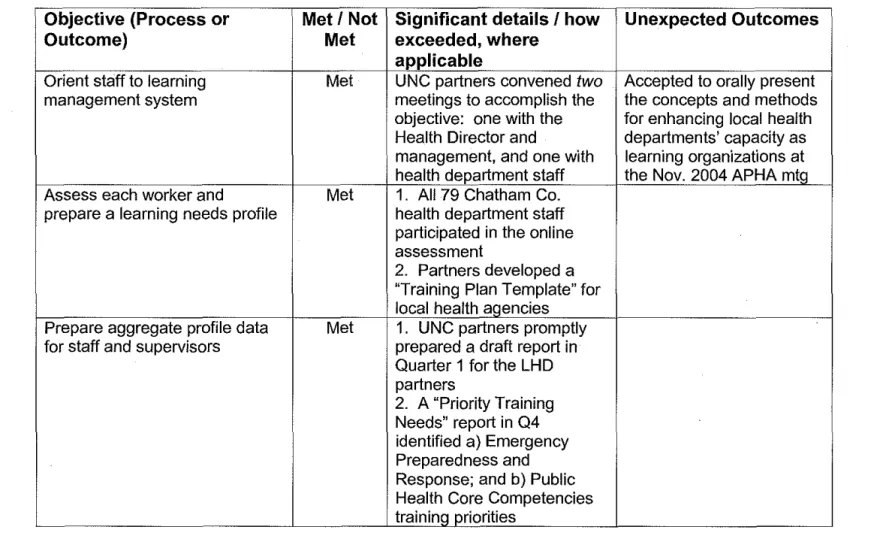
Table 1: Life Long Learning Model
Objective (Process or Met I Not Significant details I how Unexpected Outcomes
Outcome) Met exceeded, where
applicable
Orient staff to learning Met UNC partners convened two Accepted to orally present
management system meetings to accomplish the the concepts and methods
objective: one with the for enhancing local health Health Director and departments' capacity as management, and one with learning organizations at health department staff the Nov. 2004 APHA mtQ Assess each worker and Met 1. All 79 Chatham Co.
prepare a learning needs profile health department staff participated in the online assessment
2. Partners developed a "Training Plan Template" for local health agencies
Prepare aggregate profile data Met 1. UNC partners promptly for staff and supervisors prepared a draft report in
Quarter 1 for the LHD partners
Provide directory of available Met 1. Training directory Partners developed a training options includes 350 opportunities, matrix to facilitate use of
many of which are free the training options. Matrix 2. Partners compiled includes: training title, "training packages" specific description, provider, to the general public format, cost, and URL I
workforce, public health contact. nurses, and administrative
employees, based on trainings available
Establish training account for Met $7,500 account established. Partners leveraged local
Chatham County Health resources (government,
Department employees human resources offices)
for a sustainable life long learning environment Develop individual training plans Met 1. All employees received Partners ended up forming (with input from staff members, individual training plans Facilitated Learning Teams
supervisors, and health immediately upon for Year 2, which involve
department management) completion of the training peer leadership for training needs assessment through coordination I oversight the learning management
system.
2. Partners worked a lot on incentive plans for: a) fostering a learning environment; and b) completed training efforts [including payment at time of job performance evaluation for completing training identified in training plan] 2. Partners mapped out
departmental and
occupational training plans
Utilize the training account at Met To be used at Health
NCIPH for learning opportunities Director's discretion for cost-based trainings or training and learning environment resources (computers). or even monetary incentives for training completion.
Monitor processes Met Quantifiable, process- Year 2 Facilitated Learning
oriented activities were Teams will complete documented consistently baseline and quarterly throughout the project surveys, and meet
1. Quarter 2: monitored regularly to discuss learning environment experiences. barriers. and 2. Quarters 3, 4, accomplishments
monitored training plan implementation
Evaluate outcomes Met 1. Reported progress .
Year 2 Facilitated Learning quarterly for project Teams data will be used to
objectives plan the future workforce
2. Completed an evaluation development structure, survey for the Project accountability, and Evaluator, and participated strategy
Lifelong Learning Model, Model Specific Evaluation Questions
1. What percent of health department staff completed the training needs assessment?
One hundred percent of the 79 health department staff completed the training needs assessment.
2. What percent of health department staff utilized training plans?
All health department staff received an individualized training plan immediately upon completing the training needs assessment. Individual training plans were incorporated into the employee's pay for performance review plan, which is one measure of staff utilization of the training plan. However, data on use will not be available until October, 2005.
3. Did health department staff take advantage of assessment and training offered by SPH?
Health department partner staff completed a baseline training assessment offered by the SPH. The health department is reviewing locally available training and SPH trainings to identify the most appropriate training to meet a particular training need.
4. Did assessment results inform the agency training plan?
Assessment results, which provided priority competency training needs for the agency and occupational category, increased manager awareness of competency-based training needs. The health department partner created a lifelong learning infrastructure including Workforce Development Coordinators who are also focusing on training in priority areas. The health department is focusing training on priority needs to close identified gaps and examining how funds are used rather than just sending people to training.
5. Do staff follow recommended training plans?
The AHD project focus in the last year has increased use of training plans. The availability of Workforce Development Coordinators and link to pay for performance may increase use of training plans.
6. Are staff trained in identified competencies?
The health department addressed priority training needs in core public health, preparedness, and cultural competency across the agency.
7. Does this model result in more competent staff at appropriate levels?
With less than a year of targeted competency training at the health department, it is too early to measure if staff are more competent. But the health department partners state that the formal process is increasing competency across disciplines and levels of accountability. Ongoing focus on competency-based training and assessment will ensure this outcome.
Can the model be feasibly implemented? What resources are needed to implement and sustain the model?