Elder Food Safety Initiative: A Review of the Home Meal Delivery Process in Tribal Elder Nutrition Programs
By Andrea L. Hom
A Master's Paper submitted to the faculty of the University of North Carolina at Chapel Hill in partial fulfillment of the requirements for the degree of Master of Public Health in the
Public Health Leadership Program.
Chapel Hill
ABSTRACT
Introduction
Indian Health Service, Reno District, Environmental Health Services staff developed an initiative to assess food safety risk among home meal recipients at seven participating tribal elder nutrition programs (ENPs). Traditionally, the home delivery process could
significantly increase the risk of foodbome illness if inappropriate practices were being followed.
Methods:
The initiative included two assessment phases. The first assessment phase consisted of identifying food safety risks during the home delivery meal process and other operational issues related to the ENP. The second assessment involved administering a questionnaire to participants of the ENP in an effort to obtain information regarding elder food safety
knowledge, attitudes, and practices.
Results:
Eleven delivery processes, representing 7 ENPs, were assessed and had an average delivery time of 1.6 hours. Twenty-five potentially hazardous foods (PHFs) were monitored. By the end of delivery, 76% ofPHFs were below the hot holding temperatures recommended by the Food & Drug Administration. Fourteen critical control point (e.g., point or procedure in a food system at which a control can be applied and a food safety hazard prevented) failures were identified and included such deficiencies as failure to check and document final cooking temperatures (100%), failure to monitor the temperature of food received from a food distributor (100%), failure to monitor and document food temperatures during delivery (86%), and failure to monitor food temperatures after food purchase and transport (80%). Also, 29% of the ENPs were entering homes to leave meals when clients were away and 29% of the ENPs routinely left meals outside the client's home in a cooler or milk crate. One hundred and seventy eight questionnaires (51% return rate) were completed.
Findings revealed that 27% do not eat their meals immediately upon receipt, 23% had their meals left outside, and 13% had their meals left on the kitchen counter. Also, 93% of elders were unable to identify foods to avoid to reduce food safety risk.
Conclusion:
Based on the site assessments, ENPs should implement and adhere to standard operating procedures to address critical control points in their processes. They should also purchase the Nutri-System thermal bags, recently available on the market, as they can maintain 185° F during transport. Meals should not be left at the client's door or inside the home when the client is not at home. Rather a backup plan (i.e., support network) should be available and food safety education should be provided to all. In addition, further studies should be conducted with an emphasis on what happens to the meal once delivered.
2 Hom
l
TABLE OF CONTENTS
I. Background pp. 4-6
II. Methods pp. 6-8
III. Results pp. 8-11
N. Discussion pp. 11-18
v.
Conclusion pp. 18-20VI. References pp. 21-22
VII. Tables and Figures pp. 23-25
VIII. Acknowledgements pp. 26
f
BACKGROUND
Food safety is an important public health concern. It is estimated that in the United States 76 million illnesses, 325,000 hospitalizations, and 5,000 deaths are attributed to foodbome illness each year.1 According to the Centers for Disease Control & Prevention (CDC), more than 200 diseases are transmitted by food. Significant causes of foodbome illness include viruses, bacteria, parasites, toxins, and metals. Foodbome illness symptoms vary from mild gastroenteritis to life-threatening neurological, hepatic, and renal syndromes. The cost offoodbome illness is approximately $1 to $83 billion annually.1·2
Food safety is especially important among elders, a highly susceptible population, as foodbome illness may result in serious or long-term health consequences. The elder
population represents the largest at-risk segment of the US population for foodbome illness3 Reasons why elders are the largest at-risk population include having a weakened immune system, inflammation of the stomach lining and a decrease in stomach acid, and decline in sense of taste and smell? In addition, the projected population of elders 65 and older will increase 147% between the years 2000-20504 Elders age 85 and older also represent the fastest growing age group in the United States. 5
Elder Nutrition Programs (ENPs) were founded in 1972 and were authorized by Congress under Title VII (now Title III) ofthe Older Americans Act. The ENPs provide congregate and home-delivered meals to people 60 years and older, particularly to low-income elders and are the largest community nutrition program in the United States.6·8 In addition, there are many unique food safety challenges that ENPs nationwide face each year. These include serving and preparing food to a highly susceptible population, maintaining temperatures over long distances, high staff turnover, and delayed consumption of the home
delivered meal all of which increases the chances of foodbome illness. 9 Other challenges include funding for the program and lack of volunteers.
Home delivered meals are intended for the most vulnerable of the elder population. This includes individuals who are very aged, people living alone, people below or near poverty level, minority populations, and individuals with considerable health problems.10 Furthermore, the Administration of Aging states that home delivered meal participants have twice as many physical impairments as the overall elderly population.11 A combination of a limited budget, long held feelings against wasting food, and memory loss may further result in home meal delivery recipients keeping foods too long or improperly handling foods.10
Approximately, 61% of American Indian and Alaska Native (AI/AN) elders live in
addition, the life expectancy of Ail AN is three to four years less than that of the overall
t
I
f poverty, live in poor housing conditions, and are without access to adequate health care. InUnited States elder population.12 These contributing factors specific to AI! AN in addition to the factors for the general elder population increase the food safety risk significantly to this population.
District lliS staff were informed of several less than desirable food safety practices that were occurring as part of the delivery process such as leaving meals outside the home, entering the home to leave a meal when no one was home, and failure to monitor food temperatures during delivery. Given these factors, the Reno District lliS staff developed an initiative to assess food safety risks among home delivered meal recipients at seven
participating tribal elder nutrition programs in the summer and fall of2005.
METHODS
For tribes in the Reno District lliS Service Area to participate in this program, the tribes had to meet specific inclusion criteria. Criteria included: (1) the tribe must have an
ENP Program, (2) the ENP must home deliver at least 20 meals, and (3) the ENP must be
t
'
I
tinterested in participating in the program. Interest was determined following lliS EROs discussing the program with the ENP director, health director, and ENP staff.
The ENP project included two assessments, a site assessment and a questionnaire. A protocol was written to provide uniform and consistent directions to the EROs for
conducting each of the two assessments. Conference calls were also held monthly to provide ongoing communication during the initiative.
The first assessment consisted of an unannounced site assessment of the ENP. The purpose of the site assessment was to identify food safety risks during the home delivery process. Food safety risks were determined by visually observing and monitoring the home delivery process and documenting findings on a data collection form. This form was comprehensive and included the assessment of: (1) facility operations, (2) delivery
preparation, (3) delivery process, and ( 4) operational issues related to the return to the ENP.
A control plate (an extra meal) was used to monitor food temperatures of the home delivered meal during the delivery runs. A closeout discussion was also conducted at the end of each assessment with the ENP Director to discuss findings.
The site assessment form was based on the Food & Drug Administration (FDA) Food Code and the FDA Baseline Data Collection form. This FDA data collection form focuses on the five CDC identified contributing factors for foodbome illness. These factors include food from unsafe sources, inadequate cooking, improper holding time and
temperature, personal hygiene, and prevention from contamination. Results from the site assessment form were entered into an EXCEL spreadsheet and analyzed.
The second assessment included a self-administered questionnaire distributed to the elders served by the nutrition programs. The purpose of the questionnaire was to evaluate food safety knowledge, attitudes, and practices among the elders who participated in the initiative. The questionnaire consisted of eleven questions. ENP staff at each program distributed the questionnaire to both the elders who received meals at the ENPs and the elders who received meals at home. Food safety thermometers were provided to elders as an incentive for returning the completed questionnaire. Results from the questionnaire were entered into an EXCEL spreadsheet and analyzed.
A comprehensive literature review was conducted utilizing the Cumulative Index to Nursing & Allied Health Literature (CIAHL) and Pubmed databases. In addition, the reference lists of the identified documents were searched for relevant journal articles. An Internet search was also performed utilizing the search engine Google. Once websites were identified and reviewed, food safety experts and Meals-On-Wheels staff members were
l
~
contacted to obtain further information on food safety interventions specific to home delivery of meals for elder programs. All contact was via telephone and email.
RESULTS
SITE ASSESMENT
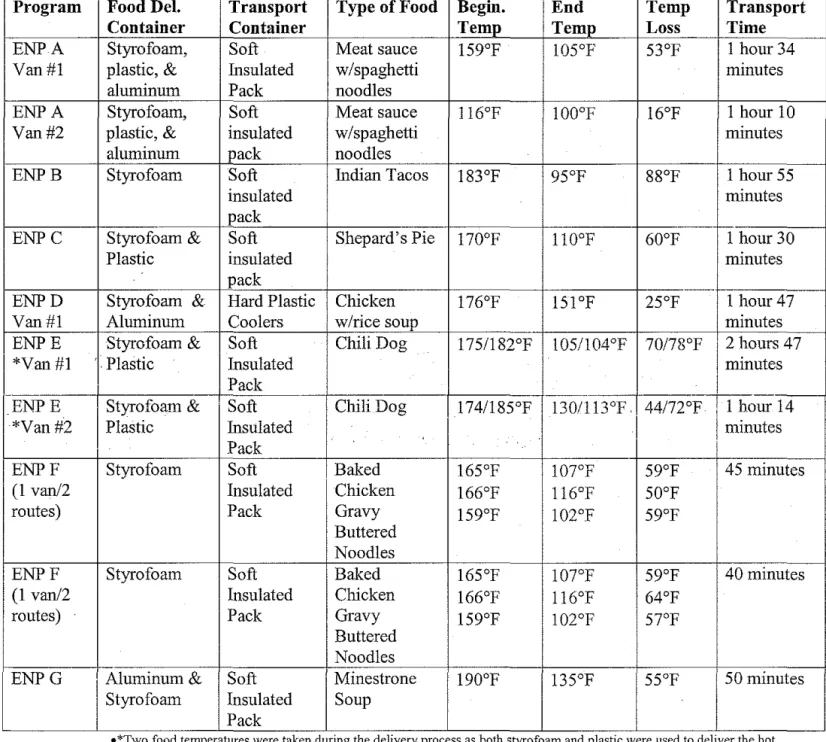
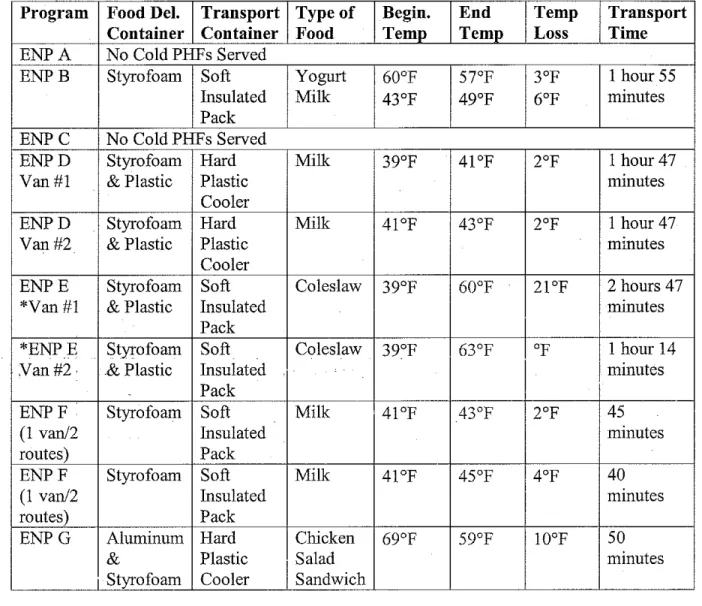
Collectively, these centers delivered 250 meals a day and served another 100 on site. The number of meals delivered at each center ranged from 20 to 75 and 43% (3/7) of programs utilized at least two vehicles for meal delivery. Thus, a total of eleven delivery processes were assessed. Results of the site assessment for cold potentially hazardous foods are summarized in table one. Results of the site assessment for hot potentially hazardous foods are summarized in table two.
Transport Time
Transport delivery runs took from 40 minutes to almost 3 hours with the average transport delivery time being 1.6 hours. Delivery time only included the time taken to deliver the meals and does not include the return time after the last meal has been delivered. Food Delivery Containers
The type of container that the food was stored in prior to transport varied. Some programs utilized styrofoam, aluminum, or plastic food delivery containers while most utilized a combination of these types. Food transport container types also varied depending on the type of food. Most used an insulated soft pack for hot holding. Only, 14% (1/7) of ENPs used a heating pad for transporting hot foods. For cold transport, the types varied widely and ranged from soft insulated coolers, milk crates, or plastic lined containers. Nearly, 72% (5/7) ofENPs did not utilize cold packs for transporting cold foods.
Food Temperatures
Twenty-five (25) potentially hazardous foods (PHFs) were monitored. According to the FDA Food Code, a potentially hazardous food is a food that is natural or synthetic (i.e., animal food or plant origin) and requires temperature control because it supports the growth of infectious or toxigenic microorganisms.13 Nine (9) were cold PHFs and sixteen (16) were hot PHFs. Sixteen percent (4/25) of the PHFs were out of temperature prior to leaving the elder nutrition program. Three of these were cold PHFs and one was a hot PHF. By the end of the delivery, 76% (19/25) PHFs had fallen out of temperature (14 hot and 5 cold foods). The FDA Food Code recommends that potentially hazardous food be at 41 °F or below for cold holding or 135°F and above for hot holding14 The decrease in the temperature of the hot foods ranged from 25°F to 88° F. Change in temperatures for the cold foods ranged from 2°F to 24°F.
Facility Operation
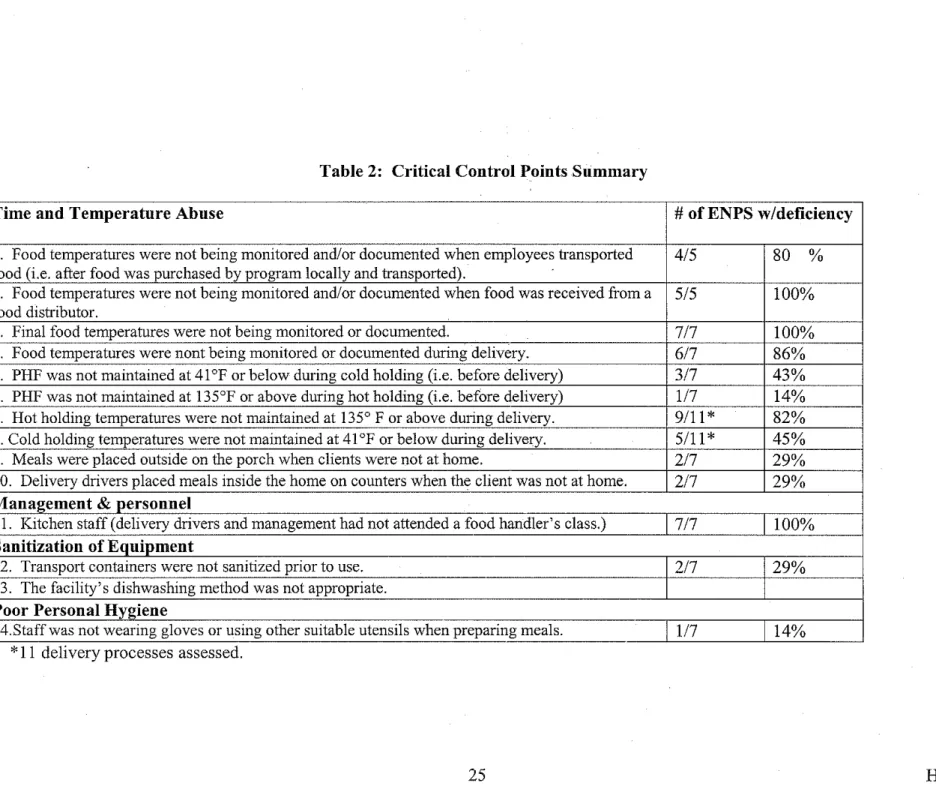
program had a1114 critical deficiencies. Rather, most programs had several or multiple critical deficiencies. Results of the identified CCPs are summarized in table three.
Moreover, the monitoring of food temperatures was a substantial concern in the ENP facility operation. One-hundred percent (7/7) of the ENPs were observed not checking and documenting final cooking temperatures. Furthermore, 86% (6/7) ofENPs were observed not monitoring food temperatures during home meal delivery. Eighty percent ( 4/5) of food temperatures were also not being monitored when employees transported food after
purchase and 100% (7/7) of food temperatures were not monitored when food was received on site from a food distributor.
Safety
It was also noted that 29% (2/7) ofENPs were entering homes when clients were away to leave meals on counters and 29% (2/7) ofENPs were observed leaving meals outside the client's home in a cooler or milk crate. ENP B left 29% (16/56) of their meals outside with no knowledge of when the client would return.
QUESTIONNAIRE
A total of 178 questionnaires were completed and returned which represented an overall elder participation rate of 51% (178/350). Of the returned questionnaires, 73% (1291178) were completed by elders whose meals were home delivered. Approximately, 73% (1 021140) of elders ate their meal immediately upon receipt, while 9% (131140) placed their meal in the refrigerator, 6% (9/1 02) placed their meal on the counter, 6% (811 02) in the oven, and 6% (811 02) reported doing something else with their meal other than the options listed on the questionnaire. When asked what happens to the meal if the elder was not home, 55% (74/134) stated that their meals were not delivered, 23% (311134) had their
meals left outside, 13% (17 /134) reported having their meals left on the counter, 8%
(111134) stated that their meals were placed in the refrigerator, and 1% (11134) reported their meal being placed in the oven. Nearly, 91% (153/169) of elders did not own a food
thermometer and 82% (138/169) reported they would like to have a food thermometer. Ninety-three percent (122/131) of elders were not able to identify any types of food that they should avoid to reduce the risk of foodbome illness. Seventy-five percent
(133/178) of elders reported that they were interested in learning about food safety. Most, 66% (117 /178) were interested in learning about food safety through flyers delivered to the home, 14% (251178) preferred tribal newsletter articles, I 0% (171178) preferred learning through a food safety class, and 10% (19/178) preferred learning from all three methods.
DISCUSSION
SITE ASSESMENT
The significant change in food temperatures during delivery may be attributed to the type of transport container used and the lack of or improper use of supplemental heating units for the hot PHFs and the nonuse of supplemental cooling units or ice packs for cold PHFs, Temperature loss will be discussed first for hot PHFs and then for cold PHFs,
HotPHFs
With the exception of one delivery vehicle, all hot PHFs were above 135°F prior to leaving the ENP, For the transport of hot PHFs, most ENPs utilized zipped insulated thermal bags. When researching the specification of this product, there was no assurance that the bags could maintain hot food temperatures. Rather, the bags were advertised as high efficiency units with no mention of temperature maintenance. Upon contacting the
manufacturer, it was reported that the bags \\ill keep a full container of food trays loaded at 185°F above 140°F for over an hour, longer if the bag is not opened and closed throughout the course of delivery. Given this information, it is important to note that only I hot PHF was loaded at 185°F. Furthermore, ENP staff were observed failing tore-zip the thermal transport bags between meal delivery stops, which contributed to the heat loss.
Another contributing factor to the decrease in hot PHF temperatures was the misuse of supplemental heating lmits or the lack of heating units. Heating nnits help to maintain food temperatures in the range of 140°F to 160°F tluough the gradual release of stored heat. To heat the nnit (e.g., heat bottle) properly, it must be placed in boiling water for 15 to 20 minutes. It should then be placed upright between two columns of trays or upright at the back edge side of the bag. Only, one of the seven ENPs utilized heating nnits. The ENP that did utilize the heating units was warming them in the dishwasher and placing them in
the top exterior sleeve of the thermal transport container. Thus, the heating units for this ENP were not warmed or placed correctly as recommended by the manufacturer's
instructions. With the transport runs on average lasting 1.6 hours, supplemental heat units and its proper use would be a necessity in order to maintain proper temperature. When discussing temperature loss, it should be mentioned that one ENP utilized hard plastic coolers for food transport. Food temperatures for these two delivery processes were
delivered within the recommended food safety range. The type of food, (soup) and the type of food delivery container (covered styrofoam cups) may have been the primary reason why
proper temperatures were maintained during delivery. Hard plastic coolers should be further
L
studied as a possible transport container type.=
.Cold PHFs
The type of container used to transport cold foods varied widely, from crates to hard
pla~tic coolers to insulated bags. Only a few programs were observed using cooling
elements such as ice packs or cooling units when delivering cold PHFs. Failure to use such items were believed to have caused the temperature increases seen during the site
assessment.
Temperature Findings
recommended food safety temperatures despite annual recommendations to increase food temperatures and to deliver meals quickly16
Initially, it was believed that time as a public health control could be used to address temperature loss issues. Mr. John Marcello, FDA Regional Food Specialist was contacted for guidance. Per Mr. Marcello, the current version of the FDA Food Code was intended to allow the use oftime as a microbial control only when food items were immediately
consumed. Variances may be granted if the food service program were to demonstrate through written procedure and documentation that the product is only out of temperature for 4 hours or otherwise discarded. This would be extremely difficult if not impossible as ihe meals are dropped off and ENP staff do not remain at each home to verify when the product
:c-is consumed. Thus, it :c-is strongly recommended that the ENP programs should deliver their
L
!meals to elders at the proper temperature (e.g., either above 135°F for hot foods or below 41 °F for cold foods) and stress that if they are not eaten right away they should be refrigerated and reheated.17
As mentioned in the results section, 14 critical control points (CCPs) were identified. The most significant CCPs include: Failure to monitor and document the temperatures of food transported to the facility by ENP staff (80%), failure to monitor and/or document the temperature of food obtained by the food distributor (100%), failure to monitor and
document final food temperatures (100%), failure to monitor and document food delivery temperatures (86%), failure to maintain hot holding temperatures (82%) and cold holding temperatures during meal delivery (45%), and lack of food safety education among delivery drivers and management (100%). Most of the operational issues were due to the lack of Standard Operating procedures (SOPs). The lack offood safety education was largely due
to high turnover from staff and unawareness of the need for education. The lack of SOPs during critical operational processes and lack of food safety education are key contributing factors to increasing food safety risk and must be addressed.
QUESTIONNAIRE
From the questionnaire, it was determined that approximately 27% (38/140) of elders who receive their meals home-delivered do not eat their meals right away. This statistic is consistent with other studies regarding meal disposition of home-delivered meals among elders. In a study conducted by Asp and Darling, it was noted that approximately one-half of home delivered meal recipients were saving their meal for later consumption? In another study by Lau et al, it was reported that only 12% of 400 clients were consuming their home delivered meals in their entirety after delivery.18 These studies are significant in showing the numerous occurrences of the delay in the consumption of home delivered meals.
Furthermore, delayed consumption is a considerable food safety risk to the elder population when food is not delivered within the recommended food safety range. Elders should be encouraged to eat their meal immediately upon receipt.
Another significant finding from the questionnaire was meal delivery practices when the client was not at home. Fifty-five percent (74/134) of elders responded that their meals were not delivered, however 45% (60/134) of elders stated that their meals were left outside, placed on the counter, in the refrigerator, or in the oven. Because elders are a highly
temperature danger zone should be a liability concern for the ENPs as well as a food safety risk to the consumer. In addition, allowing the delivery driver to enter into the home while the elder was not at home could lead to problems with theft or the accusation of theft.
A secondary finding of the questionnaire was the need to determine necessity, interest, and focus for food safety education among elders. Approximately, 93% (122/131) of elders were unable to identifY foods that should be avoided to reduce their risk of foodbome illness. Much is known about the elder population as a highly susceptible population, but little is know about their food safety practices at home and their general understanding of food safety.17 From this questionnaire, the IHS EROs were able to determine that there is a strong interest in food safety education among elders as well as the preferred method of communication. This initiative did not include a food safety
educational component as it was felt that addressing operational deficiencies and equipment needs were more critical. However, such activities should be planned and implemented in the future.
Interventions
l
Interventions for the ENP initiative focnsed on SOPs and equipment related interventions. However, the equipment related interventions were not implemented at this time because of the lack of funding. It is also important to note that there was no cost associated with developing or implementing the SOPs as an intervention. Therefore, the SOPs were implemented immediately during this initiative.
Nine SOPs were introduced based on site assessment findings only and specific to addressing operational food handling deficiencies for each participating center. The SOPs were based on sample plans provided from the Iowa State University Hazard Analysis
' l
r-L
Critical Control Point (HACCP) website. HACCP is a scientific and rational approach to food safety, which identifies and analyzes potential hazards in the food process and develops monitoring procedures to determine if the hazards identified are being effectively
controlled.19 Model candidates for conducting HACCP studies include establishments that serve food to a high-risk population, such as elders.20 The nine SOPs included policies as well as food temperature logs for monitoring final cooking, holding, refrigeration, and delivery temperatures. A weekly's manager's HACCP checklist was also included to promote internal inspections. EHOs discussed the SOPs with staff prior to use at the ENPs. A follow-up visit was conducted by the EHOs to address any questions or concerns from the ENP staff regarding implementation of the SOPs.
Based on site assessment findings, it was also apparent that equipment relating to the maintenance of food temperatures during meal delivery was essential as an environmental intervention for this initiative. An environmental intervention approach relies on making the environment or the product such as the home delivered meal safer. 21 After numerous
highly susceptible population.9 Other reasons for recommending this product include: durability, ease of cleaning, holding capacity, and weight of bag with electric heater versus weight of bag with heating unit. Although this equipment related intervention was not implemented, much research was conducted on this product and recommendations were made to ENPs to purchase this equipment as funding becomes available.
Once the equipment intervention is implemented, an evaluation should be conducted to monitor and assess the impact and outcome of the interventions. An evaluation
component is essential to determine the effect of the SOPs and the equipment related
intervention. Specifically, an evaluation would be essential to demonstrate if the
L
r-interventions caused a change or benefit for the participating ENPs.22
Additional research was also conducted to locate grants that may be utilized by ENPs for delivery vehicles. Two of the participating programs were awarded delivery vehicles during this initiative. Findings from the ENP initiative were utilized in a support letter to assist in the funding of the delivery vehicle for one of the participating ENPs.
CONCLUSION
Home delivered meals are intended to help the elder population live longer independently in their own communities.23 Elders receiving home delivered meals are generally homebound and rely on these meals to be safe.24 Because of the lack of
information regarding food safety and the home delivered meal process, further studies are needed on determining what happens to the meal once it is delivered. Based on these further studies, ENPs could modify their home meal delivery services (e.g., meal containers, food
safety storage recommendations, etc.) and direct educational efforts related to their findings.3
Consideration should also be given to developing and utilizing support networks. A support network may be a neighbor or a family member who would accept the meals on the elder's behalf. 9 In addition, ENPs should encourage clients to eat their food immediately and properly store leftovers. Food should never be left at the client's door or inside the home when the client is not at home. A backup plan should be readily in place in this type of situation.9 For example, ENP B now encourages clients to call the ENP to set up an alternative time to deliver the meal when the elder or other family member (i.e., support network) will be at home to receive the meal.
Communicating food safety messages to elders through flyers, newsletters, and simple pictures and signs may also help improve food saJ:ety knowledge among elders and ultimately impact food safety practices. The "Safe on Your Plate" educational resource program was designed for recipients of home delivered meals. This program included color-coded labels, which could be attached to the meal containers to provide educational
information on recommended food safety practices. Delivery dates were also labeled on each meal. Participants ofthis program strongly agreed that dating delivered meals and providing food safety information was needed to reduce the food safety risk among elders.1 0 Food safety education is also necessary for ENP staff. Training should be provided to include cooks, kitchen assistants, delivery drivers, and management. Education is essential in reducing food safety risk, but it is of particular importance to this high-risk group.
role should include providing guidance on the implementation of SOPs and providing essential educational components to ENP staff. Moreover, the annual comprehensive
envirornnental health surveys conducted by EHOs should consistently include an assessment of the horne meal delivery process. While annual comprehensive envirornnental health surveys provide guidance on proper food safety practices, the chief responsibility for handling and delivering the horne delivered meals on a daily basis rests with ENPs. It is strongly encouraged that ENPs adopt and implement SOPs to reduce food safety risk. In addition, ENPs should delivery PHFs in the recommended food safety temperature range and take appropriate corrective actions as needed. As the elder population grows so will the need for assuring good food safety practices.
REFERENCES
1. Mead, P.S., Slutsker, L., Dietz, V., McCaig, L.F., Bresee, J.S., et al. (1999) Food-Related Illness and Death in the United States. Emerging Infectious Diseases, 5(5),
p. 607-625.
2. National Policy & Resource Center on Nutrition & Aging. In Food Safety and Sanitation. (Chap. 5: National Food Safety Issues). Retrieved May 10,2004, from
http://www.fiu.edu/-nutreldr/OANP Toolkit/Food Safety02 18 03.htm 3. Fey-Yensan, N., English, C., Ash, S., Wallace, C., & Museler, H. (2001). Food
Safety Risk Identified in a Population of Elderly Home-Delivered Meal Participants.
Journal of the American Dietetic Association, 101 (9), p. 1055-1057.
4. U.S. Census Bureau, (2005, Apr. 25). In Facts for Features: Older Americans Month Celebrated in May. Retrieved Sept. 16,2005, from
http://www.census.gov/Press-Release/www/releases/archives/facts for features special editions/004210.html. 5. Stevens, D., Grivetti, L., & McDonald, R. (1992). Nutrient Intake of Urban and
Rural Elderly Receiving Home-Delivered Meals. Journal of the American Dietetic Association, 92(6), p. 714-719.
6. Balsam, A., Sullivan, A., Millen, B., & Rogers, B. (2000). Service Innovations in the Elderly Nutrition Program: Two Decades of Accomplishments. Journal of Nutrition for the Elderly, 19(4), p. 41-48.
7. Department of Health & Human Services, (1997, Mar. 19). Morning Meals on Wheels Program Initiative Announced. Retrieved Sept. 26, 2005, from
http://www .hhs. gov/news/press/1997pres/970319 .html
8. Balsam, A., Bottum, C., & Rogers, B. (1992). Project Director Characteristics in the Elderly Nutrition Program. Journal of Nutrition Education, 11(3), p. 33-44.
9. Mathieu, J.(2002). Food Safety and Home Delivery. Journal of the American Dietetic Association, 101(12), p. 1744-1746.
10. Foote, R.A. & Clark, L. (2000). Gem No. 321. Safe on yonr plate: Keeping Home Delivered Meals Safe. Journal of Nutrition Education, 32(4), p. 233C-234C.
11. Fact Sheet: Elderly Nutrition Program Evaluation. U.S. Department of Health and Human Services, Administration on Aging Website. Retrieved September 8, 2005 from http:/ /www.aoa.dhhs. gov/aoa!nutreval/fulltest/voll ch1.html.
13. U.S. Department of Health & Human Services & Food & Drug Administration, (2001). FDA Food Code. (p. 12-13). Washington D.C.
14. U.S. Department of Health & Human Services & Food & Drug Administration, (2001). FDA Food Code. (p. 68-69). Washington D.C.
15. Department of Health & Human Services, & Food & Drug Administration, (1998).
Regulatory Applications in Retail Food Establishments. (3rd edition). (p. 5-7). Rockville, MD: State Training Branch.
16. Asp, E. H. & Darling, M. E. (1988). Home-Delivered Meals: Food Quality, Nutrient Content, ;md Characteristics of Recipients. Journal of the American Dietetic
Association, 88(1), p. 55-59.
17. Gettings, M.A. & Kiernan, N. E. (2001). Practices and Perceptions of Food Safety Among Seniors Who Prepare Meals at Home. Journal of Nutrition Education, 33(3),
p. 148-154.
18. Lau, D., Coleman, P., & Krondl, M. (1994). Delayed Consumption Patterns of Home-Delivered Meals By Elderly Recipients 75+ years. Journal of the American Dietetic Association, 94, p. A-61.
19. Department of Health & Human Services, & Food & Drug Administration, (1998).
Regulatory Applications in Retail Food Establishments. (3rd edition). {p.18-19). Rockville, MD: State Training Branch.
20. Department of Health & Human Services, & Food & Drug Administration, (1998).
Regulatory Applications in Retail Food Establishments. (3rd edition). (p. 1-3). Rockville, MD: State Training Branch.
21. Christoffel, T. & Gallagher, S. (1999). Injury Prevention: Environmental
Modification. Injury Prevention and Public Health (p. 161-179). Gaithersburg, MD: Aspen Publishers, Inc.
22. Issel, L. M. (2004). Planning the Methods for Evaluating Intervention Effects. Health Program Planning and Evaluation (p. 279-283). Sudbury, MA: Jones and Bartlett Publishers.
23. Fogler-Levitt, E., Lau, D., Csima, A., Krondl, M., & Coleman, P. (1995). Utilization of Home-Delivered Meals by Recipients 75 Years of Age or Older. Journal of the American Dietetic Association, 95(5), p.552-557.
24. Food Safety and Inspection Service. (2002). Seniors Need Wisdom on Food Safety. Retrieved on May 10,2004 at http://www.fsis.usda.gov/oa/pubs/seniors.htm.
Program ENPA Van#1 ENPA Van#2 ENPB ENPC ENPD Van#1 ENPE *Van#1 ENPE *Van#2 ENPF
(1 van/2 routes)
ENPF
(1 van/2 routes)
ENPG
Table 1: Meal Delivery Results for Hot PHFs
Food Del. Transport Type of Food Begin. End Temp Transport
Container Container Temp Temp Loss Time
Styrofoam, Soft Meat sauce 159°F 105°F 53°F 1 hour 34
plastic, & Insulated w/spaghetti minutes
aluminum Pack noodles
Styrofoam, Soft Meat sauce l16°F 100°F l6°F 1 hour 10
plastic, & insulated w/spaghetti minutes
aluminum pack noodles
Styrofoam Soft Indian Tacos 183°F 95°F ggop 1 hour 55
insulated minutes
pack
Styrofoam & Soft Shepard's Pie 170°F 110°F 60°F 1 hour 30
Plastic insulated minutes
pack
Styrofoam & Hard Plastic Chicken 176°F 151°F 25°F 1 hour47
Aluminum Coolers w/rice soup minutes
Styrofoam & Soft Chili Dog 1751182°F 105/104°F 70/78°F [2 ~ours 47
Plastic Insulated mmutes
Pack - -
I
!
1 hour 14 Styrofoam & Soft Chili Dog 174!185°F 130/113°F. 44/72°FPlastic Insulated
I
I
minutesPack
Styrofoam Soft Baked 165°F 107°F 59°F 45 minutes
Insulated Chicken 166°F l16°F 50°F
Pack Gravy 159°F 102°F 59°F
Buttered Noodles
Styrofoam Soft Baked 165°F 107°F 59°F 40 minutes
Insulated Chicken 166°F ll6°F 64°F
Pack Gravy 159°F 102°F 57°F
Buttered Noodles
Aluminum& Soft Minestrone 190°F 135°F 55°F 50 minutes Styrofoam Insulated Soup
Pack
•*Two food temperatures were taken dunng the dehvery process as both styrofoam and plastic were used to deliver the hot meal.
•Red color font indicates food that was out of the recommended FDA food safety temperatures.
Table 2: Meal Delivery Results for Cold PHFs
Program Food Del. Transport Type of Begin. End Temp Transport
Container Container Food Temp Temp Loss Time
ENPA No Cold PHFs Served
ENPB Styrofoam Soft Yogurt 60°F
srF
3°F I hour 55Insulated Milk 43°F 49°F 6°F minutes Pack
ENPC No Cold PHFs Served
ENPD Styrofoam Hard Milk 39°F 41 °F 2°F I hour47
Van#! & Plastic Plastic minutes
Cooler
ENPD Styrofoam Hard Milk 4!°F 43°F 2°F I hour 47
Van#2 & Plastic Plastic minutes
Cooler
ENPE Styrofoam Soft Coleslaw 39°F 60°F 21 °F 2 hours 47
*Van#! & Plastic Insulated minutes
Pack
11 hour 14 *ENPE Styrofoam Soft Coleslaw 39°F 63°F OF
Van#2 & Plastic Insulated
I
/minutes
Pack
-l
r
I
fENPF Styrofoam Soft Milk , 4!°F 43°F 2°F 45
(1 van/2 Insulated minutes
routes) Pack
ENPF Styrofoam Soft Milk 41°F 45°F 4°F 40
(I van/2 Insulated minutes
routes) Pack
ENPG Aluminum Hard Chicken 69°F 59°F 10°F 50
& Plastic Salad minutes
i Styrofoam Cooler Sandwich
Table 2: Critical Control Points Summary
Time and Temperature Abuse # ofENPS w/deficiency
1. Food temperatures were not being monitored and/or documented when employees transported 4/5 80 % food (i.e. after food was purchased by program locally and transported).
2. Food temperatures were not being monitored and/or documented when food was received from a 5/5 100% food distributor.
3. Final food temperatures were not being monitored or documented. 717 100% 4. Food temperatures were nont being monitored or documented during delivery. 617 86% 5. PHF was not maintained at 41 °F or below during cold holding (i.e. before delivery) 3/7 43% 6. PHF was not maintained at 135°F or above during hot holding (i.e. before delivery) 1/7 14% 7. Hot holding temperatures were not maintained at 135° F or above during delivery. 9111
*
82%8. Cold holding temperatures were not maintained at 41 °F or below during delivery. 5/11
*
45%9. Meals were placed outside on the porch when clients were not at home. 2/7 29% 10. Delivery drivers placed meals inside the home on counters when the client was not at home. 2/7 29%
Management & personnel
11. Kitchen staff (delivery drivers and management had not attended a food handler's class.) 1717 1100%
Sanitization of Equipment
12. Transport containers were not sanitized prior to use. 2/7 29%
13. The facility's dishwashing method was not appropriate.
Poor Personal Hygiene
14.Staffwas not wearing gloves or using other suitable utensils when preparing meals. 1117 114%
Acknowledgements
I want to thank CDR Gina Pahona, Reno District Environmental Health Officer, Indian Health Service, for her hard work and dedication to the development of this paper. I also want to express my appreciation to the IRS Reno District Environmental Health Staff and the participating tribal ENPs. Without their assistance, this initiative would not have been possible.