2009. 48 pages. Advisor: Jane Greenberg
Metadata plays an important role in the discovery, access, and use of materials in institutional repositories (IRs). Thus far, little empirical research been conducted to assess and evaluate metadata quality practices in place. This study begins to address that gap in knowledge by gathering data on current practices and procedures relating to metadata quality and evaluation in institutional repositories. A survey was distributed to individuals at ARL-member institutional repositories with knowledge of their
institution’s metadata procedures. The survey specifically gathered data on what
metadata practices were in place and whether quality control procedures were being used. Forty respondents provided results that offer a state of the art view into the current
metadata quality practices in place at IRs. Survey results indicate that metadata activities may not yet be streamlined into institutional workflow. For most institutions, metadata quality checking is a manual process, with only a small percentage (4%) employing the use of automated tools. Additionally, institutions rely on users as much as repository to staff to discover quality problems. Other results indicate that the majority of institutions surveyed are maintaining documentation relating to metadata policies. For example, 75% of respondents reported that their institution had developed either minimum metadata requirements or metadata submission guidelines for contributors. Overall, these results reflect the challenges and growing pains facing institutions as they adapt to managing materials in the digital world.
Headings:
Institutional Repositories--United States Surveys--Metadata
by
Alexandra M. Chassanoff
A Master’s paper submitted to the faculty of the School of Information and Library Science of the University of North Carolina at Chapel Hill
in partial fulfillment of the requirements for the degree of Master of Science in
Information Science.
Chapel Hill, North Carolina December 2009
Approved by
Table of Contents
Introduction 2
Literature Review 5
2.1 The domain of institutional repositories 5
2.2 Metadata quality in institutional repositories 7
2.3 Conceptual frameworks for metadata quality 9
2.4 Metadata quality indicators 12
2.5 Metadata quality evaluation techniques 14
Methodology 18
3.1 General description 18
3.2 Participants 18
3.3 Procedures 19
3.4 Data analysis 20
Results 21
4.1 Metadata practices within IR settings 21
4.2 Institutional holdings 22
4.3 Software platforms 23
4.4 Metadata management 23
4.5 Metadata documentation 26
4.6 Repository infrastructure 28
4.7 Metadata quality 29
Discussion 31
Conclusion 36
References 38
Appendix A: Survey 41
Appendix B: Recruitment Email 45
Introduction
The growth of digital resources in the last thirty years has presented both unique
opportunities and problems to the higher education community. On the one hand, the
emergence of a networked environment has enabled scholars to have wider access to
materials. The changing landscape has created new norms and expectations for service;
researchers no longer have to visit the library to retrieve journal articles, unlike even ten
years ago. On the other hand, the subsequent effective management of these digital
resources requires the presence of robust infrastructures.
One response to the growing body of digital scholarship has been the
development of academic institutional repositories in the last decade. Lynch (2003)
defines institutional repositories as consisting of “a set of services that a university offers
to the members of its community for the management and dissemination of digital
materials created by the institution and its community members” (Defining institutional
repositories section, para. 1). Their diverse holdings can consist of many different types
of resources (scientific data sets, journal articles, unpublished research) and a host of
different materials and formats (posters, digital images, video, text files, presentations,
among other types). In her survey of American academic institutional repositories,
McDowell (2007) found the majority of content to be student-produced, including over
The management and stewardship of digital scholarship for use by the wider
community is largely enabled through the creation and maintenance of metadata.
Greenberg (2001) defines metadata as “structured data about data that supports the
discovery, use, authentication, and administration of information objects” (p. 918).
Metadata acts as a physical surrogate for digital objects by describing its corresponding
properties. In the context of institutional repositories, it follows that successful metadata
creation will support and enable the discovery, access, and use of digital resources.
Presumably, unsuccessful (or poor quality) metadata creation will impact the ability of
users to carry out these same functionalities. Consequently, institutional repositories
should include practices to evaluate metadata quality as part of their infrastructure.
Many research studies have been undertaken exploring the relationship between
metadata quality and digital repository usage (see Anderson, 2006; Bruce & Hillman,
2004; Lagoze et al., 2006, Shreeves et al., 2005). Yet relatively little empirical research
has been conducted on metadata quality and evaluation in the specific domain of
institutional repositories. There are currently no standardized methods or procedures in
place for evaluating metadata; instead, only conceptual frameworks for evaluation and
suggested quality criteria indicators exist. Furthermore, the number of institutional
repositories employing metadata quality control practices is yet unknown.
This research seeks to address this gap in knowledge by asking the following
questions:
1. What metadata practices are currently in use at institutional repositories?
The results of this research provide a state-of-the-art perspective on current metadata
quality evaluation practices and procedures in institutional repositories. Additionally, the
following results are reported on for US academic institutional repositories:
• Overall impressions of metadata quality
• The percentage with quality control procedures in place
• The percentage using quality-enforcing structures such as controlled vocabularies • The percentage providing metadata guidelines for depositors
• The percentage with existing documentation on metadata quality • Descriptions of how repositories discover quality issues
Overall, these results provide baseline data for determining quality measures and
Literature Review
2.1 The domain of institutional repositories
The emergence of institutional repositories in academic settings is a relatively
recent phenomenon. Lynch & Lippincott (2005) conducted one of the first investigations
of the state of academic institutional repository deployment in the United States through
their work with the Coalition for Networked Information (CNI). One limitation of the
study was its small sampling frame (124), roughly half of all U.S. doctoral-granting
research universities, with 97 survey participants. However, the study did offer an early
glimpse into deployment statistics; 41 repositories were reported to be fully operational.
One complicating factor in measuring deployment has been the reluctance of researchers
to define institutional repositories for survey participants. For example, the CNI study
requested that respondents complete their survey with their own view of what constitutes
an institutional repository (Survey of US higher education institutions section, para. 6).
Similarly, the absence of a widely-agreed upon definition of institutional
repositories has been problematic. A variety of organizational models based on differing
visions have been proposed. In a SPARC position paper, Crow (2002) writes that
institutional repositories should serve as alternative publishing models for scholarly
communication. He explains, “Institutional repositories can provide an immediate and
innovation in a new disaggregated publishing structure that will evolve and improve over
time” (p.5). On the other hand, Lynch, who provides the key definition in use for my
research study, advocates that institutional repositories supplement, rather than replace,
traditional publishing models. A key distinction is Lynch’s emphasis on the lifecycle
management of digital scholarship. Such a distinction has wide-ranging implications for
the establishment of a model which must support access, use, and preservation services.
The development of the Open Archive Initiative (OAI) in 2000 proved to be
highly influential on the organizational model of institutional repositories. The OAI was
born out of the EPrint community, and was initially concerned with providing
interoperable standards and guidelines for disseminating open-access digital content
(Lagoze, 2005). An important manifestation of these efforts was the creation of the
PMH, a standard protocol establishing for harvesting metadata from different
OAI-compliant data providers. The OAI-PMH standards enable the large-scale aggregation of
compliant resources, both within individual repositories and throughout an established
network or domain. As Hitchcock (2007) explains, “For the first time institutions such as
universities have the ability to capture, store and disseminate copies of the published
work of their own researchers. The importance of this cannot be understated” (Evolution
of institutional repositories, para. 2). The protocol has since been widely adopted for use
by institutional repositories; according to the online University of Illinois OAI-PMH Data
Provider Registry, there are currently 2,156 OAI-compliant repositories actively
2.2 Metadata quality in institutional repositories
The unique qualities that characterize academic institutional repositories also
greatly influence the quality of metadata. For instance, harvesting through the OAI-PMH
aggregates together metadata from a variety of disparate resources. Yet successful
harvesting requires syntactically correct metadata element usage. In 2004, the Canadian
Association of Research Libraries concluded an analysis of metadata records with the
following: “Metadata inconsistency and incompleteness are presenting a significant
challenge to the effective harvesting and searching of institutional repository records”
(Jordan & Shearer p.2). Moreover, harvesting tools like OAIster have exposed the vast
quality problems found in metadata. Spelling mistakes, inconsistent data entry on author
and title fields, malformed subject descriptions, and non-standardized date formats are
just a few of the problems exposed through metadata harvesting (see Barton, Currier &
Hey 2003; Ward 2003).
The lack of a standard metadata application profile or namespace for institutional
repositories complicates matters; metadata elements can be drawn from a variety of
metadata schemas with different conformance standards and the potential for semantic
context loss. For example, Repository A may use the Dublin Core element “format” to
describe the dimensions of an item. On the other hand, Repository B may be using the
Library of Congress’ Metadata Object Description Schema (MODS) metadata schema for
their descriptive metadata. With a higher number of descriptive elements, the MODS
schema typically allows for a more granular description items. Repository B may
describe the resources of an item through the use of multiple qualifier elements like
Another complicating factor is the discrepancies in required metadata element
usage across repositories. Repository A may require that all deposited journal articles
have a corresponding abstract submitted by the author(s). However, Repository B may
instead require that journal authors select keywords or subject headings to help describe
their works. These discrepancies complicate the potential for automated quality
evaluation procedures, contributing to the persistence of quality problems by failing to
establish conformance standards. As Duval, Hodgins, Sutton, & Weibel (2002) have
argued, “Communities of practice should be encouraged to further specify standards of
practice for a given metadata standard that will encourage uniformity of descriptions
within a given domain” (Mandatory Versus Optional Elements section, para. 2).
The few empirical investigations of metadata quality in institutional repositories
have focused on evaluating the aggregated output of harvesters within the Open Archive
community. In her examination of OAI-compliant data providers, Ward (2003) found
that, on average, only 8 of 15 required Dublin Core elements (p.316). Cole and Shreeves
(2004) looked at a pilot implementation of a collection and item-level metadata registry.
They found an immense diversity of controlled vocabulary usage, thereby impacting the
effectiveness and utility of using metadata for interoperability. They suggest that it would
be useful for the OAI-PMH to help define a “quality, shareable metadata” that
enumerates what attributes or metrics of quality produce truly interoperable metadata.
The authors conclude that while aggregation serves a useful function, more guidance is
needed on how best to optimize metadata. Efron (2007) examined the degree to which
OAI-compliant institutional repositories made use of the standard 15 Dublin Core
of 18.28 Dublin Core elements occurring per record. “Date” and “identifier” were the two
most frequently occurring elements, followed by “title,” “language,” and “format.” The
terms “contributor,” “rights,” and “coverage” were used the least and “source” was not
utilized at all.
While this research highlights the importance of interoperability for repositories,
it obscures the need to evaluate the context and required functionalities of metadata. It
also does little to establish measures for analyzing good metadata quality. As Rothenberg
(1996) writes, “The appropriateness of using a database for some purpose cannot even be
defined--let alone evaluated--until that purpose is specified. For these reasons, it is
important to focus on the evaluation and assessment of data quality, in addition to its
improvement” (Evaluating data quality in order to improve it, para. 2)
2.3 Conceptual frameworks for metadata quality
Approaches to metadata quality evaluation frequently draw upon the vast body of
data quality literature that exists. This connection is legitimized by Orr, whose sixth rule
of data quality states that “laws of data quality apply equally to data and metadata” (p.
68). Given this relationship, and the relative newness of metadata creation processes, it
is appropriate to briefly review Rothenberg’s discussion of data quality in order to
conceptualize frameworks for metadata quality evaluation.
Rothenberg (1996) proposes that the concept of data should be understood as an
abstracted model of reality. The representation choices of how to model that data
efficiently inevitably impacts its evaluation. Data quality can be defined as “a measure of
overview). Data should be evaluated in the context of its intended use; the results of
these evaluations should then be utilized to make improvements to quality. Data quality
assurance has tended to focus on validation of output (“the best data possible”) rather
than on performing explicit evaluations of purpose and intent (“how good is it?”). Thus,
a first step in evaluating data quality should be to specify the functionality it needs to
provide and the tasks it needs to support.
Rothenberg lists categories of what he terms “metadata” at three distinct levels:
the database level, the data element (or data-dictionary) level, and the data value level.
Each level contains a number of requirements that can be used to measure quality. At the
database level, for example, metadata should capture “description” and “meaning” of the
database, as well as its “intended use/range of purposes” and “constraints.”
Cumulatively, they can be seen to comprise an essential foundation for evaluating
metadata quality.
Rothenberg’s metadata categories should be understood as conceptual
requirements, rather than the more functionally-oriented elements found in standardized
metadata schemas. For instance, Rothenberg states that at the data element level, the
attributes of “resolution, precision, and intended/expected accuracy” should be expressed.
Still, the ideas that persist underneath these term structures can be mapped to specific
schema elements. Moreover, Rothenberg’s conceptual framework can be effectively
transposed onto the standard metadata application profile, which is made up of the
While there has been no official consensus on conceptual and operational
definitions of metadata quality, a variety of frameworks have been explored and tested.
Stvilia and Gasser (2008) propose a value-based assessment of metadata quality, a
baseline model that evaluates the value of metadata in the context of particular activities.
Established models can be used to contextualize and identify metadata requirements for
successful activity completion. For example, the authors mention the FRBR
bibliographic model, which outlines specific discovery tasks of “find, identify, select, and
obtain” (p.12). They stress two different approaches, analytical and empirical, which
can be used to estimate levels of quality for designated community. The former
conceptualizes metadata requirements for particular activities, whereas the latter “helps to
infer the actual or active model for quality of a particular data provider or end-user”
(p.16).
To test their model, the authors used aggregated, unqualified Dublin Core
metadata records harvested by the IMLS Digital Collections and Content project. Their
sample consisted of approximately 150,000 objects collected from more than 20 different
data providers. Their findings indicate a difference in Dublin Core element usage, based
on provider, provider type, and object type variables. The total number of distinct
elements used was much higher for academic libraries (21) than for public libraries (14)
and museums (17). While Dublin Core best practice guidelines suggest a minimum of
eight distinct elements, the authors suggest that perhaps that number be inflated to eleven.
They conclude that different types of data providers will use different baseline quality
Barton, Currier & Hey (2003) advocate separating out the concepts of structure
and content in quality evaluations, with an emphasis on the latter. They describe a
number of common data quality issues which occur in metadata records, including
spelling mistakes, inconsistent data entry on author and title fields, malformed subject
descriptions, and non-standardized date formats. Though the authors primarily conduct a
review of current literature, their stated intention is to “stimulate debate in the area of
quality assurance for metadata creation across a range of communities of practice” (p. 8).
Such debates can prove essential in prompting further research.
2.4 Metadata quality indicators
Moen, Stewart & McClure (1998) analyzed the metadata record content at GILS,
a US Government-produced network information service. They give two levels of
quality assessment measures: compliance with document requirements and
utility/appropriateness of elements in supporting the intent(s) of the user(s). Based on a
review of the literature, researchers identified a set of 23 criteria for assessing metadata
quality, including accuracy, comprehensiveness, content, consistency, timeliness, and
usability, among others. Using both quantitative and qualitative content analysis
techniques, researchers evaluated approximately 3,500 metadata records. They narrow
down to 3 general criteria effective for measuring quality: “accuracy,” “completeness,”
and “delineation of information resource type” (pp. 249-254).
Bruce and Hillmann (2004) cite the risk in assessing quality by enumerating “defects.” They argue that research focusing on syntactical errors sacrifices an “organized
identified seven characteristics of good quality metadata, based in part on the Quality
Assurance Framework for statistical data, developed by Statistics Canada and adapted for
metadata quality analysis by Paul Johnais (2002). Metadata should have completeness;
elements in the target schema should be utilized fully for description. It should be
described with accuracy, both syntactically and figuratively. Its provenance should be
disclosed, including creation information as well as any transformations undergone. It
should conform to expectations; chosen element sets and application profiles should both
support and reflect community needs and user requirements. Metadata should have
logical consistency and coherence, enabling perceptions to conform to established
standards or definitions. It should have timeliness, with attention paid to both the
currency of the description and any associated lagging. Finally, metadata must have
accessibility, in both the physical and intellectual sense. If metadata is disassociated with
the object it is describing, it lacks physical accessibility. Similarly, an object described in
alien terms to its user community can be said to lack intellectual accessibility.
The authors go on to construct a three-tiered approach to determining metadata
quality through automated means. They reason that automatic metadata validation
techniques were chosen because they were the most cost-effective. The first tier quality
indicators consist of automatic validation of XML schemas and declared namespaces.
The second tier indicators are the presence of controlled vocabularies and the population
of both discovery-oriented and community-tailored elements. Finally, the third-tier
indicators can include an application profile that conforms to a metadata standard or the
Shreves, Riley, and Milewicz (2006) characterize quality metadata as shareable
metadata qualified for exchange with other distributed systems. Shareable metadata
should possess what the authors refer to as the “six C’s.” First, metadata content should
be optimized for sharing, describing the resource sufficiently enough for intended usage.
Second, metadata records should be consistent in both their presence and absence. For
example, if a field is missing consistently across all records, an aggregator is able to
effectively ignore that field in display and search. Third, shareable metadata records are
coherent. That is, users should be able to interpret them at first-glance. Values should
appear in appropriate fields and elements should not be repeated. Fourth, shareable
metadata should have context. In other words, metadata should be able to be understood
regardless of the domain or local context it was created for. The authors recommend the
inclusion of collection-level information when possible to augment meaning. Fifth,
shareable metadata records rely on the establishment of communication between service
providers and data providers. For instance, data providers can disclose what content
standards or controlled vocabularies were used in record creation. Finally, shareable
metadata records must conform to recognized standards. Without conformance, records
are at risk of not being aggregated by data harvesters.
2.5 Metadata quality evaluation techniques
Empirical studies on metadata quality evaluation techniques have been scarce. As
the literature shows, research has primarily focused on identifying the criteria for
evaluating metadata quality. However, there are a few exceptions to this rule. Nichols et
al. (2008) compare and contrast two metadata analysis tools in use at New Zealand
make recommendations for the development of future metadata quality tools. Hughes
(2004) reported on the construction of an infrastructure to support metadata quality
assessment within a specific domain, the Open Language Archives Community (OLAC),
a consortium of linguistic data archives. The author recommends examining both
individual metadata records and collection-level metadata records, against “a baseline of
broader community practice, as well as for compliance to external standards” (p.320).
In their survey of current metadata practices in digital repositories, Park and Lu
(2008) discovered many recurring problems that underscore the challenges of good
quality metadata creation. The authors examined 659 metadata item records from
digitized image collections from three digital repositories using Dublin Core metadata
schemas. Overall, the authors found two main issues affecting metadata quality that fall
in line with other empirical research. First, there was inconsistent or inaccurate usage of
elements. For example, physical descriptions of items were mapped to both the Dublin
Core “description” and “format” elements. Moreover, there was confusion surrounding
the presumed correct use of the Dublin Core “type” and “format” elements. Further
clarification was also needed on the appropriate usage of the three Dublin Core elements:
“creator”, “contributor” and “publisher”. Second, they noted the frequency of null
values in provenance-oriented metadata elements, such as contact or acquisition
information.
Dushay & Hillmann (2003) discussed techniques used for large-scale metadata
evaluation of bulk data the National Science Digital Library. Both the metadata registry
and OAI-harvested data gathered by the authors exposed a significant amount of
problem category was an absence of data from critical Dublin Core elements such as
“format” and “type”; for repositories seeking to establish search capabilities based on
resource type or format, these null values prove to be a central concern. Secondly, they
found a number of examples where incorrect data was inputted. For example, they found
that creator names were often repeated in the language element. The third category of
data quality problems were confusing data, likely the result of merged databases or
inaccurately placed HTML tags within values. The final problem category the authors
delineate is insufficient data, where the OAI-PMH minimal requirements of simple
Dublin Core for harvesting subsequently removed the necessary context for interpretation
of metadata (p.3).
The authors go on to discuss a number of metadata evaluation processes
developed and tested to address these problems. One approach was to use an XML
schema interface tool like XMLSpy for both random sampling and easy display of
possible errors. However, the authors found that “reviewing more than a handful of
metadata records using this method was tedious at best and ultimately unsatisfactory,
primarily because it provided no pattern of error, nor any convenient way of determining
the extent of a discovered problem within a file” (p. 3). Next, they used Microsoft Excel
for visual review of the data. They sorted by element name and then sub-sorted by values
within the elements. While this approach allowed for easier detection of data errors, it
was ultimately not scalable for large amounts of data. Their third evaluation technique
was the use of a visual graphical analysis tool called Spotfire, which displays up to six
data dimensions simultaneously. Evaluators were able to detect problem patterns in both
directly to problem data. Thus, the authors conclude that the use of data visualization
software can “significantly improve efficiency and thoroughness of metadata evaluation,
both before and after transformation” (p. 9).
Few digital repositories appear to make their evaluation techniques for measuring
quality metadata available to the public. One exception is the California Digital Library,
which has produced formal specifications for a metadata processing tool to improve
quality. They disclose broad guidelines for assessing metadata quality, as well as
functional requirements for evaluating metadata for these guidelines. To address the
latter, the specifications require that: (1) All elements present should be listed along with
a percentage of non-empty elements of each type; (2) An output list should be produced
of all non-empty occurrences; (3) The number of duplicate instances of the same element
should be totaled; (4) List all non-duplicative content for specific elements and the
Methodology
3.1 General Description
In order to explore current metadata quality practices at academic institutional
repositories, a thirteen-question survey was designed and administered online using the
Qualtrics software, which is available through the Odum Institute at the University of
North Carolina at Chapel Hill (see Appendix A). Survey questions were adapted from
previous survey research on issues of importance to institutional repository communities
of practice, including overall metadata practices (Ma 2007), institutional leadership
(Bailey 2006), preservation efforts (PREMIS Implementation Group 2003), and general
usage statistics (McDowell 2007). Self-administered, online questionnaires were chosen
as a method to gather survey data as they presented the most convenient option for
respondents. As Babbie (2007) advises, “Anything you can do to make the job of
completing and returning the questionnaire easier will improve your study” (p. 260).
3.2 Participants
The sample population for this research study was comprised of Association of
Research Libraries (ARL) members with operational institutional repositories. ARL is a
not-for-profit organization comprised of 123 member libraries from research institutions
in North America. This subject population was chosen for two main reasons. First, they
previous research studies on metadata practices in IRs had looked specifically at
ARL-member institutions (Ha 2007). It was anticipated that this research could offer an
updated, state-of-the-art assessment of current metadata practices in IRs which could be
compared and contrasted with previous studies.
The subject population recruited for this research was staff members who were
most familiar with the current metadata practices at their respective IRs. Specifically,
this study sought respondents who could provide information about their institution’s
creation and management of metadata, current metadata schema(s), guidelines and
quality control procedures, and overall impression of metadata quality. It was anticipated
that the results from this sample population could be quantified to reflect the “trends,
attitudes or opinions of a population” (Creswell 2003, p.12). It was estimated that there
would be between 30 and 45 subjects participating.
3.3 Procedures
Survey participants were recruited using purposive sampling techniques with two
primary approaches. The first approach consisted of a recruitment email sent to the
Scholarly Publishing and Academic Resources Coalition (SPARC) Institutional
Repositories Discussion List. SPARC is an alliance of research and academic libraries,
with a coalition of over 200 North American members under the branch of the
Association of Research Libraries.
A second, concurrent approach consisted of contacting individual repository
contacts collected from three aggregated repository directories. The first was the
University of Illinois OAI Registry site, which compiles all OAI-compliant repositories.
The third was the Registry of Open Access Repositories (ROAR), which lists registered
users of institutional ePrint software. All three sites were manually scanned and
narrowed down purposefully to limit to the appropriate sampling frame of ARL-member
institutions.
After receiving Institutional Review Board (IRB) approval, the Principle
Investigator send a recruitment email to the SPARC-IR list serve (see Appendix B) and to
identified individual contacts at repositories (see Appendix C ), asking for their
participation in a survey on current metadata practices and procedures at their
institutional repository. The recruitment email stated that the questionnaire would take
no more than 20 minutes and that participation would be completely voluntary and
anonymous. A final, reminder email was sent one week later. The survey closed one
month after the initial recruitment email was sent. No compensation was provided for
participation in the survey.
3.4 Data Analysis
Descriptive statistical analysis was used to quantify responses of current practices
in use at institutional repositories. Quantitative data was converted into tables and figures
using Qualtrics to report results in a graphical format. Univariate data was analyzed
mainly for percentages and frequency distributions. Qualitative data was exported to
Excel and reviewed for themes and patterns. Based on analysis, major themes were
Results
Fifty-five participants began this survey, with a total of forty respondents
providing responses useful for data analysis. All questions were optional and the data
presented here are based upon the response rates for each question.
4.1 Metadata practices within IR settings
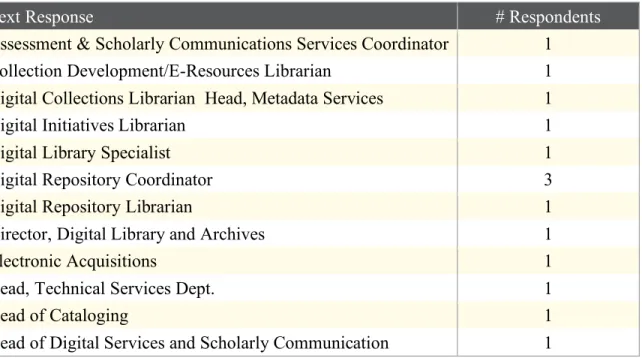
Survey respondents were first asked to identify their job titles in a free-text box.
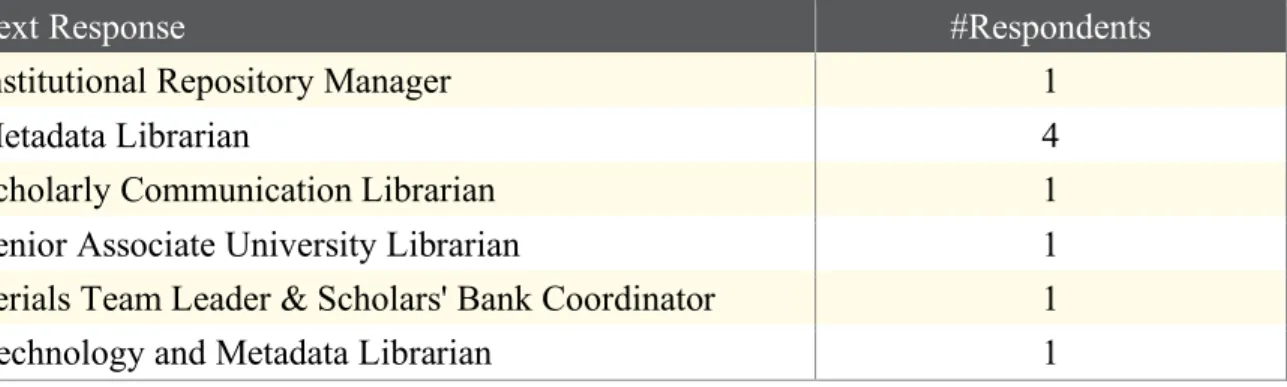
Twenty-three respondents answered this question, with the majority of responses
claiming an array of different job titles. Eleven respondents reported a position with the
term “librarian” in the title, with four respondents self-identifying as metadata librarians.
Table 1: Respondents’ job titles
Text Response # Respondents
Assessment & Scholarly Communications Services Coordinator 1
Collection Development/E-Resources Librarian 1
Digital Collections Librarian Head, Metadata Services 1
Digital Initiatives Librarian 1
Digital Library Specialist 1
Digital Repository Coordinator 3
Digital Repository Librarian 1
Director, Digital Library and Archives 1
Electronic Acquisitions 1
Head, Technical Services Dept. 1
Head of Cataloging 1
Text Response #Respondents
Institutional Repository Manager 1
Metadata Librarian 4
Scholarly Communication Librarian 1
Senior Associate University Librarian 1
Serials Team Leader & Scholars' Bank Coordinator 1
Technology and Metadata Librarian 1
4.2 Institutional holdings
In an effort to assess how repository content is managed, survey participants were
asked to disclose their institutional holdings. Respondents could select multiple types of
content. Thirty-eight institutions responded to this question, with the majority (34, or
89%) reporting that their institution held electronic dissertations or thesis. Working
papers and technical reports tied with conference proceedings and presentations (held by
28 institutions, or 83%) as the second most common digital object(s).
4.3 Software platforms
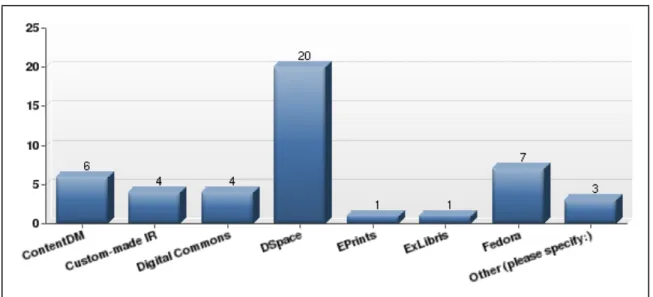
A total of thirty-eight institutions responded to a survey question about their
software platform(s) in use, checking all that apply. Twenty respondents (or 54%)
reported using DSpace, while ContentDM and Fedora were mentioned by 6 respondents,
respectively (16%). Most institutions were only using one software platform rather than
a combination of applications.
Figure 2: Software platforms
4.4 Metadata management
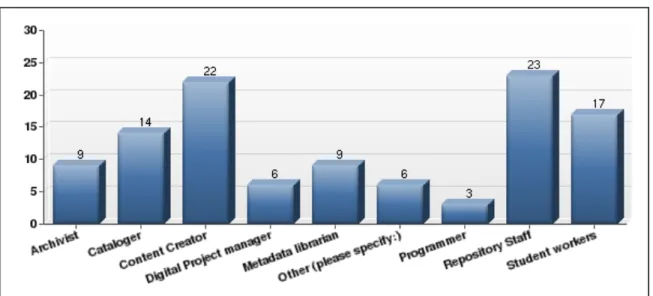
Thirty-six institutions responded to a question about how metadata was created
for deposited objects in their respective IR. Again, respondents were allowed to select as
many options as were applicable. The highest number of institutions (23, or 64%)
reported that metadata was created by repository staff. The second most frequent
metadata creator reported by institutions was the content creator of the submission (22, or
institutions reporting overall that metadata was created by both repository staff and
content creators. In fact, most institutions reported that more than one entity was
creating metadata for submissions. For example, out of those institutions that attributed
metadata creation to a cataloger, at least half of those also reported the participation of an
archivist, content creator, or student worker.
Figure 3: Metadata creator(s)
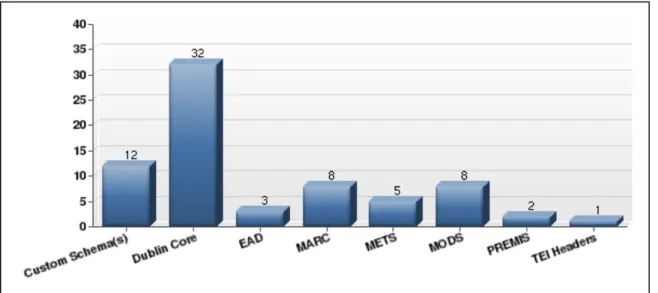
Thirty-seven respondents reported on the number and types of metadata schemas
being utilized by their institutions. The most frequently reported schema was Dublin
Core, with thirty-two institutions (86%) claiming use. Twelve institutions (or 32%)
reporting using custom schemas. Since institutions could select multiple schemas, it is
interesting to note that thirteen of the institutions using Dublin Core were using at least
Figure 4: Metadata schema(s) usage
Twenty-seven institutions responded to a question about which controlled
vocabularies they were using. Library of Congress Subject Headings (LCSH) were the
most commonly used controlled vocabulary. As expected, many of those using LCSH
were using another bibliographic classification tool, the Library of Congress Name
Authority File (LCNAF). Most institutions that were using controlled vocabularies
reported using at least two combinations. For example, all of the seven institutions using
the Art and Architecture Thesaurus (AAT) also used LCSH and LCNAF.
Table 2: Controlled vocabularies
# Answer Response %
1 Art and Architecture Thesaurus (AAT) 8 30%
2 Getty Thesaurus of Geographic Names 7 26%
3 Getty Union List of Artist Names (ULAN) 4 15% 6 Library of Congress Name Authority File (LCNAF) 13 48% 5 Library of Congress Subject Headings (LCSH) 20 74% 4 Library of Congress Thesaurus for Graphical Materials 7 26%
7 MARC relator codes 8 30%
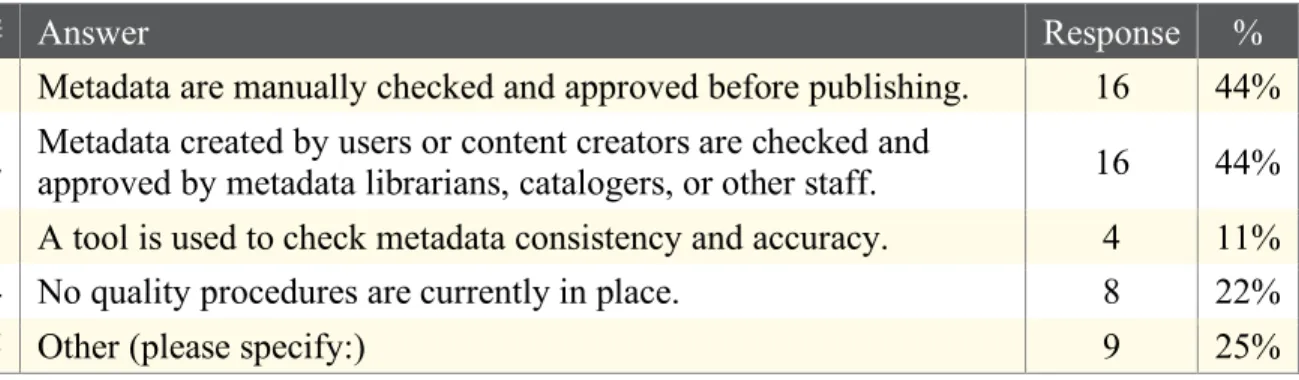
Thirty-six respondents answered a question regarding quality control procedures
at their institution. Respondents could select as many choices as were applicable; a total
of eight (or 22%) reported that no quality control procedures were currently in place.
Sixteen respondents (or 44%) reported that metadata are manually checked and approved
before publishing, with half of those respondents indicating that metadata are also
checked by librarians, catalogers, or other staff. Four institutions (or 11%) reported use
of tool to check metadata consistency and accuracy.
Table 3: Metadata quality control
# Answer Response %
1 Metadata are manually checked and approved before publishing. 16 44%
2 Metadata created by users or content creators are checked and approved by metadata librarians, catalogers, or other staff. 16 44%
3 A tool is used to check metadata consistency and accuracy. 4 11%
4 No quality procedures are currently in place. 8 22%
5 Other (please specify:) 9 25%
4.5 Metadata documentation
Thirty-six institutions responded to three survey questions seeking to explore the
degree to which specific policies, guidelines, and documentation were in use at
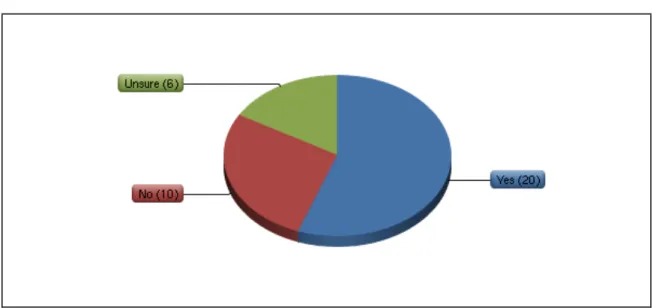
institutional repositories. Question eight asked whether internal guidelines on metadata
quality existed at institutional repositories. Twenty institutions (55%) reported that their
repository maintained some form of documentation, while ten (28%) reported they did
Figure 5: Internal documentation on metadata quality
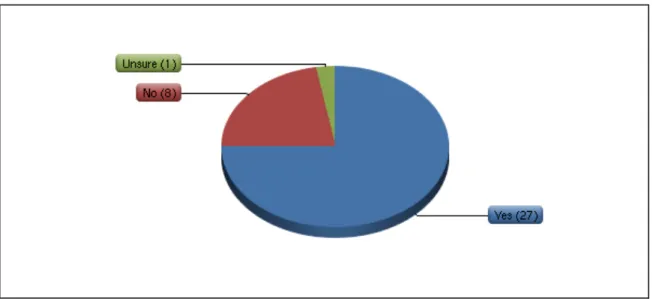
Question nine asked about whether repositories provided metadata guidelines for
depositors. The majority (26, or 72%) responded that guidelines were provided.
Figure 6: Metadata guidelines for depositors
Question ten asked whether institutions had policies on minimum metadata requirements.
Figure 7: Minimum metadata requirements
4.6 Repository infrastructure
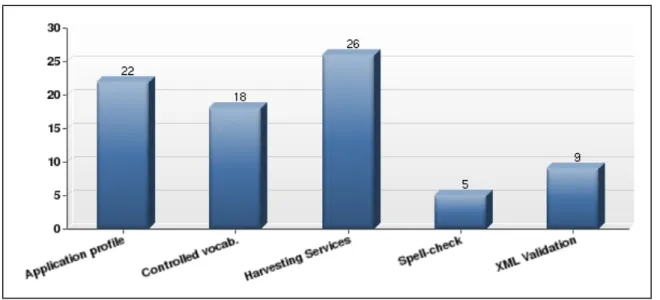
Thirty-two institutions responded to a question about infrastructure services
currently in use at their repository, selecting all applicable answers. The majority of
respondents (26, or 81%) used harvesting services such as the OAI-PMH. Respondents
also reporting using application profiles (22, or 69%), controlled vocabularies (18, or
Figure 8: Repository infrastructure services
4.7 Metadata quality
Respondents were asked to describe how metadata quality problems were
typically discovered in their repository. Thirty respondents provided write-in text
detailing the process. In general, respondents seem to indicate that quality control is done
on a reactive basis after deposit. As an institution noted, “If someone reports a problem,
we correct it.” Thirteen institutions mentioned that repository staff typically discovered
errors, while eleven institutions noted that users or content creators found them. One
respondent wrote, “All QC measures on the IR are intermittent at best! Some content
providers are more conscientious than others.” Two institutions mentioned that errors
were discovered during batch upload fails. Only one institution is doing active data
cleanup by exporting data. A few institutions reported that quality checking was done on
an ad-hoc basis due to budgetary concerns, with certain collections receiving prioritized
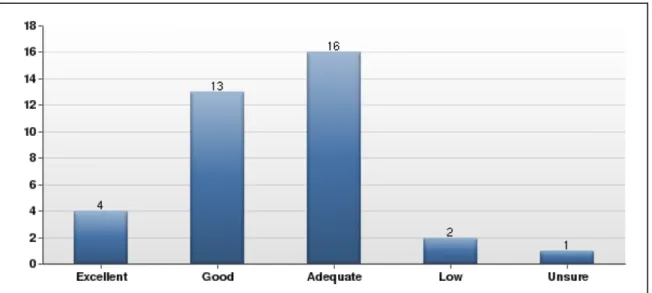
Question thirteen asked respondents for their overall impression of metadata
quality in their repository. Thirty-six respondents gave their impression, with the highest
number of institutions (16) describing their metadata quality as “Adequate.” Thirteen
institutions claimed their metadata was good, while four institutions claimed it was
excellent.
Discussion
The results presented in the previous section provide a view of practices and
procedures relating to metadata quality in institutional repositories at this time. They
show that there is no set practice for quality control, and that many institutions have not
had the opportunity to integrate metadata quality measures. In this section, further
discussion of the results is covered.
The variance shown in job titles by survey respondents suggests that institutions
may not have a unified vision of the required roles within an operational IR. For
example, only four respondents held the same position title (“Metadata librarian”). While
the majority of respondents self-identified themselves as “librarians” of some type, it is
not clear from these results whether metadata activities are considered a primary
responsibility for any respondents. The variance in job titles echoes previous survey
research on IRs which has found similar discrepancies in respondents’ positions. The
MIRACLE Project’s 2007 Census of Institutional Repositories in the United States
recruited participation from individuals “most familiar with their institution’s
involvement with IRs;” yet respondents had at least six different self-identified position
titles with nearly three-quarters of respondents (74%) reporting they were library
directors (Markey, Rieh, St. Jean, Kim & Yakel, p.14). Ma (2007) found a similar
content librarian”, and “electronic resources librarian” were among the different positions
mentioned as having responsibility for metadata activities (p. 13).
Institutional repositories appear to hold a wide range of digitized and born-digital
materials, from electronic theses and dissertations to datasets. While the types of file
formats in use were not explored in this study, the existence of multiple content types
(e.g., text, images) almost certainly factors into the ability to effectively evaluate
metadata quality. The absence of defined quality characteristics for differing content
types combined with differing needs and requirements has been problematic. Moreover,
there has been little consensus on determining what attributes should be preserved for
specific content types. Indeed, previous research has suggested that metadata quality
should be evaluated in terms of the functionality of its required use (Moen, Stewart &
McClure, 1998; Stvilia and Gasser, 2008). As Stvilia, Gasser, Twidale, Shreeves, & Cole
(2004) write, “Specific metadata quality problems arise when the existing quality level
along some particular metadata dimension is lower than the required quality level, in the
context of using this metadata to support a given activity” (p. 114).
This study also reported on the technical infrastructures in place at institutional
repositories. The results indicate that institutions are typically using only one software
platform rather than a combination of applications. Dspace is the most frequently used
software (20 institutions), with Fedora being mentioned second (seven institutions). This
finding offers promise for the possibility of establishing automated quality control
The results of this study also found that IRs are typically using the Dublin Core to
describe and manage their holdings. This makes sense considering that Dublin Core was
one of the earliest metadata standards to emerge for digital repositories. Moreover, as
noted above the majority of survey respondents are using Dspace, which has adopted a
Dublin Core metadata schema. The small number of institutions using metadata schemas
like MODS and PREMIS could be attributed to either their relative newness or the
perceived complexity to implement them. Further work on the obstacles and barriers to
use should be undertaken.
As the literature review demonstrated, there is a wide-range of quality problems
found in metadata records. The process by which metadata is created, and who creates is,
almost certainly has implications for its quality. The majority of institutions reported that
metadata is created by either repository staff (23 institutions) or content creators (22
institutions). However, there is significant overlap among categories and most
institutions attribute metadata creation to more than one entity. For example, only five
out of the 23 institutions report that metadata creation is solely done by repository staff.
Similarly, out of the 14 institutions that attributed metadata creation to a cataloger, at
least half also reported the participation of an archivist, content creator, or student
worker. The implication is that multiple people in different roles within an IR setting are
creating metadata for deposited objects. This may be the result of organizational
challenges or simply the well-intentioned effort of collaborators. Yet such endeavors
would undoubtedly be problematic for institutions without standardized metadata
The impact that quality-enforcing structures like controlled vocabularies and
application profiles might have on metadata has yet to be fully explored; however, the
results of this study offer a starting point for documenting the number of institutions
utilizing them. Most respondents reported using some type of controlled vocabulary,
with the highest number of institutions citing use of the Library of Congress Subject
Headings. It appears that most institutions that are using controlled vocabularies tend to
use more than one. Similarly, application profiles, which mix and match multiple
metadata elements from various schemas, are perceived as beneficial structures that will
positively impact metadata quality. As Heery and Patel (2000) argue in their influential
paper, application profiles arose out of practical need within the community for greater
support and management of digital objects. 22 institutions report using application
profiles, with 16 of those claiming the use of controlled vocabularies as well.
An essential part of ensuring quality metadata for institutional repositories
involves developing policies which outline metadata quality requirements and evaluation
procedures. The results of this study indicate that institutional repositories are
developing metadata policies for contributors and staff. For example, the majority of
respondents (72%) reported that their institution provided metadata guidelines for
depositors. Similarly, the majority of respondents (75%) reported that their institution
had policies on minimum metadata requirements. The weakest area of documentation
appears to be internal metadata guidelines. 20 institutions (or 55%) reported that their
repository maintained some form of documentation.
Though most quality-checking of metadata fields remains a largely manual
vary. Institutions seem to rely equally on contributors and users to discover quality
problems as they repository staff. As one institution explains, “They're discovered in a
variety of way by different people. Users or collection owners may report them. One of
the librarians may find them by chance when looking for something in our repository.”
Six institutions mentioned that metadata were manually reviewed by repository staff prior
to publication.
There was some suggestion that certain metadata fields received higher priority
for quality checking. When institutions made mention of specific metadata fields that
received attention, the focus was on author or subject entries. One institution wrote, “We
generally are not exerting a lot of control over metadata, but where we do try to look for
issues is author’s names; we want to enforce authority control when we can.” Another
institution reported that “different collections or types of material get differing levels of
metadata checking.” For example, this institution mentioned that while user-submitted
data for ETDs is not screened, “extensive checking” is done for other types of materials.
It was interesting to note correlations between an institution’s impression of
metadata quality and the existence of quality-enforcing structures like controlled
vocabularies at institutions. Out of the institutions that described their metadata as
“good”, the majority had a policy on minimum metadata guidelines (92%). Similarly, out
of the twenty institutions that had internal documentation on quality, most (85%) also
provided metadata guidelines to depositors. The implication is that when metadata
documentation is developed, it tends to be created for both content creators and
Conclusion
Though poor data quality inevitably impacts the usability and effectiveness of
digital resources, thus far little empirical investigation has taken place into the current
metadata quality practices that exist at institutional repositories. There has been little
interest directed at the development of successful evaluation techniques and procedures.
This study explored this knowledge gap by surveying current metadata practices and
exploring quality control procedures, both of which could potentially be used to develop
an evaluation framework for assessing metadata quality.
A literature review was performed to surface conceptual themes as well as
possible quality indicators useful for evaluation. The complex domain of institutional
repositories was discussed, including metadata quality issues that impact usage. Finally,
practitioners were surveyed on applications of use in an attempt to (1) summarize current
metadata practices and (2) explore any quality control procedures being used.
The results of this study suggest that metadata activities may not yet be
streamlined into an institution’s workflow and organizational structure. The number of
varying job positions responding to this survey demonstrate that a range of positions with
differing degrees of expertise are responsible for metadata practices. The lack of
formalized quality control and procedures seem to indicate that metadata quality is an
after-thought for most institutions. Metadata quality problems tend to be found on an
When metadata quality is checked, author and subject fields receive the most attention.
The majority of institutional repositories are maintaining some form of documentation,
either in the form of metadata guidelines for contributors or internal documentation for
staff.
As institutional repositories continue to grow, distributed access and sharing of
resources among contributors will increase. In this environment, the need to evaluate
metadata quality in a meaningful, scalable manner will become even more critical. The
establishment of shareable, good quality metadata is integral to the long-term health and
sustainability of institutional repositories. For institutional repositories, the development
of an application profile could go a long way towards formalizing community needs and
modeling tasks and activities to evaluate.
A number of key challenges influence the development and successful
deployment of metadata quality evaluation techniques. In particular, determining what
criteria should be used to evaluate metadata quality is essential to understanding the level
to which metadata records are compliant. Moreover, metadata quality evaluation should
incorporate both the context in which the metadata was created as well as the
functionality it is intended to support. Metadata quality evaluation should thus be viewed
as an evolving process that necessarily relies on continuous refinement through
assessment. Attention must be paid not only to the successful harvesting or output of
data, but also to determining how good the output is in the context of specific, required
References
Babbie, E. (2007). The practice of social research (11th ed.). CA: Wadsworth.
Bailey, C. W., Jr., Coombs, K., Emery, J., Mitchell, A., Morris, C., Simons, S., & Wright, R. (2006). Institutional Repositories. SPEC Kit 292. Washington, D.C.:
Association of Research Libraries.
Balci, O. (2003). Verification, validation, and certification of modeling and simulation applications. In Proceedings of the 35th Conference on Winter Simulation:
Driving innovation, New Orleans, LA., December 07 - 10, 2003.
Barton, J., Currier, S., & Hey, J. (2003). Building quality assurance into metadata creation: an analysis based on the Learning Objects and e-Prints communities of practice.” In Proceedings 2003 Dublin Core Conference: Supporting
Communities of Discourse and Practice - Metadata Research and Applications.
Seattle, WA., 2003.
Barton, J. & Robertson, R.J. (2005). Designing workflows for quality assured metadata.
CETIS Metadata & Digital Repositories SIG Meeting, Edinburgh, March 10
2005.
California Digital Library. CDL guidelines for digital objects. Retrieved from: http://www.cdlib.org/inside/diglib/guidelines/
Cole, T. & Shreeves, S. (2004). Search and discovery across collections: The IMLS digital collections and content project. Library Hi Tech, 22(3).
Creswell, J. W. (2003). Research Design: Quantitative, Qualitative, and Mixed Methods
Approaches. SAGE. Thousand Oaks. USA.
Crow, R. (2002). The case for institutional repositories: A SPARC position paper." ARL Bimonthly Report 223. Retrieved from http://works.bepress.com/ir_research/7
Dushay, N. & Hillmann, D. (2003). Analyzing metadata for effective use and re-use. in
DC-2003: Proceedings of the International DCMI Metadata Conference and
Workshop, Seattle, WA., September 28-October 2 2003. Retrieved from
http://dc2003.ischool.washington.edu/Archive-03/03dushay.pdf
practicalities. D-Lib Magazine, Retrieved from http://www.dlib.org/dlib/april02/weibel/04weibel.html
Greenberg, J. (2001). A quantitative categorical analysis of metadata elements in image- applicable metadatas schemas. Journal of the American Society for Information Science, 52(11).
Heery, R., & Patel, M. (2000). Application profiles: mixing and matching metadata schemas. Ariadne, 25. Retrieved from http://www.ariadne.ac.uk/issue25/app-profiles/intro.html.
Hitchcock, S., Brody, T., Hey, J., Carr, L. (2007). Digital preservation service models for institutional repositories. D-Lib Magazine. Retrieved from
http://www.dlib.org/dlib/may07/hitchcock/05hitchcock.html.
Hitchcock, S., Brody, T., Hey, J., Carr, L. (2007). Survey of repository preservation policy and activity. Preserv project, January 2007. Retrieved from
http://preserv.eprints.org/papers/survey/survey-results.html.
Hodge, G. (2005). Metadata for electronic information resources: from variety to interoperability. Information Services and Use, 25(1).
Hughes, B. (2004). Metadata quality evaluation: Experience from the Open Language Archives Community. Digital Libraries: International Collaboration and
Cross-Fertilization. 7th International Conference on Asian Digital Libraries, ICADL
2004, Shanghai, China, December 13-17, 2004.
Lagoze, C. (2005). Guidelines for repository implementers. Implementation guidelines for the Open Archives Initiative Protocol for Metadata Harvesting. Retrieved from http://www.openarchives.org/OAI/2.0/guidelines-repository.htm.
Lynch, C. (2003). Institutional Repositories: Essential Infrastructure for Scholarship in the Digital Age. ARL Bimonthly Report. Retrieved from
http://www.arl.org/resources/pubs/br/br226/br226ir.shtml
Lynch, C. & Lippincott, J. (2005). Institutional repository deployment in the United States as of early 2005. D-Lib Magazine. Retrieved from
http://webdoc.sub.gwdg.de/edoc/aw/d-lib/dlib/september05/lynch/09lynch.html.
Ma, J. (2007). Metadata. Washington, D.C.: Association of Research Libraries.
Markey, K., Rieh, S. Y., St. Jean, B., Kim, J., & Yakel, E. (2007). Census of institutional repositories in the United States: MIRACLE Project Research Findings.
Washington, D.C.: Council on Library and Information Resources. Retrieved from http://www.clir.org/pubs/reports/pub140/pub140.pdf.
EDUCAUSE Evolving Technologies Committee White Paper. Retrieved from
http://net.educause.edu/ir/library/pdf/DEC0303.pdf.
McDowell, C. (2007). Evaluating institutional repository deployment in American academe since early 2005. D-Lib Magazine. Retrieved from
http://www.dlib.org/dlib/september07/mcdowell/09mcdowell.html.
Moen, W.E., Stewart, E.L., & McClure, C.R. (1998). Assessing metadata quality: Findings and methodological considerations from an evaluation of the US government information locator service. ADL ’98: Proceedings of the Advances
in Digital Libraries Conference,IEEE Computer Society, Washington, DC, 1998.
Nichols, D.M., Paynter, G.W., Chan, C., Bainbridge, D., McKay, D., Twidale, M.B. & Blandford, A. (2008). Metadata tools for institutional repositories. (Working paper 10/2008). Hamilton, New Zealand: University of Waikato, Department of Computer Science.
Ochoa, X. & Duval, E. (2006). Towards automatic evaluation of learning object metadata quality. Advances in Conceptual Modeling - Theory and Practice, ER 2006 Workshops BP-UML, CoMoGIS, COSS, ECDM, OIS, QoIS,
SemWAT, Springer, pp. 372-381.
Orr, K. (1998). Data quality and systems theory. Communications of the ACM , 41(2). Retrieved from http://doi.acm.org.libproxy.lib.unc.edu/10.1145/269012.269023
Rothenberg, J. (1996). Metadata to support data quality and longevity. Proceedings of the
1st IEEE Metadata Conference, NOAA Complex, Silver Spring, MD., April
16-18 1996. Retrieved from
http://web.archive.org/web/20000708182256/http://www.computer.org/conferenc es/meta96/rothenberg_paper/ieee.data-quality.html
Stvilia, B & Gasser, L. (2008). Value-based metadata quality assessment. Library and Information Science Research, 3(1).
Stvilia, B & Gasser, L., Twidale, M., Shreeves, S., Cole, T. (2004). Metadata quality for federated collections Proceedings of the 9th International Conference on
Information Quality, Cambridge, MA. Retrieved from
https://www.ideals.uiuc.edu/handle/2142/721
Tennant, R. (2001). Different paths to interoperability. Library Journal, 126(3).
Ward, J. (2003). A quantitative analysis of unqualified Dublin Core metadata element set usage within data providers registered with the Open Archives Initiative. Joint
Appendix A: Survey
Metadata Quality Evaluation Practices in Institutional Repositories
1. Please provide your job title below.
2. Please describe the holdings of your institutional repository.
Check all that apply
o Conference proceedings and presentations o Course content (syllabi, assignments, lectures) o Datasets
o Digitized archival documents and university records (historical texts and primary sources)
o Electronic theses and dissertations o E-journals and E-Books
o E-Prints
o Learning objects
o Multimedia files (digital audio/video) o Non-scholarly institutional publications o Pictures (images)
o Undergraduate student work o Graduate student work (non-ETD) o Working papers and technical reports
3. What software platform do you use?
Check all that apply
o ContentDM o Custom-made IR o Digital Commons o DSpace
o ExLibris o Fedora
o Other (please specify):
4. Who is responsible for creating metadata for objects deposited into your institutional repository?
Check all that apply
o Cataloger o Archivist
o Repository Staff/Manager o Content Creator
o Metadata librarian/specialist o Digital project manager o Student workers
o Programmer
o Other (please specify):
5. What metadata schema has your institutional repository adopted?
Check all that apply
o Custom Schema(s) o Dublin Core
o EAD (Encoded Archival Description) o TEI Headers (Text Encoding Initiative) o MARC (Machine Readable Cataloging)
o PREMIS
6. Please indicate which of the following controlled vocabularies your institution applies to metadata.
Check all that apply
o Art and Architecture Thesaurus o Getty Thesaurus of Geography o Getty Union List of Artists o Library of Congress Thesaurus
o Library of Congress Subject Headings (LCSH) o Library of Congress Name Authority File (LCNAF) o MARC relator codes
o UNESCO Thesaurus o Other (please specify):
7. How does your institution maintain quality control for metadata?
Check all that apply
o Metadata are manually checked and approved before publishing.
o Metadata created by users or content creators are checked and approved by metadata librarians, catalogers, or other staff.
o A tool is used to check metadata consistency and accuracy. o No quality procedures are currently in place.
8. Does your institution maintain any internal documentation or guidelines on metadata quality?
o Yes
o No
o Unsure
9. Does your repository provide metadata guidelines for depositors?
o Yes
o No
o Unsure
10. Does your repository have a policy on minimum metadata requirements?
o Yes
o No
o Unsure
11. Does your repository use any of the following:
Please check all that apply
o Application profile or metadata schema
o Controlled vocabularies (e.g., Thesaurus of Graphic Materials) o Spell-check on ingest or post-ingest
o XML Validation
o Harvesting Services (OAI-PMH, OAIster)
12. Please describe your impression of the overall quality of your metadata. o Excellent
o Good o Adequate
o Low
Appendix B:
Initial Recruitment Email Sent to Institutional Repository
Managers/Staff
Dear Colleagues,
We would like to invite you to participate in an online survey entitled, “Metadata Quality Evaluation in Institutional Repositories: A Survey of Current Practices.” This research study intends to investigate current practices of metadata quality evaluation at academic institutional repositories (IRs) in the United States.
We are interested in surveying participants from ARL-member institutions who are involved with metadata practices and operations at their respective repositories. Specifically, we are seeking participants who can provide information about their IR’s creation and management of metadata, usage of metadata schema(s), guidelines and quality control procedures, and metadata policies. If you decide to be in this study, you will be one of the 123 institutions invited to participate in this research.
Participation in the survey is anonymous and voluntary. If you have any questions about the survey, please contact the Principal Investigator of this study at
[email protected]. The survey should take approximately 20 minutes to complete.
The survey, at <URL> is now open, and will remain open until <date>.
We will be sending a reminder email about the survey in one week. Your assistance in providing invaluable information about this topic is much appreciated.
Sincerely,
Appendix C: Initial Recruitment Email sent to ARL’s SPAR-IR
Listserve
Date ____________
Dear Colleagues,
We would like to invite you to participate in an online survey entitled, “Metadata Quality Evaluation in Institutional Repositories: A Survey of Current Practices.” This research study intends to explore current practices of metadata quality evaluation at academic institutional repositories (IRs) in the United States.
We are interested in surveying participants from ARL-member institutions who are involved with metadata practices and operations at their respective repositories. Specifically, we are seeking participants who can provide information about their IR’s creation and management of metadata, usage of metadata schema(s), guidelines and quality control procedures, and metadata policies. If you decide to be in this study, you will be one of the 123 institutions invited to participate in this research.
Participation in the survey is anonymous and voluntary. If you have any questions about the survey, please contact the Principal Investigator of this study at
[email protected]. The survey should take approximately 20 minutes to complete.
The survey, at <URL> is now open, and will remain open until <date>.
We will be sending a reminder email about the survey in one week. Your assistance in providing invaluable information about this topic is much appreciated.
Sincerely,