270
Stochastic human fatigue modeling in production systems
Rasoul Jamshidi
1*1School of Engineering, Damghan University, Semnan, Iran
Abstract
The performance of human resources is affected by various factors such as mental and physical fatigue, skill, and available time in the production systems. Generally, these mentioned factors have effects on human reliability and consequently change the reliability of production systems. Fatigue is a stochastic factor that changes according to other factors such as environmental conditions, work type, and work duration. Many models have been proposed to quantify fatigue in order to control its effect on reliability, but most of them considered the fatigue as a deterministic variable, while this factor is uncertain. In this paper, we propose a stochastic model for human fatigue with the aim of increasing the reliability. Considering the fatigue uncertainty, we use Chance Constraint (CC), and some methods are used to convert the model into the deterministic one. In the proposed model we consider the reliability of machines and the fatigue of human as two important factors in the production systems' reliability. The proposed model has been applied to a real case and the provided results show that production system reliability can be calculated more effectively using the proposed model.
Keywords:
Human fatigue, stochastic modeling, chance constraint.1-Introduction
Effective scheduling is one of the crucial factors affecting the efficiency and productivity. In a production system, the job implementation should be processed by machines and human resources according to a job scheduling and a plan of work-rest time.
In the most research, the related issue to human reliability has not been taken into full consideration in the production system scheduling, which makes the majority of managerial decisions difficult to change (Jensen, 2002; Neumann & Medbo, 2009). Some researchers have focused on the reasons for ignoring human resource consideration in the production system. The important reason is the difficulty of quantifying the human related factors (Bidanda, Ariyawongrat, Needy, Norman, & Tharmmaphornphilas, 2005). Many researchers investigated the human factors quantification such as reliability, fatigue, and stresses during work implementation time. (El ahrache, Imbeau, & Farbos, 2006) proposed the static fatigue analysis through the concept of Maximum Endurance Time. (Ma, Chablat, Bennis, & Zhang, 2009) investigated the influence of individual differences and external load in fatigue calculation.
(Battini, Persona, & Sgarbossa, 2014) proposed a method to obtain the estimation of the energy expenditure of a task faster in order to provide the value of human fatigue.
Also, many methods for Human Reliability Analysis (HRA) have been proposed to calculate the human error rate and reliability such as Technique for Human Error Rate Prediction (THERP) (Griffith & Mahadevan, 2011), Human Cognition Reliability (HCR)(Hollnagel, 1996).
*Corresponding author
ISSN: 1735-8272, Copyright c 2019 JISE. All rights reserved
Journal of Industrial and Systems Engineering
Vol. 12, No. 1, pp. 270-283 Winter (January) 2019
271
Cognitive Reliability and Error Analysis Method (CREAM) (Yang, Wang, Rochdi, & Belkacem, 2011) in production systems.
Although there are some papers that investigated the human related factors such as fatigue and reliability independently, few of them have considered its relation with other topics such as production scheduling (Neumann & Dul, 2010; Neumann & Village, 2012; Ryan, Qu, Schock, & Parry, 2011). The origin of these studies is the “sociotechnical systems” that proposed by (Albert, 1976; Clegg, 2000), in which the production systems are made up of both technological and human elements, both of them should work and cooperate together properly for improved the final product or service. Human’s cognitive capability, reliability, job knowledge, and performance affect the production system performance and cost (Hunter, 1986).
Production scheduling consists of planning for machines work time, humans work time, machines maintenance time, and human rest time. Many problems such as maintenance scheduling and job scheduling have been investigated by researchers in order to improve the production systems output. For a long time job scheduling and maintenance planning have been treated as two separate and independent functions (Altuger & Chassapis, 2009; Kulscar & Kulscarine Forrai, 2009; Sawik, 2005) (Pereira, Lapa, Mol, & da Luz, 2010) but because of the interdependence between these functions, many efforts have been done to develop optimization models that consider these functions simultaneously (Benmansour, Allaoui, Abdelhakim, Serguei, & Pellerin, 2011) (Benbouzid-Sitayeb, Guebli, Bessadi, Varnier, & Zerhouni, 2011).
Also, some papers have been proposed that considered the human resource role in maintenance and machine scheduling (Lodree, Geiger, & Jiang, 2009). (Mahdavi, Aalaei, Paydar, & Solimanpur, 2010) proposed a mathematical model for a dynamic cellular manufacturing systems whit human resources. (Cappadonna, Costa, & Fichera, 2013) addressed the unrelated parallel machine scheduling problem with limited human resources. (Martorell, Villamizar, Carlos, & Sánchez, 2010) proposed that appropriate development of each maintenance strategy depends on the resources scheduling such as human and material. (Taylor, 2000) studied the human as an important resource in maintenance actions. (Azizi, Liang, & Zolfaghari, 2013) focused on effect of fatigue on human performance and proposed the best work-rest schedule for each human resource. (Jamshidi & Seyyed Esfahani, 2014) proposed a mathematical model that obtains the optimal work and rest schedule based on reliability of each worker. (Islam, Khan, Abbassi, & Garaniya, 2018) developed a human error probability model considering various internal and external factors affecting seafarers' performance for ship maintenance. (Touat, Tayeb, & Benhamou, 2018) studied a scheduling problem that considers both production and maintenance where the human resource constraints are taken into account.
In recent years production scheduling under uncertainties is proposed to deal with insufficient and imperfect data about effective factors in production systems. Imprecision and uncertainty are the two types of imperfect data. A data is imprecise if its value cannot be given exactly and is uncertain whether there is a doubt concerning its validity. Researchers investigated the “uncertainty” and proposed some uncertainties models such as stochastic models (Shakhlevich & Strusevich, 2005), fuzzy logic based models (Dumitru & Luban, 1982), interval models (Matsveichuk, Sotskov, Egorova, & Lai, 2009) and scenario models (Aloulou & Della Croce, 2008).
Many stochastic models have been proposed to deal with uncertainty in production systems. (Mahdavi, Shirazi, & Solimanpur, 2010) developed a decision support system to address a stochastic job scheduling. (Al-Turki, Arifusalam, El-Seliaman, & Khand, 2011) considered a job scheduling with setup time, batch processing, and uncertain data to obtain the optimal number of machines at each stations. Also, there are some papers that studied the maintenance scheduling in production systems with uncertain parameters such as failure rate, repair cost and repair time. (Li & Cao, 1995) analyzed single machine stochastic scheduling problems with random breakdowns. (Kasap, Aytug, & Paul, 2006) considered a job and maintenance scheduling with an unreliable machine. (Allahverdi, 1995) investigated a production scheduling with flow shop and stochastic failure, (Allahverdi & Mittenthal, 1998) proposed some procedure to convert the scheduling problem with breakdown and maintenance into the one without breakdown in order to provide the time of job implementation and maintenance actions. (Gholami,
272
Zandieh, & Alem-Tabriz, 2009) proposed a hybrid flow shop scheduling with sequence-dependent setup times and maintenance due machines breakdowns. (Matamoros & Dimitrakopoulos, 2016) proposed a new short-term mine production scheduling formulation based on stochastic integer programming. (Paz Ochoa, Jiang, Gopalakrishnan, Lotero, & Grossmann, 2018) investigated a scheduling problem under uncertainties in electricity price and product demand in an air separation plant.
Although there are many papers that investigate the stochastic job and maintenance scheduling, few of them considered the human factors such as reliability and fatigue to propose a comprehensive schedule for production systems. If human resources are not taken into consideration the most production schedules are ineffective and cannot decrease the production cost and increase the quality of products. To the best of author knowledge, there is not a research in which studied the stochastic effect of human resource factors (fatigue and reliability) on production systems. In this paper, we propose a stochastic mathematical model with CC to optimize the job, maintenance and human rest time considering the reliability of machines and human resources. To solve the proposed model we use some technique to convert CC to a deterministic one. Also, a real case will be investigated to examine the solution effectiveness.
The rest of the paper is organized as follows: Section 2 presents the human fatigue and fatigue calculation method. Section 3 describes the stochastic models with CCs. Section 4 proposes the problem statement. Section 5 provides a case study to evaluate the proposed model efficiency and finally, section 6 concludes the paper.
2-Human fatigue
Human fatigue has negative effect on the long-term period and implies a lower efficiency of the human resources. Fatigue is the every loss caused by human effort, and it is categorized in psychological and physiological fatigue. The psychological fatigue is the mental fatigue that human senses while implementing the jobs and subjective evaluations can reveal this type of fatigue. The physiological fatigue is induced by the necessity of job implementation with a predetermined force during a specific period. Physiological fatigue leads to reduction in human's workforce and consequently to increase the Human Error Probability (HEP).
The physical fatigue involvement in HEP has been investigated by some researchers. (Myszewski, 2010) and proposed a curve based on error rate to show that human error increases as fatigue increases over time. (Michalos, Makris, & Chryssolouris, 2013) proposed a scoring method for a physical fatigue using the fatigue model of (Ma et al., 2009). They also provided a method to calculate the corresponding error rate based on the work of (Elmaraghy, Nada, & Elmaraghy, 2008). Besides the human fatigue, the recovery models should be noted to mitigate the human fatigue such as error and damage. In this paper we use the fatigue and recovery model proposed by (Konz, 2000), this model assumes that fatigue and recovery can be formulated as follows:
𝑓(𝑡) = 1 − 𝑒−𝜆𝑓.𝑡 (I)
𝑟(𝜏𝑖) = [1 − 𝑒−𝜆𝑓.𝑡]𝑒−𝜆𝑟𝜏𝑖 ( I I )
Where f(t) is the fatigue accumulated by time t, 𝑟(𝜏𝑖) is the residual fatigue after a rest break of length
𝜏𝑖. And 𝜆𝑓, 𝜆𝑟 are fatigue rate and recovery rate, respectively. Since the proposed model is not applicable
for all human resources in production systems, we use two variables in order to generalize the proposed formula for each human resources in different environmental conditions. So the formulas (I, II) are rewritten as follows:
𝑓(𝑡) = 1 − 𝑒−𝜆𝑓.𝑡+ 𝜀 (III)
Where 𝜀 is a random variable that changes according to environmental conditions, work type and physical conditions of human resources. To illustrate the role of 𝜀, consider a human that implements a
273
job in two different environments. The first one is normal with proper temperature, enough light and the second one without proper temperature and light. Although the human does a same job in two environments and his fatigue is equal to 𝜆𝑓 but because of different conditions, the induced fatigues are
not equal in the mentioned environments. The 𝜀 can justify this inequality, in fact, since the formula (I) have been presented for a normal condition for a specific job, 𝜀 can be considered as the effect of abnormal conditions of human fatigue. It should be noted that 𝜀 is a stochastic variable and a deterministic value cannot be assigned to it. Since we cannot eliminate the 𝜀 the fatigue value is also stochastic and we should use some technique to convert fatigue value into a deterministic one. These methods are discussed in next section.
3- Stochastic model with CC
Stochastic models have different forms and chance constrained is one of them. Chance constrained problems can be considered as follows:
𝑚𝑖𝑛
𝑥∈𝑋 𝑓(𝑥, 𝜀)
𝑆. 𝑡. 𝑃𝑟𝑜𝑏{𝐺(𝑥, 𝜀) ≤ 0} ≥ 𝛼 (IV)
Where𝑋 ⊂ ℝ𝑛, 𝜀 is a random vector, 𝑓: ℝ𝑛→ ℝ is a real valued function, α ∈ (0, 1), and𝐺: ℝ𝑛× Ξ → ℝ𝑚. Chance constrained problems have been proposed by (Charnes, Cooper, & Symonds, 1958) and have
been developed by other researchers. Chance constrained models have several applications in optimization problems with uncertainty issue such as water management (Dupačová, Gaivoronski, Kos, & Szántai, 1991) and chemical processes optimization (R. Henrion & Möller, 2003).
Researchers proposed some approximation method to solve the models consists of CCs. Back mapping, robust optimization (RO), and sample average approximation (SAA). Back mapping Find a monotonic relation between Z = G(x, 𝜀) and some random variable 𝜀𝑗 (Wendt, Li, & Wozny, 2002). (Pagnoncelli,
Ahmed, & Shapiro, 2009) proposed a method based on sampling that replaced the CC with deterministic constraint, in fact, he used the relative-frequency count for the satisfaction of CC with some known vector of 𝜀. The third method is Robust Optimization technique that is similar to SAA with some differences. This method considers the worst-case and convert the CC problem to the below models (Calafiore & Campi, 2005).
𝑚𝑖𝑛
𝑥∈𝑋 𝐸(𝑓(𝑥, 𝜀)]
𝑆. 𝑡. 𝐺(𝑥, 𝜀) ≤ 0, ∀𝜀 ∈ Ω
(V) Where Ω is a set of possible realizations of 𝜀, if the objective function consists of 𝜀 the RO technique tries to minimize the expected value of objective for a set of 𝜀𝑖. The possible realizations of 𝜀 are
generated by Monte-Carlo method. In fact, the RO problem for CC is as follows: 𝑚𝑖𝑛
𝑥∈𝑋
1
𝑁∑ 𝑓(𝑥, 𝜀
𝑘) 𝑁
𝑘=1
𝑆. 𝑡. 𝐺(𝑥, 𝜀𝑘) ≤ 0, 𝑘 = 1, … , 𝑁
(VI)
N is the number of random samples of 𝜀1, … , 𝜀𝑁. The value of N is calculated using below formula if α is
between 0 and 1, the objective function is convex for 𝑥 ∈ ℝ𝑛. (Calafiore & Campi, 2005)
N ≥ 2𝑛
(1 − 𝛼)ln( 1 1 − 𝛼) +
2 (1 − 𝛼)ln(
1 𝛼) + 2𝑛
(VII) The RO technique preserves convexity structures, and RO models are simple to implement and solve. On the other hand, for a higher reliability level α, very large numbers of random samples of 𝜀1, … , 𝜀𝑁 are
274
required. Some techniques have been proposed for scenario reduction such as methods proposed by (Campi & Garatti, 2011; René Henrion, Küchler, & Römisch, 2009). Regarding the mentioned advantages, we use RO to convert the presented model into deterministic and obtain optimal production schedule.
4-Problem statement
In this section, a mathematical model has been presented that its aim is to provide a proper schedule for job implementation, maintenance actions and human resources rest time. In this model, we have several jobs with parallel machines. Each machine should go under maintenance if implements job for a specific time. On the other hand, human resources should rest, if their fatigue reaches a predetermined level. The objective level consists of three component as follows:
Maintenance cost Total operating cost Human fatigue cost
The maintenance cost calculates the cost of machines’ maintenance, total operating cost aims to minimize the cost of production time and finally, human fatigue cost considers the fatigue cost such as injuries.
Nomenclature
Indices Variables
i: 1…I Index for machines and its
workers ywij
1 if machine i works in time position j,=0 otherwise
j: 1…J
Index for time positions ymij 1 if machine i goes under maintenance in
time position j , =0 otherwise
Parameters xj 1 if one of machines works in time
position j,=0 otherwise
α The probability (reliability) level fij Accumulated fatigue of worker i Cmi Maintenance cost for machine i wij 1 if worker i works in time position j,=0
otherwise
Fci Fatigue cost for worker i wrij 1 if worker i rests in time position j,=0
otherwise
Pri Total production time for each
machine reij
Cumulative need to recovery for worker i
in time position j
Fsti standard fatigue for workers yiij 1 if machine i is idle in time position j,=0
otherwise
Fmax Maximum allowed fatigue for
workers wiij
1 if worker i is idle in time position j,=0 otherwise
A A large number rij Reliability of machine i, in time position j
λfi Fatigue rate for worker i λmi Failure rate for machine i rsti Primary reliability of machine i
rmini The Minimum required
reliability for machine i
275 𝑚𝑖𝑛 𝑧 = ∑ ∑ 𝐶𝑚𝑖
𝐽
𝑗=1
𝑦𝑚𝑖𝑗+ ∑ 𝑗. 𝑥𝑗 𝐽
𝑗=1
+ ∑ ∑ 𝐹𝑐𝑖 𝐽
𝑗=1
(𝑓𝑖𝑗− 𝐹𝑚𝑖𝑛) 𝐼
𝑖=1 𝐼
𝑖=1
(1)
The second component prevents the unnecessary maintenance and rest time in order to minimize the production period to reduce the fixed cost. The third component considers the fatigue cost in proportion with the distance between worker fatigue and allowed fatigue. This component tries to maintain the workers’ fatigue in acceptable level to decrease the possible expenditures related to fatigue such as injuries, lack of quality and etc. as mentioned in the previous section the fij is a stochastic variable in
which a 𝜀 effects its value based on several conditions such as work type and human resources conditions. The constraints of the proposed model are presented as follows:
∑𝐽𝑗=1𝑦𝑤𝑖𝑗 = 𝑃𝑟𝑖 ∀ 𝑖 (2)
Equation (2) ensures that the working time of machines should be equal to predetermined Total production time for them. For example, if a machine has to work 8 hours per day the summation of working time position should be equal to 8 hours.
𝑝𝑟( 𝑓𝑖𝑗− 𝐹𝑚𝑎𝑥 ≤ 0) ≥ 𝛼 ∀ 𝑖, 𝑗 (3)
In equation (3) we guarantee that in most of the time positions (α percent) the worker fatigue is less than the Fmax. In fact, the worker should rest with α percent probability to mitigate his fatigue and in (1- α)
percent can work despite the extra fatigue. α is usually considered between 0.5 and 1.
𝑥𝑗≤ ∑𝐼𝑖=1𝑦𝑚𝑖𝑗 ∀ 𝑗 (4)
∑𝐼𝑖=1𝑦𝑚𝑖𝑗 ≤ 𝐴. 𝑥𝑗 ∀ 𝑗 (5)
Relations (4-5) show that both the worker and machine should be available and work together for job implementations. If a machine is under maintenance or the worker rest in a time position no job can be implemented, it should be noted that machines cannot work without their workers.
𝑦𝑚𝑖𝑗+ 𝑦𝑤𝑖𝑗+ 𝑦𝑖𝑖𝑗 = 1 ∀𝑖, 𝑗 (6)
Equation (6) shows that machines have three states, the first is under maintenance the second is working, and the third is idle. In each time position machine can be in one of these three states. This fact is also true for workers. In each position they can be in idle, working or rest states. Relation (7) shows this constraint about workers.
𝑤𝑖𝑗+ 𝑤𝑟𝑖𝑗+ 𝑤𝑖𝑖𝑗 = 1 ∀𝑖, 𝑗 (7)
Also, there is some relation between worker state and machine state. If a machine is under maintenance its worker cannot work and vice versa. Relations (8-9) show these constraints. This fact is true for the machine and worker idleness times. Relations (10-11) present these constraints. Relation (12) guarantees that worker and machine should work together for job implementation.
𝑤𝑖𝑗≤ 1 -𝑦𝑚𝑖𝑗 ∀𝑖, 𝑗 (8)
𝑦𝑤𝑖𝑗 ≤ 1 -𝑤𝑟𝑖𝑗 ∀𝑖, 𝑗 (9)
𝑤𝑖𝑗≤ 1 -𝑦𝑖𝑖𝑗 ∀𝑖, 𝑗 (10)
𝑦𝑤𝑖𝑗 ≤ 1 -𝑤𝑖𝑖𝑗 ∀𝑖, 𝑗 (11)
𝑤𝑖𝑗= 𝑦𝑤𝑖𝑗 ∀𝑖, 𝑗 (12)
Constraint (13) calculated the worker accumulated need for recovery based on his state in prior time positions. If the worker is idle his fatigue does not change and his need to recovery in next time position
276
is the same as previous time position. If he rests in a time position his fatigue decreases to its initial value (Fst). Also if the worker does not rest and works, his need to recovery increases by the rate of λf.
𝑟𝑒𝑖,𝑗= 𝑟𝑒𝑖,𝑗−1(𝑤𝑖 𝑖𝑗) + 𝐹𝑠𝑡𝑖 (𝑤𝑟𝑖𝑗) + 𝑓𝑖,𝑗−1 (𝑤𝑖𝑗) ∀𝑖, 𝑗 ≥ 2 (13)
Using relation (III) the fatigue of worker in each time position can be calculated by equation (14).
𝑓𝑖,𝑗= (1 − 𝑟𝑒𝑖,𝑗). (1 − 𝑒−𝜆𝑓𝑖). 𝑤𝑖,𝑗+ 𝑟𝑒𝑖,𝑗+ 𝜀 ∀𝑖, 𝑗 (14)
Equation (14) shows that if the worker i works in a time position his fatigue increase according to his fatigue rate. On the other hand, if the worker does not work (rest or idle) his accumulated fatigue does not alter and is the same as previous time positions.
𝑟𝑖,𝑗 = 𝑒−𝜆𝑚𝑖. 𝑦𝑤𝑖,𝑗−1. 𝑟𝑖,𝑗−1+. 𝑦𝑚𝑖,𝑗−1. 𝑟𝑠𝑡𝑖+ 𝑦𝑖𝑖,𝑗−1. 𝑟𝑖,𝑗−1 ∀𝑖, 𝑗 ≥ 2 (15)
Equation (15) shows that how the reliability of machines is calculated. If a machine works in a time position its failure probability increases and consequently its reliability decrease by rate λm. If a machine goes under maintenance its reliability increases to its initial reliability and if machines are idle its reliability does not change.
𝑟𝑖,𝑗 = 𝑟𝑠𝑡𝑖 ∀𝑖, 𝑗 = 1 (16)
The equation (16) shows that the machines’ reliability is equal to primary reliability in the first time position. Each machine has a primary reliability and after any maintenance, the reliability will be equal to the primary value. That is to say, that we have “as good as new” policy in maintenance. This fact is also true for the workers. Equation (17) shows this issue.
𝑟𝑒𝑖,𝑗= 𝐹𝑠𝑡𝑖 ∀𝑖, 𝑗 = 1 (17)
Relation (18) sets a limitation on machines’ reliability.
𝑟𝑚𝑖𝑛𝑖≤ 𝑟𝑖,𝑗≤ 1 ∀𝑖, 𝑗 = 1 (18)
As it can be seen reliability has a lower limit, this lower limit causes that a machine goes for maintenance, without this limit machines can work continuously without any problem. Also, machines cannot reach a more than 1 reliability value.
Relations (19-20) determine the type of variables and show the binary variable in the proposed model.
𝑤𝑖𝑗, 𝑤𝑟𝑖𝑗, 𝑤𝑖𝑖𝑗, 𝑦𝑚𝑖𝑗, 𝑦𝑖𝑖𝑗, 𝑦𝑤𝑖𝑗, 𝑥𝑗∈ {0,1} ∀𝑖, 𝑗 (19)
𝑓𝑖𝑗, 𝑟𝑒𝑖𝑗, 𝑟𝑖𝑗≥ 0 ∀𝑖, 𝑗 (20)
5-Computational experiments
In this section, we aim to investigate the performance of the proposed model on a production system. Before discussing experiments and comparisons, we should propose the method of scenario generating for RO of the proposed model.
There are many factors that influence the fatigue of human resources in production systems such as work complexity, available time, worker skill, worker age, environmental conditions, etc. To generate some scenarios for RO we should consider the combination of above factors and examine the effect of them on workers fatigue. We consider 4 categories of the most influential factors to generate scenarios for RO as follows:
Complexity
277
Procedures
Work Process
Considering these factors we generate some scenarios, for example, the 𝜀 is larger in a position with high complexity and low experience compared to when, the work is simple and the worker is experienced. We considered 4 level for all mentioned factors (very low, low, moderate, high) that produces 44
scenarios, this number of scenarios is larger than the N value from Equation (VII) that satisfies the conditions of RO implementation for solving the proposed chance constrained models. The value of N is equal to 124 if α is 95%.
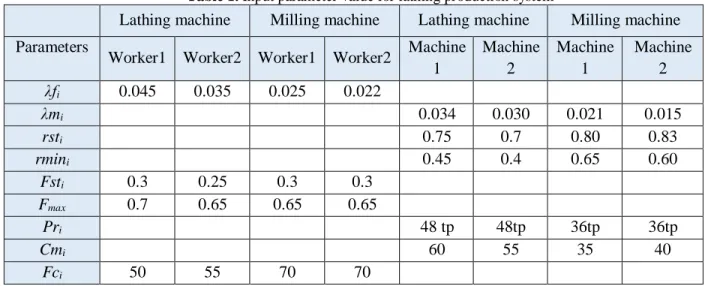
Other information about the studying production system is shown in Table 1. This production system is lathing workshop with 2 lathing and 2 milling machines, each machine has its specific worker. Each worker and machine has specific fatigue and failure rate.
Table 1. Input parameter value for lathing production system
Lathing machine Milling machine Lathing machine Milling machine
Parameters
Worker1 Worker2 Worker1 Worker2 Machine
1 Machine 2 Machine 1 Machine 2 i
λf 0.045 0.035 0.025 0.022
i
λm 0.034 0.030 0.021 0.015
i
rst 0.75 0.7 0.80 0.83
i
rmin 0.45 0.4 0.65 0.60
i
Fst 0.3 0.25 0.3 0.3
max
F 0.7 0.65 0.65 0.65
i
Pr 48 tp 48tp 36tp 36tp
i
Cm 60 55 35 40
i
Fc 50 55 70 70
In this case, each time position is equal to 10 minutes, for example, each lathing machine should work for 48 time positions or 480 minute that is equal to 8 hours. Also, the milling machine total production time is equal to 6 hours. Alpha is considered to be 95%, in other words, the model tries to satisfy the constraint (3) in at least 95% of times. The results of solving the proposed model for the lathing workshop are shown in Table 2.
Table 2. The results for chance constrained model
Objective function Maximum fatigue Minimum reliability
Number of time position for rest
Number of time position for maintenance
1725.6 0.76 0.4 22 17
To compare the result of deterministic and stochastic model Table 3 presents the result of proposed model with α=100% which transforms the chance constrained model into a deterministic one.
Table 3. The results for deterministic model
Objective function Maximum fatigue Minimum reliability
Number of time position for rest
Number of time position for maintenance
278
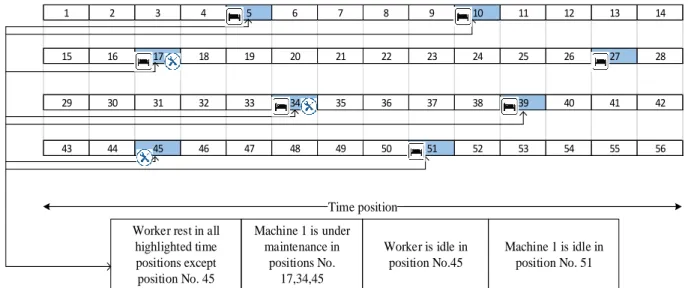
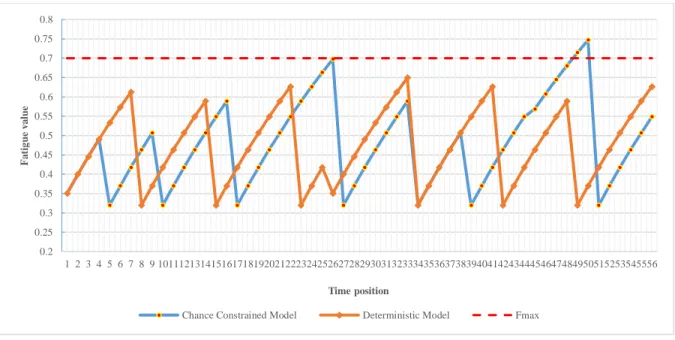
As it can be seen the maximum fatigue with α=95% reaches to 0.76 that is greater than 0.7 (Ideal maximum fatigue) since the constraint (3) is not satisfied in 5 % of time. On the other hand, since we have a hard constraint with α=95% and the constraint (3) should be satisfied in 100% of time the maximum fatigue is equal to 0.65. The number of maintenance is almost equal in two states, since the CC focused on fatigue and has a very small impact on machine reliability and maintenance time positions. The schema of the proposed schedule for first lathing machine is shown in Fig 1. For machine 1 we have 7 positions for rest and 3 positions for machine maintenance. The proposed model tried to synchronize the worker rest times and machine maintenance time to reduce the costs and complete the works in a minimum amount of time positions. The worker and machine work simultaneously in all time positions except the highlighted time positions.
1 2 3 4 5 6 7 8 9 10 11 12 13 14
15 16 17 18 19 20 21 22 23 24 25 26 27 28
29 30 31 32 33 34 35 36 37 38 39 40 41 42
43 44 45 46 47 48 49 50 51 52 53 54 55 56
Time position Worker rest in all
highlighted time positions except position No. 45
Machine 1 is under maintenance in
positions No. 17,34,45
Worker is idle in position No.45
Machine 1 is idle in position No. 51
Fig 1. The optimal schedule for lathing machine 1 and its worker
The trend of fatigue of worker 1 in two states (α=95% & α=100%) is shown in Fig 2. as it can be seen the fatigue of worker in the first status has become greater than Fmax in some position time but the occurrence probability of this issue is not larger than 5 % of position time.
279
Fig 2. The Comparison of fatigue trends in chance constrained model and deterministic model
Fig 3 shows the reliability of machine 1 in each time position, the minimum reliability of machines 1 is not lower than 0.45 that is required for job implementation by machine 1.
Fig 3. The Trend of relaibility for lathing machine 1
6-Conclusion
Human fatigue and machine reliability are two important factors in production systems. Since these two factors are probabilistic and dependent on several elements such as work type, work duration, environmental conditions, etc. We cannot confront them in a deterministic manner and stochastic techniques should be used to investigate them and propose a proper model with the aim of providing an
0.2 0.25 0.3 0.35 0.4 0.45 0.5 0.55 0.6 0.65 0.7 0.75 0.8
1 2 3 4 5 6 7 8 9 1011121314151617181920212223242526272829303132333435363738394041424344454647484950515253545556
F
a
tig
u
e
v
a
lu
e
Time position
Chance Constrained Model Deterministic Model Fmax
0.3 0.35 0.4 0.45 0.5 0.55 0.6 0.65 0.7 0.75 0.8
1 2 3 4 5 6 7 8 9 1011121314151617181920212223242526272829303132333435363738394041424344454647484950515253545556
Reli
a
b
il
it
y
v
a
lu
e
Time position
280
optimal schedule for machine and human resources in production systems. In this paper, we proposed a chance constrained model to propose the best schedule for production time, maintenance time and human resources rest time. To solve the proposed model we used the Robust Optimization (RO) method and presented some factors for scenario generation. Using the generated scenarios, the presented model was converted to a deterministic one. The performance of the proposed method was examined for a real case (lathing production system) and the provided results indicated the model can obtain an efficient and effective schedule for production, rest and maintenance time in production systems.
References
Al-Turki, U. M., Arifusalam, S., El-Seliaman, M., & Khand, M. (2011). Resource allocation,batching and dispatching in a stochastic flexible job shop. Advanced Materials Research, 264-265, 1758–1763
Albert, C. (1976). The Principles of Sociotechnical Design. Human Relations, 29(8), 783-792.
Allahverdi, A. (1995). Two-Stage Production Scheduling with Separated Set-up Times and Stochastic Breakdowns. Journal of the Operational Research Society, 46(7), 896-904.
Allahverdi, A., & Mittenthal, J. (1998). Dual criteria scheduling on a two-machine flowshop subject to random breakdowns. International Transactions in Operational Research, 5(4), 317-324.
Aloulou, M. A., & Della Croce, F. (2008). Complexity of single machine scheduling problems under scenario-based uncertainty. Operations Research Letters, 36(3), 338-342.
Altuger, G., & Chassapis, C. (2009). Multi criteria preventive maintenance scheduling through arena based simulation modeling. Paper presented at the IEEE Winter Simulation Conference, Austin,Tx. Azizi, N., Liang, M., & Zolfaghari, S. (2013). Modelling human boredom at work: mathematical formulations and a probabilistic framework. Journal of Manufacturing Technology Management, 24(5), 711-746.
Battini, D., Persona, A., & Sgarbossa, F. (2014). Innovative real-time system to integrate ergonomic evaluations into warehouse design and management. Computers & Industrial Engineering, 77, 1-10. Benbouzid-Sitayeb, F., Guebli, S. A., Bessadi, Y., Varnier, C., & Zerhouni, N. (2011). Joint scheduling of jobs and Preventive Maintenance operations in the flowshop sequencing problem: a resolution with sequential and integrated strategies. International Journal of Manufacturing Research, 6(1), 30-48. Benmansour, R., Allaoui, H., Abdelhakim, A., Serguei, I., & Pellerin, R. (2011). Simulation‐based approach to joint production and preventive maintenance scheduling on a failure‐prone machine. Journal of Quality in Maintenance Engineering, 17(3), 254-267.
Bidanda, B., Ariyawongrat, P., Needy, K. L., Norman, B. A., & Tharmmaphornphilas, W. (2005). Human related issues in manufacturing cell design, implementation, and operation: a review and survey.
Computers & Industrial Engineering, 48(3), 507-523.
Calafiore, G., & Campi, M. C. (2005). Uncertain convex programs: randomized solutions and confidence levels. Mathematical Programming, 102(1), 25-46.
281
Campi, M. C., & Garatti, S. (2011). A Sampling-and-Discarding Approach to Chance-Constrained Optimization: Feasibility and Optimality. Journal of Optimization Theory and Applications, 148(2), 257-280.
Cappadonna, F. A., Costa, A., & Fichera, S. (2013). Makespan Minimization of Unrelated Parallel Machines with Limited Human Resources. Procedia CIRP, 12, 450-455.
Charnes, A., Cooper, W. W., & Symonds, G. H. (1958). Cost Horizons and Certainty Equivalents: An Approach to Stochastic Programming of Heating Oil. Management Science, 4(3), 235-263.
Clegg, C. W. (2000). Sociotechnical principles for system design. Applied Ergonomics, 31(5), 463-477. Dumitru, V., & Luban, F. (1982). Membership functions, some mathematical programming models and production scheduling. Fuzzy Sets and Systems, 8(1), 19-33.
Dupačová, J., Gaivoronski, A., Kos, Z., & Szántai, T. (1991). Stochastic programming in water management: A case study and a comparison of solution techniques. European Journal of Operational Research, 52(1), 28-44.
El ahrache, K., Imbeau, D., & Farbos, B. (2006). Percentile values for determining maximum endurance times for static muscular work. International Journal of Industrial Ergonomics, 36(2), 99-108.
Elmaraghy, W. H., Nada, O. A., & Elmaraghy, H. A. (2008). Quality prediction for reconfigurable manufacturing systems via human error modelling. International Journal of Computer Integrated Manufacturing, 21(5), 584-598.
Gholami, M., Zandieh, M., & Alem-Tabriz, A. (2009). Scheduling hybrid flow shop with sequence-dependent setup times and machines with random breakdowns. The International Journal of Advanced Manufacturing Technology, 42(1), 189-201.
Griffith, C., & Mahadevan, S. (2011). Inclusion of fatigue effects in human reliability analysis. .
Reliabilty Engineering and System Safety, 96(11), 1437-1447.
Henrion, R., Küchler, C., & Römisch, W. (2009). Scenario reduction in stochastic programming with respect to discrepancy distances. Computational Optimization and Applications, 43(1), 67-93.
Henrion, R., & Möller, A. (2003). Optimization of a continuous distillation process under random inflow rate. Computers & Mathematics with Applications, 45(1), 247-262.
Hollnagel, E. (1996). Reliability analysis and operator modelling. Reliability engineering and system safety, 52, 327-337.
Hunter, J. E. (1986). Cognitive ability, cognitive aptitudes, job knowledge, and job performance. Journal of Vocational Behavior, 29(3), 340-362.
Islam, R., Khan, F., Abbassi, R., & Garaniya, V. (2018). Human Error Probability Assessment During Maintenance Activities of Marine Systems. Safety and Health at Work, 9(1), 42-52.
Jamshidi, R., & Seyyed Esfahani, M. M. (2014). Human resources scheduling to improve the product quality according to exhaustion limit. TOP, 22(3), 1028-1041.
282
Jensen, P. L. (2002). Human factors and ergonomics in the planning of production. International Journal of Industrial Ergonomics, 29(3), 121-131.
Kasap, N., Aytug, H., & Paul, A. (2006). Minimizing makespan on a single machine subject to random breakdowns. Operations Research Letters, 34(1), 29-36.
Konz, S. (2000). Work/rest: Part II – The scientific basis (knowledge base) for the guide1 In A. Mital, Å. Kilbom, & S. Kumar (Eds.), Elsevier Ergonomics Book Series (Vol. 1, pp. 401-427): Elsevier.
Kulscar, G., & Kulscarine Forrai, M. (2009). Solving multi-objective production scheduling problems using a new approach. Production Systems and Information Engineering, 5, 81-94.
Li, W., & Cao, J. (1995). Stochastic scheduling on a single machine subject to multiple breakdowns according to different probabilities. Operations Research Letters, 18(2), 81-91.
Lodree, E. J., Geiger, C. D., & Jiang, X. (2009). Taxonomy for integrating scheduling theory and human factors: Review and research opportunities. International Journal of Industrial Ergonomics, 39(1), 39-51. Ma, L., Chablat, D., Bennis, F., & Zhang, W. (2009). A new simple dynamic muscle fatigue model and its validation. International Journal of Industrial Ergonomics, 39(1), 211-220.
Mahdavi, I., Aalaei, A., Paydar, M. M., & Solimanpur, M. (2010). Designing a mathematical model for dynamic cellular manufacturing systems considering production planning and worker assignment.
Computers & Mathematics with Applications, 60(4), 1014-1025.
Mahdavi, I., Shirazi, B., & Solimanpur, M. (2010). Development of a simulation-based decision support system for controlling stochastic flexible job shop manufacturing systems. Simulation Modelling Practice and Theory, 18(6), 768-786.
Martorell, S., Villamizar, M., Carlos, S., & Sánchez, A. (2010). Maintenance modeling and optimization integrating human and material resources. Reliability Engineering & System Safety, 95(12), 1293-1299. Matamoros, M. E. V., & Dimitrakopoulos, R. (2016). Stochastic short-term mine production schedule accounting for fleet allocation, operational considerations and blending restrictions. European Journal of Operational Research, 255(3), 911-921.
Matsveichuk, N. M., Sotskov, Y. N., Egorova, N. G., & Lai, T. C. (2009). Schedule execution for two-machine flow-shop with interval processing times. Mathematical and Computer Modelling, 49(5), 991-1011.
Michalos, G., Makris, S., & Chryssolouris, G. (2013). The effect of job rotation during assembly on the quality of final product. CIRP Journal of Manufacturing Science and Technology, 6(3), 187-197.
Myszewski, J. M. (2010). Mathematical model of the occurrence of human error in manufacturing processes. Quality and Reliability Engineering International, 26(8), 845-851.
Neumann, W. P., & Dul, J. (2010). Human factors: spanning the gap between OM and HRM.
International Journal of Operations & Production Management, 30(9), 923-950.
Neumann, W. P., & Medbo, P. (2009). Integrating human factors into discrete event simulations of parallel flow strategies. Production Planning & Control, 20(1), 3-16.
283
Neumann, W. P., & Village, J. (2012). Ergonomics action research II: a framework for integrating HF into work system design. Ergonomics, 55(10), 1140-1156.
Pagnoncelli, B. K., Ahmed, S., & Shapiro, A. (2009). Sample Average Approximation Method for Chance Constrained Programming: Theory and Applications. Journal of Optimization Theory and Applications, 142(2), 399-416.
Paz Ochoa, M., Jiang, H., Gopalakrishnan, A., Lotero, I., & Grossmann, I. E. (2018). Optimal Production Scheduling of Industrial Gases under Uncertainty with Flexibility Constraints. In M. R. Eden, M. G. Ierapetritou, & G. P. Towler (Eds.), Computer Aided Chemical Engineering (Vol. 44, pp. 1513-1518): Elsevier.
Pereira, C. M. N. A., Lapa, C. M. F., Mol, A. C. A., & da Luz, A. F. (2010). A Particle Swarm Optimization (PSO) approach for non-periodic preventive maintenance scheduling programming.
Progress in Nuclear Energy, 52(8), 710-714.
Ryan, B., Qu, R., Schock, A., & Parry, T. (2011). Integrating human factors and operational research in a multidisciplinary investigation of road maintenance. Ergonomics, 54(5), 436-452.
Sawik, T. (2005). Integer programming approach to production scheduling for make -to-order manufacturing. Mathematical and Computer Modelling, 41(1), 99-118.
Shakhlevich, N. V., & Strusevich, V. A. (2005). Pre-Emptive Scheduling Problems with Controllable Processing Times. Journal of Scheduling, 8(3), 233-253.
Taylor, J. C. (2000). The evolution and effectiveness of Maintenance Resource Management (MRM).
International Journal of Industrial Ergonomics, 26(2), 201-215.
Touat, M., Tayeb, F. B.-S., & Benhamou, B. (2018). An effective heuristic for the single-machine scheduling problem with flexible maintenance under human resource constraints. Procedia Computer Science, 126, 1395-1404.
Wendt, M., Li, P., & Wozny, G. (2002). Nonlinear Chance-Constrained Process Optimization under Uncertainty. Industrial & Engineering Chemistry Research, 41(15), 3621-3629.
Yang, Z., Wang, J., Rochdi, M., & Belkacem, O. (2011). Bayesian modelling for human error probability analysis in CREAM. In:2011.Paper presented at the International Conference on Quality, Reliability, Risk, Maintenance, and Safety Engineering, Xi'an, China.