Chang Su. An Exploration of Redundancy in Classification Schemes on the Web: A Study of EIA and Amazon Websites. A Master’s Paper for the M.S. in I.S degree. December, 2004. 54 pages. Advisor: Deborah Barreau
Redundancy is prevalent in classification schemes applied on the Web. This study
examines the redundancy of topics in Web-based classification schemes on two websites: Energy Information Administration (EIA) and Amazon. A content map for each
classification scheme has been conducted. The results show that over half of the topics in the two classification schemes are redundant. This study identifies five patterns of
redundancy in Web-based classification schemes: cycle, parallel, faceted, split/join, and black box. The advantages and disadvantages that redundancy poses for the organization of information and user information seeking behavior are also discussed.
Headings:
AN EXPLORATION OF REDUNDANCY IN CLASSIFICATION SCHEMES ON THE WEB: A STUDY OF EIA AND AMAZON WEBSITES
by Chang Su
A Master’s paper submitted to the faculty of the School of Information and Library Science of the University of North Carolina at Chapel Hill
in partial fulfillment of the requirements for the degree of Master of Science in
Information Science.
Chapel Hill, North Carolina December 2004
Approved by
Table of Contents
Introduction ..………..…4
Literature Review………...5
Methodology………...20
Findings and Discussions………..27
Limitations……….45
Conclusion………..46
List of Tables
Table 1. Requirements for the four types of classificatory structures………6
Table 2. Advantages and limitations for four types of classificatory structures…..…..7
Table 3. Comparison between traditional and web-based classification schemes…….13
Table 4. Part of the content map for Amazon classification scheme……….26
Table 5. The first and second vertical level topics in EIA classification scheme .……26
Table 6. Overview of redundancies in the EIA classification scheme...………28
Table 7. First-level topics in Amazon classification scheme...………..29
Table 8. Example of “Architecture” on Amazon.com….………..30
Table 9. Overview of redundancies in Amazon classification scheme……….31
Table 10. The use of the topic “Consumption” in EIA classification scheme………..37
Table 11. The use of the topic “Advanced” in Amazon classification scheme ………38
Table 12. The use of the topic “Casual Users” in Amazon classification scheme……38
List of Figures
Figure 1. Analytical vs. Browsing approach……….…18
Figure 2. Screenshot of the homepage of EIA………...……23
Figure 3. Screenshot of the Web Page “Browse Subject” on Amazon.com………...…...24
Figure 4. Explanation of the relationship between “8. Analyses” and “8.3.3 Analysis”..33
Figure. 5. Explanation of the relationship between “26.8.2 Astronomy” and “26.8.2.1 Astronomy”………34
Figure 6. Screenshot from Amazon.com to show related topics………..35
Figure 7. Display of the path on the top of the Web page at Amazon.com………..40
Figure 8. Display of the path on the top of the Web page at EIA ..………..41
Introduction
Classification schemes are helpful in organizing information in the traditional environment, such as the library and museum, as well as the modern Web environment. In the traditional classification schemes, such as the Dewey Decimal Classification (DDC), redundancy is strictly prohibited. But redundancy is prevalent in Web-based classification schemes. This breaks the rule of traditional classification schemes. This paper conducts an exploration of redundancy in Web-based classification schemes.
Webster’s New World Dictionary of the American Language (1982) has given the definition of the term “redundant” as:
1) more than enough; overabundant; excess; superfluous 2) using more words than are needed; wordy
3) unnecessary to the meaning (p.1191)
The term “redundant”, which connotes unnecessary duplication and waste, appears to be something that should be avoided. In this paper, the redundant topics in the Web-based classification scheme refers to two situations. First, a topic appears more than once in the Web-based classification scheme, sometimes in a slightly different form. Second, two or more topics lead to the same destination. In Web-based classification schemes, topics are displayed as hyperlinks. The user can browse the classification scheme by clicking the mouse. In the second situation, the user will be led to the same Web page by clicking on different topics.
1) What are characteristics of redundant topics in classification schemes observed on the websites?
2) What are the advantages and disadvantages that redundancy poses for the organization of information and user information seeking behavior? This study identifies characteristics of the redundant topics in Web-based classification schemes. Characterizing the redundant topics may deepen people’s understanding of them and enable people to make better use of them in organizing information on the Web.
This paper will first describe the previous related research in six areas, including traditional classificatory structures, classification schemes, patterns of hypertext,
paradigms of research in information seeking behavior, information seeking on the Web, and the role of redundancy in organizational knowledge creation. This will be followed by a description of the methodology applied to discover and analyze redundant topics in two Web-based classification schemes. The characteristics of redundant topics and their advantages and disadvantages for the organization of information and user information seeking behavior are discussed along with the limitations, conclusions, and future work.
Literature Review
Traditional Classificatory Structures
The classificatory structure defines the relationship of contents in a classification scheme. Kwasnik (1999) identified four classificatory structures: hierarchy, tree,
generic relationship of knowledge. A tree divides the information into classes and subclasses in the same way as a hierarchy does. The main difference is that all the divisions in a tree can be based upon any type of systematic relationships instead of only the generic relationship in a hierarchy. A paradigm describes the entities from two perspectives. The faceted classification views the field from multiple perspectives. In such a structure, the whole field can be regarded as a diamond and it can be divided into classes from each angle. Kwasnik described the structural requirements for each type of classificatory structures (Table 1) and analyzed the advantages and limitations of each type (Table 2).
Table1.
Requirements for the Four Types of Classificatory Structures (Kwasnik, 1999). Type of classificatory structures Requirements
Hierarchy 1. Inclusive and mutually exclusive 2. Generic relationship
3. Inheritance and transitivity 4. Necessary and sufficient criteria 5. Complete coverage of the domain
Tree 1. Any systematic relationship
2. Necessary and sufficient criteria 3. Citation order to establish the tree 4. Complete coverage of the domain
Paradigm 1. Two-way hierarchical relationship
2. Axes represent two attributes of interest 3. Cells may be empty or may have more than
one entity
Faceted classification 1. Significant facets
Table 2.
Advantages and Limitations for Four Types of Classificatory Structures (Kwasnik, 1999). Types of classificatory
structures
Advantages Limitations
Hierarchy 1. Complete and
comprehensive information; 2. Inheritance and economy of
notation; 3. Inference; 4. Real definition;
5. High-level view and holistic perspective.
1. Only one perspective of view and one set of criteria and rules is allowed;
2. Difficult to obtain complete and comprehensive knowledge of a field; 3. Strict rules for class
inclusion.
Tree 1. Highlight/display
relationship of interest; 2. Distances between entities; 3. Relative frequency of
entities.
1. Rigid structure as representation of the knowledge;
2. One-way flow of information;
3. Selective perspective. Paradigm 1. Distinction and lack of
distinction;
2. Patterns of similarity and difference;
3. Empty cells allowed.
1. Requires knowledge of the domain;
2. Limited perspective; 3. Limited explanatory
power. Facet classification 1. Does not require complete
knowledge of the field; 2. Hospitable and flexible; 3. Expressiveness;
4. Able to accommodate a variety of theoretical structures and models; 5. Multiple perspectives.
1. Difficulty of
establishing appropriate facets;
2. Lack of relationships among facets;
3. Difficulty of visualization.
Note. Table 1 and Table 2 are abbreviated from “The role of classification in knowledge representation and discovery,” by B. Kwasnik, 1999, Library Trends, 48 (1), p.22-47.
choice of the criteria and rules to categorize the information. All classificatory structures require some systematic relationship which defines the contents in a classification
scheme and makes it predictable. The tree requires some systematic relationship between classes. In the faceted classification, a citation order is required between facets and each facet is divided into classes based upon the systematic relationship. While combining concepts from multiple facets, a citation order is required. Ranganathan (1964), who first raised the idea of faceted classification, developed five basic facets in the citation order of personality, matter, energy, space, and time. The Classification Research Group proposed a more extensive citation order of facets as: “thing—kind—part—property— material—process—operation—system operated on—product—by-product—agent— space—time—form” (Will, 2004, http://mail.asis.org/mailman/private/sigia-l/2004-November/011380.html). Such an order may serve as a guideline while building a faceted
allowed within one facet. Kwasnik (1999) has mentioned that facets lack relationships between each other. As long as it is a fundamental and meaningful way to divide the information, it can be chosen as a facet. Facets may be totally exclusive or partially overlapping. Therefore, redundant topics may appear across different facets.
Kwasnik (1999) has given strict requirements for these types of classificatory structures. It may be difficult to apply a pure structure to a classification scheme. In practice, most of classification schemes may apply a combination of several types of classificatory structures. For example, the Dewey Decimal Classification (DDC) is originally devised based on the hierarchical structure. However, it has later applied the faceted classification. In DDC21, which was published in 1996, the structure of two areas—350-354 public administration and 560-590 life sciences—were revised and faceted classificatory structure was applied in these two areas (Taylor, 2004). The faceted classificatory structure has been applied widely in Web-based classification schemes. It provides the way to represent the structure of knowledge from multiple perspectives and information technology provides ways to visualize such a structure.
partially represent the structure of knowledge in the domain, as only one perspective is chosen to be included in the tree. On the other hand, the tree is an effective way to display the relationships and distances between entities and to keep the structural integrity of the classification scheme. Compared with the tree structure, the faceted classification is hospitable, flexible, and expressive. However, as each facet may have its own structure, facets lack of relationships between each other and the faceted
classification is less powerful to provide an overview for the whole field and keep the structural integrity.
Classification Schemes
In this paper, two groups of existing classification schemes will be discussed— traditional classification schemes and Web-based classification schemes. This section discusses similarities and differences between the traditional classification scheme and Web-based classification scheme.
The traditional classification schemes are originally devised to provide a logical way to organize collections in libraries, based on the general structure of knowledge and scientific disciplines (Taylor, 2004). Traditional classification schemes regard
following the order of the notation, which also guides the user to the books. Each book can be shelved in only one place and each book can only belong to one class and be assigned with one notation. Redundancy is strictly prohibited in traditional classification schemes. Dewey Decimal Classification (DDC) and Library of Congress Classification (LCC) are two well-known traditional classification schemes.
The Web-based classification schemes came into being with the development of information technology. Taylor (2004) argued that “the ultimate aim of any classification system is to lead the patron to the information package required” (p.281). The Web-based classification scheme has the same aim. Different from the traditional classification scheme, the Web-based classification scheme aims to organize information in electronic formats and the classification scheme is implemented on the Web via hypertext. The user can navigate the structure by clicking on the hyperlinks, which represent categories in the classification scheme. Supported by the power of hypertext, any item or class can be placed at multiple positions in a Web-based classification scheme. For example, in the classification scheme on the website of Amazon.com, the topic “architecture” can be found at multiple places (Kwasnik, 2002). There are many ways to get to the same concept on a Web-based classification scheme. Hypertext makes it possible to visualize faceted classification on the Web. More and more sites tend to apply faceted
classificatory structure. The characteristics of hypertext and faceted classificatory structure allow the redundancy of topics on the Web.
information that the websites hold. Rimmer (2004) differentiated the traditional classification scheme from the Web-based scheme by describing it as universal and applies formal language to represent the scheme, while the Web-based classification scheme is “eccentric” (http://library.open.ac.uk/aboutus/seminars/Taxonomy_Seminar-CR-2004.06.ppt) and applies the user’s own language. The Web-based classification
schemes are also devised in a way to best serve the purposes of the websites. Kwasnik (2002) stated that the main goal of the website of Amazon.com is to sell books. Its classification scheme was designed to provide as many accesses to the books as possible to enhance sales.
The faceted classificatory structure provides multiple perspectives to divide the information. Different users may have different needs and different understandings of classification of information. The user may choose the perspective that matches his needs. The Web-based classification scheme also applies users’ own terminology, which may make the classification scheme easy to be understood by users.
Table 3.
Comparison between Traditional and Web-based Classification Schemes. Traditional classification
schemes Web-based classification schemes
Coverage Universal Determined by the domain of the
website
Format Physical collections Electronic format Language Formal language User’s own language Classificatory
structure
Hierarchical and enumerative Faceted Environment Libraries and museums On the Web
Redundancy No Yes
Design System-centered User-centered, context-based
Patterns of Hypertext
As mentioned above, Web-based classification schemes are visualized by hyperlinks, a main feature of hypertext on the Web. The characteristics of structural relationships between hyperlinks allow redundancy of topics in a Web-based
classification scheme. Based on his observation of a variety of hypertexts, Bernstein (1998) identified 10 patterns of hypertext, including cycle, counterpoint, mirrorworld, tangle, sieve, montage, neighborhood, split/join, missing link, and feint.
images of the house are used to organize the information. One image is normal. The other is distorted, which deepens the reader’s understanding of the theme through the distortion. The tangle refers to hyperlinks that display a variety of links, each of which provides a different entry point. The sieve refers to the tree structure. In the sieve, the reader may follow the path to the information. The Yahoo directory is regarded as a big sieve. The montage provides the reader with several superimposed windows, each of which leads to a new entry to the information. The neighborhood means that various Web pages of the same website may have some similar hyperlinks, such as the same navigational menu. Such hyperlinks establish the identity of the website. The split/join means that two or more split hyperlinks lead to the same destination. The missing link refers to the
hyperlink that does not exist. Bernstein (1998) argued that the missing link “requires the reader to imagine not only what might appear on the chosen page but also what might have appeared had he followed a different link” (p.26). The navigational feint refers to the hyperlink which is not available immediately, but is designed for future needs. Such hyperlinks may also help to provide an overview of the organization of the site structure.
The ten structural patterns of hypertext described by Bernstein (2004) are mainly based on his observation upon literary hypertexts and websites. He viewed the structural patterns of hypertexts from the perspective of the writing, but did not regard the
hyperlinks as a way to display classification schemes on the Web. For example, the pattern ‘missing link’ may be helpful in the writing and story telling, but may be useless in displaying a classification scheme on the Web.
non-linear relationship. Such non-linear relationships allow redundancy between hyperlinks. The cycle shows the use of redundancy between hyperlinks. Following the path in the cycle, the reader returns to the same node. However, Bernstein (2004) argued that although the word may be redundant, the reader may have different understanding of the same words in different contexts and the key points in the story may be emphasized as well. In the counterpint and mirrorworld, redundancy may appear in the two threads. In the example of Uncle Buddy’s Phantom Funhouse (McDaid, 1992), two images were used as two threads for organization of information in the hypertext. Although one of them is distorted, the content of the two are still the same. Bernstein argued that the use of redundancy here deepened readers’ understanding of the theme. The tangle and montage provide the reader with multiple entry points. The tangle displays within one window while the montage displays with multiple superimposed windows. However, these entry points may lead to contents which are redundant. Bernstein gave the example of the home page of David Siegel (n.d., http://www.dsiegel.com/index.shtml). The four entry points lead to four versions of homepages. These four homepages are different in interface design and emphasis, but redundant in content and topics. The neighborhood employs redundancy to establish the identity of the websites. In the split/join, the split hyperlinks may be redundant in that they lead to the same destination. Bernstein argued that the split hyperlinks provided the reader with more choices.
Paradigms of Information Seeking Behavior
The review of the literature shows the trend of design from system-centered to user-centered and context-based. Such a shift influences the design of classification schemes and puts the human in the center of design. Dervin and Nilan (1986) pointed out two paradigms in the literature from 1978 to 1986 on information needs and uses—the traditional paradigm and the alternative paradigm. The traditional paradigm is system-centered, in which most research questions are concerned with the system. The traditional paradigm regards information as objective and users as “input-output processors of information” (p.16). On the contrary, the alternative paradigm is user-centered, in which most research questions are concerned with the user. In the alternative paradigm,
information is no longer objective. The understanding and use of information is influenced by many factors, including people, situation, and system.
Pettigrew, Fidel and Bruce (2001) reviewed the post-1986 literature on information behavior and classified the new studies in three approaches: cognitive approach, social approach, and multifaceted approach. The cognitive approach focuses upon the user himself. The social approach studies the information behavior in the social context. The multifaceted approach is a combination of cognitive and social approach.
In the literature of user-centered information seeking behavior, several studies identified the uncertainty of the user in the information seeking process. (Belkin, 1986; Kuhlthau, 1993; Wilson et al., 2002). Belkin (1986) raised the Anomalous States of Knowledge (ASK) idea, which describes the gap between the users’ needs and
his query in different terms from the terms applied in the system. Third, the users might have vague needs in their minds and have difficulty in articulating them exactly. ASK suggested that users should be central to the system design. Appropriate representation of the information system should be applied to help the users to overcome ASK.
Kuhlthau (1993) elaborated the principle of uncertainty by six corollaries, including process corollary, formulation corollary, redundancy corollary, mood corollary,
prediction corollary, and interest corollary. In her study, “redundancy” infers that, in the information seeking process, the user will come across similar information as what he has already known. This is the inverse of redundant topics that are described in this paper, which refer to the duplicated information existing in the classification scheme. As
Kuhlthau stated, such redundancy may release the user’s anxiety in the searching process and make him feel more confident and comfortable.
Wilson et al. (2002) conducted a study to find out the relationship between
uncertainty in the information seeking process and other factors which may influence it, such as sex, age, discipline and so on. Their results show that the level of uncertainty has no significant relationships with sex, age, discipline, and previous seeking experience. However, the information seeking stage and knowledge of the domain of the user does significantly affect the level of uncertainty in the information seeking process.
Information Seeking On The Web
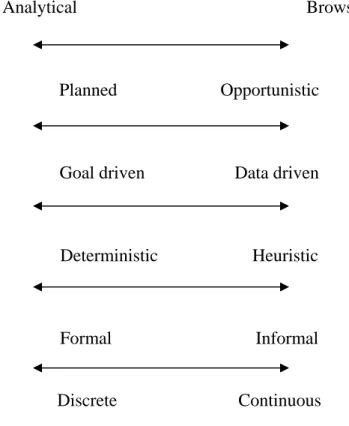
Web-based classification schemes should enhance user information seeking on the Web. Marchionini (1995) identified two approaches that the user takes to seek information in the electronic environment—analytical and browsing. Figure 1 describes the characteristics of these two approaches and illustrates the differences between them.
Analytical Browsing
Planned Opportunistic
Goal driven Data driven
Deterministic Heuristic
Formal Informal
Discrete Continuous
Figure 1. Analytical vs. Browsing Approach (Marchionini, 1995, p.73)
The analytical approach is mostly taken by expert information seekers while the browsing approach is taken by most information seekers. Marchionini (1995) argued that the analytical approach is difficult to learn and use.
redundant—especially information environments that are designed according to organizational principles. (Marchionini, 1995, p.100)
To make browsing effective, the information on the Web needs to be organized and redundant. Web-based classification schemes provide a logical structure to organize information on the website and serve as an aid for browsing. Here “redundant” means that the human-created information environments are similar to the information in users’ minds. This requires the Web-based classification scheme to be user-centered.
The Role of Redundancy In Organizational Knowledge Creation
Nonaka and Takeuchi (1995) stated that redundancy promotes knowledge creation at the organizational level. The “redundancy” that they have studied “refers to intentional overlapping of information about business activities, management responsibilities, and the company as a whole” (Nonaka and Takeuchi, 1995, p.80). They stated that western organizations and Japanese organizations have different opinions upon the value of redundant information in organizational knowledge creation. The redundant information has played an important role in the success of Japanese organizations in the world
redundant information, such as information overload and expensive cost in knowledge creation. It is necessary to keep a balance between redundancy and efficiency.
Methodology
What Classification Schemes On The Websites Are Studied?
In this study, the classification scheme on the website of Energy Information Administration (EIA) (www.eia.doe.gov) and part of the classification scheme for books on Amazon.com website (www.amazon.com) were examined. Both classification
schemes are not derived from any formal traditional classification schemes, but are locally developed by the organizations (Jeffers, W., personal communication, October 4, 2004; Kwasnik, 2002). EIA is an agency of the U.S. Department of Energy. It provides data and analyses of statistical energy information. Accordingly, the classification scheme on its website serves for information distribution to the public in the field of energy statistics. Amazon.com is a large commercial website. Its classification scheme has a quite wide coverage, with the aim to help the users to sell and buy books, CDs and audiocassettes. On the Amazon.com website, all the merchandise is first divided into several general categories, including books, apparel and accessories, electronics, toys and games, DVD, and computer and video games. The classification scheme being examined in this study is under the general category books. All the books, CDs, and audiocassettes are listed under the books on Amazon.com website. The classification scheme that was examined in this study covers all these three types.
both of them have been in use for quite a long time, which may prove their pragmatism, consistency of structure, and success in practice. Thirdly, these two classification schemes serve different purposes in different domains. If two classification schemes of the same domain or for the same purpose were examined, the characteristics of redundant topics found in Web-based classification schemes might be biased by the specific purpose or domain. The classification scheme on EIA covers the field of energy. The
classification scheme on Amazon.com has a general coverage of knowledge, which is comparable to DDC and LCC (Kwasnik, 2002). Both of them have their specific functions. One is to provide information services, and the other is to promote sales. Examining both types of sites should provide more insight into how redundancy might support user needs in Web-based classification.
How To Identify The Classification Schemes On The Website?
This paper examines redundant topics in classification schemes on the two websites. The first step is to derive the classification schemes from the noisy information on the websites. On a website, there are usually hotlinks and logos that are actually not a part of the classification scheme. The logos can be a kind of ornament on a website, which show the identity of the institution. The hotlinks can provide navigational convenience to the users, which are often directly linked to external information. Neither of them can
the classification scheme. These classes can be expanded until the finest level in the classification scheme is reached.
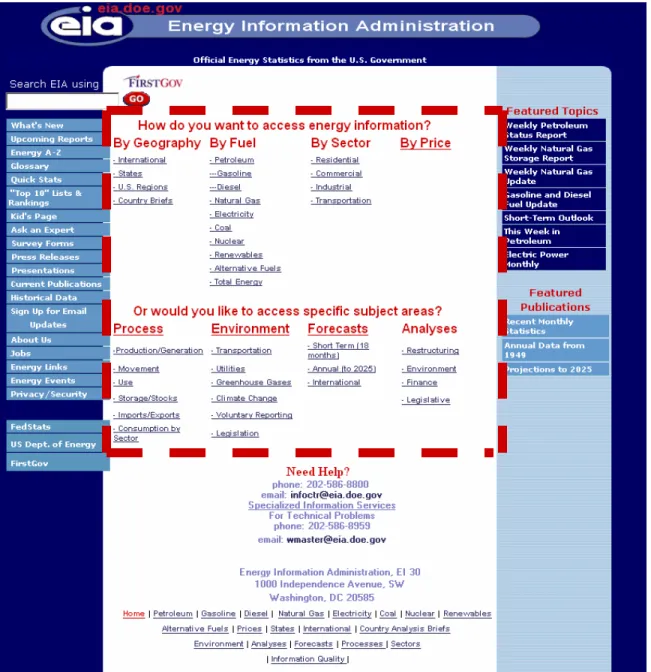
For example, on the homepage of the EIA website (see Figure 2), the hyperlinks “Featured Topics” and “Featured Publications” on the right column are not part of the EIA classification scheme. They may be helpful to directly lead the user to the
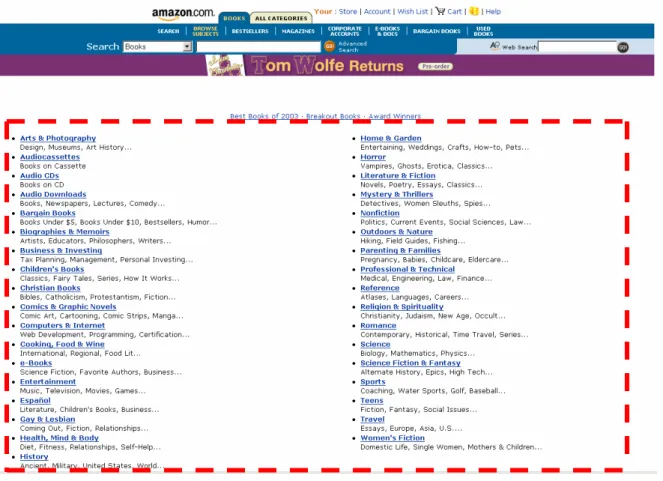
information he needs, however, neither of them displays the structure of information on the website. The hyperlinks on the left navigation bar cannot be regarded as part of EIA classification scheme either. The navigation bar shows the neighborhood pattern. They not only enhance users’ navigation performance but also establish the identity of the website and association between various Web pages. However, they do not serve as a way to organize information on the website. On the homepage of EIA website, only the hyperlinks in the center can be regarded as part of EIA classification scheme. Each hyperlink there serves as a node in the classification scheme and each node can be expanded to display the classes at the next level. These hyperlinks show the structure of information on the website. On the Amazon.com website (Figure 3), the hyperlinks in the lower part of the page display the classification scheme on Amazon.com. Web-based classification schemes may be displayed on different parts of the interface according to various needs of interface design.
To extract the classification scheme from the two websites, each hyperlink in the classification schemes was followed and expanded until the finest category was reached. On the EIA website, a classification scheme of 1,166 topics was recorded. On the
Figure 3. Screenshot of the Web Page “Browse Subject” on Amazon.com (www.amazon.com).
How to Analyze?
to each page. In terms of comprehensiveness and complexity of the contents, the survey is too brief and the detailed audit is too complicated. The content map captures the major characteristics of each page and provides a concise blueprint for the organization of contents on the website.
This study aims to explore some characteristics of redundant topics in classification schemes on the websites. A content map will be conducted for this study, as shown in Table 4. The content map was constructed in an EXCEL spreadsheet. In the spreadsheet, labels for all topics in classification schemes on the two websites were recorded and each of them was assigned with a unique ID. This ID intuitively displays the vertical and horizontal position of each topic in the classification scheme and the relationship between topics. The digits of the ID show the vertical level of the topic and the number at each digit shows its horizontal position. For example, if the ID is 1.1.1.1, then the topic is at the fourth level vertically and along the path “By GeographyÆ InternationalÆTotal EnergyÆConsumption”. The ID for the topic “By Geography” is 1. It is at the first
vertical level. The ID for the topic “International” is “1.1”. It is at the second vertical level. And the ID for the topic “Total Energy” is “1.1.1”, which is at the third vertical level. For the purpose of this study, only labels of the topics are recorded in the content map. The labels can tell the existing redundant topics and their IDs may help locate the topics and reveal their relationships. To better visually display the vertical levels,
content map is an easy way to show the organizational structure and redundant topics in classification schemes on the two websites.
Table 4.
Part of the Content Map for Amazon Classification Scheme (www.amazon.com).
Table 5.
The First and Second Vertical Level Topics in EIA Classification Scheme (www.eia.com).
How do you want to access energy
information? Would you like to access specific subject areas?
1. By Geography
2. By Fuel 3. By Sector 4. By Price
5. Process 6.
Environment
7. Forecasts 8. Analyses
Findings And Discussion
Observation Upon The Classification Schemes On EIA And Amazon
The EIA website aims to provide energy statistical data and analyses to the public and the classification scheme on its website serves this purpose. This determines the coverage of the EIA classification scheme, which focuses upon energy statistical
information. The classification scheme views the statistical data from two entry points by raising two questions—“How do you want to access energy information?” and “Would you like to access specific subject areas?” (EIA, www.eia.doe.gov). From each entry question, four first-level categories are identified. These eight categories reflect eight perspectives to divide the energy statistical data. They may be regarded as eight facets of the classification scheme, including geography, fuel type, sector, price, process,
environment, forecasts, and analyses. These eight facets are eight meaningful ways to view and divide the information. However, they lack relationships between each other. Neither are they mutually exclusive. Each facet can be further expanded with the deepest vertical level of five. Each category in EIA classification scheme has no more than 10 subcategories, which makes it possible to display all subcategories under one parent category on one screen.
petroleum, natural gas, coal and electricity are four main types of fuels. Consumption and prices are two main types of energy statistical data. International and state are two main groups in terms of geography, and annual is viewed in terms of time.
Table 6.
Overview of Redundancies in EIA Classification Scheme. Times the topic
appears
Number of topics Number of redundancies
Percentage of redundancy
1 335 0 0 2 64 64 9.8% 3 42 84 12.9% 4 27 81 12.4% 5 13 52 8% 6 8 40 6.1% 7 2 12 1.8% 8 3 21 3.2% 9 3 24 3.7%
10 1 9 1.4%
11 1 10 1.5%
12 4 44 6.8%
13 3 36 5.5%
14 1 12 1.8%
17 2 32 4.9%
18 1 17 2.6%
19 1 18 2.8%
22 1 21 3.2%
25 2 48 7.4%
26 1 25 3.8%
Total 515 651 ≈100%
Amazon.com is a popular large commercial website. Its classification scheme has a rather broad coverage with the aim to enable the users to search items for purchasing. On the homepage of its classification scheme, 35 first-level topics are displayed
Table 7.
First-level Topics in Amazon Classification Scheme
(http://www.amazon.com/exec/obidos/tg/browse/-/1000/ref=b_tn_bh_br/002-8833923-9309656).1
Arts & Photography e-Books Parenting & Families Audiocassettes Entertainment Professional & Technical
Audio CDs Espanol Reference
Audio Downloads Gay & Lesbian Religion & Spirituality Bargain Books Health, Mind & Body Romance
Biographies & Memoirs History Science
Business & Investing Home & Garden Science Fiction & Fantasy
Children’s Books Horror Sports
Christian Books Literature & Fiction Teens Comics & Graphic Novels Mystery & Thrillers Travel
Computers & Internet Nonfiction Women’s Fiction Cooking, Food & Wine Outdoors & Nature
There are no systematic relationships between the first-level topics, which represent many aspects including formats (Audiocassettes, Audio CDs, e-Books), genres
(Biographies & Memoirs, Horror, Nonfiction), perspectives (Christian’s Books, Gay & Lesbian), audience (Children’s Books, Teens, Women’s Fiction) and so on (Kwasnik, 2002). They are not faceted classificatory structure according to the structural
Table 8.
Example of “Architecture” on Amazon.com. ID Path
1.1 Arts & PhotographyÆArchitecture
1.2.2.2 Arts & PhotographyÆArtÆArt HistoryÆArchitecture 26.2 Professional & TechnicalÆArchitecture
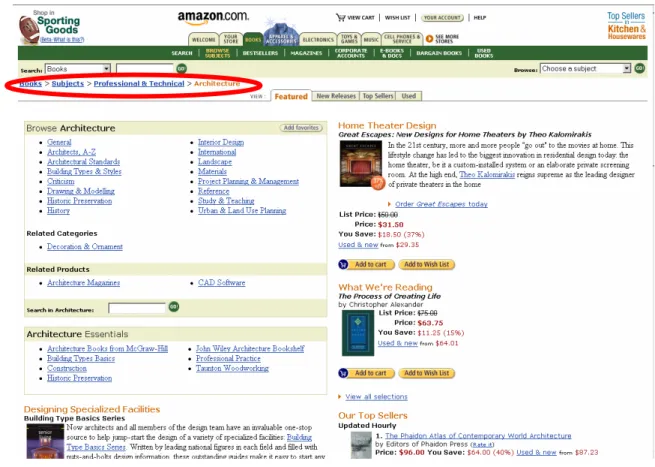
The labels, shown under the top-level topics on the homepage of its classification scheme, are not real second-level topics, but are just descriptions of the first-level topics. Such descriptions provide the user with some idea of what to be expected under the first-level topics. Clicking on each of the first-first-level topics leads the user to a Web page where the second-level topics are displayed. The path on the top of the page shows the position of the topic in the classification scheme. Each of the first-level topics can be expanded with six levels deep at the most.
Kwasnik’s (2002) study identified redundancy in the Amazon classification scheme. The same issue can be found in the latest version of the classification scheme on
In the content map for the six first-level topics in Amazon classification scheme, 1766 topics were recorded. Among them, 865 topics are unique. The results show that more than half of the topics appear more than once in the classification scheme on the website. Table 9 gives an overview of redundancies in Amazon.com classification scheme. The top ten topics that have shown up most frequently in the classification scheme are “General”, “Reference”, “Intermediate”, “Casual users”, “Advanced”, “Personal finance”, “International”, “History”, “Accounting”, and “Web browsers”. Table 9.
Overview of Redundancies in Amazon Classification Scheme.
Times of appearances
Number of Topics Number of Redundancies
Percentage
1 863 0 0
2 217 217 36.5%
3 54 108 18.2%
4 17 51 8.6% 5 8 32 5.4% 6 3 15 2.5% 7 3 18 3% 8 1 7 1.2% 9 3 24 4%
13 1 12 2%
112 1 111 18.7%
Total 1171 595 ≈100%
Patterns of Redundant Topics Observed on the Two Websites
However, identifying these patterns and discussing their advantages and disadvantages to the organization of information and user information seeking behavior may deepen people’s understanding of redundancy in Web-based classification schemes. Furthermore, the designers of classification schemes may learn from this in their future design. This part describes five patterns, including cycle, parallel, faceted, split/join, and black box.
Cycle
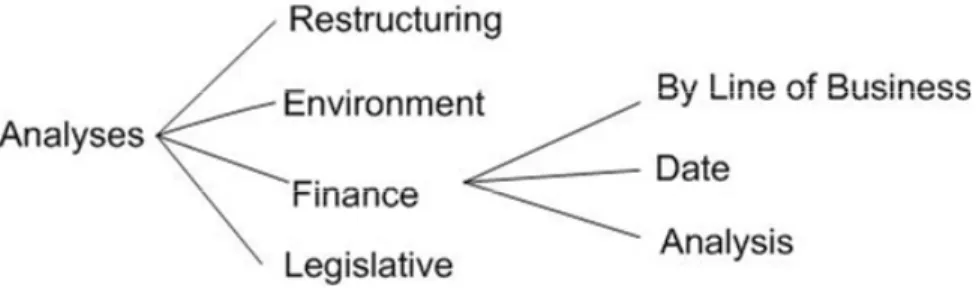
The cycle refers to the same topics, which are located at the same horizontal level but different vertical levels. The cycle creates a circle for the redundant topic. The cycle is usually generated for three reasons. Firstly, it may be generated due to duplication of division criteria. For example, in the EIA classification scheme, “8. Analyses” and “8.3.3. Analyses” appear under the same horizontal level but at different vertical levels (see Figure 4). The user comes to the redundant topic “8.3.3 Analysis” by following the route “AnalysesÆFinanceÆAnalysis”. The two redundant topics create a cycle within one
Figure 4. Explanation of the Relationship Between “8. Analyses” and “8.3.3 Analysis”.
26. Professional & Technical
26.1 Accounting & Finance 26.2 Architecture 26.3 Business Management 26.4 Education 26.5 Engineering 26.6 Law 26.7 Medical 26.8 Professional Sciences 26.8.1 Agricultural Sciences 26.8.2 Astronomy 26.8.3 Behavioral Sciences 26.8.4 Biological Sciences 26.8.5 Chemistry
26.8.6 Earth Sciences
26.8.7 Evolution 26.8.8 Mathematics 26.8.9 Physics 26.8.2.1 Astronomy 26.8.2.2 Astrophysics & Space Science 26.8.2.3 Cosmology
Figure. 5. Explanation of the Relationship Between “26.8.2. Astronomy” and “26.8.2.1 Astronomy”.
Thirdly, related topics are included in the classification scheme. In EIA classification scheme, the redundancies of the topics of main types of fuel, including “Electricity”, “Natural Gas”, “Petroleum”, “Coal”, and “Renewables”, create several cycles. For example, the topic “5.1.3.3 Electricity page” follows the path
“ProcessÆProduction/GenerationÆElectricityÆElectricity page”. In this example, the
topic “5.1.3.3 Electricity page” is a related page to the topic “5.1.3 Electricity”, but not a subclass. The redundancies of the topics of main types of fuel show the same
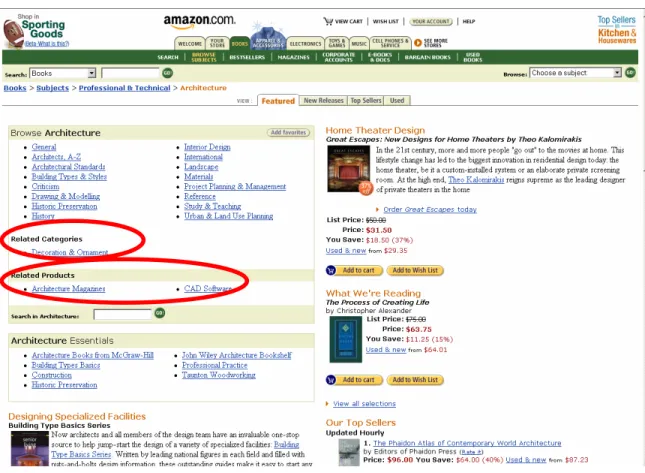
“Related Products” and “Related Categories”—are usually available, which provide hyperlinks to related topics. Such a feature has excluded the related topics from appearing in the classification scheme, while still offering the user the convenience to browse other related topics.
Figure 6. Screenshot from Amazon.com to Show Related Topics.
to show the structure of knowledge in the field. Such type of redundant topics is against the structural requirements of all classificatory structures.
The cycle may also be confusing to the user. The same topic is displayed in different places and implies a parent/child relationship between each other within a classification scheme. The meaning of the redundant topics within a cycle is vague to users, as different definitions may be implicitly given to the same topic.
In the third situation, the cycle provides the user with the choice to visit the related topics. The question is whether such related topics should be included in the classification scheme. The Amazon website creates separate columns of “Related Categories” and “Related Products”. This may be an approach to keep the structural integrity of the classification scheme while providing the user with convenient access to information on the website.
Parallel
Parallel refers to the same topics, which are located at the same vertical level but different horizontal levels. For example, in EIA classification scheme, the topic
and “1.1.2. Natural Gas”, which are two different types of fuel. The topic “1.1.2.1 Consumption” can be construed as “Petroleum Consumption” and the topic “1.1.3.1 Consumption” can be construed as “Natural Gas Consumption”.
Table 10.
The Use of the Topic “Consumption” in EIA Classification Scheme.
Table 11.
The Use of the Topic “Advanced” in Amazon Classification Scheme.
Table 12.
The Use of the Topic “Casual Users” in Amazon Classification Scheme.
Table 13.
The parallel reflects that the same criteria are applied to divide various topics. Although the redundant topics appear to be duplicated, they can be construed as different topics to the user. The parallelism shows the similarities and differences between the redundant topics. It establishes the relationship between different horizontal levels and enables the user to find comparable information across them.
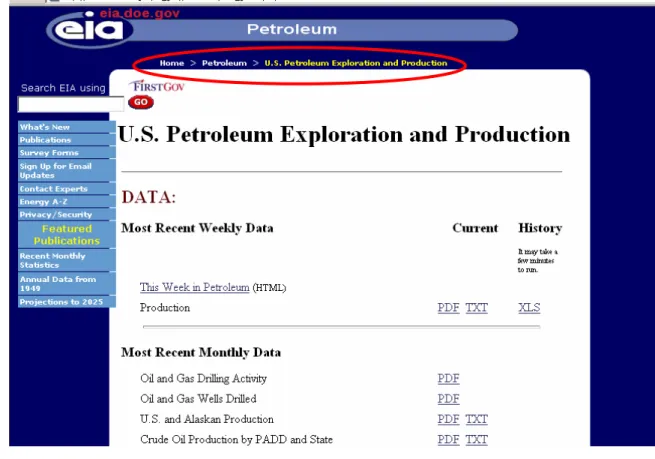
Figure 8. Display of the Path on the Top of the Web Page at EIA.
(http://www.eia.doe.gov/oil_gas/petroleum/info_glance/exploration.html).
Faceted
Faceted redundancy refers to the same topics, which are located at different
horizontal and vertical levels. It reflects the different perspectives to view the information and offers the user various entry points to the same information. As shown in Table 10, the topic “Consumption” shows up 26 times at four different vertical levels across four different facets in EIA classification scheme. No matter which entry point the user has chosen, “By Geography”, “By Fuel”, “By Sector”, or “Process”, he can get the
In Amazon classification scheme, the topic “Accounting” shows up seven times at different vertical and horizontal levels. The information seeker can find information related to the topic “Accounting” by entering from different first-level topics, including “Business & Investing”, “Computers & Internet”, and “Professional & Technical”. Table 14.
The Use of the Topic “Accounting” in Amazon Classification Scheme.
The faceted pattern displays that at least some parts of the two classification
schemes have applied the faceted classificatory structure. It reflects multiple perspectives to view the information. This pattern inherits the characteristics of the faceted
classificatory structure. Such a pattern does not show any systematic relationship between facets. However, it does show that the facets are overlapping.
The faceted pattern allows the user to find his desired information from different entry points following various routes. This type of redundant topic may be helpful to the user in the information seeking process. When the user searches for specific information, according to Belkin’s ASK, he may not be able to articulate the query accurately and clearly. However, whichever perspective he may think of and identify, he can trace that for the information without worrying about going to a dead-end.
This shows the limitation of the faceted classificatory structure. This pattern increases the user’s cognitive load in the information seeking process. The user needs to grasp an understanding of the whole field by his exploration and analysis of the facets.
Split/Join
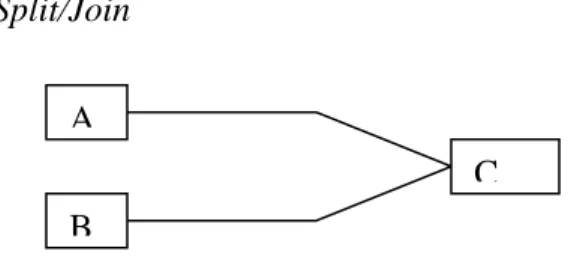
C B
A
Figure 9. Explanation of split/join.
Split/Join here refers to two different topics, which point to the same place. As shown in Figure 9, the two split topics, A and B, knit together into the topic C. Usually this pattern occurs in two situations. Firstly, two synonyms point to the same destination. The topics of “2.2.3.3. Imports/Exports” and “2.2.3.5. Pipelines” in EIA classification scheme display such characteristics. These two topics have the same meaning in this context, which refers to transportation of natural gas outside the boundary of U.S. By clicking on either of the two different topics, the user will get to the same topic “Imports & Exports/Pipeline”.
The second situation is two aspects of one concept point to the same destination. The topics in Amazon classification scheme—“1.2.2.2. Architecture” and “26.2.8. History”—show such characteristics. The topic, “1.2.2.2. Architecture” follows the route of “Arts & PhotographyÆArtÆArt HistoryÆArchitecture”, while the topic, “26.2.8. History”, follows the route of “Professional & TechnicalÆArchitectureÆHistory”. These
the concept “architecture history”. This also shows characteristics of the faceted structure in the classification scheme.
As Belkin (1986) pointed out, the terms in the user’s mind may be different from the terms used to represent the same meaning in the classification scheme. Although the topics are overlapping, they provide more possible matching terms for the user to choose in the classification scheme. If the user follows one route and gets to the information he needs, he will have no trouble with the redundant topics. However, if the user clicks on several different topics and gets to the same destination, he may feel disappointed and puzzled. It is difficult for him to understand the whole structure of knowledge in the field. This may also waste the user’s time in the information seeking process.
This pattern may jeopardize the structural integrity of classification schemes. It may be difficult to keep consistent criteria to divide the categories. In a classification scheme, it is impossible to include all the synonyms and all the aspects of one concept. It is critical for the designer to find the balance between redundancy and efficiency.
Black box
The black box refers to the redundant topics, which do not have any specific meaning with the topics themselves but just serve as a container for some items. For example, the topic “General” shows up 112 times in Amazon classification scheme. The topic “Other Related Topics” shows up 8 times in EIA classification scheme.
give “General” a try to search for the information he needs and have some understanding of the field. “Other Related Topics” in EIA classification scheme provides the link to some topics that are relevant. These topics may be relevant to the user and provide additional routes for the user to find the information. It may be helpful in the information searching process.
This type of redundant topic lacks the ability to describe itself. For example, under the parent topic, there are 16 topics including “General”. Actually, any items under the other 15 topics may be included in “General”. Kwasnik (2002) argued that the existence of such topics as “General” implied that Amazon classification scheme lacks
expressiveness. There are no consistent or clear criteria to divide “General” from other topics at the same level. It may appear as a black box to the user as he has no idea of what are inside. This fails to provide a clear structure of knowledge in the field to the user.
Limitation
This paper only studies two classification schemes on the Web, the EIA
Conclusion
This study examines the redundant topics in classification schemes on the two websites. More than half of the topics in these two Web-based classification schemes are redundant. This shows that redundant topics are a problem for the design of classification schemes on the Web. This study identifies five patterns of redundant topics, which describe some characteristics of redundant topics and show how the redundant topics are manifested in classification schemes. These patterns also provide some vocabulary to describe the existing redundant topics.
The advantages and disadvantages of these patterns, which they pose to the organization of information and user information seeking behavior, are also discussed. They may provide some considerations in the design of Web-based classification schemes. While adding redundant topics to a classification scheme on the Web, it is necessary to review three types of relationships. The first type is the relationship between the redundant topic and the whole structure of the classification scheme. This is helpful to locate one or more positions where the redundant topic can live. The second type is the relationship between the redundant topic and other sibling topics under one parent topic. This is helpful to ensure some systematic relationship between the topics at the same level. The third type is the relationship between the redundant uses of the topic in the classification scheme. The differences and similarities between these redundant uses of the same topic can provide clues of whether they are necessary to be included in the classification scheme.
to the destination information, too many redundant topics in the classification scheme on the Web will be a waste of the space on the Web and cause information overload to the user. The Amazon website has shown one possible way to reduce redundancy in its classification scheme. It provides two separate columns—“Related Subjects” and “Related Products”—on its Web pages. This helps to exclude some topics from the classification scheme while providing convenient links to useful information as well.
As redundant topics may imply different meanings at different positions, it is necessary to provide some clues to the context of each topic in the classification scheme on the website. Both EIA and Amazon websites provide the path of each topic on the Web page where the topic is displayed. This approach offers limited contextual information of the topic, as only one linear thread is described in the path. The
redundancy in the Web-based classification scheme requires new approaches to display the contextual information of topics not only in one linear thread, but also in the whole neighborhood.
Note
References:
Amazon classification scheme for books. (n.d.) Retrieved October 20, 2004 from
http://www.amazon.com/exec/obidos/tg/browse/-/1000/ref=b_tn_bh_br/102-4579237-0035363.
Belkin, N. J. (1980). Anomalous states of knowledge as a basis for information retrieval. The Canadian Journal of Information Science, 5, 133-143.
Bernstein, M. (1998). Patterns of hypertext. In Proceedings of the Ninth ACM Conference On Hypertext And Hypermedia: Links, Objects, Time and Space—Structure in
Hypermedia Systems, 21-29. New York, NY: ACM Press.
Dervin, B. and Nilan, M. (1986). Information needs and uses. Annual Review of Information Science and Technology, 21, 5-33.
Energy Information Administration. (n.d.) Retrieved October 10, 2004 from http://www.eia.doe.gov.
Fest, K., Leise, F. and Steckel, M. (2002). What is a controlled vocabulary? Retrieved November 1, 2004 from
Fraser, J. C. (2001). Taking a content inventory. Retrieved October 16, 2004 from http://www.webtechniques.com/archives/2001/10/fraser.
Guralnik, D. B (Ed.). (1980). Webster’s New World Dictionary of the American Language (2nd College Edition). New York, NY: Simon and Schuster.
Kuhlthau, C. C. (1993). A principle of uncertainty for information seeking. Journal of Documentation, 49 (4), 339-355.
Kwasnik, B. H. (1999). The role of classification in knowledge representation and discovery. Library Trends, 48 (1), 22-47.
Kwasnik, B. H. (2002). Commercial websites and t he use of classification schemes: the case of amazon.com. In Lopez-Huertas, M. J. (Ed.), Challenges in Knowledge Representation and Organization for the 21st Century, Proceedings of the
Seventh International ISKO Conference (pp.279-285). Wurzberg, Germany: Ergon Verlag.
Library of Congress. (2003). Library of Congress Classification Outline. Retrieved November 30, 2004 from http://www.loc.gov/catdir/cpso/lcco/lcco.html.
Marchionini, G. (1995). Information seeking in electronic environments. New York, NY: Cambridge University Press.
McDaid, J. (1992). Uncle Buddy’s phantom funhouse. Watertown, MA: Eastgate Systems Inc.
Nonaka, I. And Takeuchi, H. (1995). The knowledge-creating company: How Japanese companies create the dynamics of innovation. New York: Oxford University Press.
Pettigrew, K. E., Fidel, R., and Bruce, H. (2001). Conceptual frameworks in information behavior. Annual Review of Information Science and Technology, 35, 43-78.
Ranganathan, S.R. (1964). Classified catalogue code. London: Asia Publishing House.
Siegel, D. (n.d.). Homepage. Retrieved Nov. 20 from http://www.dsiegel.com/index.shtml.
Taylor, A. G. (2004). Wynar’s Introduction to Cataloging and Classification. Westport, CT: Libraries Unlimited.
Will, L. (2004, Nov. 5). The A>B, B>A problem. Message posted to Sigia-l electronic mailing list, archived at http://mail.asis.org/mailman/private/sigia-l/2004-November/011380.html.
William, J. Personal communication. October 4, 2004.