The Acquisition of German Verb-Selected
Prepositions and Derivational Prefixes in Adult
Native English Speakers
by Meghan Hersh
Senior Honors Thesis
Germanic and Slavic Languages and Literature University of North Carolina at Chapel Hill
2015
Approved:
______________________________ Dr. Christina Wegel, Thesis Advisor
Table of Contents
1. Introduction to Second Language Acquisition and German Verbs 1
1.1 Cross-Linguistic Influences 1
1.2 Factors Influencing Acquisition 3
1.3 Frequency Theory for Vocabulary Acquisition 4
1.4 The Effect of Item Difficulty on Vocabulary Acquisition 5
1.5 Introduction to German Verbal Prefixes and Prepositions 7
2. Research Study and Methodology 11
2.1 Overview of the Study 11
2.2 Study Items 11
2.3 Data Collection 12
2.4 Analysis 13
3. Verb-Selected Prepositions 15
3.1 Results Overview 15
3.2 Results by Level 15
3.3 Non-Corresponding Prepositions 16
3.4 Corresponding Prepositions 24
4. Derivational Prefixes and Verbs 31
4.1 Results Overview 31
4.2 Separable vs. Inseparable Prefixes 32
4.3 Transparent vs. Opaque Prefixes 35
5. Discussion of Results and Implications for Language Teaching 37
Appendix A 43
Appendix B 45
Appendix C 46
Appendix D 47
1. Introduction to Second Language Acquisition and German Verbs
Second Language Acquisition (SLA) is a subfield of linguistics interested in researching how
persons acquire second languages (L2) and further. It is a common view that adult learners (adult
here meaning post-pubescent) are unable to acquire a native-level command in an L2. As this is a
common end goal for second language learners, much of the research in the field looks at what
stands in the way of this goal, and how it may be achieved. Most learners achieve, instead of
native proficiency, a form of 'interlanguage' (Section 1.1). How advanced this interlanguage is
varies between people.
In this study, I focus on the acquisition of two features of the German language:
verb-selected prepositions and verbal prefixes, which are discussed in more detail in Sections 1.5. The
rate of acquisition of these and other language features are dependent on various factors, which
may either help or hinder acquisition. These factors include influence from the mother tongue
(L1), the frequency at which learners are in contact with a feature, and how difficult the item is.
These are discussed in Sections 1.1 through 1.4.
1.1 Cross-Linguistic Influences
Upon the acquisition of further languages, learners must contend with multiple language
systems. Each system will have a unique set of grammatical and discourse rules, sound
inventory, vocabulary and semantic maps. Ideally, all these language systems would remain
separate within learners’ minds, thus allowing for more native-like acquisition, but unfortunately
this is not the case. Instead, these systems intermingle and influence one another, creating what is
similar (or different) the languages are, shared or clashing grammatical features1, learners’
confidence level, et cetera (Ortega 2009).
One of the first major theories in CLI was the much simplified idea that any similarities
between the L1 and L2 would be more easily acquired than the differences (Stockwell, et. al.
1965). Though the basic idea is supported, it does not always hold, and realistically acquisition is
not always dependent the actual similarities and differences, but the perceived similarities and
differences. An experiment with Dutch speakers learning English (Kellerman 1978) showed that
although both languages allowed a single verb form to be used both transitively and
intransitively, as the Dutch speakers advanced in their study of English, they stopped accepting
the intransitive use of the verbs as readily, believing the feature to be 'too Dutch'. Thus, given
sentences similar to to the following, they would deem the second example to be disallowed in
English.
(1) He broke the cup. The cup broke.
In L2 context, CLI may manifest itself as using features from the L1 that are
ungrammatical in the L2 or overuse, underuse, avoidance, or preference of certain structures that
they find either easy or difficult. This can result in errors in producing spontaneous language. In
the context of this thesis, we are interested in how CLI affects the application of verbal prefixes
and verb-selected prepositions. The factors that can affect this will be expounded upon
throughout this thesis. Comparisons to the L1 by translating directly from English to German,
item difficulty and frequency, semantic transparency (Section 2.2), and learners’ ability to
extrapolate meaning will all influence the data collected, and determine how close learners are to
'native-like abilities'.
Grammatical features include morphological features such as whether verbs are conjugated for person, 1
1.2 Factors Influencing Acquisition
There are myriad factors that influence acquisition, all of which will vary with the individual.
Some factors may play more or less of a role than others, which may be due to individual
variation, methods of acquisition, and age. Age is not relevant for this study, as the biggest
variation comes from pre-pubescent and post-pubescent groups. As I am focusing here on adult
learners, we are unlikely to come across this type of variation. Since individual variation is
unpredictable, in that it depends solely on the individual, and age is irrelevant here, we will be
focusing on how the methods used to acquire language may influence acquisition.
Perhaps the most important factor in acquisition methods is simply how much exposure
learners have to the L2, and in what forms it is given. Naturally, the more input a learner is
exposed to, the more likelihood that they will encounter vocabulary items and grammar patterns.
The more often they encounter these, the more likely they are to acquire them (Section 1.3).
However, this input must still be comprehensible for the learner. Here, we consider Krashen’s
Comprehensible Input Hypothesis (Krashen 1985). This hypothesis states that in order for
learners to continue acquiring a language, the input they receive must be slightly above their
competency level, or i+1, where i is their current level, and +1 is one level more advanced. In
this way, learners will be able to use comprehensible context to acquire more advanced forms. In
situations where i+1 is not used, learners will have a much more difficult time acquiring a
language. If only materials at the current level of competency are used, the learners will not
acquire advanced forms, as they are not present in their input. If materials beyond i+1 are used,
they will be incomprehensible to the learner and will not be acquired. Thus, input
comprehensibility and the amount of language contact are paramount.
Methods in improving output, not just understanding, are also important for acquisition.
For output to be improved, learners must receive feedback. This can be difficult to come by, for
many reasons. For adult language learners, their typical language environment is either a
classroom or a community that speaks the target language as L1. Both present problems in
obtaining feedback, though classrooms tend to be more regulated on this front. In a language
unless it is asked for. It is certainly possible to get useful feedback from native speakers, but this
will generally be a situation where the native speaker has taken on a 'mentoring' role, where they
know the learner is comfortable with and seeks out feedback. A spontaneous conversation is
much less likely to accomplish this, as it interrupts the flow of conversation and is considered a
bit impolite. Situations where spontaneous conversation is more likely to result in correction are
where clarification is sought when either party lacks understanding. If the L2 speaker’s utterance
is incomprehensible to the L1 speaker, or the L1 speaker uses words or grammatical forms too
advanced for the L2 speaker, asking for clarification can lead to new linguistic awareness.
Classrooms, on the other hand, are much more conducive to receiving feedback. Still, giving
appropriate feedback for every ungrammatical utterance can be difficult with multiple students
and multiple mistakes. Classroom time must be managed, and spending whole sittings explaining
corrections is just as likely to stunt acquisition, as it takes away time from input. However,
failing to provide feedback is just as detrimental. Leaving mistakes uncorrected and unexplained
will allow these incorrect forms to fossilize in the L2 grammar, and lead to difficulties in
acquiring the correct forms. Feedback should be given on both form and meaning, and should
come with an explanation as to why one form is correct. This allows learners to gain a more
complete picture of the L2 and obtain a more in-depth understanding of the language.
1.3 Frequency Theory for Vocabulary Acquisition
It is commonly thought that the more often learners encounter a word, the more likely they are to
acquire it. This comes from the necessity to understand the word in context in order to better
understand the text as a whole. The more it is encountered and correctly identified, the more
likely it will be for the learner to retain it as something necessary. However, the majority of
words in any language are function words2, not content words. Thus, more texts need to be read
in order for content words to be acquired. Lower frequency words require more encounters for acquisition.
As function words do not have referents, and do not carry semantic meaning the same way as content 2
In this thesis, we are concerned with verb-selected prepositions that are explicitly tied to
a particular verb, creating a set phrase, and prefixes, which carry meanings of their own and are
used to derive a new meaning in conjunction with a core verb. Examples of each are given in
Section 1.5.
Because the prepositions are themselves function words, they tend to be a source of
difficulty for many language learners, as they rarely have singular, concrete uses, and aren’t
immediately translatable. Furthermore, in German, many verbs have a required preposition that
may or may not differ from its English counterpart, such as interessieren sich für ‘to be interested
in’. Thus, the frequency of the verb in question is also an important factor, and not just the
frequency of the preposition.
Prefixes are yet another ballgame. There are two methods for learning a full prefixed
verb. Most common at lower levels of proficiency, these words can be learned as units, such as
vorbereiten ‘to prepare’. With this method, the learners are acquiring the words as a whole, but
are not learning the core verb and the meaning of the prefix. If the learner does not understand
the meaning of the parts, they are less likely to be recognized when encountered separately, in
the case of separable prefixes. A more advanced strategy is that of learning the core verb and the
prefixes separately. Thus, vor ‘before’ + bereit ‘ready’ amounts to ‘to prepare’. This allows the
learner to encounter them more often in recognizable contexts and be able to extrapolate a
meaning when they are used in conjunction. Additionally, they are more likely to be able to coin
new words with the parts they know, which can greatly expand their vocabularies.
1.4 The Effect of Item Difficulty on Vocabulary Acquisition
The frequency theory discussed in the previous section is further complicated by item difficulty.
Items may be considered difficult due to a number of factors, such as the following: unusual
combinations of sounds, difficulty in pronunciation, similarity to L1 equivalent, and semantic
domains. The measure of difficulty may also depend on the L1 and L2 in question. An L1
more restricted than either English or German phonology, and Japanese has much fewer cognates
with English than does German. Thus, the unknown lexemes and difficult pronunciation would
make it more difficult for an L1 Japanese speaker to acquire new vocabulary.
Words that learners find more difficult are less likely to be learned, and will thus require a
great deal more exposure to be acquired. Hence, while a L2 English learner may pick up 'day'
fairly quickly, as its phonology is simple and its meaning is uncomplicated and useful, they may
have a more difficult time with 'split' with its consonant cluster and more abstract meaning. This
suggests that there should be a focus on teaching these more difficult words, as they are less
likely to be independently acquired through contact. However, it is important to differentiate
between words that are difficult to learn, and rare words that will not be needed frequently, if at
all. ‘Split’, which has a number of applications (e.g. ‘to split the bill’, ‘to split up’, etc.) is
perhaps a more useful lexical item to focus on than, for example, ‘incredulous’, which has fewer
applications and is less likely to appear.
For our purposes, we will begin by looking at the factors that influence the difficulty of
verb-selected prepositions and prefixes. This incidence of CLI may make some prepositions
easier to acquire than others. In this study, two of the test items were in jemandem verliebt sein
'to be in love with someone', and mit jemandem sprechen 'to speak with someone'. Both of these
phrases use the preposition with in English, but the equivalent of 'in' and 'with' respectively in
German. The measure of difficulty here comes primarily from the similarity to the L1. As the
first example is less similar to its English counterpart, it is likely that learners would need more
time to acquire it.
Item difficulty in regards to German prefixes has different parameters. Though there are a
few prefixes tested that are similar to English morphemes (miss- 'mis-', the majority of the
difficulty in prefixes will come with semantics. The first level of difficulty comes with the
number of meanings attributed to each prefix. Some prefixes, such as ver- have multiple
meanings, whereas others, like zer- only have one (see Fig. 2, section 1.5). Learners must know
which meaning to apply to the core verb to determine the composite meaning. For example, two
worsen'. Thus, words with the prefix ver- may be acquired later than one with a single-meaning
prefix. A further level of difficulty comes with semantic transparency. That is, how easily a
meaning can be extrapolated from its parts. For example, entdecken 'to discover', literally means
'to take the cover off something’. The English word is comprised of the same elements: dis
(reverse process) + cover. The parts suggest that you are removing a veil of ignorance to discover
the meaning, but this may not be the most intuitive to L2 learners. Alternatively, missverstehen
'to misunderstand' literally means 'to understand incorrectly', which is a simple rephrase. Lack of
semantic transparency can add to a word’s difficulty, and make it harder to acquire. Further
discussion of German verb-selected prepositions and prefixes can be found in the next chapter.
1.5 Introduction to German Verbal Prefixes and Prepositions
German prepositions are quite similar to English prepositions in principle. They are used to
clarify direction, location, time, and semantic roles and are generally used in conjunction with a
verb and a noun phrase. In both languages, certain verb phrases require specific prepositions as
part of the phrase. A lack of the correct preposition can result in ungrammatical utterances or a
difference in meaning. Where L2 learners may run into difficulty is in their usage. Equivalent
phrases, such as the example in the previous section, may or may not use equivalent prepositions.
Prepositions also will have different semantic domains in different languages. This entails that
one preposition can be used in certain situations with certain meanings, whereas its 'equivalent'
in another language is used in only partially overlapping situations. There are also cases where
prepositions are used in one language but are unnecessary in the same context in the other. For
example, erinnern sich an means 'to remember'. In the German sentence, an is the preposition,
but English does not require one.
Prefixes are a much more complicated features. Though German includes a variety of
affixes, the focus of this study is primarily on derivational prefixes. Derivational morphology
may change the meaning or part-of-speech of a word. Inflectional morphology changes
grammatical form, such as number, tense, or person. As stated in the previous section, these are
German prefixes are special, in that they can be either 'separable', or 'inseparable'.
Separable prefixes are often derived from prepositions, and can thus be used as individual units.
This is relatively rare in the realm of morphological typology. Most linguists consider prefixes
(and other affixes) to be units that cannot stand alone. For example, English 're-', as in 'redo'
cannot exist separated from the verb, e.g. *'Please do your report re' vs. 'Please redo your report.'
In German, most of these separable prefixes come from prepositions that indicate some
manner of motion, e.g. aus 'extend'. Semantic shift has allowed these to take on additional
meanings, e.g. aus 'completely'. Inseparable prefixes behave the way prefixes do in most other
languages, including English. In other words, they cannot exist alone.
Below is a table of the prepositions tested, including whether or not they were equivalent
in meaning to their English counterparts:
FIGURE 1 CATEGORIZATION OF PHRASES COMPARED TO ENGLISH
Non-Corresponding Corresponding Misleading Word-Form*Corresponding,
sich verlieben in → in love with
danken für → thank for
konzentrieren sich auf → concentrate on
kümmern sich um → take care of
lachen über → laugh about
warten auf → wait on **
erinnern sich an → remember /x/
anfangen mit → start with
teilnehmen an → participate in
zu tun mit → to do with
abhängen von → depend on
sprechen mit → speak with
achten auf → watch out for
geht um → is about
interessieren sich für → interested in
* Auf carries the meaning on in English, which would indicate that this should fall under
the 'corresponding' column. However, there is another preposition an, meaning at, to, which is
very similar in form to on. I suspect some students will try to translate on to its nearest phonetic
counterpart, which would lead to a mistake of an instead of auf.
** In some cases or in dialects, one might prefer 'wait for' instead of 'wait on'. In this
case, this phrase could double under the 'non-corresponding' column.
Where German verbal prefixes may pose complications for learners is in their number of
meanings and the semantic transparency of units. As mentioned in Section 1.4, a portion of
prefixes have more than one meaning:
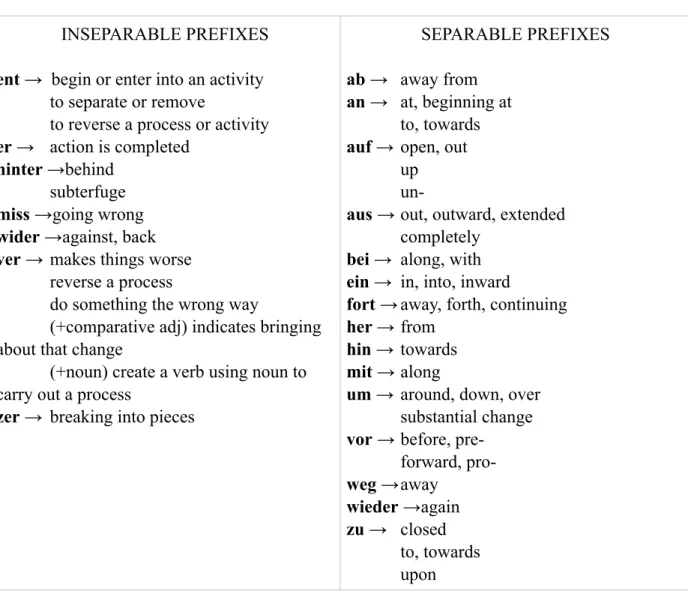
FIGURE 2 PREFIXES AND MEANINGS INSEPARABLE PREFIXES
ent → begin or enter into an activity to separate or remove
to reverse a process or activity er → action is completed
hinter →behind subterfuge miss →going wrong wider →against, back ver → makes things worse reverse a process
do something the wrong way
(+comparative adj) indicates bringing about that change
(+noun) create a verb using noun to carry out a process
zer → breaking into pieces
SEPARABLE PREFIXES
ab → away from an → at, beginning at to, towards auf → open, out up un-
aus → out, outward, extended completely
bei → along, with ein → in, into, inward
fort → away, forth, continuing her → from
hin → towards mit → along
um → around, down, over substantial change vor → before, pre- forward, pro- weg → away
As with English affixes, these prefixes change the meaning of the word they are attached
to; verstehen 'understand' becomes missverstehen 'misunderstand'. In some cases, adding a prefix
can change the part of speech of a word; the adjective groß 'big' becomes a verb vergrößern 'to
enlarge' with the addition of the prefix ver-. L2 speakers must learn how these prefixes interact
with German vocabulary in order to reach more advanced levels of competency. Being able to
parse unknown words based on the prefix and the core verb and coin new words using these
components will help students greatly expand their vocabularies. For that reason, researching the
acquisition of such is of great importance. How this study went about gathering and analyzing
2. RESEARCH STUDY AND METHODOLOGY
2.1 Overview of the Study
Most of the research done into SLA is focused on individuals learning English as a second
language. In order to acquire the specific data I was looking for, I wrote and administered an
original research study that was completed by adult, English-speaking learners of German,
currently enrolled in a formal course (e.g. classroom setting). The test items created were
intended to test learners’ knowledge of verb-selected prepositions and prefixes, and determine to
what extent CLI was a factor. Thus, test items given ranged from similar to dissimilar to their
English counterparts, and semantically transparent to opaque. These ranges will allow us to more
precisely describe the areas in which students are making more or less progress.
The research questions I hope to answer with this study are as follows:
•
How students progress in their competency, i.e. are there instances of backsliding or only improvement?•
To what degree does CLI play a factor in their progression?•
What aspects are students having trouble with?2.2 Study Items
The study administered contained 96 test items, the full version of which can be found in the
Appendix. The first sixteen of these were each of the sixteen prepositions I was interested in.
Each test item consisted of a sentence and asked the subject to fill in the appropriate preposition.
Each test item included a verb that required a specific preposition. Thus, all test items had only
one possible answer, which either aligned with English preposition usage, or differed from it.
(2) Der Professor will, dass wir ___ unsere Fehler achten.
verb. This was done to ensure that students at lower proficiencies would not have an unfair
disadvantage, and also to ensure that it was the prefix they were being tested on, not the verbs
themselves.
(3) blicken means “to look”
umblicken means _______________
Naturally, these items are less black-and-white in terms of responses. When deciding between
multiple choice and fill-in responses, many issues were considered. In the end, I opted for fill-in
answers, as they had less of a possibility for guessing answers, and would ideally provide insight
into the thinking process of the subjects. I decided that the variability of fill-in responses could
be more useful than detrimental, so long as clear criteria were used for analysis. These criteria
are outlined in Chapter 3.
2.3 Data Collection
The study was administered to students at UNC Chapel Hill currently enrolled in one of the main
track language courses, of which there are seven. Students in these courses range from A1 to B2
level competency (see the Common European Framework of Reference for Language). During
the testing, all students were permitted to take the study, and every student who participated
received a small amount of extra credit determined by the university department. However, only
the tests of students who were native speakers of English were kept for analysis, as native
speakers of other languages would likely show different forms of CLI that do not apply to
English L1 speakers.
Subjects were not told about the content of the study beforehand, preventing them from
studying the foci prior to administration. This was done to test what students had retained over
the course of their studies, instead of what was in their short-term memory. Students were given
took place during their normal class time. I briefly considered setting up outside times for the
study and asking for volunteers, but I determined this would greatly decrease participation and
limit my data.
I did run into some problems with this data collection. The majority of these issues
stemmed from the amount of data that was able to be collected. Due to time constraints, I had to
limit my sampling from one population, that is, the students in UNC Chapel Hill’s German
department. More time could have given me access to more students, possibly from a larger
geographic area. The limitation to one population led to rather disproportionate amounts of data
from different levels. As students of UNC Chapel Hill are only required to take three semesters
of a foreign language, enrollment decreases after this period, meaning there is significantly more
data from lower-level students. However, many of these students neglected to complete a
significant portion of the study, leaving a great many holes in my data for beginning learners.
2.4 Analysis
Results were entered into multiple tables for easy access to responses, with separate tables for the
verb-selected preposition and the prefix data. The raw data was then analyzed by marking all
correct responses. In cases where there was question of correctness, I consulted Christina Wegel
to determine whether or the response would be considered correct. After the entirety of the
responses had been entered and checked, graphs noting relevant data were made. These were
done by percentage, that is, the number of relevant responses compared to the number of relevant
entries total.
For the analysis, I also prepared a frequency count of all verb-selected prepositions and
prefixes tested, for all the major texts used at UNC Chapel Hill in teaching German. These texts
are Auf Geht’s and Weiter Geht’s textbooks, Die moderne Gesellschaft in Deutschland textbook,
Crazy by Benjamin Liebert, Frühlings Erwachen by Frank Wedekind, and Die Ausgewanderten
by W.G. Sebald, which are used by every course section, dependent on level. I refer to these texts
elsewhere, but is a good basis for what the subjects have been exposed to. The corpus was used
in determining what verbs and prefixes students had likely seen by the time they took their study.
In keeping with the frequency theory discussed in Chapter 1, the idea is that the more often
students were exposed to a form, the more likely they were to learn it. Thus, the corpus is used in
3. Verb-Selected Prepositions
3.1 Results Overview
Chapter 3 will look at the results for the 16 verb-selected preposition phrases given on the study.
They are divided into corresponding and non-corresponding prepositions. This categorization
depends on whether the preposition accompanying the phrase in both languages have typically
corresponding meanings. That is, mit is typically translated as ‘with’, so if a German phrase that
uses mit uses ‘with’ in English (see Section 3.4 for examples), this would count as a
corresponding preposition. Non-corresponding prepositions cannot be translated to each other in
isolation. For example, from Section 3.3, sich verlieben in translates literally into ‘to fall in love
in', but the grammatically correct English phrase is ‘to fall in love with', which would be mit in
German.
The frequency profile (see Appendix) is mentioned when appropriate to the analysis to
help shed light on some of the results. It should be noted, however, that the prepositional phrases
were rather absent in the common texts. 101 students saw only 2 of 16 phrases in their textbook
(though other phrases are common classroom phrases), and not a great frequency. Such a low
frequency is not particularly useful, but is still mentioned when relevant.
3.2 Results by Level
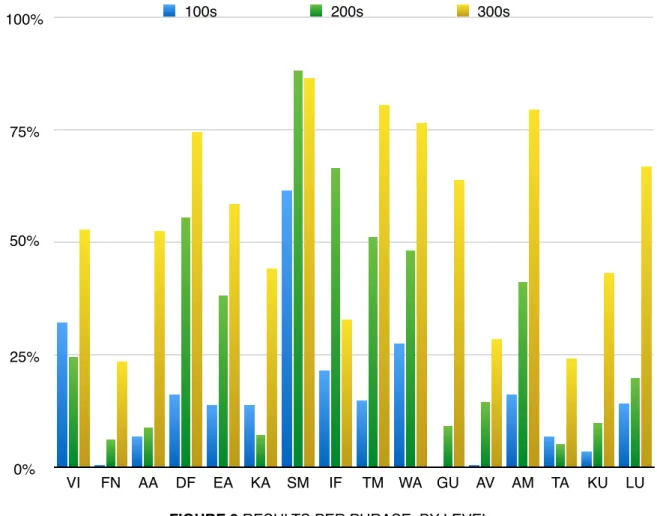
The graph below is a representation of the results by phrase, and then by class. It is collapsed
into 100 level, 200 level and 300 level. The full dataset can be found in the Appendix. As one
would expect, there is a general upward trend for most phrases, with the exception of
interessieren für 'to be interested in', which seems to peak at the intermediate level. This trend
holds for both the corresponding and non-corresponding prepositions. Few of the prepositions,
though showing improvement, still did not reach high percentages of competence by the end of
the fifth semester. Fragen nach, abhängen von, and teilnehmen an did not achieve over 50%
FIGURE 3 RESULTS PER PHRASE, BY LEVEL
3.3 Non-Corresponding Prepositions
This section will look in-depth at the specific phrases that have non-corresponding prepositions
with their English counterparts. For each phrase, the percentage of correct answers were
calculated for each class, as were the percentage of answers giving the direct translation of the
English preposition. For example, in love with would be directly translated as *verlieben mit,
though the actual German phrase is verlieben in. Thus, the percentage of in vs. mit were
calculated. In cases where the direct translation was not the most prevalent incorrect answer, this
was also considered. 0%
25% 50% 75% 100%
VI FN AA DF EA KA SM IF TM WA GU AV AM TA KU LU
The results for this were mixed. Some phrases had a much higher percentage of direct
translations, while in other phrases learners preferred other prepositions, whether correct or
incorrect.
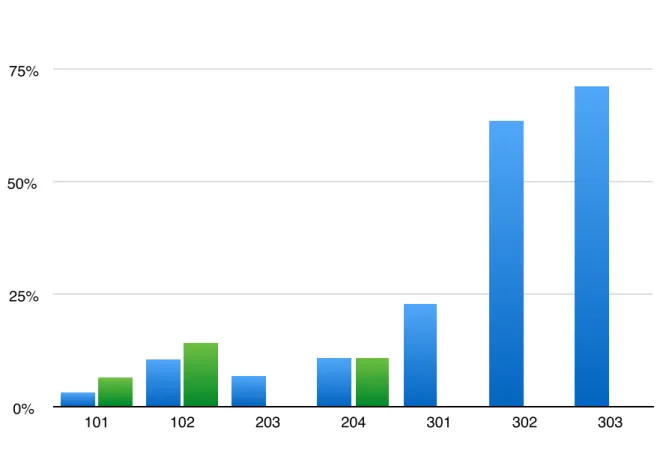
FIGURE 4. KÜMMERN UM (‘TAKE CARE OF’) 0%
25% 50% 75% 100%
101 102 203 204 301 302 303
FIGURE 5. ACHTEN AUF (‘WATCH OUT FOR’)
Kümmern sich um 'to take care of' and achten auf 'to watch out for' have a much more
predictable acquisition pattern than the subsequent phrases below, with the correct prepositions
showing a steady increase, and the incorrect prepositions in question demonstrating a steady
decrease as the students’ level progresses. These are the only two verb-selected preposition
phrases that show such a pattern. As demonstrated in Fig. 6-8, while the rate of correct
prepositions may increase in most instances, many of the incorrect prepositions stay relatively
steady.
It should be noted that the alternate prepositions for kümmern sich um do not correspond
with the English phrase. Instead, *kümmern für, which likely comes from translating kümmern as
'to care for', and *kümmern mit were the most common mistakes. Here we see a much more
distinct upward trend as students progress in favor of the correct German phrase. Likewise, the
0% 25% 50% 75%
100%
101 102 203 204 301 302 303
percentages for kümmern für and kümmern mit decrease as the level increases. Such a pattern is
also present in achten auf. Though learners start out with rather low rates of correct usage (the
frequency profile indicates that it was rarely encountered in texts, and only appeared at the
intermediate level), this jumps rather drastically by the two most advanced levels offered.
Learners rarely supplied the direct translation for this phrase. Only learners at the beginners level
and second intermediate semester considered this.
FIGURE 6. VERLIEBEN IN (‘IN LOVE WITH’)
The next set of graphs, as mentioned above, show an increase in correct preposition
usage, but little change in the usage of incorrect prepositions in question. Verlieben in 'to fall in
love with' was a phrase I expected many more students to directly translate from English. While
the percentage of *verlieben mit is still relatively high, only 101 and 203 students gave this response at a greater frequency than verlieben in. As the English phrase contains two
0%
25% 50% 75%
100%
101 102 203 204 301 302 303
prepositions (though only ‘with’ interacts with the object of the phrase), and the second
preposition ‘in’ does in fact correspond with the German phrase, it may be that more learners
latch on to this when translating the phrase. As for the texts common to each level, verlieben in is
very low-frequency. It does not appear in the texts at all until the 204 level, and even then there
are only a few instances in each class. As such, students must come across it more often in the
dialogue of the class, have learned it as a unit, or are indeed connecting the ‘in’ of ‘in love with’,
with the German phrase.
The trends for this phrase are not particularly strong. Though the correct answer has a
generally upward trend, it is not pronounced, and neither is the downward trend of *verlieben
mit.
FIGURE 7. TEILNEHMEN AN (‘TAKE PART IN’)
Teilnehmen an 'to take part in' shows a heavy preference for translating the English phrase directly, relative to the percentage of correct answers. Only the students in the highest
0% 25% 50% 75% 100%
101 102 203 204 301 302 303
level tested had a higher percentage of correct answers. Figure 5 shows the same pattern. Though
students improved in supplying the correct phrase across the levels, most levels still had a higher
percentage of direct translation. In the case of abhängen von, the 'direct translation' is a phonetic
translation, rather than a semantic one. Auf is the equivalent of English ‘on’, but as this is
phonetically more similar to an (while auf is more phonetically similar to ‘off’), it is
unsurprising that an was the more popular mistake3.
FIGURE 8. ABHÄNGEN VON (‘BE DEPENDENT ON’)
An may be considered a translation to ‘on’, though the usage of ‘on’ in these cases is generally that of an 3
adverb, as in ‘turn the light on’.
0%
25% 50% 75% 100%
101 102 203 204 301 302 303
FIGURE 9. FRAGEN NACH (‘ASK FOR’)
Figure 9 is the only non-corresponding preposition to see an increase in usage of both the
correct preposition, and the incorrect preposition in question. This is interesting, as auf is not a
direct translation of the English phrase, and exceeds the percentage of correct answers at almost
every level. There is a phrase in German that is auf eine Frage antworten 'to reply to a question',
which if known by the students, they may assume the same preposition is used. 0%
25% 50% 75% 100%
101 102 203 204 301 302 303
FIGURE 10. INTERESSIEREN FÜR (‘BE INTERESTED IN’)
This phrase is the only one among all study items in the verb-selected preposition section
to show a negative progression. While at most levels students answered für more often than the
other prepositions in question, their rate of doing so drops as they advance.
Erinnern an ‘to remember’ was the only phrase tested that did not require a preposition in
English. Likely as a result of this, there were no prepositions that stood out as being often
substituted for the correct one, as the responses were incredibly varied. As such, no graph was
made. However, the percentages of correct preposition usage for each level are shown in Figure
11 below. 0% 25% 50% 75% 100%
101 102 203 204 301 302 303
FIGURE 11. ERINNERN AN (‘REMEMBER’)
The phrase shows a steady increase in correct answers as students advance, with a large jump
between the first and second semesters. However, erinnern an was one of the most frequently
appearing phrases in the common texts. Though it did not appear in the 101 texts, it appeared six
times in the next semester, and continued to appear in every text after that, perhaps explaining
the steady increase. As there is no English preposition to confuse the situation, it is possible that
they are more able to remember the appropriate preposition, as they are not reaching for a
corresponding English one.
To summarize the findings of the non-corresponding prepositions, it appears that students
do tend to improve in most cases as they advance. Still, English prepositions do seem to
negatively influence acquisition in some cases where learners directly translate, even at higher
levels.
3.4 Corresponding Prepositions
This section will look at the phrases with corresponding English prepositions. As they are more
similar between the two languages, one would assume that CLI would be a positive influence
here. Of the corresponding prepositions, two of them have misleading phonological forms. As erinnern an
101 3.2%
102 25.0%
203 32.1%
204 44.4%
301 50.0%
302 54.5%
discussed in the previous section concerning abhängen von ‘to be dependent on’, it is of interest
whether students are more apt to reach for the correct form, or the phonologically similar form.
On the whole, phrases with corresponding prepositions are much more correctly
answered than non-corresponding prepositions. Overall (from all levels), corresponding
prepositions were answered correctly 35.22% of the time, while non-corresponding were
answered correctly only 18.51% of the time. Most phrases in this section that were tested had, by
the last semester, over 75% of correct responses. Only three did not make this cut, of which one
was konzentrieren sich auf 'to concentrate on', which is one of the non-corresponding
phonological forms mentioned above, and the other two made it over 75% at earlier levels. Every
phrase showed a clear upward trend, except sprechen mit 'to speak with', which only fell under
75% correct answers in the first two semesters of acquisition, and was therefore relatively steady.
The alternate prepositions looked at were, in this set, simply the ones with the most
responses. These were much less popular than the alternates for the non-corresponding
prepositions. In most cases, no more than 25% of a class responded with the most common
incorrect preposition, and in the cases that did, they were still shy of 50%. The only exception to
this was a single instance for konzentrieren auf, where the 204 (4th semester) level reached over
50% with *konzentrieren an, which is the phonologically similar version of the English
FIGURE 12. SPRECHEN MIT (’TO SPEAK WITH’)
FIGURE 13. ZU TUN MIT (‘TO DO WITH’)
0% 25% 50% 75% 100%
101 102 203 204 301 302 303
sprechen mit *sprechen zu *sprechen über
0% 25% 50% 75% 100%
101 102 203 204 301 302 303
FIGURE 14. ANFANGEN MIT (’TO BEGIN WITH’)
Figures 12-14 all use the preposition mit in German, and with in English, which are
corresponding prepositions (they translate to each other). Figure 12, sprechen mit 'to speak with'
is the most correctly answered phrase tested. Though this was rarely encountered in texts, it is a
common expression that one might hear in a classroom setting, as is anfangen mit 'to begin with'.
Zu tun mit 'to do with' is perhaps less likely a classroom phrase, but appeared more often in texts
than either of the other phrases in this group, accounting for its own steady increase in the last
four semesters. Thus, these words are high frequency and likely easier phrases, due to their
similarity to English. 0%
25% 50% 75% 100%
101 102 203 204 301 302 303
FIGURE 15. DANKEN FÜR (‘TO THANK FOR’)
FIGURE 16. GEHEN UM (‘TO BE ABOUT’) 0%
25% 50% 75%
100%
101 102 203 204 301 302 303
danken für *danken vor *danken an
0% 25% 50% 75%
100%
101 102 203 204 301 302 303
FIGURE 17. LACHEN ÜBER (‘TO LAUGH ABOUT’)
FIGURE 18. KONZENTRIEREN AUF (‘TO CONCENTRATE ON’) 0%
25% 50% 75% 100%
101 102 203 204 301 302 303
lachen über *lachen auf *lachen an
0% 25% 50% 75%
100%
101 102 203 204 301 302 303
FIGURE 19. WARTEN AUF (‘TO WAIT ON’)
Figures 18 and 19 were the two phrases in which, though the prepositions corresponded
in meaning, they did not corresponding in phonological form. Furthermore, warten auf may be
translated as either ‘to wait on’, or ‘to wait for’, depending on the dialect, person, or situation. It
should be noted that some may consider ‘to wait on’ to be used solely for a service, as in a waiter
at a restaurant, but its usage as ‘expecting an arrival’ is also attested.
Figure 18 does show some preference to translating the English preposition
phonologically instead of semantically, as *konzentrieren an is more common than mistakes in
other phrases. Though the correct phrase is more common for most individual levels, the
prevalence of *konzentrieren an indicates that learners may struggle with this phrase.
On the other hand, Figure 19 shows little preference for translating either ‘on’ or ‘for’
directly to German. At no level is the percentage of correct responses lower than any individual
incorrect preposition. Thus, it seems with these two phrases there is some question of how CLI
may be interfering. Figure 18 shows some measure of negative CLI, while Figure 16 shows little
influence from English. 0%
25% 50% 75%
100%
101 102 203 204 301 302 303
4. Derivational Prefixes and Verbs
4.1 Results Overview
This chapter will explore the raw results of the prefixes, and identifying any patterns that appear
in the data. On the whole, students tended to do better as they progressed. Still, there were some
prefixes and specific verbs that were a source of difficulty for all levels, which are discussed in
Sections 4.2 and 4.3 below.
Overall, students were not as successful with derivational prefixes as with prepositions
(see Chapter 3). A number of factors likely influenced the difficulty of learning and applying
these prefixes. To begin with, English has few derivational prefixes that apply to verbs. Most of
these are negative prefixes: de-, dis-, mis-, un-. Thus, CLI cannot play much of a role here, as
there is little in English to affect German acquisition positively or negatively. If anything, this
might suggest students may avoid or underuse prefixes verbs in practice, but that is not the aim
of this study. Thus, the most common German derivational prefixes that can be attached to verbs
are not found commonly or at all in English, meaning students have little to pull from.
Another issue that may have affected acquisition rates is item difficulty, as mentioned in
Chapter 1. Many of the prefixes may have more than one meaning. Thus, learners must first pick
the appropriate meaning to apply to the base verb, and then glean the meaning of the verb as a
4.2 Separable vs. Inseparable Prefixes
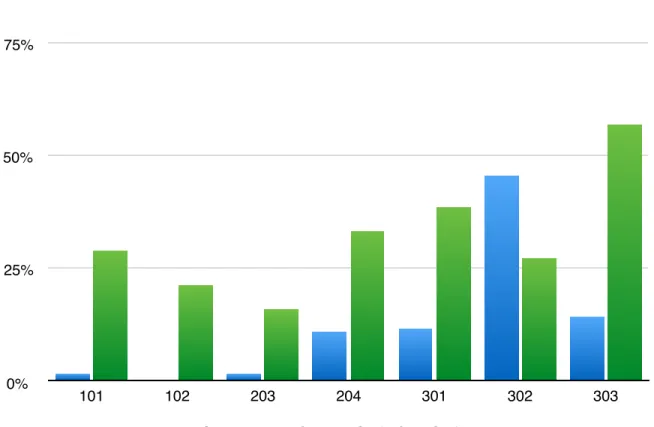
FIGURE 20. INSEPARABLE VS. SEPARABLE PREFIXES
Figure 20 demonstrates the percentage of correctly-answered items with separable or inseparable
prefixes. Students at every level did better with the inseparable prefixes, though students on the
whole had difficulty with this section of the study.
For separable prefixes, the issue of choosing a meaning to apply to the base verb seems to
be one of the biggest problems. As discussed in Chapter 1, the separable prefixes tend to be
derived from prepositions. Unlike the inseparable prefixes, they have a meaning that can stand
on their own, and are likely to be found more often in the language (as prepositions) than
inseparable prefixed verbs. Their exposure to these means they are more likely to have developed
an understanding of each preposition. Still, students at this level did better with inseparable prefixes than with the separable prefixes, as evidenced by Figure 20.
0% 25% 50% 75%
100%
101 102 203 204 301 302 303
Many of the responses seemed to apply the prepositional meaning directly to the verb
they were given. For example, aus as a preposition means 'out', and a common response to
aussehen 'to appear' was 'to see out'. There is a large difference between aussehen and sehen aus
etw. 'to see out of something' Had aus been given in a context such as Ich sehe aus dem Fenster,
this would have been the correct translation 'I am looking out the window', as here aus functions
as a preposition, not a prefix. Potentially exacerbating this problem is the relative low frequency
of words with these prefixes in the common texts. An-, aus-, and auf- were the most common
separable prefixes, and these did not come close in frequency to the most common inseparable
prefixes (er- and ver-). Exact numbers can be found in Appendix B.
Inseparable prefixes were slightly better in terms of percentage correct. Though no level
achieved over 50% correct in either category, every level was more successful with the
inseparable prefixes.
Of the inseparable prefixes, miss- was the most correctly answered by far. There were
three items with this prefix, and the majority of students successfully translated all three of them.
FIGURE 21. % OF CORRECT ANSWERS FOR
MISS-No other prefix had such a high rate of success, but this was also the only prefix that was an
obvious cognate of an English prefix (mis-). Other prefixes, while technically cognates, do not
function as affixes in English (e.g. her- ‘here’). It is most likely that the rate of success with this % Correct
miss-101 80.11%
102 89.29%
203 79.38%
204 94.44%
301 88.46%
302 96.97%
prefix was due in large part to its connection with the English prefix, as the frequency profile
(Appendix B) shows very little exposure to this form in students’ readings. Students at all levels
had the most problems with items prefixed with wider- 'against', the results of which were wildly
below their achievement with miss-.
FIGURE 22. % OF CORRECT ANSWERS FOR
WIDER-This result is interesting, as wider- is in fact a cognate to the English derivational prefix with-.
Both are used to indicate 'against, back'. One of the test items given was widerstehen, which
translates to 'withstand'. With- as an English prefix is rather uncommon though, mostly delegated
to set phrases, and is not often used to spontaneously create new words (that is, it is not a
productive prefix). As both prefixes are quite uncommon, students clearly don’t associate the
two. Many of the responses showed that students mistook wider- for wieder- 'again', being
phonetically incredibly similar:
(4) widerrufen 'to recant' | to call again
widerstehen 'to withstand' | to stand again
widerlegen 'to disprove' | to lay again
Miss- was also quite rare in terms of how often it appeared in the common texts, but as it
is more obviously connected to English, students seem to have fewer problems with it. % Correct
wider-101 0.00%
102 0.00%
203 0.62%
204 1.85%
301 1.28%
302 12.12%
4.3 Transparent vs. Opaque Prefixes
FIGURE 23. TRANSPARENT VS. OPAQUE
Figure 23 demonstrates the percentage of correct responses for the semantically transparent and
opaque verbs. There is a tendency of success with semantically transparent verbs that extends to
all levels. That is, while not all semantically transparent items were often correctly translated by
students at a given level, on the whole they were more successful with these than with the
semantically opaque items. This is not surprising, as these words require more cognitive effort to
decode, and more mental effort to recall if the word has been learned as a unit, as the parts of the
word do not readily add up to the meaning. Semantic opacity is a continuum, with few clear-cut
boundaries. For this study, in addition to items such as angreifen ‘to attack’, lit. ‘to hold on’,
which are not obvious from the parts, items created by metaphor are also considered opaque.
The disparity between these classes of verbs is much more drastic than in Section 4.2,
suggesting that semantic transparency is much more of a factor in determining item difficulty
0% 25% 50% 75%
100%
101 102 203 204 301 302 303
than prefix type. Such verbs must be acquired individually, as units, since their knowledge of
verbs and prefixes is less helpful.
German-English cognates of semantically opaque verbs did not seem to help as much as
the miss- ‘mis-’ cognate in Section 4.2. Two cognates that are semantically opaque in both
languages (being created by the same meaning combination) are:
(5) entdecken ‘to discover’ lit. to remove the cover
widerstehen ‘to withstand’ lit. to stand against
Out of 208 study participants, only 13.94% were able to correctly answer entdecken, and 2.88%
widerstehen. Compare this with semantically transparent cognate misstrauen 'to mistrust' at
87.98% correctness. Despite the bases, prefixes, and prefixed verbs all being cognates, the
semantically opaque verbs are much less likely to be correctly answered. As such, CLI seems to
have little effect here, as knowledge of English does not seem to be aiding learners. It also does
not seem to be necessarily hindering acquisition, as the miss- verbs (which were all transparent)
5. Discussion of Results and Implications for Language Teaching
Students tended to improve over time in virtually every aspect. In many categories, the
second-highest level tested did slightly better than the second-highest, though percentage-wise, this may be due
to the small sample size. The only category in which there was a noticeable decrease was in the
preposition usage of interessieren für, which needs to be tested further in order to determine if
this pattern holds with more data.
Aside from the sole outlier above, there was little obvious backsliding as students
progressed. This suggests that students are not shying away from certain interpretations or
answers. Thus, issues encountered in acquisition are that the learners are not acquiring the
correct forms, not that they are avoiding them. Per the results discussed in the previous two
chapters, between verb-selected preposition phrases and derivational prefixes, derivational
prefixes caused the most problems to students. Verb + preposition phrases improve steadily, and
with continuing instruction would likely continue such improvement, as teaching methods in this
area seem to be sufficient. Thus, the focus of this chapter is in improving teaching of derivational
prefixes, as more emphasis is needed on teaching the derivational prefixes as units themselves.
The progress for the acquisition of verb-selected preposition phrases is, all in all, much
better than the acquisition of prefixed verbs. Students achieve much higher rates of correct
answers for the prepositions, while many verbs are severely lacking. The idea of language
teaching is to make learners self-sufficient in the language. That is, they should be able to use
language creatively, by putting together sentences they have never seen before, glean the
meaning of new words, and work to fill their own lexical gaps. It is therefore inadvisable to teach
new words as units only. Doing so without giving students knowledge of the parts makes it
difficult for them to extrapolate when faced with the same morphemes in different environments.
As mentioned in Chapter 1, being able to both create and decode affixed words is of paramount
importance when it comes to vocabulary acquisition, as it enables learners to greatly increase
their vocabulary without needing to learn more units. In German, this is especially important, as
being able to decode the meaning of the prefixed base can cause difficulties with multiple
categories of words. Additionally, being able to apply and decode affixes is something that native
speakers do, as evidenced by the ability to coin new words with affixes on a whim. For example,
the traditionally incorrect English form of 'funner' instead of 'more fun' is a combination of the
base fun and the comparative -er. Per the results discussed in Chapter 4, learners seem to struggle
with this. Separable prefixes are too often confused with the prepositional counterpart, in a case
of intralanguage influence (from within the language). Naturally, in cases where the prefix does
coincide with the prepositional usage, students have a much easier time interpreting the meaning:
(6) hinterlassen 'to leave behind' | hinter 'behind'
anbinden 'to attach/to bind to' | an 'to'
aussteigen 'to climb out' | aus 'out of'
einatmen 'to breathe in' | ein 'in'
However, this is not the case often enough for this to be a sound learning strategy. It may be
helpful, when these prefixes begin to be encountered, to differentiate them from the prepositions,
as they are different morphemes.
Of the prefixed verbs that were most often correctly given, many fell into one of four
categories: miss- prefix, semantically transparent, preposition-prefix correspondence, or common
classroom terms, with some overlap. The first category, as mentioned in Chapter 4, is the only
obvious cognate, and is something readily recognizable by English speakers. The fourth includes
words such as:
(7) erklären 'to explain'
verbessern 'to improve'
anhören 'to listen to'
vorbereiten 'to prepare'
Jiang (2000, 2002) proposed three stages of vocabulary acquisition. These are:
1. Formal Stage
3. L2 Integration Stage
During the first stage the only stored information about an item is its orthographic and
phonological form, and a direct connection to an L1 translation. The second stage is reached
when both L2 and L1 syntactic information becomes stored. Learners at this stage still associate
words primarily with L1 counterparts. This is the stage at which many learners plateau, as
(derivational) morphology is seldom explicitly taught. In reaching past this stage, learners store
all information, including derivational morphology and semantic meaning. The goal of learners
and teachers should be to reach this third stage.
For the derivational morphology to be stored, learners must have information about these
morphemes, which requires instruction in such. Language teachers should dedicate class time to
reviewing derivational morphemes and how they interact with bases. Separable prefixes
especially should not be left to learners’ own devices, in terms of acquiring their meanings, as
they tend to be confused with prepositions. Takač (2008) outlines a number of strategies that are
used by learners to acquire new vocabulary, some of which are useful classroom strategies,
especially when paired with explicit instruction. Naturally activities involving authentic language
use and creative activities are incredibly important, but adult learners do not tend to get as much
out of entirely naturalistic instruction as young learners. As such, explicit instruction is
necessary, the lack of which involving derivational morphology may be contributing to the poor
results. One strategy mentioned in her paper was creating mental links, which language teachers
should aid students in doing.
According to a study by Gonnerman, et. al. (2007) learners are more likely to acquire a
new word if it is connected with an already known word that is both phonologically and
semantically similar. For example, novel and novella in English are similar in both manners,
while novelty is only similar in form. In introducing new vocabulary items, especially at higher
levels, associating terms with known words might facilitate faster acquisition. Takač (2008) also
advocates making associations between words. One method discussed in her paper is called the
Keyword Method, which involves associating the L2 word with a similar-sounding L1 word, and
independent learning method, and likely unsuited for the classroom. It also relies on the L1,
instead of making connections within the L2, which would continue learners’ reliance on
translation.
As the focus in less advanced courses is on explicit instruction, this might be a good
place to integrate information on derivational morphology. Additionally, beginning such
instruction earlier will help expand learners’ vocabularies at a stage where learners traditionally
acquire a large number of words very quickly. This will also aid them when they reach higher
levels, and begin to encounter such prefixes with greater frequency. As they will already have an
understanding of the prefixes, they are more likely to glean the meaning more easily.
Students might also find it useful if, when language teachers begin instruction on
derivational morphology, they help students make mental connections or associations in the
classroom. As the list of prefixes is much smaller than the list of vocabulary, the Keyword
Method may be more viable for this, or other ways of making associations, be they visual,
auditory, mnemonic, or otherwise. It is, however, recommended that, especially at higher levels,
associations should preferably come from within the language.
At higher levels, when encountering new vocabulary with derivational morphology in the
classroom, teachers should be sure, instead of just translating the word as a whole, to indicate
what the base means, how the prefix affects it, and the word as a whole. For example, if given
the word ausbreiten 'to spread', one should break this down into aus + breit(en). It should be
explained that breit means 'wide', and that aus adds the meaning 'out' in this case. In a verb form,
this would translate to 'widen out', which is not a grammatical phrase in English. Adding the
meanings together into a grammatical English translation would result in 'to spread'.
The main teaching texts used at UNC Chapel Hill are rather lacking in their treatment of
derivational morphology. The introductory and intermediate textbooks, Auf Geht's and Weiter
Geht’s have little in the way of explicit instruction, as they are more directed towards practicing
what has been learned during the course. As such, prefixed verbs can be found within the texts,
including their translations when deemed necessary, but are not explained grammatically. The
advanced level courses use a grammar book, Lehr- und Übungsbuch der deutschen Grammatik,
explains their syntactic usage. It does not attempt to differentiate between the prefixes, explain
when a prefix is appropriate, or mention anything in regards to its effect on the base.
Other common or popular books used by students of German reference this aspect of the
language. The first among these is 501 German Verbs, which is part of a well-known series of
language books. The separable prefixes are given the same treatment as in the grammar book
used at UNC Chapel Hill. That is, the prefixes are listed with no further commentary on
meaning, and information on word order. The inseparable prefixes, on the other hand, are listed
with their effect on verbs, though some of the prefixes are explained more in detail. 501 German
Verbs is, however, not a practice book. As such, there are no exercises to help cement the
concepts. Though it comes from a popular series, it also tends to be used as an individual
supplement, instead of a course supplement, and does not benefit from further explanations by
course professors.
A Practical Review of German Grammar also has a number of problems in its treatment
of derivational prefixes. The sections dedicated to these do not have a complete list of the
prefixes, missing a number of inseparable prefixes, and giving no concrete list of separable
prefixes at all. It does not attempt to explain the meanings of the prefixes, instead giving
examples of prefixed verbs with their English translations. Though this grammar does contain
exercises, they are more focused on conjugation than learning the prefix. For example, one of the
problems is as follows:
(8) 1. Mein Chef _______ jede Woche jemanden. (entlassen)
With such an exercise, users of the grammar are still practicing conjugation, and not prefixes.
The problem gives no indication as to the meaning of the verb, or why it is the most appropriate
prefix. Essentially, these sections of A Practical Review of German Grammar, much like the
A textbook with a much better chapter on derivational prefixes is Handbuch zur
deutschen Grammatik. The section on separable prefixes has a complete list of prefixes,
including which ones can also be used inseparably. Each prefix is listed with its meaning(s), and
an example. The inseparable prefixes are explained in more detail. Each prefix is listed with their
meaning(s), and includes comparison between an unprefixed word, and its prefixed counterpart.
For example, it gives:
(9) das Fett fat, grease entfetten to remove the fat
The entries of inseparable prefixes also take care to give information and examples for each
meaning separately. Thus, the entry for ver- contains five different usages, with word pairs that
exemplify a particular usage. There is a full series of exercises given that require users of the
book to determine the correct verb, including prefix. Such exercises force learners to think about
the prefixes and their meanings, and how they are applied to words, making these much more
effective than the exercises in A Practical Review of German Grammar. Unfortunately, later
editions of the Handbuch (the 5th and 6th) have relegated the chapter on prefixes to a reference
chapter, which tend to be glossed over by both students and teachers.
All in all, German grammars could use some improvement in their treatment of
derivational prefixes. It seems many give only superficial information and few, if any, exercises
that may be more or less relevant to the topic. In all likelihood, though not every available
German grammar was surveyed, new materials for the instruction of this topic will need to be
created.
In furthering research on this subject, it would be best to have teachers implement strategies for
teaching derivational morphemes before administrating further research. Eventually, further
studies should be implemented at the end of courses in order to see how much improvement is
made. Continuing issues may suggest that further tweaking of teaching methods needs to be
made.
Appendix A
FULL VERB-SELECTED PREPOSITION DATA BY CLASS
verlieben in fragen nach achten auf danken für
101 11.3 % 1.6 % 3.2 % 16.1 %
102 53.6 % 0.0 % 10.7 % 21.4 %
203 10.7 % 1.8 % 7.1 % 50.0 %
204 38.9 % 11.1 % 11.1 % 61.1 %
301 46.2 % 11.5 % 23.1 % 88.5 %
302 72.7 % 45.5 % 63.6 % 63.6 %
303 42.9 % 14.3 % 71.4 % 71.4 %
erinnern an konzentrieren auf sprechen mit interessieren für
101 3.2 % 6.5 % 69.4 % 32.3 %
102 25.0 % 21.4 % 53.6 % 10.7 %
203 32.1 % 8.9 % 87.5 % 66.1 %
204 44.4 % 5.6 % 88.9 % 66.1 %
301 50.0 % 30.8 % 92.3 % 57.7 %
302 54.5 % 45.5 % 81.8 % 27.3 %
303 71.4 % 57.1 % 85.7 % 14.3 %
zu tun mit warten auf gehen um abhängen von
101 11.9 % 19.4 % 0.0 % 1.6 %
102 17.9 % 35.7 % 0.0 % 0.0 %
203 30.4 % 35.7 % 1.8 % 1.8 %
204 72.2 % 61.1 % 16.7 % 27.8 %
301 65.4 % 53.8 % 38.5 % 15.4 %
302 90.9 % 90.9 % 81.8 % 27.3 %
anfangen mit teilnehmen an kümmern um lachen über
101 11.3 % 3.2 % 0.0 % 3.2 %
102 21.4 % 10.7 % 7.1 % 25.0 %
203 21.4 % 10.7 % 3.6 % 17.9 %
204 61.1 % 0.0 % 16.7 % 22.2 %
301 80.8 % 11.5 % 26.9 % 42.3 %
302 72.7 % 18.2 % 45.5 % 72.7 %
Appendix B
FREQUENCY PROFILE: VERB + PREPOSITION PHRASES
101 102 203 204 301 302 303
verlieben in 0 0 0 1 3 0 0
fragen nach 0 0 2 2 1 0 0
danken für 0 0 2 2 2 0 1
erinnern an 0 6 2 4 8 0 1
interessieren für 2 1 2 1 4 1 0
zu tun mit 3 0 2 2 7 1 1
sprechen mit 0 0 1 0 4 0 1
konzentrieren auf 0 0 0 1 0 0 0
achten auf 0 0 2 0 2 0 0
warten auf 0 1 2 2 8 0 3
gehen um 0 1 0 0 5 3 1
abhängen von 0 0 4 0 0 13 2
anfangen mit 0 0 0 0 1 0 0
teilnehmen an 0 1 2 3 0 8 1
kümmern sich um 0 1 4 0 0 0 2