ii The Impact of Personality on Team Cohesion and Performance
ABSTRACT
Marta C. Malmberg
The Impact of Personality on Team Cohesion and Performance
(Under the direction of Dr. Matthew Pearsall)
The use of teams in the workplace has become a pivotal method of completing
challenging tasks. The present research examined data from 95 participants across 18
teams and found that certain personality traits, as measured by the Myers-Briggs Type
Indicator (MBTI), have shown correlation with team performance. The teams were
composed of undergraduate and MBA students working together in semester-long
consulting projects. Each team was assigned one project leader who was an MBA
student with additional experience. The research showed that teams led by a project
leader with the thinking preference of the MBTI correlated with higher team performance
scores. Higher team performance scores were also correlated with higher team cohesion
scores. In addition, having heterogeneity of certain personality types was not found to be
more conducive for team cohesion and performance. All four dichotomies of the MBTI
were analyzed to identify additional correlated elements of team cohesion and
iii The Impact of Personality on Team Cohesion and Performance
TABLE OF CONTENTS
LIST OF TABLES
v
Chapter
I.
INTRODUCTION
1
II.
REVIEW OF COMMON LITERATURE
3
A. History and Development of the MBTI
3
B. Current MBTI Discussions
6
C. Recent Personality and Team Research 8
D. Personal Research Objectives
10
III.
METHODOLOGY 14
A. Participants14
B. Design Procedure 16
C. Measures 16
D. Correlation Analysis
19
IV.
HYPOTHESES
20
iv The Impact of Personality on Team Cohesion and Performance
A. Prevalence of Types
25
B. Hypotheses Results
27
C. Additional Findings
36
VI.
DISCUSSION
38
A. Implications
38
B. Limitations 39
C. Suggestions for Future Research 40
D. Conclusion 41
VII.
APPENDIX
A. The T.E.A.M. F.O.C.U.S. “Rules Of Engagement” Model
45
B. IRBIS Documentation
46
C. The 16 MBTI Types
47
D. General Data
51
v The Impact of Personality on Team Cohesion and Performance
LIST OF TABLES
Table 2.1
MBTI Personality Type Functions
5
Table 2.2
MBTI Matrix 6
Table 5.1
MBTI Prevalence
26
vi The Impact of Personality on Team Cohesion and Performance
CHAPTER I
INTRODUCTION
More than ever, businesses are relying on teams to solve their complex business
problems. As a result, personality research is emerging and growing as an integral aspect
of the use of teams in the workplace. The goal of my research is to provide insight into
the impact of personality on team cohesion and performance by analyzing the Student
Teams Achieving Results (STAR) program consulting teams at the University of North
Carolina Kenan-Flagler Business School (UNC Kenan-Flagler).
The STAR program is a collaborative program that connects top MBA and
undergraduate students with corporate and not-for-profit organizations in consulting
engagements. Each student was accepted through an online application process including
a resume submission. The STAR program is directed by Dr. Paul N. Friga and seeks to
enrich students through building skills in leadership, teamwork, and problem solving.
The STAR program uses the T.E.A.M. F.O.C.U.S. model, developed by Friga, to help
teams solve their clients’ business problems (see Appendix A).
vii The Impact of Personality on Team Cohesion and Performance
online version of the Myers-Briggs Type Inventory (MBTI) consisting of 48
forced-answer questions. Each question consisted of a statement that the individual would rate
as accurate or inaccurate on a five point scale. The MBTI is a personality inventory
modeled after the psychoanalytic theories of Carl Jung and is most commonly used in
occupational settings and aims to help users understand how they absorb information
from the world to make decisions.
Prior to beginning this study, the IRBIS Office of Human Research Ethics
viii The Impact of Personality on Team Cohesion and Performance
CHAPTER II
REVIEW OF COMMON LITERATURE
The following section reviews the existing literature on personality research and
the use of teams in the workplace. This literature review will include four areas of focus:
(A) a history and development of the MBTI; (B) current MBTI discussions; (C) recent
personality and team research; and (D) personal research objectives.
A. History and Development of the MBTI
In the early 1900s, Sigmund Freud’s psychoanalytic theory was the dominant
theory of personality research. Psychoanalytic theory promoted the idea that the
unconscious was the controlling driver of personality. Freud’s theory remained the
prominent belief until a group of neo-psychoanalysts, including Carl Jung (1875-1961),
diverged from Freud and proposed alternative theories.
ix The Impact of Personality on Team Cohesion and Performance
In 1923, Isabel Myers and Katharine Briggs began their work on the MBTI by
integrating Jung’s four functions. The original goal of the MBTI was to make Jung’s
research “understandable and useful in people’s lives” (The Myers & Briggs Foundation,
2001, MBTI Basics, para. 1). In the 1940s, Myers and Briggs used their research
findings to aid people in selecting appropriate career choices and to help individuals
better understand personality differences among each other (The Myers & Briggs
Foundation, 2001). The MBTI is still widely used by many groups and individuals
seeking to understand individual personality types.
The four functions from Jung’s research — thinking, feeling, sensing, and
intuition — became the foundations for the MBTI. The MBTI incorporates each of these
four original functions as well as four additional functions to represent one end of a
dichotomous scale. The dichotomy created four scales and eight functions in total. The
eight functions are represented below on their respective dichotomous scales:
Extraversion (E) — Introversion (I)
Sensing (S) — Intuition (N)
Thinking (T) — Feeling (F)
Judging (J) — Perceiving (P)
x The Impact of Personality on Team Cohesion and Performance
MBTI Personality Type Functions
Extraversion (E)
Introversion (I)
People who prefer Extraversion tend to
focus on the outer world of people and
things
People who prefer Introversion tend to
focus on the inner world of ideas and
impressions
Sensing (S)
Intuition (N)
People who prefer Sensing tend to focus
on the present and on concrete
information gained from their senses
People who prefer Intuition tend to focus on
the future, with a view toward patterns and
possibilities
Thinking (T)
Feeling (F)
People who prefer Thinking tend to base
their decisions primarily on logic and on
objective analysis of cause and effect
People who prefer Feeling tend to base their
decisions primarily on values and on
subjective evaluation of person-centered
concerns
Judging (J)
Perceiving (P)
People who prefer Judging tend to like a
planned and organized approach to life
and preferred to have things settled
People who prefer Perceiving tend to like a
flexible and spontaneous approach to life
and prefer to keep their options open
Table 2.1. MBTI personality type functions. Adapted from Chittenden & McKenzie
(2013). Talking about: create new thinking. Retrieved from
http://www.talkingabout.com.au/MBTI.
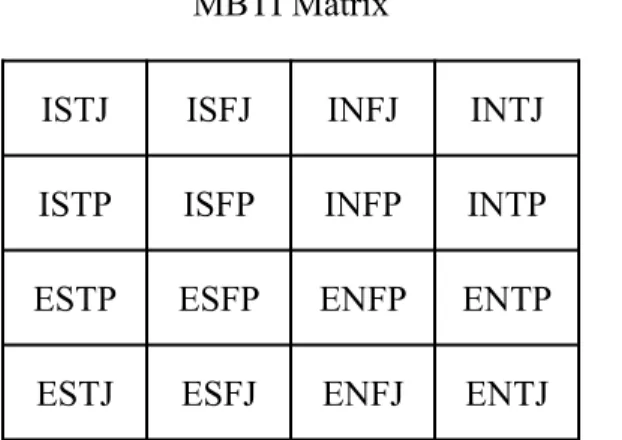
From the eight personality functions described above, sixteen personality types
can be created. The personality type is composed of one letter from each of the
xi The Impact of Personality on Team Cohesion and Performance
MBTI Matrix
ISTJ
ISFJ
INFJ
INTJ
ISTP
ISFP
INFP
INTP
ESTP
ESFP
ENFP
ENTP
ESTJ
ESFJ
ENFJ
ENTJ
Table 2.2. MBTI matrix. Adapted from The Myers & Briggs Foundation. (2001).
Another large milestone for the MBTI occurred in 1975 when Myers, along with
colleague Mary McCaulley, opened the Center for Psychological Type (CAPT). CAPT
was created as a not-for-profit resource dedicated to helping individuals discover and
understand his or her personality type. Today CAPT not only provides personality typing
consultations, but this organization houses the Isabel Briggs Myers Memorial Library as
well as the MBTI bibliography database (The Myers & Briggs Foundation, 2001). The
Library and MBTI database provide access to numerous articles, studies, and other
publications important to the field of personality research. Due largely in part to the
work of Myers and Briggs, the MBTI is now a widely recognized tool in personality
research and has been cited in thousands of publications around the world (“Mary &
Isabel's Library Online Catalog,” 2013).
B. Current MBTI Discussions
xii The Impact of Personality on Team Cohesion and Performance
the MBTI test.
Some researchers claim the MBTI has diverged from its original intention and is
being wrongly used by individuals in corporate and research settings. In the 1940s
Myers and Briggs originally published their research to help individuals discover suitable
career paths. Today, however, many researchers, including Charles Coe, a researcher
from North Carolina State University, and James Michael, a researcher at Wagner
College, argue that the MBTI is misused. Coe (1992) believes that using the MBTI to
select potential employees is a misuse of the MBTI and that the results are not
quantifiably accurate. Similarly, Michael (2003) published a report demonstrating the
misuse of the MBTI in leadership development. In Michael’s report, he notes that many
participants who received leadership training held incorrect information about the
purpose of the MBTI. For example, after receiving MBTI training, some participants
wrongly believed that the MBTI provided information about with whom they are
incompatible, which he states is a misuse of the original design of the MBTI personality
instrument.
xiii The Impact of Personality on Team Cohesion and Performance
poles (Pittenger, 1993). For example, if an individual’s actual personality fell near the
middle of the classification of an introvert or an extravert, the MBTI would force
classification into one of the two categories which can be misleading.
According to Pittenger (1993), the MBTI test is also not reliable because many
studies show that up to 50% of people who retake the test receive a different score in as
little as five weeks. Alternatively, the Myers and Briggs foundation has found that “on
retest, people come out with three to four type preferences the same 75% to 90% of the
time” (The Myers & Briggs Foundation, 2001, Facts about the MBTI instrument
reliability, para. 2). In addition, research on the Big Five personality measured
personality in 5,266 job applicants. After six months, only three of the original job
applicants displayed significantly different changes in all five of the personality traits
showing that personality is enduring in nature and remains stable for each individual
(Hogan, Barrett, & Hogan, 2007).
Despite debates and potential shortcomings, the MBTI has repeatedly proven to
be a reliable and valid measure of personality used widely across the world. Even
researchers who hold strong viewpoints against certain aspects of the MBTI, such as
Michael and Pittenger, do not advise against the use of the MBTI as a personality
measure; rather they promote exercising caution in the use of the MBTI.
C. Recent Personality and Team Research
One of the major areas of growth in personality research has been in the
xiv The Impact of Personality on Team Cohesion and Performance
researchers, especially in business settings, are seeking to better understand the
interactions between personality and teams.
Many studies have been able to find correlations between personality types and
the success of a team. Research by Suzanne T. Bell at DePaul University, for example,
used meta-analysis to analyze teams and found that several personality traits showed a
correlation with team performance (2007).
A key study conducted by the faculty in the department of Computer Science at
the University of Sheffield in the United Kingdom examined the relationship between
personality type and team cohesion in software engineering teams. The study measured
five teams across a 12-week span and routinely tested for indicators of team cohesion and
performance. The findings of this study of five software engineering teams provided
evidence that certain MBTI combinations showed evidence of greater performance and
cohesion than others. More specifically, the results showed that “certain types of teams
were found to work consistently well over the project due to homogeneity in personality
type and others were found to be very cohesive due to a mixture of types” (Karn,
Syed-Abdullah, Cowling, & Holcombe, 2007, p.99). A publication in the Journal of Strategic
Management went as far as purposing that top management groups should be composed
of a mixture of MBTI types in order to create opportunities for insights by members of
different personality types (Hurst, Rush, & White, 2007).
xv The Impact of Personality on Team Cohesion and Performance
leaders with MBTI profiles that were commonly associated with leadership. Other
research has also shown that four personality types in the four corners of the matrix—
ISTJ, INTJ, ESTJ, & ENTJ—(see Table 2.2) are found to be more equipped for project
management roles (Smith, 2001). The researchers at the University of Oviedo stated that,
“MBTI also helps in understanding group dynamics, analyzing shortcomings in an
individual’s style and how the style affects the group as a whole” (Montequin et al., 2012,
p.1,127).
Research on personality and teams has made tremendous steps forward in the last
few years as researchers seek to better understand the interaction between personality and
team performance and cohesion. Studies provide evidence that personality is not only a
predictor of team success, but that certain combinations of personality types and the
personality type of the project leader are also related to team performance. The following
study will examine each of these components as they are related to team cohesion and
performance.
D. Personal Research Objectives
In the spring of 2013, I had the opportunity to be a part of a STAR consulting
project that was working with a retail client seeking to expand their fine jewelry offerings
into some of their smaller volume stores. Throughout the duration of this project, my
team spent a semester together analyzing data and creating recommendations. At the
initial stage of the project, we exchanged our MBTI information which helped us to
better understand one another.
Through my research on the impact of personality on team cohesion and
xvi The Impact of Personality on Team Cohesion and Performance
two primary goals: (1) provide insights into the optimal composition of future STAR
consulting team and (2) advance the field of personality research.
First, I aim to provide data-driven guidance for the optimal MBTI composition of
future STAR consulting teams. Currently, the STAR program director assigns students to
teams without considering the MBTI of each of the participants. The results of my study
may provide insights into selecting teams with certain MBTI personality profiles to order
to optimize the impact of personality on team cohesion and performance.
The second goal of my research is to add to the field of personality research by
providing analysis of unique data on high-performing consulting teams. My hope is that
this study may generate further discussions by researchers on the impact of personality on
team cohesion and performance. The methods of my study closely mirror the 2007 study
of software engineering teams performed at the University of Sheffield. In this study,
five teams were analyzed across a 12 week period and routinely measured to find levels
of team cohesion and performance. The similarities of my study on STAR consulting
teams with that of the software engineering teams may support or refute current research
on the impact of personality and teams.
xvii The Impact of Personality on Team Cohesion and Performance
First, the consulting teams provided a unique sample for study. My study uses a
sample of MBA and undergraduate consulting students who were selected through a
rigorous application process. The teams were working closely with clients to solve actual
business problems. The caliber of individuals selected to the STAR program, combined
with the real client interaction of the consulting teams closely mirrors business settings in
a way that is often unattainable in a university setting.
Second, my research looks at the impact of a project leaders’ MBTI on team
cohesion and performance. Focusing on the project leader in the context of high-level
consulting projects will provide valuable insight that may be applicable to managers in a
business setting.
Finally, my research uses the MBTI as the measure of personality. Other research
has used varying personality measurements, but the MBTI was chosen for the STAR
consulting teams because the MBTI is well known for being a personality measure that
focuses on how individuals take in information from the world to make decisions. The
eight preferences of the MBTI shed light on how individuals interact in certain situations
and is therefore more likely to be a better personality inventory for measuring team
cohesion and performance. The MBTI’s growth and popularity can be attributed to the
success that individuals and teams have experienced while using this personality
xviii The Impact of Personality on Team Cohesion and Performance
Understanding your personality type as well as the type of those you are working
with can be a powerful tool for teams. Some components of the MBTI also provide
information on how each preference interacts with other people. The feeling preference
is associated with a desire to keep harmony in team settings and the thinking preference
is often criticized for being overly task-oriented and less concerned with the people-side
of a situation (The Myers & Briggs Foundation, 2001). The MBTI can predict how these
preferences will affect the interplay between team members.
Based on prior research that supports a relationship between personality and
teams, I expect to see some overall similarities in my data that would match the
conclusions drawn by other researchers. For example, data collected about the MBTI in
specific populations shows that business settings attract a majority of certain personality
types, specifically extraverts and thinkers. Relative to the overall population, I expect to
see a skewed distribution of types. In addition, multiple studies have found that
extraversion relates very strongly to leadership. It would not be surprising to find that
more extraverts applied and were selected to be project leaders and also that the teams
with extraverted project leaders experienced more success, as measured by the variables
described in the following chapters.
I would not be surprised to find that teams with a variety of personality types
experienced more success. The Myers and Briggs Foundation is very clear that no type
is “better” than any other type. Likewise, each personality type brings a unique
xix The Impact of Personality on Team Cohesion and Performance
CHAPTER III
METHODOLOGY
The following methodology will first discuss the participants used in this
research, next describe the design procedure, then discuss the measures used in the
analysis, and conclude with a detailed overview of the correlation analyses used in this
study.
A. Participants
In the spring 2013 semester, 122 undergraduate and MBA students enrolled in
and completed the UNC Kenan-Flagler STAR program from January 2013 to May 2013.
MBTI data was either missing or not collected for 27 participants, resulting in 95
completed STAR participant profiles.
The participants were assigned by the STAR program director into 18 teams, with
each team ranging in size from five to seven members. One member of each team served
as the project leader. The project leader was an MBA student typically with prior
xx The Impact of Personality on Team Cohesion and Performance
The team members met before the start of the spring 2013 semesters at a
“kick-off” workshop. During this event, members were introduced to the STAR program and
received their client assignment. Each team was assigned a unique client to resolve a
business problem facing the client’s organization. The size, industry, and needs of each
client varied from team to team. An example of a STAR project may include working to
improve sales strategies for a medical device sales company or helping a retail client
improve marketing strategies to appeal to millennials. In order to complete these types of
tasks, the STAR team may need to collect information about the target market, perform
analysis on the competitors, or interview specialists in their respective fields. For many
of the students in the STAR program, this was their first experience working with clients
on real cases.
xxi The Impact of Personality on Team Cohesion and Performance
McKinsey,” 2013). The STAR program draws heavily from best practices used at
McKinsey & Company and therefore implements the MBTI as a way to familiarize team
members with each other’s tendencies.
B. Design Procedure
Data Collection & Synthesis
The data used in this research included (1) MBTI, (2) gender, (3) degree level, (4)
project leader distinction, (5) team performance, and (6) team cohesion for each
participant in the STAR program for the spring 2013 semester.
Data was collected and compiled by the STAR program director as part of the
UNC Kenan-Flagler course. Prior to analysis, all data was stripped of identifying
characteristics and individual data was aggregated to the team level. Analysis was
completed to look for correlation between the six metrics described above.
C. Measures
MBTI
xxii The Impact of Personality on Team Cohesion and Performance
feeling was coded as “0;” judging was coded as “1” and perceiving was coded as “0.”
Gender
Participants’ gender was collected as part of this study to provide additional
predictors of team performance. Gender was recorded as either male or female. The
gender variable refers to the percent of students that are male or female on each team.
For the purposes of differentiating gender in the multiple regression analysis, male was
coded as “1” and female was coded as “0.”
Degree Level
The STAR teams consist of both MBA and undergraduate students. Degree level
refers to whether the STAR participant is an Undergraduate student or an MBA student at
UNC Kenan-Flagler. The STAR teams were mixed with about 70% of the team
comprised of MBA students and 30% undergraduate students. This ratio varied slightly
from team to team. MBA students were typically older than undergraduate students and
have additional working experience. By differentiating these two groups, it became
easier to measure the effects of age and work experience on performance. For the
purposes of the multiple regression analysis, the MBA students were coded as “1” and
the undergraduate students were coded as “0.”
Project Leader Distinction
xxiii The Impact of Personality on Team Cohesion and Performance
example, the project leader may be in charge of coordinating the meeting time, location,
and content for a meeting. Project leader distinction was included as a possible predictor
of performance to examine the impact that this variable had a team performance. In the
analysis, the project leader was coded as “1” and team members were coded as “0.”
Team Performance
Information about team performance was collected at the conclusion of each
semester of the STAR program by receiving feedback from the each team’s client. Each
team member receives the same score. Team performance served as an additional metric
of each team’s performance throughout the duration of the project. Client’s rated the
overall team performance on a five point scale. The STAR team members were not
informed of the team performance score at any point during the grading process.
Team Cohesion
xxiv The Impact of Personality on Team Cohesion and Performance
D. Correlation Analysis
The analysis was completed using both SPSS statistical analysis software and
Microsoft Excel Data Analysis tool pack. Correlation analysis was completed on the six
variables discussed in the previous section—(1) MBTI, (2) gender, (3) degree level, (4)
project leader distinction, (5) team performance, and (6) team cohesion.
Three different levels of analysis were used in order to identify different
relationships within the STAR data. The first level of analysis looked at the STAR
participants on an individual level. A correlation test looked for significant correlations
between the six variables discussed above. Microsoft Excel was used for this analysis.
The second level of analysis aggregated the STAR data to the team level. The teams
were averaged across the four dichotomies (E-I, N-S, T-F, J-P), degree level, gender, and
team cohesion. The team performance score remained the same as each team member
received the same score. By aggregating the data to the team level, more in-depth
analysis about the impact of the project leaders’ personality types could be observed.
Microsoft Excel was also used in this level of the analysis.
The third level of analysis again used aggregated team-level data, but looked at
the heterogeneity in each team by measuring the standard deviation of the variables
including personality across the four dichotomies, degree level, gender, and team
xxv The Impact of Personality on Team Cohesion and Performance
CHAPTER IV
HYPOTHESES
Prior to analysis, six hypotheses were developed for testing. The hypotheses were
chosen based upon past personality research in team settings and researcher intuition.
Hypothesis 1: Teams with extraverted project leaders have higher team performance
scores than teams with introverted project leaders.
xxvi The Impact of Personality on Team Cohesion and Performance
Hypothesis 2: Teams with feeling project leaders have higher team performance scores
than teams with thinking project leaders.
Like individuals ranked highly in extraversion, individuals identified as having
the feeling preference not only tend to have an orientation focused on people and
communication, but also tend to be “tactful” (The Myers & Briggs Foundation, 2001).
The personality traits used to describe feeling characteristics appear to correspond with
the responsibilities of the project leader. The strong match of characteristics may result
in higher team performance scores for teams with feeling-type project leaders because
they are better able to tactfully manage the teams’ needs. Therefore, I hypothesize:
Teams with feeling project leaders have higher team performance scores than teams with
thinking project leaders.
Hypothesis 3: Teams with more thinking members have higher team performance scores
than teams with more feeling members.
Research on software engineering teams found that the teams with a vast majority
of members with personality types typical of software engineers were the most consistent
throughout the project (Karn, Syed-Abdullah, Cowling, & Holcombe, 2007, p.99). Since
the “T” dichotomy is very common type for business school students, it would be
xxvii The Impact of Personality on Team Cohesion and Performance
Hypothesis 4: Teams with more judging members have higher team performance scores
than teams with more perceiving members.
The “J” dichotomy is another very common personality attribute found in
business school students. The judging preference is often described at very orderly,
focused, and task-oriented (The Myers & Briggs Foundation, 2001). In addition, a study
of twenty technology innovators found that individuals with the judging preference
displayed greater task-oriented management of their email inbox than individuals with
the perceiving preference (Ludford, & Terveen, 2003). These preferences would seem to
be very integral to client satisfaction in high-level consulting projects, which require
complex tasks, structure, and important business decisions. Therefore, I hypothesize:
Teams with more judging members have higher team performance scores than teams with
more perceiving members.
Hypothesis 5: Teams with more feeling members have higher team cohesion scores than
teams with more thinking members.
While I expect to find that teams with more thinking members have higher team
performance scores than teams with more feeling members, I expect to find that teams
with more feeling members have higher team cohesion scores than teams with more
thinking members. The feeling preference is commonly associated with a people
xxviii The Impact of Personality on Team Cohesion and Performance
other more favorably during the peer feedback process. Contrary to Hypothesis 3, which
states that more thinking members has a positive impact on team performance scores, this
hypothesis advocates that the feeling preference will have a positive impact on team
cohesion scores. Therefore, I hypothesize: Teams with more feeling members have
higher team cohesion scores than teams with more thinking members.
Hypothesis 6: Teams with greater heterogeneity in the proportion of sensing and intuitive
members have higher levels of team performance.
The final two hypotheses in this study seek to understand how the heterogeneity
of personality types impacts team cohesion and performance. A 2011 Forbes Insights
study looked at data from 1,245 executives and found that having diversity of personality
types was an important component of a corporation’s ability to maintain their competitive
edge. The idea of diversity of personality types has also been seen in research on
software engineering teams which showed that some teams were found to be more
cohesive when they had a mixture of certain personality types. For example, one
engineering team that experienced success during the project had a member, who was a
sensing type that spent time assisting other members of his team which demonstrated that
diversity of personality types provides additional insights to the team (Karn,
Syed-Abdullah, Cowling, & Holcombe, 2007).
xxix The Impact of Personality on Team Cohesion and Performance
types. Therefore, I hypothesize: Teams with greater heterogeneity in the proportion of
sensing and intuitive members have higher levels of team performance.
Hypothesis 7: Teams with greater heterogeneity in the proportion of extraverted and
introverted members have higher team cohesion scores.
xxx The Impact of Personality on Team Cohesion and Performance
CHAPTER V
RESULTS
After the analysis of the data from the UNC Kenan-Flagler STAR program was
completed, the results showed that some hypothesized personality types did have a
significant effect on team and client feedback, while other hypotheses did not. The
following sections will go into greater detail of the results of this study including the
prevalence of the personality types across different populations, the hypotheses results
and also additional findings from this study. Additional statistics can be found in
Appendix D.
A. Prevalence of Types
xxxi The Impact of Personality on Team Cohesion and Performance
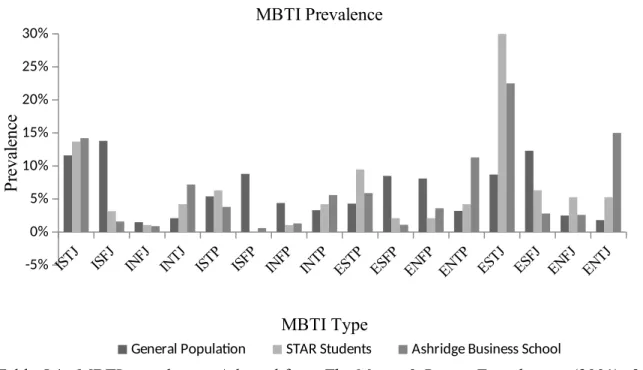
STAR program show a higher prevalence of types ISTJ & ESTJ, but also a lower
prevalence of types ISFJ & ISFP. A study of 22,783 students at Ashridge Business
School at a leading management development program in the United Kingdom found
higher proportions of students had types ESTJ, ENTJ, ISTJ, and INTJ (Carr, Curd, &
Dent, 2004). To further analyze the prevalence of types, Table 5.1 compares the
prevalence of each of the dichotomies in the United States population, the UNC
Kenan-Flagler STAR students, and a sample from Ashridge Business School. The sample from
Ashridge Business School was included to provide a reference of how the STAR program
students compared to other individuals in business settings.
ISTJ ISFJ INFJ INTJ ISTP ISFP INFP INTP ESTP ESFP ENFP ENTP ESTJ ESFJ ENFJ ENTJ
-5% 0% 5% 10% 15% 20% 25% 30%
MBTI Prevalence
General Population STAR Students Ashridge Business School