TABLE OF CONTENTS
PAGE
1.0 INTRODUCTION
1.1 Use of Aquifer Tracer Tests 1
1.2 Purpose of Present Study 2
2.0 PRINCIPUES OF CONTAMINANT TRANSPORT
2.1 Introduction 3
22 Groundwater Row Equations 3
2.2.1 Steady-State Saturated Flow 4
2.2.2 Transient Saturated Flow 5
23 Contaminant Transport Processes 6
2.3.1 Physical Processes 6
2.3.1.1 Advection 6
2.3.1.2 Hydrodynamic Dispersion , 7
2.3.2 Chemical Processes 8
2.3.2.1 Diffusion 8
2.4 The Advective-Dispersive Equation ^ ^ 9
3.0 FIELD TRACER TESTS
3.1 Types of Tracers 11
3.1.1 Temperature Tracers 12
3.1.2 Dye Tracers 12
3.1.3 Ionic Tracers 13
3.1.4 Radionuclide Tracers 14
3.2 Types of Tracer Tests 15
3.2.1 Single-Well Tracer Tests 15
3.2.2 Two-Well Tracer Tests 17
4.0 FIELD DATA COLLECTION
41 Description of Field Site 19
4.2 Tracer Test Procedure 23
4.2.1 WeUs 23
4.2.2 Equipment Used 25
TABLE OF CONTENTS (Cont'd)
PAGE
5.0 METHODS OF DATA ANALYSES
5.1 Description of Tracer Test Simulation 36
52 Tracer Transport Modeling 37
6.0 CONCLUSIONS 49
•
Rgure 3.1
nOURES
Single Well Tracer Test
PAGE
16
Rgure 3.2
Two Well Tracer Test
18
Figure 4.1
Site Location Map
20
Figure 4.2
Topographic Location Map
21
Figure 4.3
Site Map
22
Figure 4.4
Tracer Test Well Details
24
Figure 4.5
Tracer Test Control Box
26
Figure 4.6
Tracer Test Equipment Layout
27
Figure 4.7
Tracer Test No. 1 Breakthrough Curve
29
Figure 4.8
Tracer Test No. 2 Breakthrough Curve
31
Figure 4.9
Observed Recovery Well Drawdown
34
Figure 5.1
Pumping Stress at Screened Interval
38
•
Figure 5.2
Two Well Tracer Test - 0 Hours
40
Figure 5.3
Two Well Tracer Test - 2 Hours
41
Figure 5.4
Two Well Tracer Test - 4 Hours
42
Figure 5.5
Two Well Tracer Test - 6 Hours
43
Figure 5.6
Two Well Tracer Test - 26 Hours
44
Figure 5.7
Percent Tracer Recovery vs. Time
46
Figure 5.8
Two Well Tracer Test - 240 Hours
47
APPENDICES
Appendix A Tracer Test No. 1 Data
Appendix B Tracer Test No. 2 Data
Appendix C Computer Modeling Data Files
1.0 INTRODUCnON
1.1 Use of Aquifi^ Tracer Tests
Due to the increasing number of lawsuits being ffled related to groundwater contamination sites,
predictions concerning the source of the contamination, its present course and future destination
have become the bread and butter of the subsurface hydrology business. In order to procure funding
for most contamination remediation efforts, culpable parties and those at risk by the migration of
the plume must be identified. The tools most often used to make these predictions are groundwater
models.
Mathematical groundwater models require that the user input many site specific aquifer parameters
that are used to describe the contaminant transport hydraulics and the subsurface conditions over
a site. These parameters include hydraulic conductivity, hydrodynamic dispersion, and contaminant
sorption and decay, either chemical or biological. ^
The hydraulic conductivity of an aquifer is a property of a water bearing formation that is defined
as the capacity of a porous medium to transmit water. The conductivity when used in model
calculations with the gradient and porosity determines the average direction and rate of groundwater
flow. The transport of solutes in the direction of the flowing groundwater is called advection.
Hydraulic conductivity can vary over a site not only in a horizontal plane but also vertically. In
order to obtain accurate modeling results over a large area with different conductivities, these
variations should be taken into account
^^^^^^W^^^—ffV***-a tr^^^^^^W^^^—ffV***-ansverse direction (perpendicul^^^^^^W^^^—ffV***-ar to the principle direction of flow). Hydrodyn^^^^^^W^^^—ffV***-amic dispersion
occurs due to mechanical mixing of the groundwater during advection and due to molecular diffusion
of the contaminant
Aquifer tracer tests may be performed to identify the spatial variability of hydraulic conductivity
within an aquifer, and to estimate the effective hydrodynamic dispersion using tracer breakthrough
data obtained during the test. This can be accomplished by packing off sections of fully penetrating
well screens and performing tracer tests at different vertical locations within the aquifer. By
separately analyzing these data sets, a set of hydraulic parameters can be estimated for each selected
screened interval.
12. Purpose of Present Study
The main objective of this study was to obtain a better understanding of the groundwater flow
pattern that is present at a particular area of a research site by measuring certain aquifer
parameters. The groundwater at the site had become contaminated with gasoline due to the failure
of underground storage tanks and associated piping. One of the first phases of the field study
involved the installation of groundwater monitoring wells; these included two pairs of wells
specifically designed for tracer studies. Two two-well field tracer studies were then performed using
each pair of welk.
The tracer tests had three objectives: (1) estimate aquifer parameters of the area in question, (2)
2.0 PRINCIPLES OF CONTAMINANT TRANSPORT
2.1 Intiodiictioii
In order to adequately understand contaminant transport in groundwater, the processes and
equations that are used to describe groundwater flow must be studied. The groundwater flow
equations form the basis for the transport equations because the bulk of the contamination in the
groundwater will propagate in the direction of and at a velocity equal to the average linear
groundwater velocity. This process is known as advection.
In addition to advection, localized processes that affect the transport of solutes within a groundwater
system are also very important to contaminant transport modeling. The phenomena of contaminant
dispersion, sorption, and reaction are included in the contaminant transport equations to further
describe these additional transport processes. The correct inclusion of these properties into a
model is essential to adequately describe the location, shape, and concentration of a propagating
contaminant plume.
22, Groundwater Flow Equations
The derivations of the equations used in groundwater flow applications are based on the
conservation principles dealing with mass, momentum, and energy. The basic law of flow is Darcy's
law. When Darcy's law is combined with an equation of continuity that describes the conservation
of fluid mass during flow through a porous medium, a partial differential equation of flow is the
result (Freeze and Cherry, 1979). Different forms of the flow equation result for steady-state,
The following sections review the three most commonly used forms of the groundwater flow
equations. The sections are a summary of Chapter 2, Section 2.11, "Groundwater" by R. Allan
Freeze and John A. Cherry (1979).
22.1 Steatty-State Saturated Flow
The equation of groundwater flow under steady-state conditions through an anisotropic saturated
porous medium:
i(K,!L)+i(is*) + i(K,^) = o (1)
dx. dK dy dy dz dz
The terms x and y refer to the principal horizontal axes with z representing the vertical axis. The
hydraulic head at any point in the three-dimensional flow field is represented by h. The subscripted
value of hydraulic conductivity, K, refers to the hydraulic conductivity in the direction of the three
principle axes.
\.
For the case of an isotropic medium, the hydraulic conductivities in the x, y, and z directions will
be equal, ie., K^^ = IC = K^.. Further simplification of the equation is possible if it can be assumed
that the aquifer medium is homogeneous as well.
Therefore, for the case of steady-state flow through a homogeneous, isotropic medium the equation
reduces to:
^h 4. ^h 4. ^ = 0 (2)
ax^ ay2 az2
This equation is known as the Laplace equation. The solution to the equation, the function h(x,y,z),
is the hydraulic head, (h), at the point (x,y,z) in the flow field. The usual application of this
equation is to a field site that has been divided into a 2-dimensional grid with each point in the grid
-\
of the hydraulic head, is then calculated for a range of depths (z) within the aquifer. Contour maps
of the local groundwater equipotential lines at specific depths (z) within the aquifer, can be then
generated.
?.?..?. Transient Saturated Row
For the case of a transient flow condition, the time rate of change of the hydraulic head will be
changing with time and must be accounted for in the equation. The groundwater flow equation used
to describe transient flow through a saturated anisotropic porous medium is as follows:
3 , 3hv 3/3h. d . 3h. 3h
_ (K, _) + _ (Ky _) 4. _ (K, !i) = S3 _ (3)
dx. ax dy dy d^ 3^ 3t
The term S^ is the specific storage term defined as the volume of water that a unit volume of a
saturated aquifer releases from storage under a unit decline in hydraulic head. The dimensions of
S^arepL]-!. \
For the special case of homogeneous and isotropic media, the equation reduces to:
3^h + 3^h ^ d^h — S3 3h ^4\
3x2 g^ gjj2 K a
Further reduction of the equation is possible for the special case of a horizontal confined aquifer
of thickness b. The storage coefficient, S, is defined as:
S = S3b (5)
In words, the storage coefficient or storativity of a saturated confined aquifer is the volume of water
that is released fi'om storage per unit surfece area of aquifer per unit decline in hydraulic head. The
The transmissivity, T, of a confined aquifer is a parameter used as a measure of the available yield
of a confined aquifer. T is defined as:
T = Kb (6)
The dimensions of transmissivity are [L'^/T].
Inserting the storage coefficient and the transmissivity into the equation, and assuming a
2-dimensional analysis is required, the equation for the special case of a horizontal confined aquifer
of thickness b, reduces to:
6^h ^ d^h _ S dh ^j\
ax^ dy^ T a
The solution to the equation, h(x, y, t) predicts the groundwater hydraulic head at any point on a
horizontal plane through the aquifer at any time, t.
23 Contaminant Transport Processes
23.1 Physical Processes
23.1.1 Advection
Advection is the process by which a dissolved solute or contaminant is carried by and in the direction
of the flowing groundwater. The bulk of the contamination is transported by this process.
The rate of the transport is equal to the average linear groundwater velocity, v, where v = v/n, v
23.12. HydnDdynamic Dispersion
Dispersion is a mixing process that causes the spreading of the contaminant from its advective path.
This phenomenon is caused in part by mechanical mixing and in part by molecular diffusion from
thermal-kinetic energy of the solute. The spreading causes dilution of the contaminant The
dispersion caused by mechanical mixing of the groundwater alone is called mechanical dispersion.
On a microscopic scale, mechanical dispersion is caused by three processes. The first is mixing of
the molecules due to the varying velocities of the molecules in the individual pore spaces between
particles. This is due to the frictional forces exerted on the molecules from the media. The second
process is caused by the varying pore sizes between media causing the molecules to move at different
pore velocities around the particles. The third process is related to the irregular and differing
shapes of the pore channels.
The spreading of the contaminant in the direction of the bulk of the flowing groundwater is called
longitudinal dispersion, whereas spreading in directions perpendicular to the direction of
groundwater flow is referred to as transverse dispersion. As can be expected, the dispersion in the
longitudinal direction is usually much larger than its transverse counterpart.
When using a 2-dimensional contaminant transport model, if the principal axes are aligned with the
direction of flow, the x direction, the dispersion in the x direction is the longitudinal dispersion and
For the one-dimensional case, the coefficient of hydrodynamic dispersion can be expressed in terms
of two components (Freeze and Cherry, 1979):
Dj = a«v + D* (10)
where: D^ is the coefficient of hydrodynamic dispersion, [L^/T]
a* is the dispersivity, [L]
D* is the coefficient of effective molecular diffusion for the solute in the porous medium,
[L2/T]
V is the pore velocity in the longitudinal direction, [L]
When doing transport modeling in 2 and 3-dimensions, the dispersion terms for each of the principle
directions are used along with all the off-diagonal terms, ie., D^ Dyy, D^, D^ Dy^ D^, D^ Dy^,
and D^y. Equations for all six dispersion terms can be found in Chapter 7-3 of Bear, 1979.
23.2 Qiemical Processes
232.1 Diffusion
Molecular diffusion is a microscopic physicochemical mixing process caused by varying concentration
gradients. Diffusion in solutions is the process whereby ionic or molecular constituents move under
the influence of their kinetic activity in the direction of their concentration gradient (Freeze and
Cherry, 1979). During fluid motion, such as flowing groundwater, diffusion acts as an additional
mechanism to provide solute mixing.
The coefficient of molecular diffusion, D, comes &om Pick's first law which can be stated as follows
(Freeze and Cherry, 1979):
F = -D(dC/dx) (11)
where: F = mass flux of the solute, [M/L^
D = aqueous diffusion coefficient, [L'^/T]
C = solute concentration, [M/L^]
dC/dx = concentration gradient, [M/L ]
The diffusion coefficients for ions in aqueous solutions have been well documented and are available
in many standard chemistry textbooks. Some of the major ions in groundwater (Na"*", K"*", Mg"*"^,
Ca'''^ Cr, HCO3", SO^'*''^) have diffiision coefficients in the range of 1 X 10'^ to 2 X 10"^ m/s @
25 degrees Celsius (Freeze and Cherry, 1979). The coefficients are temperature dependent For ions
in porous media, however, the "apparent" diffusion coeffiicients are much smaUer than in water due
to adsorption and because the ions follow longer paths of diffusion caused by the presence of
particles in the solid matrix (Freeze and Cherry, 1979).
The apparent diffusion coefficient for nonadsorbed particles in porous media, D , is represented by
the following (Freeze and Cherry, 1979):
D* = S>D (12)
where 2> is an empirical coefficient which accounts for the effects of the solid matrix on the
diffusion. In laboratory studies, experimental values for 2) of between 0.5 and 0.01 have been
commonly observed (Freeze and Cherry, 1979).
2.4 The Advective-Dispersive Equation
is called the advective-dispersive equation. One commonly used form of this equation is given below
(for a complete derivation of the advective-dispersive equation, see Freeze and Cherry, 1979,
Appendix X):
ac r a'^c a^c a^c-i r ac ac ac -i
_=LDx _ + Dy _+ D, _j-[v^_ + Vy_ + v,_J -q/n (13)
at ds? dy^ d^ ax ay az
where: C = concentration of solute = mass of solute/unit volume of solution
q = rate of change of solute mass (sink)/unit volume of porous media
V = pore or seepage velocity
n = porosity of the media
D = (D^ D^ D2):dispersion coefficients
The sink term q refers to the rate of loss of mass of solute/unit volume of porous media. The
changes usually occurring to a dissolved contaminant in groundwater include sorption ontoylnto the
media and losses due to chemical reactions and/or biological degradation. The form of Equation
13 above assumes that the aquifer medium in question is homogeneous, isotropic, and saturated. The
flow conditions are assumed to be steady, and Darcy's Law is applicable. The equation also assumes
that the effective transport mechanisms present are advection and dispersion. The solution to
Equation 13 is a prediction of the concentration of the solute in question at a desired point in time
at a known location.
Solving the equation requires approximation of the partial differentials by iterative numerical
techniques using finite difference and finite element modeling or the use of analytical methods.
Some analytical solutions exist for cases such as tracer slug injection into a column, with and without
adsorption. (For a discussion of some of the currently available analytical solutions, see Section 7-9
in Bear, 1979.)
Equation 13 can be used to model a field tracer test by predicting the expected concentration of the
tracer as a function of time at the point of withdrawal assuming that the tracer is conservative. By
attempting to match the model results with the actual field breakthrough data, the aquifer
parameters that were estimated in order to run the model can now be determined more accurately.
Numerous model runs using different aquifer parameters may have to be made in order to achieve
a close match of the two data sets.
3Ja FIELD TRACER TESTS
3wl Types of Tracers
In their paper presented at a 1955 American Water Works Association meeting in Sacramento,
California, Warren J. Kaufman and Gerald T. Orlob discuss characteristics of an ideal groundwater
tracer. The authors site the following properties:
"
ͣ
ͣ
, \ " ;
ͣ
\
ͣ
1. A satisfactory tracer should be susceptible to quantitative determination in very low
concentrations;
2. It should be entirely absent from the injected water or present only at low
concentrations in the displaced water;
3. It must not react with the injected or displaced waters to form a precipitate;
4. It must not be absorbed by the porous medium; and
5. It must be cheap and readily available.
Although the authors were referring to the tracing of groundwater movement under natural gradient
conditions for the purpose of watershed development and protection, their ideal tracer properties
Bear (1979) describes an ideal tracer as one that is inert with respect to its liquid and solid
surroundings and that does not affect the liquid's properties. In reality, however, the introduction
of a tracer into an aquifer does cause changes to the groundwaters' density and viscosity. In
situations where an artificial tracer is introduced in relatively low concentrations, the ideal tracer
assumption may be appropriate. In other cases for example where the groundwater density may vary
significantly within the aquifer due to seawater intrusion, the assumption that the chloride
introduced by the intrusion will behave as an ideal tracer is not valid.
3.1.1 Temperatoie Tracers
Water temperature has the potential to be a fairly useful tracer although it has not been used
extensively. The method seems to have the most potential in granular media, firactured rock, and
karst regions (Davis et al., 1985). Temperature tracers have been used to trace vertical groundwater
movement in boreholes (Keys and MacCarey, 1971; Sorey, 1971), and to trace the artificial recharge
of a naturally heated lake water into an aquifer forriiation (Keys and Brown, 1978).
A problem with using temperature tracers exists, however, due to changes in the density and viscosity
of groundwater caused by temperature changes. These changes affect the flow rate and the direction
of the groundwater. Experiments conducted in a laboratory setting have attempted to illustrate
these effects (Davis et al., 1985). In order to minimize these negative effects, the temperature
difference between the tracer and the background should be kept as small as possible.
3.L2 Dye Tracers
Various organic dyes have been used for surface water and groundwater tracing since the late 1800's
with extensive use of fluorescent dyes beginning around 1960 (Davis et al., 1985). Dyes are easy to
use and have high detectibility, however, dyes travel slower than water due to adsorption and
therefore are not conservative as are ionic or radioactive tracers (Davis et al., 1985). Some of the
more commonly used dyes include fluorescein, pyranine, lissamine FF, rhodamine WT, and sulfo
rhodamine B. A number of factors have been shown to interfere with the measurement of
fluorescent dye concentration. These factors include temperature, pH, alkalinity, and salinity (Davis
et al., 1985). Sorption and toxicity problems with the dye tracers have also been researched (Smart
and Laidlaw, 1977).
Although dyes are more often used for surface water work, groundwater tracer experiments using
dyes have been conducted. An experiment conducted using three different fluorescent dye tracers
ran into problems when the injection slug of tracer was introduced too slowly and the dye was
diluted below detection limits (Naymik and Sievers, 1985). Better results from groundwater tracing
experiments can be obtained using conservative ionic or radioactive tracers.
3.13 Ionic tracers
\
Ionic compounds have been employed extensively and Successfully as groundwater tracers. The most
common and successful species used include chloride (CI"), bromide (Br"), lithium (Li"*"), ammonium
(NH^"*"), magnesium (Mg'*"''), potassium (K"*"), iodide (I"), sulfate (S04~), organic anions (such as
benzoate), and fluorinated organic anions (Davis et al., 1985). Ionic tracers, especially anions, are
considered to be conservative under most aquifer conditions. Anionic tracers are considered to be
conservative because the anions usually will not decompose in the system, adsorb to the media, nor
undergo emion exchange.
Cations, on the other hand, have the tendency to react with the media by undergoing the process
of cation exchange. This process occurs when naturally occurring background cations such as
sodium and calcium are displaced and forced into solution by the introduction and the binding of
Under certain conditions, more than one ionic tracer should be used. In one of his papers on the
3-dimensional natural gradient tracer tests that were performed at the Canadian Forces Base Borden
in Ontario, Canada, Freyberg (1986) discusses his reasons for using both chloride and bromide as
tracers. The author explains that a contaminant plume containing elevated levels of chloride ions,
but negligible levels of bromide ions, is emanating from an abandoned landfill upgradient from the
experimental site. The plume is thought to lie below the experimental zone. By inspecting the
chloride:bromide concentration ratios for the samples collected during the experiment, the author
was able to identify the intersecting regions between the experimental and the landfill plumes.
Freyberg (1986) also discusses how the use of the two nonreactive tracers thought to behave so
identically, provided additional information on aspects of sampUng variability. Different analysts
performed the data reduction for the two ions which allowed for observation of any variability by
the analyst's judgment
In their paper on groundwater contaminant migration from a landfill, Sudicky et al., (1986) describe
their reasons for choosing a chloride tracer for their field experiments with a natural gradient
dispersion test The authors cite that chloride was selected for the tracer because it meets most of
the criteria for an ideal tracer. In addition, chemical analyses for chloride ion are inexpensive with
analytical precision being generally high.
3.1.4 Radionuclide Tracers
The majority of radioactive tracers used today are from sources of contamination already present
in the aquifers. According to one source the use of artificially introduced radioactive tracers has
declined in many countries including the United States (Davis et al., 1985). Field detection of
radioactive tracers is possible at very low concentrations using fairly simple field equipment (Molz
et al., 1986). In addition, tracers can be selected that have half-lives so short that they are
essentially decayed after a few hours or a few days (Davis et al., 1985).
32 Types of Tracer Tests
It is generally agreed that tracer tests are currently the most reliable field methods for obtaining
data to describe dispersion in groundwater (Molz et aL, 1986). All tracer tests fall into one of two
categories; forced or natural gradient
Natural gradient tests involve the introduction of a conservative tracer into an aquifer and
monitoring the movement of the tracer under natural groundwater flow conditions. Because the
natural movement of groundwater is in most cases very slow, the projected duration of a natural
gradient tracer test over even a small horizontal distance can take from weeks to months to
complete. For this reason, forced gradient tests have been developed to allow tracer tests to be
completed within much shorter time frames.
Forced gradient tracer tests introduce much higher hydraulic gradients than are present under
natural flow conditions into the aquifer through the use of one or a series of pumping wells. The
increased groundwater flow rate which is a response to the pumping stress, forces the groundwater
to flow much faster than it would under natural flow conditions allowing a shorter duration test.
The two most common types of forced gradient tracer tests are single-well and two-well tests.
32.1 Single-Well Tracer Tests
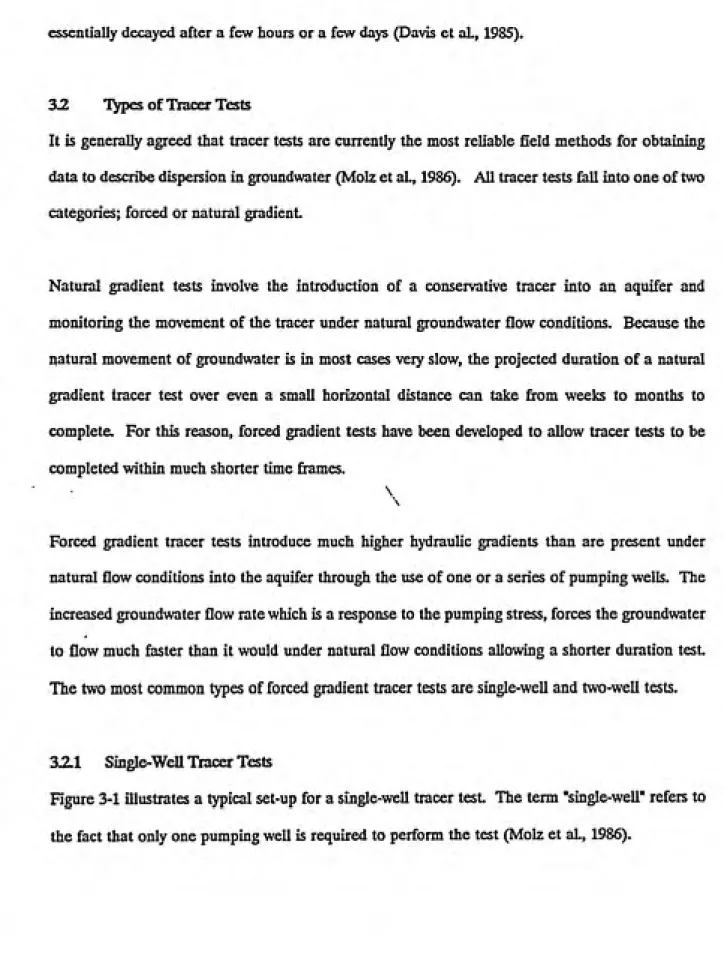
Figure 3-1 illustrates a typical set-up for a single-well tracer test. The term "single-well" refers to
WITHDRAWAL
CoutW
Qout
Ti n 1 n n ) i i'l r
SAMPLING PORT
INJECTION
Cin(t)
Qin
/^77^7^T^777
\
WATER TABLE
ͣ
ZONE OF INJECTED TRACER
FIGURE 3.1
SINGLE WELL TRACER TEST
(Ref: Davis etaU 1985)
During the test, a tracer solution having a known concentration, Cjn(t), is injected at a known rate,
Qjjj, for a known period of time into a well that is fully penetrating and screened over the entire
thickness of the aquifer. After a certain period of time, the flow may be reversed and the tracer
solution is pumped from the welL The recovered tracer solution pumped from the well at
concentration, Com(t), may be used to develop a breakthrough curve of concentration vs. time data.
In many cases it may be useful to calculate the percentage of tracer recovered.
In cases were the vertical conductivity distribution in the aquifer is desired, multi-level sampling
wells can be used in conjunction with the injection well. Concentration vs. time measurements are
then made at the different isolated points in each observation well during the experiment (Molz et
al., 1986). Horizontal hydraulic conductivities are estimated using the tracer travel time and tracer
concentration data measured at each vertical sampling interval
3.2.2 Two-Well Tracer Tests "^
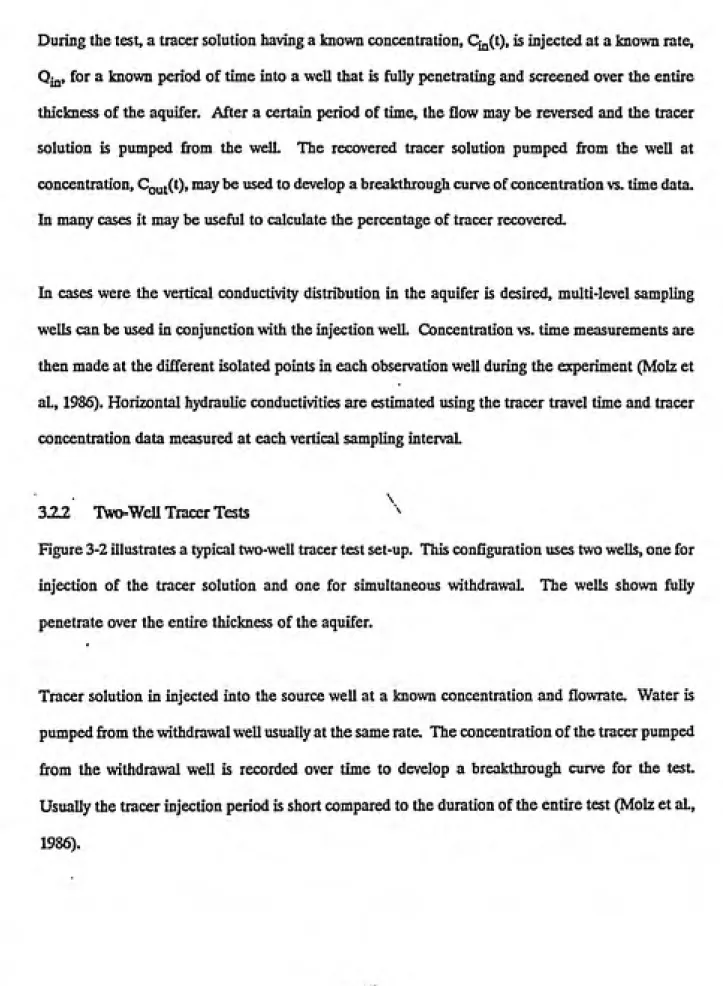
Figure 3-2 illustrates a typical two-well tracer test set-up. This configuration uses two wells, one for
injection of the tracer solution and one for simultaneous withdrawal. The wells shown fuUy
penetrate over the entire thickness of the aquifer.
Tracer solution in injected into the source well at a known concentration and flowrate. Water is
pumped from the withdrawal well usually at the same rate. The concentration of the tracer pumped
from the withdrawal well is recorded over time to develop a breakthrough curve for the test.
Usually the tracer injection period is short compared to the duration of the entire test (Molz et al.,
WITHDRAWAL
Cout(t)
Qout
PUMPED WELL
11 rn n
INJECTION
Cin(t)
Qin
kt
-© (E^-S
n n iT/j 1 / n i i in
y.
_ ^
INJECTION WELL
T-i 11 n I) I n 11 7 r
N
\
.^rsfl
M_8L£
FIGURE 3.2
TWO WELL TRACER TEST
(Ref: Davis et aU 1985)
Two-well tests may be carried out in either a recirculating or non-recirculating mode (Molz et al.,
1986). In the recirculating mode, the water pumped from the withdrawal well is reinjected back into
the injection welL The injection concentration of tracer solution in this case will be equal to the
sum of the tracer solution plus the concentration of the withdrawn water from the aquifer.
By using multi-level observation weUs to collect groundwater samples during the test, horizontal
conductivities may be estimated from the concentration and time data.
4J0 FIELD DATA COLLECnON
4^1 Description of Field Site
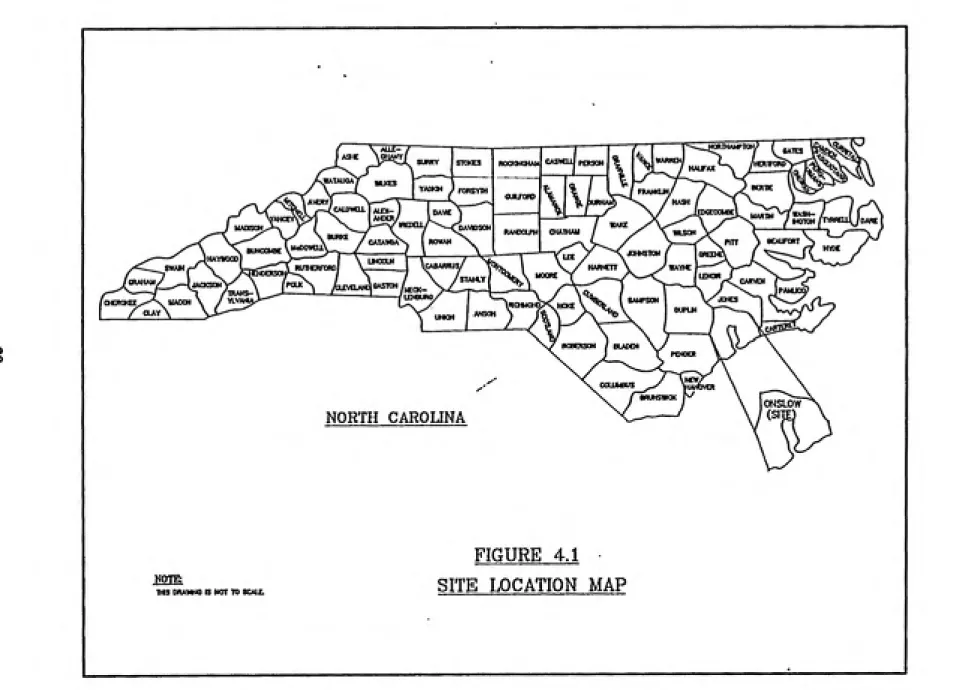
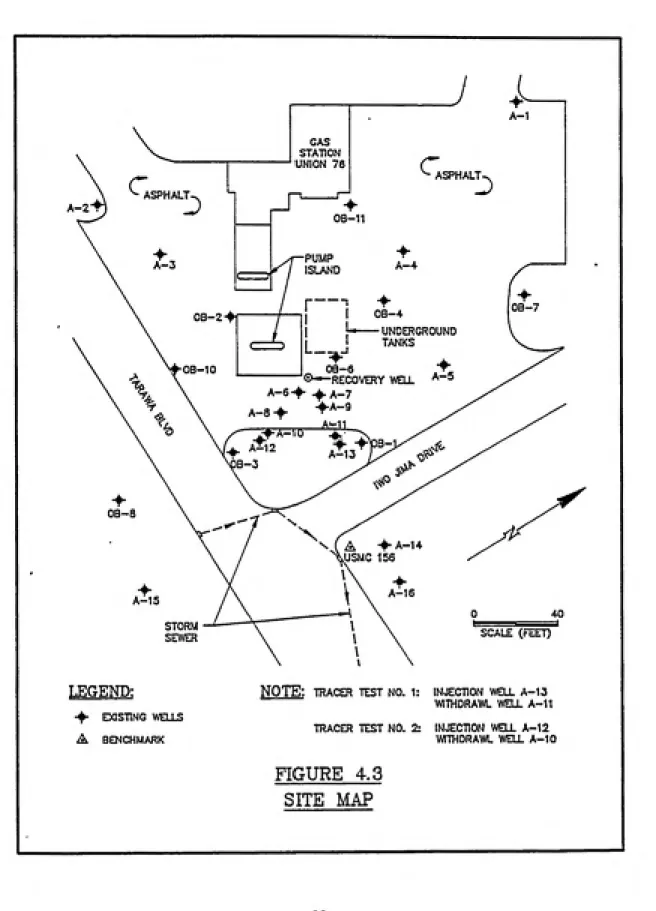
This study was conducted at the Terrawa Terrace site located at Camp Lejeune, North Carolina
(Figures 4.1, 4.2, and 4.3). Geologically, the site is located within the North Carolina coastal plain
which is characterized by sandy soils and a shallow groundwater table. Boring logs and published
soil data maps indicate that approximately 200 feet of fine to medium grained sands mixed with
varying amounts of clay (Mayer and Miller, 1988) comprise the surficial unconfined aquifer which
is underlain by a confining layer. The average depth to groundwater at the site is approximately 25
feet
A gas station at the site has been identified as the source of subsurface gasoline contamination
caused by leaking underground storage tanks and associated piping. It is estimated that
approximately 7400 gallons of leaded and unleaded gasoline were released between September 1985
g
CASWui
ROCKtNGHAM PEHOTH ItERIFORD
\\h-WATAUOA
YAOKIM 1 fORSYTO
AStRY
<=*">»*"• *l£3<- DAME
njOECOMBEl „^^„ ^WAW-
WOTON /TYBBEU-V /OAIIEDAVIDSON WL5QN
CATATOA UcOOWELl
JOHNSTON I I OR
HARNFIT \ y WAItieUNCOIN
CABAnnus RUTWRFOBD
POLK
5TANLY OARVEH
CRAHAM PAMUCO
TRAHS-YIV,
CHEROKEE^^'^ UACON
CLAY
mCHMONO^^ HOKE
^WSON
RENDER
lAHOVER
ONSLOW
(SITE
NORTH CAROLINA
mm.
im iNAwm n NOT TO acAii.
FIGURE 4.1
Ai
^'
^
r idifiePointy
MORGAN
^
SCALE 1:50,000
0
n: :e
2 MILES
3
CAUP LEUSUNE SPECIAL UAP
NORTH CAROLINA - EAST COAST
1976
PREPARED BY DMATC AND DMAHC
PUBUSHED BY THE
DEFEMSE MAPPING AGENCY HYDROGRAPHIC CENTtR
WASHINGTON, D.C.
FIGURE 4.2
A-2-J I
A-1
ASPHALT-^^
STATION UNION 76
ASPHALT
OB-11
PUMP
ISLAND
UNDERGROUND
TANKS
OB-8
USMC STORM
LEGEND:
-- EXISTING WELLS
A BENCHMARK
NOTE: TRACER TEST NO. 1: INJECTION WEa A-13
WITHDRAWL WELL A-11
TRACER TEST NO. 2: INJECTION WELL A-12
WITHDRAWL WELL A-10
FIGURE 4.3
SITE MAP
After the release was discovered, a consultant was retained to perform groundwater contamination
assessment and remediation services. Eleven monitoring wells were installed during the initial
phase of the investigatioiL Eventually, a pump and treat system designed to remove free gasoline
from the surface of the water table and to remove dissolved gasoline constituents from the
groundwater was designed and constructed at the site. The underground storage tanks were
removed in May 1987 and the area served as a groundwater contamination research site.
During July and August of 1987, a UNC research team installed 16 additional groundwater
monitoring weUs including twelve multi-level sampling wells. A map of the site included as Figure
4.3 shows the well locations as of December 1987.
42, Tracer Test Procedure
4.2.1 WeUs
Two two-well tracer tests were performed at the site using two different pairs of weUs. Test No.
1 was conducted on August 25, 1987 using wells A-11 and A-13. Test No. 2 test took place on
November 12,1987 using wells A-10 and A-12. During the two tracer tests, the existing groundwater
recovery and treatment system continued to operate. The average groundwater pumping rate from
the recovery well as measured before the start of each tracer test was approximately 10 gpm. It is
assumed that this average rate was maintained during the two tests.
Each pair of welk consists of an injection well and a withdrawal well. The injection wells, weUs
A-12 and A-13, are constructed of 48 feet of 2 inch diameter stainless steel casing with 2 feet of slotted
stainless steel screen. The withdrawal wells, wells A-10 and A-U, are constructed of 50 feet of 4
inch diameter stainless steel casing with 2 ft. screen sections. Construction details of the two
INJECnON WELLS
STEEL RISER: 6" DIA. WITH LOCKING CAP
WITHDRAWAL WELLS
STEEL RISER: 4" DIA. WITH LOCKING CAP
'^^S^
*.**¥.>)
5S5SSSSS5?3SSSSS55SSSSS5S5S5S5S5S5SSSS5SSS5SS^S5S5?^!SS
CONCRETE COLLAR EXTENDING'
2' BELOW GROUND SURFACE.
COLLAR IS TAPERED, 18" DIA.
AT SURFACE. AND SLOPED TO
_GRADE AWAY FROM CASING.
GROUT BACKRLb NEAT CE.MENT
SEAL OF 1/2' BENTONITE PELLETS
SAND
BACKFILL-CASING: 4" DIA., TYPE 304
STAINLESS STEEL, FLUSH
THREADED, SCH 10
CASING: 2" DIA., TYPE 304
STAINLESS STEEL. FLUSH THREADED,
SCH 10
SCREENED SECTION: 2' LENGTH, 4"
DIA., TYPE 304 STAINLESS STEEL
SCREEN, WIRE WOUND. FUT BOTTOM
ON SCREEN SECTION.
SCREENED SECTION: 2" LENGTH, 2'
DIA.. TYPE 304 STAINLESS STEEL
SCREEN, WIRE WOUND. FLAT BOTTOM
ON SCREEN SECTION
L
55ES555555S5^
LT.*^
>.•>
5^r^
liQIE: CRAVING IS NOT TO SCALE
FIGURE 4.4
TRACER TEST WELL DETAILS
4:12 Equipment Used
In order to be certain that the pumps controlling the rate of tracer solution injection and the rate
of groundwater withdrawal are producing identical yields, it is imperative during a tracer test that
the injection and withdrawal flow rates be continuously monitored. In addition, sampling ports must
be conveniently located to allow for frequent sample collection of tracer solution and withdrawn
groundwater. With these ideas in mind, a tracer test control box was designed and constructed as
shown in Figure 4.5.
To monitor and control the groundwater withdrawal rate from the pumping well, the box contained
a flowmeter, a sampling port, and control valve. The groundwater was pumped from the withdrawal
well using a stainless steel submersible pump. The tracer solution was pumped from the mixing
tanks to the injection well via the magnetic motor pump housed in the control box. The injection
line was also equipped with a flow control valve, a sampling port and an instantaneous readout
flowmeter. An inline filter housing was plumbed in for use during a subsequent experiment. A filter
cartridge was not placed in the housing during the two tracer tests. An equipment layout illustrating
the hardware setup during the two tests is shown in Figure 4.6. The hardware setup for the two
tests was identical.
4.23 Tracer Test No. 1
Tracer Test No.l was started at approximately 11:00 am on August 25, 1987 and continued for a
duration of 25.5 hours. Prior to the start of the test, 90 gallons of tracer solution were prepared
using groundwater from the site. A measured amount of sodium chloride was added to bring the
concentration of the solution equal to 250 mg/L of chloride plus whatever background chloride
concentration was present (approximately 15 mg/L Q-). A total of 85.16 grams of chloride were
TO OUTFALL
TO
INJECTION
ͣ
UNE
-TV
-GILMONT FLOW METER
DWYER FLOW METER--PVC PIPE
X
INJECTION FLOWRATE CONTROL VALVE
5
COLE-PARMER
MAGNETIC MOTOR PUMP
PUMP
2
T
INJECTION SAMPUNGPORT \
O
WITHDRAWAL'FLOWRATE CONTROL
VALVE WITHDRAWAL-SAMPUNG PORT• STAINLESS
STEEL PIPE
INJECTION UNE FROM TRACER SOLUTION TANKFROM WITHDRAWAL
WELLͣ
0.2 ii RLTER HOUSING
(TEFLON)
50
SCALE (FEET)
FIGURE 4.5
TRACER TEST CONTROL BOX
TRACER SOLUTION
VESSELS
TRACER SOLUTION
PUMPED
GROUND-WATER TO OUTFALL
CONTROL
BOX
PUMPED —
GROUND
WATER
— 1/2"
STAINLESS
STEEL
UNES
TRACER SOLUTION
ͣ
2" INJECTION
ͣ
4' WITHDRAWAL ^"^^
WEIL
NOTE: PLAN MEW NOT TO SCALE
FIGURE 4.6
Tf^s-The tracer solution was injected via the injection well, well A-13, at a flowrate of 0.25 gallons per
minute (gpm) and the groundwater was withdrawn from the pumping well, well A-11, at a flowrate
of 0.25 gpm. The flow rate was controlled by fine tuning with the control valves. When all of the
tracer solution was injected, the influent line was switched to vessels containing background
groundwater. For the duration of the test, the background groundwater was continuously injected
at the 0.25 gpm flowrate to maintain a steady state system.
Groundwater samples from the pumping well were collected every 15 minutes for the duration of
the test. A mobile on-site laboratory was set up to analyze the samples for chloride concentration.
A complete listing of the data collected from Tracer Test No. 1 is included as Appendix A. The
analytical method used to analyze the samples for chloride concentration was Method A
(Mercurimetric Titration), ASTM D 512 - 80.
By reducing the collected data, the breakthrough cti^^e, shown in Figure 4.7, was developed.
4i4 Tracer Test No. 2
Tracer Test No. 2 was started at approximately 6:34 am on November 12, 1987 and continued for
a duration of 30 hours. Prior to the start of the test, 120 gallons of tracer solution were prepared
using groundwater from the site. A measured amount of sodium chloride was added to bring the
concenfration of the solution equal to 250 mg/L of chloride plus whatever background chloride
concentration was present (15 mg/L C1-). A total of 113.55 grams of chloride were injected over the
duration of the test
The tracer solution was injected into the injection well, well 12, and the groundwater was withdrawn
from the pumping well, well 10, at a flowrate of 0.5 gallons per minute (gpm). The flow rate was
controlled by fine tuning with the confrol valves. As was done during the first tracer test, when all
E
z
g
H Z
u
o z o o
u
Q q: o
-J
I
o
80
70
60
-50
40
30
20
10
-0 -ly
RESULTS FROM FIRST TRACER TEST
TRACER CONCEN. = 250 mg/L CHLORIDE
J
20
TIME IN HOURS
r
of the tracer solution was injected, background groundwater was injected at the same flowrate to
maintain a steady state system.
Groundwater samples from the pumping well were collected every 30 minutes for the duration of
the test. The mobile on-site laboratory used for Tracer Test No. 1 was used to analyze the samples
for chloride concentration. A summary of the parameters for Tracer Tests No. 1 and 2 is as follows:
Flowrate
Injection Well
Withdrawal well
Radial Distance
Test Duration
Tracer Injection Time
Injected tracer volume
Tracer concentration
Mass of Injected Tracer
TRACER TEST NO. 1
0.25 gpm
A-13 (2" O.D.)
A-11 (4" O.D.)
3.84 feet
25.5 hours
6 hours ^\
90 gallons
250 mg/L chloride
85.162 grams
TRACER TEST NO. 2
0.5 gpm
A-12 (2" O.D.)
A-10(4"O.D.)
2.63 feet
30 hours
4 hours
120 gallons
250 mg/L chloride
113.549 grams
By reducing the collected data, the breakthrough curve, shown in Figure 4.8, was developed. A
complete listing of the data collected from Tracer Test 2 is included as Appendix B. The analytical
method used to analyze the samples for chloride concentration was Method A (Mercurimetric
Titration), ASTM D 512 - 80.
1^
-I
\
E
z
g
z
u
o z o o
u
Q
o: o
_J
I
o
80
70
-60
50
-40
30
RESULTS FROM SECOND TRACER TEST
TRACER CONCEN. = 250 mg/L CHLORIDE
20
10
-20
TIME IN HOURS
43 Discussion of Results
The test parameters selected prior to Tracer Test No. 1 were chosen using the most reliable site
data available. The breakthrough curve obtained from the test data was not as complete as it could
have been because the "tail" of the curve did not approach the abscissa asymptotically. Additional
data should have been collected until the flattening of the curve had been obtained. Although the
samples collected were being analyzed in the field within a short time, the duration of the test, the
fi-equency of sampling, and the field laboratory conditions which prohibited sample analysis at night,
all contributed to misjudging what the true length of the test should have been.
In order to correct this problem for Tracer Test No. 2, the injection and withdrawal flow rate was
doubled to allow for the capture of more tracer solution in a shorter period of time. It was ako
decided to lengthen the minimum duration of the test to 30 hours. By incorporating these two
changes into the tracer test procedure, the plotted breakthrough data from Test No. 2 as shown in
Figure 4.8 appear to be more representative of a complete test
It is interesting to note the percent of the total mass of injected chloride recovered from each test;
37 percent for Tracer Test #1 and 52 percent for Tracer Test #2. With both injection and
withdrawal wells only about three feet (one meter) apart, the tracer solution injected in the center
of the screened interval of both of the injection weUs, the submersible pumps installed in the center
of the screened intervals of the withdrawal wells, and both wells having approximately the same
screened interval, it would seem logical to expect to recover most if not all of the injected tracer
during each of the tests.
Factors that could account for the difference in the amount of the tracer recovered between Test
#1 and Test #2 include the difference in the flow rates and the duration of pumping.
Another factor that may have influenced the tracer test results is the construction of the withdrawal
well for Test #2, well #A-11. The construction of this well is somewhat suspect due to problems
that occurred in the field during drilling. The completed depth of the well is approximately 18
inches less than the other weUs making the screened interval o&et somewhat as compared to the
other tracer wells. The percent of total mass of tracer recovered during Test #2 may have been
even greater if the injection well had been completed to the same depth as the withdrawal well.
Because the point of injection of the tracer was at 50 feet below grade under a standing water
column of approximately 25 feet, the tracer was injected under pressure. The hydraulics of injecting
0.25 to 0.5 gallons per minute of solution probably caused a radial flow of the solution to spread in
all directions. Whether the pumping stress caused by the withdrawal well was strong enough to
overcome the spreading of the tracer and pull it back toward the withdrawal well in the duration
of the test could account for the majority of the tracer loss.
\
The other obvious possible cause of tracer loss is the apparent pumping stress induced by the
recovery well located approximately 40 feet from the tracer wells. Water levels in the monitoring
wells as measured around the time of the first tracer test are shown on Figure 4.9. Using this data
and assuming that they are representative of steady state conditions and that the surface horizontal
gradient is approximately equal to the gradient at 50 feet below grade, an estimate of the horizontal
groundwater velocity in the vicinity of the tracer test wells can be calculated. Assuming a hydraulic
conductivity of 1 x 10 ft/sec (Mayer and Miller, 1988), an effective porosity of 0.40 (typical for
sandy coastal plain aquifers), a horizontal gradient in the vicinity of the tracer wells of approximately
0.018 (as estimated from Figure 4.9) and assuming Darcy's Law applies, the horizontal velocity can
then be calculated to be approximately 4.5 x 10"^ ft/sec. Assuming that the duration of the tracer
4^
16-1
0 16
SCALE (METERS)
1—I—I—r
J___I___I___I___I___L
FIGURE 4.9
OBSERVED RECOVERY WELL DRAWDOWN (IN METERS)
withdrawal well is located between the recovery well and its respective tracer injection welL If the
groundwater moved 6 inches in the direction toward the pumping well during each tracer test, one
would ©q)ect that this would assist in the capture of the tracer as opposed to causing the tracer to
be lost
The loss of the tracer could also be attributed to the presence of a vertical gradient in the vicinity
of the tracer test wells caused by the recovery well. In their modeling study of the hydraulics of the
pumping recovery well at the Camp Lejeune site, Mayer and Miller (1988) determined that a vertical
gradient did exist in the vicinity of the pumping well. The recovery well is screened at an interval
of approximately 40 to 45 feet below grade (Mayer and Miller, 1988), whereas the tracer test wells
are screened at 50 feet below grade and are located approximately 40 feet away from the recovery
well. Using the data from the simulated hydraulic heads as a function of elevation in the immediate
vicinity of the recovery well (Mayer and Miller, 1988) at a depth of 50 feet below grade, a vertical
gradient due to the recovery well pumping stress of approximately 0.0075 and a vertical velocity of
1.8 X 10 ft/sec can be estimated. The actual vertical gradient in the vicinity of the tracer wells will
be significantly less than at the recovery well as demonstrated in the areal graphical vertical head
distributions shown in the referenced paper. Therefore, during the 30 hour duration of the tracer
tests, it is estimated that the groundwater may have moved less than 3 inches vertically upward due
to the stress induced by the recovery well. The stresses induced by the recovery well probably did
have some effect on the movement of the tracer and could be accountable for some of the losses.
However, these losses as estimated herein appear to be negligible. The effects of density and
temperature differences were assumed to be negligible and were not taken into account in the
5.0 METHOD OF DATA ANALYSIS
5.1 Descriptioii of Ttaca Test Simulatioii
By using equations that attempt to simulate the breakthrough response, certain aquifer parameters
can be estimated. These equations are usuaUy solved using computer models. To estimate the
aquifer parameters using the tracer test breakthrough data, the preferred method of analysis was the
use of a readUy available public domain computer based curve matching model. With the assistance
of the International Groundwater Modeling Center (IGWMC) of the Holcomb Research Institute
at Butler University in Indianapolis, Indiana, the available models were identified. The list was
narrowed to one potential model, since analytical solutions have not been derived for conditions
similar to those investigated in this study. The model chosen for further evaluation was the
Computer Aided Tracer Test Interpretation Code, "CATTI" by J.P. Sauty and W. Kinzelbach, May
1988. The model is a computer code used to estimate aquifer transport parameters from tracer test
data by either manual adjustment or by automatic least-square determination. CATTI is a
nonproprietary code and is distributed through the IGWMC
Since the CATTI documentation did not provide a complete description of the underlying theory
of the model, the author of the model, J. Sauty, was contacted in France. He was able to supply an
additional reference (Sauty and Kinzel, 1988) which was carefully reviewed. Upon further review,
it was determined that the CATTI program was an empirical solution, which was based upon a
radially symmetric flow field. This was a clear violation of the conditions under which the
experimental data was collected.
Also, CATTI simulates breakthrough data from either instantaneous or continuous tracer injection
tests for the case of radial flow, however, the actual field tests involved injecting tracer over a 4 to
6 hour period. The injections were neither instaneous nor continuous. After reviewing these model
limitations an alternate scheme was sought.
52, Tracer Transport Modeling
Since efforts to locate a satisfactory analytical solution failed, a numerical approach was deemed
necessary. Several models exist in the public domain to simulate the tracer tests performed.
The groundwater hydraulics in the vicinity of the tracer wells were simulated using the
McDonald-Harbaugh "Modular Three-Dimensional Finite-Difference Ground-water Flow Model" (McDonald
and Harbaugh, 1988). In order to run this model, a finite difference grid was set up around the
vicinity of the pair of wells used for Tracer Test #1. The model grid was set up with 17 columns
with a total dimension of 33.83 feet, 34 rows with a total dimension of 38.83 feet, and nine layers
with a total dimension of 134 feet The grid was set up with varying size cells with the sizes of the
cells decreasing as they approach the location of the wells. Cell sizes ranged firom 2x2 inches to
6x6 feet The ocact dimensions of the model grid including each cell block are included in the
MAIN.DAT input file included in Appendix C. Using the site parameters for hydraulic conductivity,
the model was run to simulate steady state flow conditions. The model was set up with a constant
head boundry on the perimeter and no flow boundaries on the top and bottom. The screened
interval was used as a separate layer. The simulation was run neglecting any effects from the
recovery welL
The hydraulic gradient as calculated from this three dimensional groundwater flow simulation for
the screened interval of both wells is shown in Figure 5.1. According to the modeling results, no
U I I II I II III I m I I 11 H I 11 I III 111 H I II III 11 HI I II I 11 111 I H II H 11 11 H 11II11
o o
6 66
J^
o o
-111 nil...mil iiiniimiimii iiiliiiimiiiiiiiiiiiiiiiiiiiiiiiiiiii
in
ID
LU
Assuming that the tracer particles move perpendicularly toward the equipotential lines, it appears
from the results shown in Figure 5.1, that the tracer would indeed move radially outward from the
well.
To track the path of the particles and to generate time of travel information to confirm whether the
percentage of tracer recovered during the tracer tests was reasonable, the three dimensional particle
tracking program, MODPATH, was used. MODPATH (Pollock, 1989) is a post-processing package
developed to compute three dimensional path lines based on steady-state simulations obtained from
the U.S. Geological Survey Modular Three-Dimensional Finite-Difference Ground-water Flow
Model.
MODPATH uses a semi-analytical partical tracking scheme based on the assumption that each
directional velocity component varies linearly within a grid cell. Given the initial position of a
partical anywhere in a cell, the coordinates of any other points along its pathinline within the cell,
and the time of travel between them, can be computed by the model (Pollock, 1989).
Data is input to MODPATH through a combination of files and interactive dialogue. The model
input data includes the input files BAS.DAT, BCF.DAT, WEL.DAT, OCDAT, SIP.DAT and the
output files BUDGET.OUT and HEAD.OUT used and generated in the execution of the Modular
Three-Dimensional Finite-Difference Ground-water Flow Model. MODPATH also requires the
data file MAIN.DAT. A detailed descriptiuon of the input parameters for these two files are
included in the model user manual (Pollock, 1989). A copy of each of the input files used to run
the simulation is included in Appendix C A companion program, MODPATH-PLOT, was used to
generate the graphical presentation of the MODPATH particle tracking output as shown in Figures
.fpwfflSWSRJ
t---_---1
L 3
ͣͣ
,____________________^---1
11 i- 1
All---1_________________________1
lLi-l.--l__
1
[
FIGUFE52
TWO WELL TRACER TEST - 0 HOURS
40
0 1 2 FEET
I.I I I iJ---1
s
%
I I I I
2 FEET
nGURE5.3
TWO WELL TRACER TEST - 2 HOURS
0 1 2 FEET