COLLISION COURSE CITIES:
IMPLEMENTING REGIONAL GOVERNANCE IN THE
AUSTIN – SAN ANTONIO CORRIDOR
by
Mary Beth Williams
A Master’s Project submitted to the faculty of the University of North Carolina at Chapel Hill in partial fulfillment of the requirements for the degree of Master of City and Regional Planning in
the Department of City and Regional Planning.
ABSTRACT
INTRODUCTION
Wide open spaces. Fifty years ago, this was an accurate description of the majority of the 74-mile long corridor in Central Texas that stretches between Austin and San Antonio. Open space. Open land. Open sky. Now, rapid, sprawling growth in both of these cities has transformed the entire corridor along Interstate Highway 35 into one continuous zone of new development where the boundaries between distinct communities have faded out of sight. Two of the largest cities in the country are on a collision course trajectory, yet little has changed in how these two independent communities plan for and manage growth. Because of this unwavering approach to self-interested governance, the area has missed numerous opportunities to advance proactive policy, invest in forward-thinking infrastructure improvements, and harness the collective power of communities working in cooperation. While, there is widespread recognition that the future of these two metropolitan areas is undeniably intertwined, there is little consensus on how to effectively transition from hopeful regional thinking to concrete regional acting. This report will examine regional governance and planning processes in the Austin – San Antonio Corridor to understand why plans for regional governance go awry and what the prospects are for changing the corridor’s course in the future. Although adjacent cities have collided in other areas, it has never before been at this scale, and there has never been a more critical place or critical moment for communities to harness the political will to come together.
Methodology
To answer the question of why do regional governance plans go awry, this report utilizes a case study methodology to delve into the specifics of the Austin – San Antonio Corridor, a region that has experienced a continuous cycle of failed attempts at regional planning and governance. This study is first grounded in a thorough review of the existing literature on regional governance that explores the modern definition of governance, the commonly associated benefits, and the factors that influence success. The second component of this case study is an analysis of three of the most ambitious regional governance attempts in the corridor that have ultimately been unsuccessful in achieving their original goal but have left an indelible mark on current approaches to regional thinking. The first, is a broad-based effort to craft a vision plan for growth management. The second is a targeted transportation plan to create a commuter rail between the corridor communities. The third, is an existing non-profit entity originally designed to promote collective economic growth and development in the corridor. The planning process in each of these situations is assessed in terms of its leadership and engagement structure, goals and objectives, implementation strategy and enforcement, and lingering legacy. The final component of this case study is a comprehensive discussion on existing barriers to regionalism that is informed by interviews with ten stakeholders from throughout the region. These stakeholders included both local planning experts from the different corridor communities and leaders of regional organizations that span large segments of the corridor. While this methodology is purely qualitative in nature, this process was selected to facilitate a deep analysis of the forces and motivations that underlie the observable outcomes of regional planning efforts. This rich understanding was then used to craft a set of broad recommendations for the corridor moving forward that address the barriers identified and outline the actions needed to lay the groundwork for future collaboration. While this analysis has a limited focus on one specific region, the lessons learned here can be helpful for avoiding similar pitfalls in other comparable areas that are struggling to make progress on regional governance initiatives.
Overview of the Austin – San Antonio Corridor
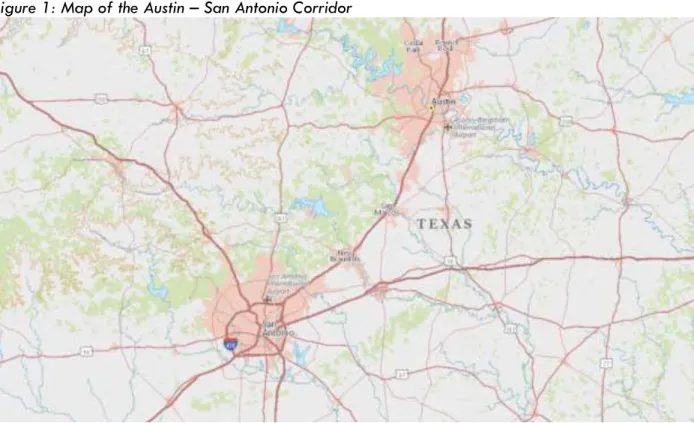
of the county’s $900 billion in trade travels by ground along this important north – south connection. The corridor is located on the edge of the Edwards Plateau, just east of the rolling hills of the Texas Hill Country and just west of the coastal gulf plains. The communities in the region include a wide diversity of bustling cities and charming small towns. The two undisputed principal cities of the corridor are Austin, the capital of Texas, and San Antonio. The two central business districts of these cities are 74 miles apart. The I-35 connection between these metropolitan areas intersects an additional five incorporated cities along its path. These smaller interior communities include the City of Buda, the City of Kyle, the City of San Marcos, the City of New Braunfels, and the City of Schertz. The culture of the corridor is shaped by a legacy of Native Americans, Spanish settlers, German immigrants, and Texas’ wild west frontier days and the influence of these different periods is evident in a variety of historic sites and a melting pot of architectural styles (Corridor Council 2018). The unique diversity of the corridor is reflected in the plethora of different landscapes, natural features, political ideologies, traditions, and community heritage.
Figure 1: Map of the Austin – San Antonio Corridor
Source: ESRI Business Analyst 2017
Organization (CAMPO) and Alamo Area Metropolitan Planning Organization (AAMPO) and under this view the region is comprised of 12 counties. The combined Council of Governments definition includes the area served by Capital Area COG and Alamo Area COG and under this view the region is comprised of 23 counties. The final definition that occasionally used to define the corridor is the one utilized by the Corridor Council, the only existing regional organization whose geographic reach extends to both metro areas. Under this definition, the region includes 8 counties. All of these different definitions primarily differ based on how many additional counties to the west and east of I-35 are included beyond those that intersect its path. The variety of conflicting geographies that are simultaneously used to define the Austin – San Antonio Corridor makes it challenging to reach a consensus among different stakeholders on what scope actually defines the region.
Figure 2: Geographic Definitions of the Austin – San Antonio Corridor
Source: ESRI Business Analyst 2017
of Eternal Boom” (Hall 2016), LawnStarter speculated “two of the state’s biggest cities are on a population collision course” (LawnStarter 2017), and the Rivard Report highlighted the “nearly uninterrupted commercial development along I-35” (Baker 2016). The remarkable change taking place in the region also caught the attention of numerous academic scholars like Robert Lang who highlighted the Austin – San Antonio Corridor as a specific example in three separate studies. In this research, he explored the emergence of new “megapolitan regions” forming along key interstates where development was filling in gaps between distant city cores and stretching regions to an unprecedented scale (Lang and Nelson 2007, Lang and Hall 2008, Lang and Knox 2009). As growth in the region shows no signs of slowing down, headlines from around the nation continue to theorize on what this boom means for the future of this critical corridor.
Figure 3: Population Growth in the Austin – San Antonio Corridor
Corridor Definition Population (2000) Population (2017) % Change
Combined MSAs 2,961,466 4,530,741 53%
Combined MPOs 2,833,481 4,360,261 54%
Combined COGs 3,155,552 4,767,944 51%
Corridor Council 2,809,738 4,316,840 54%
Source: US Census 2000, ESRI Business Analyst 2017
Amidst the rapidly changing built environment of the Austin – San Antonio Corridor, there has been a growing chorus of voices clamoring for a regional approach to planning the corridor that contains the two booming metropolitan areas. These regional planning advocates are not an entirely new phenomenon. As we will see, forward thinking individuals began proposing more regional collaboration and cooperation as early as the turn of the 21st century when it first became clear that the area was entering a new era of unprecedented growth. However, it is only recently that an entire spectrum of stakeholders from local city planners to agency leaders to public officials have arguably reached consensus that this should be a priority issue. In an article published in mySA
in 2015, Austin Mayor Steve Adler and San Antonio Mayor Ivy R. Taylor publicly reiterated their desire to work more collaboratively together. Mayor Taylor stated, “We have the makings of a mega-regional economy that could rival the Metroplex of Dallas and Fort Worth and any other major corridor in the country. Taken together, we are the core of an urban region that will shape the future of Texas and our nation in the years come. We will never be each other but we are looking at where it makes sense to collaborate so we can benefit from one another’s strengths and expertise” (Taylor 2016). These public commitments from the mayors of both major cities in the region reflect a growing consensus that cooperative regional planning is essential to ensuring the corridor’s bright future.
LITERATURE REVIEW OF REGIONAL GOVERNANCE
To build a foundation for understanding how and why regional governance plans break down at the scale of the Austin – San Antonio Corridor, we must delve into several threads of existing literature. First, we must understand exactly what regional governance means in this modern era. To accomplish this, we will review three historic waves of thinking on regional governance, the dominant definition in today’s context, and the important limitation that “regional” governance in practice still generally refers to metropolitan-level planning. Second, we must understand the benefits associated with regional governance. We will explore the advantages linked to smart growth, economic development, and equity. Lastly, we will conduct a thorough analysis of the critical factors scholars believe influence the success and failure of regional governance strategies. This will include an assessment of the growing literature around the processes, power dynamics, and scales that can make regional governance challenging to achieve in the real world. These three areas of literature will lay the groundwork for delving into the specifics of the Austin – San Antonio Corridor and its trials and tribulations in advancing a regional planning agenda.
What is regional governance?
The definition of regional governance has evolved over the last century as scholars fiercely debated the merits of different models, but in today’s context the “New Governance” approach dominates. This lengthy debate can roughly be categorized into three distinct waves representing shifting viewpoints on the most appropriate method for governing increasingly complex urban regions (Wallis 1994, Lester 2006). The first wave was the rationalization model. Rationalization emphasized the centralization and consolidation of regional governments to overcome the negative externalities of uncontrolled, market-driven growth (Wallis 1994, Lester 2006). The second wave was the public choice model and this dominated until the 1990s. Public choice advocates argued that the most efficient allocation of public services was achieved through a competitive local government marketplace where residents could express their priorities by “voting with their feet” (Tiebout 1956). The third wave of governance theory was the hybrid new governance approach (Wallis 1994, Lester 2006). The hybrid new governance model concedes the core arguments behind both of the previous waves but seeks to find a balanced compromise between these two extremes. This middle ground mentality began to emerge with force in the 1990s and was coupled with federal attempts to encourage more regional cooperation and problem solving between local governments (Lester 2006, Downs 1994, Wiewel and Persky 2002). Lester detailed the nuanced approach of the new governance perspective when he explained, “It recognizes the importance of multiple political entities and authorities within a metropolitan region, yet seeks to find stable institutional mechanisms to promote metropolitan-wide cooperation, solve regional collective action problems, and overcome problems of excessive competition” (Lester 2006, Wallis 1994). After decades of bitter debate, the balanced new governance model is still the dominant theory that guides regional governance thinking today.
broad definition, there is widespread consensus that the actual manifestations of regional governance in practice rarely amounts to traditional government structures. Beck described how the traditional institutions of the previous era have essentially become “zombie categories” (BECK and WILLMS 2003) and Long argued that “governance is increasingly redefined and much of governing does not emerge from the government” (Long 1958). Others have elaborated on this phenomenon and described the new forms that have emerged in a variety of policy areas. These descriptions include, “a horizontal network of relationships rather than a tightly ordered hierarchy” (Powell 1990), “networked governance… collaborative governance… participatory governance… private public partnerships…” (Lester and Reckhow 2012), and an “amalgamation of administrative forms including hybrids of traditional bureaucracies, market driven organizations and governance networks that incorporate broader participation” (Olsen 2005). These diverse governance structures have created a “regional institutional smorgasbord” (Lester and Reckhow 2012). The new governance umbrella still dominates theory today, but a vast diversity of governance shapes and forms have emerged.
An important caveat to this broad definition that includes collaborative efforts with both formal and informal processes and public and private actors, is that regional governance does refer almost entirely to metropolitan-level planning. Lester stated, “the salience of the metropolitan region as a scale of real…public intervention has increased significantly” (Lester and Reckhow 2012). In this well-documented reality, the crossing borders phenomenon still tends to refer to MSA-wide or sub-MSA collaboration rather than the higher level of adjacent sub-MSA cooperation or something similar (Katz 2000, Friedman and Weaver 1979, Lester and Reckhow 2012). While regional governance is a broad, almost all-encompassing description for multi-jurisdictional collaboration, it is less common at geographic scales greater than the metropolitan area.
What are the benefits of regional governance?
shared” (Stephens and Wikstrom, 2000). In many cases, the benefits of public goods reach far beyond arbitrary political boundaries which provides the rational for collaboration between the entire region that benefits. Other equity arguments contend that the regional level is a fruitful ground for bringing together stakeholders from diverse and sometimes conflicting groups to solve “collective action problems” and “deeply-rooted conflicts such as racial and income equality” that can only be addressed through regional cooperation (Lester 2006, Oakerson 2004, Innes 1999, Innes 2004, Innes and Rongerude 2005). It is clear that regional governance is associated with numerous advantages that range from smart growth solutions to economic development benefits to equity agenda progress.
What factors influence success or failure?
factors related to processes of regional governance planning can have huge effects on the future success of the effort.
A large amount of the literature related to regional governance processes has emphasized power imbalances and their potential to impact the effectiveness of regional governance. Many scholars have spent significant time critiquing the simplicity of regional governance theory for “underestimating the role of unequal power relationships in collaborative process” (Innes 2004, Ansell and Gash 2006). As the literature has pointed out, the root cause of these power imbalances in regional governance group dynamics usually stems from preexisting conditions before the group came together to collaborate but the sheer act of collaboration can effectively mirror or magnify these imbalances in harmful ways (Lester and Reckhow 2012). Keck and Sikkink explained, “power is exercised within networks and power often follows from resources” (Keck and Sikkink 1998). Authors have acknowledged that it is possible for power differentials to work in both positive and negative ways and “present great challenges to many actors and key opportunities to others” (Ansell 2000, Weir 2005). However, the vast majority of research identifies power imbalances as a key factor that can not only influence but in some cases derail regional governance planning.
The growing focus on megaregions in recent years has identified scale as another critical success factor for regional governance and there has been considerable speculation about the limits it imposes on effective planning. Although it didn’t become a salient term until the mid-2000s, the discussion of megaregions is not a sudden phenomenon and its roots date back to the 1950s. Jean Gottman was the first to coin the term “megapolis” to describe the urban expansiveness that was manifesting along the Mid-Atlantic coast (Gottman 1957, Gottman 1961). Since then, numerous scholars have been fascinated with the increasingly complex and multi-nodal form of growing American cities. In response, the literature is now filled with a vast vocabulary of references to “urban regions” (Pickard 1966), “city of realms” (Vance 1977), “galactic metropolis” (Lewis 1983), “100-mile city” (Sudjic 1992), “splintering urbanism” (Graham and Marvin 2001), “city-regions” (Scott 2001), “megaregions” (Carbonell and Yaro 2005), “mega-city regions” (Hall and Pain 2006), “new megas” (Florida 2006), “corridor megapolitans” (Lang and Nelson 2007), “mid-exurban realms” (Lang and Hall 2008), and the “megapolitan region” (Lang and Knox 2009). Although the fluid state of urban form and development naturally generates corresponding discussions on the governance best suited to manage these areas (Lang and Knox 2009, Markusen 1987), there are mixed opinions on whether governance is a worthwhile and effective tool beyond its current state of metropolitan-level collaboration, and the challenges of scale are at the heart of this discussion. Benner and Pastor summarized this uncertainty around the future of governance at the megaregion scale when they asserted, “Just as the notion of thinking regionally has made its way into the progressive lexicon, some analysts have argued that America’s metro areas are now actually reconstituting as sprawling megaregions…the question remains, are they arriving to a new policy table just as the scale of the economy is shifting up and out?” (Benner and Pastor 2011). The specific drawbacks of large scales that scholars have called out include the limited issue set available (Teitz and Barbour 2007, Dreier, Mollenkopf, and Swanstrom 2001), the low prospects of formal institutions (Metcalf and Terplan 2007, Jones 2007), the challenges of building legitimacy and credibility (Dewar and Epstein 2007, Teitz and Barbour 2007), and the fact that “the levers for action exist elsewhere” (Benner and Pastor 2011). For all of these reasons, scale is certainly a daunting factor that many experts believe can influence the effectiveness of regional governance.
UNSUCCESSFUL ATTEMPTS
widespread support for regionalism and several ambitious attempts at advancing different aspects of the regional planning agenda, this corridor still officially operates as a collection of separate, independent communities. To understand why this is the case, we will review three ultimately unsuccessful efforts to advance regional governance in the corridor. The first is Envision Central Texas, a collective effort to create a vision for future growth in several of the corridor’s communities. The second is Lone Star Rail District, an ambitious transit plan to provide commuter rail as an alternative transportation option to congested I-35. The third is the Corridor Council, a 30-year old non-profit that initially seemed poised to facilitate and promote collaborative economic development. The analysis of these three attempts will yield a better understanding of what issues arose during each of these planning processes by reviewing the leadership and engagement structure, goals and objectives, implementation strategy and enforcement, and lingering legacy. To truly understand why little progress has been made to advance regional planning in the Austin – San Antonio Corridor, we must gain a thorough understanding of this area’s unique past if we hope to chart a different course in the future.
Envision Central Texas
Envision Central Texas was a visionary collaborative planning process that engaged five counties within the Austin – San Antonio Corridor back in the early 2000s. This ambitious engagement was the first of its kind in the region at a time when existing infrastructure was only just beginning to reflect the warning signs of growing pains. The planning process for Envision Central Texas was spearheaded by a standalone non-profit of the same name whose mission was to “craft a regional vision to help us focus on the future as a connected community”. The impetus for the initiative was further described as “where in the past we have been smaller communities separated by miles of open lands, today we must recognize that we are an interconnected and interdependent region that can benefit from a renewed sense of community – a regional community” (ECT 2004). While the planning process achieved substantial applause and engagement at the time, it has gradually slipped into the depths of obscurity is now remembered fondly by only a handful of the longest-serving officials (Steiner 2011). Now fifteen years later, we revisit this groundbreaking attempt at regionalism to better understand the structure of the Envision Central Texas initiative and where this plan ultimately fell short in achieving its full vision.
Leadership & Engagement Structure
The Envision Central Texas project attracted an impressive collection of powerful leaders from throughout the region. Envision Central Texas, originally called Central Texas Visioning Project, was formed in 2002 by a collective of some of the most influential business and civic leaders in the Austin region that called themselves the “Group of Eight”. Several of these founding members were previously involved in the Austin Tomorrow plan which was developed in the 1970s. This initial regional leadership of the Group of Eight eventually morphed into a standalone non-profit entity with a 73-member board of directors. These invested stakeholders comprised a diverse variety of the biggest movers and shakers influencing the future trajectory of the region. This included almost every elected city and county official in the five-county area, leaders from the business community, transportation and environmental agencies, neighborhood advocates, and influential Latino community organizers (Steiner 2011). This diverse coalition of policy-makers, regional planners, and representatives of special interest groups formed a broad-based coalition that united key decision makers under a shared mission.
Williamson which comprised the entire Austin metropolitan area. This was unlike any and all previous planning efforts which focused solely on Austin rather than the surrounding areas. When deciding on the geographic scope of the project, the idea of including the entire Austin – San Antonio Corridor was seriously considered but ultimately not selected because of concerns that including the larger area might dilute the group’s ability to deliver meaningful accomplishments (Steiner 2011). Still, the project successfully brought together an unprecedented scale of diverse communities and interests within the corridor.
Envision Central Texas also involved an extensive community engagement program. Shortly after Envision Central Texas was established, this group of influential leaders successfully raised over $2 million in private funds to kick off an official planning process to develop a common vision for the Central Texas region. The board selected a 23-member executive committee that was charged with steering this process and began meeting regularly on a weekly basis. Then the organization hired the renowned planning consultants Fregonese Calthorpe Associates to spearhead the planning process and EnviroMedia to manage local public relations and community engagement. Over the course of two years, the team engaged in extensive community outreach that included a media bus tour throughout the region, two focus group sessions, a telephone survey of 750 respondents, seven planning workshops with 1,200 participants, six community test site workshops, a leadership workshop with 150 of the area’s regional leaders, and a public feedback survey with over 12,500 respondents (Steiner 2011, ECT 2004). This massive endeavor provided numerous opportunities for the community and the public to engage with the visioning process.
Goals & Objectives
The Envision Central Texas goal was unique because it represented the first shift towards regionally thinking. Unlike any planning documents that came before, the plan emphasized the urgency of adopting a regional approach to ultimately being successful. The plan reiterated at every opportunity the importance of thinking beyond jurisdictional boundaries. This compelling argument for regional thinking was communicated with arguments and promises like “We are a uniquely aware community which must now answer a call before it is too late. A call for our future and or children’s future. A call to come together not as disparate individuals seeking their required end but as a community seeking its desired end. An end that could also be defined as a new beginning not simply brought by our leaders but rather sought by our people…” and “We will work steadfastly to promise a regional point of view and to bring to the forefront the reality that we live in a single integrated region that shares its future, its problems, and its successes. We firmly believe that to succeed in the future, Central Texas must approach issues together with debate, collaboration, cooperation, and wisdom…” and “We must retain our region’s unique character by thinking and acting like a region, understanding our futures are linked and our fortunes are tied together…” (ECT 2004). This emphasis on regionalism was a defining component of the Envision Central Texas plan that was unlike any effort before or since.
Implementation Strategy & Enforcement
After the initial release of the plan, the exact future of the Envision Central Texas organization was unclear but tentatively structured. Within the strategic vision plan, the organization embedded a list of seven roles Envision Central Texas was committed to pursuing. These roles were limited to continued advocacy and education roles and they described their position as an “honest broker” between groups. To support this work, seven Implementation Committees were formed to carry out their future goals. These committees began working in summer of 2004 and included: Transportation and Land Use Integration, Economic Development, Housing and Jobs Balance, Density and Mixed Use, Open Space Funding, Social Equity, and Best Practice Recognition (ECT 2004). This tenuous structure guided Envision Central Texas in the initial aftermath of the plan release.
The organization continued under this structure for another nine years and during this time did achieve some notable accomplishments. Among these was the organization of a TOD symposium in 2004 to educate voters about a commuter rail proposal in Austin, another summit in 2005 to discuss the State Highway 130 proposal, an informal partnership on GIS mapping, the preparation of a land conservation plan for four of the five counties in partnership with the Trust for Public Land from 2006 to 2009, the creation of several land use and transportation modeling tools available to local governments, and the development and approval of an bond election for $567.4 million for the City of Austin that embodied Envision Central Texas growth principles (Steiner 2011). These notable accomplishments were implemented years after the initial delivery of the strategic vision plan and the organization should certainly receive credit for its influence during these years.
cooperate. For example, the strategic vision plan ended with the powerful request, “It is now up to the overall community to make use of this as it sees fit. You and your neighbor and your neighbor’s neighbor. This is who must learn from it and growth with it. To grow either taller or smaller, more compact or less, but to grow in a manner that enhances our future and in a manner where we can honestly say we tried to make our lives better for tomorrow than our lives were yesterday. So please use this tool and join us as we join you in Envisioning our future together…” (ECT 2004). In 2008, the organization hired a consultant to conduct a vision progress assessment and review its organization strategy. The study concluded, “There was widespread lack of clarity about the role of Envision Central Texas and while there was a broad-based interest in regional issues and a growing awareness of the need for a region-wide response, the participants believed that Central Texas faced many of the same issues it did when the program was launched five years before only magnified...” (ECT 2004). In 2013, nine years after delivering the strategic vision that they limited ability to enforce, Envision Central Texas quietly disbanded (Steiner 2011).
Lingering Legacy
While Envision Central Texas was ultimately limited in its scope of focus on the corridor and its authority to enforce the regional vision that was established in 2004, the initiative brought unprecedented attention to the importance of thinking regionally. An Austin Chronicle article that was published in October 2003, praised the organization for its efforts even while warning that the ultimate impact might be limited. The article stated, “It is still important to have a vision – on that, there is already agreement, from left, right, and center, and ECT has been roundly applauded for taking on (or taking over) “regionalism” – even by people who turn right around and say that any regional growth management plan is futile” (ECT 2004). Texas Monthly publisher Mike Levy also reiterated that “The best thing that ECT can do is get on everyone’s radar screen that the issues we face are not just about one town or one neighborhood” (Steiner 2011). In that respect, Envision Central Texas is a shining example of one of the most ambitious efforts to promote the benefits of adopting a regional planning approach. While they were ultimately unable to enforce their vision of growth, this early attempt at regional planning demonstrated that diverse stakeholders and interest groups throughout the community desired a change from the free-for-all growth model that was currently consuming the corridor. The dialogue on regionalism started during the Envision Central Texas process still lingers in the corridor today.
Lone Star Rail District
In contrast to Envision Central Texas which faded away quietly into the night, another ambitious regional planning effort in the corridor came to a sudden and tragic end. In October 2016, headlines across the region proclaimed “RIP Lone Star Rail” announcing the end of a 13-year planning process to bring commuter rail to the Austin – San Antonio Corridor (Brodesky 2016). The Lone Star Rail project was created in response to the mounting traffic congestion issues along the high growth area surrounding I-35 and was focused on delivering an inter-municipal public transportation alternative (Lone Star Rail District 2018). In the wake of this project’s dramatic ending, communities across the region mourned the lost possibilities that once seemed almost within their reach. We will review the planning process leading up to this conclusion to better understand why yet another attempt to link the corridor communities under a banner of regional connectivity failed to achieve meaningful results.
Leadership & Engagement Structure
Intermunicipal Commuter Rail District upon authorization from the Texas State Legislature. The agency held its first board meeting in 2003 when planning began in earnest and eventually changed its name to Lone Star Rail District in 2009 (Lone Star Rail District 2018). The board of the agency was composed of both public officials from the local communities in the corridor and private sector business leaders and the organization had some credibility as an official public entity.
Throughout its planning process, Lone Star Rail engaged in extensive community awareness campaigns and conducted several iterations of public engagement. When the project was first initiated, it was really just a partnership between Austin and San Antonio and their respective counties. However, through extensive engagement, by 2007 every single impacted city and county along the proposed route had joined the district as a member and was actively engaged in the planning process. In 2005, the agency selected a Locally Preferred Alternative alignment that was determined based on public input from nine public planning meetings along the corridor that engaged over 5,000 individual participants. In 2006, the agency conducted a series of studies that evaluated passenger service, station locations and designs, ridership modeling, financial analysis, and revenue forecasts. And in 2011, the agency solicited its first fiscal and economic benefits study. All of these research studies were made available to the public and were used as the foundation for gathering compelling data that was included in the project’s public outreach materials. In 2013, the agency began negotiating and signing interlocal funding agreements with all of the district communities to create value capture zones and use tax increment financing for funding of the ongoing operations and maintenance costs. An additional round of public engagement was conducted at this time to communicate the benefits and transit-oriented developments that were anticipated in each of these communities (Lone Star Rail District 2018). The project’s commitment to community engagement was evident through the entire process.
Goals & Objectives
The overall goal of the Lone Star Rail project was to create a seamless non-driving connection between Austin and San Antonio. The logistics of accomplishing this involved converting an existing Union Pacific freight line into a commuter passenger rail that utilized the existing infrastructure. The line linked the twelve communities of Taylor, Hutto, Georgetown, Roundrock, Austin, Buda, Kyle, San Marcos, New Braunfels, Schertz, and San Antonio and created a seamless passenger rail connection between this 110-mile stretch of Central Texas and the roughly 4 million Texans that live there. The service schedule accounted for thirty-two trains a day that would run both ways seven days a week. The plan also included 75-minute express service from Downtown Austin to Downtown San Antonio (Lone Star Rail District 2018). The essential purpose of the project was to deliver an alternate mode of public transportation to the I-35 corridor.
deals that had already begun to occur in several of the communities. These proposed developments included the new Apple campus in north Austin, the Grove at Shoal Creek, and Schertz town center which were all located near the future rail line stations. Both the transportation and economic benefits were core objectives of the Lone Star Rail District plan.
Implementation Strategy & Enforcement
While Lone Star Rail successfully raised the necessary capital funding, the project ultimately reached an impasse in negotiations with Union Pacific. The original estimated cost for the project was around $2 billion to $3 billion and this amount included the track, structures, stations, operations and maintenance facility, locomotives, and coaches. This capital amount was covered through a plan that included a mix of federal grants and loans, private investment, and state sources. The lion’s share of the state funding sources was the Texas Rail Relocation and Improvement Fund which was created and approved by voters statewide in 2005 in a constitutional amendment. Shortly after this huge funding hurdle was achieved, the agency began negotiations with Union Pacific. The foundation of this partnership centered around Union Pacific abdicating the use of its existing rights of way in exchange for Lone Star Rail District relocating and building a new freight line track for them further east. In 2010, Union Pacific entered into a Memorandum of Understanding with Lone Star Rail District and studies began on alternatives for the new freight corridor. However, in February 2016, Union Pacific abruptly notified Lone Star Rail District that they were withdrawing from their Memorandum of Understanding. In response to this revelation, a domino effect occurred as other parties in this venture halted their corresponding work as well. Both of the Metropolitan Planning Organizations in Austin and San Antonio removed the project from their long-range plans and the Federal Highway Administration rescinded its authorization to move forward on the Environmental Impact Statement (Lone Star Rail District 2018). As an article in My SA recounted, “The UP diagnosis was a blow that Lone Star Rail never truly recovered from. Gone were the big dreams. It chugged along on life support for months, an agonizing process for its closest observers. Without the UP line, the Lone Star Rail sought alternative options in a desperate attempt to recover to full health. But these were unappealing and unproven remedies that many experts viewed as longshots at best. With no clear route to link Austin and San Antonio, the Lone Star Rail became mired in an existential crisis…” (Brodesky 2016). After this surprising turn of events with Union Pacific, this 13-years process came to a screeching halt.
In the end, the Lone Star Rail’s entire plan hinged on the decision of a third party they had no control over and the project exhibited blind and naïve commitment to its initial goal. While the decision of Union Pacific to forego further engagement with the project was in some ways unexpected, it was also always well within their rights to choose not to cooperate. The existing line was rightfully their property. And while the outcome was tragic and disappointing, the public response notably laid the blame for the failure of the project at the feet of the politicians and the consultants involved who failed to foresee the possibility of this turn of events. The reliance on Union Pacific’s rail was the sole focus of the study for its entire 13 years of existence. While this stretch of rail was selected because it was undoubtedly the most direct route already in existence that connected the heart of each of these communities, at the end of the day Lone Star Rail District had no authority to force Union Pacific to hand over their rights to it (Brodesky 2016, Wear 2016). This failure to craft alternative contingency plans ultimately made the project vulnerable to the whim of a third party and the Lone Star Rail District has now been dissolved.
Lingering Legacy
Out of the ashes of Lone Star Rail emerged several new uncoordinated attempts at collaboration. Once it became clear that connecting these two cities by rail was off the table for at least another generation, several of the powers that be in the corridor took it upon themselves to restart talks with their fellow corridor communities. These sporadic attempts included a joint meeting between the mayors of Austin and San Antonio in which the possibility of a regional airport was discussed, a joint forum with Capital Area COG (CAP COG) and Alamo Area COG (AA COG) to discuss air quality in the region, and a joint workshop with Capital Area Metropolitan Planning Organization (CAMPO) and Alamo Area Metropolitan Planning Organization (AAMPO) to discuss transportation connections between the two regions (Rath 2018). Together, these initiatives indicate that while Lone Star Rail was ultimately unsuccessful, the project spurred new interest and activity in regional planning even if the effects of these informal meetings are still unknown at this time.
The Corridor Council
The final attempt at regional coordination we will review is the Corridor Council, a non-profit organization that still exists today but is hindered by a diluted focus and declining reputation. This membership organization started as a business-led economic development platform, but over time has repositioned its role to focus on what some would call transportation advocacy. The lack of clarity around their organizational purpose has resulted in confusion and disappointment among its members who are in many cases turning elsewhere for their regional coordination needs.
Leadership & Engagement Structure
The Corridor Council was founded over 30 years ago as a standalone non-profit entity. The internal organization of the non-profit is streamlined to create limited overhead costs. The permanent staff includes just four full time and part-time employees- a President, a Director of Administration, an Accounting Manager, and an Events Coordinator. The current President of the organization has been in the position for over twenty-four years. The non-profit is also governed by a 20-member board of directors. This fairly lean structure of the agency has remained the same since it was founded.
that did not include any sort of community engagement component and they did not solicit input from the greater public. Total membership in the organization at its peaks was comprised of more than 130 representatives from different political jurisdictions, public authorities, and private businesses (Corridor Council 2018). Membership of the Corridor Council suggests that the agency obtain widespread buy in from a diverse body of community stakeholders.
While public-sector participation has remained steady, private-sector participation in Corridor Council has diminished to just a niche market of stakeholders. Total memberships in the Corridor Council is now hovering at just 52 unique representatives or organizations and most of the membership decline since its peak reflects the loss of private businesses. However, public entities and specifically municipal government entities have remained active. Current memberships include representatives from almost every municipal government within the geographic boundary of the corridor and span both large and small communities. The designated representative in most cases is usually the community’s City Manager. Private-sector participation on the other hand is now limited to a fairly niche market of firms that deal exclusively with infrastructure, construction, or its related activities. These primarily include engineering consulting firms, utility providers, and regional banks and investors (Corridor Council 2018). These member businesses reflect a limited sample of the corridor’s very diverse economy and the wide variety of different business interests that could be represented in the organization.
Goals & Objectives
The purpose of the Corridor Council encompasses a broad economic development agenda. The Corridor Council website claims their mission statement is to “provide jobs and economic growth to our region, to provide infrastructure required by growth in a manner designed to preserve our lifestyle and quality of life, and to promote within and beyond our communities a sense of regional identity” (Corridor Council 2018). These sentiments are echoed in the organization’s overview that discusses I-35’s prominence as a global commercial corridor that facilitates a “river of trade” in North America, NAFTA’s historic and future influence on the region, and the diverse lifestyles offered by the different corridor communities. The organization also reiterates its desire to be a broad-based facilitator between the corridor stakeholders by explaining, “we believed it was imperative the growing region have a neutral location to discuss issues of the day” (Corridor Council 2018). All of these materials suggest the organization’s focus is to provide broad, overarching economic development coordination for the region.
Implementation Strategy & Enforcement
While the purpose of the Corridor Council clearly reflects a broad-based economic development mission, the actual work of the agency to-date demonstrates an exclusive focus on the infrastructure component of their mission. In their “active” projects page on their website, the Corridor Council only highlights its ongoing efforts to promote transportation investment in the I-35 region. The active projects currently include the Texas Rail Relocation and Improvement Association, the Lone Star Rail District, and State Highway 130. As we just learned, these first two projects which were associated with the formation of the commuter passenger rail from Austin to San Antonio are no longer moving forward. The third project is an 89-mile tollway that opened in 2012 as an alternate route to I-35 and is designed to divert and relieve traffic on the interstate (Corridor Council 2018). Nowhere besides in the language in their mission statement does the Council describe how they are actually taking steps to achieve the broader economic development goals they tout as their core objectives.
Council. Their role in all of these is simply as outside awareness builder of sorts. In fact, based on their annual reports, the only concrete activities and services they actually engage in are sending out a monthly newsletter that provides updates on the latest transportation projects and hosting a handful of public events in 2016 that brought their members together to discuss issues. Although they position themselves as the one and only comprehensive agency focused on promoting the corridor’s economic development interests, there is shocking absence of any traditional or innovative economic development support services (Corridor Council 2018). The Corridor Council appears to engage in an extremely limited set of activities that advance their goals and instead focus on promoting the awareness of other organization’s projects.
Lingering Legacy
Because of the clear paradox between the Corridor Council’s official economic development goals and the absence of any concrete strategic plan to implement and enforce them, their stakeholders have become increasingly disenchanted with the organization’s effectiveness. This disenchantment has manifested as both genuine lack of clarity on the Council’s priorities. Members repeatedly acknowledge that although it has been around for decades, they can’t point to one thing the organization has actually accomplished besides sending news updates to their inbox once a month. There is also a shared belief that the organization is still searching for its true purpose (Rath 2018, Voights 2018, White 2018, Kiloh 2018). This internal lack of clarity has understandably imbued its members with a lack of trust in its abilities to add value to the region’s economic future.
STAKEHOLDER PERSPECTIVES
In addition to understanding the nuances of past attempts at regional governance in this corridor, it is equally important to delve into the perspectives of those stakeholders who are most intimately involved in this process. To do this, we interviewed ten individuals from throughout the Austin – San Antonio Corridor who represent key planning experts from a variety of both large and small communities as well as leaders of regional planning agencies whose work spans multiple jurisdictions in the region. This thoughtful approach allowed us to gain a deep understanding of the pervasive and resilient desire for collaboration and the shared frustrations around the barriers that continue to challenge that process. These perspectives of key stakeholders throughout the region provide essential insight into the complex corridor ecosystem and its prospects for future regional efforts.
While there has been minimal progress towards an enduring structure of regional governance in the corridor, it is evident from conversation with key stakeholders that widespread support for some form of regional planning and coordination remains strong. Stakeholders from up and down the political ladder in the region were united in their belief that regional collaboration was absolutely critical to the future of the corridor and its individual communities. For example, Howard Koontz, Director of Community Development for the City of Kyle, expressed his belief in the mutually beneficial nature of collaboration when he explained, “I think if we got together and put a plan together rather than all of us trying to do it independently on our own that would increase our ability to not just grow but to flourish” (Koontz 2018). Diane Rath, Executive Director of Alamo Area Council of Governments, also emphasized, “Both cities and both regions are on the edge of a very exciting time. It’s currently been very exciting and I think it will continue to be for us, but we have all recognized that we have to do more regional planning and we have to use the broader definition of region in doing this” (Rath 2018). Bridgett White, Director of Planning and Community Development for the City of San Antonio, echoed these sentiments, “As we grow, and we know we are going to grow, the gap between San Antonio and Austin will get smaller and cooperation will be very important. We need to work together. Otherwise, in 5, 10, 15 years from now we are going to realize we could have addressed the issues we’re seeing if we only started working together back then” (White and Nino 2018). Chris Looney, Director of Planning and Community Development for the City of New Braunfels, also shared his commitment to a regional agenda but uncertainty about what that entails when he stated, “Everybody has recognized that we can’t operate in a vacuum. The point we’re at now is we are all open to it but now what do we do?” (Looney 2018). These conversations with local planning experts and high-ranking leaders of regional agencies reveal a near-universal desire for regional collaboration.
to be the way it is” (Kiloh and Giello 2018). The insights shared by stakeholders throughout the region revealed a collection of structural and political obstacles, and testimony by those that would be mostly intimately involved in future planning initiatives yields a valuable understanding of these complex factors that have made progress on regional governance so elusive.
Structural Barriers
Stakeholders identified three key structural barriers that were consistent challenges to regional efforts. Structural barriers are those stumbling blocks to regionalism that result because of the composition of the legal environment and the design of institutional agencies in the Austin – San Antonio Corridor. Structural barriers are hurdles that can generally only be addressed through the modification of existing laws or official institutions in the region. These modifications are more likely to be feasible in the long-term. Three key structural barriers were cited by stakeholders including the limited legal authority of local governments, the fragmented institutional environment, and the ineffectiveness of informal processes.
Local governments have limited legal authority.
Texas is known for its free market mentality and untouchable property rights protection, and this mindset is reflected in an extremely restrictive legal environment. The legal environment in Texas makes it uniquely challenging to achieve the levels of regional coordination that have been utilized elsewhere in the country. The first legal component that contributes to this, is the reality that no zoning of any kind is allowed in unincorporated areas in Texas. In every other state in the country, legislative authority for zoning in unincorporated areas is designated to the county outside of city jurisdictions. While there are situations in which rural areas can elect to opt out of this authority, the decision to have no zoning is an optional choice by a minority of areas rather than the non-optional rule (O’Toole 2011). Betty Voights, Executive Director of Capital Area COG summarized this phenomenon with the simple explanation, “Every city only plans for their city limits and there is no organization that connects between those. In fact, there’s an anti-planning dynamic in Texas. Our counties have absolutely no land use authority to speak of and the legislature is constantly trying to water down any authority that the cities have. Twenty years ago when Texas was a lot more rural this was less of an issue. But it’s an issue now” (Voights 2018). David Fowler, Senior Planner at the City of Buda, elaborated, “There are very few exceptions to the fact that unincorporated areas cannot be zoned, so that makes any kind of land use control at a county-wide or regional-level exceedingly difficult because it has no teeth. The state legislature is actively opposed to giving counties land use control and land use planning that crosses borders in any true sense seems to be just too much for people. Texas is a highly populated state, but it still has a rural mentality. People like living on larger pieces of land and having as much control over their land as possible, and this permeates a lot of policy decisions” (Fowler and Sparks 2018). This limited scope of zoning authority in Texas means that the range of collaboration opportunities available for local governments in the corridor are unlikely to include joint land use planning under the current legal context.
Manager for the City of Austin, also emphasized the impact of this new bill and explained, “The recent changes by the state mean that most of our growth is now going to occur in unincorporated areas with no land use control. The vote requirement for annexation makes it much more difficult for municipalities to annex surrounding areas to grow. Unless there’s a ranch with just one owner who decides he wants to develop it and votes yes for annexation, I don’t think you will see any annexation so there will be even less land use control. The law is new enough that I don’t think we’ve seen the full effect yet but the people that are involved in this area believe this is game over” (Kiloh and Giello 2018). This change in annexation law compounds the already existing complications in land use planning by further restricting annexation and the associated zoning control that municipalities can engage in. The complexity of the Texas legal environment imposes relatively narrow powers on local governments and creates a web of restrictions that communities are still learning to navigate at a sub-regional level much less at a regional scope that encompasses the entire Austin – San Antonio Corridor.
A fragmented institutional environment diminishes planning synergies.
While almost every region at this scale is supported by a network of overlapping and sometimes conflicting organizations, the institutional landscape of both Austin and San Antonio are particularly crippled by severe institutional fragmentation. This fragmentation limits synergistic planning within each of the metropolitan areas which makes the goal of cross-metropolitan coordination seem like an even loftier feat than it would in a less complex environment. The most glaring example of this unique institutional fragmentation is the fact that the Metropolitan Planning Organization (MPO) is a separate independent organization from the Council of Governments (COG) in both cities (Figure 2). The MPO’s mission is to provide long-range urban transportation planning and administer federal funds to transportation projects in the area. The COG’s mission is to facilitate collaboration between regional communities and provide service delivery of wide-ranging public needs like emergency communications, law enforcement training, aging assistance programs, homeland security planning, solid waste reduction, GIS data services, economic development and policy research (Voights 2018, Rath 2018). In almost every area of the country, MPOs are part of a city, county, or council of governments and there only eight exceptions to this rule (Rath 2018). The fact that two of these exceptions are the metropolitan areas located at either end of this growing corridor is a political legacy that dates back to the 1960s when Metropolitan Planning Organizations were first formed (Wikipedia 2018). Because of this legacy, and the fact that each of the MPO regions are defined differently from their respective COG regions in Austin and San Antonio, cohesive planning that reflects coordination between these pivotal organizations is almost non-existent. The corridor itself therefore falls under the mixed domain of two distinct MPOs and two distinct COGs. In addition, each city also falls within a distinct water planning region, workforce development region, and TX DOT region (Rath 2018, Koontz 2018). These are just a few examples of organizations that are crucial to the region’s future that not only have inconsistent boundaries within their own metropolitan area but also only have partial control of the corridor as a whole.
much as he wants to collaborate, “Institutionally and structurally they are really two separate metros with separate series of institutions. There are two COGs. Two MPOs. Two transit agencies. Multiple layers of entities that are involved in these things” (Kiloh and Giello 2018). Diane Rath, the Executive Director of Alamo Area COG, experienced this frustration on a particularly personal level since this was the organizations she was charged with optimizing. She described this problem as, “The detriment we’ve found ourselves in now is not only the fact that both of our COGs are not the MPO but equally important and becoming more so every day, is that we are two totally separate structures. Initially, when we were all created 50 years ago it made sense because we were very different communities. But now, we really are a continuous region. It truly makes it difficult to have separate institutions for all of these things. We are entering the stage of becoming one large megaregion. Our infrastructure as it is now, is not such that it allows for cohesive planning. It’s a huge flaw in how we are organized and it makes it much more difficult when dealing with all of the regional issues” (Rath 2018). Betty Voights, Executive Director for Capital Area COG, also reiterated the challenges of this fractured structure, “Between our COGs there’s not a lot of things that are coordinated formally. We have the exact same menu of service delivery but for all of our programs we do it for our counties and she does it for her counties” (Voights 2018).
Informal processes result in little progress.
A heavy reliance on informal relationships is the third barrier to collaboration and this has created an environment where unstructured contact is sporadic and free from accountability. The prominence of relationship politics and the It’s-Who-You-Know-Not-What-You-Know dynamic received mixed feedback from the stakeholders in the region. While some did emphasize they believed this was an asset to the region, most acknowledged that it has led to little results so far. The fact is, this is a relatively small region so there are a variety of informal mechanisms that can bring planning professionals in the area together. It is fairly common to switch jobs among the different communities over time so people often have professional ties to multiple cities in the corridor (Looney 2018). Some of the professional organizations like the Congress for New Urbanism Central Texas chapter (CNU – CTX) includes both Austin and San Antonio and everything in between (Kiloh and Giello 2018). Bridgett White, Director of Planning and Community Development for the City of San Antonio emphasized this natural cooperation dynamic, “One thing about planners, once you know a planner you keep in touch to see what different things are happening. We always reach out to our personal relationships to understand what another city is doing and what they may have encountered. So there’s always an ability to hear and see what’s going on around you just because of the nature of what we do” (White and Nino 2018). Chris Looney, Director of Planning and Community Development for the City of New Braunfels also explained the benefit of this informal dynamic when we said, “The Planning Director in San Marcos, the Assistant Planning Director in Seguin, all of the people in San Antonio, the folks in Schertz- we all have personal relationships which has certainly bled over into collaborative spirit” (Looney 2018).
What’s the goal? What’s the initiative? If you told me there was another meeting I would go. But there’s no end zone. I think you can field a team but you have to tell us what game we’re playing. Unfortunately, if you honestly need projects and products to come forward then there needs to be metrics of what needs to be accomplished and deliverables and consequences. If we want something to happen, it needs to be something more structured than folks getting together at a Mexican restaurant on Thursday afternoon” (Koontz 2018). Bridgett White, Director of Planning and Community Development for the City of San Antonio slightly amended her earlier positivity when she admitted, “When all you have this informal structure, then person A says person B is doing it and person B says person A is doing it, but in reality there’s no person who actually checks that final box and that’s a concern. I think eventually it will need to evolve into a formal structure” (White and Nino 2018). While the informal processes that exist in the region might have contributed to the growing desire for collaboration, so far they have failed to develop into a structured plan of action with accountable participants.
Political Barriers
Political barriers are those stumbling blocks to regionalism that result because of the opinions and mindsets of decision makers in the Austin – San Antonio Corridor. Political barriers are hurdles that might be addressed through relationship building tactics, public awareness campaigns, or other programs that target existing opinions and use strategic persuasion to influence and attempt to change individual and group attitudes. These are generally feasible to implement in the short-term but have a less defined formula for success. Political barriers in the region identified by stakeholders include a sense of hopelessness, a pervasive competition mindset, and a fear of losing unique identities.
Lack of state support creates a sense of hopelessness.
While demand for regional planning in the corridor has grown louder, proponents’ hopes that they will actually achieve this have repeatedly been tested by the lack of state-level support given to their efforts. David Fowler, Senior Planner for the City of Buda, expressed his disappointment with the state legislature, “The big headline is that true regional planning is pretty darn discouraged in my opinion. The political atmosphere really discourages regional planning that involves multiple jurisdictions” (Fowler and Sparks 2018). Betty Voights, Executive Director of Capital Area COG shared similar frustrations, “Texas as a state would need to embrace planning in a broader sense. I think philosophically planning just isn’t their biggest priority. They embrace it as it relates to 911 and homeland security but the state has not embraced planning for how and where growth should occur. That is the fundamental problem and that needs to happen first. If it continues like it is now, the corridor will be exactly the same but worse because it will be totally market driven and drastically built out. The state leadership also doesn’t want to admit it’s not working, so even though my staff and I know we desperately need to be working on these things, our hands are tied.” (Voights 2018).
and I’m not optimistic anymore” (Kiloh and Giello 2018). Even those stakeholders that held onto hope that change was possible were skeptical that anything except political turnover could facilitate that. Diane Rath, Executive Director of Alamo Area COG expressed her anxiety that, “Some of our enlightened elected officials recognize that we need to change but to make any drastic change to the governance structure of the region would require the decision of all elected officials throughout the area. That’s a tremendous logistical as well as political challenge. I think the only thing that will make it possible is more time and eventually transitions in people with different personalities. But that change has to occur in the future and hopefully before it’s too late” (Rath 2018).
Competition and perceived cultural differences foster mistrust.
Underlying the supportive calls for coordinated regional planning in the corridor, were pervasive reservations about the compatibility of these communities working together effectively. The first reason given for this hesitation centered around whether it was feasible to overcome the individualistic mindset of these naturally competitive areas. The same dynamic that fuels the informal personal relationships simultaneously fosters intense competition among the different municipalities and their leaders who are rewarded only for their successes that benefit their respective community. David Fowler, Senior Planner for the City of Buda, explained, “A lot of regional coordination is really a contest for scarce resources. So even if you are working together in a collegial manner you have to remember it’s a contest for resource allocation” (Fowler and Sparks 2018). Howard Koontz, Director of Community Development for the City of Kyle, also echoed these sentiments, “When they all get together and are in front of each other, they smile and they laugh and they handshake and it’s just like one big team party. But when they are alone again and work for themselves, they are all trying to cannibalize the same potential clients and same opportunities that are coming to the region. If you land a project that’s a victory for you and not your neighbor. That is the reality but that’s the kind of thing that is slowing us down. We are fighting against one another. We need to be able to congratulate our neighbor and be proud of their accomplishments instead of being envious and bitter it didn’t come to our community.” (Koontz 2018).
This competition was not just unique to the relationships among the smaller communities in the corridor but also acknowledged between the edge communities and the larger metropolitan areas. Howard Koontz went on to specifically cite the example of Austin’s changed relationship with growth and development. Howard clarified that for a long time, Austin’s whole direction in planning was “don’t build it and they won’t come” and this translated into policies that were intentionally designed to make development as tedious and difficult as possible to preserve their small town charm. However, it has only been in the last decade, that Austin finally acknowledged that their strategy did nothing to prevent or deter growth and in Howard’s words, “They have now done a whole sale change and turned 180 degrees. Before, they were pushing people away which fueled a lot of the growth outside the urban core. Now, they are competing with those smaller cities that forever their anti-growth attitude was feeding” (Koontz 2018). This complicated relationship means there is competition between the different small communities and between the small communities and the big cities.
Austin but I get the impression once you get out of Austin that’s not really something that non-Austin Texans are so proud of. The rest of the state looks at Austin and rolls their eyes and does the exact opposite. Austin may struggle to partner up with the other large metro areas” (Koontz 2018). Other long-time residents in the area thought the relationship between Austin and San Antonio was a little more complex than simple political disagreements. Chris Looney, Director of Planning and Community Development for the City of New Braunfels shared, “Austin and San Antonio have always had a friendly competition with each other. I’ve always thought that San Antonio had an inferiority complex with Austin but now I’m hearing that may have switched and Austin is starting to have an inferiority complex with San Antonio. Maybe it’s always been mutual” (Looney 2018).
Even when their comments reflected conflicting viewpoints, these perceptions of cultural differences were also acknowledged by residents of both cities. Greg Kiloh, Redevelopment Project Manager for the City of Austin explained, “They are separate places because they are culturally separate. People often say San Antonio is the oldest city in Texas and Austin is the youngest. San Antonio was really big early on and even though it is still bigger than Austin, it doesn’t feel like it and there’s a perception that they are kind of stuck in the past. Austin is younger, more dynamic and changing a lot. Austin is becoming urban and people outside of Austin still don’t like urban” (Kiloh and Giello 2018). Diane Rath, Executive Director of Alamo Area COG who was born and raised in San Antonio, summarized the rivalry as, “Austin looks at San Antonio like we’re country bumpkins and thinks they are far more sophisticated than us. Austin has had far more people move in from Boston and other places and much of the state doesn’t necessarily view that as an advantage. They are growing and blowing and fast-paced. In San Antonio, we’ve worked really hard to maintain a family environment. We also treasure and celebrate cultural diversity and take great pride in the bi-culturalism that exists here and the strength it brings to our community” (Rath 2018). She also explained that as a practical manner, these differences translated to a different policy environment where the two cities were unlikely to see eye to eye. As Diane stated, “Austin is much more aggressive in their regulatory environment than San Antonio and we often look at what they’re doing and think they are crazy” (Rath 2018).
There is fear that coming together will hasten loss of identity.
While the benefits to increased integration of planning efforts were fully acknowledged, many stakeholders still expressed fear that progress on this front would inevitably hasten the loss of the unique identity of their community. Although there are five incorporated communities located in the corridor in less than a 74-mile distance, each of these individual municipalities has maintained a distinctly individual personality with a unique culture, built environment, economy, and prized assets. In characteristic Texas fashion, these communities are also fiercely proud of these individual identities and are deeply afraid of anything that might tarnish this heritage. The rapid change that this entire corridor has experienced in recent decades has only exacerbated this protectionist and preservationist mindset (Looney 2018, Koontz 2018). Although these communities are growing together spatially, they have no desire to be each other and the cultural differences mentioned above reiterate their eagerness to point out even subtle differences.