Training Medical Professionals in Japan and the US:
To Dr. Naoki Ikegami
Table of Contents
When the Same Symptoms Present: An Introduction 1
The Aging Patient 5
The Insured and Uninsured Patient 8
Government Spending on the Patient 11
References 16
Chapter I. Past Medical History 17
Japan 18
The United States 27
Professionalism and Impatient Facilities 33
References 38
Chapter II. Debriefing Professionalism 39
Professionalism in Unstructured Interview 43
References 49
Chapter III. Prognosis 50
Attitudinal Mismatch 53
Professional Development at the Beginning of Medical Education 56
Student Involvement in Medical Education 59
Standardized Patient Practice 61
References 66
The Same Symptoms Present Elsewhere: Conclusion 67
When the Same Symptoms Present: An Introduction
Two patients identify with a similar set of symptoms, and each visits the doctor.
One patient stands outside a clinic in the early morning, while the other patient sits in a
waiting room with one of the first scheduled appointments of the day. Despite one
patient’s free access to care, and the other patient’s slot in a micro-managed
appointment system, both patients wait two hours to see the physician. By the end of the
appointment, the doctor acknowledges the reported illness, but it remains chronically
unidentified.
It would be safe to assume that the reader of this thesis has at one point played the role of a patient and visited the doctor for a particular illness. As a patient who navigates the healthcare system, he or she is not unfamiliar with present issues in the healthcare system of his or her country. In fact, patients navigating healthcare systems in other nations, particularly Japan, are experiencing the same types of situations and encounters as patients in the United States. This is happening at a time when medical education, for the first time in a century, is actively making changes to its curricula. When defined by licensure, the practice of professional medical care has only existed in Japan and the United States for approximately one hundred and thirty years.
This thesis and its argument will reinforce the importance in comparing
biomedicine in Japan and the US,1 not because they are the same system, but because the same symptoms continue to present within these differing systems, much like a recurring illness. After a brief introduction to current topics in healthcare for these two nations, this
1 Both nations have been compared in scientific literature as early as the 1970s in an effort to
thesis will reveal the origins of biomedicine as a professional practice in Japan and the United States that is less than two hundred years old2. There is some evidence to suggest that during this change, the licensure and professional status of physicians at the end of the nineteenth century has had lasting effects on healthcare today, specifically by creating an abstracted concept of what it means to be a professional.3 Medical training of
physicians has perpetuated a doctrine governed by “professionalism,” a sense of
appropriate manner, a qualitative measure that has since been quantified. Even so, since the concession of physicians as licensed professionals and the standardization of medical education, only now are medical schools adjusting curricula for future physicians. Now that medical education is changing, this thesis will caution against the use of subjective definitions of professionalism when teaching future physicians and will propose four suggestions for changing curricula. Ultimately, this thesis will explore the
“professionalism” of professionals in healthcare and compare medical education curricula in Japan and the US through preliminary research in Japan and unstructured interviews with physicians in the US. The main objective of this thesis is to address the conundrum of professionals being unaware of their own “professionalism.”
Professionalism
The Charter on Medical Professionalism was concurrently published in 2002 in both the Lancet and Annals. The publication, preceding this thesis by over a decade, outlines three principles and a set of responsibilities that are entrusted to medical
physicians as professionals. Physicians become professionals after receiving appropriate
2 Biomedicine trains professionals to diagnose and to heal. It wasn’t until the early twentieth century that
training and subsequent licensure, with the ultimate product of their service as the becoming of a trusted individual for patients. To define professionalism, the Oxford American Dictionary defines the term as the competence or skill expected of a professional,4 which is a rather subjective description for such a weighted topic. The argument of this thesis identifies professionalism as the underlying complexity in healthcare’s relationship with society, and the Physician Charter, which explicitly recognizes that “professionalism is the basis of medicine’s contract with society,” adequately supports this original idea.5 What is more, in other scholarly articles
professionalism is equated to various other concepts, including appearance and attitude, competence, appropriate behavior, ethical conduct, patient interaction, communication, and, the most technical, acquisition of licensure.
Addressing professionalism makes the subjectivity of the concept clearer, and recognizing the potential consequences of the abstraction of this concept is the next revolutionary step in improving healthcare and patient care, the altruistic purpose of the profession to begin with. It is possible that healthcare issues continue to become more complicated because professionals are unable to assess the consequences of their own professionalism, past and present.
Chronically Unidentified Illness
Overall, biomedicine is a very broad topic to argue. To narrow the subject further, aging populations, health insurance and government spending are three examples where physicians face many complexities and professionalism is stretched thinly. These same issues, discussed for decades on how to improve a comprehensive system of healthcare
4 Oxford American Dictionary, see professionalism.
5 Harold C. Sox, “Medical Professionalism in the New Millennium: A Physician Charter,” Annals of
delivery, never leave the conversation; the issues only appear more complicated. That is to say, literature in the healthcare world continues to discuss these issues as issues, stoking the awareness for change, but clearly not admitting to have identified the illness. Awareness of an issue is better than not realizing that one exists, and it is often that problems are defined by their consequence; problems can really only be
acknowledged once they have reared themselves as such, or have been reared. Complementarily, regular amendments to policy ought to be commonplace. In all attempts to isolate the main issues in the system, most conclusions are in agreement that navigating both the success and the foundering of the nations in healthcare is an
inevitable and unifying long-term responsibility on the behalf of healthcare authorities. For instance, various works by Naoki Ikegami focus on positive and negative lessons around policy making in Universal Health Care (UHC), not only for developing nations, but also developed ones.6 Amidst these attempts it is guaranteed and by some preferred that changes to healthcare come incrementally and at a relatively steady pace. While these amendments and lessons continue to adjust healthcare in the long-term, perhaps the more recent changes occurring in the medical training of physicians can revolutionize healthcare in the short-term by focusing on the activity of professionals in the field. As healthcare issues seem to take more complicated forms, addressing professionalism in medical education now is a necessary approach to take, and a parallel to the Physician Charter in 2002. The following discussion will review three relevant topics where healthcare issues have increased in complexity for both Japan and the United States, in
6 Naoki Ikegami and Akiko Maeda, overview to Universal Health Coverage for Inclusive and Sustainable
order to give context to the theatre where medical curricula are changing and impact on professionalism abounds.
The Aging Patient
Among the most pertinent of issues addressed in scientific literature is the aging demographic in Japan and the United States. Aging society has significant influence on health insurance and government spending. Furthermore, populations are aging
simultaneously within healthcare systems that some authorities might consider aged themselves. Likewise, biomedicine is changing simultaneously with a standard of medical training that has not changed in over the past century. Whether generalized by diversity in the US or a comparable homogeneity in Japan, the vertical demography of society is changing for both countries, and aside from the elderly, this has greater implications for other participants in health care and the rest of the population. It has the power to influence the coverage and resources available to other patients in the healthcare system, while also mismatching resources and elderly patients.
The demography of society is changing in all sorts of ways... The demands within families have changed – the burden of looking after elderly family members for many more years than was the case twenty years ago puts pressures on lifestyles and finances…There is a danger that currently aging members of a population will divert resources from the next generation, at the risk of increasing that generation’s health problems. We have seen how many of the problems of health in middle age have their origins in early life and this demands resources. But these resources are increasingly needed for the elderly. Addressing the mismatches associated with ageing is a real conundrum.7
7 Mark Hanson and Peter Gluckman, Mismatch: Why our World No Longer Fits our Bodies (Oxford : OUP,
One such mismatch associated with the aging population is that life expectancies are hitting record highs. According to World Bank data from 2014, the percentage of Japan’s population over the age of 65 is 26%, which is nearly double the United States’, a growing 14% of the population.8 What is more, Japan’s Ministry of Health, Labor, and Welfare announced in 2015 that the life expectancy of women hit a world record high at an average 86.83 years of age, with men taking the third spot globally at 80.50 years.9 With these data it is an obvious conclusion that a significant portion of the population is getting larger and living for longer. One could argue that an ameliorative factor here could be the health of the Japanese population, which experiences less chronic conditions and represents a smaller number of individuals with HIV/AIDs, but another trend is remaining constant. Although Japan also has a high healthy life expectancy averaging over 70 years of age,10 the margin between a healthy life expectancy and average life expectancy is not shifting to accommodate the increase in life expectancy; life
expectancy in Japan increases, and the age of onset for limitations to health is remaining constant.11
With health compromised by limitations, resources for care are always needed for the aging population, especially in the United States. Yet, even with resources available, the US struggles with an appropriate application of these resources. Just as with Japan, elderly often have little to no income compared to middle-aged individuals, but will spend comparatively the same amount of money, if not more, on health care. When the
8 The World Bank. 2014. World Development Indicators. Washington, D.C., data for population ages 65
and above % total.
elderly do have appropriate coverage and care, the delivery of care is still compromised. Edward Shorter recounts in his work, The Health Century, the common experience of a young physician who must provide care to many elderly patients in an emergency setting in limited amounts of time with each patient, often resulting in important details specific to geriatric patients being overlooked. It is not uncommon for such patients to have “multiple medical problems and very little understanding about them” while taking “fifteen different medications [with] no idea what they are and for what purpose.”12 These are the implications behind the aging population that training physicians encounter today, and one such example where the responsibilities of professionalism are tested.
The aging demography is affecting the medical and financial spheres of society, where a lack in elderly care, when filled, has the potential to compromise the health of the next generation in regard to the economy and resources. Even when care is accessible, it is not always appropriately matched to the patient. A connection between managing healthcare systems and understanding patient needs and how to meet them with the appropriate resources holds more weight than before. Aging patients represent a shared burden in Japanese and American society that holds greater implications. In both cases, a majority aging population is receiving a minority of the active focus of the biomedical system. Choosing to refocus on patient skills in medical education is a fortunate result of recent changes to curricula.
The Insured and Uninsured Patient
Another discussion correlated with the previous is one of national health insurance. The Japanese government nationally covers health insurance, whereas the United States capitalizes health insurance. In the midst of this, Japan thrives on capitalism yet spends one of the smallest percentages of its gross domestic product on healthcare while the United States spends one of the highest percentages. A brief account of physicians and the origin of health insurance practice will shed light on such situations as they exist in healthcare today.
Health insurance in Japan is equitable, and is composed of employment-based health insurance and residence-based health insurance, of which there are several categories. The insured patient in Japan is free to choose their doctor and treatment that they receive.13 Japan regulates government spending on health care through a standard fee-for-service system consistent in all municipalities that reflects health care coverage in the nineteenth century; national health insurance is rooted in preserving the health of the working class in Japan’s modern past, and residence-based insurance took its initial forms in physician remuneration in the 1800s.14 Later, the important enactment of the Health Insurance Law of 1922 provided health benefits15 to workers who were a crucial population when building up Japan as a nation in the Meiji era. Its enactment is important
13 Naoki Ikegami, “Japanese Health Care: Low Cost Through Regulated Fees,” Health Affairs 10, no. 3
(1991) : 88.
14 John Creighton Campbell, Naoki Ikegami, and Yusuke Tsugawa, “The Political-Historical Context of
because this is the foundation for the health insurance system in Japan today.16 During the Meiji Restoration Japan promoted efforts for modernization as Japanese ones17
through the use of bunmei kaika, civilization and enlightenment.18 It is interesting to view a system of health coverage as something that also “demarcated a crisis of Japanese modernity” with other national efforts towards a unified national state in the early 1900s.19 Having health insurance for workers implied that modernization could be achieved ideally without falling victim to infectious disease, and possibly limiting other new modern deaths, although this did not happen to be the case later on.20 Gradually, Japan had integrated biomedicine into formal study, which arguably complemented the existing practice of kanpo medicine that had already existed in Japan.21 This of course ended when Meiji government officials phased out the status of kanpo doctors for the professional status of biomedical physicians who were passing their formal examinations and becoming these licensed professionals by the 1880s.
Health insurance and physicians fulfilled a different role in America in the early 1900s because politically, the US was not as centralized22 as European countries, or Japan for that matter. The launch into market healthcare for the United States was largely influenced by the nature of the economy at the time, but in its primitive form healthcare
16 John K. Iglehart, “Japan’s Medical Care System,” in Health Care Systems and Their Patients 1992, ed.
Marilynn M. Rosenthal and Marcel Frenkel (Boulder : Westview Press, 1992), 149.
17 Marilyn Ivy, “Ghastly Insufficiencies: Tono Monogatari and the Origins of Nativist Ethnology” in
Discourses of the Vanishing, Marilyn Ivy (Chicago : University of Chicago Press, 1995), 73.
18文明開化 (bunmei kaika): Civilization and Enlightenment, used in the Meiji period to promote modern
thought.
19 Ivy, “Origins of Nativist Ethnology,” 68.
20 Public health initiatives and activities were severely marginalized as japan approached the Second World
War. This content will be discussed more in chapter two.
21漢方 (kanpou): Doctors in Japan who study Chinese derived medicine.
22 Leiyu Shi, “Historical Overview of US Health Care Delivery” in Essentials of the US Healthcare System
was restricted to a very domestic sphere. While licensure of physicians did emerge state by state in the early 1800s, it was almost completely abolished since patient autonomy and patient choice were valuable aspects of care. Doctors were paid fees for their services, but these doctors were not necessarily professionals, and the medical economy remained a domestic23 one in the nineteenth century. Transactions and choice stayed between the patient and the physician. While Japan remunerated physicians to keep them in rural areas in the late 1800s, when urbanization sent many to larger metropolitan areas,
“unrestricted entry into practice” in the United States meant that “doctors were apparently well distributed through rural areas.”24 By not having many professionals in practice and a less restrictive system of licensure, political economy was too decentralized and education too burdening, therefore demand in small towns and other rural communities sufficed and national health insurance did not have a sturdy platform on which to develop. Hence, one proposed reason for why the US has yet to acquire a system of national health insurance, much less a universal healthcare system.
With this bit of information concerning early physician status among political, economic motives, hopefully it is easier to see a correlation between the standing of health insurance today and the roles of physicians within their respective healthcare systems as professionals. Of course, much more contributes to the status of the healthcare system in its present state in America and in Japan, but this paper will not specifically go into further discussion about hospitals, policy or public health. Instead, history shows where inconsistencies in professionalism have contributed to complexity in healthcare.
23 This implies that most often transactions occurred privately between the physician and the patient. 24 Paul Starr. The Social Transformation of American Medicine (New York : Basic Books, Inc., Publishers,
Government Spending on the Patient
America, without national health insurance but instead a large sector of private insurance, spends a considerable percentage of GDP on healthcare. Public spending is reserved for patients without proper funds and elderly patients, while those who can afford to pay for the insurance and receive employer benefits use private spending. According to an approach used by Christian Aspalter,25 the Welfare systems and per capita spending of the United States is nothing less than social, and approximately 48% more social than Japan, a country that is known for practicing and promoting a system of Universal Health Care (UHC) and National Health Insurance (World Bank). Japan’s regulated fee schedule is successful at containing costs. For instance, Aspalter states that “the United States would be among the top three world health care systems in terms of ‘socialism,’” which is something an American might not have ever considered, in terms of America’s governmental spending.26 This is because “when it comes to absolute public health care spending the USA is also a large public health spender, the third largest in the world.”27 Specifically, this is looking at “the absolute public spending per capita for
health care.”28 The tables below present extracted data from Tables 10.1 and 10.3 in
Aspalter and Uchida’s work, and current data from World Bank and WHO that compare Japan and the United States.
25 Christian Aspalter, “European and Asian health care systems in comparative perspective” in Health Care
Systems in Europe and Asia 2012, ed. Christian Aspalter, Yasuo Uchida, and Robin Gauld (New York : Routledge, 2012). Aspalter uses data to show how the health care system in the US is approximately 35 percent more socialist than the health care system of the United Kingdom, which tends to be the prime example of socialized medicine from an American perspective. Another point worth noting is that the Welfare system in the US is also a very socialized system of health care.
Table 1. Comparing government spending on healthcare in Japan and the US
Health expenditure, total, % of GDP (World Bank, 2013)
Per capita spending on healthcare, USD (World Bank, 2013)
General government expenditure on health as a percentage of total expenditure on health (WHO, 2013)
Per capita spent on health by
government based on 2013 data, USD
Japan 10.3 3,966 82.1 3,256
United States 19.7 9,146 52.9 4,838*
*The United States government spends approximately 48.5% more per capita on healthcare than Japan. In terms of this data, and using the framework of Aspalter’s argument specifically, it can be argued that “the health care system in the United States... is actually about [48] percent more ‘socialist’ than that of [Japan]” (167).
Government spending on healthcare in Japan and the US continues to increase as a result of aging populations and subsequent complexities in health insurance policy, but also because of the technology, changing market forces, problems in health care delivery, and globalization that are simultaneously making it difficult for professionals to meet their responsibilities.29
Why Medical Education is Changing
Now that the reader is familiar with some context of healthcare issues in the US and Japan, these observations can be used in an analogy. Just as the complex status of healthcare today is influenced by its professional origins, the history of medicine as a licensed profession has long influenced both patients and professionals in healthcare. Similarly, the same medical training for nearly one hundred and fifty years has
perpetuated patient care compromised by inconsistencies in professionalism. Licensure made practicing physicians into professionals once they completed necessary medical education, removing them from domestic relationships and placing them into political
and market economy sectors in Japan and the United States, respectively. Training as a physician professionally meant gaining access to patients in university hospitals for training purposes, a method now revolutionized by objective structured clinical
encounters.30 For this reason in particular, focusing on professionalism as it is taught in medical education is crucial. The physicians that the profession has produced since the end of the nineteenth century have contributed greatly to the field of healthcare, and the consequences of their formulized training then is bringing about a change in medical education now.
What has impacted patients the most? Patient autonomy is still valued in the healthcare system, but obvious issues such as insurance and government spending put restrictions on patient choice. For both America and Japan, physicians were licensed professionals by approximately the year 1890. As the next chapter will outline, the US was influenced by Europe as much as Japan had been, but at the same time, the shift to biomedicine, Western medicine, took different courses from different origins in these nations, and yet, patient situations are becoming evermore complicated such that the training of physicians is changing.
Readjustments to medical education have already been executed in select
universities in the United States. As for Japan, patient care and professional awareness is becoming a frontier focus in medical training.31 While biomedicine is a dynamic social
30 Objective structured clinical encounter (OSCE): training in medical education involving standardized
patients to create a clinical environment for medical students where both students and patients suspend disbelief.
31 The use of standardized patients in Japan is not employed in the same ways as it is in the United States.
science, medical education has remained stagnant since the adoption of the profession through licensure in the late nineteenth century, assuring a standard that would produce the most professional of physicians. Licensure is a main component of many professions, not only healthcare.
As this paper will continue to suggest, medical education has recently become an avenue for change, mostly by training professionals not to think quantitatively, but qualitatively about the patient care they are delivering. Therefore, training students with more qualitative social science skills can foster stronger professionals in the field. For the US, this has taken a patient focused turn in education and for Japan it has taken an
international focus, with particular interest in professionalism and what it means in a Japanese context. One could predict that the combination of the two will help to communicate changes in the US to Japan, frontier programs in Japan to the US, and Japan’s synthesis of international medicine into their own system. This sudden qualitative shift could critically analyze healthcare’s own professional methods as a negative impact on the systems overall since modernity. At the founding of the professions during
industrial ages and rapid decades for societal change in the late nineteenth century,
perhaps the negative consequence of professionalism was unavoidable at the time. Today, it is possible to survey consequences in clinical encounters that have been perpetuated by professional medical training, and now is the time to recognize them.
importantly, this thesis will investigate how professionalism is taught currently since the medical training of physicians is changing for the first time in one hundred and fifty years, which reveals how now would be the time to correctly and concretely outline medical professionalism for the sake of future physicians.
Moving forward, the second chapter of this thesis will attempt to identify the critical events that made medical physicians professionals, in two separate and unique biomedical systems that continue to express the same symptoms of patient care, aging population, financial and policy driven burdens. It will begin the discussion on how a medical profession meant to provide care was compromised in its relationship with its patient, all by licensing physicians and creating professionals facing variable and
References
Aspalter, Christian. “European and Asian health care systems in comparative perspective” in Health Care Systems in Europe and Asia 2012, ed. Christian Aspalter, Yasuo Uchida, and Robin Gauld, 167-201. New York : Routledge, 2012.
Campbell, John Creighton, Naoki Ikegami, and Yusuke Tsugawa, “The Political-Historical Context of Japanese Health Care,” in Universal Health Coverage for Inclusive and Sustainable Development, Lessons From Japan 2015, ed. Naoki Ikegami, 15-26. Washington DC : International Bank for Reconstruction and Development / The World Bank, 2014.
Hanson, Mark and Peter Gluckman, Mismatch: Why our World No Longer Fits our Bodies. Oxford : OUP, 2006.
Iglehart, John K., “Japan’s Medical Care System,” in Health Care Systems and Their Patients 1992, ed. Marilynn M. Rosenthal and Marcel Frenkel, 147-174. Boulder : Westview Press, 1992.
Ikegami, Naoki and Akiko Maeda, overview to Universal Health Coverage for Inclusive and Sustainable Development, Lessons From Japan, Edited by Naoki Ikegami. Washington DC : International Bank for Reconstruction and Development / The World Bank, 2014.
Ikegami, Naoki. “Japanese Health Care: Low Cost Through Regulated Fees,” Health Affairs 10, no. 3 (1991) : 87-109.
Ivy, Marilyn. “Ghastly Insufficiencies: Tono Monogatari and the Origins of Nativist Ethnology” in
Discourses of the Vanishing, Marilyn Ivy, 66-97. Chicago : University of Chicago Press, 1995.
Shi, Leiyu. “Historical Overview of US Health Care Delivery” in Essentials of the US Healthcare System 2005, Leiyu Shi and Douglas A. Singh, 45-69. Boston : Jones and Bartlett Publishers, 2005.
Shorter, Edward. The Health Century. New York : Doubleday, 1987.
Sox, Harold C., “Medical Professionalism in the New Millennium: A Physician Charter,” Annals of Internal Medicine 136, no. 3 (2002) : 243-46
Starr, Paul. The Social Transformation of American Medicine. New York : Basic Books, Inc., Publishers, 1982.
The World Bank. 2013. World Development Indicators. Washington, DC : The World Bank (World Health Organization Global Health Expenditure Database) Last modified 2016.
http://data.worldbank.org/indicator/SH.XPD.TOTL.ZS.
The World Bank. 2014. World Development Indicators. Washington, DC : The World Bank (The United Nations Population Division’s World Population Prospects) Last modified 2016.
http://data.worldbank.org/indicator/SP.POP.65UP.TO.ZS?order=wbapi_data_value_2014+wbapi_ data_value+wbapi_data_value-last&sort=desc
“女性86.83歳で3年連続世界一14年の日本人平均寿命,”日本経済新聞 July 30, 2015.
http://www.nikkei.com/article/DGXLASDG30H8W_Q5A730C1EA1000/
Chapter I. Past Medical History
Although there is not an overwhelming amount of evidence to support this, it is possible that the development of the profession of medical physicians apart from other occupations created stress on the doctor-patient relationship, having an affect on how the relationship is perceived today. With healthcare issues becoming more and more complex, professionals are limited in their time that they have with patients, not to mention various stressors that affect the behavior of professionals and communication between physicians and patients. If professionalism is considered the unforeseen, underlying context of complexity in healthcare, then reviewing the history of physicians as professionals is a necessary component to understanding how misconceptions in professionalism have the potential to be sustained in training and practice today.
The Physician Charter on medical professionalism was an essential step towards more structured study, acknowledgement, and discussion of professionalism by
professionals. It points out that professionalism and professional medical practice may not be consistent in other cultures as it is in Western thought, going on to specify that the charter is intended to be applicable from a global perspective.32 The charter questions directly its own representation of traditions of medicine in other cultures.33 In the context of medicine that is practiced in Japan and the US, however, this question omits the details of the origins of biomedicine in nations across the globe by isolating the West and
creating a single “other” category. Both Japan and the US begin to adopt biomedical practices early on from European influence, but both countries adopted biomedicine in a way that was tailored to fit the current situations at the time. For instance, before
32 Sox, “Charter,” 244
33 Sox, “Charter,” 243. “Does this document represent the traditions of medicine in cultures other than
licensure, many forms of medical practice were considered primitive because licensure did not standardize practice. America experienced a sense of fragmentation as a result of the Civil War (1861-1865), and Japan by the Sengoku Period (1467-1603). Though by the end of the nineteenth century, physicians in both countries experienced a change in status from domestic workers to trained professionals, along with which came the nature of responsibilities regarding professionalism that the charter reiterates. For this reason in particular, understanding the history of medical practice as a professional one is key to further investigation of professionalism in practice and in medical education in Japan and the US.
This chapter will separately discuss licensure, European influence, integration of biomedical practice, histories of professional licensure and training for Japan and the United States. In addition, these histories will be assessed for compromise in patient care in the early twentieth century, where a sudden influx of training medical physicians needing access to patients tested the altruism of the profession.
Japan
By 1868, biomedicine was already on the political agenda for becoming a part of medical practices inherent to Japan at the time. The institute for the medical profession, the Institute of Western Medicine, was renamed and this time, the word “Western” was omitted from the title.34 Shortly thereafter, the Bureau for the Examination of Medicine was established in the city of Tokyo as a part of the Department of Education a year before Tokyo University’s medical school was established in 1875.35 By 1903, all of the
34 Willis Norton Whitney, “Notes on the History of Medical Progress in Japan.” Transactions of the Asiatic
physicians teaching at this medical school were Japanese,36 even though less than a quarter of physicians in Japan at this time practiced newly indoctrinated practices of Western biomedicine.37 Although foreign physicians still had a small role in medicine at this time, Japan began to set a precedent for the nation’s medical profession through Tokyo University, and rather than requesting the assistance of foreign doctrine, charged its own students to study in Europe.
Adopting European Doctrine in Japan
Before the European introduction of Western medicine, healing existed in Japan in the form of kanpo.38 As a matter of fact, some scholars specifically mention how “Europeans had little of value to teach regarding the art of healing” in Japan, 39 given that healing was already a practice before Western medicine arrived there. What the
Europeans did offer, arguably, is a set of new methods with which to approach medical practice to a Japan preparing for a new modern era by the time of the Meiji Restoration in 1868. According to Genpaku Sugita, the Dutch methods for healing were “far superior to the Chinese or Japanese methods theretofore employed.”40 In the early seventeenth century, when the Japanese began discourse with the Dutch by 1608, resources for modern medicine were introduced in the forms of anatomy books, lectures, and visits to
36 Yoshio Izumi and Kazuo Isozumi, “Modern Japanese medical history and the European influence,” Keio
Journal of Medicine, 50, no. 2 (2001) : 97.
37 Carl Mosk, Making Health Work (Berkley : University of California Press, 1996), 89.
38Kanpo is a Japanese medical approach to healing based on Chinese principles practiced by self-employed
physicians. This is why, from one perspective, Japan should not be identified with medical pluralism, a term used in medical anthropology to describe a society that has more than one healing system at the disposal of those who are ill or in need of healing.
39 Harald Fodstad, Marwan I. Hariz, Hidehiro Hirabayashi, and Chihiro Ohye, “Barbarian Medicine in
the emperor.41 This influence begins the gradual internalization of biomedical practice into Japanese healing methods. The following comment by Hanaoka Seishu offers some clarity concerning the roots of this new Japanese approach to healing, and the association between European medicine and kanpo as an embodiment of the same longstanding goal: treating patients.
There is no distinction in principle between ancient and modern medical treatment, while in the treatment of internal and external disease the principle is one: if, therefore, we permit ourselves to be biased toward the teachings of the ancients, we may fail to understand those of today; while if we do not consider the internal condition of the body, how can we treat understandingly those diseases which manifest themselves externally? The Dutch physicians are most minute in theory, but rough in their mode of treatment: Chinese science is indeed minute, or
accurate, in practice; but is restrained by the theories of the past. Therefore, as to treatment, I look to the living body alone for indications, seeking for the mode, afterwards, from philosophers; and am consequently not restricted to rules giving remedies, but act as necessity demands. When medicines are ineffectual, as well as acupuncture and the cautery (moxa), the abdomen and back may be opened, the stomach and intestines washed, and whatever is likely to save the patient, may be done.42
Japanese physicians started to internalize newly introduced Western medicine, using an approach that adopted both Dutch and traditional Chinese practices. Seishu’s comment on the principle of medical treatment in Japan not only contextualizes how modern medicine from Europeans was received, but how well this modern medicine was received.
Succinctly, the Dutch practice was embraced because upon revision and speculation, their methods for healing from a Japanese perspective were in need of modification, but
“superior” to what was currently in practice.
41 Access to medical texts early on was limited to the extent that Japanese physicians could only take notes
from lectures delivered by Dutch medical physicians. Western anatomical texts were not published in Japan until later.
The embrace of the modern medicine that Seishu refers to, however, did not come to Japan without a price. Religious motives and charitable operations established foreign hospitals in Japan, as well as the foreign relations that Japan chose to avoid during the Tokugawa Era. One speculation for this is that “although a few hospitals were established by political leaders or monks, Japan lacked a developed tradition of religious and secular charities that supplied medical care or operated hospitals.”43 Japan did not have what is thought of today as “hospitals, or even public or religious institutions that could serve as the nuclei for hospitals...before Westernization.”44 Moreover, Japan was not a centralized political state when Western medicine first made its impression in the seventeenth
century. The Tokugawa Shogunate was governed by cultural ideals largely in isolation from global affairs or influence. Politically and professionally for the Meiji era, however, hospitals became closely tied to medical institutions because the need for medical
personnel was prompt once licensure standards were set by the government. Nevertheless, by 1910, the amount of physicians practicing had severely decreased.45 Because central authorities developed policy in order to raise the standards of medical and public health personnel into the early twentieth century,46 the training and qualifications of physicians for these systems followed suit, thus cutting kanpo practicing physicians out of the modern equation of medicine.
43 Marc A. Rodwin, “The Evolution of Japanese Medicine” in Conflicts of Interest and the Future of
Medicine: The United States, France, and Japan 2011. Marc A. Rodwin (Oxford : OUP, 2011),163. 44 Naoki Ikegami, “Factors Determining the Allocation of Physicians in Japan,” in Universal Health
Coverage for Inclusive and Sustainable Development, Lessons From Japan 2014, ed. Naoki Ikegami (Washington DC : International Bank for Reconstruction and Development / The World Bank, 2014), 121. In fact, it was not until religion was removed from the Western hospitals that the institution had actually become successful. A convoluted relationship that developed between Japan and its religious, foreign diplomats during the isolationist period of the Tokugawa Shogunate, which ended at the Meiji Restoration in 1868, is one of the reasons why these hospitals were not successful.
Undoubtedly, “Dutch ships brought a variety of Western knowledge,” but the political atmosphere at the time meant “that knowledge had no profound effect on the secluded Japanese society during the major part of the seventeenth century.”47 That is, having “no profound effect” from a Western point of view. By 1774, Sugita had completed a translation of the first Dutch medical text into Japanese, the celebrated Kaitai Shinsho, “New Text on Anatomy.”
The above figures are pages from an original copy of Genpaku Sugita’s Kaitai Shinsho, courtesy of the Keio University Library’s Digital Gallery of Rare Books & Special Collections. On the left, a pair of bodies on page 59 of the volume is also the backside of page 58, a recognizable, classical European figure shown to the right. The dissected bodies are merely simple outlines in the middle of profound Japanese text. These dissected bodies are an exquisite representation for the metaphorical dissection of the Dutch doctrine into a precedent for an adopted method of healing by 1868.
Kaitai Shinsho is not the first product of translating Dutch medical text, but it is
the first completed, published volume in Japanese. Although Japan was considered isolated during the eighteenth century, European influence before this period still led to the adoption of methods afterwards that scholars translated and studied, and the product
of these efforts became concrete adoptions of the doctrine, such as Kaitai Shinsho. Over a century after the publication of Kaitai Shinsho, Whitney incorrectly remarks in 1884 that, “indeed Western, medicine can hardly be said to have been practiced to any extent in Japan until within the past few decades of the present
century,”48 that is, around the time of the Meiji Restoration in the late nineteenth century. According to this research, on the contrary, it is not Whitney’s Western medicine that Japan did not practice until the late nineteenth century, but instead an integrated, Japanese system of practice that did not come into its own, professionally, until 1868.
Licensure of Professionals in Japan
For the duration of the Tokugawa Shogunate (1603-1867), “medical practice was unrestricted,” without a professional form of “licensing”49 but Japan already “had many well-established private practitioners of traditional medicine” by the time that Sugita’s
Kaitai Shinsho was published.50 Physicians who practiced kanpo did so by
self-employment, and there were plenty of private practices. These physicians, however, lacking license, were neither autonomous parties, nor ever characterized by elevated status, and therefore could not differentiate their practice from other literary scholars with professional practice. That is to say, individuals who did not practice medicine began to contribute to medical methods at a time when Japanese physicians were trying to translate and understand the methods of modern medicine, as the following observation from 1885 highlights.
48 Whitney, “Notes on Medical Progress.”
There were many literary men who, intruding upon the domain of medicine, wrote commentaries on medical works with popular explanations; and who, often
following too closely the letter, and mistaking the real meaning of text, bred confusion among those who relied upon these erroneous explanations.51
New, modern methods in medicine meant new medical education, and would require an unprecedented set of standards for this physician training.
The government introduced licensure for all physicians, and this arguably is the event in Japan’s medical history that secured a sense of professionalism in the physician role. Licensing increased the level of qualification standards; medical education became required and quite accessible, setting physicians of modern medicine apart from
physicians of traditional medicine.
… at a time when regional beliefs and practices were being threatened by the comprehensive state ideology of ‘civilization and enlightenment’ (bunmei kaika); this ideology was backed by fiercely ambitious policies and programs for
inculcating modern habits and ideas into the populace. The widespread
importation of western knowledge during the Meiji period led to a questioning and reassessment of native forms.52
As was already discussed, modern medicine was among the import of knowledge from the West. Meiji period policy affected kanpo doctors specifically because developing licensure qualified the physicians of Western medicine as the true medical professionals for the new modern era, thereby strategically distinguishing the new physicians from what Ivy comments on as “native forms.”53
51 Whitney, “Notes on the Progress,” 316. 52 Ivy, “Origins of Nativist Ethnology,” 70.
53 This holds the capacity for a dual meaning. Reassessment of native forms can refer to the compromise of
While medical education became accessible, a deficit in available practicing physicians became a harsh reality. Tokyo University’s Medical School employed a number of foreign physicians who were later replaced by competent Japanese graduates with their own personal experience of study gained in Europe, especially Germany. Government officials had accepted German practices of biomedicine in university education in 1869. Although medical students were increasing in numbers and modern medicine became a standard of practice that the medical schools put forth, still “there were five times as many traditional practitioners” than physicians trained in modern medical practice. Medical schools and hospitals, which grew in a parallel fashion since patients were a key aspect of modern medical education,54 were created by the state. In 1875 and 1883, it was necessary to have a biomedical degree in order to practice.55
Formal licensure in 1882 included already practicing kanpo physicians. In 1883, the government issued licenses once more to physicians to authorize their practice, but the new system of licensure required an examination focused exclusively on biomedical practice, not on kanpo. Some say that the Tokugawa legacy remained even into the beginning of the Meiji Restoration, which the revolution of medical practice clearly illustrates, since government officials systematically had to give preference to Western medicine over kanpo. But once modern medicine became an internalized practice in Japan as biomedicine, state-issued biomedical licensure became a requirement for qualified physicians, giving the profession its autonomy over traditional methods of healing. The Meiji government made a clear assertion with these actions to expand biomedical education to prepare for the new, the modern Japan of the twentieth century.
54 Ikegami, “Allocation,” 121.
Early Medical Training in Japan
Proliferation of both medical universities and government-run vocational medical schools created a sufficient amount of biomedical graduates. While prerequisite standards across schools were not equivalent, both sets of medical students had to pass the same licensing examination that began in 1883. Medical education became accessible to those who were competent at the university level standards, as well as accessible to those entering at the lower level of the dual structured medical education system. This meant that “world-class standards in physician training” became the overall standard, and many medical students were thereby professionally trained.56
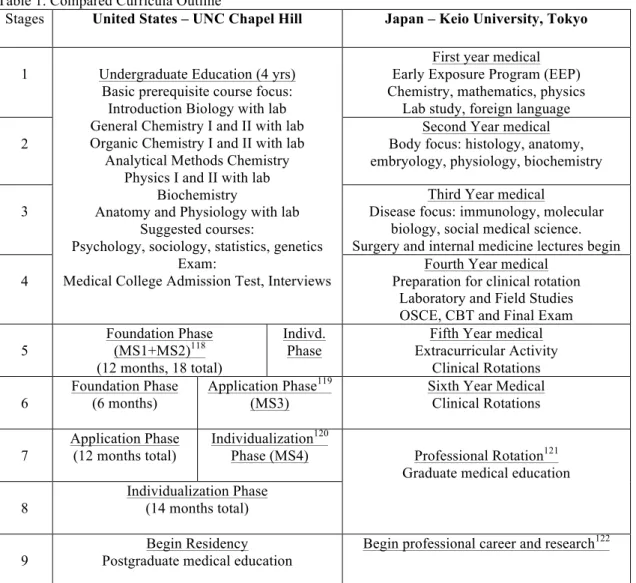
Adopting biomedicine into the twentieth century approach to medical practice came with a price, but introducing professionalism into the physician role came with a price as well. By making physicians train and test for licensure, medical practice was set apart from domestic practices as a profession.57 The Meiji Restoration turned students of modern medicine into new professionals, in a new, modern Japan. The Restoration also opened “elite, public medical schools and affiliate hospitals” for clinical education in biomedicine, and “a few not-for- profit Western medical schools and hospitals, notably Keio University.”58 Therefore, not only was Tokyo University’s medical school setting a precedent in education by 1875, but Keio University’s medical school began to set a standard for medical education since its opening in 1920. Keio University, or Keio Gijuku, was relatively influential in biomedicine in Japan before the establishment of a medical
56 Ikegami, “Allocation,” 120.
57 Medical care was often delivered at home or by local family doctors in private settings in both Japan and
school; Fukuzawa Yukichi had established a disease research institute in prior years. Medical schools took after Keio and Tokyo Universities,59 and various municipalities developed similar medical schools with hospitals, where patient access would be guaranteed. But a seemingly minor side effect presented; in the midst of a rapid rate of modernization and new medical education, efforts for a better version of Japanese medicine through training were counterproductive to raised quality standards in health, compromising individual patient health. This is when symptoms of stress on the
professional system began to present. In fact, it is symptomatic of stress on medical education today.
The United States
Around 1870, hospitals were redefined from being charitable in nature to being prestigiously associated with universities. Harvard University, like Tokyo University, set a precedent in medical education for its nation. Physicians were finally encountering the standards intended for professional practice and licensure would soon follow. By this time the United States was already aware of needed reform of the medical system following the Civil War, but an arguable air of democratic politics clouded the boundaries of patient autonomy within medicine. The American Medical Association attempted but did not achieve licensure in states because “nineteenth century America did not readily provide the political and institutional means to guard entry to professional status.”60 Hence, even when American physicians sought professional recognition at the
59 Especially for Keio, this is still the case today. A later chapter will discuss Keio’s national influence in
end of the colonial era61 a sense of patient autonomy and a decentralized market left physicians without licensure until 1898.62 From this point, however, the medical system still did not necessarily improve. Perhaps, for the patient, it still has not improved.
English Influence and Democratic Influence on Medicine in the US
America’s political situation of colonial democracy severely shaped the form of any emerging medical body. Guilds parented medical practices, but not within the status of a working medical society. Although initial medical influences and practices were grafted from England, the US began to engender all combinations and practices of healing that had no restriction on their practice in the eighteenth century. Unlike Japan, the United States did not reap the benefits of elite physicians migrating into the country.63
Guilds did not have power over the people, and even less so over state
governments. Unregulated practice at this degree made medical practice so common that almost anyone could claim to know a bit of medicine. In some ways, the primary body of medical practice in the United States in the eighteenth century was quackery; nothing about the origins of medical practice in the US was professional.64 Some accounts of the medical situation in the 1800s emphasized the prominence of quackery among trade-like
61 Starr, “Social Transformation,” 30.
62 This is at least a decade after Japan already licensed its physicians to practice in Western medicine;
physicians in Japan practiced Western medicine professionally before physicians in the US.
63 Starr, “Social Transformation,” 39. Starr comments on how English physicians had no reason to visit the
US for either medical training or experience, whereas Japan profited from German physicians, for instance. 64 Quackery was especially a conflict with the dispensing of medicine. Many people claimed to have
practice. In Livesey’s Moral Reformer of September, 1838, the nation is blatantly reprimanded.
Looking at the quack advertisements which fill up the first page of almost every newspaper, I had thought we had no small proportion of quackery in this country. However if we can give credit to the following notice, in this as in many other matters, we are still behind, America. The reason I conceive, why these quacks are not oftener exposed is this; those who will not purchase these “invaluable” and “unrivalled” medicines, think them beneath their notice; those who do purchase, finding that they have been gulled, in order to preserve their own credit in society for having a little common sense, and to prevent being laughed at, remain perfectly mute upon the subject.65
Here the reader should notice something negative about democracy. Not only does this passage reveal the extent to which medicine existed as a common trade, it delivers a less acknowledged, negative perspective of democratic politics in eighteenth century America. That is to say, when uneducated patient autonomy restricted medical practice within the boundaries of domestic affairs, untrained practice only proliferated. The politics of medical practice were as such: metaphorically, by electing for patient autonomy over licensed professionals, patients inadvertently had already elected for decades of stagnant medical advancement and ineffective medical treatment. Medicine was inauthentic, the converse of altruistic, without any way of attaining standards for health. Democracy at these premature stages of medicine created quite the unequal stage for a nation of equal opportunity. Keeping medical transactions between the patient and the physician without a professional body resulted in resentment, no reconciling standard for health care delivery, and quackery extending well into the nineteenth century. The behavior of quacks as superior to the rest of the population was foreshadowing of the status that professional physicians would hold in the decades to follow.
For those who were aware of the prevalence of quackery in America, it was safely assumed with little doubt that “quackery flourish[ed] in America to an extent unknown in other lands.”66 The public played doctor on themselves, thereby targeting common ailments67 that gained attention, sparked revenue, and continued the malpractice.
Licensure of Professionals in the US
In order to separate medical practice apart from other domestic occupations, licensure was needed to make a significant change to the medical system. Stricter degree requirements and prerequisite education was proposed as early as 1825,68 but such earlier efforts were stomped out by the reality of a domestic economy and democratic politics. Hence, the dissolution of reform attempts in the 1830s and 1840s.69 No real reforms had the appropriate habitat in which to thrive since medical institutions were only open because making professionals meant making money.
… in the care of the sick, as in other activities, private choice should prevail- hence their support for the abolition of all medical licensing. They thought people should be able to contract treatment with whomever they wished; the market, in other words, could best regulate itself…. In different ways, professionalism, charity, and government intervention were efforts to modify the action of the market, without abolishing it entirely.70
66 John C. Dent, “Quacks and Quackery in America,” Once a Week 10, no. 246 (September 14, 1872)
235-38.
67In this article from Once a Week, John Dent also criticizes the young America and her citizens indirectly
for her freedom and democracy. “A great variety of causes contribute to make the people of America particularly susceptible to such disorders… the restless, feverish habits of life; the continual, never-ceasing exertions to acquire the almighty dollar; the preference for pastry and unwholesome confections as articles of food; and the stimulating atmosphere which is almost universally prevalent on the other side of the Atlantic, may be mentioned as the principal of these causes… these alone are amply sufficient to account for the actual state of affairs” (235).
68 Martin Kaufman, American Medical Education, The Formative Years, 1765-1910 (Westport, CT :
The creation of the American Medical Association is arguably the moment when licensure was truly sought out in the US, but a nationally adopted method of licensing physicians would not come to fruition until 1898. When medical societies, schools and hospitals came together to found the AMA in 1847, a specific intention was to restrict entry into medical practice. Unlike Japan, the methods of medical practice in the US after the Civil War, as mentioned above, truly were primitive. Lax education standards through apprenticeships propagated unprofessional training and the plans for marriage between the US medical system and the market economy price-tagged ill patients while also shaping them into objectified educational mediums. Professionals in medicine had abandoned the responsibility of observing patient autonomy once licensure was able to override democracy, and consequentially the altruism of the practice. This is
symbolically represented by the change of hospital roles during this time. Hospitals went from charitable institutions to educational ones, and the professionalism of the medical practice became a status symbol of capitalizing care.
Licensing professionals and the shift of medicine towards the market economy meant that physicians began leaving the more rural areas of the country for cities.71 And, much like Japan, the increase in standards for physicians reaped less available resources in the beginning of the twentieth century. By restricting entry to practice, only select physicians made it to the professional level.
71 The divide between available physicians and rural communities is still a real conflict today within
With physicians gaining influence in hospital activity without being employed there, eventually autonomy shifted from the patient level to the state level, and states made licensure legislative practice by 1896.72 By this time, Japan was already requiring the licensure of physicians for over a decade; physicians in Japan were licensed
professionals of Western medicine thirteen years before physicians in the US received these privileges from their state governments.
Early Reforms for Medical Training in the US
In 1914 the AMA published its listing of internships73 which served to enhance the medical training of graduates, a precursor to residency programs that are now
required in US medical education. Part of this was necessary to counteract a sour trend of producing medical physicians through lax enforcement of training standards. A history of the blind leading the blind through apprenticeships meant that at one point, almost
anyone could enter medical school with the correct bill for tuition. Because the medical profession in the US became so closely tied to the market economy and the earning of a livelihood, investments in medical education by professors and other physicians was an economic one. Explicitly stated, the primary concern of physicians for ill patients was fostered by the need to earn a livelihood.74 Regardless then of the initiated reform placed on medical education, the training of future physicians from the 1870s onward, the situation in professional American medicine worsened.
72 Kaufman, “American Medical Education,” 143. In reality, only 23 states total out of 45 states were
requiring physicians to be licensed by the new standard. The significance of stronger government 73 Starr, “Social Transformation,” 124.
74Marc A. Rodwin, “The Rise of a Protected Medical Market, The United States before 1950” in Conflicts
Here, the reader can see how not maintaining professional responsibility had a direct impact on the care that patients received at the end of the medical system that altruistically matters the most. The following section investigates other effects of producing professional physicians in Japan and the US at the beginning of the twentieth century.
How the Influx of Professionals Creates Consequence:
Professionalism and Impatient Facilities
Once the standards of medical training and physician practice increased, medical resources decreased. For instance, as standards increased, hospitals decreased via
consolidation and the number of physicians practicing in Western medicine
professionally was low for a time in both the US and Japan. When prefectural funding of medical institutions ended for Japan in the 1880s, only a few remained funded by the government while the rest went private. These schools became national medical universities later on.75 Therefore, before these two nations experienced an influx of professionals, there was a deficit. As was already discussed, in the case of Japan this was largely influenced by politics, and in the United States by the shifting economy from a domestic stage to a market monopoly. Lacking professional physicians, both nations rebounded by educating new students in vast numbers, where some were more equipped than others.
Education after the medical degree hence became more valuable but
simultaneously scarce for the United States. Training and practice opportunities were few
75 Shizu Sakai, “History of Medical Care at Inpatient Facilities in Japan,” Japan Medical Association