Type II OM as a Cardiovascular Risk Equivalent: A Systematic Review of
the Literature.
By
Anna Miller-Fitzwater Second Appraiser: Adia Bradley
A Master's Paper submitted to the faculty of the University of North Carolina at Chapel Hill
In partial fulfillment of the requirements for the degree of Master of Public Health in
the Public Health Leadership Program.
Chapel Hill
Abstract
Context: The incidence of Type II Diabetes Mellitus (DM) is rapidly expanding in the
United States. Cardiovascular disease (CVD) remains the leading cause of death for
people with DM. Since a systematic review had not be done to assess ifDM is a CVD or
coronary heart disease (CHD) risk equivalent for future CHD events the most recent
guidelines from the National Cholesterol Education Panel, the Adult Treatment Panel III
(ATP-III) were made based on a series of three studies. The ATP-III recommended that
all people with DM be treated as (CHD) risk equivalents.
Objective: To review the literature systematically to answer the question "Is DM a
substantial CHD risk equivalent for hard CVD events?" and to further analyze this
question by answering a series of sub-questions.
Data Sources: We searched MEDLINE including the clinical queries option through
December 17,2007 for English language articles containing the MESH phrases
"Arterioscleorsis" or "Myocardial Ischemia/epidemiology" or "Myocardial
Ischemia/prevention and control" AND "Diabetes Mellitus". We also hand searched
bibliographies of relevant articles and files of experts in the field.
Study Selection: Studies were included if they were in conducted in western populations,
had at least a 5 year follow-up period, measured clinical outcomes of CVD (not
intermediate factors), and answered our primary question or one of our sub-questions of
those with CVD but no DM. Admissible study designs included cohort studies,
systematic reviews, meta-analyses, and controlled trials. Studies were independently
critically appraised by two reviewers with discrepancies adjudicated by a third reviewer.
Studies that were of adequate internal and external validity were included in the results.
Data extraction: Two reviewers independently abstracted the relevant data from the
included studies and entered them into evidence tables. These tables were checked
against each other and combined into a single table.
Data synthesis: There is little data comparing the risk of nonfatal CHD events between
DM and prior CHD/CVD. Mixed effects were noted when answering the question of
whether or not DM is a CHD risk equivalent for future CHD mortality or CVD mortality.
Most studies suggested that prior MI conferred a higher risk for future CVD events than
did DM. When compared to men, DM seemed to confer a higher risk in women for
future CHD than did prior MI. DM also seemed to confer higher risks for CHD mortality
in relation to the risk ofMI as a women aged and in people with a long duration ofDM.
Equivalent risk factors in populations of people with DM compared to those with prior
MI did not seem to change the risk equivalency for future CHD morality when compared
to the overall unstratified analysis. We also found that there is inadequate research to
show how the presence of other markers of CVD in people with DM changes their risk
for future CHD events in relation to those with DM but without CVD or those without
Conclusion: DM is not a universal CHD risk equivalent for future CHD mortality. All
patients with DM should not be treated to the stringent LDL cutoffs used for people with
prior CHD. Those at low risk (young, short duration of diabetes, few other risk factors,
etc.) should be treated based on their absolute risk calculation for future CHD which
Introduction
Diabetes Mellitus (DM) is a established contributor to the population health burden of cardiovascular disease* (CVD). CVD remains the leading cause of death for people with DM with about 65% dying from heart disease or stroke.[!] Current data estimate that 7 percent of the American population, 20.8 million people, have diabetes.[!] The vast majority of Americans with DM, 90-95%, have Type 2 DM.[l]
Due to the high prevalence of Type 2 DM and its association with other cardiovascular risk factors, it is most commonly studied when considering the overall CVD risks ofDM. Type 2 DM is commonly accompanied by the triad of hyperglycemia, insulin resistance, and excess free fatty acids which leads to dyslipidemia.[2, 3] Of interest, the pattern of dyslipidemia seen in Type 2 DM is particularly atherogenic. This "diabetic dyslipidemia" consists of high triglycerides, low HDL, and normal to increased LDL with a high percentage of small dense LDL.[2-4] Thus, Type 2 DM patients have a higher risk of CVD events when compared to a non-diabetic with the same LDL
cholesterol level. [5] Furthermore, it is well researched that patients with Type 2 DM have a worse prognosis following a myocardial infarction (MI) than do persons without DM. [6, 7]
In response to a small series of articles [8-1 0] and the presence of increased morbidity and mortality after MI in patients with Type 2 DM, the National Cholesterol Education Panel (NCEP) of the National Heart, Lung, and Blood Institute updated the Adult Treatment Panel (ATP) guidelines raising DM to the status of a cardiovascular heart disease (CHD) risk equivalent for future CHD events as opposed to classifying it as
a risk factor.[ 4] This reclassification scheme automatically places all patients with DM
into the highest CHD risk category requiring the most aggressive treatment cutoffs (LDL
goal <100, consider drug therapyif~130) irrespective of a given individual's risk factors.
This reclassification has had profound implications on the use of cholesterol lowering
medications.
The most recognized study of the three studies used to frame the NCEP guidelines
was done by Haffner et al. comparing mortality from MI in subjects with type 2 DM
without prior MI and non-diabetics with prior MI.[8] Haffuer and his colleagues found
that the adjusted hazard ratio (adjusted for age, sex, total cholesterol, hypertension, and
smoking) for death from MI for type 2 DM subjects without prior MI was not
significantly different compared to that of non-diabetic subjects with prior MI (HR 1.2
95% CI 0.6-2.4, referent group was non-diabetic subject with prior MI).[8] Although this
is a well conducted study, there are four key worries that question the wisdom of only
using this article to form recommendations. These are: potential residual confounding,
small numbers of outcome events leading to wide confidence intervals, selecting a
population with high rates of mortality due to CHD, and narrowing the outcome to only
mortality from CHD events as opposed to measuring all CHD events.
Excluding Haffuer's original article, the other two studies did not directly address
whether DM is a CHD risk equivalent.[9, 1 0] The second Haffuer article measured
carotid artery intima-media thickness, an intermediate outcome which is less reliable than
directly answering the primary question.[9] ln the third study all of the patients with DM
also had either unstable angina or a non-Q-wave MI.[lO] Given that unstable angina and
this study all qualify as having prior CHD and thus are placed in the highest risk category
irrespective of their DM status.[ 4]
The authors of the ATP III also cite a study of elderly Australians showing that
DM was not a CHD risk equivalent when compared with prior CHD.[4, 11] At the time
A TP recommendations were written, the panel chose to base their recommendations on
the assertion that DM is a CHD risk equivalent due to the paucity of data showing a lack
of equivalence and the strength of Haffi1er's article. However, since the publication of the
A TP III guidelines in 2002 other studies have been published that, like the study
mentioned in the previous paragraph, address whether NIDDM represents a CHD risk
equivalent for future CHD events.
To implement the most appropriate interventions, clinical practice guidelines,
such as the ATP guidelines, should be based on an unbiased systematic review of the
literature. [12, 13] However, to date a systematic review assessing if Type 2 DM is a
CHD risk equivalent for future CHD events has not been done. This paper proposes to
look carefully and systematically at the question of whether DM is a substantial CHD risk
equivalent for hard CHD events (including nonfatal MI and CHD mortality).
This paper will also examine multiple complexities of the primary question that
may lead to different answers. For example, how does the risk comparison change if the
definition of prior CHD is expanded to include other conditions such as angina? In order
words, if we expand the exposure variable to include other measures of CV disease
besides MI, does the answer to whether or not DM is a CHD risk equivalent change?
If we broaden the outcome measure to include all "hard" CVD events (MI, sudden
answer than using the more narrow CHD mortality as our outcome? Does the answer to our primary question differ if we expand the outcome to include other cardiovascular outcomes such as CV A? It was previously noted in data from the United Kingdom Prospective Diabetes Study (UKPDS), that patients with type 2 DM are at higher absolute risk of having a future MI event (14.7-17.4/1000 patient/years) than they are of having a future CVA event (5.0-5.8/1000 patient/years). [14]
Does the presence of established other vascular disease, such as PVD or CV A, in the diabetic cohorts change the outcome of our question? Using data from the
Framingham study, Abbott et al. [15] found that diabetic patients that had peripheral arterial findings (carotid bruits, femoral bruits, or non-palpable pedal pulses) had an increased risk for other major CVD outcomes as compared to those with diabetes only. More recently, Norman et al. [16] used the ankle-brachial index (ABI) measurement to illustrate the concept of using PAD as a marker for atherosclerotic vascular disease in the type 2 diabetic population. In this case the authors found patients having an ABI of <90 and diabetes were at higher risk of cardiac death than those with only diabetes.[16]
Does age of the patient matter? Most elderly people already have some degree of atherosclerosis contributing to a high risk for CHD events, whereas younger people are generally healthy and at low risk for CHD. Therefore, is it possible that in older people DM along with age associated risk causes CHD risk in a person with DM to equal that of a person with prior MI? Whereas, in a younger people the risk for CHD events is so low that those with prior MI only will have very serious disease such that in young people
Does the answer to the primary question differ between genders? Comparing the Women's Health Study [17] to the Physicians Health Study [18] gives us some insight into the fact that the myocardial ischemia behaves differently in men compared to women. While the low-dose alternate day aspirin therapy arm of the PHS had to be terminated early due to aspirins' profound effects on the primary prevention ofMI [18], aspirin had no significant effect on primary prevention of MI in the all female WHS [ 17].
Does the duration or control of a person's DM change the answer to the overall question? For instance, is risk determined by the overall glycemic load, how high the blood glucose has been over how long it has been high.
This primary question and its complexities are important because if we find that Diabetes Mellitus is not an independent CHD risk equivalent then by choosing to selectively, rather than universally, treat patients with DM it will be possible to both reduce harmful side effects experienced from using lipid lowering medications in situations where they provide little effect and to increase the cost effectiveness of using lipid lowering therapy in the population of patients with Type 2 DM.
We will examine whether these questions are answerable with the current
Methods
Focused Question and Inclusion/Exclusion Criteria
To direct our literature search, we developed a primary focused question:
What is the 5-l 0 year risk of CHD events in people with DM who do not have a
history of prior MI compared with the 5-10 year risk of CHD events in people without
DM who have had a prior MI. We defined CHD events as "hard" CHD events including
nonfatal MI, and cardiac death.
We also considered several a priori-stated sub-questions within this overall
question:
I) Does the answer to the primary question differ if the prior MI
definition of exposure is expanded to include other types of CVD (such
as angina, stroke, etc)?
2) Does the answer to the primary question differ if the outcome is
expanded to include hard CVD events (including MI, CV A, symptomatic
PVD, and sudden cardiac/vascular death)?
3) Does the answer to the primary question differ among prior diabetics
who do or do not have symptomatic CVD other than MI (e.g. angina,
TlA, CABG, previous CVA, symptomatic claudication)?
4) Does the answer to the primary question differ among people at high
vs.lower CVD risk (e.g., higher number ofCVD risk factors)?
5) Does the answer to the primary question differ among men vs. women
6) by age
We chose to focus our study on western populations in the age range of30-74.
Given that we want to direct our question to western populations, to avoid heterogeneous
confounding factors between studies, such as cultural influence, that may change CVD
risk between populations and would reduce the internal validity of our review we chose
to limit included studies to only those that were conducted in western populations. We
further chose to limit our review to studies that only included persons between the ages of
30-74 because that is the population that the most common clinically used CHD risk
calculator, the Framingham CHD Risk Calculator, is based on.[l9) We also required that
each study must compare our two groups of interest, those patients with DM without
prior MI and those patients with prior MI and without DM. Given the inability to control
and standardize a cohort study, to obtain the "true" answer to our question the two groups
of interest must be chosen and tested under the same conditions, otherwise the risk for
selection and measurement biases skewing our answer would be too great Also, within a
cohort study (given that the populations cannot be randomized to distribute potential
confounders evenly between the two groups of interest), it is imperative that the studies
used in this review assess CVD risk factors among the two groups of interest using
proper statistical adjustment
We chose to only include hard clinical CHD events as our outcome measure for a
couple of reasons. First, we wanted to directly answer the question we were asking rather
than measure an intermediate outcome, such as angina or coronary artery stenosis, to
eliminate the case-specific heterogeneity in detection, progression, and treatment of
intermediate outcomes and their subsequent influence on our final outcome. Secondly,
easier to measure because they are more clinically apparent making them easier to
measure and harder to overlook. Since CVD is a chronic condition, we wanted to
examine risk over a reasonable time period; thus we chose to limit our search to studies
that had a minimum follow-up period of 5 years.
Regarding study design we were primarily looking for systematic reviews and
cohort studies because they represent the best fit study designs for our question.
However we used a more comprehensive search to assure that we did not miss any
important randomized controlled trials or meta-analyses. We excluded cross sectional
studies given their inability to establish prognosis and thus risk. Due to practical reasons
we were forced to include only studies that were published and written in English. We
also chose to eliminate any studies that had fatal flaws in internal validity given that we
could not be convinced of their conclusions. Furthermore, we required adequate
description of the study to assess external validity so that we were able to maintain a
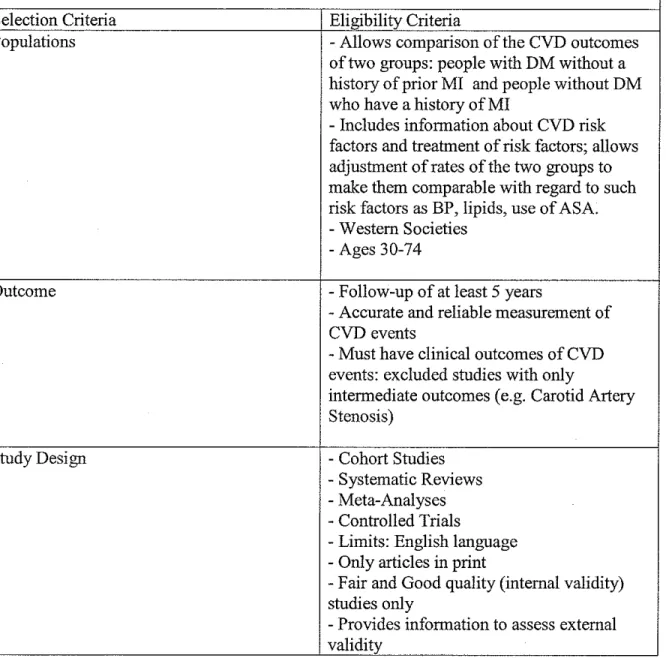
Table 1. Inclusion and Exclusion Criteria for Selecting Admissible Evidence
Primary Focused Question: "What is the 5-10 year risk of CVD events in people with DM who do not have a history of prior MI, compared with the 5-10 year risk of CVD
events in people without DM who have had a prior Ml?"
Selection Criteria Eligibility Criteria
Populations - Allows comparison of the CVD outcomes
of two groups: people with DM without a history of prior MI and people without DM who have a history ofMI
- Includes information about CVD risk factors and treatment of risk factors; allows adjustment of rates of the two groups to make them comparable with regard to such risk factors as BP, lipids, use of A SA. - Western Societies
-Ages 30-74
Outcome - Follow-up of at least 5 years
- Accurate and reliable measurement of CVD events
- Must have clinical outcomes of CVD events: excluded studies with only
intermediate outcomes (e.g. Carotid Artery Stenosis)
Study Design - Cohort Studies
- Systematic Reviews - Meta-Analyses - Controlled Trials
- Limits: English language - Only articles in print
-Fair and Good quality (internal validity) studies only
- Provides information to assess external validity
Search Strategy
We searched MEDLINE, including the clinical queries option which
automatically searches the Cochrane library, for eligible studies (see Table 2). Our
search included all studies published in English up to December 17, 2007. We recovered
to other medical search engines, which may limit our ability to catch all relevant studies
with our search. Thus, we attempted to increase the sensitivity of the search by querying
experts and hand searching bibliographies of pertinent articles. Our initial search strategy
was as sensitive as possible, using the overarching MeSH term of "Myocardial Ischemia".
We found that we could not use the MeSH term "recurrence" to define our population of
people without DM but with prior MI due to the fact that it greatly limited the number of
studies and did not include studies referred to us from experts. Since we were not able to
narrow the search using "recurrence", given the large number of studies published solely
on Myocardial Ischemia we were forced to abbreviate the search term to the two
subcategories, "epidemiology'' and "prevention and control". We determined that these
two subcategories of Myocardial Ischemia were appropriate by consulting librarians and
experts, subsequently confirming that articles referred to us from experts were found
using these terms. It is possible that by using the subcategories we missed important studies, however given the practical constraints of conducting the study we felt that this
was the best case approach. It is important to note that we linked our Myocardial
Ischemia subcategories to Diabetes Mellitus using the term AND. Since we required that
all studies directly compare people with DM but with no MI to those that had MI but no
DM we were able to eliminate many unnecessary articles buy using AND instead of OR.
We were also forced to limit to only published articles that were written in English. Both
of these limits also increase our potential for retrieval bias thus increasing the chance that
we missed important articles. To examine our sub-questions we only modified our search
terms by adding the MeSH term "arteriosclerosis" as all other sub-questions should be
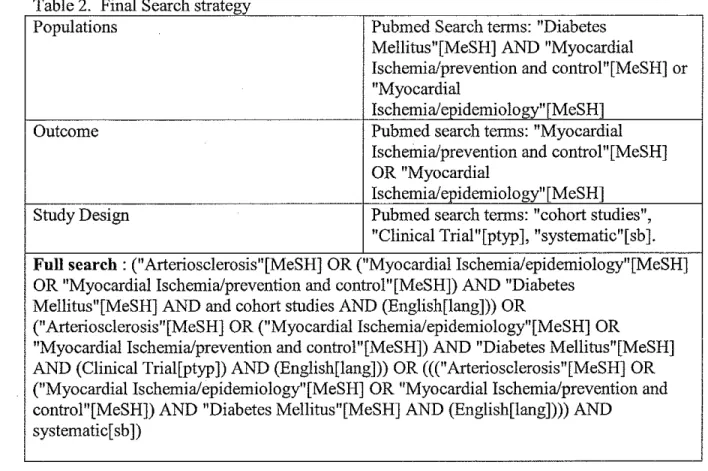
Table 2 Final Search strategy
Populations Pubmed Search terms: "Diabetes
Mellitus"[MeSH] AND "Myocardial
Ischemia/prevention and control"[MeSH] or "Myocardial
Ischemia/epidemiology"[MeSH]
Outcome Pubmed search terms: "Myocardial
Ischemia/prevention and control"[MeSH] OR "Myocardial
Ischemia/epidemiology"[MeSH] Study Design Pubmed search terms: "cohort studies",
"Clinical Trial"[ptyp ], "systematic"[ sb ].
Full search : ("Arteriosclerosis"[MeSH] OR ("Myocardial Ischemia/epidemiology"[MeSH]
OR "Myocardial Ischemia/prevention and control"[MeSH]) AND "Diabetes Mellitus"[MeSH] AND and cohort studies AND (English[lang])) OR
("Arteriosclerosis"[MeSH] OR ("Myocardial Ischemia/epidemio1ogy"[MeSH] OR
"Myocardial Ischemia/prevention and control"[MeSH]) AND "Diabetes Mellitus"[MeSH] AND (Clinical Tria1[ptyp]) AND (English[lang])) OR ((("Arteriosclerosis"[MeSH] OR ("Myocardial Ischemia/epidemiology"[MeSH] OR "Myocardial Ischemia/prevention and control"[MeSH]) AND "Diabetes Mellitus"[MeSH] AND (English[1ang]))) AND
systematic[ sb])
Identifying Pertinent Articles
See Table 3 for a numerical outline of the methods used to identify articles that
were abstracted for data. Once the abstracts from all the articles were obtained (2,081),
the two primary authors divided the abstracts and independently reviewed them, using the
inclusion/exclusion criteria to categorize them as "pertinent", "possibly pertinent", or "not
pertinent". The 1,951 studies classified as "not pertinent" were reviewed by the other
author before discarding them. If the two authors disagreed on discarding an abstract, it
was carried forth for further review pending retrieval of the full text article. Full text
articles of the 130 pertinent and possibly pertinent articles were then compiled in an
Endnote library, read, and re-categorized by the two primary authors into articles that
background or were no longer useful (112). None of 130 pertinent and possibly pertinent
articles were discarded.
Data Abstraction
The two primary authors independently appraised the internal validity of the
studies that met all eligibility requirements and directly addressed the focused question.
We began the data abstraction process by cutting and pasting the MEDLINE abstract into
a table, which we subsequently filled in with all of the required data needed for the
review, see Figure I. We compared the main study question of each article to what was
done in the study and the final conclusion of the study. If the study did not address the a
priori initial question the study was considered to have a fatal flaw and thus excluded
from the review. We then examined each article for the three main types of biases,
selection, measurement, and confounding. We examined each category of bias within the
article for the presence of "fatal flaws", defined as an unforgivable potential for bias in
any of the three categories. If no fatal flaws were found we ranked each category of bias
on a scale from I-III, III being the worst.
We examined the study for selection bias, including who was invited to
participate in the study, ifboth groups were obtained from the same source population,
how many invited participants actually participated in the study and how the groups were
maintained throughout the study, including number of drop-outs/loss to follow-up in each
group. Measurements of both exposure, interventions (if applicable), outcomes, and
potential confounders were considered next. Measurements were assessed to determine if
they were valid (accurate), reliable (reproducible), and applied to all study participants
study groups, the outcome, and were not a causal intermediate in the pathway from the
exposure to the outcome. Proper analysis techniques were examined in the context of the
design of the study, controlling for confounding, and appropriate handing of data when
loss to follow-up or dropout occurred. If the study was a "negative" study, we examined
it to determine the power of the study to detect a difference when a difference is actually
present. If the power of the study was extremely low, as evidenced by a very large
confidence interval, it was considered to have a fatal flaw and excluded from the review.
Studies with moderate sized confidence intervals were included in the review.
The internal validity of these studies was graded based on the scheme developed
by the United States Preventive Services Task Force.[20) A "good" study is considered
to adequately meet all criteria relevant to the study design, a "fair" study is one that does
not meet all criteria but also does not include any fatal flaws, a "poor" study is one that
includes a fatal flaw.[20) A fatal flaw is considered if there is a high probability for any
of the types of biases (selection, measurement, confounding), if the analysis techniques
are not appropriate, or the study otherwise had a serious methodological flaw that would
inhibit the study from correctly answering its question. Ifthere was disagreement
between the two primary authors about grading the internal validity of a study, a third
investigator reviewed the study and the disagreement was decided by discussion among
all three investigators.
If an article was found that addressed the question but was, by consensus of all
three investigators, of poor quality, it was excluded from the review. All studies that met
eligibility criteria and were of good or fair internal validity and had adequate information
Figure 1: Critical Appraisal Criteria
Table 3 Flow Chart of Articles Identified to arrive at those included
Number of Articles
Abstracts Identified 2081
Pertinent/Possibly pertinent 130
No 1951
Full text reviewed 130
Pertinent 18
Not pertinent to primary question (many were 112 backgronnd articles)
Articles on sub-guestion#2 found from other sources
Citation Review (later excluded due to broad outcomes) I [21]
Articles on nrimary guestion found from other sources
Expert Files I [22]
Total articles addressing 12rimar.y guestion 19
Excluded for short follow-up 1[23]
Excluded not direct comparison I [24]
Papers with poor quality 4 [II, 22, 25, 26]
Not used for primary question: broad CHD exposure 3[27-29]
Final Number 10
Funding
This review was not funded by an outside funding agency nor do any of the
Results
In Appendix A we included detailed summary tables for all studies that addressed
our primary question. Those tables include abstracted data on the following topics:
- Internal validity and external validity grading
- Population selection method and demographics
- Follow-up length
- Measurements
- Statistical analysis and adjustments used
- Power estimate of the study, if applicable
- Summary of results by outcome (CHD events, CHD mortality, CVD events,
CVD, mortality, and Overall mortality).
For studies that addressed our primary question but were considered to be of poor
quality, the above data (with the exception of results, power, and external validity) along
with the reasons for the study being considered poor and thus not used to draw formal
conclusions, can also be found in Appendix A.
Our results are structured to parallel our original question and its division into
sub-questions. Overall results applicable to the question of whether or not DM is a
cardiovascular risk equivalent for future CHD events will be presented first, followed by
results divided by the sub-questions: 1) Exposure expanded to include other types of
CVD. 2) Outcome expanded to include hard CVD events 3) Diabetics who do versus
those who do not have symptomatic CVD other than MI 4) High versus lower CVD risk
Summary data from studies meeting inclusion criteria addressing either our main
question or a sub-question can be found within the body of the results section of the paper.
Of note, studies may be included more than one table if they address both our main
question and one or more sub-questions.
Primary Question: Do patients with prior DM only have the same risk for future
hard CHD events as those with prior MI only?
We identified ten studies that both answered this question and met our inclusion
criteria [8, 30-38). All of the studies received a final internal validity rating of"Fair" and
external validity rating of "Fair" or "Good" for the populations that they studied. Given
that no studies were ranked overall as "Good", a single analysis of all studies addressing
the question will be done as opposed to a stepwise analysis separating the Good from the
Fair studies. Outcome data regarding CHD events vs. CHD mortality will be broken
down into two separate groups of tables to allow for easier interpretation. One study, Lee
et a!. 2004 [3 8], did not separate these outcomes and thus will be presented as a combined
outcome measure. Results and outcomes measure from these studies can be found in
Tables 4-6. Also if a study reported a relative risk or hazard ratio comparing MI in
reference to DM, the inverse was also given in the results column of the table to show the
relative risk ofDM in reference to MI in order to allow for easier comparison between
studies.
Studies that report effects when the outcome is defmed as CHD events
Only one study, conducted in men by Wannamethee eta!. 2004 [30], reported
with prior MI (Table 4). Of note, this study calculated the risk of CHD/CVD events and
CHD/CVD mortality in men with DM, prior MI, and angina pectoris, therefore results
from this study will also be discussed in sub-questions 1 and 2. They defined CHD
events as non-fatal MI as outlined by the second edition of the WHO criteria [30). They
found that the risk for future non-fatal MI is lower in men with only DM as compared to
those with only prior MI, RR MI vs. DM = 1.59 (1.09-2.31 ).
Table 4. Risk for future CHD events comparing patients with prior DM only to those with prior MI only
The risk for future CHD events is higher in people with DM only as compared to those with only prior MI.
Study (population) Risk measurement [inverse) Definition of outcome
No studies Not applicable Not applicable
The risk for future CHD events is equivalent in people with DM only as compared to those with only prior MI.
Study (population) Risk measurement [inverse] Definition of outcome
No studies Not applicable Not applicable
The risk for future CHD events is lower in people with DM only as compared to those with only prior MI.
Study (population) Risk measurement [inverse] Definition of outcome
Wannamethee 2004 (men)[30] MI vs. DM: RR- 1.59 (1.09- Nonfatal MI as defmed by WHO 2.31) [0.63 (0.43-0.92)] criteria
Studies that report effects when the outcome is defmed as CHD events and CHD
mortality
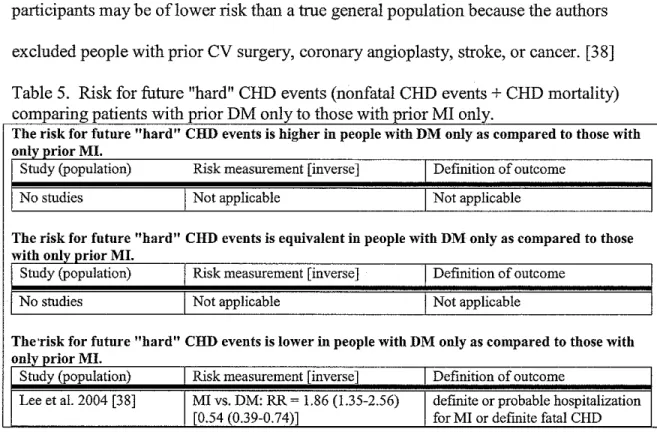
Lee eta!. 2004 [38], in a nine year population based follow-up study of men and
women, found that when a combination of CHD events and CHD mortality is considered
the outcome, people with only prior MI had a higher risk of future adverse outcomes than
did people with prior DM only, RR = 1.86 (1.35-2.56). They defined CHD events as
participants and a search of local hospital discharge records. [3 8] Of note, these
participants may be of lower risk than a true general population because the authors
excluded people with prior CV surgery, coronary angioplasty, stroke, or cancer. [38]
Table 5. Risk for future "hard" CHD events (nonfatal CHD events+ CHD mortality) t t "th DM I t th "th MI I
companng pa ten s WI pnor on yo osew1 tpnor on y.
The risk for future "hard" CHD events is higher in people with DM only as compared to those with only prior MI.
S!udy (population) Risk measurement [inverse] Definition of outcome
No s!udies Not applicable Not applicable
The risk for future "hard" CHD events is equivalent in people with DM only as compared to those with only prior MI.
S!udy (population) Risk measurement [inverse] Definition of outcome
No sluclies Not applicable Not applicable
The·risk for future "hard" CHD events is lower in people with DM only as compared to those with only prior MI.
S!udy (population) Risk measurement [inverse] Definition of outcome
Lee eta!. 2004 [38] MI vs. DM: RR ~ 1.86 (1.35-2.56) definite or probable hospitalization [0.54 (0.39-0.74)] for MI or defmite fatal CHD
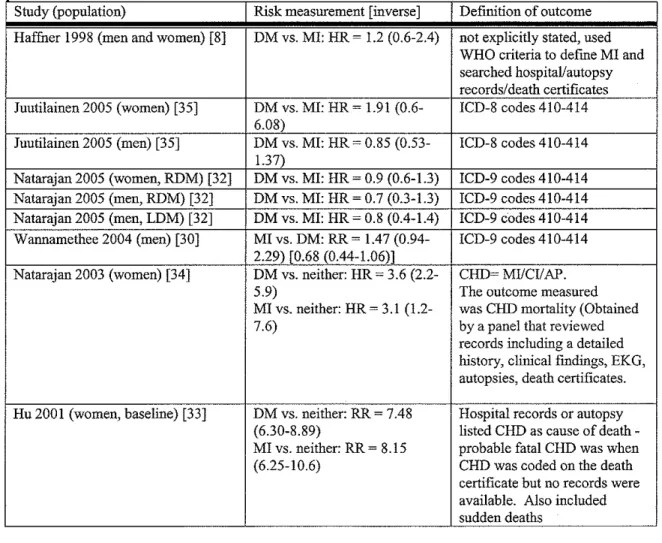
Studies that report effects when the outcome is defined as CHD morality
There were many more studies that used CHD mortality instead of CHD events as
their final outcome, likely due to the ease and accuracy of measuring death as compared
to measuring an event. Their results are summarized in Table 6. Many studies are
represented more than once within the table because they reported outcomes by dividing
their overall population into two or more groups based on demographic characteristics.
Given that the results of the different studies were quite heterogeneous a meta-analysis of
the outcomes is not appropriate. A narrative analysis will be presented instead.
In two studies, [31, 32], the authors found patients with DM to be at higher risk for future CHD mortality than those with only prior MI in one of their subpopulations.
that in at least one of their population subdivisions prior DM is a risk equivalent to prior
MI when considering CHD death as the outcome. [30, 32-35] Five studies [31, 33, 34,
36, 37] totaling eight subgroups found that participants with DM had a lower risk of CHD
death than did those with prior MI.
Hu 2005 [31] in their Finnish population study found that women with MI at
baseline had a HR of 0.57 (0.39-0.82) when comparing them to women with DM at
baseline over a mean follow-up period of 12 years. However, they did not obtain the
same results when they compared participants with either baseline or incident MI in
reference to their other three equivalent subpopulations, women with incident DM (HR =
1.65 (1.27-2.14)), men with baseline DM (HR = 1.78 (1.39-2.27)), and men with incident
DM (HR = 2.15 (1.7-2.73), all of which they found to be oflower risk than participants
with MI. [31] Of note, the authors mentioned that type 1 DM patients were excluded
from the analysis but they did not mention by what grounds they excluded them. [31]
A long term follow-up study (17-21 years) by Natarajan et al2005 [32] using the
NHANES I cohort data did not differentiate between types of diabetes. It also divided it's
participants into categories depending on length ofDM, recent diabetes (RDM) was
considered <1 0 years and long term diabetes (LDM) > 10 years. They, like Hu et al.
2005 [31], also noted that women that had LDM at baseline were at increased risk when
compared to women with prior MI for CHD mortality, HR = 1.8 (1.1-3.2). [32] Unlike
the women with long term diabetes, they found that women with a recent diagnosis of
diabetes had an equivalent risk of CHD mortality compared to that of a woman with prior
DM and those with a long term diagnosis ofDM had similar risks to patients with prior
MI, HR 0.7 (0.3-1.3) and 0.8 (0.4-1.4), respectively. [32]
As mentioned earlier, Haffner et al. 1998 [8] reported a HR of 1.2 (0.6-2.4) over
an 8 year follow-up period when comparing people with prior MI to people with DM
only. This HR represents an overall HR for the entire population of the study (including
both men and women) due to the fact that Haffner did not divide the population into
sub-groups for analysis. However, Haffner [8] did an excellent job of excluding type 1 DM
by measuring C-peptide levels, excluding patients diagnosed before age 30, and noting
that none of the DM patients had a history of ketoacidosis.
Juutilainen et al. 2005 [35], is the follow-up study to the original Haffner study
[8]. The major improvements this study made over the older Haffner study [8] is that
they continued to follow the original participants until a mean follow-up of 18 years, the
results were reported by gender, and both the exposure and outcomes included separate
results for other CVD. Despite the longer follow-up and the stratification of results they
came to similar conclusions as the original Haffner study [8] with a HR for men with DM
only compared to men with MI only of 0.85 (0.53-1.37) and an equivalent HR for women
of 1.91 (0.6-6.08). [35] Although the risk comparison between MI and DM was
statistically equivalent for women, it seems that it is likely that DM actually confers a
higher risk for CHD mortality given the skewed CI and the robust HR.[35]
Wannamethee et al. 2004 [30], using 10 year data on men from the British
regional heart study, found that men with type 2 DM had equal risk to that of men with
is in contrast to their finding, as mentioned above, within the same study that men with
DM have a lower risk of CHD events than do their companions with only prior MI.
Natarajan et al. 2003 followed men and women for 20 years that were members of
the original Framingham Heart Study or members of the Framingham Offspring Study.
[34) The authors found differing results on risk equivalency based on gender. Women
with DM had similar risk for future CHD mortality than did women with prior MI, the
HR for DM in reference to participants with neither condition is 3.6 (2.2-5.9) and the HR
for prior MI compared to neither condition is 3.1 (1.2-7.6). Whereas men with DM had a
lower risk for CHD mortality than did men with prior MI (HR for DM vs. neither= 1.7
(1.2-2.5) and for prior MI vs. neither= 5.0 (3.6-6.9). [34) Note that this study is
somewhat weak in that it uses two different populations (the different Framinghams) and
two different CBG cutoffs for the definition of diabetes based on the population. Also, it
did not mention the exact cutoff for diabetes in the Original Framingham Study, only that
probable diabetes was two casual CBGs > 150 mg/dL or the use of hypoglycemic
medicines. If this is the definition that was used then this is a very broad measure and
will likely capture many "diabetics" that are at very low risk and may not even qualify for
a true diagnosis of diabetes.
Hu et al. 2001 [33) used 20 years of data over the years 1976-1996 from the
Nurses Health Study (all women). They attempted to exclude type 1 diabetes by limiting
their definition of diabetes to those diagnosed after age 30. They also stratified their
outcomes by duration of disease, however they chose to separate the participants by
doing one analysis with only baseline disease and then doing another analysis of baseline
risk for CHD mortality as women with only prior MI by comparing the RRs of the two
groups with reference to the group of women that had neither condition. The RR for
women with DM was 7.48 (6.3-8.89), while the RR for women with MI was 8.15
(6.25-10.6). [33] When assessing women with baseline disease in combination with incident
disease, the risk of CHD death becomes lower for women with baseline or incident DM
as it does for women with prior or incident MI (HR 5.65 (4.83-6.60) and 10.7 (9.03-12.6),
respectively). [33]
Cho et aL 2002 [36] is structured similarly to the Hu et aL 2001 study [33] with
the major differences being that the Cho population consisted of males enrolled in the
Health Professionals Follow-up study and the follow-up time was only over a period of
10 years (between 1986 and 1996). Cho et aL [36]also attempted to exclude type I
diabetes by excluding participants that self-reported to be type 1 and those that were
diagnosed under the age of 30. In both subpopulations, men with baseline disease and
men with baseline + incident disease, the risk for future CHD mortality was higher in
men with MI only. In both cases when determining the HRs the exposed group was
compared to the group that had neither condition, then the HRs for the exposed groups
were compared to each other. For the men with baseline DM only the HR was 3.84
(3.12-4.71) and the HR for men with prior MI only was 7.88 (6.86-9.05). [36] In this
case the men with baseline+ incident DM had a HR of3.37 (2.72-4.17) as compared to
the men with baseline MI, 8.39 (7.29-9.65). [36]
Vaccaro et aL 2004 [37] followed men over a mean duration of25 years that were
excluded from the MRFIT trial due to prior CHD or DM. They did not attempt to
risk for CHD mortality than was prior MI, HR of prior MI in reference to prior DM was
1.37 (1.26-1.48). [37] Of note, their definition ofDM did not include less severe diabetic
patients due to the fact that they only included people that self-reported use of medication
for diabetes. [37] However, it did include people with type I DM which may also bias
the results, likely toward DM being a lesser risk factor than prior MI but not positively.
Table 6. Risk for future CHD mortality comparing patients with prior DM only to those 'th MI I
WI 1pnor on y.
The risk for future CHD deaths is higher in people with DM only as compared to those with only prior MI.
Study (population) Risk measureinent [inverse] Definition of outcome
Hu 2005 (women, baseline) [31] MI vs. DM: HR- 0.57 (0.39- ICD-9 codes 410-414 and 120-0.82) [1.75 (1.22-2.56)] 25
Natarajan 2005 (women, LDM) [32] DM vs. MI: HR- 1.8 (1.1-3.2) ICD-9 codes 410-414
The risk for future CHD deaths is equivalent in people with DM only as compared to those with only prior MI.
Study (population) Risk measurement [inverse] Definition of outcome
Haffner 1998 (men and women) [8] DM vs. MI: HR-1.2 (0.6-2.4) not explicitly stated, used WHO criteria to define Ml and searched hospital/autopsy
records/death certificates
Juutilainen 2005 (women) [35] DM vs. MI: HR ~ 1.91 (0.6- ICD-8 codes 410-414 6.08)
Juutilainen 2005 (men) [35) DM vs. MI: HR- 0.85 (0.53- ICD-8 codes 410-414 1.37)
Natarajan 2005 (women, RDM) [32] DM vs. MI: HR- 0.9 (0.6-1.3) ICD-9 codes 410-414 Natarajan 2005 (men, RDM) [32) DM vs. MI: HR ~ 0. 7 (0.3-1.3) ICD-9 codes 410-414 Natarajan 2005 (men, LDM) [32) DM vs. MI: HR ~ 0.8 (0.4-1.4) ICD-9 codes 410-414 Wannamethee 2004 (men) [30] MI vs. DM: RR- 1.47 (0.94- ICD-9 codes 410-414
2.29) [0.68 (0.44-1.06)]
Natarajan 2003 (women) [34) DM vs. neither: HR ~ 3.6 (2.2- CHD~ MI/CI/AP.
5.9) The outcome measured
MI vs. neither: HR~ 3.1 (1.2- was CHD mortality (Obtained
7.6) by a panel that reviewed
records including a detailed history, clinical fmdings, EKG, autopsies, death certificates.
Hu 2001 (women, baseline) [33] DM vs. neither: RR- 7.48 Hospital records or autopsy
(6.30-8.89) listed CHD as cause of
death-MI vs. neither: RR~ 8.15 probable fatal CHD was when
(6.25-10.6) CHD was coded on the death
certificate but no records were
The risk for future CHD death is lower in people with DM only as compared to those with only prior MI.
Study (population) Risk measurement [inverse] Definition of outcome
Hu 2005 (women, incident) [31] MI vs. DM: HR ~ 1.65 (1.27- ICD-9 codes 410-414 and I20-2.14) f0.61 (0.47-0.79)] 25
Hu 2005 (men, baseline)[31] MI vs. DM: HR- 1.78 (1.39- ICD-9 codes 410-414 and I20-2.27) [0.56 (0.44-0.72)] 25
Hu 2005 (men, incident)[31] MI vs. DM: HR ~ 2.15 (1.7- ICD-9 codes 410-414 and I20-2.73) [0.46 (0.37-0.59)] 25
Natarajan 2003 (men) DM vs. neither: HR- 1.7 (1.2- C~MIICI/AP.
2.5) The outcome measured
MI vs. neither: HR ~ 5.0 (3.6- was CHD mortality (Obtained
6.9) by a panel that reviewed
records including a detailed history, clinical findings, EKG, autopsies, death certificates.
Hu 2001 (women, baseline + DM vs. neither: RR- 5.65 Hospital records or autopsy
incident) [33] (4.83-6.60) listed CHD as cause of death
-MI vs. neither: RR ~ 10.7 probable fatal CHD was when (9.03-12.6) CHD was coded on the death
certificate but no records were available. Also included sudden deaths
Cho 2002 (men, baseline DM) [36] DM vs. neither: HR ~ 3.84 ICD-9 codes 410-414 (3.12-4.71)
MI vs. neither: HR ~ 7.88 (6.86-9.05)
Cho 2002 (men, baseline+ incident) DM vs. neither: HR- 3.37 ICD-9 codes 410-414
[36] (2.72-4.17)
MI vs. neither: HR ~ 8.39 (7.29-9.65)
Vaccaro 2004 (men) [37] MI vs. DM: HR- 1.37 (1.26- ICD-9-NACM codes 410-414, 1.48) [0.73 (0.68-0.79)] 429.2
Summary. Only one study [30] rated as fair addressed the risk comparison for future
CHD events, finding that the risk for future CHD events is lower in people with DM
compared to those with only prior MI (MI vs. DM RR = 1.59 (1.09-2.31 ). Thus, no
concrete conclusions can be drawn regarding the comparative risk for future CHD events.
Furthermore, the existing literature reflects differing outcomes to the question of whether
all people with prior DM are at equivalent risk for future CHD mortality as are those with
prior MI only. These studies were all rated as fair. Recurring themes contributing to fair
measurement of disease exposures and confounding variables, and mediocre adjustment
for confounding variables.
Sub-question #1: Do patients with prior DM only have the same risk for future hard
CHD events as those with other combinations of prior CVD (expanded exposure
group)?
Three studies not addressed above in the primary question [27-29] and three
studies that addressed the primary question [30, 34, 35] reported outcome data comparing
the risk of future hard CHD events in participants with prior DM only to those with a
broader definition of prior CVD. The results for CHD mortality will be discussed in the
context of the other studies. One of the new studies in this group, Eberly et a!. 2003 [28]
received a rating of good for it's internal validity, while the others received a "fair" rating.
These additional studies all had external validities that were fair-good. The results of
these studies are summarized in tables 7 and 8, along with the definition of prior CVD to
allow for appropriate analysis and the inverse of the RRIHR if the study reported in
results as prior CVD in reference to DM.
Studies that report effects when the outcome is def"rned as CHD events
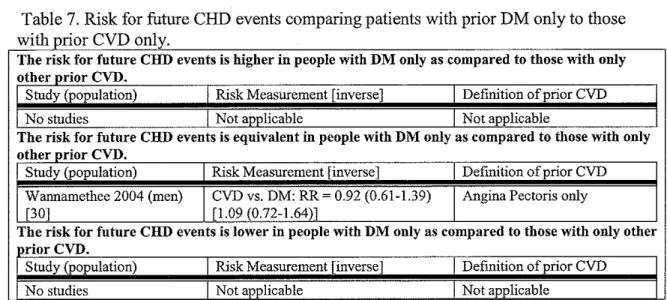
All of the studies with the exception ofWannamethee 2004 [30], who reported
data on both CHD events and mortality, reported CHD mortality as the outcome. Using
CHD events as the outcome, W annamethee et a!. calculated a RR of 0.92 (0.61-1.39)
when comparing participants with angina pectoris in reference to participants with DM.
compared to prior MI, they found that when comparing people with DM to people with
angina pectoris they are risk equivalents for future nonfatal MI.
Table 7. Risk for future CHD events comparing patients with prior DM only to those with prior CVD only
The risk for future CHD events is higher in people with DM only as compared to those with only other prior CVD.
Study (population) Risk Measurement [inverse] Definition of prior CVD
No studies Not applicable Not applicable
The risk for future CHD events is equivalent in people with DM only as compared to those with only other prior CVD.
Study (population) Risk Measurement [inverse] Definition of prior CVD
Wannamethee 2004 (men) CVD vs. DM: RR~ 0.92 (0.61-1.39) Angina Pectoris only
[30] [1.09 (0.72-1.64)]
The risk for future CHD events is lower in people with DM only as compared to those with only other priorCVD.
Study (population) Risk Measurement [inverse] Definition of prior CVD
No studies Not applicable Not applicable
Studies that report effects when the outcome is defmed as CHD mortality
Whiteley et a!. 2005 [27] is one of the three studies that did not address our
primary question but instead used a broader definition than only prior MI for the CVD
exposure group. They compared the relative risk of CHD mortality of participants with
prior DM only to that of participants with a history of a positive Rose questionnaire,
severe chest pain lasting greater than 30 minutes, or EKG changes suggestive ofMI.[27]
Their study was conducted in men and women ages 45-64 in two towns in Scotland.[27]
They did not attempt to exclude type I DM but mentioned that it is highly likely that
most had type 2 DM.[27] They found that women with DM were at a higher risk for
future CHD mortality than are women with CHD, relative risk for people with DM vs.
CHD = !.97 (!.27-3.08).[27] However for men they found that DM conveyed a similar
risk for CHD mortality as does prior CHD, relative risk for people with DM vs. CHD =
Eberly et a!. 2003 [28] is another one of the three studies that used an expanded
definition of prior CVD to determine CHD mortality risk. In this case they defined CVD
as reporting a history of coronary bypass surgery, a history of non-fatal stroke, a history
of non-fatal MI, or a history of silent MI by EKG before the last annual visit of the cohort
study.[28] Of note, all of these men would have been excluded at the beginning of the
RCT, thus all of the participants in the cohort study have a relatively short duration of
disease.[28] This holds true for the population with DM as well.[28] They did not
attempt to exclude participants with type 1 DM, however given that all of the cases were
diagnosed in adulthood it is likely that the vast majority of the participants with DM have
type 2 DM. Eberly et al. [28] conducted their analysis on a post-randomized controlled
trial (RCT) cohort from the years 1982-1999. The cohort that they used was the MRFIT
cohort, a group of men at increased risk for CHD aged 35-57 at baseline that were
selected to participate in a RCT addressing the primary prevention of CHD mortality.
Note, all of the men enrolled in the study were willing to make major life changes in
order to improve their cardiovascular health (such as quit smoking, diet, and go to annual
medical visits). [28] This limits the external validity of the study to fair when compared
to the average American patient. Overall, they found that men with DM have a lower
risk for CHD mortality as compared to men with prior CVD, hazard ratio for men with
non-fatal CVD in reference to men with DM = 1.88 (1.51-2.34).[28]
The last study to use an expanded exposure group for the CVD group is Lotufo et
al. 2001.[29] Lotufo et al. 2001 [29] defined prior CHD as self-report of history ofMI or
angina pectoris. They studied the U.S. Physician's Health Study cohort which only
DM but mentioned that given the age distribution of the population that it was likely that
the majority had type 2 DM.[29] All men with a history of cancer, stroke, liver disease or
renal disease were excluded, which somewhat limits the external validity of this study,
thus it was also only given a fair. They found that the risk of CHD mortality was lower
in the people with DM (RR compared to those without DM or CHD = 2.9 (2.3-3.7) when
compared to those with prior MIIAP (RR compared to those without DMIMI = 5.4
(4.7-6.2).[29]
Juutilainen et a!. 2005 [35], in addition to examining the relative risk of CHD
mortality of having DM compared to having MI, did further analysis based on different
definitions of CHD. They defined CHD in three other ways besides only hospital
verified MI: 1) angina pectoris only (Rose criteria) 2) EKG changes only and 3) MI, AP,
or EKG changes.[35] As a reminder, they found that both men and women with diabetes
were are equivalent risk for CHD mortality in reference to men and women with prior MI
only (DM vs. MI: HR for men= 0.85 (0.53-1.37), HR for women= 1.91 (0.6-6.08).[35]
When comparing the risk for CHD mortality in men with DM to men with expanded
CHD exposure definitions Juutilainen et a!. [3 5] found that when compared to men with
either EKG changes only or to the group of men with MI,AP, or EKG changes, men with
DM have a mildly higher risk for future CHD mortality (HR DM vs. EKG changes=
1.54(1.02-2.33), HR DM vs. MIIAP/EKG changes= 1.50(1.01-2.22).[35] They found a
slightly different answer when comparing men with DM to men with prior AP only found
that they have an equivalent risk of CHD mortality (HR DM vs. AP only=
1.45(0.9-2.34).[35] For all categories of CHD exposure (except prior MI only), they found that
CHD.[35] The hazard ratios are as follows: 1) DM vs. AP only= 4.86(2.08-11.33) 2)
DM vs. EKG changes only= 4.27(2.08-8.79) and 3) DM vs. MIIAP/EKG changes=
3.52(1.83-6.79).[35]
Wannamethee et al2004 [30] found that when changing their definition ofCHD
from prior MI only prior angina pectoris men with diabetes continued to be at equivalent
risk for CHD mortality as those with CHD, HR AP onlyvs. DM = 0.79 (0.48-1.30).[30]
However, the risk ofDM for CHD mortality was somewhat stronger in reference to AP
when compared to the risk ofDM for CHD mortality in reference to prior MI, HR MI vs.
DM = 1.47(0.94-2.29).
Natarajan eta!. 2003 [34] also examined the risk for CHD mortality in women
with DM compared to that of women with angina pectoris/coronary insufficiency
(AP/CI). As a reminder, they found that women with DM were at an equivalent risk for
CHD mortality as were those with prior MI only (HR DM vs. neither= 3.6(2.2-5.9), HR
MI vs. neither= 3.1 (1.2-7 .6)).[34] When comparing the risk of CHD mortality in women
with DM to women with AP/CI they also found risk equivalence, albeit just barely (HR
AP/CI vs. neither= 1.5(0.9-2.7), HR DM vs. neither= 3.6(2.2-5.9)).[34] Looking at the
95% confidence intervals of the above HRs it is likely that DM actually imparts a higher
risk for CHD mortality than does AP /CL
Table 8. Risk for future CHD mortality comparing patients with prior DM only to those with prior CVD only
The risk for future CHD deaths is higher in people with DM only as compared to those with only other prior CVD.
Study (population) Risk Measurement [inverse] Definition of prior CVD
Whiteley 2005 (women) [27] DM vs. CVD: HR ~ 1.97 Positive Rose questionnaire,
(1.27-3.08) severe chest pain> 30 min, EKG changes
Juutilainen 2005 (men) [35] DM vs. CVD: HR-!.54 EKG changes (1.02-2.33)
Juutilainen 2005 (women) [35] DM vs. CVD: HR- 4.86 AP (2.08-11.33)
Juutilainen 2005 (women) [35] DMvs. CVD: HR-4.27 EKG changes (2.08- 8.79)
Juutilainen 2005 (women) [35] DM vs. CVD: HR ~ 3.52 MI, AP, or EKG changes (1.83-6.79)
The risk for future CHD deaths is equivalent in people with DM only as compared to those with only other prior CVD.
Study (population) Risk Measurement [inverse] Definition of prior CVD
Whiteley 2005 (men) [27] DM vs. CVD: HR- 1.17 (0.78- Positive Rose questionnaire,
1.74) severe chest pain >30 min, EKG
changes Juutilainen 2005 (men) [35] DM vs. CVD: HR ~ 1.45 (0.9- AP
2.34)
Wanoamethee 2004 (men) [30] CVDvs. DM: RR- 0.79 (0.48- Angina ouly 1.30) [1.27 (0.77-2.08)]
Natarajan 2003 (women) [34] DM vs. neither: HR- 3.6 (2.2- Angina pectoris
5.9) Coronary Insufficiency
CVD vs. neither: HR ~ 1.5 (0.9-2.7)
The risk for future CHD deaths is lower In people with DM only as compared to those with only other prior CVD.
Study (population) Risk Measurement [inverse] Definition of prior CVD
Eberly 2003 (men) [28] Nonfatal-CVD vs. DM: HR- 1.88 Coronary Bypass surgery (1.51-2.34) [0.53 (0.43-0.66)] Non fatal stroke
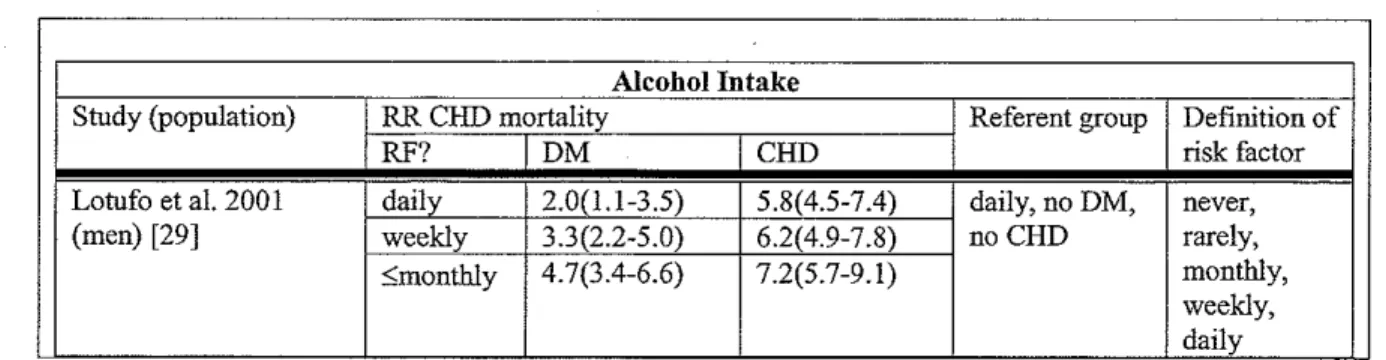
NonfatalMI silent Ml Lotufo 200 I (men) [29] DM vs. neither: RR- 2.9 (2.3-3.7) MI
CVD vs. neither: RR~ 5.4 (4.7-6.2) Angina
Summary. Not surprisingly, when expanding the CHD exposure group to include less
severe cardiovascular diseases than MI (such asAP, EKG changes, CI, severe chest pain
>30 min, positive Rose questionnaire) the hazard ratios for CHD mortality comparing
people with DM to people with CVD lean toward assigning more risk to DM than prior
CVD.[27, 30, 34, 35] This was true even when a statistically significant change in risk
equivalency compared to a more narrow definition of CHD, only MI, was not seen.[30,
34] Also Eberly et al. 2003 [28] expanded their definition to include other severe
markers of CVD (coronary bypass surgery, nonfatal stroke, nonfatal MI, and silent MI on
compared to having prior CVD. Lotufo et aL 2001 [29] is unique in that they included
AP in their definition of prior CHD yet still found a lower relative risk for CHD mortality
in people with DM than people with prior CHD.[29] Unfortunately, they did not do an
analysis looking only at prior MI as the definition of CHD for comparison. Given what
we have just learned, it is likely that the relative risk for CHD mortality in participants
with DM would be even lower when compared to participants with prior MI only.
Sub-question #2: Do patients with prior DM only have the same risk for future hard
CVD events as those with prior Mlonly (expanded outcome measure)?
Using data from the studies that addressed our primary question and data from
other studies that we identified through our literature search we will attempt to draw
some conclusions about this sub-question. Note however, that we did not do a separate
full systematic review on this topic and that it is likely that our search terms missed some
studies that would be pertinent to this topic. Results can be found in Tables 9 and 10,
along with a definition of the outcome measured and the inverse of the risk measurement
if it was calculated in the study as MI in reference to DM.
Studies that report effects when the outcomes is def"med as CVD events
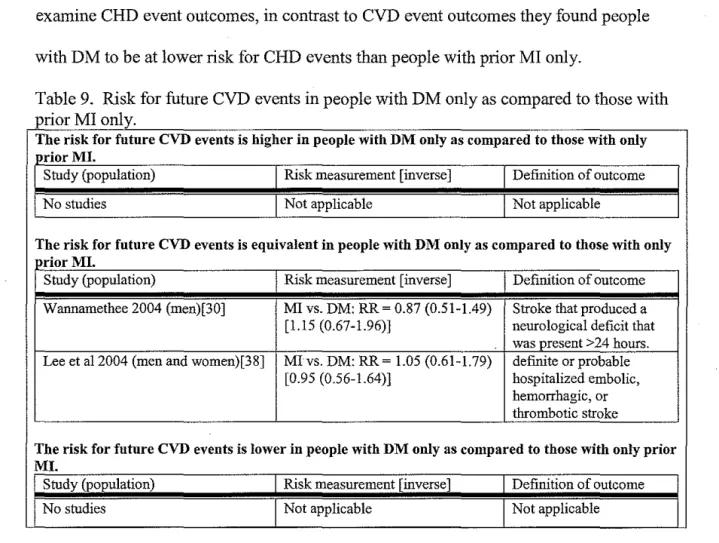
Two studies [30, 38] examined the risk for future CVD events in people with DM
only compared to people with CHD only, see Table 9. Both of these studies found that
having DM leads to an equivalent risk for future CVD events as does having prior MI
only. Wannarnethee et aL [30] and Lee et aL [38] both defined CVD events as "major
stroke events" including fatal and nonfatal outcomes. Lee et aL did not make this
examine CHD event outcomes, in contrast to CVD event outcomes they found people with DM to be at lower risk for CHD events than people with prior MI only.
Table 9. Risk for future CVD events in people with DM only as compared to those with prior MI only
The risk for future CVD events is higher in people with DM only as compared to those with only J>.rior MI.
Study (population) Risk measurement [inverse] Definition of outcome
No studies Not applicable Not applicable
The risk for future CVD events is equivalent in people with DM only as compared to those with only prior MI.
Study (population) Risk measurement [inverse] Definition of outcome
Wannamethee 2004 (men)[30] MI vs. DM: RR~ 0.87 (0.51-1.49) Stroke that produced a [1.15 (0.67-1.96)] neurological deficit that
was present >24 hours. Lee et al2004 (men and women)[38] Mlvs. DM: RR-1.05 (0.61-1.79) defutite or probable
[0.95 (0.56-1.64)] hospitalized embolic, hemorrhagic, or thrombotic stroke
The risk for future CVD events is lower in people with DM only as compared to those with only prior MI.
Study (population) Risk measurement [inverse] Definition of outcome
No studies Not applicable Not applicable
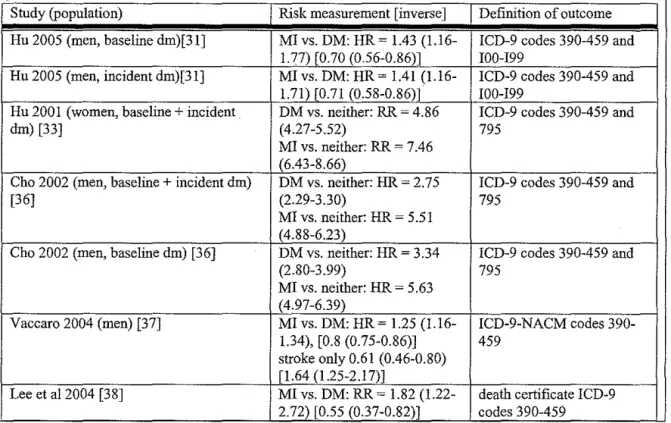
Studies that report effects when the outcomes is def"med as CVD mortality Seven of the studies addressing the primary question[30, 31, 33, 35-38] also examined CVD mortality as an outcome. Within the seven studies there were 13
subpopulations that were examined, see Table 10 for a summary of their results. It is also helpful to refer to Table 6 for comparisons with the outcome of CHD mortality.
MI for CVD mortality were slightly different than their findings for CHD mortality. For
CVD mortality they found that having incident DM was of equivalent risk as having
incident MI, HR for MI vs. DM = 1.22(0.98-1.53).[31) Whereas for CHD mortality the
analogous HR was 1.65(1.27-2.14).[31) Comparing both outcomes (CHD mortality and
CVD mortality) in men they found that, in both subpopulations looking at both outcomes,
having DM conferred a lower risk for mortality than did MI. The hazard ratios
comparing those with MI only to those with DM only in men were; baseline/CHD
mortality 1. 78(1.30-2.27), baseline/CVD mortality 1.43(1.6-1. 77), incident/CHD
mortality 2.15(1.7-2.73), incident/CVD mortality 1.41(1.16-1.71).
Juutilainen et a!. 2005[35) found that in both men and women having DM confers
a statistically equivalent risk for CVD mortality as does having prior MI, HRs DM only
vs. MI only are 1.00(0.64-1.58) and 2.89(0.92-9.11) respectively.[35) However, it seems
that when assessing women in this study the risk for CVD mortality is likely higher for
DM than MI due to the skewing of the confidence interval and the robust HR.[35)
Juutilainen et a!. found similar results when the outcome was CHD mortality, for both
men and women that DM confers a statistically equivalent risk for CHD mortality when
compared to prior Ml, HRs DM only vs. MI only are 0.85(0.53-1.37) and 1.91(0.6-6.08)
respectively.[35) Once again, although not statistically significant the risk for women
from DM for CHD mortality is likely higher than from MI given the skewing of the Cl
and the robust HR.[35)
Wanamethee et a!. 2004 [30) in their study of men also found that the risks
mortality.[30] The relative risk for MI only vs. DM only for CHD mortality was
1.47(0.94-2.29), whereas for CVD mortality it was 1.42(0.98-2.05).[30]
Hu eta!. 2001 [33] also came to similar conclusions about risk equivalency when
comparing CHD and CVD mortality risk in participants with DM only and those with MI
only. They found that women with baseline DM are risk equivalents to women with
baseline MI for CVD mortality, RR ofDM vs. neither= 6.59(5.69-7.63) vs. RR ofMI vs.
neither= 6.58(5.19-8.36).[33] The equivalent relative risks when looking at CHD
mortality are 7.48(6.30-8.89) and 8.15(6.25-10.6), respectively.[33] This finding is also
interesting in that it allows for comparison of risk between CHD mortality and CVD
mortality. In this case the risks conferred by baseline MI or baseline DM are similar
regardless of the outcomes measured. When Hu eta!. [33] examined the risks for
mortality in the group of women with baseline or incident DM only or baseline or
incident MI only, they found that when looking at either CHD or CVD mortality that
people with DM are at lower risk than are people with MI.[33] The relative risk ofCVD
mortality in women with baseline or incident DM only compared to a person with neither
MI or DM was 4.86(4.27-5.52), the equivalent RR for women with baseline or incident
MI only was 7.46(6.43-8.66).[33] Analogous RR for an outcome ofCHD morality were
5.65(4.83-6.60) and 10.7(9.03-12.6), respectively.[33]
Cho eta!. 2002 [36] had the same subpopulation divisions as Hu eta!. 2001 [33]
with the exception that their study was conducted in men. In both subpopulations of men,
they found that for CVD mortality the hazard ratio for men with diabetes only was lower
than that of men with MI only.[36] For men with baseline only disease the hazard ratio
3.34(2.80-3.99) compared to the hazard ratio for men with MI in reference to men without DMIMI
that was 5.63(4.97-6.39).[36] The analogous hazard ratios for CHD mortality in men
with baseline disease were 3.84(3.12-4.71) and 7.88(6.86-9.05). For men with baseline
or incident disease the hazard ratio for CVD mortality in men with DM in reference to
men without DMIMI was 2.75(2.29-3.30) compared to the hazard ratio for men with MI
in reference to men without DM/MI that was 5.51(4.88-6.23).[36] For men with baseline
or incident disease the analogous hazard ratios for CHD mortality were 3.3 7 (2. 72-4.17)
and 8.39(7.29-9.65).[36] Thus, the conclusions for CVD mortality are the same in all of
their subpopulations as were their conclusions for CHD mortality.[36]
Vaccaro et a!. 2004 [37] did not find a change in risk equivalency between DM
and MI when comparing the outcomes of CHD mortality and CVD mortality. In their study of men they calculated a hazard ratio for CVD mortality in men with prior MI only
in reference to men with prior DM only of 1.25(1.16-1.34).[37] Their hazard ratio
comparing the same groups for the outcome of CHD mortality was 1.37(1.26-1.48).[37]
Interestingly they did find that when only measuring risk of death from stroke, having
diabetes conferred a higher risk for mortality than did prior MI, HR stroke vs. DM =
0.61 (0.46-0.80).[37]
Lee et a!. 2004 [38] found that having MI confers a greater risk for CVD mortality
than does having DM, RR MI vs. DM = 1.82(1.22-2.72). This finding is similar to their
finding that people with prior MI only have a greater risk of hard CHD events (including
CHD mortality) than do people with DM, RR MI vs. DM = 1.86(1.35-2.56).[38] This
difference in CVD mortality risk was noted despite their finding that DM and MI confer
Table 10. Risk for future CVD death in people with DM only as compared to those with prior MI only
The risk for future CVD deaths is higher in people with DM only as compared to those with only prior CHD.
Study (population) Risk measurement [inverse] Definition of outcome
Hu 2005 (women, baseline) [31) M1 vs. DM: HR ~ 0.63 (0.47- 1CD-9 codes 390-459 and IOO-0.84) [1.59 (1.19-2.13)) 199
The risk for future CVD deaths is equivalent in people with DM only as compared to those with only prior CHD.
Study (population) Risk measurement Definition of outcome
Hu 2005 (women, incident dm) [31) MI vs. DM: HR ~ 1.22 (0.98- 1CD-9 codes 390-459 and IOO-1.53) [0.81 (0.65-1.02)) !99
Juutilainen 2005 (women) [35] DM vs. MI: HR ~ 2.89 (0.92- ICD-8 codes 390-459 9.11)
Juutilainen 2005 (men) [35] DM vs. Ml: HR- 1.00 (0.64- ICD-8 codes 390-459 1.58)
Wannamethee 2004 (men) [30] M1 vs. DM: RR ~ 1.42 (0.98- ICD-9 codes 410-439. 2.05) [0.70 (0.49-1.02)]
Hu 2001 (women, baseline dm) [33] DM vs. neither: RR ~ 6.59 ICD-9 codes 390-459 and 795 (5.69-7.63)
MI vs. neither: RR ~ 6.58 (5.19-8.36)
The risk for future CVD death is lower in people with DM only as compared to those with only prior CHD.
Study (population) Risk measurement [inverse] Definition of outcome
Hu 2005 (men, baseline dm)[31] Ml vs. DM: HR~ 1.43 (1.16- ICD-9 codes 390-459 and 1.77) [0.70 (0.56-0.86)] I00-!99
Hu 2005 (men, incident dm)[31] Ml vs. DM: HR- 1.41 (1.16- ICD-9 codes 390-459 and 1.71) [0.71 (0.58-0.86)] I00-199
Hu 2001 (women, baseline+ incident DM vs. neither: RR ~ 4.86 ICD-9 codes 390-459 and
dm) [33] (4.27-5.52) 795
Ml vs. neither: RR ~ 7.46 (6.43-8.66)
Cho 2002 (men, baseline + incident dm) DM vs. neither: HR- 2.75 ICD-9 codes 390-459 and
[36] (2.29-3.30) 795
Ml vs. neither: HR ~ 5.51 ( 4.88-6.23)
Cho 2002 (men, baseline dm) [36] DM vs. neither: HR- 3.34 ICD-9 codes 390-459 and
(2.80-3.99) 795
M1 vs. neither: HR ~ 5.63 (4.97-6.39)
Vaccaro 2004 (men) [37] Ml vs. DM: HR~ 1.25 (1.16- ICD-9-NACM codes 390-1.34), [0.8 (0.75-0.86)] 459
stroke only 0.61 (0.46-0.80) [1.64 (1.25-2.17)]
Summary. In almost all cases there was no change in risk equivalency ofDM only and
MI only when comparing the outcomes of CVD and CHD mortality. Thus, the results for
CVD mortality based on the presence ofDM or MI were found have heterogeneous
outcomes as did the results for CHD mortality. One study [3 7] reported results for only
fatal stroke events, finding that participants with DM have a higher risk than do
participants with prior MI. Both studies addressing CVD events (defined as nonfatal and
fatal stroke) found risk equivalency between DM and MI.[30, 38] Since there are few
studies, a definitive conclusion regarding CVD events cannot be made.
Sub-question #3: Does having other markers of CVD in patients with prior DM
change the risk for future hard CHD events when they are compared to those with
prior MI only?
Only one of our included studies, Wannamethee eta!. [30], measured other types
of CVD in the participant subgroups. They found that within the diabetic population
5.9% recalled having a stroke, 6.4% reported chest pain on exertion, 3.5% reported
severe chest pain (used as a marker for possible MI), and 19.3% reported breathlessness.
[30] However, they did not stratify the results comparing those with DM that had these
symptoms to those with DM that did not have these symptoms so they were not able to
further compare those risk measurements to the risk found in participants with only prior
MI.
Summary. From the data we assembled, no conclusions can be drawn regarding the
question of whether the presence of markers of other CVD events in the diabetic