Acceptability of Male Circumcision
Among Men and Women
For Prevention of HIV Infection in Uganda
By
Lisa Marie Albert
A Master’s Paper submitted to the faculty of the University of North Carolina at Chapel Hill
In partial fulfillment of the requirements for the degree of Master of Public Health in
the Public Health Leadership Program.
Chapel Hill
2010
___________________________
Advisor signature/printed name
________________________________
Second Reader Signature/printed name
________________________________
ABSTRACT
In the last decade three randomized controlled trials in Kenya, South Africa, and Uganda have
shown that male circumcision reduces the sexual transmission of HIV from women to men, as
reported by the World Health Organization (WHO). The purpose of this study was to assess
the current situation in Uganda with regards to male circumcision (MC) in order to provide
decision makers with adequate information to decide whether and how to promote male
circumcision as an HIV prevention strategy. This paper highlights circumcision of young
children because they are an overlooked target group for HIV prevention efforts. Objectives
of this assessment were to measure the acceptability of MC among men and women including
their roles as parents.
Following recommendations from the WHO document, “Male Circumcision Situation
Analysis Toolkit”, mixed-method data collection was conducted across four Ugandan
districts. A two-stage household survey of 833 adult males and 842 adult females, focus
group discussions, and a health provider survey were conducted in each district.
Acceptability of MC was positive and substantial after respondents were told that recent
studies show that male circumcision reduces the risk of transmission of HIV from women to
men. In uncircumcised men, between 40% - 62% across the districts would consider getting
circumcised. Parental support of MC for sons ranged between 60% to 86% of fathers and
49% - 95% of mothers, across the four districts. Widespread support exists among men and
women in this study for promoting medical MC as part of Uganda’s current ‘ABC+’ HIV
prevention strategy. Any MC intervention should clearly stress that MC should not be
depended on solely to prevent HIV. Existing reservations and barriers to medical MC must be
carefully addressed for the intervention to succeed.
INTRODUCTION
Studies of Male Circumcision in Africa
In the last decade three randomized controlled trials in Kenya, South Africa, and Uganda have shown that male circumcision can reduce the sexual transmission of HIV from women to men as much as 60% (Auvert et al., 2005; R. C. Bailey et al., 2007; H. A. Weiss, Quigley, & Hayes, 2000), leading the WHO and UNAIDS to issue a set of recommendations for the use of male circumcision (MC) in HIV prevention efforts (WHO/UNAIDS, 2007). These recommendations suggest programs be implemented among populations where the prevalence of heterosexually transmitted HIV infection is high and prevalence of MC is low. Based on generalized
heterosexual epidemics, high HIV prevalence and low levels of MC, thirteen eastern and southern African countries, including Uganda, were selected for MC programs to be implemented (WHO & UNAIDS, 2009).
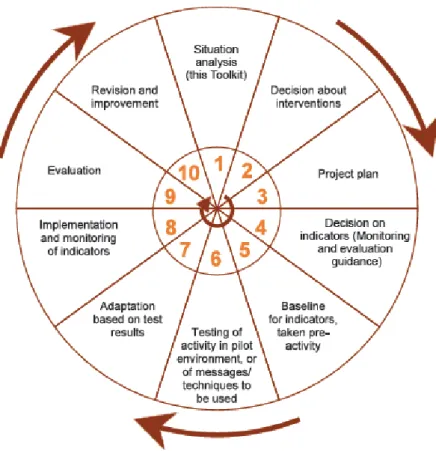
Situation Analysis Informs Male Circumcision Program for HIV Prevention The first step in informing the design of a prevention program is performing a situation analysis to identify what is happening in the field with regards to MC and HIV prevention and why it is happening (WHO, 2009).
Figure I. Program Cycle around Interventions (WHO, 2009)
consider being circumcised if the cost were minimal. This study was conducted before the association between MC and reduced HIV rates was generally recognized, and was not oriented towards determining acceptability of circumcision for protection against HIV. The study did not report on whether non-circumcising populations would consider circumcising their children for health reasons, and if so, at which age.
Most MC program efforts to date have focused on the circumcision of adult men, an approach which has shown some success. For example, in a rapid results initiative in over 90,000 adult male circumcisions were performed as of January 2010 (Dickenson & WHO, 2010). Circumcision of male children, however, has received less attention from public health professionals. Some data show that a larger public health benefit would accrue over time from infant circumcision and that infant circumcision is safer and yields fewer adverse events (WHO/UNAIDS, 2007).
In Uganda, rather than engage immediately in MC roll-out, the government undertook a situation analysis to inform program planning for an MC HIV prevention program in Uganda. The current mixed-method study assessed popular and policy-level attitudes, as well as provider opinions, related to male circumcision (MC) in four Ugandan districts in order to provide decision makers with adequate information about whether to promote male circumcision as an HIV prevention strategy.
METHODS
included: (1) a household survey of men and women, (2) focus group discussions, (3) a health facility service availability study, and (4) stakeholders’ workshops at the national and local level. The current manuscript focuses on results from the household survey, complemented by results from focus group discussions, and service provider survey conducted in March and April of 2008.
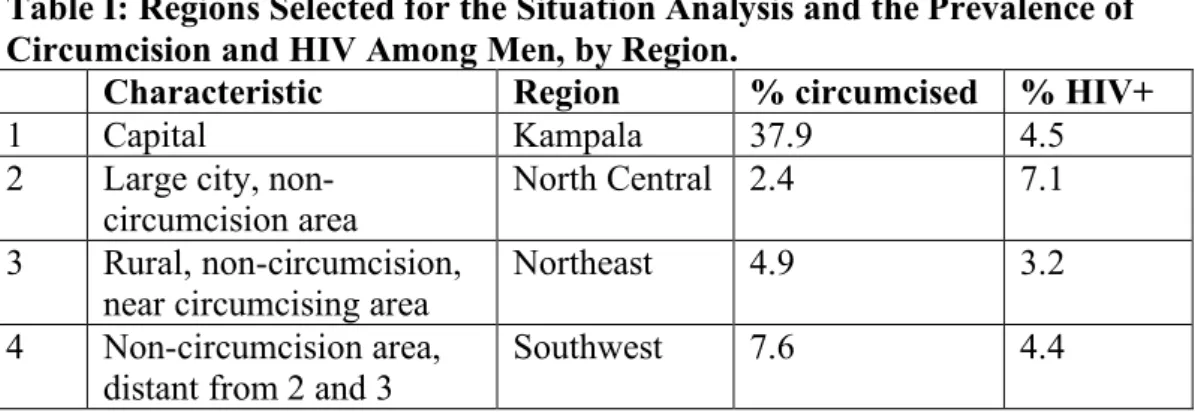
Following WHO toolkit guidelines, MC assessments were undertaken in four districts: 1) Kampala, the district with the largest population/capital city; 2) Gulu, a large city in a non-male circumcision area, 3) Kumi, a rural district in a non-male circumcision area that is near a district that practices male circumcision, and 4) Rukungiri, a non-male circumcision area that is geographically distant from 2 and 3. (Table 1).
Table I: Regions Selected for the Situation Analysis and the Prevalence of Circumcision and HIV Among Men, by Region.
Characteristic Region % circumcised % HIV+
1 Capital Kampala 37.9 4.5
2 Large city, non-circumcision area
North Central 2.4 7.1
3 Rural, non-circumcision, near circumcising area
Northeast 4.9 3.2
4 Non-circumcision area,
distant from 2 and 3 Southwest 7.6 4.4
Source: Uganda HIV/AIDS Sero-behavioural Survey 2004-2005, conducted by the Uganda Ministry of Health
Household Survey
Sample
To obtain a sample that was representative of the population of each district, a separate, two-stage cluster sampling strategy was used in each of the four selected districts. The Primary Sampling Unit (PSU) was the 2001 population census
PSUs were randomly selected within each district, and 14 SSUs were quasi-randomly selected within each PSU for sampling (seven each for men and women). In a few cases, the selected secondary sampling units were unreachable despite diligent efforts. In such cases, these units were replaced with new sampling units. No data detailing non-response rates to the household survey are available.
Eligibility to participate in the survey included being 1) at least 18 years of age and 2) the parent of at least one child. A total of 1,677 men and women – approximately 210 men and 210 women per district, participated in the household survey which aimed to explore the knowledge and personal preferences of men and women with regard to male circumcision, for themselves and their male children. The
interviewer-administered survey instrument was brief, focused, and translated into the local language.
Measures
There were three main outcome measures for this study: (1) willingness to circumcise among uncircumcised men, (2) willingness to circumcise male children, and (3) best age for circumcision. Prior to administering these questions, all household survey respondents were provided with a health message linking male circumcision to reduced HIV infection: “Recent studies show that male circumcision reduces the risk of being infected with HIV. Being circumcised is not enough on its own to protect from HIV and circumcised men MUST continue using other forms of protection.” After provision of the message, uncircumcised men were asked: “Based on this information would you consider being circumcised?” All household survey
son, would you support your son’s circumcision?” All survey respondents were also asked: “When would your son be circumcised?”
Analyses followed a pre-specified plan. Two male survey respondents who did not provide circumcision status were excluded from analysis. Also, in some instances, skip patterns prescribed in the survey were not followed during survey administration. Such cases were programmatically corrected in SAS V9.1 at the time of analysis.
Focus Group Discussions
Focus group discussions (FGDs) were used to elicit viewpoints from men, women and key members at the community level. Approximately 30 FGDs were conducted in each district, averaging 10 individuals each. FGD participants were recruited using local networks and contacts established during the one-day workshops and survey. Purposive sampling ensured that FGDs were composed of participants with similar backgrounds based on sex, age, and circumcision status (for men). FGDs were conducted in the local language; the discussion guide was translated into local languages and then back-translated to English in order to ensure accuracy of terms. The FGDs were tape recorded, then coded and analyzed using qualitative software analysis programs.
Health Care Provider Survey
A total of 59 health practitioners were surveyed across the four focal districts, with Kampala providing the majority of data (42 interviews). Two-thirds of all interviews were conducted with hospital staff, but staff from health centres IVs and IIIs, a nursing home, and an AIDS information centre were also interviewed. A range of government, faith-based, non-faith-based NGOs, and private for-profit facilities were represented. Staff members were surveyed to assess their current practices in MC, as well as their overall attitudes towards the practice. Only 34 of the 59 practitioners surveyed (58%) had ever performed a male circumcision, with circumcisions being performed across all age groups.
RESULTS
In the results section, we focus primarily on results from the household survey, but draw on findings from the focus group discussions and health care provider survey to provide further insights into the household survey findings.
Table II: General Characteristics of Household Survey Respondents (N=1675) Kampala District (N=418) Gulu District (N=421) Kumi District (N=416) Rukungiri District (N=420)
Females (N=842) (N=210) (N=211) (N=211) (N=210)
Mean age (range) 30.1 (16-62) 35.2 (17-70) 33.6 (19-60) 35.7 (18-80) Mean number of sons
(range)
2.1 (1-10) 2.3 (1-7) 2.8 (1-8) 2.4 (1-9)
Mean number of daughters (range)
2.0 (1-6) 2.7 (1-9) 2.5 (1-8) 2.3 (1-7)
Religion (%)*
Catholic 28 76 45 39
Protestant 31 17 49 52
Muslim 29 2 1 2
Other 11 4 4 6
Residence (%)*
Rural -- 73 97 100
Urban 100 27 3 --
Males (N=833) (N=208) (N=210) (N=205) (N=210)
Mean age (range) 31.8 (19-67) 35.1 (18-77) 37.8 (20-71) 42 (20-80) Mean number of sons
(range)
2.2 (1-20) 2.7 (1-8) 3.0 (1-13) 2.7 (1-15)
Mean number of daughters (range)
2.3 (1-15) 2.4 (1-7) 2.9 (1-8) 2.6 (1-11)
Religion (%)*
Catholic 39 77 42 35
Protestant 32 19 49 57
Muslim 21 2 2 2
Other 7 2 6 6
Residence (%)*
Rural -- 67 96 98
Urban 100 33 4 2
Circumcised (%)** 40 (n=84) 12 (n=26) 4 (n=8) 8 (n=16)
Uncircumcised (%)** 60 (n=124) 88 (n=184) 96 (n=197) 92 (n=194)
*Percents are rounded to nearest integer, so may not add up to 100.
** Two males have been excluded form analysis due to missing results on circumcision status.
Outcomes
Stated Willingness of Uncircumcised Men to Undergo Male Circumcision
that male circumcision improves hygiene and provides some protection against STDs and HIV. Circumcision was also perceived by some focus group participants to increase men’s sex drive and/or women’s sexual pleasure – a benefit in the eyes of many, but a point of concern among others who believed that circumcised men would engage in riskier sex. For example, one Kumi man suggested: “It also promotes promiscuity among men, because they will think they are now safe to have live sex
with anyone – which means they may end up getting HIV.” In addition, men and women worried about the medical procedure itself, including pain, infection, disfigurement, death or even contracting HIV during the procedure. Finally, some were concerned about the need for financial assistance during the recovery period to help maintain their family income.
Stated Willingness to Circumcise One’s Son
Willingness of men (circumcised (N=134) and uncircumcised (N=699) combined) to have their sons circumcised was very high (Figure II). Overall, men’s support of a son’s circumcision ranged from to 86% in Kampala to 60% in Kumi. When examined by circumcision status, uncircumcised men in Kampala District were the most likely to support circumcision for their male children (79% support), and uncircumcised men in Kumi District were least likely to support it (59% support) (Figure II). Almost
Figure II. Percent Willingness to Circumcise Son or Self by District (95% CI)
73
86
70 60
79
69
59
68
95
76
49
76 55
62
41
40
0 10 20 30 40 50 60 70 80 90 100
Kampala
Gulu
Kumi
Rukungiri
% of men willing to have their sons circumcised % of uncircumcised men willing to have their sons circumcised
% of women willing to have their sons circumcised % of uncircumcised men willing to be circumcised
A higher percentage of women (N=842) than men (N=833), except in Kumi, were willing to circumcise their sons. Women’s support of a son’s circumcision ranged from 95% in Kampala to 49% in Kumi.
Among uncircumcised men (N=699), place of birth (rural/urban) did not have a strong affect on the rate of acceptability of son circumcision. Gulu was the only district with a substantial number of current residents living in both Rural (n=116) and Urban (n=58) areas and the acceptability of circumcision for sons was strong at 67% and 72% respectively.
respondents, religion was grouped into Catholic, Protestant, and Other (including no religion). Among uncircumcised men, acceptability to have one’s son circumcised was strong across religions, with Protestants in Kumi being the least supportive at 57% and Protestants in Kampala being the strongest supporters at 81%. In Kumi, only 46% (n=13) of other religions or non-religious participants supported circumcision.
Some respondents did change their opinion about circumcising their sons after provision of the health message, but there was no reduction in support in any city. In Kampala, Gulu, and Kumi, percent support of circumcised males (N=134) remained exactly the same before and after the health message. Overall, women were more likely to increase their level of support than men (Table III). About half of the women in Kampala, Gulu, and Rukungiri districts increased their support after hearing the health message, while about one-third of the uncircumcised men in Gulu and Kumi districts did the same.
Table III: Proportion of female and uncircumcised male respondents who initially did not support circumcision of their sons, but increased their support after provision of the health message
District
Kampala Gulu Kumi Rukungiri
Males (N=26)
Females (N=18)
Males (N=78)
Females (N=101)
Males (N=118)
Females (N=118)
Males (N=77)
Females (N=96)
Increased support (%)
4 44 32 51 34 11 19 49
In FGDs, the most common reason for supporting a son’s circumcision was to prevent HIV/AIDS or to provide for a “healthier future” more generally. As one male
Nevertheless, FGDs also raised a number of concerns and challenges to MC
promotion. These included concerns about cost, pain associated with the procedure, a perception by some that circumcision would signify a religious conversion, or that the procedure would encourage their children to engage in risky sexual activity. A few participants suggested that more information was needed about the health benefits of male circumcision.
Age at Which Men and Women Would Consider Male Circumcision for Their Sons
Overall, household survey participants supported MC during infancy (0-1 years) or childhood (2-9 years), rather than adolescence (10-17 years) or adulthood (18 and over). However, there was some variation by gender and district. Half of men and about two-thirds of women in Kampala (the district with the largest Muslim
Table IV. When Would Your Son be Circumcised?
Female (N=842)
Uncircumcised Males (N=699)
Result Kampala (n=210) Gulu (n=211) Kumi (n=211) Rukungiri (n=210) Kampala (n=124) Gulu (n=184) Kumi (n=197) Rukungiri (n=194)
Infant (0-1 years) n Percent 95% C.I. 133 67 (59, 75) 50 31 (23, 40) 28 27 (16, 38) 100 63 (55, 71) 48 55 (44, 66) 18 15 (8, 22) 31 28 (18, 38) 55 42 (33, 51)
Child (2-9 years) n Percent 95% C.I. 31 16 (11, 21) 57 36 (27, 44) 31 30 (18, 42) 34 22 (15, 28) 32 36 (26, 47) 51 43 (33, 53) 46 42 (31, 53) 48 36 (27, 45) Adolescent (10-17 years) n Percent 95% C.I. 13 7 (2, 11) 37 23 (16, 30) 27 26 (17, 35) 17 11 (5, 17) 4 5 (0, 9) 34 29 (21, 37) 25 23 (15, 30) 20 15 (9, 21)
Adult (18 and over) n Percent 95% C.I. 20 10 (6, 14) 16 10 (5, 15) 15 15 (6, 24) 6 4 (1, 7) 1 1 (0, 3) 11 9 (4, 15) 7 6 (2, 11) 6 5 (1, 8)
Don't Know n Percent 95% C.I.
1 1 (0, 2)
-- 2
2 (0, 5) 1 1 (0, 2) 3 3 (0, 7) 4 3 (0, 7) 1 1 (0, 3) 3 2 (0, 5) DISCUSSION
Stated Support for Male Circumcision
The household survey asks individuals whether or not they were willing to get circumcised or to get their sons circumcised. The outcomes from this data are merely a litmus test to see if the people of Uganda are open to considering a male
circumcision program for HIV prevention. Stating ones support of male circumcision for survey purposes is clearly different than actually following through with the male circumcision surgery. So, these outcomes are not meant to estimate what actual circumcision rates will be if and when Uganda rolls out a MC program. It should be noted that uptake and actual participation of an MC program would depend on the public’s reception of media messages and political support prefacing and during roll out of an MC program.
Between 40 and 60% of uncircumcised men were willing to consider MC for
highlighted potential barriers to MC during adulthood, including concerns about the medical procedure itself, but also perceptions linked to religious or cultural identify and influence on post-procedure risk behaviours. Data from men enrolled in the seminal trial in Kenya that linked MC to reduced HIV rates, however, did not find increased HIV risk behaviour following medical male circumcision (Mattson et al., 2008). Nonetheless, risk compensation remains a concern in MC rollout and needs to be carefully and effectively addressed in communication strategies for MC scale-up (WHO/UNAIDS, 2007).
Importantly, this study demonstrated moderate to strong acceptability, across the four districts, for circumcising sons. Almost all circumcised men supported circumcision of their sons. In addition, the majority of women in all districts and the majority of uncircumcised men, in all but Kumi district, supported MC for their sons.
Age for Male Circumcision
While there was some variation in the most appropriate age range during which to circumcise sons, survey participants preferred circumcision at younger ages for their sons (i.e., 0-9 years), rather than during adolescence or adulthood. This was echoed in our survey of health care providers, who believed that MC in infants was best.
clinical settings with trained personnel (WHO, 2008). In addition, infant circumcision avoids potential unintended consequences of increased risk behaviour due to a belief that one is now protected from HIV. While circumcision of adolescent and adult males is believed to provide a more immediate and rapid effect on the HIV epidemic than circumcision of infants and young children (WHO/UNAIDS, 2007), it should be noted that circumcision with neonates is much simpler and less risky; therefore the acceptability of infant circumcision in Uganda is important for long-term strategies against HIV (WHO/UNAIDS, 2007).
Traditional vs. Medical Male Circumcision
Due to traditional circumcision practices, MC in Uganda seems to be most prevalent in the late teen to adult years, rather than with infants. Given the existence of traditional circumcision practices in some parts of the country and the potential demand for circumcision at older ages, introduction strategies for medical MC must consider how best to accommodate such traditional practices, as well as to effectively communicate messages about the partial protection of MC and the need to sustain other risk reduction behaviours, including faithfulness, partner reduction and condom use (Asiimwe, Kibombo, & Neema, 2003).
It may be unrealistic to expect that traditional circumcision will halt even with a medical MC rollout. Results from a recent study in Tanzania show that traditional MC is an ingrained cultural ritual that is preferable in some regions to medical MC
efforts to formally regulate, register, and train traditional practitioners in good circumcision practices.
Research is currently underway by Family Health International in Uganda to examine the attitudes of traditional circumcisers towards medical MC. The results of this study should inform how to better position the introduction of medical MC in areas of varying tradition in Uganda. As pointed out in past research, the government will need to address how best to incorporate or change traditional circumcision practices that may be harmful, including the sharing of knives or circumcision festivities that “create opportunities for adolescents and adults to engage in risky sexual practices” and pressure for the newly circumcised boy to have sex with a woman to prove his manhood (Asiimwe, Kibombo, & Neema, 2003).
If results of this research in Uganda mirror those of Tanzania, then any MC program should give consideration to incorporating traditional circumcisers in program implementation, including government funded trainings and certifications on how to provide safe and effective circumcisions.
Health Message Communication
HIV and the necessity of continued condom use should accompany medical MC introduction. These messages could be incorporated to existing educational
campaigns to correct misconceptions that men will not need to use condoms after they are circumcised. Studies testing communication messages are ongoing in Kenya, however similar research should be done in Uganda as well. Informed by such research, public health authorities could consider collaboration with media outlets during a MC roll-out in forming accurate HIV prevention messages and presenting research results that address fears such as risk compensation after MC.
Kenya launched its Voluntary Medical Male Circumcision programs on the
Another consideration for public health practitioners is to determine whether the definition of medical male circumcision is clearly communicated through media sources. As Wang points out, media can be a tool to accurately convey the definition of circumcision since some studies have shown that men who self-reported being circumcised were actually not circumcised upon examination. Some traditional circumcisions in Sub-Saharan Africa are reported to have as little as 1 cm of foreskin removed (Brown et al., 2001). A study in Rakai, Uganda showed that larger foreskin surface area is associated with an increased risk of HIV acquisition and that
circumcision practitioners should reduce any excess foreskin during circumcision (Kigozi et al., 2009). The amount of foreskin removed in the traditional circumcision may not coincide with the standards of foreskin removal used in the three trials
showing HIV protection with MC (Brown et al., 2001; Wang, Duke, & Schmid, 2009). Therefore, media communication should be clear about the difference between some traditional circumcisions and medical circumcision, to increase the accuracy of self-reporting and to increase the public health effect of a male circumcision program.
Male Circumcision Program Development in Uganda
The government of Uganda has begun to receive pressure in the media for not having a circumcision policy in place yet, while at least 13 other Sub-Saharan countries have made headway or are in full force in implementing medical male circumcision
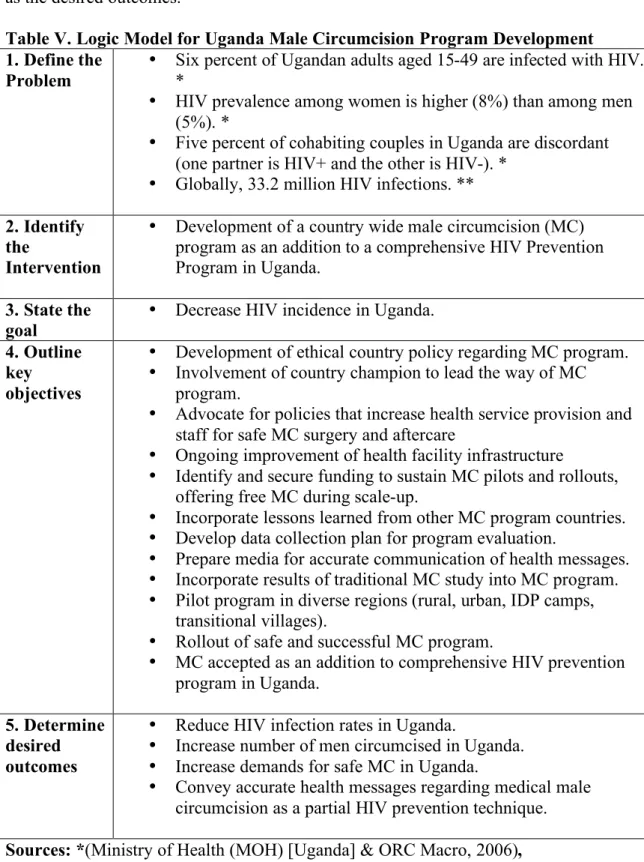
the opportunity to apply lessons learned. The following logic model (Table V) provides a visual recounting of the relationships between resources and activities that will be needed to implement an MC program for HIV prevention in Uganda, as well as the desired outcomes.
Table V. Logic Model for Uganda Male Circumcision Program Development 1. Define the
Problem •
Six percent of Ugandan adults aged 15-49 are infected with HIV. *
• HIV prevalence among women is higher (8%) than among men (5%). *
• Five percent of cohabiting couples in Uganda are discordant (one partner is HIV+ and the other is HIV-). *
• Globally, 33.2 million HIV infections. ** 2. Identify
the
Intervention
• Development of a country wide male circumcision (MC) program as an addition to a comprehensive HIV Prevention Program in Uganda.
3. State the
goal • Decrease HIV incidence in Uganda. 4. Outline
key objectives
• Development of ethical country policy regarding MC program. • Involvement of country champion to lead the way of MC
program.
• Advocate for policies that increase health service provision and staff for safe MC surgery and aftercare
• Ongoing improvement of health facility infrastructure • Identify and secure funding to sustain MC pilots and rollouts,
offering free MC during scale-up.
• Incorporate lessons learned from other MC program countries. • Develop data collection plan for program evaluation.
• Prepare media for accurate communication of health messages. • Incorporate results of traditional MC study into MC program. • Pilot program in diverse regions (rural, urban, IDP camps,
transitional villages).
• Rollout of safe and successful MC program.
• MC accepted as an addition to comprehensive HIV prevention program in Uganda.
5. Determine desired outcomes
• Reduce HIV infection rates in Uganda.
• Increase number of men circumcised in Uganda. • Increase demands for safe MC in Uganda.
• Convey accurate health messages regarding medical male circumcision as a partial HIV prevention technique. Sources: *(Ministry of Health (MOH) [Uganda] & ORC Macro, 2006),
To date, Uganda has formally assessed existing policies using the UNAIDS legal and regulatory self-assessment tool and is currently underway with drafting an MC policy and has designed a strategy and operational plan (WHO & UNAIDS, 2009).
Piloting the Male Circumcision Rollout
Sustainable solutions for MC program implementation will depend on a broad
strengthening of health care systems in Uganda (Family Health International, 2010b). In Uganda there are only 10 specialist surgeons, 350 anaesthesiologists, and 16,000 nurses to serve a population of over 30 million (Ozgediz et al., 2008). In addition, there is an imbalance in the providers with 90% of physician providers being
concentrated in the capital city Kampala, while 90% of Uganda’s population reside in rural areas (Ozgediz et al., 2008). These rural areas have mostly been served by surgical camps which occur once or twice per year for one to two weeks at a time, with local health providers and nurses providing care and receiving additional training (Ozgediz et al., 2008). If this camp model is considered for a MC rollout, and if goals are to circumcise a majority of the male population in Uganda, then it is likely new staff or volunteers will need to be trained to provide MC operations.
performed, including challenges of limited human resources, revising country protocols to determine who is allowed to provide the minor operations, and task-shifting to avoid provider burnout (Cairns, 2010; Dickenson & WHO, 2010).
Kenya had previous experience with Rapid Results Initiative when doing HIV testing, so was familiar with the process to go about with the expanded access initiative. Marie Stopes International has published a case study of pilot programs done in Kenya between June 2007 and December 2008, where 5344 men and adolescent boys were circumcised with an average of 20 circumcisions per day (Nelson & Quinn, 2009). The Swaziland case study provides examples of small pilots of that country’s MC program, along with challenges faced in the pilots and how the pilots were used for data collection (Groeneveld, Hayes, Skorochod, & Skorochod, 2008).
CONCLUSION
Results from this situation analysis on MC as an HIV prevention strategy in Uganda suggest that MC is acceptable in the four districts sampled in Uganda, and that
circumcising young or infant males may be more acceptable to Ugandan communities than circumcision of older males. Furthermore, although women have not traditionally been targets of MC promotional and campaign messages, our research findings
demonstrate that they are an audience amenable to MC messages and may be
infant and neonate circumcision could be collected in MC program pilots, and efforts to strengthen general hospital capacity should be sought out to build sustainability in general services as well as HIV prevention services and post-care. Clear and
persuasive health communications are critical to emphasize that MC provides only partial protection against HIV and should be considered as only one of many strategies in a comprehensive HIV prevention program to reduce HIV incidence in Uganda. Pending further research, a successful MC prevention program may need to develop strategies to incorporate traditional circumcisers in the safe MC HIV
REFERENCES
Asiimwe, D., Kibombo, R., & Neema, S. (2003). Focus group discussion on social cultural factors impacting on HIV/AIDS in uganda. Kampala, Uganda: Makerere Institute of Social Research (MISR).
Auvert, B., Talijaard, D., Lagarde, E., Sobngwi-Tambekou, J., Sitta, R., & Puren, A. (2005). Randomized, controlled intervention trial of male circumcision for reduction of HIV infection risk: The ANRS 1265 trial. PLoS Medicine, 2(11), e298.
Bailey, R. C., Stella, N., & Richard, O. (1999). Sexual behaviors and other HIV risk factors in circumcised and uncircumcised men in uganda. Journal of Acquired Immune Deficiency Syndromes, 22(3), 294.
Bailey, R. C., Moses, S., Parker, C. B., Agot, K., Maclean, I., Krieger, J. N., et al. (2007). Male circumcision for HIV prevention in young men in kisumu, kenya: A randomised controlled trial. The Lancet (North American Edition), 369, 643-656. Binagwaho, A., Pegurri, E., Muita, J., & Bertozzi, S. (2010). Male circumcision at
different ages in rwanda: A cost-effectiveness study. PLoS Medicine, 7(1), e1000211.
Brown, J. E., Micheni, K. D., Grant, E. M., Mwenda, J. M., Muthiri, F. M., & Grant, A. R. (2001). Varieties of male circumcision: A study from Kenya. Sexually Transmitted Diseases, 28(10), 608-612.
Cairns, G. (2010). Kenya leads on circumcision rollout. Retrieved April/3, 2010, from
Dickenson, K., & WHO. (2010). Male circumcision scale-up, Retrieved April 3, 2010, from
http://app2.capitalreach.com/esp1204/servlet/tc?c=10164&cn=retro&e=12350
&m=1&s=20431&&espmt=2&mp3file=12350&m4bfile=12350&br=80&audio
=false
Family Health International. (2010a). Clearing house on male circumcision for HIV prevention. Retrieved April 3, 2010, from http://www.malecircumcision.org Family Health International. (2010b). Clearing house on male circumcision for HIV
prevention: Challenges around implementation. Retrieved April 3, 2010, from http://www.malecircumcision.org/advocacy/male_circumcision_advocacy_challe
nges.html
Fox, M. (2009, Thu, Jul 16 2009). Circumcision helps protect men, not women from
AIDS. Message posted to
http://www.reuters.com/article/idUSTRE56F7BG20090717
Groeneveld, A., Hayes, B., Skorochod, E., & Skorochod, P. (2008). Circumcision Saturday: A case study from Swaziland. WHO.
Kigozi, G., Wawer, M., Ssettuba, A., Kagaayi, J., Nalugoda, F., Watya, S., et al. (2009). Foreskin surface area and HIV acquisition in Rakai, Uganda (size matters). AIDS (London, England), 23(16), 2209-2213.
doi:10.1097/QAD.0b013e328330eda8
Mattson, C. L., Campbell, R. T., Bailey, R. C., Agot, K., Ndinya-Achola, J. O., &
Moses, S. (2008). Risk compensation is not associated with male circumcision in
Kisumu, Kenya: A multi-faceted assessment of men enrolled in a randomized
Mboera, L., Massaga, J., Senkoro, K., Kilima, S., Mayala, B., Msovela, J., et al. (2009). Challenges and opportunities for the involvement of traditional practitioners in scaling up safe male circumcision in the context of HIV
prevention in Tanzania. Dar es Salaam, Tanzania: National Institute for Medical Research.
Ministry of Health (MOH) [Uganda], & ORC Macro. (2006). Uganda HIV/AIDS sero-behavioural survey 2004-2005. Calverton, Maryland, USA: Ministry of Health and ORC Macro.
Nelson, E., & Quinn, H. (2009). Pioneering HIV prevention strategies in rural kenya: A case study of Marie Stopes International's male circumcision outreach project. Marie Stopes International.
Otieno, E. (2010). Kenya: 90,000 men get the cut in HIV campaign. Retrieved Mar 4, 2010, 2010, from http://allafrica.com/stories/201002021082.html
Ozgediz, D., Galukande, M., Mabweijano, J., Kijjambu, S., Mijumbi, C., Dubowitz, G., et al. (2008). The neglect of the global surgical workforce: Experience and evidence from Uganda. World Journal of Surgery, 32(6), 1208-1215.
doi:10.1007/s00268-008-9473-4
PlusNews. (2010). Africa: tracking the male circumcision rollout. Retrieved 03/04, 2010, from http://allafrica.com/stories/201003020888.html
United Nations. (2009). The Millennium Development Goals report 2009. New York: United Nations Department of Economic and Social Affairs.
Van Damme, L., Govinden, R., Mirembe, F. M., Guedou, F., Solomon, S., Becker, M.
L., et al. (2008). Lack of effectiveness of cellulose sulfate gel for the prevention of
Wang, A. L., Duke, W., & Schmid, G. P. (2009). Print media reporting of male
circumcision for preventing HIV infection in Sub-Saharan Africa. Bulletin of the
World Health Organization, 87(8), 595-603.
Wawer, M. J., Makumbi, F., Kigozi, G., Serwadda, D., Watya, S., Nalugoda, F., et al.
(2009). Circumcision in HIV-infected men and its effect on HIV transmission to
female partners in Rakai, Uganda: A randomised controlled trial. Lancet,
374(9685), 229-237.
Weiss, H. A., Halperinb, D., Bailey, R. C., Hayes, R. J., Schmid, G., & Hankins, C. A.
(2008). Male circumcision for HIV prevention: From evidence to action? AIDS
(London), 22(5), 567-74.
Weiss, H. A., Quigley, M. A., & Hayes, R. J. (2000). Male circumcision and risk of
HIV infection in Sub-Saharan Africa: A systemtic review and meta-analysis.
AIDS, 14, 2361-2370.
Westercamp, N., & Bailey, R. C. (2007). Acceptability of male circumcision for
prevention of HIV/AIDS in Sub-Saharan Africa: A review. AIDS and Behavior,
11(3), 341-355. doi:10.1007/s10461-006-9169-4.
WHO. (2009). Male circumcision situation analysis toolkit. WHO.
WHO, UNAIDS, JHPIEGO. (2008). Manual for male circumcision under local
anaesthesia. No. V2.5C, WHO, UNAIDS, JHPIEGO.
WHO/UNAIDS. (2007). New data on male circumcision and HIV prevention:
policy and programme implications: Conclusions and recommendations.