Vol. 11, No. 2, pp 217-230
Matrix Kummer-Pearson VII Relation and
Polynomial Pearson VII Configuration Density
Francisco J. Caro-Lopera1, Jos´e A. D´ıaz-Garc´ıa2
1Departmento de Ciencias B´asicas, Universidad de Medell´ın, Colombia. 2Departamento de Estad´ıstica y C´alculo, Universidad Aut´onoma Agraria An-tonio Narro, M´exico.
Abstract. A case of the matrix Kummer relation of Herz (1955) based on the Pearson VII type matrix model is derived in this paper. As a con-sequence, the polynomial Pearson VII configuration density is obtained and this sets the corresponding exact inference as a solvable aspect in shape theory. An application in postcode recognition, including a nu-merical comparison between the exact polynomial and the truncated configuration density, is given at the end of the paper.
Keywords. Matrix Kummer relation, Pearson VII configuration den-sity, zonal polynomials.
MSC: Primary: 62E15, 60E05, 43A90, 33C20; Secondary: 44A15.
1
Introduction
Start assuming that a given sample ofn“figures”, comprised inN
land-marks (“anatomical” points) in K dimensions, and summarized in an
N ×K matrix X, belongs to certain matrix variate distribution with
unknown scale and location parameters. The statistical theory of shape
pursues the distribution of the transforming X after filtering out some
non important geometrical aspect of the original figures, such as the
Francisco J. Caro-Lopera([email protected]), Jos´e A. D´ıaz-Garc´ıa( ) (jadiaz@ uaaan.mx)
Received: February 1, 2012; Accepted: August 13, 2012
scale, the position, the rotation, the uniform shear, and so on; then the so called shape of the population object should be inferred and some comparisons among population shapes could be performed, among many others statistical comparisons in the shape space, instead of comparisons in the very noised non transformed Euclidean space. As usual, the clas-sical theory of shape, with different geometrical filters, as the Euclidean or affine, was based on Gaussian samples, see for example Goodall and Mardia (1993) and the references therein. Then, the non normal ap-plications demanded general assumptions for the samples, and the so termed generalized shape theory was set under elliptical models. Un-der the Euclidean filter we can mention the work of D´ıaz-Garc´ıa and Caro-Lopera (2010) and D´ıaz-Garc´ıa and Caro-Lopera (2012); they find the density of all geometrical information about the elliptical random
X which remains after removing the scale, the position and the
rota-tion. Finally, if an affine filter is applied, in order to remove fromX all
geometrical information of scale, position, rotation and uniform shear,
Caro-Lopera et al(2010) obtained the so term configuration density of
X. All the above densities are expanded in terms of the well known
zonal polynomials, in a series of papers by A.T. James in 60’s, see for example Muirhead(1982).
The transition of the Gaussian shape theory to the elliptical shape theory demanded some advances in integration involving zonal
polyno-mials (see for example Caro-Lopera et al(2010)), but important
prob-lems remain, the computability of the shape densities.
In this paper we focus in alternatives for such problems. It is easy to see in Goodall and Mardia (1993), D´ıaz-Garc´ıa and Caro-Lopera (2010) and D´ıaz-Garc´ıa and Caro-Lopera (2012) that the structure of shape densities under Euclidean transformations involves series of zonal poly-nomials which heritages the difficulties for computations of the classical hypergeometric series studied by Koev and Edelman (2006). However, a class of the generalized confluent type series of the configuration
densi-ties of Caro-Loperaet al(2010) can be handled in order to transformed
the series into polynomials, and then the addressed open problems for computations of the series can be avoided.
The configuration density under Kotz type samples (including Gaus-sian) has this property, and the inference can be performed with
polyno-mials instead of infinite series, see Caro-Loperaet al(2009). The source
for this property resides in a generalization of the Kummer relation of Herz (1955).
This motivates the present work, claiming that there is a similar
Kummer relation based on a Pearson VII distribution, which under cer-tain restriction of the parameters in the associated Pearson VII config-uration density, it can be turned into a polynomial density. Then the inference can be performed easily by working with the exact likelihood, which is written in terms of very low zonal polynomials. In fact the ex-act densities can be write down by using formulae for those polynomials; for example, in the planar shape theory (the most classical applications
resides in the study of figures in ℜ2), we can use directly the formulae
given by Caro-Lopera et al(2007) instead of the numerical approaches
by Koev and Edelman (2006), in order to perform some analytical prop-erties of the exact density.
This discussion is placed in the paper as follows: section 2 defines a Pearson VII type series and finds an integral representation that leads to a matrix Kummer type relation which we call Kummer-Pearson VII re-lation; then by applying some general properties studied by Herz (1955), the equality is extended for the required domains in the shape theory context. Finally, Kummer-Pearson VII relation gives the finiteness of the Pearson VII configuration density in section 3. Finally, section 4 studies an experiment of handwritten digit 3, and compares numerically the exact and the truncated associated estimates of the mean configu-rations.
2
Matrix Kummer-Pearson VII relation
Recall that the matrix Kummer relation (due to Herz (1955), see also Muirhead(1982)) states that
1F1(a;c;X) = etr(X)1F1(c−a;c;−X). (1)
Now, letX>0 be anm×mpositive definite matrix, then define
1P1(f(t,X) :a;c;X) =
∞ ∑
t=0
f(t,X) t!
∑ τ
(a)τ
(c)τ
Cτ(X), (2)
where the function f(t,X) is independent of τ, τ = (t1,· · · , tm), t1 ≥
t2· · · ≥tm>0, is a partition of t,
(β)τ =
m ∏ i=1
(
β−1
2(i−1)
) ti
, and
(b)t=b(b+ 1)· · ·(b+t−1), (b)0 = 1.
Then, using this notation we see that the Kummer relation (1) is a particular case of a general type of expressions with the following form
1P1(f(t,X) :a;c;X) =v(X)1P1(g(t,X) :c−a;c;h(X)), (3)
where the functionsv, gandhare uniquely determined by the particular
functionf and according to the domain of the parametersa,c and the
matrixX.
First, we consider an integral representation of the left hand side of
(3) under the model f(t,X) = (b)t.
Theorem 2.1. Let X < I, Re(a) >(m−1)/2, Re(c) > (m−1)/2
and Re(c−a) > (m−1)/2. Then for suitable reals b and d, we have that
1P1
(
(b)td−b−t:a;c;X
)
= Γm[c]
Γm[a]Γm[c−a]
×
∫
0<Y<Im
(d−tr(XY))−b|Y|a−(m+1)/2|I−Y|c−a−(m+1)/2(dY).(4)
Proof. First, we use a zonal polynomial expansion
(d−tr(XY))−b =
∞ ∑ t=0
(b)td−b−t
t! [tr(XY)]
t
=
∞ ∑ t=0
(b)td−b−t
t!
∑ τ
Cτ(XY).
Then integrating term by term using [Muirhead, 1982, theorem 7.2.10], we have that
∫
0<Y<Im
(d−tr(XY))−b|Y|a−(m+1)/2|I−Y|c−a−(m+1)/2(dY)
=
∞ ∑
t=0
(b)td−b−t
t!
∑ τ
∫
0<Y<Im
|Y|a−(m+1)/2 ×|I−Y|c−a−(m+1)/2Cτ(XY)(dY)
=
∞ ∑
t=0
(b)td−b−t
t!
∑ τ
(a)τ
(c)τ
Γm[a]Γm[c−a]
Γm[c]
Cτ(X)
= Γm[a]Γm[c−a]
Γm[c]
∞ ∑ t=0
(b)td−b−t
t!
∑ τ
(a)τ
(c)τ
Cτ(X)
= Γm[a]Γm[c−a]
Γm[c]
1P1
(
(b)td−b−t:a;c;X
)
,
and the required result follows. Now, we derive the version of (1) but based on a Pearson VII type model, we call this expression, Kummer-Pearson VII relation.
Theorem 2.2. LetX>0,Re(a)>(m−1)/2,Re(c)>(m−1)/2and
Re(c−a) >(m−1)/2. Then for suitable reals b and d, the Kummer-Pearson VII relation is given by
1P1
(
(b)td−b−t:a;c;X
)
= (d−trX)−b1P1
(
(b)t(d−trX)−t:c−a;c;−X
)
. (5)
Proof. Consider W=I−Y in (4), then we obtain
1P1
(
(b)td−b−t:a;c;X
)
= Γm[c]
Γm[a]Γm[c−a]
×
∫
0<W<Im
(d−tr[X(I−W)])−b|W|c−a−(m+1)/2
×|I−W|a−(m+1)/2(dW)
= Γm[c]
Γm[a]Γm[c−a]
×
∫
0<W<Im
(d−trX−tr(−XW))−b|W|c−a−(m+1)/2
×|I−W|a−(m+1)/2(dW)
= Γm[c]
Γm[a]Γm[c−a]
× Γm[a]Γm[c−a]
Γm[c] 1
P1 (
(b)t(d−trX)−b−t:c−a;c;−X
)
,
which is the required result.
The reader can compare theorem 2.2 (and its proof) with the Kum-mer relation (and its proof given by Herz (1955)). So the analysis of Herz (1955) for extending the above relations for other values of the parameters, holds in the Kummer-Pearson VII relation too.
Explicitly, we proved that the integral representation (4) of1P1((b)t:
a;c;X) holds for Re(X)<I (by analytic continuation), Re(a)>(m−
1)/2,Re(c)>(m−1)/2 andRe(c−a)>(m−1)/2. Then by a suitable
modification of the arguments in Herz (1955), we can extend the domain of (5) as follows.
Theorem 2.3. Re(X)>0,Re(a)>(m−1)/2andRe(c)>(m−1)/2. Then for suitable complex numbers b and d, the Kummer-Pearson VII relation is given by
1P1
(
(b)td−b−t:a;c;X
)
= (d−trX)−b1P1
(
(b)t(d−trX)−t:c−a;c;−X
)
. (6)
The above relation is important in shape theory applications, in the
so called polynomial Pearson VII configuration density.
3
Polynomial Pearson VII Configuration
Density
Our motivation for studying finite shape densities, comes from the com-putations of hypergeometric series type involved in these distributions. It is known, that the zonal polynomials are computable very fast by Koev and Edelman (2006), but the problem now resides in the conver-gence and the truncation of the series of zonal polynomials. In fact, in the same reference of Koev and Edelman (2006) we read:
“Several problems remain open, among them automatic detection of convergence .... and it is unclear how to tell when convergence sets in. Another open problem is to determine the best way to truncate the series.”
Thus the implicit numerical difficulties for truncation of any config-uration density motivate two areas of investigation: first, continue the numerical approach started by (Koev and Edelman (2006)) with the confluent hypergeometric functions and extend it to the case of some configuration series type, as Pearson VII, Bessel, Logistic, for exam-ple; or second, propose a theoretical approach for solving the problem
analytically (see Caro-Loperaet al(2009)).
We study now the second question corresponding to the polynomial Pearson VII configuration density.
Recall that ap×nrandom matrixXis said to have a matrix variate
symmetric Pearson type VII distribution with parameters s, R ∈ ℜ,
M :p×n,Σ:p×p,Φ :n×nwithR >0,s > np/2,Σ>0, and Φ>0 if its probability density function is
Γ[s]
(πR)np/2Γ [s−np/2]|Σ|n/2|Φ|p/2 (
1+tr(X−M)
′Σ−1(X−M)Φ−1
R
)−s
.
When s= (np+R)/2,Xis said to have a matrix variate t-distribution
withR degrees of freedom. And in this case, ifR= 1, thenXis said to
have a matrix variate Cauchy distribution, see Caro-Loperaet al(2010).
Then, by Caro-Lopera et al(2010) we have that (see Goodall and
Mardia (1993) for the gaussian case),
Lemma 3.1. Let be
A= ΓK[(N −1)/2]
πKq/2|Σ|K/2|U′Σ−1U|(N−1)/2Γ
K[K/2]
, a= (N −1)/2, (7)
X=U′Σ−1µµ′Σ−1U(U′Σ−1U)−1/R, c=K/2, (8)
b=s−K(N −1)/2, d= 1 + tr(µ′Σ−1µ)/R. (9)
If Y ∼ EN−1×K(µN−1×K,ΣN−1×N−1 ⊗IK, h), for Σ > 0, then the
non-isotropic noncentral Pearson type VII configuration density is given by
A1P1 (
(b)td−b−t:a;c;X
)
, (10)
where 1P1(·) has been defined in (2).
Unfortunately, the above configuration density with general form
A1P1(f(t) : a;c;X) is an infinite series, given that a= (N −1)/2 and
c=K/2 are positive (recall thatN is the number of landmarks,K is de
dimension andN−K−1≥1). So a truncation is needed for performing
inference when the modified algorithms of Koev and Edelman (2006) are used.
However the above series can be turned into a polynomial if we use
the following basic principle of Caro-Lopera et al(2009).
Lemma 3.2. Let beN−K−1≥1as usual, and consider the definition of 1P1(·) in (2). The infinite configuration density has the general form
CD1 =w(K, N,X) 1P1 (
f(t,X) : N −1
2 ;
K
2 ;X
)
,
for suitable functions: w(·), independent of t and τ but dependent of
K, N and X; andf(·), independent ofτ, but dependent oftand possibly of X (it depends on the generator elliptical function, compare with the particular Pearson VII case of lemma 3.1). Then, according to (3), if the dimension K is even (odd) and the number of landmarks N is odd (even), respectively, then the equivalent configuration density
CD2 =w(K, N,X)v(X) 1P1 (
g(t,X) :−
(
N −1
2 −
K 2
)
;K
2;h(X)
)
,
is a polynomial of degreeK((N−1)/2−K/2)in the latent roots of the matrixX(otherwise the series is infinite); wherev, gandhare functions understood in the context of (3) and depends on the elliptical generator function.
Given an elliptical configuration densityCD1indexed by the function
f(·) and based in the fact that a= (N −1)/2 > 0, c = K/2 >0, the
crucial point here consists of finding an integral representation valid
for c −a = −(N −K −1)/2 < 0, which will lead to an equivalent
elliptical configuration densityCD2indexed by some functiong(·). Then
the finiteness of CD2 follows from K even (odd) and N odd (even),
respectively.
In particular, for the Pearson VII generator function, the referred polynomial density is provided by applying the new Kummer-Pearson VII relation of theorem 2.3, via lemma 3.2, in lemma 3.1.
Theorem 3.1. Let be A, a, b, c, dand X defined by (7)-(9).
If Y ∼ EN−1×K(µN−1×K,ΣN−1×N−1 ⊗IK, h), Σ > 0, K is even
(odd) andN is odd (even), respectively, then the polynomial non-isotropic noncentral Pearson type VII configuration density is given by
A(d−trX)−b1P1 (
(b)t(d−trX)−t:c−a;c;−X
)
, (11)
and it is a polynomial of degreeK((N−1)/2−K/2)in the latent roots of X.
Proof. The proof is trivial, just start with the infinite configuration density (10):
A1P1 (
(b)td−b−t:a;c;X
)
,
where A, a, b, c, d and X are given by (7)-(9). Then apply (6) and the
result follows. Note that the finiteness follows from Lemma (3.2) by
noting that c−a =−(N −K −1)/2 is a negative integer, when K is
even (odd) andN is odd (even).
The principle of lemma 3.2 is based on a known property of the
hy-pergeometric series easily extended to series of the type 1P1(f(t,X) :
a, c;X), see (2), which states that ifais a negative integer or a negative half integer, the series vanishes in a polynomial. Then if we have an application following a confluent distribution type, it is a polynomial,
always that the parameteraaccepts the addressed special domain,
oth-erwise the distribution is a series of zonal polynomials and the open
problems for its computability remains. This last case occurs for exam-ple in the general configuration density, which is an infinite confluent
series type becausea= (N−1)/2>0, then it is not trivial to turn that
series into polynomials, because the application does not allow a nega-tive parameter. Then the lemma 3.2 gives a special subclass by selecting the number of landmarks (even, odd) given the dimension (odd, even), otherwise the configuration density remains a series, then the associated Kummer relation must be obtained in order to transform the numerator
parameter aintoc−awhich is a negative half integer as required. So,
in the context of shape theory under affine transformations, the study of Kummer relation type plays an important role. It is easy to check that the classical Kummer relation first derive by Herz (1955), and set in the context of zonal polynomials by Constantine (1963) is related with a Gaussian kernel; but if we want to obtain some non Gaussian
polyno-mial densities (under the explained restrictions of N and K), then we
need to derive new Kummer relations; it was the case of certain class of Kotz configuration densities (which includes the classical Gaussian), it required the derivation of the associated Kummer Kotz relation, see
Caro-Lopera et al(2009). Thus, in the case of the Pearson polynomial
configuration density the corresponding Kummer relation was the key point for transforming series.
The above discussion opens related problems in some special topics of matrix variate analysis involving confluent matrix with special domains for the parameters, or general hypergeometric series type with more or equal Pochhammer symbols in the numerator, several examples of this situations, which demands new developments for Euler relations and
similar ones, can be inferred from some distributions proposed in [?,
chapters 8–11].
4
An Application in Postcode Recognition
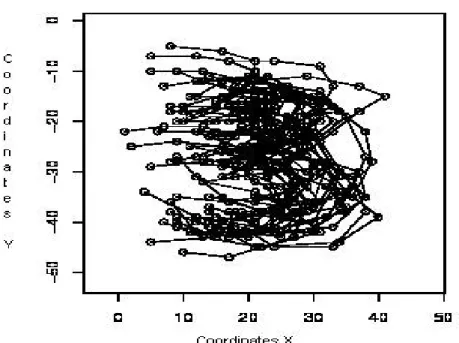
As an illustration of the impressive numerical advantage of the exact polynomial densities against the usual shape densities based con infinite series of zonal polynomials, this section studies some aspects of a classi-cal example in statisticlassi-cal shape theory, the handwritten digit 3. Dryden and Mardia(1998) and other authors have studied the population mean shape of a collection of 30 handwritten number three. The codes were summarized in 13 landmarks, according the curvature of the extremes of the digit. Figure 1 (which was built with the R-package Shapes, au-thored by I. L. Dryden) shows the sample. The referred studies are based
on the assumption that the landmarks are randomly normal distributed and the shape of the object is reached under filtering out the scale, loca-tion and rotaloca-tion of the figure. However, the nature of the handwritten process seems to be far of a modeling with a similarity transformation and perhaps an affine transformation is closer to this situation, because the main uniform change of the construction of the figure appears pre-dominantly in one direction (vertical), simulating a spring type move-ment, instead of constant growing in all directions. In that case we remove all geometrical information of the figure which is related with the scale, location, rotation and uniform shear. An statistical proof of this statement can be obtained by using dimension model theory, based
on modifications of the so calledBIC∗ criterion, see Raftery(1995),
Ris-sanen(1978), Yang and Yang(2007), and the references there in. The corresponding statistical proof for this experiment under a Gaussian generator and affine transformation against an Euclidean law is given
by Caro-Loperaet al(2009).
Table 1: The maximum likelihood estimates of configuration location
Truncation Convergence Time Loglikelihood Iterations FuncCount Seg.
Series 0 N 195 2.2093e+003 15974 20000
Polynomial 0 Y 120.8906 2.1219e+003 8367 10479
Series 5 N 284.5781 2.1686e+003 15977 20000
Polynomial 5 Y 147.4219 1.5346e+003 7854 9914
Series 10 N 361.1563 1.8315e+003 15927 20000
Polynomial 10 Y 228.7500 1.3223e+003 10111 12633
Series 20 Y 378.4844 1.6994e+003 12853 16115
Polynomial 20 Y 299.3594 1.3223e+003 10111 12633
Series 50 Y 532.2656 1.5287e+003 9622 12037
Polynomial 50 Y 521.9375 1.3223e+003 10111 12633
Series 100 Y 1.1054e+003 1.4244e+003 10971 13731
Polynomial 100 Y 883.4219 1.3223e+003 10111 12633
Series 120 Y 957.0781 1.4023e+003 7768 9704
Polynomial 120 Y 901,5687 1.3223e+003 10111 12633
Series 150 Y 1.5775e+003 1.3787e+003 10068 126515
Polynomial 150 Y 1.2637e+003 1.3223e+003 10111 12633
Template
Tables 1, 2 and 3 shows the configuration location estimates by us-ing two methods, the classical one (based on an infinite series of zonal polynomials, see lemma 3.1) and the polynomial density obtained by the matrix Kummer-Pearson relation (see theorem 3.1); the truncation of the series, the time in seconds and the convergence of the algorithms are given in the corresponding columns; also it is shown the number of iterations and functions being evaluated in the optimization routine and the maximum value reached in the likelihood. Finally, the tables
Table 2: ...Continuation Table 1
V1 V2 V3 V4 V5
Series
[
−0.9965 0.3517
] [
0.0709
−0.2434
] [
0.0695
−0.3486
] [
0.4455
−0.5559
] [
0.2338 0.4746
]
Polynomial
[
0.0558 0.6188
] [
−0.2476 0.3414
] [
−0.455
−0.0065
] [
−0.5717
−0.3417
] [
−0.435 0.0312
]
Series
[
−0.4139 2.1333
] [
0.2583 1.1821
] [
−1.2376 1.9376
] [
−0.7693
−0.3752
] [
−1.0877 0.0451
]
Polynomial
[
−1.4363 1.7525
] [
−3.0789 1.5125
] [
−3.7258 0.884
] [
−3.7155 0.109
] [
−3.521 0.763
]
Series
[
0.0556 1.0517
] [
−0.3136 0.7415
] [
−0.5988 0.2595
] [
−0.7255
−0.2247
] [
−0.5666 0.2315
]
Polynomial
[
−1.2968 2.6833
] [
−3.1351 2.2759
] [
−3.9553 1.291
] [
−4.0714 0.0888
] [
−3.7561 1.1051
]
Series
[
0.0668 1.3995
] [
−0.4858 1.0199
] [
−0.8513 0.3873
] [
−1.049
−0.2859
] [
−0.8157 0.324
]
Polynomial
[
−1.2968 2.6833
] [
−3.1351 2.2759
] [
−3.9553 1.291
] [
−4.0714 0.0888
] [
−3.7561 1.1051
]
Series
[
−0.0738 1.8964
] [
−0.9106 1.4216
] [
−1.4161 0.5915
] [
−1.6445
−0.3127
] [
−1.345 0.4978
]
Polynomial
[
−1.2968 2.6833
] [
−3.1351 2.2759
] [
−3.9553 1.291
] [
−4.0714 0.0888
] [
−3.7561 1.1051
]
Series
[
−0.3405 2.216
] [
−1.456 1.7225
] [
−2.0655 0.7939
] [
−2.2739
−0.2482
] [
−1.9498 0.6722
]
Polynomial
[
−1.2968 2.6833
] [
−3.1351 2.2759
] [
−3.9553 1.291
] [
−4.0714 0.0888
] [
−3.7561 1.1051
]
Series
[
−0.4354 2.2876
] [
−1.6332 1.7975
] [
−2.2695 0.8526
] [
−2.4668
−0.2183
] [
−2.1407 0.7234
]
Polynomial
[
−1.2968 2.6833
] [
−3.1351 2.2759
] [
−3.9553 1.291
] [
−4.0714 0.0888
] [
−3.7561 1.1051
]
Series
[
−0.5634 2.3686
] [
−1.8664 1.8863
] [
−2.5352 0.9255
] [
−2.7168
−0.1767
] [
−2.3905 0.7869
]
Polynomial
[
−1.2968 2.6833
] [
−3.1351 2.2759
] [
−3.9553 1.291
] [
−4.0714 0.0888
] [
−3.7561 1.1051
]
Template
[
−2.0908 2.2071
] [
−4.0409 2.8051
] [
−4.5904 2.2904
] [
−4.2069 1.3688
] [
−3.3126 1.7582
]
show the maximum likelihood estimates of configuration location. It is important to note that the exact configuration density is just a polyno-mial of 10 degree, which can be constructed by using the exact formulae
given by Caro-Lopera et al(2007). Also, observe that all the estimates
after this truncation are equal, as it can be noticed in the table. How-ever, the estimates based on the truncation of the series given in lemma 3.1) are so unstable, in fact, it is not sufficient a truncation of 120 in the modification of the algorithms of Koev and Edelman (2006) to ob-tain the exact estimation. Moreover, the computations were performed with a processor Intel(R) Corel(TM)2 Duo CPU, [email protected], and 2,96GB of RAM, and we tried to obtained an estimation with a trun-cation of 150, with the same initial values, and the programm does not tolerate that truncation. Tables also shows the configuration
Table 3: ...Continuation Table 1
V6 V7 V8 V9 V10
Series
[
−0.2582 0.4178
] [
0.0624
−0.3006
] [
0.117 0.0974
] [
−0.1171 0.0412
] [
−0.1083 0.5711
]
Polynomial
[
−0.393 0.1695
] [
−0.4416 0.2615
] [
−0.6074 0.0661
] [
−0.7698
−0.3256
] [
−0.822
−0.6514
]
Series
[
−0.251 2.519
] [
−0.5782 1.5909
] [
−1.0868
−0.1355
] [
−1.0048
−0.8559
] [
−1.4068 0.3555
]
Polynomial
[
−3.7978 1.2843
] [
−4.5051 1.6567
] [
−5.2428 1.3901
] [
−5.3697 0.5387
] [
−4.8461
−0.3302
]
Series
[
−0.5192 0.5463
] [
−0.5901 0.7407
] [
−0.794 0.4857
] [
−1.0118
−0.1144
] [
−1.0649
−0.668
]
Polynomial
[
−3.983 1.9115
] [
−4.708 2.4794
] [
−5.5607 2.0488
] [
−5.8348 0.7249
] [
−5.395
−0.6145
]
Series
[
−0.7521 0.7489
] [
−0.8495 0.9931
] [
−1.1504 0.6829
] [
−1.4295
−0.101
] [
−1.5055
−0.8253
]
Polynomial
[
−3.983 1.9115
] [
−4.708 2.4794
] [
−5.5607 2.0488
] [
−5.8348 0.7249
] [
−5.3955
−0.6145
]
Series
[
−1.2986 1.0772
] [
−1.493 1.4286
] [
−1.9345 1.0284
] [
−2.2848
−0.0132
] [
−2.318
−0.9888
]
Polynomial
[
−3.983 1.9115
] [
−4.708 2.4794
] [
−5.5607 2.0488
] [
−5.8348 0.7249
] [
−5.3955
−0.6145
]
Series
[
−1.9591 1.3502
] [
−2.2843 1.784
] [
−2.8528 1.3471
] [
−3.2177 0.1607
] [
−3.1477
−0.9718
]
Polynomial
[
−3.983 1.9115
] [
−4.708 2.4794
] [
−5.5607 2.0488
] [
−5.8348 0.7249
] [
−5.3955
−0.6145
]
Series
[
−2.1715 1.4227
] [
−2.5401 1.8768
] [
−3.1444 1.4358
] [
−3.5064 0.2207
] [
−3.3982
−0.946
]
Polynomial
[
−3.983 1.9115
] [
−4.708 2.4794
] [
−5.5607 2.0488
] [
−5.8348 0.7249
] [
−5.3955
−0.6145
]
Series
[
−2.4511 1.5105
] [
−2.8769 1.9884
] [
−3.5264 1.5443
] [
−3.8811 0.2992
] [
−3.7205
−0.9059
]
Polynomial
[
−3.983 1.9115
] [
−4.708 2.4794
] [
−5.5607 2.0488
] [
−5.8348 0.7249
] [
−5.3955
−0.6145
]
Template
[
−3.5881 2.7053
] [
−5.4996 4.0629
] [
−7.5557 4.8428
] [
−8.2514 4.4208
] [
−6.9108 2.8899
]
nates of the template digit 3, a figure consisting of two equal sized arcs, and 13 landmarks (two coincident) lying on two regular octagons see Dryden and Mardia(1998), p.153. Finally a test about the equality of the configuration shape and the templates indicates an approximate zero p-value, the same conclusion obtained by Dryden and Mardia(1998) and
Caro-Loperaet al(2009) by using other approaches.
Acknowledgment
The authors wish to thank the Editor and the anonymous reviewers for their constructive comments on the preliminary version of this paper. The first author was supported by Universidad de Medell´ın-Colombia grant No. 158.
Figure 1: Sample of 30 handwritten digit 3.
References
Caro-Lopera, F. J., D´ıaz-Garc´ıa, J. A., and Gonz´alez-Far´ıas, G. (2007),
A formula for Jack polynomials of the second order. Applicationes
Mathematicae,34, 113–119.
Caro-Lopera, F. J., D´ıaz-Garc´ıa, J. A., and Gonz´alez-Far´ıas, G. (2009),
Inference in statistical shape theory: elliptical configuration
den-sities. Journal of Statistical Research,43(1), 1–19.
Caro-Lopera, F. J., D´ıaz-Garc´ıa, J. A., and Gonz´alez-Far´ıas, G. (2010),
Noncentral Elliptical Configuration Density. Journal of
Multivari-ate Analysis,101(1), 32–43.
Constantine, A. G. (1963), Noncentral distribution problems in
multi-variate analysis. The Annals of Mathematical Statistics,34, 1270–
1285.
D´ıaz-Garc´ıa, J. A. and Caro-Lopera, F. J. (2012), Generalised shape
theory via SVD decomposition I. Metrika, 75, 541-565.
D´ıaz-Garc´ıa, J. A. and Caro-Lopera, F. J. (2012), Statistical theory of shape under elliptical models and singular value decompositions.
Journal of Multivariate Analysis, 103, 77-92.
Dryden, I. L. and Mardia, K. V. (1998), Statistical Shape Analysis. Chichester: John Wiley & Sons Inc.
Goodall, C. R. and Mardia, K. V. (1993), Multivariate aspects of shape
theory. The Annals of Statistics,21, 848–866.
Herz, C. S. (1955), Bessel functions of matrix argument. The Annals
of Mathematics,61, 474–523.
Koev, P and Edelman, A. (2006), The efficient evaluation of the hyper-geometric function of a matrix argument. Mathematics of
Com-putation, 75, 833-846.
Muirhead, R. J. (1982), Aspects of Multivariate Statistical Theory. Wi-ley Series in Probability and Mathematical Statistics, John WiWi-ley & Sons, Inc.
Raftery, A. E. (1995), Bayesian model selection in social research.
So-ciological Methodology, 25, 111–163.
Rissanen, J. (1978), Modelling by shortest data description.
Automat-ica,14, 465–471.
Yang, Ch. Ch. and Yang, Ch. Ch. (2007), Separating latent classes
by information criteria. J. Classification,24, 183–203.

![Table 2: ...Continuation Table 1 V 1 V 2 V 3 V 4 V 5 Series [ −0.9965 0.3517 ] [ 0.0709 −0.2434 ] [ 0.0695 −0.3486 ] [ 0.4455 −0.5559 ] [ 0.23380.4746 ] Polynomial [ 0.0558 0.6188 ] [ −0.24760.3414 ] [ −0.455 −0.0065 ] [ −0.5717−0.3417 ] [ −0.4350.0312 ] S](https://thumb-us.123doks.com/thumbv2/123dok_us/8354151.2220842/11.892.203.695.182.654/table-continuation-table-v-v-v-series-polynomial.webp)
![Table 3: ...Continuation Table 1 V 6 V 7 V 8 V 9 V 10 Series [ −0.2582 0.4178 ] [ 0.0624 −0.3006 ] [ 0.117 0.0974 ] [ −0.11710.0412 ] [ −0.10830.5711 ] Polynomial [ −0.393 0.1695 ] [ −0.44160.2615 ] [ −0.60740.0661 ] [ −0.7698 −0.3256 ] [ −0.822 −0.6514 ]](https://thumb-us.123doks.com/thumbv2/123dok_us/8354151.2220842/12.892.202.695.179.651/table-continuation-table-v-v-v-series-polynomial.webp)