
By
D.B. Radtke, J.V. Davis, and F.D. Wilde
Page
Specific electrical conductance ... SC–3
6.3.1 Equipment and supplies ... 4
6.3.1.A Maintenance, cleaning, and storage ... 6
6.3.2 Calibration ... 8
6.3.3 Measurement ... 12
6.3.3.A Surface water ... 13
In situ measurement ... 13
Subsample measurement... 14
6.3.3.B Ground water ... 17
Downhole and flowthrough-chamber measurement ... 17 Subsample measurement... 19 6.3.4 Troubleshooting ... 21 6.3.5 Reporting ... 22
6.3
SPECIFIC ELECTRICAL
CONDUCTANCE
Tables
6.3–1. Equipment and supplies used for
measuring conductivity ... 4 6.3–2. Example of cell constants for
contacting-type sensors with electrodes and
corresponding conductivity ranges ... 5 6.3–3. Correction factors for converting
non-temperature-compensated values to conductivity at 25 degrees Celsius, based on 1,000 microsiemens
potassium chloride solution ... 11 6.3–4. Troubleshooting guide for
Electrical conductance is a measure of the capacity of water (or other media) to conduct an electrical current. Electrical conduc-tance of water is a function of the types and quantities of dis-solved substances in
water, but there is no universal linear rela-tion between total dis-solved substances and conductivity.
The USGS reports con-ductivity in microsie-mens per centimeter at 25 degrees Celsius (µS/ cm at 25°C). The method described in
this section for measuring conductivity is applicable to surface water and ground water, from fresh to saline.
Specific electrical
conductance (conductivity):
a measure of the electrical
conductance of a substance
normalized to unit length
and unit cross section at a
specified temperature.
SPECIFIC ELECTRICAL
6.3
The instrument system used to measure conductivity must be tested before each field trip and cleaned soon after use. Every conductivity instrument must have a log book in which repairs and calibrations are recorded, along with manufacturer make and model description and serial or property number.
Table 6.3–1. Equipment and supplies used for measuring conductivity1 [°C, degrees Celsius; L, liter; µS/cm, microsiemens per centimeter at 25 degrees Celsius]
✓ Conductivity instrument and conductivity sensor Battery powered Wheatstone bridge
Direct readout
Temperature range at least –5 to +45°C Temperature compensating (25°C)
Accuracy: Conductivity ≤100 µS/cm, within 5 percent of full scale Conductivity >100 µS/cm, within 3 percent of full scale
✓ Thermistor thermometer sensor (for automatic temperature-compensating models)
✓ Thermometer, liquid-in-glass or thermistor
✓ Extra sensors (if possible) and batteries, or backup instrument
✓ Conductivity standards at conductivities that approximate and bracket field values
✓ Compositing and splitting device for surface-water samples
✓ Flowthrough chamber or downhole instrument for ground-water measurements
✓ Plastic beakers (assorted sizes)
✓ Soap solution, nonphosphate (1 L)
✓ Hydrochloric acid solution, 5 percent volume-to-volume (1 L)
✓ Deionized water, 1 L, maximum conductivity of 1 µS/cm
✓ Paper tissues, disposable, soft, and lint free
✓ Brush (small, soft)
✓ Waste disposal container
✓ Minnow bucket with tether (or equivalent) for equilibrating buffer solutions to sample temperature
✓ Instrument log book for recording calibrations, maintenance, and repairs
1
Modify this list to meet the specific needs of the field effort.
P Many conductivity instruments are available; the specifica-tions and instrucspecifica-tions provided here are general. Users must be familiar with the instructions provided by the manufac-turer.
P Conductivity sensors are either contacting-type sensors with electrodes or electrodeless-type sensors.
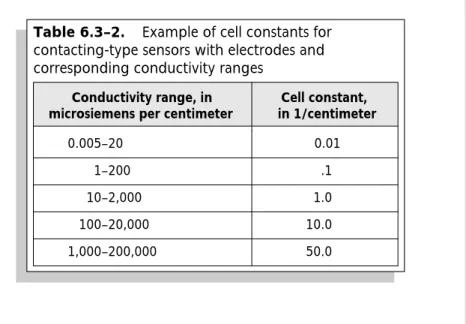
—Contacting-type sensors with electrodes. Three types of cells are available: (1) a dip cell that can be suspended in the sample, (2) a cup cell that contains the sample, or (3) a flow cell that is connected to a fluid line. Choose a cell con-stant on the basis of expected conductivity (table 6.3–2). The greater the cell constant, the greater the conductivity that can be measured. The cell constant is the distance be-tween electrodes (in centimeters) divided by the effective cross-sectional area of the conducting path (in square cen-timeters).
—Electrodeless-type sensors. These operate by inducing an alternating current in a closed loop of solution, and they measure the magnitude of the current. Electrodeless sen-sors avoid errors caused by electrode polarization or elec-trode fouling.
Quality-controlled conductivity standards ranging from 50 to 50,000 µS/cm at 25°C can be obtained from QWSU. Prepare stan-dards outside this range or order them from suppliers of chemi-cal reagents. Conductivity standards usually consist of potassium chloride dissolved in reagent-grade water.
Table 6.3–2. Example of cell constants for
contacting-type sensors with electrodes and corresponding conductivity ranges
Conductivity range, in microsiemens per centimeter
Cell constant, in 1/centimeter 0.005–20 0.01 1–200 .1 10–2,000 1.0 100–20,000 10.0 1,000–200,000 50.0
As soon as possible after delivery to the office, label conductivity standards with the date of expiration. Discard standards that have expired, been frozen, have begun to evaporate, or that were de-canted from the storage container.
Maintenance
Maintenance of conductivity equipment includes periodic office checks of instrument operation. To help keep equipment in good operating condition:
P Protect the conductivity system from dust and excessive heat and cold.
P Keep all cable connectors dry and free of dirt and extraneous matter.
P Protect connector ends in a clean plastic bag when not in use.
Sensor cleaning
Conductivity sensors must be clean to produce accurate results; residues from previous samples can coat surfaces of sensors and cause erroneous readings.
P Clean sensors thoroughly with deionized water (DIW) before and after making a measurement (this is sufficient cleaning in most cases).
P Remove oily residue or other chemical residues (salts) with a detergent solution. Sensors can soak in detergent solution for many hours without damage.
P If oil or other residues persist, dip the sensor in a dilute hy-drochloric acid solution. Never leave the sensor in contact with acid solution for more than a few minutes. Check the manufacturer’s recommendations before using acid solution on sensors.
P Clean carbon and stainless steel sensors with a soft brush. Never use a brush on platinum-coated sensors.
Sensor storage
Refer to the manufacturer’s recommendations.
P Sensors may be temporarily stored in deionized water between measurements and when the system is in daily use.
P For long-term storage, store sensors clean and dry.
CAUTION: Before handling conductivity standards or acids, refer to Material Safety Data Sheets (MSDS) for safety precautions.
Some of the procedures recommended herein for equipment operation may be out of date if the equipment being used is different from that described or incorporates more recent technological advances—follow the manufacturer’s instructions.
Conductivity systems must be calibrated before every water-qual-ity field trip and again at each site before samples are measured. Calibration readings are recorded in the instrument log book and on field forms at the time the instrument is calibrated. Remem-ber, the temperature sensor on the conductivity sensor must be calibrated and District certified within the past 4 months. Calibration and operating procedures differ, depending on instrument and sensor type.
P Some conductivity sensors may need to be soaked overnight in deionized water before use—Check the manufacturer’s in-structions.
P Some analog instruments require an initial mechanical zero adjustment of the indicator needle.
P For a cup-type cell, calibration and measurement procedures described for the dip-type cell apply; the only difference is that standards are poured directly into the cup-type cell.
P When using a dip-type cell, do not let the cell rest on the bottom or sides of the measuring container.
Conductivity systems normally are calibrated with at least two standards. Calibrate sensors against a standard that approximates sample conductivity and use the second standard as a calibra-tion check. The general procedures described in steps 1–15 be-low apply to most instruments used for field measurements— check the instrument manual for specific instructions.
1. Inspect the instrument and the conductivity sensor for dam-age. Check the battery voltdam-age. Make sure that all cables are clean and connected properly.
2. Turn the instrument on and allow sufficient time for electronic stabilization.
Calibrate at your field site—bring standards to sample temperature.
3. Select the correct instrument calibration scale for expected con-ductivity.
4. Select the sensor type and the cell constant that will most accu-rately measure expected conductivity.
5. Select two conductivity standards that will bracket the expected sample conductivity. Verify that the date on the standards has not expired.
6. Equilibrate the standards and the conductivity sensor to the tem-perature of the sample.
• Put bottles of standards in a minnow bucket, cooler, or large water bath that is being filled with ambient water.
• Allow 15 to 30 minutes for thermal equilibration. Do not al-low water to dilute the standard.
7. Rinse the conductivity sensor, the thermometer (liquid-in-glass or thermistor), and a container large enough to hold the dip-type sensor and the thermometer.
• First, rinse the sensor, the thermometer, and the container three times with deionized water.
• Next, rinse the sensor, the thermometer, and the container three times with the standard to be used.
8. Put the sensor and the thermometer into the rinsed container and pour in fresh calibration standard.
9. Measure water temperature. Accurate conductivity measure-ments depend on accurate temperature measuremeasure-ments or accurate temperature compensation.
• If the sensor contains a calibrated thermistor, use this ther-mistor to measure water temperature.
• If using a manual instrument without a temperature display or temperature compensation, adjust the instrument to the temperature of the standard using a calibrated liquid-in-glass or a thermistor thermometer.
10. Agitate a submersible-type conductivity sensor up and down under the solution surface to expel air trapped in the sensor. Read the instrument display. Agitate the sensor up and down under the solution surface again, and read the display. Repeat the procedure until consecutive readings are the same.
11. Record the instrument reading and adjust the instrument to the known standard value.
• For nontemperature-compensating conductivity instruments, apply a temperature-correction factor to convert the instru-ment reading to conductivity at 25°C.
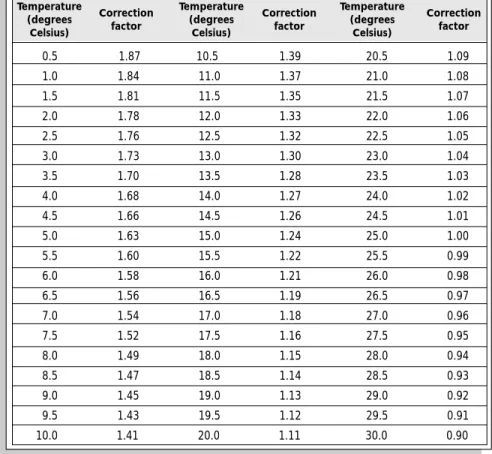
• The correction factor depends to some degree on the specific instrument used—use the temperature-correction factor rec-ommended by the manufacturer. If this is not available, use correction factors from table 6.3–3.
• If an instrument cannot be adjusted to a known calibration standard value, develop a calibration curve. After tempera-ture compensation, if the percentage difference from the stan-dard exceeds 5 percent, refer to the troubleshooting guide (section 6.3.4).
12. Record in the instrument log book and on field forms: • The temperature of the standard solution.
• The known and the measured conductivity of the standard solution (including ± variation).
• The temperature-correction factor (if necessary).
13. Discard the used standard into a waste container. Rinse the sensor, thermometer, and container thoroughly with deionized water.
14. Repeat steps 7 through 13 with the second conductivity standard.
• The purpose for measuring a second standard is to check in-strument calibration over the range of the two standards. • The difference from the standard value should not exceed 5
percent.
• If the difference is greater than 5 percent, repeat the entire calibration procedure. If the second reading still does not come within 5 percent of standard value, refer to the troubleshoot-ing guide in section 6.3.4 or calibrate a backup instrument. • Switching instrument calibration scales could require
recalibration.
15. Record in the instrument log book and on field forms the calibration data for the second standard.
Do not use expired standards. Never reuse standards.
Table 6.3–3. Correction factors for converting
non-temperature-compensated values to conductivity at 25 degrees Celsius, based on 1,000 microsiemens potassium chloride solution
[Use of potassium-based constants on non-potassium-based waters generally does not introduce significant errors for general purpose instruments used to measure conductivity]
Temperature (degrees Celsius) Temperature (degrees Celsius) Temperature (degrees Celsius) Correction factor Correction factor Correction factor 0.5 1.87 10.5 1.39 20.5 1.09 1.0 1.84 11.0 1.37 21.0 1.08 1.5 1.81 11.5 1.35 21.5 1.07 2.0 1.78 12.0 1.33 22.0 1.06 2.5 1.76 12.5 1.32 22.5 1.05 3.0 1.73 13.0 1.30 23.0 1.04 3.5 1.70 13.5 1.28 23.5 1.03 4.0 1.68 14.0 1.27 24.0 1.02 4.5 1.66 14.5 1.26 24.5 1.01 5.0 1.63 15.0 1.24 25.0 1.00 5.5 1.60 15.5 1.22 25.5 0.99 6.0 1.58 16.0 1.21 26.0 0.98 6.5 1.56 16.5 1.19 26.5 0.97 7.0 1.54 17.0 1.18 27.0 0.96 7.5 1.52 17.5 1.16 27.5 0.95 8.0 1.49 18.0 1.15 28.0 0.94 8.5 1.47 18.5 1.14 28.5 0.93 9.0 1.45 19.0 1.13 29.0 0.92 9.5 1.43 19.5 1.12 29.5 0.91 10.0 1.41 20.0 1.11 30.0 0.90
To extend the temperature range shown in table 6.3–3, consult the manufacturer’s guidelines. If these are unavailable, use the following equation:
where,
C25= corrected conductivity value adjusted to 25°C; Cm = actual conductivity measured before correction; and tm = water temperature at time of Cm measurement.
Cm C25 =
In situ measurement generally is preferred for determining the conductivity of surface water; downhole or flowthrough-cham-ber measurements are preferred for ground water. Be alert to the following problems if conductivity is measured in an isolated (dis-crete) sample or subsample:
P The conductivity of water can change over time as a result of chemical and physical processes such as precipitation, adsorp-tion, ion exchange, oxidaadsorp-tion, and reduction—Do not delay making conductivity measurements.
P Field conditions (rain, wind, cold, dust, direct sunlight) can cause measurement problems—Shield the instrument to the extent possible and perform measurements in a collection chamber in an enclosed vehicle or an on-site laboratory.
P For waters susceptible to significant gain and loss of dissolved gases, make the measurement within a gas-impermeable con-tainer (Berzelius flask) fitted with a stopper—Place the sensor through the stopper and work quickly to maintain the sample at ambient surface-water or ground-water temperature.
P Avoid contamination from the pH electrode filling solution— Measure conductivity on a separate discrete sample from the one used for measuring pH; in a flowthrough chamber, posi-tion conductivity sensor upstream of the pH electrode.
Document the precision of your measurements. Precision should be determined about every tenth sample or more fre-quently, depending on study objectives. Successive measurements should be repeated until they agree within 5 percent at conduc-tivity ≤ 100 µS/cm or within 3 percent at conductivity > 100 µS/ cm.
The conductivity measurement reported must account for sample temperature. If using an instrument that does not auto-matically temperature compensate to 25°C, record the uncom-pensated measurement in your field notes, along with the cor-rected conductivity value. Use correction factors supplied by the instrument manufacturer if available; otherwise, refer to table 6.3–3.
6.3.3
MEASUREMENT
Surface-water conductivity should be measured in situ, if pos-sible; otherwise, determine conductivity in discrete samples col-lected from a sample splitter or compositing device. Filtered samples may be needed if the concentrations of suspended ma-terial interfere with obtaining a stable measurement.
In situ measurement
Conductivity measurements in flowing surface water should rep-resent the cross-sectional mean or median conductivity at the time of observation (see step 7, below). Any deviation from this convention must be documented in the data base and with the published data.
First:
P Take a cross-sectional conductivity profile to determine the degree of system variability. A submersible sensor works best for this purpose.
P Refer to NFM 6.0 for criteria to help decide which sampling method to use.
Next, follow the 7 steps listed below:
1. Calibrate the conductivity instrument system at the field site after equilibrating the buffers with stream temperature.
2. Record the conductivity variation from a cross-sectional profile on a field form and select the sampling method.
• Flowing, shallow stream—wade to the location(s) where con-ductivity is to be measured.
• Stream too deep or swift to wade—lower a weighted con-ductivity sensor from a bridge, cableway, or boat. Do not at-tach weight to the sensor or the sensor cable.
• Still-water conditions—measure conductivity at multiple depths at several points in the cross section.
3. Immerse the conductivity and temperature sensors in the water to the correct depth and hold there (no less than 60 seconds) until the sensors equilibrate to water conditions.
4. Record the conductivity and corresponding temperature read-ings without removing the sensors from water.
• Values should stabilize quickly to within 5 percent at conduc-tivity ≤100 µS/cm and within 3 percent at conductivity >100
µS/cm.
• Record the median of the stabilized values on field forms. • If the readings do not meet the stability criterion after
extend-ing the measurement period, record this difficulty in the field notes along with the fluctuation range and the median value of the last five or more readings.
5. For EWI or EDI measurements, proceed to the next station in the cross section and repeat steps 3 and 4. Record on field forms the mean (or median, if appropriate) value for each subsection measured.
6. When the measurement is complete, remove the sensor from the water, rinse it with deionized water, and store it.
7. Record the stream conductivity on the field forms:
• In still water—median of three or more sequential values. • EDI—mean value of all subsections measured (use the
me-dian if measuring one vertical at the centroid of flow). • EWI—mean or median of all subsections measured (see NFM
6.0).
Subsample measurement
Representative samples are to be collected and split or composited according to approved USGS methods (Wells and others, 1990). Measure the conductivity of samples as soon as possible after collection. If the sample cannot be analyzed immediately, fill a bottle to the top, close it tightly, and maintain the sample at stream temperature until measurement.
Reported conductivity values normally are determined on an unfiltered sample. Large concentrations of suspended sediment can be a source of measurement error—record such conditions in the field notes.
P If sediment concentrations are heavy, measure conductivity on both unfiltered and filtered subsamples and record both values on the field form.
P If the conductivity value differs significantly between the fil-tered and unfilfil-tered samples, report the filfil-tered value as sample conductivity and identify it as a “filtered sample.” 1. Calibrate the conductivity instrument system at the field site. 2. Select the sampling method (see NFM 6.0) and collect a
repre-sentative sample.
3. Withdraw a homogenized subsample from a sample splitter or compositing device. Rinse the sample bottles three times with the sample—rinse them with sample filtrate, for filtered samples. 4. Rinse the conductivity sensor, the thermometer (liquid-in-glass or thermistor), and a container large enough to hold the dip-type sensor and the thermometer.
a. First, rinse the sensor, the thermometer, and the container three times with deionized water.
b. Next, rinse the sensor, the thermometer, and the container using sample water.
5. Allow the sensors to equilibrate to sample temperature, then discard the used sample water. Pour fresh sample water into a container holding the sensor and the thermometer. When us-ing a dip-type sensor, do not let the sensor touch the bot-tom or sides of the measuring container.
6. Measure water temperature.
• If the conductivity sensor contains a calibrated thermistor, use this thermistor to measure water temperature.
• If the instrument is not temperature compensating, use a cali-brated thermistor or a liquid-in-glass thermometer.
• Adjust the instrument to the sample temperature (if neces-sary) and remove the thermometer.
7. Measure conductivity.
a. Remove any air trapped in the sensor by agitating the sensor up and down under the water surface.
b. Read the instrument display.
c. Agitate the sensor up and down under the water surface, and read the display again.
8. Record the conductivity and the sample temperature on field forms.
• If the instrument is not temperature compensating, record the raw data and convert the values to conductivity at 25°C using temperature-correction factors provided by the manu-facturer.
• Report the median of the readings to three significant figures on the field forms.
• Discard the sample into a waste container and dispose ac-cording to regulations.
9. Quality control—
• Repeat steps 3 through 8 with at least two fresh subsamples, rinsing the instruments once only with sample water.
• Subsample values should be within ±5 percent for conductiv-ity ≤100 µS/cm, or ±3 percent for conductivity >100 µS/cm. • If criteria cannot be met: filter the samples, report the median
of 3 or more samples, and record this difficulty in field notes. 10. Rinse the sensor, the thermometer, and the container with deion-ized water. If another measurement is to be made within the next day or two, store the sensor in deionized water. Otherwise, store the sensor dry.
Downhole and flowthrough-chamber
measurement
1. Calibrate the conductivity instrument system on site.
• Bring standard solutions to the temperature of the water to be sampled by suspending the standards in a bucket into which well water is flowing. Allow at least 15 minutes for tempera-ture equilibration. Do not contaminate standards with sample water.
a. Check the temperature of the water flowing into the bucket against that of standards.
b. Check that the thermometer (usually a thermistor func-tion in the conductivity meter) has been certified within the past 4 months for the temperature range to be mea-sured.
• After calibration, rinse the conductivity and temperature sen-sors thoroughly with deionized water.
2. Install the conductivity and temperature sensors.
• Downhole system—Lower the conductivity and temperature sensors to sampling point, followed by pump.
a. Remove any air from the system by agitating the conduc-tivity sensor up and down under the water; read the in-strument display.
b. Repeat this procedure until rapid consecutive readings are approximately the same.
Measurements of ground-water conductivity must represent aqui-fer conditions. Temperature changes resulting from transporting a well sample to land surface can affect conductivity.
P To minimize the effect from temperature changes, measure conductivity as close to the source as possible, using either a downhole or flowthrough-chamber sampling system (refer to NFM 6.0 for details).
P Bailed or other methods for collecting discrete samples iso-lated from the source are not recommended as standard prac-tice, although such methods are sometimes called for owing to site characteristics or other study requirements.
• Flowthrough-chamber system—Install the chamber system as close to the well as possible and shield the system from direct sunlight.
a. Position the conductivity sensor upstream from the pH elec-trode.
b. Direct flow to the chamber after an initial discharge to waste to clear sediment from sample line.
c. Release any air trapped in the chamber.
d. Agitate the conductivity sensor up and down under the water to remove air from system. Rapid consecutive read-ings should be about the same.
3. During purging (table 6.0–1 in NFM 6.0): • Keep flow constant and laminar.
• Allow the sensors to equilibrate with ground-water tempera-ture for 5 minutes or more at the flow rate to be used for collecting all other samples.
4. Measure conductivity and associated temperature at regular in-tervals throughout purging; record the conductivity values and the associated temperature in the field notes.
• If the conductivity sensor contains a calibrated thermistor, use this thermistor to measure water temperature.
• If the instrument is not temperature compensating, install a calibrated thermometer in the flowthrough chamber, record raw data, and apply correction factors.
5. Check the variability of the conductivity values toward the end of purging.
• The stability criterion is met when five readings taken at regu-larly spaced intervals of 3 to 5 minutes or more are within
±5 percent for conductivity ≤100 µS/cm
±3 percent for conductivity >100 µS/cm
• When readings fluctuate rapidly, record the median of three or more readings within about 60 seconds as the value for a specific time interval.
• If the criterion is not met, extend the purge period in accor-dance with study objectives and continue to record measure-ments at regularly spaced time intervals. Record this difficulty on the field forms.
6. Report conductivity.
• Record the final five values on field forms.
• Report the median value of the final five measurements as the sample conductivity.
• If values exceed the stability criterion, report the range of val-ues observed for the time interval, along with the median of the final five or more values.
Subsample measurement
Conductivity measurements reported from bailed or other dis-crete samples need to be identified in the data base, indicating the sampling method used. Refer to 6.0.3.B in NFM 6.0 for use of bailers and the subsample method.
1. Calibrate the conductivity instrument system onsite.
• Bring standard solutions to the temperature of the water to be sampled by suspending the standards in a bucket into which well water is flowing. Allow at least 15 minutes for tempera-ture equilibration. Do not contaminate standards with sample water.
a. Check the temperature of the water flowing into the bucket against that of standards.
b. Check that the thermometer (usually a thermistor func-tion in the conductivity meter) has been certified within the past 4 months for the temperature range to be mea-sured.
• After calibration, rinse the conductivity and temperature sen-sors thoroughly with deionized water.
2. Draw off subsamples for measurement.
• Quality control—Collect three subsamples to check preci-sion.
• If samples need to be stored for a short time, or if several subsamples will be measured, collect sample aliquots in sepa-rate field-rinsed bottles—fill to the brim, cap tightly, and main-tain at ambient ground-water temperature. Measure conduc-tivity as soon as possible.
3. Follow procedures described in steps 4 through 10 for “Subsample measurement” of surface water (6.3.3.A).
TECHNICAL NOTE: If the sample is measured in an open container and readings do not stabilize within several
min-utes, the cause may be CO2 degassing—use a closed
sys-tem to measure the sample. Filter the conductivity sample if the settling of clay particles appears to interfere with the stability of the readings.
Contact the instrument manufacturer if the actions suggested in table 6.3–4 fail to resolve the problem.
P If available, use a commercial, electronic calibrator to check the function of conductivity instruments.
P Check the voltage of batteries. Always have good batteries in instruments and carry spares.
Table 6.3–4. Troubleshooting guide for conductivity measurement
[HCl, hydrochloric acid; °C, degrees Celsius]
Symptom Possible cause and corrective action
• Standards may be old or contaminated—use fresh standards. • Electrodes dirty—clean with a detergent solution, then with 5
percent HCl. Before using any acid solution to remove resistant residues, check manufacturer’s guidelines.
Will not calibrate to • Air trapped in conductivity sensor—agitate sensor up and down standards to expel trapped air.
• Weak batteries—replace.
• Temperature compensation incorrect—ensure that thermometer is operating properly and is calibrated.
• Sensor constant incorrect—replace sensor. • Loose or defective connections—tighten or replace. • Broken cables—repair or replace.
Erratic instrument • Air trapped in conductivity sensor—agitate sensor up and down readings to expel trapped air.
• Rapid changes in water temperature—measure in situ. • Outgassing of ground-water sample—use a downhole
instru-ment; if unavailable, use a flowthrough chamber. • Broken sensor—replace.
• Temperature compensator not working—measure conductivity of a solution. Place solution in a water bath and raise solution Instrument requires temperature to about 20ºC. Measure conductivity again, frequent recalibration allowing sufficient time for temperature of conductivity sensor
to equilibrate to temperature of sollution. If the two values differ by 5 percent or more, replace conductivity sensor.
Report routine conductivity measurements to three significant figures, whole numbers only, in microsiemens per centimeter at 25°C.
P Record the accuracy range of the instrument system in the data base, if possible, and always report it with published val-ues.
P Enter field-determined conductivity measurements on NWQL Analytical Services Request form using the correct parameter code.

![Table 6.3–4. Troubleshooting guide for conductivity measurement [HCl, hydrochloric acid; °C, degrees Celsius]](https://thumb-us.123doks.com/thumbv2/123dok_us/8987039.2382749/21.918.204.765.205.1060/table-troubleshooting-guide-conductivity-measurement-hydrochloric-degrees-celsius.webp)
